Pastor Sherry’s message for July 21, 2023
Scriptures: Gen 28:10-19a; Ps 139:1-12, 23-24; Ro 8:12-25; Matt 13:24-30, 36-43
Some years ago, the magazine, Christianity Today, ran a true story about a woman in India, living in a concrete sewer pipe, with her husband and two kids. I never forgot it. Her name was Shivamma. She was a member of the Dalit caste, the lowest of the low (an “untouchable,” except for rape). She reported that she had been barren. A Dalit Christian named Bangarraju prayed for her in her home, the pipe. She conceived and bore two kids, a son and a daughter. The girl baby was badly jaundiced and not expected to live. Bangarraju returned and prayed for the child, and she was healed. Shivamma became a Christian she says because: “I realized that Jesus is the living God. We used to drink and every day we would fight, fight, fight. Jesus Christ brought peace to our family. I have no fear, because I have come to know the living God. I trust Him.” I love this story because God met her needs. As a result, she now trusts Him.
I believe this connects with another story concerning a debate between a Christian and an atheist. The Atheist began by writing on a white/dry erase board, “God is nowhere.” At his turn, the Christian speaker then erased “nowhere” and used the same letters to write, “God is now here.”
Our Scriptures today focus on the twin themes of God’s deep, intimate knowledge of us and His abiding and patient presence with us.
In our Old Testament lesson, we once again pick up the story of Jacob (Genesis 28:10-19a), the 3rd of the famous Hebrew patriarchs, Abraham, Isaac, and Jacob. By now, Jacob has tricked his brother Esau out of both his birthright and their father’s blessing. Esau is so enraged that he has sworn to catch Jacob and kill him. Remember, Esau was a skilled hunter, and could have easily picked Jacob off from a distance with his bow. So, at his Rebekah’s suggestion, Jacob runs to Haran to take refuge with her brother, Laban (and the extended family).
Our passage finds Jacob 40 miles from home. He has run/walked at a rate of 3.5 miles per hour for 12 hours! He wants to put allot of distance between himself and Esau. He lays down to rest at Luz. It was then a pretty dreary place: a high desert plateau about 1200 feet above sea level, arid and rocky. How must he have felt as he bedded down for the night? No doubt he was a worried/anxious fugitive. He knows his brother, Esau, is skilled with a bow, spear, or sling. He must have traveled the whole way, looking over his shoulder. Additionally, this is his first night alone and away from his home and his people. He was also probably uncertain about his future. Traveling alone, he had a long, potentially dangerous journey ahead.
His mother had made the reverse trip, years ago, before his birth, but she had been accompanied by servant girls and the protection of several men in a camel caravan. She also traveled with the knowledge that she was likely fulfilling God’s will for her life. There’s no indication of prayer here on Jacob’s part—before, or during the first leg of his flight—so Jacob was probably much less sure of what might happen to him.
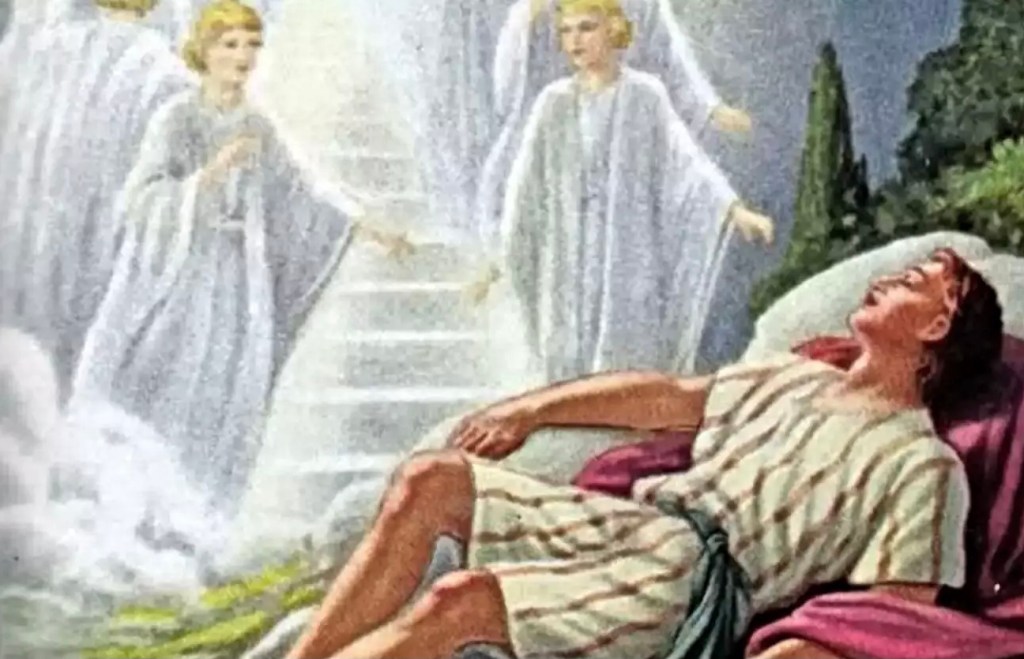
He beds down on rocky ground and God gives him a dream about a ladder to heaven. Angels traverse the ladder. Some are going up, signifying that they have access to heaven; others are going down demonstrating that they have access to earth. The Preincarnate Jesus stands at the top (His is “the voice from the top of the stairs”). In this memorable dream, God suddenly and unexpectedly breaks into Jacob’s life.
He’s hardly what we would consider worthy of a God-sighting—he’s in a serious conflict with his brother, has tricked his nearly blind father, and runs away. This is a sinful dude! Paul would say in Romans that he is operating out of his flesh or his carnal nature rather than his spiritual one. Nevertheless, Jacob has a spiritual encounter with God.
Much later, in John 1:47-51, when Jesus encounters Nathanael He said of him, “Here is a true Israelite, in whom there is nothing false.” “How do you know me?” Nathanael asked. Jesus answered, “I saw you while you were still under the fig tree before Philip called you.” Then Nathanael declared, “Rabbi, you are the Son of God; You are the King of Israel.” Jesus said, “You believe because I told you I saw you under the fig tree. You shall see greater things than that.” He then added, “I tell you the truth, you shall see heaven open, and the angels of God ascending and descending on the Son of Man. In other words, in the dream, Jesus is the ladder between God the Father and human beings. The ladder represents Jesus’ position as mediator between God the Father and us. It further confirms that we only get to heaven through Him–Jesus is truly the only way to the Father.
Additionally in the dream, the Lord reiterates to Jacob the promises He had made to Abraham, his grandfather and to Isaac, his father:
1.) Property the Promised Land, even though Jacob is leaving it;
2.) Progeny lots of descendants to populate the land and to bless all the people of the earth.
3.) Presence God will be with him. In the Ancient Near East, they believed all gods were attached to the land and did not travel with people outside national borders. When Daniel is later told by the angel Gabriel that he had been detained in relaying to Daniel the answer to his prayers by “the prince of Persia,” this “prince” was a demonic entity assigned by Satan to influence that territory (Daniel 10:13). God is affirming that He is not like these lesser, demonically inspired gods. Instead, He asserts, I won’t lose track of you outside the Promised Land (or in a sewer pipe outside some remote village in India, or even in Wellborn, Florida.) To God, this is all simply geography. As Psalm 139 tells us, He is not limited by where we located on earth.
4.) Protection In verse 15 God says, I am with you and I will watch over you wherever you go, and I will bring you back to this land. I will not leave you.
Notice, God does not require anything of Jacob. There is no If…then clause, surrounding these promises with conditions. God has chosen a flawed patriarch through whom to work out His plan of salvation. As Psalm 139 affirms, God knows Jacob’s every thought and scheme. And He is reassuring Jacob there is no place any of us can go where God might lose track of us.
So, Jacob’s response when he awakens is to make a vow to the Lord. He demonstrates his new partnership with God by first setting up a memorial stone to commemorate his divine encounter. He anoints it with oil, an act of worship which makes it holy. The stones became an altar.
Then, he renames the place, Bethel or house of God/the gate of God. It is no longer Luz; it has become a shrine. He reiterates God’s promises to him from the dream. Even though he enters into a conditional relationship, from his side with God, his faith is developing. Jacob is what we would call “a work in progress.” As a result, he moves from the status of fugitive to that of pilgrim. Like grandfather Abraham before him he also promises God a tithe, 1/10th of all God intends to give him.
The next day, as Jacob continues on his journey, how do you think he felt? No doubt, he had been comforted and reassured. God is with him so he’s not alone. Neither are we! As Paul later writes in Romans 8:12-25, we are children of God. As sons and daughters of God, and heirs—all because of the saving work of Jesus on our behalf, we have the right to call Father God, Abba, the Aramaic, personal, intimate form of father, or Daddy. Like us, Jacob has God’s protection—neither he nor we need to be afraid. He doesn’t have to worry about his brother catching up to him and killing him, or of a hostile reception in Haran. We don’t need to stress over the hundreds of potential negative outcomes that assault our minds daily either. Jacob could be confident that God would prosper him and bring him back to the Promised Land. We too can be confident that God will be with us in the storms of life and will usher us into heaven when our journey here on earth is done.
So, where can we run from God’s love? No where because we know God is now here! Jacob’s story makes me glad I am not him. But isn’t it also so reassuring to realize that God never deserts us. He loves us even if we are not truly making decisions pleasing to Him, and He cares for us, faithfully. This story also reaffirms for us that our God appears to enjoy overturning human expectations. He can and does do great things with the least likely. He’s not discouraged by our rebellion, sinfulness, or even our unbelief or lack of trust. He clearly sees us as we are—there’s no hiding from Him, or fooling him. And He see us, too, as who He wants us to become.
There is an ancient Hebrew poem that I think sums this up:
Wherever I go…only Thou!
Wherever I stand…only Thou!
Just Thou! Thou, Thou, Thou!
When things are good, Thou!
When things are bad, Thou!
Thou, Thou, Thou!
Aren’t we grateful?! Amen!
©️2023 Rev. Dr. Sherry Adams
 Wellborn Methodist Church--Wellborn, Florida