Pastor Sherry’s message for April 21, 2024
Scriptures Acts 4 5-20; Ps 23; 1 Jn 3 16-24; Jn 10 1-18
The story is told about a woman calling for help from a small plane. She and her husband were flying a small plane to dine with friends, perhaps from Live Oak to Cedar Key. Once airborne, the husband got sick and fainted. Scared witless, she radioed for help, saying she didn’t know how to fly. Lots of people provided lots of advice as to her location, her altitude, how to find out how much fuel remained, and how to turn on her landing lights. A flight instructor out at a nearby airport heard the radio chatter. He jumped into his plane and took off. He wisely waited for a lull in radio traffic, then told others who he was and to stop transmitting. He introduced himself to her and told her he would try to coach her down safely. When he saw her plane, he told her to turn her landing lights off. Then he came alongside her and taught her the basics of flying. He also called ahead for an ambulance for her husband and then helped her to land safely. The woman and her husband were saved because she obeyed the voice of the flight instructor.
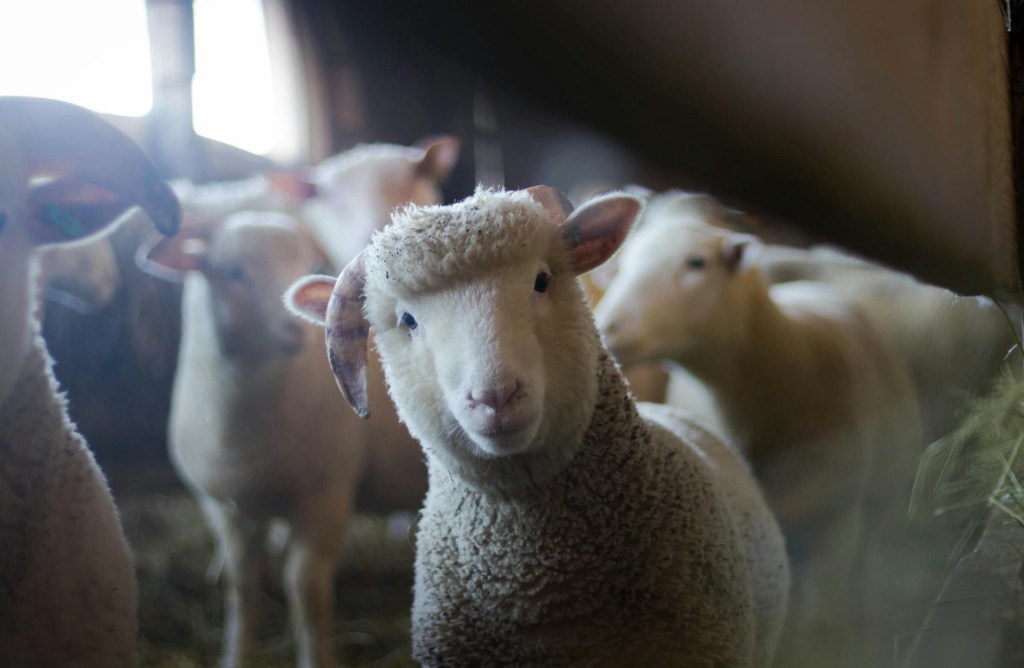
Our Psalm and Gospel readings both reference us as sheep, and the Lord as our Shepherd. At first blush, referring to us as sheep is not very flattering they are notoriously helpless, often grazing their way lost; they are skittish, fleeing when frightened; they are prone to over-eating (along with goats, they will even eat kudzu); and, if they fall into running water, their heavy coats will become waterlogged and they will drown. However, they do recognize the voice of their particular shepherd.
Do you know there are over 700 references to sheep and shepherds in Scripture? In the Old Testament, the Good Shepherd was God, the Father
1.) 23rd Psalm The Lord is my shepherd; I shall not be in want (Peterson expresses it this way in The Message I don’t need a thing!).
2.) Psalm 100 …we are His people and the sheep of His pasture.
3.) Isa: 40
:11 [God] tends His flock like a shepherd; He gathers the lambs in His arms and carries them close to His heart; He gently leads those that have young.
4.) In Ezekiel: 34, God the Father lambasts the kings, prophets, and priests of Israel, calling them bad shepherds. He accuses them of abusing, neglecting, and even preying upon His sheep. He promises to save His flock. In verse 23, He declares I will place over them one shepherd, My servant David, and He will tend them and be their shepherd. Now Ezekiel lived about 400 years after King David, so he wasn’t talking about David per se. Instead, he was prophesying about Jesus (who, like David and out of his lineage) is a Shepherd-King.
In the New Testament, the Good Shepherd is Jesus, God the Son Our Gospel today is from John 10 1-18. Scholars say this is the climax of John’s Gospel because Jesus identifies Himself as “The Good Shepherd” (v.11), thus calling Himself one with God the Father. In verse 14, Jesus says I am the Good Shepherd; I know My sheep and My sheep know Me. God the Father called Himself “I am that I am.” Every time in John, when Jesus makes an “I am” statement, He is admitting that He is God.
We find Him in today’s passage teaching in the Temple during the season of Hanukkah. He identifies for His audience the bad shepherds They victimize God’s sheep; they are thieves and murderers; and they are not willing to die to protect their sheep. Then He describes what a Good Shepherd does. Back in Jesus’ day, sheep from several flocks were gathered into a sheepfold at night (a kind of roofless barn bordered by a rock fence). The shepherd would lay across the opening to this structure to make sure the sheep stayed within and that predators would remain outside. So He is saying that He is willing to lay down His life for the benefit of His flock [us]. Unlike a hired hand, he does not flee when confronted with danger. He is invested in the welfare of His sheep [gain, us].
How do we know we are the sheep of the Good Shepherd?
First, we are baptized into His flock (we become children of God).
Second, we learn to hear His voice our God communicates with us through our spiritual ears, a kind of knowing that just comes into our heads. He also speaks to us through His written Word; by His Holy Spirit (the still small voice); in our dreams–We know many Moslems have come to Jesus in recent years because He has appeared to them in their dreams– through song lyrics, bumper stickers, billboards; sometimes through other people, even including overheard conversations; and often through our particular circumstances. He speaks to us and He wants us to communicate with Him in return. We talk with Him by praying—it’s just having a conversation with Him. We also talk with Him through our worship and praise.
Third, we come to realize we are each known by Him. He has known us from before we were born. Psalm 139 says O Lord, You have searched me and You know me. You know when I sit and when I rise; You perceive my thoughts from afar. You discern my going out and my lying down; You are familiar with all my ways. Before a word is on my tongue, You know it completely, O Lord…for You created my inmost being; You knit me together in my mother’s womb…When I was woven together in the depths of the earth, Your eyes saw my unformed body. Jesus adds, in Luke 12 7 Indeed, the very hairs of your head are numbered! God knows us intimately, better than we know ourselves He knows our every action; our every plan; our thoughts, even before they are fully formed; our words, even before we utter them. This is such a paradox all of us are members of His flock, but He views us individually as well (I once saw a humorous bumper sticker that read, “Jesus loves you, but I’m His favorite!”).
Fourth, if we are smart sheep, we follow Him. Shepherds in Jesus’ day led their flocks, from the front. They did not push from behind. They whistled and called the sheep by name. The shepherd’s job, as Psalm 23 says, was to lead them to green pastures (healthy, plentiful food), beside calm, clean waters, to calm them down and settle their fears, and to protect them from predators. When we follow Him, we go where He wants us to go, we do what He wants us to do. Because He is the Good Shepherd, we can trust in His intentions for us. He wants only the best for us, as Jeremiah 29 11 says ”For I know the plans I have for you,” says the Lord. “Plans to prosper you and not to harm you; plans to give you a hope and a future.”
When we follow Him… we are to be obedient. Most of us are not too keen on obedience; we prefer to do things our own way (We have all heard toddlers say, “Me do it!”). This kind of independence starts young. Beth Moore shared that her 3 year old daughter once stood on the third step of the staircase, with her hands on her hips, and defiantly declared, “I am the boss of me!” But Jesus is clear, saying in John 14 23-24 If anyone loves Me, He will obey my teaching. My father will love him, and we will come to him and make our home with him. He who does not love me will not obey my teaching.
We obey His teaching by putting our love into action! Christian love cannot be just a sentiment, a feeling. Christian love must be a Love Relationship–with the members of this body; with the people of this community; with those who do not yet know Jesus. Jesus blesses us when we obey His commands and love one another.
Fifth, smart sheep know Jesus is Lord! Our Acts passage demonstrates, once again, that Peter and John were so emboldened by the Holy Spirit, that they were brave enough to confront the Jewish religious leaders (the Sadducees), despite their power to jail them. The Sadducees did not believe in a resurrection and did not want them teaching the Jesus had been resurrected. His resurrection did not fit their narrative, so they denied it. After discussion these leaders let them go, but warned them not to continue to teach anyone about Jesus. Peter replies, (vv.19-20) Judge for yourselves whether it is right in God’s sight to obey you rather than God. For we [Peter and John] cannot help speaking about what we have seen and heard. In so many words, what Peter means is, “I know Jesus is Lord so I will obey Him in spite of your threats or intimidation.”
John writes in his epistle (1 John 3 16-24), Christian love means being willing to give your life for the welfare of another (verse 16). Christian love is not just words, but actions (verse 18)! Smart Sheep demonstrate this by the way we go about loving others.
Just as the lady in the plane lived to tell the story because she listened to and trusted in the flight instructor, we too are best off when we do what our Lord asks of us. Like the flight instructor, He keeps us on course and guides us to safe landings. But better than that flight instructor, He knows us intimately and loves us. This week, let’s remind ourselves that we have a shepherd Who knows and loves us, intimately; Who cares for us generously and graciously; and Who desires that we serve and bless those around us. For His love’s sake, we want to be smart sheep!
©️2024 Rev. Dr. Sherry Adams
 Wellborn Methodist Church--Wellborn, Florida