Pastor Sherry’s message for April 6, 2025
Scriptures: Isa 43:16-21; Ps 126; Phil 3:4b-14; Jn 12:1-8
I love stories of healing: (1) One of our parishioners told us once that she felt God free her from years of a smoking addiction while sitting here in our sanctuary. (2) We learned several weeks ago that someone we had been praying for for weeks was suddenly healed of Stage 4 Cancer. (3) John Wimber, who founded the Vineyard Church (a charismatic, nondenominational church that focuses on healing), reported many healings but one in particular seems pretty spectacular to me:
“…he received a phone call from a distraught father. The man was sobbing and could hardly talk. ‘My baby is here in the hospital,’ he said, ‘and they have tubes from machines attached all over her body. The doctors say she will not survive the night. What can you do?’ John said he would come to the hospital. After he put the phone down, he prayed, ‘Lord, is this baby supposed to die?’ John sensed the Lord saying, ‘No!” John walked into the hospital with the knowledge that he was a representative of Christ, a messenger who had a gift for that baby girl.
“When John entered the baby’s room, he sensed [a spirit of] death, so he said quietly, ‘death, get out of here [in Jesus’ name].” It left, and the whole atmosphere of the room changed, as though a weight had been lifted. Then he went over and began praying for the girl. After only a few minutes he knew she was going to be healed, and so did her father. Hope came into his eyes.
“She is going to be okay,’ he said; ‘I know it.’.
“Within 20 minutes she had improved greatly; several days later she was released, completely healed.”
(Graham Twelftree, Your Point Being?, Monarch Books, 2003, p.132.)
Stories like these touch our hearts. They remind us of God’s great love for us. They deepen our faith. And they are evidence that our God didn’t just do miracles in Bible-times. There is in some corners of the Church a believe called dispensationalism. Folks who subscribe to this belief feel convinced that all miracles of healing or deliverance stopped with the death of the last Apostle. But we know this is simply not true.
All of our Scripture passages today seem to suggest God’s great delight in surprising us with his grace and goodness. It’s as though He is saying to us, If you thought this was spectacular….
A. In Isaiah 43:16-21, the prophet Isaiah reminds God’s Chosen People of His redeeming work on their behalf. They had been bound up as slaves in Egypt for 400 years. God had tucked them out of the way while He waited on the Canaanites to accept Him as their Lord. They didn’t. So God sent Moses as His choice of a leader to free the Israelites. Miraculously, then, Moses led 2 million people, plus their animals and belongings, through a supernaturally dried up Red Sea (1446BC). They walked through on dry land, while the Egyptian army and the chariots that pursued them were drowned.

Isaiah speaks for God saying essentially, “If you think that was spectacular, wait til you see this new thing I am going to do. In verses 18-19 (MLV), the Lord says—But forget all that—It is nothing compared to what I am going to do. For I am about to do something new. See, I have already begun! Do you not see it? He is referring to how He, the Lord, will lead His people with a cloud by day and a pillar of fire by night. He will provide them with supernatural food (manna) from heaven and supernatural water from rocks. He will protect them from enemy attacks. physical diseases, and even from wear and tear on their clothes and sandals.
But, most spectacular of all, He is predicting—through His prophet—the redemption of all humankind He has planned through the efforts of Jesus Christ. In the entire history of the world, there has never been a religion in which the deity comes to earth to save human beings. This is clearly “a new thing.”
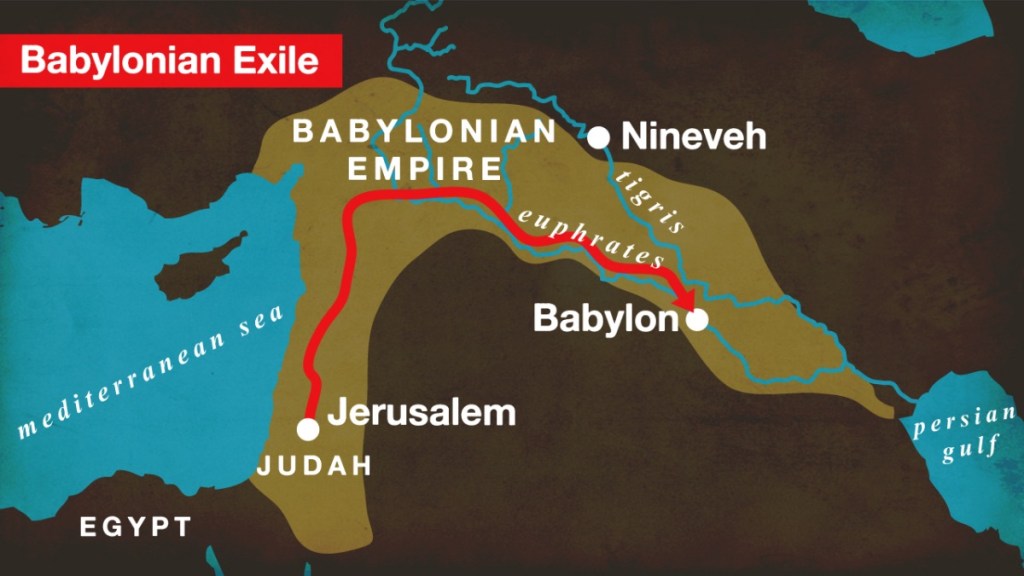
B. Psalm 126 offers a similar refrain. This time the Jewish people have been released from their 70 year exile in the Babylonian-Persian Empire. God had allowed the forces of King Nebuchadnezzar to defeat Judea, destroy Jerusalem, and cart the people off (586BC). He was chastising them—after many warnings of judgment to come—for their idolatry and stubborn disobedience. The news that they were free to return to Jerusalem stunned the Jewish captives! The psalmist writes in vv.1-3—When the LORD brought back His exiles to Jerusalem, it was like a dream! We were filled with laughter, and we sang for joy. And the other nations said, “What amazing things the LORD has done for them.” Yes, the LORD has done amazing things for us! What Joy!
This probably felt to them like a spectacular new thing. God’s miracles for His people were clearly not at an end. And, just as the Isaiah passage predicted Jesus’ 1st Coming, this psalm looks forward to the Jesus’ 2nd Coming.
C. The Isaiah reading dealt with the Exodus, and our psalm, with the return of the Babylonian exiles. Paul takes us in a different but related direction in Philippians 3:4b-14. Paul had, prior to coming to Christ, thought he could manage his own salvation by his own efforts. He lists 7 credentials he had accumulated that made him a religious superstar:
1.) He had godly parents, who saw to it that he was circumcised on the 8th day—by Jewish Law.
2.) He was purely a Jew—no nonbelieving Gentiles in his gene pool.
3.) He was a member of the tribe of Benjamin, Jacob’s favorite son after his loss of Joseph.
4.) He was an elite leader.
5.) He was a Pharisee by training, dedicated to teaching and enforcing Jewish Law.
6.) He was so zealous that he persecuted the infant Christian Church.
7.) And he kept short sin accounts with God, making the requisite sacrifices when he sinned.
But, since becoming a follower of Jesus Christ, he considers all his worldly accomplishments worthless. And so should we. It’s not about impressing others with what we have done or not done. Paul knows he could not make himself right with God through his own efforts. He wants us to realize that (v.9)—…God’s way of making us right with Himself depends on faith. It’s about having faith in Jesus Christ. He is now dedicated to getting to know Jesus better and better, and to helping others do so too. And so he presses on (vv.13-14)—Forgetting the past and looking forward to what lies ahead, I press on to reach the end of the race and receive the heavenly prize for which God, through Christ Jesus is calling us.

This is definitely a spectacular new thing: Salvation does not come from our efforts, but has been won for us by our Lord and Savior, Jesus Christ. We don’t have to try to be perfect. Our sins are covered by the sacrificial blood of the sinless Son of God. Our striving can cease, replaced by our faith.
D. Finally, in our Gospel lesson (John 12:1-8), we see a young woman do something extraordinarily new to honor Jesus. The scene is a dinner party in Jesus’ honor at the home of Lazarus. Rev. Dr. J. Vernon McGee says the Lazarus family represents 3 essentials in every Church:
(1) The resurrected Lazarus has new life in Christ.
(2) Martha no doubt prepared and served the meal, so she represents service.
(3) Mary kneels at Jesus’ feet, worshiping and adoring Him.
(McGee, Through the Bible Commentary on John, Thomas Nelson, 1991, p.38.)

Notice how extravagant are Mary’s efforts. Jesus will wash His disciples’ feet with water at the Last Supper, but she anoints His feet with a very expensive perfume from India, and dries them with her lovely long hair.
Mary of Bethany realizes how very special Jesus is and she honors Him with a pound of spikenard worth a year’s wages. She, like Paul who comes after her, has made worshipping Jesus the most important thing. Jesus accepts her worship as if she is anointing Him for His death some 6 days ahead. We could say she is fully committed and has the utmost faith in Jesus.
I don’t know about you, but I find that Jesus often surprises me by answering prayers I haven’t even put into words. There’s a certain busy intersection, with no light in my town, into which it is very difficult to turn left. For several days, as I have approached this intersection, there has been—amazingly—no traffic in either direction. As I have easily executed my left-hand turn, I have laughed and thanked the Lord. This is not as spectacular as opening the Red Sea, returning exiles to Jerusalem, or healing a dying baby. But it serves as a reminder to me that Jesus sees me, loves me, and wants to have me cross the intersection safely.
Like Paul and like Mary of Bethany let’s during what’s left of Lent, focus on how grateful we are to serve a God who enjoys gifting us with spectacular large and delightful small surprises.
Thanks be to God who gives us the victory through our Lord Jesus Christ. Alleluia, alleluia!
©️2025 Rev. Dr. Sherry Adams
 Wellborn Methodist Church--Wellborn, Florida