Pastor Sherry’s message for January 19, 2025
Scriptures: Neh 8:1-10; Ps 19; 1 Cor 12:1-11; Jn 2:1-11
Remember the old TV show, “The Tonight Show” with comedian Johnny Carson? He was hilarious, wasn’t he? You can probably recall some particularly funny episodes (You can locate reruns on www.YouTube.com).
One night he featured an interview with an 8 year old hero. The child had rescued two friends who had gotten trapped in a West Virginia coal mine.
As Johnny continued to talk with the boy, it became obvious that the child was a Christian.
So Johnny asked him if he attended Sunday school. When the boy said he did Johnny inquired, “What are you learning in Sunday school?” “Last week,” came his reply, “our lesson was about when Jesus went to a wedding and turned water into wine.” The audience roared, but Johnny tried to keep a straight face. Then he said, “And what did you learn from that story?” The boy squirmed in his chair. It was apparent he hadn’t thought about this. But then he lifted up his face and said, “If you’re going to have a wedding, make sure you invite Jesus!”
(Borrowed from www.Sermons.com, 1/14/2025)
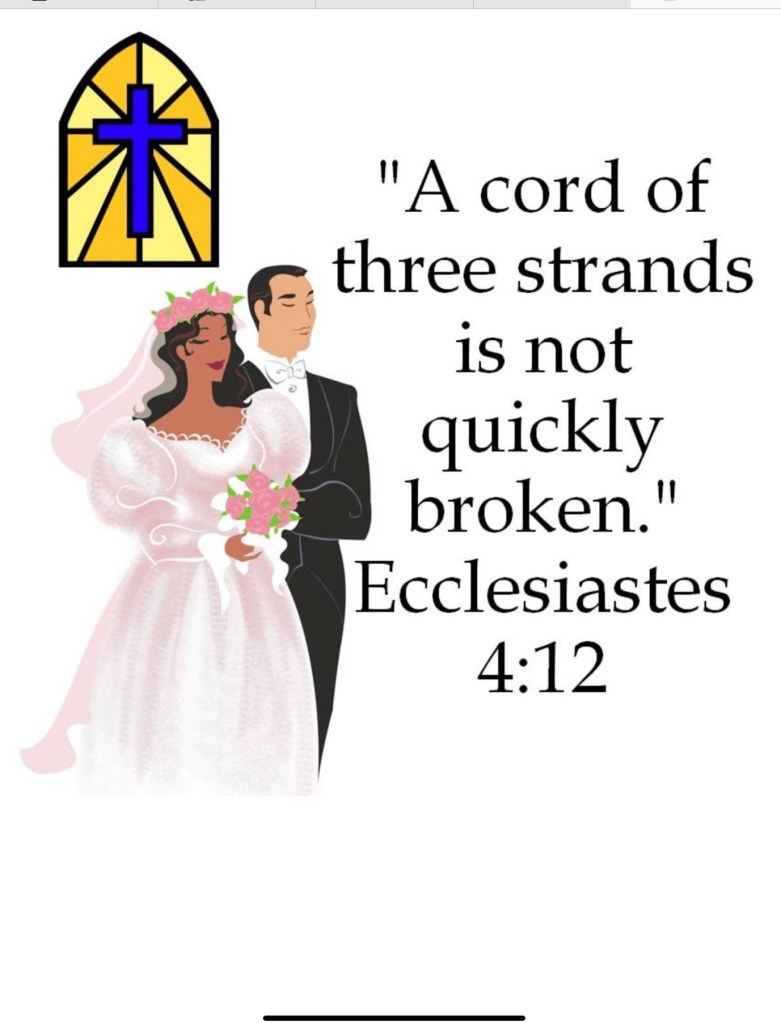
The child was wise beyond his years! We are told in Ecclesiastes 4:12 a cord of three strands is not easily broken. This passage (4:9-12) is often read at weddings. The bride and groom represent two of the three strands. The marriage is strengthened if the third strand is Jesus.
Again, the child said, “If you are going to have a wedding, make sure you invite Jesus.”
Our Gospel lesson today (John 2:1-11) recounts the wedding at Cana—to which Jesus had been invited. Weddings were important events in Israel in the time of Christ. They often involved feasting, dancing, and visiting with friends and family for up to a week! It was time off for everyone to celebrate! The couple didn’t take a Honeymoon in those days.
Instead, in the place of what we would call a Wedding Reception, the newlyweds would share their joy, and strengthen their ties, with their relatives and neighbors, with feasting and fun.
Now the village of Cana was just over the hill from Nazareth. Some scholars believe Mary, Jesus’ mother, had relatives there, so she, Jesus and the rest of her family had been invited. You can thus see how, if a couple were poor, there was a real danger of running out of food and/or wine. Wine to them was a staple with meals. Perhaps the alcohol content helped kill bacteria in their unfiltered water. However, drunkenness was universally condemned. This couple, in our story today, does run out of wine, and the bridegroom is about to be publically embarrassed.
So Mary brings their dilemma to Jesus’ attention. She says, They have no more wine. Jesus responds, Dear woman, why do you involve Me? Scholars are undecided about why she would ask Him to do something for them in this setting. Jesus knew His Heavenly Father had not yet told Him to begin His public ministry, so He was reluctant to perform a miracle—He says, My time has not yet come. I have heard this passage preached where the minister claimed Mary was a pushy, Jewish mother. I could be wrong, but I think because she was His mother, she knew of knew His capabilities and His compassion. She had empathy for the couple. Thus it is very likely that God the Father nudged Mary to “jump start” Jesus.
Whatever the case, He honors her by resolving the crisis. He has servants gather 6 large water jars, each holding 20-30 gallons. This would have been water set aside for ritual purification. He then transforms the water into the best wine ever—somewhere between 6X20=120 gallons to 6X30=180 gallons! This was an audaciously generous amount of delicious wine. The one we would call “the wedding planner” or the master of the banquet, is amazed! In so doing, Jesus has just offered the first sign of His divinity: He can transform matter/material world.
We know from this side of the Cross that Jesus only did what His heavenly Father told Him to do. So why unveil His divine powers at a wedding?
Our Psalm (19) celebrates God as our creator and redeemer. The Hebrew word used for God in the first 6 verses of this psalm is Elohim—it is the plural form of El—the Mighty One, or God the Creator [indicating that all 3 persons of the Trinity were involved in creation]. He created grapes and led someone at some point to ferment grape juice into wine. The Vineyard is one of several metaphors God uses to describe the nation of Israel. The wedding takes place within the vineyard, Israel, and the groom has need of more wine. Perhaps God is saying, Jesus will meet your need, and what He supplies is better than the best.
In the 1 Corinthians 12:1-11 passage, Paul lists 9 spiritual gifts potentially given– through the power of the Holy Spirit–to those of us who love Jesus. These gifts are not given to us for our personal enjoyment, but for us to help with building up God’s Kingdom here on earth. Among these is miraculous powers. Jesus demonstrated His miraculous powers at the wedding in Cana. Some believe this signaled His endorsement of the marital union. (Since God the Father invented marriage in Genesis, we can be sure God the Son would support the Father’s idea.) Other scholars make the distinction between Moses and Jesus: Moses’ first miracle was to turn Nile River water into blood (representing the Law); Jesus’ first miracle was to turn water into fine wine (indicating grace and mercy). Still other Biblical experts assert that Jesus took something old and battered (the jugs/water pots) and filled them with something new designed to meet their needs. In other words, He took a good thing from the past—water—and turned it into a good thing for the future–good, new wine. This way, we can begin to see the wine as a metaphor for the generous blessing of God.
Additionally, we have paired with these readings the Old Testament lesson from Nehemiah 8:1-11, which takes place in Jerusalem in 445BC. Jewish POW’s of first the Babylonian, then the Persian Empires, had been set free by the Persian king, Artaxerxes, to return to their homeland. Under the oversight and direction of their governor, Nehemiah, they have completed the massive rebuilding of the city walls in just 52 days. Ezra, their priest, had begun the sad reconstruction of the Temple—which would take many more years. We find them today assembled–on the equivalent of their New Year’s Day—inside the Water Gate (1 of the 12 refurbished gates of the city). You may remember that business, legal, and political matters were debated and decided, in those days, at the city gates. So this wasn’t just some narrow passageway. It was, instead, a gate opening into a sizeable square or assembly area.
Ezra and Nehemiah had convened a “solemn assembly” of all the returning citizens. Scholars estimate some 49,000 men, women, and children of an age to understand, had gathered there. After 70 years of exile in a foreign nation, they were probably starved for God’s word. They may have held Bible studies while in captivity, but they had not really been formally taught the Torah (the Law). Ezra and Nehemiah did not want the people to be ignorant of God’s Law. Their parents’ and grandparents’ ignorance and rebellion is what got them transported to Babylon in the first place.
Notice what happens: Ezra proclaims God’s word, in a loud voice, from a raised platform (perhaps the first pulpit). The people remain standing, and quiet, and as they listen for some 4-6 hours! This is where the synagogue tradition of standing for the reading of Scripture began. Standing is a sign of respect, of reverence. I went to 4 years of Catholic Girl’s School (though not a Catholic) and learned quickly that one stood when called upon by one of the nuns. These Israelites are hearing God’s Law, Torah read to them—Genesis, Exodus, Leviticus, Numbers, and Deuteronomy—perhaps for the first time. There are Levites/priests available to walk among the crowd and explain what God’s Word means. This is probably the most important job we pastors do—explain the meaning of Scripture, as best as we can. The pre-Reformation Catholic Church had moved away from this important duty, focusing instead on the dictates of “holy mother church.” The Protestant Reformers were thus insistent that we preach and explain God’s word. Like the people of Nehemiah’s day, we cannot obey God’s Word if we don’t know or understand it.
The people respond with AMEN, AMEN! May it be so, hands lifted, praising God. We say, Thanks be to God! following the reading of Scripture in our worship services, and hopefully we mean it. They then, as the Word sunk in, became convicted of their sinfulness. They now knew the standard, and could gage how far short of it they fell. So, they prostrate themselves and cry tears of repentance. But Ezra, Nehemiah, the 13 on the platform, and the Levites among them, tell them not to grieve or mourn…a. They were to celebrate their deliverance from captivity by God. He once again (remember 400 years in Egypt) freed them and restored them. He hadn’t turned His back on them! And now they had had a new chance to get it right. This was an occasion to celebrate, to rejoice about the goodness and mercy of the Lord!
We are just 2 and ½ weeks into the New Year. Let’s invite Jesus—not just to the wedding—but into our lives. Let’s also commit ourselves to reading and studying Scripture, God’s Word. Let’s allow God’s Word to cleanse us, or as Paul puts it in Ephesians 5:26–>wash us with the water of the Word. God’s Word transforms us, if we are open to Him. God’s Word leads, guides, and directs us. Finally, let’s look for the miracles, or blessings, He has for us, and be sure to thank Him for them. Amen! May it be so!
©️2025 Rev. Dr. Sherry Adams
 Wellborn Methodist Church--Wellborn, Florida