Pastor Sherry’s message for March 3, 2024
Scriptures: Gen 20:1-17; Ps 19; 1 Cor 1:18-25; John 2:13-22
Yesterday, my son moved out of my guest room into a modest house in Lake City. After 2.5 years, it was time for him to be on his own again. Fortunately for him, the landlord had had the place cleaned. It’s really a sweet place in a quiet neighborhood. I think he will be happy there.
When we finished lifting and carrying clothes and boxes, I was too tired to clean the guest room and put it back to the way it looked before he came. My daughter could tell you, I would have had the vacuum and dust cloths out, and the cleaning frenzy would have commenced. As it was, at 77, I had just enough energy left to come home, take a hot shower, and fall into bed.
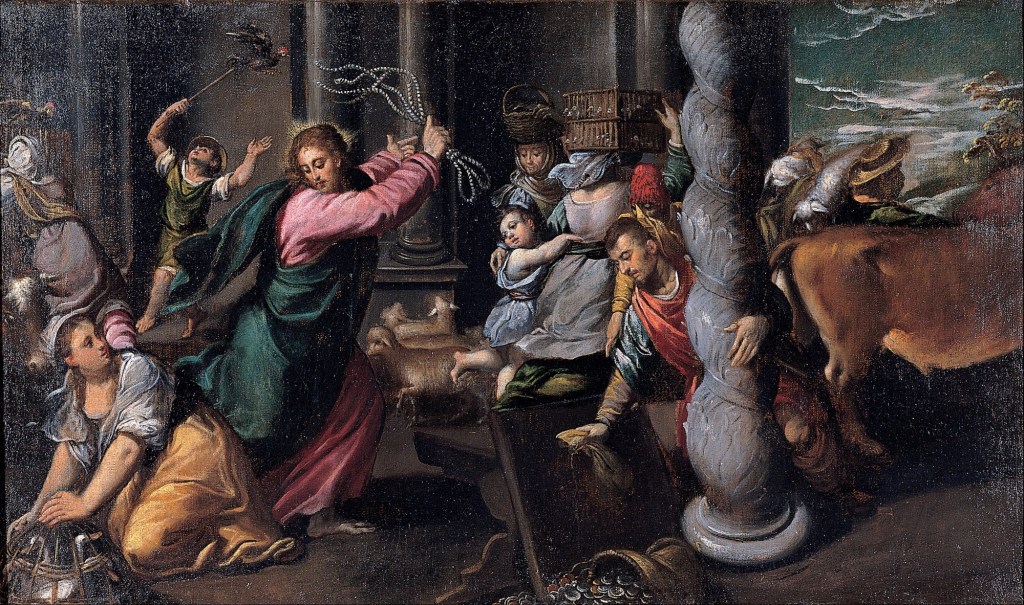
Our Gospel today depicts Jesus in a cleaning frenzy. Unlike me, He was totally energized to clean up His Father’s House. Let’s not forget that since He too is God, it was His House as well. And He was incensed that the religious authorities had allowed what He saw going on there.
In our Gospel lesson (John 2:13-22), Jesus goes head to head with the Temple leadership to effect a physical and a spiritual house cleaning. The religious establishment had authorized both the buying and selling of sacrificial animals, and a coin exchange–for a fee—on the Temple Grounds. Some worshippers came from long distances without animals of their own. So those “pilgrims” without animals had to purchase one or two to make their sacrifice. Additionally, they had to pay a ½ shekel Temple Tax. The fact that no Roman coins could be used–because they had Caesar’s face on them (a graven image which Jewish law prohibited), as well as the inscription, “Caesar is Lord” (which constituted blasphemy to the Jews), meant that they also had to exchange their money, for a fee.
Jesus was incensed with all of this for a number of reasons:
1.) Those selling the animals unfairly marked them up. They knew people didn’t have a choice, and they gouged them for the convenience.
2.) They also charged an outrageous fee for the coin exchange.
3.) The animals were smelly and noisy and distracting in what was a house of prayer and a place of worship.
4.) But perhaps worst of all, the marketplace took over the only area in the Temple where Gentiles could gather. Essentially, they were prevented from worshipping in the only space allotted to them.
So Jesus cleared the area in no uncertain fashion. He formed a whip and used it to drive away the animals. He also overturned tables, no doubt scattering money everywhere. He shouted (v.16) How dare you turn my Father’s House into a market! Of course, then “The Jews” (John-speak for the religious establishment) want to know what gives Jesus the right to clear the Temple and upset their very profitable businesses. They said, Give us a miraculous sign—prove You have sufficient authority to do this. Jesus responds rather cryptically, telling them (v.19), Destroy this temple and I will raise it again in three days. They think He is speaking of the Temple building and scoff at Him. We know He was speaking of His body (predicting His resurrection)—a pretty authenticating sign! But they were so haughty—so sure their understanding surpassed His—that they did not believe Him. Don’t you imagine that when He left, they went right back to doing business as usual?
They must have forgotten verse 6 of Psalm 138—God is close to the humble, but distances Himself from the proud. It’s dangerous to think we always have all the right answers. Pride caused most of the Pharisees, Scribes, and Sadducees to miss who Jesus was. They’d made an idol of their understanding of the Scriptures. Because Jesus didn’t fit their preconceptions, they missed out on the opportunity to develop a relationship with the Son of God. Let’s not make the same mistake. Let’s make sure we clean our spiritual houses of the sin of pride.
Let’s take a look too at our Old Testament lesson from Genesis 20:1-17. Just last week, we were praising Abraham, the Father of our Faith, for his trust in the Lord. Abe is such a great example of trusting in the Lord’s provision of the Promised Land; trusting in God’s promise of descendants without number; and benefiting from God’s blessings of health and wealth. Where he seemed to have wavered in his faith, however, was in being certain that God would protect his life. Apparently, his wife Sarah was very beautiful. I’ve heard another pastor humorously refer to her as a “Biblical babe.” Unfortunately, whenever Abraham encountered a foreign ruler, they appeared to covet her. Back in Genesis 12, when Abraham moved to Egypt due to a famine, the Egyptian pharaoh heard of Sarah’s beauty and took her from him. Abraham in a sense brought this on himself because he lied, telling Pharaoh she was his sister (she was his half-sister), instead of his wife. He was afraid Pharaoh would kill him in order to clear the way to marry her. In this situation, he didn’t depend on the Lord!
Fortunately for both of them, God protected them anyway. He afflicted the Egyptians with “serious diseases” until Pharaoh gave Sarah back to Abraham and told them both to leave. So, this had happened before. You would think that Abraham would now trust God to protect him from rulers tempted by Sarah’s beauty. But no, in today’s lesson, the two encounter Abimelech, a Canaanite king. Like with Pharaoh previously, Abraham again lied and said Sarah was his sister, not his wife. The same thing happened as Abimelech coveted Sarah and took her, intending to add her to his harem.
Once again, God intervened—not with disease—but with a dream containing a death threat. Abimelech believed God’s message from the dream and immediately returned Sarah to Abraham. But the pagan king was also outraged and demanded to know why Abraham lied to him and put him and his people at risk. Abraham, the great model to us of faith, had not trusted the Lord to keep him and Sarah safe from another lusty king. Abraham, who God judged as righteous due to his faith, has now lied twice.
What do you make of this? I think we can safely say that Abraham was a good man but not a perfect man. There was and is only one perfect man–that’s our Lord, Jesus. Like us all, Abraham’s great faith wavered from time to time. Don’t we all have times when our faith is stronger or weaker than usual. We too may have areas in our lives where we find it very hard to trust God. Nevertheless, since he was God’s choice as the patriarch of the Jews—since God meant to accomplish great things through him—the Lord guaranteed his safety. Similarly, I think God has grace for us in those areas we have not yet surrendered to Him.
Remember, we are in the season of Lent. These two readings today focus on two aspects of human behavior that God wants us to clean out of our spiritual houses: (1) Pride (and even the misuse of His house of worship), and lying. Lent is a time for evaluating our behavior, recognizing our sins, and asking God’s forgiveness. Maybe you are not overly proud and you don’t lie. But each of us is probably guilty of some other sins we could name. Soon, in our preparation to receive Holy Communion, we will say a general prayer of confession. Let’s take a moment now to call to mind our sins and confess them to Jesus, in our hearts, right now. Let us also be comforted by what the Apostle John promised in 1 John 1:8-9—If we claim to be without sin, we deceive ourselves and the truth is not in us. If we confess our sins, He is faithful and just and will forgive us our sins and purify us from all unrighteousness. Amen and amen!
©️2024 Rev. Dr. Sherry Adams
 Wellborn Methodist Church--Wellborn, Florida