
Come, Holy Spirit!

Pastor Sherry’s message for Pentecost Sunday—May 23, 2021

Scriptures: Acts 2:1-21; Ps 104:24-35; 1 Jn 3:1-7; Jn 1526; 16:5-15

In 1995, Mark Batterson and a small team planted the National Community Church in a movie theatre on the Metro line (subway) in Washington, DC. It has since grown, through prayer and sovereign moves of the Holy Spirit, to 7 locations in and around DC, and ministers to around 3,000 members. This week, I reread 2 books Batterson has written: In a Pit with a Lion on a Snowy Day and Wild Goose Chase.

In a Pit with a Lion on a Snowy Day is based on 2 Samuel 23:20-21 Benaiah son of Jehoida was a valiant fighter from Kabzeel, who performed great exploits. He struck down two of Moab’s best men. He also went down into a pit on a snowy day and killed a lion. And he struck down a huge Egyptian. Although the Egyptian had a spear in his hand, Benaiah went against him with a club. He snatched the spear from the Egyptian’s hand and killed him with his own spear.

Benaiah, a mighty Hebrew warrior, chases a lion into a pit on a snowy day and kills it. Why would anyone do such a thing? Adult lions weigh about 500 pounds. Let’s guess that Benaiah weighed about 180. Clearly he was out-weighed by about 320 pounds. Add to that the fact that a lion’s paws, claws, and teeth were better suited to combat in a slippery environment than a man with no rifle or semi-automatic (but perhaps Benaiah had a spear or club). Whatever his weaponry, Benaiah slays the lion. Now I believe the Holy Spirit must have both led Benaiah to the pit, and empowered him with the courage and the skill to overcome the lion. This feat becomes the most prominent feature of his impressive resume. He is subsequently hired by King David to lead his body guard. Later, he rises to become the commander of the king’s armies.

Essentially, Batterson encourages us, in this book, to become “Lion Chasers,” pursuing the divine appointments, the God-given opportunities our Lord provides of us. He also points out how often “lion Chasers” are rewarded by the Lord.

In his book, Wild Goose Chase, Batterson distinguishes between a wild goose chase and chasing a wild goose. We tend to think of a wild goose chase as a fruitless endeavor, a waste of our time.

But the Celtic Christian name for the Holy Spirit is An Geadh-Glas, or the Wild Goose. Please understand that the Celts meant no disrespect. (The Lakota Sioux thought of the Holy Spirit as a buffalo, upon whom their plains existence depended entirely.) Like a wild goose (or a buffalo), the Holy Spirit is unpredictable, and out of our control—and sometimes even scary. But if we chase after Him, if we follow His nudges and urges, the Lord leads us into some amazing adventures.

Given this background, let’s look at our 1st reading, Acts 2:1-21: the empowerment of the HS at Pentecost. The context of this passage is that the 120 disciples, men and women, are praying in the Temple. Jesus had told them (Acts 1:4)àDo not leave Jerusalem, but wait for the gift my Father promised…in a few days, you will be baptized with the Holy Spirit. So they are being obedientàthey waited, they prayed. On Pentecost, 10 days after Jesus’ ascension, the Holy Spirit shows up! This is a theophany! A God-sighting! And He arrives with significant supernatural fanfare, or signs and wonders.

(1) 1st sign (which was heard)àSuddenly from heaven there came a sound like the rush of a violent wind. This was no gentle breeze! Like tornados, it probably sounded like dozens of freight trains. God had done this beforeàEzekiel 37:9àGod sends the wind to raise the dry bones of Israel to life. When I was baptized by the Holy Spirit, I was at the beach with a group of friends who were praying for me. A moaning wind came up in my face. It was so strong that I could hardly breathe. Afterward, my friends denied having heard or felt it!

(2) 2nd sign (which was seen)àThey saw what seemed to be tongues of fire that separated and came to rest on each of them. Imagine if you had been there! Fire over your head, fire over the heads of your friends, no one burning up! Wow! But God had done this before, tooàExodus 3:2-5àMoses and the burning bush. The bush was on fire, but it did not burn up. God used that bush to light a fire in Moses. In Isaiah 6àIsaiah’s callàIsaiah realizes he is a sinful man called to serve as the Lord’s prophet. An angel brings a burning coal and applies it to hislips and tongue. He is purified without being burned. He did, however, get fired up to serve the Lord!

​(3) 3rd sign (which was again heard)àAll of them were filled with the HS and began to speak in other languages, as the Spirit gave them ability.  They were all supernaturally empowered to do something they had never done before, speak ​in a foreign language.  Parthians, Medes, and folks from other nationalities visiting Jerusalem heard them praising God in their native tongues—and according to scholars, with the correct accents!  These foreign visitors realized something extraordinary was happening as they recognized the 120 as simple folk from Judea.  Now God had done this before as wellàIsaiah 50:4àThe Sovereign Lord gave me [Jesus and the prophet Isaiah] an instructed ​tongue; i.e., inspired speech.   I have heard of a number of incidents, especially from missionaries serving abroad, when they suddenly either spoke or understood a language they had never been taught.  Peter quotes the prophet Joel,(Acts 2:28)à[The Lord, speaking thru the prophet Joel, promises],…I will pour out my Spirit on all people.  Your sons and daughters will prophesy, your old men will dream dreams, your young men will see visions.  Even on my servants, both men and women, I will pour out my Spirit in those days.

The Holy Spirit did show up, big time, on the Day of Pentecost! But why would God go to all this trouble? (wind, fire, inspired speech?)

(1) Pentecost marks the birth of the Christian Church (Big C, all Christians despite denominational differences) and inaugurates “the Church Age” (which begins with Pentecost and will continue until the Rapture).

(2) The Holy Spirit empowers us to tell others about Jesus. The disciples were waiting, praying, in the Temple, when the Wild Goose manifested in these very surprising ways. Jesus had given them the Great Commission, Matt 28:18àGo and make disciples of all nations, baptizing them…and teaching them to obey everything I have commanded you. Now, filled with the HS, the disciples began telling anyone who would listen about Jesus. Like Benaiah jumping into the pit, they rushed out, with great urgency, to share with others what God had done for them. Like Benaiah jumping into the pit, we need supernatural help to share our faith with others. We need God-given opportunites, divine appointments so we know with whom we are to share the Good News. We need instructed tongues, so we know what to say when we do share.

(3) Empowerment to do the kinds of things Jesus did for the building up of God’s Kingdom. Through our prayers and faith, God can use us to heal others. My friend and seminary buddy, Hazel, had a healing ministry in Charleston, SC. Through her prayers and those whom she trained, one person grew back a kidney; another had their gall bladder healed. A third was healed of Bi-polar Disorder; a 4th had a brain tumor shrink to nothing.

Similarly, Agnes Sanford, the wife of a clergyman, also had the gift of healing. Her parents were missionaries to China in the 1930’s and 40’s. Agnes laid hands on a crippled Chinese man when she was 3YO and he was healed. Her parents did not understand her gift (their theology taught that all the gifts of healing ended with the Apostles), and told her not to do it again. Later, as an adult during WW2, she suffered from depression until a pastor friend released her to work in her gifting. She laid hands on injured GI’s, prayed for them, and they were healed of either their physical or emotional problems.

Graham Cooke, a present-day British Christian healer has a gift of “prophetic healing.” In other words, in the healing conferences he leads, God tells him what is wrong with a person as they are coming forward to him for prayer. He relates the story of a man who came forward suffering from a long-standing porn addiction. As the man approached him, the Holy Spirit told Graham that God intended to heal him of his addiction. Indeed,Graham prayed and the guy was set free.

Through our faith and our obedience, we can be equipped by God to do things we would never have thought possible. The 120 were waiting in anticipation, but I bet when they awoke on Pentecost, they never thought they would be evangelizing in foreign languages later that morning. I doubt Benaiah anticipated slaying a lion with only a spear or a club that day. I grew up wanting to be a mother and a teacher, then later—when my high school students kept coming to me with their problems–a psychologist. God has given me gifts of teaching and wisdom to impart to those I counseled. Yet, here I am now serving Him and you as your pastor. The Holy Spirit also gifts us for specific ministries at different times of our lives.

Moving at the nudge/inspiration of the HS is like chasing a Wild Goose (the Celtic An Geadh-Glas). It is an adventure! We wore red in honor of Pentecost today. Red reminds us of the tongues of fire. Red reminds us of one of the ways God chooses to show up. This week, be sure to be aware of how God might show up in your life. Savor your divine appointments. Write them down so you remember them. Share them with others, as God directs you.

Let’s remember this week—and always—that our God empowers us through His Holy Spirit to both tell others about Jesus and to operate in the gifts He has given us. Even if it seems as scary as jumping in a pit with a lion on a snowy day, let’s look for God-given opportunities and divine appointments. And let’s ask Him for the courage of a Benaiah—and of a Mark Batterson–the courage to do what the Lord has given us to do.

©️2021 Rev. Dr. Sherry Adams
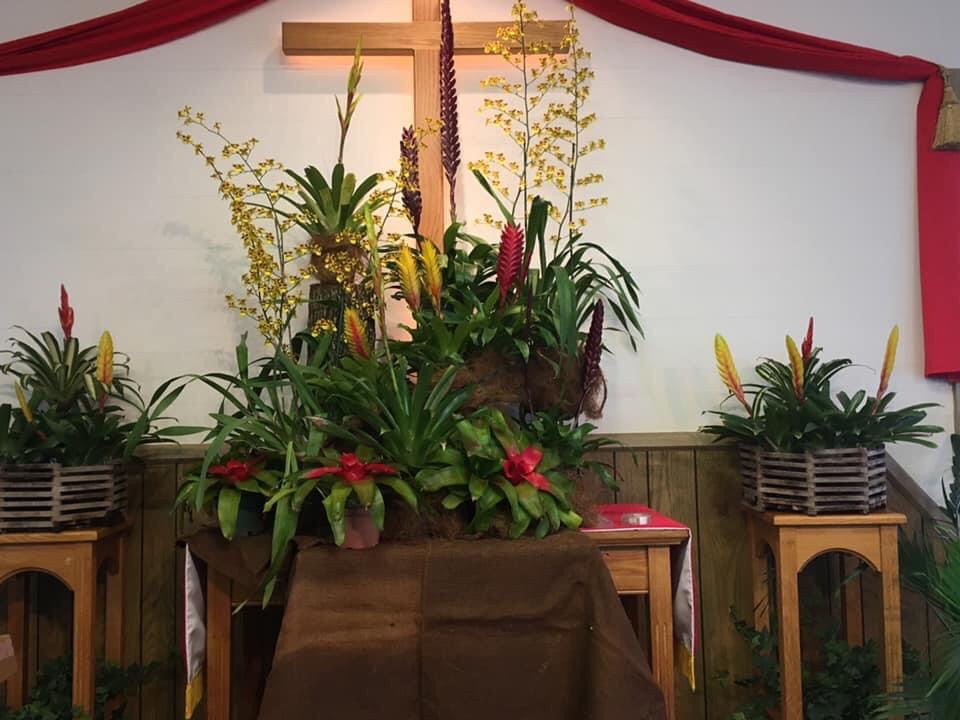
 

Thanks to the Geiger family for Pentecost altar flowers.

Trusting in God’s Promises

Pastor Sherry’s Message for February 28, 2021

Scriptures: Gen 17:1-16; Ps 22:23-31; Ro 4:13-25; Mk 8:31-38

Who of us has not enjoyed Charles Schultz’ comic strip, “Peanuts”?  Charlie Brown, the main character, though just a child–with an amazingly creative dog, Snoopie– is sort of a pint-sized “everyman,” a “mensch” as they would say in Yiddish.  Most of us can identify with his earnestness, his longing to be well regarded (especially by the curly-haired girl of his dreams), and his desire to do the right thing.  We can also all identify with him when things in his life go wrong.  Consider his relationship with Lucy and the football:  Haven’t you found yourself thinking, if not saying, “Charlie Brown, don’t trust her to hold that football!”  You know she will grab it out of the way just as you go to kick it, don’t you?  Charlie, she just can’t resist seeing you fall flat on your bohunkus!  Charlie, don’t you know by now, she can’t be trusted?”

         Charlie Brown is just a cartoon character, but don’t you identify with him in this? Can’t you think of times you have trusted someone, like Lucy, who turned out to be clearly untrustworthy?  We may not have landed flat on our backsides like Charlie, but the disappointment and the betrayal hurt nonetheless.

         There is such good news about the character of our God!  For all of us Charlie Browns, one of the best of God’s characteristics is that He is trustworthy!  My first principal told me, in dealing with high school students, “Say what you mean and mean what you say.”  She was a 35 year old nun who had been an excellent teacher herself.  She mentored me and claimed me to the teaching profession in 1970.  In advising me to always say what I meant and to mean what I said, she was conveying to me one of the ways you earn students’ trust and cooperation—and she was right!

         Our God says what He means and means what He says.  God does not lie.  He always speaks the truth.  He has earned our trust and our cooperation.  Our Scriptures today provide several examples of this:

         Genesis 17:1-16.  Last week, we examined God’s Covenant promise to Noah.  Remember, He promised never again to destroy all living creatures with a worldwide flood.  And now, several thousands of years later, He hasn’t broken this promise.  Our Old Testament reading this week finds God making a number of new promises to Abram.  The pre-incarnate Jesus visits Abram when Abram is 99 years old (Sarai, his wife, is 89).   Jesus tells him that he will be (vv.4-5)…the father of many nations.  No longer will you be called Abram; your name will be Abraham, for I have made you a father of many nations. The name Abram means exalted father in the Hebrew; whereas Abraham means father of many, or, father of a multitude. Jesus changes his name to indicate the coming change in his status: he is already a father to Ishmael, but by human manipulation.  God intends to make him the father of Isaac by divine intervention.  Jesus prophesies that nations and kings will come from Abraham’s lineage–not just figuratively or even spiritually, but literally and biologically.  In the 4000+ years since this prophesy, two great nations have indeed come from Abraham and Sarah:  (1) the Arabs from Ishmael’s line; (2) the Jews from Isaac’s line; (3) and Christians worldwide, who have been grafted into Isaac’s line through Christ Jesus.  How’s that for promise-keeping?!

         In verse 7, God promises to be Abraham’s God forever.  In verse 8, God guarantees that the Land of Canaan will be …an everlasting possession to [Abraham] and to your descendants after you.  Nowthe Jews have been put out of the Holy Land 3 times:

                 First, when famine drove them to Egypt under Joseph’s administration under pharaoh.  There were approximately 90 of them when Jacob’s extended family sought Joseph’s aid, but over 1.5 to 2 million of them when they left to return to the Land during the exodus 400+ years later. 

                 Second, in 578BC, as a punishment for idolatry.

                 Lastly, in 70AD as a punishment from the Romans for continuing insurrection, but actually from God for having rejected His Messiah. Scripture seems to indicate that they will not truly be restored to the Land until Jesus’ 2nd Coming.  (They were ceded the state of Israel in 1947, but its borders were/are far smaller than what God gave to Abraham, and there are said to be more Jews in New York than there are now in Israel.)  However, the Lord made this as an everlasting promise, so we can be sure that Israel will one day be fully restored to the Jews.

         Finally, in verse 10, God says the sign of the covenant will be circumcision.  This is done at 8 days old for Jews (13 years old for Arabs).  It’s a permanent sign.  Unlike a tattoo, it cannot be undone.  In essence it means, If I do not keep this covenant, may the sword of the Lord cut me off and my offspring as I have cut off my foreskin.  YIKES!  This is a serious promise!

         Psalm 22:23-31.  The first portion of this psalm conveys Jesus’ thoughts from the Cross.  Scholars believe He also thought this section assigned for us today, even though it celebrates the sovereignty and the trustworthiness of God.  Think of that.  Struggling for breath from the Cross, and in terrible pain, Jesus ends His meditations by declaring (v.28) that God the Father has charge of all creation, …for dominion belongs to the Lord and He rules over the nations.  Jesus’ final word from the cross and in this psalm is Tetelestai, (v.31) it is finished.  (This is actually His next to the last statement He made before His death.  As He breathed His last, He said, Father, into Your hands I commend [place] My spirit.)   How remarkable that, as He was dying, He would be rejoicing with His Father over having completed the work God sent Him to earth to do.

         Romans 4:13-25.  Paul is trying to demonstrate that Abraham    was made righteous before God by his faith, not his deeds.  Actions-wise, Abraham was just like us, a mix of good intentions, wise actions, and sinfulness.  However, it was his trust in God that makes him a standout, the “Father of our Faith.”  Paul makes the point in verses 19-21, that Abraham, without weakening in his faith,… faced the fact that his body was as good as dead—since he was about a hundred years old—and that Sarah’s womb [at 90YO] was also dead.  Yet he did not waver through unbelief regarding the promise of God, but was strengthened in his faith and gave glory to God, being fully persuaded that God had power to do what He had promised.  This is why it was credited to him as righteousness.  Abraham believed God even though biology, science, and common sense would have all made the case that a 100YO and a 90YO could not conceive and bear a child.  Oh that we might believe in God’s promises with this kind of unwavering faith!

         Finally, in our Gospel lesson (Mark 8:31-38), Jesus rebukes Peter for wanting Jesus to act according to Peter’s expectations.  You see, it’s not just science, biology, and common sense that we have to sometimes set aside in our walk in faith. It’s our will, too, that can be problematic.  Peter’s understanding was that Messiah would reign victoriously, so he was appalled that Jesus would predict His own death.  Jesus goes on to state thatHis followers must deny their own will, or…take up [our] cross and follow Him.  His followers must be willing suffer and to lose their [physical] lives in order to gain them [eternal spiritual ones].  YIKES!  Isn’t that where we err also?  We want Jesus to do for us what we request of Him.  Instead our Lord would have us trust in Him and do as He directs us to do.

         Are we willing to do this?  Do we so trust in Jesus that, like Abraham, we would deny biology, science, and common sense and trust in what God promises us?  Do we so trust in Jesus that, like Peter, we would stand corrected when what we desire contradicts what God wants for us?  When our will clashes with God’s will for us?  When our perception of what should happen conflicts with what God allows to happen?

         If you are one of those who want Charlie Brown to quit trusting in Lucy, rest reassured that Charles Schultz was a Christian.  He wrote his comic strip over 50 years, from 1950 to the year 2000 when he died. He showed us through the Peanuts gang that some are trustworthy—Linus for one, and Snoopy for another, and some are not–Lucy.  Charles Schultz knew and believed in the One who is worthy of trust.  Hopefully we do too!

©2021 Rev. Dr. Sherry Adams

Our God Does Not Forget Us!

Pastor Sherry’s Message for February 7, 2021

Scriptures: Isa 40:21-31; Ps 147:1-11; 1 Cor 9:16-23; Mk 1:29-30

If we were having a conversation, I would ask you to tell me if you have heard this story before.  But, we’re not, so please bear with me if this is a repeat.  It’s the truestory of the Cambodian man whose testimony I heard in a college chapel service and found to be riveting!

In the 1970’s, he was a 16 YO brilliant student, already in medical school at that young age.  One day, he and his friends were recreating in a city park when truckloads of Kmer Rouge soldiers (under the dictator PolPot) descended upon them.  He witnessed his friends to either side of him being shot to death. (They held University ID’s, and the communists were bent on getting rid of all intellectuals, doctors, etc.).  He was spared because—through a bureaucratic snafu, he had as yet no university ID [1st miracle].  Nevertheless, he was taken to prison camp with many others.  The word had spread there that they were all to be executed (You may remember a movie which documented those events called, “The Killing Fields”).  He found himself blindfolded and lined up and realized the executions were being carried out to his left.  He said he cried out to God, “If You exist, spare my life and I will serve you for the remainder of it.”  By a 2nd miracle, they ceased the executions just before they reached him.

         In a 3rd miracle, he escaped into the jungle.  While running by night and hiding during the day, he met a fellow he called, “The Jungle Man,” a 4th miracle.  “The Jungle Man” was a Christian who shared with him his faith in Jesus.  He taught him one Bible verse–probably John 3:16.  (Just think, if you were running for your life, which one Bible verse would you have wanted to have memorized?)  They had to separate for safety, but the Cambodian gradually made it to a refugee camp across the border into Thailand.  In a 5th miracle, he encountered “The Jungle Man” at the camp community water faucet.  “The Jungle Man” then taught him another Bible verse.  Daily, he learned a new verse and shared with whoever-camped-in-his-area would listen. No one had a Bible, but many were hungry to learn of Christ.  There is no telling how many were saved by learning those verses and sharing the love of Jesus with other refugees.  Not so ironically, they took in Living Water around a simple water faucet.

         In a 6th miracle, the Cambodian found sanctuary in the US, in Denver, Colorado.  There, he completed college and seminary—though he didn’t share how that had come about.  Nevertheless, it is clear he honored his promise to God to become a pastor.  I have no idea how many Cambodian refugees found their way to that Denver seminary, but in a 7th miracle, the Cambodian man met there and married a Cambodian Christian woman.

         They completed their studies and returned to Cambodia to preach the Gospel to their countrymen (now a communist country).  They were both arrested on arrival, imprisoned, and denied much food or water.  Like Paul in our 1st Corinthians passage, he believed he could not stand to not preach the Gospel.  Like Jeremiah, he felt his very bones would have to cry out God’s word.  His confinement left him despondent and frustrated with God.  As he grumbled one day, his dear wife reminded him, “Husband, didn’t Paul preach to the walls when he was imprisoned?”  So he began to preach to the walls.  It turned out they were bugged!  Several communist guards who were listening were actually converted! [8th miracle].  In a 9th miracle, they came to him and said,”We can’t let you go, but is there something else we can do for you?”  I might have asked for more food or water, but in his zeal, he asked them to bring people to his prison door so he could preach to them.  He reported that the guards actually went out into the streets and brought people in by gun point!  [10th miracle]  Eventually, he and his wife were released [11th miracle],  and he founded a Christian Seminary in Cambodia. By the time I heard him, he had been leading teaching crusades for Jesus in soccer stadiums in Cambodia, still a communist country [12th miracle].

         I was very touched by his testimony (which I heard in the late 1990’s). It was clear to me that God protected and provided for him over and over again in miraculous ways.  He knew for certain that God had saved him, several times over.   The Cambodian man’s experiences are dramatic and extraordinary, but as our Scriptures today attest, we too can be assured of God’s love, grace, provision, and protection.  Let’s focus on 2 of them:

               1.) Isaiah 40:21-31.  Isaiah is probably my favorite book in the Old Testament.  It is certainly quoted in the New Testament more than any other O.T. book.  Beginning with Chapter 40, the Prophet Isaiah is foretelling the return of the Israelite remnant from their Babylonian Captivity.   Now scholars believe Isaiah prophesied from 750-700BC.  In previous chapters, he predicts the Southern Kingdom, including Jerusalem, will be taken intocaptivity because they abandoned God and worshipped pagan dieties.  God then removed His protection from them and allowed the Babylonians to capture and deport them in 586BC.  Now, in chapter 40, Isaiah predicts that 70 years later God will bring them back home.  This had been meant as a punishment for their spiritual adultery.  In His mercy, however, God fully meant to later restore them.  In fact,God assures them in this message that, when the time comes, they will be able to pack up and set out in confidence.  WHY?

         a.)Because of His power and His sovereignty.  Afterall, He is (v.22) enthroned above the circle of the earth.  The sky and its stars are His canopy, His tent.  In Verses 22-24, he says essentially that God rules and overrules the decisions and the actions of rulers.  They only come to power because He allows it.  And when their reign ends, they disappear like dandelion seeds dispersed by wind.

         b.) And because He does not forget about us or fall asleep on the job! In verse 27, we learn thatGod knows where they are and what they need (He knows this about us too).  In verse 28, he proclaims that The Lord is the everlasting God.  This means He’s not dead! He’s not even retired!

He hasn’t abandoned us or left us to fend for ourselves.  Psalm 121:4 echoes this:  He who watches over Israel will neither slumber nor sleep….Later, in verses 7-8, the psalmist declares, The Lord will keep you from all harm—He will watch over your life; the Lord will watch over your coming and going both now and forevermore.  I don’t know about you, but I find deep comfort and reassurance in these passages.

         c.) Finally, if we wait upon Him (hope/trust in Him), God will renew our strength.  Isaiah 40:29 says, He gives strength to the weary and increases the power of the weak.  And in verse 30 (saving the best for last; this is one verse I would memorize to share), But those who hope in the Lord will renew their strength.  They will soar on wings like eagles; they will run and not grow weary, they will walk and not grow faint.  Do you know that God gave the Israelites strength to walk back to Jerusalem from Babylon, a journey on foot of 1678 miles!  He did the same for the Cambodian pastor.  Like Paul, the Cambodian fellow felt compelled to preach the Gospel.  Like Paul, God gave the Cambodian the power to preach and an audience to preach to.  So too can we assume He will also strengthen us if we ask.

         2.) Mark 1:29-39.  Look at the renewed strength Jesus gave to Peter’s wife’s mother!  She was sick, He healed her, and she popped right up and fixed Him supper.  From the perspective of one laid low this past week by a reaction to the Covid vaccine, I can now appreciate more fully how complete was her healing.  I spent two days in bed recuperating, while she immediately felt good enough to get up from bed and cook.

         The same was true for Jesus.  He taught at the Synagogue, chased out some demons, then He healed untold numbers of sick and demonized after sundown (once the Sabbath had ended).  Surely He was tired!  But rather than sleeping in late the next day, He got up early and went off alone to pray.  He knew that it was His connection to His Father and the Holy Spirit that renewed His strength.  Sure, He was/is God and we are not.  But He was/is human too, with human needs and frailties like ours.  I think Mark is emphasizing for us what Jesus modeled:   the necessity of a prayer connection with Our Heavenly Father, our Source and our Strength.                                                  

         Over the course of this next week, I urge you to focus on the encouragement our God gives us for those times we grow weary or overwhelmed.  We tend to think, “I can’t!” or “It’s awful!”  and forget that God is able.  Like with a deck of cards, pick a worry, any worry:

         a.) Your health; the Covid or other illnesses or concerns.

         b.) Your finances; the direction of the economy;

         c.) The moral decline of our culture;

         d.) The bad behavior or poor choices of a loved one;

         e.) The bad behavior or poor choices of our political leaders;

         f.) A mental condition or an addictive pattern with which you currently                     struggle, etc.

Let’s remember that none of these issues is a surprise to God. None of these is too difficult for Him to handle.  None of these is outside His expertise or His control.  This week, let’s practice trusting in the God of Isaiah, of St. Paul and of the Cambodian pastor.  Our God is never asleep at the wheel!  He knows what is going on in our lives and what we need.  When we trust in Him to provide and protect, He gives strength to the weary and increases the power of the weak.

Thanks be to God who gives us the victory through our Lord, Jesus Christ.  Alleluia!  Alleluia!

©2021 Rev. Dr. Sherry Adams

Using Our Talents

Pastor Sherry’s Message for November 15, 2020

Scriptures: Judges 4:1-7; Matt 25:14-30

A pastor friend tells the story of his brother, Tony, and their elderly Aunt Mildred.  Aunt Mildred was getting along in years, so the two brothers bought her a motorized recliner.  You know the kind, it pushes you up and out of the chair so you don’t have to struggle to stand.  Soon after gifting her, Tony went to see how Mildred liked her new chair.  “Tony,” she says, “I’m having a lot of trouble getting out of my chair.”  Puzzled, Tony replied helpfully, “Let me check on the motor.”  Mildred then told him, “Well, that won’t do no good.  I never plug it in!”  Dumbfounded, Tony asked, “Well, whyever not?”  To which Aunt Mildred replied, “Well, what if the power goes out whilst I was a-laying back in it?  I wouldn’t never be able to get out of it!”  I love this story because it demonstrates so well how fear, and a lack of faith, can prevent us from using the blessings, the “talents,” God has given us.

Our OT and Gospel lessons today give us two examples of what God thinks of those who do not trust in Him enough to utilize the talents He has given us for building up His Kingdom. In our OT lesson, we have the only example of a woman called to lead the nation of Israel, Deborah the Prophetess.  She was called and equipped by God to lead during the time of the Judges.

The backstory is that Joshua has died at 110 years of age without a follow-up human leader.  The Israelites had not yet been governed by a king.  Their leader, to date, had been a man like Moses or Joshua, selected  and directed by God)   Even though the people promised Joshua three times (recall our OT passage from last week), they would remain obedient to God, within 40 years, they had taken up idolatry and forsaken the LORD.  As a result, the Lord would then allow a Canaanite people—Amorites, Amonites, Moabites, Midianites, or even Philistines—to oppress them.  They would then call out to the LORD for help.  He would reply by raising up a judge to lead them in defeating their enemy.  They would thank and praise Him.  But, shortly, once the threat was over, they would again forget about their loyalty to God.  And the 40 year cycle would begin all over again.  Deborah, a woman, was the 3rd such judge God provided.

Who was she?  She only takes up two chapters of Scripture in which we learn the following about her:

            1.) She was a wife to Lippidoth.  We know nothing of him, except that he seemed to have recognized God’s call on his wife’s life; and he did not appear to resent her influence or power. 

2.) She was “a mother of Israel,” out of the tribe of Ephraim.  While this may imply she had children of her own—if so they are not mentioned in Scripture–it certainly means she nurtured and cared for the nation.

            3) She was a wise counselor.  People came from miles away to seek her wisdom and advice.

            4.) She was a renowned judge like Judge Judy, Justice Amy Coney Barrett, or Judge Jannine Pirow.  Instead of sitting at the city gates to hear cases, verse 5  tells us she sat beneath a palm tree named for Her–the Palm of Deborah–located between Ramah and Bethel.

            5) She was a legitimate prophetess.  Like her male counterparts, she was anointed by God, who told her what to say to His people.  She conveyed God’s words to the people and she foretold events accurately.

            6.) We learn in today’s passage that she was a warrior.

            7.) She was also a poet.  She wrote a song/psalm, describing what God accomplished through her leadership—in Judges chapter 5.

            8.) Finally, she was a woman who loved and trusted God.

Notice, she had many gifts/talents.  What did she do with them?  The Canaanite King Jabin had oppressed the Israelites for 20 years. He terrorized them with 900 iron chariots/horses, and an able-bodied general named Sisera.  During this oppressive time, Jabin confiscated all the Israelites’ iron weapons.  The people call out to God for help, and God tells Deborah to send for General Barak of the tribe of Naphtali.  She did and told Barak that God intended for him to lead the people into battle against Sisera.  In V.6 she says to Barak, The LORD, the God of Israel, commands you: ‘Go, take with you ten thousand men of Naphtali and Zebulon and lead the way to Mount Tabor.  I will lure Sisera, the commander of Jabin’s army, with his chariots and his troops to the Kishon River and give him into your hands.

Deborah knows that God is going to give Gen. Barak the victory.  The General doesn’t see how—he lacks faith in God.  His citizen army is outnumbered 10 to 1, and Sisera’s army is much better equipped.  He must have felt like Deborah was essentially telling him to prepare for his death.  He does eventually agree to go as directed, but only if the prophetess will go with him.  Is he afraid?  Or is he simply clear that he needs the counsel of the one who hears from God?  Since he doesn’t really seem to trust her or God etirely, she tells him God will give the victory (over Gen. Sisera) to another woman (Jael, the wife of a weapons maker).

Judges, chapter 5, is called Deborah’s Song:  Some Biblical scholars call it “one of the oldest and finest pieces of Hebrew poetry.”  In it, Deborah gives God the glory for their victory.  Deborah walked in faith to free her people from oppression.  She used her gifts of leadership to direct the Israelites into battle, despite overwhelming odds and the prevailing customs for women of the time.  Because of her obedience, God gave Israel another 40 years of freedom and peace.

In our Gospel lesson, Matthew 15:14-30, Jesus provides examples of two who utilize their talents for God and one who does not.  In His parable,the master (probably God) leaves his assets in the hands of threestewards/servants (believers).  He appears to have doled out his assets according to the degree to which He trusts in their abilities and their motivation.  One very able fellow gets 5 talentsàA talent back then was equal to 1 years’ wages; for the purpose of illustration, let’s say a years’ wages were $30,000.  That would mean this 1st guy has been entrusted with 5 times that or $150,000.  The next gets 2 talents, or $60,000;and the 3rd gets 1, or $30,000.

When the Master returns, He expects them to account for how they invested His money during His absence.  The fellow who had 5 talents invested them wisely and wound up earning double or $300,000!  The guy with 2 also invested wisely and doubled his earnings, netting $120,000.  The faithless guy hid his 1 talent, so he gained nothing.  Although he was honest and returned the $30,000 in tact, the master was angry because he could have at least deposited it somewhere and earned interest on it.  The Master commends the first two dudes, but He has nothing but contempt for the third.  This guy was either so lazy as to not use the talents at all.  Or perhaps like Aunt Mildred, he was too afraid to fail, so he did nothing (safe but unproductive).  This guy then gets thrown into the outer darkness, (v.30)…where there will be weeping and gnashing of teeth—not a pleasant place!

This is not a story about investing money wisely.  It is about utilizing the skills and the ministry gifts we have been given to build up God’s Kingdom.  Notice, all are called to account—this is the “White Throne Judgment” at the end of time:  Those who have used their gifts are blessed now and in the afterlife; while those who have not are chastised and punished.  Those of us who believe in Jesus Christ will be clothed in His righteousness, so we will not be reminded of all of our sins in this judgment scene.  Instead, we will probably be asked how we did at loving God and others (The Great Commandment), and whether or not we used our talents and gifts to benefit God’s Kingdom (The Great Commission).

So what is the point for us today?  God uses people who trust in Him.

Do you trust God?  Are you willing to be obedient to Him, even when the situation seems difficult or impossible?  If He can use an unarmed army to defeat a vastly superior force, He can master any situation we bring before Him.  God expects us to use the talents He has given us to bless others.  Are we doing that?  May it be so!

©2020 Rev. Dr. Sherry Adams

Looking to Self or to Jesus?

Pastor Sherry’s message for August 9, 2020

Scriptures: Gen 37:1-38; Ps105:16-22; Matt 14: 22-33

This is a true story:  In early February, a sheriff’s officer clocked a 2020 grey Kia sedan cruising at the brisk pace of 95 mph on Interstate 10 through Florida’s panhandle.  Two men, in their mid-30’s, were headed east towards Live Oak and Jacksonville, then on their way south to Orlando. This corridor is a major feeder for drug trafficking into the Sunshine State, so officers are constantly on the lookout for signs of suspicious activity.


Federal law permits officers to stop those who are breaking the law, issuing arrests and tickets accordingly. But the Fourth Amendment prohibits the search of vehicles without probable cause, or reasonable suspicion. One lawyer explains it this way:   “Basically, a law enforcement agent’s hunch without proof of illegality isn’t enough for him or her to look through a car legally. Before rummaging through a vehicle, the officer would have to observe something illegal. Examples of this are seeing or smelling an illegal substance. An admission of guilt by the person driving the car is another situation in which an officer can legally examine a car.”


When the officers pulled this vehicle over, they noticed— right in plain sight–two plastic zip-locked bags. Both were clearly labeled “Bag Full of Drugs.” This sight, needless to say, provided sufficient probable cause to warrant a search of the carand of the bags. Inside, Santa Rosa County Sheriffs found a treasure-trove of methamphetamine, GHB, cocaine, fentanyl, MDMA tablets, and various drug paraphernalia. Both driver and passenger were booked into the Santa Rosa County Jail without bond, on charges of drug trafficking. Later, the Santa Rosa County Sheriff’s Office posted the following message to Facebook:


“Santa Rosa K-9 Deputies recently assisted [Florida Highway Patrol] on a traffic stop on I-10 where a large amount of narcotics were discovered. Note to self — do not traffic your illegal narcotics in bags labeled ‘Bag Full of Drugs.’ Our K-9’s can read.”

Law enforcement must abide by the 4th Amendment, but to our God–who knows all–words like probable cause and reasonable suspicion are meaningless. He is omniscient. We may attempt to hide our sins, or at least not place them in bags labeled “Bags full of wicked things,” but still He sees. He sees when the door is closed. He hears when the windows are shut. He knows even when our browser history has been completely wiped clean. 

We have a very similar event recorded for us in Genesis 37—as well as its antidote in Matthew 14.  Let’s examine them more closely.

Genesis 37:1-36 records for the backstory behind the enmity of Joseph’s brothers toward him.  Thus far, in each generation of the founding family of the Israelites, God has chosen the younger sibling over the elder:  God chose Abraham’s son by Sarah over the older son, Ishmael;God then chose Jacob, deceitful though he was, over his elder twin, Esau;once again, in this newest generation, God choses the baby son, Joseph, over all 10 of his strapping elder brothers.

Joseph, the son of Jacob’s beloved wife Rachel, is also Jacob’s favorite.

Reuben was the 1st born, but he disqualified himself by sleeping with his stepmother, Bilhah.  Not only is this icky to consider, but it says to his father, in effect, “I wish you were dead.”  The next two eldest, Simeon and Levi, prove themselves to be violent men lacking in integrity.  They violate a treaty their father had made with the King of Shechem.  They are rightfully incensed when their sister, Dinah, is raped by the prince of Shechem.  They expect swift retribution, the prince’s death.  However, their father forges an agreement with the king which would allow Dinah and the prince to marry, provided all the male Shechemites submit to circumcision (i.e., become Jews). The brothers think this is weak on their father’s part, and that he does not sufficiently value their sister’s honor.  So, they sneak into the Shechem at night and kill all the males recovering from circumcision surgery, including their sister’s fiancé.  Father Jacob/Israel is now royally angry and disgusted with all of them, except Joseph.  He fears they have demonstrated to the Canaanites that Jews do not keep their word and violate legitimate treaties.  By this point, Jacob clearly favors Joseph over all of them.  He unwisely uses him to spy on them as they graze their father’s flocks.  He also increases their jealously and enmity by giving Joseph a special garment, in effect saying that Joseph—not any of the other 10–is the heir.

 Naively, Joseph doesn’t help make himself more popular with his siblings when he shares 2 dreams in which it appears he will one day rule over them.

In today’s passage, they stop short of killing him; but instead sell him to Ishmaelite (remember Ishmael, 1st son of Abraham?) traders bound to sell him into slavery in Egypt.  They concoct a plausible story for their Father, not anticipating the depth of his grief.  And they essentially invoke the death penalty upon their brother—as few people in that day survived long as a slave.  Scholars say that ½ of the later Roman Empire consisted of slaves.  They had no pay, no days off, and no rights, so many died early deaths.

 Joseph’s ordeal is memorialized in our Psalm (105:16-22) today.

The jealous and hateful brothers never appear to check out their feelings, or their actions, with God.  They are filled with murderous rage and they act on it.  But our psalmist reminds posterity (both the Jews & us) that God (v.17)...sent a man [Joseph] before them [into Egypt, all of Jacob’s other sons and all their families]—Joseph, sold as a slave.  The equivalent of a prince of his family suffered, being encased in shackles and irons;

He did serve as a slave for 14 years, until…(v.19)…what he had foretold [the two dreams] came to pass, til the word of the Lord proved him true.

 We know the rest of the story:  Pharaoh, nudged by God, appointed Joseph over all of Egypt to superintend the storage and distribution of grain during a 7 year famine.  As a result, he then becomes the means of saving his extended family—including those jealous, murderous brothers—from starvation.  God redeems Joseph, and his brothers and their families.

How might the story have been different if the brothers had consulted God? How might the story have been different if they had prayed for Joseph—and their father, Israel—instead of acting on jealousy, rage, and vindictiveness?

The 10 elder brothers together provide a vivid example of how not to be.


For an example of how to be, let’s look at our Gospel lesson, Matthew 14:22-33.  The context is that Jesus has fed the 5,000 + women & children.  He then sends the disciples out to sea in their boat while He trudged up a mountain to pray.  Apparently He prays all night.  He comes walking toward them during what the Romans referred to as the 4th watch, 3-6:00am.  It must have been pretty alarming for them to see Him striding toward them on the waves.  1st they mistake Him for a ghost. He responds (v.27) àTake courage!  It is I.  Don’t be afraid.  He knows they aren’t expecting to encounter Him this way.  He understands their fear, and He compassionately reassures them.

Peter has sized up this unusual situation and desires to walk on the water too.  I don’t blame him—wouldn’t you jump at the chance to defy Physics, or to do something with our Lord that was unheard of?  We observe that Peter did fine, until he took his eyes off Jesus.  There’s the lesson for us all:  Keep our eyes on Jesus!  When we follow hard after God, He holds an umbrella of protection over us.  But when we say in effect, that’s OK God, I don’t need you.  I’ll do this myself, we step out from under that umbrella of protection.  Bad things, scary things, unjust things, stupid things, even evil things happen when we place our attention on ourselves only–like Joseph’s jealous and murderous brothers; or like the 2 drug runners traveling I-10 in the Kia.  Bad things, scary things, unjust things, stupid things, and even evil things can also happen when we put all our attention on persons or activities that divert us from  Christ. 

 Like the old hymn says, we need to “Turn your eyes upon Jesus.”


Turn your eyes upon Jesus…

Look full in His wonderful face,

And the things of earth will grow strangely dim,

In the light of His glory and grace.


O soul, are you weary or troubled?

No light in the darkness you see…

There’s light for a look at the Savior,

And life more abundant and free.


Through death and into life everlasting

He passed and we follow Him there.

Over us sin no more hath dominion

For more than conquerors we are.


Jesus keeps us afloat. Jesus lifts us up and out of ourselves, out of our difficult situations, and into the safety and security of His tender care.  This week, let’s try to remain safe and sound under His umbrella of protection.

 C 2020 Rev. Dr. Sherry Adams>