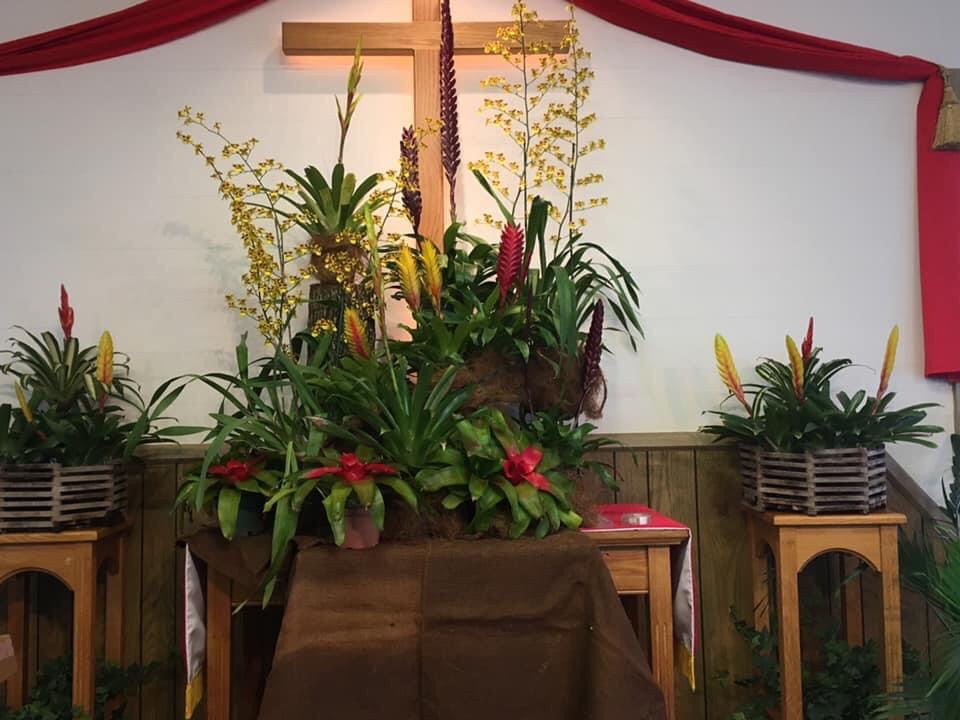
Filled Back Up

Pastor Sherry’s message for October 31, 2021

Scriptures: Ruth 1:1-18; Ps 146; Heb 9:11-14; Mk 12:28-34

This morning, we encounter as our Old Testament lesson, the lovely story of the friendship of Ruth and Naomi. (Various verses from the book of Ruth are often quoted at weddings.) The context is provided right off the bat, in the first verse in the days that the Judges ruled…. This means it was after the Israelites had entered the Land of Promise, and after the death of Joshua, Moses’ successor. It was a very dark period of Hebrew history (1380-1050BC). It was dark because, just a few generations after entering the Land—and after 40 years of wandering in the desert, and after seeing God’s signs and wonders—another generation grew up, who knew neither the LORD nor what He had done for Israel. Then the Isaelites did evil in the eyes of the Lord and served the Baals (Judges 2:10-11).

In other words, they would sin mightily against all the commandments, but especially the first 4. They rejected God and got involved in idolatry (Baal worship=spiritual adultery). God would then say, OK, have it your way…(Ro 1:28-29) Furthermore, since they did not think it worthwhile to retain the knowledge of God, He gave them over to a depraved mind, to do what ought not to be done. They have become filled with every kind of wickedness, evil, greed and depravity (sins against the last 6 commandments). God would then also remove His hand of protection from around them: He would allow Moabites to terrorize them; the Amalekites, Ammonites, or Philistines to subjugate them; the Midianites to raid them and cart off their crops, animals, and even their women and children. Sometimes God would not command rain to fall, which resulted in famine. They would then repent, beg for His help, swear again their allegiance to Him, and He would graciously rescue them. This would happen in about 40 year cycles, time for one generation to die off and be replaced by another.

When the story of Ruth begins, God has allowed a famine in the land. Scripture tells us that famine, locusts, or plagues are evidence of God’s judgment! So what should have been Israel’s response? 2 Chronicles 7:14 If My people, who are called by My name, will humble themselves and pray and seek My face and turn from their wicked ways, then will I hear from heaven and will forgive their sin and will heal their land. Even if they did not yet have 2 Chronicles to read, they had the 40 year cycles playing out in the book of Judges. The lesson, again and again, is Repent, pray, ask for God’s mercy.

Naomi and her family lived in Bethlehem in Judah, which means house of food/bread; in Judah which means praise. But, unfortunately, Naomi’s husband Elimelech (my God is King) decides not to repent, pray, and ask for God’s mercy, but rather to leave and head to Moab. YIKES! Understand that Elimelech leaves God’s protection and provision to move in with Israelite enemies/God’s enemies. He leaves the house of bread, in the region of praise, choosing not to wait on a miracle from God, but to leave the covenant community of Israel, and trust in his own resources; to do as he saw fit. He moves his family to the land of the Moabites, who were descended from Lot, born of incest. In Psalm 108:9, God says, Moab is my washpot garbage can. Willful Elimelech leaves the house of bread for the garbage can.

He takes with him Naomi (pleasant; Merry Sunshine!) and their two sons, Mahlon (sickly; weakling;) and Kilion (puny). Because of this fateful and foolish move, Naomi is reduced from fullness to emptiness: With 2 sons and a husband, Naomi leaves Bethlehem feeling “Full.” But, during their sojourn in Moab, she begins to empty. She has no additional children; her husband, Elimelech, dies; her two sons marry Moabite women, Ruth and Orpah—who are both lovely and loving, but who appear to be barren. Then, both young men die! Naomi winds up empty in Moab!

What does she decide to do? Like so many of us when life leaves us frustrated and alone, we either strike out for a new place/new beginning or we go back home, don’t we? She’s already done the former. So now it’s time to try the latter. She probably thought to herself, When was I last full? In Israel, when I lived among family; in Israel, where I had women friends; in Israel, where I lived under God’s protection. She may have even thought, Maybe the Lord allowed all of this because we didn’t trust Him

Did Naomi repent for having fled from the Promised Land? Did she pray? Did she ask for God’s forgiveness? It doesn’t seem like it because at first she returns to Bethlehem and tells the women there, call me Mara (bitter). Like a lot of us, rather than taking responsibility for being out of God’s will, she blames God for her misfortunes.

But our lesson today points to one benefit she has gained from her sojourn in the garbage pail: Ruth. Through Ruth, God begins to fill Naomi back up:

1.) First, consider Ruth’s character: She is compassionate. She knows Naomi is grieved and depressed, so she puts Naomi’s need for companionship and assistance ahead of her own comforts. This is what St. Paul would later define as agapao, a 1st Corinthians 1 type of love. She is also loyal. Maybe she had experienced first-hand Naomi’s kindnesses to her as a young bride. Perhaps Naomi had consoled her in her childlessness. Maybe Naomi had been very helpful to her during Mahlon’s illness and death. Scripture is silent on these points. Whatever had happened between them, it was enough for Ruth to prefer leaving her own homeland to venture to a land where she might be forever an outcast. I think that tells us she was courageous.

2.) Second, Ruth had become a God-follower, v.16–Your God will be my God…may the Lord deal with me, be it ever so severely, if anything but death separate you and me. How had that happened? Probably because of Naomi’s example: Naomi tells the women of Bethlehem that she knows God has brought me back empty (Hmmm, that implies she prayed), and to call her Mara. But she seems also to have practiced St. Francis’ (much later advice: Preach the Gospel at all times; if necessary, use words. Even if her depression was talking most recently, Ruth had seen the true Naomi, before all of her misfortunes. Maybe God was telling Naomi, through Ruth’s presence, I have blessed you with a true-blue friend!

And that was just the beginning, wasn’t it? If you know the story of Ruth, you know that Naomi still held a deed to a family-owned, but mortgaged, tract of land. God supplies a kinsman redeemer (a foreshadowing of Christ), Boaz, who generously pays off the mortgage and marries Naomi’s foreign daughter-in-law. We know God designed this because there was another fellow in the family who wanted the land, but not Ruth. Also, Boaz, an older guy, was rather amazed that this lovely young woman would desire him over guys her own age.

The childless Ruth bears a son to Boaz, Obed (servant of the Lord.) Obed is the father of Jesse, and the Grandfather of King David. More importantly, we know that Ruth and Boaz establish the line of Jesse of the tribe of Judah, out of which comes the Messiah, Jesus. The Lord fills Naomi back up–just like Job–really beyond anything she can ask or imagine.

Psalm 146 echoes the theme: Verses 5-6 say, Blessed is he [or she] whose help in the God of Jacob, whose hope is in the Lord his [her] God, the Maker of heaven and earth, the sea, and everything in them—the Lord, who remains faithful forever. Verses 7-9 almost seem to have been composed for Naomi in particular: He upholds the cause of the oppressed and gives food to the hungry…the Lord lifts up those who are bowed down…the Lord…sustains the fatherless and the widow….

Hebrews 9:11-14 exhorts us to trust in Jesus’ saving power. While Naomi and Ruth’s time predated Christ’s by centuries, nevertheless they were redeemed by a prototype of Christ. The writer to the Hebrews wants us to know and to appreciate the fact that the blood Jesus shed to pay the penalty for our sins far surpasses the blood of animals to make atonement for us. Jesus is our Kinsman Redeemer.

Mark 12:28-34 presents us with a lawyer (or teacher of the law) who confesses that loving God and loving our neighbors is more important to God than making burnt offerings (to remove the blot of sin) or sacrifices. Jesus commends him for his wisdom. Love of God—trust in God—and love of people are what most please God.

There are some wonderful lessons for us, given current events as well as our personal dilemmas and calamities:

1.) You may remember from last week, There is no situation I can get into that God cannot get me out of. If we trust in God, we will be all right. Elimelech and Naomi should have trusted in God. They could have saved themselves a lot of trouble if they had humbled themselves, repented, sought God, and prayed. He promises in 2 Chronicles 7:14 to hear, forgive, and heal if we do. However, because God is a redeemer, even though Naomi returned to Bethlehem minus a husband and two sons, she was richer for having a loyal, generous, and loving daughter-in-law. Ruth became the great-grandmother of King David and is included in the lineage of Jesus. Surely Naomi is in heaven rejoicing that that is the case!

2.) I am convinced that 2 Chronicles 7:14 is God’s answer to our personal dilemmas. No matter what be-devils you—health issues, depression or crippling anxiety, family quarrels, money problems, unpleasant situations at work or in the neighborhood—bring all these issues to God’s attention. Repent of your sins. Ask for His help. Trust in His love. Then watch and see what He does.

3.) I am also convinced that 2 Chronicles 7:14 is God’s answer to the trouble our country is in now. We need to confess our sins as a nation, to repent, and to return to our foundational beliefs in God. America was meant to be a “City set on a hill,” an example to the rest of the world of what a country can look like when it is focused on loving God and obeying His will. What we see now is a country that is suffering the consequences of being out of God’s will. He has lifted His hedge of protection from us. We are encountering all manner of troubles because we have walked away from Him. The answer, the antidote, is not to throw more money on our problems, but to return to the God who has purchased us with His own blood! Thanks be God who gives us the victory through our Lord Jesus Christ! Alleluia! Alleluia!

©2021 Rev. Dr. Sherry Adams

Where are We Left?

Pastor Sherry’s message for 10/19/2021

Scriptures: Job 38:1-7, 34-41; Ps 104:1-9, 24, 35c; Heb 5:1-10; Mark 10:35-45

Hudson Taylor (1832-1903), the great British missionary to China, spent 51 years in ministry there. Raised a Methodist, he went to China as a Baptist, founded the China Inland Mission—which targeted the interior of the country–brought 800 missionaries over the years to join him; founded 125 schools in 18 provinces, and led over 18,000 souls to Christ.

The story is told of his first voyage to China, aboard a sailing vessel. As it neared the channel between the southern Malay Peninsula and the island of Sumatra, the missionary heard an urgent knock on his stateroom door. He opened it, and there stood the captain of the ship. “Mr. Taylor,” he said, “we have no wind. We are drifting toward an island where the people are heathen, and I fear they are cannibals.”

What can I do?” asked Taylor.

“I understand that you believe in God. I want you to pray for wind.”

All right, Captain, I will, but you must set the sail.” “Why that’s ridiculous! There’s not even the slightest breeze. Besides, the sailors will think I’m crazy.” But finally, because of Taylor’s insistence, he agreed. Forty- five minutes later he returned and found the missionary still on his knees. “You can stop praying now,” said the captain. “We’ve got more wind than we know what to do with!”

Obviously, Taylor was a man of prayer. Additionally, he believed in God’s call on his life. He believed in God’s power to equip and provide for him. He also believed he would successfully make it to China and that God would do a mighty work among the Chinese through him. Similarly, I had felt convinced of God’s call on my life. Once, when I was in seminary, my school sent me to a conference in Jackson, Mississippi. On my return to Pittsburgh from Jackson, our plane hit some very bumpy weather. The woman in the seat next to me was a seasoned traveler. She flew frequently for work. But during this trip, she took out the “barf bag,” convinced she would lose her lunch before we crashed. I told her not to worry. I had prayed that angels would hold up our wings, the nose, and the tail of the plane and was convinced the Lord would save us because I was halfway through seminary and knew that God was not yet finished with me.

Taylor read the same Bible we do (probably the King James version.) Our passages today are all about faith. They appear to answer the question, “Where are we left?” Or, you may prefer, “Where does that leave us?” Or, as cynics might say, “What’s the point?”

I believe that question is best answered if we take our passages in order. Please pay attention to what our Lord is saying to us (The Bible is His love song to us).

A. In Job 38:1-7, 34-41, we find God revealing Himself to Job from the midst of a whirlwind, an impressive phenomenon of nature. Job has wanted an opportunity to put his case before the Lord. In our passage today, God shows up as Creator of the Universe. He begins by telling Job, in verse 2, that his complaints are unjustified because he argues from a place of limited understanding. Notice, the Lord does not explain why Job had to suffer, nor does he defend His divine right to let him. Instead, from verses 3-41, God asks Job a series of rhetorical questions about creation, all of which point to God’s power, sovereignty, and loving care. Essentially, God is saying to Job, “Who are you–My creation–to question, to critique Me–your Creator?” In a subsequent chapter, Job will admit that God is Sovereign over all things, including himself, and will humbly retreat from being angry with or making demands of God.

So, reading and understanding this passage, Where are we left? Like Job, we should stand in awe of God and His creative power. Like Job, we should trust in God because He is our creator and the lover of our souls.

Paul starts from the same place in Romans 1. Paul says God’s creation so demonstrates His greatness that unbelievers have no excuse to be atheists. Evidence of His goodness and His power surround us in nature. True, we are free to reject Him, but YIKES! He will allow us to do so, but we act to our detriment as He removes His “umbrella of protection” from us. Like Job, we want to trust in God’s goodness and love for us, despite our questions.

Remember the example of Hudson Taylor: When faced with cannibals, he didn’t get frustrated with God; instead, he trusted in God to see him through safely.

B. Psalm 104:1-9, 24, 35c continues the theme. Biblical scholars call this psalm a hymn of praise to the God of Creation. In fact, it appears to address the same questions God raised with Job. In Job 38:4, God asks Job, Where were you when I laid the earth’s foundation? Tell Me, if you understand. Psalm104:5 says—He [God] set the earth on its foundations; it can never be moved. In Job 38:8, God asks Job, Who shut up the sea behind doors when it burst forth from the womb?

The answer appears in Psalm 104:6-9–You [The Lord] covered it [the earth] with the deep as with a garment; the waters stood above the mountains. But at Your rebuke the waters fled, at the sound of your thunder they took flight; they flowed over the mountains, they went down into the valleys, to the place you assigned for them. You set a boundary they cannot cross; never again will they cover the earth.

Where are we left? Like Job, we should praise God for His power, His greatness, and His wisdom. Even when we don’t understand why things are going the way they are in our lives, we should praise God for His creation.

C. The writer to the Hebrews, in Hebrews 5:1-10, defines the function or purpose of a priest. Pastors are still referred to as priests in the Roman Catholic, Orthodox, Anglican, and Episcopal traditions. In the Protestant Reformation, however, priests were renamed as “pastors,” “ministers,” or “reverends.” No matter what you call him or her, however, the duties of a pastor include: (1) Being a person of prayer; (2) Having been called by God (acceptable to God); (3) To represent the people to God; and (4) To explain God’s Word to people.

The writer to the Hebrews wants folks to understand that Jesus currently fulfills the role of our Great High Priest. He sits at the right hand of the Father, interceding for us. Some would say He fulfilled the role of Prophet as he taught and healed during His earthly ministry. He spoke the words His Father gave Him to speak. He communicated the Father’s love, will, and healing power to us. They also contend we will see Him as King when He comes again, in glory, to assume His rightful authority over all the earth. So we see His 3 roles as prophet, priest, and king.

Jesus did all the things an earthly priest would do: He was a man of prayer. He was called and ordained to ministry (at His baptism, the Father said, This is my beloved Son in Whom I am well pleased). He provided the sacrifice for our sins—the once and for all perfect sacrifice—not of animals but of Himself. He was totally submitted to the will of His Father, even unto death.

So, where are we left? Saved and secure! Saved and secure! Jesus paid our sin debt. Jesus’ sacrifice earned our salvation, our freedom.

Again, we should be grateful!

D. Jesus teaches the disciples, once again—in Mark 10:35-45–that ministry in His Kingdom is not about position and power, but about servanthood and humility. John and James are jockeying for favored positions in Jesus’ new administration. Jesus responds to them in two ways:

First, He asks in verse 38–Can you drink the cup I drink? This is an old Jewish expression which means, Can you share my fate? They appear to believe they can. Next, He tells them they will suffer and die, as He is going to, but that He does not have the authority to grant them positions of privilege—that prerogative is the Father’s. .

The angry response of the other 10 to John and James power ploy prompts Jesus’ teaching in verses 42-45–You know that those who are regarded as rulers of the Gentiles lord it over them, and their high officials exercise authority over them. Not so with you. Instead, whoever wants to become great among you must be your servant, and whoever wants to be first must be slave of all. For even the Son of Man did not come to be served, but to serve, and to give His life as a ransom for many. What pleases God in His Kingdom is our each having a servant’s heart. Demonstrating humble and loving service to God and others is how we advance in the Lord’s eyes.

So, where are we left? Serving God and others, humbly rather than looking for recognition, bonuses, or rewards.

Where are we left? We want to trust in God, in spite of our circumstances. The God of Creation–the God who created us–deserves our adoration and praise. The author of our salvation, Jesus, deserves our gratitude and love. The Father is worthy. Jesus is worthy. The Holy Spirit is worthy.

Additionally, in God’s Kingdom, He responds favorably to prayer and humble service. He restored a humble and worshipful Job. He raised an obedient Son from the dead. He listened to and responded to the prayers of a humble missionary, Hudson Taylor.

As I see it, the following story seems to indicate where God might have us end up:

Some years ago, at the Seattle Special Olympics, nine contestants–all physically or mentally disabled–assembled at the starting line for the 100-yard dash. At the gun, they all started out, not exactly in a dash, but with a relish to run the race to the finish and win. All, that is, except one little boy who stumbled on the asphalt, tumbled over a couple of times, and began to cry.

The other eight heard the boy cry. They slowed down and looked back. Then they all turned around and went back… every one of them! One girl with Down’s Syndrome bent down and kissed him and said, “This will make it better.” Then all nine linked arms and walked together to the finish line. Everyone in the stadium stood, and the cheering went on for several minutes.

Stories like this warm our hearts, and may even make us cry. Those children showed all the adults watching how we are to love and to live—not left crying on the track, but uplifted, helped, and loved by our friends. We can be this loving and caring. Let’s practice having servants’ hearts this week. Thanks be to God who gives us the victory through our Lord, Jesus Christ! Alleluia! Alleluia!

©2021 Rev. Dr. Sherry Adams

PASSING MARKS

Pastor Sherry’s message for October 10, 2021

Scriptures: Job 23:1-17; Ps 22:1-15; Heb 4:12-18; Mk 10:17-31

The story is told of an Ohio State University student who was academically competent but tended to need time to complete assignments (smart but not speedy).  You may know the type.  They do know the material, but think things through carefully until they have the right answer.  Others may come to the answer more rapidly but few are as careful as this.

The student was troubled by a Calculus class he needed to pass—and wasn’t—with a demanding, annoying professor.  The guy seemed to delight in frustrating his already discouraged students.  During exams, he would walk around, watching them like a hawk, expecting to discover someone cheating.  He would frequently announce the amount of time left—30 minutes, 20 minutes, 10 minutes, etc.- just to interrupt their trains of thought and to agitate everyone.  In a class of 1,000 students, the slow-but-steady young man was the only one not to turn in his exam when time was called.

The prof waited impatiently and then, an hour later, when the young man finally finished his test, the prof asked him what he thought he was doing.  The kid answered, “Turning in my exam.”  The prof replied, “Your exam is an hour late. Congratulations!  You’ve failed it.  So, I will see you next term when you repeat my class.”  The student smiled and asked, “Do you know my name?”  The prof replied gruffly and incredulously, “What?” The student rephrased his question, “Do you know what my name is?” With irritation, the prof replied, “There are 1,000 students in this class.  What makes you think I would know your name?”  The student then smiled, and, lifting up a tall stack of test booklets, placed his completed test in the middle of the pile and casually exited the huge lecture hall.

Life sometimes presents us with tests–and authority figures– like that one.  We may think our prospects are slim and we don’t have much of a chance of succeeding. But the truth is that if we have a relationship with the Lord, we can make it through any trial that might come.  Let’s see what our passages today have to add to this issue:

A.  Our OT lesson comes from Job 23:1-17.  You may recall that the Lord is so confident of Job’s righteousness that He allows Satan to strip him of his family, his wealth, and his health.  Satan is sure Job will turn against God if his blessings are all removed.  But Job is such a faithful believer that he does not, even though his wife advises (Job 2:9), Curse God and die (Great advice, right? Horrible!).

Instead, Job spends much of the book trying to figure out how he has offended God.  He believes he is being punished, but stops short of blaming God (This is such a good lesson for us!).  In today’s chapter, he begins to believe his faith is being put to the test.  So he wants an opportunity to speak to God face to face.  In verse 3 he admits he doesn’t know where to find Him; in verses 4-7, he is sure that if he could locate God, and confront Him, God wouldn’t find any problems with him.

YIKES!  Don’t you just want to tell Job 3 things:

    #1, None of us is without sin—as Paul says, except for Jesus, No, not one!  As J. Vernon McGee says, No one can go into the presence of God to defend himself.  We must all go before God to plead guilty before him.  Every one of us is guilty (commentary on Job, p.125).  We are only made righteous—we only have passing marks– because we have been cleansed by the shed blood of Jesus Christ.

    #2, So, if we think we can defend ourselves before God, we need to remember to approach Him with humility.  He is God; we are not! 

    #3, Finally, anyone who seriously wants to find God will do so.  Our God is not hiding from us.  In fact, He calls us to Himself.  If we really want to meet up with Him, He will make Himself known to us—through Scripture, dreams, billboards, overheard conversations, song lyrics, and life events (to name a few means at His disposal).  And unlike the calculus professor at Ohio State, God is for us, not against us.

But praise God!  By the time Job arrives at verse 10, he realizes he is being tested for some purpose.  Like us, he doesn’t yet know what the purpose is.  Like us, he doesn’t understand why he needs testing.  But—hopefully also like us—he does believe that God is using this testing to somehow bring about His good purposes in Job’s life.  If we let it, trouble strengthens our faith.  If we let it, trouble improves our moral character.

If we let Him, God will comfort us and equip us as we move through our difficulties.  Some unnamed wise person once said, You know that God has never promised that we would miss the storm, but He has promised that we would make the harbor.

B.  Psalm 22 is known as “the Psalm of the Cross.”  Written by King David (around 1,000BC) before the Romans invented crucifixion, it provides us a clear window into Jesus’ thoughts as He hung on the Cross.  Some scholars believe Jesus recited this psalm from memory while nailed to the Cross.  In verses 1-2, Jesus essentially cries out to His Father, My God, where are you?  He is feeling deserted and abandoned.  In verses 3-5, He reminds Himself that His Father is the Holy One in whom the patriarchs of Israel put their trust…they trusted and You delivered them…in You they trusted and were not disappointed.

Unlike Job or us, Jesus was entirely without sin.  He had personally done nothing to merit death.  In verses 6-8, He states that He knows He has not provoked the attacks of vicious and vindictive men; and that, thus far, God has not delivered Him from their cruelty.  He reminds His Father that He has trusted in Him from birth.  Finally, verses 12-15 describe His deep physical and emotional distress.  Here is indeed a portrait of unjust suffering.  By the end of the psalm, however–as by the end of the book of Job–we find that the truly righteous, despite their suffering, still maintain their faith in the Lord.

C. Our Gospel lesson (Mark 10:17-31) relates Jesus’ encounter with a rich young man.  The fellow mistakenly believes in his own righteousness.  He says he has kept the last 6 commandments all of his life, the ones that have to do with how we relate to others.  We are told that Jesus loved him, even though He realized the man has probably not kept the first 4.  How did Jesus know?  He recognized the man’s wealth was an impediment to his relationship with God.  Jesus asks him to give it up.  The young man walks away from Christ because he cannot (his wealth was his idol); and both he and Jesus are saddened by his decision.

The message is to give up whatever keeps us from remaining close to Jesus.  At one time with me, it was my children.  I didn’t trust God to care for them.  I had to give that up and then noted how much better they did than when I tried to control them.  Later, I learned that God was not selling my house because I was not willing to pastor a church.  I thought I had been called to ordained ministry, as a psychologist, to do therapy with the clergy.  But the Lord made it clear I had to give that goal up too.  The day that I agreed to do whatever God asked of me, my house sold.  My realtor brought a couple by to see it at 5:00pm and I had a signed contract by 8:00pm.  Jesus promises us we will receive blessings 100 times greater than whatever we have to give up for His sake.  He promises us eternal life, despite any and all persecution.

D.  The writer to the Hebrews (4:12-18) wants us never to forget that God’s Word activates us/energizes us to hold firm to our faith.  Scripture is more than words on a page.  It comes with power to help us achieve what God has for us.  Secondly, it exposes us to God’s sight.  If we compare ourselves to the biblical standard, we see where we fall short.  We can’t really get away with slipping our exam booklet into the middle of the pile.  God knows all about us.  Thirdly, Jesus’ example, and His once and for all perfect sacrifice for our sins, allows us now to approach God’s throne of grace not with fear of condemnation, but with confidence in God’s loving grace and mercy.

None of us wants to suffer, do we? Nevertheless, we have to realize that following Christ does not give us a pass to avoid problems.

Rather it is a guarantee—as we see in the outcomes of Jesus and of Job—of blessings and God’s favor following our faithfulness through trials.  Because of God’s grace and mercy, we are all like calculus students who have gotten away with not finishing on time by putting our test booklets in the middle of the pile.  Chuck Swindoll has written (in One Step Forward, Two Steps Back, p.35), “Every problem is an opportunity to prove God’s power.  Every day we encounter countless golden opportunities, brilliantly disguised as insurmountable problems.”

Let us pray:  Lord, we know we make better than passing marks when we remember that You do not promise to save us from trials, but You do promise to be present with us as we endure them.  We ask Jesus to tattoo on our hearts the reminder that He suffered untold agonies to atone, in advance, for our sins.  Help us to recognize that there is nothing we can do to achieve or earn our salvation.  Our money will not get us to Heaven, just as our good behavior or our generosity toward others will not.  It is only by loving You and Jesus, and accepting our grace-filled redemption at Your hands, that we are saved.  Assist us to let go of all and any impediments or roadblocks to having a satisfying, deeply faithful, intimate relationship with You.  Amen! 

©2021 Rev. Dr. Sherry Adams

The Law of Sowing and Reaping

Pastor Sherry’s message for 9/26/2021,

Scriptures: Esther 7:1-10; 9:20-22; Ps 124; Jas 5:13-20; Mk 9:38-50

For several weeks we have examined the choice between living righteously for God and living foolishly for self. The story is told of two missionaries to a town called Efulan, in Cameroon, Africa, who became ill and had to return home to the US. They felt bad about abandoning their work and wondered what would become of the 6 men they had been able to convert to Christ. Two years later, they were able to return and were shocked to discover:

1. The 6 Jesus-followers had met weekly for prayer and Bible study;

2. They had witnessed to others about Jesus, to the extent that they became known as “the Jesus men.”

3. 25 years later, that church had grown from 6 men to 7000! Additionally, 3 indigenous ministers had been raised up and trained. And at a special service, 24 native elders helped distribute communion to the 7000 members.

It sounds shocking, I’m sure, that so much growth could take place without the 2 missionaries being there to mentor and teach. I had a similar lesson myself, about 30 years ago. Before going to seminary, I left a group counseling practice to set up an office on my own. It was a true financial risk, one I did not share with my clients. Instead, I closed down for a week to paint and decorate my new space, then launched into private practice. All of my clients moved with me, I was gratified to learn. What I had not expected, however, was how much they would grow and change without me. Each one had made some sort of break-through while I had been out of pocket. It was such a lesson in humility for me. As I discussed it with the Lord, I apologized to Him for thinking He needed me to heal my clients. I learned that week that He did the healing and I was just an instrument He could use or do without.

Those two unnamed missionaries lived for God. They worked faithfully in the mission-field of Cameroon. God grew their initial labor into a church in their absence. Like me, they had sown to the good, and God multiplied and blessed their efforts (as He did mine).

Paul states for us “The Law of Sowing and Reaping” in Galations 6:7-8–Do not be deceived: God cannot be mocked. A man reaps what he sows. The one who sows to please his sinful nature, from that nature will reap destruction; the one who sows to please the Spirit, from the Spirit will reap eternal life. This is not one of our Scripture passages appointed for today, but it does present the foundational theme common to them.

Once again, we are presented with the choice: if we do ungodly things, they tend to boomerang back on us; whereas, if we do good things—like the missionaries—blessings come back to us.

A. Esther 7:1-10; 9:20-22 explains why the Jews celebrate the feast of Purim. It is meant for them to express their gratitude for God’s divine deliverance. Queen Esther, an undercover Jewish woman, was chosen by King Xerxes of Persia to become his new wife/queen. (He had divorced the beautiful Vasti for having disobeyed s summons.) Now Haman, the King’s “Prime Minister,” hated the Jews–especially Esther’s Uncle Mordecai, a palace scribe. Haman sneakily encourages the King to pass an edict that would allow citizens of his entire empire to attack and kill Jews, all over his empire, on a certain, future date. Not realizing his queen was a Jewess, Xerxes signs the edict into law. Once he did so, according to Persian custom, his edict could not be rescinded.

Uncle Mordecai gets a message to Esther encouraging her to ask her husband to overrule his original edict with another which would allow Jews to defend themselves. Our passage today divulges her strategy: She invites the King and Haman to two banquets. During the first, she does not make her request. Xerxes is so pleased—and Haman is so flattered—that the King is willing to give her up to half his extensive kingdom. But, having primed the pump, she simply invites the two men back to a second banquet.

At the second, she reveals that she is Jewish and asks that the king spare her people who are set to be annihilated (by his own order). The King has a short memory. He fails to realize he signed a death warrant for all the Jews in Persia. Until Esther confronts Haman, Xerxes also fails to remember that Haman had initiated the idea. The King is furious over his dilemma and “takes 5” to mull over a response. In his absence, Haman appears to attack the Queen as she is reclining on her eating couch. Perhaps he is fearful and enraged, but maybe he is frantically entreating her forgiveness and mercy. Whatever Haman’s motives, Xerxes returns, and believes Haman intends to rape his wife in the king’s own palace. Ironically, Haman is sentenced to death—for abusing the queen–on the very gallows he had erected to hang Uncle Mordecai!

I think all of us would agree this is a dramatic example of the boomerang effect of the Law of Sowing and Reaping. There are other scriptural examples, as well: Old Testament Jacob tricked his blind father, Isaac; later Jacob’s 10 sons tricked him into believing his favorite son, Joseph, was dead. Additionally, Jacob cheated his brother, just as Uncle Laban later cheated him, again and again. Paul appears to have authorized the stoning of the first Christian martyr, Stephen; later, after his conversion, Paul himself is stoned, almost to death, on his 1st missionary journey. If we choose to do the devil’s work, the same kind of evil often later boomerangs back to us.

B. Psalm 124, on the other hand, recounts what happens to those who choose to love God—He protects them! King David recalls how God rescued the Israelites time and again. He is quick to give God the glory in his famous last line: Our help is in the name of the Lord, the Maker of heaven and earth. When we choose to honor God, to trust in God, He blesses us—a positive boomerang.

C. In James 5:13-20, the practical disciple reiterates King David’s point. God is trustworthy and takes care of us. If we love and serve Him, He answers our prayers and rescues us from trouble; He desires to heal us and to forgive us when we ask; and He delights in our praise. James gives us the example of Elijah whose God-directed prayers prevented rain in Israel for 3.5 years. Then, when again directed by God, his prayers brought on the rain. James reminds us in verse 16b—The prayer of a righteous man is powerful and effective.

There we have it: Righteous living results in prayers that are effective. What a fantastic positive boomerang! Incidentally, when I discover God withholding an answer to prayer I have repeatedly placed before Him, I have to consider what I may have done that might pose a sin-based-impediment to His taking action. Many of us get angry when God appears not to answer our prayers. Instead of being angry with Him, we might be better off examining our own hearts. It is, afterall, the prayers of a righteous person that are powerful and effective.

D. In Mark 9:38-50, Jesus spells out both a positive and a negative result of the Law of Sowing and Reaping. In verses 39-41, Jesus implies that blessings come to those who do miracles and provide physical refreshment to others in Jesus’ name. In other words, good deeds result in blessings. Conversely, in verses 42-48, Jesus states what happens to those who cause children (or “little ones”, perhaps “innocent ones”) to sin—it would be better for [them] to be thrown into the sea with a large millstone tied around [their] neck[s]. It brings to mind pedophiles, doesn’t it? And people like sex traffickers and the Jeffrey Epstein’s and Harvey Weinstein’s of the world. There may be a special level of hell reserved for those folks. Again, if we perpetrate evil, it will boomerang back on us.

Jesus then goes on to exaggerate for effect. He says to cut off or gouge out any body part that leads us to sin. We are not meant to take this literally, blinding or mutilating ourselves. Instead, we want to make every effort to not cooperate with the evil one by sinning, especially in a habitual way. We want to remain committed to Christ and to ask His forgiveness when we stray.

Someone has composed a poem which summarizes the positive side of the Law of Sowing and reaping:

Life’s Mirror

There are loyal hearts, there are spirits brave;
There are souls that are pure and true;
Then give to others the best you have,
And the best will come back to you.

Give love, and love to your life will flow,
A strength in your inmost need;
Have faith, and other hearts will show
Their faith in your word and deed.

Give truth, and your gifts will be paid in kind,
And honor will honor meet;
And a kindly smile will surely find,
A smile that is just as sweet.

Give a helping hand to those in need,
And a harvest of golden grain
You’ll reap some day from the love-sown seed,
If you sowed in the Master’s Name.

For life is the mirror of king and slave—
‘Tis just what we are and do;
Then give to others the best you have,
And the best will come back to you.

This week, let’s try to be aware of which direction we are sowing toward. The Law of Sowing and Reaping is, like King Xerses’ edicts, immutable. Once our actions have put evil into play, we run the dire risk of having it return to us. However, on the other hand, when we put blessings into play, blessings come back to us. With a thought toward reaping God’s best, let’s be aware of doing our best toward Him and others. Amen! May it be so!

© 2021 Rev Dr Sherry Adams

True Security

Pastor Sherry’s message for September 5, 2021

Scriptures: Proverbs 22:1-2, 8-9, 22-23; Psalm 125; James 2:1-17; Mark 7:24-37

The following story was included in an edition of Our Daily Bread:

A group of botanists went on an expedition into a hard-to-reach location in the Alps, searching for new varieties of flowers. One day as a scientist looked through his binoculars, he saw a beautiful, rare species growing at the bottom of a deep ravine. To reach it, someone would have to be lowered into that gorge. Noticing a local youngster standing nearby, the man asked him if he would help them get the flower. The boy was told that a rope would be tied around his waist and the men would then lower him to the floor of the canyon. Excited yet apprehensive about the adventure, the youngster peered thoughtfully into the chasm. “Wait,” he said, “I’ll be back,” and off he dashed. When he returned, he was accompanied by an older man. Approaching the head botanist, the boy said, “I’ll go over the cliff now and get the flower for you, but this man must hold onto the rope. He’s my dad!”

A story from an anonymous source recalls the initial construction on the Golden Gate Bridge. Apparently, no safety devices were used and 23 men fell to their deaths. For the final part of the project, however, a large net was used as a safety precaution. At least 10 men fell into it and were saved from certain death. Even more interesting, however, is the fact that 25% more work was accomplished after the net was installed. Why? Because the men had the assurance of their safety, and they were free to wholeheartedly serve the project.

These stories illustrate so beautifully the source of our security in life. The boy could have trusted in the scientists as they were eager to obtain the rare bloom. But he knew he could feel true security only in his own father’s hands. The Golden Gate construction crew could have trusted in their own prowess and skills. Nevertheless, they performed more efficiently and effectively with the security provided by a safety net.

Last week, we looked at what it takes to dwell with God. This week, our Scriptures assert that God is our sure hands and our safety net.

A. Our OT lesson contains 6 Proverbs. Together these assert for us our God created all of us. Rich or poor, or in-betweens, He brought us into being; however, this doesn’t mean that He views all of us the same way. As verse 8 tells us, He who sows wickedness reaps trouble, and the rod of his fury will be destroyed. The Bible divides the people of this world into two camps: the righteous and evil-doers, sheep and goats. Those who are evil-doers will reap what they sow. God will both repay their evil with evil (Boomerang effect), and ultimately thwart/stymie/interrupt their ability to continue their evil practices. The righteous, on the other hand, will be blessed.

This point is reiterated in verses 22-23: Do not exploit the poor because they are poor and do not crush the needy in court, for the Lord will take up their case and will plunder those who plunder them. Yikes! Again we see the principle of reaping and sowing, of “what goes around comes around.” God oversees the world and punishes evil-doers, either in this world or the next. Even if we don’t see the evidence of this at present, the principle still holds—our God is in charge and we can count on His justice!

B. Psalm 125 is called the “Song of Security.” It asserts that

God protects and provides for us, and that the wicked, in eternal terms, have short shelf-lives. Think of the worst tyrants in history. Many were assassinated; many others went mad or took their own lives. True security comes from our intimate relationship with God. It is as rock solid as the mountains around Jerusalem. As Peterson paraphrases (The Message, p.1072), we can trust ultimately that God will round up the backsliders, corral them with the incorrigibles.

C. James 2:1-17 continues this theme. If he were present with us today he would tell us there is no “brotherhood of all humankind.” Instead, there are two kinds of folk: Good people and evil-doers, those who love God and those who reject Him. The “woke folk” would assert that this is intolerant and bigoted, prejudicial and inequitable. But the Bible asserts over and over again that we chose our path. God doesn’t coerce us to take one direction or the other. Our own choices place us on His team or off. We choose whether or not to join the “fellowship of believers.”

So, given this Biblical truth, James spends 11 verses telling us to be sure to demonstrate/live out loving our neighbor. We’re not to show favoritism to rich people over poor, attractive over unattractive folks.

If we are unmerciful and judgmental toward others, God will respond that same way toward us. In verse 13, James reminds us: Mercy triumphs over judgment!

D. Finally, John Mark (probably writing for Peter) shares with us two examples of Jesus’ mercy:

In the first, Jesus treks up to Tyre, north of Israel, to find respite and rest from the crowds following Him. Nevertheless, a Greek woman (according to Matthew) born and living in Syro-Phoenicia, tracks Him down. We don’t know if she believes in the Hebrew God, but she appears to have faith that Jesus can heal her demonized daughter. She garners His attention then enters into a debate with Him. He appears to tell her He isn’t meant to offer healing and salvation to non-Jews (the children at the table). She may not see herself as a dog–like the Jews of the time would have–but she argues that even they get the crumbs that the children drop while eating. In other words, she believes Jesus offers enough to go around to even her. (I remember how my toddler son, from his highchair, would take a bite then hand his cookies or biscuits to our German Shepherd. As a partner in crime, the dog would gently take and eat these offerings.) Jesus is impressed by her humility, her faith, and her perseverance. He assures her that her daughter is healed. He says she is healed from the distance, and Mark reports that the woman returned home to find it was true. As James would say, Mercy triumphs over judgment. Unlike His disciples, Jesus does not overlook the needs of the non-Jews who approach Him in faith. Our God’s mercy transcends the man-made boundaries of race, nationality, political affiliation, and gender.

Next Jesus travels back south to the Sea of Galilee–imagine how many miles He put on His sandals!–and east to the area known as the Decapolis (10 towns). Folks there ask Him to heal a deaf-mute man. Jesus takes the man out of the limelight (off TV, away from phone cameras). He puts His fingers in the guy’s ears first; then, in a way that seems very unsanitary to us, He places some of his spit on the man’s tongue. (This puts me in mind of “mom spit.” How many of us have had spots on our faces washed with mom-spit applied to her finger or thumb? They should examine its chemical properties to discover how it cleans.) Jesus exclaims Ephpatha! Open up! And the man’s hearing and his speech is restored. We don’t know if the guy was a believer, but his friends had faith in Jesus’ ability to heal. This is yet another example of Jesus’ mercy.

Intent on discovering His “healing method,” I once did a review of all of Jesus’ healings recorded in the 4 Gospels. I had to conclude there was no one method we could imitate. He healed some with a word, others with touch, still others with spit or the command to do something (pick up a mat, go see the priests, go wash, etc.). He even insisted that some healings came about due to prayer and fasting. Though His methods varied, what He did appears to have been tailored to meet the needs of each individual.

In conclusion, we can truly rest secure in the fact that our God loves us, protects us, and provides for us. Again the story is told from a daily devotional:

There is a monastery in Portugal, perched high on a 3,000 foot cliff, and accessible only by a terrifying ride in a swaying basket. The basket is pulled with a single rope by several strong men, perspiring under the strain of the fully loaded basket. One American tourist who visited the site got nervous halfway up the cliff when he noticed that the rope was old and frayed. Hoping to relieve his fear he asked, “How often do you change the rope?” The monk in charge replied, “Whenever it breaks!”

Thank God our God is more proactive than that group of monks!

Let us believe in what the psalmist asserts (125:1-2): Those who trust in the Lord are like Mount Zion, which cannot be shaken but endures forever. As the mountains surround Jerusalem, so the Lord surrounds His people both now and forevermore. Jesus Christ is our safety net. Jesus Christ—not our bank accounts, our human contacts, our personal power, our intellect, our degrees, our influence, or safety features like security systems, guns, or non-frayed ropes–provides our true security. Thanks be to God who gives us the victory through our Lord Jesus Christ! Alleluia! Alleluia!

©️2021 Rev. Dr. Sherry Adams

Keeping the Faith

Pastor Sherry’s message for August 29, 2021

Scriptures: Song of Songs 2:8-13; Ps 15; Jas 1:17-27; Mk 7:1-8, 14-15, 21-23

Recently I read Michael Youssef’s book, Saving Christianity (published in 2020). In it, he describes the factors that have led to a serious decline in membership and Sunday attendance in mainline Christian churches such as ours. Youssef is a naturalized US citizen from Egypt. He is the lead pastor of the Church of the Apostles in Atlanta, Georgia (the Buckhead neighborhood). He left a mainline denomination to found his church in 1987. He departed because his superior (a Bishop or Superintendent, unnamed in his book) had rejected the Biblically-faithful notion that Jesus Christ is the way, the truth, and the life, and the only way to the Father. Like too many mainline church leaders, that fellow (Youssef’s boss) did not believe the Bible is the inspired and inerrant Word of God. He also didn’t believe in salvation by grace through faith in Jesus Christ, and only Jesus Christ. (I have served under several such leaders. Like Youssef, I had to walk away from their apostasy.) This leader mocked Youssef as he withdrew to plant the Church of the Apostles. Youssef started with fewer than 40 souls. But, through faithful Biblical preaching and teaching–and a vigorous, Christ-centered outreach to the surrounding community–His church has now grown to over 3000 members.

He believes–and I agree—that we cannot cherry-pick the Scriptures, taking in what we agree with and rejecting what we disagree with. There is no integrity to that. Just as Jesus is either God or a madman–but not simply a moral leader or a good teacher–there is also just one choice with the Bible. Either we accept the Bible as God’s word written, in its entirety, or we reject it.

Under the guidance of the Holy Spirit, we are told in 2 Peter 2:1-2–But there were also false prophets among the people, just as there will be false teachers among you. They will secretly introduce destructive heresies, even denying the sovereign Lord who bought them—bringing swift destruction on themselves. Even as far back as the first century, the Church was infiltrated by heretics who sought to either alter or water down the faith. Here Peter is warning the infant church to be wary of those who preach or teach false doctrines. Similarly, Jude, Jesus’ brother, warned in Jude 3-4–I…urge you to contend for the faith that was once for all entrusted to the saints. For certain men whose condemnation was written about long ago have secretly slipped in among you. They are godless men, who change the grace of our God into a license for immorality and deny Jesus Christ as our only sovereign and Lord. The apostle John cautioned, in Revelation 22:18-19–And I warn everyone who hears the words of the prophecy of this book: If anyone adds anything to them, God will add to him the plagues described in this book. And if anyone takes words away from this book of prophecy, God will take away from him his share in the tree of life and in the holy city which are described in this book. Clearly, we are not to add verses or subtract verses from the Bible. As I have urged before, if we don’t understand a Scripture passage, or don’t like it, we are to trust in God’s purposes for us, study the opinions of reliable Bible scholarly and commentators, and patiently wait upon the Holy Spirit to make its meaning clear. As Paul counsels Timothy, (2 Timothy 3:16-17) All Scripture is God-breathed and is useful for teaching, rebuking, correcting and training in righteousness, so that the man [woman] of God may be thoroughly equipped for every good work.

Our passages assigned for today substantiate this approach. They also demonstrate to us the wisdom of Scripture:

A. Song of Songs 2:8-13–reaffirms to us that Jesus loves us.

This book is God’s endorsement for love and sensuality in the marital context. Like the “Beloved,” the newlywed wife depicted here, we are to eagerly anticipate being reunited with Christ. We don’t know where her groom had disappeared to, whether to military deployment, a business trip, or hospitalization, but she waits to hear his voice alerting her to his return. Similarly, Jesus is now physically separated from us, as He sits at the right hand of God the Father in heaven. But we can and do hear the Bridegroom’s or Jesus’ voice through God’s Word. We who believe in Jesus as our Savior, await his call to us—either from the grave or at the rapture—Arise, come, my darling; my beautiful one, come with Me. Our Lord wants us to dwell with Him in heaven.

B. Psalm 15–is a description of those who will dwell with God.

Verse 1 asks the question, Lord, who may dwell in Your sanctuary? Who may live on Your holy hill? The remainder of the psalm provides the answer:

1. Those who are upright/righteous;

2. Those who speak truth;

3. Those who do not slander others or hold grudges;

4. Those who despise vile actions but honor righteous behavior;

5. Those who keep their oaths, even when it costs them;

6. Those who make an honest living and never accept a bribe.

The psalmist, King David, predates Jesus but nevertheless describes Christ’s character. We are to be like Jesus. Those who revere the Lord and who order their lives in accordance to His will can look forward to living with Jesus in heaven. Those who love Him and act like Him will dwell with God.

C. In our Gospel lesson (Mark 7:1—8, 14-15, 21-23), Jesus distinguishes between outward ritual (religion by rote) and heart attitudes. The Pharisees have come to listen but also to find fault. They fault Jesus because His disciples are not following one of their traditions, hand-washing before meals. This practice is wise, a fact which has certainly been reemphasized in this era of Covid. But in the arid Ancient Near East, water was hard to come by. However wise it is for one to wash hands before eating, Jesus reminded them that it is not mandated by Scripture.

Jesus then takes them to task and calls them hypocrites! He points out that they adhere to man-made rules but neglect their relationships with God and their family members. Jesus then goes on to list the sins that come from a wrong heart-attitude toward God and our relatives and neighbors:

1. Sexual immorality;

2. Theft;

3. Adultery;

4. Greed;

5. Malice;

6. Deceit;

7. Lewdness;

8. Envy;

9. Slander;

10. Arrogance and folly.

Notice, these behaviors and attitudes are nearly the opposite of those recommended by our psalmist, David. Jesus is saying, essentially, it’s not rule-keeping or going through the “holiness motions” that allows us to dwell with God, but rather the condition of our heart. Do we love Jesus? Do we ask the Holy Spirit to help us to think and to live like Jesus? Are we surrendered and obedient to the will of God?

D. Finally, James, the brother of Christ–ever offering us practical advice—reminds us in James 1:17-27–(verse 17)—Every good and perfect gift is from above, coming down from the Father of the heavenly lights, who does not change like shifting shadows.

In other words, all good things come from God, who desires to bless us.

We can trust in Him because, unlike humans, He is always faithful and true.

James continues in verse 19–My dear brothers, take note of this: Everyone should be quick to listen, slow to speak, and slow to become angry. He advises us to listen to God and others carefully. Truly hear someone out before composing a rebuttal or a come-back in your mind. Then take time to consider your response before speaking. We all know that once words are spoken, they are difficult to take back. Be careful about becoming angry, and careful with your anger expressions. It is not a sin to become angry, but so often it is what we do with our anger that offends God.

In verse 22 James admonishes us—Do not merely listen to the word, and so deceive yourselves. Do what it says! We are not to be consumers of church services. We are to use what we learn on Sundays to guide the way we operate in our world. We need to “walk the walk.” If a nonbeliever were watching us, would they see enough evidence to assume we are followers of Jesus Christ?

Our passages today confirm for us that (1) Jesus loves us.

(2) We can believe that if we love Jesus, and behave like Him toward God and others, we will join Him in heaven. (3) Christ-like heart attitudes matter more to God than empty ritual and non-biblical tradition. (4) Our faith is evidenced in action.

Youssef believes the broader Christian Church is being decimated by “enemies from within,” by apostasy (false doctrines), and by our lack of respect for the Word of God. Our foes are those who call themselves Christians while divorcing themselves from the Biblical faith.

These folks are being deceived by the evil one (Remember from last week that we are in a spiritual battle). Youssef writes (p.93), If you abandon the foundation of Christianity—the Scriptures and the atoning death and resurrection of Christ—and replace the Christian gospel with the secular left agenda of Darwinism, climate change, identity politics, victim oppression politics, LGBTQ politics, and on and on, you will become the darling of the media and the leftist political establishment. You’ll be interviewed on CNN, MSNBC, and NPR, and you’ll write for the “Washington Post” and “New York Times,” and you’ll be praised by the “Daily Beast” and “Huffington Post.” You can call yourself a “person of good news,” but it won’t be the Good News of salvation by grace through faith in Christ.

NO Sir, our hope is set on nothing less than Jesus and His righteousness! It is not politically correct these days to be a faith-filled, Bible-believing follower of Jesus Christ (Remember, we are in a spiritual battle). But I would rather be out of step with the power-elites, the politically correct, and all the woke folks, than turn my back on Jesus Christ as revealed to us in Scripture, and as faithfully passed remembered and passed on to us by generation after generation of believers in the apostolic faith.

©️2021 Rev. Dr. Sherry Adams

Semantic Spin Revisited

Pastor Sherry’s message for June 6, 2021

Scriptures 1 Sam 8:1-20; Ps 138; 2 Cor 4:13-5:1; Mark 3:20-35

Three years ago, when these Scripture passages appeared in the Lectionary, I preached about “Semantic Spin,” and the distinction the media and politicians were making at that time between a “spy” and an “informant.” I referred to that as a real life example of defining something one way to deflect criticism, when in truth it is actually the opposite.  Despite the 9th Commandment, which prohibits lying–or bearing false witness against another—isn’t it all too frequent that we find our politicians, media, business leaders, educators, and neighbors, spinning lies to in an attempt to manipulate our cooperation/compliance/agreement?  Some notable examples recently include: 

​​1. Critical Race Theory—now embedded in our school curricula, government, military, and corporations—and touted as truth, it defines human history as a struggle between oppressors, usually white, against everyone else.  This is Marxism with a new spin.  Rather than breeding a spirit of unity in our country, it actually promotes racial division and hatred.

​​2. We were told the Group “Black Lives Matter” exists to encourage and strengthen black families; but it is actually a front for funding and fomenting civil unrest and hatred toward America.

​​3. We were told Covid-19 did not originate in a Chinese Virology Lab, so as not to offend the Chinese Communist government. But now a significant amount of evidence supports the conclusion that it was manufactured by the Chinese and escaped containment.

​​4. The power elites advocate that, contrary to science and to God’s order, there is no such thing as two genders.  Kindergarteners in some school districts are being taught this as truth.   They are also recommending that kids as young as 8YO should be allowed to opt for sex ​change surgeries and authorized to use powerful sex change hormones.

​​5. President Biden’s proposed Budget for 2022 resumes federal funding for abortions because they are considered by some as a women’s health issue.  What about the health of the unborn baby?

6. 1 year ago, segregation was immoral, but now we are going to segregate those who have declined taking the Covid vaccine from these who have taken it. If we begin this sort of discrimination, what might be next? Will we segregate those with Hepatitis-C, with TB, or with HIV-Aids?

Radical influences in our culture would like us to set human will above human nature or even common sense, let alone good theology.

My favorite news commentator often ends his show by stating that his program is “the sworn enemy of lying, pomposity, smugness, and group think.”  These four are all good things to oppose and are currently rampant in our culture.

​Our Scriptures today provide two further examples of Semantic Spin, and how God responds to it:

1 Sam 8:1-20àThe Israelites are unhappy. The Prophet Samuel has reached retirement age, so the question has arisen as to who should replace him. Like Eli’s sons before him, Samuels’ two sons did not walk in the ways of the Lord. They were either not believers at all, or they knew better–but lacked integrity–and sold their influence to the highest bidder. The people did not want these two young men to lead them. Up until this point, there had been no king in Israel. God had appointed a prophet (or a judge) who was to hear from God what He wanted, then convey God’s will to the people. So rather than ask the prophet to inquire of God who God wanted to lead them, they ask for a king. Notice, Samuel could have inquired of the Lord but he didn’t. And now the people have an excuse they spin to justify getting a king: A reliable prophet has not been assigned us.

So, we’d like to be like all the other countries of the known world, and have a king.  What they really mean—but don’t say—is that we want to do things our way rather than be led by the Lord.

​In verse 9, God tells Samuel not to take it personally—God knows they are actually rejecting Him, not Samuel—but to warn them what having a king might mean for them.  God has a special house, the Tabernacle, but they will have to build another special house for the king, a palace.  This will cost them money, which means they will be taxed.  A king will want to have his own army, which will result in higher taxes.  And their sons will be conscripted into the army, while their daughters will serve as palace maids, artisans, and possibly wives and concubines.  Samuel warns them in verses13+àHe [a king] will take the best of your fields and vineyards and give them to his attendants….He will take the best of your menservants, maidservants, cattle and donkeys….He will take a 10thof your flocks, and you yourselves will become his slaves.

​Nevertheless, despite all these arguments against it, the people still demand a human king.  What were they thinking? God is not fooled!  They can spin it however they want, but they are rejecting God’s leadership.

We gotta have a king…is a semantic spin on disobedience.  It’s a “no confidence vote” for God—we don’t trust The One who is the same today, yesterday, and forever—so we want to place our trust in a human, fallible, possibly self-focused leader.  REALLY?  YIKES!  They will get a king but at considerable cost.  Accepting semantic spin is ultimately expensive.

​In our Gospel lesson, Mark 3:20-35, Jesus is teaching in Capernaum, 30 miles from Nazareth.  He’s been so swamped by ministry at this point that He has ducked into a home to get a meal (probably Peter and Andrew’s house). But the teachers of the Law have followed Him, to accuse Him:  This time they claim He is doing His miraculous work by the power of Satan.  Good gracious!  Think of this:  They are saying the 2ndPerson of the Trinity, who stands before them, is doing work inspired by the Father (Person 1), through the power of the Holy Spirit (Person 3)—and they are claiming He is instead drawing on the power of Satan.  Even Satanists will tell you their power comes from the Devil.   What an insulting charge! What an outrageous spin!

​But Jesus responds to them calmly and logically.  Essentially, He says, I am casting Satan out of people; why would Satan want Me to work contrary to his goals?  He asserts in verses 23-26àHow can Satan drive out Satan?  If a kingdom is divided against itself, that kingdom cannot stand.  If a house is divided against itself, that house cannot stand.  And if Satan opposes himself and is divided, he cannot stand; his end has come.  Then He warns them—I am doing what I do by the power of the Holy Spirit.  If you call what I do a work of Satan, you have blasphemed/falsely accused both the Holy Spirit and Me, two persons of the Trinity.  This is not smart. This is in fact an unforgivable sin because it credits the Work of God to Satan; and it indicates a heart already taken over by Satan.  Again, semantic spin is very expensive!

​Now He’s really said it, hasn’t He?  The crowd is murmuring, no doubt speculating how long Jesus has before the power elites arrest Him.  Some gossip, or perhaps even some well-meaning person, runs the 30 miles to Nazareth to get Mary, James and Jude to rescue Jesus before He is arrested.  No doubt they cry, He’s talking crazy!  He’s making them mad!  They’ll arrest Him for sure!  You better go see about Him!  Afterall, John the Baptist, Jesus’ cousin, has already been arrested and jailed.  His family knows what tends to happen to religious zealots.  They’ve suggested Jesus is crazy, but He is just honestly challenging the illogical arguments of the teachers of the Law.  He’s being defined as out of His mind—semantic spin–

but He’s actually exercising His power as God to define what is true.

Nevertheless, Mary and her grown sons rush to rescue Him. When Jesus is told that His family has arrived, He responds in an unexpected way. We/they would have expected Him to go greet them. Instead, Heredefines the concept of family: Verse 33àWho are my mother and my brothers? Verse 34àWhoever does God’s will is my brother and sister and mother. He is saying the spirit-ties of those who believe in Him actually form a closer relationship to Him than blood ties do. Haven’t you found that this is so? I share much more in common with the Body of Christ than I do with my blood kin who do not accept Jesus as Lord. I can and do love them; but there is not the same meeting of the mind and heartwith them that I enjoy with my fellow-believers. We have heard, “Blood is thicker than water.” But here Jesus is saying that the waters of Baptism are supernaturally “thicker than the blood of family.”

So, let’s return to the business of “semantic spin revisited.”

There’s a lot of this going around in our culture today. We need to know God’s Word to discern the truth. We need to call upon the Holy Spirit to pare away fiction or lies from the truth. We can ask the Holy Spirit for spiritual gifts of wisdom and discernment. He can and will help us identify—and resist–lying, pomposity, smugness, and group-think.

​​

Let’s pray: Gracious Lord, please lead, guide and direct us. Help us not to be taken in by those whose motives are to tear down another and advance their own cause. Help us to discern truth and to recognize semantic spin. The enemy tried so many times to accost you with lies, Lord Jesus. We appear to be similarly bombarded with lies today. Reveal to us the truth in every political and governmental situation. Bring integrity and truth-telling back into the halls and agencies of our national and state governments. Rule and overrule the hearts of anyone who is corrupt or who is advancing an evil plot. Bring all lies and corruption out into the light of Christ, we pray in His all-powerful name. AMEN

©️2021 Rev. Dr. Sherry Adams

Come, Holy Spirit!

Pastor Sherry’s message for Pentecost Sunday—May 23, 2021

Scriptures: Acts 2:1-21; Ps 104:24-35; 1 Jn 3:1-7; Jn 1526; 16:5-15

In 1995, Mark Batterson and a small team planted the National Community Church in a movie theatre on the Metro line (subway) in Washington, DC. It has since grown, through prayer and sovereign moves of the Holy Spirit, to 7 locations in and around DC, and ministers to around 3,000 members. This week, I reread 2 books Batterson has written: In a Pit with a Lion on a Snowy Day and Wild Goose Chase.

In a Pit with a Lion on a Snowy Day is based on 2 Samuel 23:20-21 Benaiah son of Jehoida was a valiant fighter from Kabzeel, who performed great exploits. He struck down two of Moab’s best men. He also went down into a pit on a snowy day and killed a lion. And he struck down a huge Egyptian. Although the Egyptian had a spear in his hand, Benaiah went against him with a club. He snatched the spear from the Egyptian’s hand and killed him with his own spear.

Benaiah, a mighty Hebrew warrior, chases a lion into a pit on a snowy day and kills it. Why would anyone do such a thing? Adult lions weigh about 500 pounds. Let’s guess that Benaiah weighed about 180. Clearly he was out-weighed by about 320 pounds. Add to that the fact that a lion’s paws, claws, and teeth were better suited to combat in a slippery environment than a man with no rifle or semi-automatic (but perhaps Benaiah had a spear or club). Whatever his weaponry, Benaiah slays the lion. Now I believe the Holy Spirit must have both led Benaiah to the pit, and empowered him with the courage and the skill to overcome the lion. This feat becomes the most prominent feature of his impressive resume. He is subsequently hired by King David to lead his body guard. Later, he rises to become the commander of the king’s armies.

Essentially, Batterson encourages us, in this book, to become “Lion Chasers,” pursuing the divine appointments, the God-given opportunities our Lord provides of us. He also points out how often “lion Chasers” are rewarded by the Lord.

In his book, Wild Goose Chase, Batterson distinguishes between a wild goose chase and chasing a wild goose. We tend to think of a wild goose chase as a fruitless endeavor, a waste of our time.

But the Celtic Christian name for the Holy Spirit is An Geadh-Glas, or the Wild Goose. Please understand that the Celts meant no disrespect. (The Lakota Sioux thought of the Holy Spirit as a buffalo, upon whom their plains existence depended entirely.) Like a wild goose (or a buffalo), the Holy Spirit is unpredictable, and out of our control—and sometimes even scary. But if we chase after Him, if we follow His nudges and urges, the Lord leads us into some amazing adventures.

Given this background, let’s look at our 1st reading, Acts 2:1-21: the empowerment of the HS at Pentecost. The context of this passage is that the 120 disciples, men and women, are praying in the Temple. Jesus had told them (Acts 1:4)àDo not leave Jerusalem, but wait for the gift my Father promised…in a few days, you will be baptized with the Holy Spirit. So they are being obedientàthey waited, they prayed. On Pentecost, 10 days after Jesus’ ascension, the Holy Spirit shows up! This is a theophany! A God-sighting! And He arrives with significant supernatural fanfare, or signs and wonders.

(1) 1st sign (which was heard)àSuddenly from heaven there came a sound like the rush of a violent wind. This was no gentle breeze! Like tornados, it probably sounded like dozens of freight trains. God had done this beforeàEzekiel 37:9àGod sends the wind to raise the dry bones of Israel to life. When I was baptized by the Holy Spirit, I was at the beach with a group of friends who were praying for me. A moaning wind came up in my face. It was so strong that I could hardly breathe. Afterward, my friends denied having heard or felt it!

(2) 2nd sign (which was seen)àThey saw what seemed to be tongues of fire that separated and came to rest on each of them. Imagine if you had been there! Fire over your head, fire over the heads of your friends, no one burning up! Wow! But God had done this before, tooàExodus 3:2-5àMoses and the burning bush. The bush was on fire, but it did not burn up. God used that bush to light a fire in Moses. In Isaiah 6àIsaiah’s callàIsaiah realizes he is a sinful man called to serve as the Lord’s prophet. An angel brings a burning coal and applies it to hislips and tongue. He is purified without being burned. He did, however, get fired up to serve the Lord!

​(3) 3rd sign (which was again heard)àAll of them were filled with the HS and began to speak in other languages, as the Spirit gave them ability.  They were all supernaturally empowered to do something they had never done before, speak ​in a foreign language.  Parthians, Medes, and folks from other nationalities visiting Jerusalem heard them praising God in their native tongues—and according to scholars, with the correct accents!  These foreign visitors realized something extraordinary was happening as they recognized the 120 as simple folk from Judea.  Now God had done this before as wellàIsaiah 50:4àThe Sovereign Lord gave me [Jesus and the prophet Isaiah] an instructed ​tongue; i.e., inspired speech.   I have heard of a number of incidents, especially from missionaries serving abroad, when they suddenly either spoke or understood a language they had never been taught.  Peter quotes the prophet Joel,(Acts 2:28)à[The Lord, speaking thru the prophet Joel, promises],…I will pour out my Spirit on all people.  Your sons and daughters will prophesy, your old men will dream dreams, your young men will see visions.  Even on my servants, both men and women, I will pour out my Spirit in those days.

The Holy Spirit did show up, big time, on the Day of Pentecost! But why would God go to all this trouble? (wind, fire, inspired speech?)

(1) Pentecost marks the birth of the Christian Church (Big C, all Christians despite denominational differences) and inaugurates “the Church Age” (which begins with Pentecost and will continue until the Rapture).

(2) The Holy Spirit empowers us to tell others about Jesus. The disciples were waiting, praying, in the Temple, when the Wild Goose manifested in these very surprising ways. Jesus had given them the Great Commission, Matt 28:18àGo and make disciples of all nations, baptizing them…and teaching them to obey everything I have commanded you. Now, filled with the HS, the disciples began telling anyone who would listen about Jesus. Like Benaiah jumping into the pit, they rushed out, with great urgency, to share with others what God had done for them. Like Benaiah jumping into the pit, we need supernatural help to share our faith with others. We need God-given opportunites, divine appointments so we know with whom we are to share the Good News. We need instructed tongues, so we know what to say when we do share.

(3) Empowerment to do the kinds of things Jesus did for the building up of God’s Kingdom. Through our prayers and faith, God can use us to heal others. My friend and seminary buddy, Hazel, had a healing ministry in Charleston, SC. Through her prayers and those whom she trained, one person grew back a kidney; another had their gall bladder healed. A third was healed of Bi-polar Disorder; a 4th had a brain tumor shrink to nothing.

Similarly, Agnes Sanford, the wife of a clergyman, also had the gift of healing. Her parents were missionaries to China in the 1930’s and 40’s. Agnes laid hands on a crippled Chinese man when she was 3YO and he was healed. Her parents did not understand her gift (their theology taught that all the gifts of healing ended with the Apostles), and told her not to do it again. Later, as an adult during WW2, she suffered from depression until a pastor friend released her to work in her gifting. She laid hands on injured GI’s, prayed for them, and they were healed of either their physical or emotional problems.

Graham Cooke, a present-day British Christian healer has a gift of “prophetic healing.” In other words, in the healing conferences he leads, God tells him what is wrong with a person as they are coming forward to him for prayer. He relates the story of a man who came forward suffering from a long-standing porn addiction. As the man approached him, the Holy Spirit told Graham that God intended to heal him of his addiction. Indeed,Graham prayed and the guy was set free.

Through our faith and our obedience, we can be equipped by God to do things we would never have thought possible. The 120 were waiting in anticipation, but I bet when they awoke on Pentecost, they never thought they would be evangelizing in foreign languages later that morning. I doubt Benaiah anticipated slaying a lion with only a spear or a club that day. I grew up wanting to be a mother and a teacher, then later—when my high school students kept coming to me with their problems–a psychologist. God has given me gifts of teaching and wisdom to impart to those I counseled. Yet, here I am now serving Him and you as your pastor. The Holy Spirit also gifts us for specific ministries at different times of our lives.

Moving at the nudge/inspiration of the HS is like chasing a Wild Goose (the Celtic An Geadh-Glas). It is an adventure! We wore red in honor of Pentecost today. Red reminds us of the tongues of fire. Red reminds us of one of the ways God chooses to show up. This week, be sure to be aware of how God might show up in your life. Savor your divine appointments. Write them down so you remember them. Share them with others, as God directs you.

Let’s remember this week—and always—that our God empowers us through His Holy Spirit to both tell others about Jesus and to operate in the gifts He has given us. Even if it seems as scary as jumping in a pit with a lion on a snowy day, let’s look for God-given opportunities and divine appointments. And let’s ask Him for the courage of a Benaiah—and of a Mark Batterson–the courage to do what the Lord has given us to do.

©️2021 Rev. Dr. Sherry Adams


Thanks to the Geiger family for Pentecost altar flowers.

Trusting in God’s Promises

Pastor Sherry’s Message for February 28, 2021

Scriptures: Gen 17:1-16; Ps 22:23-31; Ro 4:13-25; Mk 8:31-38

Who of us has not enjoyed Charles Schultz’ comic strip, “Peanuts”?  Charlie Brown, the main character, though just a child–with an amazingly creative dog, Snoopie– is sort of a pint-sized “everyman,” a “mensch” as they would say in Yiddish.  Most of us can identify with his earnestness, his longing to be well regarded (especially by the curly-haired girl of his dreams), and his desire to do the right thing.  We can also all identify with him when things in his life go wrong.  Consider his relationship with Lucy and the football:  Haven’t you found yourself thinking, if not saying, “Charlie Brown, don’t trust her to hold that football!”  You know she will grab it out of the way just as you go to kick it, don’t you?  Charlie, she just can’t resist seeing you fall flat on your bohunkus!  Charlie, don’t you know by now, she can’t be trusted?”

         Charlie Brown is just a cartoon character, but don’t you identify with him in this? Can’t you think of times you have trusted someone, like Lucy, who turned out to be clearly untrustworthy?  We may not have landed flat on our backsides like Charlie, but the disappointment and the betrayal hurt nonetheless.

         There is such good news about the character of our God!  For all of us Charlie Browns, one of the best of God’s characteristics is that He is trustworthy!  My first principal told me, in dealing with high school students, “Say what you mean and mean what you say.”  She was a 35 year old nun who had been an excellent teacher herself.  She mentored me and claimed me to the teaching profession in 1970.  In advising me to always say what I meant and to mean what I said, she was conveying to me one of the ways you earn students’ trust and cooperation—and she was right!

         Our God says what He means and means what He says.  God does not lie.  He always speaks the truth.  He has earned our trust and our cooperation.  Our Scriptures today provide several examples of this:

         Genesis 17:1-16Last week, we examined God’s Covenant promise to Noah.  Remember, He promised never again to destroy all living creatures with a worldwide flood.  And now, several thousands of years later, He hasn’t broken this promise.  Our Old Testament reading this week finds God making a number of new promises to Abram.  The pre-incarnate Jesus visits Abram when Abram is 99 years old (Sarai, his wife, is 89).   Jesus tells him that he will be (vv.4-5)…the father of many nations.  No longer will you be called Abram; your name will be Abraham, for I have made you a father of many nations. The name Abram means exalted father in the Hebrew; whereas Abraham means father of many, or, father of a multitude. Jesus changes his name to indicate the coming change in his status: he is already a father to Ishmael, but by human manipulation.  God intends to make him the father of Isaac by divine intervention.  Jesus prophesies that nations and kings will come from Abraham’s lineage–not just figuratively or even spiritually, but literally and biologically.  In the 4000+ years since this prophesy, two great nations have indeed come from Abraham and Sarah:  (1) the Arabs from Ishmael’s line; (2) the Jews from Isaac’s line; (3) and Christians worldwide, who have been grafted into Isaac’s line through Christ Jesus.  How’s that for promise-keeping?!

         In verse 7, God promises to be Abraham’s God forever.  In verse 8, God guarantees that the Land of Canaan will be …an everlasting possession to [Abraham] and to your descendants after you.  Nowthe Jews have been put out of the Holy Land 3 times:

                 First, when famine drove them to Egypt under Joseph’s administration under pharaoh.  There were approximately 90 of them when Jacob’s extended family sought Joseph’s aid, but over 1.5 to 2 million of them when they left to return to the Land during the exodus 400+ years later. 

                 Second, in 578BC, as a punishment for idolatry.

                 Lastly, in 70AD as a punishment from the Romans for continuing insurrection, but actually from God for having rejected His Messiah. Scripture seems to indicate that they will not truly be restored to the Land until Jesus’ 2nd Coming.  (They were ceded the state of Israel in 1947, but its borders were/are far smaller than what God gave to Abraham, and there are said to be more Jews in New York than there are now in Israel.)  However, the Lord made this as an everlasting promise, so we can be sure that Israel will one day be fully restored to the Jews.

         Finally, in verse 10, God says the sign of the covenant will be circumcision.  This is done at 8 days old for Jews (13 years old for Arabs).  It’s a permanent sign.  Unlike a tattoo, it cannot be undone.  In essence it means, If I do not keep this covenant, may the sword of the Lord cut me off and my offspring as I have cut off my foreskin.  YIKES!  This is a serious promise!

         Psalm 22:23-31.  The first portion of this psalm conveys Jesus’ thoughts from the Cross.  Scholars believe He also thought this section assigned for us today, even though it celebrates the sovereignty and the trustworthiness of God.  Think of that.  Struggling for breath from the Cross, and in terrible pain, Jesus ends His meditations by declaring (v.28) that God the Father has charge of all creation, …for dominion belongs to the Lord and He rules over the nations.  Jesus’ final word from the cross and in this psalm is Tetelestai, (v.31) it is finished.  (This is actually His next to the last statement He made before His death.  As He breathed His last, He said, Father, into Your hands I commend [place] My spirit.)   How remarkable that, as He was dying, He would be rejoicing with His Father over having completed the work God sent Him to earth to do.

         Romans 4:13-25.  Paul is trying to demonstrate that Abraham    was made righteous before God by his faith, not his deeds.  Actions-wise, Abraham was just like us, a mix of good intentions, wise actions, and sinfulness.  However, it was his trust in God that makes him a standout, the “Father of our Faith.”  Paul makes the point in verses 19-21, that Abraham, without weakening in his faith,… faced the fact that his body was as good as dead—since he was about a hundred years old—and that Sarah’s womb [at 90YO] was also dead.  Yet he did not waver through unbelief regarding the promise of God, but was strengthened in his faith and gave glory to God, being fully persuaded that God had power to do what He had promised.  This is why it was credited to him as righteousness.  Abraham believed God even though biology, science, and common sense would have all made the case that a 100YO and a 90YO could not conceive and bear a child.  Oh that we might believe in God’s promises with this kind of unwavering faith!

         Finally, in our Gospel lesson (Mark 8:31-38), Jesus rebukes Peter for wanting Jesus to act according to Peter’s expectations.  You see, it’s not just science, biology, and common sense that we have to sometimes set aside in our walk in faith. It’s our will, too, that can be problematic.  Peter’s understanding was that Messiah would reign victoriously, so he was appalled that Jesus would predict His own death.  Jesus goes on to state thatHis followers must deny their own will, or…take up [our] cross and follow Him.  His followers must be willing suffer and to lose their [physical] lives in order to gain them [eternal spiritual ones].  YIKES!  Isn’t that where we err also?  We want Jesus to do for us what we request of Him.  Instead our Lord would have us trust in Him and do as He directs us to do.

         Are we willing to do this?  Do we so trust in Jesus that, like Abraham, we would deny biology, science, and common sense and trust in what God promises us?  Do we so trust in Jesus that, like Peter, we would stand corrected when what we desire contradicts what God wants for us?  When our will clashes with God’s will for us?  When our perception of what should happen conflicts with what God allows to happen?

         If you are one of those who want Charlie Brown to quit trusting in Lucy, rest reassured that Charles Schultz was a Christian.  He wrote his comic strip over 50 years, from 1950 to the year 2000 when he died. He showed us through the Peanuts gang that some are trustworthy—Linus for one, and Snoopy for another, and some are not–Lucy.  Charles Schultz knew and believed in the One who is worthy of trust.  Hopefully we do too!

©2021 Rev. Dr. Sherry Adams

Our God Does Not Forget Us!

Pastor Sherry’s Message for February 7, 2021

Scriptures: Isa 40:21-31; Ps 147:1-11; 1 Cor 9:16-23; Mk 1:29-30

If we were having a conversation, I would ask you to tell me if you have heard this story before.  But, we’re not, so please bear with me if this is a repeat.  It’s the truestory of the Cambodian man whose testimony I heard in a college chapel service and found to be riveting!

In the 1970’s, he was a 16 YO brilliant student, already in medical school at that young age.  One day, he and his friends were recreating in a city park when truckloads of Kmer Rouge soldiers (under the dictator PolPot) descended upon them.  He witnessed his friends to either side of him being shot to death. (They held University ID’s, and the communists were bent on getting rid of all intellectuals, doctors, etc.).  He was spared because—through a bureaucratic snafu, he had as yet no university ID [1st miracle].  Nevertheless, he was taken to prison camp with many others.  The word had spread there that they were all to be executed (You may remember a movie which documented those events called, “The Killing Fields”).  He found himself blindfolded and lined up and realized the executions were being carried out to his left.  He said he cried out to God, “If You exist, spare my life and I will serve you for the remainder of it.”  By a 2nd miracle, they ceased the executions just before they reached him.

         In a 3rd miracle, he escaped into the jungle.  While running by night and hiding during the day, he met a fellow he called, “The Jungle Man,” a 4th miracle.  “The Jungle Man” was a Christian who shared with him his faith in Jesus.  He taught him one Bible verse–probably John 3:16.  (Just think, if you were running for your life, which one Bible verse would you have wanted to have memorized?)  They had to separate for safety, but the Cambodian gradually made it to a refugee camp across the border into Thailand.  In a 5th miracle, he encountered “The Jungle Man” at the camp community water faucet.  “The Jungle Man” then taught him another Bible verse.  Daily, he learned a new verse and shared with whoever-camped-in-his-area would listen. No one had a Bible, but many were hungry to learn of Christ.  There is no telling how many were saved by learning those verses and sharing the love of Jesus with other refugees.  Not so ironically, they took in Living Water around a simple water faucet.

         In a 6th miracle, the Cambodian found sanctuary in the US, in Denver, Colorado.  There, he completed college and seminary—though he didn’t share how that had come about.  Nevertheless, it is clear he honored his promise to God to become a pastor.  I have no idea how many Cambodian refugees found their way to that Denver seminary, but in a 7th miracle, the Cambodian man met there and married a Cambodian Christian woman.

         They completed their studies and returned to Cambodia to preach the Gospel to their countrymen (now a communist country).  They were both arrested on arrival, imprisoned, and denied much food or water.  Like Paul in our 1st Corinthians passage, he believed he could not stand to not preach the Gospel.  Like Jeremiah, he felt his very bones would have to cry out God’s word.  His confinement left him despondent and frustrated with God.  As he grumbled one day, his dear wife reminded him, “Husband, didn’t Paul preach to the walls when he was imprisoned?”  So he began to preach to the walls.  It turned out they were bugged!  Several communist guards who were listening were actually converted! [8th miracle].  In a 9th miracle, they came to him and said,”We can’t let you go, but is there something else we can do for you?”  I might have asked for more food or water, but in his zeal, he asked them to bring people to his prison door so he could preach to them.  He reported that the guards actually went out into the streets and brought people in by gun point!  [10th miracle]  Eventually, he and his wife were released [11th miracle],  and he founded a Christian Seminary in Cambodia. By the time I heard him, he had been leading teaching crusades for Jesus in soccer stadiums in Cambodia, still a communist country [12th miracle].

         I was very touched by his testimony (which I heard in the late 1990’s). It was clear to me that God protected and provided for him over and over again in miraculous ways.  He knew for certain that God had saved him, several times over.   The Cambodian man’s experiences are dramatic and extraordinary, but as our Scriptures today attest, we too can be assured of God’s love, grace, provision, and protection.  Let’s focus on 2 of them:

               1.) Isaiah 40:21-31Isaiah is probably my favorite book in the Old Testament.  It is certainly quoted in the New Testament more than any other O.T. book.  Beginning with Chapter 40, the Prophet Isaiah is foretelling the return of the Israelite remnant from their Babylonian Captivity.   Now scholars believe Isaiah prophesied from 750-700BC.  In previous chapters, he predicts the Southern Kingdom, including Jerusalem, will be taken intocaptivity because they abandoned God and worshipped pagan dieties.  God then removed His protection from them and allowed the Babylonians to capture and deport them in 586BC.  Now, in chapter 40, Isaiah predicts that 70 years later God will bring them back home.  This had been meant as a punishment for their spiritual adultery.  In His mercy, however, God fully meant to later restore them.  In fact,God assures them in this message that, when the time comes, they will be able to pack up and set out in confidence.  WHY?

         a.)Because of His power and His sovereignty.  Afterall, He is (v.22) enthroned above the circle of the earth.  The sky and its stars are His canopy, His tent.  In Verses 22-24, he says essentially that God rules and overrules the decisions and the actions of rulers.  They only come to power because He allows it.  And when their reign ends, they disappear like dandelion seeds dispersed by wind.

         b.) And because He does not forget about us or fall asleep on the job! In verse 27, we learn thatGod knows where they are and what they need (He knows this about us too).  In verse 28, he proclaims that The Lord is the everlasting God.  This means He’s not dead! He’s not even retired!

He hasn’t abandoned us or left us to fend for ourselves.  Psalm 121:4 echoes this:  He who watches over Israel will neither slumber nor sleep….Later, in verses 7-8, the psalmist declares, The Lord will keep you from all harm—He will watch over your life; the Lord will watch over your coming and going both now and forevermore.  I don’t know about you, but I find deep comfort and reassurance in these passages.

         c.) Finally, if we wait upon Him (hope/trust in Him), God will renew our strength.  Isaiah 40:29 says, He gives strength to the weary and increases the power of the weak.  And in verse 30 (saving the best for last; this is one verse I would memorize to share), But those who hope in the Lord will renew their strength.  They will soar on wings like eagles; they will run and not grow weary, they will walk and not grow faint.  Do you know that God gave the Israelites strength to walk back to Jerusalem from Babylon, a journey on foot of 1678 miles!  He did the same for the Cambodian pastor.  Like Paul, the Cambodian fellow felt compelled to preach the Gospel.  Like Paul, God gave the Cambodian the power to preach and an audience to preach to.  So too can we assume He will also strengthen us if we ask.

         2.) Mark 1:29-39Look at the renewed strength Jesus gave to Peter’s wife’s mother!  She was sick, He healed her, and she popped right up and fixed Him supper.  From the perspective of one laid low this past week by a reaction to the Covid vaccine, I can now appreciate more fully how complete was her healing.  I spent two days in bed recuperating, while she immediately felt good enough to get up from bed and cook.

         The same was true for Jesus.  He taught at the Synagogue, chased out some demons, then He healed untold numbers of sick and demonized after sundown (once the Sabbath had ended).  Surely He was tired!  But rather than sleeping in late the next day, He got up early and went off alone to pray.  He knew that it was His connection to His Father and the Holy Spirit that renewed His strength.  Sure, He was/is God and we are not.  But He was/is human too, with human needs and frailties like ours.  I think Mark is emphasizing for us what Jesus modeled:   the necessity of a prayer connection with Our Heavenly Father, our Source and our Strength.                                                  

         Over the course of this next week, I urge you to focus on the encouragement our God gives us for those times we grow weary or overwhelmed.  We tend to think, “I can’t!” or “It’s awful!”  and forget that God is able.  Like with a deck of cards, pick a worry, any worry:

         a.) Your health; the Covid or other illnesses or concerns.

         b.) Your finances; the direction of the economy;

         c.) The moral decline of our culture;

         d.) The bad behavior or poor choices of a loved one;

         e.) The bad behavior or poor choices of our political leaders;

         f.) A mental condition or an addictive pattern with which you currently                     struggle, etc.

Let’s remember that none of these issues is a surprise to God. None of these is too difficult for Him to handle.  None of these is outside His expertise or His control.  This week, let’s practice trusting in the God of Isaiah, of St. Paul and of the Cambodian pastor.  Our God is never asleep at the wheel!  He knows what is going on in our lives and what we need.  When we trust in Him to provide and protect, He gives strength to the weary and increases the power of the weak.

Thanks be to God who gives us the victory through our Lord, Jesus Christ.  Alleluia!  Alleluia!

©2021 Rev. Dr. Sherry Adams