
Christ the Lord is Risen Today!

Pastor Sherry’s message for Easter Sunday

Scriptures: Jer 31:1-6; Ps 118:1-2,14-24; Acts 10:34-43; Matt 28:1-15

We opened our worship service this morning with the hymn, “Christ the Lord is Risen Today” (p.251 of the new Global Methodist Church hymnal)

It was written by Charles Wesley, who lived from 1707-1788, and “was probably the greatest hymnwriter the Christian Church has ever known.”

(Robert K. Brown & Mark R. Norton, The One Year Book of Hymns, Tyndale House, 2024, p.88.) He was the youngest brother of John Wesley, the founder of our Methodist denomination. Both brothers were Anglican priests, serving the Church of England. Rev. John was known for the radical idea of preaching outdoors. Actually, the Church of England at that time was spiritually dead. John and Charles Wesley were both filled with the Holy Spirit and “on fire” for Christ. Their desire for revival, and their preaching aimed at winning souls to Christ, distressed many of their parishioners and the Anglican Church authorities, so they were put out of the Church! Then John and Charles simply took the Gospel to the people, preaching in city squares, and outside factories and coal mines. Their congregation became the poor and often illiterate agricultural, industrial, and mine laborers of the day.

Rev. John moved about the countryside on horse-back, and Charles often accompanied him. It is said that Charles wrote an average of two hymns a week as they traveled, from age 31 (the year of his conversion) until his death, 50 years later. His over 6,500 wonderful hymns were a brilliant way for those who could not read the Bible to learn about Jesus. Some of his most memorable hymns are “Hark the Herald Angels Sing,” “O For a Thousand Tongues to Sing,”and, “Love Divine, All Loves Excelling.”

Consider the lyrics of “Christ the Lord is Risen Today,” a hymn about Jesus’ resurrection, including simple, but theologically sound lyrics, easy to remember:

Christ the Lord is risen today, Alleluia!

Sons of men and angels say, Alleluia!

Raise your joys and triumphs high, Alleluia!

Sing, ye heavens, and earth reply. Alleluia!

Charles is teaching that all earthly and heavenly beings celebrate Christ’s resurrection.

Lives again, our glorious King, Alleluia!

Where, O death, is now thy sting, Alleluia!

Once He died our souls to save, Alleluia!

Where’s thy victory, boasting grave? Alleluia!

Why do heaven and earth celebrate?  Because Jesus defeated death and saved us  Death has dogged human beings ever since Adam and Eve. But the grave could not confine our Lord Jesus! He broke the bondage of death through His resurrection (echoing St. Paul, from 1 Corinthians 15:55-57 (NLT) who quotes from Hosea 13:14-→Death is swallowed up in victory. O death, where is your victory? O death, where is your sting? For sin is the sting that results in death…But thank God! He gives us victory over sin and death through our Lord Jesus Christ. How beautiful that people who could not read, could learn this hymn and be reassured that the grave would not be their final end if they believed in Jesus!

Our Scripture lessons today all reiterate this truth:

A. In our Old Testament lesson, Jeremiah 31:1-5, God reassures us of His continuous, faithful love for Israel and for us. The Lord asserts through the prophet (v.3, NLT)-→”I have loved you, My people, with an everlasting love. With unfailing love, I have drawn you to Myself.” He is saying to them and to us that—despite our sinfulness and despite how often we disappoint Him–He still loves us! He has not given up on us. He promises in this chapter that He will one day restore Israel, both so that they will again worship Him; but also, in God’s great scheme of things, they will also come to worship His Son, Jesus. The implication, then, is that we will be resurrected and in Heaven so we too can worship Him there.

B.  St. Luke, in Acts 10:34-43, affirms this when he writes that one result of the resurrection was that Jesus’ work on the Cross opened the way for us Gentiles to gain entrance into God’s Kingdom. As we have often noted, ethnic divisions were deeply ingrained in the Jews in 1st century Israel. For the Israelites, there were only two categories: Jews (God’s Chosen people) and Gentiles (everyone else). Knowing this, Peter is surprised to be summoned to the home of the Roman Centurian, Cornelius (He managed a troop of over 100 men). His household already knew about and believed in the Jewish God. Peter enters his home and announces: (v.34, NLT)–>I see very clearly that God shows no favoritism. In every nation, He accepts those who fear Him and do what is right.

Peter’s sermon from vv.36-43 is truly a great summary of the entire Gospel. In short, (a) Jesus lived and walked among us, preaching, teaching, healing, and casting out demons; (b) He died on the Cross to satisfy the penalty for our sins; (c) And He rose again, demonstrating His power over sin and death. Cornelius and his family and friends wanted to be baptized and to become Christ-followers. Then the Holy Spirit fell on them all, validating what Peter had been told. All of us who are “in Christ” (have been born again) are going to heaven.

C. Scholars tell us that Psalm 118:1-2, 14-24, was sung by Jewish believers, from memory, at the Passover meal. Jesus, the true Passover Lamb, would have sung it with His apostles after they drank the final cup of wine at His Last Supper. The psalm is a song of salvation, celebrating the victory of a reigning king who had once been looked down upon. Several verses are particularly meaningful when viewed in the light of the resurrection: Verse 18, NIV–>I shall not die, but live, and declare the works of the Lord…He has not given Me over to death. Jesus was laid dead in a tomb; but He did not remain there as we know. Instead, He rose again, overcoming death! And verses 22-23, NLT–>The stone [the rock: Jesus] that the builders rejected has become the cornerstone. This is the Lord’s doing and it is wonderful to see.  Verse 24 summarizes it all beautifully (NLT)-→This is the day [Resurrection Day/Easter Sunday] the Lord has made. We will rejoice and be glad in it. Today, the universal Christian Church celebrates Jesus’ resurrection.

D. Our Gospel gives us John’s version of the events of Resurrection morning (John 28:1-15). He reiterates what the other Gospels attest to: women, not the men, were the first eye-witnesses to the Resurrection. This is important to note as women were not considered reliable witnesses in those days.

Remember, our God likes to do things “opposite the ways of the world.” I think He was also affirming that He valued women. So, the angel appears to Mary Magdalene and Mary (the mother of James and Joses/Joseph), 2 witnesses. They were greeted by a shining angel, following an earthquake and the supernatural opening of the tomb. The Roman guards are so shocked they faint away. This in itself is unlikely as these were hardened men. It seems the angel didn’t want them to overhear his conversation with the women. The angel tells the ladies that Jesus is alive! He has risen! They can look into the tomb and see for themselves that His body is gone. They are to go tell the disciples that Jesus has risen from the dead, and intends to meet them in Galilee.

Even better, as they are on their way to witness to the men, they encounter Jesus Himself! He tells them not to be afraid—don’t you love it?! And to tell the men to rendezvous with Him—away from Jerusalem—in Galilee.

Meanwhile, the guards revive and have to report they’ve lost the One whose body they had been assigned to guard. This could have resulted in capital punishment for each of them. However, the Jewish religious leaders concoct a convenient narrative: Despite the sealed tomb, and the contingent of battle-hardened soldiers, Jesus’ unarmed followers stole His body! They have to bribe the soldiers to agree to collude with them. And Matthew informs us that many Jews believe that false narrative, that hoax, to this day—proving yet again, at least regarding false narratives, that there is nothing new under the sun.

But John and Charles Wesley, like us, knew the true story, and Charles enshrined it in his hymn:

Love’s redeeming work is done, Alleluia!

Fought the fight, the battle won, Alleluia!

Death in vain forbids Him rise, Alleluia!

Christ has opened paradise, Alleluia!

(Jesus is victorious over death.)

Soar we now where Christ has led, Alleluia!

Following our exalted Head, Alleluia!

Made like Him, like Him we rise, Alleluia!

Ours the Cross, the grave, the skies, Alleluia!

    (We too shall die to be raised again.)

Alleluia, the Lord is Risen! The Lord is risen indeed! Alleluia! Amen!

©️2026 Rev. Dr. Sherry Adams
Palms to Passion

Pastor Sherry’s message for April 13, 2025

Scriptures: Lk 19:28-40; Ps 118:1-2, 19-29; Isa 50:4-9; Ps 31:9-16; Phil 2:5-11; Lk 22:14-23:56

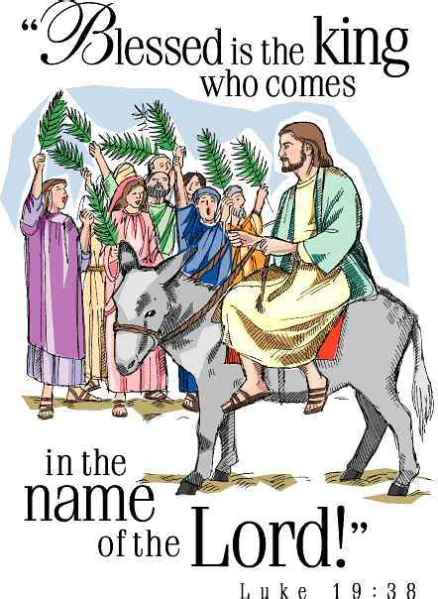
Our custom here at Wellborn Methodist Church has been to focus on Jesus’ Passion—His experiences and thoughts leading up to and including His Crucifixion.   Typically, then, we have handed out palm crosses, like you have today, but without focusing on Jesus’ triumphal entry into Jerusalem on Palm Sunday. This year, I wanted us to focus on the difference between Palm Sunday and Good Friday.  This is why we began our service on the front porch today, symbolically outside Jerusalem, if you will. And we followed the path of Jesus, riding on a donkey, as He made His way from the city gate into the Temple.

Now the Sadducees of 2000 years ago believed the Messiah would enter the city 4 days before Passover. Passover would have begun at sundown on Friday and ended at sundown on Saturday, the Jewish Sabbath.Thus, they made sure the gates to the Temple remained open the first day of their week, so Messiah could walk right on in and assume His throne.

Under normal circumstances, then, there would have been a great deal of hoopla and excitement among the Passover crowds, with people asking, “Is this the year?  Will Messiah show up? “  Knowing He would be arrested early Thursday morning and hanging on His Cross by Friday, Jesus chose to enter Jerusalem on what we call Palm Sunday.  What courage!

He fulfilled the prophesy of the minor prophet, Zechariah, from chapter 9, verse 9 (NLT) Rejoice, O people of Zion!  Shout in triumph, O people of Jerusalem!  Look your king is coming to you.  He is righteous and victorious, yet He is humble, riding on a donkey—riding on a donkey’s colt.  Victorious kings, Like David, would have entered the city to large, cheering crowds.  The people would have waved palms and placed their garments on the road for the King to tread upon.  At the end of 4th season of “The Chosen,” in episode 8 (you may call it up on YouTube), the writers re-enact one such victorious return, singing of King David, “Hosannah, Our King is Victorious!”

King David would have ridden in on his war-horse, but King Jesus rides in on a humbler animal, a donkey.  Luke wants us to be sure to know that this animal was borrowed from someone who knew of and loved Jesus, and it had never been ridden before.  Many in Jerusalem assumed Jesus was the Messiah and thronged around Him, praising Him and singing many of the lines read today from Psalm 118:25-29. Hosannah (Yesha anna in Hebrew) means save us now.  The crowds are asking Jesus to save them.

Do you think they knew that He was God in the flesh? They are cheering Him on. They are rejoicing in His presence. They are filled with hope that He is their Messiah.

The Passion readings appointed for today lead us from this celebratory procession to Jesus’ arrest, trials, death, and burial: 

A. Paul reminds us in Philippians 2:5-11 that Jesus humiliated or humbled Himself to come to earth to save us.  The Palm Sunday crowds expected Him to save them and that is exactly what He intended to do.  Paul wants us to be as humble and as obedient to the Father as Jesus was. Jesus obeyed His Father in everything, even up to and including His manner of death. Though totally righteous and holy, He died as though He were a rightfully tortured and despised criminal.

Paul also desires that we appreciate the depths of Jesus’ sacrifice on our behalf:  He gave up His heavenly prerogatives as King of the Universe–the One who spoke creation into existence–to be born in a stable, to a poor, young, homeless couple, in a ragtag and oppressed, tiny nation. Instead of demanding respect and a wide following as a great and exalted leader, He humbly behaved as a servant to all. No wonder the Father has honored Him above all things, declaring that His name commands total obedience, from every being, in every sphere of the universe!  Incidentally, this includes non-believers who will be shocked to arrive at the Great White Throne Judgment, only to discover they made the wrong choice to dismiss Him during their lifetimel

B.  Isaiah prophesies in 50:4-9 how Jesus, the Suffering Servant of God, will be treated during His Passion experience.  Verse 4 tells us He was tutored by Holy Scripture and also by His heavenly Father.  Verse 5 insists that He was always obedient to the Father’s will.  Verse 6 peaking for Jesus in the first person—I offered My back to those who beat Me, My cheeks to those who pulled out My beard.  I did not hide My face from mocking and spitting. This verse tells us He would endure beatings:  He was beaten by the Jewish Temple guards during the night;

Then He was beaten again by the Roman soldiers early in the morning. He would be spit upon, in His face (such a sign of contempt and hatred), and on His bloody body (YIKES!  to so desecrate God Himself)!  He will have His beard pulled out.

But notice too, in verses 7-9a—He will trust in God, His Father, the entire time.  He remained constant and faith-filled, despite all the evil that was done to Him!  I think He thus modeled to us how we might withstand persecution, if such befalls us for being Christians.  We are to hold on to our faith in God and to the love of Jesus for us, with both hands.

C.  Psalm 31:9-16 was written by King David.  The portion we read today is a prayer in which he seeks the Lord’s deliverance from a very powerful foe.  It is also very aptly describes what Jesus probably suffered on the way to His crucifixion at Golgatha, and even as He hung suspended from the Cross:  

   (1) V.9— Be merciful to Me, O LORD, for I am in distress… 

(2) V.10—My life is consumed by anguish and my years by groaning; My strength fails….

(3) Vv.11-12—Because of My enemies, I am the utter contempt of My neighbors; I am a dread to my friends—those who see Me on the street flee from Me.  I am forgotten by them as though I were dead; I have become like broken pottery.  

He is experiencing despair and grief.  But He does not succumb to it.  In verse 14, he reminds Himself, But I trust in You, O LORD.  I say, “You are my God.”  And He reaffirms for Himself, (v.15) My times are in Your hands.  We can trust in God to sustain us through the most difficult times because He is only a prayer away (meaning He is present to us).  He loves us, and He sent His only, beloved Son to die to save us.

D.  Our Passion narrative comes from Luke this year (22:14-23:56).  It needs little explanation as it speaks very powerfully for itself.  We see and understand that, though they had welcomed Him as a hero on Sunday, by Thursday they had replaced their Hosannah’s with outraged cries to Crucify Him!  What happened?  Well, quite simply, He disappointed their expectations.  They wanted a military leader to subdue the Romans; a warrior on a war-horse rather than a humble donkey.  They expected Him to overthrow their oppressors instead of teaching and praying daily in the Temple.  He didn’t live up to their idea of a Savior.  Their disappointment turned into anger and murderous rage, fueled and stoked by the jealous religious leadership who felt threatened by Him. So they killed Him.  But they didn’t eradicate either His memory or His influence.

We are currently living through a period in our country in which the influence of Jesus appears to have waned.  Fewer and fewer people seem to know Who Jesus is and why believing in Him and worshipping Him is important. Many churches have declining memberships. Folks appear to have given up regular Sunday attendance.  In fact, a statistic I heard recently said that most committed Christians only attend church once every three weeks.  Many activities compete for our attention—sporting events, leisure time pursuits, work, even sleeping in.  I was probably in my late 30’s when I realized that God spoke to me during Sunday worship.  His voice came to me through the music, the sermon, the readings, or sometimes from something a fellow worshipper said.  As much as I wanted to sleep in, I realized if I missed church, I would miss what the Lord had to say to me that week.  And as I came to regard my congregation as my “spiritual family,” I also realized I would miss what was often only a once a week contact. 

We need to remember all that Christ has done for us.  As I preached last week, we need a Savior because we cannot save ourselves.  The Good News is that we are washed clean of our sins by the sinless blood of the true Passover Lamb, our Lord and Savior, Jesus Christ.  Come, Let us adore Him!

©️2025 Rev. Dr. Sherry Adams

Good Friday Message

Pastor Sherry’s message for April 15, 2022.

Scriptures: Isa 52:13-53:12; Ps 22; Heb 10:16-25; John 18:1-19:42

Our Scripture passages today are all very solemn, fitting this day we remember the death of our Lord, Jesus Christ, on the Cross. The Passion narrative according to John takes us through Jesus’s “kangaroo trials” to His crucifixion.

First, He is arrested. He had made Himself disappear suddenly, in the past, when He did not intend to be captured. In Nazareth, after He had read the passage from Isaiah (61:1-2) that contains the job description of the Messiah and said Today this scripture is fulfilled in your hearing, His hometown friends tried to throw Him off a cliff (Luke 4:29-30). However, He walked through the midst of them and vanished. This time, though, He chose to remain and to face what was coming.

Did you notice that those who came to arrest Him fell back when He identified Himself as Jesus of Nazareth (v.6)? He seemed firmly in control as He calmly surrendered. They had sent a group of some 500 men to capture Him, armed with clubs and weapons, but He wouldn’t allow a fight to ensue. He tells them to let His disciples go. Luke tells us He even healed Malchus’ ear after Peter had cut it off (Luke 22:50-51). This should have made some impression on those who came to arrest Him. Surely they might have wondered if He were not someone special.

From the garden, they take him to the palace of Annas, the former high priest. Out of favor with the Romans, Annas was still the religious power broker of Jerusalem. Biblical scholars say he was both brilliant and satanic. Many credit him with this plan to eliminate Jesus; they had just awaited the “right time” and a Judas to appear. So they arrest Him under the cover of night, when all those who loved and believed in Jesus would be at home.

Jesus challenges Anna’s court honestly, confronting the guy who hit Him (v.23) If I said something wrong, testify as to what is wrong. But if I spoke the truth, why did you strike Me? Jesus, again calmly but firmly, reminds them they are out of line: by Jewish law,

1.) No court trial could begin at night/be held at night;

2.) No one could strike a person on trial without a verdict;

3.) Furthermore, Jewish Law prohibited sentencing a man on the day he was brought to trial.

But this trial at Annas’s was a mockery of justice.

Annas then sends Him to Caiaphas, the Roman’s choice for “high priest,” as well as Annas’s son-in-law (a 1st century example of nepotism). John reminds us that earlier (John 11:50), Caiaphas had said to the Sanhedrin You do not realize that it is better for you that one man die for the people than that the whole nation perish. Caiaphas did not realize at the time that he was speaking prophetically. Nevertheless, Jesus knows He is laying down His life for the sins of Israel and for us. Caiaphas and Annas both find Jesus guilty of blasphemy, because He admitted He is the Son of God. He–the Way, the Truth, and the Life– is accused of lying even though He told the truth. How ironic! They would have liked to have stoned Jesus, but the Romans forbade any nation to invoke capital punishment but them.

So Jesus is next sent to the Roman, Pontius Pilate. Pilate tries every which way to free Jesus. He knows the Jewish religious hierarchy is just jealous of Him. Even though Pilate believes Jesus is innocent, he still has Him scourged (39 lashes with a whip), hoping this will satisfy them. He offers to set Jesus free due to the Passover Holiday. He can find nothing wrong with Jesus, but hands Him over to be crucified when the Jews threaten to tell Caesar that Pilate has released a man claiming to be king of the Jews.

And so, trading the sinless Son of God for a murderous insurrectionist, the Jewish leadership have their way and Jesus is crucified. Ironically, the sign on His cross identifies Him as King of the Jews: It is written…

1.) In Hebrew—the language of religion;

2.) ,In Greek—the language of culture and education;

3.) And in Latin—the language of law and order in the Roman world.

The Jews want it adjusted, but Pilate will not bend.

Notice that John does not tell us much about the crucifixion. None of the Gospel writers do. They highlight Jesus’ dignity. They did not want us to focus on Christ’s agony. In fact, the Bible commentator J. Vernon McGee says the Father deliberately made darkness come over the land from noon until 3:00pm so watchers could not see Jesus’ intense suffering as He took on all the sin of the world, past, present, and future; and as the Father turned His back on Him. We are told that soldiers gamble over who will get His clothes. John then relates three of the 7 statements Jesus makes as He is dying:

1.) He asks John to care for His mother, Mary;

2.) He says He is thirsty;

3.) And, lastly, He asserts, It is finished [meaning the work of salvation He was sent to do]. Finally, we learn He was taken down and buried just before the Sabbath began at sundown.

To get a sense of what the crucifixion was like for Jesus, we have to turn to Isaiah 53 and Psalm 22. Isaiah 52:13-53:12 is the 4th and final Suffering Servant Song, a Messianic Prophecy, often referred to as the Gospel in the Old Testament. Isaiah tells us Jesus will be raised high, lifted up (on the Cross) but also highly exalted (when it is all over). No one would think so as they observed Him carrying His Cross. He will in fact startle or surprise the whole world—even render them speechless—because it will be through the loss of all things that He gains all things.

Seven hundred years before Jesus’ birth, Isaiah accurately predicts the kind of death Jesus will endure. An ordinary man to begin with—not a Rock Star–He will be (v.3) despised and rejected by men, a man of sorrows and familiar with suffering…; beaten beyond recognition; pieced, crushed, oppressed, afflicted; killed in the worst possible way–like a common criminal–hung between true felons; he will die childless—“cut off,” to the Hebrews, evidence of a tragic, futile existence. People will think He got what He deserved, but He didn’t…verses 4-5 Surely He took up our infirmities and carried our sorrows….the punishment that brought us peace was upon Him, and by His wounds we are healed. In verse 9 He was assigned a grave with the wicked, and with the rich in His death, because He had done no violence, nor was any deceit in His mouth.

The Father will richly reward Him (verse 11) After the suffering of His soul, He will see the light of life [resurrection], and be satisfied…Therefore I will give Him a portion among the great, and He will divide the spoils with the strong.

God intends to reward Him as though He were a king sharing in the spoils of a great victory, because He went willingly to death, and because He interceded for our sins.

Psalm 22 reveals to us Christ’s thoughts on the cross: He feels forsaken by His Father: The Father was with Him when He was arrested. The Father was with Him during His ludicrous trials. The Father was with Him when He was beaten. The Father was with Him when He was nailed to the Cross. But the Father turned His back on Him when He became sin for us, from noon until 3:00pm.

He admits to feeling like a worm. The word for worm in the Hebrew is the Coccus worm, which emitted a substance used to make red dye. This is symbolic of Jesus’ blood poured out for us. From the Cross He feels surrounded by His enemies: The soldiers are many bulls…the strong bulls of Bashon. His tormentors from the foot of the Cross—scribes, Pharisees, the hostile mob—resemble (v.13) roaring lions tearing their prey; and verse 16 dogs have surrounded Me; a band of evil men has encircled me, they have pierced my hands and my feet. Nevertheless, He trusts in the love of His Father.

Biblical Scholars tell us Jesus fulfilled 28 prophecies of the Messiah from the Cross. We can recognize them in our Psalm and Isaiah passages. The sinless Son of God laid down His life for us, paying the penalty for our sins; reconciling us to God the Father; and clothing us in His righteousness. These Sacred writings prove to us that Jesus—and only Jesus—was and is the Messiah, the Son of God. Let us ponder His sacrifice and offer Him our gratitude and love.

©2022 Rev. Dr. Sherry Adams