Pastor Sherry’s message for May 4, 2025
Scriptures: Acts 9:1-20; Ps 30; Rev. 5:1-14; Jn 21:1-12
Some years back, I read a book—can’t remember the title—but it was an autobiographical account of an Army doctor in WWI, who died and was taken up into heaven. You may renenber, from our Covid experience, that there was a huge, worldwide influenza epidemic from 1918-1920. Mostly young people were susceptible, especially those gathered together in army camps, bases, or foxholes. This doctor, whose name I’ve sadly forgotten, was working in an Army hospital at a base in Texas. He was struck down by the disease and appeared to have died. Someone even covered his head with a blanket, the sign to everyone that another soldier had perished. It took several hours before anyone came to remove his body.
But in the meantime, he found himself flying back over his home (planeless) in Virginia, where he saw his mother hanging out clothes to dry, and his father walking over to talk with her. He noted that his parents were safe and well. Then he found himself whisked up into heaven. He reported beautiful, vivid colors, lots of flowers and wonderful smells. Everyone he saw there was happy and healthy. He felt enveloped in love. He even encountered Jesus! He was filled with joy and wanted to stay; but, in short order, Jesus told him his work on earth was not done, so he was going to be sent back. The doctor came back to life just as they were preparing to remove his body for burial. He went on to get well, only to fall into a profound depression that lasted 3 years! He wrote that he missed heaven so much that he found life as we know it to be profoundly disappointing by comparison. Eventually, he rallied, found meaning and purpose in being a doctor, and went on with his life.
I previously preached here about Jesus’ fish-fry on the beach, and Paul’s dramatic conversion, but today I want to focus our attention on our reading from Revelation.
Revelation chapters 4 and 5 offer us the best report of what Heaven is like in all of Scripture. In Chapter #4, the 90-92 years old Apostle John finds himself “taken up” into the Heavenly throne room. He has a vision of Jesus and receives the Lord’s words for the 7 churches in Asia Minor, but is then directed by Jesus to come up into heaven.
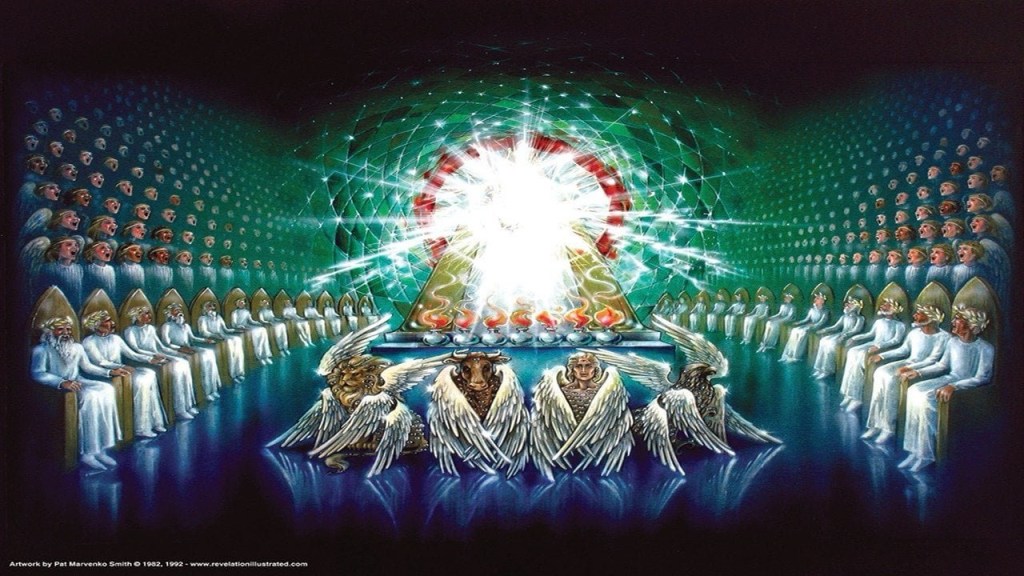
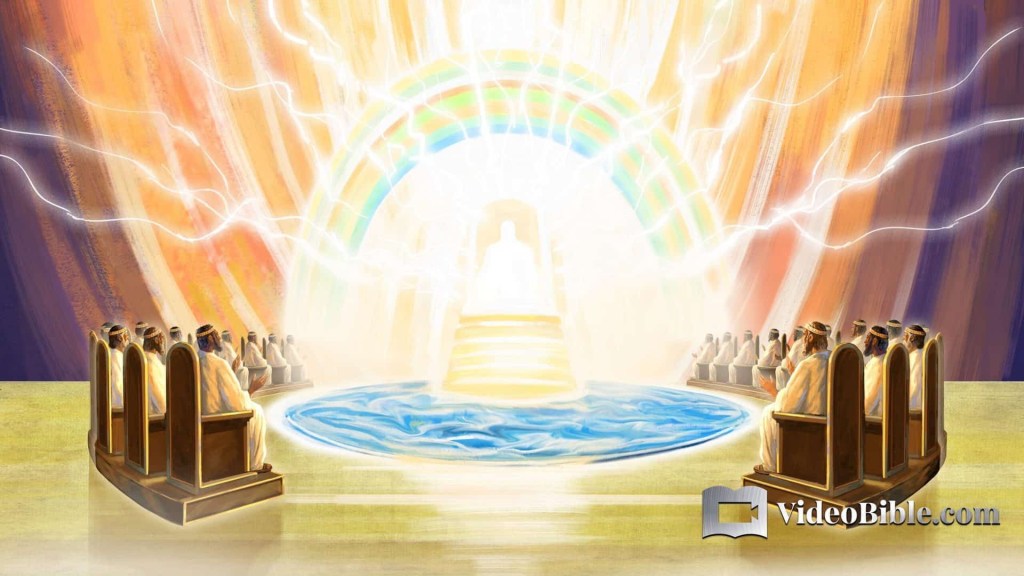
He sees things there that are almost too difficult to for him to put into words. He sees God the Father, seated on His throne, at the very center of a huge gathering. God dwells in dazzling light so overwhelming that John cannot clearly see His face. He tries to describe that light by using the image of light reflected by sunlight on jewels. Scholars believe the jewel tones he saw were red, white, bright green, and perhaps purple. Additionally he observes that God is surrounded on His throne by an emerald-hued rainbow. The rainbow is likely reminiscent of the days of Noah. It seems to indicate the eternality of God’s promises—that is, that God does not break His promises to us, even if we disappoint Him.
Around God’s throne are 24 smaller thrones. There is considerable conjecture about who the 24 elders are who are seated on the lessor thrones. Most experts today think they represent “the true Church” or the “Redeemed:” including the 12 patriarchs or leaders of the Old Testament tribes of Israel; and the 12 Apostles from the New Testament. They are dressed in white, the color of purity and righteousness, and what seems to be the uniform of heaven. They all wear a gold crown on their head, indicating they are a royal priesthood.
John hears thunder and sees lightening shoot out from God’s throne. In Old Testament times, these signaled God’s presence and often His judgment. John perceives that the One seated on the throne is about to release His judgment on the inhabitants of the earth. Additionally, He notes (1) 7 torches around the throne, symbolic of the full presence of the Holy Spirit.
(2) Then he describes a “glass sea” under the throne, separating God the Father from everyone else there. God is totally holy. He is also, as I often say, large and in charge, so this bit of separation makes sense.
(3) John is also amazed by God’s Honor Guard–the 4 living creatures (seraphim). They have eyes all over themselves, which looks and sounds very strange but indicates that they are omniscient or all- seeing. They fly about on 6 wings. Their bodies are those of strange, composite beings that may symbolize the apex of created life forms:
(a.) The mightiest wild animal, a lion (known to be ferocious);
(b.) The mightiest domestic animal, an ox (known for its strength);
(c.) The mightiest of all animals, humankind (known for our intelligence)
(d.) And the mightiest bird, the eagle (known for its swiftness).
Obviously these composite beings are capable of protecting God’s space and His person. Who could successfully take them on?
In Chapter #5, we find God the Father holding a scroll in His right hand, the hand of power. John notes that it has writing on both sides. Typically in those days, people wrote on the front side of papyrus only, as the fibers on front were oriented horizontally while those on the back ran vertically. To have written on both sides indicates that the scroll is filled to overflowing with the decisions and the direction of God. A number of Biblical scholars believe it contains both the salvation of humankind and the judgment of the wicked. A noted expert on the interpretation of Revelation, Robert Mounce, writes, “The whole story of human history rests in the hand of God. What simpler or more sublime way of picturing God’s ultimate sovereignty over all history could be found than this picture of the scroll resting in the hand of God? However strong evil becomes, however fierce be the satanic evils that assail God’s people on earth, history still rests in God’s hand.”
(Robert H. Mounce, The Book of Revelaton (Revised Ed.), Eerdmans, 1998, pp.82-83.)
Additionally, this scroll is sealed with 7 seals against tampering (again 7, in the Hebrew numbering system, is the number indicating completion). So, we can assume that what’s written therein is perfectly safe against tampering and that what’s written therein is very important!
John hears an angel ask (v.2) Who is worthy to break the seals on this scroll and open it? Perhaps eager to learn God’s plans, John bursts into tears because (v.4)…no one was found worthy to open the scroll and read it. Then one of the 24 elders directs John to stop weeping. because Someone worthy has been found: the Lion of the Tribe of Judah, the heir to David’s throne, Jesus.
But the Jesus who comes forth is not a warrior king in all His resurrection splendor, nor a majestic lion. Rather, He is portrayed as a little lamb who had been sacrificed—alive now (resurrected) but probably evidencing a slit throat. Obviously it takes Someone totally conformed to God’s will—like Jesus—to break the seals. God Himself doesn’t do it, but He has the Mediator, Jesus, bring human history to its foreordained consummation (Mounce, Ibid, p.143).
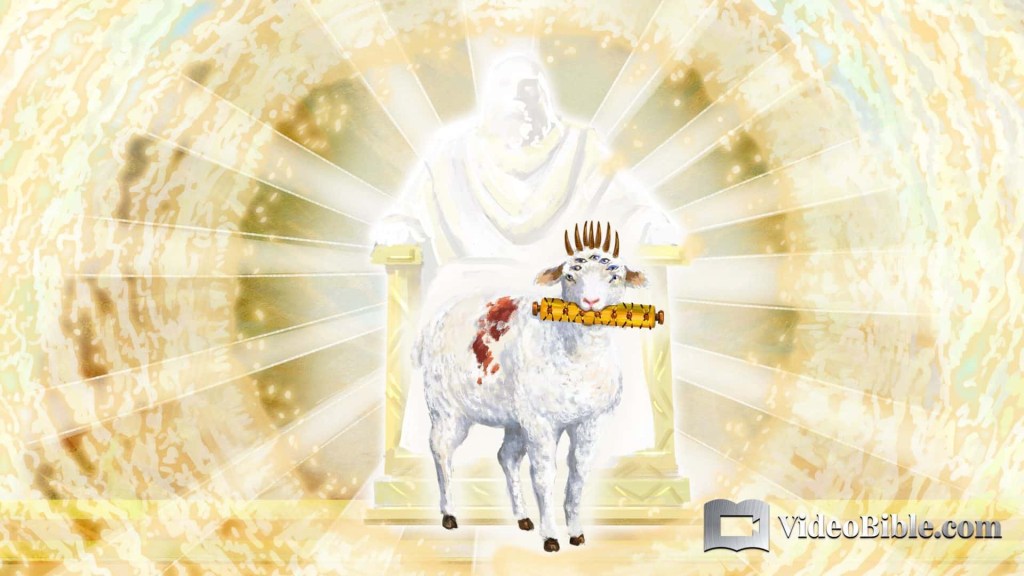
At this point, we should pause and say, “Worthy is the Lamb!” The use of the Lamb image is both striking and unusual. When people groups want symbols of power for their country, they tend to choose apex predators: Russia has the bear; Britain, a lion; France, a tiger; and the USA, the bald eagle. But God chooses a slain lamb, a typical temple sacrifice for sin. Christ is victorious precisely because He has surrendered Himself to be sacrificed, like a Passover Lamb. He has triumphed over sin, death, and evil by His death on the Cross.
This particular lamb, Jesus, is powerful because He is depicted with seven horns, an Old Testament symbol for complete and perfect power.
Similarly, He has 7 eyes, representing His all-seeing omniscience.
So the Lamb slain from the foundation of the world steps forward to open the scroll, and all of heaven bursts into song. The 24 elders fall down before Him, surrendering to worship, singing Jesus a new song. They play harps to accompany worship music (I don’t think we will be the ones playing harps, despite what the culture contends). The elders also offer up golden bowls of incense, which John is told are the prayer of the saints. Then a myriad of angels join in a powerful chorus. Finally, John writes (v.13) Blessing and honor and glory and power belong to the one sitting on the throne and to the Lamb forever and ever. (Talk about a Halleluia Chorus!)
So what can we take away from our glimpse into God’s throne room in Heaven? I believe the following insights are worth remembering:
1.) True power in this world does not rest with human dictators or human governments, but rather with our God.
2.) God controls the course of human history.
3.) Even the most exalted beings in heaven humbly acknowledge God’s superiority in every way—so should we.
4.) As God, Jesus knows how human history will end…our history is truly His-Story.
5.) How true then is Paul’s assertion from Romans 8:31 If God is for us, who can be against us?
6.) When we each get to heaven we will join millions of believers and angels in worship of our God and our Lord Jesus.
Thanks be to God Who gives us the victory through our Lord Jesus Christ! Alleluia! Alleluia!
©️2025 Rev. Dr. Sherry Adams
 Wellborn Methodist Church--Wellborn, Florida