Pastor Sherry’s message for April 20, 2025
Scriptures: Isa 65:17-25; Ps 118:1-2,14-24; 1 Cor 15:19-26; Lk 24:1-12
How many of you enjoy a good mystery? Briefly, here are two. See if you can figure them out:
1. “Everyday a gentleman went to work. Every day, he would ride the elevator all the way to the bottom floor of the high rise apartment building in which he lived. But when he came home from work, he would ride the elevator back up to only the 6th floor. Then, he would take the stairs to his apartment many stories higher in the building. This he did every day, unless it was raining. If it was raining, he would ride the elevator all the way to the floor of his apartment. Why?”
2. Here’s the second one: “Ann is lying on the floor dead. There’s broken glass and water all around her. Stuart is asleep on the couch seemingly oblivious to the death that has occurred. How did Ann die?”
To keep you from puzzling these two mysteries out while I continue to preach, I’ll tell you their solutions: “In the first one, the gentleman would only go to the 6th floor on his return home from work because that was the highest button that he could reach on the elevator control panel. He was a short man. On days that it rained, he had his umbrella with him, and he could use that to punch the button that indicated his floor.” “In the second situation, it might help you to know that Ann is a fish, and Stuart is a cat. And the glass and water all around Ann on the floor is from her fishbowl that Stuart successfully knocked over.” The true mystery here is what then kept Stuart from eating Ann?
(Borrowed from a sermon by Chris Talton, April 15, 2001, www.sermoncentral.com, 3/24/2005)
If we put ourselves in the position of the women who went to Jesus’ tomb on the morning of His Resurrection Day, we would realize they too were presented with several mysteries:
1. The gigantic stone that had sealed the entrance to the tomb had been rolled back. Who could have done such a thing? Remember, these ladies had been with Jesus at the Cross. They had seen Him suffer and die. They had watched Joseph and Nicodemus remove Jesus’ body from the Cross and transport it for burial in the new tomb nearby. They also knew the men had hastily anointed Jesus body with embalming ointments and cloths, and had come to neaten things up and complete the job. Surely they realized no single person could have rolled that huge, heavy stone away.
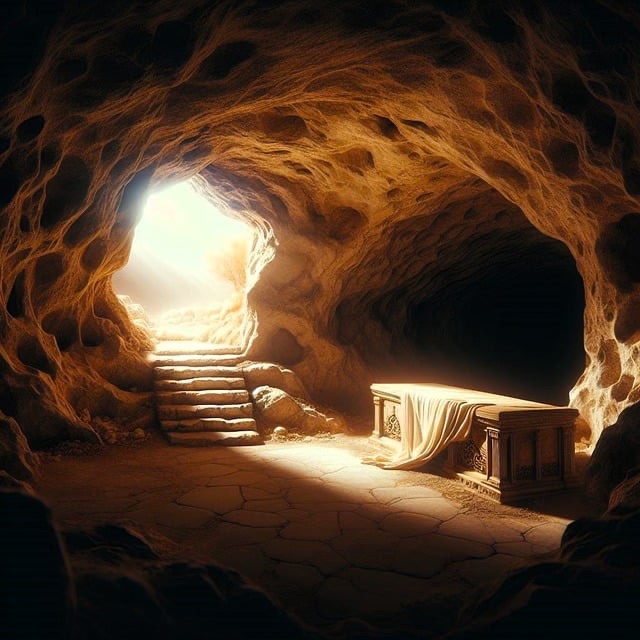
They probably also knew a contingent of Roman soldiers had been assigned there to guard the tomb. So what had happened to them? Had the Romans stolen Jesus’ body? Had the Jewish religious authorities taken it? They had to be both puzzled and alarmed.
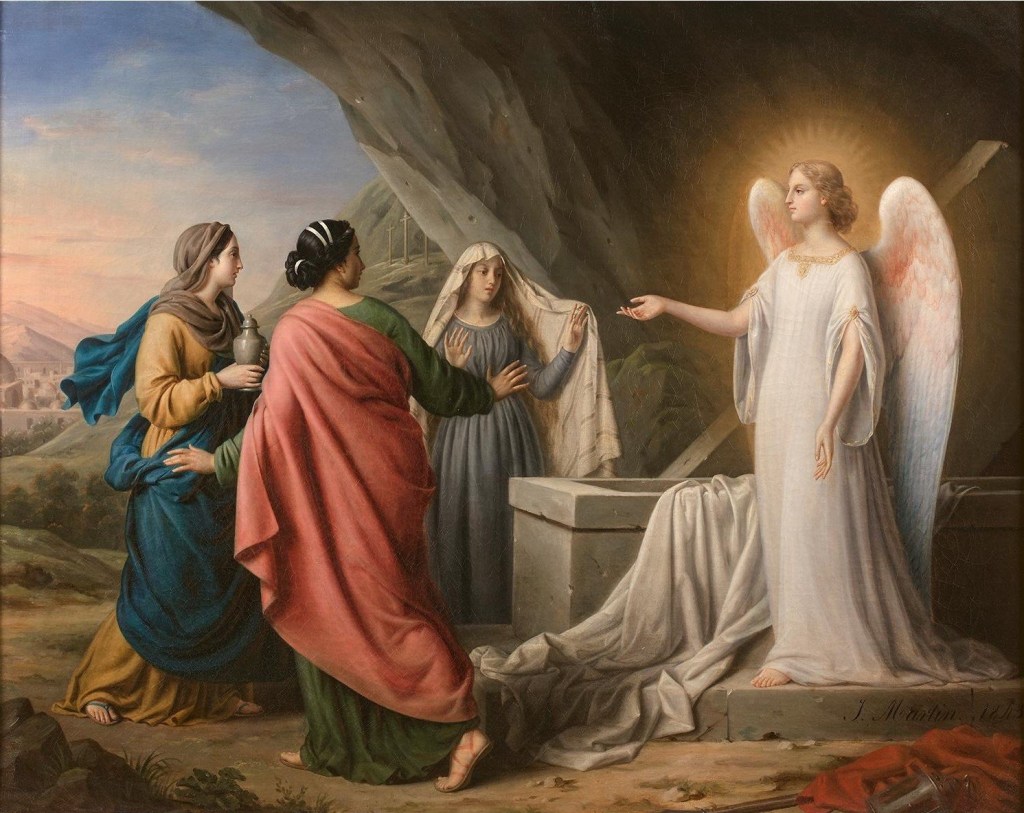
Cautiously, they stepped inside the tomb to see if His body was there. Instead of finding Jesus’ corpse, they suddenly encountered two “men” in brilliant white clothes–angels. It’s almost comical that the angels ask them, Why do you look for the living among the dead? [He is alive!] He is not here; He has risen. Literally, the ancient Greek states, He has been raised. The verb tense implies that God the Father has raised Jesus.
Angels had proclaimed His birth; now angels proclaim His resurrection (The angels and the women are all witnesses to this miracle). These angels remind them of Jesus’ teachings about His death and resurrection on the 3rd day. This is a prompt for them to remember. but it’s also a rebuke—”How could you forget something so very important?!!”
Then they do remember, and go to tell the disciples (the next resurrection witnesses). The Eleven do not believe them, even though they should have known these women were reliable truth-tellers. Peter takes off for the tomb, to see for himself (he is now a witness). Peter probably now knows better than anyone not to doubt the Lord’s words. But he still wonders (perhaps “marvels”) about what Jesus’ absence in the tomb means.
This passage (Luke 24:1-12) closes with questions in everyone’s mind about what has happened (big mysteries).
The accounts of Jesus’ Resurrection are also reported in the other three Gospels, Matthew 28:1-8; Mark 16:1-8; and John 20:1-8.
A. You might want to read them each and compare to get a fuller sense of how the first witnesses to Jesus’ resurrection responded to the mysteries with which they were presented.
B. Paul, as we know, came to believe in Jesus sometime after the events of Resurrection Sunday. By then, the mysteries had been explained.
So Paul is intent, in our 1st Corinthians 15:19-26 lesson, that we understand that Jesus’ resurrection is the defining moment of Christianity.
First, back in verses 5-8, he reminds us of who all saw Jesus following His resurrection: Peter (omitting the women); the 12 minus Judas; more than 500 disciples (maybe he included the women among the 500); Jesus’ brother, James; and Paul himself.
Next, in verses 13-19, Paul asserts that our entire faith depends upon the truth of the resurrection: Verse 14—If Christ has not been raised, our preaching is useless and so is your faith. In other words, Christ’s resurrection from the dead is incontrovertibly true and forms the basis of our belief in Him. We worship a God who has the power to bring His Son back from the dead. I want a strong, powerful God like that, don’t you? We worship a God who loves us so much that He sacrificed His one and only Son to redeem us. We worship Jesus, the One and Only, the God Who—because of His self-sacrificing love for us and His obedience to His Father–was willing to cover the cost of our sins. The sinless Son of God gave up His life so we might have new life, and have it abundantly. We can connect directly with the Father because Jesus opened the way for us (As He hung on the cross, the massive Temple curtain was torn in two, from top to bottom.) We can anticipate being resurrected because Jesus opened the way for us. And, when He comes again in glory to judge the living and the dead, He will destroy death…Praise God!
C. We don’t know who wrote Psalm 118:1-2, 14-24, but it is an ode to joy! The psalmist invites us to focus on heavenly realities–not the frustrations and disappointments of this life. Because of the mighty things Jesus will do [has done]—including demonstrating His power over death—we can gratefully rejoice in the Lord and praise Him for our deliverance, provision, and protection.
We are to be thankful to Him because (V.1)—The Lord is good; His love endures forever. (V.14)—The Lord is my strength and my song; He has become my salvation. (V.18)—Prophesying Jesus’s resurrection, the psalmist wrote, I will not die but live, and will proclaim what the Lord has done…He has not given Me over to death. Jesus was laid dead in a tomb–But He did not remain there as we would have. He rose again, overcoming death for our sakes! We are also grateful for the fact that (v.22)—The stone the builders rejected [Jesus] has become the capstone. The capstone was either (1) a large rectangular stone used as a lintel over a doorway; or (2) a large square or rectangular stone used to anchor or align the corner of a wall; or (3) it might also be the keystone or middlemost stone in an arch. The capstone (building corner or doorway lintel) or keystone (arch) kept the building from collapsing by supporting what existed beside and above it. The psalmist prophetically meant this as a metaphor for Jesus, who holds all things together for us— no wonder we call Him our Rock and our Redeemer.
Our passage today ends with this line (V.24)—This is the day the Lord has made, let us rejoice and be glad in it.
D. Isaiah 65:17-25 reminds us both that Jesus overcame sin and death, and that we too will therefore experience a joy-filled life after death.
After Jesus defeats the forces of evil at Armageddon, God (v.17) will create new heavens and a new earth. If you read through the book of Revelation, you can tell that our world will be a disastrous mess by the time Jesus appears a 2nd time. We will probably need a new earth, at a minimum.
Verse 19 tells us that the newly created Jerusalem will be delightful!
God will be overjoyed with His people there; and they too will be very happy, with no one weeping or crying. Premature death will be an event of the past (no cancers, illnesses, strokes, heart-attacks, eye problems, hearing loss, or sciatic pain). People will be able to enjoy the fruits of their labors (no warfare or taxes). All of God’s people will be blessed! God will answer our prayers before we even finish praying them. And all animals will become plant-eaters—no more carnivores devouring prey—and will be at peace with each other.
Thanks be to God the mysteries presented the women at the open tomb have been solved. We are not left to wonder. Paul wants us to fully appreciate what Jesus has done for us through dying and rising again. Our psalmist calls upon us to be grateful and to rejoice! And Isaiah describes a wonderful world ahead for us when the resurrected Jesus comes back to earth. Let’s celebrate by singing along to Keith and Kaitlin Getty’s version of https://youtu.be/m_063OI38RQ?si=Dre8ll-AV-GHUlPB In Christ Alone.
©️2025 Rev. Dr. Sherry Adams
 Wellborn Methodist Church--Wellborn, Florida