Pastor Sherry’s message for March 29, 2024
Scriptures: Isa 52:13-53:12; Ps 22; Heb 10:16-25; John 18:1-19:42
Our Scripture passages today are all very solemn, fitting this day we remember the death of our Lord, Jesus Christ, on the Cross:
A. The Passion narrative according to John, takes us through…
(1) Jesus’ arrest. He had made Himself disappear suddenly, in the past, when He did not intend to be captured. This time, knowing what He was to do, He allowed them to capture Him. Did you notice, they fell back when He identified Himself as Jesus of Nazareth? Were they frightened? Did they glimpse a hint of His divinity? He seemed firmly in control as He calmly surrendered. They had sent a group of 500 men to capture Him, armed with clubs and weapons. But He wouldn’t allow a fight to ensue. He tells them to let His disciples go. Luke tells us He even healed Malchus’ ear, after Peter cut it off.
(2) Then to Annas,’ the former high priest’s place. Out of favor with the Romans, Annas was still the religious power broker of Jerusalem—sort of like George Soros today. Biblical scholars say Annas was both brilliant and satanic.
Many credit him with this plan to eliminate Jesus, waiting until the cover of night, when all those who loved and believed in Jesus would be at home. Jesus challenges him honestly, (v.23)—If I said something wrong, testify as to what is wrong. But if I spoke the truth, why did you strike Me? Jesus, again calmly but firmly, reminds them they are out of line: by Jewish law, no court trial could begin at night/be held at night; no one could strike a person on trial without a verdict; Jewish Law also prohibited sentencing a man on the day he was brought to trial. But this was Annas’ Kangeroo Court, and side-stepping the law to suit one’s agenda is not new.
(3) Annas sends Him to Caiaphas, the Roman’s choice for “high priest,” Annas’ son-in-law (an early example of nepotism). John reminds us that in Chapter 11:50, Caiaphas had said to the Sanhedrin, You do not realize that it is better for you that one man die for the people than that the whole nation perish. Caiaphas did not realize at the time that he was speaking prophetically. In fact, Jesus knew He was laying down His life for the sins of Israel and for us.
Caiaphas and Annas find Jesus guilty of blasphemy, because He admitted He is the Son of God. This was and is the truth, but they did not believe Him. They would have liked to have stoned Him, but the Romans forbade any nation to invoke capital punishment but them.
(4) So Jesus is sent to Pontius Pilate. Pilate tries every which way to free Jesus. He knows the Jewish religious hierarchy are just jealous of Him. Hoping to placate them, he has Jesus scourged (39 lashings with a whip). He offers to set Him free due to the Passover Holiday. He can find nothing wrong with Jesus, but hands Him over to be crucified when the Jews threaten to tell Caesar that Pilate has let go a man claiming to be king of the Jews. Pilate is a political animal who wants desperately to leave Judea and return to Rome, so he capitulates, despite his conscience.
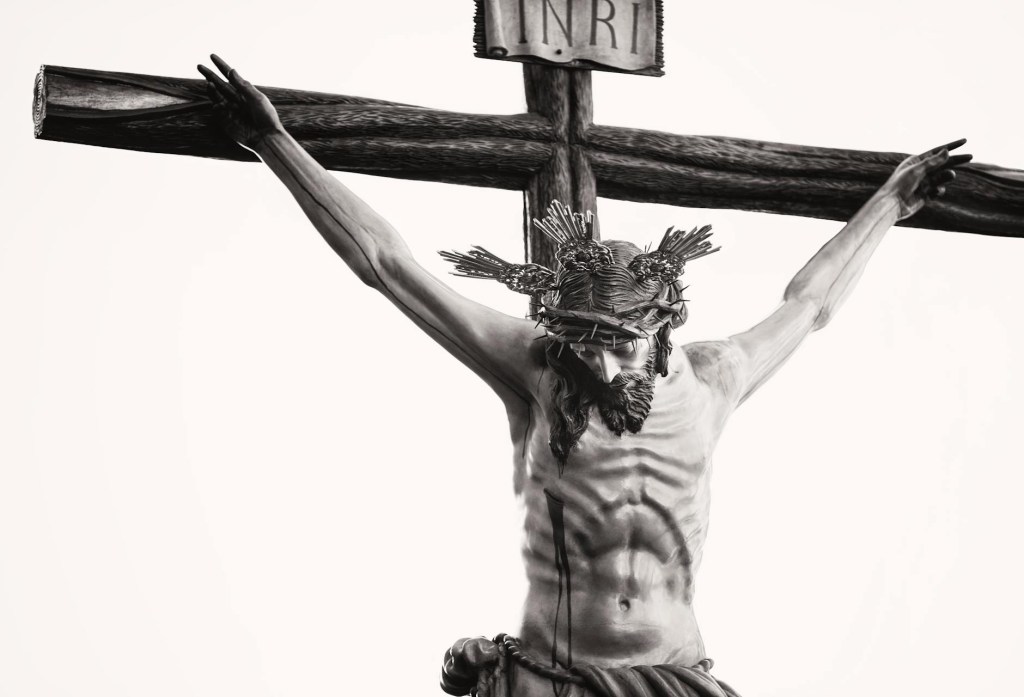
(5) And so, trading the sinless Son of God for a murderous rebel, the Jewish leadership have their way and Jesus is crucified. Ironically, the sign on His cross identifies Him as King of the Jews: It is written In Hebrew or Aramaic, the language of religion; in Greek, the language of culture and education; and in Latin, the Roman language of law and order. The Jews want it adjusted to read, “He claimed to be the King of the Jews,” but Pilate will not bend.
(6) Notice that John does not tell us much about the crucifixion. He reports that the soldiers gamble over who will get His clothes. John relates 3 statements Jesus makes as He is dying: He asks John to care for His mother, Mary; He says He is thirsty; and, lastly, He asserts, It is finished (meaning He had completed the work of salvation He was sent to do).
(7) Finally, we learn He was taken down and buried just before the Sabbath began at sundown.
B. All 4 of the Gospelers were pretty circumspect about Jesus’ 6 hours on the Cross. They highlight Jesus’ dignity. They did not want us to focus on Christ’s agony. J. Vernon McGee says the Father deliberately made darkness come over the land from noon until 3:00pm so watchers could not see Jesus’ intense suffering as He took on all the sin of the world, past, present, and future; and as the Father turned His back on Him.
To get a sense of what the crucifixion was like for Jesus, we have to turn to Isaiah 53 and Psalm 22.
A. Isaiah 52:13-53:12 is the 4th and final Suffering Servant Song, Messianic Prophesy (called the Gospel in the Old Testament). Isaiah tells us Jesus will be raised high, lifted up (on the Cross) but also highly exalted (when it is all over). No one would think so as they observed Him carrying His Cross. He will in fact startle [not sprinkle] the whole world—render them speechless—because it will be through the loss of all things that He gains all things. Such a paradox!
700 years before Jesus’ birth, Isaiah accurately predicts the kind of death Jesus will endure. An ordinary man to begin with—not a fellow with Rock Star looks–He will be
1.) verse 3—despised and rejected by men, a man of sorrows and familiar with suffering…
2.) beaten beyond recognition;
3.) pieced, crushed, oppressed, afflicted;
4.) killed in the worst possible way, like a common criminal, hung between true felons;
5.) He will die childless—“cut off,” to the Hebrews, evidence of a tragic, futile existence due to no progeny to carry on the family blood line;
In fact, people will think He got what He deserved, but He didn’t…
1.) Verses 4-5—Surely He took up our infirmities and carried our sorrows….the punishment that brought us peace was upon Him, and by His wounds we are healed.
2.) Verse 9—He was assigned a grave with the wicked, and with the rich in His death, because He had done no violence, nor was any deceit in His mouth.
3.) The Father will richly reward Him—verse 11—After the suffering of His soul, He will see the light of life [resurrection], and be satisfied…Therefore I will give Him a portion among the great, and He will divide the spoils with the strong. God intends to reward Him as though He were a king sharing in the spoils of a great victory, because He went willingly to death, and because He interceded for our sins.
B. Psalm 22 reveals to us Christ’s thoughts on the cross: He feels forsaken by His Father. The Father was with Him when He was arrested. The Father was with Him during His ridiculous trials. The Father was with Him when He was beaten. The Father was with Him when He was nailed to the Cross. But the Father turned His back on Him when He became sin for us, from noon until 3:00pm.
He admits to feeling like a worm—a Coccus worm, in the Hebrew. This particular worm emitted a substance used to make red dye, symbolic of Jesus’ blood poured out for us.
From the Cross He feels surrounded by His enemies: The soldiers are many bulls…the strong bulls of Bashon. His tormentors from the foot of the Cross—scribes, Pharisees, the hostile mob—resemble (v.13)— roaring lions tearing their prey; and (v.16)— dogs have surrounded Me; a band of evil men has encircled me, they have pierced my hands and my feet. Nevertheless, He trusts in the love of His Father.
Biblical Scholars tell us Jesus fulfilled 28 prophesies of the Messiah from the Cross. You can recognize them and count them from our Psalm and Isaiah passages. The sinless Son of God laid down His life for us, paying the penalty for our sins; reconciling us to God the Father; and clothing us in His righteousness. These sacred writings prove to us that Jesus—and only Jesus—was and is the Messiah, the Son of God.
Today through Sunday, Let us ponder His sacrifice and offer Him our gratitude and love.
©️2024 Rev. Dr. Sherry Adams
 Wellborn Methodist Church--Wellborn, Florida