
Pastor Sherry’s message for March 29, 2026
Scriptures: Isa 50:4-9a; Ps 31:9-16; Phil 2:5-11; Matt 26:14-27:66
Back in 2003, the Newsboys (a Christian boy band) released a song called “You are my King (Amazing Love).” I’ve always loved that song! Here is a link to the video: Amazing Love by Newsboys with lyrics I love this song because it expresses so well what Jesus did for us on the Cross.
Today, the Christian Church celebrates Palm Sunday—the anniversary of the day of Jesus’ triumphant entry into Jerusalem. The people hailed Him as their Messiah—and they were right! But in a few short days later (by Good Friday), the palm waving ended in His procession to Golgatha. That’s why we ask Joy, who has such a lovely soprano voice, to sing the “Via Delorosa” today—Jesus did experience such a sad painful journey on the road to Calvary.
From today through Holy Week to Easter Sunday, we move from joy to grief to extraordinary, resurrection joy again. But what was the point? What did God intend for us to learn?
Well first, Jesus’ mission on earth fulfilled about 300 Old Testament prophesies (There are another 25-26 that He won’t fulfill until His 2nd Coming.)
Many prophets said the Messiah was coming. They described exactly what He would do when He arrived on the scene (His job description is foretold in Isaiah 61:1-3). They predicted how He would die (Psalm 22 and the portion we read today from Psalm 31, as well as the 4 “Suffering Servant Songs” from Isaiah—including Isaiah 50:4-9). And they also insisted He would overcome the power of death. One of the more subtle prophesies comes from way back in Genesis 3:14-15, which tells us that the Christ will crush Satan’s head. What’s fascinating about this is that Jesus died at Golgatha, which means the place of the skull.
This demonstrates that Jesus’ death fulfilled God’s plan and purpose. His death was not just a sad outcome of Judas’ lack of faith or of the Jewish religious leadership’s jealousy; nor was it just one of many, many oppressive Roman attempts to ensure peace in a turbulent country. No, it was God’s demonstration of His extreme love for us! Think of John 3:16-→For God so loved the world that He sent His one and only Son so that everyone who believes in Him might not perish but have eternal life. God sent His sinless Son (see Philippians 2:5-11) to humbly and obediently take our guilt upon Himself and to ransom us from the death penalty we had incurred.
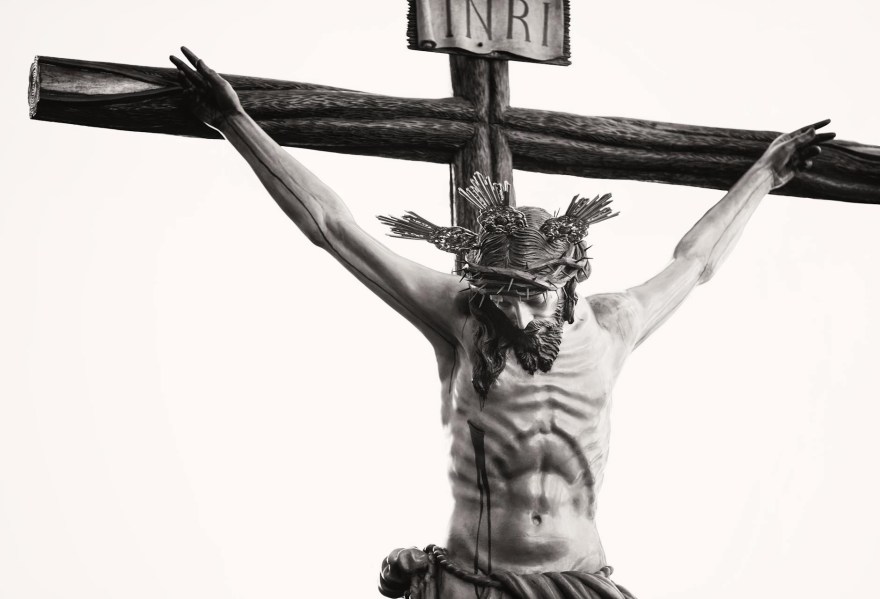
Jesus also went to the Cross for us so that we might, once again, regain the sweet fellowship with God that was lost to us by Adam and Eve when they sinned in the garden. Our God is holy. He will not abide in the presence of sin. When sin entered the world, through Adam and Eve’s disobedience, humankind realized there was nothing we could do on our own to get back into God’s good grace! Jesus’ saving act of dying on the Cross made this possible once again. If we believe in Jesus, we are covered with His righteousness. (As St. Paul says, we are in Christ). Just as the Temple curtain was torn from top to bottom at Jesus’ death, this ensures that there is now no impediment, no barrier between us and God the Father.
Back in 2005, an American pastor surveyed 100 Christians from several churches in his town. He asked them, “Would it have made any difference in your life as you are now living it, if Jesus had not died on the Cross?”
1. 45% said they did not think so—almost half!
2. 25% (1/4th) said they thought so, but they could not specify how;
3. 20% said it made all the difference in the world to them.
4. And 10% said they had no idea.
(As cited by Jeff Strite in www.sermoncentral.com, 3/19/2005
5. What a sad commentary on the work of the Church! We are clearly failing at convincing folks they need a savior and at bringing folks into a personal relationship with Jesus Christ!
So what would you say? I hope that each one of you realizes that Jesus Christ is the only way to the Father. I pray each one of you can say His sacrifice of Himself on the Cross means the world to you! He saved your life and He saved mine! I also pray you live each day in that knowledge and that you allow His tender, self-sacrificial love to gently transform you into the image and likeness of Christ—becoming the best you the Lord meant you to be. Lastly, I pray you live each day of your life praising Jesus for saving you!
©️2026 Rev Dr Sherry Adams





 Wellborn Methodist Church--Wellborn, Florida