But, What’s Next?

Pastor Sherry’s message for April 27, 2025

Scriptures: Acts 5:27-39; Ps 150; Rev 1:4-8; Jn 20:10-31

The true story is told of a mom of two small children helping them dye Easter Eggs several days before Easter Sunday (Yes, I realize Easter Sunday was last week). Her children were 3YO Dan and 2YO Debbie. As they worked at this craft activity, she taught them the meaning of Easter. She also taught them the Easter acclamation: She said, “Alleluia, The Lord is Risen!”  And the children learned to repeat, “The Lord is risen indeed, alleluia!  It turns out their father is a Presbyterian minister.

Dan, the 3YO, wanted to impress his Dad with what he had learned.  So, on Easter morning, he burst into his dad’s bedroom, shouting, “Daddy, Daddy, Daddy, God’s back!”  Isn’t that adorable?!  Don’t you love the way small children interpret life events?

Yes, Jesus came back from the grave, But, What’s Next? Where does this leave us?  What are we supposed to do now?

As always, our readings today point us in exactly the right direction:

A. Let’s start with our Gospel from John 20:19-31.  We remember from our Gospel lesson last week that some women disciples of Jesus had gone to His tomb to pay their final respects to the Lord—only to find His tomb open, and His body gone.  Before they could get too upset, however, 2 angels appeared to tell them Jesus had been resurrected, and that they were to go report that miraculous news to “the-12-minus-Judas,” which they did.  The guys were of course skeptical, because none of them expected to see Jesus as anything other than dead. 

In today’s passage, it is the evening of Resurrection Day and Jesus appears to the “11-minus-Thomas.”  He suddenly materializes through a locked door.  He has to say (v.19)  Peace be with you! because they were no doubt shocked and afraid. He shows them his wounded hands and feet to assure them He is real and not a ghost. But notice what he does next:  He says again (v.21)—Peace be with you!  Then, He says, As the Father has sent Me, I am sending you.  He calms their fears and their excitement.  Then He announces that He is sending them. Of all the things He could have chosen to say to them, He gives them their But, what’s next?  Here’s what’s next for them and for us: They (and we) are to tell others who do not know Jesus, the Good News.  We are to teach them about who He is and what all He did.  We are to pray for them for faith and healing.

B. Our Acts lesson (5:27-39) tells us that this is exactly what the Disciples began to do.  Rather than continue to huddle in the Upper Room, they went to the Temple and began to preach and teach about Jesus. In chapter 4, Peter and John were arrested for this and for healing a beggar.

Peter boldly declares to the Sanhedrin (4:10)—It is by the name of Jesus Christ of Nazareth, Whom you crucified but Whom God raised from the dead, that this man stands before you healed. Peter did not mince any words did he?  The Jewish religious authorities tell them they are not to preach anymore about Jesus.  But again Peter bravely responds (4:19-20)—Judge for yourselves whether it is right in God’s sight to obey you rather than God.  For we cannot help speaking about what we have seen and heard.  The authorities let them go.

By the time of today’s passage, the word has spread that the Apostles are doing what Jesus did, preaching, teaching and healing.  Crowds flock to them. The jealous religious leaders once again have them arrested and jailed. An angel sets the Apostles free, and they resume teaching and healing again the next day. The jealous leaders, who are mad enough to kill them, arrest them again.  Bold Peter again proclaims they have to keep bringing people to Jesus because they are obeying God!  Even if it means being arrested or persecuted, they won’t stop.

At this point, the highly respected Rabbi Gamaliel (Paul’s teacher) wisely speaks up.  He counsels the Sanhedrin to leave the Apostles alone.

If they are zealots acting on their own, their movement will die a natural death; but if they are indeed doing God’s will, the Sanhedrin will not be able to stop them.  Worse yet, they will find themselves fighting against God. His wisdom prevails.

Now, we did not live with Jesus for three years, hear His words, or witness to His healings and deliverances.  But because of what we know from the Bible, and from what Jesus modeled and taught, we realize Jesus is worthy.  As the beginning verses of Revelation (1:4-8) reveal to us, He is our sovereign and everlasting God.  He is worthy of our attention.  He is worthy of our obedience.

D. And our Psalm (150) dramatically proclaims He is worthy of our praise and worship.  Only the Trinity, Father, Son, and Holy Spirit, are worthy of our worship.  Our culture now worships money, power, influence, sex, even fashion and one’s social media presence.  We need to be mindful of who or what we worship. The story is told of how the brother of the famous American preacher named Henry Ward Beecher (1813-1887), came to his church one Sunday to substitute for him. 

A large audience had already assembled to hear Beecher, and when the substitute pastor stepped into the pulpit, several disappointed listeners began to move toward the exits. That’s when the minister stood and said loudly, “All who have come here today to worship Henry Ward Beecher may now withdraw from the church. All who have come to worship God keep your seats!” 

(Lou Nicholes, November 28, 2017, as presented by  http://www.SermonCentral.com ,4/20/2025).

Hopefully, we come to church to worship none other than our Lord, Jesus Christ.

So, What’s Next?  We cannot just occupy the pews of our church building. The What’s next is to tell those who aren’t connected to Jesus about Who He is, why they need Him in their lives, and how to go about getting connected to Him.  It’s the first thing He told the Eleven—so it must have been very important to Him. One of the purposes for coming to church on Sunday is to become strengthened and equipped to bring others to Jesus. Another purpose for coming to church is to worship Him.

We need to obediently respond to Christ’s command that we tell those we encounter about Jesus. This will require we have God’s peace in our hearts and spirits. We need not stand on street corners or go door to door passing out tracts. Instead, we look for opportunities that the Lord gives us to connect with people, as well as the words to say.

This reminds me of something I heard from Graham Cooke, an Anglican priest, at a healing conference he held some years back at a Vineyard Church in Gainesville, Florida. He said he was in America, somewhere in New England, when he walked into a Starbucks. As he entered, he heard the Lord tell him, See that man seated over there.  I want you to go tell him I will heal his daughter if he prays for her daily. Graham obediently went up to the man to convey this message. The guy asked him not to bother him as he had had very bad news and wasn’t up to talking to anyone. Graham said he had a message from God for him. The guy replied that he was an atheist and didn’t believe in God. Graham replied to him, “Well God believes in you.”  He then told him the Lord knew that he had just learned that his daughter, his only child, had dropped out of college and was prostituting herself to earn money for drugs. The Lord also knew he was broken-hearted. God promised to heal her if the man would pray for her daily for 6 months. The man told Graham that he didn’t know how to pray.  So Graham Cooke wrote a prayer out on a Starbuck’s napkin and directed him to say that to Jesus daily. He also gave him his card so the man could report back whatever happened. Four months later, the guy contacted Graham Cooke to tell him his daughter had left her life of drugs and prostitution, that they were reconciled, and that he was both thrilled and grateful. In fact, both of them had become Christ-followers as a result of this. This is such a great example of (1) a divine appointment, an opportunity set up for Rev. Cooke by the Lord, and (2) also of how the Lord gave him the words to say. As a result, both this man and his prodigal daughter became believers in Jesus Christ.

Finally, we remember that our motivation to tell others about Jesus comes from our devotion to Him and our worship of Him.

Alleluia, He is risen!  The Lord is Risen indeed, Alleluia!

©️2025 Rev. Dr. Sherry Adams 

Resurrection Sunday, 2025

Pastor Sherry’s message for April 20, 2025

Scriptures: Isa 65:17-25; Ps 118:1-2,14-24; 1 Cor 15:19-26; Lk 24:1-12

How many of you enjoy a good mystery?  Briefly, here are two.  See if you can figure them out:

1. “Everyday a gentleman went to work.  Every day, he would ride the elevator all the way to the bottom floor of the high rise apartment building in which he lived.  But when he came home from work, he would ride the elevator back up to only the 6th floor.  Then, he would take the stairs to his apartment many stories higher in the building.  This he did every day, unless it was raining.  If it was raining, he would ride the elevator all the way to the floor of his apartment.  Why?”

2.  Here’s the second one:  “Ann is lying on the floor dead.  There’s broken glass and water all around her.  Stuart is asleep on the couch seemingly oblivious to the death that has occurred.  How did Ann die?”

To keep you from puzzling these two mysteries out while I continue to preach, I’ll tell you their solutions: “In the first one, the gentleman would only go to the 6th floor on his return home from work because that was the highest button that he could reach on the elevator control panel.  He was a short man.  On days that it rained, he had his umbrella with him, and he could use that to punch the button that indicated his floor.” “In the second situation, it might help you to know that Ann is a fish, and Stuart is a cat.  And the glass and water all around Ann on the floor is from her fishbowl that Stuart successfully knocked over.”  The true mystery here is what then kept Stuart from eating Ann? 

(Borrowed from a sermon by Chris Talton, April 15, 2001, www.sermoncentral.com, 3/24/2005)

If we put ourselves in the position of the women who went to Jesus’ tomb on the morning of His Resurrection Day, we would realize they too were presented with several mysteries:

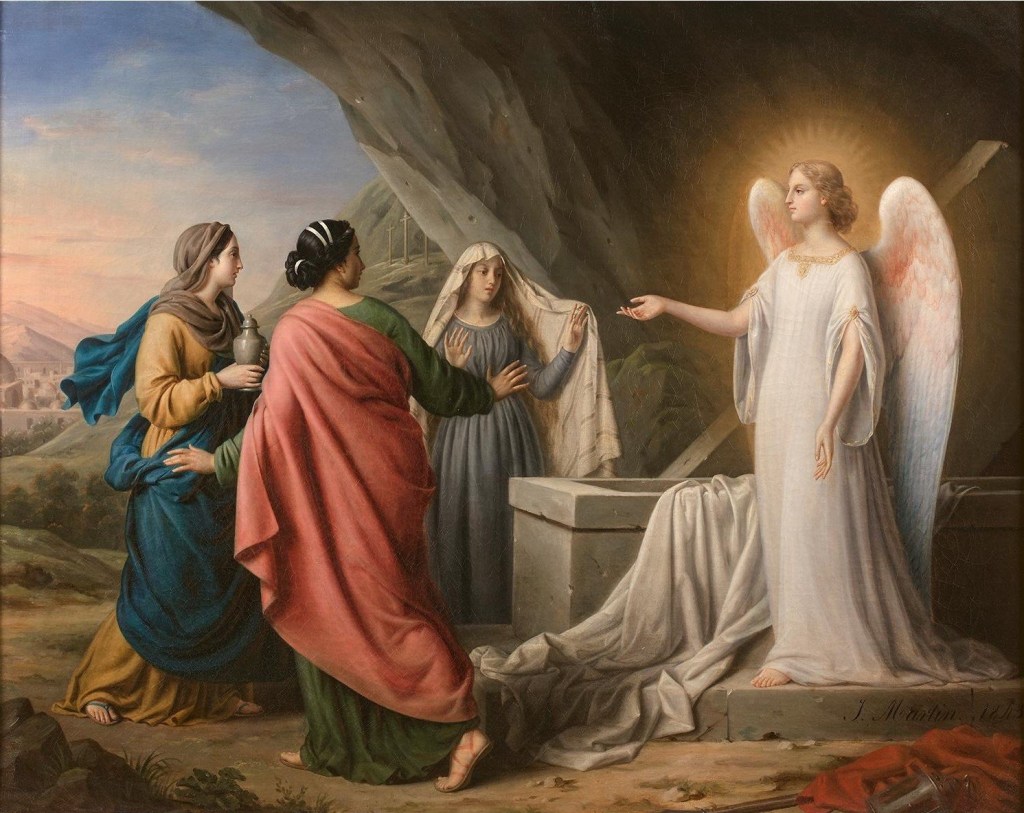
1. The gigantic stone that had sealed the entrance to the tomb had been rolled back.  Who could have done such a thing?  Remember, these ladies had been with Jesus at the Cross.  They had seen Him suffer and die.  They had watched Joseph and Nicodemus remove Jesus’ body from the Cross and transport it for burial in the new tomb nearby.  They also knew the men had hastily anointed Jesus body with embalming ointments and cloths, and had come to neaten things up and complete the job.  Surely they realized no single person could have rolled that huge, heavy stone away.

They probably also knew a contingent of Roman soldiers had been assigned there to guard the tomb.  So what had happened to them?  Had the Romans stolen Jesus’ body?  Had the Jewish religious authorities taken it?  They had to be both puzzled and alarmed.

Cautiously, they stepped inside the tomb to see if His body was there. Instead of finding Jesus’ corpse, they suddenly encountered two “men” in brilliant white clothes–angels.  It’s almost comical that the angels ask them, Why do you look for the living among the dead?  [He is alive!]  He is not here; He has risen.  Literally, the ancient Greek states, He has been raised.  The verb tense implies that God the Father has raised Jesus.

Angels had proclaimed His birth; now angels proclaim His resurrection (The angels and the women are all witnesses to this miracle).  These angels remind them of Jesus’ teachings about His death and resurrection on the 3rd day.  This is a prompt for them to remember. but it’s also a rebuke—”How could you forget something so very important?!!”

Then they do remember, and go to tell the disciples (the next  resurrection witnesses).  The Eleven do not believe them, even though they should have known these women were reliable truth-tellers.  Peter takes off for the tomb, to see for himself (he is now a witness).  Peter probably now knows better than anyone not to doubt the Lord’s words.  But he still wonders (perhaps “marvels”) about what Jesus’ absence in the tomb means. 

This passage (Luke 24:1-12) closes with questions in everyone’s mind about what has happened (big mysteries). 

The accounts of Jesus’ Resurrection are also reported in the other three Gospels, Matthew 28:1-8; Mark 16:1-8; and John 20:1-8.

A. You might want to read them each and compare to get a fuller sense of how the first witnesses to Jesus’ resurrection responded to the mysteries with which they were presented.

B. Paul, as we know, came to believe in Jesus sometime after the events of Resurrection Sunday.  By then, the mysteries had been explained.

So Paul is intent, in our 1st Corinthians 15:19-26 lesson, that we understand that Jesus’ resurrection is the defining moment of Christianity.

First, back in verses 5-8, he reminds us of who all saw Jesus following His resurrection:  Peter (omitting the women); the 12 minus Judas; more than 500 disciples (maybe he included the women among the 500); Jesus’ brother, James; and Paul himself.

Next, in verses 13-19, Paul asserts that our entire faith depends upon the truth of the resurrection:  Verse 14—If Christ has not been raised, our preaching is useless and so is your faith. In other words, Christ’s resurrection from the dead is incontrovertibly true and forms the basis of our belief in Him.  We worship a God who has the power to bring His Son back from the dead.  I want a strong, powerful God like that, don’t you?  We worship a God who loves us so much that He sacrificed His one and only Son to redeem us.  We worship Jesus, the One and Only, the God Who—because of His self-sacrificing love for us and His obedience to His Father–was willing to cover the cost of our sins.  The sinless Son of God gave up His life so we might have new life, and have it abundantly.  We can connect directly with the Father because Jesus opened the way for us (As He hung on the cross, the massive Temple curtain was torn in two, from top to bottom.)  We can anticipate being resurrected because Jesus opened the way for us.  And, when He comes again in glory to judge the living and the dead, He will destroy death…Praise God! 

C.  We don’t know who wrote Psalm 118:1-2, 14-24, but it is an ode to joy!  The psalmist invites us to focus on heavenly realities–not the frustrations and disappointments of this life.  Because of the mighty things Jesus will do [has done]—including demonstrating His power over death—we can gratefully rejoice in the Lord and praise Him for our deliverance, provision, and protection.

We are to be thankful to Him because (V.1)—The Lord is good; His love endures forever.  (V.14)—The Lord is my strength and my song; He has become my salvation.  (V.18)—Prophesying Jesus’s resurrection, the psalmist wrote, I will not die but live, and will proclaim what the Lord has done…He has not given Me over to death. Jesus was laid dead in a tomb–But He did not remain there as we would have.  He rose again, overcoming death for our sakes!  We are also grateful for the fact that (v.22)—The stone the builders rejected [Jesus] has become the capstone.  The capstone was either (1) a large rectangular stone used as a lintel over a doorway; or (2) a large square or rectangular stone used to anchor or align the corner of a wall; or (3) it might also be the keystone or middlemost stone in an arch.  The capstone (building corner or doorway lintel) or keystone (arch) kept the building from collapsing by supporting what existed beside and above it. The psalmist prophetically meant this as a metaphor for Jesus, who holds all things together for us— no wonder we call Him our Rock and our Redeemer.

Our passage today ends with this line (V.24)—This is the day the Lord has made, let us rejoice and be glad in it.

D. Isaiah 65:17-25 reminds us both that Jesus overcame sin and death, and that we too will therefore experience a joy-filled life after death.

After Jesus defeats the forces of evil at Armageddon, God (v.17) will create new heavens and a new earth.  If you read through the book of Revelation, you can tell that our world will be a disastrous mess by the time Jesus appears a 2nd time.  We will probably need a new earth, at a minimum.

Verse 19 tells us that the newly created Jerusalem will be delightful!

God will be overjoyed with His people there; and they too will be very happy, with no one weeping or crying.  Premature death will be an event of the past (no cancers, illnesses, strokes, heart-attacks, eye problems, hearing loss, or sciatic pain).  People will be able to enjoy the fruits of their labors (no warfare or taxes).  All of God’s people will be blessed!  God will answer our prayers before we even finish praying them.  And all animals will become plant-eaters—no more carnivores devouring prey—and will be at peace with each other.

Thanks be to God the mysteries presented the women at the open tomb have been solved.  We are not left to wonder.  Paul wants us to fully appreciate what Jesus has done for us through dying and rising again.  Our psalmist calls upon us to be grateful and to rejoice!  And Isaiah describes a wonderful world ahead for us when the resurrected Jesus comes back to earth.  Let’s celebrate by singing along to Keith and Kaitlin Getty’s version of https://youtu.be/m_063OI38RQ?si=Dre8ll-AV-GHUlPB In Christ Alone.

©️2025 Rev. Dr. Sherry Adams 

The Crucifixion

Pastor Sherry’s message for Good Friday 

Scriptures: Isa 52:13-53:12; Ps 22; Heb 10:16-25; John 18:1-19:42

Have you considered recently that we date our lives from the birth of Jesus?  Whether folks believe in Jesus or not, we all—believers and nonbelievers alike– date our checks, emails, letters, our own birthdates, any contracts we sign, from Jesus’ birth.  The Latin expression is Anno Domini, or AD, and means the year of our Lord.  Time before Christ’s birth is designated as BC, Before Christ.  We thus might think of today as April 18, 2025 AD, or April 18th in the year of our Lord 2025. This certainly commemorates Jesus’ 1st Advent, but truly we might more properly number our years from the date of His Crucifixion, 33 years later.

Why would I say this?  Because Good Friday marks the day we were all saved.  On this day, we commemorate the fact that our precious Savior atoned for all of our sins, past, present, and future.  His passion, His suffering, His shed blood washed us clean.  He traded our guilt for His righteousness; our punishment for His purity.  He won for us the right to go to Heaven when we die, and He made us adopted sons and daughters of God the Father, grafted into the line of God’s Chosen People.  Good Friday is a very special day.

(Leith Anderson, www.PreachingToday.com, 4/15/2025.)

Our Scripture passages assigned for today all try to communicate some aspect of Jesus’ Crucifixion:

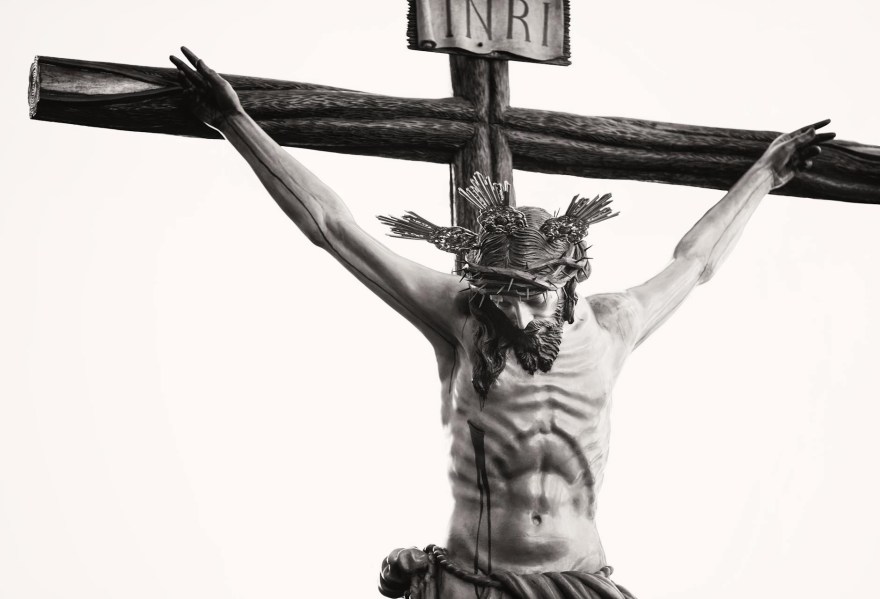
A. The Isaiah lesson was written 700 years before the events came to be, and describes them so accurately.  If you want a sense of what the crucifixion was like for Jesus, Isaiah 52:13-53:12, the 4th and final Suffering Servant Song, is the place to start. Biblical scholars call this Messianic prophesy the Gospel in the Old Testament.

Isaiah tells us Jesus will be raised high, lifted up (on the Cross) but also highly exalted (when it is all over).  No one would think so as they observed Him carrying His Cross.  He will in fact startle or surprise the whole world—even render them speechless—because it will be through the paradoxical loss of all things that He gains all things.

Jesus’ suffering included the fact that though King of the Universe, He will be/was (v.3)—despised and rejected by men, a man of sorrows and familiar with suffering… beaten beyond recognition; pieced, crushed, oppressed, afflicted; executed in the worst possible way–like a common criminal–hung between true felons.  He will die childless—“cut off,” which was to the Hebrews evidence of a tragic, futile existence.  People will think He got what He deserved, but He didn’t…verses 4-5—Surely He took up our infirmities and carried our sorrows….the punishment that brought us peace was upon Him, and by His wounds we are healed.  

A preacher named Leith Anderson describes it this way, “On the cross Jesus was stained with our human sin. He had never personally experienced sin before in his life, and now he was overwhelmed with sin in his death. God dumped on him the concentrated sum total of every murder, every lust, every envy, every rape, every theft, every profanity, every act of racism, every injustice against the poor, every sin of every person from every generation.” 

(Leith Anderson, www.PreachingToday.com, 4/15/2025.)

Despite all this pain and suffering, however, Isaiah also predicts Jesus will ultimately be vindicated.  Isaiah tells us that the Father will richly reward Him—verse 11—After the suffering of His soul, He will see the light of life [resurrection], and be satisfied…Therefore I will give Him a portion among the great, and He will divide the spoils with the strong.  God the Father intended to reward Him as though He were a king sharing in the spoils of a great victory, because (1) He went willingly to death, and because (2) He graciously interceded for our sins.

B. The Passion narrative of John (18:1-19:42) describes exactly what took place during Jesus’ arrest, disreputable trials, torture, crucifixion, and burial.  We can all discern how closely it fulfills Isaiah’s prophesy.  What wasn’t made evident ahead of time, however, is how clearly Jesus controlled events.  They sent 500 men to arrest Him!  (Temple guards and Roman soldiers.)  He bravely stepped up and asked who they sought and they replied, “Jesus the Nazarene.”  Verse 6 tells us that when He answered, I AM He —They all drew back and fell to the ground.  Perhaps it was due to the fact that He said “I AM,” the Hebrew name for God.  Or maybe they were suddenly afraid of the unarmed Christ!  He asked again who they came for, they said again, “Jesus the Nazarene,” and He replied (impatiently?) (v.8)—I told you that I AM He…and since I AM the One you want, let these others go.  He safeguarded His disciples.

He prevented widespread bloodshed.

Later, He corrected the High Priest’s guard for hitting Him, thereby demonstrating how dishonorable were His 3 trials:

1.) In Hebrew jurisprudence in those days, no trial could begin at night as this one was;

2.) No trial could begin and end within one day, as this one did.

3.) No one could strike a prisoner who had not yet been found guilty.

4.) No one could be sentenced without 2 or more eye-witnesses.

And when Pilate demanded, (v.10)—Don’t you realize that I have the power to release You or crucify You?  Jesus replied (v.11)—You would have no power over Me at all unless it were given to you from above.

He even determined the moment of His death (v.30)—He said, “It is finished,” bowed His head, and gave up His spirit. 

Jesus allowed everything to take place as it did out of obedience to His Heavenly Father, and to fulfill more than 28 prophesies.

C. Psalm 22 reveals to us Christ’s thoughts on the cross:  From noon until 3:00pm, He felt forsaken by His Father. The Father was with Him when He was arrested.  The Father was with Him during His outrageous trials. The Father was with Him when He was beaten.  The Father was with Him when He was nailed to the Cross.  But His Father—because a holy God cannot tolerate the presence of sin–turned His back on Him when He became sin for us. The most awful moment of Jesus’ crucifixion came when he cried out, “Eloi, Eloi, lama sabachthani?”  Those words are in Jesus’ native tongue of Aramaic and mean, “My God, my God, why have you forsaken me?”

He also admits to feeling like a worm.  The word for the term for worm that He uses is, in the Hebrew, a Coccus worm.  When smashed, the Coccus worm emitted a substance used to make red dye.  This is symbolic of Jesus’ blood poured out for us. 

Additionally, He feels the scorn and hatred of His enemies.  From the Cross He feels surrounded and besieged:  The soldiers are like many bulls…the strong bulls of Bashon (a region known for cattle production) .  

His tormentors from the foot of the Cross—scribes, Pharisees, the hostile mob—resemble (v.13)— roaring lions tearing their prey; and verse 16— dogs have surrounded Me; a band of evil men has encircled me, they have pierced my hands and my feet.  

Nevertheless, despite pain, suffering, and the loneliness of feeling abandoned, Jesus trusts in the love of His Father.

D.  The writer to the Hebrews (10:16-25) wants us to remember 2 additional facts:  (1) As Christ breathed His last breath, the curtain in the Temple—a large curtain of finely woven linen—was torn from top to bottom.  No human hand accomplished this.  God in Heaven tore it to indicate that Jesus’ death has granted us access to Him.  We may freely enter into the Holy of Holies (God’s presence) through the shed blood of Jesus Christ.

(2) Jesus’ death also ended the sacrificial system that had begun with Abel.  The shed blood of bulls, sheep, goats, etc., was required for centuries to atone for human sin.  God set it up so that something had to die to make up for or redeem us from our sin.  But with Jesus’ Once-and-for-all-perfect-sacrifice-of-Himself, these were no longer needed.  In this sense, Jesus’ Cross became an altar.

On this Good Friday, let us sincerely and truly thank our Lord Jesus for all He endured to save us.  Thanks be to God who gives us the victory through our Lord Jesus Christ!  Alleluia!  Alleluia!  

©️2025 Rev. Dr. Sherry Adams

Palms to Passion

Pastor Sherry’s message for April 13, 2025

Scriptures: Lk 19:28-40; Ps 118:1-2, 19-29; Isa 50:4-9; Ps 31:9-16; Phil 2:5-11; Lk 22:14-23:56

Our custom here at Wellborn Methodist Church has been to focus on Jesus’ Passion—His experiences and thoughts leading up to and including His Crucifixion.   Typically, then, we have handed out palm crosses, like you have today, but without focusing on Jesus’ triumphal entry into Jerusalem on Palm Sunday. This year, I wanted us to focus on the difference between Palm Sunday and Good Friday.  This is why we began our service on the front porch today, symbolically outside Jerusalem, if you will. And we followed the path of Jesus, riding on a donkey, as He made His way from the city gate into the Temple.

Now the Sadducees of 2000 years ago believed the Messiah would enter the city 4 days before Passover. Passover would have begun at sundown on Friday and ended at sundown on Saturday, the Jewish Sabbath.Thus, they made sure the gates to the Temple remained open the first day of their week, so Messiah could walk right on in and assume His throne.

Under normal circumstances, then, there would have been a great deal of hoopla and excitement among the Passover crowds, with people asking, “Is this the year?  Will Messiah show up? “  Knowing He would be arrested early Thursday morning and hanging on His Cross by Friday, Jesus chose to enter Jerusalem on what we call Palm Sunday.  What courage!

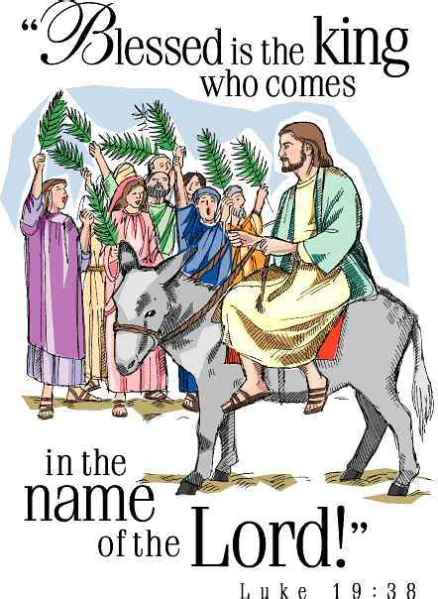
He fulfilled the prophesy of the minor prophet, Zechariah, from chapter 9, verse 9 (NLT) Rejoice, O people of Zion!  Shout in triumph, O people of Jerusalem!  Look your king is coming to you.  He is righteous and victorious, yet He is humble, riding on a donkey—riding on a donkey’s colt.  Victorious kings, Like David, would have entered the city to large, cheering crowds.  The people would have waved palms and placed their garments on the road for the King to tread upon.  At the end of 4th season of “The Chosen,” in episode 8 (you may call it up on YouTube), the writers re-enact one such victorious return, singing of King David, “Hosannah, Our King is Victorious!”

King David would have ridden in on his war-horse, but King Jesus rides in on a humbler animal, a donkey.  Luke wants us to be sure to know that this animal was borrowed from someone who knew of and loved Jesus, and it had never been ridden before.  Many in Jerusalem assumed Jesus was the Messiah and thronged around Him, praising Him and singing many of the lines read today from Psalm 118:25-29. Hosannah (Yesha anna in Hebrew) means save us now.  The crowds are asking Jesus to save them.

Do you think they knew that He was God in the flesh? They are cheering Him on. They are rejoicing in His presence. They are filled with hope that He is their Messiah.

The Passion readings appointed for today lead us from this celebratory procession to Jesus’ arrest, trials, death, and burial: 

A. Paul reminds us in Philippians 2:5-11 that Jesus humiliated or humbled Himself to come to earth to save us.  The Palm Sunday crowds expected Him to save them and that is exactly what He intended to do.  Paul wants us to be as humble and as obedient to the Father as Jesus was. Jesus obeyed His Father in everything, even up to and including His manner of death. Though totally righteous and holy, He died as though He were a rightfully tortured and despised criminal.

Paul also desires that we appreciate the depths of Jesus’ sacrifice on our behalf:  He gave up His heavenly prerogatives as King of the Universe–the One who spoke creation into existence–to be born in a stable, to a poor, young, homeless couple, in a ragtag and oppressed, tiny nation. Instead of demanding respect and a wide following as a great and exalted leader, He humbly behaved as a servant to all. No wonder the Father has honored Him above all things, declaring that His name commands total obedience, from every being, in every sphere of the universe!  Incidentally, this includes non-believers who will be shocked to arrive at the Great White Throne Judgment, only to discover they made the wrong choice to dismiss Him during their lifetimel

B.  Isaiah prophesies in 50:4-9 how Jesus, the Suffering Servant of God, will be treated during His Passion experience.  Verse 4 tells us He was tutored by Holy Scripture and also by His heavenly Father.  Verse 5 insists that He was always obedient to the Father’s will.  Verse 6 peaking for Jesus in the first person—I offered My back to those who beat Me, My cheeks to those who pulled out My beard.  I did not hide My face from mocking and spitting. This verse tells us He would endure beatings:  He was beaten by the Jewish Temple guards during the night;

Then He was beaten again by the Roman soldiers early in the morning. He would be spit upon, in His face (such a sign of contempt and hatred), and on His bloody body (YIKES!  to so desecrate God Himself)!  He will have His beard pulled out.

But notice too, in verses 7-9a—He will trust in God, His Father, the entire time.  He remained constant and faith-filled, despite all the evil that was done to Him!  I think He thus modeled to us how we might withstand persecution, if such befalls us for being Christians.  We are to hold on to our faith in God and to the love of Jesus for us, with both hands.

C.  Psalm 31:9-16 was written by King David.  The portion we read today is a prayer in which he seeks the Lord’s deliverance from a very powerful foe.  It is also very aptly describes what Jesus probably suffered on the way to His crucifixion at Golgatha, and even as He hung suspended from the Cross:  

   (1) V.9— Be merciful to Me, O LORD, for I am in distress… 

(2) V.10—My life is consumed by anguish and my years by groaning; My strength fails….

(3) Vv.11-12—Because of My enemies, I am the utter contempt of My neighbors; I am a dread to my friends—those who see Me on the street flee from Me.  I am forgotten by them as though I were dead; I have become like broken pottery.  

He is experiencing despair and grief.  But He does not succumb to it.  In verse 14, he reminds Himself, But I trust in You, O LORD.  I say, “You are my God.”  And He reaffirms for Himself, (v.15) My times are in Your hands.  We can trust in God to sustain us through the most difficult times because He is only a prayer away (meaning He is present to us).  He loves us, and He sent His only, beloved Son to die to save us.

D.  Our Passion narrative comes from Luke this year (22:14-23:56).  It needs little explanation as it speaks very powerfully for itself.  We see and understand that, though they had welcomed Him as a hero on Sunday, by Thursday they had replaced their Hosannah’s with outraged cries to Crucify Him!  What happened?  Well, quite simply, He disappointed their expectations.  They wanted a military leader to subdue the Romans; a warrior on a war-horse rather than a humble donkey.  They expected Him to overthrow their oppressors instead of teaching and praying daily in the Temple.  He didn’t live up to their idea of a Savior.  Their disappointment turned into anger and murderous rage, fueled and stoked by the jealous religious leadership who felt threatened by Him. So they killed Him.  But they didn’t eradicate either His memory or His influence.

We are currently living through a period in our country in which the influence of Jesus appears to have waned.  Fewer and fewer people seem to know Who Jesus is and why believing in Him and worshipping Him is important. Many churches have declining memberships. Folks appear to have given up regular Sunday attendance.  In fact, a statistic I heard recently said that most committed Christians only attend church once every three weeks.  Many activities compete for our attention—sporting events, leisure time pursuits, work, even sleeping in.  I was probably in my late 30’s when I realized that God spoke to me during Sunday worship.  His voice came to me through the music, the sermon, the readings, or sometimes from something a fellow worshipper said.  As much as I wanted to sleep in, I realized if I missed church, I would miss what the Lord had to say to me that week.  And as I came to regard my congregation as my “spiritual family,” I also realized I would miss what was often only a once a week contact. 

We need to remember all that Christ has done for us.  As I preached last week, we need a Savior because we cannot save ourselves.  The Good News is that we are washed clean of our sins by the sinless blood of the true Passover Lamb, our Lord and Savior, Jesus Christ.  Come, Let us adore Him!

©️2025 Rev. Dr. Sherry Adams

If You Thought This was Spectacular….

Pastor Sherry’s message for April 6, 2025 

Scriptures: Isa 43:16-21; Ps 126; Phil 3:4b-14; Jn 12:1-8

I love stories of healing:  (1) One of our parishioners told us once that she felt God free her from years of a smoking addiction while sitting here in our sanctuary.  (2) We learned several weeks ago that someone we had been praying for for weeks was suddenly healed of Stage 4 Cancer. (3) John Wimber, who founded the Vineyard Church (a charismatic, nondenominational church that focuses on healing), reported many healings but one in particular seems pretty spectacular to me:

“…he received a phone call from a distraught father.  The man was sobbing and could hardly talk.  ‘My baby is here in the hospital,’ he said, ‘and they have tubes from machines attached all over her body.  The doctors say she will not survive the night.  What can you do?’  John said he would come to the hospital.  After he put the phone down, he prayed, ‘Lord, is this baby supposed to die?’  John sensed the Lord saying, ‘No!”  John walked into the hospital with the knowledge that he was a representative of Christ, a messenger who had a gift for that baby girl. 

“When John entered the baby’s room, he sensed [a spirit of] death, so he said quietly, ‘death, get out of here [in Jesus’ name].”  It left, and the whole atmosphere of the room changed, as though a weight had been lifted. Then he went over and began praying for the girl.  After only a few minutes he knew she was going to be healed, and so did her father.  Hope came into his eyes.  

“She is going to be okay,’ he said; ‘I know it.’. 

“Within 20 minutes she had improved greatly; several days later she was released, completely healed.”

(Graham Twelftree, Your Point Being?,  Monarch Books, 2003, p.132.)

Stories like these touch our hearts. They remind us of God’s great love for us.  They deepen our faith.  And they are evidence that our God didn’t just do miracles in Bible-times.  There is in some corners of the Church a believe called dispensationalism. Folks who subscribe to this belief feel convinced that all miracles of healing or deliverance stopped with the death of the last Apostle.  But we know this is simply not true.

All of our Scripture passages today seem to suggest God’s great delight in surprising us with his grace and goodness.  It’s as though He is saying to us, If you thought this was spectacular….

A. In Isaiah 43:16-21, the prophet Isaiah reminds God’s Chosen People of His redeeming work on their behalf.  They had been bound up as slaves in Egypt for 400 years.  God had tucked them out of the way while He waited on the Canaanites to accept Him as their Lord.  They didn’t.  So God sent Moses as His choice of a leader to free the Israelites.  Miraculously, then, Moses led 2 million people, plus their animals and belongings, through a supernaturally dried up Red Sea (1446BC). They walked through on dry land, while the Egyptian army and the chariots that pursued them were drowned.

Isaiah speaks for God saying essentially, “If you think that was spectacular, wait til you see this new thing I am going to do. In verses 18-19 (MLV), the Lord says—But forget all that—It is nothing compared to what I am going to do.  For I am about to do something new.  See, I have already begun!  Do you not see it?  He is referring to how He, the Lord, will lead His people with a cloud by day and a pillar of fire by night.  He will provide them with supernatural food (manna) from heaven and supernatural water from rocks.  He will protect them from enemy attacks. physical diseases, and even from wear and tear on their clothes and sandals.

But, most spectacular of all, He is predicting—through His prophet—the redemption of all humankind He has planned through the efforts of Jesus Christ. In the entire history of the world, there has never been a religion in which the deity comes to earth to save human beings.  This is clearly “a new thing.”

B.  Psalm 126 offers a similar refrain.  This time the Jewish people have been released from their 70 year exile in the Babylonian-Persian Empire.  God had allowed the forces of King Nebuchadnezzar to defeat Judea, destroy Jerusalem, and cart the people off (586BC).  He was chastising them—after many warnings of judgment to come—for their idolatry and stubborn disobedience.  The news that they were free to return to Jerusalem stunned the Jewish captives!  The psalmist writes in vv.1-3—When the LORD brought back His exiles to Jerusalem, it was like a dream!  We were filled with laughter, and we sang for joy.  And the other nations said, “What amazing things the LORD has done for them.” Yes, the LORD has done amazing things for us! What Joy!

This probably felt to them like a spectacular new thing.  God’s miracles for His people were clearly not at an end.  And, just as the Isaiah passage predicted Jesus’ 1st Coming, this psalm looks forward to the Jesus’ 2nd Coming. 

C. The Isaiah reading dealt with the Exodus, and our psalm, with the return of the Babylonian exiles.  Paul takes us in a different but related direction in Philippians 3:4b-14.  Paul had, prior to coming to Christ, thought he could manage his own salvation by his own efforts.  He lists 7 credentials he had accumulated that made him a religious superstar:

1.) He had godly parents, who saw to it that he was circumcised on the 8th day—by Jewish Law. 

2.) He was purely a Jew—no nonbelieving Gentiles in his gene pool. 

3.) He was a member of the tribe of Benjamin, Jacob’s favorite son after his loss of Joseph.

4.) He was an elite leader.

5.) He was a Pharisee by training, dedicated to teaching and enforcing Jewish Law.

6.) He was so zealous that he persecuted the infant Christian Church.

7.) And he kept short sin accounts with God, making the requisite sacrifices when he sinned.

But, since becoming a follower of Jesus Christ, he considers all his worldly accomplishments worthless. And so should we.  It’s not about impressing others with what we have done or not done. Paul knows he could not make himself right with God through his own efforts.  He wants us to realize that (v.9)—…God’s way of making us right with Himself depends on faith.  It’s about having faith in Jesus Christ.  He is now dedicated to getting to know Jesus better and better, and to helping others do so too.  And so he presses on (vv.13-14)—Forgetting the past and looking forward to what lies ahead, I press on to reach the end of the race and receive the heavenly prize for which God, through Christ Jesus is calling us. 

This is definitely a spectacular new thing: Salvation does not come from our efforts, but has been won for us by our Lord and Savior, Jesus Christ.  We don’t have to try to be perfect. Our sins are covered by the sacrificial blood of the sinless Son of God. Our striving can cease, replaced by our faith.

D. Finally, in our Gospel lesson (John 12:1-8), we see a young woman do something extraordinarily new to honor Jesus.  The scene is a dinner party in Jesus’ honor at the home of Lazarus.  Rev. Dr. J. Vernon McGee says the Lazarus family represents 3 essentials in every Church:

(1) The resurrected Lazarus has new life in Christ.

(2) Martha no doubt prepared and served the meal, so she represents service.

(3) Mary kneels at Jesus’ feet, worshiping and adoring Him.

(McGee, Through the Bible Commentary on John, Thomas Nelson, 1991, p.38.)

Notice how extravagant are Mary’s efforts.  Jesus will wash His disciples’ feet with water at the Last Supper, but she anoints His feet with a very expensive perfume from India, and dries them with her lovely long hair.

Mary of Bethany realizes how very special Jesus is and she honors Him with a pound of spikenard worth a year’s wages.  She, like Paul who comes after her, has made worshipping Jesus the most important thing. Jesus accepts her worship as if she is anointing Him for His death some 6 days ahead. We could say she is fully committed and has the utmost faith in Jesus. 

I don’t know about you, but I find that Jesus often surprises me by answering prayers I haven’t even put into words.  There’s a certain busy intersection, with no light in my town, into which it is very difficult to turn left. For several days, as I have approached this intersection, there has been—amazingly—no traffic in either direction. As I have easily executed my left-hand turn, I have laughed and thanked the Lord. This is not as spectacular as opening the Red Sea, returning exiles to Jerusalem, or healing a dying baby.  But it serves as a reminder to me that Jesus sees me, loves me, and wants to have me cross the intersection safely.

Like Paul and like Mary of Bethany let’s during what’s left of Lent, focus on how grateful we are to serve a God who enjoys gifting us with spectacular large and delightful small surprises.

Thanks be to God who gives us the victory through our Lord Jesus Christ.  Alleluia, alleluia!

©️2025 Rev. Dr. Sherry Adams

God Never Gives Up On Us

Pastor Sherry’s message for March 30, 2025

Scriptures: Jos 5:9-12; Ps 32; 2 Cor 5:16-21; Lk 15:1-32

I ask your forgiveness if I have used this story before.  After 10 years here at Wellborn Methodist Church, I have lost track of which stories I have told when.  In this story a guy who committed a crime was sentenced to time in prison:

“ On his first day there he was sitting in the dining hall at lunch and suddenly a man stood up and shouted 37!  And everybody laughed.  After a while another man stood up and shouted 52!  And everybody chuckled and smiled.  After a few more minutes somebody else stood and yelled 86!  And again everyone laughed.  The new guy leaned over toward the man across from him and said, “What’s going on?  Why is everyone laughing at those numbers?” 

“The man said, “It’s like this.  There are only a hundred of so jokes in the world, and in here you hear them all.  We decided to save time and give them numbers.”  Wishing to fit in and win friends, the new convict decided to give it a try.  “17!” he yelled out.  Nobody laughed, nobody looked at him; finally, he sat down mystified.  “What happened?”  he asked his new friend.  The man shrugged and said “Oh, some people know how to tell a joke, and some people don’t.”   

(Fairless and Chilton, The Lectionary Lab Commentary: C, 2015, pp.128-129.)

Sometimes those of us who preach end up feeling this way about certain Bible stories.  They are so well known we could call out their names—like numbered jokes–and you would remember them.  Think of Noah and the Flood, Jonah and the Whale, the Good Samaritan, or the Woman at the Well.  You know these stories, you’ve heard them preached or discussed many times, and you could probably tell us all how they apply to our lives.

So what’s a preacher to do to bring new insights to such well-known tales and keep you all awake during the telling?

Our Gospel today (Luke 15:1-31) certainly falls into this category of famous parables. With the inspiration of the Holy Spirit, I will try to bring something fresh to our understanding of these well-beloved Parables.

A. Dr. Luke, the author of our Gospel account, has grouped together three parables of Lost things in Chapter #15.  They all say essentially the same thing, but using 3 different illustrations:

(1) An example directed at men (shepherds), a lost sheep;

(2) An instance directed at women (housewives), a lost coin;

(3) And an image most of us can relate to, a lost child, or son.

These constitute Jesus’ answer to the Pharisees’ criticism that He, a rabbi, hung out with sinners.  He knew they were muttering against Him (v.2) This man welcomes sinners and eats with them.  Jesus’ three examples—especially the final one—contrast the love of God for sinners, against the exclusiveness and snobbiness of the Jewish religious leaders.  Those folks, over time, had established themselves as a “holy club” whose members they considered special while those outside the club were considered losers.  Jesus is saying, among other things, God the Father and He, Jesus, both love the Lost Ones, the losers.. Yes, He also loves those of us who He has already found, and who have accepted Him.  In all three parables, Jesus defines repentance as the acceptance of having been found.  The initiative belongs to God.  He never gives up on trying to reach us.  He really goes out of His way to find us.  And, I could be wrong, but studying Jesus’ model, I think our job, as followers of our God, is to notice those who don’t love Him—or don’t even know about Him–and tell them the Good News of the Gospel:

(1.) Jesus Christ came to save the Lost;

(2.) He died on a Cross, taking upon Himself the penalty for all of our sin, for all time;

(3.) And He rose again, overcoming the penalty for our sins, which is death, and guaranteed to each of us eternal life in Heaven with Him.

Our Lord Jesus hung out with sinners because He hoped to save them.

B. While we’re on the subject, let’s take a look at our Old Testament lesson from Joshua (5:9-12).  The context is that God has safely delivered the Israelites from slavery in Egypt.  During their 40 years of wilderness wanderings, He has protected them from illness and enemies; provided them with water from the rock (Jesus) and has fed them with manna (also Jesus); He has disciplined those who were rebellious and ungrateful; and He has now directed General Joshua, their new leader, to lead them across the Jordan River into the Promised Land.

Instead of immediately attacking and defeating Jericho—which you might think He would do–God has Joshua circumcise all the men and boys born since the exodus.  YIKES!  Besides being very painful, this no doubt laid them out for several days as they recovered.  It also required that the Lord continued to protect them as they were vulnerable to attack. Clearly this was important to our God.  Why?  Circumcision was the undeniable, indelible, permanent sign of their covenant relationship with God—a daily reminder that they belonged to Him.  They had not practiced it in the latter years of slavery and didn’t stop traveling to circumcise in the desert.  God was saying to them, You are not lost; you belong to Me; You must carry the sign of our Covenant relationship.

Next, He directed Joshua to lead them in a Passover service.  The Lord wanted them to remember how He saved them from the angel of death—the 10th plague—in Egypt.  He wanted them to remember they were saved by the blood of the Passover Lamb painted over their doorways—a foreshadowing of Jesus.

Having rededicated themselves to God, the Lord discontinued the daily drop of manna and they ate instead of the grain and fruit of their new territory.  

Again, notice the lengths our Lord goes to help us remember we are His.

C. David’s psalm (Psalm 32) is what is called in the Hebrew a maschil, a psalm of instruction.  In Psalm 51:12-13, King David’s great penitential psalm, He promised that if God forgave him for his adultery with Bathsheba and his murder of Uriah her husband, he would teach others to love and obey God.  Scholars believe Psalm 32 is David’s fulfillment of that promise.  (Obviously, the psalms are not listed in chronological order.)

In verse 1, David writes (NLY, p.671)—Oh, what joy for those whose disobedience is forgiven, whose sin is put out of sight.  David is clearly speaking as someone who has experienced God’s forgiveness. He is rejoicing in the fact that God did not give up on him, despite his egregious sins.

He recounts how the Holy Spirit afflicted his conscience (v.3) until he came to a point of repentance.  He celebrates the fact that (v.5)—I said to myself, “I will confess my rebellion to the Lord.”  And You forgave me.  All my guilt is gone.

He uses the remainder of the psalm to praise God as his hiding place (v.7), and to instruct us that (v.10)—many sorrows come to the wicked, but unfailing love surrounds those who trust in the Lord.

D. Paul picks up a similar refrain in 2 Corinthians 5:16-21.

1st he states that we have no basis for judging others, as we are all sinners, and Christ died for every one of us.  Because of this, we are all new creatures in Christ.  He has pursued all of us. He has redeemed all of us. This fact has resulted in a new relationship between us and our God. Just as the reiteration of the covenant at Gilgal (which means rolled away; at that place God rolled away the shame of their past slavery, through circumcision and Passover) reaffirmed the Israelites as God’s Chosen People, we have—through our belief in Jesus–been reconciled to the Father.

We have also been given a ministry (vv.18-20, NLT)—And all of this is a gift from God who brought us back to Himself through Christ.  And God has given us this task of reconciling people to Him.  For God was in Christ, reconciling the world to Himself, no longer counting people’s sins against them.  And He gave us this wonderful message of reconciliation.  So we are Christ’s ambassadors.  We speak for Christ when we plead, “Come back to God!”

During Lent, as I said last week, as we do our spiritual housecleaning, we must all come to grips with the fact that we are all sinners.   As Paul says (Romans 5:8)—While we were still sinners, Jesus Christ died for our sins.  Our Lord Jesus is not satisfied until we Lost Ones are found by Him.  Our God is called The Great Hound of Heaven because He pursues us like a bloodhound until He finds us.  He and all of Heaven celebrate when we turn to Him.  He loves us with a steadfast and faithful agape love.  He is willing to forgive us whenever we repent and ask Him.

Interestingly, in the stories of the Lost Sheep and the Lost Coin, there is an invitation to us to party, but we don’t know if anyone did.  Similarly, in the story of the Lost Son, we know the party takes place, but we don’t know if the self-righteous older son ever participated.  These parables are left open-ended for a reason.  The ending is up to us.  How will each of us respond?  Let us join in with our reconciling Lord, who never gives up on us.  Please also turn to www.YouTube.com and listen to a song by Jesus Culture called “One Thing Remains.”

©️ Rev. Dr. Sherry Adams

Radical Heart Surgery

Pastor Sherry’s message for March 23, 2025

Scriptures: Isa 55:1-9; Ps 63:1-8; 1 Cor 10:1-13; Lk 13:1-9

I believe I’ve mentioned several times in the past that I taught Psychology at Santa Fe College in Gainesville for about 5 years. Most majors at Santa Fe required Psychology—even welding!—so there were many sections offered. Whether you are majoring in Biology, English, or even Art, a basic understanding of human behavior can be very helpful.

I enjoyed how bright and how funny the students were, and often learned as much from them as they hopefully learned from me. Instead of a term paper every semester, I had them embark on a Self-Change project. They were to use principles of psychology to either (1) add a new, good habit like drinking more water, or working out more regularly, or even devoting more time to study; or (2) they could try to overcome a bad habit, like quitting smoking or dipping, or one young lady who decided to stop gossiping at work. She noticed her coworkers always talked badly about whoever was not present. She realized that probably meant they criticized her when she wasn’t there. She admitted that work had become an unsafe place, emotionally. A non-Christian, she decided to do something about it by abstaining from gossip.

Another young woman said she wanted to avoid talking and thinking negatively. She’d noticed that always focusing on the negative put her in a bad mood (This is true for most people).She planned to substitute three good thoughts for every negative one she had—it turns out that recent psychological research has shown that substituting positive for negative thoughts is an excellent way to overcome depression..

These young women had great intentions. I had hoped these self-change projects would make a significant difference for my students, but I sometimes had my doubts. A girl in one of my classes said she was going to control her road rage, and she appeared to have done so. The following semester, however, I was right behind her in traffic when she grew enraged at the driver ahead of her, and then honked, yelled, and made rude hand gestures to this person. She didn’t see me, but I emailed her about witnessing her relapse into road-rage, and encouraged her to remember her intentions to change and try again.

What that proved to me was that to overcome long standing bad habits, we need the help of the Holy Spirit. Simply put, our willpower alone is not enough. We are told by Jesus that (Matthew 12:34) Out of the fullness of the heart, the mouth speaks. To achieve the kinds of behavioral changes we may want to make requires radical heart-surgery—a transformed heart! My students needed Jesus, and so do we! 

In our Gospel lesson today, Luke 13:1-9, Jesus talks about a what we may term “radical heart surgery.” Just as with real estate, a critical factor in understanding any passage from Scripture is its location, location, location! In the end of Chapter 12, is Jesus’ final appeal to the nation of Israel to repent. He tells them they are responsible for every sin they commit. He also reminds them to keep short accounts with God, asking for forgiveness daily, while they still have time to make things right. In the passage right after this one, Jesus again heals on the Sabbath. He has already duked this one out with the Jewish religious leaders several times. It is lawful to heal on the Sabbath, because the Sabbath was made for humankind, and besides He, Jesus, is Lord of the Sabbath. Therefore He has the authority to determine what is lawful to do during it. So He heals a woman in the Synagogue who has been bent over for 18 years. He then looks to see if the hearts of the religious establishment have been changed since He healed the man with the withered hand. Apparently not! The Synagogue ruler dresses Jesus down for healing during worship! And Jesus calls him a hypocrite for leading his animals to water on the Sabbath, but denying a woman freedom from her crippled condition. 

So our passage is sandwiched between two important notions: (1) Your hearts are not right with God (including Jesus). Do something about this now, as your time for changing is short. And (2) your hearts are not right with your neighbors. In other words, “You’d stress the letter of your interpretation of the Law over this woman’s welfare? Really?”

Then He moves on to two examples from real life: Some listeners (believers? Scribes, Pharisees?) relate to Him the latest of Pilate’s atrocities. We tend to think of Pilate only in the context of Jesus’ crucifixion, but he was a weak leader, “sentenced” to serve Caesar in Judea as a last chance to prove himself. Thus he was highly reactive and overly sensitive to whatever might displease Caesar. Apparently Pilate exacted capital punishment on some Jews from Galilee as they were in the act of worshipping at the Temple. To the Jewish mind, then, this was pretty horrific. Furthermore, whatever happened to the notion of “sanctuary”? Like if terrorists stormed Wellborn Methodist Church and killed us all while we were singing or praying together, we and others would be outraged.

These tale-bearers then ask, Do you think these Galileans were worse sinners than all the other Galileans, because they suffered thus?

They want a judgment call. The prevailing thought at that time was that all misfortune—disease, financial struggles, relationship problems, premature death—was due to your being an extreme sinner. They really believed that you could recognize a sinner by the amount of tragedy in his/her life. They perhaps wanted some assurance they are not as bad as the slain worshippers.Note Jesus’ answer: I tell you, No [they were not worse sinners]; but unless you repent you will all likewise perish. Does that answer strike you as a little strange? Jesus responds to their question—NO—then redirects them from the issue of whose sin is worse. Just as back in Chapter 12, He wants them (and us) to remember they (and we) are all sinners.(a) We need to get right with God and others; (b) We are all going to die someday, somehow; (c.) So, right now we need to admit our sin, confess it to God, and ask His forgiveness. And by the way, He probably didn’t miss that they had pointed out that the unfortunate citizens Pilate had executed were—like Jesus—Galileans. Some scholars posit that they were either being dismissive of Jesus —like saying He was a hick from Wellborn or Live Oak! Or, even more subversive, they were trying to set Him up to condemn Pilate so they could then rat Him out to the Romans. By this point in Luke’s Gospel, the gloves are off between the Jewish religious leaders and Christ.

Then Jesus brings up another tragic account: the tower that fell, killing 18 workers.This may have been a portion of an aqueduct that Pilate was having built in Jerusalem—so, back at you with the Pilate provoked deaths of Galilean Jews. This time the persons killed were residents of Jerusalem. Jesus poses their question back to them, Or those eighteen upon whom the tower in Silo’am fell and killed them, do you think that they were worse offenders than all the others who dwelt in Jerusalem? I tell you NO; but unless you repent you will all likewise perish.With an economy of words, Jesus deflects from the issue about the degree of sin because it distracts from the weightier, more important issue: Don’t worry about who sinned more than whom; it’s not a contest as every sin separates us from God, so there are no degrees of sin. But right now, you (we) need to look to the evil in our own hearts. Do we love God with our whole heart, soul, mind, and strength?Do we love our neighbors as ourselves?

Then He follows up with the Parable of the Barren Fig Tree. In the Old Testament, vineyards and orchards were metaphors for the nation of Israel.Fig trees were often planted in vineyards. They typically took three years to mature (bearing fruit, when mature, 10 months out of 12); Then another 3 years to bear fruit that God would not allow them to use; But, by the 7th year, (4th year with fruit), this fruit belonged to God; This barren fig tree has not produced fruit for 7 years (seven means completion in the Hebrew numbering system)! The tree’s time was complete.

The Vineyard owner is God (representing God’s justice).The Lord is disappointed that the Jewish religious leadership has not been more fruitful. He is ready to cut them down!They’re hogging soil nutrients that could go to the vines, the people.The vinedresser is also God (representing God’s mercy), and asks for patience, grace. Let me dig about it, aerate it, water it; let me pour manure on it, and offer it more time to change. Jesus is making a point the religious leaders would have well understood! “You are helpless to help yourself! Heart-changing help must come from outside yourself —we/you are all sinners in need of a Savior.”And whether they accepted it or not, Jesus was giving them a limited time to repent/to accept He is God.We know they ultimately rejected Christ and so God allowed the Romans to destroy the Temple and Jerusalem in 70 AD.

So what does this mean to us? Jesus is sharing us the truths that (1) We are all sinners! (2) Sin kills. It cuts us off from God, and it warps our relationships with others. Consider the example of pornography—a self-change project that several of my male students embarked upon.

It objectifies the person viewed.It tends to result in the viewer becoming angry with the object of their lust, blaming her for posing for the picture.

And it sends every thought through a sexual filter. (3) We all need to repent.(4) We need to invite the Holy Spirit to do radical surgery on our hearts.

Jesus gave these hardhearted, religious leaders another chance. Let’s remember this week how gracious and patient He is with each of us. Then let’s humbly and sincerely thank Him for His grace, His mercy, and His forgiveness. AMEN!

©️2025 Rev. Dr. Sherry Adams

Connected to Christ

Pastor Sherry’s message for March 16, 2025

Scriptures: Gen 15:1-18; Ps 27; Phil 3:17-4:1; Lk 13:31-35

Last week, I preached about how to avoid temptation.  I hope a number of you were able to follow Jesus’ example and thwart the evil one as he tried to lead you astray.  This week, I would like us to focus on keeping our eyes on Jesus—and remaining connected to Christ.

Emily Compagno, of Fox News, has written a book called Under His Wings: How Faith on the Front Lines has Protected American Troops (Fox Books, 2023).  Her 1st story is of an Army Colonel she met in Iraq, in 2009, while on a USO tour as an NFL cheerleader.  Col. Tim Karcher was responsible for hosting and protecting Emily and her team as they visited our troops in the war zone to bring greetings from home and to boost morale.  She learned he was a committed Christian who led Bible studies in his home when stateside.  He was also the proud father of 3 girls, and the devoted husband to Alesia, a woman he believed God had given him 20 years earlier.  Emily met him his 3rd duty tour in Iraq.

Three days after Emily had returned to the US, he was in an army vehicle, stopped at a corner in an Iraqi town, when an IED exploded.  He checked to see if everyone else in the vehicle was OK and told his crew both his legs were broken.  The truth was both his legs had been blown off just above his knees!  He died once as they worked on him in the field, and again, several times, as they medivacked him to an Army trauma hospital in Germany, then on home to Walter Reed Army Hospital in DC.  He later wrote to Emily,

“I died there as well.  I remember as it was happening that I was really, really sad.  Not scared, because I knew where I was going.  I was sad to leave my wife, my daughters behind.  I was going to miss out on walking my daughters down the aisle, that kind of stuff.  But I also knew this:  hundreds and hundreds of people were praying for me.  And it was a rough, rough time.  I had all kinds of infections, a fever of 105,” (p.19).

Col. Karcher leaving hospital

He survived yet again to spend 2 years in military rehab in San Antonio, Texas, learning to walk with 2 prosthetic legs.  His last Army assignment, prior to retiring in 2015, was to serve as Director of the Army’s Wounded Warrior Program at Ft. Belvoir in Virginia.  St. Paul writes in 2 Corinthians 1:4 We comfort [others] with the comfort by which we have been comforted.  As a double-amputee, he was the perfect person to encourage other soldiers who had lost their limbs.  (I have included slides of him leaving Walter Reed and also of him walking 100 miles in a fund-raiser to benefit our wounded warriors.)

Col. Karcher’s 100 mile walk.

Col. Karcher is clearly a heroic and a determined guy who credits his faith—His connection to Christ–his family, and the prayers of hundreds with pulling him through.  

II. Body▶️Let’s see what our Scripture passages have to say today about having the faith to pull through tough times.

A. In Genesis 15:1-19—in His 4th appearance to him— God tells Abram, who is still awaiting the Child of Promise that He, the Lord, is Abram’s shield and greatest treasure.  In other words, God is Abram’s king or sovereign (shield) Who protects him (as He does us).  The Lord, too, is the best reward Abram, or us, could ever receive—greater even than the Child of Promise.  And, because the Lord keeps His promises, an heir, Isaac, is coming, as are many, many other descendants (v.3)▶️…look up at the heavens and count the stars—indeed if you can count them…So shall your offspring be.  All who believe in Christ Jesus are descendants of Abram, grated in to the line of Jewish believers.  And so also is the gift of property coming to this wandering Aramean, land stretching from the borders of Egypt to the Euphrates River.

In today’s passage, Abram has not yet seen either of these come true, but he believes God.  Verse 6 says▶️Abram believed the Lord, and He [God] credited it to him as righteousness.  Jesus had not yet come to earth to save us, yet God saved Abram due to his faith. Will we see Abraham in heaven?  YES! 

Notice one other point: God reiterates His promises to Abram by literally “cutting a covenant” with him.  In the Ancient Near East at that time, when you made a binding agreement with someone, you literally cut animal sacrifices in two and walked between them.  You were saying that, in effect, if I break this agreement, may I die as have these animals.  God was swearing an oath to Abram on His own life.  Remarkable!  Also, the forms He used to represent Himself (God is Spirit) are symbolic of the coming Christ:

The smoking firepot represents the judgments Jesus will make at His 2nd Coming; the burning lamp signifies Jesus as the light of the world.

We could say, then, that God as the Pre-incarnate Jesus, swore an oath with Abram.

Much later, Abram died a wealthy man with an heir from his own elderly body, Isaac, and a huge amount of property.  Good things come to those of us who trust in the Lord.  Like Col. Karcher, we may not move through our lives without pain and suffering, but Jesus holds our lives in His able hands and blesses us.

B.  King David wrote Psalm 27.  In the first 6 verses, David notes how God provides confidence and encouragement for those of us who love Him.  In verses 7-12, he then goes on to pray for deliverance from treacherous enemies.  Interestingly, these enemies have leveled false charges against King David.  This is so like what we witness today, where we observe people on social media and in politics so ready to fabricate lies aimed at discrediting/running down others.

But in verse 4, David articulates his primary desire:  One thing I ask of the Lord, this is what I seek:  that I may dwell in the house of the Lord all the days of my life, to gaze upon the beauty of the Lord and to seek Him in His temple. King David desires full-on access to God:  He’s got wealth and political power—his throne; he’s got either a land at peace, or military victories; he’s got wives and concubines and a bunch of children; but more than these usual things people yearn for, before anything else, David desires intimate communication/connection with the Lord.  This fervent desire to seek God’s face and to develop a deep relationship with Him is what carries us through hard times and helps us overcome our tough circumstances.

C. Our New Testament passage today is from Philippians 3:17-4:1.  Just prior to today’s reading, in verses 13-14, Paul asserts▶️…but one thing I do: Forgetting what is behind and straining toward what is ahead, I press on toward the goal to win the prize for which God has called me heavenward in Christ Jesus.  What goal is he talking about?  Intimate connection with Jesus.  He wants to be as close to Jesus as possible because (v.20)▶️Our citizenship is in heaven.  This earth is not our final home.  All that goes on here is a testing, a proving ground for rewards given us later in heaven.  Those who don’t pass the tests are what Paul calls (vv.18-19)▶️…enemies of the cross of Christ.  Their destiny is destruction, their god is their stomach [meaning satisfying their physical or their emotional needs], and their glory is in their shame. Their mind is on earthly things.

Paul exhorts us not to be like these kinds of folks.  He wants us to keep our focus on The things of God; And to remain closely connected to Jesus.

D.  And if we were not clear on this, Jesus weeps over Jerusalem, in Luke 13:31-35.  Jesus is praying as He overlooks the city from some height.  He is grieved because he knows what is to come–His betrayal, the trumped up accusations, the fraudulent trials, the beatings, and His crucifixion.  The city He has come to die for will soon reject Him.

He is grieved because he knows that Jerusalem, the capital city of God’s chosen people, was not desperate enough to seek His face.  They preferred to protect their idea of God while rejecting and discarding the One Who was God. 

Jesus has since gone on to glory, while His enemies in Jerusalem and Judea have no doubt met a far worse end.  We know He loves us and died for our sakes.  We know He has hidden us in the shelter of His wings.

On this, the 2nd Sunday of Lent, as we continue our spiritual house-cleaning, we should be asking ourselves, “Are we deeply connected to Jesus?”  The truth is that we need Him.  Consider this poem:

At my lowest, God is my hope.
At my darkest, God is my light.
At my weakest, God is my strength.
At my saddest, God is my comforter.”

Author Unknown

(Kathy Keller, “Stay Close to God,” www.sermonillustrations.com, 12/18/ 23).

This week, let’s focus on getting and remaining connected to Christ.  AMEN!

©️2025 Rev. Dr. Sherry Adams 

Conquering Temptations

Pastor Sherry’s message for March 9, 2025

Scriptures: Deut 25:1-11; Ps 92:1-15; Ro 10:8-13; Luke 4:1-13

Oscar Wilde, the Irish poet and playwright of the mid to late 1800’s once said, ”I can resist everything but temptation.”  Probably many of us can say the same.  Another fellow from the Funny Papers complained to a pastor, “How come opportunity knocks once, but temptation beats down my door every day?”

(Charles Swindoll, the Tale of the Tardy Oxcart, Word Publishing, 1998, pp.560, 562.)

It would seem that there is no end to things that tempt us:  Perhaps you have given up cussing for Lent, then accidentally trip over your dog, or close your hand in your car door?  Immediately you find yourself swearing away

Or, you plan to forgive a certain aggravating person, do so, and then find they aggravate you all over again the very next time you meet up with them?  I was once told by a person enrolled at one of the service academies that their honor code was so widely adhered to that you could leave a $100 dollar bill out on a desk and no one would take it.  I truly hope our war-fighters-in-training are as honorable; but I have to wonder if laying out a temptation like that—even among honorable persons—is very smart.

Our adversary, the Devil, comes at us with temptations.  He loves to try to make us doubt God’s goodness.  But if that doesn’t work, he’ll come up with a temptation to pull us away from our part in God’s story.  (Think of the word history.  As a former high school history teacher, I have come to the conclusion that the passage of time carries God’s story—He oversees history; it is His story and He invites us to participate.)  The Apostle Peter knew this well.  He famously warned us (1 Peter 5:8, NIV)  Be self-controlled and alert.  Your enemy the devil prowls around like a roaring lion looking for someone to devour.

So how are we to avoid the traps he sets for us?  What’s the secret to frustrating the evil one?  What strategies does Jesus model to enable us to conquer our temptations?

Let’s take a look at our Gospel lesson (Luke 4:1-13) for some valuable pointers.

Today’s passage begins with Jesus being sent—by the Holy Spirit—into the wilderness for a time of testing.  The Father knew our Lord needed to be tested before He began His earthly ministry.  Both Jesus and the Father knew He needed to prove that He could recognize Satan’s temptations and resist them.  In a sense, the Father had Jesus begin His public ministry just as Adam and Eve had begun the human story, with a test.  They were commanded not to eat from the Tree of the Knowledge of Good and Evil.  And we now know they failed the test.  Satan seduced or tempted them; and to their and our everlasting regret, they fell for it.

If we read Dr. Luke’s genealogy of Jesus at the end of Chapter 3, we see that Jesus, the Son of God, is descended from Adam (on His mother’s side).  He could be said to be the Son of God and also a descendant son of Adam.

Paul and others call our Lord the 2nd Adam.  Will He be taken in like the 1st Adam was?  Will he fall for Satan’s ploy to feed Himself by turning stones into bread?  Notice the situation is similar, but the setting differs.  Adam and Eve were ensconced in a beautiful garden where all their needs were met.

But Jesus is tempted in a barren wilderness.  His ancestors, the Israelites, wandered in the wilderness for 40 years.  God is inviting Jesus to re-enact, in 40 days, not only Adam and Eve’s trial, but that of Jesus’ Israelite ancestors as well.  And we see—Praise God!—that the 2nd Adam, the perfect Israelite, does it better.

Normally, our Lord would want Jesus to eat when He was hungry. But during this 40 days (the precursor to Lent), He had dedicated Himself to a fast.  (This is why so many Christians decide to spend these 40 days of Lent in some sort of fast.)  Jesus was focusing all His attention on His relationship with His Heavenly Father.  But He was most likely also physically and emotionally depleted.  Isn’t it just like Satan to come at us when we are particularly vulnerable because we are tired or hungry?  He was also alone, away from the potential support of home and family.  I think this latter factor plays into marital affairs on business trips. There is no one around and a person becomes vulnerable due to fatigue and stress and no reminders of a family waiting at home.

So Satan’s first temptation to Jesus was to have something He was not meant to have.  There nothing sinful about bread, in and of itself.

But eating at this time would have distracted Him from His retreat with His Heavenly Father.  So it is with us, isn’t it?  There’s nothing wrong with good food, nice clothes, a beautiful home, a snazzy car, a prestigious job—unless our pursuit of them comes between us and God.  Jesus knew He wasn’t to eat then, so He refused Satan’s temptation, and quoted Scripture to him🡪NLT, Deuteronomy 8:2 & 3 Remember how the Lord your God led you through the wilderness for these 40 years, humbling you and testing you to prove your character, and to find out whether or not you would obey His commands.  Yes, He humbled you by letting you go hungry and then feeding you with manna, a food previously unknown by you and your ancestors.  He did it to teach you that people do not live by bread alone; rather, we live by every word that comes from the mouth of the Lord.     

Jesus’ 2nd temptation was to be someone He was not meant to be.  Satan thought to tempt Jesus with becoming an earthly ruler.   Satan is the Prince of this world, but He did not then and does not now have the power to make someone king of the world.  Only God can do this.  So, notice, Satan was lying, wasn’t he?  He will also lie to us.  Jesus says in the Gospel of John that Satan is the Father of Lies and that lies are his native language. 

He will tempt us to become something we are not meant to be.  It might be to become popular, famous, rich, or influential.  It might be to be married, or to raise a household of kids.  God may even have these things in mind for us—but not just now, or not under our current circumstances.  Additionally, the cost of caving in to the temptation is turning our backs on God’s plan for our lives.

Again, notice that Jesus quotes Scripture in his response to Satan: (NLT, Deuteronomy 6:13 & 14) You must fear [revere, worship] the Lord your God and serve Him.  You must not worship any of the gods of neighboring nations, for the Lord your God, who lives among you is a jealous God.  Jesus wisely only wanted to please God.  Jesus wisely determined only to worship God.

His 3rd temptation was to do things He was not meant to do.

Satan wanted Jesus to perform a miracle and save Himself from falling/suspending the law of gravity.  But our Lord knew He was not to get ahead of the will of the Father.  Satan believes he has the victory when he tempts us to act carelessly or recklessly, assuming God will rescue us from whatever is foolhardy.  Jesus knew it is not our place to test God by taking ridiculous risks to see if He rescues us from our own foolishness.  We were not meant to abuse our bodies and minds with alcohol or drugs; engage in sexual relations outside of marriage; explode with anger; cheat, steal from, or lie to God or another, etc.

The truth is that each of Satan’s temptations—of Jesus and of us—is to shortcut God’s plans for us.  He wants to seduce us away from God’s story for our lives.  He promises the easy way of no hardship, no suffering, and no Cross.  But Jesus stood strong against Satan.  He said, essentially, that His life was about more than satisfying His bodily appetites;more than having worldly power; and more than personal safety.   He made it clear that His life was about doing His Father’s will.

A preacher named Bryan Wilkerson once wrote, “So Jesus was tempted along these three lines—to have something, to be somebody, and to do something other than [what] God intended. In other words, Jesus was being tempted to break away from God’s story.”  And so are we.

(Sermon on Jesus’ Temptations, http://www.PreachingToday.com, 3/5/25.)

Fortunately, He also teaches us to conquer temptations by asking ourselves the following:

1.  Is what we want something God would not want us to have?(Or not to have yet, at this exact moment?

2. Is it to become something God does not mean for us to be?

3. It is to do something God would not want us to do?

In studying this passage, I firmly believe that all of our temptations can be put in one of these three categories.  Just stopping to consider which category a given temptation exists in might be just enough to help us avoid it.

Jesus also models…

1. Relying on the inspiration of the Holy Spirit,

2. Knowing and following Scripture,

3. And checking things out in conversations with the Father. There are some excellent strategies for turning away from temptation.  May we remember these this Lent, and always.  Thanks be to God who gives us the victory through our Lord Jesus Christ.  Alleluia, Alleluia!

©️2025 Rev. Dr. Sherry Adams

Transfigured to Transform

Pastor Sherry’s message for March 2, 2025

Scriptures: Ex 34:29-35; Ps 99; 2 Cor 3:12-4:2; Lk 9:28-43

Today the Church celebrates Transfiguration Sunday. What does it mean that Jesus was “transfigured”? The story is told of a Sunday School teacher trying to explain our Gospel story to a group of young children:

She noticed one little boy seemed confused.  When she was finished [reading] she asked him, “Johnny, why don’t you tell us where Jesus was in this story” He replied, “Oh, he was on a mountain.”

“Yes, that’s right; said the teacher, “Do you remember why he was up there?”

Johnny answered with a confused look, “I guess that’s where his arithmetic class was held .”

The teacher looked at him and wondered what he meant. “What do you mean, arithmetic class?”

“Well” Johnny replied, “The Bible said, ’Jesus went up on the mountain and there he BEGAN to FIGURE.”

(Tim Zingale, “Transformed,” 2/11/02, www.sermons.com)

Don’t you love the unique and literal way that little kids think?  The child obviously didn’t get it—the teacher needed to explain further.

There is a story told about Napoleon that comes closer to describing it.  It took place during his disastrous invasion of Russia (1812).The Emperor“

“… somehow got separated from his men and was spotted by his enemies, the Russian Cossacks. They chased him through the winding streets. Running for his life Napoleon eventually ducked into a furrier’s shop. Gasping for air and talking at the same time he begged the shopkeeper to save him. The furrier said, “Quick hide under this big pile of furs in the corner.” Then the furrier made the pile even large by throwing more furs atop of Napoleon.

“No sooner had he finished when the Russian Cossacks burst into the shop. “Where is he?” they demanded to know. The furrier denied knowing what they were talking about. Despite his protests the Russian Cossacks tore the shop apart trying to find Napoleon. They poked into the pile of furs with their swords but did not find him. The eventually gave up and left the shop.

“After some time had past, Napoleon crept out from under the furs, unharmed. Shortly after Napoleon’s personal guards came into the store. Before Napoleon left, the furrier asked, “Excuse me for asking this question of such a great man, but what was it like to be under the furs, knowing that the next moment could surely be your last?”  Napoleon became indignant. “How dare you ask such a question of the Emperor Napoleon?” Immediately he ordered his guards to blindfold the furrier and execute him.  The furrier was dragged out of the shop, blindfolded and placed against the wall of the shop. The furrier could see nothing but he could hear the guards shuffling into a line and preparing their rifles. Then he heard Napoleon call out, “Ready!” In that moment a feeling the shopkeeper could not describe welled up with him. Tears poured down his cheeks. “Aim!”  Suddenly the blindfold was stripped from his eyes. Napoleon stood before him. They were face to face and Napoleon said, “Now you know the answer to your question.”

“The lesson here is obvious: How can you describe a near death experience? You can’t. It has to be experienced. Jesus’ transfiguration falls in the same category of events which cannot be described. I think that is why Luke says that they kept it to themselves and told no one what they had seen. How do you describe it? It had to be experienced.”

(Brett Blair, www.eSermons.com, 2/27/2025.  Adapted from a story from Wayne Heyer.)

It’s interesting, isn’t it?  People can talk around it, but apparently the experience was difficult to describe.   Jesus’ transfiguration means that, for a brief time, He appeared to His closest friends in all His heavenly glory.  He had metamorphosized before their eyes.  Blinding light emanated from Him— His whole body radiated light   So Jesus shines bright as the brightest sunlight; He blazes brighter than a raging bonfire.  This gives new meaning to the praise song, “Shine, Jesus Shine,” doesn’t it?  Also, consider the Aaronic Blessing (Numbers 6:24-26, NIV):  The Lord bless you and keep you; the Lord make His face to shine upon you and be gracious unto you; the Lord turn His face toward you and give you peace.  Remember, the book of Revelation (21:22-24) tells us that Jesus and God the Father will be our light sources in the New Jerusalem, following Jesus’ 2nd Coming, as there will be no more sun, moon, or stars.  Paul tells us that we too will undergo this kind of transformation when we enter heaven.  We too will shine in the reflection of the Lord’s presence…but more about this in a minute.  (By the way, the three friends did not talk about what they saw because Jesus told them not to.  If you had seen Him in His heavenly state, wouldn’t you have kept quiet if He required it of you?)

II. Body—>Did you notice that all of our readings today focus on Jesus’ Transfiguration?

A. In our Gospel passage (Luke 9:28-43) Peter, James, and John are eye-witnesses to Jesus’ transfiguration.  By this third year of their “seminary experience” with Him (seminary normally takes 3 years), they probably thought they knew Him pretty well.  They have only seen Jesus as the itinerant rabbi from a humble, back-water town.  Yes, they have witnessed Him perform miracles.  They have been astonished by His wise but counter-cultural teaching.  But they have not, prior to this, been exposed to Him in all His heavenly glory.

Now, He metamorphosizes before them into the God He really is. Seeing Him this way should have convinced them that He truly is the Son of God.  Furthermore, they recognize Him talking with Moses, the deliverer and Law-Giver, and Elijah, the great prophet!  Finally, in the coup de grace, they hear God the Father say (v.35)—>This is My Son, whom I have chosen.  Listen to Him.  Surely these special friends realize in this experience that they have massively underestimated Jesus!  This very special event should have helped move them to the awareness that they were friends and comrades of the long-awaited Messiah.  The two figures with Him were both divinely favored heroes of Israel:  Moses, like Jesus, had lead God’s people out of bondage—>he foreshadowed Jesus as savior and redeemer.  Elijah was a great prophet who, like Jesus, held power over nature, performed wonderful miracles, and defeated 850 priests of Satan.  God the Father, in His proclamation, makes it clear that He sees Jesus as similar to but superior to them both.

You might be wondering how they knew it was Moses and Elijah who conversed with Jesus.  The Holy Spirit probably just revealed their identities to them, because they just seemed to know.

B.  Speaking of Moses (Exodus 34:29-35), he too briefly reflected God’s glory whenever He visited with the Lord.  Let’s consider first the backstory to this event: Just 3 months after crossing the Red Sea and escaping the pursuing Egyptian army—as well as having been fed, watered, and protected by God in the meantime–the Israelites are  encamped at the base of Mt. Sinai.  They have violated their covenant with God by worshipping a golden calf.  They have thus already broken the 1st (No gods before Me) and 2nd (No graven images/no idols) commandments which Moses is bringing to them.  Biblical scholars tell us had he brought the two tablets into the camp, their punishment would have been death to every one of them!  But, in anger and grief—and to protect them from the death penalty–Moses breaks the original tablets containing the 10 Commandments before returning to the camp.  God then commands the Levites faithful to Him to go throughout the camp, killing those guilty of worshipping the golden calf (spiritual adultery).  The guilty parties die (surely God discerned who offended and who did not), but how does the rest of the community get back into God’s good graces?

Moses journeys back up to meet with God a 2nd time.  He goes to beg the Lord to forgive His people. He hopes to try to repair the broken Covenant.  And, of course, he needs to request a new set of stone tablets.

God, in response, identifies Himself as patient, loving, faithful, forgiving, and just; and He demonstrates to Moses and to us that His covenant promises depend more upon His unchanging nature than on Israel’s (or our) unfaithfulness to Him.  Then He writes, a 2nd time, His Laws on new stone tablets.

As a result of this extraordinary encounter, Moses’ face shines!

He has experienced God’s glory and it is reflected on his countenance.

At first, he appeared not to have been aware; but in verse 30, we are told—>When Aaron and all the Israelites saw Moses, his face was radiant, and they were afraid to come near him.  He had to call them to himself to convince them it was still Moses that they saw, and that he was all right.  Interestingly, he then veiled himself as the glow wore off.

He spoke to God and to the people bare-faced, but he “masked up” afterward, to prevent anyone from seeing the glow diminish.  It appears he was trying to manage their perception of him.  He may have wanted their respect.  He may have wanted them to remember he spoke frequently with the Lord.

C. But Paul tells offers us an alternative explanation in 2nd Corinthians 3:12-4:2.  He asserts that Moses veiled himself…not because the people were afraid of him—at least not after the 1st time; but instead because Moses wanted them to focus on the Lord and not on Moses’ face (another form of idolatry).  He wore a veil until the shine dimmed.  He wore a veil because the people’s hearts were hard and not yet ready to draw close to God.  What Paul is saying in our passage today is that because Jesus has come and revealed Himself as our Messiah, we do not veil the Gospel but teach it freely and openly (Vv.16-17, NLT)—>But whenever someone turns to the Lord, the veil is taken away.  For the Lord is the Spirit, and wherever the Spirit of the Lord is, there is freedom.  We teach the Gospel without any gimmicks or tricks.  Additionally, neither Paul nor any of us is veiled because the Lord wants all to see His glory reflected in us. He wants others to see the life-giving Holy Spirit at work in our lives, and reflected in the faces of all believers.

D. Finally, Psalm 99 enjoins the people of all nations to worship the Lord, the King of all the Earth, who rules from Mt. Zion (the Temple Mount in Jerusalem).  We are reminded that Moses and Aaron served Him.  They called out to Him for help and He answered them.  He punished idolaters and the rebellious.  And He has always acted justly and righteously.  We will be able to gaze upon Him in heaven.  Again, our faces will be unveiled, and our eyes will be able to behold His brightness.  

So What are we to take away from Jesus’ Transfiguration?  First of all, clearly He is God.  Jesus shone with His heavenly glory and if we had been there, with Peter, James, and John, we would have seen it.  Moses picked up some of God’s reflective glory whenever he visited with the Father either on top of the mountain, or in the Tent of Meeting.  But Paul wants us to reflect Jesus’ glory in the way we look, the way we act, and in the way we speak to others.  Jesus transfigured so that we might be transformed more and more into His image and likeness.  We can do this as we allow the Holy Spirit to continuously mold and shape us more and more into the image and likeness of Christ.

©️2025 Rev. Dr. Sherry Adams