We Want a Hero!

Pastor Sherry’s message for 8/27/23

Scriptures: Ex 1:1-2:10; Ps 124; Romans 12:1-8; Matt 16:13-20

I attended 4th grade in NOLA (New Orleans, Louisiana). My dad was in the navy and we were stationed there for two years. My teacher was a sweet, pretty young woman, newly married. I can’t remember her name but I do remember that she exercised no classroom control. The boys in particular behaved very badly and she could not get them to shape up. They neither listened to nor respected her. The ceiling of our classroom was covered with their spit-balls. Normally, as an Adams, I was assigned a front row seat. But to avoid having sloppy, germy spit balls hit my face, neck, shoulders, or arms, I asked to be allowed to sit in the back row. I really learned to hate school that year.

From the vantage point of having taught high school and college classes for years now, I suspect this woman started off too soft, too friendly. We teachers are trained to start out “tough” or “strict” and then to loosen up control once the class has learned to be respectful and cooperative. You cannot start off lax and then tighten up later. Such a move causes resentment. She was so frustrated that she often punished the whole class—also not an effective move—by making us copy down dictionary definitions of dozens of words. She left at the half year point. I now suspect she “escaped” into a convenient pregnancy.

She was replaced by a retired Marine drill sergeant named Mr. Sterling (notice, I have remembered his name). He was tall and fit and tolerated no nonsense. Anyone who acted out was dealt with immediately and firmly. They might have to sit on an invisible bench—something you could not require of a kid now—or memorize the teen times tables. Mr. Sterling got those bad boys into order in no time. Because of him, our classroom grew to be safe again. He eliminated flying spit balls and group punishment—what a relief, on both counts. And if the class was good, he would tell us another installment of an exciting story, ending each day in a cliffhanger to be continued tomorrow, if we were cooperative. Looking back, it’s obvious that he was a wise man and a good teacher. He seriously became my hero.

We need and long for heroes to rescue us from painful circumstances, even death, and to help us become more than we might ever expect. If you’ve lived through a near death experience and a rescue, you know such an experience impacts your life in lasting ways.

A. In our Old Testament lesson today, we encounter 3 heroes:

First we have the very brave ladies who led the corps of Hebrew midwives, Shiphora (whose name means beauty) and Puah (splendor). We are told that a new pharaoh (coming some 200-250 years after Joseph’s administration) had not heard of Joseph and what he had done for Egypt. Additionally, this ruler was very worried about how numerous the Jews had become. As herdsmen, the Israelites had been left alone to multiply their numbers in the fertile delta region. (Egyptians avoided herders and herd animals, regarding them as “unclean” and uncouth.) God had foretold to Jacob in Genesis 46:3–Do not be afraid to go down to Egypt for I will make you into a great nation. So, the phenomenal growth of the Israelite people while sojourning in Egypt is the outworking of this promise. This Pharaoh, however, viewed them as a threat to Egyptian security.

He could have released them to return to the Promised Land, but decided instead to enslave them. This would eliminate any threat and Egypt could benefit from their free, hard labor. Israelite labor built 2 treasury cities of bricks. We know from modern philosophy that absolute power corrupts absolutely. Pharaoh first provided them with straw to make their building bricks—straw was the binding agent necessary to help the bricks remain firm. But later, to hopefully reduce their numbers, Pharaoh made them locate their own straw, while keeping their quotas the same. We would call this today “management by intimidation” or “management by spreadsheet.” Nevertheless, the Israelites continued to multiply, as if Egypt were a giant hatchery or incubator for them.

Pharaoh then instituted an edict that male babies born to Hebrew women were to be euthanized just after birth. The midwives were to kill all newborn males. But Puah and Shiphora revered God, the God of life, and refused to obey Pharaoh’s commands. When Pharaoh noted his male enfant genocide edict was not being enforced, he demanded to know why. The ladies fabricated the excuse that Hebrew women were so resilient that they gave birth, on their own, before the midwives could even arrive. Much like King Herod would later have his troops do to toddlers who could have been Jesus, Pharaoh had his troops throw male Hebrew babies into the Nile. Psalm 124:6 says—Praise be to the Lord, who has not let us be torn by their teeth….This could very likely refer to the teeth of Nile crocodiles who would feed on these poor infants. How cruel! Satan was working hard, even this early in Jesus’ lineage, to prevent Christ’s birth. These two midwives were truly heroes (heroines)!

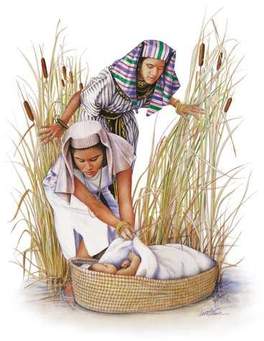
Now enters our next hero, Moses. He was born to the Levite couple, Amram and Jocebed. Jocebed hides him for 3 months. Then, probably fearing he’d be heard crying and discovered by Pharaoh’s soldiers, she places him in a water-tight basket and floats him on the Nile with prayer. She also sends his older sister, Miriam, to keep watch. Miriam sees Pharaoh’s childless daughter draw Moses out of the river. As our God would have it, Miriam and Pharaoh’s daughter just happen along at the opportune time. Sister helpfully offers to find a Hebrew slave to nurse the baby—none other than her and his mother! Don’t ever think God lacks a sense of humor, or of justice. In an amazing turn of events, Jocebed, the slave, is paid to feed her own rescued son! We know, from this side of the Cross, that Moses, whose name means draw out or brought out, would be used by God to bring or draw out His Chosen People from slavery in Egypt. Moses goes on to become the hero of the Exodus.

B. Finally, in our Gospel lesson (Matthew 16:13-20) we have the greatest hero of all, Jesus! Jesus leads His disciples to Caesarea Philippi, a Roman resort town about 2 day’s walk north of Capernaum. He asks them what people make of Him, (v.13)—Who do people say the Son of Man [the title Jesus used to refer to Himself] is. People aren’t sure. Some say He’s His cousin, John the Baptist, back from the grave; others say He’s Elijah; still others believe He is a prophet like Jeremiah. These are all famous prophets.

But then He asks them, knowing they have been with Him for 2.5 years, (v.15)—But what about you? Who do you say I am? They have the most experience with Him. They should be able to say. Impulsive Peter accurately pipes up, You are the Christ, the Son of the Living God. Jesus commends him for having heard that from the Holy Spirit. We know, again from this side of the Cross, that Jesus Christ is the long awaited Messiah. He has rescued us from the penalty for our sins and from everlasting punishment in hell. He is truly our hero!

Why search for and honor heroes? First, they provide us with examples who give us hope. They help us to see that people can behave bravely or in the interests not just of self, but altruistically, in the interest of others (love one another). They teach us that we can rise above our usual self-focused behavior. They encourage us to be brave and to do the right thing, even if it threatens our own life. Secondly—or perhaps even more important—they rescue us from dire circumstances. The two leaders of the midwives, Puah and Shiphora, were used by God to save many male Hebrew babies. Moses, born to Hebrew slaves, ends up being nurtured and educated under Pharaoh’s own nose then used by God to free His people. Jesus asks the disciples, Who do the people say the Son of Man is? We want and need a hero. We know that Jesus is our Redeemer, our Savior; our Divine Rescuer. He has paid the penalty for our sins. Like Mr. Sterling, He will establish order and peace in His Second Coming. We owe Him our love, our thanks, our praise! He is our Hero!

Thanks be to God who gives us the victory through our Lord Jesus Christ. Alleluia, Alleluia!

*Please be sure you are prepared for Hurricane Idalia and pray the Lord diminishes its strength before it hits any Florida community. Blessings and peace! *

©️2023 Rev. Dr. Sherry Adams

Family Reunion

Pastor Sherry’s message for August 20, 2023

Scriptures: Gen 45:1-7, 25-28; Ps 133; Ro 11:1-2a, 29-32; Matt 14:10-28

Amy Peterson writes, “…I started reading The Kindness of God by Catholic theologian and philosopher Janet Soskice. In her examination of the etymology of the word kindness, Soskice helped me see it for the first time as a strong virtue rather than a weak one. “In Middle English,” she writes, “the words ‘kind’ and ‘kin’ were the same—to say that Christ is ‘our kinde Lord’ is not to say that Christ is tender and gentle, although that may be implied, but to say that he is kin—our kind. This fact, and not emotional disposition, is the rock which is our salvation.” I paused after reading this sentence to try to take it in, to try to peel the sentimental layers off my definition of kindness and replace them with this fact: to be kind meant to be kin. The word unfolded in my mind. God’s kindness meant precisely that God became my kin—Jesus, my brother—and this, Soskice said, was a foundational truth about who I was. Not only that, but for speakers of Middle English, Lord had a particular meaning—a lord was someone from the nobility, the upper social classes. To say “our kinde Lord” was to say the difference in social or economic status between peasants and nobility was also erased through Jesus the “Lord” being of the same “kinde” as all, landowners and peasants alike. Jesus erased divisions that privileged some people over others.”

(Amy Peterson, Where Goodness Still Grows: Reclaiming Virtue in an Age of Hypocrisy, Thomas Nelson, 2020.)

The theme of our Scripture readings today is “Divine Kinship” or “Family Reunion.”

A. It begins with our Genesis reading (45:1-7, 25-28). After having lived in Egypt for about 22 years, Joseph has recognized his brothers and now reveals himself to them. Why would they not have recognized him?

By this time, he did not look Hebrew. They were bearded but he was clean shaven. Additionally, he was wearing an Egyptian wig (Egyptians shaved their heads, due to problems with lice, and were noted for wearing elaborate wigs). There was also his Egyptian style of dress and perhaps an arm bracelet and a jeweled collar signifying being a high Egyptian official. The last time they had seen him, he had been a gangly boy of 17; now he’s 39 years old and no doubt looked very different from the way he had in their last encounter. They also would have heard him speaking Egyptian/Arabic, but talking with them through an interpreter (even though he understood Hebrew). Finally, they were not expecting to see him again since slavery was usually implied a death sentence.

Unbeknownst to them, he has put them through two tests to see if they have changed in the intervening twenty two years. First, he has them leave Simeon behind and promise to bring back Benjamin, his full brother. He is checking to see how honest they are now. They had betrayed him. They had no doubt lied to their father. Will they sacrifice another brother to get what they want? Second, they return and bring back Benjamin, but Joseph has his favorite cup put into Benjamin’s bag of grain, and has his servants accuse their father’s new favorite of theft. Joseph wants to know if they have come to grips with what jealousy cost them in the past. Are they more loyal to Benjamin than they had been to Joseph? Have they developed more compassion for their aging and grieved father?

Apparently so because Judah, their leader, steps up and offers himself (and even his children) in place of Benjamin. Judah recognizes this dilemma is God’s punishment for what they had done to Joseph. He and the others cannot bear to imagine Jacob’s grief over losing Rachel’s only other son, Benjamin.

So, satisfied that his ten half-brothers have truly undergone a moral transformation, he reveals himself to them as their long, lost brother, Joseph. At first, they can’t believe it is him. Then they fear his retribution. But in a truly Christ-like way, he reassures them, [Peterson’s The Message, p.93] am Joseph your brother whom you sold into Egypt. But don’t feel badly, don’t blame yourselves for selling me. God was behind it. God sent me here ahead of you to save lives. There has been a famine in the land now for two years; the famine will continue for five more years—neither plowing nor harvesting [will take place]. God sent me on ahead to pave the way and make sure there was a remnant in the land, to save your lives in an amazing act of deliverance. So you see, it wasn’t you who sent me here but God. He set me in place as a father to Pharaoh, put me in charge of his personal affairs, and made me ruler of all Egypt. God uses Joseph to save his father, Jacob/Israel, his brothers, and his whole extended family (a total of 90 people). But Joseph’s wisdom also saves thousands, perhaps millions of Egyptians as well as untold, unnumbered, other Gentiles. What a fabulous and far-reaching family reunion!

B. In Psalm 133, King David continues the theme of family reunion. Verse 1 celebrates —How good and pleasant it is when brothers [and sisters] live together in unity! There is no back-biting, no sarcasm, no jealousy; no murderous rage, no hidden agendas. Instead, such family members experience love, support, and acceptance.

He goes on to mention two metaphors for how rich a blessing this could be: (1) a generous supply of anointing oil, representing empowerment of the Holy Spirit; and (2) abundant dew, highly desired and valued in an arid climate. As troubled and complex as were the kinship relationships in King David’s family, this psalm sets out his longing for this kind of God-inspired love, cooperation, and blessing among brothers and sisters.

C. In Romans 11:1-2a, 29-32, Paul continues his case for the Jewish people. True, most at that time, rejected Jesus as their Messiah. But Paul is adamant (v.1) that God has not rejected them, His Chosen People. They have rejected Him but He has not washed His hands of them. Instead, the Lord has a plan for bringing them to a saving knowledge of Christ.

Back in verses 25-26, he wrote —the harvest of the Jews will come after…the full number of the Gentiles has come in. And so all Israel will be saved…. Just as God has been merciful to us, He too will have mercy on the Jews. Many students of the book of Revelation believe the main purpose of the Great Tribulation (assuming the Church has already been raptured) is to turn a massive number of Jews into Jesus-followers. What a grand family reunion that will be!

D. Finally, in our Gospel lesson (Matthew 15, also Mark 7), Jesus delivers a new doctrine and graciously responds to a Gentile woman.

The new teaching is on moral uncleanliness. Yes, it’s a good health practice to wash your hands before eating—but hand-washing has only to do with the physical. Instead, it’s what comes out of one’s mouth that demonstrates one’s spiritual condition. Our moral or spiritual cleanliness—our heart attitudes–are revealed by what we say. This is why we want to work hard to eliminate cussing and gossip and lying and slander from our daily speech. He calls the rule-bound religious leaders of the Jews blind guides, and appears—by this point–to have given up on appealing to them further.

In fact, He leaves the country for the first time, venturing North into Tyre and Sidon (cities in Phoenicia). No doubt He wants a time-out from his Jewish adversaries. But almost immediately, He encounters a persistent Syro-Phoenician, Canaanite, or Gentile woman. Remember, He says (v.24) was sent only to the lost sheep of Israel (not Gentiles).

She calls Him (v.22) —Lord, Son of David. She knows He is a descendant of King David. But she is an outsider, not a member of the family. She is an ethnic outsider; she is a religious outsider; and her gender, in those days, made her an outsider as Jewish rabbis would rarely have spoken directly to a woman.

But she has a demonized daughter that no one has been able to heal, and she is desperate. She is begging Him to heal/deliver her child. Jesus makes the point that she does not belong to “the family.” He came to feed the “children of Israel” (v.26)It is not right to take the children’s bread and toss it to the puppies [the Hebrew word here means not adult dogs but the diminutive, puppies]. He is essentially saying, just as in a family, there is an order here —The children (Israelites) eat first; Then puppies get fed, but not from the table and not until the kids are done. He is not telling her she cannot expect help from Him, but rather that there is a set of priorities to His ministry.

She gets what He is saying, steps into His metaphor, and reminds Him (v.27) —…but even the puppies eat the crumbs that fall from their masters’ table. She knows she does not have a legitimate place at the Jewish table. But even as a nonfamily member, she has faith that Jesus can provide enough that some leftovers will be available to her and to her daughter. Notice, she doesn’t say, Give me what I deserve due to my goodness or my rights, as many today might demand. Instead, (as Timothy Keller asserts in his book King’s Cross , Dutton, 2011, p.89), she implies, “Give me what I don’t deserve on the basis of Your goodness—and, please, I need it right now.”

Jesus commends her faith (The Message, p.1775) —Oh, Woman, your faith is something else. What you want is what you get! Right then her daughter became well. She entered into His metaphor and responded with belief in Him. Because of her faith, He made her a member of His family.

There is no reason for us to ever feel like we are alone or outsiders. God’s family is made up of both Jewish and Gentile believers. Our weekly worship service is like a big family reunion. We who believe in Jesus Christ are members of God’s family. Come, every Sunday, to be with people who love Jesus and who love you. Amen!

©️2023 Rev. Dr. Sherry Adams

After Suffering Comes…

Pastor Sherry’s message for August 13, 2023

Scriptures: Gen 37:1-28; Ps 105:1-22, 45b; Ro 10:1-15; Matt 14:22-36

In a new twist on an old story, a young woman texts her parents from college:

Dear Mom and Dad,

Just thought I’d share with you my new plans: I’ve fallen in love with a guy named Jim. He quit high school in the 11th grade to get married. About a year ago, he got divorced. We’ve been dating for about 2 months and just decided to get married. I will be moving in with him shortly as we believe I’m pregnant. Don’t worry, though. I dropped out of all my classes last week, but I do plan to finish school at some point in the future. Unfortunately, I’ve been smoking a lot of pot, but intend to quit if it turns out I am expecting.

About 10 minutes later comes a second text:

Mom and Dad,

I just want you to know that everything I’ve texted you so far today is false. NONE of it is true! But, it is true that I made a C- in French and failed my Math class. And it’s also true that I will soon need a lot more money for tuition. Love you! Your Daughter.

(Chuck Swindoll, The Tale of the Tardy Oxcart, Word Publishing, 1998, p.445.)

I hope you’ve never been this frightened, or this manipulated, by someone you love. This devious, scheming young woman shocked then reassured her parents! It’s a sales technique: 1st ask an impossible “big,” then 2nd follow that up with a smaller, more reasonable request (people then tend to acquiesce to the smaller “ask”). Probably without meaning to, she was also illustrating how often, in the Christian walk, we have to endure suffering before we either come into an understanding of why God allowed difficulties to come our way, or enter into a time of blessing.

This truly is the focus of our Scripture lessons today.

A. Our Genesis passage (37:1-12) begins the Joseph narrative.

More chapters of Genesis are devoted to Joseph than to Abraham, his great grandfather; to Isaac, his grandfather; or to Jacob/Israel, his father. One reason is that he represents the nation of Israel. Remember, the name Israel means he who struggles or wrestles with God and with men and who comes through or prevails (though, as I pointed out last week, who can prevail against God?). Joseph endures some very tough times, but, because he is basically a righteous man, he is eventually blessed by the Lord. He also becomes a source of blessing to his family, his nation, to the Egyptians, and to unknown numbers of other Gentiles trying to survive the famine. It is through Joseph that the Lord moves the future leaders of the twelve tribes of Israel to Egypt, and ultimately sets the stage for the Exodus.

A second reason Joseph gets so much biblical coverage is that, as J. Vernon McGee writes, “There is no one in Scripture who is more like Jesus in his person and experiences than Joseph.” (McGee, Through the Bible Commentary: Genesis, Chapters 34-50, Thomas Nelson Publishers, 1991, p.43.):

1.) Both births were miraculous;

2.) Both were especially loved by their fathers;

3.) Joseph was set apart by his special coat, while Jesus was set apart by his sinlessness;

4.) Both were ridiculed for asserting they would one day rule over their brethren;

5.) Both were obedient to their fathers at considerable cost to self;

6.) Both were sent by their fathers into danger;

7.) Both were hated and rejected by their brothers (in Jesus’ case, His countrymen);

8.) Both redeemed/saved their brothers.

Our passage today provides the backstory for Joseph’s betrayal by his brothers. The 10 (half) brothers born to Leah and the 2 concubines were murderously jealous of Joseph. They resented their father’s favoritism. It’s never good to favor one child over another. The favored one can ultimately feel guilty or develop an unhealthy arrogance; the non-favored becomes resentful and can be plagued by low self-esteem. Jacob should have known better since his father, Isaac, had favored his twin, Esau. As a licensed psychologist, I can tell you I have seen this again and again: without Jesus, we later become or re-enact as an adult what we hated as a child. These brothers resented his dreams of future grandeur. They also despised the fact that their oblivious father tasked Joseph with ratting them out!

So they plot to kill him, their own flesh and blood. Reuben, the by- now discredited eldest, attempted to rescue him, thinking he would recover Joseph, return him to their father, and perhaps regain some favor with dad. Judah, the one to whom the leadership of the clan had passed after Reuben’s gross disrespect of Jacob, talked them out of murder and into selling Joseph into slavery—a likely avenue to death, anyway, but without having bloodied their hands. These dreadful brothers then sell Joseph to Ismaelite traders (descendants of Abraham’s son, Ishmael) for 20 shekels (another foreshadowing of Christ, who was betrayed for 30 pieces of silver.)

B. As our Psalm (105:1-22, 45b) recounts in verses 17-22, God intended Joseph’s descent into slavery—They bruised his feet with shackles, [and] his neck was put in irons—as well as his later rise to prominence—Till what he foretold [in his two dreams] came to pass, till the word of the Lord proved him true. King David, the assumed author of the psalm, relates how Pharaoh freed Joseph and made him master over all of Egypt in the time of a devastating 7 year famine. He also describes how God elevated Joseph—through Pharaoh—to instruct his princes as he pleased and teach his elders wisdom. Joseph was 17 when sold into slavery. For 14 years, God prospered both Potiphar’s house and the Egyptian prison under Joseph’s supervision and influence. Everything Joseph touched “turned to gold.” Once he was freed, he did instruct Pharaoh and the Egyptian leadership in the meanings of Pharaoh’s dreams. And by saving his family from starvation, he taught his 10 elder brothers and even his father about the sovereignty of God, and the value of forgiveness.

C. As I said last week, our God has not given up on the Jews, His Chosen People. Fortunately for us, we, Christ’s followers, are also God’s chosen people through the saving work on Jesus Christ on the Cross for our sake. We have been grafted into the lineage of Jesus by our belief in Him. We are co-heirs with Jesus, our Lord and our brother. Paul makes it clear in Romans 10:1-15 that keeping God’s Law saves neither us nor the Jews. Since we are sinners who cannot keep it perfectly, the Law simply serves the purpose of proving to us that we need a savior. In verse 9, Paul emphatically asserts what it takes to be saved If you confess with your mouth, ‘Jesus is lord,’ and believe in your heart that God raised Him from the dead, you will be saved! Jesus has done the hard work of salvation for us. We just respond with belief, with faith in Him.

Verses 11-15 contain Paul’s urgent plea that we, Christ’s Church, reach out to evangelize the Jews. He quotes the prophet Joel (2:32) Everyone who calls on the name of the Lord [who believes in Jesus] will be saved. He also quotes the prophet Isaiah (53:1) How beautiful are the feet of those who bring Good News. I remember a friend’s father telling me in the 8th grade that I had pretty feet. I remember thinking at the time that that felt rather “icky” and I couldn’t imagine why he would say such a thing. Everyone knows our feet are not really that attractive. But the prophet means that the one or ones who convey the Good News to those who haven’t yet taken it in are beautiful in God’s sight, feet and all. Paul’s heartfelt prayer is that his Jewish brothers and sisters come to a saving faith in Jesus. And he believes that those of us who try to evangelize the Jews–who have suffered dreadfully down through the ages–will be particularly blessed by the Lord.

D. I’m not sure Jesus would say it this way, but in today’s Gospel Lesson (Matthew 14:22-36), He urges us to…

1.) Get out of the boat. Let go of our fear. Let go of our pride. Let go of our insistence in our self-sufficiency, our willfulness, our disobedience. Do what God is calling us to do, even if it is emotionally uncomfortable for us.

2.) Keep our eyes on Jesus. Just attending church won’t save us. Even reading Christian books won’t save us. Having wonderful Christian friends won’t save us. These things can help move us in the right direction, but it is having faith in Jesus and confessing our faith aloud that saves us.

3.) And trust in Him to help us do what would be impossible for us—like walk on water—without Him. Our God…is able to do exceedingly and abundantly more than all we ask or imagine…. (Ephesians 3:20). I can do all things through Christ who gives me strength (Philippians 4:13).

When asked why God allows good people to undergo bad experiences (suffer), the famous Presbyterian preacher, R.C. Sproul, answered, “I haven’t met any good people yet, so I don’t know.” He was, of course, considering the Apostle John’s assertion from 1 John 1:8 If we claim to be without sin, we deceive ourselves and the truth is not in us. Or as the Apostle Paul states (Romans 3:10) There is no one righteous, not even one.

The next time you find yourself in a season of suffering, remember that—unlike the college co-ed–God does not manipulate us. He does, however, test us. He allows us to walk through suffering for a season, but always with a purpose. The purpose is to mold and shape our character; to reduce our dependence upon anything but Him; and to deepen or strengthen our faith. And he brings us out of that suffering both transformed and blessed. Look at Joseph. Look at Jacob/Israel and his extended family. Look at Peter. Look at Paul. Look at you! Thanks be to God who gives us the victory through our Lord Jesus Christ. Alleluia, alleluia!

©️2023 Rev. Dr. Sherry Adams

God Wants to Talk About You

Pastor Sherry’s message for August 6, 2023

Scriptures: Gen 32:1-31; Ps 17:1-9; Ro 9:1-5; Matt 14:13-21

In August of 2001, country singer Toby Keith released a song titled, “I Wanna Talk about Me.” It’s kind of a country rap showcasing a man’s desire to have some equal “air time” with his significant other. Here are a few of the lyrics:

We talk about your work, how your boss is a jerk,

We talk about your church and your head when it hurts.

We talk about the troubles you’ve been havin’ with your brother,

Bout your daddy and your mother and your crazy ex-lover. We talk about your friends and the places that you been,

We talk about your skin and the devils on your chin,

The polish on your toes, and the run in your hose, And Lord knows we’re gonna talk about your clothes!

You know talking about you makes me smile. But every once in a while, I want talk about me…

Wanna talk about I,

Wanna talk about #1, oh my, me, my…

What I think, what I like, what I know, what I want, what I see.

I like talking about you, you, you, you usually…

But occasionally, I want to talk about me!

I can’t think about this song without smiling. It sounds like his girlfriend is very self-focused, since it’s hard for him to get a word in edgewise. But if and when he gets the floor, what does he want to talk about? Himself! He wants to “talk about me!”

The song has become a metaphor in my family for thinking only of self. Someone cuts us off in traffic. One of us will smile and say to the others, “I want to talk about me.” Someone cuts in line in front of us at the grocery store, or at the post office, etc., and we’ll be thinking, “I wanna talk about me.” Have you noticed that, even when you politely let someone go ahead of you, often they don’t say thank you or even give you eye contact because…”I wanna talk about me.”

Let’s take a look at what the Lord has to say about this all too prevalent attitude in today’s world.

A. Psalm 17:1-9 was written by King David. Biblical scholars believe it dates from the time before he ascended the throne. God had lost confidence in King Saul and had had His prophet Samuel anoint David as the next King. The jealous and mentally unstable King Saul accurately viewed David as a rival to his throne and set out to kill him. In this psalm, David pleads with God for protection against Saul and any other adversaries.

Yes, David is worried about saving his own skin; but he also tells God (Peterson’s The Message, p.962)I’m not trying to get my way in the world’s way. I’m trying to get Your way; Your Word’s way; I’m staying on Your trail; I’m putting one foot in front of the other. I’m not giving up. David views the Lord as his (and our) protector. David trusts in God to provide him a divine rescue.

David knows we need to take our focus off ourselves and put it on God, first, and then on others. This is the shape of the Cross. The vertical reminds us to love God. The horizontal reminds us to love others. God would have us put our focus on loving Him and then on loving others. A healthy self-love comes third.

B. Our Old Testament lesson, Genesis 32:1-31, provides us with an object lesson in where our love/focus should be directed. Jacob is re- entering the Promised Land after having been an immigrant to Syria for 20 years. In that time, his Uncle Laban had cheated him at his wedding, substituting the less desirable Leah in the dark wedding tent for Jacob’s beloved Rachel. Uncle Laban also changed Jacob’s wages 10 times, always shifting things to Laban’s advantage.

Nevertheless, despite these numerous setbacks, the Lord has prospered Jacob: He leaves Syria with great wealth:

1.) 2 wives and 2 concubines (remember, this is before Moses’ time when the Law was given);

2.) 11 sons and 1 daughter;

3.) A large retinue of servants;

4.) and huge numbers of livestock.

Due to God’s blessings, Jacob returns to the Promised Land as rich as an Arabian prince or an oil sheik.

Focused on his fears that his brother might still want revenge (and is coming to greet him with 400 troops), Jacob sends Esau multiple, generous gifts to sweeten the deal:

1.) 200 female goats & 20 males (220 goats); 2.) 200 ewes & 20 rams (220 sheep);

3.) 30 female camels with young (30+ camels); 4.) 40 cows, 10 bulls (50 cattle);

5.) 20 female donkeys, 10 males (30 donkeys).

This represents approximately 600 livestock! And he still has other flocks with which to sustain his people. He divides his clan into two groups and directs them to separate encampments for protection

Then he prays. At this point, I want to shout out, “Good job, Jacob!” He reminds God of His promises to his grandfather, Abraham, to Isaac, his father, and to him. He admits he doesn’t deserve God’s love and mercy. But he does plead for God’s protection—like David will later—(Peterson’s The message, p.70) Save me, please, from the violence of my brother, my angry brother! I’m afraid he’ll come and attack us all, me, the mothers and the children. When he ran for his life 20 years earlier, his focus had been on himself—>“I wanna talk about me.” Now, after 20 years of trials, he has matured: His focus is still on self, but has enlarged to include family and the Lord.

God recognizes Jacob’s maturing faith, but then intervenes to strengthen it. In verse 24, Jacob finds himself engaged in a wrestling match with the pre-incarnate Christ. It’s like Jesus is saying to him, “Jacob, you are less self-focused than you were 20 years ago. But your faith still needs to deepen. In your life, you have wrestled with your twin, Esau…you have wrestled with your Uncle Laban for 20 years. But your first priority must be Me, God!” This then becomes a major turning point in Jacob’s faith: This is why we celebrate the “heal-grabber” as a respected patriarch. He persists. He does not let go of God. He has finally learned it’s not about struggling with God or others. It’s about yielding to God and holding on to Him. Once he comprehends this, Jesus blesses him and changes his name to IsraelGod-wrestlerHe who struggles with God and with men and has come through. (Some translations substitute the word overcome or prevail for come through, but actually none of us can overcome God.)

Our God wants to talk with each of us about us, and He does get the last word. He wants our focus to move from self to Him. He wants us to be generous toward other people, putting their needs above our own.

C. Look at Jesus’ example of this in our Gospel lesson, Matthew 14:13-21. Verse 1 tells us the Lord had just gotten word that King Herod had beheaded His cousin, John the Baptist. Jesus wanted or needed time by Himself to pray and to grieve His cousin’s murder. He tried to sail off to gain some alone-time with His Father. But He was accompanied by His disciples and, when the crowds saw Him depart, they raced around the lake to meet Him where He landed. I hope He was able to take a time- out to regroup and recharge emotionally and spiritually, but He seems hard- pressed for time and opportunity.

Notice He doesn’t act frustrated. Instead, (v.14) He had compassion on them and healed their sick. Additionally, after having taught them all afternoon, He tells His disciples to (v.16)…give them something to eat. They can’t feed this crowd, but Jesus can. He is saying to them, “Trust Me. I can make something from almost nothing [actually, He can make something from nothing]. I can take the little you bring Me and make of it much!”

D. And let’s not forget He does not break His promises. As our Romans 9:1-5 passage demonstrates, even though the Jews of His time rejected Him as their Messiah, He has not rejected them. Many Christians have taken it upon themselves to persecute the Jews because their religious leaders murdered Jesus. But God makes it clear through Paul that He has not forgotten that they are His chosen people. There is no place in the Christian life for us to disdain Jews. Through them, God has worked out His plan of salvation. Through them, God has brought forth the lineage leading up to Jesus. As we read last Sunday in Romans 8:31If God is for us, who can be against us?

God doesn’t want us to just “talk about me,” or be self-focused.

He wants us to focus on Him and on the needs of others. All through Scripture, He urges us to turn away from a concentration on self or selfishness. We are to follow Jesus’ and Jacob’s examples. He wants us to grab ahold of Him and hang on—no matter what. We are to surrender our wills to His, or as AA says, “let go and let God.” And then watch for His often surprising blessings.

©️2023 Rev. Dr. Sherry Adams

Wherever I go, only Thou.

Pastor Sherry’s message for July 21, 2023

Scriptures: Gen 28:10-19a; Ps 139:1-12, 23-24; Ro 8:12-25; Matt 13:24-30, 36-43

Some years ago, the magazine, Christianity Today, ran a true story about a woman in India, living in a concrete sewer pipe, with her husband and two kids. I never forgot it. Her name was Shivamma. She was a member of the Dalit caste, the lowest of the low (an “untouchable,” except for rape). She reported that she had been barren. A Dalit Christian named Bangarraju prayed for her in her home, the pipe. She conceived and bore two kids, a son and a daughter. The girl baby was badly jaundiced and not expected to live. Bangarraju returned and prayed for the child, and she was healed. Shivamma became a Christian she says because: “I realized that Jesus is the living God. We used to drink and every day we would fight, fight, fight. Jesus Christ brought peace to our family. I have no fear, because I have come to know the living God. I trust Him.” I love this story because God met her needs. As a result, she now trusts Him.

I believe this connects with another story concerning a debate between a Christian and an atheist. The Atheist began by writing on a white/dry erase board, “God is nowhere.” At his turn, the Christian speaker then erased “nowhere” and used the same letters to write, “God is now here.”

Our Scriptures today focus on the twin themes of God’s deep, intimate knowledge of us and His abiding and patient presence with us.

In our Old Testament lesson, we once again pick up the story of Jacob (Genesis 28:10-19a), the 3rd of the famous Hebrew patriarchs, Abraham, Isaac, and Jacob. By now, Jacob has tricked his brother Esau out of both his birthright and their father’s blessing. Esau is so enraged that he has sworn to catch Jacob and kill him. Remember, Esau was a skilled hunter, and could have easily picked Jacob off from a distance with his bow. So, at his Rebekah’s suggestion, Jacob runs to Haran to take refuge with her brother, Laban (and the extended family).

Our passage finds Jacob 40 miles from home. He has run/walked at a rate of 3.5 miles per hour for 12 hours! He wants to put allot of distance between himself and Esau. He lays down to rest at Luz. It was then a pretty dreary place: a high desert plateau about 1200 feet above sea level, arid and rocky. How must he have felt as he bedded down for the night? No doubt he was a worried/anxious fugitive. He knows his brother, Esau, is skilled with a bow, spear, or sling. He must have traveled the whole way, looking over his shoulder. Additionally, this is his first night alone and away from his home and his people. He was also probably uncertain about his future. Traveling alone, he had a long, potentially dangerous journey ahead.

His mother had made the reverse trip, years ago, before his birth, but she had been accompanied by servant girls and the protection of several men in a camel caravan. She also traveled with the knowledge that she was likely fulfilling God’s will for her life. There’s no indication of prayer here on Jacob’s part—before, or during the first leg of his flight—so Jacob was probably much less sure of what might happen to him.

He beds down on rocky ground and God gives him a dream about a ladder to heaven. Angels traverse the ladder. Some are going up, signifying that they have access to heaven; others are going down demonstrating that they have access to earth. The Preincarnate Jesus stands at the top (His is “the voice from the top of the stairs”). In this memorable dream, God suddenly and unexpectedly breaks into Jacob’s life.

He’s hardly what we would consider worthy of a God-sighting—he’s in a serious conflict with his brother, has tricked his nearly blind father, and runs away. This is a sinful dude! Paul would say in Romans that he is operating out of his flesh or his carnal nature rather than his spiritual one. Nevertheless, Jacob has a spiritual encounter with God.

Much later, in John 1:47-51, when Jesus encounters Nathanael He said of him, “Here is a true Israelite, in whom there is nothing false.” “How do you know me?” Nathanael asked. Jesus answered, “I saw you while you were still under the fig tree before Philip called you.” Then Nathanael declared, “Rabbi, you are the Son of God; You are the King of Israel.” Jesus said, “You believe because I told you I saw you under the fig tree. You shall see greater things than that.” He then added, “I tell you the truth, you shall see heaven open, and the angels of God ascending and descending on the Son of Man. In other words, in the dream, Jesus is the ladder between God the Father and human beings. The ladder represents Jesus’ position as mediator between God the Father and us. It further confirms that we only get to heaven through Him–Jesus is truly the only way to the Father.

Additionally in the dream, the Lord reiterates to Jacob the promises He had made to Abraham, his grandfather and to Isaac, his father:

1.) Property the Promised Land, even though Jacob is leaving it;

2.) Progeny lots of descendants to populate the land and to bless all the people of the earth.

3.) Presence God will be with him. In the Ancient Near East, they believed all gods were attached to the land and did not travel with people outside national borders. When Daniel is later told by the angel Gabriel that he had been detained in relaying to Daniel the answer to his prayers by “the prince of Persia,” this “prince” was a demonic entity assigned by Satan to influence that territory (Daniel 10:13). God is affirming that He is not like these lesser, demonically inspired gods. Instead, He asserts, I won’t lose track of you outside the Promised Land (or in a sewer pipe outside some remote village in India, or even in Wellborn, Florida.) To God, this is all simply geography. As Psalm 139 tells us, He is not limited by where we located on earth.

4.) Protection In verse 15 God says, I am with you and I will watch over you wherever you go, and I will bring you back to this land. I will not leave you.

Notice, God does not require anything of Jacob. There is no If…then clause, surrounding these promises with conditions. God has chosen a flawed patriarch through whom to work out His plan of salvation. As Psalm 139 affirms, God knows Jacob’s every thought and scheme. And He is reassuring Jacob there is no place any of us can go where God might lose track of us.

So, Jacob’s response when he awakens is to make a vow to the Lord. He demonstrates his new partnership with God by first setting up a memorial stone to commemorate his divine encounter. He anoints it with oil, an act of worship which makes it holy. The stones became an altar.

Then, he renames the place, Bethel or house of God/the gate of God. It is no longer Luz; it has become a shrine. He reiterates God’s promises to him from the dream. Even though he enters into a conditional relationship, from his side with God, his faith is developing. Jacob is what we would call “a work in progress.” As a result, he moves from the status of fugitive to that of pilgrim. Like grandfather Abraham before him he also promises God a tithe, 1/10th of all God intends to give him.

The next day, as Jacob continues on his journey, how do you think he felt? No doubt, he had been comforted and reassured. God is with him so he’s not alone. Neither are we! As Paul later writes in Romans 8:12-25, we are children of God. As sons and daughters of God, and heirs—all because of the saving work of Jesus on our behalf, we have the right to call Father God, Abba, the Aramaic, personal, intimate form of father, or Daddy. Like us, Jacob has God’s protection—neither he nor we need to be afraid. He doesn’t have to worry about his brother catching up to him and killing him, or of a hostile reception in Haran. We don’t need to stress over the hundreds of potential negative outcomes that assault our minds daily either. Jacob could be confident that God would prosper him and bring him back to the Promised Land. We too can be confident that God will be with us in the storms of life and will usher us into heaven when our journey here on earth is done.

So, where can we run from God’s love? No where because we know God is now here! Jacob’s story makes me glad I am not him. But isn’t it also so reassuring to realize that God never deserts us. He loves us even if we are not truly making decisions pleasing to Him, and He cares for us, faithfully. This story also reaffirms for us that our God appears to enjoy overturning human expectations. He can and does do great things with the least likely. He’s not discouraged by our rebellion, sinfulness, or even our unbelief or lack of trust. He clearly sees us as we are—there’s no hiding from Him, or fooling him. And He see us, too, as who He wants us to become.

There is an ancient Hebrew poem that I think sums this up:

Wherever I go…only Thou!

Wherever I stand…only Thou!

Just Thou! Thou, Thou, Thou!

When things are good, Thou!

When things are bad, Thou!

Thou, Thou, Thou!

Aren’t we grateful?! Amen!

©️2023 Rev. Dr. Sherry Adams

It’s Good to be Humble

Pastor Sherry’s message for November 1, 2020

Scriptures: Joshua 3:7-17; 1 Thess 2:9-13; Matt 23:1-1

Back before the Civil War, there was an exchange in the US Senate that went something like this: The senator from North Carolina pontificated,I come from North Carolina, a great vale of humility, lodged between two mountains of conceit.” The two mountains of conceit he was referring to were his neighboring states of Virginia and South Carolina.While there is nothing new under the sun regarding human nature, how gentlemanly an insult that was compared to the way our politicians attack one another today. Not to be outdone, the senator from Virginia stood and replied,“That is true but only because North Carolina has a lot to be humble about.” The Virginian meant his remarks as a slur, thereby missing the point that, according to our Lord, It’s Good to be Humble.

Several of our Scriptures today testify to this point. In our Old Testament lesson, Joshua 3:7-13, the people of Israel are poised to enter the Promised Land. As we read last Sunday, Moses has died and has passed on the mantle of leadership to his assistant, Joshua. Now Joshua announces to the people how the Lord intends for them to proceed into Canaan: The Jordan River, massively swollen from Spring rains, is at flood stage. Rivers at flood stage flow quite quickly and carry a lot of debris. You don’t want to step into one as you might be swept off your feet by the current or hit by a floating tree truck. Nevertheless, the priests are to carry the Ark of the Covenant into the midst of the river. Once they do, the river’s flow will stop and the people will pass over on dry land. From the time the Ark had been constructed, it had been carried on two long poles supported by priestly shoulders and suspended from golden loops—i.e., it was not to be touched by human hands. The Ark of the Covenant was holy—set apart—for the Lord.

Now remember how God had parted the Red Sea: Moses held out his staff and a strong wind separated the ocean. Crossing the Jordan perhaps took more faith as there was no such demonstration. Those poised on Jordan’s banks had only heard the stories of the Red Sea Crossing and the 10 Plagues upon Egypt.

Only Caleb and Joshua had actually experienced these miraculous events. So, what was God demonstrating by leading His people with His Ark? All throughout the wilderness wanderings (40 years), the Ark had traveled, or rested, in the middle of the camp. This had signaled to them that God was in their midst. Now, though, the Ark was to go first, signifying:

(1) God is leading His people (as Hebrew shepherds do).

(2) He is more powerful than the gods of Canaan. Baal, chief of the Canaanite gods, had—by legend–defeated the gods of the sea. So the Canaanites believed the flood waters of the Jordan were Baal’s efforts to prevent the Israelites from entering what they considered to be their land. God is going to demonstrate to everyone that flood waters are no barrier to Him.

(3) Additionally, God will assist them in overcoming the tribes who now occupy the land (Canaanites, Hittites, Hivites, Perizzites, Girgashites, Amorites, and Jebusites). No doubt the folks in Jericho thought they had plenty of time to prepare for a big fight. It would never have occurred to them that the God of the Israelites could or would stop and cross a flooding Jordan.

(4) And since God was leading the Israelites, He is claiming Canaan—the Promised Land—as His own (which of course it was). The people were to pass by the Ark about 3,000 feet distant. Scholars tell us the Ark is a “type” (symbol) of Christ; after all, Jesus is Emmanuel, GOD with US. (By the way, when the Israelites camped, they arranged the members of 3 tribes to the North, three tribes to the South, 3 tribes to the East, and 3 tribes to the West of the Ark, which was in the middle of all 12 tribes.)

(5) Finally, since it occurred just as Joshua predicted, God is demonstrating His confidence in Joshua as Moses’ successor. Joshua is actually a great example of a humble leader. He does not assert himself as God’s choice, but instead obediently follows through on God’s instructions; and he allows God Himself to confirm him as God’s choice of a leader.

Our Epistle lesson today is from 1 Thessalonians 2:9-13. In it, Paul expresses his gratitude to the church at Thessalonica for their faithful obedience to the Word of God. Paul had brought them this word. He thanks God for them because they believed the Gospel. He commends them for faithfully serving God, and for being humble and obedient to Jesus. He reminds them that he was simply doing God’s will and God’s work when he came among them. Paul claims to have ministered to them in humility and encourages them to follow his example.

Our Gospel lesson from Matthew 23:1-12 shows Jesus publically denouncing the Scribes and Pharisees for their overweening pride. Remember, they have dogged Him as he has attempted to teach in the Temple, and have asked numerous questions to try to entrap Him so they could have Him arrested. The role of the Pharisees and the Scribes was supposed to have been to teach the people how to live in relationship with God. They were to explain who God is, what God expects of us (the Law), and how to talk to Him and hear from Him. That’s pretty much what the job of a pastor is today.

Jesus first commends them, saying (v.1) theysit in Moses’ seat….

Moses collected and taught the meaning of the 10 Commandments. They are continuing his function as teachers of the Law. Jesus is saying they have authority to do so. However, He goes on to qualify this in (v.3) So you must obey them and do everything they tell you. But do not do what they do, for they do not practice what they preach. You see, the Scribes and the Pharisees made two mistakes:

(1) They preached religiosity (live by the rules) rather than relationship;

(2) And they didn’t live up to the standards they taught–like the politicians and news commentators who have condemned us for not wearing masks, then were caught on camera not wearing masks themselves.

We look at folks like that and say, “Hypocrites!” Rather than remaining humble and obedient to God, the Pharisees wore large symbols of their special office, to draw attention to themselves. They also enjoyed special treatment, privileges, and deference. Furthermore, they gave themselves special titles: Rabbi/teacher when only Jesus is our Rabbi; and Father when only God is our Father.

Now I wear robes and you call me Pastor—is that bad? No, some terms and clothing help us both to remember the duties of the office. What Jesus has a problem with is pride that comes from such things. He clarifies this when He says, (vv.11-12) The greatest among you will be your servant. For whoever exalts himself will be humbled and whoever humbles himself will be exalted. Jesus does not want us to get carried away with pride. Jesus wants us to stay humble. Jesus wants us—like Joshua, Paul, and the Thessalonians—to remain obedient to God’s authority.

Today the Christian Church celebrates All Saints Day. I believe one of the marks of a true saint is not so much holiness (who of us is truly holy?) as the recognition that we are set apart for God. God has done this for us. Our appropriate response is our humility. We are all called to be humble servants of God. In our country today, we have replaced our belief that we all have equal rights and opportunities with the secular notion that–no matter how we behave–we have the right to be proud of ourselves and to demand that others respect us. Even in the Church today, we have replaced an awareness of our sinfulness and our need for a Savior—and gratitude for the great gifts of Jesus’ sacrifice and of His forgiveness and grace–with the simplistic notion that “God loves you no matter your behavior.” He does love us just the way we are, but He also loves us too much to leave us that way. So, unlike the Scribes and Pharisees, or any other proud and puffed up religious leaders, we want to be humble. We want to remember and emphasize loving the person over the rule. We don’t want to be “all show and no go.”

Today, All Saints Day, let us humbly remember that God’s love for us is more a function of His grace andmercy than of anything we have done or deserve; that we are all called to love and serve others—not as arrogant or proud persons–but as Servants of Christ. And let us remember that it’s good to be humble!

Copyright 2020 Rev. Dr. Sherry Adams

Jacob’s Ladder

Pastor Sherry’s Message for July 19, 2020

Scriptures: Gen 28:10-19a; Ps 139:1-12, 23-24; Ro 8:12-25; Matt 13:24-30, 36-43

 Some years ago, I read a story in Christianity Today about a woman in India, who lived in a concrete sewer pipe with her husband and two kids.

Her name is Shivamma.  She was a member of the Dalit caste, the lowest of the low, pretty much untouchable—except for rape.  She remembers she was barren.  A Dalit Christian named Bangarraju prayed for her in her home and she conceived and bore two children, a son and a daughter.  The girl child became badly jaundiced.  Bangarraju returned, prayed, and the child was healed.  Shivamma became a Christian.  She says she accepted Christ  because, I realized that Jesus is the living God.  We used to drink and everyday we would fight, fight, fight.  Jesus Christ brought peace to our family.  I have no fear, because I have come to know the living God.  I trust Him.  God met her in her need, and she now trusts Him.

 In another story, there was a debate between a Christian and an Atheist.  The Atheist began his presentation by writing on a whiteboard, God is nowhere.  When the Christian speaker stood up to make his arguments, he erased nowhere and used the same letters to write, God is now here.

Let’s look at what our Scriptures have to say today about the twin themes of God’s presence and God’s knowledge of us.  In our OT lessonàGenesis 18:11-22, we encounter the patriarch, Jacob.

He is the younger of the twin boys born to Isaac and Rebekah.  He was named Jacob (which means heel grabber because he was born grasping his older twin’s heel; but it also carries the sense of deceiver, schemer.  God had told his mother, when pregnant, that the older will serve the younger.  In other words, God was reversing the usual order of things.

Even from the womb, God had determined that Jacob would be the one to carry out His plan of redemption from Abraham and Isaac.

Nevertheless, Isaac favors Esau, so Rebekah and Jacob collude to rob Esau of both his birthright and his father’s blessing.  Esau is furious when he discovers this, so Rebekah invents the pretext of needing to go abroad to find a suitable wife to help Jacob escape his brother’s wrath.  Jacob leaves the family compound.  Notice none of them bothers to check in with the Lord: Not Mama Rebekah; Not brother Esau; Not Papa Isaac; Not even the culprit, Jacob.  This does not appear to be a family of very firm faith!

Our passage today finds Jacob has put 40 miles between himself & Esau by the time he stops for the night.  He was “booking it” to get out of Canaan! How must he have felt? No doubt he was anxiously looking over his shoulder for his murderous brother.  He must have felt alone.  Perhaps he was worried about the long, potentially dangerous journey ahead of him, uncertain of his future.  Can you identify?  Maybe you find yourself in a dark & lonely place right now; perhaps you too are filled with uncertainty.  Maybe, like Jacob, it’s even your fault that you find yourself “out there, on your own.”  Well, this story was made for you (and me), so read on!

Jacob falls asleep (not the sleep of the just) and dreams of a ladder or a set of stairs reaching to heaven.  The Lord is at the top (“the Voice from top of stairs”), and Jacob, realizes he is sleeping, at the bottom.  Angels are traversing the ladder, some going up, others coming down.  The Lord reiterates to Jacob the promises He has made to Grandfather Abraham and Father Isaac:  I am giving you Propertyàthe land; Progenyàlots of descendants to populate the land and to bless all people of the earth; PresenceàGod would be with him; and ProtectionàGod says  I am with you and I will watch over you wherever you go, and I will bring you back to this land.  I will not leave you…. Notice:  God does not require anything of Jacob.  There is no if…then clause.

God has chosen an unlikely patriarch.  Even though, as Psalm 139 affirms, God knows his every thought and scheme.  There is no place Jacob can go where God might lose track of him (or of us).  Not departing the Promised Land for Haran (Syria); not getting lost in NYC or the Amazon jungle; not even by participating in a Witness Protection Program, in Minot, ND, where our names and ID’s are changed; Not living in a sewer pipe outside some remote Indian village—these are just issues of geography.

Not even struggling alone with a job loss, the death of a loved one, declining health, financial setbacks, or troubled relationships. Our God knows where we are emotionally and spiritually, besides.  He is the with us God, Emmanuel.  He knows our names.  He is always present to us.

Now do you notice Jacob’s response to God?  He doubts.  He has chutzpah, vowing to follow the Lord if God goes with him; if God protects him; if God provides for him; and if God brings him safely back to the land again.  To his credit, He sets up a memorial stone (and names it Bethelàhouse of God) to commemorate his encounter with the pre-incarnate Christ.   And he promises a tithe, a 10th of all God gives him.  But the schemer is bargaining with God.

I don’t’ know about you, but I take a great deal of comfort from the Jacob story:  Jacob is not of man of strong or good character.  He’s a liar;a trickster.  He’s not even a strong believer.  God has promised him 4 P’s without strings, but he puts conditions on his commitment to God.  He’s not perfect, but still God loves him.  We could say God goes out of His way to comfort Jacob.

If we follow Jacob’s story thru the next 22 chapters of Genesis, we find that the Lord does take Jacob to His woodshed/the Refiner’s Fire:  The deceiver is himself deceived, by wily Uncle Laban. He spends 20 years outside the land, working off debt to his Uncle; building up a family (12 sons, 1 daughter); and acquiring herds and wealth with which to support them.  He flees his Uncle when he returns to the Promised Land.  He fears a hostile reunion with the brother he wronged. His favorite wife dies in childbirth. His only daughter is raped.  His sons cause him grief.  They jealously sell his favorite son into slavery and lead him to believe Joseph is dead.  And, upon entering the Land, he wrestles all night with the pre-incarnate Christ, Who leaves him crippled, but changes his name from Jacob to Israelhe who struggles with God & men, and overcomes.

It’s a heck of a journey, isn’t it?  Jacob’s story makes me glad I am not him!  But it also assures me (and you) that God never deserts us; that He loves us even if we are Scallywags; and that He cares for us, faithfully.

Do you know that scholars believe Jacob’s Ladder is really an image, a prediction of Jesus?  Jesus, you see, mediates between us and God.  Jesus is our only way—our ladder, if you will–to heaven.

So what are the lessons we can draw from Jacob?  (1) If we think God doesn’t know where we are, or what we are thinking, we are grossly mistaken!  (2) Our God appears to enjoy overturning human convention and Human expectations.  He can do great things with the least likely.  He’s not discouraged by our rebellion, sinfulness, or unbelief.  (3) He clearly sees us as we are—there’s no hiding from Him, or fooling him–as well as who He wants us to become.

 There is an ancient Hebrew poem that I think sums this up very well:

Wherever I go…only Thou!

Wherever I stand…only Thou!

Just Thou!  Thou, Thou,

Thou!  When things are good,

Thou!  When things are bad…

Thou!  Thou, Thou, Thou!

©2020 Rev. Dr. Sherry Adams


Good Friday Meditation

Pastor Sherry’s Good Friday Meditation

Scriptures: Isaiah 52:13-53:12; Psalm 22; John 18:1-40.

         This past weekend, I provided some psychological (as a licensed psychologist) and spiritual (as an ordained pastor) training at a nearby Christian, residential treatment center for those suffering from mental health issues or addictions.  In response to something I said, one young man wanted to know what makes me think Christianity is superior to any other of the great world religions.  The treatment center is avowedly Christian, so I was surprised that he appeared to believe that Jesus is just like any other religious figure, one among equals; I also realized he was less interested in discovering an answer and more committed to being provocative.  I thought a minute and replied, “It is the only world religion in which the God chose to die for His people.”  That answer seemed to have caused him to think.  I hope it also opened a way for him to draw closer to our Lord.

         On Good Friday, we commemorate the day our God died.  We say, “Christ died for us,” and that is true.  Over 2000 years ago, on a hill just outside the city of Jerusalem, Jesus Christ—God in the form of a man–died on a cross.  As Revelation 13:8 tells us, He was…the Lamb slain from the creation of the earth.  This was not a “Plan B,” devised by the Trinity when it became evident that people could not, on their own, sustain an intimate relationship with a holy God.  It had always been God’s plan that His Son would die as a substitutionary sacrifice for the sins of all of us.  At the Cross of Christ, we see our God at His most loving and at His best.  We also see human beings at our worst. 

         Our Scripture passages appointed for today are all appropriately solemn.  The Apostle John’s “Passion Narrative”  (please read it now) takes us through Jesus’ arrest; His trials before the former high priest, Annas, the current high priest, Caiaphas, and the Roman overlord, Pontius Pilate; then finally to His actual crucifixion.  What is stunning in John’s account is how calm Jesus appears to be.  We know He had been so stressed earlier that, as He prayed, He sweated blood.  Now that His time had come, however, as a huge detail of men arrives to capture Him, He seems to be firmly in control.  Twice He tells them who He is, almost prompting them to proceed.  Though the lynch mob was armed, Jesus would not allow them to become violent toward His disciples.  He even chastised Peter for cutting off Malchus’ ear and heals the damage.  One would think this might alert them that Jesus is who He says He is, but they are so bent on destroying Him that they ignore that evidence.  Instead, they tie Him up and haul Him off to see Annas.

         Now Annas had displeased the Romans, so, though legally out of power, he nevertheless still operated as the chief religious broker of Jerusalem.  Biblical scholars say he was both brilliant and evil.  Many credit him with the final plan to eliminate Jesus.  He has his troops wait until the cover of night, when all those who loved Jesus would be home sleeping.  Annas interrogates Him and an official of some sort strikes Jesus for what he interprets as insubordination.  Jesus challenges them honestly (verse 23)àIf I said something wrong, testify as to what is wrong.  But if I spoke the truth, why did you strike Me?ImHim  The most just and honest person in the crowd calmly but firmly reminds them that they—and this kangaroo court–are out of line.  By Jewish law, no court trial could begin or be held at night.  Additionally, no one could legally strike a person on trial without a verdict.  Finally, Jewish Law prohibited sentencing a man on the day he was brought to trial.  Annas then sends Jesus to Caiaphas, the Roman’s choice for “high priest” and Annas’ son-in-law (an early example of nepotism).

         John reminds us in 11:50, that Caiaphas had previously said to the Sanhedrin—when they were plotting how to eradicate Jesus—You do not realize that it is better for you that one man die for the people than that the whole nation perish.  The puppet high priest did not realize then that he had spoken prophetically.  Nevertheless, Jesus knew that by this point, He had totally recommitted to laying His life down for the sins of Israel and for us.  Caiaphas and Annas find Jesus guilty of blasphemy because He honestly admitted He is the Son of God.  They would have liked to have stoned Him, but the Romans forbade any other nation to invoke capital punishment but them.  So Jesus is next sent to Pilate.

         Pilate tries every which way to free Jesus:  He knows the Jewish religious establishment is just jealous of Him.  He has Jesus scourged (39 lashings with a whip), hoping this will satisfy their blood-lust.  He offers to set Him free, but hands Him over to be crucified when the Jews threaten to report to Caesar that Pilate has let a man go who claimed to be the king of the Jews.  And so, trading the sinless Son of God for a murderous insurrectionist, the Jewish leadership has their way and Jesus is crucified.  Ironically, the sign on His cross identifies Him as King of the Jews in three languages:  Hebrew, the language of religion; Greek, the language of culture and education; and Latin, the language of law and order.  The Jews want it reworded, but ironically Pilate will not bend. 

         Notice that John does not tell us much about the crucifixion.  The soldiers gamble over who will get His clothes, and John relates three statements Jesus makes as He is dying:  (1) He asks John to care for His Mother, Mary; (2) He says He is thirsty; and (3) He asserts, It is finished (meaning the work of salvation He was set to do is complete).  Lastly we learn that Jesus’ body was removed and buried just before the Sabbath began at sundown.

         All four Gospel writers were all rather circumspect about Jesus’ six hours on the Cross.  They each highlight His dignity, but they did not want us to focus on His agony.  J. Vernon McGee says the Father deliberately made darkness come over the land from noon until 3:00pm so that curious observers could not witness Jesus’ intense suffering.  He was of course suffering from extreme physical torment, but also because He had taken on all the sins of the world (spiritual torture)—past, present, and future—as well as experiencing, for the first time, being totally separated from His Father (emotional and cognitive anguish).

         To get a sense of what the crucifixion was like, we have to turn to the Isaiah (52:13-53:12) and Psalm (22) lessons.  The Isaiah lesson appointed for today (please read it now) is the 4th Suffering Servant Song.  It is a Messianic prophesy, written about 700 years before the events actually transpired, but fulfilled perfectly by Jesus.  It is a prediction of how Messiah would be treated prior to and during His execution.  Isaiah tells us that Jesus will be raised high, lifted up (on the Cross), but also highly exalted (when it is all over).  No one who viewed Him carrying His Cross would think this could ever be so.  He will, in fact, startle the whole world—render them speechless—because it will be through the loss of all things that He gains all things.

         To begin with, He looked ordinary, not model or movie star handsome. Isaiah foretold that He would be (v.3)à…despised and rejected by men, a man of sorrows and familiar with suffering…. He was beaten beyond recognition; pierced, crushed, oppressed, afflicted; executed in the worst possible way, like a common criminal, hanged between two true felons; and he died childless, cut off—a condition the Jews would have regarded as evidence of a tragic, futile existence.  People will think He got what He deserved, but He didn’t: (vv.4-5)àSurely He took up our infirmities and carried our sorrows…the punishment that brought us peace was upon Him, and by His wounds we are healed.  Verse 9 tells us He was assigned a grave with the wicked, and with the rich in His death, because He had done no violence, nor was any deceit in His mouth.  The Father will richly reward Him (v.11)àAfter the suffering of His soul, He will see the light of life [resurrection], and be satisfied…Therefore I will give Him a portion among the great, and He will divide the spoils with the strong.   In other words, God intends to reward Him as though He were a king sharing in the spoils of a great military victory.  His rewards derive from having gone willingly to death and from having interceded with His body for our sins.

         Psalm 22 (please read it now) reveals to us Christ’s thoughts from the Cross.  He feels forsaken by His Father—even though the Father had been present with Him as He was arrested, subjected to His ludicrous trials, beaten, and nailed to the Cross.  But the Father turned His back on Him when He became sin for us, from noon until 3:00pm.  He admits to feeling like a worm.  This was a specific type of worm, called a “Coccus,” which emitted a substance used to make red dye—symbolic of Jesus’ blood poured out for us.  From the Cross, He feels surrounded by His enemies:  The soldiers are the many bulls…the strong bulls of Bashon; His tormentors from the foot of the Cross (Scribes, Pharisees, the hostile Jewish mob) resemble (v.13)àroaring lions tearing their prey; and (v.16)àdogs have surrounded Me; a band of evil men has encircled Me, they have pierced my hands and my feet.  Nevertheless, He trusts in the love of His Father.

         Biblical scholars tell us Jesus fulfilled 28 prophesies of the Messiah from the Cross.  We can recognize them from our Psalm and Isaiah readings.  The sinless Son of God laid down His life for us, paying the penalty for our sins, clothing us in His righteousness, and reconciling us to God the Father.  These sacred writings prove to us that Jesus—and only Jesus–was and is the Messiah, the Son of God. 

         Psalm 30:5 says, Weeping may endure for a night, but joy comes in the morning.  The only way to the joy of Easter is through the agony of Good Friday.  In God’s economy, suffering often appears to precede satisfaction, trial comes before triumph, clouds before sunshine, rain before flowers.  Today, let’s remember that salvation is free for humankind, but it cost God and Jesus everything!  Let us remember our Lord today with gratitude and abiding love!  Thanks be to God who gives us the victory—over sin and our death penalty–through our Lord, Jesus Christ!  AMEN!    

©2020 Rev. Dr. Sherry Adams

Fear Not!

Pastor Sherry’s Message 

Scripture Readings: Sam.16:1-13; Ps 23; John 9:1-41

One of my heroes of the faith is a man named Charles Simeon (1758-1836).  He was an Englishman who was about 18 at the time of our Revolutionary War.  An Evangelical, Bible-believing, Anglican pastor and college professor, he had graduated from Eton & from Cambridge University.  Having had an encounter with Christ through his own Scripture readings on Easter Sunday, Charles had converted to Christianity at age 19.  He was definitely a unique person as there were apparently no other Christians at the University for the next 3 years.

Two years after graduating from Cambridge, in 1782, he was appointed by his Bishop to be the lead pastor at Holy Trinity Church–the most prominent church in Cambridge at the time.  Though typically Bishops then appointed clergy rather than their being “called” by individual congregations, Charles was a young man (24) for such an important position. As it turned out, many parishioners there didn’t want him because he believed in Jesus and he preached the Scriptures.  It was the era of the Enlightenment, when many intellectuals in England—and in this university city–had abandoned their faith in God in favor of trusting only in science.  They preferred an associate pastor, a Mr. Hammond, a guy who preached more to their liking.  So unable to get the Bishop to agree with their choice, they began a campaign to run Simeon off. For 12 years,

  1. They locked their pew doors so that anyone who came to services had to

stand in the aisles.

  1. They refused to let Simeon preach the Sunday afternoon service for 10

years.

  1. They slandered
  2. In addition, Cambridge students
  3. Derided his belief in the truth claims of the Bible;
  4. Ostracized the students he did convert;
  5. Disrupted services inside & created noisy demonstrations in thestreets to keep worshippers away;
  6. And threw tomatoes at Simeon as he entered the church yard.
  7. Cambridge University named him Dean for 9 years, even though his peers snubbed/avoided him because he was a follower of Jesus Christ.

What is truly astonishing to me about him is that he remained in that parish for 54 years (ages 24-77)!  He did not appear to be afraid of what they might do to him to drive him off; instead he simply out-persisted his antagonists!  Over the years he was there, he turned many hearts to Jesus through his patient endurance & faithful Gospel preaching (his sermons have been preserved in 21 volumes).  Though they had begun his tenure by hating and reviling him, by the time he died, the entire parish & University turned out for his funeral.  He had become beloved by town, gown, and parish.  He had served as a model of humility and perseverance. What sustained him through the first 12 years of energetic resistance? He never married, so it wasn’t a reassuring, supportive spouse.  So Who or What helped him to patiently persist all those lonely years?  The same Jesus, and the same Holy Spirit, who sustain, protect, and encourage each of us.

Right now, we are in voluntary quarantine due to the Chinese Corona Virus.  Let’s examine what the Scripture lessons appointed for today have to tell us about facing such threats without fear.

  • In our Old Testament lesson, Samuel anoints David King of Israel in about 1025BC. Now Israel had a king already, King Saul; but because he did not have a healthy respect for or a reverence for God, God had rejected him as the leader of His people.  So God sends the prophet Samuel to anoint someone else to take Saul’s place.  Afraid of Saul’s anger and vengeance, Samuel journeys to Bethlehem under a religious pretext.  Notice, the prophet doesn’t know God’s choice; he has to have Jesse parade 7 of his eight handsome sons before him (David was the baby of 10 kids, including 2 daughters).  The 7 older sons are tall and handsome, but God rejects them all.  The Lord tells His prophet, Do not look on his appearance or on the height of his stature, because I have rejected him; for the Lord does not see as mortals see; they look on the outward appearance, but the Lord looks on the heartIt’s only when David is sent for, that God says, “Yes, this is my choice.”

Why is David God’s choice as King?  We tend to judge people by their looks, how much money they have, and/or their influence or status.  But God is mainly concerned with heart attitudes.  It’s due to David’s heart (his character) that God chooses him.  Later, he proves he is…

a.) courageous by killing Goliath, the giant, with just a slingshot;

b.) humble by assisting/serving the very man he is to replace;

c.) not vengeful because he refrains from killing Saul, even when Saul is

determined to kill him;

  • and commited to God, even though it takes another 15 years before

he actually begins his reign as king.

Please be aware that the prophet Samuel was very worried about going to Bethlehem.  Like us, facing this Chinese Coronavirus pandemic, he had the backing, the fortification, the defense of God’s presence with him.  We do not need to be afraid!  We do not need to panic, even if the culture around us seems to be freaking out.  We know Jesus, so we can know (and feel) peace.

  • In the 23rd Psalm, we learn that King David trusted God to lead, guide, & provide for him. Verse 4 relates to the issue of fear:  Even though I walk through the valley of the shadow of death, I will fear no evil, for You [God] are with me.  David had experienced God’s protection over and over again, and so have we.  I wonder if,  when we get to heaven, we will learn of the many threats against us–brought about by the Evil One–from which God will have rescued us?  To God be the glory, great things He has done!


Additionally, like Charles Simeon 2800 years later, King David spent 15 years in the school of hard knocks.  If you look at the lives of many Biblical Greats, we see the same pattern:

  • Abraham & Sarah anxiously wait 25 yrs. for the birth of Isaac;
  • Moses shepherds 40 yrs. before leading God’s people out of Egypt, then wanders about with them for another 40;
  • Joseph endures 7 yrs. as a slave & another 7 in prison before God raises him to second in command after Pharaoh.

The question is:  Why does God allow this sort of thing to happen to those who put their trust in Him?  We were given the answer in last week’s Epistle reading from Peterson’s The Message(Ro 5:3-5):  We continue to shout our praise even when we’re hemmed in with  troubles [suffering], because we know how troubles can develop passionate patience in us [patient endurance], & how patience in turn forges the tempered steel of virtue [character], keeping us alert for whatever God will do next.  In alert expectancy [hope] such as this, we’re never left feeling shortchanged.  Quite the contrary—we can’t round up enough containers to hold everything God generously pours into our lives thru the Holy Spirit!  In other words, God allows us to undergo suffering [like the Chinese CoronaVirus and its attendant quarantine] because our patient endurance of it molds and shapes our character.  Unless we get really angry with God, it makes us more dependent on Him.  We become acquainted with the Holy Spirit and we learn to listen to His voice for guidance.  As a result, our faith deepens.  Charles Simeon admitted he had a terrible temper and a sharp tongue prior to his 12 year struggle with the resistance at Holy Trinity Church.


3.)Our Gospel lesson relates the story of the man born blind.  What might his testimony have to tell us about facing fear?  For one thing, he’s cheeky, gutsy, and grateful.  Prior to meeting Jesus, he is an adult who has had to beg for his living.  Imagine never, ever having seen colors or dimensions; or not being able to observe the behavior of people or their facial expressions.  What about missing out on perceiving your mother or your father’s faces?  He encounters Christ and receives sight, for the first time ever. Wow!  What joy!  Though he might now have some concerns about how to make a living, on the whole, this is something to be thrilled about!

However, look at the response of the others around him:  Some of his neighbors doubt his identity and his healing.  The Pharisees grill him.  Like police with a suspect under a naked light bulb, they demand to know, “Who healed you?”  “Why was the One who healed you working on the Sabbath?”  In other words, they are trying to discern, “Is Jesus a good guy or a sinner?”  They don’t believe the man’s own account, so they call his parents.  Now, these parents are shrewd.  They know the attitude of Pharisees toward Jesus, and they’ve heard that the Pharisees are throwing Christ-followers out of the synagogue,.  So they refuse to commit themselves and send the issue back to their son:  “Hey, don’t ask us!  He’s a grown up!  Ask him!”  The Pharisees call the man back again, and want him to renounce Christ.  He won’t do it! [Good for him!]  Essentially he says, “This is my story and I’m sticking to it…I’m sticking with Him too!  And then they do excommunicate him.

This man is very brave in the face of economic and social ruin.  Excommunication from the synagogue in those days meant you were a pariah.  You could not talk with practicing Jews; you would not be invited to their homes; you had no way to make a living nor to worship God.  Yet this guy braves it all.  His reward?  He gets to see and he gets to see Jesus!

Truthfully, how much do we have to fear from the Virus?   In Whom do we trust?

When we consider the examples of Charles Simeon, from history, & of King David and the man born blind from our Scriptures, we are encouraged to Take heart!  The spiritual temptation, when we go through hard times, is to cringe,  to withdraw, and to lose faith in God’s power or desire to act on our behalf.  These individuals each urge us to keep our faith and keep our heads!  We want to trust in our God and in His loving protection of us.  We want to remember that our God uses hard times—like what we are going through now–to improve & refine us:

  • He knocks off our prickly edges, and hammers out our imperfections;
  • He molds and shapes us into the image of Jesus;
  • He softens our hearts and helps us to love as He does.

So, as Moses writes (Deuteronlmy 1:29), let us remember, Do not be terrified, do not be afraid [of the virus].  The Lord will fight for you!  Let’s remember to keep the faith and not surrender to fear.  Thanks be to God who gives us the victory through our Lord, Jesus Christ. Amen. 

Copyright 3/22/20201 Rev. Dr. Sherry Adams