Worthy is the Lamb

Pastor Sherry’s message for May 4, 2025

Scriptures: Acts 9:1-20; Ps 30; Rev. 5:1-14; Jn 21:1-12

Some years back, I read a book—can’t remember the title—but it was an autobiographical account of an Army doctor in WWI, who died and was taken up into heaven. You may renenber, from our Covid experience, that there was a huge, worldwide influenza epidemic from 1918-1920.  Mostly young people were susceptible, especially those gathered together in army camps, bases, or foxholes. This doctor, whose name I’ve sadly forgotten, was working in an Army hospital at a base in Texas. He was struck down by the disease and appeared to have died. Someone even covered his head with a blanket, the sign to everyone that another soldier had perished. It took several hours before anyone came to remove his body.

But in the meantime, he found himself flying back over his home (planeless) in Virginia, where he saw his mother hanging out clothes to dry, and his father walking over to talk with her. He noted that his parents were safe and well. Then he found himself whisked up into heaven. He reported beautiful, vivid colors, lots of flowers and wonderful smells. Everyone he saw there was happy and healthy. He felt enveloped in love. He even encountered Jesus! He was filled with joy and wanted to stay; but, in short order, Jesus told him his work on earth was not done, so he was going to be sent back. The doctor came back to life just as they were preparing to remove his body for burial. He went on to get well, only to fall into a profound depression that lasted 3 years!  He wrote that he missed heaven so much that he found life as we know it to be profoundly disappointing by comparison. Eventually, he rallied, found meaning and purpose in being a doctor, and went on with his life.

I previously preached here about Jesus’ fish-fry on the beach, and Paul’s dramatic conversion, but today I want to focus our attention on our reading from Revelation.

Revelation chapters 4 and 5 offer us the best report of what Heaven is like in all of Scripture. In Chapter #4, the 90-92 years old Apostle John finds himself “taken up” into the Heavenly throne room. He has a vision of Jesus and receives the Lord’s words for the 7 churches in Asia Minor, but is then directed by Jesus to come up into heaven.

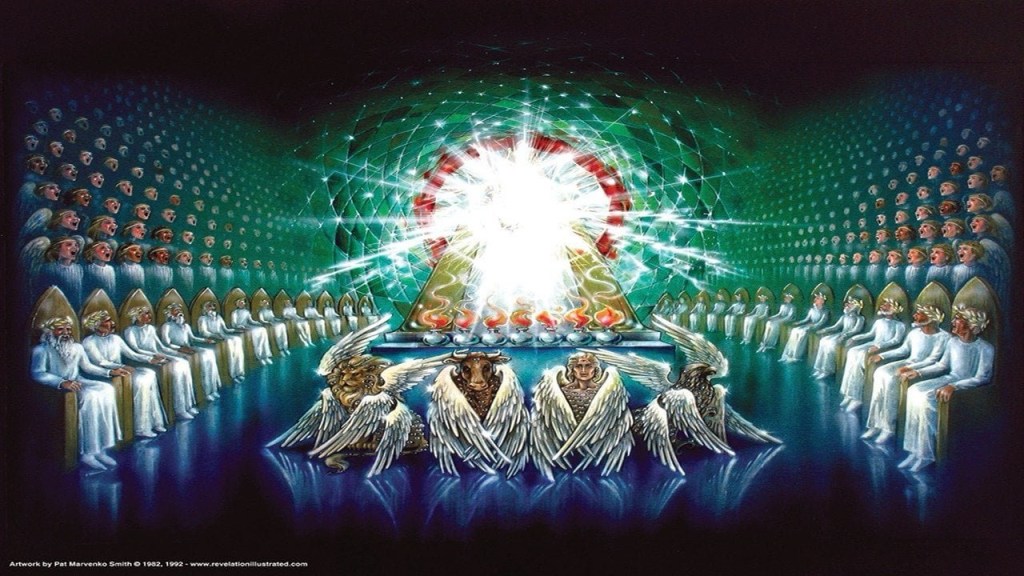
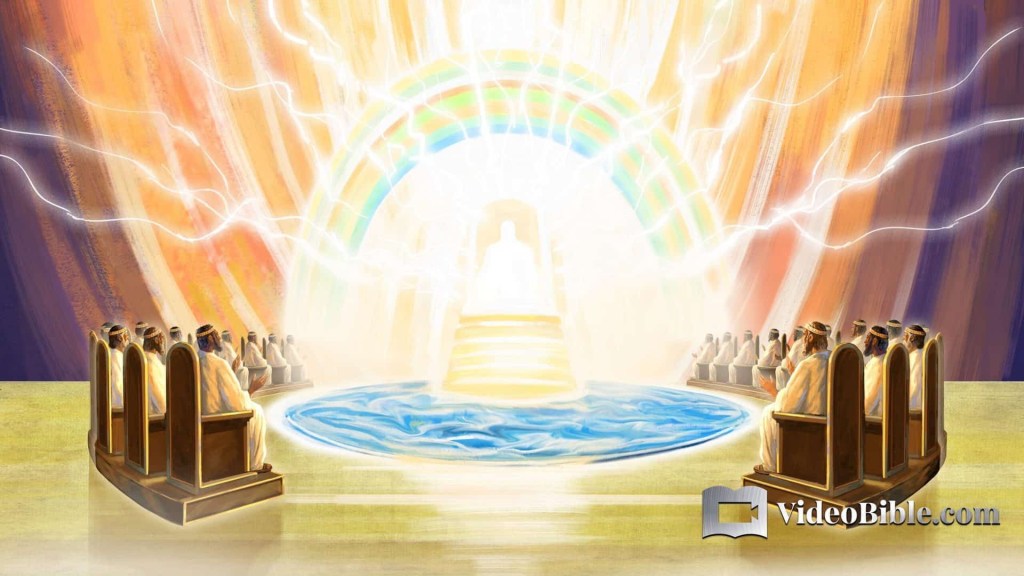
He sees things there that are almost too difficult to for him to put into words. He sees God the Father, seated on His throne, at the very center of a huge gathering. God dwells in dazzling light so overwhelming that John cannot clearly see His face. He tries to describe that light by using the image of light reflected by sunlight on jewels.  Scholars believe the jewel tones he saw were red, white, bright green, and perhaps purple.  Additionally he observes that God is surrounded on His throne by an emerald-hued rainbow. The rainbow is likely reminiscent of the days of Noah.  It seems to indicate the eternality of God’s promises—that is, that God does not break His promises to us, even if we disappoint Him.

Around God’s throne are 24 smaller thrones.  There is considerable conjecture about who the 24 elders are who are seated on the lessor thrones.  Most experts today think they represent “the true Church” or the “Redeemed:” including the 12 patriarchs or leaders of the Old Testament tribes of Israel; and the 12 Apostles from the New Testament.  They are dressed in white, the color of purity and righteousness, and what seems to be the uniform of heaven. They all wear a gold crown on their head, indicating they are a royal priesthood.  

John hears thunder and sees lightening shoot out from God’s throne. In Old Testament times, these signaled God’s presence and often His judgment. John perceives that the One seated on the throne is about to release His judgment on the inhabitants of the earth. Additionally, He notes (1) 7 torches around the throne, symbolic of the full presence of the Holy Spirit.

(2) Then he describes a “glass sea” under the throne, separating God the Father from everyone else there. God is totally holy. He is also, as I often say, large and in charge, so this bit of separation makes sense. 

(3) John is also amazed by God’s Honor Guard–the 4 living creatures (seraphim). They have eyes all over themselves, which looks and sounds very strange but indicates that they are omniscient or all- seeing. They fly about on 6 wings. Their bodies are those of strange, composite beings that may symbolize the apex of created life forms:

(a.) The mightiest wild animal, a lion (known to be ferocious);

(b.) The mightiest domestic animal, an ox (known for its strength);

(c.) The mightiest of all animals, humankind (known for our intelligence)

(d.) And the mightiest bird, the eagle (known for its swiftness).

Obviously these composite beings are capable of protecting God’s space and His person. Who could successfully take them on?

In Chapter #5, we find God the Father holding a scroll in His right hand, the hand of power.  John notes that it has writing on both sides. Typically in those days, people wrote on the front side of papyrus only, as the fibers on front were oriented horizontally while those on the back ran vertically. To have written on both sides indicates that the scroll is filled to overflowing with the decisions and the direction of God.  A number of Biblical scholars believe it contains both the salvation of humankind and the judgment of the wicked. A noted expert on the interpretation of Revelation, Robert Mounce, writes, “The whole story of human history rests in the hand of God.  What simpler or more sublime way of picturing God’s ultimate sovereignty over all history could be found than this picture of the scroll resting in the hand of God?  However strong evil becomes, however fierce be the satanic evils that assail God’s people on earth, history still rests in God’s hand.”

(Robert H. Mounce, The Book of Revelaton (Revised Ed.), Eerdmans, 1998, pp.82-83.)

Additionally, this scroll is sealed with 7 seals against tampering (again 7, in the Hebrew numbering system, is the number indicating completion). So, we can assume that what’s written therein is perfectly safe against tampering and that what’s written therein is very important!

John hears an angel ask (v.2) Who is worthy to break the seals on this scroll and open it?  Perhaps eager to learn God’s plans, John bursts into tears because (v.4)…no one was found worthy to open the scroll and read it. Then one of the 24 elders directs John to stop weeping. because Someone worthy has been found:  the Lion of the Tribe of Judah, the heir to David’s throne, Jesus.

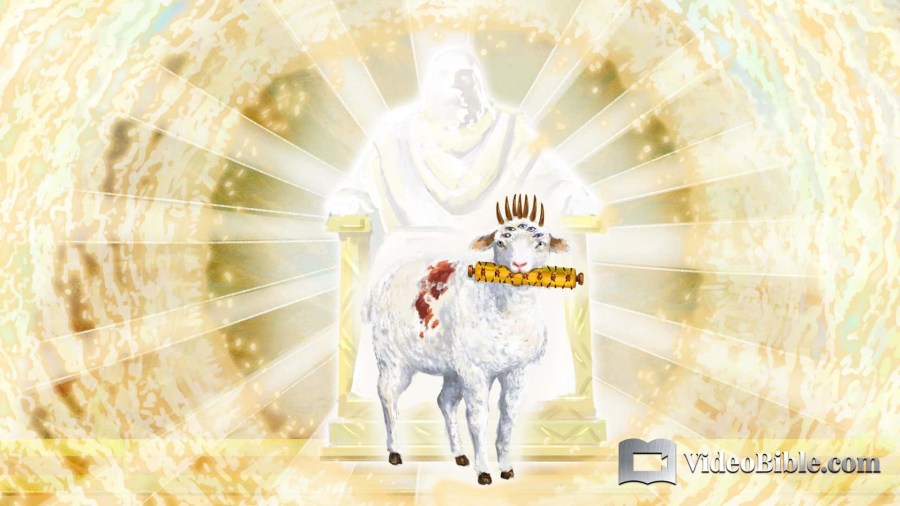
But the Jesus who comes forth is not a warrior king in all His resurrection splendor, nor a majestic lion. Rather, He is portrayed as a little lamb who had been sacrificed—alive now (resurrected) but probably evidencing a slit throat. Obviously it takes Someone totally conformed to God’s will—like Jesus—to break the seals. God Himself doesn’t do it, but He has the Mediator, Jesus, bring human history to its foreordained consummation (Mounce, Ibid, p.143).
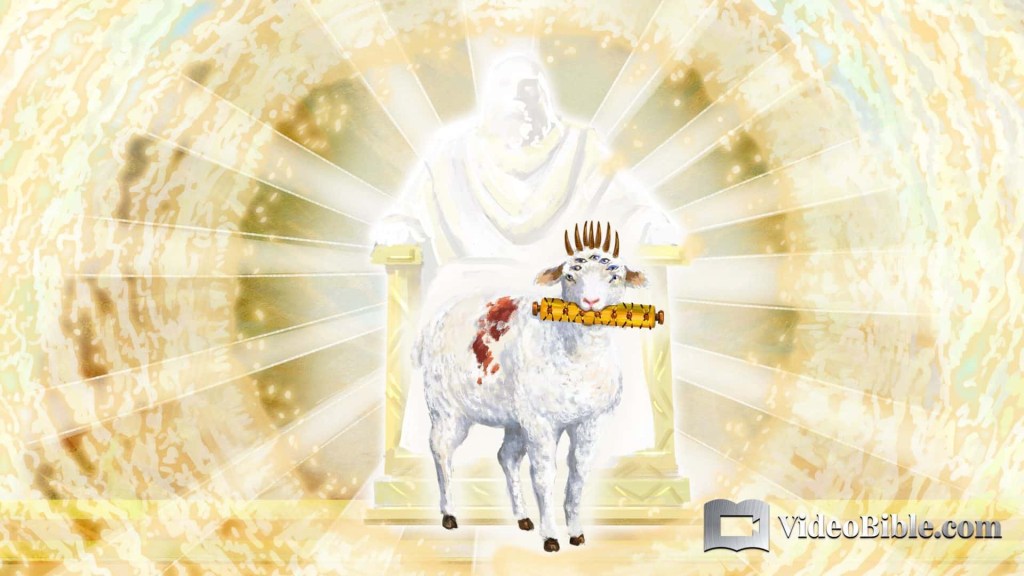
At this point, we should pause and say, “Worthy is the Lamb!” The use of the Lamb image is both striking and unusual. When people groups want symbols of power for their country, they tend to choose apex predators: Russia has the bear; Britain, a lion; France, a tiger; and the USA, the bald eagle. But God chooses a slain lamb, a typical temple sacrifice for sin. Christ is victorious precisely because He has surrendered Himself to be sacrificed, like a Passover Lamb.  He has triumphed over sin, death, and evil by His death on the Cross.

This particular lamb, Jesus, is powerful because He is depicted with seven horns, an Old Testament symbol for complete and perfect power.

Similarly, He has 7 eyes, representing His all-seeing omniscience.

So the Lamb slain from the foundation of the world steps forward to open the scroll, and all of heaven bursts into song. The 24 elders fall down before Him, surrendering to worship, singing Jesus a new song. They play harps to accompany worship music (I don’t think we will be the ones playing harps, despite what the culture contends).  The elders also offer up golden bowls of incense, which John is told are the prayer of the saints.  Then a myriad of angels join in a powerful chorus.  Finally, John writes (v.13) Blessing and honor and glory and power belong to the one sitting on the throne and to the Lamb forever and ever. (Talk about a Halleluia Chorus!)
So what can we take away from our glimpse into God’s throne room in Heaven?  I believe the following insights are worth remembering:  

1.) True power in this world does not rest with human dictators or human governments, but rather with our God.

2.)  God controls the course of human history.

3.) Even the most exalted beings in heaven humbly acknowledge God’s superiority in every way—so should we.

4.)  As God, Jesus knows how human history will end…our history is truly His-Story.

5.) How true then is Paul’s assertion from Romans 8:31 If God is for us, who can be against us?

6.) When we each get to heaven we will join millions of believers and angels in worship of our God and our Lord Jesus.
Thanks be to God Who gives us the victory through our Lord Jesus Christ!  Alleluia!  Alleluia!

©️2025 Rev. Dr. Sherry Adams 

Resurrection Sunday, 2025

Pastor Sherry’s message for April 20, 2025

Scriptures: Isa 65:17-25; Ps 118:1-2,14-24; 1 Cor 15:19-26; Lk 24:1-12

How many of you enjoy a good mystery?  Briefly, here are two.  See if you can figure them out:

1. “Everyday a gentleman went to work.  Every day, he would ride the elevator all the way to the bottom floor of the high rise apartment building in which he lived.  But when he came home from work, he would ride the elevator back up to only the 6th floor.  Then, he would take the stairs to his apartment many stories higher in the building.  This he did every day, unless it was raining.  If it was raining, he would ride the elevator all the way to the floor of his apartment.  Why?”

2.  Here’s the second one:  “Ann is lying on the floor dead.  There’s broken glass and water all around her.  Stuart is asleep on the couch seemingly oblivious to the death that has occurred.  How did Ann die?”

To keep you from puzzling these two mysteries out while I continue to preach, I’ll tell you their solutions: “In the first one, the gentleman would only go to the 6th floor on his return home from work because that was the highest button that he could reach on the elevator control panel.  He was a short man.  On days that it rained, he had his umbrella with him, and he could use that to punch the button that indicated his floor.” “In the second situation, it might help you to know that Ann is a fish, and Stuart is a cat.  And the glass and water all around Ann on the floor is from her fishbowl that Stuart successfully knocked over.”  The true mystery here is what then kept Stuart from eating Ann? 

(Borrowed from a sermon by Chris Talton, April 15, 2001, www.sermoncentral.com, 3/24/2005)

If we put ourselves in the position of the women who went to Jesus’ tomb on the morning of His Resurrection Day, we would realize they too were presented with several mysteries:

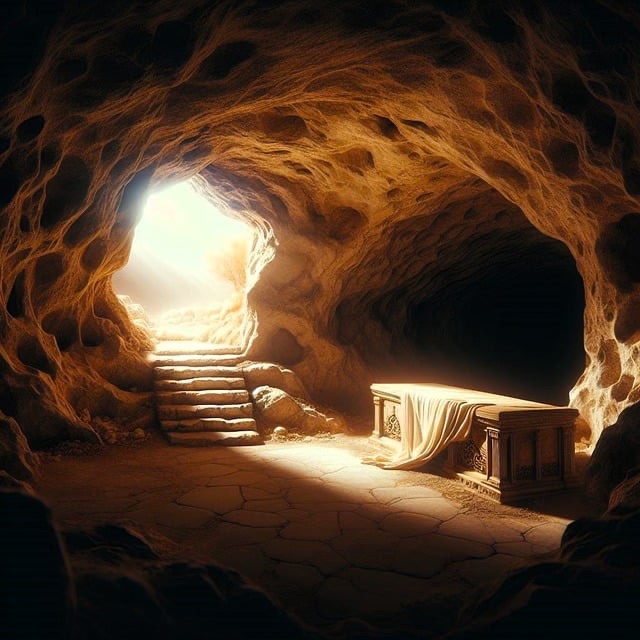
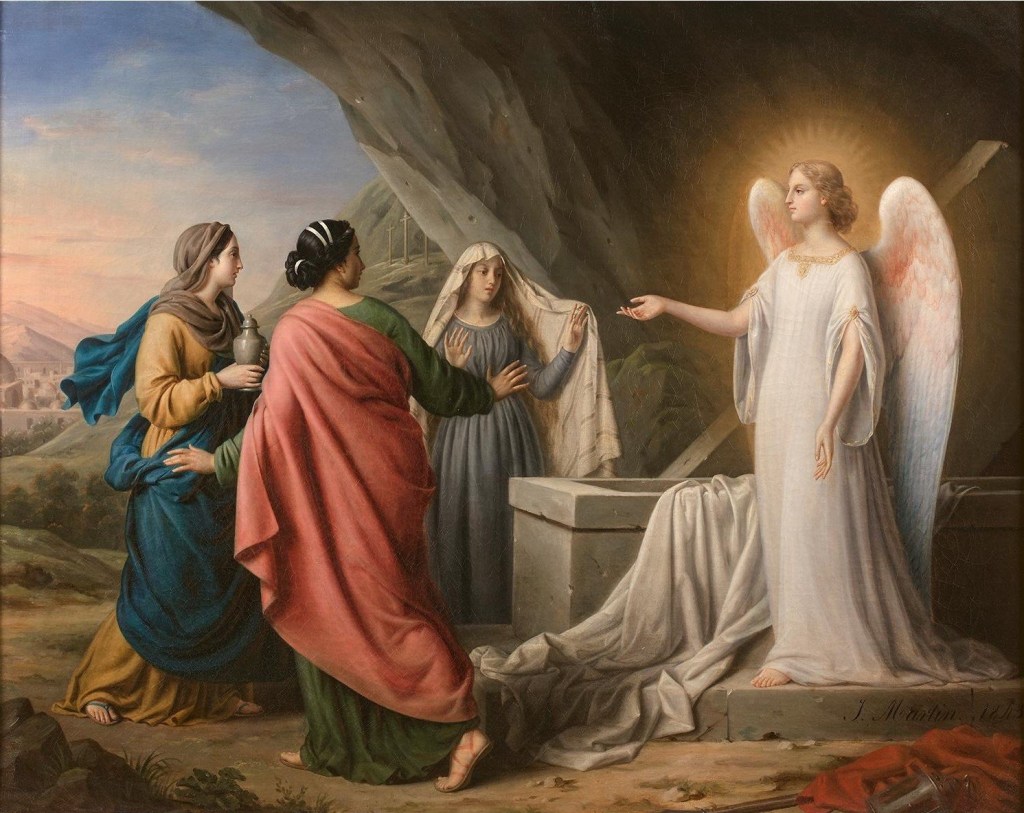
1. The gigantic stone that had sealed the entrance to the tomb had been rolled back.  Who could have done such a thing?  Remember, these ladies had been with Jesus at the Cross.  They had seen Him suffer and die.  They had watched Joseph and Nicodemus remove Jesus’ body from the Cross and transport it for burial in the new tomb nearby.  They also knew the men had hastily anointed Jesus body with embalming ointments and cloths, and had come to neaten things up and complete the job.  Surely they realized no single person could have rolled that huge, heavy stone away.

They probably also knew a contingent of Roman soldiers had been assigned there to guard the tomb.  So what had happened to them?  Had the Romans stolen Jesus’ body?  Had the Jewish religious authorities taken it?  They had to be both puzzled and alarmed.

Cautiously, they stepped inside the tomb to see if His body was there. Instead of finding Jesus’ corpse, they suddenly encountered two “men” in brilliant white clothes–angels.  It’s almost comical that the angels ask them, Why do you look for the living among the dead?  [He is alive!]  He is not here; He has risen.  Literally, the ancient Greek states, He has been raised.  The verb tense implies that God the Father has raised Jesus.

Angels had proclaimed His birth; now angels proclaim His resurrection (The angels and the women are all witnesses to this miracle).  These angels remind them of Jesus’ teachings about His death and resurrection on the 3rd day.  This is a prompt for them to remember. but it’s also a rebuke—”How could you forget something so very important?!!”

Then they do remember, and go to tell the disciples (the next  resurrection witnesses).  The Eleven do not believe them, even though they should have known these women were reliable truth-tellers.  Peter takes off for the tomb, to see for himself (he is now a witness).  Peter probably now knows better than anyone not to doubt the Lord’s words.  But he still wonders (perhaps “marvels”) about what Jesus’ absence in the tomb means. 

This passage (Luke 24:1-12) closes with questions in everyone’s mind about what has happened (big mysteries). 

The accounts of Jesus’ Resurrection are also reported in the other three Gospels, Matthew 28:1-8; Mark 16:1-8; and John 20:1-8.

A. You might want to read them each and compare to get a fuller sense of how the first witnesses to Jesus’ resurrection responded to the mysteries with which they were presented.

B. Paul, as we know, came to believe in Jesus sometime after the events of Resurrection Sunday.  By then, the mysteries had been explained.

So Paul is intent, in our 1st Corinthians 15:19-26 lesson, that we understand that Jesus’ resurrection is the defining moment of Christianity.

First, back in verses 5-8, he reminds us of who all saw Jesus following His resurrection:  Peter (omitting the women); the 12 minus Judas; more than 500 disciples (maybe he included the women among the 500); Jesus’ brother, James; and Paul himself.

Next, in verses 13-19, Paul asserts that our entire faith depends upon the truth of the resurrection:  Verse 14—If Christ has not been raised, our preaching is useless and so is your faith. In other words, Christ’s resurrection from the dead is incontrovertibly true and forms the basis of our belief in Him.  We worship a God who has the power to bring His Son back from the dead.  I want a strong, powerful God like that, don’t you?  We worship a God who loves us so much that He sacrificed His one and only Son to redeem us.  We worship Jesus, the One and Only, the God Who—because of His self-sacrificing love for us and His obedience to His Father–was willing to cover the cost of our sins.  The sinless Son of God gave up His life so we might have new life, and have it abundantly.  We can connect directly with the Father because Jesus opened the way for us (As He hung on the cross, the massive Temple curtain was torn in two, from top to bottom.)  We can anticipate being resurrected because Jesus opened the way for us.  And, when He comes again in glory to judge the living and the dead, He will destroy death…Praise God! 

C.  We don’t know who wrote Psalm 118:1-2, 14-24, but it is an ode to joy!  The psalmist invites us to focus on heavenly realities–not the frustrations and disappointments of this life.  Because of the mighty things Jesus will do [has done]—including demonstrating His power over death—we can gratefully rejoice in the Lord and praise Him for our deliverance, provision, and protection.

We are to be thankful to Him because (V.1)—The Lord is good; His love endures forever.  (V.14)—The Lord is my strength and my song; He has become my salvation.  (V.18)—Prophesying Jesus’s resurrection, the psalmist wrote, I will not die but live, and will proclaim what the Lord has done…He has not given Me over to death. Jesus was laid dead in a tomb–But He did not remain there as we would have.  He rose again, overcoming death for our sakes!  We are also grateful for the fact that (v.22)—The stone the builders rejected [Jesus] has become the capstone.  The capstone was either (1) a large rectangular stone used as a lintel over a doorway; or (2) a large square or rectangular stone used to anchor or align the corner of a wall; or (3) it might also be the keystone or middlemost stone in an arch.  The capstone (building corner or doorway lintel) or keystone (arch) kept the building from collapsing by supporting what existed beside and above it. The psalmist prophetically meant this as a metaphor for Jesus, who holds all things together for us— no wonder we call Him our Rock and our Redeemer.

Our passage today ends with this line (V.24)—This is the day the Lord has made, let us rejoice and be glad in it.

D. Isaiah 65:17-25 reminds us both that Jesus overcame sin and death, and that we too will therefore experience a joy-filled life after death.

After Jesus defeats the forces of evil at Armageddon, God (v.17) will create new heavens and a new earth.  If you read through the book of Revelation, you can tell that our world will be a disastrous mess by the time Jesus appears a 2nd time.  We will probably need a new earth, at a minimum.

Verse 19 tells us that the newly created Jerusalem will be delightful!

God will be overjoyed with His people there; and they too will be very happy, with no one weeping or crying.  Premature death will be an event of the past (no cancers, illnesses, strokes, heart-attacks, eye problems, hearing loss, or sciatic pain).  People will be able to enjoy the fruits of their labors (no warfare or taxes).  All of God’s people will be blessed!  God will answer our prayers before we even finish praying them.  And all animals will become plant-eaters—no more carnivores devouring prey—and will be at peace with each other.

Thanks be to God the mysteries presented the women at the open tomb have been solved.  We are not left to wonder.  Paul wants us to fully appreciate what Jesus has done for us through dying and rising again.  Our psalmist calls upon us to be grateful and to rejoice!  And Isaiah describes a wonderful world ahead for us when the resurrected Jesus comes back to earth.  Let’s celebrate by singing along to Keith and Kaitlin Getty’s version of https://youtu.be/m_063OI38RQ?si=Dre8ll-AV-GHUlPB In Christ Alone.

©️2025 Rev. Dr. Sherry Adams 

Faulty Expectations

Pastor Sherry’s message for April 23, 2023

Scriptures: Acts 2:14a,36-41; Ps 116:1-4,12-19; 1 Pet 1:17-23; Lk 24:13-35

I read a story recently from “Our Daily Bread” that tickled me:

“A traveling salesman had a flat tire while driving, in the rain, at night, on a country road. But to his dismay he had no lug wrench. Seeing a nearby farmhouse, he set out on foot. Surely the farmer would have a lug wrench, he thought. But would he even come to the door? And if he did, he’d probably be furious at being bothered. He’d say, ‘What’s the big idea getting me out of bed in the middle of the night?’ This thought made the salesman angry. ‘Why, that farmer is a selfish old clod to refuse to help me.’

“Finally the man reached the house. Frustrated and drenched, he banged on the door. ‘Who’s there?’ a voice called out from a window overhead. ‘You know good and well who it is,’ yelled the salesman, his face red with anger. ‘It’s me! And you can keep your old lug wrench! I wouldn’t borrow it is it was the last one in the county.’”

Do you see how the salesman’s faulty expectations influenced his interactions with the sleepy farmer? He had worked himself into a “mad” over how he anticipated the conversation would go. He hadn’t even yet interacted with the man, but his imagined and negative expectations skewed the way he then approached someone who could have helped him. Psychological research tells us that our common default is to evaluate a situation negatively. We do this almost automatically and have to learn to override this in order to think positively. In olden times, there was a practical value to scanning the environment for dangers. Negative evaluations keep us safe, but they won’t get us to happy. Positive thinking is what does that.

Think about your typical expectations. Has faulty thinking ever been true of you? I once began a new job—prior to seminary—with a boss who claimed she was a Christian. I liked her initially and thought she would be a good person to work for; hers was the 5th firm in 2 years to take over the rehabilitation company that employed my team and me. She called her business, “RehabActs,” and told me she had named it for the book of Acts. My expectations of her were positive until I discovered later that she was using my mental health license to defraud Medicaid and Medicare. I confronted her and told her she was putting my license in jeopardy but she informed me that she was the boss and that I would sign off on services we had not performed or be fired. When she would not listen to reason, I had to quit in order to protect my credentials from ethics violations and possible criminal charges. My expectations that she would be an ethical employer had been extremely disappointed.

How often have your expectations of friends and family disappointed you? I recently learned of two adult children whose father did not invite them to his wedding, even though they both lived in the same town where the marriage ceremony took place, and could have attended. They both discerned from this that he did not hold either one in very high esteem. They were of course deeply disappointed.

How about business or financial decisions that turned out to be mistakes? Or retirement plans? I remember a woman who shared with me her broken heart. She and her husband had worked for years to fix up a lake house to retire to, only to have him die a week after they moved in. She awoke one morning to find him dead in his recliner. She had expected they would live out their retirement years in this tranquil and beautiful setting, but she sold the property on which they had worked so hard. The memories of what was not to be were too painful.

Our readings today address the issue of faulty (or mistaken) vs. sound expectations:

A. Our Gospel lesson (Luke 24:13-35) invites us to consider how many of Jesus’ followers probably responded to news of His death and resurrection. Afterall, death seems so final, the end of possibilities and dreams. These two on the road to Emmaus–Cleopas and a friend? His wife? His son?–were confused and disappointed. Many had thought that Jesus was the Messiah who would help them overthrow Roman rule. But now He had been executed like a common criminal. Rumors were spreading that He had been seen, alive and well. Jesus had apparently risen from the dead! They wondered, “Could this possibly be true?”

Then Jesus sets them straight—in what had to have been a phenomenal walk through the Hebrew Scriptures: Verse 27 and beginning with Moses and all the Prophets, He explained to them what was said in all the Scriptures concerning Himself. He shared with them the totality of how the Old Testament pointed to and described the Christ. No doubt He shared how Jesus’s life and ministry fulfilled these Scriptures. Did you realize that all of the items in the Holy Place and the Holies of Holies were symbolic of Jesus? How about the way the Israelites camped and marched in the Wilderness? They camped by tribes in the shape of a Cross, with the Tabernacle in the middle and the tribe of Judah ahead of it. No doubt He disabused them of their faulty expectations that Jesus was meant to be a conquering hero in His First Coming. No, He came first as a humble servant to save them and us spiritually, from our sins. But when He returns in His 2nd coming, He will then arrive as King of Kings and Lord of Lords, completing our rescue from the grip of human and satanic tyrants.

Notice, it was only as He blessed and broke bread with them that they recognized Him (v.31) Then their eyes were opened and they recognized Him, and he disappeared from their sight. How frustrating to have Him then suddenly vanish (oh, that resurrection body!). He reveals Himself to them, they get it, and He evaporates! However, they now know they too have encountered the Risen Christ. So, they hot-foot it back to Jerusalem to share their news with the disciples gathered there. Don’t you know they also gave a seminar on their faulty expectations vs. Christ’s reality?

B. In our Acts lesson (Acts 2:14a,36-41), Peter preaches a Pentecost sermon that converts the hearts of 3,000 Jews to Jesus. Having been empowered by the Holy Spirit, he is no longer captured by fear. Instead, he becomes a bold, authoritative street preacher. Gloves off, he accuses them in verse 36 Therefore, let all Israel be assured of this: God has made this Jesus, whom you crucified, both Lord and Christ. He confronts them with their national sin. They feel both convicted and guilty. They ask him and the other disciples (v.37)…Brothers, what shall we do?

In verse 38, he tells them to repent, be baptized, and receive the Holy Spirit. Isn’t this what each of us has done as we too have come to a saving knowledge of Christ? Our faith has led us to a desire to be baptized with water (if we were not as infants); and, hopefully, we have also been received the gift of the Holy Spirit. In other words, Peter was exhorting them to let go of their faulty expectations of the Messiah and accept that Jesus was and is the Christ.

C. Peter goes on to say in his epistle (1st Peter 1:17-23) that there is no other way to salvation except through belief in Jesus. In verses 18-19, he insists, essentially, that nothing can save us from our sins but Jesus…not money (gold or silver); not power and influence; not personal effort; not other gods (notice the little “g”). No, we are only saved by…(v.19) the precious blood of Christ, a lamb without blemish or defect. This is one of the main reasons Christianity is becoming less popular in our culture today. Secularists take exception to the Bible’s exclusive claims. Jesus said no one comes to the Father except through Him; He is the only way to heaven. Many would prefer that there would instead be several routes to Paradise. Jesus is the only way to salvation because it is only He who paid the cost of all of our sins.

Additionally, as Rev. Dr. J. Vernon McGee says, “Jesus was not an ambulance sent to a wreck,” not an emergency response to a catastrophe (Commentary on 1 Peter, Thomas Nelson Publishers, 1991, p.40.) Jesus’ saving work on the Cross was always God’s plan (v.20) He was chosen before the creation of the world [and] was revealed in these last times for your sake.

D. So, what is our response to be—our sound expectation–for this great Good News? Our Psalm (116:1-4, 12-19) tells us: (Vv.1-2) I love the Lord, for He heard my voice; He heard my cry for mercy. Because He turned His ear to me, I will call on Him as long as I live. Whoever wrote this psalm was a person in distress who chose to upon the Lord for help. Asking God for help is a choice, often peoples’ last option after they have done all they possibly can in a given situation. But this composer believed the Lord would hear and would help. So he or she wrote this love song to God. As the psalmist teaches us, we respond to God with gratitude because He hears us. We respond with love for Him because He replies to our heartfelt prayers.

The truth is that God needs nothing from us. The best gift we can give God is our love. Another great gift to Him is our thanks.

We want to have only sound expectations of Jesus. We are to let go of any faulty expectations that get in the way of a sound faith and understanding of Jesus Christ. These include common misperceptions that Jesus should do what I want Him to do for me to have faith in Him. These also include my dependence on my own wealth, power, or influence–or my own will. King Louis XIV of France (1643-1715), also known as “the Sun King,” reigned for 72+ years. Upon losing a massive battle to the English at Blenheim, he is said to have exclaimed, “How could God do this to me? After all I have done for Him?” God bless him, but what hubris!

A wiser Frenchman, Blaise Pascal (a famous mathematician and philosopher who lived during Louis 14th’s reign, once said, “Human knowledge must be understood to be believed but divine knowledge must be believed to be understood.” If we read the Bible, it will correct our faulty expectations. If we ask for the help of the Holy Spirit as we read it, Scripture will teach us what we can accurately hope for from our God. The Spirit will correct our faulty understandings. The Spirit will deepen our faith and our love for God. Thanks be to God! Amen!

©️2023 Rev. Dr. Sherry Adams

Proof of the Resurrection

Pastor Sherry’s message for April 16,2023

Scriptures: Acts 2:14a, 22-32; Ps 16; 1 Pet 1:3-9; Jn 20:19-31

The story is told that… “in 1799 the armies of Napoleon appeared on the heights above the town of Feldkirch, Austria. It was Easter Day, and the rays of the rising sun glittered on the weapons of the French, as they appeared drawn up on the hills to the west of the town. The Town Council was hastily called together to consult what was to be done.

“After much discussion, the dean of the Church rose and said, ‘My brothers, it is Easter Day! We have been reckoning our own strength, and that fails. Let us turn to God. Ring the bells and have service as usual, and leave the matter in God’s hands.

“They agreed to do as he said. Then from the church towers in Feldkirch there rang out joyous peals in honor of the Resurrection and the streets filled with worshipers hastening to the church.

“The French heard the sudden ringing of the joy bells with surprise and alarm. They concluded that the Austrian army had arrived to relieve the place. So they hastily fled, and before the bells had ceased ringing not a Frenchman was to be seen.”

(Website “Ministry 127,” 2023, quoting Walter Baxendale, Dictionary of Anecdote, Incident, Illustrative Fact: Selected and Arranged for the Pulpit and the Platform, 1888.)

There are a number of great lessons in this story, aren’t there? Look at what God can do when we trust in Him for protection. The French had had their revolution (1787), during which they had killed off many Roman Catholic clergy and protestant Huguenots 12 years before. Without anyone to lead worship, provide Biblical teaching, and help nurture and reinforce their Christian beliefs, the faith of the French army had withered to such an extent that they no longer even recognized Easter Sunday! (This is similar to today in America, in that a recent “man in the street” interview in New York City revealed that only one woman out of dozens of interviewees knew the meaning of Easter.) This is why the Napoleonic Army misconstrued the meaning behind the ringing of the bells.

I rang our bell this morning. Bob, the bell ringer when I arrived 8 years ago, has since moved into a nursing home. No one has rung our bell since he left. It occurred to me today that it was beyond time to ring it again. Our bell could also be called a “joy bell.” It calls us to worship and should remind us of the joy we have in Jesus’ resurrection.

Another story is told of a man driving down a country road with his 5 year old son. They passed a cemetery and noticed a large pile of dirt next to a grave that had been freshly dug. The little boy looked and exclaimed to his father, “Look, Dad, one got out!” The person who composed this story remains unknown. Nevertheless, the next time you pass a cemetery…“think of the One Whom the grave could not hold” (also anonymous).

Another unknown person once said, “Christmas is the promise and Easter is the proof.” Our Scriptures today all instruct us in the proof of Jesus’ resurrection:

A. Part of the proof resides in Psalm 16. It is a prophesy written by King David, but which pertains to and was fulfilled by Jesus some 1000 years later. Jesus says (v.8) I have set the Lord always before me. Because He is at My right hand, I will not be shaken. From this side of the Cross and Resurrection, we can attest that this was (and is) true of Christ’s life. No one and nothing had been able to deter Him from fulfilling His mission here on earth. The Father communicated often with the Son and because of their love for each other, Jesus persevered through (1) His poverty and homelessness; (2) His rejection by the religious authorities of His people; and (3) through His passion and death, to His glorious resurrection.

In verses 9-10, He states, Therefore My heart is glad and My tongue rejoices; My body also will rest secure, because You will not abandon Me to the grave, nor will You let Your Holy One [Jesus] see decay. Jesus totally trusted in His Father. He knew He would die, but He also knew His body would not languish in the grave. Because of His sacrifice for our sins, those of us who believe in Him can also trust our graves are not our final destinations.

Verse 11 describes His ascension into heaven You have made known to Me the path of life; You will fill Me with joy in Your presence, with eternal pleasures at Your right hand.

B. John’s account in our Gospel lesson today (John 20:19-31) describes how patiently Jesus proved His resurrection to the 11 Apostles (Judas had committed suicide) following Easter. First He appeared to all but Thomas, who was absent. His resurrection body suddenly manifested, despite the locked door. We are told He identified Himself to them by showing them His damaged hands, feet, side. This was no imposter, nor was He a ghost. He greeted them in peace (they were scared). He imparted to them Holy Spirit empowerment to overcome their fears, and to assist Him to begin to preach the truth of His resurrection to whomever would listen. The sins of those who became born again through their preaching were forgiven (cleansed by the blood of the Lamb); those who rejected Christ would continue to carry the guilt of their sin themselves.

Then He returned a week later to confront Thomas’ unbelief. Thomas was apparently a “Detective Joe Friday” (Remember the TV show, “Dragnet”?) who wanted to see and hear for Himself, “Just the facts, M’am.”

Like a modern day CSI investigator, he wanted physical proof before he would believe. Jesus knew this about him and patiently provided it for him. Thomas saw, believed, then proclaimed, My Lord and my God. Jesus affirmed Thomas (v.29) Because you have seen Me, you have believed. But He also rebuked him and the others Blessed are those who have not seen and yet have believed. These 11 were eye-witnesses to the Resurrection and they believed. But those of us who weren’t eye-witnesses, and still believe, are especially praised.

C. Peter’s famous Pentecost sermon (Acts 2:14a, 22-32) displays his deepened faith. He has accepted the proof of Jesus’ resurrection. In verse 25, he quotes from Psalm 16:8-11. By now, it is clear to him that Jesus fulfilled King David’s prophesy of Jesus’ life, death, resurrection, and ascension. And this is essentially what he preached to the Pentecost crowd in Jerusalem that day. Peter wanted them to understand that Jesus fulfilled King David’s prophetic promise (vv.31-32) Seeing what was ahead, He [King David] spoke of the resurrection of the Christ, that He was not abandoned to the grave, nor did His body see decay. God has raised this Jesus to life, and we are all witnesses of the fact. Can’t you just hear the excitement, the joy in his voice as he proclaimed this? Clearly Peter had become totally convinced and convicted!

D. In his letter, 1st Peter 1:3-9, the Apostle to the Jews of the Diaspora–those who lived outside Israel–is writing to encourage Christ-followers who are experiencing persecution. The time is somewhere during the mid-60’s of the First Century. Emperor Nero (54-68) had begun persecuting Christians in Rome. It is said that he had set fire to the poorest section of the city, but blamed Christians—even using their burning bodies as torches for his garden parties. (Later on, Emperor Domitian [81-96] would extend persecution of Christians throughout the Empire—claiming Christians were intolerant and seditious because they would not worship the Roman panoply of gods nor agree that “Caesar is Lord”).

Peter encouraged believers in the passage we read today to hold on to their hope, despite any persecution or suffering they might undergo. He says in verse 3 that our hope lies in Jesus’ Resurrection from the dead, and is also due to (v.4) …an inheritance that can never perish, spoil, or fade—kept in heaven for you, who through faith are shielded by God’s power….Despite any persecution we may suffer, we await in faith our own resurrection. Additionally, we happily anticipate joy without limit in Heaven.

Finally, echoing Jesus’ words to Thomas, he commends them (v.8) Though you have not seen Him [Jesus], you love Him; and even though you do not see Him now, you believe in Him. We, too, are to believe in Jesus because of His resurrection, the ultimate proof that He was and is God.

The first 2 Scottish missionaries sent to the Island of Aniwa in New Hebrides were killed and consumed by cannibals. Needless to say, it was difficult to recruit others to try to take their place. One fellow, though, John G. Paton (1884-1907)–perhaps distantly related to our army general, George Patton –bravely volunteered to go. When church members, friends, and family tried to talk him out of it, citing the danger of the cannibalistic natives, he said, “I confess to you, that if I can but live and die serving and honouring the Lord Jesus, it will make no difference to me whether I am eaten by cannibals or by worms; and in the Great Day my resurrection body will arise as fair as yours in the likeness of our risen Redeemer.” Because of the proof of the resurrection, Paton could fearlessly go minister among cannibals. In fact, he served as a missionary in New Hebrides for 15 years and successfully converted the entire island of Aniwa by the time he returned to Scotland.

(Story recounted on Website “Ministry 127,” April, 2023.)

We too can have the same confidence: We can trust that whatever happens to our mortal bodies, we will be raised to have resurrection bodies. We can also trust that we will dwell with Christ and all the resurrection saints in Heaven. The next time you pass a cemetery, think of the One Whom the grave could not hold, and be thankful.

©️2023 Rev. Dr. Sherry Adams

He is Risen!

Pastor Sherry’s Easter message for 4/9/23

Scriptures: Acts 10:34-43; Ps 118:1-2, 14-24; Col 3:1-4; Jn 20:1-18


“Max Lucado, in his book, Six Hours One Friday, tells the story of a missionary in Brazil who discovered a tribe of Indians in a remote part of the jungle. They lived near a large river. The tribe was friendly and in need of medical attention. A contagious disease was ravaging the population and people were dying daily. An infirmary was located in another part of the jungle and the missionary determined the only hope for the tribe was to go to the hospital for treatment and inoculations. In order to reach the hospital, however, the Indians would have to cross the river—a feat they were unwilling to perform.

“The river, they believed, was inhabited by evil spirits. To enter the water meant certain death. The missionary set about the difficult task of overcoming the superstition of the tribe.

“He explained how he had crossed the river arrived unharmed. No luck. He led the people to the bank and placed his hand in the water. The people still wouldn’t believe him. He walked out into the river and splashed water on his face. The people watched closely, yet were still hesitant. Finally, he turned and dove into the river. He swam beneath the surface until he emerged on the other side. Having proved that the power of the river was a farce, the missionary punched a triumphant fist into the air. He had entered the water and escaped. The Indians broke into cheers and followed him across.”

Isn’t that what Jesus did? He entered the river of death and came out on the other side so that we might no longer fear death, but find eternal life in Him.

(Max Lucado, Six Hours One Friday, Multnomah Books, 1989, pp.157-158).

Today, Easter Sunday, we celebrate the fact that Jesus Christ demonstrated that He had overcome sin and death by rising from the dead. He demonstrated the full extent of His miraculous power. And He brought us hope for the future (death is not the final outcome for us). All of our readings today refer in some way to Jesus’ resurrection:

A. In our Gospel, John (20:1-18) highlights some of the events of that first Easter Day. Mary Magdalene—remember, she had held a vigil for Jesus, along with His mother, John, and several other women–at the foot of His Cross. She had probably wept and prayed for Him as he hung dying. No doubt she had watched Joseph of Arimathea and Nicodemus quickly wrap His body for burial. In a dry land with limited water, they would have cleaned the corpse as best they could. They had to hurry before the onset of the Sabbath—He had to be buried before sundown. They then coated the body with myrrh, aloe, and the other spices they had brought. Next, they wrapped it up in stripes of cloth, which would have encased the body in a permanent, glued-on, kind of bandage. This process is important to note because of what happens later.

Mary had watched and must have thought the men did not do as good a job as they should have done for someone as important as Jesus. So she returned to the grave early the next morning, intending to make things right. How she thought she might roll away the heavy stone sealing the tomb is anyone’s guess. Nevertheless, she found the tomb already opened but containing no body. John tells us she ran to find Peter and the other disciple [this is how John always refers to himself in his Gospel], both of whom ran to see for themselves. John, the younger man, arrived first but only peeked into the tomb. The older Peter lagged behind, but reached the tomb and charged in to see only grave clothes on the shelf where Jesus had been laid.

The grave clothes told a story: The myrrh, aloe, and spices should have stuck the cloth stripes to the body, like a mummy. Remember Lazarus needed help to remove his. Both men saw strips of linen lying there, as if Jesus had materialized up through them, leaving them behind. In addition, the shroud for his head and face had been neatly folded and set aside. John saw this, knew it was physically impossible and therefore evidence of a miracle, and believed that Jesus had been resurrected. They appeared to have then gone home to ponder over what they’d seen.

Mary remained, grieving. Jesus appeared in His resurrection body and she didn’t recognize Him. Apparently the nail holes on His hands and feet, and the pieced place on His side, were evident, but something about His face and posture were altered in His resurrection body. Or perhaps she didn’t realize it was Him because she wasn’t expecting to see Him. She only comprehended that it was Jesus when He called her by name. He told her then to go tell the other disciples that He is going to see God the Father. Now we know from other accounts that He later met privately with Peter, encountered the two disciples on the road to Emmaus, and arrived back to greet 10 of the 11 disciples in the Upper Room, but we do not really know where He went during the middle hours between dawn and later that evening. Somewhere during that time, He had a joyous reunion with His Father in heaven! Mary, then, obediently carried the Good News of Jesus’ Resurrection—I have seen the Lord!–to the others.

B. Peter is certainly fired up as he preaches to Cornelius and his household in Acts 10:34-43). He had seen the empty tomb, the discarded grave clothes, and the resurrected Christ! Filled with the Holy Spirit (at Pentecost, back in Acts 2), he preaches with fiery conviction. Dr. J. Vernon McGee makes the point that, “There is not a single sermon in Acts that does not mention the resurrection of Jesus.” (Through the Bible Commentary Series, Acts, Thomas Nelson, 1991, p.129).

Peter reviews for the Cornelius’ Roman household the salient points of Jesus’ life and ministry, emphasizing the resurrection (vv.39b-41) They [the Jewish religious authorities + the Romans ] killed Him by hanging Him on a tree, but God raised Him from the dead on the third day and caused Him to be seen. He was not seen by all the people, but by witnesses whom God had already chosen—by us who ate and drank with Him after He rose from the dead. What a privilege to have been chosen by the Father to be one of the 500 or so to actually see and spend time with Jesus!

C. Paul reminds us, in Colossians 3:1-4, that because we are “in Christ,” we …have been raised with Christ. We share in Christ’s resurrection. Due to this new position in Christ, we have said goodbye to our old, fleshly selves; and we have put on a new, spiritual self. As a result of this phenomenal realignment/reorientation of our individual identities, Paul wants us to (v.2) set your minds on things above, not on earthly things. If you have read anything about people who claim to have died and gone to heaven (NDE’s, Near Death Experiences), they all agree they did not want to return to earth. Having seen Heaven, they wanted to stay. Similarly, Paul believes since heaven is ahead of us, we should focus on Jesus as we continue our tenure on earth. As children of the Resurrection, we are to pattern our lives after Jesus and keep our concentrate on heavenly realities.

D. Psalm 18:1-2, 14-24 is an ode to joy! The psalmist, predating but very like Paul, invites us to focus on heavenly realities–not the frustrations and disappointments of this life. Because of the mighty things Jesus has done—including demonstrating His power over death—we can rejoice in the Lord and praise Him for deliverance, provision, and protection.

We are thankful because…

1.) (V.1) The Lord is good; His love endures forever.

2.) (V.14)The Lord is my strength and my song; He has become my salvation.

3.) (V.17) I will not die but live, and will proclaim what the Lord has done.

4.) (V.24) This is the day the Lord has made, let us rejoice and be glad in it.

We also celebrate the fact that (v.22) The stone the builders rejected [Jesus] has become the capstone. The capstone was either a large rectangular stone used as a lintel in a doorway, or a large square or rectangular stone used to anchor or align the corner of a wall. It might also be the keystone or middlemost stone in an arch. The capstone (building corner or doorway lintel) or keystone (arch) kept the building from collapsing by supporting what exited beside and above it. Considering this metaphor for Jesus, no wonder we call Him our Rock and our Redeemer.

The story is told of…”a man (who) took a vacation to Israel with his wife and mother-in-law. During their time in the Holy Land, his mother-in-law unexpectedly passed away. The following day, the husband met with the local undertaker to discuss funeral plans.

“In cases like these, there are a couple of options to choose from,” the undertaker explained. “You can ship the body home for $5,000, or you can bury her in the Holy Land for just $150.” The man took a minute to think about it, and then announced his decision to ship her home.

“The undertaker, intrigued by his decision, said, “That’s an interesting choice. Can I ask why would you pay $5,000 to ship your mother-in-law home, when you can easily bury her here for $150?” The man promptly replied, “About 2,000 years ago, a man died and was buried here. Three days later he rose from the dead, and I can’t take that chance!” (Subsplash website, 5 humorous Easter sermon illustrations, April 13, 2022.)

Of course there is no guarantee that the mother-in-law would have resurrected—unless she had been a believer in Jesus Christ. Additionally, we know, of course, that Jesus’ ability to raise us from the dead is not limited to the geography of Israel—thank Goodness! Nonetheless, we can enjoy a good joke.

We can also enjoy the secure future we have in Christ. Like the missionary to Brazil, Jesus entered the river of death and came out victorious on the other side. Because He did this for us, we too share in His resurrection victory—and all of its benefits.

Alleluia, He is risen! The Lord is risen indeed, Alleluia!

©️2023 Rev. Dr. Sherry Adams

He Is Risen!

Pastor Sherry’s Message for Resurrection Day–April 4, 2021

Scripture Readings: Acts 10:34-43; 1 Cor. 15:1-11; John 20:1-18

One of my favorite Bible Commentators is the Rev. Dr. Delmer Chilton, a Lutheran pastor from North Carolina.  Together with his buddy, a Baptist pastor named John Fairless, he posts a blog called, “Two Bubbas and a Bible.”  In an Easter post some years back, Pastor Chilton shared a story told to him by a South Carolina pastor who had been invited by a guard friend to baptize some prisoners at the Central Carolina Prison in Columbia.  The pastor appeared at the prison early in the am, only to be frisked, ID’ed, interrogated, and then moved from one waiting area to another over the span of an hour.  The pastor joked that it took an hour to move him 15 feet.  Finally he met his guard friend and they walked together down some long hallways to the prison chapel.  It was a small, austere room containing several rows of chairs, a pulpit, and a piano.

         On this particular day, the pulpit and the piano had been pushed aside to accommodate a large wooden box.  The box contained an insert of blue plastic sheeting, into which had been poured gallons and gallons of water.

The first prisoner stepped into the box, sat down, then and laid back into the water.  Just as the pastor was about to dip the      man’s head under while reciting the baptismal proclamation, he realized the box was actually a coffin–a simple pine-box, prison issue, no frills.  He further realized that the prisoner was metaphorically going into and coming up out of the grave.

         Our baptismal service includes a prayer that reads (United Methodist Hymnal, p.36) as follows:  Pour out Your Holy Spirit to bless this gift of water and those who receive it, to wash away their sin and clothe them in righteousness throughout their lives, that, dying and being raised with Christ, they may share in His final victory.  In other words, we believe that with Christ as our Savior/our head, we go into death with Him on Good Friday (symbolically), and rise with Him in resurrection joy on Easter Sunday!  Together with Jesus, at Easter we (1) Die to sin and resurrect to new lives, covered by Christ’s righteousness;(2) We move from the despair of thinking the world, the flesh and the Devil have won, to the hope of realizing that Jesus has defeated all three.  (3) We all go under to death and rise up again to eternal life; and (4) Jesus’ resurrection ensures new life for us!

         It should come as no surprise that all of our Scriptures today emphasize Jesus’ Resurrection:

         In our Gospel lesson, John 20:1-18, the Apostle John describes    the reactions of the first eye-witnesses to the resurrection.  Mary Magdalene runs the gamut of emotions.  She arrives in the predawn, grieving but desiring to properly clean and anoint Jesus’ body.  She is no doubt shocked to discover the large rock is rolled back and the tomb is empty.   She frantically seeks the aid of Peter and John to locate Jesus’ body.  (Some Biblical scholars tell us that just as John took in Mary, Jesus’ mother, he also gave comfort to Peter who would have been ashamed over having denied and abandoned Jesus when He most needed him. Thus Mary Magdalene would have found them together.)

         They too are stunned and run to see the empty tomb for themselves.

Peter agrees the Lord’s body is gone.  But John then remembers how Jesus had told them He would die and be raised again on the 3rd day.  John appears to put it together, and is then reassured.  The two leave, ostensibly to ponder what they have seen.

Following their departure, Mary is even more deeply grieved and looks into the empty tomb to encounter 2 angels. They seem to chide her for crying, (v.13) Woman, why are you crying? In other words, This isn’t the end, Mary! But a new and better beginning! She turns, sees Jesus, and finally recognizes Him when He calls her name. Now she’s relieved and overjoyed to see Him again! Now she can run to gladly share with the disciples, (v.18) I have seen the Lord! She had mourned His death, but now she has witnessed and testified to the fact that He is alive!

         In our Acts lesson today (10:34-43), we find Peter, also an eye-witness, preaching to Cornelius, a Roman centurion, and his family–Gentiles living in Caesarea.  His sermon majors on Jesus’ life, death, and resurrection.  In fact, every sermon recorded in Acts does the same.

You see, this is the Gospel:  (1) Christ came to earth, lived among us and identified with us. (2) Then Christ died a criminal’s death to save us from the penalty for our sins.  (3) Finally, Christ overcame the power of sin and death and rose again!  Do you realize there would be no hope for us if Jesus’ life, His story, ended with the crucifixion?  The source of our hope lies in His return to life.  His resurrection demonstrates both that He is God, and that

He has extraordinary, life-giving power!

         Paul, in our NT lesson from 1 Corinthians 15:1-11, wants us to be sure we understand 2 facts:  First, Jesus’ resurrection was not just a spiritual truth but a bodily phenomenon.  The original Greek words he uses for resurrection are anastasis nekron, which means the standing up of a corpseJesus appeared to His followers in a real body.  One that had been alive, but was then killed; and then miraculously stood up or came back to life!

         Secondly, Paul assures us, Jesus appeared (post-resurrection) to over 500 witnesses.  The resurrection is no myth!  This is no baseless narrative that has been spun to deceive.   No, Jesus’ resurrection is am historic fact!

         1.) Peter and John saw Him;

         2.) Mary Magdalene and the other faithful women saw Him;

         3.) His mother saw Him;

         4.) His brother James saw Him;

         5.) The 10 Apostles in the upper room saw Him;

         6.) The two disciples on the road to Emmaus saw Him;

         7.) Paul encountered Him on the road to Damascus;

8.) And Paul declares (v.6) that a significant number of unnamed disciples saw Him at various events during the 40 days between His Resurrection and Ascension.

You might be able to dismiss the testimonies of a few wild-eyed zealots. But add to this over 500 “normal people?” Additionally, how about the fact that Jesus fulfilled over 325 Messianic prophesies from the Old Testament? Josh McDowell, in his book, More Than a Carpenter, computes the probability of anyone but Jesus fulfilling so many prophesies as the chance of finding one gold coin thrown into a pile of silver coins spread, 3 feet thick, over the surface area of the state of Texas! Moreover, consider the fact that Jesus is probably the most influential person who has ever lived. He is still worshipped today, 2000 years later. He is still proclaimed as Lord, after 2 millennia. Lastly, consider that hundreds of thousands of His followers have met martyr’s’ deaths rather than renounce Him. People do not willingly face death for something or someone that they consider to be exceedingly important.

         The truth is that the Resurrection is neither normal nor natural.

It may and probably does get in the way of many practical people coming to faith.  Nevertheless—though supernaturally caused–it was and is as real as real can be.

         It is hugely important to us because it speaks of Jesus’ transformative power.  Those South Carolina prisoners who were baptized in that coffin didn’t get to leave prison due to their new life in Christ.  They still had to serve out their sentences.  But spiritually speaking, they had gone from “dead men walking,” waiting to die, to new creations, new believers filled with new life.

         As we live into Easter, let’s be aware of how we might be living like dead persons walking.  Let’s jettison that prison and realize we don’t have to live that way.  Because of Jesus’ resurrection power, we can shake loose from whatever is holding us back and embrace the new life God has for us.  We can metaphorically lay down in a coffin, dying to our sins, but rise up with Christ with great joy and new hope on Easter!  Or, as one of my favorite Easter hymns proclaims,

                 He is risen, He is risen!  Tell it out with joyful voice:

                          He has burst His three days’ prison;

                 Let the whole wide earth rejoice;

                          Death is conquered, we are free,

                 Christ has won the victory!

Alleluia, Alleluia, thanks be to God for giving us the victory through our Lord Christ Jesus!  Alleluia, Alleluia!   

©2021 Rev. Dr. Sherry Adams