Who can Pull Us up out of the Pit?

Pastor Sherry’s message for August 11, 2024

Scriptures: 2 Sam 18:1-33; Ps 130; Eph 4:25-5:2; Jn 6:35, 41-59

In the first church I served, we were to have composed our sermons by Tuesday so we could alert the Music Director, who would then choose music that complimented and reinforced the message.  This about killed me. I am often struggling to finish my sermon by Friday night or Saturday afternoon.  So I have relied here, at Wellborn Methodist Church, on the Holy Spirit to guide the selections our musicians make.  This morning, Joy’s anthem, “Undo,” by a band called “Rush of Fools,” was perfect.  Isn’t that just what we look to Jesus to do for us?  We need Him to pull us up out of the pit.  As the song says, “Turn me around, pick me up, undo what I’ve become.  You’re the only One who can undo what I’ve become.”

Paul, in our New Testament reading today (Ephesians 4:25-5:2), continues to remind us that as Christ-followers, we are to put away our old fleshly life, and adopt a new way of living that imitates the life of Jesus. To that end, we are to (1) be truth-tellers, not liars; (2) control our tempers rather than let anger drive our behavior; (3) say things that are good and helpful rather than foul or abusive (limit criticisms and eliminate cursing!);

And (4) be kind to others rather than spew out bitterness, rage, anger, slander, or any evil behavior (like holding grudges).  As imitators of Christ, therefore, we are to live lives characterized by love, and that demonstrate self-sacrifice, just as Jesus did. This is a tall order, isn’t it?  It’s a high standard to try to attain.  But this should be the life standard toward which we each aim.  If not, we find we fall into a pit of our own making, and we need the divine rescuer, Jesus—Who we just might call “The Great Undo-er.”

As you know, we are in an election year and it would be very easy to locate examples of each of the fleshly behaviors Paul warns us to avoid in the behaviors of various candidates.  But rather than do that, let’s look to King David’s family, and the legacy of violence and rebellion exhibited by his relatives in 2 Samuel 18:1-33.  Our passage opens with King David telling his army commanders to take it easy with the young man Absalom.  Why? What’s the deal with Absolom? To find out we have to rewind and review some earlier chapters:

Remember that some years prior, Amnon, the eldest of David’s sons, raped his half-sister, the beautiful Tamar.  David was angry about this, but did not avenge Tamar.  Perhaps he was still feeling guilty about his own sexual immorality with Bathsheba.  Perhaps he thought, “Who am I to punish him for actions I also took?  Maybe he realized this was part of the playing out of the consequences of his past sin.  The prophet Nathan had told him—even though God had forgiven him— Now, therefore, the sword [violence, rebellion] will never depart from your house [dynasty; extended family] (12:10).  Maybe David feared taking any punishing action would bring about more bloodshed. So, even though he could have insisted Amnon marry Tamar, thereby legitimizing her status as a wife, David did nothing.

This apparent inability of King David, to discipline his wayward son Amnon and to help restore his daughter Tamar, incensed Absalom, Tamar’s full brother.  Absalom slyly and covertly plotted revenge against Amnon for 2 years.  He invited Amnon, together with his father’s other sons by other wives, to a sheep-shearing festival at his country home.  Absalom got Amnon drunk, then had him killed.  Now, just as David had had Uriah killed so he could marry the pregnant Bathsheba, Absolom has had another person kill his half-brother.  David must realize Absalom’s murder of his eldest mirrors his own homicidal act. Furthermore, Absolom has demonstrated that murderous rage leads to bitterness and to evil behavior.

Absalom hits the road and is exiled from his father for 3 years.  Scripture tells us that, all that time, David longed to see Absalom—now his eldest, his heir, his favorite—and mourned his absence (13).  Curiously, though, he did not send for him.  Absalom is as good as banished.  In effect, David has now lost his 2 eldest sons—1 dead, 1 exiled. 

In a complicated strategy, Joab, David’s cousin and general, (14) manipulates David into calling his son home.  David agrees, but does not invite Absalom into his presence (Is he holding a grudge?).  Another 2 years go by and Absalom grows embarrassed and increasingly embittered.

Let’s examine David’s behavior toward Absalom:  David is uncharacteristically unforgiving!  He has nursed an offense toward his son.  The King has to be urged by his cousin to recall Absalom to Jerusalem.  Then, 2 years later, he has to be again urged by Joab to reconcile with Absolom.  So, 5 years after Absalom kills Amnon (7 yrs. after the rape of Tamar), David finally summons him.  The King greets him with a kiss, but this is too little too late.  The damage to their relationship has been compounded.  Many cultures in the Ancient Near East then, as now, were “Shame-based cultures” (Honoring the family was the supreme virtue). A son, even a prince, did not shame his father. By taking a father’s right to discipline Amnon, Absalom has shamed the King.  David had exhibited his corresponding displeasure by not inviting his son back home, thus shaming Absolom.  (Contrast this with God’s example of the father in the Prodigal Son story.)  Privately David loves Absolom and misses him, but publically his pride has taken a hit, and he harbors an offense against Absalom.  He builds up a wall in his heart, and he emotionally abandons his heir.

Now let’s look at Absalom’s behavior toward his father:  After having taken himself into exile for 3 years, then feeling ignored for another two, Absalom is embittered. Like Father, like son.  He too has registered a hit to his pride. He too has taken offense and held onto it.  He too has established walls in his heart against his father.  From all of this, it’s a simple step to betrayal.

  So (15) describes how Absolom campaigns—over the next 4 years—to win over his countrymen. He was exceedingly handsome and famous for his beautiful, luxuriant hair. Though he had slain his ½ brother at his own table (a huge violation of Ancient Near East hospitality rules), he is now nice as can be to everyone. It’s a presidential campaign! He is kissing babies, promising tax cuts, and telling people what they want to hear. He is also trying to usurp his aging father’s public popularity.

Then, before David even suspects what is happening, Absalom launches a coup, and a Civil War erupts between the followers of the father and those who are loyal to the son (Chapters 16-17).  David, the seasoned warrior, flees the city (He desires no fighting in Jerusalem). He has his experienced and loyal army with him (Green Berets, Navy Seals). One of his Mighty Men, for instance, was Benaiah. He was famous for having jumped into a pit on a snowy day, where he killed a lion with only his spear (1 Chronicles 11:22).  David’s military was brave, bold, and highly skilled. They beg David, due to his age, not to go into battle with them. They realized that if the king were captured or killed, Absolom would win the war. So David agrees, sees them off, but asks them to spare his son’s life (18).

Now remember Absalom is not a warrior (he is instead a shrewd politico). Lacking an army, he has to call in Israelite citizens to bear arms for him. These are like the “national guard.”  They have some training, but limited experience. The armies encounter each other in a large forest.  Absalom’s forces pick this place, but it is not a wise battle-site, as trees, hills, and cliffs appear to have impeded troop movements. David’s veterans overcome the larger, inexperienced forces.  Absalom may have been trying to retreat or desert, when his rich, lush hair entraps him. Even though Joab, David’s cousin, had been told to capture but not kill the rebel prince, he insubordinately kills him anyway and buries his body in a pit (adding insult to injury). By the way, isn’t this the same cousin who brought Absolom back to Jerusalem, only to murder him 4 years later? Perhaps Joab reasoned that Absalom was a trouble-maker who would never fall into line; that he would always present a threat to David’s reign.  Whatever his motivation, he ruthlessly brings a sad chapter in King David’s life to an end. Joab, a second cousin, kills a second cousin. And a bereft King David loses his favorite son and heir.

What might God be saying to us today through Paul, Absolom, and King David?

      (1) What do we do when relatives take offense? We cannot hang on to offenses. They expand over time. They harden into bitterness.  They shrivel our hearts and set our spirits up against God. We must recognize and take responsibility for our own sins of pride.  We must forgive the offense and pray for the person who offended us. We must make an attempt to make amends. From the perspective of time and distance, we can see where either Absalom or David could have attempted to mend the breach.

       (2) Isn’t it true that we reap what we sow?  David kiiled a man so that he could have that man’s wife. In the very next generation, one son is sexually immoral, ravaging a woman who was not his wife. The second son kills the first.  God forgave David and forgives us of our sins, if—like David—we just humble ourselves and ask it of Him. Nevertheless, He often lets us experience the fruit or consequences of our mistakes, either in our own lives, or in our children’s or grandchildren’s generations. I have seen this so often in my counseling practice.  Similar sin patterns run down the generations in a given family. One family may be characterized by multiple suicides, another—like the Kennedys—for violent deaths; another for pornography, adultery, and serial affairs.  Intergenerational sin patterns that are not recognized and repented of can be and are passed down.

        (3) We want to forgive, before it’s too late. I picture King David wailing, keening his grief, sobbing with regret, wishing he had handled Amnon, Tamar, and Absalom differently.  The child born of David’s adultery died, but three of his other children’s lives were also ruined.  I believe he must have been so sorry that he had not been as competent a father as he had been a king or a warrior.

(4) Who could have pulled King David out of the pit of despair?  It is the same God who pulls us up out of the pit. Psalm 130:1-2—Out of the depths [the pit] I cry to you, O Lord; O Lord, hear my voice.  Let your ears be attentive to my cry for mercy.  We turn to the Lord for help. As Jesus advises in our Gospel lesson (Jn 6:35, 41-59), we stay intimately connected to our Lord, through communion conversation, and worship.

When we find ourselves in the pit, let’s remember to call upon the Lord.  As the song says, “He is the only one to undo what we have become.” Let’s ask Him for wisdom and discernment; for strength to endure (resilience); and for assistance in living a life like that of Jesus.  Amen!

©️2024 Rev. Dr. Sherry Adams 
Changed for Good

Pastor Sherry’s message for April 14, 2024

Scriptures: Acts 3:12-19; Ps 4; 1 Jn 3:1-7; Lk 24:36-48

The story is told of Mahatma Ghandi that…”As a young man, [he] studied in London. After learning about Christianity, and after reading the Sermon on the Mount, he decided that Christianity was the most complete religion in the world. It was only later, when he lived with a Christian family in East India, that he changed his mind. In that household he discovered that the word rarely became flesh — that the teaching of Jesus rarely became the reality of Jesus.”

(Susan R. Andrews, “Holy Heartburn,” article in The Christian Century, April 7, l999; p. 385.)

What a shame!  This is the guy who forced Great Britain– through peaceful means–to give India its independence.  He had been baptized.

He had read the Bible, and was particularly inpressed by the “sermon on the mount,” but he rejected Christianity because he did not see people who called themselves Christians living according to the precepts of Jesus.  It was as though these were great ideas, but none could live them out in reality.  Imagine the impact he may have had on India if he had encountered Holy-Spirit-filled Christians like Pastor Terri preached about last Sunday! 

Our faith in Jesus ought to be demonstrated in the way we live our lives, day to day—not just how we behave in Church on Sunday. Let’s see what our Scriptures today tell us about living a life that shows others we have been changed for good: 

A. First we see Peter in Acts 3:12-19.  Peter and John are going to the Temple at 3:00p.m. to pray.  This was the hour of the evening sacrifice when Jesus had died on the Cross.  Remember, the new Christian Church was composed only of Jewish believers at this point, and many continued their Jewish religious observances. 

A crippled panhandler asks them for money, much in the way we see homeless with their signs at the corners of our city streets, or at the on/off ramps of our interstates.  Peter replies, famously, (v.6) Silver or gold I do not have, but what I have I give to you.  In the name of Jesus Christ of Nazareth, walk.”  What a terrific gift!  Peter and John lift the guy to his feet, and his feet and ankles realign as they are made strong.  The beggar has asked for money, but he receives a healing.  He’s asked for money–provision for a day or two–but Peter and John give him the ability to support himself for the rest of his life.  This is the first recorded miracle of the infant Church.

This incident also prompts Peter’s 2nd sermon.  Once again, he emphasizes the facts that Jesus was real—He lived, died, and truly rose from the dead.  Once again, he asserts the need for repentance for sin and faith in Christ.   Dr. Luke, the physician and author of Acts, tells us 5,000 men (not to mention women and children) at the Temple that day came to faith in Jesus.  (Remember Peter’s sermon on Pentecost resulted in 3,000 conversions).   He’s now preached 8,000 souls into the Kingdom.

Metaphorically speaking, Peter’s hair is on fire!  He knows that Jesus lives and has empowered him to take the Gospel to whoever will hear it.

He is no longer fearful, shaking in his boots!  Peter’s behavior change demonstrates that conviction/faith plus a relationship with Christ (being born again) changed his life for good.

B. Psalm 4 This psalm of David constitutes a prayer for relief.

In it, the King first cries to God for help (perhaps for end of a drought or a victory over an enemy).  In verses 2-3, he inquires of his people why they seek help from fake gods rather than the One True God.  As J. Vernon McGee says, “The refuge of the people of God in the time of trouble is prayer.”  (Through the Bible Commentary on the Psalms, Thomas Nelson, 1991, p.42).  We cry out to God with and in our prayers.

King David knows the pressure of life is often very great, so, 

in verses 4-5, he offers his people a correction:  Do not give in to exasperation, anger, or anxiety; instead, put your trust in the Lord.

This is how we live a life centered on God.

Finally, in verses 6-8, David reminds us all that God is good to us and that He offers provision and peace.  Our God is neither asleep at the wheel, nor careless, nor incompetent.  We can place the fate of ourselves and of our loved ones in His hands when we/they are ill or distressed.  We can trust in the power of prayer.  Furthermore, we don’t have to feel totally alone, up against hostile or evil forces, because we are loved and cared for by our God.  A “true believer,” changed for good, lives life with confidence!

In 1st John 3:1-7, the Apostle John urges us to live like we know Jesus.  He is saying that our lives ought to demonstrate the fact that we are, as Paul says, “in Christ.”  Knowing Jesus should make a positive difference in the way we relate to God and to others:  We don’t just talk the talk, spinning the impression that we love Jesus; instead, we actively walk it out.  We try to keep short sin accounts with God, asking for His forgiveness daily.  We cooperate with the Holy Spirit who assists us to behave like Jesus.  We are kind, loving, and forgiving of others.  Our lives truly reflect the difference loving Jesus has made in us.

  John wants us to know that knowing Jesus intimately is going to change us in ways we couldn’t even predict.  If anyone had told me—even 15 years ago—that I would one day pastor a Methodist Church, I would have written them off as delusional.  Think of the behaviors you have changed since coming to know Jesus:  Maybe you’ve stopped cussing; or stopped being so self-centered; perhaps you have curbed being so critical of others; or stopped gossiping or worrying so much.  Have you added some good behaviors, become more generous?  Are you more peace-filled, more compassionate, more forgiving? 

Some time ago, I shared with you what happened to the sailors from the mutiny on the HMS Bounty (which took place on April 28, 1789):  Led by Lt. Fletcher Christian, they mutinied because their Capt., Lt. William Bligh, was so cruel.  But they also rebelled because they had all become attached to Tahitian women (probably topless) when they spent time in Tahiti for repairs.  Apparently they put Bligh and 18 officers in a lifeboat and then sailed the ship back to Tahiti to pick up their girlfriends.  They then located Pitcairn Island—what someone has said is “1,000 miles from nowhere”–put ashore and burned the ship, fearing capture and death (Mutineers were summarily executed in the British Navy in those days).

Most then proceeded to drink themselves to death within 10 years.

The women and their children became afraid of them and avoided them.  The last two men standing, an old guy and a young fellow, then discovered a mildewed Bible at the bottom of a trunk.  They began to read it and doing so changed their lives.  The children were the first to notice a change in them.  Soon they encouraged the women to come see.  The young guy, Alexander Smith, wrote, “I had been working like a mole for years…and suddenly it was as if the doors flew wide open, and I saw the light, and I met God in Jesus Christ, and the burden of my sin rolled away, and I found new life in Christ.”

Eighteen years following the mutiny on the Bounty, a Boston whaler came across Pitcairn Island.  The Captain went ashore, where he found a community of godly people, filled with love and peace.  When he got back to the United States, he reported that he had never before met a people who were so good, gracious, or loving—all due to reading and absorbing the Bible…these folks had been changed for good because they believed in Jesus Christ and followed His precepts for living.

D. Rather than chastise the Apostles for having abandoned Him during His trials and His crucifixion, in this Post-Resurrection Gospel passage, Luke 24:36-48, Jesus greets them with good will.  He offers to dine with them (demonstrating He was not a ghost, as spirits do not eat).  He then opens up for them the Law, the Prophets, and the Psalms.  What a fabulous Bible Study that must have been!  Messiah Himself teaches them how the Old Testament predicted and described Him, as well as how He fulfilled every “jot and tittle.”  

What grace!  What mercy!  With the possible exception of John (who stood with the women at the foot of the Cross), they had all let Him down.  

He doesn’t retaliate or abandon them.  Instead, He reinstates, reassures, equips, and encourages them.  Additionally, He also goes on to entrust them with a great mission:  take what He has taught them into the world….He overlooks (or simply accepts) their human frailties.   And realizing their potential, He gives them a new purpose for living. 

This is the God we serve; this is the Jesus we believe in.

As Pastor Terri said last week, if we are born again, we have Holy Spirit power.  If we are born again, we will live lives that conform to that of Jesus.

Let us pray:  Lord, help us to live in ways that prove to a new believer—perhaps someone like Mahatma Ghandi—or even to an unbeliever, that loving Jesus really can change us all for the good.  Amen!

©️2024 Rev. Dr. Sherry Adams

Spiritual House Cleaning

Pastor Sherry’s message for March 3, 2024

Scriptures: Gen 20:1-17; Ps 19; 1 Cor 1:18-25; John 2:13-22

Yesterday, my son moved out of my guest room into a modest house in Lake City.  After 2.5 years, it was time for him to be on his own again.  Fortunately for him, the landlord had had the place cleaned.  It’s really a sweet place in a quiet neighborhood.  I think he will be happy there.

When we finished lifting and carrying clothes and boxes, I was too tired to clean the guest room and put it back to the way it looked before he came.  My daughter could tell you, I would have had the vacuum and dust cloths out, and the cleaning frenzy would have commenced.  As it was, at 77, I had just enough energy left to come home, take a hot shower, and fall into bed.

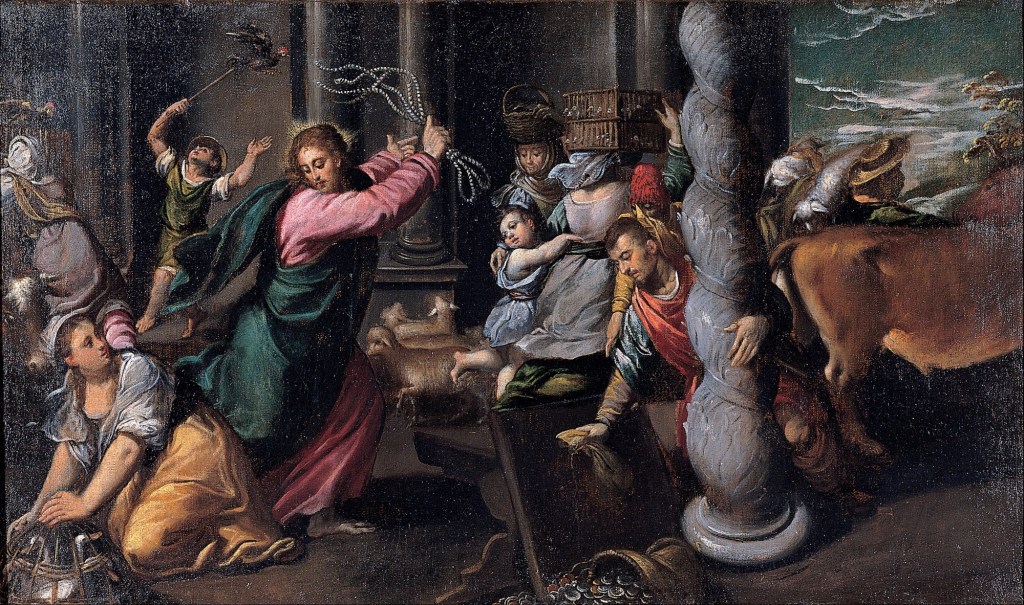
Our Gospel today depicts Jesus in a cleaning frenzy.  Unlike me, He was totally energized to clean up His Father’s House.  Let’s not forget that since He too is God, it was His House as well.  And He was incensed that the religious authorities had allowed what He saw going on there.

In our Gospel lesson (John 2:13-22), Jesus goes head to head with the Temple leadership to effect a physical and a spiritual house cleaning.  The religious establishment had authorized both the buying and selling of sacrificial animals, and a coin exchange–for a fee—on the Temple Grounds.  Some worshippers came from long distances without animals of their own.  So those “pilgrims” without animals had to purchase one or two to make their sacrifice.  Additionally, they had to pay a ½ shekel Temple Tax.  The fact that no Roman coins could be used–because they had Caesar’s face on them (a graven image which Jewish law prohibited), as well as the inscription, “Caesar is Lord” (which constituted blasphemy to the Jews), meant that they also had to exchange their money, for a fee.

Jesus was incensed with all of this for a number of reasons:

1.) Those selling the animals unfairly marked them up. They knew people didn’t have a choice, and they gouged them for the convenience. 

2.) They also charged an outrageous fee for the coin exchange.

3.) The animals were smelly and noisy and distracting in what was a house of prayer and a place of worship.

4.) But perhaps worst of all, the marketplace took over the only area in the Temple where Gentiles could gather.  Essentially, they were prevented from worshipping in the only space allotted to them.

So Jesus cleared the area in no uncertain fashion.  He formed a whip and used it to drive away the animals.  He also overturned tables, no doubt scattering money everywhere.  He shouted (v.16) How dare you turn my Father’s House into a market!  Of course, then “The Jews” (John-speak for the religious establishment) want to know what gives Jesus the right to clear the Temple and upset their very profitable businesses.  They said, Give us a miraculous sign—prove You have sufficient authority to do this.  Jesus responds rather cryptically, telling them (v.19), Destroy this temple and I will raise it again in three days.  They think He is speaking of the Temple building and scoff at Him.  We know He was speaking of His body (predicting His resurrection)—a pretty authenticating sign!  But they were so haughty—so sure their understanding surpassed His—that they did not believe Him.  Don’t you imagine that when He left, they went right back to doing business as usual?  

They must have forgotten verse 6 of Psalm 138—God is close to the humble, but distances Himself from the proud.  It’s dangerous to think we always have all the right answers.  Pride caused most of the Pharisees, Scribes, and Sadducees to miss who Jesus was.  They’d made an idol of their understanding of the Scriptures. Because Jesus didn’t fit their preconceptions, they missed out on the opportunity to develop a relationship with the Son of God.  Let’s not make the same mistake. Let’s make sure we clean our spiritual houses of the sin of pride.

Let’s take a look too at our Old Testament lesson from Genesis 20:1-17.  Just last week, we were praising Abraham, the Father of our Faith, for his trust in the Lord.  Abe is such a great example of trusting in the Lord’s provision of the Promised Land; trusting in God’s promise of descendants without number; and benefiting from God’s blessings of health and wealth. Where he seemed to have wavered in his faith, however, was in being certain that God would protect his life.  Apparently, his wife Sarah was very beautiful.  I’ve heard another pastor humorously refer to her as a “Biblical babe.”  Unfortunately, whenever Abraham encountered a foreign ruler, they appeared to covet her.  Back in Genesis 12, when Abraham moved to Egypt due to a famine, the Egyptian pharaoh heard of Sarah’s beauty and took her from him. Abraham in a sense brought this on himself because he lied, telling Pharaoh she was his sister (she was his half-sister), instead of his wife. He was afraid Pharaoh would kill him in order to clear the way to marry her.  In this situation, he didn’t depend on the Lord!

Fortunately for both of them, God protected them anyway. He afflicted the Egyptians with “serious diseases” until Pharaoh gave Sarah back to Abraham and told them both to leave.  So, this had happened before. You would think that Abraham would now trust God to protect him from rulers tempted by Sarah’s beauty.  But no, in today’s lesson, the two encounter Abimelech, a Canaanite king. Like with Pharaoh previously, Abraham again lied and said Sarah was his sister, not his wife. The same thing happened as Abimelech coveted Sarah and took her, intending to add her to his harem. 

Once again, God intervened—not with disease—but with a dream containing a death threat. Abimelech believed God’s message from the dream and immediately returned Sarah to Abraham. But the pagan king was also outraged and demanded to know why Abraham lied to him and put him and his people at risk.  Abraham, the great model to us of faith, had not trusted the Lord to keep him and Sarah safe from another lusty king. Abraham, who God judged as righteous due to his faith, has now lied twice.

What do you make of this?  I think we can safely say that Abraham was a good man but not a perfect man. There was and is only one perfect man–that’s our Lord, Jesus.  Like us all, Abraham’s great faith wavered from time to time.  Don’t we all have times when our faith is stronger or weaker  than usual.  We too may have areas in our lives where we find it very hard to trust God.  Nevertheless, since he was God’s choice as the patriarch of the Jews—since God meant to accomplish great things through him—the Lord guaranteed his safety.  Similarly, I think God has grace for us in those areas we have not yet surrendered to Him.

Remember, we are in the season of Lent.  These two readings today focus on two aspects of human behavior that God wants us to clean out of our spiritual houses:  (1) Pride (and even the misuse of His house of worship), and lying.  Lent is a time for evaluating our behavior, recognizing our sins, and asking God’s forgiveness.  Maybe you are not overly proud and you don’t lie.  But each of us is probably guilty of some other sins we could name.  Soon, in our preparation to receive Holy Communion, we will say a general prayer of confession.  Let’s take a moment now to call to mind our sins and confess them to Jesus, in our hearts, right now.  Let us also be comforted by what the Apostle John promised in 1 John 1:8-9—If we claim to be without sin, we deceive ourselves and the truth is not in us.  If we confess our sins, He is faithful and just and will forgive us our sins and purify us from all unrighteousness.  Amen and amen!

©️2024 Rev. Dr. Sherry Adams

Wise Up!

Pastor Sherry’s message for November 12, 2023

Scriptures: Amos 5:18-24; Ps 78:1-7; 1 Thess 4:13-18; Matt 25:1-13

Someone on the Internet has come up with a list of 263 ways to say a person is not too bright. We probably all know, “The light’s on but no one’s home,” or “dumb as a box of rocks,” but have you heard the following:

1. A few screws short of a hardware store.

2. A few fries short of a Happy Meal.

3. The gates are down and the lights are flashing, but the train isn’t coming.

4. The elevator goes all the way to the top floor, but the doors don’t open.

5. Would lose a debate with a doorknob.

6. If this person had another brain, it would be lonely.

7. If you gave them a penny for their thoughts, you’d get change.

8. Has a mind like a steel trap: rusty and illegal in 37 states.

9. If their nose was on upside down they’d drown in the rain.

10. Their dog teaches them new tricks.

(Borrowed from https://dan.hersam.com/lists/not_bright.html)

My adult son offered a new one as we watched our favorite football team compete yesterday. They were playing at their opponents’ stadium and we noticed a big “3” painted on their field. The TV announcers never explained what the number three meant. My son suggested it stood for the number of their football players whose IQ was greater than that of Forrest Gump’s.

Both the list and my son’s comment may all be pretty funny, but none is kind. I don’t advise applying them to someone—remember, Jesus said not to call anyone “an idiot” (Matthew 5:22). However, in today’s Gospel, He does encourage us all to be wise instead of foolish.

I’ve titled today’s sermon, “Wise Up!” because our scripture readings point to the difference between wise and foolish behavior; i.e., we don’t want to be “eating soup with a fork.”

A. In Amos 5:18-24, our Old Testament reading, the prophet Amos is certainly telling the folks in the Northern Kingdom of Israel to wise up! We might say they go through the motions of attending church—they act like they love God—but their behaviors the rest of the week reveal their hypocrisy. Even worse, they actually worship idols, false gods. They have turned their backs on our One True Lord. They have broken the 10 Commandments; they are behaving immorally; they have corrupted justice; they have trampled on the poor; they have oppressed the righteous; they have taken bribes. Doesn’t this sound a lot like our culture today?

And the Lord has about had it with them. God cannot be fooled. We might try to hide things from Him, but He knows everything! He knows they have betrayed and abandoned their faith in Him (and for our nation, our faith in Christ Jesus). God, through Amos, gives them one last chance to repent, to change their ways. He warns them that terrible punishment is coming to them. Amos calls it the Day of the Lord and it will indeed be horrifying for those who have rejected God. He uses two arresting metaphors: (1) They might run to escape a lion or cougar, but will then encounter a bear. (2) They might think they have reached the safety of their home, only to be bitten there by a poisonous snake. In other words, there will be no escape for evil-doers, no matter how fast or how far they run.

In God’s mercy, they could have averted this terrible punishment if they had (v.24)—> …let justice roll on like a river, righteousness like a never-failing stream! But, they were unwilling to change, so their end came shortly after Amos’ prophesies. In 722BC, God used the dreaded, blood-thirsty, Hamas-like Assyrians to overrun them, defeat them, and carry any survivors off to Ninevah (Iraq) as slaves. They were stubborn. They didn’t wise up. God, after dozens and dozens of warnings, finally let them have it.

This is why we pray for our nation weekly. America is now a post-Christian nation. We were founded as a Christian society and meant to be an example for the world. Now, we too have rejected and rebelled against God. We too have had dozens of chances. We hope that the Lord will help our nation return to Him, rather than bring on an Assyrian-like punishment.

B. In 1 Thessalonians 5:1-11, Paul is warning Christians there (and us now) to be prepared for the end of time. He states in v.2 that—> …you know very well that the day of the Lord [same expression used by Amos] will come like a thief in the night. “The day of the Lord” is a synonym for God’s judgment. It will come when folks least expect it. Nevertheless, true believers need not be afraid of it. Paul equates nonbelievers with those living in nighttime darkness. But we who believe in Jesus Christ are all…sons [and daughters] of the day. We do not belong to the night or to the darkness. So then, let us not be like others, who are asleep but let us be alert and self-controlled (vv.5-6). We who love Jesus have nothing to fear because we will have been raptured up to heaven before the Great Tribulation takes place. God’s judgment will fall on nonbelievers and evil-doers. Meanwhile, the dead who waited on Christ, or who believed in Christ, will rise first. Then those of us believers who are still living will be lifted up/beamed up (raptured) to meet Christ in the air.

Now I used to wonder if the rapture came before, during, or after the Great Tribulation. However, Paul makes it clear in verse 9—> For God did not appoint us to suffer wrath but to receive salvation through our Lord Jesus Christ. This is pretty clear, isn’t it? The Church of true believers will not suffer on the day of the Lord. We will be removed from the earth before the time of terrible trial begins.

While we wait on this time of judgment or the rapture, however, Paul urges us to…(v.8)—> be self-controlled, putting on faith and love as a breastplate, and the hope of salvation as a helmet. He wants us to demonstrate faith, love, and hope to others and especially as a witness to unbelievers. He also wants us to encourage and build one another up (v.11).

C. Finally, we have Jesus’ parable of the 10 virgins in Matthew 25:1-13. The bride (who is not mentioned) is the Church; the bridegroom is Jesus. But who are the 10 wise and foolish bridesmaids?

Interestingly, all ten fall asleep while waiting on the bridegroom whose arrival is delayed. The story then asks us to consider which we would rather be, prepared or unprepared, for when Jesus returns. The prepared ones go in with and enjoy the wedding supper of Jesus, the Messiah. Those unprepared ones, however, miss out. We might say they…”Couldn’t hit the floor if they fell on it,” or that “Wisdom is chasing them but they’re always faster.” They are Christ-followers who are not ready to meet Jesus. In fact, Jesus says to these unprepared ones (at His 2nd Coming), I tell you the truth, I don’t know you. How are they unprepared? They have never cultivated a personal relationship with Jesus.

His final advice to us all is to Be Wise! Be ready! When we Floridians know a hurricane is coming we stock up, don’t we? We make sure we have stock-piled clean water in jugs. We have candles and matches, as well as a battery operated radio, in case we lose electricity. We gather food we can eat without cooking, etc. What would we need to have on hand if we are to be wise about Jesus’ return?

(1) We should intensify our relationship with the Lord;

(2) We might read and meditate more on Scripture;

(3) We could ask for forgiveness of our sins, keeping short accounts with the Lord. Back when I provided mental health in nursing homes (prior to going to seminary in the mid-1990’s), I noticed folks in the final stage of Alzheimers, comatose and vegetative, being fed with a tube in their stomach and hydrated through an IV. Sometimes their relatives asked me why the Lord was keeping their loved one alive in this helpless state. I told them I didn’t really know but I advised them to pray for this person—to pray specifically that God would forgive them for any unconfessed sin.

One family told me they were sure their dear mother had no unconfessed sins. I then told them I was sure their mother was a lovely person, but I wondered how any of us could ever be sure she didn’t have some hidden, long ago sin. I recalled that both of my dying, comatose parents each slipped away about a half hour after I prayed that Jesus would forgive them their sins. This family later reported to me that their mother died during the night after they had prayed this way for her.

(4) Obviously, it is wise to be prayed up, in frequent communication with the Lord. You might ask, “How do I know I am hearing from the Lord?” I recommend you ask the Holy Spirit to guard your prayers from any interference from Satan or his minions, and then pay attention to the thoughts that drop immediately into your head. If they do not contradict the Bible, you can be assured you are hearing from the Lord. Often I find the Lord does not speak to me as I am used to hearing others speak. He uses vocabulary or expressions that differ a bit from what I am used to hearing or saying. This helps me recognize His “voice.”

I believe our lessons today are telling us to pray for our nation to wise up! According to news sources, 76% of Americans today believe our country is clearly moving in the wrong/the unwise direction.

I believe we should also pray that each of us will have the faith to trust that God will protect us as things worsen toward the end. We cannot trust in our own goodness or our intelligence to save us. Those who do will be left behind to suffer God’s wrath. We must, instead, live out a life that tells others we believe in Jesus Christ as our Lord and Savior.

Finally, I believe we must pray that we will each be prepared– like the 5 wise bridesmaids–at any moment to meet the Lord. None of us knows how long he or she has to live. And none of us knows when the day of the Lord will occur. Let’s all wise up and be ready!

©️2023 Rev. Dr. Sherry Adams

Copper Nails on my Conscience

Pastor Sherry’s message for February 26, 2023

Scriptures: Gen 2:15-17, 3:1-7; Ps 32; Ro 5:12-19; Matt 4:1-11

Dr. H.A. Ironside (1876-1951) was a famous preacher and Bible teacher in America. One day, he was preaching on verse 3 from Psalm 32 (Peterson’s paraphrase, The Message, p.948) When I kept it [my unconfessed sin] all inside, my bones turned to powder, my words became a daylong groan, when he said, “There is nothing that so takes the joy out of life like unconfessed sin on the conscience.” He went on to repeat the following story, borrowed from a pastor friend, who had been preaching on the subject of unconfessed sin and the importance of both confession and of providing restitution to anyone we may have injured through that sin:

At the close [of a service] a young man, a member of the church, came up to him with a troubled countenance. “Pastor,” he explained, “you have put me in a sad fix. I have wronged another and I am ashamed to confess it or to try to put it right. You see, I am a boat builder and the man I work for is an infidel. I have talked to him often about his need of Christ and urged him to come and hear you preach, but he scoffs and ridicules it all. Now, I have been guilty of something that, if I should acknowledge it to him, will ruin my testimony forever.”

He then went on to say that sometime ago he started to build a boat for himself in his own yard. In this work copper nails are used because they do not rust in the water. These nails are quite expensive and the young man had been carrying home quantities of them to use on the job. He knew it was stealing, but he tried to salve his conscience be telling himself that the master had so many he would never miss them and besides he was not being paid all that he thought he deserved. But this sermon had brought him to face the fact that he was just a common thief, for whose dishonest actions there was no excuse.

“But,” said he, “I cannot go to my boss and tell him what I have done or offer to pay for those I have used and return the rest. If I do he will think I am just a hypocrite. And yet those copper nails are digging into my conscience and I know I shall never have peace until I put this matter right.” For weeks the struggle went on. Then one night he came…and exclaimed, “Pastor, I’ve settled for the copper nails and my conscience is relieved at last.”

“What happened when you confessed to your employer what you had done?” asked the pastor.

“Oh,” he answered, “he looked queerly at me, then exclaimed, ‘George, I always did think you were just a hypocrite, but now I begin to feel there’s something in this Christianity after all. Any religion that would make a dishonest workman come back and confess that he had been stealing copper nails and offer to settle for them, must be worth having.'”

[The pastor] asked if he might use the story, and was granted permission.

Sometime afterwards, he told it in another city. The next day a lady came up and said, “[Pastor], I have had ‘copper nails’ on my conscience too.” “Why, surely, you are not a boat builder!” “No, but I am a book-lover and I have stolen a number of books from a friend of mine who gets far more than I could ever afford. I decided last night I must get rid of the ‘copper nails,’ so I took them all back to her today and confessed my sin. I can’t tell you how relieved I am. She forgave me, and God has forgiven me. I am so thankful the ‘copper nails’ are not digging into my conscience anymore.”

I have told this story many times and almost invariably people have come to me afterwards telling of “copper nails” in one form or another that they had to get rid of. On one occasion, I told it at a High School chapel service. The next day the principal saw me and said, “As a result of that ‘copper nails’ story, ever so many stolen fountain pens and other things have been returned to their rightful owners.”

Dr. Ironside concluded, “Reformation and restitution do not save. But where one is truly repentant and has come to God in sincere confession, he will want to the best of his ability to put things right with others.” (H.A. Ironside, Illustrations of Bible Truth, 1945, Moody Press, pp. 104-106.)

Now this story dates from 1945. We know our culture has changed radically since then. Most Americans then were church-attending Christians; and most had developed strong consciences. You see, following Jesus gives us a standard of morality against which to measure our behavior. Without this standard, we have the sort of mess we see in our culture today. For instance, we have to wonder if children are being taught right from wrong anymore. Or are they being taught, “Don’t do that because it irritates me,” or “Do this because it pleases me.” Such an approach simply teaches our children to be manipulative people-pleasers. Nevertheless, we have to hope that most older Americans’ consciences would bother them if they wronged another; and we should pray for those both young and older whose consciences are underdeveloped.

Regardless, this is what Christ wants from us when we wrong others:

1. Confess the wrong;

2. Then, make it right.

This is the focus of our Scripture passages today:

A. In Genesis 2:15-17, 3:1-7, God makes Adam’s wonderful life situation in the garden dependent upon one, and only one condition: (v.17) But you must not eat from the tree of the knowledge of good and evil, for when you eat of it you will surely die. The fruit of one tree alone —among many, wonderful other trees–was forbidden. Notice the Lord told them ahead of time what would happen if they disobeyed His command. Obviously, Adam and Eve did not physically die when they sinned, but because they had rebelled, sin and death entered the world. They were severely negatively impacted—physically (they aged, then eventually died), emotionally, and especially spiritually. Their sin separated them from intimacy with God. Because we were all under the headship of Adam, the natural head (patriarch) of the human race, we also suffered the consequences of his actions as they trickled down to us.

B. Paul, in Romans 5:12-19, explains this principle further.

Adam, from whom we are all descended, sinned; because he sinned, we his descendants, are tainted with the same sin. Roman Catholics call this original sin. What was his and Eve’s original sin? It was rebellion, motivated by pride. We didn’t commit their specific sin, but isn’t it true that we too are rebellious and hounded by pride? When we decide to disobey God, aren’t we saying in so many words, “Lord, I choose my will over Yours—even though You are wiser than me, as well as all-knowing and able to see into the future.” Paul makes the case in verses 13-14 that (original) sin had entered the world even before the Law was given to us by God via Moses. Even so, the Law was not able to keep us from sinning!

Fortunately for us, Jesus’ atoning death on the Cross more than corrected for our inherited sin nature. Thanks be to God! To provide an analogy, let’s say that just like a gene for height or for hair color is handed down through generations, we were all born—from Adam down to Christ—physically bent or twisted. Even receiving and abiding by the Law would not remove the warp in us human beings. But for those of us who believe in Jesus, His atoning death for our sakes essentially de- warped or un-warped us. Now can we still sin? Unfortunately, yes. But the difference for believers is that we are covered with or shielded by the right-ness of Christ.

Paul calls this a demonstration of God’s grace. Jesus not only satisfied the penalty for our sin, but he gave us in addition an unmerited, undeserved, but magnanimous gift! Listen to how Peterson paraphrases verses 15-19 in everyday American (The Message, NavPress, 2002, p.2040) Yet the rescuing gift is not exactly parallel to the death-dealing sin. If one man’s sin [Adam’s] put crowds of people at the dead-end abyss of separation from God, just think what God’s gift poured through one man, Jesus Christ, will do! There is no comparison between that death-dealing sin and this generous, life-giving gift. The verdict on that one sin was the death sentence; the verdict on the many sins that followed was this wonderful life sentence. If death got the upper hand through one man’s wrongdoing, can you imagine the breathtaking recovery life makes, sovereign life, in those who grasp with both hands this wildly extravagant gift, this grand setting-everything-right, that the one man Jesus Christ provides?

Here it is in a nutshell: Just as one person did it wrong and got us in all this trouble with sin and death, another person [Jesus, the 2nd Adam] did it right and got us out of it. But more than just getting us out of trouble, He got us into life! One man said no to God and put many people in the wrong; one man said yes to God and put many in the right.

In other words, from God’s perspective, “…putting humankind to rights is far more important that making up for Adam.” (J. Vernon McGee, Thomas-Nelson, 1991, Romans, p. 92). Thanks be to God, we are no longer under the headship of Adam. Jesus Christ is the head of a new race, the Redeemed. This is our true identity and it supercedes our racial, ethnic, and even gender identities! Those of us who love Jesus are no longer under death sentence of original sin. Jesus Christ has set us free!

Additionally, Jesus (Matthew 4:1-11) provides us with the best example of how to proceed when we are tested or tempted to sin. Matthew reports (v.1) that…Jesus was led by the Spirit into the desert to be tempted by the devil. This occurred right after He had been baptized and the Father had claimed Him as His Son and blessed Him, audibly, from heaven. Matthew then goes on to relate Jesus’ major temptations:

1.) To feed His own hungers—forty days without food had to have been rough!

2.) To win popularity and great power, cheaply and quickly;

3.) And to become famous.

However, to accommodate Satan, He would have had to betray the One True God. Thanks be to God that He did not betray His Father! Besides wrestling with hunger, thirst, and loneliness in the wilderness, Jesus had lots of time to think and pray. During those 40 days, He came to a true understanding of Who He was/is. He came to grips with His true identity as the Son of God.

Now the Devil watches us all carefully, so he knows which buttons to push to try to pull us away from God. Satan’s temptations were all intended to seduce Jesus into being selfish and self-gratifying. But our Lord knew after 40 days of self-denial that He was meant to be selfless and self-sacrificing. He was meant to save lost sinners (The Revs. John Fairless and Delmer Chilton, “The Lectionary Lab, year A, 2013, p. 75). Thanks be to God!

Let’s return to the image of copper nails on our conscience. King David wrote Psalm 32, while he was suffering the impact of his sins with Bathsheba and against Uriah, her husband—coveting his neighbor’s wife, adultery with her, and setting Uriah in the front lines of the next battle so he would be killed. King David killed to save his skin and his reputation. However, his conscience was so seared by his memory of the copper nails that he felt compelled to confess his sins to Almighty God (here and in Psalm 51). Then he reports, with great relief and gratitude, that he receives God’s forgiveness, and feels blessed because of his restoration.

Jesus has given us the key to resisting our temptations:

1. Understand our true identity as the Redeemed, and the magnitude of God’s love and grace;

2. Then ask the Holy Spirit to help us use Scripture to resist the Devil.

We don’t want to be like the 4 pastors who agreed to confess their sins to each other (What an awful idea!): One said, “I cheat on my taxes.” The 2nd confessed he snuck food and drinks into the movie theater. The 3rd said he borrowed all of his sermons from the internet. The 4th was unwilling to say what he did wrong. The others pressed him, saying, “Come on, we confessed ours. It’s your turn.” It took some pressure, but he finally admitted, “Mine’s gossiping and I can hardly wait to get out of here.” Unlike this guy, remember cooper nails. Confess the wrong; make it right.

Paul has stressed for us the enormity of Jesus’ saving actions in each of our lives. Our best response is to praise Him with gratitude. Thanks be to God Who gives us the victory through our Lord Jesus Christ!

©️2023 Rev. Dr. Sherry Adams

Where is Your Heart?

Pastor Sherry’s message for Ash Wednesday February 22, 2023

Scriptures: Joel 2:1-2, 12-17; Ps 51:1-17; 2 Cor 5:20b-6:10; Matt 6:1-6, 16-21

John Wesley began his small group meetings with the question, “How is it with your soul?” As the founder of our Methodist denomination, we know Wesley as a passionate evangelist. Even though ordained an Anglican, he had experienced the Church of England—in the 18th century–as spiritually dead. So he left church buildings and preached in fields, in town squares, or wherever he could find a responsive audience.

But he wasn’t just content to bring people to a saving knowledge of Jesus; he wanted them to be discipled in the faith. So he began to set up small groups, which he called “Bands.” These were like Cursillo or Emmaus Walk “Reunion Groups.” They met once a week to challenge themselves to move deeper into their faith. Cursillo and Emmaus groups ask, “When this week did you feel closest to Christ?” Sometimes the question is, “Where are you in your walk with Jesus?” Or, as Jesus asks in today’s Gospel (v.21), Where is your heart?

Today, the church season of Lent begins. For the 40 days leading up to Easter (not including Sundays), the Church—Roman Catholics, Anglicans, Episcopalians, Lutherans, and Presbyterians—commemorates Jesus’ 40 days in the wilderness. Remember, following His baptism, the Holy Spirit drove Him out into the wilderness to fast, to pray, and to be tested. We too are encouraged to fast, pray, and to develop the strength to resist temptations, as Jesus did. The intention of this is to help us to take inventory of where we are spiritually, and to make course corrections. You could say the 40 days of Lent invite us to ask daily, “How is it with my soul?” or “Where is my heart?”

Our Scriptures today all speak to this issue:

A. In our Gospel lesson (Matthew 6:1-6, 16-21), Jesus directs our attention to our motivation as we give (service or money), fast, or pray. Our understanding of our heart is that it is a very important physical organ that may or may not work well. We also see it as a metaphor for our tender feelings. We say, “She has a good heart,” meaning she is generous or compassionate. Or we say, “He has a tender heart,” when he is known for rescuing stray animals or showing kindness to children. We just celebrated Valentine’s Day, a day to focus on romantic hearts.

But the Hebrew understanding of heart was very different: To them, it is not just an important physical organ. The people of Jesus’ day considered the word heart as a metaphor for the whole self. They believed you decided with your heart rather than your brain. They saw the heart as the core of our identity (not race, gender, or nationality). Our heart, according to them, is what drives or motivates us. So, when Jesus says (v.21) For where your treasure is, there your heart will be also, He means we can each rightly discern our priorities by noting where we spend our time, attention, and money. Our priorities can be on acquiring physical things, like a fancy car, a fine home, an expensive item of clothing or of jewelry. Our priorities may be our spouses or our kids, our “grands,” or our pets. Our priorities may also be such values as success, security, happiness, or romantic love. None of these is bad in and of themselves; they become problematic when these treasures/priorities come between us and our relationship with Jesus.

So to spiritually wean ourselves away from whatever interferes with a heart-felt relationship with our Lord, we may choose, for 40 days…

a. to give up social media; TV; chocolate; eating out; etc. I recently read of a woman who decided to pare down the number of knickknacks and decorating items she had by donating a bagful a day to recycling shops. I think the Lord would approve of her desire to simplify her life’s distractions and clear away her clutter; but He probably would not be impressed if this were just another self-improvement project disguised as a Lenten discipline. He would want her to do whatever she does in order to draw her heart closer to Him.

b. Or, we may decide to take on a new spiritual discipline: I am taking (instead of leading) a Bible study on Zoom with some friends from Tallahassee beginning Monday night. You could take a walk daily with the purpose of having quiet time to talk with the Lord. You could read some Christian books—fiction or nonfiction–to increase your faith, etc.

The traditional disciplines, or methods of self-restraint, are what Jesus cites in verses 1-6 and 16-21: (a) Almsgiving or giving of your time, talents or cash to others; (b) Fasting; and (c) increased prayer. The point is to draw our hearts closer to Christ, not to impress others.

B. Briefly, the authors of our other lessons today encourage us to draw our hearts closer to Christ in the following ways:

1. Joel says (2:12-13) we draw closer to the Lord when we …return to [the Lord] with all your heart, with fasting and weeping and mourning. Rend your heart and not your garments. Return to the Lord your God, for He is gracious and compassionate, slow to anger and abounding in love, and He relents from sending calamity. This return to the Lord involves demonstrating repentance.

We acknowledge our sins and turn away from them.

2. King David implies, by his example in Psalm 51, that we can return to a close relationship with God when we honestly acknowledge our sins. As we recite tonight verses1-17, we can clearly perceive his sincere grief and regret over what he has done. His sins were grave: coveting his neighbor’s wife, adultery with her, and murder of her husband. We know from Psalm 32:3-4 that he suffered emotional pain and agony as long as he covered up those sins. He openly begs for God’s forgiveness, asking for mercy. He also recognizes that it is only God Himself who can cleanse him (v.10) Create in me a pure heart, O God, and renew a steadfast spirit within me. He also affirms his faith that God will forgive him because he has asked (v.15) O Lord, open my lips, and my mouth will declare Your praise, and (v.17) The sacrifices of God are a broken spirit; a broken spirit and contrite heart, O God, you will not despise.

3. Paul, with his typical zeal, exhorts us to (2 Corinthians 5:20b) Be reconciled to God. In chapter 6, verses 3-10, he reminds the Corinthian Church (and us) that we are to faithfully turn our hearts to Jesus no matter how dire or how happy our circumstances. We are to stay close to Christ because (5:21) God made Him who had no sin to be sin for us, so that in Him we might become the righteousness of God.

So, this Lent—beginning tonight—let’s ask ourselves, daily, “How is it with my soul?” or “Where is my heart?” Let‘s each take an honest inventory of our spiritual health. And then let’s engage in the attitudes and behaviors that will bring us right up, tucked up to Jesus.

And all God’s people say, “Amen!”

©️2023 Rev. Dr. Sherry Adams

Our Starting Point, Our Standing Place

Pastor Sherry’s message for February 5, 2023,

Scriptures: Isa 58:1-12; Ps 112:1-10; 1 Cor 2:1-16; Matt 5:13-20

Over my years here, you have probably realized that I don’t usually preach from the writings of Paul. I find him often difficult to understand and more often addressing theological points rather than everyday life. But this week, the Lord told me it was time for me to “Grow up!” So, today I will focus on the second chapter of Paul’s first letter to the Corinthian church. In chapter #2, he focuses on our correct starting point with Jesus and our secure standing point.

But first, let’s look at some humorous examples of various starting points:

(1) Great grandma’s recipe for chicken and dumplings: First, catch a chicken (Aren’t we glad we don’t have to do this today?). I remember this as a little child. My grandparents had a few chickens. Saturday afternoon they would kill one; my grandmother would pluck the feathers and clean it out, and then cook it for Sunday dinner.

(2) In the 1920’s, the University of Michigan had a famous football coach named Fielding Harris Yost. One season, Michigan had been badly beaten by Notre Dame, one of their major archrivals. The atmosphere on the train trip back to Ann Arbor was silent and dismal, as players waited to be thoroughly chewed out. Eventually, Yost stood up in the aisle to address the team. In a calm manner, and with a solemn demeanor, Yost held up a football and explained, “Gentlemen, this is a football.”

(3) You may have noticed that I struggle with my weight. Both of my grandmothers were plump (I always thought they were “fluffy” and provided such comfortable laps for a child), so I think I may have been genetically primed to carry extra pounds. At any rate, I have tried almost every diet plan known to humankind: Weight Watchers; The Daniel Diet (based on what Daniel, Shadrach, Meshach, and Abednego ate in Nebuchadnezzar’s court); Jenny Craig; The Maker’s Diet (consisting of vegetables like leeks and grains like spelt found in Old Testament times); Keto; and GoLo (or as my son calls it, “NoGo.”). Even when I struggle to take the excess pounds off, I cannot seem to preserve or maintain a reduced weight. I can start, but I can’t seem to successfully stand. Here’s the truth: I know the secret of weight loss, but I just enjoy eating too much of the wrong things. The most effective weight loss strategy—the starting point and the standing place of weight loss–boils down to this truth: Eat Less, Move More.

(Ideas borrowed from the Revs. John Fairless and Delmer Cilton, The Lectionary Lab Commentary, Year A, 2013, p.51.)

Again, I believe this is where the apostle Paul is coming from as he addresses the Church in Corinth (Greece) (1 Corinthians 2:1-16). Here’s the historic situation: Paul had established this church, in about 18 months, from 49-50 AD. The city was a sea port of Greece, numbering about 400,000, and populated by sailors, soldiers, and tradespeople of many races, nationalities, and belief systems. Additionally, it offered more than 1,000 male and female prostitutes to copulate with “worshipers” of the goddess Aphrodite and the god Apollo, in fertility rites.

Needless to say, the prevailing lifestyles were carnal ones—a lot like present day Las Vegas, which panders to about every addiction know to humankind–focused on meeting all sorts of human “needs.”

Since founding the church, a number of problems had arisen, so Paul wrote this first letter to them, from Ephesus, to address the 5 most troubling dilemmas:

(1) Divisions—those who preferred Apollos, or Peter, or Paul. He made short work of this issue in chapter 1. Christianity is not a cult of personality. We are all followers of Jesus Christ. We are to keep our focus on Jesus…End of story (Starting point, standing place).

(2) A case of a man sleeping with his stepmother—YIKES! This sin was a “notorious” one because everyone in Corinth knew about it. It was a disturbing example to nonbelievers. In a later chapter Paul gives the church a choice: the man can stop having sex with his stepmother and repent, or he can be expelled from the church.

(3) Law suits between members. Paul says, “God forbid!” This is not behavior grounded in Christian love. It is also a poor witness to nonbelievers. Paul wants the Corinthians to forgive as they have been forgiven.

(4) Abuses of Christian freedom (using grace as an excuse to continue to live as though we don’t know Jesus). Again, in a later chapter, Paul says in essence, “No, we really don’t have the freedom to do wrong.”

We are to remember that our bodies are temples of the Holy Spirit. When we fornicate or commit adultery, we bring Jesus into that illicit relationship. Again, YIKES!

(5) And, finally, he addressed the general chaos he had heard reigned during communion. People were hogging the bread and getting drunk on communion wine. Paul calls this a violation of the law of love and charity with our neighbor. It was selfish, indulgent behavior. We are to receive communion decently and in order, not taking more than our fair share.

He begins, in chapter two, to instruct (and correct) them by returning to the starting point, the basics: Remember, before you cook a chicken, you need to have one on hand. If you want to win at football, you need to know how to handle the ball (knowing the rules and having some strategic moves doesn’t hurt either). In other words, this is an “eat less, move more” moment for the Church at Corinth. The basic starting point (and standing place) for the Christian Church is (v.2) …Jesus Christ and Him crucified [and resurrected].

Paul then goes on to tell them (vv.3-4) he is not a great orator or a gifted debater, both of which were skills highly prized by Greeks I came to you in weakness with great fear and trembling. My message and my preaching were not with wise and persuasive words, but with a demonstration of the Spirit’s power, so that your faith might not rest on human wisdom, but on God’s power. He spoke as an ordinary person, not caring to draw attention to himself as a great preacher. He claims he had no eloquent words, no clever arguments; just “the Word of God for the People of God.” He says he preached in the power of the Holy Spirit, so all the glory would go not to him but to the Lord.

Next, he reminds them (vv.6-8) that salvation was purchased for us by the Son, but it was planned by the Father. Paradoxically, the Gospel is both simple and exceedingly complex–simple enough for an illiterate or uneducated person to grasp; but also so profound that it challenges the most brilliant minds. He stresses that the “lost”—and even immature believers—won’t get it. Jesus Christ crucified for our sins may seem ridiculous (foolishness) to nonbelievers. Nonbelievers of that day said, He was a nobody from nowhere of importance! And, He was executed as a criminal! Even Satan thought he had defeated Jesus at the Cross. Jesus’ death on the Cross is a mystery, a sacred secret, an unveiling of God’s plan from Old Testament times. These truths were hidden in the Old Testament (hinted at by the prophets, but not explained). They were also hidden from the unsaved world, people like Pilate and Herod, and others who encountered Jesus and never suspected Who He really was: The Son of God; The Creator and Redeemer of the World.

But Paul then asserts that these truths were revealed to us, by the Holy Spirit, and through the life, teachings, death, and resurrection of Jesus Christ. And Paul and the other apostles all devoted their lives to sharing them with anyone who wanted to understand.

This wisdom is still valid and applicable to our lives today. In verses 9-10, Paul quotes from Isaiah 64:4 ’What no eye has seen, what no ear has heard, and what no human mind has conceived’—the things God has prepared for those who love Him—these are the things God has revealed to us by His Spirit. The Holy Spirit has revealed to us God’s thoughts, God’s wisdom. After all, Deep speaks to deep (Psalm 42:7);

(V.13) —This is what we speak, not in words taught us by human wisdom but in words taught by the Spirit, explaining spiritual realities with Spirit-taught words. God’s thoughts have been preserved for us in God’s Word (the Bible).

Paul wants the Corinthians and us to know that our standing place is secure in Jesus Christ. We don’t have to placate a group of immoral immortals, as pagans do their gods (who often act like out-of-control humans). Our God has done the work of salvation for us. We simply have to say, “Yes, Lord, I believe.” Paul also wants us and them to realize that because we love Jesus, we have the mind of Christ. Through Christ, we are redeemed or ransomed. Through Christ, we are made right with God the Father (our sin is washed away by Jesus’ blood). Through Christ, we are sanctified, set apart for God’s service as works in progress. In Christ, we come to understand the wisdom of God.

So what’s the point for us today in modern-time America? We start right and stand firm/true when we accept and believe that Jesus Christ has saved us. This is not a faith based on human wisdom, but on the wisdom of God–even if nonbelievers consider it to be far-fetched.

As a result, those of us who are in Christ can say that, “Every Day is a good day.” It might not always look like it. It might not always feel like it. But think of this: We close our service each Sunday with a portion of the Kenyan (African, Anglican) liturgy…

All our problems…we send to the Cross of Christ.

All our difficulties…we send to the Cross of Christ.

All the devil’s works…we send to the Cross of Christ.

And all of our hopes…we set on the Risen Christ.

The purpose of this is to remind us, as we leave worship to go out into the world again, that we can give every trouble we encounter to Jesus. We can stand firm on the fact that He is able to take care of it all. We can also stand firm on the knowledge that Jesus Christ is our hope.

Our starting point and our standing place is this: Jesus Christ and Him crucified…and raised from the dead. Halleluiah! Amen!

©️2023 Rev. Dr. Sherry Adams

What Does God Want From Me?

Pastor Sherry’s message for January 29, 2023

Scriptures: Micah 6:1-8; Ps 15; 1 Cor 1:18-31; Matt 5:1-12

I heard an interesting, true story this week: A high school student I know—Jake–was called down to the office and told another kid—Sam–had accused him of bringing drugs to school to sell. Now Sam had been caught red-handed with illegal substances. When the school authorities asked where Sam got the drugs, he falsely named Jake. They brought Jake in, told him what he had been accused of, and searched him. Jake defended himself by saying he doesn’t do drugs and he certainly would neither bring them to school nor sell them. Because they had Sam’s story 1st, the authorities seemed reluctant to believe Jake. They frisked him and searched his locker and backpack but found nothing. Finally, they let Jake return to class yet would not tell him the name of the student who had falsely accused him.

The grown-ups must have forgotten that this is a small town. Word got out—as it generally always does–and Jake learned the identity of his accuser. Jake’s parents were furious at Sam—and wanted to address the matter with Sam’s parents straight away–but Jake asked them to let him handle the situation. Jake calmly confronted Sam, asking him why he had lied about him. Sam “stone-walled,” would not answer Jake, and would not give him eye-contact.

I was appalled when I heard this and I wondered if this is indicative of the value system of most teens today. Jake, a Christian, has taken a wise stance: he is now praying for his false-accuser…Praying that Sam would come to know Jesus; and Praying that Sam would regret lying and trying to get an innocent person into trouble. I commend him and would only add my hope that Sam comes to know the 10 Commandments—bearing false witness is #9.

Thinking about this incident over the last few days, I realized Jake’s response is right out of our Micah 6:1-8 lesson, as well as our psalm and Gospel:

The prophet Micah was a contemporary of Isaiah in Judea, and of Amos and Hosea in Samaria, during the 8th century BC. It was a time of great prosperity and wealth in Judah. It was also a time of extensive apostasy. Political corruption was rampant; the rich and powerful felt free to exploit those who were weaker; and many had fallen away from God.

When they did worship Him, their worship was pro-forma, mind-less and rote. Mostly, they just went through the motions. And their moral behavior was despicable. Actually, they were behaving a lot like modern Americans today.

So God appointed Micah as a “whistle-blower” to his time period. His job was to challenge the people on their arrogance, dishonesty, and hypocrisy. He was also tasked with warning them of the judgment to come if they did not turn back to the Lord.

Chapter 6:1-8 forms the climax of Micah’s prophesy: He portrays God as confronting Judah, as though they were adversaries in a court of law.

Listen to Peterson’s paraphrase (The Message) of verses 1-2–Take your stand in court. If you have a complaint, tell the mountains [powerful nations]; make your case to the hills [smaller. Less influential nations]. And now, Mountains, hear God’s case; listen, Jury Earth—For I am bringing charges against My people, I am building a case against Israel. God is telling the world to watch and listen.

But instead of going on the offensive, God asks what He is guilty of that His people have all but abandoned Him. He reminds them of their salvation history with Him:

(1) He has rescued them slavery in Egypt.

(2) He provided them with good leaders like Moses, Aaron and Miriam.

(3) When the king of Moab, Balak, hired the false prophet Balaam to curse them, God protected them by blocking any curses.

(4) He also provided for them when Joshua assumed leadership from Moses (at Shittim), and protected them at Gilgal as they recovered from circumcision. (They had not circumcised anyone on the wilderness march, so all the adult males now needed to take the sign of their covenant with God. Doing so required about 3 days recovery time when they would have been too vulnerable to resist an enemy attack). God had been faithful while they have been faithless.

Then the prophet anticipates the people’s response to God’s indictment: (verses 6-7) —Should we bring an armload of offerings topped off with yearling calves? Would God be impressed with thousands of rams, with buckets and barrels of olive oil? Would He be moved if I sacrificed my firstborn child, my precious baby, to cancel my sin? They are essentially asking, “What do we do to make amends to God?” “Is God mad because we didn’t do enough?” “Should we do more to try to please Him?” But God does not want extravagant offerings from us. As if we can do something for God! A much later generation will ask the same thing of Jesus, and He will answer (John 6:28-29) —This is the work of God [that you can do], that you believe in Him Whom He has sent [faith in Jesus]. All we can do, and the best we can do, is to have faith in our Lord Jesus Christ.

And in verse 8, Micah summarizes the issue: He has shown you, O mortal, what is good. And what does the Lord require of you? To act justly, to love mercy, and to walk humbly with your God. Listen to the way Peterson paraphrases it: But He’s already made it plain how to live, what to do, what GOD is looking for in men and women. It’s quite simple: Do what is fair and just to your neighbor, be compassionate and loyal in your love, and don’t take yourself too seriously—take God seriously.

They are dwelling in darkness, as are many in our country today. . Psalm 15: 2-3 says [Those who please God are] the one whose walk is blameless, who does what is righteous, who speaks the truth from their heart; whose tongue utters no slander, who does not wrong to a neighbor, and casts no slur on others. Sam’s behavior demonstrates he is dwelling in darkness. The folks back then—much like many “religious” folks today–are focusing on external religious practices, while neglecting their internal experience of God. They need to know and relate to God’s heart.

So what does Micah mean in verse 8? This side of the Cross, we know that we must believe in Jesus to be saved. What God wants from us is to demonstrate our faith by living a life that pleases Him:

(1) To act justly means to do what is right and truthful in God’s eyes. Sam lied to get the focus off himself—he threw Jake under the bus. If Sam had acted justly, he would have admitted his own fault and left Jake out of it. To act justly means exhibiting honest practices in business; not cheating on your taxes or your spouse; giving your employer a full day’s work for a full day’s pay (and employers should give their workers the pay they have earned; playing by the rules in sports and cards, etc; in other words, doing the right thing in God’s eyes.

(2) To love mercy means to offer others grace—i.e., treat them better than they deserve. Justice is a great starting point, but it’s not enough. Grace is Jake forgiving Sam for having tried to ruin his reputation and get him into trouble. God has saved us, through Jesus, when we did not deserve it. We offer grace to others because Jesus offered/offers it to us.

(3) To walk humbly with our God means to do God’s will instead of our own. Humility says “God made me and He knows what is best for me. I’m not as smart as He is, so I will submit to Him and follow His will.” Pride, on the other hand, says, “I’m in charge of me and I will do what I want to do.” It puts self ahead of God. In fact, it makes self a god instead of the One Who is God. Prideful people lack a “teachable spirit.” They are unwilling to admit they don’t always know what is best and are therefore unwilling to listen to someone who might be wiser or more experienced.

No wonder God says in Isaiah 66:2–But to this one I will look, to him who is humble and contrite of spirit, and who trembles at My Word.

No wonder Jesus lists humility of spirit as the 1st characteristic to be blessed in the Beatitudes of Matthew. As Peterson phrases it, You’re blessed when you’re at the end of your rope. With less of you there is more of God and His rule.

So what’s God want from me, from us? What defines a life that pleases God? First, we must have faith in His Son, Jesus. Next, we try to live a life that is characterized by the following: Acting honestly and rightly; offering grace to others, even when they don’t appear to deserve it; and being humble with regard to God, remembering to be grateful to Him for all of His blessings, and to be obedient to Him, even when it’s hard. I believe Jake pleased God when he confronted Sam face-to-face, rather than castigating him on social media. This righteous behavior took courage and humility. That young man certainly set an example for Sam, and for us.

May we all remember to act justly, offer grace/mercy to others, and walk humbly with our God! Amen!

©️2023 Rev. Dr. Sherry Adams

Leading Others to Christ

Pastor Sherry’s message for January 15, 2023

Scriptures: Isa 49:1-7; Ps 40:1-11; 1 Cor 1:1-9; Jn 1:29-42

Do you remember who led you to Christ? Perhaps it was a Sunday School Teacher when you were a child? Maybe a godly parent or relative, or even a Christian neighbor, a teacher, or a coach you admired? It might have even been someone you met in the pages of a book—like the Bible or the Chronicles of Narnia? Or someone from TV? A television evangelist someone recommended you watch? Or a series, like the very popular current series, “The Chosen”? If you haven’t tuned into it on a streaming service or YouTube, I would highly recommend that you do. I have long loved Jesus, but I am finding The Chosen’s portrayal of Gospel stories has deepened my faith in Him.

I credit my grandmothers with teaching me about Jesus. They were both church-going, Bible reading women with personal relationships with Jesus. My father’s mother saw to it that I was baptized at age three. Both taught me that Jesus loved me, and saw to it that I attended Sunday School when in their care. In the days before Christian cartoons, movies and internet, I remember those old flannel-board presentations of cut outs of Noah and the animals making their way into the ark, and of David going up against Goliath. My mother’s mother cleaned her church and took me with her as a child, teaching by example the idea of serving God with our hands and our hearts.

Think back to who introduced you to Jesus and be sure to thank them in person, or thank God for them if they have already gone on to Glory.

Our Gospel lesson today (John 1:29-42) describes how John the Baptist (JtB) pointed two of his followers to Jesus. JtB sees Jesus passing by and comments to them (v.36) Look, the Lamb of God! The first is Andrew, the brother of Simon Peter. We don’t know the identity of the second guy—though tradition tells us it was John, the author of this Gospel account. (He is always so modest, never naming himself in his Gospel account, but often calling himself “the disciple Jesus loved.”)

These two come alongside Jesus, Who then asks them, What do you want? He’s not being rude; He just wants to know what is motivating them to connect with Him. Perhaps they are nervous, or feel put on the spot, but they respond, (v.36) Rabbi, where are you staying? I think this is such a curious question. I would have asked about His knowledge and/or His credentials: “Are You indeed the Christ?” “May we ask You some questions?” “May we follow You to find out more?” Instead, it sounds as if they want to know about His accommodations—“Are you staying here Capernaum? “ “At the Holiday Inn or the Hilton Courtyard?” But Jesus isn’t put off and replies, (v. 39) Come and you will see an echo of Psalm 34:8 Taste and see that the Lord is good; blessed is the man who takes refuge in Him. He very simply invites them. He encourages them to Come and…see for themselves, and they do spend the rest of the day with Him.

At some point—maybe that day or the next—Andrew leads Peter to Jesus. Andrew rightly believes that he and John—thanks to JtB—have met the One believed to be Messiah. Andrew then urges his brother, Simon Peter, to come meet Jesus as well. Jesus greets Simon with “a word of knowledge.” Without having previously met Simon, Jesus says his name, and cites his lineage ”You are the son of John” [Simon bar Jonah]. Then He proceeds to change Simon’s name: Cephas is the Aramaic form of rock or stone; Peter is the Greek word for rock. Peter was at that point anything but a rock! Jesus is renaming him not to describe his current state, but to inform who he was to become.

So let’s consider this: JtB, Jesus’ cousin, identifies Christ to Andrew and John. They have JtB’s word for it that Jesus is the Lamb of the God (a title with Messianic implications). They spend time with Him and are convinced He is the Messiah. Andrew brings Peter to Christ (just as John brings his brother James, and his father, Zebedee.) We are each individually introduced to Jesus, very often one-by-one, almost like exposure to a virus (meaning no disrespect).

We can also “catch the fever” by reading Scripture. Some pretty famous Christian authors were nonbelievers prior to reading the Bible: The English professor and subsequent theologian, CS Lewis, was converted by reading Scripture, as were the journalists become Christian writers and apologists, Philip Yancey and Josh McDowell.

Our Old Testament lesson, Isaiah 49:1-7 is the 2nd (of 4) Servant Songs, all prophesies of Jesus. Last week, we read the 1st Servant Song from Isaiah 42, which talked about the character and mission of Jesus. He would be humble, gentle, and compassionate; He would be completely righteous or sinless; And he would be thoroughly dedicated to the task God placed before Him–He would redeem Israel as well as the rest of humankind.

Isaiah 49 speaks again of His task/His ministry of Salvation. God had meant the nation of Israel to be “a light to the Gentiles…,” a good example meant to attract pagan nations to God. But they had focused on themselves and had insulated themselves from other nations, thinking of them as unclean. So the Father would send Jesus Christ to take on the sinfulness of the world (i.e., clean us up). He was God’s plan from the beginning.

In verse 2, the prophet states He [God the Father] made My mouth [Jesus’] like a sharpened sword…. This means that Jesus’ teachings and pronouncements would be truthful and accurate. While His death might look to some like defeat, it would in fact fulfill God’s purposes for Him. The prophet predicts that the Father will be pleased with Jesus’ efforts–and Jesus did effect our salvation! Additionally, this Servant Song predicts, rightly, that Jesus the Messiah will be a light for the Gentiles and will save us all from the penalty for our sins.

Psalm 40:1-11 reiterates the same message. The death of Jesus might look like a catastrophic defeat, but His death and resurrection are in fact a great victory. The Psalmist, King David, through the inspiration of the Holy Spirit, defines Christ’s victory as a New Song, the Song of Redemption. He further asserts that (v.4) Blessed is the man [woman] who makes the Lord his [her] trust. That is what JtB, Andrew, John, and Peter each did. That’s what my grandmothers modeled for me. It’s what we all need to do…fully put our trust in Jesus.

Verse 6 is quoted in Hebrews 10:5 Sacrifice and offerings You did not desire, but a body you prepared for Me; with burnt offerings and sin offerings You were not pleased. In the Old Testament sacrificial system the burnt offering was an atonement for sin. A lamb, bull, goat, or pigeon was killed then burnt whole as an aroma pleasing to the LORD. It was a costly and extravagant offering. No part of it was to be eaten by any human. The life of the animal took the place of the life of the person, in order for the person to gain forgiveness for their sin.

Now, remember, JtB called Jesus the Lamb of God. Way back in Genesis 22:7-8 Abraham is obedient even to the extent of offering his long-awaited son to God, when Isaac asks, Father…the fire and wood are here, but where is the lamb for the burnt offering? Abraham answered, “God Himself will provide the lamb for the burnt offering, my son.” Later on, in Exodus 12 (think back to the 1st Passover) The Israelite slaves in Egypt were to select a 1 year old male lamb without defect. They were to kill it, then sprinkle its blood over their doorways, so when the angel of death swept through Egypt, claiming each first born son, those Israelites who had been obedient were spared. They had been saved by the blood of the lamb. Still later, in Isaiah 53:7 He [the suffering Servant, Jesus] was oppressed and afflicted, yet He did not open His mouth; He was led like a lamb to the slaughter, and as a sheep before her shearers is silent, so He did not open His mouth. This is part of Isaiah’s predictions of how Messiah would die (3rd Servant Song); the prophet refers to Messiah as a lamb. Jesus is the once and for all perfect sacrifice for our sins. His right standing with God is now applied to us.

Our readings today not only demonstrate how we learn about Christ—often one person teaching another—but also how precious is the gift Jesus made of Himself for us. We can and should be grateful to whoever led us to Christ. We can and should, as well, be grateful to Christ for His saving work on our behalf—how incredibly vital this is!

Furthermore, we can and should be about the business of leading others to Christ! Ask the Lord to set before you this week those He desires you to tell about Jesus. Trust in Him to prepare their hearts to hear what you have to say. Trust also in Him to give you the opportunity, the courage, and the words to say.

Thanks be to God who gives us the victory through our Lord Jesus Christ! Alleluia! Alleluia!

©️2023 Rev. Dr. Pastor Sherry Adams

Our God Prefers Truth over Lying to Influence People

Pastor Sherry’s message for November 6, 2022

Scriptures: Haggai 1:15-2:9; Ps 145:1-5; 2 Thess 2:1-17; Lk 20:27-40

One of the things I most love about our God is that He is a straight shooter. He always speaks the truth, and nothing but the truth, even if folks don’t like it or don’t want to hear it. Truth, real truth, is often a scarce commodity. In this time of elections, for instance, we hear “facts” from a candidate that are called “disinformation”—or outright lies—by his/her opponent. Since they contradict each other, we end up wondering which one is telling the real truth. The same is true of newscasters. Remember the days of the great Walter Cronkite? He detailed the news without spin or opinion. We felt like we were hearing the truth and we trusted him. Telling the truth leads to trust in the person who tells it.

Two stories I read recently highlight this:

(1) The first concerns 2 outrageously wealthy and wicked brothers. They were consummate hypocrites, acting like they were such great Christians on Sundays, and contributing tons of money to various church projects—you know the type—while the rest of the week, they schemed and scammed at work, defrauded their friends and colleagues, and cheated on their wives. (These are the kinds of Christians that non-Christians point to, paint with a broad brush, and use to call us all hypocrites.)

A new pastor arrived who preached Biblical truths with passion and commitment. Under his leadership, the church grew so much that the congregation needed to enlarge their worship space. At about that time, one of these brothers died. The other brother approached the new pastor and offered to cover the entire cost of the building expansion, if the new pastor would claim at the funeral that the deceased brother had been a saint.

Now the new minister had discerned the truth about these two brothers. Nevertheless, he gave his word that he would call the deceased a saint. He took the check to the bank, where he immediately deposited it. He then said the following at the funeral the next day: “This man was an ungodly sinner, wicked to the core. He was unfaithful to his wife, hot-tempered with his children, ruthless in his business, and a hypocrite at church…but compared to his brother, he was a saint.”

(2) The 2nd story comes from a 4th grade class who wrote a letter to their teacher who was convalescing in the hospital from surgery: “Dear Mrs. Fisher, Your fourth grade class wishes you a speedy recovery by a vote of 15-14.”

(Both stories reported by Chuck Swindoll, The Tale of the Tardy Oxcart, Word Publishing, 1998, pp.587-588.)

Two of our passages today demonstrate God’s preference for truth-telling over lying:

A. Haggai 1:15-2:9. The prophet Haggai, another minor prophet, proclaimed God’s word to the Israelite remnant when they returned to the Promised Land after their 70 year exile in Babylon. He ministered during the same period as Ezra, Nehemiah, Daniel, and Zechariah. His book is the 2nd shortest in the Old Testament (only Obadiah is shorter).

He gave five messages to the people and each is precisely dated based on the reigns of the kings of Persia. The challenge which proceeds today’s reading (1:1-11) was given on September 1, 520BC. The people had encountered resistance from Samaritans and Arabs around them in their efforts to rebuild the Temple. So when the process became difficult, they wrongly assumed it must not be God’s will to rebuild at that time. God rebuked and redirected the remnant’s erroneous assessment (1:12-15) on September 24, 520. Essentially, the Lord told them, “Au contrare, mes amis. [This is the last that I remember of my high school French.] You have deserted your work on My house to work on your own houses. I am not happy with this! Don’t worry about the resistance because…(v.13) I am with you.” So they jumped to it! (v.15b) on the 24th day of the 6th month in the 2nd year of King Darius.

After they had gathered material and begun again to rebuild, the Lord encouraged the people, (2:1-9) on October 21st, 520. The elderly folks—who had been around to see the grandeur of Solomon’s Temple—were dismayed by how pitiful (to them) the reconstructed temple looked. Solomon’s Temple, which Nebuchadnezzar of Babylon had destroyed, had been a “jewel box,” and one of the 7 Wonders of the Ancient World. It had been constructed of marble overlaid with gold, silver and jewels. These poor refugees had no such gold, silver, or jewels; they rebuilt with just rock set upon rock. So God had the prophet tell the political leader, Zerubbabel, the religious leader, Joshua (a different Joshua from the one who had led the Children of Israel into the Promised Land), and all the people, Be strong…for I am with you. The Lord encouraged them by saying (vv.6-9) In a little while I will once more shake the heavens and the earth, the sea and the dry land [in other words, shock and awe everyone]. I will shake all nations, and the desired of all nations [Jesus] will come, and I will fill this house with glory [because Jesus will be teaching within it]. The silver is Mine and the gold is Mine…the glory of this present house will be greater than the glory of the former house…and in this place I will grant peace.

So God conveyed to them the stark truth: “You have abandoned building My house because you got scared, then focused on your own houses. You need to get cracking on My house!” Once they did begin construction, they were disappointed with the results. Again, God redirected them. “I’ve got this. This house will exceed the beauty of Solomon’s Temple, though plain, because Jesus, My Son, will grace it with His divine presence.” Notice: God is honest with them but also tender and encouraging.

2. Luke 20:27-40. In a way similar to that of God the Father, Jesus rebukes and redirects the Sadducees. Remember, the Sadducees were the rich, urbane, religious liberals of the day. They dismissed the Pharisees as fundamentalists, and they curried the favor of the Romans for power and influence. They approach Jesus with a ridiculous issue: How likely is it that a woman would marry one brother after his elder brother had died, on and on through 7 brothers? Brothers 3-7 would no doubt decide she was cursed and would avoid her, or barren and would avoid her.

We see this with Judah’s 1st two sons. Back in Genesis 38, Tamar married Judah’s 1st son, Er. He was so wicked he was put to death by God.

Then, according to the law intended both to provide for and to protect widows—as well as ensure descendants for the dead man–Tamar married Judah’s 2nd son, Onan. Onan was also very evil so the Lord put him to death as well. Judah refused to allow Tamar to marry his 3rd son, Shelah, believing she might somehow cause his death too. My maternal grandmother married five times (but not to 5 brothers). Each died a natural death. Nevertheless, we teased her claiming that marrying her was the “kiss of death” for her husbands.

These Sadducees should have been familiar with this Genesis story, so would have known their example was preposterous. Additionally, as Luke points out, Sadducees didn’t even believe in an afterlife or in a resurrection.

Matthew and Mark both report that Jesus told them they neither knew Scripture nor understand the power of God (they didn’t believe in the supernatural or in miracles). Jesus doesn’t really address their ridiculous case, but instead demonstrates from Exodus 3 that Our God is the God of living persons. He says to them (v.37) But in the account of the bush, even Moses showed that the dead rise, for he calls the Lord “the God of Abraham, and the God of Isaac, and the God of Jacob” [all present tense]. He is not the God of the dead, but of the living, for to Him all are alive. He is the God of all of us on earth and also of those who go on to heaven to dwell—in a different life form—with Him there. He rebukes them for their ignorance of God’s Word and their unbelief, but redirects them to the reality of resurrection.

So what is God saying to us today thru these passages? Among a number of possibilities are the following:

(1) I believe He is asking us, “Will we be honest with people?” Like our God is, like the new pastor in the story was, and like the children were. God the Father enjoined us not to lie, making slander or “bearing false witness,” the 9th of the 10 Commandments. We want to remember that Jesus called Himself the way, the truth, and the life. To our God, truth is not just a virtue or a concept, it is the person of Jesus! Jesus called the Holy Spirit the Spirit of Truth, so He too both embodies truth and can lead us to the truth. We can ask the Holy Spirit to help us discern what is true and what isn’t. We can also ask the Holy Spirit to give us the courage to speak the truth, in all situations.

(2) We want to speak truth, but we also want—as best as we can– to speak the truth in love. The Father rebuked the remnant, then also encouraged them. Jesus rebuked the Sadducees, then redirected them, addressing their core theological errors. In both stories I related, the folks involved told the truth, but without much love or compassion.

(3) Lying politicians, newscasters, and others need to beware. Jesus says of Satan, in John 8:44 that…[Satan] was a murderer from the beginning, not holding to the truth, for there is no truth in him. When he lies, he speaks his native language, for he is a liar and the father of lives. Lying helps us resemble the evil one in behavior. Lying is never a good idea. It offends God. Additionally, the truth generally always comes out, then the liar is shown for what he/she is.

This Tuesday, Election Day, let’s watch and see who the American people perceive are the liars, and may the truth-tellers win! And may we resolve always to speak the truth in love.

©️2022 Rev. Dr. Sherry Adams