Pastor Sherry’s message for Easter Sunday
Scriptures: Jer 31:1-6; Ps 118:1-2,14-24; Acts 10:34-43; Matt 28:1-15
We opened our worship service this morning with the hymn, “Christ the Lord is Risen Today” (p.251 of the new Global Methodist Church hymnal)
It was written by Charles Wesley, who lived from 1707-1788, and “was probably the greatest hymnwriter the Christian Church has ever known.”
(Robert K. Brown & Mark R. Norton, The One Year Book of Hymns, Tyndale House, 2024, p.88.) He was the youngest brother of John Wesley, the founder of our Methodist denomination. Both brothers were Anglican priests, serving the Church of England. Rev. John was known for the radical idea of preaching outdoors. Actually, the Church of England at that time was spiritually dead. John and Charles Wesley were both filled with the Holy Spirit and “on fire” for Christ. Their desire for revival, and their preaching aimed at winning souls to Christ, distressed many of their parishioners and the Anglican Church authorities, so they were put out of the Church! Then John and Charles simply took the Gospel to the people, preaching in city squares, and outside factories and coal mines. Their congregation became the poor and often illiterate agricultural, industrial, and mine laborers of the day.
Rev. John moved about the countryside on horse-back, and Charles often accompanied him. It is said that Charles wrote an average of two hymns a week as they traveled, from age 31 (the year of his conversion) until his death, 50 years later. His over 6,500 wonderful hymns were a brilliant way for those who could not read the Bible to learn about Jesus. Some of his most memorable hymns are “Hark the Herald Angels Sing,” “O For a Thousand Tongues to Sing,”and, “Love Divine, All Loves Excelling.”
Consider the lyrics of “Christ the Lord is Risen Today,” a hymn about Jesus’ resurrection, including simple, but theologically sound lyrics, easy to remember:
Christ the Lord is risen today, Alleluia!
Sons of men and angels say, Alleluia!
Raise your joys and triumphs high, Alleluia!
Sing, ye heavens, and earth reply. Alleluia!
Charles is teaching that all earthly and heavenly beings celebrate Christ’s resurrection.
Lives again, our glorious King, Alleluia!
Where, O death, is now thy sting, Alleluia!
Once He died our souls to save, Alleluia!
Where’s thy victory, boasting grave? Alleluia!
Why do heaven and earth celebrate? Because Jesus defeated death and saved us Death has dogged human beings ever since Adam and Eve. But the grave could not confine our Lord Jesus! He broke the bondage of death through His resurrection (echoing St. Paul, from 1 Corinthians 15:55-57 (NLT) who quotes from Hosea 13:14-→Death is swallowed up in victory. O death, where is your victory? O death, where is your sting? For sin is the sting that results in death…But thank God! He gives us victory over sin and death through our Lord Jesus Christ. How beautiful that people who could not read, could learn this hymn and be reassured that the grave would not be their final end if they believed in Jesus!
Our Scripture lessons today all reiterate this truth:
A. In our Old Testament lesson, Jeremiah 31:1-5, God reassures us of His continuous, faithful love for Israel and for us. The Lord asserts through the prophet (v.3, NLT)-→”I have loved you, My people, with an everlasting love. With unfailing love, I have drawn you to Myself.” He is saying to them and to us that—despite our sinfulness and despite how often we disappoint Him–He still loves us! He has not given up on us. He promises in this chapter that He will one day restore Israel, both so that they will again worship Him; but also, in God’s great scheme of things, they will also come to worship His Son, Jesus. The implication, then, is that we will be resurrected and in Heaven so we too can worship Him there.
B. St. Luke, in Acts 10:34-43, affirms this when he writes that one result of the resurrection was that Jesus’ work on the Cross opened the way for us Gentiles to gain entrance into God’s Kingdom. As we have often noted, ethnic divisions were deeply ingrained in the Jews in 1st century Israel. For the Israelites, there were only two categories: Jews (God’s Chosen people) and Gentiles (everyone else). Knowing this, Peter is surprised to be summoned to the home of the Roman Centurian, Cornelius (He managed a troop of over 100 men). His household already knew about and believed in the Jewish God. Peter enters his home and announces: (v.34, NLT)–>I see very clearly that God shows no favoritism. In every nation, He accepts those who fear Him and do what is right.
Peter’s sermon from vv.36-43 is truly a great summary of the entire Gospel. In short, (a) Jesus lived and walked among us, preaching, teaching, healing, and casting out demons; (b) He died on the Cross to satisfy the penalty for our sins; (c) And He rose again, demonstrating His power over sin and death. Cornelius and his family and friends wanted to be baptized and to become Christ-followers. Then the Holy Spirit fell on them all, validating what Peter had been told. All of us who are “in Christ” (have been born again) are going to heaven.
C. Scholars tell us that Psalm 118:1-2, 14-24, was sung by Jewish believers, from memory, at the Passover meal. Jesus, the true Passover Lamb, would have sung it with His apostles after they drank the final cup of wine at His Last Supper. The psalm is a song of salvation, celebrating the victory of a reigning king who had once been looked down upon. Several verses are particularly meaningful when viewed in the light of the resurrection: Verse 18, NIV–>I shall not die, but live, and declare the works of the Lord…He has not given Me over to death. Jesus was laid dead in a tomb; but He did not remain there as we know. Instead, He rose again, overcoming death! And verses 22-23, NLT–>The stone [the rock: Jesus] that the builders rejected has become the cornerstone. This is the Lord’s doing and it is wonderful to see. Verse 24 summarizes it all beautifully (NLT)-→This is the day [Resurrection Day/Easter Sunday] the Lord has made. We will rejoice and be glad in it. Today, the universal Christian Church celebrates Jesus’ resurrection.
D. Our Gospel gives us John’s version of the events of Resurrection morning (John 28:1-15). He reiterates what the other Gospels attest to: women, not the men, were the first eye-witnesses to the Resurrection. This is important to note as women were not considered reliable witnesses in those days.
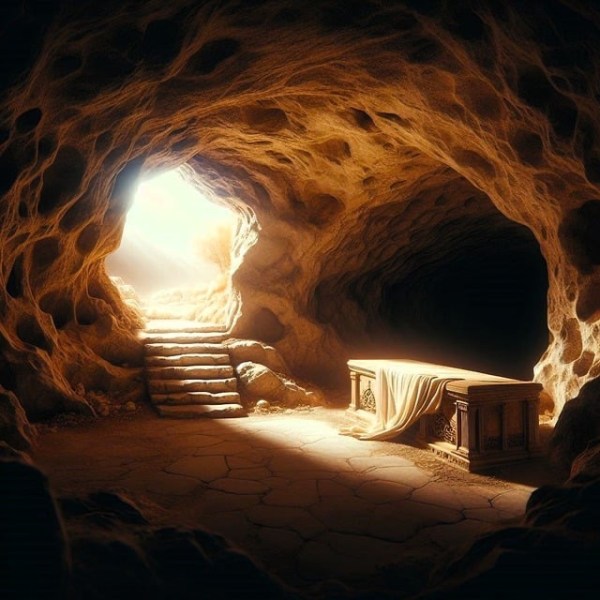
Remember, our God likes to do things “opposite the ways of the world.” I think He was also affirming that He valued women. So, the angel appears to Mary Magdalene and Mary (the mother of James and Joses/Joseph), 2 witnesses. They were greeted by a shining angel, following an earthquake and the supernatural opening of the tomb. The Roman guards are so shocked they faint away. This in itself is unlikely as these were hardened men. It seems the angel didn’t want them to overhear his conversation with the women. The angel tells the ladies that Jesus is alive! He has risen! They can look into the tomb and see for themselves that His body is gone. They are to go tell the disciples that Jesus has risen from the dead, and intends to meet them in Galilee.
Even better, as they are on their way to witness to the men, they encounter Jesus Himself! He tells them not to be afraid—don’t you love it?! And to tell the men to rendezvous with Him—away from Jerusalem—in Galilee.
Meanwhile, the guards revive and have to report they’ve lost the One whose body they had been assigned to guard. This could have resulted in capital punishment for each of them. However, the Jewish religious leaders concoct a convenient narrative: Despite the sealed tomb, and the contingent of battle-hardened soldiers, Jesus’ unarmed followers stole His body! They have to bribe the soldiers to agree to collude with them. And Matthew informs us that many Jews believe that false narrative, that hoax, to this day—proving yet again, at least regarding false narratives, that there is nothing new under the sun.
But John and Charles Wesley, like us, knew the true story, and Charles enshrined it in his hymn:
Love’s redeeming work is done, Alleluia!
Fought the fight, the battle won, Alleluia!
Death in vain forbids Him rise, Alleluia!
Christ has opened paradise, Alleluia!
(Jesus is victorious over death.)
Soar we now where Christ has led, Alleluia!
Following our exalted Head, Alleluia!
Made like Him, like Him we rise, Alleluia!
Ours the Cross, the grave, the skies, Alleluia!
(We too shall die to be raised again.)
Alleluia, the Lord is Risen! The Lord is risen indeed! Alleluia! Amen!
©️2026 Rev. Dr. Sherry Adams
 Wellborn Methodist Church--Wellborn, Florida