Trick Questions

Pastor Sherry’s Message for October 18, 2020

Scriptures: Ex 33:12-23; Matt 22:15-23

Anyone who has spent any time with young children knows they can ask some questions that contort our minds as they force us to search for explanations they can understand (assuming we understand).  Here are some examples you may have heard in the past:

  1. Why do leaves change colors; why do they fall off the trees?
  2. If shampoos come in so many shades in the bottle, why is it only white when you use it to scrub your head?
  3. If the #2 pencil is the most popular kind, why is not #1?
  4. Why can’t dogs have kittens?
  5. Where does the water in the sink come from?
  6. Why is the sky blue?

The story is told of a young child who had been watching TV.  She grew tired of the political ads and the programming aimed at adults; So she asked her Daddy to please read her a fairy tale instead.  He had no sooner begun when she interrupted with a question:  “Daddy, do all fairy tales begin with “once upon a time?”  “No,” he answered, “only those that begin with, “And when I am elected….

Two of our Scriptures today involve important questions.

Let’s examine them together.  First, our Gospel lesson, Matt 22:15-23, takes place just a day or two before Jesus is arrested.  He is teaching in the Temple.  A group of Pharisees gather—together with a delegation of  Herodians–to entrap Him by using a question.  Now the Pharisees were nationalists.  True, they felt responsible for teaching the Israelites how to relate to God, but they also loved their country.  As a result, they hated Roman rule.  The Herodians, on the other hand, were not even a religious group but rather a political party.  They favored the rule of the secular

Herodian kings.  And they supported Roman rule because doing so was their pathway to wealth from influence-peddling.  Needless to say, with these 2 unlikely groups in cahoots or colluding together, Jesus knew something was fishy.

Notice their approach:  They begin with flattery.  If they truly believed what they said, they would not be trying to entrap Him.  They claim they know He is a man of integrity.  They say they believe He teaches accurately and truthfully.  They affirm that He does not pander to any specific interest groups–He’s not on the take like they are, and He does not slant what He says in order to gain popularity, like most politicians, and like them.

If they truly believed their flattery, you would think they would admire Him and leave Him be.  But no, they are in a devilish pact to bring Him down.

So they ask …is it right to pay taxes to Caesar or not?  I have so much admiration (and love) for Jesus.  He is so smart and so cool!  He calls them out on their conspiracy!  In v.18, He asks, Why are you playing these games with Me?  Why are you trying to trap Me? (This is the way Eugene Peterson translates it in his modern paraphrase of the Bible called The Message.)  Now if Jesus said don’t pay taxes, don’t support Rome, the Herodians would have had a fit and tattled to Rome.  Rome would have considered such a statement treasonous, and would have invoked the death penalty for Jesus.  On the other hand, if our Lord said do pay taxes, the Pharisees would have accused Him of being disloyal to the nation.  In Jesus’ calm and unruffled way, He sidesteps their trap by asking to see a coin.  The inscription on the coins (denarii) of that day read, “Tiberius Caesar Divi August: Filius Augustus Pontifex Maximus,” translated this meant, “Tiberius Caesar, son of the divine Augustus, high priest.”  This inscription claimed Caesar was a god, which he clearly was not!  Jesus, who is God, looks at the coin and says, This engraving, who does it look like?  And whose name is on it?  They have to say Caesar’s as that is whose head was on it and that is what the coin read.  Then, He says, give Caesar what is his, and give God what is His.

As He often does, He has turned their question back on them and evaded their trap brilliantly!  In the Greek of that day, the word Jesus uses is apodote, which meant, render, give what is due by obligation.  Now the Jews resented Roman rule, but they also profited from Roman roads, viaducts, and architecture, Roman trade, and Roman law and order.  They clearly owed Rome something in taxes.  Jesus is saying the coins which bear Caesar’s image belong to him; thus, they were to give Caesar his due.  As long as what Caesar required did not conflict with what God requires, Jews and Romans could peacefully coexist.  (Persecution broke out against Christians, however, when the Romans demanded that Christ-followers say, “Hail Caesar!  Caesar is Lord!”)

But there is the crux of the matter, isn’t it?  The really difficult, mind-contorting question is, “what do we owe to God?”

We saw the answer two weeks ago when I preached on the Parable of the Wicked Tenants.  They and we owe God our love and gratitude.  We owe God our worship.  And we owe God our obedience.

We see it again today in our Old Testament lesson, Exodus 33:1.  Moses has just come down from the mountainwith the 10 Commandments, carved into 2 stone tablets by the finger of God.  He arrives to the camp and is stunned to catch them dancing around a goldencalf.  They have committed spiritual adultery.  Right out of the gate, they have broken 3 of the newly minted 10 Commandments!

God has seen their apostasy, and has essentially told Moses He is fed up with them.  Because God keeps His promises, they may proceed on to the Promised Land, but He will not be going with them.  In other words, they will now longer enjoy a personal relationship with Him.  To their credit, the people do not want this, nor does Moses.  Moses intercedes for the Israelites.  He asks God to (v.13) teach me your ways so that I might know You….that is, “Help me to understand You better; Teach me about Your character, Your nature.”  Then he reminds God (v.16), How will anyone know that You are pleased with me and with Your people unless You go with us?  What else will distinguish me and Your people from all the other people on the face of the earth?  God then relents, because of His relationship with Moses and with His chosen people.

Next we see that God allows Moses to have a special, profound, personal revelation of Him.  Moses gets to see God—in the rearview mirror—and live. Imagine the state of his faith after this!

So that was ancient Israel.  What is the point for us, living today in the USA?

Now I am not suggesting we answer our grandchildren or our children’squestions with a question.That is a technique Jesus often used.

Neither do we want to be like the young photographer sent to record the fires on the West Coast, who didn’t ask enough questions.  He arrived on site and found he could not get good picturesdue to the dense, dark smoke.  So he prevailed upon his agency to charter him a small plane from which to memorialize the damage.  They agreed and he sped to the airport to hop on awaiting aircraft.  As He jumped on board with his gear and closed the door, he yelled, “Ready for take off!”

The little aircraft proceeded down the runway, and jerked and shook its way airborne.  The photographer, somewhat alarmed, noticed that the pilot looked young and nervous.  Nevertheless, he asked the pilot to fly low, over the flames.  ”Why?” the pilot asked.  ”Well because I’m a photographer and I need to be close to the action to record the fire.”  The pilot was silent for a few moments, then said, “Oops, I thought you were the flight instructor.”  We do want to ask the important questions.

Today’s important question is, “What we should render to God?”  Our Scriptures today teach us that we want to offer Him a heartfelt desire to know Him personally.  This sincere quest to know Him will lead us to loving Him, being grateful to Him, worshipping Him.  This also implies that we will become obedient to Him while serving Him.  When we do these things, God is with us and God protects and blesses us.  Thanks be to God who gives us the victory through our Lord, Jesus Christ.  Alleluia!  Alleluia!

©2020 Rev. Dr. Sherry Adams

Obedience.XYZ

Pastor Sherry’s Message for September 27, 2020.

Scriptures: Matt 21:23-32; Phil 2:1-13; Ex 17:1-7

Norma Dearing, a woman who worked for years in the Christian Healing Ministry in Jacksonville, Florida (with Francis and Judith MacNut), used to use this metaphor when speaking at women’s retreats: Where is Jesus in the car of your life?  She would ask, Is He a hood ornament?  Or abumper sticker?  A decoration for all to see, but conveying no indication of your true commitment to Him.  Or perhaps He is in your trunk, taken along for the ride like luggage, or even bound and gagged, having minimal or no influence on your life at all.  Maybe you drive Him around in the back seat, from which He provides directions that you ignore.  Or, have you placed Him in the passenger seat such thatHe is companionably along for the ride, but with no real control over the direction you take.  Perhaps you have seen those bumper stickers that assert, God is my co-pilot.  Closebut not enough.  Jesus belongs in the driver’s seat of the car of our lives.  If we are obedient to Him, He determines the direction we take and the speed with which we get there.

         Some years back, I decided to use this illustration in a sermon I was giving as a seminarian.  On my way to the church where I was serving an internship–some 30 minutes from my house–I was driving along, practicing my sermon, when I got pulled over.  My 1st response was to fuss with the Lord:   Lord, I am on my way to do Your work…Couldn’t You have hidden me under the radar?  The cop walked up to my window and said, Lady, do you have any idea how fast you were going?  No Sir, I said, I’m afraid I was practicing my sermon and I wasn’t paying attention.  (Honest it was, but not very smart to admit I wasn’t paying attention.)  It turns out I was doing 65 in a 45 zone.  However, he expressed surprise that I, a woman, was on my way to preach (I figure he was probably a Roman Catholic and not used to female clergy).  He took my license and registration, and returned to his patrol car.  I continued to whine to the LORD and to beg for His divine intervention because, as a poor seminarian, I didn’t have the $180-$200 this ticket would cost.  The patrolman returned to my window and said, I’ll tell you what, if you‘ll promise to slow down, I ‘ll let you off this time.  He also asked me to pray for him and his partner.  I was absolutely delighted to comply!  As I continued on my way, more slowly, I was thanking God for His grace and mercy toward me, a sinner.  The Lord then said to me (in my spirit), Sherry, where is Jesus in the car of your life?  I replied, Lord, You know He is in the driver’s seat.  You know I have surrendered my life to Christ!  Sherry, that may be true, but whose foot is on the gas pedal?  I laughed with the Lord all the way to church that day.  I had learned yet another lesson about obedience.  Not just lesson.2 or.10 but .XYZ!

This, I believe, is the Lord’s point in our readings today:

Our Gospel comes from Matthew 21:23-32.  Jesus preaches this parable, in the Temple, on Tuesday before His arrest late Thursday night.  The Chief priests and the elders, the “usual suspects” are there, trying to find a justification to get rid of Him.  Earlier, they had observed Him clear the Temple of the moneychangers (2nd time); heal the blind and the lame; and had heard the peoples’ praise of Him.  These 3 events pointed to His authority as the Messiah, demonstrating Him in the roles of Prophet, Priest, and King.  They know the Scriptures, yet they want Him to state the source of His authority.  They should have been cognizant of the passages predicting Messiah and what He would be like.  They could have recognized Jesus was The One of whom the prophets proclaimed.  But they wouldn’t allow Him in the driver’s seat where He rightfully belonged.  Too concerned with holding their own authority, they were unable to expand their-too small box to include Him.

Our passage picks up with Jesus teaching in the Temple on Tuesday, again two days before His arrest.  He knows His religious enemies will be gathered there like so many vultures.  Nevertheless—and bravely—He teaches three parables on God’s judgment.  These stories are specifically aimed at the religious authorities for having failed as Israel’s spiritual leaders.  Our parable today is the 1st of these.

Jesus sets the parable in a vineyard. Everyone listening knows this symbolizes Israel.  Since grapes were a very important crop in Israel, the vine or the vineyard had become a metaphor for the nation.  The prophet Isaiah talks extensively of God’s disappointment in His disobedient vineyard in Isaiah 5:1-7.  Jesus teaches in JOHN 15:1, I am the true vine and my father is the gardener.  In this judgment parable, however, He introduces a father who commissions his sons to work in his vineyard.  The father figure is God.  He appoints leaders, sons, to work the vineyard, Israel.  Their work is to bring the people into intimate relationship with Him, and to assist Him to usher in His Kingdom on earth.

The first son says No, then apparently reconsiders and is obedient.  As Jesus interprets this, the 1st son represents the tax collectors and the  prostitutes—sinners, the unchurched, pagans—anyone common, ordinary person who has accepted Him as Lord.  They had probably rejected Jesus at first, thinking they didn’t need a Savior, and found themselves caught up in dead-end, sinful lives.  But, hearing Him teach and realizing they do need Jesus, they now have put Him in the driver’s seat.

The second son Jesus describes says, Yes. Lord, I’ll do what You’ve asked, but then doesn’t.  Jesus explains that these are the very ones who are there trying to trip Him up:  the chief priests & the elders. It was their job to guide the people to God and they had failed due to their spiritual blindness. They should have been able to recognize Jesus as the fulfillment of the Messianic prophesies, but they were too worried about hanging onto their power, positions, and influence.  They not only wanted to keep Jesus bound and gagged in the trunk, but they were ready to murder Him and toss His body out onto the roadside.  Jesus knows this and reprimands them for failing to believe in John the Baptist as well as for missing that He is Messiah.  Matthew explains in chapter 21:45-46, When the chief priests and the Pharisees heard Jesus’ parables, they knew He was talking about them.  They looked for a way to arrest Him, but they were afraid of the crowd because the people held that He was a prophet.  

In our Philippians lesson (2:1-13), Paul tells us the way we keep Jesus in the driver’s seat of the car of our lives is to have “the mind of Christ.”  By this he means that Christ was entirely obedient to God the Father.  Jesus humbly gave up His self-will, and all of His heavenly prerogatives, and put God in the driver’s seat.  Jesus’ humble obedience is the best model of this that we have.

We only have to look at our Exodus lesson (17:1-7) to see a repeated example of how not to behave.  Those poor Israelites appear to have forgotten God’s gracious provision for them as soon as they meet a new or different roadblock.  All too like us,they put the Lord in the driver’s seat until they become afraid.  Even so, the Lord always provided for them—this time water from the smitten rock (a prophetic picture of Jesus’ death).  Look at the pattern:  they trust and obey until they come to some new crisis; then they cry, complain, or get angry.  How gracious of God to continually rescue them and to meet their needs, despite their rebellion and lack of trust.

Our lessons today pose the question, which kind of son or daughter are we?  Our Lord calls us to be obedient to Him…are we?  Maybe like the sinners Jesus lists, we said NO at first, buthave come to say YES later in life.  Or perhaps we had never invited Him into the car of our lives, but are happy we have done so now.  Or maybe we trust Him until we hit a bump in the road, then we panic.  Jesus wants to be in the driver’s seat of the car of our lives, hands on the wheel, controlling the speed and the direction we take.  We can trust in Him to get us where we need to go.

We don’t have to whine or complain or rebel…we just need to sit back, relax, and leave the driving to Him.  We can trust and obey, even down to allowing His foot to manage the gas pedal.

©2020 Rev. Dr. Sherry Adams

Way-maker!

Pastor Sherry’s message for 9/13,2020,

Scriptures: Exodus 14:5-31; Ps 114

Osinachi Lalu Egbu is a 47YO Nigerian woman who has written more than 200 Christian praise songs.  She has shortened her name to Sinach.  Perhaps you have seen T-shirts emblazoned with the words,

“Way-Maker, Promise-Keeper, Miracle-Worker, Light-in-the-Darkness.”

These names of God begin the chorus of one of her currently popular songs, which ends with, “My God, that is Who You are!”  This song seems to be currently taking the Christian world by storm because it expresses such deep trust in God’s abilities to…1. Make a way where there seems to be none;2. Keep His promises to us;3. Work miracles on our behalf, often at the 11th hour;4. And provide light to us in our times of darkness.

I cannot think of a more dramatic event from the Old Testament that so fully demonstrates God as Way-maker, Promise Keeper, Miracle-Worker, and Light in the Darkness, as His fabulousrescue of His people in the Red Sea Crossing (Ex 14:5-31).  

Remember from last week’s lesson, God had sent the final plague—the death of the 1st born—upon Egypt.  Those Israelite slaves, however, who had applied the blood of the Passover Lamb to their door frames were spared. This final plague seemed to have broken the back of the Pharaoh’sresistance to losing his free labor-force.  He gave the word that they and their livestock could leave Egypt the next morning.  So they did…2 million of them.

Our reading today begins with them trekking through the desert region between the Nile and the Red Sea. God had them avoid two well-traveled land routes to the north, both of which paralleled the Mediterranean Sea. He knew that Egyptian spies were watching their exodus. He also realized that they would report to Pharaoh that the freed slaves seemed to be apparently wandering aimlessly. Once again underestimating God, Pharaoh decides to pursue the Hebrews with his 600 chariots. He seemed to believe his crack troops would either make mincemeat of the 2 million untrained slaves, or be able to reroute them back into captivity. Despite the recent lessons of the 10 plagues, Pharaoh appeared confident he could recapture his unpaid laborers. This, as we know, was a massive case of hubris!

Our God was not ambushed! Instead He effected a Divine Rescue:

1. As the Way-Maker, He led the people thru the desert.

The Israelites were not lost; instead they were being guided by GPS—God’s Planned Strategy.  With the Red Sea to the left and Egyptian Special Forces to the right, it seemed like the people were caught in a deadly trap between the Devil (Pharaoh) and the Deep Blue (Red) Sea!  But God purposefully led them to this situation.  The cloud-by-day, fire-by-night suddenly shifted from front, leading the people, to the back, providing a rear guard.

2. God had promised to deliver the Israelites from Egypt. So He instructed Moses to raise his staff, and by the power of the Holy Spirit, God blew open the Red Sea. Walls of water stood up on both sides of the escape route. On dry ground—let’s not miss this!—and hidden from the Egyptians, the people were able to cross through all night long. God literally had their backs! He engineered their escape as the divine Miracle-Worker.

3. The Promise-Keeper shielded the people from the their pursuers by essentially turning out the lights.

4. Meanwhile, our God provided bright firelight to reveal the path of escape for the pursed. He provided Light in the Darkness.

​There were no phones, drones, or video cameras to record this set of miracles.  Nevertheless, word of them made it to the Canaanites, especially those living in Jericho.  A Canaanite document dated from 1375BC warned of a fearsome people, called the Habiru (or Hebrews), whose powerful God fought for them. Rahab, the Canaanite prostitute who hid Joshua’s two spies, told them (Joshua 2:9-10), I know that the LORD has given this land to you and that a great fear of you has fallen on us, so that all who live in this country are living in fear because of you. We have heard how the LORD dried up the Red Sea for you when you came out of Egypt.

So, what are the lessons for us today from the Exodus?

1. We want to remember that God is the Way-maker.

When we are caught in circumstances that seem impossible for us, we are to pray, to ask for God’s help, and to trust He will provide it. Our God hears us and often provides a response we never considered nor could have predicted! Money might manifest from some unexpected source. We might enjoy a needed delay or reprieve from some consequence we had dreaded. We might experience a cure for a disease or from an addiction we had not yet overcome. We might have undergone a sudden change of heart, or seen an altered attitude or positive behavioral shift in a friend or relative. A job or an opportunity we never imagined might have presented itself.

2. We want to remember that God is a Promise-Keeper.

He promised to save us and He has, through Jesus Christ’s sacrifice of Himself upon the Cross. He promises to never leave or forsake us. He promises to protect those who love Him. He promises to be present to us. He promises to answer those who call upon Him. He promises to love us, even when we act in ways that make us unlovable. He promises to forgive us if we ask Him. The writer to the Hebrews says that God is the same yesterday, today, and forever. James tells us (1:17)…the Father of the heavenly lights who does not change like shifting shadows. He does no posing, He exhibits no fakery. He keeps His word!

3. We want to remember that God is a Miracle-Worker.

He has all of the resources of the universe at His command. It’s not like He has to search around for ways to provide for us. He doesn’t have to do fund raisers or set up a “Go Fund Me” page. He can just speak the word and His will is accomplished. Scripture tells us again and again that nothing is impossible with Him. Some people write off the Red Sea Crossing as a myth. They seem to believe even God cannot violate the laws of physics. They must not believe in the God of miracles that I do, that you do. Since God set the laws of physics into being, isn’t it clearly possible that He can override or supersede them? Our God is able to do whatever He decides todo.

Additionally, no schemes of evil men or of the Devil can thwart His plans. To me the greatest example of this is how Jesus is appearing—in dreams and visions—to people caught behind the Moslem Curtain. Hostile Moslems tell their people that Christian missionaries are evil purveyors of sex trafficing and molesters of children. Radical Islamists then use this as a justification for capturing Christian missionaries, torturing them, and thenkilling them in those countries. But no human or government can capture or kill Jesus. It’s already been done and it didn’t stick!4. Finally, we want to remember that God is the Light in the Darkness. The news media daily inundates us with negativity and fear-producing predictions. Consider what they say just with regard to thethe Covid-19 virus:a. It will have a resurgence. So far this has not really happened.b. So it’s very dangerous to send kids back to school, or to reopen businesses with face to face contact. Schools have reopened now in Florida without the dreaded upsurge predicted, as have restaurants and hair salons. The developing vaccines will either not work or will have dangerous side-effects. We will have to wait on this one, but I am willing to take a dose of vaccine when one is released. d. We can never again hug or shake hands. I have been hugging folks and shaking hands with no ill effect for several weeks. In addition, I have been careful to wash my hands well before eating.e. Our economy will never recover. This also remains to be seen; however, some are predicting we will be back to pre-pandemic economic levels by early 2021.

The person of faith wants to focus on their faith in God and not innews casters. The person of faith daily puts on the whole armor of God (Eph 6): the shoes of the Gospel of Peace; the belt of Truth; the breastplate of Righteousness; the helmet of Salvation; the shield of Faith, and the sword of the Spirit. The person of faith recalls 2 Cor 10:3-5àFor though we live in the world, we do not wage war as the world does. The weapons we fight with are not the weapons of the world. On the contrary, they have divine power to demolish strongholds. We demolish arguments and every pretension that sets itself up against the knowledge of God, and we take captive every thought to make it obedient to Christ. The person of faith recites, in Jesus’ name, No weapon formed against us will prosper/prevail (Isa 54:17).

Israel has long celebrated God’s rescue of His people in the story of the Exodus.  The freed Hebrew slaves directly experienced God as their Way-maker, Promise-Keeper, Miracle-Worker, and Light-in-the-Darkness.  And if we ponder it long enough, we will have to admit that we have probably too.  Praise God from Whom all blessings flow!

Copyright 2020 Rev. Dr. Sherry Adams
God’s Picks

Pastor Sherry’s message for August 23, 2020

Scriptures: Exodus 1:8-2:10; Ps 124; Matthew 16:13-20

This story falls under the category of “truth is stranger than fiction”:  Back in the mid to late 300’s, there was a slave in Egypt named “Moses the Black” (330-405 AD). He was a tall, intimidating Ethiopian, who stole from his Egyptian master.The master also suspected of him of murder.Rather than sell him off, the master fired him and threw him out. So, Moses the Black joined a gang of thugs. Almost immediately he became their leader, and for years his band of hoodlums terrorized folks along the Nile River Valley.

At one point, Moses the Black attempted to evade the law by hiding out in a desert monastery.  He thought he was pretty clever to take refuge in a church, but the joke was on him–as he encountered Jesus and gave his life to Christ in that place.  Perhaps even more incredible is the fact that 4 of his former gang members—not realizing he was there—decided to rob the monastery.  Moses the Black completely overpowered them (making a citizen’s arrest?), tied them up, and dragged them before the abbot.  Because he didn’t slit their throats, the thugs were so moved that they too gave their lives to Christ, and became monks as well.

Legend has it that he was martyred, as an old monk, by a different band of robbers who did not know Moses the Black’s reputation or his conversion story. The former robber, murderer, and adulterer had been transformed by God into a Christ-following teacher and priest. Interestingly enough, the former gangster who had lived by the sword also died by the sword. Nevertheless, the Catholic Church has proclaimed him a saint.

Isn’t it interesting who God chooses to do His work?  Often it is some pretty unlikely persons! Our Old Testament lesson, Exodus 1:8-2:10, introduces us to Moses’ backstory. Moses was born to an Israelite family, from the tribe of Levi, working as slaves in Egypt. Almost 350 years after the death of Joseph–the one God used to save the fledgling Israelite nation and Egypt from a massive famine–the new leadership in town had no gratitude for the Hebrew who saved his countrymen and women. The new Pharaoh (Ahmose? Rameses?), who either didn’t know the history or didn’t care, ascended to the throne of Egypt. He looked around and saw how numerous the Israelites had grown.  Here is the outworking of the promise to Abraham from Genesis 12: his descendants would outnumber the stars or the grains of sand on a beach. God would see to it that they would become a “great nation,” and they have indeed. This new Pharaoh was afraid he and his countrymen were vastly outnumbered by Hebrews.  So, he decided to contain any threat by enslaving them.  He worked them hard and harshly.  Even so still they seemed to multiply.

As the story unfolds today, Pharaoh is concerned that the Israelites are reproducing too rapidly. He calls in the head Hebrew midwives and tells them to go ahead and deliver any girl babies, but kill the boys (this is one time in ancient history when it paid to be a female). The midwives are wise; they fear/respect God more than they do Pharaoh. They refuse to practice male infant genocide. Pharaoh notices that male Israelite infants are surviving and wants to know why. The wise midwives claim Hebrew moms are very hardy and complete the birthing process without calling upon them.

This is no doubt a lie, but it seems to prevent Pharaoh from exacting revenge.       

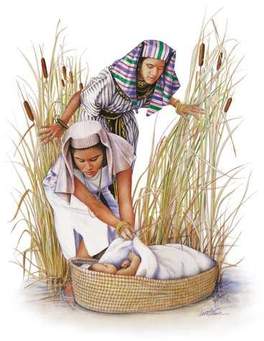
Moses is born in the midst of this national birth-control strategy. As a male, he should have been euthanized. However, his mom, Jochabed, rears him to 3 months. Then she places him in a carefully water-proofed basket and sets him adrift on the Nile. In an amazing twist of fate—like Moses the Black, thief and murderer becoming a monk—Moses the Levite is spotted and rescued by Pharaoh’s eldest daughter. Childless, she decides to raise the child as her own son. Miriam, his biological sister, has been watching over him and suggests a woman to nurse him, the baby’s own biological mother, Jochabed, for pay! How ironic, and how like our God to place the future deliverer of Israel within the very household of Israel’s chief oppressor. A Hebrew slave will learn the Egyptian language, culture, history, and military strategies. God has once again placed one of His own into a position of authority and influence in Egypt. Whether Pharaoh realizes it or not, God is also demonstrating that Pharaoh will be impotent to destroy God’s people or His program (developing the lineage of Jesus).

Psalm 124 is a Psalm of Ascents, sung by Jewish pilgrims on their way to the Temple Mount to celebrate one of the major feasts.

They praise God for His protection of them in the past. They worship Him for having protected them just as He did Moses.

In our Gospel lesson, Matthew 16:13-20, our Lord commends Peter for both recognizing and testifying to whom Jesus really is. Remember, Jesus is still outside the borders of Israel, this time in aRoman resort/retirement town, 2 days’ walk north of the Sea of Galilee.Simon, inspired by the Holy Spirit, asserts that Jesus is the Messiah, the Son of God—a Deliverer even greater than Moses. Jesus commends him and He renames Simon as Peter, or we might say, “Rocky.” Jesus Himself is the “ROCK”—but it is on faith like Peter’s and on believers like Peter that Jesus will establish His fellowship, His Church.

In addition, Jesus proclaims that (V.18)… the Gates of Hades/Hell will not overcome it [His Church]. The deaths of believing individuals will not extinguish the flame of the Church, just as Satan did not kill off the Jews through either slavery or Pharaoh’s schemes. No one person, or groups of persons, can thwart God’s plan and program.

Next, Jesus gives Peter (the apostles, the early church, and us) (v.19) …the keys of the kingdom of heaven: authority to preach and teach the Gospel. Roman Catholics claim Jesus was hereby making Peter the leader of His Church (the 1st Bishop of Rome, the first Pope) and authorizing him to forgive or fail to forgive sins.  Others—primarily Protestants–interpret this somewhat differently: If we, as Jesus-followers, loose or proclaim God’s truth on earth, the powers of heaven will support our efforts. As it says in Isaiah, God’s word will not return to Him empty.  Teaching and preaching the Scriptures will result in bringing many into God’s Kingdom. But if we bind it on earth (fail to proclaim or prevent its dissemination), the Church will not live into its destiny.

Last week, I asked us to consider who gets saved.  This week, I hope I have drawn your attention to who God picks to work in His program of redemption.  He appears to pick the unlikely: (1) The reprobate, Moses the Black, becomes a major force forChrist in the 4th century Church as a teacher, pastor, martyr, saint.  (2) Moses–born to Hebrew slaves–is nurtured and educatedunder Pharaoh’s own nose, then used by God to free His people.  (3) Peter, who takes his eyes off Jesus, resorts to violence in theGarden, denies Him three times, and fails to show up at the Cross to support Him, is selected by God as a leader in the 1st Century Church.

The beauty of all of this is that God picks unlikely, even weak and flawed people to carry out His program of redemption. He trains us up. He strategically places us. He chooses and uses folks like you and me.

What’s really amazing to me that He puts so much trust in us.

Let’s agree to live into His trust and to assist Him in His goal to bring the lost to Christ. This week, look for opportunities to tell those who don’t know Jesus (1) Who He is; (2) How much He loves them; and (3) How knowing Him has changed our lives for the good.

Thanks be to God who gives us the victory thru our Lord, Jesus Christ!  Alleluia, Alleluia!

©2020 Rev. Dr. Sherry Adams

Looking to Self or to Jesus?

Pastor Sherry’s message for August 9, 2020

Scriptures: Gen 37:1-38; Ps105:16-22; Matt 14: 22-33

This is a true story:  In early February, a sheriff’s officer clocked a 2020 grey Kia sedan cruising at the brisk pace of 95 mph on Interstate 10 through Florida’s panhandle.  Two men, in their mid-30’s, were headed east towards Live Oak and Jacksonville, then on their way south to Orlando. This corridor is a major feeder for drug trafficking into the Sunshine State, so officers are constantly on the lookout for signs of suspicious activity.


Federal law permits officers to stop those who are breaking the law, issuing arrests and tickets accordingly. But the Fourth Amendment prohibits the search of vehicles without probable cause, or reasonable suspicion. One lawyer explains it this way:   “Basically, a law enforcement agent’s hunch without proof of illegality isn’t enough for him or her to look through a car legally. Before rummaging through a vehicle, the officer would have to observe something illegal. Examples of this are seeing or smelling an illegal substance. An admission of guilt by the person driving the car is another situation in which an officer can legally examine a car.”


When the officers pulled this vehicle over, they noticed right in plain sight–two plastic zip-locked bags. Both were clearly labeled “Bag Full of Drugs.” This sight, needless to say, provided sufficient probable cause to warrant a search of the carand of the bags. Inside, Santa Rosa County Sheriffs found a treasure-trove of methamphetamine, GHB, cocaine, fentanyl, MDMA tablets, and various drug paraphernalia. Both driver and passenger were booked into the Santa Rosa County Jail without bond, on charges of drug trafficking. Later, the Santa Rosa County Sheriff’s Office posted the following message to Facebook:


“Santa Rosa K-9 Deputies recently assisted [Florida Highway Patrol] on a traffic stop on I-10 where a large amount of narcotics were discovered. Note to self — do not traffic your illegal narcotics in bags labeled ‘Bag Full of Drugs.’ Our K-9’s can read.”

Law enforcement must abide by the 4th Amendment, but to our God–who knows all–words like probable cause and reasonable suspicion are meaningless. He is omniscient. We may attempt to hide our sins, or at least not place them in bags labeled “Bags full of wicked things,” but still He sees. He sees when the door is closed. He hears when the windows are shut. He knows even when our browser history has been completely wiped clean

We have a very similar event recorded for us in Genesis 37—as well as its antidote in Matthew 14.  Let’s examine them more closely.

Genesis 37:1-36 records for the backstory behind the enmity of Joseph’s brothers toward him.  Thus far, in each generation of the founding family of the Israelites, God has chosen the younger sibling over the elder:  God chose Abraham’s son by Sarah over the older son, Ishmael;God then chose Jacob, deceitful though he was, over his elder twin, Esau;once again, in this newest generation, God choses the baby son, Joseph, over all 10 of his strapping elder brothers.

Joseph, the son of Jacob’s beloved wife Rachel, is also Jacob’s favorite.

Reuben was the 1st born, but he disqualified himself by sleeping with his stepmother, Bilhah.  Not only is this icky to consider, but it says to his father, in effect, “I wish you were dead.”  The next two eldest, Simeon and Levi, prove themselves to be violent men lacking in integrity.  They violate a treaty their father had made with the King of Shechem.  They are rightfully incensed when their sister, Dinah, is raped by the prince of Shechem.  They expect swift retribution, the prince’s death.  However, their father forges an agreement with the king which would allow Dinah and the prince to marry, provided all the male Shechemites submit to circumcision (i.e., become Jews). The brothers think this is weak on their father’s part, and that he does not sufficiently value their sister’s honor.  So, they sneak into the Shechem at night and kill all the males recovering from circumcision surgery, including their sister’s fiancé.  Father Jacob/Israel is now royally angry and disgusted with all of them, except Joseph.  He fears they have demonstrated to the Canaanites that Jews do not keep their word and violate legitimate treaties.  By this point, Jacob clearly favors Joseph over all of them.  He unwisely uses him to spy on them as they graze their father’s flocks.  He also increases their jealously and enmity by giving Joseph a special garment, in effect saying that Joseph—not any of the other 10–is the heir.

 Naively, Joseph doesn’t help make himself more popular with his siblings when he shares 2 dreams in which it appears he will one day rule over them.

In today’s passage, they stop short of killing him; but instead sell him to Ishmaelite (remember Ishmael, 1st son of Abraham?) traders bound to sell him into slavery in Egypt.  They concoct a plausible story for their Father, not anticipating the depth of his grief.  And they essentially invoke the death penalty upon their brother—as few people in that day survived long as a slave.  Scholars say that ½ of the later Roman Empire consisted of slaves.  They had no pay, no days off, and no rights, so many died early deaths.

 Joseph’s ordeal is memorialized in our Psalm (105:16-22) today.

The jealous and hateful brothers never appear to check out their feelings, or their actions, with God.  They are filled with murderous rage and they act on it.  But our psalmist reminds posterity (both the Jews & us) that God (v.17)...sent a man [Joseph] before them [into Egypt, all of Jacob’s other sons and all their families]—Joseph, sold as a slave.  The equivalent of a prince of his family suffered, being encased in shackles and irons;

He did serve as a slave for 14 years, until…(v.19)…what he had foretold [the two dreams] came to pass, til the word of the Lord proved him true.

 We know the rest of the story:  Pharaoh, nudged by God, appointed Joseph over all of Egypt to superintend the storage and distribution of grain during a 7 year famine.  As a result, he then becomes the means of saving his extended family—including those jealous, murderous brothers—from starvation.  God redeems Joseph, and his brothers and their families.

How might the story have been different if the brothers had consulted God? How might the story have been different if they had prayed for Joseph—and their father, Israel—instead of acting on jealousy, rage, and vindictiveness?

The 10 elder brothers together provide a vivid example of how not to be.


For an example of how to be, let’s look at our Gospel lesson, Matthew 14:22-33.  The context is that Jesus has fed the 5,000 + women & children.  He then sends the disciples out to sea in their boat while He trudged up a mountain to pray.  Apparently He prays all night.  He comes walking toward them during what the Romans referred to as the 4th watch, 3-6:00am.  It must have been pretty alarming for them to see Him striding toward them on the waves.  1st they mistake Him for a ghost. He responds (v.27) àTake courage!  It is I.  Don’t be afraid.  He knows they aren’t expecting to encounter Him this way.  He understands their fear, and He compassionately reassures them.

Peter has sized up this unusual situation and desires to walk on the water too.  I don’t blame him—wouldn’t you jump at the chance to defy Physics, or to do something with our Lord that was unheard of?  We observe that Peter did fine, until he took his eyes off Jesus.  There’s the lesson for us all:  Keep our eyes on Jesus!  When we follow hard after God, He holds an umbrella of protection over us.  But when we say in effect, that’s OK God, I don’t need you.  I’ll do this myself, we step out from under that umbrella of protection.  Bad things, scary things, unjust things, stupid things, even evil things happen when we place our attention on ourselves only–like Joseph’s jealous and murderous brothers; or like the 2 drug runners traveling I-10 in the Kia.  Bad things, scary things, unjust things, stupid things, and even evil things can also happen when we put all our attention on persons or activities that divert us from  Christ. 

 Like the old hymn says, we need to “Turn your eyes upon Jesus.”


Turn your eyes upon Jesus…

Look full in His wonderful face,

And the things of earth will grow strangely dim,

In the light of His glory and grace.


O soul, are you weary or troubled?

No light in the darkness you see…

There’s light for a look at the Savior,

And life more abundant and free.


Through death and into life everlasting

He passed and we follow Him there.

Over us sin no more hath dominion

For more than conquerors we are.


Jesus keeps us afloat. Jesus lifts us up and out of ourselves, out of our difficult situations, and into the safety and security of His tender care.  This week, let’s try to remain safe and sound under His umbrella of protection.

 C 2020 Rev. Dr. Sherry Adams>

Surrender … but hold on!

Pastor Sherry’s Message for August 2, 2020

Scriptures: Genesis 32:22-31; Ps 17:1-7

Can you remember how you felt when you knew you had to face some pretty unpleasant event?  I can think of two such events when I was a kid and even one as an adult.  When I was going into the 7th grade, my dad was transferred to Hawaii.  This was in the late 50’s when the islands were still a territory, not yet a state.  So we had to endure a series of painful immunizations.  I dreaded the days we had to present ourselves for those shots.  The anticipation was far worse than the actual event.  In another example, my brother and I had misbehaved badly for our mother.  When our abusive stepdad went out to sea, we both felt like the clamps had come off and I am sure we manipulated our mother something fierce.  One particular time, she threatened, “Just you want ‘til you dad comes home!”  She marked the days on the calendar.  We got more and more distressed as the weeks sped away and the date of his return loomed before us.  I am sure my brother and I were the only ones on the dock, as the ship came in, who were not celebrating its return.  He did beat us, rather severely.  I was only about 9-10, but I remember recognizing that my mother was a weak disciplinarian who never should have left the job to another.  Interestingly, she never seemed to be able to figure out why we didn’t love him better or have happier memories of our childhood.

As an adult, I had stood up as the lone dissenter in a vote for a new pastor.  The rest of the committee got very angry with me as we decided everything by unanimous vote; they perceived that I was holding up the process.  We eventually decided the matter by drawing lots—an old Biblical tradition—and the guy I felt so strongly about won the job unanimously!  Later the new pastor (who thought I was the lone holdout against him) told me I had to be reconciled with each of the other 11.  I did so, and believe me, I approached each individual appointment with anxiety.  The whole experience was an exercise in humility.

This is essentially the situation the patriarch Jacob faces in today’s OT Lesson, Genesis 32:22-31. He is returning to the Promised Land after 20 years of exile.

Recall that he was named “Jacob” (which meant heel grabber, deceiver) as the younger of a set of twins.  He later manipulated his slower, less cerebral brother, Esau, out of his birthright:  The lion’s share of their father’s property & livestock; but also the Covenantal relationship with God.  This is bad enough, but—with his mother’s complicity—he tricks/deceives his blind father into giving him his blessing!  His mother, Rebekah, should have known better.  God had told her that the older twin would serve the younger.  She should have remembered and waited on God to see how He meant to work this out.  Instead, the wily Jacob and his mother demonstrate no respect for Isaac, no love for Esau, and no faith in God.  Jacob gets the blessing, fraudulently, but he earns the murderous rage and hatred of his only sibling.  This forces him to flee the country—never to see his mother again.

As our passage from last week indicated, Jacob is taken to the Spiritual Woodshed by his mother’s brother, Uncle Laban (Let us all hope we never encounter an Uncle Laban in our lifetime):  Jacob agrees to work 7 years for the lovely Rachel, only to be given the less attractive, older sister, Leah, on his wedding night.  The deceiver is deceived!  Uncle Laban justifies his trickery with the custom that older daughters must marry before younger ones.  Once Jacob recovers from his shock and anger, he agrees to work another 7 years for his true love.  The two “sister wives”compete over who can give Jacob the most sons.  The ladies add two more “sister wives” to fuel the race.  Leah, the less valued wife, ends up with 6 sons and a daughter of her own, and two sons by a surrogate.  The favorite wife, Rachel, struggles with infertility, but has two surrogate sons and, finally, two sons of her own (dying as she gives birth to #2 after Jacob has settled in back home).

Once Jacob’s term of 14 years is up, he is forced to indenture himself to Laban for another 6 years, so as to amass sufficient resources to support 4 wives & 12 children.  Meanwhile, the jealousies, resentments, envy and animosity of the “sister wives” and their children continue to fester.  Laban keeps changing the terms of his contract with Jacob (10 times!), trying to cheat him.  We are talking a highly dysfunctional family here.  By the time of today’s lesson, Jacob has been out of the “Promised land” for 20 years.  Jacob, the “Trickster,” has been repeatedly tricked by an even cannier trickster.  I picture him as exhausted, harried, and burnt-out.

Now Jacob knows God has called him to return home, but what about the vengeful Esau?  When Jacob had last encountered his brother, Esau had been intent on killing him.  So Jacob has finally escaped one enemy—Uncle Laban—only to face another, Esau.  Just prior to today’s passage (Gen 32:9-12), Jacob prays a powerful prayer to God:  (1) He acknowledges how God has blessed him; (2) He reminds God that it is He who has called him home; and (3)He asks God to save him from his brother’s wrath.  He then sends his wives & family across the Jabbok (Wadi Zarqa, 20 mi. west of the Jordan).  Alone, he is suddenly grabbed by God!  He struggled all his life to prevail, no doubt thinking, “I can determine my destiny.”  1st, he had contended with Esau; 2nd, with Uncle Laban.  Now, he wrestles all night with the pre-incarnate Christ–Hosea 12:4-5 reports, He strove with the angel and prevailed, he wept and sought His favor.  He met God at Bethel, and there God spoke with him—the LORD the God of hosts, the LORD is His name.

Now, finally Jacob realizes, God holds my destiny.  Actually, God is wrestling with one hand tied behind His back.  But Jacob won’t quit.  Jesus wants to go so He won’t be recognized.  Jacob has surrendered his will to God but he won’t let go of Him.  Jacob has become a perseverer.  Graciously, Jesus will not overrule Jacob’s will, so instead He puts his hip out of joint.  Jacob wisely asks for a blessing from the Divine Logos.  Jesus, who knows everything, asks him a rhetorical question, What is your name?  The Lord then changes his name from Jacob (Deceiver) to Israel (He who contends with God and men and overcomes).

By changing his name, Jesus is indicating that Jacob’s character has been purified. Jesus is also letting Jacob know that his future successes will result (Zechariah 4:6), ”Not by might, not by power, but by my Spirit,” says the Lord Almighty.

Israel wants Jesus’ name but the LORD will not reveal it to him.  We cannot overcome or control God; instead, we yield and hold on!  This is both a spiritual victory for Israel and a demonstration of human frailty in the face of God.  God will superintend the reconciliation with his brother.  As my prayer partner likes to say, God rules and overrules the hearts of men and women.  The apostle Paul wrote in Philippians 1:6, …He who began a good work in you will carry it on to completion until the day of Christ Jesus.  God had begun a good work in Jacob.

The spiritual woodshed was intended to transform him, mold and shape the deceptiveness out of him through adversity.  In wrestling with him, Jesus was saying—without words—your brother, Esau, will not overcome or kill you.  You do not need to fear him, because I and the angel armies are with you.

Among the many lessons of Jacob/Israel wrestling with God are these:

  • God accepts us as we are, but loves us too much to leave us that way. He doesn’t overrule our will, but He will discipline us.  Until we are transformed by this discipline, often the things we most want are what elude us.
  • Nevertheless, He will persist with us, giving us enough lessons to bring us

around.

  • When we finally do surrender to Him, He then blesses us.  Jacob/Israel re-entered the Land with 11 sons and 1 daughter, lots of servants, huge numbers of sheep, goats, cattle, donkeys and camels—enough excess to offer reparations to Esau—or at least “to sweeten” their first meeting.
  • I tell the clients I work with at Honey Lake Clinic, “If you want God to heal you, you have to set aside your ideas of how you will be healed and let God be God.” That is true for all of us. Not my will but yours be done, Oh Lord!  When we are dealing with God, our proper attitude needs to be one of surrender; surrender, but hold on!


©2020 Rev. Dr. Sherry Adams


The Original Sister Wives

Pastor Sherry’s Message for July 26, 2020

Scripture: Gen 29:15-28

Have any of you watched the reality TV series, “Sister Wives?’’  I’ve not watched it nor am I recommending it.  It apparently follows the lives of Kody Brown, his 4 wives, and their combined 18 children.  They call themselves practitioners of “Plural Marriage,” better known to the rest of us as “Polygamy.”  They claim they decided to film the show to explain their beliefs and to benefit their children—and to make some money!  Some say it has demonstrated the friendship bonds of the wives; while others contend it exposes the jealousies and hurts one would expect in such an arrangement.  It seems the first wife has infertility issues, and has had only one child.  Wives #2 and #3 have had 6 children each.  Wife #4 has three kids from a previous marriage and two now with Kody.  Their unusual lifestyle makes me wonder if they are aware of today’s Old Testament lesson.

Genesis 29:15-28 was written about 4,000 years ago and concerns the patriarch, Jacob.  In Genesis 25, you may remember that he talks his brother Esau into trading his birthright (the rights of his inheritance as the first born) for a pot of stew.  This exposes Esau as impulsive, a man ruled by his fleshly appetites.  It reveals that Esau had no regard for the Covenant Promises God had made with his Grandfather, Abraham or with his Father, Isaac.  Esau is contemptuous of his spiritual inheritance.  He is a non-believer, a man of little faith in God.  And it demonstrates that the quiet homeboy, Jacob, was capable of setting an effective trap for his brother, the hunter.  Perhaps Jacob was smarter that Esau?  By Genesis 27, Jacob poses as his brother and deceives their now blind father, Isaac, into giving him his blessing as well.  Their mother, Rebekah, collaborates in this deception.  They demonstrate no respect for Isaac and no love for Esau.  They also display no faith in God to provide a way to work out His own prophesy.  Jacob gets his father’s blessing, but also his brother’s enmity.  He has to flee the Land for his life (remember, Esau is an excellent hunter).  His mother, it will turn out, will never see Jacob again.

Now, in Chapter 29, we find Jacob outside “the Land,” seeking a wife from among his Uncle Laben’s (Mother Rebekah’s brother) people.  Jacob doesn’t yet know it, but he has entered God’s spiritual woodshed, and is about to be severely disciplined.  He sees the beautiful Rachel at the well.  Like his mother Rebekah, she was providing water for the flocks.  Jacob sees her and it is love at first sight!  Uncle Laben invites him into the extended family and offers to pay his for his work.   Jacob offers to work for 7 years in exchange for a marriage to Rachel.  Laben has many flocks of sheep, goats and cattle.  He also has two daughters:  Leah, the elder one, whose name means “COW,” and Rachel, the younger, whose name means “EWE.”  Leah was said to have weak eyes.  Her eyes may have been lovely and blue, but it appears she was otherwise unattractive.  Rachel, on the other hand, was lovely in form and beautiful.  Simply put, she was a knock-out!

Maybe Laben thought that someone else would offer for Leah in the meantime, but he makes the deal and Jacob works off his 7 year commitment.  In fact, Scripture tells us (v.20), So Jacob served seven years to get Rachel, but they seemed like only a few days to him because of his love for her.  (Jacob had fallen hard!)

The time for the marriage ceremony arrives and Jacob says, Give me my wife.  My time is completed and I want to lie with her.  Yikes!  He’s pretty clear on what he wants, isn’t he?!  Some commentators say he should have been more specific:  He should have said, Give me Rachel.  No one had offered for Leah in the interim, so wily Label gowns and veils her and stuffs her into the marital tent under the cover of night.  We assume Jacob consummated the marriage, believing he had in his arms his heart’s desire, only to wake the next morning and discover Leah in Rachel’s place!

Let’s think for a moment about how each player in this drama may have felt:  Laben was no doubt happy to have gotten his less desirable, elder daughter off his hands.  But what about Leah?  Did she sense ahead of time how Jacob might have blamed her?  Did she love him?  Had she hoped he could come to love her?  Or was she mainly a pawn of her Father’s and ashamed of the duplicity?  What about Rachel?  This was to have been her wedding.  Was she disappointed?  Relieved?  Jealous?  Angry at her father?  We don’t now.  She may have perhaps been proud because Jacob immediately agreed to work another 7 years to gain her.  What of Jacob?  Was he disappointed?  Aggrieved?  Furious!  Did he feel resentful and bitter toward Laban?  Resentful and bitter toward Leah?  Determined to marry Rachel whatever it took?  Did he understand that God had allowed the trickster (him) to be tricked?  It is after all no accident that the elder preceded the younger.  It was also no accident that though he had stolen his brother’s birthright and blessing, he now had to work hard for 14 years to earn what he desired.

Ah, but the woodshed experienced didn’t end at the conclusion of 14 days and 2 marriage feasts:  No, we see the impact of unrequited love and a lack of appreciation.  Now we see the rivalry for Jacob’s love by the original “sister wives.”  (The reality TV series has nothing on this story!)  The Lord pities Leah because she is not loved. He blesses her with 4 sons:  (1) Reuben–the Lord sees affliction.  She says, (v.32) It is because the Lord has seen my misery.  Surely my husband will love me now. (2) Simeon–the Lord hears.  She explains (v.33), because the Lord heard that I am not loved, He gave me this one too.   (3) Levi (the priestly tribe)–hope for attachment.  Believing Jacob must surely come to love her now, she exclaims (v.34) Now at last my husband will become attached to me because I have borne him three sons.  (4) Judah (the royal tribe)–Praise for the Lord!  She then declared, (v.35) This time I will praise the Lord.  It appears that 4 sons later, she has given up on Jacob to affirm her worth and has learned to trust the Lord more.  She has become the truly more faith-filled wife.

Meanwhile, Rachel, the favored wife, is barren and envious of her sister.  She blames Jacob, but he seems to have no problem impregnating her sister.  So, like Grandmother Sarah, she gives her servant, Bilhah, to Jacob as a surrogate mother and 3rd wife.  Bilhah proceeds to bear two sons:  (5) Dan–God has vindicated.  Rachel celebrates his birth by saying (30:6), God has vindicated me.  He has listened to my pleas and given me a son.  (6) Naphtali–a mighty struggle.  Rachel exclaims, (v.8) I have had a great struggle with my sister and I have won.  Leah appears to have perked up at this time, and re-enters the contest:  She offers her servant woman, Zilpah, as surrogate wife #4 to Jacob—just as in the reality TV program.  Zilpah bears two sons:  (7) Gad–good fortune.  Leah says (v.11), what a good fortune!  (8) Asher–happy one.  Again, Leah is delighted and says (v.13), How happy I am!  The women will call me happy! 

It’s the top of the 9th inning, and the score is Leah 4 sons +2 surrogates vs. Rachel’s 2 surrogates.  Leah proceeds to bear two more sons and a daughter, Dinah:  (9) Issachar–God has given me my reward; (10) Zebulon–God has endowed me with a good dowry.  Having borne him 6 + 2 sons, Leah sadly asserts (v.20), This time my husband will treat me with honor because I have borne him 6 sons.  By this point, God has taken pity on Rachel and opened her womb.  She already has the two surrogate sons from Bilhah, but now actually bears (11) Joseph (his father’s favorite and the Old Testament character who most closely represents Jesus).  His name means, May He add/increase.  Rachel has just given birth and she is already looking forward to another son!  She declares (v.24), God has taken away my disgrace.  May the Lord add to me another son.   He does allow her to conceive (12) Benjamin, but dies just after giving him birth.  Jacob names him Son of my right hand.

Move ahead 20 years later, Jacob returns to “the Land,” with large flocks and 12 sons, but what has he learned (and what have we learned)?

  • He has learned that God will not allow His people to secure His blessing through deceptive and manipulative means. What goes around comes around, or as Scripture puts it, we reap what we sow.  If we treat others with deceit, someone will eventually deceive us.  If we abandon others, we will in turn be abandoned.  If we betray someone, we too will eventually be betrayed.  I have seen it happen again and again.
  • God’s plan for marriage is one man and one woman because “Plural Marriage” doesn’t work (See Leviticus 18:18). It leads to heartbreak. There is a real danger in thwarting human affection.  Isaac’s and Rebekah’s favoritism; Jacob and Esau’s lack of love for each other; the sister wives’ jealous competition with each other; the enmity and jealousy between the sons of Leah and the sons of Rachel each result from unloving behavior and attitudes toward one another.  This plural arrangement leads to jealous, unholy competition, and family discord.  Jacob’ family is a train wreck!  TCL or reality TV can spin it any way they want, but you will not convince me that Polygamy or “Plural Marriage” works.  Truthfully, marriage is difficult enough with only one partner!   Jacob’s family saga demonstrates that God’s plan is the best plan!
  • Finally, the real message of grace here, though, is that God has mercy on the unloved wife and blesses her. He also eventually blesses the favored, but dishonored, beloved wife.  Lastly, He redeems their duel by using the 12 sons to create the 12 tribes of Israel.  Praise God we truly do serve a God who can and does redeem our messes.

©2020 Rev. Dr. Sherry Adams

Jacob’s Ladder

Pastor Sherry’s Message for July 19, 2020

Scriptures: Gen 28:10-19a; Ps 139:1-12, 23-24; Ro 8:12-25; Matt 13:24-30, 36-43

 Some years ago, I read a story in Christianity Today about a woman in India, who lived in a concrete sewer pipe with her husband and two kids.

Her name is Shivamma.  She was a member of the Dalit caste, the lowest of the low, pretty much untouchable—except for rape.  She remembers she was barren.  A Dalit Christian named Bangarraju prayed for her in her home and she conceived and bore two children, a son and a daughter.  The girl child became badly jaundiced.  Bangarraju returned, prayed, and the child was healed.  Shivamma became a Christian.  She says she accepted Christ  because, I realized that Jesus is the living God.  We used to drink and everyday we would fight, fight, fight.  Jesus Christ brought peace to our family.  I have no fear, because I have come to know the living God.  I trust Him.  God met her in her need, and she now trusts Him.

 In another story, there was a debate between a Christian and an Atheist.  The Atheist began his presentation by writing on a whiteboard, God is nowhere.  When the Christian speaker stood up to make his arguments, he erased nowhere and used the same letters to write, God is now here.

Let’s look at what our Scriptures have to say today about the twin themes of God’s presence and God’s knowledge of us.  In our OT lessonàGenesis 18:11-22, we encounter the patriarch, Jacob.

He is the younger of the twin boys born to Isaac and Rebekah.  He was named Jacob (which means heel grabber because he was born grasping his older twin’s heel; but it also carries the sense of deceiver, schemer.  God had told his mother, when pregnant, that the older will serve the younger.  In other words, God was reversing the usual order of things.

Even from the womb, God had determined that Jacob would be the one to carry out His plan of redemption from Abraham and Isaac.

Nevertheless, Isaac favors Esau, so Rebekah and Jacob collude to rob Esau of both his birthright and his father’s blessing.  Esau is furious when he discovers this, so Rebekah invents the pretext of needing to go abroad to find a suitable wife to help Jacob escape his brother’s wrath.  Jacob leaves the family compound.  Notice none of them bothers to check in with the Lord: Not Mama Rebekah; Not brother Esau; Not Papa Isaac; Not even the culprit, Jacob.  This does not appear to be a family of very firm faith!

Our passage today finds Jacob has put 40 miles between himself & Esau by the time he stops for the night.  He was “booking it” to get out of Canaan! How must he have felt? No doubt he was anxiously looking over his shoulder for his murderous brother.  He must have felt alone.  Perhaps he was worried about the long, potentially dangerous journey ahead of him, uncertain of his future.  Can you identify?  Maybe you find yourself in a dark & lonely place right now; perhaps you too are filled with uncertainty.  Maybe, like Jacob, it’s even your fault that you find yourself “out there, on your own.”  Well, this story was made for you (and me), so read on!

Jacob falls asleep (not the sleep of the just) and dreams of a ladder or a set of stairs reaching to heaven.  The Lord is at the top (“the Voice from top of stairs”), and Jacob, realizes he is sleeping, at the bottom.  Angels are traversing the ladder, some going up, others coming down.  The Lord reiterates to Jacob the promises He has made to Grandfather Abraham and Father Isaac:  I am giving you Propertyàthe land; Progenyàlots of descendants to populate the land and to bless all people of the earth; PresenceàGod would be with him; and ProtectionàGod says  I am with you and I will watch over you wherever you go, and I will bring you back to this land.  I will not leave you…. Notice:  God does not require anything of Jacob.  There is no if…then clause.

God has chosen an unlikely patriarch.  Even though, as Psalm 139 affirms, God knows his every thought and scheme.  There is no place Jacob can go where God might lose track of him (or of us).  Not departing the Promised Land for Haran (Syria); not getting lost in NYC or the Amazon jungle; not even by participating in a Witness Protection Program, in Minot, ND, where our names and ID’s are changed; Not living in a sewer pipe outside some remote Indian village—these are just issues of geography.

Not even struggling alone with a job loss, the death of a loved one, declining health, financial setbacks, or troubled relationships. Our God knows where we are emotionally and spiritually, besides.  He is the with us God, Emmanuel.  He knows our names.  He is always present to us.

Now do you notice Jacob’s response to God?  He doubts.  He has chutzpah, vowing to follow the Lord if God goes with him; if God protects him; if God provides for him; and if God brings him safely back to the land again.  To his credit, He sets up a memorial stone (and names it Bethelàhouse of God) to commemorate his encounter with the pre-incarnate Christ.   And he promises a tithe, a 10th of all God gives him.  But the schemer is bargaining with God.

I don’t’ know about you, but I take a great deal of comfort from the Jacob story:  Jacob is not of man of strong or good character.  He’s a liar;a trickster.  He’s not even a strong believer.  God has promised him 4 P’s without strings, but he puts conditions on his commitment to God.  He’s not perfect, but still God loves him.  We could say God goes out of His way to comfort Jacob.

If we follow Jacob’s story thru the next 22 chapters of Genesis, we find that the Lord does take Jacob to His woodshed/the Refiner’s Fire:  The deceiver is himself deceived, by wily Uncle Laban. He spends 20 years outside the land, working off debt to his Uncle; building up a family (12 sons, 1 daughter); and acquiring herds and wealth with which to support them.  He flees his Uncle when he returns to the Promised Land.  He fears a hostile reunion with the brother he wronged. His favorite wife dies in childbirth. His only daughter is raped.  His sons cause him grief.  They jealously sell his favorite son into slavery and lead him to believe Joseph is dead.  And, upon entering the Land, he wrestles all night with the pre-incarnate Christ, Who leaves him crippled, but changes his name from Jacob to Israelhe who struggles with God & men, and overcomes.

It’s a heck of a journey, isn’t it?  Jacob’s story makes me glad I am not him!  But it also assures me (and you) that God never deserts us; that He loves us even if we are Scallywags; and that He cares for us, faithfully.

Do you know that scholars believe Jacob’s Ladder is really an image, a prediction of Jesus?  Jesus, you see, mediates between us and God.  Jesus is our only way—our ladder, if you will–to heaven.

So what are the lessons we can draw from Jacob?  (1) If we think God doesn’t know where we are, or what we are thinking, we are grossly mistaken!  (2) Our God appears to enjoy overturning human convention and Human expectations.  He can do great things with the least likely.  He’s not discouraged by our rebellion, sinfulness, or unbelief.  (3) He clearly sees us as we are—there’s no hiding from Him, or fooling him–as well as who He wants us to become.

 There is an ancient Hebrew poem that I think sums this up very well:

Wherever I go…only Thou!

Wherever I stand…only Thou!

Just Thou!  Thou, Thou,

Thou!  When things are good,

Thou!  When things are bad…

Thou!  Thou, Thou, Thou!

©2020 Rev. Dr. Sherry Adams


Truth Stranger Than Fiction

Pastor Sherry’s message for July 5, 2020

Scriptures: Gen 24:34-38, 42-49, 58-67; Ps 45:10-17; Ro 7:15-25a; Matt 11:16-19, 25-30

A nine year old boy was asked by his mother what he had learned that day in Sunday School. “Well mom,” he said, “our teacher told us how God sent Moses behind enemy lines on a rescue mission to lead the Israelites out of Egypt.  When he got to the Red Sea, he had his army build a pontoon bridge and all the people walked across safely.  Then he radioed headquarters for reinforcements.  They sent bombers to blow up the bridge after the Israelites were saved.   Pharaoh’s chariot guys all drowned.

Mom asked, “Now, Joey, is that really what your teacher taught you?”

Well no, Mom,” the boy declared in exasperation, “but if I told it the way the teacher did, you’d never believe it!”


Today, we have another Old Testament story that defies logic, unless you believe in a God of miracles.  Remember Isaac, the miraculous “child of promise,” born to parents aged 100 and 90?  Last week, we examined how God demanded that Abraham sacrifice this child to Him, but also rescued Isaac at the last minute by providing a ram to take his place.

Isaac is one of the 4 patriarchs of our faith, but Scripture only gives us a very few glimpses of him.  Nevertheless, we can infer that he was a good son, because he was obedient to his father Abraham—even given the threat of death.  And today’s passage reveals him as a man of faith, praying to God as his bride arrives on a camel.

Let’s examine the story in more depth, as I believe it reveals some principles we can live by today.  Abraham is concerned that Isaac have a wife…(v.1) now Abraham was now old and well advanced in years….He calls his trusty servant (Eliezar?) and tells him to journey to NW Mesopotamia (Syria) to find a good woman from among his extended clan (the people he left behind to follow God).  He does not want Isaac to marry a pagan Canaanite woman.  Nor does he want Isaac to journey outside the Land.  The servant prays to Abraham’s God and suggests a fairly complex sign by which he might recognize God’s choice of a bride for Isaac:  (1) She will offer him water to drink; (2) She will even draw water for his 10 camels; And (3) She will offer traditional ancient middle eastern hospitality including water for the feet; food/refreshments; and overnight accommodations for him and his animals.

When he arrives at the appropriate village, the servant encounters a beautiful young woman who does exactly that.  She gives him water.  She draws water for his animals.  She invites him home to meet her family and to partake of their hospitality.  This woman is Rebekah, Abraham’s great-niece, the virgin granddaughter of his brother.

Now of all the towns the servant could have visited, what are the chances that he would run into Abraham’s kin?  What are the chances that they would still even be alive?  God has clearly superintended this journey.  The servant recognizes this and offers praise and thanksgiving to God: (v.26)–Then the man bowed down and worshiped the Lord, saying, ”Praise be to the Lord, the God of my master Abraham, who has not abandoned his kindness and faithfulness to my master.  As for me, the Lord has led me on the journey to the house of my masters’ relatives.”

This woman, Rebekah, is clearly God’s choice for Isaac.  The servant tells her the story of how he decided to approach her—he’d asked God for a sign.  She doesn’t seem to have difficulty believing him. And he gives her a ring and two gold bracelets, as proof of Abraham’s wealth.  Her brother, Laban, shows up, hears the story, and also invites the servant home.  Once again, the servant shares his instructions with everyone.  Probably Rebekah is somewhere, outside the tent, listening in as the story is retold.  Everyone seems to agree she is God’s choice of a bride for Isaac.  Additionally, the servant has also filled them in on Isaac’s miraculous birth and his divine rescue.  The family appears to be impressed with the costly gifts he has bestowed on the maiden, signifying that Abraham is indeed as wealthy she the servant has claimed.  The bride-price is agreed upon, but by the next morning the family appears to back off a bit.

In an intimation of things to come—Uncle Laban will later renege on his agreement with Jacob, Rebekah’s as yet unborn son–the family urges the servant to wait another 10 days before departing.  Maybe they want to drive the bride-price up a bit.  No doubt concerned for Abraham’s age and health, the servant urges an immediate departure, with no delay.  Interestingly, the family suggests that Rebekah be consulted.  From what she’s heard and experienced, the young woman is ready to go! Maybe she fears her wily brother will somehow interfere with her opportunity.  Whatever the case, she is prepared to go off with a servant she barely knows, to a country she’s never seen, to meet a husband she’s only heard of.  What a brave young woman and what an adventure!

What principles might this story hold for us today?  1st, we note the faithfulness of the servant.  He’s given his word to Abraham to do his best; but otherwise he has no stake in the outcome.  Nevertheless, he works hard to fulfill his word.  He prays for the Lord’s favor.  He diligently repeats his instructions from Abe.  He obviously does not want to mess up!

This servant also moves at the leading of God, rather than his own fleshly desires or his fears.  He is willing to carry out the task his master, Abraham has given him and he appeals to Abraham’s God for help.  This is the antidote to our sinful fleshly desires, as given expression by Paul in Romans 7:15-25a.  The antidote to our self-will is obedience—obedience to Christ, cooperating with the transforming power of His Holy Spirit.

The example of this unnamed servant is about 4,000 years old.  2,000 years later, Jesus will say, Let your yes mean yes and your no mean no.

We are to keep our word.  Like Eliezer, we are to say what we mean and mean what we say.  This is the kind of behavior that helps others to trust us.

Second, I am struck with the willingness of Rebekah.  She doesn’t know Abraham from Adam’s house cat.  She is looking at marrying a dude she’s only just heard of and never seen. She will be making her home far away from her family, probably never seeing them again.  What convinces her to take the risk of leaving everything she has ever known?  Perhaps it was hearing the servant relate the miraculous nature of Isaac’s birth. No doubt she also heard the story of his almost-sacrificial death, and been impressed with the fact that—while he could have overwhelmed his father’s strength, and taken himself off the altar–he instead chose to be obedient to and respectful of his father.  Maybe she rightfully understood that Isaac was special to God and wished to link her future to such an esteemed man.

And, if she were a woman of faith, she might have been able to see and understand how God had indeed chosen her to be Isaac’s mate.  After all, the servant had asked for a complex set of signs; and, without any prior knowledge of them, she had fulfilled each one.

I don’t know if you have ever experienced God providing you a sign, but I have.  My best buddy in seminary came from the Chicago area.  She was trying to verify if God was truly calling her to seminary.  She was walking the shores of Lake Michigan and asked God to affirm her call by proving a green rock among all the gray ones.  She was amazed and delighted to minutes later encounter a green rock—the only green rock–on the shore.  Not only that, the green rock was shaped like a triangle.  She understood this mean she was to attend Trinity out of the other 10 seminaries in our denomination.  Similarly, I asked God for direction as to which seminary He wanted me to attend.  I was living in Tallahassee, Florida, then.  Rarely does anyone in Tallahassee ever hear of Pittsburgh, Pennsylvania, where Trinity is located.  For weeks, my daughter and I were inundated with what we called our “Pittsburgh signs”:  PA license plates, bumper stickers for the Steelers or the Penguins; movies we rented that had been filmed in Pittsburgh or which featured the city; and magazine articles in doctor’s or dentist’s offices on some aspect of life in Pittsburgh. We laughingly told God we got it and He could stop the signs anytime. We were not too surprised when they dried up immediately!

Several years after arriving at seminary, my best buddy and I attended a healing conference.  We shared a motel room while there and I awoke one night to hear her crying.  She was in crisis, doubting her call, and worried she would graduate with a Masters of Divinity, but be unable to locate a Bishop willing to ordain her.  By this time I knew her well, was convinced she was called to ordained ministry, and—coming under conviction–told her she was not to look to the left or the right, or to listen to the opinions of people, but to keep her eyes on the Cross of Christ  She was to trust that the Lord had indeed called her. The next morning, while serving us communion, the lead pastor of the healing ocnference spoke directly to her and said, “You are not to look to the left or to the right, or to listen to the opinions of people, but to keep your eyes on the Cross of Christ.  You have been called into ministry and Jesus will see you through.”  She felt affirmed by this marvelous sign and so did I.  These experiences taught me that we can ask God for signs and He will and does respond.

Our Genesis lesson today has a happy ending.  It’s actually a love story!  Rebekah gets on her camel and rides to Israel and to Isaac.  The evening she arrives, Isaac is out praying.  He sees her and is intrigued.  She sees him, leaps off her camel (she’s impressively energetic, isn’t she?), and wraps herself in her veil, thus indicating she is a single woman.  The servant then relates the entire saga to Isaac.  Isaac obviously sees Rebekah as God’s answer to his prayers (& his father’s plans).  Verse 67 tells us, Isaac brought her into the tent of his mother Sarah [now dead], and he married Rebekah.  So she became his wife, and he loved her; and Isaac was comforted after his mother’s death.

In a number of ways, this story is stranger than fiction, but I believe the lessons are pretty clear:  (1) We want to be faithful to God; (2) We can ask Him for a sign; (3) We want to say yes to whatever He arranges for us; and (4) We can trust that there is a reward for our obedience.  Our God is good.  He desires our love and devotion to Him.  He takes good care of those who love and obey Him.  Thanks be to God who gives us the victory through our Lord Jesus Christ!  Alleluia! Alleluia!

©2020 Rev. Dr. Sherry Adams

My Way or God’s?

Pastor Sherry’s Message for June 28, 2020

Scriptures: Gen. 22:1-14; Ps 13; Ro 6:12-23; Matt 10:40-42

It appears that this has become the my summer of sermons beginning with songs. For example, two weeks ago, I cited a great hymn about the Trinity. Then last week, I quoted the lyrics from the theme song to the TV show, “Friends.”  This week, I want to remind you of the old Frank Sinatra hit, “I did it my way.”  You may remember that the song is a retrospective view of a man’s life as he considers his mortality:

For what is a man, what has he got? 

If not himself, then he has naught.

                                    To say the things he truly feels, and not the words of one who kneels.

                                    The record show I took the blows, and did it my way.

These are the words of someone who is totally self-possessed, totally self-reliant, and very proud!  These are the words of a person who has decided to live life on his own terms, without regard for God.  The song is from the 1970‘s—in fact, Sinatra quipped that it was our real national anthem in 1974.  Upon reflection, we realize it could easily still be so today.

If we let those lyrics sink in, we realize they celebrate a God-less perspective.  Last week, I talked about how Abraham faced a difficult choice:  Honor God (and his wife, Sarah) and run off Ishmael; or disobey God and keep his first born son close by (and ultimately threaten Isaac, the “child of promise.”  Abraham passed the test (and God took care of Ishmael).  This week, our Old Testament passage has Abraham face another test, his 4th.  YIKES!  In his 1st test, God told him to leave his home and family, in Ur, and go where the Lord would lead him. His 2nd test was Lot’s request that they divide the land to accommodate their growing herds, whereupon Abraham allowed the choicest land to go to Lot. The 3rd test was to set aside Ishmael to protect Isaac.  And now, almost beyond belief, is God’s demand that he sacrifice that same child.

Doing life his way must have looked pretty good to Abraham by this point.  He is now about 136 years old, and Isaac is either about 15 or some scholars believe he is as old as 30 (as Christ was when He began His public ministry). There will be no more children after Isaac from Abraham and Sarah.  Abraham is also probably aware that child-sacrifice is abhorrent to God.  Who knows what he was thinking as he and Isaac trudged toward their destination?  Nevertheless, amazingly, Abraham submits his will to God’s.

Would we be so faith-filled or so obedient, do you think?  This Old Testament lesson (Genesis 22:1-14) is again a rich fore-shadowing of Jesus:  God sends Abe and Isaac to the region of Moriah.

This is the same ridge as the Temple Mount in Jerusalem (constructed much later).  It also appears to be the same ridge as Golgatha, the site of the Crucifixion. There is to be a sacrifice of an only, precious son.  It is a 3 day journey for them,  as would be Jesus’ journey from death to resurrection.

God, at the last minute, provides the sacrificial animal.  This is a male sheep, fully grown (a ram) because the Bible records only one “Lamb of God,” Jesus Christ!  This story vividly demonstrates Abraham’s faithàvv.7-8àIsaac spoke up and said to his father Abraham, “Father?”  “Yes, my son?” Abraham replied.  “The fire and the wood are here,” Isaac said, “But where is the lamb for the burnt offering?”  Abraham answered, “God Himself will provide the lamb for the burnt offering, my son.”  It also establishes the precedent for substitutionary atonement, wherein Jesus took our place as He paid the penalty for our sins.

The test was “Will you do what I ask even if it costs you. What is most precious to you?”  Remember last Sunday Jesus said (Matthew 19:37) we cannot love any person more than we love God?

Abraham is the Father of our faith because he—like Jesus later—did exactly what his heavenly Father asked of him.  It should be obvious that this was a gut-wrenching choice.  It should also be obvious that many of us would not have been willing to submit to God’s will in that situation. Many Biblical scholars hypothesize that Abraham believed God could resurrect Isaac–if it came to that—or somehow restore him.  Actually, he had implied to the two servants that he and his son would meet back up with them.  And he trusted that God would keep His promise to bring forth many nations from Abraham’s and Sarah’s bodies.

This is the best response to any test God may send us.  It is to trust in what you know about God’s nature, even if you don’t understand what He is doing or why.  Our best response is to trust in who God and in what He has promised us.

Our other passages today provide essentially the same message:

This is what David is saying in Psalm 13.  He is weary of being pursued by a murderous King Saul, so he turns to God in prayer, admitting he is afraid even to sleep.  But, by vv.5-6, he has reassured himself of God’s goodness and trustworthiness, and we get the sense that he relaxes.

Paul, in our Romans 6 lesson, reminds us that we all must choose whom we will serve.  He says we either serve ourselves—our sinful nature—or we serve God.  Additionally, if we choose to serve God, we cannot, by our own strength, successfully live a Christian life style.  We need to approach the task with faith like Abraham’s.  We need the assistance of the Holy Spirit at work in and empowering us.

Jesus, in Matthew 10:40-42, also commends the role of faith and obedience.  We participate in God’s work when we do even small acts of service to others.  Additionally, we are not to be overwhelmed by the size of the task.  Instead, we recognize in faith that God has called us to a given task; then we recognize in faith that God will enable us to do what He has called us to.  Finally, trusting in the Holy Spirit rather than in ourselves, we partner with Him to put forth our best effort.

Think today of the times and ways that God has tested you:

Perhaps you have given back an overpayment at the cash register.  Maybe you have held yourself back from taking from social services or the government what you know you don’t truthfully deserve. Possibly you are scrupulous abut providing a full day’s effort for a full day’s pay.  Or, perhaps

if a group of folks were looting the Dollar General Store up the road, rather than joining in with them—even if you thought the police wouldn’t arrest you—you gather friends to intervene and prevent further unlawful mayhem and destruction.  And we are all presented with the choice, aren’t we, to cheat on our taxes or our spouse?

There appear today to be many, many opportunities to do

the wrong thing.  But as followers of Jesus Christ we don’t go the way of the crowd.  We don’t even do it “my way” (according to our will, our flesh).  No, to please our loving Father and our Lord, Jesus Christ, we choose to do things God’s way.  This week (and always), let’s pray for the strength and courage to make choices, every day, that please our God.

©2020 Rev. Dr. Sherry Adams