Spiritual Wisdom

Pastor Sherry’s Message for August 15, 2021

Scriptures: 1 Kings 2:10-12, 3:3-14; Ps 111; Eph 5:15-20; Jn 6:51-58

About 30 years ago, before I attended seminary, I led a mental health team who treated residents of 4 nursing homes in and around Tallahassee, Florida. In this work, I learned a hymn I’d never heard before. My colleague who provided music therapy for those who had Alzheimer’s would play this hymn and the patients–even if they could not remember their children’s names–all remembered it and would sing along! I was amazed.

What can wash away my sins?

Nothing but the blood of Jesus.

What can make me whole again?

Nothing but the blood of Jesus.

Oh, precious is the flow that makes me white as snow.

No other fount I know,

Nothing but the blood of Jesus.

Such a great hymn and so true.  We were bought with a price and redeemed by the shed blood of Jesus Christ. Thank you, Lord Jesus!

    Our readings today have to do with gaining true wisdom, spiritual wisdom.  School began this past Tuesday here in North Florida.  The start of the school year always puts me in mind of our hopes that our children’s and grandchildren’s teachers and professors would…

    1.) Recognize and even appreciate their academic talents;     2.) Make allowances for and help them overcome their deficits. 

Some years back, I taught a male student at Santa Fe Community College who could not read.  He failed my first two exams.  After class following the second test, I asked him to verbally respond to the questions.  He knew the information completely.  He could remember the material but was sadly unable to “crack the written code.”  Some of my college students admitted they had never opened a book in high school; others realized, too late, they would have to study more to succeed in college. 

    3.) We also hope teachers and professors will not kill students’ desire to learn, nor their love for their God, their family, or their country.

We also hope that our kids/grandkids would be intent on being fully present; attentive; eager to learn; on time; well-behaved, and disciplined enough not to play games on their laptops or text on their cell phones. Wouldn’t it be great if students all sought wisdom in their educational endeavors? Similarly, wouldn’t it be wonderful if teachers/professors also exhibited wisdom in both the presentation of material in their classes, and in their evaluations of how much their students have learned?

    I don’t know about you but I find it interesting that, just as school is starting, our lectionary readings–which cycle around every three years—contrast the two forms of wisdom, academic or secular wisdom and spiritual wisdom?  It’s no coincidence, but rather a “God-incidence.”

    Our Old Testament reading comes from 1 Kings 3:3-14. It narrates events from 970 BC, almost 3000 years ago.   Having ruled from 1010-970 BC, King David has died.  His two eldest sons predeceased him:  As you may remember from last week, Amnon—son of David’s 3rd wife–was killed by Absalom—son of his 4th wife, for having raped Tamar, Absalom’s sister.  Nine years later, Absalom was slain in a Civil War he had started to wrest the throne from his father.  The next son in line was Adonijah, the son of David’s 5th wife, Haggith.  But God had selected, and King David had crowned Solomon—son of Bathsheba, his 8th wife—as his successor.  (Remember that  David had been the runt of the litter, youngest of 8 boys, when he was chosen by the Lord to be King).  Once again, God jumps the “normal” order of succession to bring about His choice.  After all, the King of Israel was both a political and a theocratic or spiritual king, who ruled at God’s pleasure.  So, despite his birth order, Solomon has assumed the throne.

In some verses skipped, he takes as his wife, in a political alliance, the daughter of Pharaoh and not a believer in the God of Israel. We are told in verse 3 that he loved the Lord. Initially, then, he lived according to the Law of Moses—he kept God’s Law. However, he also worshipped the Lord in Canaanite “high places” which had been set apart for pagan gods of fertility. From the get-go, Solomon seemed to be hedging his bets. He appears to have had a weakness for women, lots of women (having accumulated 700 wives and 300 concubines—many of whom worshipped pagan gods–by the end of his reign). So, over the long run, he did not remain loyal to God. He appears to have thought: I’ll follow the God of my father, David; but what can it hurt to honor other gods as well?

    This practice of mixing pagan elements with worshiping the One True God is called syncretism and is abhorrent to our God.  When I was in seminary, my daughter and I had a friend named Mrs. Wilson.  She was kind and generous to us, but she mixed her Roman Catholic beliefs in with the Hindu concept of reincarnation.  I remember asking her why she would want to risk returning to earth as a cockroach or a rat.  I assured her that Jesus Christ had done all the work necessary for her to reach heaven if she only put her trust in Him.  Such syncretism violates the 1st Commandment.  We are told (verse 5) that the syncretistic Solomon offered a very generous number (1000) of sacrifices to Israel’s God, Yahweh—but in a place devoted to pagan worship.  Thus Solomon ignores the urging of the one who wrote Psalm 111 who says, (verse 1) I will extol the LORD with all my heart, in the council of the upright and in the assembly.  The psalmist implores us to worship our God with single-minded devotion.

    Nevertheless, despite Solomon’s lack of a steadfast commitment to God alone, notice that God still planned to use him and to bless him.  This is good news to him and to us.  Except for Jesus Christ, there are no perfect people.  We tend to align ourselves along a continuum from not at all committed to God to totally sold out to God, and on any given day, we land somewhere in between–and often moving toward one pole or the other.  Even so, God chooses to use us.  How amazing!

That night, God spoke to Solomon in a dream. In what strikes me as a beautiful act of grace, God says to the not-quite-committed new king, (verse 5) Ask for whatever you want Me to give you. If I had been God, I doubt I would have been so generous. This guy is all too human—not as whole-heartedly faithful to God as his father David had been. Why should God trust him? Solomon, though, gives a great answer: Recognizing his limitations, he admits (verse 7), I am only a little child and do not know how to carry out my duties. He honestly admits he knows he is not yet equipped or experienced enough to rule. As Eugene Peterson, in his modern paraphrase of the Bible, restates it, I don’t know the ropes, hardly know the ‘in’s’ and ‘outs’ of this job and the scope of it is intimidating. So please give me a God-listening-heart so I can rule your people well. He has asked for wisdom in judgment and in governmental leadership or statesmanship. He has asked to know what is the right thing to do as he rules. God is so pleased with this request that He rewards him. God notes that Solomon wasn’t moved by self-centered motives: a long life for himself, great personal wealth, or the deaths of his enemies. So the Lord grants his request, (v.12) I will give you a wise and discerning heart, so that there will never have been anyone like you, nor will there ever be. Solomon will be the wisest king—other than Jesus—who ever lived!

However, he fails in moral leadership, in the way he lives his life. He asked for wisdom to govern well, not wisdom to guide his own personal life. That just occurred to me as I studied the passage this week. I had never seen it before. I always wondered how he could have messed up so badly and still been so wise. Under the influence of his foreign wives, he veers off into idolatry, and appears to have suffered from a sexual addiction. Perhaps Paul was thinking about Solomon as he wrote to the Ephesians in our New Testament lesson today (Ephesian 5:15-20). The apostle tells us Be very careful, then, how you live—not as unwise but as wise….Solomon had great wisdom for governing—oh, if we only had that in DC today! But he lacked a firm moral compass, rooted in faithfulness to the Lord. Believers who walk wisely, remain in the will of God. Jesus urges us in John 15:4 No branch can bear fruit by itself [“operating out of human wisdom”]; it [we, the branches] must remain in the vine. Neither can you bear fruit unless you remain in Me.

King Solomon provides such a good lesson to us as someone who starts off pretty well, but ends up badly. Nevertheless, God knew he was inadequate and chose to work through him anyway. In a sense, all of us are inadequate to serve God. We can only go as far and as high as we do on our knees (in prayer and submission to God). We do best when we seek spiritual wisdom, God’s will. Again, the author of Psalm 111 writes, (verse 10) The fear of the Lord [awe, reverence for, respect of] is the beginning of wisdom. My Old Testament professor, Dr. Paul House, put it this way: Wisdom, even God-given wisdom, must be maintained by responsible human faithfulness. Serving God faithfully, according to Eugene Peterson, really is a long obedience in the same direction—us being obedient to accompany God in His direction.

    Jesus shocked His contemporaries by suggesting in today’s Gospel (John 6:51-58) that they feed on Him.  They didn’t understand that He meant spiritually.  We need to establish, nurse, and maintain a deep relationship with Him.  He is our source!  He is our Savior.  As the old hymn says, the shed blood of Christ protects and redeems us.  Recognizing and exhibiting gratitude for His great love for     us is true wisdom.

As your loved ones (or you yourself) begin the new school year, may you (and they) be endowed with Godly wisdom and an obedient heart, remaining faithful to the God who loves, equips, and blesses you.

©️2021 Rev. Dr. Sherry Adams

God’s Math

Pastor Sherry’s message for 7/25/2021

Scriptures: 2 Sam 11:1-15; Ps 14; Eph 3:14-21; Jn 6:1-21

Last week, I shared about the ministry of Mother Theresa, one of my “Heroes of the Faith.” This week, I want to mention another: Heidi Baker. She and her husband, Rolland, are both Pentecostal pastors with Ph.D.’s in Theology from the London School of Theology. They are also missionaries with a heart for orphans and the poor. While praying one day, God had told Heidi that He was “giving them Mozambique”–which was, at the time, one of the poorest nations in the world. Heidi and Rolland have been living and serving in Mozambique, Africa, since 1995. She and Rolland house, feed, and educate orphan children. She has become a noted speaker and “the public face” of their ministry. Her method in Mozambique has been to train up children to pray for others. She teaches them to pray: They pray for the deaf to hear, and they do. They pray for the blind to see, and they do. They pray for the paralyzed to walk, and they do. She claims that God has raised over 100 people from the dead, through the prayers of her various prayer teams.

In this destitute country, God has worked thru her and her husband to establish schools; provide medical clinics; distribute food; drill wells; and provide physically and spiritually for over 3,000 orphans. The Bakers have raised up many indigenous pastors and have planted somewhere in the neighborhood of 10,000 Christian congregations in mozambique!

One of my favorite stories from her ministry is about a “multiplication miracle.” A woman from Texas was visiting with the Bakers and offered to fix them dinner. She prepared a wonderful meal for 5, Heidi, Rolland, their two children, and herself. When she called the Bakers in to eat, Heidi expressed initial dismay at the small quantity as they always fed their 250 orphans whenever they ate. Heidi immediately suggested they pray for more food, then she told the woman to keep ladling out food from the pots as the plates kept coming. The woman was amazed to discover the pots never emptied. The Lord had multiplied her dinner until all the children and adults present received food. (See her book, Compelled by Love, to read about this story and others.) Wouldn’t it have strengthened your faith to have witnessed that?

Our Gospel for today focuses one of Jesus’ multiplication miracles, the feeding of the 5,000 from John 6:1-21 (also recounted in the other three gospels). John tells us (v.4) the Passover Feast was near. Jesus is not in Jerusalem; rather, He is preaching and teaching in Galilee. As I shared last week, a huge crowd had followed Him. In His compassion, He knows they are hungry. Perhaps recalling the Exodus and Numbers about the daily manna from heaven, as well as Elijah’s encounter with the Widow of Zarephath (1 Kings 17:7-24), Jesus tests the disciples, asking them where they might find bread (and meat) for the crowd to eat. A correct answer would have been, “Lord, you know,” or “Lord, You are able to provide. But instead of thinking of heavenly possibilities, they focus on the earthly realities. Philip and Andrew seem set on problem-solving. They assert in verse 7 that the group lacks the money to buy enough; but they also point out in verse 8 that they have inventoried the current supply and found some small provisions—5 hamburger-sized loaves and 2 small, dried fish–insufficient for the numbers of folks present

Rev. Dr. J. Vernon McGee (p.99 of his commentary on John) says the 12 desired to become Jesus’ Board of Directors, and thus formed a committee to look into the problem. McGee and others have defined a church committee as “a group of people who individually can do nothing, but collectively they decide nothing can be done” (Not my experience at WUMC). He also claims a church committee is “a group of people who take down minutes and waste hours.” Sure enough, the committee report is that feeding 5,000 men (approximately 15,000, if we conservatively add in 1 woman and 1 child per each male) is impossible. They recommend to Jesus that He send them home. They have resolved the issue without considering God’s maththe mathematics of a miracle.

Jesus resolves the problem in a way reminiscent of the Old and New Testament multiplication miracles: He provides for them abundantly, passing out more than enough bread and fish to go around. Just like at the wedding in Cana, where He turned 6 large jars of water into 100 gallons of the finest wine. Just like with the manna and quail in the desert, plenty for 1-2 million people, every day for 40 years! Just like with Elijah and the widow, enough oil and flour to make bread until the famine ended.

Jesus turns His wanna-be Board of Directors into a wait-staff. He has them distribute fish sandwiches to groups seated on the grounds. Then, in a wonderful display of God’s abundant provision, He has them pick up the left overs. Now we must bear in mind that these folks were not usually well-fed.

Given free food, you can imagine that they would have eaten their fill. Instead of gathering up bites left on their plates, they collected 12 baskets full of what were probably whole sandwiches. Again, as J. Vernon McGee says, “I tell you, if you have the 5 loaves plus the 2 fish plus Jesus, then you’ve got something, Friend. Without Him, you don’t have anything at all.”

Our God is a God of abundance. He desires to bless us, extravagantly.

Before we get carried away, however, let’s remember there are limits to God’s efforts to bless. These limits often arise from our own sin and our rejection of Him. This is the point, I think, of our Old Testament lesson today from 2 Samuel 11:1-15. Up to this point in 2nd Samuel, we have encountered David’s triumphs:

1.) Anointed King as a successor to Saul;

2.) Killing the giant, Goliath, in battle;

3.) Successfully eluding Saul’s jealous and zealous pursuit of him;

4.) Finally uniting all 12 tribes under his leadership;

5.) Subduing the enemies of Israel; and

6.) Bringing the Ark to Jerusalem, his capital.

Now we see him plunge into trouble, the first act of a cascade of subsequent heartbreaks.

In what may have been a midlife crisis, David does not go off to battle against his lone unsubdued enemy, the Ammonites. He sends the army ahead without him. At home in his palace, he appears to be restless and bored. Rather than take his troubles to God, or ask what he might do to better his people, he takes a walk at night on his rooftop. From this height, he sees the lovely, we-presume-naked-Bathsheba, bathing on her rooftop. Rooftops were cool at night; perhaps she was trying to escape the heat. Where were her privacy screens? Now David has several other wives at this point (he is approximately 40YO), but he sees her and lusts after her.

Do you notice the connection between wealth, power, and boredom here? It has been my observation that the evil one uses this toxic combination to lead many into sexual sin. Look at the fall of Rome. Consider Jeffrey Epstein’s “Lolita Express” in which rich, powerful men—like Bill Clinton and Prince Andrew, and unnamed others–flew to an isolated Caribbean island to engage in illicit sexual activities with under-aged girls. The king summons Bathsheba to his palace and begins an affair with her. He is married, several times over. And so is she. Her husband is Uriah, a Hittite believer and one of David’s “Mighty Men” (body guards). Scholars also believe she was the daughter of another of his Mighty Men, Eliam. The couple’s actions thus hurt a number of people and seriously offend God. In one night, given moods of boredom and dissatisfaction, David sins colossally. He breaks the 6th, 7th, 9th and 10th commandments.

He also misuses his God-given powers as king. He sent for Bathsheba. Was she a willing participant? Possibly, but we don’t know for sure. She becomes pregnant. Scripture is clear (v.4) that she was not impregnated by her husband, as her monthly cycle had just ended. Now David feels forced to mount a sophisticated cover-up.

Notice that God includes David’s (and Bathsheba’s) moral failure in Scripture. God neither denies it, excuses it, nor pretties it up. God desires to use it as instruction for us. As our Psalm (14) says, Only a fool believes there is no God. David authored this psalm. He knows that God is omniscient, all seeing, all knowing. But like so many of us when we embark on sin, he isn’t thinking of God’s response. Nevertheless, God sees and knows and holds David accountable.

Because we are in Christ, as Paul asserts in Ephesians 3:14-21, we are covered by His righteousness. This is great, good news! Unlike with King David, the penalty for our sins has been taken on for us by Jesus. The penalty for both David and Bathsheba was death. Because we believe in Jesus, however, we are spared. What we may not be able to dodge, though, is the Law of Sowing and Reaping. We reap what we sow. We are subject to the ripple-effect of our sins. I could be wrong, but, as I see it, the consequences of our sins often boomerang back upon us. As the culture puts it, “What goes around comes around.” We steal from someone, someone then later steals from us. We betray someone, someone later betrays us, etc. We might say that sin ripples are often a form of subtraction.

This week, let’s focus our attention on God’s multiplication. As with Mother Theresa and with Heidi and Rolland Baker, God wants to bless us. Let’s try not to fall into sin, but if we do, let’s be quick to repent and ask God’s forgiveness. We want to experience God’s blessings, not the adverse consequences of our poor choices. Let’s ask God the Holy Spirit to help us and let’s remember, as St. Paul says in Ephesians 3:20, our God…is able to do immeasurably more than we can ask or imagine….

©️2021 Rev. Dr. Sherry Adams

God’s Faithfulness and Compassion

Pastor Sherry’s message for July 18,2021

Scriptures: 2 Sam 7:1-17; Ps 89:20-37; Eph 2:1-13; Mk 6:30-34, 53-36

    One of my heroes of the faith is Mother Theresa.  She was a humble Catholic nun, an Albanian, who went to minister in Calcutta (Kolkata), India, in 1929 at the age of 19.  She taught school there for 17 years, until she had an encounter with Christ, in 1946, in which He called her to minister His love, His compassion, to the poor.  She began, by herself, to meet the physical needs of sick and dying children left on the streets. The Hindu faith ascribes to the notion of karma or fate.  So if you are left to die in the streets, that is your karma and no one is to intervene.  But Mother Theresa knew that Jesus would have us treat others—love others–as we do ourselves and not leave the sick and dying to cope on their own.  Her “hospice” ministry quickly expanded to sick and dying adults, as well.  As other women joined with her, she formed a new order of nuns, the Missionaries of Charity. By the time she died in 1997, she had gathered 4,000 nuns into her order; established hospice and healing centers in 90 different countries; and she had been awarded the Nobel Peace Prize (1979).  The Roman Catholic Church elevated her to sainthood in 2006.

    Senator Mark Hatfield tells of touring Calcutta with Mother Teresa and visiting her “House of Dying.”  There he saw dozens of sick children being cared for in their last days, and witnessed the poor line up by the hundreds, daily, to receive medical attention from her dispensary.  Watching her feed and nurse people left by others to die, Hatfield was overwhelmed by the sheer magnitude of the suffering she and her co-workers faced daily. “How can you bear the load without being crushed by it?” he asked.  Mother Teresa replied, “My dear Senator, I am not called to be successful, I am called to be faithful.”  As this story illustrates, Mother Theresa is best known for her compassion for “the least of these,”and her faithfulness to God.

    These are the twin themes of our Scriptures today:

    A.  2 Samuel 7:1-17 tells of the time, about 1,000BC, when King David decided to demonstrate His devotion to God by building Him a house (a Temple).  He revealed his plan to the prophet, Nathan, who agreed wholeheartedly.  But, as Nathan was taking his leave from the king, God grabs ahold of him and says, Go back!  Tell David I said “no.”  Furthermore, God adds, whoever said I needed a house?  For years, God had met with His people in a tent!  An advantage of a tent is that it’s mobile.  It demonstrated that God is not confined to one geographic area, as were the false gods and idols known to the people surrounding Israel.  So, God is essentially saying, While I appreciate the thought, I choose not be contained by humankind.  Afterall, He’d appeared to the Children of Israel in a cloud by day, and a pillar of fire by night as they traveled the Wilderness.  It was He who had told them to create the “Tent of Meeting,” in which He was present to them, but never confined.  This remained the case until God allows David’s son, Solomon, to build Him a Temple.  It also remained true until the Apostle John writes, in John 1:14, that–at the Advent of Jesus–The Word became flesh and dwelt (in the Greek, the word means tented; pitched His tent) among us —a tent of flesh!

God denied the gesture but Honored David’s love and devotion. He gives David more than he could have asked for or imagined. First, He calls David “His Servant.” This is a Biblical term of endearment which implies a special relationship with God. It is used only with regard to some patriarchs, several prophets, the nation of Israel, and Jesus. He says to Nathan, Tell David I will build him a house (a dynasty). David already has a luxurious palace. In the Hebrew, the word House (bayith) has 3 separate meanings: (1) It can mean David’s palace (verses 1-2); (2) Yahweh’s Temple (verses 5-7, 13); or, (3.)David’s dynasty (verses 11, 16, 18, 19, 25, 27, and twice in 29). This is the only royal house or dynasty that the Lord would ever sanction in perpetuity.

    Next, God sets out the terms of His Covenant with David, promising:

    1.) I will make your name great (famous/renown)

    2.) I will provide a place for My people (the present nation of Israel is a partial fulfillment of this; the ultimate fulfillment awaits the end of times);

    3.) I will give you rest from your enemies;

    4.) I will raise up offspring to succeed you (he did go on to have a number of sons);

    5.) I will establish the throne of your kingdom forever.  No one will usurp this throne.  The dynasty may fade—which it does–but it will not disappear completely.

    6.) I will be his Father/He will be My son.  This was true of David’s son, Solomon and later, of Jesus.

    7.) I will discipline Him….  David’s wicked descendants are later taken out by the Assyrians or the Babylonians.  When the sin of us all was laid upon Jesus, He is flogged and crucified.

    8.) But I will always love him!

    9.) Your throne will be established forever. The gospeler, Dr. Luke, tells us in Luke 1:32 that Gabriel told Mary, He [Jesus] shall be great, and shall be called the Son of the Most High, and the Lord God shall give Him the throne of his father David.

    Needless to say, 2 Samuel 7 is a very important passage in the Old Testament.  It presents the Messianic Hope! Our God is a faithful, promise-keeping God.  He predicted that Messiah would arise from the tribe of Judah, David’s tribe, back in Genesis 49:10.  This theme of “Messianic Hope” is reiterated 4 times in Isaiah, 3 times in Jeremiah, 2 times in Ezekiel, several times in Daniel, and once each in Hosea, Amos, and Zechariah.  Jesus arrives in the New Testament and embodies and fulfills this promise.

    B.  Psalm 89:20-37 is what is called a maschil, an instructive psalm.  The portion appointed for today reviews and commends the Covenant that God made with David (as per our O.T. lesson).  King David will have a son (descendant) who will sit on the throne of the Universe! Verses 34-37 contain God’s promise or oath to King David.  In other words, Messiah (Jesus) will be a descendant of his.  The entire psalm declares God’s faithfulness to His covenant promises 10 times.

    C. Our Gospel lesson, Mark 6:30-34, 53-57, emphasizes Jesus’ love and compassion.  The point at which we find Him today, both He and His disciples are tired.  The disciples have just returned from having been sent out to teach, heal, and cast out demons.  They are euphoric.  But we all know that euphoria is often followed by exhaustion and a need for sleep. Immediately after being reunited, Jesus however is confronted with crowds of people seeking Him out.  So He takes the time to teach and feed 5,000 (probably closer to 15,000, counting women and children).  He and the disciples try again to have a respite, a mini-break, a time-out.  They even escape to sea and attempt to sail away from the crowds.  But the people run around the lake, searching Him out in the seaside towns until they locate Him.  

    We might say that Jesus was at the “Height of His fame.”  Mobs of folks were desperate to find Him in order to be inspired and comforted by His teaching; to experience His healing; and to encounter His love.  Verse 34 tells us…He had compassion on them, because they were like sheep without a shepherd.  God is love, even when He is tired.

    D. Finally, in our NT lesson, Ephesians 2:1-13, Paul declares some of the benefits to us of our God’s faithfulness and compassion:

Verses 4-5–But because of His great love for us, God, who is rich in mercy, made us alive with Christ, even when we were dead in transgressions—it is by grace that you are saved.  God sent Jesus to earth to pay the penalty for our sins.  He saved us from the penalty—death—through Jesus’ substituting of Himself on the Cross for us.  The Father so loved us that He created and executed the plan to save our spiritual lives.  He saved us because we could not save ourselves.

    He also (verse 6) …raised us up with Christ and seated us with Him in the heavenly realms with Christ Jesus….Because we are in Christ (we have affirmed our faith in Him), we are heirs of heaven.

Our afterlife is assured!  Verse 7 goes on to tell us that these two great gifts are not due to us but entirely to God.  God has demonstrated His faithfulness to His promises to King David as well as His love and compassion for us.

    Now how are we to respond to God’s faithfulness and His compassion?  Mother Theresa once said, “Not all of us can do great things.  But we can do small things with great love.”  Most of us are not called to be a Mother Theresa.  However, we can each think of some small things we can do for others to demonstrate God’s love.  We can send a card, make a phone call, or take a meal to someone who is ill or to their family as they care for the sick one.  We can mail a card, place a call, or prepare a meal to take to those who are grieving.  Friday, a total stranger paid for my coffee at a hospital coffee shop.  I was visiting one of our parishioners and the barista could not make change for my twenty.  The guy next to me presented his credit card, saying when I thanked him, “Pay it forward.”  We can do kind things like that to pay God’s love forward.

    We can also be aware of God’s great faithfulness to us daily.  We can and should express our thanks and gratitude to Him everyday.  He never leaves or forsakes us.  While people may abandon us, God never does!  We can tell others about how He has been there for us.  This week and always, let us aspire to be known by our compassion and our faithfulness to our faithful and compassionate God. 

©️2021 Rev. Dr. Sherry Adams

Faith Like A Mustard Seed

Pastor Sherry’s message for June 13, 2021

Scriptures: Mark 4: 26–32

In 2010, 8 of us from Servants of Christ Anglican Church, in Gainesville, Florida, went on a mission trip to Turkey.  There we worked with a missionary who ministered to Iranian refugees.  Through the missionary/interpreter, I was able to interview a 24 year old man who had recently been baptized.  His name was Navid.  I wanted to know how he had come to faith in Christ.  Now bear in mind that the missionary and his wife had studied Turkish for 1 year, then Farsi—the language of Iranians—for 3.  He would present my question to Navid in Farsi, then share Navid’s answerwith me in American.  It was a time-consuming but very elucidating conversation.  

Navid shared that his father had been an Islamic cleric who was desperate for him to become a pious Muslim. His father went so far as to offer to set him up in his own business—a shoe manufacturing concern—if he would just agree to worship Allah. But, like many young people from Iran at that time, he associated the poverty and rigid governmental controls with his father’s religion, and wanted no part of it. We learned that young Iranians were opting to dive into the drug culture, obtaining high quality drugs from over the border in Afghanistan, or were finding their way to Jesus and other faiths. Navid admitted a peer had approached him to consider Jesus, but he was not interested in any form of religion. That very night, as he slept, he had a dream in which Jesus appeared to him. Jesus told him three times, “I want you to reconsider.” I asked, “How did you know it was Jesus?” He answered, “You just know.”

​Somehow Navid obtained a copy of the New Testament and began attending the only authorized Christian Church in Tehran.  He read the Gospel of Matthew to the end and wanted to be baptized.  The church pastor told him he could not baptize him or they would both be killed.  Soon thereafter, the authorities did find him exiting the church and beat him severely.  He waited 3 days until he was feeling good enough to move and fled the country with his wife, Camilla.  She was so precious.  I asked the missionary to ask her what made her come to Christ.  She too had not been very interested in Christianity until she saw how knowing Jesus Christ had changed her husband.

I tell you this story to illustrate that the Kingdom of God—which is God’s rule over not just us on earth but over the universe—moves forward one person at a time. Sometimes it moves quickly, as with the 3,000 on the day of Pentecost. But I find it usually is a slow work, requiring patience, time to develop relationships, and lots of prayer. Let’s see what our Gospel lesson has to say about the gradual but compelling way in which God’s Kingdom advances.

Mark 4:26-32 contains two parables involving seeds:

​The first, peculiar only to the Gospel of Mark, involves scattering seed on the ground.  No matter what the farmer does, waking or sleeping, the seed “does its thing.”  The man may apply some fertilizer or water, but God superintends the growth!  The seed takes root, then sends up a shoot which erupts through the earth.  This little seedling becomes a stalk, which continues to grow, and then it “bears fruit” or ripens.  The farmer or the planter harvests what God has caused to grow.

​Notice the role of the person.  He or she broadcasts the seed, but he/she cannot really control the growth.  In God’s Kingdom, that part is left up to God.  As St. Paul later writes in 1 Corinthians 3:6, I planted the seed, Apollos watered it, but God made it grow.  This is the same point made again.  We do our part, but real growth only comes from the Lord.

​As a pastor, I consider myself a “water-er,” an irrigation system if you will.  Probably someone before me has introduced you to Jesus.  They spread or planted the seed.  I have then come along to explain God’s Word to you.  I can also demonstrate my faith by the way I live my life and by my personal testimony as to how loving God has changed my life for the good.  This is the kind of irrigation or watering of the Word that I do.  But neither the one who sowed Christ into your life, nor me as the “water-er,” can really control your growth as a believer.  I can’t make you love Jesus.  I can’t force you to read the Bible or to pray daily.  I can’t compel you to tell others who don’t know Jesus yet about how essential He is to your life.  In God’s Kingdom, that part is left up to God the Holy Spirit, and to you, cooperating with Him.  Recall that a young man tried to tell Navid about Jesus.  He rejected that invitation.  He accepted Christ when Jesus Himself appeared to him.  Nevertheless, I believe the unnamed peer sowed a seed that Jesus caused to take root in Navid.  In ways perhaps imperceptible to Navid, in ways inscrutable and supernatural, God then began to work in his life.  Today he has been granted Canadian citizenship, lives up North, and I understand he is now a pastor and a church planter there.  Jesus has really grown his faith, hasn’t He?!

​Consider who sowed into your life:  As we approach Father’s Day, was it your Dad or another Father-figure (a Spiritual Father) who introduced you to Jesus?  Perhaps it was a Spiritual Mother.  My grandmothers told me about Jesus.  My paternal grandmother was a Presbyterian who saw to it that I was baptized at 3YO.  She took me to Sunday School and read me the Bible.  My maternal grandmother was a Pentecostal Holiness who taught me many of the old hymns we sing today.  She also helped me learn to listen to the voice of the Holy Spirit.  Maybe it was the example of a peace-filled or joy-filled Christian friend who convinced you.  You may want to thank whoever it was.

The second parable is the famous one of the mustard seed. My paternal grandmother gave me a necklace containing a tiny, yellow mustard seed, when I was a child. I understood it meant that my faith might start small, but like the tiny seed, it could grow into a large tree if I nurtured my relationship with Jesus. Later I wondered if she meant to remind me that God likes to use little things, even little people, to do great works. Both of these interpretations of the mustard seed are correct, but they also seem just a little too tame!

Consider that Jesus taught in parables in order to challenge people’s thinking. He seemed to delight in overturning their usual assumptions, to frustrate and then transform them–and us:

​1.) It was a hated Samaritan who nursed the Jewish man back to ​​​health.  No Jewish listener in the crowd would have expected the ​​rescuer to be an enemy.

​2.) The shepherd leaves the 99 to go rescue the one lost sheep.  Who ​​​leaves 99 to go after one?  Surely He left other caretakers in ​​​charge or had the 99 penned up in a corral, but Scripture is ​​​silent on this.

​3.) The Father forgives the rascally prodigal son and reinstates him, ​​​while the righteous, well-behaved elder son sulks.  Both sons are ​​disappointments, but the Father loves and forgives each one.

​4.) The last laborer gets the same pay as those who toiled longest.  To ​​our American sensibilities, this seems most unfair!

Pick your favorite parable. Jesus turns human logic on its head. So we want to look for what might be radical about a mustard seed, or for the ways in which Jesus might just be challenging our common conceptions.

What if we have generally interpreted this parable from the perspective of mustard seeds that are cultivated, or “tame mustard” seeds? These are planted in neat rows in order to harvest mustard for medicinal purposes, or to be made into spices and condiments.  This interpretation doesn’t really seem authentic as it involves too much human control.  What if we thought, instead, of “wild mustard” seeds?  These varieties are the Biblical equivalent of Kudzo!  They are a weed that you would hate to take root in your yard or garden.  If you have ever struggled with getting rid of bamboo, or ivy, potato vines, or dandelions, you know what I mean.  Wild mustard just takes over!  (My farmer son-in-law tells me there is wild mustard growing here in Suwannee County!)

​Normally, cultivated or tame mustard grows in shrubs that reach about 3-4 feet high.  Wild mustard can, however, become tree-sized, if allowed to run amok.  Could our Lord be telling us, tongue in cheek, I’m not saying God’s Kingdom grows like a tame and cultivated variety of plant, carefully shaped by humankind into something resembling an English garden (or clipped and snipped to look like Mickey Mouse or Goofy at Disneyworld).  Oh no!  I’m talking about God’s Kingdom reaching out and overtaking people.  Maybe not with allot of noise or commotion.  Maybe not even in a way you and I can see and evaluate as it’shappening.  The Kingdom of God—or God’s reign in the human heart—is notsomething you or I can limit or manage.  Like the seed described in the first parable, it moves at the direction of the Holy Spirit.

Our God looks within and works from within. As with the seed, from the first parable, our growth in Christ starts inside and works up and out. My prayer for you this week is that our love of Jesus may spread, like the Kudzo-like mustard seed, out of Wellborn United Methodist Church into Wellborn, Live Oak, over east to Jacksonville or west to Tallahassee. May our love of Christ transform us and take over our communities. AMEN! May it be so!

©️2021 Rev. Dr. Sherry Adams

God is on His Throne

Pastor Sherry’s message for May 30, 2021

Scriptures: Isaiah 6:1-8; Ps 29; Rom 8:12-17; John 3:1-17

Today is Trinity Sunday. Nowhere in Scripture is the word Trinity used, nor is the concept explained. It is simply assumed as “a given.” However, there are a number of direct and indirect references to the Trinity in today’s lessons:1.) Isaiah 6:8 Then I heard the voice of the Lord saying, “Whom shall I send? And who will go for us?” (“Us” means “more than one.” The ancient Hebrews never used the royal prerogative of later European kings and queens, whereby they referred to themselves in the plural.) So this means there is more than one person in the Godhead.

2.) Romans 8:12-17 (God the Father, God the Son, and God the Holy Spirit.) In verses 13-14, we are to be led by the Holy Spirit; and in verses 16-17, we are sons [and daughters] of God the Father, thus…heirs of God and co-heirs with Christ.

3.) John 3:1-17contains Jesus’ conversation with the Pharisee, Nicodemus. In verse 5, Jesus tells Nicodemus that…no one can enter the kingdom of God unless he is born of water and the Spirit. In verse 16, He instructs the Pharisee that…God [the Father] so loved the world that He gave His one and only Son, that whoever believes in Him shall not perish but have eternal life. Thus, Jesus mentions His Father, Himself, and the Holy Spirit.So we have these references to the Trinity, but what is it and how does it work?

Our passages today do not explain how God is 3 in 1. Since Easter, we have been studying the roles of the 3 persons of the Trinity, and especially, since Pentecost, the function of the Holy Spirit. To get any clearer, we would have to borrow a line from my Aunt Vona: She was a dear heart who would talk on the phone with her friends for hours. When it came time to end the call, she would invariably end the conversation by saying, “I would tell you more, but I already told you more than I heard myself.” It’s certainly OK to do so in human discourse, but we have to take care with God and not say more than we know. How the Trinity operates is what the Roman Catholics would call a “Holy Mystery.”Mystery.”

Since I cannot really explain the Trinity, what I want to focus on today is Isaiah’s encounter with it, especially with God the Father (or perhaps the pre-incarnate Jesus).

Isaiah 6:1-8 contains Isaiah’s call to be a prophet.

Jewish tradition tells us Isaiah’s father, Amoz, was a brother to King Amaziah (a.k.a., King Ussiah). This would make Isaiah Uzziah’snephew. Isaiah appears to have loved and respected his uncle. Uzziah had assumed the throne in Jerusalem at age 16 and reigned for 52 econd, when we are years! Under him, Judea became very prosperous. He is particularly remembered for having defeated and subjugated several long-term enemies of Israel: the Philistines, the Ammonites, and the Arabians! In fact, he was considered the last of the great kings of the Southern Kingdom–until he became proud and took it upon himself to offer a sacrifice in the Temple (a task God had ordained only priests to perform). He had usurped a prerogative of the religious officials, so God disciplined him with leprosy. This made him ritually unclean; therefore, he could no longer enter the Temple. Ultimately he died of leprosy.[1]

No doubt Isaiah was grieved both by Uzziah’s grave sin and by his punishment and death. No doubt he thought, “He was a great king! What will become of us now?” Perhaps he feared for the nation and for himself. Nevertheless, because Isaiah was first of all a priest, he goes to the Temple to pray and he actually sees the Lord, the True King of Israel.

The Temple is filled with smoke and the building trembles—signs of God’s presence. Back in Exodus 19:18-19 Mount Sinai was covered with smoke, because the Lord descended on it in fire. The smoke billowed up from it like smoke from a furnace, the whole mountain trembled violently…. The smoke was a sign Isaiah and others could see.

The trembling, like an earthquake, could be felt and heard. This was a theophany (a God-sighting), with fanfare. Biblical scholars don’t believe Isaiah really saw God the Father because no one can see God the Father and live—but what he did see was awe inspiring. He probably saw the Pre-incarnate Christ, seated on the throne, surrounded with bright light much like what St. John saw in the throne room of heaven and described in Revelation 4.

Isaiah saw the train of God’s robe fill the Temple, indicating the vastness, the immensity of God. And he saw and heard the seraphim, greatliving creatures (a type of angel) with 6 wings. He heard their loud voices proclaiming God’s holiness. The word seraphim comes from the root word meaning to burn. Their job appears to be to search out–and call out–sin. They are accompanied in the throne-room by cherubim—another form of angelic being—whose job it is to protect the holiness of God.

Since he is in the presence of the sin-seeking seraphim, Isaiah is immediately made aware of his sinfulness: Verse 5 Woe to me! I am ruined! For I am a man of unclean lips and I live among a people of unclean lips, and my eyes have seen the King, the Lord almighty!

He is both grieved and afraid. He fears he is in mortal danger. He knew that (Exodus 3:6) Moses hid his face from God, and that God’s presence filled Job with self-contempt and repentance (Job 42:6). Later saints like Peter and Paul are similarly struck with their unworthiness in the presence of God: In Luke 5:8, Peter asks Jesus to …depart from me for I am a sinful man. In Romans 7:24, Paul says, What a wretched man I am! Who will rescue me from this body of death? We can assume from these examples that all those who stand in God’s presence are immediately made aware of their sinfulness.

But, thanks be to God for His great grace! The Lord provides a way for Isaiah to become cleansed from his sin. A seraph brings a burning coal from the altar and touches it to his lips. His sins appear to be what comes out of his mouth as he is made aware—as though he sees his soul as in a spiritual mirror—For I am a man of unclean lips, and I live among a people of unclean lips…. He’s not burned, but is cleaned up! (Verse7)…See, this has touched your lips; your guilt is taken away and your sin atoned for. The coal cleanses him spiritually. Remember how I have often told you, the Old Testament predicts, or points to the New Testament? Thus the coal is seen by Biblical scholars as a symbol of both the purifying power of the Holy Spirit and the redeeming work of Jesus Christ as He took our sins upon Himself on the Cross.

Then Isaiah hears God ask, (v.8) Whom shall I send? Who shall go for us? God presents Isaiah with a call beyond being a priest. He is to be a prophet; He is to serve the Trinity, the “Us.” Isaiah obediently agrees…Here I am. Send me!

In Psalm 29, King David praises God’s voice, likening it to what we perceive in a fierce thunder storm (maybe a hurricane):

1.) Verse 3 The voice of God thunders;

2.) Verse 4 The voice of God is powerful and majestic;

3.) Verse 5 The voice of the Lord breaks mighty trees (Apparently the Cedars of Lebanon then were like the Sequoias of today);

4.) Verse 7 The voice of the Lord strikes with flashes of lightening;

5). Verse 8 The voice of the Lord shakes the desert;

6.) Verse 9 The voice of the Lord twists the great oaks.

What King David is saying poetically is that God is great! God is powerful!

Who can contend against Him? No one who is smart! Who can overcome Him? No one at all!

So what do these 2 passages mean for us today?

First, our God is still present to us in three persons, Father, Son, and Holy Spirit. In fact, when we pray, we pray to the Father, through the intercession of His Son, Jesus Christ, and in the power of the Holy Spirit. Paul tells us in Romans that even when we lack the words to say, the Holy Spirit interprets our very groans to God in heaven.

Second, when we are upset by either national or personal events, we—like Isaiah—should pray! Isaiah provides us with the perfect example of a response to grief or fear: Seek the Lord! We can and should put our confidence in God. Governments, human beings, family feuds, all come and go. But our God is on His throne eternally.

Finally, our God is strong and able. He can manage anything we are struggling with: My spouse is unfaithful; my spouse has died; my child has tuned against me, our family, and/or God; my job is killing me! My job has been eliminated! My body is failing me; my mind (or my memory) has gone off somewhere and I can’t find it. We can put our trust in God with regard to all of these concerns. Give to Him each one. Trust in Him to be present with you and to act in your very best interests.

Thanks be to God who gives us the victory through our Lord, Jesus Christ! Alleluia! Alleluia!

[1] He reigned for 52 years (792-740);

​​​​​

©️2021 Rev. Dr. Sherry Adams

Come, Holy Spirit!

Pastor Sherry’s message for Pentecost Sunday—May 23, 2021

Scriptures: Acts 2:1-21; Ps 104:24-35; 1 Jn 3:1-7; Jn 1526; 16:5-15

In 1995, Mark Batterson and a small team planted the National Community Church in a movie theatre on the Metro line (subway) in Washington, DC. It has since grown, through prayer and sovereign moves of the Holy Spirit, to 7 locations in and around DC, and ministers to around 3,000 members. This week, I reread 2 books Batterson has written: In a Pit with a Lion on a Snowy Day and Wild Goose Chase.

In a Pit with a Lion on a Snowy Day is based on 2 Samuel 23:20-21 Benaiah son of Jehoida was a valiant fighter from Kabzeel, who performed great exploits. He struck down two of Moab’s best men. He also went down into a pit on a snowy day and killed a lion. And he struck down a huge Egyptian. Although the Egyptian had a spear in his hand, Benaiah went against him with a club. He snatched the spear from the Egyptian’s hand and killed him with his own spear.

Benaiah, a mighty Hebrew warrior, chases a lion into a pit on a snowy day and kills it. Why would anyone do such a thing? Adult lions weigh about 500 pounds. Let’s guess that Benaiah weighed about 180. Clearly he was out-weighed by about 320 pounds. Add to that the fact that a lion’s paws, claws, and teeth were better suited to combat in a slippery environment than a man with no rifle or semi-automatic (but perhaps Benaiah had a spear or club). Whatever his weaponry, Benaiah slays the lion. Now I believe the Holy Spirit must have both led Benaiah to the pit, and empowered him with the courage and the skill to overcome the lion. This feat becomes the most prominent feature of his impressive resume. He is subsequently hired by King David to lead his body guard. Later, he rises to become the commander of the king’s armies.

Essentially, Batterson encourages us, in this book, to become “Lion Chasers,” pursuing the divine appointments, the God-given opportunities our Lord provides of us. He also points out how often “lion Chasers” are rewarded by the Lord.

In his book, Wild Goose Chase, Batterson distinguishes between a wild goose chase and chasing a wild goose. We tend to think of a wild goose chase as a fruitless endeavor, a waste of our time.

But the Celtic Christian name for the Holy Spirit is An Geadh-Glas, or the Wild Goose. Please understand that the Celts meant no disrespect. (The Lakota Sioux thought of the Holy Spirit as a buffalo, upon whom their plains existence depended entirely.) Like a wild goose (or a buffalo), the Holy Spirit is unpredictable, and out of our control—and sometimes even scary. But if we chase after Him, if we follow His nudges and urges, the Lord leads us into some amazing adventures.

Given this background, let’s look at our 1st reading, Acts 2:1-21: the empowerment of the HS at Pentecost. The context of this passage is that the 120 disciples, men and women, are praying in the Temple. Jesus had told them (Acts 1:4)àDo not leave Jerusalem, but wait for the gift my Father promised…in a few days, you will be baptized with the Holy Spirit. So they are being obedientàthey waited, they prayed. On Pentecost, 10 days after Jesus’ ascension, the Holy Spirit shows up! This is a theophany! A God-sighting! And He arrives with significant supernatural fanfare, or signs and wonders.

(1) 1st sign (which was heard)àSuddenly from heaven there came a sound like the rush of a violent wind. This was no gentle breeze! Like tornados, it probably sounded like dozens of freight trains. God had done this beforeàEzekiel 37:9àGod sends the wind to raise the dry bones of Israel to life. When I was baptized by the Holy Spirit, I was at the beach with a group of friends who were praying for me. A moaning wind came up in my face. It was so strong that I could hardly breathe. Afterward, my friends denied having heard or felt it!

(2) 2nd sign (which was seen)àThey saw what seemed to be tongues of fire that separated and came to rest on each of them. Imagine if you had been there! Fire over your head, fire over the heads of your friends, no one burning up! Wow! But God had done this before, tooàExodus 3:2-5àMoses and the burning bush. The bush was on fire, but it did not burn up. God used that bush to light a fire in Moses. In Isaiah 6àIsaiah’s callàIsaiah realizes he is a sinful man called to serve as the Lord’s prophet. An angel brings a burning coal and applies it to hislips and tongue. He is purified without being burned. He did, however, get fired up to serve the Lord!

​(3) 3rd sign (which was again heard)àAll of them were filled with the HS and began to speak in other languages, as the Spirit gave them ability.  They were all supernaturally empowered to do something they had never done before, speak ​in a foreign language.  Parthians, Medes, and folks from other nationalities visiting Jerusalem heard them praising God in their native tongues—and according to scholars, with the correct accents!  These foreign visitors realized something extraordinary was happening as they recognized the 120 as simple folk from Judea.  Now God had done this before as wellàIsaiah 50:4àThe Sovereign Lord gave me [Jesus and the prophet Isaiah] an instructed ​tongue; i.e., inspired speech.   I have heard of a number of incidents, especially from missionaries serving abroad, when they suddenly either spoke or understood a language they had never been taught.  Peter quotes the prophet Joel,(Acts 2:28)à[The Lord, speaking thru the prophet Joel, promises],…I will pour out my Spirit on all people.  Your sons and daughters will prophesy, your old men will dream dreams, your young men will see visions.  Even on my servants, both men and women, I will pour out my Spirit in those days.

The Holy Spirit did show up, big time, on the Day of Pentecost! But why would God go to all this trouble? (wind, fire, inspired speech?)

(1) Pentecost marks the birth of the Christian Church (Big C, all Christians despite denominational differences) and inaugurates “the Church Age” (which begins with Pentecost and will continue until the Rapture).

(2) The Holy Spirit empowers us to tell others about Jesus. The disciples were waiting, praying, in the Temple, when the Wild Goose manifested in these very surprising ways. Jesus had given them the Great Commission, Matt 28:18àGo and make disciples of all nations, baptizing them…and teaching them to obey everything I have commanded you. Now, filled with the HS, the disciples began telling anyone who would listen about Jesus. Like Benaiah jumping into the pit, they rushed out, with great urgency, to share with others what God had done for them. Like Benaiah jumping into the pit, we need supernatural help to share our faith with others. We need God-given opportunites, divine appointments so we know with whom we are to share the Good News. We need instructed tongues, so we know what to say when we do share.

(3) Empowerment to do the kinds of things Jesus did for the building up of God’s Kingdom. Through our prayers and faith, God can use us to heal others. My friend and seminary buddy, Hazel, had a healing ministry in Charleston, SC. Through her prayers and those whom she trained, one person grew back a kidney; another had their gall bladder healed. A third was healed of Bi-polar Disorder; a 4th had a brain tumor shrink to nothing.

Similarly, Agnes Sanford, the wife of a clergyman, also had the gift of healing. Her parents were missionaries to China in the 1930’s and 40’s. Agnes laid hands on a crippled Chinese man when she was 3YO and he was healed. Her parents did not understand her gift (their theology taught that all the gifts of healing ended with the Apostles), and told her not to do it again. Later, as an adult during WW2, she suffered from depression until a pastor friend released her to work in her gifting. She laid hands on injured GI’s, prayed for them, and they were healed of either their physical or emotional problems.

Graham Cooke, a present-day British Christian healer has a gift of “prophetic healing.” In other words, in the healing conferences he leads, God tells him what is wrong with a person as they are coming forward to him for prayer. He relates the story of a man who came forward suffering from a long-standing porn addiction. As the man approached him, the Holy Spirit told Graham that God intended to heal him of his addiction. Indeed,Graham prayed and the guy was set free.

Through our faith and our obedience, we can be equipped by God to do things we would never have thought possible. The 120 were waiting in anticipation, but I bet when they awoke on Pentecost, they never thought they would be evangelizing in foreign languages later that morning. I doubt Benaiah anticipated slaying a lion with only a spear or a club that day. I grew up wanting to be a mother and a teacher, then later—when my high school students kept coming to me with their problems–a psychologist. God has given me gifts of teaching and wisdom to impart to those I counseled. Yet, here I am now serving Him and you as your pastor. The Holy Spirit also gifts us for specific ministries at different times of our lives.

Moving at the nudge/inspiration of the HS is like chasing a Wild Goose (the Celtic An Geadh-Glas). It is an adventure! We wore red in honor of Pentecost today. Red reminds us of the tongues of fire. Red reminds us of one of the ways God chooses to show up. This week, be sure to be aware of how God might show up in your life. Savor your divine appointments. Write them down so you remember them. Share them with others, as God directs you.

Let’s remember this week—and always—that our God empowers us through His Holy Spirit to both tell others about Jesus and to operate in the gifts He has given us. Even if it seems as scary as jumping in a pit with a lion on a snowy day, let’s look for God-given opportunities and divine appointments. And let’s ask Him for the courage of a Benaiah—and of a Mark Batterson–the courage to do what the Lord has given us to do.

©️2021 Rev. Dr. Sherry Adams


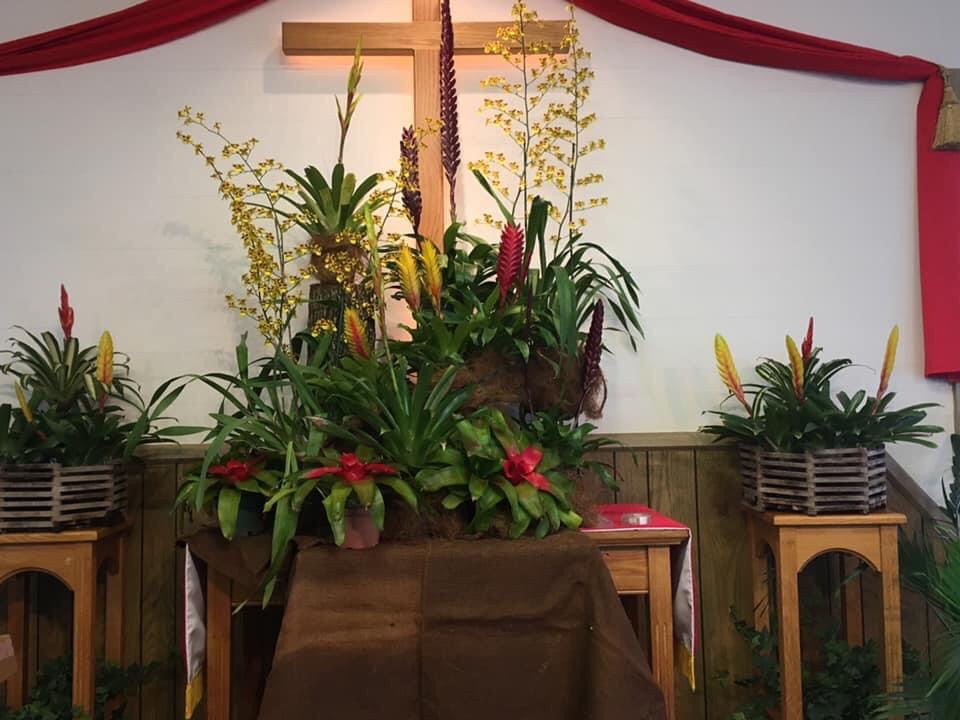
Thanks to the Geiger family for Pentecost altar flowers.

Correct Assessments

Pastor Sherry’s message for March 21, 2021

Scriptures: Jer 31: 31–34; Ps 51: 1–10; Heb 5: 1–10; John 12: 20-33

Do you remember a Scottish woman named Susan Boyle? She appeared on an English TV program called Britain’s Got Talent in 2001. She wowed the skeptical judges with her stunning rendition of “I Dreamed a Dream” from Les Miserables.

You may remember that she looked fairly frumpy; both the audience and the judges were cynical and dismissive, until she began to sing! Then they were awed and astonished. She has since gone on to improve her appearance and create award-winning albums.

Susan’s story proves the adage that we should not judge a book by its cover. Psychological research on perception says that we tend to size a person up in five seconds. We decided we would or would not like them based on very little information. We take more time than this to buy a car or rent an apartment. This makes it easier for us to quickly move on to other things but it also results in some misperceptions and erroneous assumptions.

Thankfully, our God has much more information on people and events than we do, and never makes some wrong assessment. His assessments are always correct!

Let’s start with our Jeremiah passage. Just prior to the passage, God says through His prophet to the Israelites, I have loved you with an everlasting love. God is foretelling the day when he will call all the Jews who are scattered throughout the world back to Israel. He will make a new covenant with them. Instead of abandoning them due to their unwillingness to except His son as Messiah, He will write his law upon their hearts. Instead of punishing them for turning away from Jesus, He will claim them to Himself again. As Peterson translates it, “they will no longer go about setting up schools to teach each other about God. They’ll know me first hand, the dull and the bright, the smart and the slow. I’ll wipe the slate clean for each of them. I’ll forget they ever sinned.”

We should rightfully expect judgment, but instead we get mercy, grace, forgiveness, and that everlasting love only God radiates. How surprising! How wonderful! How humble and grateful we should be that God assesses us and still desires to be in close relationship with us all.

Psalm 51: 1–13 is King David’s great penitential Psalm. He has broken the sixth, seventh, and tenth commandments. He had set up Uriah, a loyal bodyguard, to be murdered so that he could claim his wife, with whom he had had an adulterous relationship. And he kept quiet about his massive sins, only to suffer torment he was highly anxious and miserable.

When I kept it all inside, my bones turned to powder, my words became day long groans. The pressure never let up; all the juices of my life dried up.

The writer to the Hebrews (4:13) observes nothing in all creation is hidden from God’s sight. Everything is uncovered and laid bare before the eyes of Him to whom we must give account.

Sure enough, God dispatches the prophet Nathan to confront him in story form. David could’ve lied and blown Nathan off. Like many absolute rulers, he could’ve had him killed. But in a plot twist from what one might have expected from any other ancient Middle Eastern king, David admits his guilt—he takes responsibility.

  • For his transgressions—Stepping over God’s boundaries, he transgressed against Bathsheba, Uriah, and to his family. He was a poor example to his sons and to his nation.
  • For his iniquities— those things that are grossly immoral and thoroughly wrong: adultery, murder, covetousness.
  • For sins— failure to meet God‘s standards.

However, David does provide a good model for us in this Psalm. He admits his sins, transgressions, and iniquities; he begs God‘s forgiveness, and he asks God to transform him by the power of his Holy Spirit. In today’s “cancel culture,” David would be toast. His life and his legacy would be ruined. But our God loved his heart, took pity on him, and forgave him. I don’t know about you, but this is the kind of correct assessment I would prefer God had of me.

Hebrews 5:5-10 is making it clear to us that Jesus is our great high priest. But he’s from the tribe of Judah, not descended from Aaron, nor a member of the Levites the priestly clan. However, given God’s correct assessment, the Father defines Jesus as our high priest in the order of Melchizedek. Melchizedek is first mentioned in Genesis 14. He congratulates Abraham on his victory against four pagan kings and blesses Abraham in the name of the Most High God. As king of Salem, he gives Abraham bread and wine. Then Abraham awards him a tithe.

John 12 2333, some Greeks come to ask Jesus their questions. As outsiders they were consigned to the court of the Gentiles in the temple and could not be present to hear Jesus teach. They approach Phillip, perhaps because his name is Greek, who with Andrew bring them to Jesus’ attention. Jesus, knowing He is soon facing the cross, meets with them briefly. We don’t know what the Greeks expect or want to ask. But Jesus reiterates He is going to die.

A millennium later (Psalms 110:4), David speaks prophetically of a priest and king to whom he would bow, Jesus the Messiah. Today’s passage from Hebrews, written just after Christ’s Ascension, asserts that Jesus is a high priest from the order of Melchizedek, a higher order than the Aaronic or Levitical priesthood. Speaking God’s truth and accurately predicting His death, resurrection, and the destruction of Jerusalem, Jesus was a prophet in His earthly ministry. He will come again in glory as the universal king. And here we learn Jesus is our great high priest.

The kernel that falls to the ground but results are much fruit and many other seeds

He knows he’s going to the cross and it’s going to be very painful. He doesn’t want to, but he will. For the third time, God speaks encouragement to him. He will be lifted up as His followers hope, but on a cross not to a kingly throne…yet. Nevertheless, over hundreds of years, has He not drawn millions to Him?

So often our God does the opposite of what we might expect, or even what we wish Him to do, so how might we deal with this? We might want to remember that God’s assessments are always correct. We tend to trust in our own perceptions. Experience tells us we are sometimes—maybe even often—wrong. Nevertheless, we worship a God who is always accurate in his assessments.

Are we going to trust in our own perceptions or in God’s accurate assessments?

Proverbs 3:5– trust in the Lord with all your heart and lean not on your own understanding.

Proverbs 28-26– he who trust in himself is a fool, but he who walks in wisdom is kept safe.

Prayer:

Lord, help us to put our trust in you, even above ourselves and our own perceptions, judgments, and assessments. Help us to rightly discern the truth and to live lives that are pleasing in Your sight. We pray this in the mighty, compassionate, grace-filled, and always accurate name of Your son, Jesus Christ. Amen.

Copyright 2021 Rev. Dr. Sherry Adams

The Saving Power of God

Pastor Sherry’s message for March 14, 2021

Scriptures: Num 21:4-9; Ps 107:1-3, 17-22; Eph 2:1-10; Jn 3:14-21

Stories are told—true stories—of both Queen Elizabeth and Queen Victoria pardoning someone who had incurred the death penalty. In Queen Elizabeth’s case, the queen was traveling by barge on July 17, 1579. Not realizing her majesty was cruising through the area, a young man named Thomas Appletree was firing off shots into the air to impress his friends. Unfortunately for him, one of his bullets came within 6 feet of the queen, seriously wounding one of her rowers. The queen offered encouragement to the wounded man while young Appletree was summarily arrested by her guards and later condemned to death. Just as Appletreewas being led to the gallows, however, a pardon arrived from the queengraciously sparing his life. We don’t know her motivations. Perhaps she realized it had been a careless accident, “no harm, no foul.” Or maybe she had an appreciation for the folly of youth. Whatever the case, she let the guy go free.

In Queen Victoria’s case (just 18 years old when she came to the throne in 1837), she was asked to sign some documents, one of which concerned the execution of a criminal. She was reluctant to do this and asked, “And must I be a party to his death?” The Prime Minister answered, “I fear it is so, unless Your Majesty desires to exercise her royal prerogative of mercy.” In a surprising move for someone so young and so new to power, she responded, “As an expression of the spirit in which I desire to rule, I will exercise my royal prerogative.” She wrote, “Pardoned” on the document, and the man was freed.

​In both examples, neither fellow to be executed had any power to save himself.  Instead, both were pardoned by the sovereign authority—really by the saving grace–of God and of his compassionate monarch.

​Our scripture lessons today all attest to the saving power ​of our God:

Numbers 21:4-9 Recounts the 8th and final incidence of the Israelites grumbling against God during their desert wanderings.

No doubt they were tired of trudging across desert terrain, of the unchanging wilderness landscape, and of the food—marvelous though it was! Even a daily ration of steak or lobster would lose its appeal if that were all we had to eat.  So, they declare (v.5)àWe detest this miserable food. Despite the fact that it tasted good (like honey and coriander); was so nutritious that they had no diseases, cancers, or flues for 40 years; and they didn’t have to produce it by digging or hunting. They simply had to gather the flakes from the ground each morning.  Falsely asserting that they had it so good back in Egypt, they grumble one too many times.

Their behavior is what we might call “snarky,” or “snaky,” and certainly demonstrated a lack of gratitude to God. So, in an apt judgment for their lack of appreciation, the Lord sets loose poisonous snakes among them. No doubt these snakes bit the worst of the complainers first, and then struck fear into everyone else. (I mean, think of it! No chairs in the desert to jump up on to get away. No guns to shoot the things! YIKES!) But, when they beg Moses for help, God also graciously provides a curious snake-bite remedy: He has Moses fashion a snake out of bronze and affix it to a wooden pole, which he raises up so it can be seen. He then tells them that if they are bitten, they can look upon the snake on the pole and be healed.

This incident and God’s antidote are actually a foreshadowing, or a typology of Jesus: The snake represents the peoples’ sins, ingratitude and rebellion. The snake—sin–is nailed to tree, branch, or cross. (In the Hebrew, all three words are the same. Any portion of a tree, even a twig, was called a tree.) Jesus, on the Cross, exchanges our sins for His right-standing with God the Father.

Today’s Gospel, John 3:14-15, references and interprets this Old Testament event. Jesus says, Just as Moses lifted up the snake in the desert, so the Son of Man must be lifted up, that everyone who believes in Him may have eternal life. In other words, as Jesus explains to the Pharisee Nicodemus–and to us–it will be/was necessary for Him to go to the Cross and to die for our sins. We are set free of the penalty for our sins (death) by looking on Jesus with eyes of faith.

John goes on to say, (3:16) For God so loved the world that He gave His one and only Son, so that whoever believes in Him shall not perish but have eternal life. Notice it says that God loves all, but only saves those who believe in Jesus. Under the Old Covenant, we paid the price for our own sins. We raised or purchased an animal for sacrifice. Our sins were transferred to that animal, which the priest then slaughtered in our presence and burned on the altar. We left sin-free until we sinned again and had to do the same thing over and over. But under the New Covenant, we are forever saved by the power of God through our faith in the sacrifice of Jesus on our behalf. Please don’t miss the symbolism: Sin (not Jesus) is the snake! But through Jesus, our sin is nailed to the Cross of Christ–nothing else has to die and we are pardoned.

In Ephesians 2:1-10 Paul wants us to be mindful of the fact that we have no power, within ourselves, to save ourselves. Just like the two Brits who were saved by the two young queens, we are guilty of being sinners.

Paul writes, (verses 1-3, Peterson’s The Message) It wasn’t so long ago that you were mired in that old stagnant life of sin. You let the world, which doesn’t know the first thing about living, tell you how to live. You filled your lungs with polluted unbelief, and then exhaled disobedience. We all did it, all of us doing what we felt like doing when we felt like doing it, all of us in the same boat. It’s a wonder God didn’t lose His temper and do away with the whole lot of us. Some scholars believe that, without Jesus, we are all failures, spiritual zombies, lacking any ability to bring ourselves back to life.

But the great Good News is that (v.5)àInstead [of doing away with or executing us], immense in mercy and with an incredible love, He [God] embraced us. He took our sin-dead lives and made us alive in Christ. He did all this on His own, with no help from us! Or, as Paul goes on to explain in verses 8-9 (NIV) For it is by grace you have been saved, through faith—and this not from yourselves, it is the gift of God—not by works so that no one can boast.

Another of my heroes of the Christian faith is Martin Luther, the German reformer in the 1500’s. He had an exacting, critical father who wanted him to be a lawyer. Luther aspired to be a Catholic priest instead.

To his father’s huge disappointment, he did get ordained, but suffered from depression—probably somewhat due to having never received his earthly father’s approval. Luther feared he could never be good enough to please God. It is recorded that he read verses 8-9 in Ephesians 2 one day and had a “Eureka moment!” He realized he didn’t have to work so hard to attain God’s favor. No daily confessions–apparently he had attended confession 2-3 times a day trying to overcome his sinfulness. No repeated praying of the rosary day after day and no need to beat himself with a hand-held whip to atone. Instead, he finally realized that God the Father is not like his continually disapproving earthly father. Because of his faith in Christ Jesus, he had God’s favor. Because of our faith in Jesus Christ, we have God’s favor.

Again, Peterson paraphrases Paul so beautifully here (vv.4-7) Now God has us where He wants us, with all the time in this world and the next to shower grace and kindness upon us in Christ Jesus. Saving is all His idea, and all His work. All we do is trust Him enough to let Him do it. It’s God’s gift from start to finish! We don’t play the major role. If we did, we’d probably go around bragging that we’d done the whole thing! No, we neither make nor save ourselves. God does both the making and saving. God loves us, but His holiness and His perfect justice require that we confess our sins to and verbalize our need for Him. He has the power and the grace to then forgive us due to Jesus’ atoning death on the Cross, and to (pardon) save us.

Psalm 107:1-3, 17-22 spells out for us our appropriate response: In verse 1 the psalmist says we want to give thanks to the Lord because He is good to us and loves us. In verses 17-23 he exhorts us not to be rebellious and ungrateful, like the Israelites in the desert. In essence, we are urged to recognize God’s saving power.

The stories of the pardons of the two British queens are very grace-filled, are they not? They were gracious and magnanimous enough to eliminate the men’s punishment. But let’s remember that our God has done them one better. He didn’t just pardon us. He pardoned us thentook our sentence, the death penalty, so that justice was fulfilled and we wouldn’t have to pay the price There’s a contemporary Christian song with the following, relevant lyrics:

Amazing love, oh what sacrifice,

The Son of God given for me.

My debt He paid and my death He died

That I might live.

Thanks be to God who gives us the victory through our Lord Jesus Christ!

C 2021 Rev. Dr. Sherry Adams

We Hate To Wait.

Pastor Sherry’s message from December 6, 2020.

Scriptures: Isa 40:1-11; PS 85:1-2, 8-13; 2 Pet 3:8-15a; Mk 1:1-8

WE hate to wait, don’t we?  We are used to fast food, fast times in the ER,  ATM’s that work quickly, vending machines that pop out a soda or water in seconds, and rapid computer start-ups.   And we can get very impatient if things take longer than we expect them to.

But God doesn’t appear to mind having us wait.   First of all, He operates out of KYROS –God’s time, not KRONOSour time, chronological time.

Secondly, God has things to teach us while we wait.

Our Scriptures today all have something to tell us about waiting:

In 2 Peter 3:8-15a, Peter reminds us that God himself is patient.  He calculates time differently than we do–vv.8-9–With the Lord a day is like a thousand years, and a thousand years are like a day.  The Lord is not slow in keeping His promises, as some understand slowness.  He is patient with you, not wanting anyone to perish, but everyone to come to repentance. 

It may seem like He is slow to keep His promises (a day is like 1000 years); but, even so, He patiently delays because He wants to give us time.  He wants everyone possible to come to a saving faith in His Son, Jesus.  Consider what God told Abraham about the Canaanites:  He said Abraham’s numerous descendants would sojourn as captives in Egypt for 400 years, until the time of the Canaanites had come to an end.  Apparently God was informing these pagans about Himself during that interval and they rejected Him.  He gave them 400 years to come to Him and they apparently refused.  So, when the Israelites came into the Land of Promise, God told them to wipe out all the tribes of nonbelievers who were there.  If you want to stop smoking, you don’t hang out with smokers.  If you want to quit drinking, you don’t hang around drinkers.  God wanted His chosen people to remain faithful to Him and not adopt pagan ways.  The Israelites were disobedient.  They fraternized with the non-believers then let live and became idolaters, bringing upon them God’s punishment.

On the other hand, when God takes action, the swiftness with which He moves will blow your hair back!  He’ll move when you least expect it, v.10–But the day of the LORD will come like a thief.  We’ll all be shocked at how quickly He acts then.  So, we need to be prepared, to be ready.  The season of Advent reminds us to prepare our hearts to celebrate His first coming, and to anticipate His second coming, His triumphant return in majesty and authority.  Thus, we might be able to better bear up under waiting if we can remind ourselves that God Himself is patient.

Our Old Testament reading is from Isaiah 40:1-11.  These famous words are sung in arias in Handel’s Messiah.  1st, the Lord speaks a word of reassurance:  verse 1–Comfort, comfort my people; speak tenderly to Jerusalem and proclaim to her that her hard service has been completed, that her sin has been paid for, that she has received from the Lord’s hand double for all her sins.

The double comfort is an emphatic reassurance of God’s tenderness and goodness.  God is announcing, through the prophet, that their 70 year captivity in Babylon is ended.  The people have paid for their sins, and God is about to engineer their release and return to Jerusalem.

Verses 3-5 explain that John the Baptist is going to show up and point out the Messiah.  Our Gospel (Mark 1:1-8) lesson echoes this passage and identifies John the Baptist as the long prophesied forerunner of Christ.  Mark quotes from Malachi 3:1–“See. I will send my messenger, who will prepare the way before me.  Then suddenly the Lord you are seeking will come to His temple; the messenger of the covenant, whom you desire, will come,” says the Lord Almighty.  Then Mark recites Isaiah 40:3A voice of one calling [John] in the desert, prepare the way for the Lord; make straight in the wilderness a highway for our God.

            In verses 6-8–God reminds us of how short our lives are compared to the eternal value of God’s Word—His Word written, the Bible; and His Word made flesh, Jesus.  You may recognize verses 9-11 as another of the arias in Handel’s “Messiah.”  The prophet tells us that Jesus will come with power at His 2nd Coming; but He will be a tender and gentle shepherd during His 1st Coming.  In other words, we can wait patiently because wonderful things are sure to happenAnd did you notice that our God loves to comfort us!

            The portions of Psalm 85 we read today, remind us that God keeps His promises to His people:  Messiah is coming.  When He comes again, He will bring a world-wide peace.  Furthermore, the psalmist speaks of several qualities as if they were living beings, saying thatlove and faithfulness will meet at Jesus’ return;  righteousness and peace will kiss each other;faithfulness will spring forth from the earth;and righteousness will look down from heaven.  In other words,Jesus will arrive with these four attributes:  love for us;faithfulness to God’s direction;righteousness, or right living; and God’s deep shalom Peace.

Jesus is coming, John the Baptist will prepare folks for His arrival, and Christ will demonstrate peace, love, holiness, and faith.

We hate to wait, so what thoughts might help us wait with grace?  It has been said that we can bear any how if we know the why.

First, I believe we need to understand that waiting can reveal to us our true motives.  Waiting requires that we are committed enough to take some time for things to unfold.  If we cannot wait, we might just have to ask ourselves how committed we are to God or to someone else we are waiting upon.  If we are so “me focused” that we are impatient, we may lack that commitment and perhaps are unwilling to postpone our own gratification.

Second, waiting builds the spiritual fruit of patience.  The old saw goes, Don’t pray for patience.  If you do, God will put you in a situation that requires that you develop it.  God will and does answer that prayer, but you may wish He had taught you that virtue another way.

Third, waiting builds anticipation, so that we better appreciate those things that did not come to us immediately.  One Christmas, my daughter located all of her gifts that I had hidden away prior to wrapping them.  On Christmas morning, she asked where a purse was that I had gotten her.  I had forgotten it and even where I had put it.  She knew where it was and that gave her secret away.  I asked her if it had been worth it to have found everything ahead of time.  She was sorry that she had spoiled her surprises. Similarly I think when we have to work hard for something and wait to gain it, we tend to value it more when it comes to us.

Fourth, waiting builds intimacy with and dependence upon God.  As we wait, we either come to believe that God is not answering our prayers and lose heart—or even get angry with Him—or we deepen our faith in Him.  As we see Him then resolve what we had asked Him for, we become more dependent on Him, more surrendered to His will.

Finally, we want to remember that waiting is the crucible of the saints!  Waiting is a grand Biblical tradition:

  1. Abram waited 25 years for Isaac; (his descendants waited 440 years to inherit the Land).

2. Jacob, Abraham’s  grandson, worked for his shifty Uncle Laban 21 years                                before returning to “the Promised Land” as Israel.

3.  Moses waited 40 years + 40 more years (in the back of beyond as a

shepherd) before he led the Israelites out of their Egyptian bondage.

4. King David was anointed by Samuel, then waited 20 years to actually become king.          

5.  Even Jesus waited.  He could have been teaching and preaching from age 12, but God sent Him back to Nazareth to grow in stature with God and humans before beginning His ministry at age 30.

Waiting molds and shapes our character.  God uses it to train us (to help us learn to trust him and to persevere in doing the right thing).  God uses the time to burn off such impurities as impatience, pride, lust, greed, etc.   God uses waiting to make us dependent upon Himself.  The prophet Isaiah extolls the value of waiting in Isaiah 40:31àThose who wait upon the Lord will renew their strength; they shall mount up with wings like eagles; they shall run and not grow weary; they shall walk and not be faint.  The psalmist of Psalm 27:18 writesO tarry and await the Lord’s pleasure; be strong and He shall comfort your heart; wait patiently for the Lord.

We have a God who keeps His promises, and who often requires us to wait!

Let us wait in faith.   Let us not grow anxious or weary, but, instead, let’s trust in God’s goodness and loving kindness towards us, and in His perfect timing!  Amen and Amen!

©2020 Rev. Dr. Sherry Adams

It’s Good to be Humble

Pastor Sherry’s message for November 1, 2020

Scriptures: Joshua 3:7-17; 1 Thess 2:9-13; Matt 23:1-1

Back before the Civil War, there was an exchange in the US Senate that went something like this: The senator from North Carolina pontificated,I come from North Carolina, a great vale of humility, lodged between two mountains of conceit.” The two mountains of conceit he was referring to were his neighboring states of Virginia and South Carolina.While there is nothing new under the sun regarding human nature, how gentlemanly an insult that was compared to the way our politicians attack one another today. Not to be outdone, the senator from Virginia stood and replied,“That is true but only because North Carolina has a lot to be humble about.” The Virginian meant his remarks as a slur, thereby missing the point that, according to our Lord, It’s Good to be Humble.

Several of our Scriptures today testify to this point. In our Old Testament lesson, Joshua 3:7-13, the people of Israel are poised to enter the Promised Land. As we read last Sunday, Moses has died and has passed on the mantle of leadership to his assistant, Joshua. Now Joshua announces to the people how the Lord intends for them to proceed into Canaan: The Jordan River, massively swollen from Spring rains, is at flood stage. Rivers at flood stage flow quite quickly and carry a lot of debris. You don’t want to step into one as you might be swept off your feet by the current or hit by a floating tree truck. Nevertheless, the priests are to carry the Ark of the Covenant into the midst of the river. Once they do, the river’s flow will stop and the people will pass over on dry land. From the time the Ark had been constructed, it had been carried on two long poles supported by priestly shoulders and suspended from golden loops—i.e., it was not to be touched by human hands. The Ark of the Covenant was holy—set apart—for the Lord.

Now remember how God had parted the Red Sea: Moses held out his staff and a strong wind separated the ocean. Crossing the Jordan perhaps took more faith as there was no such demonstration. Those poised on Jordan’s banks had only heard the stories of the Red Sea Crossing and the 10 Plagues upon Egypt.

Only Caleb and Joshua had actually experienced these miraculous events. So, what was God demonstrating by leading His people with His Ark? All throughout the wilderness wanderings (40 years), the Ark had traveled, or rested, in the middle of the camp. This had signaled to them that God was in their midst. Now, though, the Ark was to go first, signifying:

(1) God is leading His people (as Hebrew shepherds do).

(2) He is more powerful than the gods of Canaan. Baal, chief of the Canaanite gods, had—by legend–defeated the gods of the sea. So the Canaanites believed the flood waters of the Jordan were Baal’s efforts to prevent the Israelites from entering what they considered to be their land. God is going to demonstrate to everyone that flood waters are no barrier to Him.

(3) Additionally, God will assist them in overcoming the tribes who now occupy the land (Canaanites, Hittites, Hivites, Perizzites, Girgashites, Amorites, and Jebusites). No doubt the folks in Jericho thought they had plenty of time to prepare for a big fight. It would never have occurred to them that the God of the Israelites could or would stop and cross a flooding Jordan.

(4) And since God was leading the Israelites, He is claiming Canaan—the Promised Land—as His own (which of course it was). The people were to pass by the Ark about 3,000 feet distant. Scholars tell us the Ark is a “type” (symbol) of Christ; after all, Jesus is Emmanuel, GOD with US. (By the way, when the Israelites camped, they arranged the members of 3 tribes to the North, three tribes to the South, 3 tribes to the East, and 3 tribes to the West of the Ark, which was in the middle of all 12 tribes.)

(5) Finally, since it occurred just as Joshua predicted, God is demonstrating His confidence in Joshua as Moses’ successor. Joshua is actually a great example of a humble leader. He does not assert himself as God’s choice, but instead obediently follows through on God’s instructions; and he allows God Himself to confirm him as God’s choice of a leader.

Our Epistle lesson today is from 1 Thessalonians 2:9-13. In it, Paul expresses his gratitude to the church at Thessalonica for their faithful obedience to the Word of God. Paul had brought them this word. He thanks God for them because they believed the Gospel. He commends them for faithfully serving God, and for being humble and obedient to Jesus. He reminds them that he was simply doing God’s will and God’s work when he came among them. Paul claims to have ministered to them in humility and encourages them to follow his example.

Our Gospel lesson from Matthew 23:1-12 shows Jesus publically denouncing the Scribes and Pharisees for their overweening pride. Remember, they have dogged Him as he has attempted to teach in the Temple, and have asked numerous questions to try to entrap Him so they could have Him arrested. The role of the Pharisees and the Scribes was supposed to have been to teach the people how to live in relationship with God. They were to explain who God is, what God expects of us (the Law), and how to talk to Him and hear from Him. That’s pretty much what the job of a pastor is today.

Jesus first commends them, saying (v.1) theysit in Moses’ seat….

Moses collected and taught the meaning of the 10 Commandments. They are continuing his function as teachers of the Law. Jesus is saying they have authority to do so. However, He goes on to qualify this in (v.3) So you must obey them and do everything they tell you. But do not do what they do, for they do not practice what they preach. You see, the Scribes and the Pharisees made two mistakes:

(1) They preached religiosity (live by the rules) rather than relationship;

(2) And they didn’t live up to the standards they taught–like the politicians and news commentators who have condemned us for not wearing masks, then were caught on camera not wearing masks themselves.

We look at folks like that and say, “Hypocrites!” Rather than remaining humble and obedient to God, the Pharisees wore large symbols of their special office, to draw attention to themselves. They also enjoyed special treatment, privileges, and deference. Furthermore, they gave themselves special titles: Rabbi/teacher when only Jesus is our Rabbi; and Father when only God is our Father.

Now I wear robes and you call me Pastor—is that bad? No, some terms and clothing help us both to remember the duties of the office. What Jesus has a problem with is pride that comes from such things. He clarifies this when He says, (vv.11-12) The greatest among you will be your servant. For whoever exalts himself will be humbled and whoever humbles himself will be exalted. Jesus does not want us to get carried away with pride. Jesus wants us to stay humble. Jesus wants us—like Joshua, Paul, and the Thessalonians—to remain obedient to God’s authority.

Today the Christian Church celebrates All Saints Day. I believe one of the marks of a true saint is not so much holiness (who of us is truly holy?) as the recognition that we are set apart for God. God has done this for us. Our appropriate response is our humility. We are all called to be humble servants of God. In our country today, we have replaced our belief that we all have equal rights and opportunities with the secular notion that–no matter how we behave–we have the right to be proud of ourselves and to demand that others respect us. Even in the Church today, we have replaced an awareness of our sinfulness and our need for a Savior—and gratitude for the great gifts of Jesus’ sacrifice and of His forgiveness and grace–with the simplistic notion that “God loves you no matter your behavior.” He does love us just the way we are, but He also loves us too much to leave us that way. So, unlike the Scribes and Pharisees, or any other proud and puffed up religious leaders, we want to be humble. We want to remember and emphasize loving the person over the rule. We don’t want to be “all show and no go.”

Today, All Saints Day, let us humbly remember that God’s love for us is more a function of His grace andmercy than of anything we have done or deserve; that we are all called to love and serve others—not as arrogant or proud persons–but as Servants of Christ. And let us remember that it’s good to be humble!

Copyright 2020 Rev. Dr. Sherry Adams