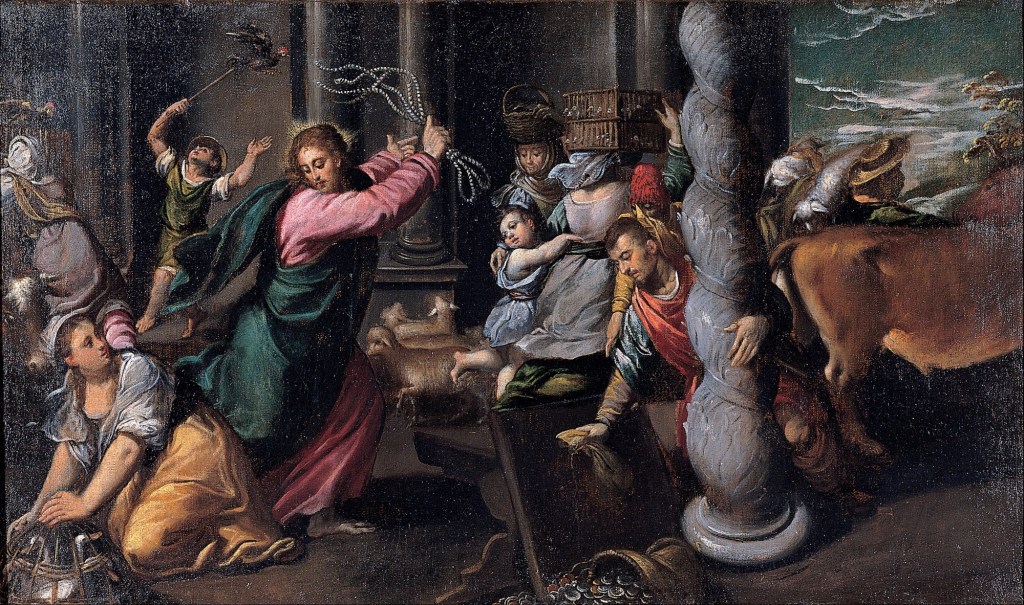
Setting Us Right With God

Pastor Sherry’s message for February 25, 2024

Scriptures: Gen 17:1-7, 15-16; Ps 22:23-31; Ro 4:13-25; Mk 8:31-35

I read a humorous story this week.  Again, it has to do with a child’s perception of how things “ought to be”:

“A Sunday School teacher held up a portrait of Christ. She explained to the class that it was not an actual photograph of Christ but only an artist’s conception of what Christ might have looked like.

‘’But,’ said one little girl, ‘you’ve got to admit it looks a lot like him.’’’

(Borrowed from a sermon entitled, “A Pair of Ducks and Abundant Life,” www.sermons.com, 2/23/2024).

Isn’t that just the cutest thing?  I love how literal children tend to be and the humor that often results.  Little kids are trying to figure out how things in life work.  I remember when my 49 year old son was about 2 or two and a half and was trying to figure out animal categories. We had a dog with 4 legs, two ears, and a tail. In his child-logic, he looked at cows and told me (since they had 4 legs, 2 ears, and a tail), “Moo-tows are Biggggg doggies!”

It would be interesting to hear a child’s perspective on the elderly Abraham—at a great-great grandparent age—having a baby and his faith that God’s promise to him could still come true.  This constitutes the focus of several of our readings this morning:

A. In our Old Testament reading, Genesis 171-7, 15-16), God appears to Abraham for the 5th time, and reiterates His Covenant Promises:

God is giving him lots of land (the Promised Land, Canaan, or present day Israel; and even a baby from him and his elderly wife, Sarah.  Notice, the passage emphasized Abraham’s age, 99 (Sarah’s is 89).  God the Father wants Abraham—and us– to know that neither Abe’s biological age, nor his body’s elderly condition, could prevent God’s from fulfilling His promises.

Our God is capable of making awesome promises, with spectacular fulfillments.  The Israelites later did occupy God’s Land Grant.  And, at age 100 for Abraham (and 90 for Sarah), Isaac was born to them.  The Jewish people came from Abe via Isaac, and later Jacob.  The Arab people came from Abe via Ishmael, and Jacob’s twin, Esau.  By now, those two people groups constitute, in fact, millions upon millions of Abraham’s descendants.

B.  Paul is very taken by this fact, as evident in today’s epistle reading from Romans 4:13-25.  He is arguing for Abraham’s faith, and the need for our faith!  He is saying God fulfilled His promises to Abraham not based on anything Abe had done for God (except for trusting in Him).  God fulfilled His promises to Abraham due to Abe’s faith in the Lord to fulfill His promises.  This is so important for us to understand!  We are to trust in God, as Abraham did.  We are not looking for a promised baby in our old age, or a promised land.  We are looking for salvation.  Perhaps we are looking for healing or for peace.  We are anticipating living with God forever in Heaven—our happy ending.  But none of these gifts are due to any of our actions or our works.  Our salvation comes from the actions, the completed work of Jesus Christ and Him alone. 

Who would have thought His death on the Cross and His resurrection would be the means by which God would redeem us?  Who would have thought a 100 year olf man would birth a man who would then go on to have…first 2, then 12, then dozens, then hundreds, then thousands, then millions of descendants?  Clearly Isaiah the Prophet was correct when he quotes God as saying (Isaiah 55:8-9, as per Peterson’s The Message, p.1317)”I don’t think the way you think.  The way you work isn’t the way I work.”  God’s decree.  “For as the sky soars high above earth, so the way I work surpasses the way you work, and the way I think is beyond the way you think.“

Our God makes awesome promises.  He provides spectacular fulfillments.  In deed, He set us right with Himself.

C.  This is why Jesus gets so upset with Peter in today’s Gospel (Mark 8:31-38).  This interaction takes place just after Peter tells Jesus, “You are the Christ,” meaning the Messiah or the Anointed One.  It is also just before Jesus reveals Himself as God on the Mount of Transfiguration—during which Peter is present.  Jesus is trying to tell them all what His mission entails:  To redeem human kind, He must (v.31)— …suffer many things and be rejected by the elders, chief priests, and teachers of the Law, and that He must be killed, and after three days rise again.  Peter was so outraged after hearing this that he probably stopped listening when he heard Jesus say He would be executed.  We can imagine this, can’t we?  It’s just so human.  We don’t want someone we value or love or admire to die early.  Neither do we want them to die a horrible, gruesome death.  No, we want them to continue to live so we can enjoy their presence.  In speaking up so, poor Peter doesn’t realize he has just voiced to Jesus Satan’s short cut—take the crown but reject the cross.  Poor Peter doesn’t realize until he’s said it that Satan has used him to again tempt Jesus.  Jesus’ response is swift, isn’t it? (V.31)—Get behind Me, Satan!  Then He admonishes Peter—You do not have in mind the things of God, but the things of men.  Or, as Peterson paraphrases it, Peter, get out of My way.  You have no idea how God works.”

It’s true, isn’t it?  Peter doesn’t want Jesus to suffer and die.  He wants Him to keep on teaching, interpreting Scripture, healing, and casting out demons…being his friend.  Obviously, these are the desires of men and women, but in this case, not of God.  Having total faith in the Father, Jesus is committed to doing God’s will God’s way.  Nothing will deter Him from it.

He knows His mission is a huge undertaking. It is nothing less than setting us right with God! 

D.  Additionally, Jesus is familiar with Psalm 22.  We will note on Good Friday that the first portion of the psalm predicts Jesus’ thoughts from the Cross.  In the portion assigned to us today, verses 23-31, King David (and later Jesus) assert that they will praise God the Father amidst the congregation of all the people.  Even from the cross, Christ will trust that God still loves Him.  The hours on the cross, when Jesus becomes sin for us, the Father will turn His face from Him.  Nevertheless, He knows His Father is waiting to welcome Him back, to resurrect Him.  Too exhausted to speak, He praises God in His heart, crying out only (v.31) Tetelestai/it is finished.

Jesus’ final words from the cross are that He has completed the work of redemption the Father gave Him to do.  He has set us right with God again.

Thank you, Jesus, for Your courage and bravery!  Thank you for Your great agapeo (New Testament)/hesed (Old Testament) love for us.  Your loyal, everlasting, long-suffering love for us.  Thank You that You love us enough to have done for us what we could not do for ourselves.  Thank you for setting us right with God.

None of us knows what You look like, but I’ll bet Your face in Your resurrected body is beautiful.  (Isaiah said that His face would be unremarkable in His first Coming, so as to not attract the kind of fame a rock star gathers about himself; see Isaiah 53:2.)  Keith Greene, a Christian musician who died at 28 years old–way too young–in a 1982 plane crash, wrote and sang a song about the face of Christ.  The words go like this: 

Oh Lord, You’re beautiful,

Your face is all I see,

For when Your eyes are on this child,

Your grace abounds to me.

I want to take Your word and shine it all around

But first help me just to live it, Lord

And when I’m doing well help me to never seek a crown

For my reward is giving glory to You.

Oh Lord, please light the fire

That once burned bright and clean

Replace the lamp of my first love 

That burns with holy fear.

Oh Lord, You’re beautiful,

Your face is all I see,

For when Your eyes are on this child,

Your grace abounds to me.

Listen here.

May it be so for each of us.  Amen and Amen.

©️2024 Rev. Dr. Sherry Adams 

The Crown Without the Cross

Pastor Sherry’s message for February 18, 2024

Scriptures: Gen 9:8-17; Ps 25:1-10; 1 Pet 3:18-22; Mk 1:9-15

I read a funny story the other day that I want to share with you:  

“The local sheriff was looking for a deputy, and one of the applicants – who was not known to be the brightest academically, was called in for an interview.  “Okay,” began the sheriff, “What is 1 and 1?” “Eleven,” came the reply. The sheriff thought to himself, “That’s not what I meant, but he’s right.”

“Then the sheriff asked, “What two days of the week start with the letter ‘T’?” “Today & tomorrow.” Replied the applicant. The sheriff was again surprised over the answer, one that he had never thought of himself.

“Now, listen carefully, who killed Abraham Lincoln?”, asked the sheriff. The job seeker seemed a little surprised, then thought really hard for a minute and finally admitted, “I don’t know.” The sheriff replied, “Well, why don’t you go home and work on that one for a while?” The applicant left and wandered over to his pals who were waiting to hear the results of the interview. He greeted them with a cheery smile, “The job is mine! The interview went great! First day on the job and I’m already working on a murder case!”

(Borrowed from www.sermoncentral.com, 2/16/2024.)

Our Gospel this morning comes from Mark 1:9-15.  You may recall that we have jumped about some in Mark since Epiphany.  We have focused on Jesus’ choice of His disciples.  We have looked at His demonstrations of His power over the supernatural realm and over physical illness.  Last Sunday, we encountered His revelation of Himself, to Peter, James, and John in all His heavenly glory, on the Mount of Transfiguration.  This included God the Father’s order to the disciples to listen to Jesus.  They were reminded that Jesus goes where the Father directs Him, not where they might think He should go.

How odd, then, that we backtrack to the very beginning of Jesus’ ministry today:  He is baptized and blessed by the Father.  This is so very important because psychological research has revealed that fathers convey self-esteem on their children.  God the Father blesses Jesus before He launches on His ministry.  Then, the Holy Spirit leads Him into the wilderness to be tempted.  We could say it is Jesus’ 1st day of His public ministry—His 1st day of walking in His calling.  There is a lesson here for us:

Before He even really begins, He is confronted with three grave temptations.  Satan is trying to get Him to take a short cut or to “do things the easy way.” God the Father and the Holy Spirit are no doubt watching and rooting for Him to resist the possibilities of accepting His crown while avoiding the Cross.

Whoever it is that creates the lectionary arrangement of the readings (I think it’s a committee) wants us to realize—before we get too far into remembering Jesus’ ministry—that Satan will always try to pull us away from, or divert us from what God wants to accomplish through us. 

Will we take the short cut the evil one offers?  Or will we persevere through the tough times, remaining obedient to God as Jesus was?

Let’s look at these 3 temptations Satan presented to Jesus in more detail:

A.  There is the temptation to feed Himself:  Turn stones into bread.  After 40 days without food, He clearly must have been hungry.  We can only go three days without water, but people can live longer without food.  We grow weaker and lose a lot of weight, but we can still hang on to life.  The greater issue behind feeding Himself was would He be willing to use His power to satisfy Himself?  In terms of His ministry to redeem the world, this would have been a short-sighted choice.  It would have also indicated a lack of faith in His Father—He surely trusted that His Father would not have allowed Him to die before He even got started.  I remember telling you all once that I was flying back to Pittsburgh, PA, from Jackson, MS, when our plane was stranded on the tarmac during a terrible rain storm.  Once the lightening relented, we took off into the air, but proceeded to bump around a lot, losing altitude quickly in those sickening drops.  The lady seated next to me was a seasoned traveler who flew weekly for business.  She got out the “barf bag” because it she said it was the bumpiest she had ever experienced.  She wondered aloud if we were going to crash.  I told her no—with total confidence—because I was still in Seminary and I know the Lord was not finished with me yet.  God was not yet finished with Jesus, either.

The temptation to feed yourself is a little like the college quarterback who recently spent his $300,000 signing bonus (not to sign on but to return for another season) on a Lamborghini for himself, instead of offering watches, like Tom Brady did, to the lineman who protected him; or even cash for school tuition for those teammates who lacked athletic scholarships.

Jesus said “No” to this temptation to take care of Himself first.  Can this be said of each of us?

If we are as God-focused as Jesus, our tithe would come off the top of our pay.  It should be the first check we write after receiving our pay.  Please understand I am not urging you to give Wellborn Methodist Church all 10% of your resources.  We need enough money to keep the lights on…but you are free to offer a portion of your tithe to other worthwhile charities/causes as well.  The point is that rather than paying down our responsibilities and giving God the little that is left over, we gift God first.

Truly, the issue is, “Do we trust God to take care of us?”  Since I have lived on my own, I have found that the Lord always provides for me.  I might get down to my last dime to my name, but the Lord will come through with additional cash in the nick of time and usually in ways I would never have expected.  Even in the extreme situation of having no food for 40 days, Jesus trusted in His Father.

What about Jumping to your death on the rocks below?  If I were starving, the turning stones to bread would have truly tempted me.

This one, not so much…even if I knew I had the power to save myself.

I’m wary of heights.  I can recall visiting the Grand Canyon, which is a mile deep, and creeping cautiously to the edge to look down—there are no guard rails so you do have to be careful.  And I hate that feeling you get in roller coasters—and even in elevators or planes—of the bottom falling out.  My kids will tell you I scream all the way on roller coaster rides.  Nothing about dropping into thin air tempts me.

But again, Satan has offered Jesus a selfish way to attract attention and gain fame.  This is another cheap way out.  I’ll bet Jesus was tempted by the bread, but this one probably left Him cold.  Recall how often He asks people He’s healed not to tell anyone about it?  Last week He urged Peter, John, and James not even to tell the other disciples what they had witnessed on the Mount of Transfiguration.  Jesus wisely understood that some flashy, dynamic miracle witnessed by thousands would have gained Him too much attention from His enemies.  They would have come for Him before He had completed the work the Father gave Him.  As it was, He knew 3 years was hardly enough time to redeem as many hearts as He hoped to.  By rejecting Satan’s dare, He demonstrated for us that it is better to avoid the easy, splashy alternative, and just do the work set before us.

The third and last temptation was a doozy!  Serve Satan, instead of God the Father?  Are you kidding me?  Satan was tempting Jesus, who is God, to worship himself, a counterfeit god. This was a challenge to Christ to practice idolatry.  How absurd!  No wonder Jesus directs Satan to be gone from Him.  For us, however, the temptation may be more enticing.

Think of the siren allure of addictions. This substance or behavior will soothe you; it will help you feel nurtured or cared for.  Power and influence can have the same impact.  Watching the Fulton Country (Atlanta, GA) DA is a perfect example of how power and influence can corrupt.   She promised, on videotape, never to sleep with a subordinate.  Not only has she slept with someone she employed, but she paid for lavish trips for the two of them with public funds.  Corruption appears to abound in our federal government and also in state and even local governments.  How many have pilfered tax payer dollars? How many have sold their integrity for generous amounts of cash?  How many are compromised by elicit behaviors that have been videoed, then used to blackmail officials?  We want to remember that whatever we value more than God becomes our false God.

Jesus Christ has shown us the way:  Just say “No” to putting comfort before duty, fame before love of others, and anything before love of God.  Someone has put it this way:

A seeker after truth came to a saint for guidance.

“Tell me, wise one, how did you become holy?”

“Two words.”

“And what are they, please?”

“Right choices.”

The seeker was fascinated. “How does one learn to choose rightly?”

“One word.”

“One word! May I have it, please?” the seeker asked.

“Growth.”

The seeker was thrilled. “How does one grow?”

“Two words.”

“What are they, pray tell?”

“Wrong choices.”

I could be wrong, but I believe God allows us to endure times of testing to strengthen our faith in Him, and to develop our ability to resist the easy shortcuts with which Satan tempts us.

(Borrowed from Brian Stoffregen, Exegetical Notes, published on http://www.sermoncentral.com 2/16,2024.)

Let us keep our eyes on the example of Jesus, choosing to please God and frustrate the devil.  Amen, may it be so!

©️2024 Rev. Dr. Sherry Adams 

Come and Hear for Yourself!

Pastor Sherry’s message for January 21, 2024

Scriptures: 1 Sam 3:1-20; Ps 139:1-6, 13-18; 1Cor 6:12-20; Jn 1:43-51

This weekend, I attended a Retreat put on by my former church in Gainesville, Florida, Servants of Christ Anglican Church. The retreat leadership had texted me in early October to ask me to come and graciously offered to pay my expenses. Later, I learned this was the same weekend of the inaugural conference in Florida of the Global Methodist Church. My head told me I should cancel the healing conference and attend the meeting of our new church peers. But I believe the Holy Spirit protested and insisted I attend the healing retreat instead. Sometimes that is exactly what happens: The Holy Spirit urges you to do one thing while your practical, cognitive mind argues the opposite. I have learned over the years to always obey the leading of the Spirit.

The retreat was held in Steinhatchee, Florida, a fishing village on the Gulf Coast. For the past week and a half, I had been experiencing pain in both hips—pain when walking and pain on trying to rise from a chair or to navigate steps. By the time I arrived Friday evening, I could hardly walk. By Saturday afternoon, when they held their healing service, I had figured out that my feet, my knees, and my hips all needed healing from pain. At night when I laid down to sleep, my legs throbbed. It occurred to me that Satan was trying to either handicap me or to take me out of active ministry. The team I approached for prayer agreed that he was attacking me from the ground up. They prayed that the Holy Spirit would then flood me with a healing anointing from my head down. I immediately felt relief, especially in my hips. No more pain! They had bound the powers of hell from inflicting pain upon me and they prayed that the Lord Jesus would heal and restore me. Like the woman with the 12 year issue of blood (Mark 5:21-43), I had the faith that the Lord had healed me. Since then, with any twitch or ache in my feet, legs, or hips, I have audibly affirmed that I have been healed and have observed that the pain then desists. Clearly the Holy Spirit wanted me to attend that retreat and I am so glad I listened.

This brings me to an important set of questions for you: Do you hear from the Holy Spirit? Do you hear from the Lord? Do you have a place where you can go to be alone and communicate with or hear from the Lord? Many people refer to this special place as their “prayer closet.” It’s separate from other spaces in a house. When you are there, you can count on not having your prayer time disturbed. It’s lovely if you can dedicate a small room or even a walk in closet for this effort. If not, your prayer closet may be your car or your shower; it may also be your garden or your daily jog or walk, or even when you do the dishes. The main point is to locate a space and visit it regularly so you can talk to God and hear back from Him.

In this vein, I want to focus on today’s Gospel, Psalm 139, and our 1st Samuel reading.

A. In our Gospel lesson today (John 1:43-51), Jesus is calling His disciples. In verses 35-42, just prior to today’s reading, Jesus calls the first 3: Andrew and Peter, Andrew’s brother–both from Bethsaida; and a third un-named one who Church tradition says is John, the Gospel’s author. In today’s passage–which takes place 1 day later–Jesus calls Philip. Philip then locates his friend, Nathanael, and tells him (v.45) We have found the one Moses wrote about in the Law, and about whom the prophets also wrote—Jesus of Nazareth, the son of Joseph. Nathanael responds rather sarcastically Nazareth! Can anything good come from there? Philip then invites Nathanael to come and see for himself.

Now let’s take a deeper look at Nathanael. He is also known in Scripture as Bartholomew. Confusingly for us, his names are used interchangeably in the New Testament. Scholars believe Bartholomew may have been what we would call his “last name.” Remember Peter had been known as Simon Bar Jonah, son of Jonah. Nathanael may have been called Nathanael Bar Tolmai, or son of Tolmai, which eventually morphed into Bartholomew.

We don’t know much about him except that he was honest–even perhaps to a fault—and skeptical. It appears he was from Cana, a rival village just over the hill from Nazareth, so he may have been calling on village prejudice when he doubted the Messiah could ever come from Nazareth. It is his honesty that impresses Jesus, Who calls him (v.47) …a true Israelite, in whom there is no guile/nothing false/no deceit.

Jesus is saying that, unlike the Jewish patriarch, Jacob, who was a schemer and a cheat, Nathanael is not. Jesus recognizes him as a guy who calls a spade a spade. He has integrity; he’s authentic; he is not an insincere fake.

Nathanael is naturally curious about how Jesus recognized him and read his character so correctly, since they had never met before. Jesus tells him that He saw him (v.49) …when you were under the fig tree. Fig trees grow out kind of round with branches that may dip to the ground. If a man crawled inside, he could lean against the trunk and be nearly hidden. Or, if the tree were older and larger, he could find respite from the sun and support for his back as he sat beneath it. This is where Jesus had a vision of him. Afterall Jesus, as God, is omniscient, knowing all things. Jesus knew this is where Nathanael had gone to study Scripture and to pray. As He does with any of us (see Psalm 139), Jesus knows our thoughts. There is no place we can run to and hide from Him. Nathanael had been studying Scripture in his “fig tree prayer closet,” seeking to know God better. So Jesus calls him as a disciple.

We can also safely assume, I think, that Nathanael had accurate insight or spiritual discernment. In verse 49 he says Rabbi, You are the Son of God; You are the King of Israel. In that moment, in that brief interaction, Nathanael realizes Jesus’ true identity. Jesus is more than a Rabbi. Jesus, referring back again to the patriarch, Jacob, tells Nathanael he will …see heaven open and the angels of God ascending and descending on the Son of Man (v. 51). The pre-incarnate Christ is the one Jacob saw in his dream of a ladder with angels ascending and descending. Here He is telling Nathanael that He, Jesus, is the ladder [the bridge; the mediator] between God and humankind. Philip invited Nathanael to come and see; but Jesus drew him near to see and hear for himself.

B. Oh, that we all might be such serious readers of Scripture, such dedicated followers of Christ. Our Old Testament lesson from 1 Samuel 3:1-20 describes another person who came forward and heard for himself. In gratitude to God, the barren Hannah, when she conceived and bore Samuel, obediently took him to be mentored and trained up for service to the Lord by Eli, the priest. Samuel was probably 3 years old when Hannah delivered him to Eli, as Hebrew women tended to nurse their babies for that length of time. Unfortunately, Eli was not a good father. His two sons, Hophni and Phinehas, were notoriously evil men. They served at the temple, but had contempt for the Lord and for their father. Eli rebuked them but did not remove them from their priestly duties. Later, God Himself pronounced a death sentence on them and had them killed by the Philistines.

Despite his lack of success as a father, Eli functioned as Samuel’s mentor. Samuel was about 12 or so when God called him twice. Samuel thought he was being paged from sleep by Eli because he did not at this point discern the Lord’s voice. We are told in verse 7 Now Samuel did not yet know the Lord: The word of the Lord had not yet been revealed to Him. This does not reflect at all well upon Eli as a priest. Shame on him! Samuel has been serving God in His Temple at Shiloh for 9 years, but Eli has not taught him about God! YIKES! Telling people about God is the primary job of a priest. No wonder the Lord is going to strip the priesthood from Eli and his descendants. We find in this passage that God is initiating a long-overdue relationship with the young man who had been destined to serve Him since before his birth.

The third time God called him and Samuel mistakenly responded to Eli, Eli figured out that it was the Lord Who was summoning Samuel. Eli tells him to listen to and respond to God the next time He calls his name. Sure enough, God calls him a 4th time and this time Samuel says,(v.10) Speak, for your servant is listening. God then declares a judgment against Eli and his descendants. He also installs Samuel as his prophet, now replacing judges and priests as God’s spokespersons.

So what does this mean for us? Psalm 139 assures us that God knows us and knows our thoughts even before we express them. He seeks us out for relationship. He delights in responding to those of us who have sought Him. And He reveals Himself to those who are ignorant of Him.

If we want to have an intimate relationship with the Lord, we need to spend regular time communicating with Him. We need to locate or set up a prayer closet. We need to spend time reading and thinking about God’s Word.

In closing, I want to share a Christian song with you. It’s sometimes used at funerals—in fact, I would love to have it sung at mine—but it also refers to having attuned your ears to hear from the Lord. In 2010, I went with 9 others on a mission trip to Turkey. This song became our theme song. We sang it to a house church of 40 Iranian Christians, who had already worked a 12 hour day, and yet who crammed themselves into a hot, unairconditioned room in a town in Turkey to worship God and to hear from us. Please listen as we play this acapella version of “There’s a Stirring” from YouTube:

There’s a stirring deep within me

Could it be my time has come

When I see my gracious Savior

Face-to-face when all is done.

Is that His voice I am hearing,

“Come away my precious one”?

Is He calling me?

Is He calling me?

I will rise up, rise up.

Then I’ll bow down

And lay my crown at His wounded feet.

May we all come forth and hear (and respond to) the Holy Spirit when He calls us.

©️2024 Rev. Dr. Sherry Adams

Waiting on Jesus

Pastor Sherry’s message for December 3, 2023

Scriptures: Isa 64:1-9; Ps 80:1-7, 17-19; 1 Cor 1:3-9; Mk 13:24-37

Waiting is difficult, isn’t it? Think of all the times you’ve had to wait…

1. Would you get the job you just interviewed for?

2. What about the results of that medical test or scan you just underwent?

3. Did that person you fell in love with also love you back—remember the agony of that wait?

4. Would your child get into the college or internship of their choice?

5. Would your house sell? Would the sellers of the house you want accept your offer?

6. How about that last month of pregnancy? Would that baby ever make an entrance?

7. What about waiting on a grant to come through or a check in the mail?

8. How about those hostages of Hamas, waiting to be set free, or their families, dying to know how they are?

9. Remember being a kid and having to wait for Christmas morning to finally arrive?

Most of us hate to wait. We wring our hands. We pace the floor. We lose sleep. We grumble and groan and complain. We engage in what addiction counselors are now calling “BEEPS” Behaviors, Experiences, Events, People, and/or Substances that help us self-medicate or suffocate our anxiety as we wait.

(Ed Khouri, Restarting, Life Model Works, 2010, p.32.)

If we’re really smart, we pray and ask God to help us wait, so that we can learn what He means for us to learn during this time; so that we may develop the spiritual fruit of patience.

Today is the first Sunday of Advent—a time of great anticipation as we wait upon the arrival of Jesus.

A. In Isaiah 64:1-7, the prophet reminds us both that God controls the entire universe and that our condition as humans is that of unclean sinners (vv.5-7). Verses 1-2 constitute a cry, a plea for God to come down to earth, to defeat Israel’s enemies (and ours), and to make things right.

Isaiah recalls times God did intervene on the behalf of Israel doing (v.3)—…awesome things that we did not expect. He also reminds them and us, (vv.4-5)—Since ancient times, no one has heard, no ear has perceived, no eye has seen any God beside You, who acts on behalf of those who wait [there it is, wait] for Him. You come to the help of those who gladly do right, who remember Your ways. In other words, we can and should call upon God for help when we are troubled or anxious, when we are worn out with waiting. Isaiah assures us God will respond!

But notice, the prophet attaches this caveat: God rescues those who do the right thing, who remember to do as God would have us do.

I have told you before that I had some difficulty and fear around selling my house when I was leaving seminary. I had listed it in September of 2001, but then 9/11 took place and no one in SW Pennsylvania was buying or selling homes. By January 21, 2002, I had completed my degree but still had no buyers for my home. Worse yet, I had no job and no money. I was sick with a cold and would awaken all through the night whenever I became too congested to breathe. I would take something then return to bed, begging God in prayer to sell my house. Finally, at about 4am, I asked the Lord if I were doing something or not doing something that served as an impediment to Him taking action. I heard Him say, in my spirit, that I had not surrendered to being a lead pastor. He was of course right. I had thought to assist someone, as my gifts are in teaching and counseling, not in administration or leadership. I immediately agreed to surrender to His will, got up at 8:00am, and sent off letters to 4 small parishes in North Florida (I wanted to go home and I wanted a church small enough so I could know everyone’s names.) I put those letters in the mail at 10:30am on January 22nd. My realtor called at 11am with a couple interested in my house. They came at 5:00pm that day and signed a contract by 8:30pm. Additionally, I needed to close on February 7th as my next mortgage payment was due on the 8th and I knew I would be unable to pay it. My Jewish realtor said there wasn’t enough time to make that happen, but I replied that she did not know my Jesus. Sure enough, we closed on my house on the 7th, thanks be to God! I learned from this that God sometimes waits for us to change before He moves on our behalf. We have to be willing to ask if our wills are blocking His will and take action to rectify that.

Finally, Isaiah reminds us in this passage that we are like clay in the great Potter’s hands. We want to conform to His will. We want to allow Him to mold and shape us into the image of our best selves. When we wait upon God to act, God is working on our character, transforming us more and more into the image and likeness of Jesus. We may hate to wait, but God uses that time to do a work in us.

B. Psalm 80:1-7, 17-19, is both a prayer for God to relieve the peoples’ suffering—especially after an attack by brutal enemies—and a plea for God to lead them again. The psalmist, Asaph, a contemporary of King David, appeals to God as our shepherd king as He is enthroned in heaven. He is asking God to move on behalf of His people. In the desert wanderings, the ark and the cloud would move out for the days’ march. This signified that God was their leader. When camped, three tribes situated themselves to the north of the ark, three to the east, three to the west, and three to the south, with God at their center. When they moved, however, the tribe of Benjamin, along with the half-tribes of Joseph’s sons Ephraim and Manasseh (remember, Benjamin and Joseph were Jacob’s two favorite sons), would past like the Red Sea, allow the Ark to lead them, then follow directly behind. Then the other 9 tribes would all fall in behind them as well.

Asaph asks for God’s favor (v.3)—Restore us, O God: Make Your face shine upon us, that we may be saved (This is repeated 3 times). This is a poetic way of saying, smile at us. Demonstrate on your face that you enjoy being with us. Picture how people hold an infant and smile as they talk baby-talk to the new little one. Our faces often “shine upon” or look with great favor upon babies when we talk to them.

He also uses the images of eating and drinking tears to describe how much Israel has suffered. Some biblical experts believe there is no nation ever that has suffered to the degree that Israel has—and survived. (J. Vernon McGee, Commentary on Psalms, Chapters 42-89, Thomas Nelson, 1991, p.5.) According to Paul, as he writes in Romans 11, the Jews have suffered because they rejected Jesus as the Messiah when He walked among them. However, when “the time of the Gentiles” is over–or after the Church is raptured–and when the Great Tribulation begins, there will be a huge harvest of God’s original chosen people, as they finally recognize Jesus Christ as their Messiah.

Indeed, verse 17 predicts that Messiah, Jesus, will be standing at God’s right hand and will come (2nd Coming) to save them. We are to await that great day with hope and faith.

C. In 1 Corinthians 1:3-9, Paul refers to Jesus Christ a total of 5 times in 7 verses. The season of Advent calls upon us to be a waiting people. Who or what are we waiting for? Paul asserts it is Jesus, the end all and be all of our lives. And Paul assures us He will impart to us grace with which to await His 2nd Coming.

D. Finally, in our Gospel lesson (Mark 13:24-37) we are reminded, as we wait, of Jesus’ 2nd Coming. At the Incarnation, Jesus’ 1st Coming, God broke into human history, as a flesh and blood infant person. He came to preach, teach, heal, encourage, and to demonstrate to us God’s great saving love for us. When He comes again, it will be as the Great King of the Universe, and as a conquering military hero, to judge all the people of the earth. He will liberate all of the Christ-followers who are left from the effects of a fallen world.

His 2nd arrival will follow what the news media will probably proclaim as great heavenly catastrophes and climate change calamities: The sun and the moon will no longer give off light (the light source will be God the Father and Jesus). The stars will fall and planets will change their orbits. Non-believers will be horrified, terrified of what is to come. But Jesus will have already gathered to Himself the Church in the Rapture, and will at that time, then gather in those who have come to believe in Him through the Great Tribulation. Christ’s warning to us is clear: We are to be ready for when this happens…this afternoon or tonight, next month or next year. We don’t know the hour or the day, but while we wait, we need to get ready.

We hate to wait, so what can we do to help us wait with grace and peace? First it helps to understand that waiting can reveal to us our true motives. Are we committed enough to take some time. Or, are we so “me focused” that we are impatient and won’t postpone gratification?

Second, waiting builds the spiritual fruit of patience. The old saw goes, “Don’t pray for patience. If you do, God will put you in a situation that requires that you develop it.” God will and does answer that prayer, but you may wish He had taught you that virtue another way.

Third, waiting builds anticipation, so that we better appreciate those things that did not come to us immediately.

Fourth, waiting builds intimacy with and dependence upon God. Remember that waiting is the crucible of the saints! Back before pills were packaged, pharmacists used a mortal and pestle to pulverize substances into powder form, then sold the compounds they created in little bags. We are like those substances, with God grinding out our impurities as we wait. We are not alone in having to wait. In fact, waiting is a grand Biblical tradition: Abraham waited 25 years for Isaac; (his descendants waited 440 years to inherit the Land). Jacob, his grandson, worked for Laban 21 years before returning to “the Land” as Israel. Joseph was a slave in Egypt in Potipher’s house for 7 years, then in prison for another 7 before being raised second only to Pharaoh. Moses waited 40 years in Egypt, then another 40 years as a shepherd in Midian, before he led the nation of Israel out of bondage. King David was anointed by Samuel, then waited 20 years to become king. Jesus was 30 before beginning His ministry.

As I have said before, waiting molds and shapes our character. God uses it to train us to trust and to persevere. God uses the time to burn off or grind down our impurities (impatience, anxiousness, bad temper, Beeps). God uses it to make us dependent upon Himself. The result, if we wait and trust, is fantastic! The prophet Isaiah wrote in 40:31—Those who wait upon the Lord will renew their strength. They shall run and not grow weary; they shall walk and not be faint.

We have a God who keeps His promises! Let us wait upon Him and His timing with grace and in faith. In this season of Advent, let’s not grow anxious or impatient. But, instead, let’s trust in God’s goodness and loving kindness towards us, and in His perfect timing!

©️2023 Rev. Dr. Sherry Adams

Kingdom Courage

Pastor Sherry’s message for November 19, 2023

Scriptures: Jud 4:1-24; Ps 90:1-12; 1 Thess 5:1-11; Matt 25:14-30

Chuck Swindoll recalls the story of a 70 year old man who was being celebrated aboard a cruise ship for having saved a young woman. These folks were on a week-long cruise from California to Hawaii. The man was out walking on the deck when he saw the young woman fall overboard. He saw she could not swim, so he immediately went in after her, staying with her until they were both rescued. That night, the captain insisted they honor the somewhat embarrassed gentleman, over dinner, for his heroic actions. Speeches were made and the story of the man’s bravery was told and retold. Finally, they invited the fellow to the mike to say a few words. In what was probably the shortest hero speech ever offered, the fellow spoke these stirring words:

“I just want to know one thing—who pushed me?”

(Chuck Swindoll, The Tale of the Tardy Oxcart, Word Pub., 1998, p.119.)

I love this story because it illustrates so well the fact that our God can make the most unlikely of us into heroes. Can you imagine jumping overboard—at age 70—to rescue someone you didn’t know? Perhaps you’ve heard of similar stories. Courageous persons don’t allow their fears to talk them out of doing the brave thing. They also usually involve trusting in God to see them through a tough situation.

Our Old Testament and Gospel lessons today give us two examples of God’s concept of Kingdom Courage:

In our Old Testament lesson (Judges 4:1-24), we have the only example of a woman called to lead the nation of Israel, Deborah the Prophetess. Scripture mentions several women prophets: Miriam (Moses’ sister) (Exodus 15:20), Huldah, who sent a message to the good King Josiah (2 Kings 22:14), Noadiah, a bad prophet who tried to thwart the rebuilding of Jerusalem (Nehemiah 6:14), and Anna, who recognized that the infant Jesus was the Messiah (Luke2:36).

Deborah was called and equipped by God to lead during the time of the Judges. Joshua had died at 110, leaving no successor (no human understudy to rise up and lead in his place). Even though the people had promised him many times they would remain obedient to God, within 40 years, they had taken up idolatry and forsaken the LORD. The Lord would then allow a Canaanite people—Amorites, Amonites, Moabites, Midianites, or even Philistines—to then oppress them. They would then call out to the LORD for His rescue. God would forgive them and raise up a judge to lead them in defeating their enemies. They would thank and praise Him; but shortly, once the threat was over, they would again forget about their loyalty to God. And the 40 year cycle would begin all over again. The book of Judges reports 7 such cycles and 7 judges. Deborah was the 4th.

Who was she? Scripture tells us she was…

1.) A wife to Lippidoth. We know nothing of him, except that he seemed to have recognized God’s call on his wife’s life and did not appear to try to frustrate her influence or power.

2.) “A mother of Israel,” out of the tribe of Ephraim. While this may mean she had children of her own, it also means she nurtured and cared for the nation.

3) A wise counselor people came from miles around to seek her wisdom and advice.

4.) A renown judge—like Judge Janine Pirou or Judge Judy. Instead of sitting at the city gates to hear cases as was typical in those days (V.5)She sat beneath a palm tree named for Her–the Palm of Deborah–located between the cities of Ramah and Bethel.

5) A legitimate prophetess—She was anointed by God, who told her what to say to His people. She foretold events accurately, and nothing she prophesied disagreed with Scripture.

6.) We learn in today’s passage that she was a warrior.

7.) She was also a poet—She wrote a song/psalm, describing what God accomplished through her leadership in Judges 5.

8.) Finally, she was a woman who loved and trusted God—I’d say she had Kingdom Courage.

The situation Deborah finds herself in is that the Canaanite King Jabin had oppressed the Israelites for 20 years. He terrorized them with 900 iron chariots and horses and his successful General Sisera. Sisera’s army had confiscated all the Israelite‘s iron weapons in their initial victories. The Israelites were left then with wooden and stone weapons, clubs, rakes, etc.—they were at a distinct disadvantage. God tells Deborah to call for Gen. Barak from the tribe of Naphtali. She did, telling him that God meant for him to lead the people into battle against Sisera: (v.6–The LORD, the God of Israel, commands you: ‘Go, take with you ten thousand men of Naphtali and Zebulon and lead the way to Mount Tabor. I [the Lord] will lure Sisera, the commander of Jabin’s army, with his chariots and his troops to the Kishon River and give him into your hands.

God told Deborah and Gen. Barak that He was going to give the Israelites the victory. The General doesn’t see how—he doesn’t really trust in God. He focuses on the fact that his troops are outnumbered 10 to 1. He also knows he has no horses or chariots and that Sisera’s army is much better equipped (with iron weapons) than his army is. Barak agrees, but only if the prophetess will accompany him. However, since he doesn’t really seem to trust her or God, she tells him God will give the victory (Gen Sisera) to a woman (Jael, the wife of a weapons maker).

This previously unknown woman, Jael, was married to a Jewish man named Heber. He was an iron weapons manufacturer and a turncoat who collaborated with the Canaanites against his own people. To expedite his transactions, Heber and his much more loyal wife, Jael, lived in tents near the Canaanite army and the proposed battle site. (Sorry to say, but the men in this account do not appear to have the same moral fiber, Kingdom Courage, or faith that the women do.)

Much of what happens in the ensuing battle is recorded by Deborah in her psalm, in chapter 5. From her victory song we learn the LORD sent…

1.) Soldiers from the 6 tribes of Naptali, Zebulon; Issachar; Ephraim, Manasseh, and Benjamin.

2.) He also sent hail, sleet, and torrents of rain in which…

a.) bogged down the 900 chariots in deep mud;

b.) panicked the horses so they ran off;

c.) Canaanite archers couldn’t shoot their arrows in the sleet;

d.) and their swordsmen couldn’t wield their swords as well in the cold (remember this is essentially a desert-like land, where they are used to the heat, not the cold).

e.) Additionally, many enemy soldiers were swept away in a flash flood.

The battle belonged to the Lord. Israel’s army was able to kill all the enemy, except Sisera, who ran off in a desperate attempt to save himself. He escaped on foot and asked for sanctuary with Jael in her tent. In that culture in that day, the only man who was authorized to enter a woman’s tent was her husband. To hide out in a woman’s tent was outrageous. Remember, Jael is the wife of the Jewish weapon-maker. Sisera asked for water, but she gave him warm milk which we know would make him sleepy. Once he nodded off, she then executed this terrifying enemy of her people while he slept—and with the only weapon she had at hand. Interesting that, like the shoemaker’s daughter who has no shoes, this woman does not even have a metal knife at her disposal. Instead, she pounds a tent peg through his temple, killing him instantly, and fulfilling Deborah’s prophesy.

In her psalm, Deborah gives God the glory for their victory. Deborah trusted in God to free her people from oppression. She used her gifts of leadership in the face of overwhelming odds. Because of her faithful obedience and her Kingdom Courage, God gave Israel another 40 years of peace.

In our Gospel lesson, Matthew 15:14-30, Jesus provides examples of two courageous servants who utilize their talents for God and one who does not. Jesus says the master in the story leaves his assets in the hands of three servants. He appears to dole out his assets according to his trust in their abilities/motivation. One very able fellow gets 5 talents. Back then, a talent was equal to 1 years’ wages. For purposes of illustration, let’s say a years’ wages were $30,000; this guy has been entrusted with 5 times that or $150,000. The next gets 2 talents, or $60,000; and the third, 1 talent or $30,000.

When the Master returns, He expects them to account for how they invested His money. The fellow who had 5 talents invested them wisely and wound up earning double or $300,000! The guy with 2 also invested wisely and earned double, or $120,000. The guy with no faith or Kingdom Courage hid his 1 talent, so he gained nothing. At least he was honest and returned the $30,000. But the master was angry because he could have at least deposited the $30,000 somewhere and earned interest.

The Master commends the first two, Well done, good and faithful servant…Come and share your master’s happiness! But He has nothing but contempt for the third. This guy was either so lazy as to not use the talents, or too afraid to fail, so he did nothing. This guy gets thrown into the outer darkness, (v.30)…where there will be weeping and gnashing of teeth.

Many see this as a very hard teaching of Jesus. What they need to understand is that this is not a story of money or of wise investment practices. It is about utilizing the skills and gifts we have been given by God to build up His Kingdom. Notice, all are called to account: Those who use their gifts are blessed now and join Jesus in eternity. Those who do not are chastised and punished. I believe when we stand before God at His judgment seat, He will ask those of us who love His Son two questions: How well did you do at loving others? And how well did you use the gifts I gave you to advance My Kingdom?

So what is the point for us today?

First, like the 70 year old man pushed to rescue a woman at sea, God can make even ordinary people into heroes. Deborah was very gifted, but think about the housewife, Jael. She not only countered her husband’s disloyalty to Israel, but she was brave enough to kill a cruel enemy with a tent peg and a hammer.

Second, think about the two unnamed servants who took a risk and invested their master’s money. What about the risk and Kingdom Courage it takes us to step into our gifting? We need to not focus on our fears, but rather trust in God to help us achieve what He has put in our hearts. He expects us to use the talents He has given us to bless others.

Finally, God wants us to exhibit Kingdom Courage. He often uses ordinary people who trust in Him to accomplish His will. Do you trust God?

Are you willing to be obedient to Him, even when your situation seems difficult or impossible? If He can use an essentially unarmed army to defeat a vastly superior force, He can master any situation we bring before HIM.

What situation are you in that has you flummoxed, frightened, or frustrated?

Give it to the Lord, over and over until you see results (this is called “praying through”). Then ask God to give you Kingdom Courage to do any hard things that He may indicate He wants you to do.

Amen. May it be so!

©️2023 Rev. Dr. Sherry Adams

Love in Action

Pastor Sherry’s message for September 10, 2023

Scriptures: Ex 12:1-14; Ps 149; Ro 13:8-14; Matt 18:15-20

A group of 4-8 year olds was asked, “What does love mean?” Here are some of their answers:

Rebecca — age 8—>“When my grandmother got arthritis, she couldn’t bend over and paint her toenails anymore so my grandfather does it for her all the time, even when his hands got arthritis too. That’s love.”

Karl — age 5—>“Love is when a girl puts on perfume and a boy puts on shaving cologne and they go out and smell each other.”

Chrissy — age 6—>“Love is when you go out to eat and give somebody most of your French fries without making them give you any of theirs.”

Danny — age 7—>“Love is when my mommy makes coffee for my daddy and she takes a sip before giving it to him, to make sure the taste is okay.”

Bobby — age 7—>“Love is what’s in the room with you at Christmas if you stop opening presents and listen.”

Noelle — age 7—>“Love is when you tell a guy you like his shirt, then he wears it every day.”

Cindy — age 8—>“During my piano recital I was on a stage and I was scared. I looked at all the people watching me and saw my daddy waving and smiling. He was the only one doing that. I wasn’t scared anymore.”

Chris — age 7 —>“Love is when Mommy sees Daddy smelly and sweaty and still says he is handsomer than Brad Pitt.”

Lauren — age 5—>“I know my older sister loves me because she gives me all her old clothes and has to go out and buy new ones.”

Jessica — age 8—>“You really shouldn’t say ‘I love you’ unless you mean it. But if you mean it, you should say it a lot. People forget.”

(Borrowed from PASTOR LARRY PRESNELL’S BLOG, 2/14/11.)

These kids have the right idea, don’t they? Love is a positive, generous feeling. But it is a feeling expressed in an action. Kids recognize love when they observe a loving action.

Our God tends to express his love in action and wants us to do likewise.

A. Psalm 149 is a psalm of praise to God because He is both our Creator and our Redeemer. He redeemed the Israelites from Egypt by the blood of the Passover Lamb and through His powerful judgment of Egypt. Just as the Israelites (v.3) Praise[d] His name with dancing and ma[d]e music to Him with tambourine and harp following their escape through the Red Sea, we too can and should praise Him for His powerful, redemptive acts on our behalf. Scripture tells us that God is love. If we have eyes to see, we can confirm that He clearly loves us. As we acknowledge each Sunday in our “Joys” of Our “Joys and Concerns Prayers,” we can and do see clear evidence of His love in action in our lives.

B. Paul exhorts us to make sure our actions are loving in Romans 13:8-14. He insists that those who abide by the 10 Commandments are living a life-style characterized by love, as (v.10)—>Love does no harm to its neighbor. Again, as I have mentioned before, the vertical of the Cross represents our love for God (commandments 1-4), while the horizontal, our love for others (5-10). People who love well do not break these laws.

C. Jesus describes a loving way to address conflict between Christians in Matthew 18:15-20. We are not to sweep conflict under the rug and ignore it. And, rather than talk ugly about a person who has offended us—which many choose to do–we are to go to that individual and try to work it through. I recommend you pray before trying to do this. Ask God to give you the words, the wisdom, and the right heart attitude, and also to be working on the other person before you meet. He often, I find, solves the problem before we even begin the needed conversation.

D. Our Old Testament Lesson (Exodus 12:1-14) provides a perfect and memorable example of God’s love expressed in His actions. You may recall that back in Ex 3:7+, God had told Moses:

I have indeed seen the misery of my people in Egypt. I have heard them crying out because of their slave drivers, and I am concerned about their suffering. So I have come down to rescue them from the hand of the Egyptians and to bring them up out of that land into a good and spacious land, a land flowing with milk and honey. But I know that the king of Egypt will not let you go unless a mighty hand compels him. So I will stretch out my hand and strike the Egyptians with all the wonders that I will perform among them. After that, he will let you go. That was God’s promise: He would create a situation that would compel stubborn Pharaoh to let His people go. The Hebrews had been in Egypt about 400 years—long enough for the Canaanites to have time to come to love the true God–which they never did. So the Lord was ready to rescue the Israelites from Egyptian slavery and give them the land occupied by various pagan Canaanite tribes. His method was to judge Egypt with 10 plagues. Each plague was actually a put down of some Egyptian god. Yahweh had declared war on the gods of Egypt:

1st, He turned the Nile to blood—the fish died and no one could drink the water. They had to dig wells. The Egyptians so depended on the river for their water supply and commerce that they equated it with life. By polluting the Nile, God was saying to them, “I, not your river god, am the source of all life.”

2nd, He sent down upon them a superabundance of frogs. Egyptians of that day equated frogs with evil spirits. God is saying, “I can produce animal pests which your numerous gods of nature cannot prevent.”

Similarly, out of dust Moses tosses into the air, God produces 3rd, a plague of lice and 4th, of biting flies. God is saying, “Why aren’t your gods able to counter and destroy these pests?”

5th, God sends disease on their cattle, rams, sheep, and goats–many of which die. The Egyptians had gods for each of these animals. But our God is saying, “I have complete control over animal life, not Osirus, the bull god or Apis the ram god.”

6th, He afflicted the animals that remained—as well as the people—with boils. Even Pharaoh’s magicians couldn’t prevent these painful boils from manifesting. God is saying, “Only I have power over physical health.”

7th, He sends hail, actually fiery ice clumps. Egypt normally gets very little rain. God is saying, “I—not Hephaistos, your god of fire or Porphry, your god of rain—have complete authority over forces of nature.”

8th, God sends locusts to eat up any vegetation left over, then sends them to drown in the Red Sea. Egypt’s gods of nature are obviously helpless to combat any act of the One, True God. Our God is saying, “I can raise up hordes of any destructive creature, deploy them, and then I can put an end to them.”

By now, the Egyptian economy is in ruins, but still Pharaoh will not let his slave labor go free. God then sends the 9th plague, 3 days of complete darkness over all of Egypt–except over the Nile delta where the Israelites live. God is saying, “Your sun god, Re, is powerless before Me.”

Finally, God sends the 10th plague, the death of the firstborn person and animal. Egyptians believed their god, Horus, was the god of life.

They also believed they owed their lives to their Pharaoh, who they believed was divine. But God is saying, “Not so fast, My friends! I am the giver of life and I can take it away when it is in rebellion against Me…even to and including the first born of Pharaoh.

This brings us to chapter 12 and the institution of the Passover: God intended to take the life of every 1st born in Egypt. Those who loved Him, however, were to be spared. Through Moses, He told the Hebrew slaves to select a perfect 1 year old male lamb. They were then to slaughter it on the evening of Abib 14th (meaning young head of grain for the Spring harvest), or the 14th of Nisan (the later Babylonian name). God directed them to re-order their calendar so that Nisan became the first month of their year. Additionally, they were to paint their door frames with the lamb’s blood. The blood of the lamb would signal to the angel or death that they were true believers and their lives will be spared. They were to remain inside their homes, but dressed for travel, as they would be leaving Egypt directly.

Next, they were to eat the roasted lamb, unleavened bread, and bitter herbs. Roasting, rather than baking or boiling, was meant to recall the fire of God’s judgment on Egypt. The bitter herbs were to remind them of their tribulations under slavery. Leaven was a metaphor for sin, so the purpose of unleavened bread (like a pita) was to prompt them to remember that something else—the lamb-had paid the price for their sin. They were protected from the angel of death by the blood of the Passover Lamb. The first born of all of those with no blood over their doors died that night. By the next day, all of Egypt wanted the Israelites to be gone!

This is love in action! God protected the Israelite people from the angel of death by the blood of the Passover Lamb with which they had earlier anointed their door frames. The Historic Jewish Passover finds its ultimate fulfillment in Jesus Christ—it foreshadows or predicts Jesus’ blood shed for us on the Cross. He too was a perfect male lamb—>John the Baptist calls Him, in John 1:29—>…the Lamb of God Who takes away the sin of the world. He was completely without sin. He was God, the only Son of God, so His blood was the blood of God. No imperfect person would have been capable of atoning for our sins. But the writer to the Hebrews says that Jesus is the once and for all perfect sacrifice for our sins. Peter, on trial before the Sanhedrin, testifies in Acts 4:12 that—>Salvation is found in no one else [meaning Jesus] for there is no other name under heaven given to men by which we must be saved. John tells us in 1 John 3—>This is how we know what love is: Jesus Christ laid down His life for us. What perfect love!

We know that God is love. We also know He daily demonstrates His love for us in action. We must have spiritual eyes to begin to recognize His loving actions toward us. The 10 plagues and the Passover constituted God’s strategy for motivating a despot, a tyrant, to let go of a free labor force of 1-2 million people. The plagues and the Passover demonstrate how far God will go to redeem those He loves. Jesus’ death on the cross proves the same truth again: Our God has died an undeserved but agonizing penalty to obtain our freedom from slavery to sin and death. Like His Father before Him, He has gone to extreme lengths to redeem us.

As the apostle John tells us in 1 John 4:10—>This is love: not that we loved God, but that He loved us and sent His Son as an atoning sacrifice for our sins.

Thanks be to God who gives us the victory through our Lord Jesus Christ! Alleluia, alleluia!

©️2023 Rev. Dr. Sherry Adams

Pastor Sherry’s messages will return in October following her vacation.

After Suffering Comes…

Pastor Sherry’s message for August 13, 2023

Scriptures: Gen 37:1-28; Ps 105:1-22, 45b; Ro 10:1-15; Matt 14:22-36

In a new twist on an old story, a young woman texts her parents from college:

Dear Mom and Dad,

Just thought I’d share with you my new plans: I’ve fallen in love with a guy named Jim. He quit high school in the 11th grade to get married. About a year ago, he got divorced. We’ve been dating for about 2 months and just decided to get married. I will be moving in with him shortly as we believe I’m pregnant. Don’t worry, though. I dropped out of all my classes last week, but I do plan to finish school at some point in the future. Unfortunately, I’ve been smoking a lot of pot, but intend to quit if it turns out I am expecting.

About 10 minutes later comes a second text:

Mom and Dad,

I just want you to know that everything I’ve texted you so far today is false. NONE of it is true! But, it is true that I made a C- in French and failed my Math class. And it’s also true that I will soon need a lot more money for tuition. Love you! Your Daughter.

(Chuck Swindoll, The Tale of the Tardy Oxcart, Word Publishing, 1998, p.445.)

I hope you’ve never been this frightened, or this manipulated, by someone you love. This devious, scheming young woman shocked then reassured her parents! It’s a sales technique: 1st ask an impossible “big,” then 2nd follow that up with a smaller, more reasonable request (people then tend to acquiesce to the smaller “ask”). Probably without meaning to, she was also illustrating how often, in the Christian walk, we have to endure suffering before we either come into an understanding of why God allowed difficulties to come our way, or enter into a time of blessing.

This truly is the focus of our Scripture lessons today.

A. Our Genesis passage (37:1-12) begins the Joseph narrative.

More chapters of Genesis are devoted to Joseph than to Abraham, his great grandfather; to Isaac, his grandfather; or to Jacob/Israel, his father. One reason is that he represents the nation of Israel. Remember, the name Israel means he who struggles or wrestles with God and with men and who comes through or prevails (though, as I pointed out last week, who can prevail against God?). Joseph endures some very tough times, but, because he is basically a righteous man, he is eventually blessed by the Lord. He also becomes a source of blessing to his family, his nation, to the Egyptians, and to unknown numbers of other Gentiles trying to survive the famine. It is through Joseph that the Lord moves the future leaders of the twelve tribes of Israel to Egypt, and ultimately sets the stage for the Exodus.

A second reason Joseph gets so much biblical coverage is that, as J. Vernon McGee writes, “There is no one in Scripture who is more like Jesus in his person and experiences than Joseph.” (McGee, Through the Bible Commentary: Genesis, Chapters 34-50, Thomas Nelson Publishers, 1991, p.43.):

1.) Both births were miraculous;

2.) Both were especially loved by their fathers;

3.) Joseph was set apart by his special coat, while Jesus was set apart by his sinlessness;

4.) Both were ridiculed for asserting they would one day rule over their brethren;

5.) Both were obedient to their fathers at considerable cost to self;

6.) Both were sent by their fathers into danger;

7.) Both were hated and rejected by their brothers (in Jesus’ case, His countrymen);

8.) Both redeemed/saved their brothers.

Our passage today provides the backstory for Joseph’s betrayal by his brothers. The 10 (half) brothers born to Leah and the 2 concubines were murderously jealous of Joseph. They resented their father’s favoritism. It’s never good to favor one child over another. The favored one can ultimately feel guilty or develop an unhealthy arrogance; the non-favored becomes resentful and can be plagued by low self-esteem. Jacob should have known better since his father, Isaac, had favored his twin, Esau. As a licensed psychologist, I can tell you I have seen this again and again: without Jesus, we later become or re-enact as an adult what we hated as a child. These brothers resented his dreams of future grandeur. They also despised the fact that their oblivious father tasked Joseph with ratting them out!

So they plot to kill him, their own flesh and blood. Reuben, the by- now discredited eldest, attempted to rescue him, thinking he would recover Joseph, return him to their father, and perhaps regain some favor with dad. Judah, the one to whom the leadership of the clan had passed after Reuben’s gross disrespect of Jacob, talked them out of murder and into selling Joseph into slavery—a likely avenue to death, anyway, but without having bloodied their hands. These dreadful brothers then sell Joseph to Ismaelite traders (descendants of Abraham’s son, Ishmael) for 20 shekels (another foreshadowing of Christ, who was betrayed for 30 pieces of silver.)

B. As our Psalm (105:1-22, 45b) recounts in verses 17-22, God intended Joseph’s descent into slavery—They bruised his feet with shackles, [and] his neck was put in irons—as well as his later rise to prominence—Till what he foretold [in his two dreams] came to pass, till the word of the Lord proved him true. King David, the assumed author of the psalm, relates how Pharaoh freed Joseph and made him master over all of Egypt in the time of a devastating 7 year famine. He also describes how God elevated Joseph—through Pharaoh—to instruct his princes as he pleased and teach his elders wisdom. Joseph was 17 when sold into slavery. For 14 years, God prospered both Potiphar’s house and the Egyptian prison under Joseph’s supervision and influence. Everything Joseph touched “turned to gold.” Once he was freed, he did instruct Pharaoh and the Egyptian leadership in the meanings of Pharaoh’s dreams. And by saving his family from starvation, he taught his 10 elder brothers and even his father about the sovereignty of God, and the value of forgiveness.

C. As I said last week, our God has not given up on the Jews, His Chosen People. Fortunately for us, we, Christ’s followers, are also God’s chosen people through the saving work on Jesus Christ on the Cross for our sake. We have been grafted into the lineage of Jesus by our belief in Him. We are co-heirs with Jesus, our Lord and our brother. Paul makes it clear in Romans 10:1-15 that keeping God’s Law saves neither us nor the Jews. Since we are sinners who cannot keep it perfectly, the Law simply serves the purpose of proving to us that we need a savior. In verse 9, Paul emphatically asserts what it takes to be saved If you confess with your mouth, ‘Jesus is lord,’ and believe in your heart that God raised Him from the dead, you will be saved! Jesus has done the hard work of salvation for us. We just respond with belief, with faith in Him.

Verses 11-15 contain Paul’s urgent plea that we, Christ’s Church, reach out to evangelize the Jews. He quotes the prophet Joel (2:32) Everyone who calls on the name of the Lord [who believes in Jesus] will be saved. He also quotes the prophet Isaiah (53:1) How beautiful are the feet of those who bring Good News. I remember a friend’s father telling me in the 8th grade that I had pretty feet. I remember thinking at the time that that felt rather “icky” and I couldn’t imagine why he would say such a thing. Everyone knows our feet are not really that attractive. But the prophet means that the one or ones who convey the Good News to those who haven’t yet taken it in are beautiful in God’s sight, feet and all. Paul’s heartfelt prayer is that his Jewish brothers and sisters come to a saving faith in Jesus. And he believes that those of us who try to evangelize the Jews–who have suffered dreadfully down through the ages–will be particularly blessed by the Lord.

D. I’m not sure Jesus would say it this way, but in today’s Gospel Lesson (Matthew 14:22-36), He urges us to…

1.) Get out of the boat. Let go of our fear. Let go of our pride. Let go of our insistence in our self-sufficiency, our willfulness, our disobedience. Do what God is calling us to do, even if it is emotionally uncomfortable for us.

2.) Keep our eyes on Jesus. Just attending church won’t save us. Even reading Christian books won’t save us. Having wonderful Christian friends won’t save us. These things can help move us in the right direction, but it is having faith in Jesus and confessing our faith aloud that saves us.

3.) And trust in Him to help us do what would be impossible for us—like walk on water—without Him. Our God…is able to do exceedingly and abundantly more than all we ask or imagine…. (Ephesians 3:20). I can do all things through Christ who gives me strength (Philippians 4:13).

When asked why God allows good people to undergo bad experiences (suffer), the famous Presbyterian preacher, R.C. Sproul, answered, “I haven’t met any good people yet, so I don’t know.” He was, of course, considering the Apostle John’s assertion from 1 John 1:8 If we claim to be without sin, we deceive ourselves and the truth is not in us. Or as the Apostle Paul states (Romans 3:10) There is no one righteous, not even one.

The next time you find yourself in a season of suffering, remember that—unlike the college co-ed–God does not manipulate us. He does, however, test us. He allows us to walk through suffering for a season, but always with a purpose. The purpose is to mold and shape our character; to reduce our dependence upon anything but Him; and to deepen or strengthen our faith. And he brings us out of that suffering both transformed and blessed. Look at Joseph. Look at Jacob/Israel and his extended family. Look at Peter. Look at Paul. Look at you! Thanks be to God who gives us the victory through our Lord Jesus Christ. Alleluia, alleluia!

©️2023 Rev. Dr. Sherry Adams

Wherever I go, only Thou.

Pastor Sherry’s message for July 21, 2023

Scriptures: Gen 28:10-19a; Ps 139:1-12, 23-24; Ro 8:12-25; Matt 13:24-30, 36-43

Some years ago, the magazine, Christianity Today, ran a true story about a woman in India, living in a concrete sewer pipe, with her husband and two kids. I never forgot it. Her name was Shivamma. She was a member of the Dalit caste, the lowest of the low (an “untouchable,” except for rape). She reported that she had been barren. A Dalit Christian named Bangarraju prayed for her in her home, the pipe. She conceived and bore two kids, a son and a daughter. The girl baby was badly jaundiced and not expected to live. Bangarraju returned and prayed for the child, and she was healed. Shivamma became a Christian she says because: “I realized that Jesus is the living God. We used to drink and every day we would fight, fight, fight. Jesus Christ brought peace to our family. I have no fear, because I have come to know the living God. I trust Him.” I love this story because God met her needs. As a result, she now trusts Him.

I believe this connects with another story concerning a debate between a Christian and an atheist. The Atheist began by writing on a white/dry erase board, “God is nowhere.” At his turn, the Christian speaker then erased “nowhere” and used the same letters to write, “God is now here.”

Our Scriptures today focus on the twin themes of God’s deep, intimate knowledge of us and His abiding and patient presence with us.

In our Old Testament lesson, we once again pick up the story of Jacob (Genesis 28:10-19a), the 3rd of the famous Hebrew patriarchs, Abraham, Isaac, and Jacob. By now, Jacob has tricked his brother Esau out of both his birthright and their father’s blessing. Esau is so enraged that he has sworn to catch Jacob and kill him. Remember, Esau was a skilled hunter, and could have easily picked Jacob off from a distance with his bow. So, at his Rebekah’s suggestion, Jacob runs to Haran to take refuge with her brother, Laban (and the extended family).

Our passage finds Jacob 40 miles from home. He has run/walked at a rate of 3.5 miles per hour for 12 hours! He wants to put allot of distance between himself and Esau. He lays down to rest at Luz. It was then a pretty dreary place: a high desert plateau about 1200 feet above sea level, arid and rocky. How must he have felt as he bedded down for the night? No doubt he was a worried/anxious fugitive. He knows his brother, Esau, is skilled with a bow, spear, or sling. He must have traveled the whole way, looking over his shoulder. Additionally, this is his first night alone and away from his home and his people. He was also probably uncertain about his future. Traveling alone, he had a long, potentially dangerous journey ahead.

His mother had made the reverse trip, years ago, before his birth, but she had been accompanied by servant girls and the protection of several men in a camel caravan. She also traveled with the knowledge that she was likely fulfilling God’s will for her life. There’s no indication of prayer here on Jacob’s part—before, or during the first leg of his flight—so Jacob was probably much less sure of what might happen to him.

He beds down on rocky ground and God gives him a dream about a ladder to heaven. Angels traverse the ladder. Some are going up, signifying that they have access to heaven; others are going down demonstrating that they have access to earth. The Preincarnate Jesus stands at the top (His is “the voice from the top of the stairs”). In this memorable dream, God suddenly and unexpectedly breaks into Jacob’s life.

He’s hardly what we would consider worthy of a God-sighting—he’s in a serious conflict with his brother, has tricked his nearly blind father, and runs away. This is a sinful dude! Paul would say in Romans that he is operating out of his flesh or his carnal nature rather than his spiritual one. Nevertheless, Jacob has a spiritual encounter with God.

Much later, in John 1:47-51, when Jesus encounters Nathanael He said of him, “Here is a true Israelite, in whom there is nothing false.” “How do you know me?” Nathanael asked. Jesus answered, “I saw you while you were still under the fig tree before Philip called you.” Then Nathanael declared, “Rabbi, you are the Son of God; You are the King of Israel.” Jesus said, “You believe because I told you I saw you under the fig tree. You shall see greater things than that.” He then added, “I tell you the truth, you shall see heaven open, and the angels of God ascending and descending on the Son of Man. In other words, in the dream, Jesus is the ladder between God the Father and human beings. The ladder represents Jesus’ position as mediator between God the Father and us. It further confirms that we only get to heaven through Him–Jesus is truly the only way to the Father.

Additionally in the dream, the Lord reiterates to Jacob the promises He had made to Abraham, his grandfather and to Isaac, his father:

1.) Property the Promised Land, even though Jacob is leaving it;

2.) Progeny lots of descendants to populate the land and to bless all the people of the earth.

3.) Presence God will be with him. In the Ancient Near East, they believed all gods were attached to the land and did not travel with people outside national borders. When Daniel is later told by the angel Gabriel that he had been detained in relaying to Daniel the answer to his prayers by “the prince of Persia,” this “prince” was a demonic entity assigned by Satan to influence that territory (Daniel 10:13). God is affirming that He is not like these lesser, demonically inspired gods. Instead, He asserts, I won’t lose track of you outside the Promised Land (or in a sewer pipe outside some remote village in India, or even in Wellborn, Florida.) To God, this is all simply geography. As Psalm 139 tells us, He is not limited by where we located on earth.

4.) Protection In verse 15 God says, I am with you and I will watch over you wherever you go, and I will bring you back to this land. I will not leave you.

Notice, God does not require anything of Jacob. There is no If…then clause, surrounding these promises with conditions. God has chosen a flawed patriarch through whom to work out His plan of salvation. As Psalm 139 affirms, God knows Jacob’s every thought and scheme. And He is reassuring Jacob there is no place any of us can go where God might lose track of us.

So, Jacob’s response when he awakens is to make a vow to the Lord. He demonstrates his new partnership with God by first setting up a memorial stone to commemorate his divine encounter. He anoints it with oil, an act of worship which makes it holy. The stones became an altar.

Then, he renames the place, Bethel or house of God/the gate of God. It is no longer Luz; it has become a shrine. He reiterates God’s promises to him from the dream. Even though he enters into a conditional relationship, from his side with God, his faith is developing. Jacob is what we would call “a work in progress.” As a result, he moves from the status of fugitive to that of pilgrim. Like grandfather Abraham before him he also promises God a tithe, 1/10th of all God intends to give him.

The next day, as Jacob continues on his journey, how do you think he felt? No doubt, he had been comforted and reassured. God is with him so he’s not alone. Neither are we! As Paul later writes in Romans 8:12-25, we are children of God. As sons and daughters of God, and heirs—all because of the saving work of Jesus on our behalf, we have the right to call Father God, Abba, the Aramaic, personal, intimate form of father, or Daddy. Like us, Jacob has God’s protection—neither he nor we need to be afraid. He doesn’t have to worry about his brother catching up to him and killing him, or of a hostile reception in Haran. We don’t need to stress over the hundreds of potential negative outcomes that assault our minds daily either. Jacob could be confident that God would prosper him and bring him back to the Promised Land. We too can be confident that God will be with us in the storms of life and will usher us into heaven when our journey here on earth is done.

So, where can we run from God’s love? No where because we know God is now here! Jacob’s story makes me glad I am not him. But isn’t it also so reassuring to realize that God never deserts us. He loves us even if we are not truly making decisions pleasing to Him, and He cares for us, faithfully. This story also reaffirms for us that our God appears to enjoy overturning human expectations. He can and does do great things with the least likely. He’s not discouraged by our rebellion, sinfulness, or even our unbelief or lack of trust. He clearly sees us as we are—there’s no hiding from Him, or fooling him. And He see us, too, as who He wants us to become.

There is an ancient Hebrew poem that I think sums this up:

Wherever I go…only Thou!

Wherever I stand…only Thou!

Just Thou! Thou, Thou, Thou!

When things are good, Thou!

When things are bad, Thou!

Thou, Thou, Thou!

Aren’t we grateful?! Amen!

©️2023 Rev. Dr. Sherry Adams

He Messes with our Messes

Pastor Sherry’s message for 2/25/23


Scriptures: Gen 21:8-21; Ps 86:1-10, 16-17; Ro 6:1-11; Matt 10:24-39


Beth Moore is a fabulous Bible teacher. Over the years, I have taken part in probably well over a dozen of her Bible studies. I recommend her to you. She is a life-long Baptist who has recently become an Anglican. In one of her studies, she made the statement that, “God loves to mess with our messes.” Let me illustrate this with a story from the early ministry of Tony Campolo.

He was a sociology professor who challenged his students, one day, to think about what Jesus might have said to a prostitute. He was hoping to get to evangelize them, quoting from such passages as John 4 and John 8. He wanted to demonstrate that Jesus was compassionate and merciful—much more so than the leaders of any other world religion.

He was stopped in his tracks, however, when a Jewish student in his class spoke up saying, “Jesus never met a prostitute.” The student continued to reiterate his perspective whenever Professor Campolo tried to resume his agenda, asserting, “Professor, you didn’t hear me. I said that Jesus never met a prostitute.” When Campolo persisted despite the young man’s argument, the student then said rather forcefully, “You’re not listening to what I am saying. I am saying that Jesus never met a prostitute. Do you think that when He looked at Mary Magdalene He saw a prostitute? Do you think He saw whores when He looked at women like her? Doc, listen to me! Jesus never met a prostitute!”

This silenced Professor Campolo. He realized he, a Christian, was being taken to school by a Jewish student who seemed to understand Jesus better than he had. (Illustration provided by The Rev Fred Demaray from AHA: The God Moment that Changes Everything, by Kyle Idelman, David C. Cook, 2014.)

The Jewish student makes the point that Jesus didn’t share our mistaken perceptions or attitudes. Instead, He offered grace, He offered mercy. He sees beyond our habitual behaviors to the heart of each of us. He loves us as we are, but also loves us too much to leave us that way. He wants to change our mistaken perceptions and attitudes. He wants to change our sinful behaviors. I believe, along with Beth Moore, that our God loves to mess with our messes—if we let Him! Let’s examine what our Scripture passages today tell us about our Lord’s ability to redeem what we have messed up.

In our OT lesson, (Genesis 21:8-21), we find God acting, in a surprising way, to fix a big mess that Sarah and Abraham had created. Remember, God had promised a child/an heir (so, a boy) to Abraham and Sarah, when Abe was 75 and Sarah 65. Back in Genesis 12:1, God had promised I will make you into a great nation and I will bless you. This assumed a large extended family; this assumed a son, but no son had come. Later, when Abraham is about 78 or so, and his son had not appeared as yet, the Promise was reiterated by God in Genesis 15:4. Abraham feared his estate would go to his manager, Eliazer, as was the custom. But God reassured him, saying This man will not be your heir, but a son coming from your own body will be your heir. Even later, when still there is no heir, Sarah came up with a “bright idea:” I’ve got an Egyptian servant girl. Sleep with her and her child will be your heir.” Abraham was about 85. Hagar was to be a surrogate for Sarah. Today they might visit a sperm bank and be artificially inseminated with am anonymous stranger’s DNA, but they did what was available to them at the time. Though not very clinical, Abraham copulates with her, and Hagar bears Ishmael for them.

As you can imagine, problems then arise between Sarah and Hagar:
Hagar apparently acts like the one of greater status, bragging over being the “baby-mama,” while the infertile Sarah does a slow, jealous burn. This is a mess! They’ve created a mess! Sarah’s bright idea leads to the kinds of unanticipated problems that plague many blended families today. Some years back (preceding seminary), I worked as a middle school counselor for a year. I was walking a troubled 8th grade boy back to class when he said to me, “See that girl over there. She used to be my sister.” I wondered how that could be. I knew his father and mother were divorced. He lived with dad because mother, a nurse, had a drug problem and had lost custody. Dad, however, would move his current girl-friend into their house—often with her children—and these new kids would become his “brothers” and “sisters” for a time. When dad and girl-friend inevitably broke up, the woman and her kids would move away, and this boy would lose his new siblings. In Abraham’s day, as in ours, it was very difficult to blend families of children from different parents.

Nevertheless, as we read last week, God finally acted when Abraham was 100 and Sarah, 90! Sarah conceived Isaac, carried him to term, and they were thrilled! But, YIKES! Ishmael is the first born (maybe as old as 14-15 by then). One day, Sarah overhears him mocking her small son. Having had her fill of Hagar’s bragging and now Ishmael’s contempt, she demands that Abraham drive them away. She may have feared that Ishmael would later kill Isaac in order to inherit; or, as a least one scholar has suggested, she may have read into Ishmael’s remarks a threat to sexually abuse his half-brother, Isaac. She certainly doesn’t trust that he will carefully guard his rival, the Heir. Like a mama bear, she wants Ishmael away from her cub. She convinces a broken-hearted Abraham to run both mother and son off.

Now before we get to what happens to mother and son in the desert, let’s check out a meaningful set of comparisons: Remembering that the Old Testament always points to Jesus, I feel a need to point out to you 9 similarities between the births of Isaac and that of Jesus:


(1) Both were promised. 25 years earlier, God had told Abraham that He would give a son to Abe and Sarah. We are told in Scripture, 750 years before Jesus was born, (Isa 7:14) The Virgin will be with child and will give birth to a son, and will call Him Immanuel [God with us].


(2) With both births, there is a long interval between promise and fulfillment: 25 years for Isaac; more like 1,000 years for Jesus, going back to God’s promise to King David in Psalm 89:29 I will establish His line forever, His throne as long as the heavens endure.


(3) The people involved are incredulous when they hear the birth announcements, as they seemed impossible. Genesis 18:12 tells us So Sarah laughed to herself as she thought, “After I am worn out and my husband is old, will I now have this pleasure?” Dr. Luke shares in Luke 1:34 “How will this be,” Mary asked the angel, “since I am a virgin?” Mary is confused, but humbly concurs. She responds to the angel, “I am the Lord’s servant….May it be to me as you have said.”


(4) Both sons were named before they were born. Remember, Sarah laughed Isaac means he laughs. In Matthew 1:21, the angel of the Lord appears to Joseph in a dream Joseph, son of David, do not be afraid to take Mary home as your wife, because what is conceived in her is from the Holy Spirit. She will give birth to a son, and you are to give Him the name Jesus, because He will save His people from their sins.


(5) Both births occurred at God’s appointed time. We are told in Genesis 21:2 that Sarah became pregnant and bore a son to Abraham in his old age, at the very time God had promised him. Similarly, Paul states in Galatians 4:4 But when the time had fully come, God sent His son, born of a woman, born under the Law, to redeem those under the Law, that we might receive the full rights of sons.


(6) Both births were miraculous–Isaac’s because of the ages of his parents; Jesus, because of Mary’s virginal state.


(7) Both sons brought particular joy to their fathers. Abraham and Sarah both laughed and were delighted with Isaac’s birth. God the Father put His stamp of approval on Jesus at His baptism in Matthew 3:17 And a voice from heaven said, “This is my Son, whom I love; with Him I am well pleased.”


(8) Both were obedient to their fathers, even unto death.
Isaac was about 18 (some say he was as old as 33) when Abraham had him lay upon the altar, prepared to sacrifice him to God’s will. Jesus was 33 years old when He obeyed the Father and submitted to the Cross.


(9) Finally, the miraculous birth of Isaac is a picture of, or a metaphor for the resurrection of Jesus: In Romans 4:19, Paul tells us Without weakening in his faith, he [Abe] faced the fact that his body was as good as dead—since he was about 100 years old—and that Sarah’s womb was also dead. As with resurrection, out of death comes life! And, in today’s epistle to the Romans (6:1-11), Paul wants us to understand that since we are “in Christ,” and Christ was resurrected from the dead, we will be too. In verse 4 (Peterson, the Message, p.2041) Paul insists That’s what baptism into the life of Jesus means. When we are lowered into the water, it is like the burial of Jesus; when we are raised up out of the water, it is like the resurrection of Jesus. Each of us is raised into a light-filled world by our Father….Then, in verse 8 he adds Could it be any clearer? Our old way of life was nailed to the Cross with Christ, a decisive end to that sin-miserable life—no longer at sin’s every beck and call! What we believe is this: If we get included in Christ’s sin-conquering death, we also get included in His life-saving resurrection.

Thank you, God, for covering us with Jesus’ righteousness in baptism. Thank you, Jesus, that You see us not as we are but as we were meant to be.Thank you, Jesus, that You redeem and resolve the messes we make through our ignorance or our willfulness.

Now, let’s go back to God’s care of Hagar and Ishmael (and of Abe): God assures Abraham that a great nation will come from Ishmael. Abe may never see him again, but God tells him that Ishmael will live and prosper/become a great nation. This had to have been hard on Abe, but it also beats sending your son off to war and not knowing if he will survive; or having him die in a car wreck, a drive by shooting, or some incurable disease.

Abe sends the two away with as much food and water as they can carry. Eventually, they run out of water. Hagar knows they will soon die. She places a weakened Ishmael at some distance from her so she will not have to observe his death. Both Hagar and Ishmael—nonbelievers, despite having lived with Abraham for years–are crying, and an angel calls to her, What’s the matter, Hagar? Do not be afraid. God has heard the boy crying as he lies there. Lift the boy up and take him by the hand, for I will make him into a great nation [now Hagar knows his destiny]. Then God opened her eyes and she saw a well of water. So she went and filled the skin with water and gave the boy a drink. God was with the boy as he grew up [for all intents and purposes, he had no father but the Lord]. The Lord provides water. The Lord provides protection from wild animals and hostile drifters. Later, Hagar finds him an Egyptian bride, but God, his heavenly father, makes him into a great nation. Ishmaelites became known as nomads in Sinai and on Paran (present day Iran). They later blended with the kin of Esau, grandson of Abraham through Isaac, to become the Arabs.

We serve a God Who loves to mess with our messes! Our God plans for events (and people) waaaaay in advance. He knows ahead of time what will happen to us. He provides a way for us to survive and to thrive—if we look to Him.
He also redeems our sins/our misguided solutions/our messes:
There is no doubt that God did not approve of Abraham and Sarah’s “plan B.” Sarah’s impatience led to the birth of the Arab peoples, who have always been antagonistic to God’s chosen people, the Jews. Nevertheless, when Abe and Sarah created a mess, God took care of Ishmael. God loves to mess with our messes! My experience is that He often redeems our thoughtlessness, our mistakes, if we only think to ask. I have found that if I am running late and worry I will be demonstrating to another that I don’t value their time, I ask God to intervene, and they end up being late too. As with the Tony Campolo story, Jesus sees us as we are and can be, not as our behavior indicates.

Finally, our God loves us as we are, but also loves us too much to leave us that way. So, be aware: He will mess with your mess!

©️2023 Rev. Dr. Sherry Adams

Follow Me into the Light

Pastor Sherry’s message for March 19, 2023

Scriptures : 1 Sam 16:1-13; Ps 23; Eph 5:8-14; Jn 9:1-41

My new, favorite, contemporary, Christian song is, “Follow Me,” by Casting Crowns* (Thrive CD, 2013). The lyrics are as follows:

(Look/listen for the repeated themes.)

At the end of myself, I am empty and dry

I have nothing to give, But surrender inside.  

[Jesus responds] Let down your nets, This is not the end

From now on, you’ll be Fishers of Men. [Who is this? Peter, Lk 5:1-11]

Follow Me, Follow Me, Follow Me.  

At the end of myself, Judgment calls out my name

I’ve been looking for love, but I’m swallowed by shame. 

[Jesus responds] Throw away all your stones, Find forgiveness in Me.

Let me be your new passion, My daughter you’re free [Woman caught in adultery, Jn 8:1-11]. 

At the end of myself, I’ve done things my own way;

This world gave up on me, now it’s death I do pay.

[Jesus responds] You know who I am, I’m sin’s sacrifice;

Today you will be… in paradise.  [Thief on the Cross, Lk 23:32-45]

[Any seeker] Who is the man who calmed the seas?

And Who is this man who loves the least of these?

[Jesus responds] I am the Promised One; God gave His only Son.

And those who believe…Will live eternally.

At the end of yourself, just follow Me.

I will give you new life, just follow Me, Follow me.

If at the end of yourself, just follow Me.

You may lose everything, just follow Me.

I will give you new life, just follow Me, follow Me.

The repeated themes are, off course, Follow Me, and, At the end of myself. When we come to the end of our own resources, we know we need Jesus. Another way of saying this is that without Jesus, we are spiritually blind. Two of our Scripture passages today deal with blindness (physical and spiritual) and what it takes to come out into the Light of Christ. Let’s examine them together:

A. John 9:1-41 details Jesus’ healing of the man born blind.

The context is that of a Sabbath Day when Jesus spots this blind man begging before one of the Temple gates in Jerusalem. Blind and other physically impaired persons usually did not make a living—in those days–by practicing a trade. Instead, they customarily stationed themselves somewhere near consistent foot traffic and begged for food money from passersby.

Upon seeing him, the disciples want Jesus to explain the cause of the man’s blindness (a theoretical, theological discussion). But Jesus downplays the issue of who or what to blame, saying (v.3, The Message, Eugene Peterson, NavPress, 2002, p.1937)”You’re asking the wrong question. You’re looking for someone to blame. There is no such cause-effect here. Look instead for what God can do. Then He proceeds to meet the man’s most pressing practical need, saying (vv.4-5, MSG)We need to be energetically at work for the One who sent Me here, working while the sun shines. When night falls, the workday is over. [Remember, this was a predominantly rural culture with no one working past sundown.] For as long as I am in the world, there is plenty of light. I am the world’s Light. (Other translations say, I am the Light of the World.) The poor guy has lived in darkness his whole life! Jesus isn’t going to stand there and argue the why’s of the fellow’s condition. He intends to heal him.

He also intends for them and for us to realize He is God. He makes an “I AM” statement—to Jewish ears, he was declaring His divinity. God the Father had identified Himself to them as “I am Who I am,” meaning that He has always existed; in a sense, our God is always exists in the present tense. In the Gospel of John, Jesus makes many I am statements so that the Jews would realize He was identifying Himself as God: I am the Living Water; I am Manna from Heaven; I am the Way, the Truth; and the Life; I am the Good Shepherd; I am the Resurrection and the Life; etc.

Now, this poor blind man has never enjoyed light in his life, but the One who is the Light of the World is going to bring it to him. He makes a kind of clay from saliva and dirt and places it on the guy’s closed eyes.

Now, consider this: The blind fellow has heard Jesus’ voice; he has felt Jesus’ touch; he has probably even smelled Jesus’ scent. He obeys his unseen Redeemer by going, as instructed, to wash the clay off in the pool of Siloam (which John tells us means “sent.” The man was sent by Jesus to the pool named “Sent”). He seems to trust Jesus, sight-unseen. He chooses to do what Jesus tells him (Contrast this with Naaman the Syrian general who was too proud to dip himself—as the prophet had instructed him—in the Jordan. His servants had to convince him to “follow orders” to obtain his healing.)

Throughout the rest of the incident, the Pharisees are trying to figure out how a rabbi who breaks Sabbath rules against working on that day—which makes Jesus a sinner in their eyes—could possibly work a miracle of God. The guys’ neighbors can’t explain it. Some of them don’t even recognize him since he is now sighted. His parents do recognize him but are afraid the religious rulers will excommunicate them if they celebrate Jesus, so they avoid committing themselves. But the grateful and spunky guy takes them to task! He’s not concerned about their theological issues. He just knows he was born blind but now has his sight.

Then Jesus turns the tables on the Pharisees when He calls them physically sighted but spiritually blind. He has worked a miracle that they cannot accept. In so doing, He has fulfilled the prophesy from Isaiah 61:1 that Messiah would restore sight to the blind. But in their confidence that Jesus cannot really be the Messiah, they refuse to see the evidence before their own eyes.

B. Paul also addresses the topic of spiritual blindness in Ephesians 5:8-14. Of course he (and we) start from knowledge that Jesus is the Light of the world. As Peterson puts it his paraphrase (MSG p.2132), Paul exhorts us You groped your way through that murk [habitual sins] once, but no longer. You are out in the open now. The bright light of Christ makes your way plain. So no more stumbling around. Get on with it! The good, the right, the true—these are the actions appropriate for daylight hours. Figure out what will please Christ, and then do it. In other words, prior to accepting Jesus as our Lord and Savior, we lived in spiritual darkness. Once we accept Jesus, we live the Light of Christ. As St. John would say later in 1 John 1:5-6 God is Light; in Him there is no darkness at all. If we claim to have fellowship with Him yet walk in the darkness, we lie and do not live by the truth. We demonstrate the fact that we dwell in Christ’s light by living a life different from that of our culture: We demonstrate goodness or kindness to others. We live lives that are righteous as we try to do those things of which Jesus would approve, and avoid doing the opposite. Our words and our manner reflect truth—i.e., we are sincere and genuine.

Finally, Paul urges us to (v.11) have nothing to do with the fruitless deeds of darkness….Dark deeds aren’t driven away by preaching or lecturing against them; but rather, our actions speak louder—and are a better witness to Christ—than are our words. Rev. Dr. J. Vernon McGee relates a true story of one of his parishioners. She was a married lady who grieved the fact that her husband was uninterested in Jesus. She wanted him to share her faith and to accompany her to church and in prayer. So she educated, begged, pleaded, nagged, and even resorted to crying through the two meals a day they were together. Dr. McGee told her to stop that immediately. He recommended she pray, fix excellent meals, and deal with her husband with a smile on her face and a loving attitude. It took about six months, but one day he suggested they attend church together. We cannot shame another into accepting Christ (McGee’s commentary on Ephesians, Thomas Nelson, 1991, pp.142-143).

The song I read earlier gives 3 examples of people who chose to follow Jesus: Peter, the woman caught in adultery, and the thief on the Cross. Our Gospel lesson provides an additional one, the man born blind. As with each of them, we often come to Jesus when we come to the end of ourselves; i.e., when we exhaust ourselves trying to save ourselves. We realize we can’t do it on our own. We recognize we need Jesus. Then, like the man born blind, we obey Him out of thanksgiving for His gift of salvation and healing.

Following Jesus means we don’t just claim we love Him, but we live lives that are changed due to our relationship with Him. We come to demonstrate the fruit of the spirit (Galatians 5:22) love, joy, peace, kindness, gentleness, goodness, patience, faithfulness, and self-control. We live out being good, being right with God, and being truthful.

Dear Lord, help us to live lives that are pleasing to You and that reflect Your Light to a lost, angry, and hopeless world. Help us to truly follow You. May the way we live attract others to You, O Lord, we pray in Jesus’ name. Amen.

©️2023 Rev. Dr. Sherry Adams

*Follow Me by Casting Crowns’ video: https://youtu.be/LraPDltKlvI