Pastor Sherry‘s message for August 23, 2026
Scriptures: Ex 1:8-2:10; Ps 124; Ro 12:1-8; Matt 16:13-20
This story falls under the category of “Truth is Stranger than Fiction”: Back in the mid to late 300’s, there was a slave named Moses the Black” (who lived from 330-405AD). He was a tall, intimidating Ethiopian, who stole from his Egyptian master. The master also suspected of him of murder. Rather than sell him off, the master fired him and threw him out.
So, Moses the Black joined a gang of thugs. Almost immediately he became their leader, and for years his band of hoodlums terrorized folks along the Nile River Valley. At one point, he evaded the law by hiding out in a desert monastery. He thought he was pretty clever to take refuge in a church, but the joke was on him, as he encountered Jesus there, and then gave his life to Christ in that place.
Even more incredible is the fact that four of his former gang members—not realizing he was there—decided to rob the monastery. Moses the Black completely overpowered them (citizen’s arrest), tied them up, and dragged them before the abbot. Because he didn’t slit their throats, the thugs were so moved that they too gave their lives to Christ, and became monks as well. Legend has it that he was martyred, as an old monk, by a different band of robbers who did not know who he was. The former robber, murderer, adulterer had been transformed by God into a Christ-following teacher and priest. Notice, however, that even though God so transformed him, he still reaped what he had sown: He had lived by the sword, and he also died by the sword.
(Wikipedia, 8/19/26.)
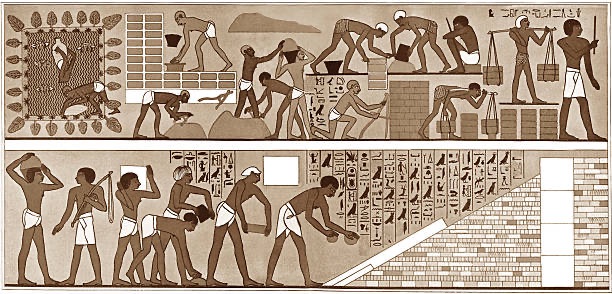
But isn’t it interesting who God chooses to do His work? Last week, we noted that it was a non-Christian German painter, Count Zinzendorf (1700-1760), numerous Moravian Christians, and John Wesley Joseph, Jacob’s favorite son; St. Paul; and even some pretty unlikely persons, like you and me! This week, our OT lesson, Exodus 1:8-2:10, introduces us to Moses’ backstory. Moses was born to an Israelite family, from the tribe of Levi, working as slaves in Egypt. Almost 350 years after the death of Joseph–the one God had used to save the fledgling Israelite nation as well as Egypt from a massive famine–a new Pharaoh (Ahmose? Rameses?), from a different line, came to the throne of Egypt. He looked around and saw how numerous the Israelites had grown. Here is the outworking of God’s promise to Abraham: his descendants would outnumber the stars, or the grains of sand on a beach. From the 90 family members who joined Joseph in Egypt, the Israelites had grown to what scholars believed were about 2 million Hebrews by the time Moses led their exodus. They had indeed become a “great nation,” and the new Pharaoh was afraid he and his countrymen could be overwhelmed and overcome by them. So, he decides to contain any threat by enslaving them. He works them hard and harshly, but still they seem to multiply.
As the story unfolds today, Pharaoh is concerned that the Israelites are reproducing too rapidly. So he calls in the head Hebrew midwives and tells them to go ahead and deliver girl babies, but kill the boys (this is once in history that it paid to be female). The midwives are wise. They fear/respect God more than Pharaoh. They refuse to practice male infant genocide. Pharaoh then notices that male Israelite infants are surviving and wants to know why. The wise midwives claim Hebrew moms are very hardy and complete the birthing process without calling upon them. This is no doubt a lie; but it seems to prevent Pharaoh from exacting revenge.
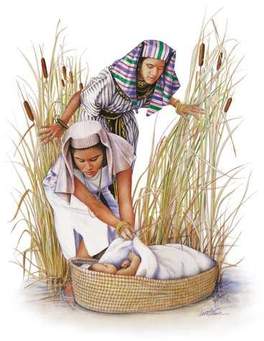
Moses is born in the midst of this birth-control strategy. As a male, he should have been euthanized; but his mom, Jochabed, rears him to 3 months. Then she places him in a carefully water-proofed basket, and sets him adrift on the Nile–a true act of faith (Nile crocks are ferocious, but we don’t know if they were so numerous then). In an amazing twist of fate—like Moses the Black, thief and murderer becoming a monk—Moses the Hebrew is spotted and rescued by Pharaoh’s eldest daughter. Childless, she decides to raise the baby as her own son. Miriam, his sister, has been watching over him and suggests a woman to nurse him—his biological mother, Jochabed, for pay! How ironic—and how like our God—to keep Moses safe on the river, and to place the future deliverer of Israel within the very household of Israel’s chief oppressor. A Hebrew slave will learn the Egyptian language, culture, and military strategies. God has once again placed one of His own (like Joseph) into a position of authority and influence. Additionally, “Moses is ‘brought out’ of the river [so that] one day, he will ‘bring out’ the nation of Israel from Egypt.”
(John Faiurless & Delmer Chilton, The Lectionary Lab Commentary, Year A, The Lectionary Lab, 2013, p.207.)
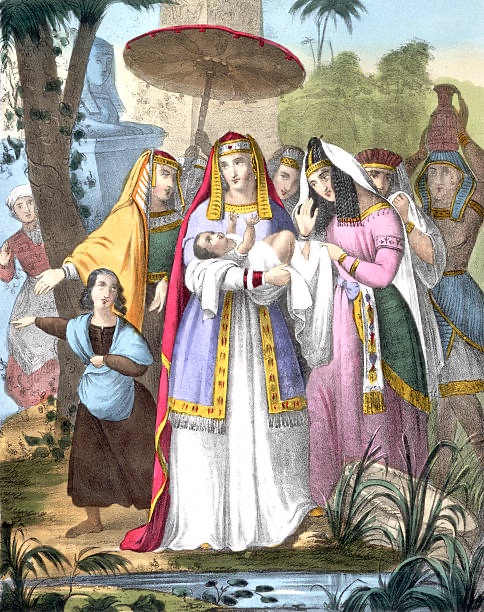
Whether Pharaoh realizes it or not, God is also demonstrating that Pharaoh will be impotent to destroy God’s people or His program (shoring up the lineage of Jesus).
Psalm 124 is a Psalm of Ascents, sung by Jewish pilgrims on their way to the Temple Mount to celebrate one of the major feasts. They praise God for His protection of them now and in the past, even mentioning saving them from (v.6, crocodile) teeth. They worship Him saying (v.8, NLT)–>Our help is from the Lord, Who made heaven and earth.
In our Gospel lesson, Matthew 16:13-20, our Lord commends Peter for both recognizing and testifying to who Jesus really is. Remember, Jesus is still outside the borders of Israel, in a Roman resort town (Caesarea Phillipi), 2 days’ walk north of the Sea of Galilee. Peter, inspired by the Holy Spirit, asserts that Jesus is the Messiah, the Son of God—a Deliverer even greater than Moses. Jesus praises him. He calls him “Peter,“ or “Rocky.” Jesus Himself is “The ROCK”—but it is on faith like Peter’s, and believers like Peter that Jesus will establish His Community, His Church. In addition, Jesus proclaims that…
(v.18) the Gates of Hades/Hell will not overcome it. The deaths of believing individuals will not extinguish the flame of the Church. Historically, the Church has always grown during times of persecution. Nonbelievers are so impressed with the peace or the commitment of martyrs that they too come to believe in Jesus. Just as Satan did not kill off the Jews through either slavery or Pharaoh’s schemes, no one person, or group of persons, can thwart God’s plan and program. Furthermore, Jesus gives Peter (the apostles, the early church, and us) (v.19) the keys of the kingdom of heaven authority to preach and teach the Gospel. Some claim Jesus was hereby making Peter the leader of His Church, and giving him the power to forgive or fail to forgive sins.
Others interpret this somewhat differently: Only God can forgive sins. But, iI we, as Jesus-followers, loose or proclaim God’s truth on earth, the powers of heaven will support our efforts. God’s word will not return to Him empty (Isa 55;11). Souls will be brought into God’s Kingdom. But if we bind it on earth (forbid or fail to proclaim), the Church will not live into its destiny.
Last week, I asked us to consider who gets saved. This week, the issue under consideration is who does God choose to work in His program of redemption. He appears to pick the unlikely:
1.) The reprobate, Moses the Black, becomes a major force for Christ in the 4th century Church as a teacher, pastor, and martyr.
2.) Moses–born to Hebrew slaves–is nurtured and educated under Pharaoh’s own nose, then used by God to free His people.
3.) Peter, who takes his eyes off Jesus, resorts to violence in the Garden, denies Him three times, and fails to show up at the Cross to support Him, is selected by God as a leader in the 1st Century Church.
4.) Paul assures us in Romans 12:13-20 that the Holy Spirit has given to each of us gifts to be used for the upbuilding of God’s Kingdom here on earth.
The beauty of all of this is that God chooses unlikely, even weak and flawed people to carry out His program of redemption. He trains us up. He places us strategically—like Joseph, like Moses–right where He wants us. Back in the 1960’s there used to be a popular poster in offices that showed flowers in a pot with the caption, “Bloom where you are planted.” That poster irritated the stew out of me! Like many of my generation, I wanted to change either the place where I was, or take myself elsewhere. The idea of blooming where I was planted seemed to me either too restrictive and like giving up. I have since come to realize that the Lord places us where we are for His reasons. We-folks like you and like me- are meant by Him to join Him in His Kingdom purposes where we find ourselves.
The wonder of it is that He puts so much trust in us. This week, let’s agree to assist Him in His goal to bring the lost to Jesus. This week, look for opportunities to tell those who don’t know Jesus Who He is; how He loves them; and how knowing Him has impacted and improved our lives. The best thing you can share with a nonbeliever is how you have seen Him work in your life.
Thanks be to God who gives us the victory thru our Lord, Jesus Christ!
.©️2026 Rev. Dr. Sherry Adams