Profiles of Humility

Pastor Sherry’s message for February 9, 2025

Scriptures: Isa 6:1-13; Ps 138; 1 Cor 15:1-11; Lk 5:1-13

Remember Muhammed Ali?  The famous boxer who used to humbly claim, “I am the greatest!”?  Well, the story is told that he was seated on a plane getting ready to take off, and the flight attendant noted he wasn’t using his seatbelt.  She politely asked him to fasten it.  He replied, ”I’m Superman and Superman don’t need no seatbelt.”  To which she responded, ”Superman don’t need no airplane either, so please fasten your seatbelt.”   

 (Steve Jones, “God’s Spiritual Stimulus Plan—Humility, www.sermomcentral.com, 2/6/25.)  

By the way, a parishioner of mine told me (following this sermon) that her father was a city bus driver in Louisville, Kentucky, for years, and that Muhammed Ali (aka, Cassius Clay) rode his bus daily as a child going to school.  Her father said the great boxer had always had a tendency to brag about himself.

 A second story regarding humility involves Benjamin Franklin:  Apparently he once… “made a list of character qualities that he wanted to develop in his own life. When he mastered one virtue, he went on to the next. He did pretty well, he said, until he got to humility.  Every time he thought he was making significant progress, he would be so pleased with himself that he became proud.”

(“Illustrations on Humility,” the Disciplers Blog, 2/7/2025.)

It’s hard to be humble, isn’t it?  But our Scripture passages today provide us with some pretty strong reminders that the virtue of humility pleases God.

A.  Let’s look first at the prophet Isaiah (Isaiah 6:1-13).  This story recaps his call, by the Lord, to become a prophet.  The context for Isaiah is the death of the good king, Uzziah.  Uzziah had ruled the Southern Kingdom (Judea and Jerusalem) for 52 years, from 791-740 BC.  He subdued Israel’s traditional enemies, the Philistines (ancestors of today’s Palestinians), the Arabs, and the Ammonites.  And, as long as Uzziah sought God and did not get too proud, he led the country into a period of peace and prosperity.  When Uzziah died, however, Isaiah was grieved and worried for the future of Judea.  Fortunately, Isaiah took his worry to the Temple, where he placed it on God’s altar through prayer.  No doubt he was lamenting. “Lord, what shall we do? What will happen to us all now?”  

The Lord responds to him with a vision and a calling.  The vision is of God on His throne.  The Lord is so immense that the train of His garment fills the Temple.  God wants to reassure Isaiah that all is well:  Isaiah’s earthly King is dead, but his heavenly King is alive and well and sovereign over all things.

Isaiah also sees 6 seraphim—in the Hebrew, the name means to burn—flying about the Throne.  While the job of the cherubim is to protect the holiness of God, the job of the seraphim is to seek out sin and destroy it.

(J. Vernon McGee, Through the Bible Commentary on Isaiah, Thomas Nelson, 1991, p.68.)

This is important because Isaiah immediately becomes aware that he is a sinful man who has seen God himself.  He knows from Moses’ dialogue with God in Exodus 33:20, that—No one may see Me and live.  No sinful being may exist in the physical presence of the Living God.  So he cries out (verse 5, NLT)—It’s all over!  I am doomed, for I am a sinful man.  I have filthy lips and I live among a people with filthy lips.  Yet I have seen the King, the Lord of Heaven’s Armies.  Isaiah is honest—he admits and takes responsibility for his sinfulness.  He doesn’t blame his environment, his parents, or any sinful associates.  He humbles himself before God.

God then directs a seraph to cleanse Isaiah’s lips with a burning coal from the altar where sacrifices for sins are carried out.  Prior to Jesus’ once- and-for-all-perfect sacrifice of Himself, an animal was chosen to be offered in one’s place.  The sinner consigned his/her sins to the animal’s head, the priest slit the animal’s throat, drained its blood, and placed its body on the sacrificial altar to be burned.  The life blood of the animal paid for the sin of the human.  The burning or live coal the seraph brought to Isaiah came from the altar at which such atonement for sin was made.  McGee goes on to assert that this act foreshadowed the coming cleansing we would all experience through the shedding of Jesus’ blood (Ibid., p.71).  Remember the words of the old hymn, “What can wash away my sins? Nothing but the blood of Jesus.”  Instead of hurting Isaiah, Christ’s future (to him) finished work on the Cross cleansed and healed him.

Then the Lord calls Isaiah to a frustrating work in which he will convey God’s words to a people group who will neither listen to nor receive what the Prophet has to say.  Again, Isaiah humbly agrees to answer the call–Here I am; send me–even though it is to a mission that will feel very frustrating.

B.  In Psalm 138, King David offers thanksgiving to the Lord for His love and protection.  He says in v. 1—I will sing your praises before the gods.  By gods, David was referring to the false gods of Israel’s neighbors, Egyptian, Philistine, and Canaanite gods.  For us, today, the meaning is anything we put ahead of God in our lives (McGee, p.156 of his commentary on the Psalms).  This could be money, power, status, influence, certain relationships with people, and addictions.

In verse 2, he goes on to praise God for His love and His trustworthiness.  In verse 6, he insists—Though the Lord is great, He cares for the humble, but He keeps His distance from the proud.

There it is, the theme of humility and how it pleases God.  Later, James, the half-brother of Christ, will write (James 4:6)—God opposes the proud but gives grace to the humble.  Similarly Peter will state (1 Peter 5:6)—So humble yourselves under the mighty power of God, and at the right time He will lift you up in honor. 

C.  St. Paul, in his 15th chapter of 1 Corinthians (verses 1-11), refutes the first heresy to arise in the infant Christian Church: That there was no resurrection.  He carefully enumerates all the folks who saw and interacted with the risen Jesus.  There were more than 512 eye-witnesses.  Then he, himself, saw Jesus on the road to Damascus.

Next, he humbly recounts (vv.8-10, NLT)—Last of all, as though I had been born at the wrong time, I also saw Him.  For I am the least of all the apostles.  In fact, I’m not even worthy to be called an apostle after the way I persecuted the Church.  But whatever I am now, it is because God poured out His special favor on me….

Some say Paul, the apostle to the Gentiles, was the greatest of all the apostles; but here he humbly reminds us that if he is so, it is only due to the grace and forgiveness of Christ.

D.  Finally, we have the example of Peter (also of James, John, and Andrew, Peter’s brother) in Matthew 5:1-11.  Jesus uses Peter’s (and Andrew’s) boat to address the crowd of His followers.  The fishermen are cleaning their nets, but they are also listening to Jesus.  He dismisses the crowd and urges Peter to pull away from the shore and launch his nets again.  It’s daylight and they have already fished all night with no results.

They are tired, and Peter seems crabby.  He knows from experience that the fish they sought tend to swarm only at night.  He must wonder, “What’s the point of going back out now that it’s daylight?”

But Peter does as Jesus says and is amazed to haul in a gigantic haul of fish!  They bring in enough to tear their handmade nets.  They land enough to nearly sink Peter’s boat and that of the Zebedee brothers, James and John.  Peter recognizes both the miracle of the catch and that Jesus has the surprising power to accomplish miracles.  Like Isaiah before him, he immediately becomes aware of his sinfulness.  He humbles himself.  He feels so unworthy, he even asks the Lord to leave him.  But Jesus instead invites him—all 4 fishing partners, in fact–to become “fishers of men/people.”

Peter humbles himself and Jesus makes him a disciple—an apostle.

The Prophet Micah (6:8) has asserted that the way we please God is…”to do what is right, to love mercy, and to walk humbly with your God.”   Ali lacked humility, Franklin–like us–struggled to attain it, but Isaiah, King David, Paul, and Jesus’ Apostles all demonstrated it.  It is a virtue we can develop.  It is something we can intentionally cultivate and attain.

How do we do it?  King David was right:  (1) Put God first in our lives.  We decide to try to please Him.  (2) Then we recall James 1:17 (NLT)—Whatever is good and perfect is a gift coming down to us from God our Father, Who created all the light in the heavens.  He never changes or casts a shifting shadow [meaning He is not mercurial but is the same yesterday, today, and forever].  Whatever we do that might make us proud is actually something God prompted in us, inspired, or helped us to do.  Then, we must willingly give Him the praise for every good thing we accomplish and every good thing we experience.   Thanks be to God Who gives us the victory through our Lord Jesus Christ.  Alleluia, Alleluia!

©️2025 Rev. Dr. Pastor Sherry Adams
Invite Jesus!

Pastor Sherry’s message for January 19, 2025

Scriptures: Neh 8:1-10; Ps 19; 1 Cor 12:1-11; Jn 2:1-11

Remember the old TV show, “The Tonight Show” with comedian Johnny Carson?  He was hilarious, wasn’t he?  You can probably recall some particularly funny episodes (You can locate reruns on www.YouTube.com).

One night he featured an interview with an 8 year old hero.  The child had rescued two friends who had gotten trapped in a West Virginia coal mine.

As Johnny continued to talk with the boy, it became obvious that the child was a Christian.

So Johnny asked him if he attended Sunday school. When the boy said he did Johnny inquired, “What are you learning in Sunday school?” “Last week,” came his reply, “our lesson was about when Jesus went to a wedding and turned water into wine.” The audience roared, but Johnny tried to keep a straight face. Then he said, “And what did you learn from that story?” The boy squirmed in his chair. It was apparent he hadn’t thought about this. But then he lifted up his face and said, “If you’re going to have a wedding, make sure you invite Jesus!” 

(Borrowed from www.Sermons.com, 1/14/2025)

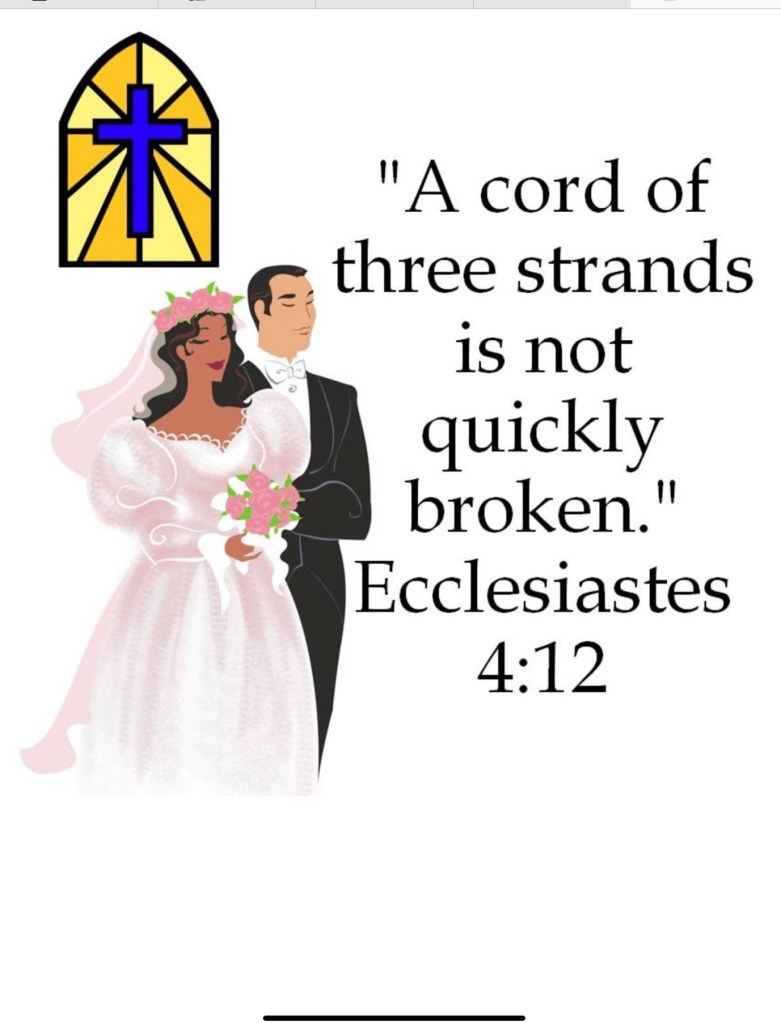
The child was wise beyond his years!  We are told in Ecclesiastes 4:12 a cord of three strands is not easily broken.  This passage (4:9-12) is often read at weddings.  The bride and groom represent two of the three strands.  The marriage is strengthened if the third strand is Jesus.

Again, the child said, “If you are going to have a wedding, make sure you invite Jesus.” 

Our Gospel lesson today (John 2:1-11) recounts the wedding at Cana—to which Jesus had been invited.  Weddings were important events in Israel in the time of Christ.  They often involved feasting, dancing, and visiting with friends and family for up to a week!  It was time off for everyone to celebrate!  The couple didn’t take a Honeymoon in those days.

Instead, in the place of what we would call a Wedding Reception, the newlyweds would share their joy, and strengthen their ties, with their relatives and neighbors, with feasting and fun. 

Now the village of Cana was just over the hill from Nazareth.  Some scholars believe Mary, Jesus’ mother, had relatives there, so she, Jesus and the rest of her family had been invited.  You can thus see how, if a couple were poor, there was a real danger of running out of food and/or wine.  Wine to them was a staple with meals.  Perhaps the alcohol content helped kill bacteria in their unfiltered water.  However, drunkenness was universally condemned.  This couple, in our story today, does run out of wine, and the bridegroom is about to be publically embarrassed.

So Mary brings their dilemma to Jesus’ attention.  She says, They have no more wine.  Jesus responds, Dear woman, why do you involve Me?  Scholars are undecided about why she would ask Him to do something for them in this setting.  Jesus knew His Heavenly Father had not yet told Him to begin His public ministry, so He was reluctant to perform a miracle—He says, My time has not yet come.  I have heard this passage preached where the minister claimed Mary was a pushy, Jewish mother.  I could be wrong, but I think because she was His mother, she knew of knew His capabilities and His compassion. She had empathy for the couple.  Thus it is very likely that God the Father nudged Mary to “jump start” Jesus.

Whatever the case, He honors her by resolving the crisis.  He has servants gather 6 large water jars, each holding 20-30 gallons.  This would have been water set aside for ritual purification.  He then transforms the water into the best wine ever—somewhere between 6X20=120 gallons to 6X30=180 gallons!  This was an audaciously generous amount of delicious wine.  The one we would call “the wedding planner” or the master of the banquet, is amazed!  In so doing, Jesus has just offered the first sign of His divinity:  He can transform matter/material world.

We know from this side of the Cross that Jesus only did what His heavenly Father told Him to do.  So why unveil His divine powers at a wedding?

Our Psalm (19) celebrates God as our creator and redeemer. The Hebrew word used for God in the first 6 verses of this psalm is Elohim—it is the plural form of El—the Mighty One, or God the Creator [indicating that all 3 persons of the Trinity were involved in creation].  He created grapes and led someone at some point to ferment grape juice into wine.  The Vineyard is one of several metaphors God uses to describe the nation of Israel. The wedding takes place within the vineyard, Israel, and the groom has need of more wine. Perhaps God is saying, Jesus will meet your need, and what He supplies is better than the best.

In the 1 Corinthians 12:1-11 passage, Paul lists 9 spiritual gifts potentially given– through the power of the Holy Spirit–to those of us who love Jesus. These gifts are not given to us for our personal enjoyment, but for us to help with building up God’s Kingdom here on earth.  Among these is miraculous powers.  Jesus demonstrated His miraculous powers at the wedding in Cana.  Some believe this signaled His endorsement of the marital union.  (Since God the Father invented marriage in Genesis, we can be sure God the Son would support the Father’s idea.)  Other scholars make the distinction between Moses and Jesus: Moses’ first miracle was to turn Nile River water into blood (representing the Law);  Jesus’ first miracle was to turn water into fine wine (indicating grace and mercy).  Still other Biblical experts assert that Jesus took something old and battered (the jugs/water pots) and filled them with something new designed to meet their needs. In other words, He took a good thing from the past—water—and turned it into a good thing for the future–good, new wine. This way, we can begin to see the wine as a metaphor for the generous blessing of God.

Additionally, we have paired with these readings the Old Testament lesson from Nehemiah 8:1-11, which takes place in Jerusalem in 445BC.  Jewish POW’s of first the Babylonian, then the Persian Empires, had been set free by the Persian king, Artaxerxes, to return to their homeland.  Under the oversight and direction of their governor, Nehemiah, they have completed the massive rebuilding of the city walls in just 52 days.  Ezra, their priest, had begun the sad reconstruction of the Temple—which would take many more years.  We find them today assembled–on the equivalent of their New Year’s Day—inside the Water Gate (1 of the 12 refurbished gates of the city).  You may remember that business, legal, and political matters were debated and decided, in those days, at the city gates. So this wasn’t just some narrow passageway. It was, instead, a gate opening into a sizeable square or assembly area.

Ezra and Nehemiah had convened a “solemn assembly” of all the returning citizens.  Scholars estimate some 49,000 men, women, and children of an age to understand, had gathered there.  After 70 years of exile in a foreign nation, they were probably starved for God’s word.  They may have held Bible studies while in captivity, but they had not really been formally taught the Torah (the Law). Ezra and Nehemiah did not want the people to be ignorant of God’s Law. Their parents’ and grandparents’ ignorance and rebellion is what got them transported to Babylon in the first place.

Notice what happens: Ezra proclaims God’s word, in a loud voice, from a raised platform (perhaps the first pulpit). The people remain standing, and quiet, and as they listen for some 4-6 hours!  This is where the synagogue tradition of standing for the reading of Scripture began.  Standing is a sign of respect, of reverence.  I went to 4 years of Catholic Girl’s School (though not a Catholic) and learned quickly that one stood when called upon by one of the nuns. These Israelites are hearing God’s Law, Torah read to them—Genesis, Exodus, Leviticus, Numbers, and Deuteronomy—perhaps for the first time.  There are Levites/priests available to walk among the crowd and explain what God’s Word means.  This is probably the most important job we pastors do—explain the meaning of Scripture, as best as we can.  The pre-Reformation Catholic Church had moved away from this important duty, focusing instead on the dictates of “holy mother church.”  The Protestant Reformers were thus insistent that we preach and explain God’s word.  Like the people of Nehemiah’s day, we cannot obey God’s Word if we don’t know or understand it.

The people respond with AMEN, AMEN! May it be so, hands lifted, praising God.  We say, Thanks be to God! following the reading of Scripture in our worship services, and hopefully we mean it.  They then, as the Word sunk in, became convicted of their sinfulness.  They now knew the standard, and could gage how far short of it they fell.  So, they prostrate themselves and cry tears of repentance.  But Ezra, Nehemiah, the 13 on the platform, and the Levites among them, tell them not to grieve or mourn…a. They were to celebrate their deliverance from captivity by God.  He once again (remember 400 years in Egypt) freed them and restored them.  He hadn’t turned His back on them!  And now they had had a new chance to get it right.  This was an occasion to celebrate, to rejoice about the goodness and mercy of the Lord!

We are just 2 and ½ weeks into the New Year.  Let’s invite Jesus—not just to the wedding—but into our lives.  Let’s also commit ourselves to reading and studying Scripture, God’s Word.  Let’s allow God’s Word to cleanse us, or as Paul puts it in Ephesians 5:26–>wash us with the water of the Word.  God’s Word transforms us, if we are open to Him.  God’s Word leads, guides, and directs us. Finally, let’s look for the miracles, or blessings, He has for us, and be sure to thank Him for them.  Amen!  May it be so!

©️2025 Rev. Dr. Sherry Adams

God’s Perfect Gift

Pastor Sherry’s message for Christmas Eve, 2023

Scriptures: Isa 52:7-10; Ps 98; Heb 1:1-4; John 1:1-14

A pastor wrote, ”Yes, God is our loving and gracious Heavenly Father—but He eternally dwells in unapproachable [ineluctable, unavoidable, inescapable, certain] light. That means that God transcends us and is totally beyond us. In Theology proper a Latin term is used to capture this reality; God is defined as Deus absconditus, which translates as ‘the hidden God’. If God had not initiated revealing Himself to sinful and fallen mankind in the Garden of Eden and onward through the Old Testament; if God had not chosen to come out of His holy habitation—mankind would have hopelessly lived and died without knowledge of Him. Christmas is the time we celebrate God coming to be with us; no longer sending others, like prophets, priests, kings, and angels to give us His Word. Christmas is God Himself no longer sending–but coming.

“We should reflect upon how fortunate we are that God has mercifully and graciously come to us in our dreadfully lost condition. The writer of Hebrews described our distance from God quite simply as, “our God is a consuming fire” (Heb. 12:29). The imagery of God as [a] blazing and consuming fire aptly expresses God’s holy distance. Because of His holiness, God is eternally inaccessible to man. Our God always lives in an atmosphere of absolute purity, far too holy for mortals to ever enter. Note that Hebrews says that ‘our God is [not was!] a consuming fire.’ ”

“But to solve the problem of the God who is unapproachable, God Himself came to be with us—as one of us, to die for the whole world of lost sinners.”

(Dr. John Barnett, sermon entitled, “The Six Names Of Christmas – Immanuel – God With Us,” www.sermoncentral.com, Jul 10, 2018.)

The Scriptures appointed for today share with us God’s motivation for sending Jesus to earth as a tiny baby, as well as what our response to Him should be:

A. Again, the writer to the Hebrews puts it this way in our New Testament reading (Hebrews 1:1-4): In the past, God reached out to us through the prophets (v.1). But, more recently, He …has spoken to us by His Son, whom He appointed heir of all things, and through whom He made the universe. The writer to the Hebrews wants us to realize that God reached out to us first. He initiated a relationship with us, not the other way around. First, He sent many prophets (Moses, Samuel, Isaiah, Jeremiah, Daniel, Ezekiel, etc.) to let us know who He is and what He wants of us. When all those efforts fell short—because human beings were lukewarm, or even outright rebellious, in their response–He sent us His One and Only Son.

But Jesus is not just a messenger of God! The Son (v.3)is the radiance of God’s glory and the exact representation of His being, sustaining all things by His powerful word. I love the way Peterson expresses it (The Message, p.2181)By His Son, God created the world in the beginning, and it will all belong to the Son at the end. This Son perfectly mirrors God and is stamped with God’s nature. He holds everything together by what He says—powerful words! In other words, Jesus is higher than prophets or even angels. He is perfectly human, but also perfectly God. As God encased in baby flesh, He—the Holy One—can interact with sinful us.

B. The apostle John (1:1-14) begins His Gospel essentially asserting what the Writer to the Hebrews later wrotethat God intends to reveal Himself, His glory, through Jesus! Where Luke and Matthew begin with Jesus’ birth stories, and Mark, with Jesus’ entre into ministry, John takes us back to creation, before time and space began. Jesus was present at Creation. John wants to make sure we understand that Jesus, (v.1)the Word, was with God, distinct from the Father; and also that the Word was Godpart of the same deity. They share an identity of being; like the Father, Jesus is fully divine. The Apostle writes in verse 2 that the Father and the Son were in relationship with each other. Additionally, Jesus, the WORD, was the agent of Creation (v.3). God the Father planned it; but all things came into being through the words Jesus spoke. The WORD is life”the Life force.” Life comes to us not just through Him; in fact, His life is our light. Physically, we cannot live without light. Spiritually, His life enlightens (brings light into) ours. In John 8:12 Jesus saysI am the light of the world. As if to reinforce this notion, the 3rd verse of “Silent Night” statesSon of God, Love’s pure light, radiant beams from Thy holy face, with the dawn of redeeming grace, Jesus, Lord at Thy birth….

Jesus came to dispel the darkness of unbelief, sin, death, oppression, and bondage. Even though He made us, some of us will–and have– refused to believe in Him. In our rebellion, some of us (what John calls the world) will reject Him and the freedom He offers. But to those of us who have received Him (v.10)–we who have accepted His gift of Himself–He has given another gift: the right to become children of God! We are not biological heirs, not heirs through any human effort; instead, we are spiritual children of God, through Christ’s blood and the Father’s will.

In verse 14, John famously assertsThe WORD became flesh and made His dwelling among us! This is a break with all non-Christian thought: The agent of creation becomes a creature. Peterson describes it this way (The Message, p.1916)

The WORD became flesh and blood

And moved into the neighborhood.

We saw the glory with our own eyes,

The one-of-a-kind glory,

Like Father, like Son,

Generous inside and out,

True from start to finish.

Jesus came to demonstrate to us, in the flesh and through His behavior, the Father’s nature. He is God revealing God: (1) Behaviorally, (2) Relationally,

(3) Intellectually, and (4) Spiritually. He is our Savior, our Redeemer, our Healer, our Good Shepherd, our King. Our response to Him must go beyond intellectual agreement! We need to be in a personal relationship with Him.

We need to accept God’s Perfect Gift.

C. Our Psalm (98) anticipates Jesus’ 1st Coming and urges us to celebrate Him with great joy.

D. Our Isaiah (52:7-10) lesson anticipates Jesus’ 2nd Coming with the same excitement and joy.

James, the brother of Jesus, wrote (1:17)Every good and perfect gift is from above, coming down from the Father of the heavenly lights, who does not change like shifting shadows. This Christmas, let us remember that God the Father has given us the Perfect Gift, His Son, Jesus Christ. Even if there are no gifts for you under your Christmas tree, God has generously sent Jesus into your life. Because of this, we are truly blessed!

Because of God’s perfect gift of Jesus, we can state the following with confidence (please repeat after me) (Borrrowed from Joel Osteen’s The Power of I Am, Faith Works, 2015):

1. “I am forgiven. I am redeemed. I am wearing a robe of righteousness. I am clothed in Christ” (p.42).

2. “God promised me beauty for ashes, joy for mourning. I’m not staying here. I’m moving forward. New beginnings are in my future. The rest of my life will be the best of my life” (p.41).

3. “I have grace for this season. I am strong in the Lord. Those who are for me are greater than those who are against me” (p.41).

4. “I am getting stronger, healthier, wiser. My youth is being renewed like the eagles” (p.38).

5. “I am free. Addictions do not control me” (p.39).

6. “I am blessed. I am prosperous. I have the favor of God” (p.38).

7. Sickness, addiction, poverty, you are temporary. I am a child of the Most High God. I am overcoming you,” by the blood of the Lamb of God (p.44).

Jesus is the gift that just keeps giving! Thanks be to God who gives us the victory through our Lord, Jesus Christ. Alleluia, alleluia!

©️2023 Rev. Dr. Sherry Adams

Pentecostal Power

Pastor Sherry’s Message for May 28, 2023

Scriptures: Acts 2:1-21; Ps 104:24-34; 1 Cor 12:3-14; Jn 7:37-44

Isn’t it interesting that sometimes what you thought you heard may not necessarily have been what was said? Or even if you heard what was said accurately, the words used conveyed something different to you depending on your background and experiences?

For example, there is…

“an old joke that used to be popular around the Pentagon that the different branches of the Armed Forces have trouble operating jointly because they don’t speak the same language.

For example, if you told Navy personnel to “secure a building,” they would turn off the lights and lock the doors.

Army personnel would occupy the building so no one could enter.

Marines would storm the building, capture it, and defend it with suppressive fire and close combat.

The Air Force, on the other hand, would take out a three-year lease with an option to buy. “ (Illustration borrowed from www.sermons.com, 5/25/23.)

This joke is such a good example of how the same word can mean something different to different groups of folks. The word Pentecostal is another such word. To most, the noun, Pentecost, refers to the day we celebrate today, the anniversary of the day the Holy Spirit was given to all believers in Jesus, and the day the Church (capital “C”—Christians of all denominations) was born. It also marks an ancient Jewish religious feast day. It commemorated the end of the barley harvest and the beginning of the wheat harvest—the Spring Harvest season. Thus it was one of the 3 times per year a Jewish man was expected to journey to Jerusalem (The other two times were for Passover and the Feast of Tabernacles).

But consensus breaks down when the adjective form, Pentecostal, is used. This could refer to a Christian denomination, for example Pentecostal Holiness. A good number of folks associate it with speaking in tongues—and some Pentecostal churches believe you must speak in tongues to demonstrate you have been baptized in the Holy Spirit—though nowhere in Scripture is it stated that all spirit-filled Christians must speak in tongues. It could also mean charismatic—a person who believes in and moves in the gifts of the Holy Spirit.

Our readings today are all Pentecostal, or refer to some aspect of the Pentecostal power that manifested that Day.

A. In our Acts 2:1-21 lesson, we are reminded of the supernatural power the Holy Spirit can and does demonstrate when He shows up. (1) There was the sound of wind rushing. In this case, it was like the sound of a tornado, but without the wind damage. That sound is like 5-6 locomotive engines rushing by. The Holy Spirit came on with such a loud sound that folks rushed out of their homes to see what had produced it. Prior to moving off to seminary, I asked a group of my friends to pray for me to receive the Holy Spirit. We had gathered on the beach at night for that purpose. A very strong wind came up and blew in my face as they were praying. I felt I could hardly breathe. Afterwards, I asked them what they made of that wind. No one else in the group had experienced it! We knew then that the Spirit had indeed come over me.

(2) There was also the curious sight of a larger flame in the air separating into smaller flames. Stranger still, the smaller flames come to rest over the heads of the 120 disciples gathered in that place. Like the bush Moses saw aflame as he was shepherding sheep, these flames did not burn anyone or anything.

(3) There was also the sudden, unexplained ability of all to speak in tongues/languages they had never been taught. Apparently all 120 disciples present were filled with the power of the Holy Spirit. This power enabled them to do things they had never learned nor expected to be able to do.

Wouldn’t it be marvelous to instantly speak another language without the tedium of memorizing sounds, vocabulary words, and grammar rules, let alone another alphabet like that of Greek or Hebrew? These were not just a nonsense languages, gibberish, but actual languages and dialects recognized by the many nonbelievers who were there. People said, “Hey! Aren’t these men and women from Galilee?” In other words, “How do these “backwoods” folk know our native tongues?”

(4) Additionally, Peter—who had been unwilling to admit his association with Jesus just some 53 days earlier—is emboldened to preach to Jews (vv.14-36) about Jesus and 3,000 were so convinced by his sermon that they agreed to be baptized that day (v.41).

Miraculous, wonderful things happen when the Holy Spirit demonstrates His Pentecostal Power!

B. The key verse for us in Psalm 104:24-34 is verse 30 When You send Your Spirit, they [meaning humankind and all animal life] are created, and You renew the face of the earth.In this tribute to the creative power of God the Father, the Holy Spirit manifests this divine creative power. God may have efficiently used similar designs—apes have physical characteristics similar to humans—but He formed them all out of nothing. The originals were adults of two genders, so they could reproduce.

Each living thing is a manifestation of Holy Spirit power—remember, at the creation of the world, the Holy Spirit was hovering over the waters (Genesis 1:2). In a sense, we could say Pentecostal power was present at Creation.

C. In our 1 Corinthians 12:3-14 passage, Paul lists 9 gifts of the Holy Spirit (He has two other gifts lists in Romans 12:6-8 and 1 Corinthians 12:28-31.) These are each supernatural abilities bestowed on certain believers—not for their own entertainment or to puff up their egos—but (v.7) for the common good. They are meant to build up the body of Christ, His Church. They include (vv.8-10) wisdom, knowledge, faith, healing, miraculous powers, prophesy, distinguishing spirits (evil ones from good; angels from demons), speaking in tongues, and interpretation of tongues. Each believer is given at least one spiritual gift; some are given more than one. For example, sometimes when I pray for healing for a person and lay hands on them, my hands grow hot. The person I am praying for also feels those “hot hands.” The heat means the Holy Spirit is at work, healing them. I do not generate the heat and I do not experience it each time I pray for healing. This has led me to believe the gifting can come and go. Sometimes I have it and sometimes I don’t. It’s up to the Spirit when to apply it. And, again, the purpose of the gifts is to edify the Church, not the person who has the gift.

Think about it: What is (are) your spiritual gift(s)? You have been given Pentecostal power with which to help others.

D. In John 7:37-44, Jesus makes one of His I am statements. Remember, to the Jews, Yahweh or Father God was and is the Great I am. By saying, I am, Jesus was admitting He is equal to God and that He is God. Just prior to this chapter in John 6, Jesus states that He is the manna from heaven; He is heavenly food. Some turn away from Him then, misconstruing is metaphor as a cal for them to consume Him as in cannibalism. In John 7, He says He is living water to drink. Jesus is in Jerusalem at the Feast of Tabernacles (Ingathering, Booths, the Fall Harvest Festival). Believing Jews were to sleep in tents, booths, or tent-like structures meant to remind them of God’s provision for them during their 40 years of Wilderness Wanderings. For the 7 days of this national holiday, they were to do no work. They would worship the Lord at the Temple, daily, to seek forgiveness for their sins and to thank God for their harvest. Otherwise, they were to celebrate, feast, and visit with family and friends. On the eighth and last day of the Feast, the priests would pour water on the altar of sacrifices, dousing the flames and asking God to provide rain for another year.

According to John (vv.37-38), on the final day of the Feast, perhaps just as the priest poured water on the altar Jesus stood and said in a loud voice, “If anyone is thirsty, let him come to Me and drink. Whoever believes in Me, as the Scripture has said, streams of living water will flow from within him. He was saying, “I, God, give you what you need to sustain life.” This is the same living water He promised the Samaritan woman at the well. This water is a metaphor for a relationship with Christ that is life-giving and life-changing. John goes on to explain it also refers to the life-giving Spirit (v.39) By this He meant the Spirit, whom those who believed in Him were later to receive. Up to that time the Spirit had not been given, since Jesus had not yet been glorified.

Jesus gives us what we need—life giving, flowing-not-stagnant, living water—by gifting us with the Holy Spirit. The Spirit empowers us to live a life pleasing to God, and to love others, as Jesus commanded us. Just as in chapter 6, His words caused confusion about His true identity among those listening.

But we are not confused, are we? We have the gift of the Holy Spirit, one of whose jobs is to reveal all that is true to us. You know, if you watch the news on TV and ask the Holy Spirit to reveal what is true, you can begin to know who lies and who speaks truthfully. We know, through the supernatural gift of faith, that Jesus is indeed the Christ. We also know He has imparted to us the Pentecostal power of the Holy Spirit.

As we walk out this next week, let’s try to remember…

(1) We worship an all-powerful, creative God;

(2) His Son, Jesus, has given us the powerful, power-filled Holy Spirit to lead, guide, and direct us here on earth.

(3) The Holy Spirit also gift us—according to His will—with supernatural abilities meant to benefit others. Ponder what those are for you. Consider how you have used them in the past and might use this Pentecostal Power even more fully in the present and in the future. We want to be believers in and practitioners of God’s Pentecostal Power.

©️2023 Rev. Dr. Sherry Adams

He is Risen!

Pastor Sherry’s Easter message for 4/9/23

Scriptures: Acts 10:34-43; Ps 118:1-2, 14-24; Col 3:1-4; Jn 20:1-18


“Max Lucado, in his book, Six Hours One Friday, tells the story of a missionary in Brazil who discovered a tribe of Indians in a remote part of the jungle. They lived near a large river. The tribe was friendly and in need of medical attention. A contagious disease was ravaging the population and people were dying daily. An infirmary was located in another part of the jungle and the missionary determined the only hope for the tribe was to go to the hospital for treatment and inoculations. In order to reach the hospital, however, the Indians would have to cross the river—a feat they were unwilling to perform.

“The river, they believed, was inhabited by evil spirits. To enter the water meant certain death. The missionary set about the difficult task of overcoming the superstition of the tribe.

“He explained how he had crossed the river arrived unharmed. No luck. He led the people to the bank and placed his hand in the water. The people still wouldn’t believe him. He walked out into the river and splashed water on his face. The people watched closely, yet were still hesitant. Finally, he turned and dove into the river. He swam beneath the surface until he emerged on the other side. Having proved that the power of the river was a farce, the missionary punched a triumphant fist into the air. He had entered the water and escaped. The Indians broke into cheers and followed him across.”

Isn’t that what Jesus did? He entered the river of death and came out on the other side so that we might no longer fear death, but find eternal life in Him.

(Max Lucado, Six Hours One Friday, Multnomah Books, 1989, pp.157-158).

Today, Easter Sunday, we celebrate the fact that Jesus Christ demonstrated that He had overcome sin and death by rising from the dead. He demonstrated the full extent of His miraculous power. And He brought us hope for the future (death is not the final outcome for us). All of our readings today refer in some way to Jesus’ resurrection:

A. In our Gospel, John (20:1-18) highlights some of the events of that first Easter Day. Mary Magdalene—remember, she had held a vigil for Jesus, along with His mother, John, and several other women–at the foot of His Cross. She had probably wept and prayed for Him as he hung dying. No doubt she had watched Joseph of Arimathea and Nicodemus quickly wrap His body for burial. In a dry land with limited water, they would have cleaned the corpse as best they could. They had to hurry before the onset of the Sabbath—He had to be buried before sundown. They then coated the body with myrrh, aloe, and the other spices they had brought. Next, they wrapped it up in stripes of cloth, which would have encased the body in a permanent, glued-on, kind of bandage. This process is important to note because of what happens later.

Mary had watched and must have thought the men did not do as good a job as they should have done for someone as important as Jesus. So she returned to the grave early the next morning, intending to make things right. How she thought she might roll away the heavy stone sealing the tomb is anyone’s guess. Nevertheless, she found the tomb already opened but containing no body. John tells us she ran to find Peter and the other disciple [this is how John always refers to himself in his Gospel], both of whom ran to see for themselves. John, the younger man, arrived first but only peeked into the tomb. The older Peter lagged behind, but reached the tomb and charged in to see only grave clothes on the shelf where Jesus had been laid.

The grave clothes told a story: The myrrh, aloe, and spices should have stuck the cloth stripes to the body, like a mummy. Remember Lazarus needed help to remove his. Both men saw strips of linen lying there, as if Jesus had materialized up through them, leaving them behind. In addition, the shroud for his head and face had been neatly folded and set aside. John saw this, knew it was physically impossible and therefore evidence of a miracle, and believed that Jesus had been resurrected. They appeared to have then gone home to ponder over what they’d seen.

Mary remained, grieving. Jesus appeared in His resurrection body and she didn’t recognize Him. Apparently the nail holes on His hands and feet, and the pieced place on His side, were evident, but something about His face and posture were altered in His resurrection body. Or perhaps she didn’t realize it was Him because she wasn’t expecting to see Him. She only comprehended that it was Jesus when He called her by name. He told her then to go tell the other disciples that He is going to see God the Father. Now we know from other accounts that He later met privately with Peter, encountered the two disciples on the road to Emmaus, and arrived back to greet 10 of the 11 disciples in the Upper Room, but we do not really know where He went during the middle hours between dawn and later that evening. Somewhere during that time, He had a joyous reunion with His Father in heaven! Mary, then, obediently carried the Good News of Jesus’ Resurrection—I have seen the Lord!–to the others.

B. Peter is certainly fired up as he preaches to Cornelius and his household in Acts 10:34-43). He had seen the empty tomb, the discarded grave clothes, and the resurrected Christ! Filled with the Holy Spirit (at Pentecost, back in Acts 2), he preaches with fiery conviction. Dr. J. Vernon McGee makes the point that, “There is not a single sermon in Acts that does not mention the resurrection of Jesus.” (Through the Bible Commentary Series, Acts, Thomas Nelson, 1991, p.129).

Peter reviews for the Cornelius’ Roman household the salient points of Jesus’ life and ministry, emphasizing the resurrection (vv.39b-41) They [the Jewish religious authorities + the Romans ] killed Him by hanging Him on a tree, but God raised Him from the dead on the third day and caused Him to be seen. He was not seen by all the people, but by witnesses whom God had already chosen—by us who ate and drank with Him after He rose from the dead. What a privilege to have been chosen by the Father to be one of the 500 or so to actually see and spend time with Jesus!

C. Paul reminds us, in Colossians 3:1-4, that because we are “in Christ,” we …have been raised with Christ. We share in Christ’s resurrection. Due to this new position in Christ, we have said goodbye to our old, fleshly selves; and we have put on a new, spiritual self. As a result of this phenomenal realignment/reorientation of our individual identities, Paul wants us to (v.2) set your minds on things above, not on earthly things. If you have read anything about people who claim to have died and gone to heaven (NDE’s, Near Death Experiences), they all agree they did not want to return to earth. Having seen Heaven, they wanted to stay. Similarly, Paul believes since heaven is ahead of us, we should focus on Jesus as we continue our tenure on earth. As children of the Resurrection, we are to pattern our lives after Jesus and keep our concentrate on heavenly realities.

D. Psalm 18:1-2, 14-24 is an ode to joy! The psalmist, predating but very like Paul, invites us to focus on heavenly realities–not the frustrations and disappointments of this life. Because of the mighty things Jesus has done—including demonstrating His power over death—we can rejoice in the Lord and praise Him for deliverance, provision, and protection.

We are thankful because…

1.) (V.1) The Lord is good; His love endures forever.

2.) (V.14)The Lord is my strength and my song; He has become my salvation.

3.) (V.17) I will not die but live, and will proclaim what the Lord has done.

4.) (V.24) This is the day the Lord has made, let us rejoice and be glad in it.

We also celebrate the fact that (v.22) The stone the builders rejected [Jesus] has become the capstone. The capstone was either a large rectangular stone used as a lintel in a doorway, or a large square or rectangular stone used to anchor or align the corner of a wall. It might also be the keystone or middlemost stone in an arch. The capstone (building corner or doorway lintel) or keystone (arch) kept the building from collapsing by supporting what exited beside and above it. Considering this metaphor for Jesus, no wonder we call Him our Rock and our Redeemer.

The story is told of…”a man (who) took a vacation to Israel with his wife and mother-in-law. During their time in the Holy Land, his mother-in-law unexpectedly passed away. The following day, the husband met with the local undertaker to discuss funeral plans.

“In cases like these, there are a couple of options to choose from,” the undertaker explained. “You can ship the body home for $5,000, or you can bury her in the Holy Land for just $150.” The man took a minute to think about it, and then announced his decision to ship her home.

“The undertaker, intrigued by his decision, said, “That’s an interesting choice. Can I ask why would you pay $5,000 to ship your mother-in-law home, when you can easily bury her here for $150?” The man promptly replied, “About 2,000 years ago, a man died and was buried here. Three days later he rose from the dead, and I can’t take that chance!” (Subsplash website, 5 humorous Easter sermon illustrations, April 13, 2022.)

Of course there is no guarantee that the mother-in-law would have resurrected—unless she had been a believer in Jesus Christ. Additionally, we know, of course, that Jesus’ ability to raise us from the dead is not limited to the geography of Israel—thank Goodness! Nonetheless, we can enjoy a good joke.

We can also enjoy the secure future we have in Christ. Like the missionary to Brazil, Jesus entered the river of death and came out victorious on the other side. Because He did this for us, we too share in His resurrection victory—and all of its benefits.

Alleluia, He is risen! The Lord is risen indeed, Alleluia!

©️2023 Rev. Dr. Sherry Adams

Gratitude Like The One In Nine

Pastor Sherry’s message for October 9, 2022

Scriptures: Jer 29:1-7; Ps 66:1-12; 2 Tim 2:8-15; Lk 17:11-19

A Jesuit priest has said, “It’s not joy that makes us grateful, it’s gratitude that makes us joyful.” That bears repeating: “It’s not joy that makes us grateful, it’s gratitude that makes us joyful.” Modern psychological research has shown that finding things to be grateful for is a key to good mental health. People who can think of 3 things for which they are thankful, daily, are less likely to be depressed and more likely to be happy.

A cartoon in a magazine shows a couple, at the church door, saying goodbye to the pastor following the service. The man says, “Wonderful sermon! Thanks for not mentioning my name.” We can be grateful for not having our sins shared from the pulpit. (I promise you, I will never name you and your personal sins from this pulpit.)

I can think of two other examples of grateful people:

(1) The leader of our denomination, John Wesley, “…was about 21 years of age when he went to Oxford University. He came from a Christian home, and he was gifted with a keen mind and good looks. Yet in those days he was a bit snobbish and sarcastic. One night, however, something happened that set in motion a change in Wesley’s heart.

“While speaking with a porter, he discovered that the poor fellow had only one coat and lived in such impoverished conditions that he didn’t even have a bed. Yet he was an unusually happy person, filled with gratitude to God.

“Wesley, being immature, thoughtlessly joked about the man’s misfortunes. “And what else do you thank God for?” he said with a touch of sarcasm.

“The porter smiled, and in the spirit of meekness replied with joy, ‘I thank Him that He has given me my life and being, a heart to love Him, and above all a constant desire to serve Him!

“Deeply moved, Wesley recognized that this man knew the meaning of true thankfulness.

“Many years later, in 1791, John Wesley lay on his deathbed at the age of 88. Those who gathered around him realized how well he had learned the lesson of praising God in every circumstance. Despite Wesley’s extreme weakness, he began singing the hymn, ‘I’ll Praise My Maker While I’ve Breath.’”

(From a sermon entitled “True Thankfulness” by Donnie Martin, July 26, 2010)

(2) Albert, the fellow who manned a drive up window at a Café DuMonde in New Orleans, where I stopped most mornings to get a CafeAuLait. He lacked most of his teeth but the ones he had were gold. He probably worked for minimum wage, but when I asked him each day how he was, he always replied, “I’m blessed!” The Lord used Albert in my life just as he used the porter in John Wesley’s. Two “simple” but wise—though economically disadvantaged persons–knew the value of daily expressing their gratitude to God.

Let’s see what our Scripture lessons today have to say about daily expressing gratitude to God:

A. Our Psalm (66:1-12) instructs us to praise God because of His deliverance, His preservation, and His provision for us.

B. In our Epistle (2 Timothy 2:8-15), Paul instructs us thank God for our redemption through Jesus Christ.

C. In our Old Testament lesson (Jeremiah 29:1-7), the prophet has written a letter to the Jewish captives in Babylon. They had been carted away, in defeat, to a pagan foreign nation. Surprisingly, instead of commiserating with them, Jeremiah essentially tells them that they are to “bloom where they have been planted.” This sentiment was often pictured on posters in the 1960’s and I remember thinking as a young person, “I don’t want to bloom where I am planted. I want to, instead, change my environment.” I didn’t realize then that God often calls us to do our best where we are, as He intends us to be transformed there, as well as to influence others to be transformed. So, Jeremiah encourages the deportees to build homes for themselves and their families. They are to settle in where they have wound up. Further, he encourages them to plant gardens, so they can feed themselves. Obviously, the Lord intends that they will be there for a while.

They are to marry and have sons and daughters. Again, this implies they will be there for some time. This side of the Cross, we know they were there for 70 years, or for most of 2 generations. Rather than being frustrated or resentful (hateful), they were also to contribute to the peace/prosperity of the city of Babylon. In fact, the Lord says, through the prophet, (v.7) —Pray to the LORD for it [Babylon], because if it [Babylon] prospers, you too will prosper.

They were not to be grateful for their captivity, their deportation to a foreign land. God used that experience to punish them because He is holy (and cannot abide sin). They were guilty of idolatry, greed, lust and sexual perversion, and multiple abuses of power. They had been grossly out of line for a long time. We know from Hebrews 12:5-11 that God disciplines those He loves. We also realize that if He didn’t, we could not really trust Him. He means what He says in Scripture, and He says what He means. The Lord has punished them, hoping they will change their sinful attitudes and improve their behavior in the future. The point is that—even though they are captive in a foreign land—which seems terrible to them, it comes as no surprise to God—He engineered it. They can and should be grateful to Him because they are alive and He has not abandoned them.

We want to be grateful to God for what He teaches us through our trials. When we go through trials—emotional pain—we are molded and shaped by God. Years ago, I was counseling college students at Florida State University as part of a pre-doctoral psychology internship. While there, I encountered a “trust fund baby,” a young man who had been handed everything. He told me that he drove a brand new BMW; all his expenses were paid by his parents; he had a job waiting for him, in his father’s firm, when he finished school; and he had never had to mourn the loss of someone he loved. In other words, he had never suffered, he had never had to struggle. He asked me to help him develop some motivation for life. I suggested he volunteer at a soup-kitchen for the homeless, or spend time with disadvantaged kids in daycare. I have never known anyone to have compassion for others who has not observed or experienced suffering. When we go through trials, we learn compassion for others. We learn to have patience. We learn to trust in God despite our circumstances.

D. In our Gospel lesson (Luke 17:11-19, Jesus heals 10 lepers.

Our Lord is headed to Jerusalem to die. At the fringe of some unnamed village, 10 lepers appeal to Him for healing. He gives them what they want, freely, graciously. Notice: they had faith in Him and in His ability to heal them. He says to them, (v.14) —Go, show yourselves to the priests.

Leviticus 14:1-10 describes all the things a leper who had been healed had to do: (1) Show him/herself to the priest. (2.) The priest would then perform a detailed ritual to ensure the person was cleansed spiritually as well as physically; (3.) Then the healed person was to wash his/her clothes; shave off all his/her hair, even eyebrows; and bathe with water.

So, the ten obey Jesus and scurry off to begin the cleansing process. It is on their way that they are healed. They had stepped out in faith. They had trusted in Jesus. And unlike Naaman the Syrian (2 Kings 5), they were immediately compliant. But only one guy notices his healing and returns first to thank Jesus. Maybe the other nine were just too overjoyed to focus on gratitude. Or maybe they believed they deserved it (they felt entitled). Most likely their attention was on remembering and performing the religious requirements, or on the anticipated happy reunions with their families. We don’t really know why they didn’t think to thank the LORD.

The one guy who does was a hated Samaritan! We would say today that he wasn’t raised right; that he was not well bred; that he was “sorry from way back.” But the fellow who wasn’t raised right knew enough to express his gratitude. Maybe he was shocked that Jesus would heal even him. Maybe he was aware that he didn’t deserve this kind of grace from a Jewish rabbi. Jesus’ response to the Samaritan’s gratitude was fantastic—v. 17–Rise and go; your faith has made you well. This implies that the fellow was kneeling at Jesus’ feet; or maybe he had prostrated himself, in adoration. Jesus is so pleased that he commends him for his faith and for his manners. This guy has received the same physical healing as the other 9; but he has also received a complete healing. In addition to the physical, he received a spiritual healing as well–forgiveness for his sins. Both healings merited eternal gratitude.

Today’s lessons go beyond issues of disease or misfortune and healing: They challenge us to be mindful of all that God has done for us and to be grateful to Him. Too many of us are like a demanding guy in the Post Office. A guy with a broken right arm goes into the Post Office. The lady at the counter asks how she might help him. He proceeds to ask for a post card and a stamp. Then he asks her to write out his message on the card, and finally to address it to his friend. She asks again if there is anything else he needs. He looks at the card and says, “Yes please add an apology to my friend for the bad handwriting.”

(Borrowed from John Fairless and Delmer Chilton, The Lectionary Lab Commentary, Year C, 2015, p.310.)

Are we like that—or like the 9 who were healed, but didn’t express their gratitude? It’s all too easy, isn’t it, to take God’s grace for us for granted and to forget to express to Him our grateful thanks. This week, let’s remember to express to our Lord our thanks and praise. Even better, try to think of three things daily for which you are grateful to God. Do this for a month and watch and see what happens. You should find yourself being more joy-filled.

©️2022 Rev. Dr. Sherry Adams

True Security

Pastor Sherry’s message for September 5, 2021

Scriptures: Proverbs 22:1-2, 8-9, 22-23; Psalm 125; James 2:1-17; Mark 7:24-37

The following story was included in an edition of Our Daily Bread:

A group of botanists went on an expedition into a hard-to-reach location in the Alps, searching for new varieties of flowers. One day as a scientist looked through his binoculars, he saw a beautiful, rare species growing at the bottom of a deep ravine. To reach it, someone would have to be lowered into that gorge. Noticing a local youngster standing nearby, the man asked him if he would help them get the flower. The boy was told that a rope would be tied around his waist and the men would then lower him to the floor of the canyon. Excited yet apprehensive about the adventure, the youngster peered thoughtfully into the chasm. “Wait,” he said, “I’ll be back,” and off he dashed. When he returned, he was accompanied by an older man. Approaching the head botanist, the boy said, “I’ll go over the cliff now and get the flower for you, but this man must hold onto the rope. He’s my dad!”

A story from an anonymous source recalls the initial construction on the Golden Gate Bridge. Apparently, no safety devices were used and 23 men fell to their deaths. For the final part of the project, however, a large net was used as a safety precaution. At least 10 men fell into it and were saved from certain death. Even more interesting, however, is the fact that 25% more work was accomplished after the net was installed. Why? Because the men had the assurance of their safety, and they were free to wholeheartedly serve the project.

These stories illustrate so beautifully the source of our security in life. The boy could have trusted in the scientists as they were eager to obtain the rare bloom. But he knew he could feel true security only in his own father’s hands. The Golden Gate construction crew could have trusted in their own prowess and skills. Nevertheless, they performed more efficiently and effectively with the security provided by a safety net.

Last week, we looked at what it takes to dwell with God. This week, our Scriptures assert that God is our sure hands and our safety net.

A. Our OT lesson contains 6 Proverbs. Together these assert for us our God created all of us. Rich or poor, or in-betweens, He brought us into being; however, this doesn’t mean that He views all of us the same way. As verse 8 tells us, He who sows wickedness reaps trouble, and the rod of his fury will be destroyed. The Bible divides the people of this world into two camps: the righteous and evil-doers, sheep and goats. Those who are evil-doers will reap what they sow. God will both repay their evil with evil (Boomerang effect), and ultimately thwart/stymie/interrupt their ability to continue their evil practices. The righteous, on the other hand, will be blessed.

This point is reiterated in verses 22-23: Do not exploit the poor because they are poor and do not crush the needy in court, for the Lord will take up their case and will plunder those who plunder them. Yikes! Again we see the principle of reaping and sowing, of “what goes around comes around.” God oversees the world and punishes evil-doers, either in this world or the next. Even if we don’t see the evidence of this at present, the principle still holds—our God is in charge and we can count on His justice!

B. Psalm 125 is called the “Song of Security.” It asserts that

God protects and provides for us, and that the wicked, in eternal terms, have short shelf-lives. Think of the worst tyrants in history. Many were assassinated; many others went mad or took their own lives. True security comes from our intimate relationship with God. It is as rock solid as the mountains around Jerusalem. As Peterson paraphrases (The Message, p.1072), we can trust ultimately that God will round up the backsliders, corral them with the incorrigibles.

C. James 2:1-17 continues this theme. If he were present with us today he would tell us there is no “brotherhood of all humankind.” Instead, there are two kinds of folk: Good people and evil-doers, those who love God and those who reject Him. The “woke folk” would assert that this is intolerant and bigoted, prejudicial and inequitable. But the Bible asserts over and over again that we chose our path. God doesn’t coerce us to take one direction or the other. Our own choices place us on His team or off. We choose whether or not to join the “fellowship of believers.”

So, given this Biblical truth, James spends 11 verses telling us to be sure to demonstrate/live out loving our neighbor. We’re not to show favoritism to rich people over poor, attractive over unattractive folks.

If we are unmerciful and judgmental toward others, God will respond that same way toward us. In verse 13, James reminds us: Mercy triumphs over judgment!

D. Finally, John Mark (probably writing for Peter) shares with us two examples of Jesus’ mercy:

In the first, Jesus treks up to Tyre, north of Israel, to find respite and rest from the crowds following Him. Nevertheless, a Greek woman (according to Matthew) born and living in Syro-Phoenicia, tracks Him down. We don’t know if she believes in the Hebrew God, but she appears to have faith that Jesus can heal her demonized daughter. She garners His attention then enters into a debate with Him. He appears to tell her He isn’t meant to offer healing and salvation to non-Jews (the children at the table). She may not see herself as a dog–like the Jews of the time would have–but she argues that even they get the crumbs that the children drop while eating. In other words, she believes Jesus offers enough to go around to even her. (I remember how my toddler son, from his highchair, would take a bite then hand his cookies or biscuits to our German Shepherd. As a partner in crime, the dog would gently take and eat these offerings.) Jesus is impressed by her humility, her faith, and her perseverance. He assures her that her daughter is healed. He says she is healed from the distance, and Mark reports that the woman returned home to find it was true. As James would say, Mercy triumphs over judgment. Unlike His disciples, Jesus does not overlook the needs of the non-Jews who approach Him in faith. Our God’s mercy transcends the man-made boundaries of race, nationality, political affiliation, and gender.

Next Jesus travels back south to the Sea of Galilee–imagine how many miles He put on His sandals!–and east to the area known as the Decapolis (10 towns). Folks there ask Him to heal a deaf-mute man. Jesus takes the man out of the limelight (off TV, away from phone cameras). He puts His fingers in the guy’s ears first; then, in a way that seems very unsanitary to us, He places some of his spit on the man’s tongue. (This puts me in mind of “mom spit.” How many of us have had spots on our faces washed with mom-spit applied to her finger or thumb? They should examine its chemical properties to discover how it cleans.) Jesus exclaims Ephpatha! Open up! And the man’s hearing and his speech is restored. We don’t know if the guy was a believer, but his friends had faith in Jesus’ ability to heal. This is yet another example of Jesus’ mercy.

Intent on discovering His “healing method,” I once did a review of all of Jesus’ healings recorded in the 4 Gospels. I had to conclude there was no one method we could imitate. He healed some with a word, others with touch, still others with spit or the command to do something (pick up a mat, go see the priests, go wash, etc.). He even insisted that some healings came about due to prayer and fasting. Though His methods varied, what He did appears to have been tailored to meet the needs of each individual.

In conclusion, we can truly rest secure in the fact that our God loves us, protects us, and provides for us. Again the story is told from a daily devotional:

There is a monastery in Portugal, perched high on a 3,000 foot cliff, and accessible only by a terrifying ride in a swaying basket. The basket is pulled with a single rope by several strong men, perspiring under the strain of the fully loaded basket. One American tourist who visited the site got nervous halfway up the cliff when he noticed that the rope was old and frayed. Hoping to relieve his fear he asked, “How often do you change the rope?” The monk in charge replied, “Whenever it breaks!”

Thank God our God is more proactive than that group of monks!

Let us believe in what the psalmist asserts (125:1-2): Those who trust in the Lord are like Mount Zion, which cannot be shaken but endures forever. As the mountains surround Jerusalem, so the Lord surrounds His people both now and forevermore. Jesus Christ is our safety net. Jesus Christ—not our bank accounts, our human contacts, our personal power, our intellect, our degrees, our influence, or safety features like security systems, guns, or non-frayed ropes–provides our true security. Thanks be to God who gives us the victory through our Lord Jesus Christ! Alleluia! Alleluia!

©️2021 Rev. Dr. Sherry Adams

Way-maker!

Pastor Sherry’s message for 9/13,2020,

Scriptures: Exodus 14:5-31; Ps 114

Osinachi Lalu Egbu is a 47YO Nigerian woman who has written more than 200 Christian praise songs.  She has shortened her name to Sinach.  Perhaps you have seen T-shirts emblazoned with the words,

“Way-Maker, Promise-Keeper, Miracle-Worker, Light-in-the-Darkness.”

These names of God begin the chorus of one of her currently popular songs, which ends with, “My God, that is Who You are!”  This song seems to be currently taking the Christian world by storm because it expresses such deep trust in God’s abilities to…1. Make a way where there seems to be none;2. Keep His promises to us;3. Work miracles on our behalf, often at the 11th hour;4. And provide light to us in our times of darkness.

I cannot think of a more dramatic event from the Old Testament that so fully demonstrates God as Way-maker, Promise Keeper, Miracle-Worker, and Light in the Darkness, as His fabulousrescue of His people in the Red Sea Crossing (Ex 14:5-31).  

Remember from last week’s lesson, God had sent the final plague—the death of the 1st born—upon Egypt.  Those Israelite slaves, however, who had applied the blood of the Passover Lamb to their door frames were spared. This final plague seemed to have broken the back of the Pharaoh’sresistance to losing his free labor-force.  He gave the word that they and their livestock could leave Egypt the next morning.  So they did…2 million of them.

Our reading today begins with them trekking through the desert region between the Nile and the Red Sea. God had them avoid two well-traveled land routes to the north, both of which paralleled the Mediterranean Sea. He knew that Egyptian spies were watching their exodus. He also realized that they would report to Pharaoh that the freed slaves seemed to be apparently wandering aimlessly. Once again underestimating God, Pharaoh decides to pursue the Hebrews with his 600 chariots. He seemed to believe his crack troops would either make mincemeat of the 2 million untrained slaves, or be able to reroute them back into captivity. Despite the recent lessons of the 10 plagues, Pharaoh appeared confident he could recapture his unpaid laborers. This, as we know, was a massive case of hubris!

Our God was not ambushed! Instead He effected a Divine Rescue:

1. As the Way-Maker, He led the people thru the desert.

The Israelites were not lost; instead they were being guided by GPS—God’s Planned Strategy.  With the Red Sea to the left and Egyptian Special Forces to the right, it seemed like the people were caught in a deadly trap between the Devil (Pharaoh) and the Deep Blue (Red) Sea!  But God purposefully led them to this situation.  The cloud-by-day, fire-by-night suddenly shifted from front, leading the people, to the back, providing a rear guard.

2. God had promised to deliver the Israelites from Egypt. So He instructed Moses to raise his staff, and by the power of the Holy Spirit, God blew open the Red Sea. Walls of water stood up on both sides of the escape route. On dry ground—let’s not miss this!—and hidden from the Egyptians, the people were able to cross through all night long. God literally had their backs! He engineered their escape as the divine Miracle-Worker.

3. The Promise-Keeper shielded the people from the their pursuers by essentially turning out the lights.

4. Meanwhile, our God provided bright firelight to reveal the path of escape for the pursed. He provided Light in the Darkness.

​There were no phones, drones, or video cameras to record this set of miracles.  Nevertheless, word of them made it to the Canaanites, especially those living in Jericho.  A Canaanite document dated from 1375BC warned of a fearsome people, called the Habiru (or Hebrews), whose powerful God fought for them. Rahab, the Canaanite prostitute who hid Joshua’s two spies, told them (Joshua 2:9-10), I know that the LORD has given this land to you and that a great fear of you has fallen on us, so that all who live in this country are living in fear because of you. We have heard how the LORD dried up the Red Sea for you when you came out of Egypt.

So, what are the lessons for us today from the Exodus?

1. We want to remember that God is the Way-maker.

When we are caught in circumstances that seem impossible for us, we are to pray, to ask for God’s help, and to trust He will provide it. Our God hears us and often provides a response we never considered nor could have predicted! Money might manifest from some unexpected source. We might enjoy a needed delay or reprieve from some consequence we had dreaded. We might experience a cure for a disease or from an addiction we had not yet overcome. We might have undergone a sudden change of heart, or seen an altered attitude or positive behavioral shift in a friend or relative. A job or an opportunity we never imagined might have presented itself.

2. We want to remember that God is a Promise-Keeper.

He promised to save us and He has, through Jesus Christ’s sacrifice of Himself upon the Cross. He promises to never leave or forsake us. He promises to protect those who love Him. He promises to be present to us. He promises to answer those who call upon Him. He promises to love us, even when we act in ways that make us unlovable. He promises to forgive us if we ask Him. The writer to the Hebrews says that God is the same yesterday, today, and forever. James tells us (1:17)…the Father of the heavenly lights who does not change like shifting shadows. He does no posing, He exhibits no fakery. He keeps His word!

3. We want to remember that God is a Miracle-Worker.

He has all of the resources of the universe at His command. It’s not like He has to search around for ways to provide for us. He doesn’t have to do fund raisers or set up a “Go Fund Me” page. He can just speak the word and His will is accomplished. Scripture tells us again and again that nothing is impossible with Him. Some people write off the Red Sea Crossing as a myth. They seem to believe even God cannot violate the laws of physics. They must not believe in the God of miracles that I do, that you do. Since God set the laws of physics into being, isn’t it clearly possible that He can override or supersede them? Our God is able to do whatever He decides todo.

Additionally, no schemes of evil men or of the Devil can thwart His plans. To me the greatest example of this is how Jesus is appearing—in dreams and visions—to people caught behind the Moslem Curtain. Hostile Moslems tell their people that Christian missionaries are evil purveyors of sex trafficing and molesters of children. Radical Islamists then use this as a justification for capturing Christian missionaries, torturing them, and thenkilling them in those countries. But no human or government can capture or kill Jesus. It’s already been done and it didn’t stick!4. Finally, we want to remember that God is the Light in the Darkness. The news media daily inundates us with negativity and fear-producing predictions. Consider what they say just with regard to thethe Covid-19 virus:a. It will have a resurgence. So far this has not really happened.b. So it’s very dangerous to send kids back to school, or to reopen businesses with face to face contact. Schools have reopened now in Florida without the dreaded upsurge predicted, as have restaurants and hair salons. The developing vaccines will either not work or will have dangerous side-effects. We will have to wait on this one, but I am willing to take a dose of vaccine when one is released. d. We can never again hug or shake hands. I have been hugging folks and shaking hands with no ill effect for several weeks. In addition, I have been careful to wash my hands well before eating.e. Our economy will never recover. This also remains to be seen; however, some are predicting we will be back to pre-pandemic economic levels by early 2021.

The person of faith wants to focus on their faith in God and not innews casters. The person of faith daily puts on the whole armor of God (Eph 6): the shoes of the Gospel of Peace; the belt of Truth; the breastplate of Righteousness; the helmet of Salvation; the shield of Faith, and the sword of the Spirit. The person of faith recalls 2 Cor 10:3-5àFor though we live in the world, we do not wage war as the world does. The weapons we fight with are not the weapons of the world. On the contrary, they have divine power to demolish strongholds. We demolish arguments and every pretension that sets itself up against the knowledge of God, and we take captive every thought to make it obedient to Christ. The person of faith recites, in Jesus’ name, No weapon formed against us will prosper/prevail (Isa 54:17).

Israel has long celebrated God’s rescue of His people in the story of the Exodus.  The freed Hebrew slaves directly experienced God as their Way-maker, Promise-Keeper, Miracle-Worker, and Light-in-the-Darkness.  And if we ponder it long enough, we will have to admit that we have probably too.  Praise God from Whom all blessings flow!

Copyright 2020 Rev. Dr. Sherry Adams