The Trouble with Judging

Pastor Sherry’s message for July 27, 2025

Scriptures: Hosea 1:1-10; Ps 85; Col 2:6-19; Lk 131:1-17

I have a good friend in ministry, a Pentecostal pastor, who preaches whatever the Lord lays on his heart.  In our tradition, however, we tend to preach the readings already chosen for us and listed in what is known as “the Revised Common Lectionary.”  Back in 1983, representatives of 19 Christian denominations in the US met and agreed upon 4 Scripture passages—one from each of the Old Testament, Psalms, New Testament, and Gospels–to be read each Sunday in each of their churches.  Typically, Methodist (United and Global), Lutheran, Presbyterian, Anglican, Episcopalian, and Roman Catholic pastors preach from these selections.  They allow us to touch on much of Scripture over the course of 3 year cycles.

In my 24-25 years of ministry, I’ve been pleasantly surprised to discover the appointed readings often meet a congregation right where they are that very moment.  We could say that they are Holy Spirit inspired, and they are!  But so too is the method of asking the Lord what to preach.  Back before I went to seminary, in the 1990’s, I was doing nursing home mental health work in Tallahassee, Florida.  There was a very well run nursing home, called Miracle Hill, in the African American section of town that my team and I visited once a week.  All the patients and all of the staff were African American.  We learned they had a preacher come in on the day we visited to hold a service for the residents.  We heard him a time or two and discovered he did an excellent job.  So, we planned our time to complete our paperwork around his sermon time.  He would tell the patients that he and his wife had “gone before the Lord” to get the message he was to present to them.  I had never heard of this before, but I was very impressed with the wonderful messages he brought them weekly. 

This week, I have used both traditions: I have drawn the first 3 readings from the Lectionary.  But the Lord directed me to exchange the 4th reading, the Gospel, for an alternative.  That’s why it’s not what was printed in your bulletin (I know I drive a number of people crazy when I do this).

But when the Lord directs me to focus on a specific passage, I must comply.

He apparently wanted me to preach this morning on the problems with making judgments about others.  Consider the following true story:

“GUILTY AS SIN the headline read just a few years ago. The banks in New Jersey had been robbed systematically, one after the other. What made the robber stand out was his politeness. He just gave the tellers a note which said, “Please place your money in this bag. Thank you.” The newspapers called him the Gentleman Bandit!

“The widespread publicity led to a very unlikely arrest – the suspect was a Catholic priest. His church was appalled but stood beside him, saying they knew he could not be the bandit. They signed petitions, held protest marches and came up with his bail. But the police were certain they had their man. All of the eyewitnesses positively identified him. And the news media dug into his past, to find that in a previous church he had left under a cloud because of financial irregularities in the parish. For a priest he had a pretty expensive lifestyle – his own apartment and a fast car. People whispered his church was probably standing up for him because otherwise they looked like dupes.

“As people across the country watched the story unfold on the news, they were positive this priest had pulled a fast one. He probably had a sociopath personality so he could rob banks during the week and preach the next Sunday without feeling any guilt. No one outside his congregation was standing up for this guy. But then a funny thing happened. The real Gentleman Bandit was caught red-handed. As it turned out, he was the spitting image of the priest. It’s just that he wasn’t the priest. The priest was released, his church threw him a big party, and the news media and those who had prematurely judged him moved on to the next story.”   (Contributed by Pastor Sheila Crowe, http://www.sermon central.com, 7/2017.)

Obviously, one problem with judging others is that we often lack all the facts necessary to make an accurate assessment.  We may think we have correctly discerned the truth—at least from our point of view; but we can do damage to peoples’ relationships and to their reputations by passing along falsehoods we mistakenly think are true.  We especially need to be careful when sharing our views within the hearing of non-Christians.  Unbelievers tend to have heard of Jesus’ words from His Sermon on the Mount (Matthew 7:1-2): Judge not lest you be judged, or as the New Living Translation rephrases it: Do not judge others and you will not be judged.  For you will be treated as you treat others.  The standard you use in judging is the standard by which you will be judged.  The Bible comments on judging over 180 different times, so we can correctly infer from this that the topic is important to God.

In fact, in the Gospel the Lord told me to address today (Luke 13:1-17), Jesus teaches about our tendency to make judgments about others.  The context is two horrendous events that had recently occurred in Jerusalem:  Pilate had some men from Galilee killed as they offered sacrifices (i.e., were worshipping in the Temple).  The crowd was understandably upset and wanted to know how God could have allowed that to happen.  Many assumed the dead men must have been terrible sinners.

Additionally, 18 men constructing a tower near the Pool of Siloam were killed when the tower collapsed (they must not have had a qualified structural engineer overseeing the build).  Again, the people were wondering if the 18 dead men had been terrible sinners to deserve their fate.  Notice, Jesus does not answer their questions about the victims’ spiritual states.  Instead, He redirects them to consider their own spiritual condition (Matthew 7:3, NLT: Why worry about the speck in your friend’s eye when you have a beam in your own?)

Jesus then tells the crowd the parable of the Fig Tree:  It appears to be barren, yielding no fruit, at the very time the owner should be able to expect a harvest. The owner makes a judgment:  Cut it down.

The gardener (Jesus) offers another perspective:  Let’s be patient, tend it another year, and then decide.  Our Lord recommends grace instead of judgment, continued care instead of condemnation.

There are actually several morals to this story:

1.) Trouble doesn’t always come to a person due to their sins.

My first year of seminary, I saw my savings of $30,000 go up in smoke due to having no health insurance and a house that was a money pit (despite a home inspection stating it was fine prior to purchase).  I would not be so arrogant as to say I was sinless during that time, but looking back, I believe the Lord wanted me to learn He would provide for me when my resources were exhausted.  It was one of a number of similar lessons He provided until I decided I really could trust in Him regarding money-matters.  Additionally, I learned He can only fill us when we are empty (of ourselves and our own resources)!

2.) Another important lesson is that becoming a follower of Jesus does not inoculate us from trouble.  Instead, the evil one paints a target on us.  We need to persist in our faith that the Lord protects us and sees us through whatever trouble the devil sends.

3.) Finally, when trouble comes to someone else, it doesn’t necessarily indicate that we are morally superior to them.  Consider the Central Texas floods.  Did you at any time wonder what they had done to experience such widespread death (135 by the latest count), with over 60 still missing?  Do you think they thought the same thing last year when our area experienced 3 hurricanes?  We are not to judge others.  Instead, the Lord expects us—as with the barren fig tree–to extend prayer and  compassionate care as we are able.

Finally, Jesus demonstrates His compassion for the bent over woman.  She doesn’t even approach Him.  She has been bent over, almost in half, for 18 years.  How uncomfortable and inconvenient this must have been for her.  He sees her in the synagogue, and has mercy on her (on the Sabbath).  He tells her (v.12), Dear woman, you are healed of your sickness [such wonderful words!].  And she stands straight up (no weeks of physical rehabilitation for her!).

The guy in charge of the synagogue gets mad.  Notice he doesn’t directly address Jesus but instead tells the crowd to come any other day to be healed.  He has judged that the Sabbath is for worship alone, so Jesus and this woman are in the wrong.  Jesus correctly calls him—and those who value rules over a person’s well-being–a hypocrite.  He has missed the point of God’s mercy (remember the parable of the barren Fig Tree.)

Now, compare this with the adult life of the Prophet Hosea:  God calls him to be a prophet (1 of 7) to the morally corrupt Northern Kingdom.  But He gives him an especially tough assignment. He is to live out for the Israelites how God feels being in covenant relationship with them.  He is told to marry an unfaithful woman—actually a prostitute (YIKES!  This is a pretty strong statement about how the Lord regards Israel at this time.) Hosea’s lived experience is to remain faithful to someone who is not faithful—with all the attendant heartbreak, humiliation, and public shame and ridicule that entails.

Hosea is remarkably obedient.  He marries Gomer and they have one child, a son.  Some scholars believe this child was truly his son, but others are not convinced.  God tells Hosea to name the child, Jezreel, which means the Lord will scatter—clearly a warning of the invasion and captivity to come.  But it also means not pitied, and bastard.  Poor kid!  None of these translations would be easy to live with.  Since Gomer is adulterous, Hosea has no idea if the next two kids are biologically his:  A girl named Lo-Ruhamah, or Not Loved; and a second boy named Lo-Ammi, not My People.  God is making some strong statements to the wayward Israelites.

Are Hosea or his children to blame for Gomer’s infidelity/sin?  No, God is using them as object lessons to His people—they represent His pain due to their spiritual adultery.  Imagine what Hosea’s neighbors probably had to say; imagine their judgments of Him.  He would have been a laughing stock and considered a weak, spineless man, a “cockhold.”  Imagine what they probably said about each of his children.  They were no doubt bullied and ridiculed by the other kids.  This is yet another reason why we want to be cautious of judging others. 

Think of the falsely condemned Catholic priest.  Thank God the true bank robber, his look-alike, was found and arrested!  Let’s remember we will be judged by God according to the measure we used with others: (Matthew 12:37, NLT): The words you say will either acquit you or condemn you.

Let’s pray:  Lord Jesus, we need Your help with this!  Help us to see others with Your eyes.  Help us to speak words of grace and mercy, rather than of judgment and condemnation.  Help us to leave the judgments to You, the One Who sees and knows all, and Who judges with righteousness.  Amen! 

©️2025 Rev. Dr. Sherry Adams 
What’s Our Standard?

Pastor Sherry’s message for 7/28/24, 

Scriptures: 2 Sam 11:26-12:23; Ps 51:1-12; Eph 4:1-16; Jn 6:24-35

What’s our Standard?  What yardstick do we use by which to measure our behavior?

Many people today recommend human reason (including scientific findings) as their standard.  They maintain that we can solve all of our social, economic, and political problems by just agreeing with certain “experts”—even social media—and acting on what they recommend.  But I have to say I don’t really trust human reason all that much.  

In my counseling office over the years, I have heard people justify all kinds of wrong behaviors:  theft; betrayal; harming or ignoring the needs of a child; continuing an addiction; and even murder.  Isn’t it true that we can do all kinds of wrong things for what we may consider right reasons?  We justify lying to keep someone from firing us or leaving us. We justify stealing because we think we need or deserve whatever it is.  We have to remind ourselves that in God’s Kingdom, the ends never justify the means.

And haven’t we learned since the outbreak of Covid that the supposed facts of Science can be altered to support a particular political agenda?  We learned later on that masking, social distancing, and business, church, and school closures didn’t really help.  I’m glad I didn’t die from Covid—I’m glad that no one in this congregation died from Covid–but the second vaccine shot eliminated my sense of smell—thank God it wasn’t my eyesight—and I still can’t smell much of anything after all this time.  I maintain a healthy skepticism of human reason.

Another standard some folks tend to trust in are traditions. These are time-tested ways of thinking, believing, and acting. Some traditions are worth adhering to: Giving to the disadvantaged at Thanksgiving and Christmas; and patriotism for our country, thanking our service men and women for their service, and respecting our flag. But some are misguided and passé. The traditional view that the world was flat, and the belief that you would fall off if you sailed too far, restricted world exploration by sea for centuries. Wrapping a feverish person in multiple blankets to aid him/her in sweating out a fever, instead of trying to cool them off, probably killed a lot of folks. How about blood-letting to allow harmful “vapors” to escape an already weakened patient?  I just learned that General Stonewall Jackson of the Civil War did not die from having his arm amputated but from being told by field doctors to lie flat as he recovered.  As a result of his bed posture, he died of Pneumonia.  Singing “We are the Boys from Old Florida” at the start of the 4th quarter of Gator football games, when many UF students and fans are women, is fun but outmoded.  

I’m as careful about evaluating traditions as I am about accepting human reason. Hold off your acceptance. Take time to carefully evaluate human reason and traditions.  For my money—and I believe for yours too—I find the Bible provides us with the truest and best standards to follow.

Our Scriptures today all express this truth:

A.  In our Gospel lesson (John 6:24-35), Jesus conveys several profound and trustworthy truths:  (1) He is able to correctly perceive human motives.  He knows the crowd has followed Him across the lake for more food.  He tells them (v.24, NLT)—I tell you the truth, you want to be with Me because I fed you, not because you understood the miraculous signs.  Just previous to this, He had fed the 5,000 (including uncounted women and children, the number was more like 15,000) at the Sermon on the Mount.  Rather than (2) appreciate Jesus’ multiplication miracle, or (3) His authority over material things, they come looking to see if He would again manufacture food for them.  Instead, He directs them to (4) believe in Him because He is the Bread of Heaven (All of His I AM statements in John’s Gospel are Jewish ways for Him to say He is God.  Because He is God, He is able to create food enough to feed a multitude from just a little (5 loaves + 2 fish +Jesus= food for 15,000 and 12 baskets of leftovers).  The truth is Jesus is God.  He loves us and He can supply all our needs. (He may not supply all our wants, but He does take care of our needs.)

B.  King David, in our Old Testament reading (2 Samuel 11:26-12:23), provides us with a set of colossal sins and David’s Biblical responses to them. He has sinned by coveting and entering into an adulterous relationship with Bathsheba, Uriah’s wife; and by arranging for Uriah’s death when their adultery results in a baby.

Though his sins are state secrets, Scripture records he did not get off “scot-free.”  Only Bathsheba, the servants who David sent to gather her, and Joab, David’s general, know of his treachery, and they are not talking! They realize he could have them arrested and executed.  His secret sins are relatively safe, but nevertheless, King David feels wretched. Several of the psalms he wrote at this time, including today’s psalm, Psalm 51, tell of his great, private shame, remorse, and misery: (v.4) For I know my transgressions, and my sin is always before me.  In Psalm 31:10, he wrote—My life is consumed by anguish and my years by groaning; my strength fails because of my affliction, and my bones grow weak.   Similarly in Psalm 32:3—When I kept silent, my bones wasted away through my groaning all day long.  We could say that the Holy Spirit has brought him under conviction and he is suffering the resulting emotional and spiritual anguish.

The only One who knows of his sins besides those who refuse to talk is the Lord. Notice that God does not abandon King David. Instead, He sends the brave prophet, Nathan, to call him to account. Nathan tells David a story about a poor man taken advantage of by a rich man.  David, thinking this is a report about someone in his kingdom, is outraged! He wants the rich man brought to justice. So Nathan confronts him (v.7)—You are the man!  The story was only a metaphor. Nathan conveys God’s disappointment in David. God had given him so much!  In fact, he already had 6 wives by this time; Bathsheba made #7. (How many wives does a man need?  Often one provides enough drama and interest.)  But David’s sinful actions convey to God that David instead lacks gratitude to and has contempt for the Lord. What a novel way to consider sin: Our sins show our contempt for God. YIKES!

Now David has 3 choices in the way he could respond:  (1) He could deny his sin altogether—as so many government leaders do today (This is an example of human reason at work).  (2)  He could have had Nathan executed—as any despot or dictator would (a “time honored” but ignoble tradition).  (3) Or he could admit the truth, the Biblical standard. This, and the fact that David never was an idolater, is what makes King David a man after God’s own heart.  He desperately desires to recommit himself to God.  So, He admits his sin, he repents, and he asks God to forgive and restore him.

Remember, this is a saga from the Old Testament. It predates the saving work of Jesus Christ.  God graciously forgives David and Bathsheba.  He spares them the punishment for adultery (and murder) which would have resulted in them both being stoned.  But God does not prevent the grave consequences of David’s sin from affecting him. Notice how the Law of Sowing and Reaping then plays out in David’s life:  (1) The child born to Bathsheba, a firstborn son, dies after birth (his death for Uriah’s death).

(2) Later, one of David’s other sons, Amnon, covets and rapes his beautiful step-sister, Tamar (a sexual sin, rape, for a sexual sin, adultery).   (3.) Absalom, Tamar’s full brother, kills Amnon out of revenge (another death for a death).  (4.) Still later, Absalom will try to wrest the throne from King David (lawlessness and rebellion against David for lawlessness and rebellion against God).

C.  King David models for us in Psalm 51, that we can return to a close relationship with God when we honestly acknowledge our sins.  As we read responsively verses 1-12, it is clear that David has sincere grief and regret over what he has done.  He openly begs for God’s forgiveness, asking for mercy.  He also recognizes that it is only God Himself who can cleanse him (v.10)—Create in me a pure heart, O God, and renew a steadfast spirit within me.   He affirms his faith that God will forgive him because he has asked (v.15)—O Lord, open my lips, and my mouth will declare Your praise, and (v.17)—The sacrifices of God are a broken spirit; a broken spirit and contrite heart, O God, you will not despise.  

D.  Paul advises his protégé, Timothy, in 2 Timothy 4:2-4a—Preach the word, be prepared in season and out of season, correct, rebuke, and encourage–with great patience and careful instruction—for the time will come [and is now here] when men [and women] will not put up with sound doctrine.  Instead, to suit their own desires, they will gather around them a great number of teachers to say what their itching ears want to hear.  They will turn their ears away from the truth….. In our Ephesians reading today (Ephesians 4:1-16), Paul asserts that we grow up or mature in our faith when (v.14)–>…we will no longer be infants tossed back and forth by the waves, and blown here and there by every wind of teaching and by the cunning and craftiness of men in their deceitful scheming.   In other words, we become mature Christians when we are able to discern Biblical truth from human reason or tradition.

The Truth is contained in Scripture.  Jesus Christ is the way, the Truth, and the life.  Our standards are spelled out for us in the words of The Bible and in the way that Jesus modeled for us.  Remember back in the 1990’s when many people wore bracelets that said “WWJD”?  That stood for “What Would Jesus Do?” There’s our standard.  Let’s be skeptical of human wisdom and of human tradition. Let’s look to our Lord for how we should live and what we should believe.  AMEN!  

©️2024 Rev. Dr. Sherry Adams 

Spiritual House Cleaning

Pastor Sherry’s message for March 3, 2024

Scriptures: Gen 20:1-17; Ps 19; 1 Cor 1:18-25; John 2:13-22

Yesterday, my son moved out of my guest room into a modest house in Lake City.  After 2.5 years, it was time for him to be on his own again.  Fortunately for him, the landlord had had the place cleaned.  It’s really a sweet place in a quiet neighborhood.  I think he will be happy there.

When we finished lifting and carrying clothes and boxes, I was too tired to clean the guest room and put it back to the way it looked before he came.  My daughter could tell you, I would have had the vacuum and dust cloths out, and the cleaning frenzy would have commenced.  As it was, at 77, I had just enough energy left to come home, take a hot shower, and fall into bed.

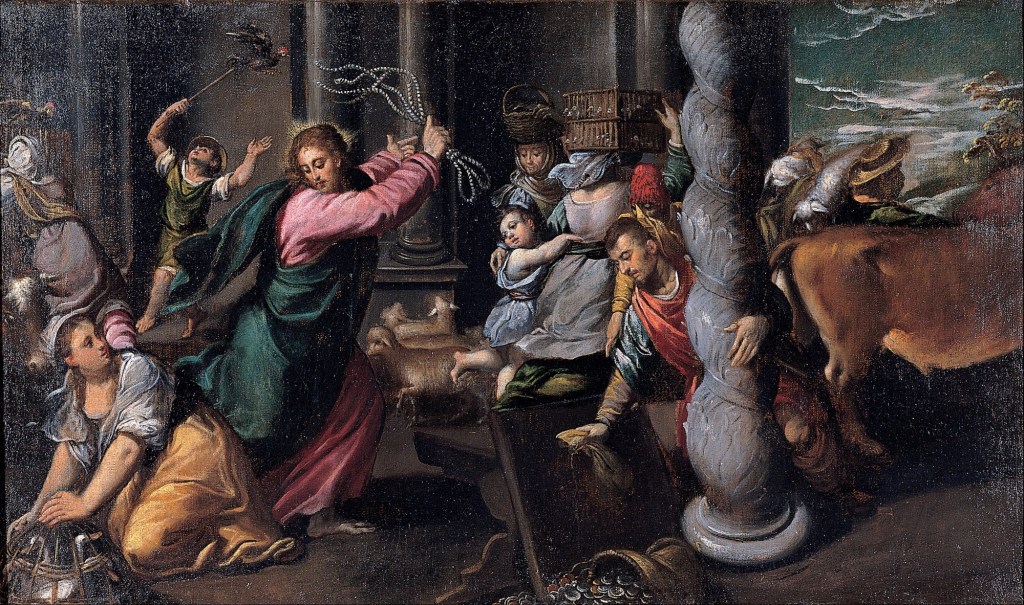
Our Gospel today depicts Jesus in a cleaning frenzy.  Unlike me, He was totally energized to clean up His Father’s House.  Let’s not forget that since He too is God, it was His House as well.  And He was incensed that the religious authorities had allowed what He saw going on there.

In our Gospel lesson (John 2:13-22), Jesus goes head to head with the Temple leadership to effect a physical and a spiritual house cleaning.  The religious establishment had authorized both the buying and selling of sacrificial animals, and a coin exchange–for a fee—on the Temple Grounds.  Some worshippers came from long distances without animals of their own.  So those “pilgrims” without animals had to purchase one or two to make their sacrifice.  Additionally, they had to pay a ½ shekel Temple Tax.  The fact that no Roman coins could be used–because they had Caesar’s face on them (a graven image which Jewish law prohibited), as well as the inscription, “Caesar is Lord” (which constituted blasphemy to the Jews), meant that they also had to exchange their money, for a fee.

Jesus was incensed with all of this for a number of reasons:

1.) Those selling the animals unfairly marked them up. They knew people didn’t have a choice, and they gouged them for the convenience. 

2.) They also charged an outrageous fee for the coin exchange.

3.) The animals were smelly and noisy and distracting in what was a house of prayer and a place of worship.

4.) But perhaps worst of all, the marketplace took over the only area in the Temple where Gentiles could gather.  Essentially, they were prevented from worshipping in the only space allotted to them.

So Jesus cleared the area in no uncertain fashion.  He formed a whip and used it to drive away the animals.  He also overturned tables, no doubt scattering money everywhere.  He shouted (v.16) How dare you turn my Father’s House into a market!  Of course, then “The Jews” (John-speak for the religious establishment) want to know what gives Jesus the right to clear the Temple and upset their very profitable businesses.  They said, Give us a miraculous sign—prove You have sufficient authority to do this.  Jesus responds rather cryptically, telling them (v.19), Destroy this temple and I will raise it again in three days.  They think He is speaking of the Temple building and scoff at Him.  We know He was speaking of His body (predicting His resurrection)—a pretty authenticating sign!  But they were so haughty—so sure their understanding surpassed His—that they did not believe Him.  Don’t you imagine that when He left, they went right back to doing business as usual?  

They must have forgotten verse 6 of Psalm 138—God is close to the humble, but distances Himself from the proud.  It’s dangerous to think we always have all the right answers.  Pride caused most of the Pharisees, Scribes, and Sadducees to miss who Jesus was.  They’d made an idol of their understanding of the Scriptures. Because Jesus didn’t fit their preconceptions, they missed out on the opportunity to develop a relationship with the Son of God.  Let’s not make the same mistake. Let’s make sure we clean our spiritual houses of the sin of pride.

Let’s take a look too at our Old Testament lesson from Genesis 20:1-17.  Just last week, we were praising Abraham, the Father of our Faith, for his trust in the Lord.  Abe is such a great example of trusting in the Lord’s provision of the Promised Land; trusting in God’s promise of descendants without number; and benefiting from God’s blessings of health and wealth. Where he seemed to have wavered in his faith, however, was in being certain that God would protect his life.  Apparently, his wife Sarah was very beautiful.  I’ve heard another pastor humorously refer to her as a “Biblical babe.”  Unfortunately, whenever Abraham encountered a foreign ruler, they appeared to covet her.  Back in Genesis 12, when Abraham moved to Egypt due to a famine, the Egyptian pharaoh heard of Sarah’s beauty and took her from him. Abraham in a sense brought this on himself because he lied, telling Pharaoh she was his sister (she was his half-sister), instead of his wife. He was afraid Pharaoh would kill him in order to clear the way to marry her.  In this situation, he didn’t depend on the Lord!

Fortunately for both of them, God protected them anyway. He afflicted the Egyptians with “serious diseases” until Pharaoh gave Sarah back to Abraham and told them both to leave.  So, this had happened before. You would think that Abraham would now trust God to protect him from rulers tempted by Sarah’s beauty.  But no, in today’s lesson, the two encounter Abimelech, a Canaanite king. Like with Pharaoh previously, Abraham again lied and said Sarah was his sister, not his wife. The same thing happened as Abimelech coveted Sarah and took her, intending to add her to his harem. 

Once again, God intervened—not with disease—but with a dream containing a death threat. Abimelech believed God’s message from the dream and immediately returned Sarah to Abraham. But the pagan king was also outraged and demanded to know why Abraham lied to him and put him and his people at risk.  Abraham, the great model to us of faith, had not trusted the Lord to keep him and Sarah safe from another lusty king. Abraham, who God judged as righteous due to his faith, has now lied twice.

What do you make of this?  I think we can safely say that Abraham was a good man but not a perfect man. There was and is only one perfect man–that’s our Lord, Jesus.  Like us all, Abraham’s great faith wavered from time to time.  Don’t we all have times when our faith is stronger or weaker  than usual.  We too may have areas in our lives where we find it very hard to trust God.  Nevertheless, since he was God’s choice as the patriarch of the Jews—since God meant to accomplish great things through him—the Lord guaranteed his safety.  Similarly, I think God has grace for us in those areas we have not yet surrendered to Him.

Remember, we are in the season of Lent.  These two readings today focus on two aspects of human behavior that God wants us to clean out of our spiritual houses:  (1) Pride (and even the misuse of His house of worship), and lying.  Lent is a time for evaluating our behavior, recognizing our sins, and asking God’s forgiveness.  Maybe you are not overly proud and you don’t lie.  But each of us is probably guilty of some other sins we could name.  Soon, in our preparation to receive Holy Communion, we will say a general prayer of confession.  Let’s take a moment now to call to mind our sins and confess them to Jesus, in our hearts, right now.  Let us also be comforted by what the Apostle John promised in 1 John 1:8-9—If we claim to be without sin, we deceive ourselves and the truth is not in us.  If we confess our sins, He is faithful and just and will forgive us our sins and purify us from all unrighteousness.  Amen and amen!

©️2024 Rev. Dr. Sherry Adams

Kingdom Courage

Pastor Sherry’s message for November 19, 2023

Scriptures: Jud 4:1-24; Ps 90:1-12; 1 Thess 5:1-11; Matt 25:14-30

Chuck Swindoll recalls the story of a 70 year old man who was being celebrated aboard a cruise ship for having saved a young woman. These folks were on a week-long cruise from California to Hawaii. The man was out walking on the deck when he saw the young woman fall overboard. He saw she could not swim, so he immediately went in after her, staying with her until they were both rescued. That night, the captain insisted they honor the somewhat embarrassed gentleman, over dinner, for his heroic actions. Speeches were made and the story of the man’s bravery was told and retold. Finally, they invited the fellow to the mike to say a few words. In what was probably the shortest hero speech ever offered, the fellow spoke these stirring words:

“I just want to know one thing—who pushed me?”

(Chuck Swindoll, The Tale of the Tardy Oxcart, Word Pub., 1998, p.119.)

I love this story because it illustrates so well the fact that our God can make the most unlikely of us into heroes. Can you imagine jumping overboard—at age 70—to rescue someone you didn’t know? Perhaps you’ve heard of similar stories. Courageous persons don’t allow their fears to talk them out of doing the brave thing. They also usually involve trusting in God to see them through a tough situation.

Our Old Testament and Gospel lessons today give us two examples of God’s concept of Kingdom Courage:

In our Old Testament lesson (Judges 4:1-24), we have the only example of a woman called to lead the nation of Israel, Deborah the Prophetess. Scripture mentions several women prophets: Miriam (Moses’ sister) (Exodus 15:20), Huldah, who sent a message to the good King Josiah (2 Kings 22:14), Noadiah, a bad prophet who tried to thwart the rebuilding of Jerusalem (Nehemiah 6:14), and Anna, who recognized that the infant Jesus was the Messiah (Luke2:36).

Deborah was called and equipped by God to lead during the time of the Judges. Joshua had died at 110, leaving no successor (no human understudy to rise up and lead in his place). Even though the people had promised him many times they would remain obedient to God, within 40 years, they had taken up idolatry and forsaken the LORD. The Lord would then allow a Canaanite people—Amorites, Amonites, Moabites, Midianites, or even Philistines—to then oppress them. They would then call out to the LORD for His rescue. God would forgive them and raise up a judge to lead them in defeating their enemies. They would thank and praise Him; but shortly, once the threat was over, they would again forget about their loyalty to God. And the 40 year cycle would begin all over again. The book of Judges reports 7 such cycles and 7 judges. Deborah was the 4th.

Who was she? Scripture tells us she was…

1.) A wife to Lippidoth. We know nothing of him, except that he seemed to have recognized God’s call on his wife’s life and did not appear to try to frustrate her influence or power.

2.) “A mother of Israel,” out of the tribe of Ephraim. While this may mean she had children of her own, it also means she nurtured and cared for the nation.

3) A wise counselor people came from miles around to seek her wisdom and advice.

4.) A renown judge—like Judge Janine Pirou or Judge Judy. Instead of sitting at the city gates to hear cases as was typical in those days (V.5)She sat beneath a palm tree named for Her–the Palm of Deborah–located between the cities of Ramah and Bethel.

5) A legitimate prophetess—She was anointed by God, who told her what to say to His people. She foretold events accurately, and nothing she prophesied disagreed with Scripture.

6.) We learn in today’s passage that she was a warrior.

7.) She was also a poet—She wrote a song/psalm, describing what God accomplished through her leadership in Judges 5.

8.) Finally, she was a woman who loved and trusted God—I’d say she had Kingdom Courage.

The situation Deborah finds herself in is that the Canaanite King Jabin had oppressed the Israelites for 20 years. He terrorized them with 900 iron chariots and horses and his successful General Sisera. Sisera’s army had confiscated all the Israelite‘s iron weapons in their initial victories. The Israelites were left then with wooden and stone weapons, clubs, rakes, etc.—they were at a distinct disadvantage. God tells Deborah to call for Gen. Barak from the tribe of Naphtali. She did, telling him that God meant for him to lead the people into battle against Sisera: (v.6–The LORD, the God of Israel, commands you: ‘Go, take with you ten thousand men of Naphtali and Zebulon and lead the way to Mount Tabor. I [the Lord] will lure Sisera, the commander of Jabin’s army, with his chariots and his troops to the Kishon River and give him into your hands.

God told Deborah and Gen. Barak that He was going to give the Israelites the victory. The General doesn’t see how—he doesn’t really trust in God. He focuses on the fact that his troops are outnumbered 10 to 1. He also knows he has no horses or chariots and that Sisera’s army is much better equipped (with iron weapons) than his army is. Barak agrees, but only if the prophetess will accompany him. However, since he doesn’t really seem to trust her or God, she tells him God will give the victory (Gen Sisera) to a woman (Jael, the wife of a weapons maker).

This previously unknown woman, Jael, was married to a Jewish man named Heber. He was an iron weapons manufacturer and a turncoat who collaborated with the Canaanites against his own people. To expedite his transactions, Heber and his much more loyal wife, Jael, lived in tents near the Canaanite army and the proposed battle site. (Sorry to say, but the men in this account do not appear to have the same moral fiber, Kingdom Courage, or faith that the women do.)

Much of what happens in the ensuing battle is recorded by Deborah in her psalm, in chapter 5. From her victory song we learn the LORD sent…

1.) Soldiers from the 6 tribes of Naptali, Zebulon; Issachar; Ephraim, Manasseh, and Benjamin.

2.) He also sent hail, sleet, and torrents of rain in which…

a.) bogged down the 900 chariots in deep mud;

b.) panicked the horses so they ran off;

c.) Canaanite archers couldn’t shoot their arrows in the sleet;

d.) and their swordsmen couldn’t wield their swords as well in the cold (remember this is essentially a desert-like land, where they are used to the heat, not the cold).

e.) Additionally, many enemy soldiers were swept away in a flash flood.

The battle belonged to the Lord. Israel’s army was able to kill all the enemy, except Sisera, who ran off in a desperate attempt to save himself. He escaped on foot and asked for sanctuary with Jael in her tent. In that culture in that day, the only man who was authorized to enter a woman’s tent was her husband. To hide out in a woman’s tent was outrageous. Remember, Jael is the wife of the Jewish weapon-maker. Sisera asked for water, but she gave him warm milk which we know would make him sleepy. Once he nodded off, she then executed this terrifying enemy of her people while he slept—and with the only weapon she had at hand. Interesting that, like the shoemaker’s daughter who has no shoes, this woman does not even have a metal knife at her disposal. Instead, she pounds a tent peg through his temple, killing him instantly, and fulfilling Deborah’s prophesy.

In her psalm, Deborah gives God the glory for their victory. Deborah trusted in God to free her people from oppression. She used her gifts of leadership in the face of overwhelming odds. Because of her faithful obedience and her Kingdom Courage, God gave Israel another 40 years of peace.

In our Gospel lesson, Matthew 15:14-30, Jesus provides examples of two courageous servants who utilize their talents for God and one who does not. Jesus says the master in the story leaves his assets in the hands of three servants. He appears to dole out his assets according to his trust in their abilities/motivation. One very able fellow gets 5 talents. Back then, a talent was equal to 1 years’ wages. For purposes of illustration, let’s say a years’ wages were $30,000; this guy has been entrusted with 5 times that or $150,000. The next gets 2 talents, or $60,000; and the third, 1 talent or $30,000.

When the Master returns, He expects them to account for how they invested His money. The fellow who had 5 talents invested them wisely and wound up earning double or $300,000! The guy with 2 also invested wisely and earned double, or $120,000. The guy with no faith or Kingdom Courage hid his 1 talent, so he gained nothing. At least he was honest and returned the $30,000. But the master was angry because he could have at least deposited the $30,000 somewhere and earned interest.

The Master commends the first two, Well done, good and faithful servant…Come and share your master’s happiness! But He has nothing but contempt for the third. This guy was either so lazy as to not use the talents, or too afraid to fail, so he did nothing. This guy gets thrown into the outer darkness, (v.30)…where there will be weeping and gnashing of teeth.

Many see this as a very hard teaching of Jesus. What they need to understand is that this is not a story of money or of wise investment practices. It is about utilizing the skills and gifts we have been given by God to build up His Kingdom. Notice, all are called to account: Those who use their gifts are blessed now and join Jesus in eternity. Those who do not are chastised and punished. I believe when we stand before God at His judgment seat, He will ask those of us who love His Son two questions: How well did you do at loving others? And how well did you use the gifts I gave you to advance My Kingdom?

So what is the point for us today?

First, like the 70 year old man pushed to rescue a woman at sea, God can make even ordinary people into heroes. Deborah was very gifted, but think about the housewife, Jael. She not only countered her husband’s disloyalty to Israel, but she was brave enough to kill a cruel enemy with a tent peg and a hammer.

Second, think about the two unnamed servants who took a risk and invested their master’s money. What about the risk and Kingdom Courage it takes us to step into our gifting? We need to not focus on our fears, but rather trust in God to help us achieve what He has put in our hearts. He expects us to use the talents He has given us to bless others.

Finally, God wants us to exhibit Kingdom Courage. He often uses ordinary people who trust in Him to accomplish His will. Do you trust God?

Are you willing to be obedient to Him, even when your situation seems difficult or impossible? If He can use an essentially unarmed army to defeat a vastly superior force, He can master any situation we bring before HIM.

What situation are you in that has you flummoxed, frightened, or frustrated?

Give it to the Lord, over and over until you see results (this is called “praying through”). Then ask God to give you Kingdom Courage to do any hard things that He may indicate He wants you to do.

Amen. May it be so!

©️2023 Rev. Dr. Sherry Adams