Advent Joy

Pastor Sherry’s message for December 14, 2025

Scriptures: Isa 35:1-10; Lk 1:46-55; Ja 5:7-10; Matt 11:2-11

You may have heard this illustration before. Josh McDowell used it in his book, More than a Carpenter, Tyndale House, 1977, p.108:

In his book, Science Speaks, Peter Stoner applies the modern science of probability to just eight prophecies regarding Christ [from 60 major Old Testament prophesies of Jesus]. He says, “The chance that any man might have …fulfilled all eight prophecies is one in 10 to the 17th. That would be 1 in 100,000,000,000,000,000.” (one hundred quadrillion) Stoner suggests that “we take 10 to the 17th silver dollars and lay them on the face of Texas. They will cover all of the state 2 feet deep. Now mark one of these silver dollars and stir the whole mass thoroughly… Blindfold a man and tell him he can travel as far as he wishes, but he must pick up [that one marked silver dollar.] What chance would he have of getting the right one?” Stoner concludes, “Just the same chance that the prophets would have had of writing those eight prophecies and having them all come true in any one man…providing they wrote them in their own wisdom.”

(Peter Stoner and Robert Newman, Science Speaks, Moody Press, 1976, pp.106-112.)

This account gives us some idea of the incredible veracity, the compelling truth of the Biblical claim that Jesus Christ is God’s Messiah. Not only do Stoner’s (and Newman’s) math computations demonstrate that only one person in all of history could have fulfilled just 6 of the 60 major Old Testament prophesies of the Messiah, but that Jesus–and only Jesus–was the one person who satisfied these prophesies (He also satisfied the other 52 major and 270 minor ones).

Today is the 3rd Sunday of Advent and we just lit the candle representing Joy (and prophesy) in our Advent Wreath. Doesn’t it bring you great joy to realize we worship the One, True King, Jesus Christ our Lord? I read this years ago and it solidified in my mind what I already knew in my heart and in my spirit—Jesus is the One and Only, long awaited Messiah. Our Scripture lessons today all testify to His identity and to His saving actions on our behalf:

A. Let’s begin with Luke 1:46-55, known as Mary’s Magnificat, a psalm of praise to God from the newly pregnant Mother of Jesus. Mary realizes a great honor is being bestowed upon her to become what the ancient Greek Christians would later call the theotokis or God-bearer.  In those days, to be chosen to bear the Messiah was every Jewish girl’s dream. Even though having a child out of wedlock could prove dangerous (she could have been stoned) and embarrassing for her before her family and her small community, Mary believes the Angel Gabriel’s announcement and rejoices in God’s choice of her. She then composes a song in which she primarily praises God. How humble and obedient she was! We could expect the whole psalm to say, “YIPPEE, God picked ME! Hooray, I was His choice!” But instead she proclaims (vv.47-49, NLT)—Oh how my soul praises the Lord, how my spirit rejoices in God my Savior! For He took notice of His lowly servant girl, and from now on all generations shall call me blessed. For the Mighty One is holy and He has done great things for me. She recognizes that God has truly honored her, and she modestly admits her delight.

But then she proceeds to glorify God for what He is doing through her for His people. She shifts the focus from herself, and sets it upon God’s actions. She proceeds to praise Him for… (1) His mercy to those who respect and revere Him; (2) His past works of power; (3) His surprising, unexpected propensity to reverse worldly fortunes: The lowly are raised up, while the lofty and self-reliant are brought low; and 4) His fulfillment of His promises to Israel: A king from the lineage of David, and a Messiah who will bless all nations on earth. Can’t you just hear her joy as she delights in the plans of God the Father and in the future redeeming work of her soon-to-be-born son?!

B. Just prior to our Gospel lesson today, Matthew 11:2-11, Jesus has sent the 12 out to put into practice all He has taught them.

Meanwhile, He does not sit idle, but continues to preach and teach. John the Baptist (JtB), has been imprisoned for some time now, and—as often happens—he begins to doubt his earlier faith that his cousin Jesus is the Messiah. Remember, he was the forerunner, the prophet to announce Jesus’ arrival. But, rotting away in a dungeon, he begins to doubt his previous certainty. He deploys two of his disciples to ask Jesus (v.3) Are You the One who was to come, or should we expect someone else? 

No doubt JtB expected Jesus to set him free. After all, Jesus’ job description from Isaiah 61:1 promised that Jesus would—…proclaim that captives [would] be released and prisoners [would] be freed. John was probably expecting his immediate emancipation. He may have also been frustrated that it was taking Jesus so long to usher in His Kingdom on earth.

But instead of sending word of eminent release, Jesus reiterates from Isaiah 61:1 that the blind see, the lame walk, lepers are healed, the deaf hear, the dead are raised to life, and the Good News is preached to the poor.

Because He does not reiterate that He will also (NIV)—proclaim freedom for the captives and release from darkness for the prisoners, JtB learns Jesus will not be initiating a jail break. Yes, John, your cousin is the Messiah you proclaimed at the beginning of His earthly ministry; but no, He will not be commuting your sentence. 

Jesus does not meet JtB’s personal hopes. Apparently, it suited God’s purposes for JtB to leave the scene (decrease) so that Jesus’ ministry could increase. If you have watched the various scenes from “The Chosen,” you may have encountered the one that focuses on JtB’s execution. It what seemed to me to be so poignant, the writers have John look out a window, as the executioner’s ax is lifted above his head, and see a lamb grazing. It is as though the Lord wanted to remind him in his last moments that he had done a good job of telling others He was and is the Lamb of God. Jesus does proclaim to those He was teaching that JtB was the greatest of the Old Testament prophets. Hopefully, John understood this need to exit the world stage and had prepared himself to meet his Maker.

C. In fact, JtB probably knew Isaiah 35:1-10, a Messianic prophesy from 700 years before Jesus’ birth. He would have remembered that in the predicted Messianic or Mellenial Age (the 1000 year reign of Christ) that the material earth will be restored to the time before the Fall. As a consequence of Adam and Eve’s sin, God had cursed the ground and the serpent—not the humans. True, life would be harder than it had been for them in the Garden, but only the physical earth and Satan were actually cursed. Paul will later assert (Romans 8:22)—We know that the whole creation has been groaning as in the pains of childbirth right up to the present time. Paul had learned from Jesus that creation, too, would be redeemed at Jesus’ 2nd Coming.

Additionally, JtB would recall that the bodies of human beings will be renewed. Verses 5-6 promise that—…the eyes of the blind will be opened and the ears of the deaf unstopped. Then will the lame leap like a deer, and the mute tongue shout for joy. Water will gush forth in the wilderness and streams in the desert. Think of the vast swath of desert land in our southwest, or the enormous Sahara in North Africa. These lands will be renewed and covered with vegetation and flowers.

Though Jesus accomplished the healing of many individuals in His 1st Advent—we really have no idea of how very many He healed–when He comes again, all of humankind will be spiritually, physically, and emotionally restored. How can we learn this and not experience a welling up within our hearts and spirits of great joy?!!

D. No wonder we have the James 5:7-10 passage. The 2nd coming of Jesus Christ will right all that is now wrong with our world. However, as James counsels us, we need to (v.7)—Be patient, then, brothers [and sisters] until the Lord’s coming. Scripture has told us what to expect.

We just need to wait with faith, as a farmer waits for his/her crops to grow.

We should get ourselves ready to receive our King. James counsels us not to let Him catch us gossiping about or negatively judging others. And we can and should meditate on the lives of the prophets, including JtB, as we wait. They all prophesied the wonders to come In Jesus, but did not get to see them manifest in their own lives.

An anonymous author once wrote: 

If our greatest need had been information, God would have sent us an educator; If our greatest need had been technology, God would have sent us a scientist; If our greatest need had been money, God would have sent us an economist; If our greatest need had been pleasure, God would have sent us an entertainer; But our greatest need was forgiveness, so God sent us a Savior.

(Quoted in www.sermoncentral.com, 12/10/2025)

Thank God the Father sent us a Savior! We all needed saving from the penalty of death for our sins and from our carnal tendencies to seek out and indulge in sin. We all needed a divine rescue! We needed the gift of Jesus! 

The song in our hearts today could very well be Beethoven’s Ode to Joy (Music by Beethoven; lyrics by Henrr Van Dyke):

Joyful, joyful, we adore Thee, God of glory, Lord of Love;

Hearts unfold like flowers before Thee, praising Thee, the Sun above.

Melt the clouds of sin and sadness; drive the dark of doubt away;

Giver of immortal gladness, fill us with the light of day.

All Thy works with joy surround thee, earth & heaven reflect Thyrays;

Stars and angels sing around Thee, center of unbroken praise,

Field and forest, vale and mountain, blooming meadow, flashing sea,

Chanting bird and flowing fountain, call us to rejoice in Thee.

Thou art giving and forgiving, ever blessings, ever blest,

Wellspring of the joy of living, ocean depth of happy rest;

Thou our Father, Christ our Brother; all who live in love= thine;

Teach us how to love each other, lift us to the joy divine.

Lord, please fill our hearts with Joy during this Advent Season. Amen and Amen!

©️2025 Rev. Dr. Sherry Adams 

Christmas Joy, All Year Round

Pastor Sherry’s message for December 15, 2024

Scriptures: Zeph 3:14-20; Isa 12:2-6; Phil 4:4-7; Lk 3:7-18

If there is a single word that describes what Christmas is about, it’s JOY!  Some of our favorite Christmas carols include the word:  (1) Joy to the world, the Lord is come; (2) O come all ye faithful, joyful and triumphant…; (3) Shepherd, why this jubilee, why your joyous strains prolong? (4) Good Christian men rejoice, with heart and soul and voice; (5) Joyful all ye nations rise, join the triumph of the skies, with the angelic host proclaim, “Christ is born in Bethlehem.”

But, I wonder how many of us could truthfully say we are filled with joy this morning?  Listening to these wonderful carols can help lift our spirits; however, it’s not always easy to feel joy, is it?  Judge Oliver Wendell Holmes, Jr.—a Supreme Court justice for 30 years–admitted becoming a judge had been his second choice of vocation.  He later said, “I might have entered the ministry if certain clergymen I knew had not looked and acted so much like undertakers,” a sad commentary on the clergy of his day.

(Moody Bible Institute’s “Today in the Word,” 6/88, p.13).

Or as the Christian writer, John Ortberg asserts, “Joy in this world is always in spite of something.”  His statement implies that we have to fight against negative emotions to feel joy.  It also suggests that we have to work hard to overcome every seduction of the world, the flesh, and the devil to experience it. 

(John Ortberg, The Life you’ve Always Wanted, 1997. P.73)

I think a large part of our problem with the emotion joy is that we have mistaken the way we think about it.  We tend to connect it with happiness and believe it is due to our circumstances.  But the truth is that true joy comes from our relationship with Christ Jesus.  The Rev. Will Willamon, former chaplain at Duke University, once said: Real joy is not self-induced. The Christmas story affirms that despite the oppressive political systems and the depressing reality of life, Christians can still be joyful, for they know joy is not about what they do to solve the problems of life, but that it is instead a byproduct of what God does through Jesus Christ. 

(Will Willimon, Christmas sermon, Duke University, 12/25/1994)

Like the peace that passes all understanding (Philippians 4:7), it has much less to do with what is going on in our life situations, and much more to do with the depth of our connection with our Lord.

Additionally, true joy just shows up on our faces.  Someone once stated, “Countenance is a press conference that your face calls to give the state of union of your soul.”  The story is told of a man… who walked by a table in a hotel and noticed 3 men and a dog playing cards.  The dog appeared to be winning.  “That must be a very smart dog,” the man commented.  “He isn’t so smart,” said one of the players. “Everytime he gets a good hand he wags his tail!”

(Kent Crockett’s  Sermon Illustrations, www.kentcrockett.com, 12/24/18)

I guess you could say that it is possible to look at certain people or animals and see joy all over their faces, or in the way they carry themselves, even if you know their life situations are troublesome. 

Our Scriptures this morning point to how we can experience true joy this Christmas—and actually, all year round:

A.  In our Old Testament lesson, Zephaniah 3:14-20, the prophet foretells of a glorious day coming for Jerusalem (and for those of us who love Jesus).  Zephaniah (who prophesied from 640-609 BC) was of royal blood, the great-great-grandson of King Hezekiah—one of the few good kings of Judea.  He was a minor prophet who appeared on the scene during the reign of King Josiah, another good king of Judea, and was one of the last of the prophets prior to the “Babylonian Captivity.”  Unlike his contemporary Jeremiah, who is often referred to as the weeping prophet, Zephaniah is called the prophet of love because of the final chapter of his prophesy.

He spends two chapters warning the people of God’s coming judgment on them for their idolatry and apostasy—for which they were subsequently carried off into the Babylonian Empire for 70 years.  His last chapter foretells of God’s planned restoration and redemption of them.  In His love for them, God is going to bring them back to Jerusalem from where they have been scattered.  How gracious of God to promise them deliverance and restoration even before He punishes them.

The prophet predicts essentially the 2nd Coming of Christ as well, also known as “the Great and Glorious Day of the Lord.”  In verses 14-15 he writes—Sing, O Daughter of Zion; shout aloud, O Israel!  Be glad and rejoice with all your heart, O Daughter of Jerusalem!  The Lord has taken away your punishment, He has turned back your enemy.  The Lord, the King of Israel, is with you; never again will you fear any harm.  And continuing on into verse 17, he comforts us all with this beautiful promise—The Lord your God is with you, He is mighty to save.  He will take great delight in you, He will quiet you with His love, He will rejoice over you with singing.

God, through Zephaniah, wants us to know that He will indeed discipline us, but He will also restore us because of His great love for us.

The writer to the Hebrews affirms this fact in 12:6—…the Lord disciplines those He loves….The Apostle John says it another way, quoting Jesus (John 15:1-2)—I am the True Vine and my Father is the Gardener.  He cuts off every branch in Me that bears no fruit, while every branch that does bear fruit He prunes [this process tends to hurt!] so that it will be even more fruitful.  Paradoxically, the fact that God allows us to go through trials is evidence of His love for us.   Furthermore, if we have the self-discipline and godly insight to recognize this fact, we can actually rejoice in our trials, knowing God is using them to mold and shape us.

B.  Isaiah 12:2-6 is essentially a song of praise to God.  In verse 2 he asserts—Surely it is God who saves me.  I will trust in Him and not be afraid.  He follows this up in verse 6 by assuring us that our response to God’s acts should make us—Shout aloud and sing for joy, people of Zion, for great is the Holy One of Israel among you.  So, we are to rejoice in God because He is our savior; our strength, our song, and our salvation; and because He has done—and will do–glorious things for us.

If we focus our hearts and minds on these things, we cannot help but be filled with joy.

C. In our New Testament lesson, Philippians 4:4-7—Paul actually commands us to rejoice!  We are not to worry about anything, a 2nd command.  Instead, we should submit all our concerns—with thanksgiving–to God through prayer.  Paul is insisting we pray about everything, a 3rd command.  Then, he promises, God’s peace will settle on us and in us and even guard us.  And, if we concentrate, intentionally, only on things that are noble, right, pure, lovely, admirable, excellent, or praiseworthy, we will retain our peace and increase our joy.  In other words, achieving a state of joy is both a choice and a habit.  It comes from disciplining ourselves to look for and celebrate the good.  It is also based upon trusting God, trusting in Jesus. 

Joy is certainly available to us, but it is not found in people’s usual life pursuits:

1. Voltaire, the French philosopher and historian (1694-1778), was an atheist who asserted as he died, “I wish I had never been born.”

2. The British poet, Lord Byron (1788-1824), investigated every possible type of pleasure but concluded before his untimely death at age 36, “The  worm, the canker, and grief are mine alone.”

3. Jay Gould, an unscrupulous, American financier and multi- millionaire (1836-1892), said from his death-bed, “I suppose I am the most miserable man on earth.”

4. Lord Beaconsfield (1804 –1881), also known as British Prime Minister Benjamin Disraeli, later wrote, “Youth is a mistake; manhood a struggle, old age a regret.” 

5. Even Alexander the Great (357-324BC), the young Greek General who conquered the known world of his day, was said to have wept in his tent, because he believed, “There are no more worlds to conquer.”   He died at age 33.

Each of these famous persons realized by the end of his life, that joy does not come from unbelief in God, nor the dogged pursuit of pleasure, money, position, fame, or successful military conquest (i.e., power).  

(Idea borrowed from “Pursuit for Joy,” www.bible.org, 12/14/2018).

D. Fortunately, though, we can all access joy through drawing near to Jesus.  In our Gospel lesson, Luke 3:7-18, John the Baptist teaches two activities that result in joy:  The first is submitting to baptism.

John’s baptism symbolically washes away our past sins.  Jesus’ baptism in the Holy Spirit empowers us to avoid present and future sin.  If you ever saw the movie, “Oh Brother, Where art Thou?” you may remember the scene in which the fugitive convict, Delmer, gets baptized in the river.

Later, in the car with his other 2 convict buddies, he exclaims, “I have been redeemed.  The preacher said so. All my sins and wrongdoings has been wiped away, including robbing that Piggly-Wiggly.”  Another convict says, “Uh, Delmer, I thought you said you was innocent of those charges.”

Delmer confidently replies, “Well, I lied, but I been forgiven of that too.”

Having his sins washed away filled Delmer with joy—as it should for each of us.  

The second activity that can lead to joy is being generous toward and honest with others.  John the Baptist exhorts is listeners to share with those who have needs, to not extort or oppress those less powerful, and to only charge a person their fair tax.  Our Christmas gift exchanges are a great way to experience this kind of generosity.  So are putting money in a Salvation Army kettle, filling Christmas shoe-boxes for Samaritan’s Purse’s Operation Christmas Child, or bringing food to the ill or the grieving.  

May we each draw closer to Jesus this Advent and experience His gift to us of Christmas joy all year round.  Amen!  May it be so!

©️2024 Rev. Dr. Sherry Adams

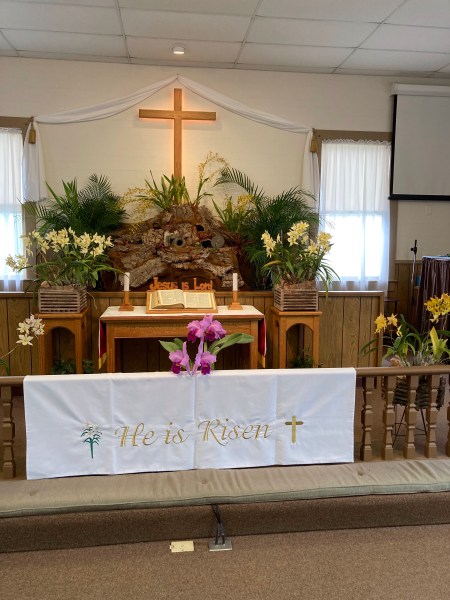
Alleluia, He is Risen!

Pastor Sherry’s message for March 31, 2024

Scriptures: Acts 10:34-42; Ps 118:1-2, 14-24; 1 Cor 15:1-11; Mk 16:1-14

The story is told of a woman hurrying to church on Easter Sunday morning, when her car broke down: 

Not wanting to be late for the Easter service, she ordered an Uber to pick her up. The car arrived, and she quickly jumped in the back. 

Halfway through the ride, she asked the driver a question, but the driver didn’t respond. So she leaned forward and tapped [him] on the arm. The driver let out a loud scream, swerved into the other lane, almost hit another car, slammed on the brakes, and skidded over to the shoulder. 

The woman and driver sat in silence for a minute from the shock of what just happened. Finally, she said apologetically, “Wow, I’m so sorry. I had no idea that tapping your shoulder would alarm you like that.” 

“No, you really didn’t do anything wrong. It’s just that it’s my first day driving an Uber. You see, for the past 25 years, I’ve been driving a hearse.” 

(Borrowed from Subsplash.com, a blog, dated February 3, 2024.)

I’ll bet the poor driver thought he had witnessed a resurrection!  He was clearly shocked. He, and the woman trying to get to Easter Sunday services, were fortunate to escape injury.  It’s just a story—I don’t even know if it’s true—but it’s a reminder, isn’t it, of how fragile life is and of how amazingly our God looks after us.  I hope before they resumed their drive, they both took the time to thank the Lord for seeing them through a close call.

I think our responses to Easter Sunday must be belief and incredible gratitude.  Jesus’ death and resurrection accomplished for us what we could not do for ourselves.  He saved us from the penalty for our sin.  He dismantled the barriers between us and God the Father.  He demonstrated God’s life-giving, resurrection power.  And He grafted us into His Father’s family as adopted sons and daughters.

A. Mark gives us what is probably Peter’s account of what happened at the first Easter or Resurrection Sunday:  He shares that 3 women—who had all been at the foot of the Cross, grieving what had been done to Jesus—hurried to the tomb to complete the Jewish burial customs.

He had been hastily buried because of the Sabbath was scant hours away and the Sabbath prohibition from doing any work on that day.

None of the men accompanied them.  They may have been afraid they would be captured and crucified too.  Given the brutality of the Romans, this was all too likely, so the 11 disciples were in hiding.

No doubt the women wondered as they neared the tomb, “How will we roll back the rock covering the entrance?”  But they quickly observed that the tomb was standing open!  Moreover, it was empty!  Except for an angel who said (v.6)”Don’t be alarmed, …You are looking for Jesus the Nazarene, who was crucified.  He has risen!  He is not here.  See the place where they laid Him.  But go, tell His disciples and Peter, ‘He is going ahead of you into Galilee.  There you will see Him, just as He told you.’” 

What an astonishing greeting!  I’ve never seen an angel, but my friends who have say they are about 9 feet tall and shine brightly.  No wonder they always tell those to whom they appear to not be afraid.  The three ladies, who are no doubt in shock, run off.  According to Mark, they say nothing to anyone, at first.  Matthew and Luke tell us they did go and tell the 11 apostles.  John says Jesus appeared to Mary Magdalene first and told her to tell the 11.

So there are a few discrepancies about timing and order—which is often true with eye-witnesses as they process their own shock and surprise—but the main narrative is the same: (1) The tomb is open and empty.  (2) The angel announces the Jesus is alive again!  Alleluia!  He is risen!  (3) Whoever encounters the angel is told take that Good News to Jesus’ closest friends:  Jesus has done what He said He would do!  Alleluia!  He is risen indeed!

B. As Paul makes clear in our 1st Corinthians 15:1-11 lesson,we are to understand 2 facts:

First, Jesus’ resurrection was not just a spiritual truth but a bodily phenomenon.  The words he uses in the Koine Greek (the language in which the New Testament was written) are anastasis nekron, which means the standing up of a corpse.   Jesus appeared to His followers in a real body.  One that had been alive, but was then executed, and then miraculously came back to life!

Second, He appeared (post-resurrection), Paul tells us, to over 500 witnesses.  This is no myth!  This is no baseless narrative that has been spun to deceive.   No, Jesus’ resurrection is a fact!

1.) Peter and John saw Him;

2.) Mary Magdalene and the other faithful women saw Him; 

3.) His mother saw Him;

4.) His brother James saw Him;

5.) The 10 Apostles in the upper room saw Him;

6.) Later, the Apostle Thomas also saw Him;

7.) The two disciples on the road to Emmaus saw Him;

8.) Paul encountered Him on the road to Damascus;

9.) And Paul adds (verse 6) that >500 persons saw Him, at various times, during the 40 days between His Resurrection and Ascension.

You might be able to dismiss the testimonies of a few wild-eyed zealots.

But add to this over 500 “normal people?”   How about the fact that Jesus fulfilled over 325 Messianic prophesies from the OT?  Or the fact that He is probably the most influential person who has ever lived?  Still worshipped today, 2000 years later; still proclaimed as Lord, for 2 millennia. Or that thousands of His followers have met martyr’s’ deaths rather than renounce Him.  Scholars say there is more evidence of Jesus’ life, death, and resurrection than there is of the life of Julius Caesar.  These very strong proofs of the reality of Jesus’ resurrection should strengthen our faith in Him.

But let’s also consider what our other passages today have to say about why His resurrection should also result in our tremendous gratitude:

A.  King David who wrote Psalm 118:1-2, 14-24 as an ode to joy!  He invites us to focus on heavenly realities–not the frustrations and disappointments of this life.  Because of the mighty things Jesus has done—including demonstrating His power over death—we can gratefully rejoice in the Lord and praise Him for our deliverance, provision, and protection.

We are thankful to Him because…

(1) Verse 1—The Lord is good; His love endures forever.

(2) Verse 14—The Lord is my strength and my song; He has become my salvation.

(3) Verse 17—Prophesying Jesus’s resurrection, David wrote, I will not die but live, and will proclaim what the Lord has done.

(4) Verse 24—This is the day the Lord has made, let us rejoice and be glad in it.

(5) We are also grateful for the fact that (v.22)—The stone the builders rejected [Jesus] has become the capstone.  The capstone was either a large rectangular stone used as a lintel in a doorway, or a large square or rectangular stone used to anchor or align the corner of a wall.  It might also be the keystone or middlemost stone in an arch.  The capstone (building corner or doorway lintel) or keystone (arch) kept the building from collapsing by supporting what existed beside and above it.  Considering this metaphor for Jesus, who holds all things together for us, no wonder we call Him our Rock and our Redeemer.

B. Peter is certainly fired up as he boldly preaches to Cornelius and his household in Acts 10:34-43).  He saw the empty tomb, the discarded grave clothes, and the resurrected Christ!  Filled with the Holy Spirit (back in Acts 2), he preaches with fiery conviction.  Peter reviews for the Cornelius household the salient points of Jesus’ life and ministry, emphasizing the resurrection (vv.39b-41)—They [the Jewish religious authorities and the  Roman civil authorities] killed him [Jesus] by hanging Him on a tree, but God raised Him from the dead on the third day and caused Him to be seen.  He was not seen by all the people, but by witnesses whom God had already chosen—by us who ate and drank with Him after He rose from the dead.  Peter says they hanged Him on a tree—remember, Hebrews considered any piece of wood a “tree.”   They hear this and the Holy Spirit falls upon them all with the result that they praised God and spoke in tongues.  Wow! Powerful preaching, Peter!  Then Peter declares, “let’s baptize them with water.”

Here’s Peter-–not so long ago, cowering and ashamed—now boldly proclaiming Christ and baptizing Gentiles into “The Way,” as it was called in the 1st century.  Jesus has restored Peter.  And I think we can safely surmise Peter is so grateful for Jesus’ forgiveness, love, and trust in him, that he will go anywhere and preach to anyone willing to listen.

  Some of you may have seen or read Tolkien’s Trilogy of the Rings.  After accompanying Frodo on a often terrifying, always challenging, and truly exhausting mission to destroy the evil ring, Samwise Gamchee, Frodo’s faithful companion, collapses.  When he comes to, the first thing he sees is the good wizard Gandalf, who Sam had thought was dead.  At that moment, he asks a question (perhaps one of the best lines from the movies or the book, “Is everything sad going to come untrue?”  Jesus entered the river of death and came out victorious on the other side, making the sad of His death come untrue.  Because He did this for us, we too share in His resurrection victory—and all of its benefits. Yes, the world is still broken and people are still hurting, but because of Jesus, we have this promise.  At His 2nd Coming, everything sad will come untrue!!

Alleluia, He is risen!  The Lord is risen indeed, Alleluia!

©️2024 Rev. Dr. Sherry Adams

Humility and Joy

Pastor Sherry’s message for December 17, 2023

Scriptures: Isa 61:1-4, 8-11; Ps 126; Lk 1:46b-55; Jn1:6-8, 19-28

Our Gospel today focuses on the role of John the Baptist as a forerunner to the appearance of Jesus.

“Two hundred years ago there was another man named John, a preacher of extraordinary power and influence in England and America. We know John Wesley as the founder of the Methodists. Surprisingly, however, Wesley was not the most popular preacher of his day. A man named George Whitefield preached to far more people than Wesley, baptized many more into the Kingdom of God and was a favorite of such prominent Americans as Benjamin Franklin.

“Whitefield and Wesley were the best of friends –[in fact they had met in college and, together with Charles Wesley, founded the Methodist denomination]– until they had a severe falling out over Whitefield’s strict adherence to Calvinist doctrine. Whitefield was asked following this falling out, “Do you expect that you will see John Wesley in heaven?”

“’No,’ answered Whitefield.

“’That’s what I thought you would say,’ his questioner replied.

“’But you don’t know what I mean,’ said Whitefield. ‘Wesley will be so far up there near the great Throne, I will never see him.’

“Such an answer takes a certain kind of divine humility.”

(Rev. King Duncan, www.Sermons.com, 12/17/2023)

Isn’t it great to know that a famous contemporary of the founder of our denomination was such an humble guy? George Grandison Whitfield led the Great Awakening, the first revival in colonial America, in the 1740’s. His theatrical, charismatic preaching brought many Americans to a saving faith in Jesus, just as Wesley’s preaching accomplished a similar feat in England. Whitfield is said to have preached “at least 18,000 times to perhaps 10 million listeners in Great Britain and her American colonies.” (Wikipedia citation on George Whitfield). In this example, Whitfield was as humble as John the Baptist. As we read in today’s Gospel, John the Baptist humbly redirected attention from himself to Jesus.

I think we can all agree that this kind of humility is fairly rare in our culture today, as well as very admirable. You all know by now that I love college football, but the sense of entitlement and arrogance among today’s players is causing me to rethink continuing as a fan. I heard this week that some players at my favorite school were consistently late to practice and did not work as hard as they should have in the weight room. They have full scholarships to an excellent academic institution, free condo apartments, free training table meals, and free tutoring, and yet they are too full of themselves to cooperate with their coaches and to settle into the program. Instead of appreciating their opportunities, they whine about too little playing time and bail out of the team to transfer where they are promised more money. How many other students would be thrilled to have what they take for granted. They are increasingly short on gratitude and humility.

But back to our Biblical example of humility: Let’s examine John the Baptist’s humility as described in John 1:6-8, 19-28. The Apostle John began his Gospel version of Jesus’ ministry by establishing that our Lord was both present at creation and spoke it into existence. He was and is the logos, the Word Made Flesh. The words coming from the Word established the foundations, the geography, the plants and animals of the world.

The Apostle John then inserts into his account the existence and mission of John the Baptist (vv.6-8) He came as a witness to testify concerning that Light, so that through Him all men might believe. He himself was not the Light; he came only as a witness to the Light.

From there, John goes on to describe (vv.19-28) a dialogue between John the Baptist and some Priests, Levites, and Pharisees regarding his identity. They wondered if he were Elijah, come back to earth. They surmised he might be the prophet mentioned in Deuteronomy 18:15 and 18, a successor to Moses–though all the prophets from Moses until John the Baptist were successors to Moses. John the Baptist freely admits he is not the Messiah/the Christ. He also denies he is any of the others they suggest. Then he quotes Isaiah 40:3—which we read last week—and admits he is the forerunner to JesusThe voice of one calling in the desert, “Make straight the way for the Lord.” He very humbly also states (vv.26-27)I baptize with water…but among you stands one you do not know. He is the one who comes after me, the thongs of whose sandals I am not worthy to untie.”

One among you—did that mean Jesus was there in the gathered crowd, ready to be baptized by JtB? Or does it mean that Jesus was already in Israel and they had not yet encountered Him? Whichever the case, this statement should have clued them in that the Promised Messiah was coming soon. Apparently, they didn’t believe him.

Nevertheless, what a joy for JtB to realize his job was to announce the coming of the Messiah. What a joy to know that he was supposed to get the hearts of the people ready to receive Him. And how humble to later say (John 3:28-30)I must decrease so that He [Jesus] may increase.

This theme of humility and joy continues with Mary’s Magnificat, our New Testament lesson (Luke 1:46-55). The pregnant mother of Jesus realizes a great honor is being given to her. Every Jewish girl hoped to become the mother of the Messiah. The angel told Mary she would have that honor. She would be what the ancient Greek Christians would later label the theotokis or God-bearer.

In her joy, she creates a song in which she praises God because (v.49)The Mighty One has done great things for me—holy is His name. But, with great humility, she moves quickly ahead to also applaud God for what He is doing through her for His people: She celebrates Him for His mercy to those who respect and revere Him; His past works of power/His miracles; His surprising, unexpected propensity to reverse worldly fortunes. Contrary to the ways of the world, He raises up the lowly, the humble, while He brings low the lofty and arrogant. Finally, she praises Him for His fulfillment of His promises (from Genesis 12 and 22) to Israel: There would come a righteous king from the lineage of David. This Messiah will bless all the nations on earth. Can’t you just hear her joy as she delights in the plans of God the Father and in the future redeeming work of her soon-to-be-born son?

Psalm 126 is an expression of joy for God’s rescue of His people from captivity in Babylon and for the anticipated restoration of Jerusalem. This psalm is a prophesy of things to come, but is written in what’s known as “the prophetic tense,” past tense for something that has not yet happened because it will take place. After 70 years, the Persian King Cyrus, a nonbeliever, will allow the Jews to return to and rebuild their country. He sent the returnees with armed soldiers for protection and included the gold that had been taken from the Temple to finance reconstruction. Ezra the priest would oversee rebuilding the Temple. Nehemiah, the king’s trusted spokesperson, will oversee reconstruction of the city of Jerusalem.

The returning remnant were overjoyed to be going home (vv.1-2)We were like men who dreamed. Our mouths were filled with laughter, our tongues with songs of joy. The returnees rightly and humbly acknowledge it is only God who could have effected their release from Babylon. The psalm hints, too, of Jesus’ 1st Advent, when He would come to free us from the penalty for our sins.

In our Old Testament lesson (Isaiah 61:1-4, 8-11), the prophet summarizes what Jesus will do in both His first and second comings. Jesus came the 1st time to preach Good News to the Poor/the humble (in spirit and economically). He brought comfort. By paying for our sins, He brought blessed assurance. He also came to bind up or heal the broken-hearted. Jesus can heal any wound we received either as a child or as an adult. He is able. Additionally, He proclaimed freedom for captives (those who have been captured and harmed by the sins of others). He released prisoners (those whose own sins have put them in bondage).

Because of what He did in His first Advent, we can trust with faith that He will accomplish what is yet to be when He returns a 2nd time: He will judge between the good and the evil-doers. He will put down rebellion. He will eradicate evil. He will usher in the Millenium (1000 year reign of Christ). He will rule the world from Jerusalem. It will be a time of great peace and prosperity. He will provide peace and comfort to all those who mourn or grieve, exchanging their pain and grief for beauty, gladness, and praise. He will so strengthen them that they will stand as strong as oaks of righteousness, a planting of the Lord for the display of His splendor. Additionally, they will be empowered to rebuild the ancient ruins…and renew the ruined cities….

When Jesus comes again in all His glory, He will greatly bless those who love Him, materially, physically, and spiritually. Both Advents are causes for humility and joy!

Do you see the twin themes of Humility and Joy in all of our readings today? As we celebrate Jesus’ 1st Coming, we want to be both humbled and joy-filled—Humbled because we have done nothing to merit God’s great loving care for us. He planned and fulfilled His divine rescue out of His amazing, saving love for us. The Incarnation is a miracle! Jesus agreed to come to earth, leaving all of His prerogatives in heaven to live among us in poverty, and to die a horrid death to atone for our sins. We want to be joy-filled because we owe God the Father and Jesus our gratitude and praise.

Thanks be to God who gives us the victory through our Lord Jesus Christ. Alleluia, Alleluia.

©️2023 Rev. Dr. Sherry Adams

He is Risen!

Pastor Sherry’s Easter message for 4/9/23

Scriptures: Acts 10:34-43; Ps 118:1-2, 14-24; Col 3:1-4; Jn 20:1-18


“Max Lucado, in his book, Six Hours One Friday, tells the story of a missionary in Brazil who discovered a tribe of Indians in a remote part of the jungle. They lived near a large river. The tribe was friendly and in need of medical attention. A contagious disease was ravaging the population and people were dying daily. An infirmary was located in another part of the jungle and the missionary determined the only hope for the tribe was to go to the hospital for treatment and inoculations. In order to reach the hospital, however, the Indians would have to cross the river—a feat they were unwilling to perform.

“The river, they believed, was inhabited by evil spirits. To enter the water meant certain death. The missionary set about the difficult task of overcoming the superstition of the tribe.

“He explained how he had crossed the river arrived unharmed. No luck. He led the people to the bank and placed his hand in the water. The people still wouldn’t believe him. He walked out into the river and splashed water on his face. The people watched closely, yet were still hesitant. Finally, he turned and dove into the river. He swam beneath the surface until he emerged on the other side. Having proved that the power of the river was a farce, the missionary punched a triumphant fist into the air. He had entered the water and escaped. The Indians broke into cheers and followed him across.”

Isn’t that what Jesus did? He entered the river of death and came out on the other side so that we might no longer fear death, but find eternal life in Him.

(Max Lucado, Six Hours One Friday, Multnomah Books, 1989, pp.157-158).

Today, Easter Sunday, we celebrate the fact that Jesus Christ demonstrated that He had overcome sin and death by rising from the dead. He demonstrated the full extent of His miraculous power. And He brought us hope for the future (death is not the final outcome for us). All of our readings today refer in some way to Jesus’ resurrection:

A. In our Gospel, John (20:1-18) highlights some of the events of that first Easter Day. Mary Magdalene—remember, she had held a vigil for Jesus, along with His mother, John, and several other women–at the foot of His Cross. She had probably wept and prayed for Him as he hung dying. No doubt she had watched Joseph of Arimathea and Nicodemus quickly wrap His body for burial. In a dry land with limited water, they would have cleaned the corpse as best they could. They had to hurry before the onset of the Sabbath—He had to be buried before sundown. They then coated the body with myrrh, aloe, and the other spices they had brought. Next, they wrapped it up in stripes of cloth, which would have encased the body in a permanent, glued-on, kind of bandage. This process is important to note because of what happens later.

Mary had watched and must have thought the men did not do as good a job as they should have done for someone as important as Jesus. So she returned to the grave early the next morning, intending to make things right. How she thought she might roll away the heavy stone sealing the tomb is anyone’s guess. Nevertheless, she found the tomb already opened but containing no body. John tells us she ran to find Peter and the other disciple [this is how John always refers to himself in his Gospel], both of whom ran to see for themselves. John, the younger man, arrived first but only peeked into the tomb. The older Peter lagged behind, but reached the tomb and charged in to see only grave clothes on the shelf where Jesus had been laid.

The grave clothes told a story: The myrrh, aloe, and spices should have stuck the cloth stripes to the body, like a mummy. Remember Lazarus needed help to remove his. Both men saw strips of linen lying there, as if Jesus had materialized up through them, leaving them behind. In addition, the shroud for his head and face had been neatly folded and set aside. John saw this, knew it was physically impossible and therefore evidence of a miracle, and believed that Jesus had been resurrected. They appeared to have then gone home to ponder over what they’d seen.

Mary remained, grieving. Jesus appeared in His resurrection body and she didn’t recognize Him. Apparently the nail holes on His hands and feet, and the pieced place on His side, were evident, but something about His face and posture were altered in His resurrection body. Or perhaps she didn’t realize it was Him because she wasn’t expecting to see Him. She only comprehended that it was Jesus when He called her by name. He told her then to go tell the other disciples that He is going to see God the Father. Now we know from other accounts that He later met privately with Peter, encountered the two disciples on the road to Emmaus, and arrived back to greet 10 of the 11 disciples in the Upper Room, but we do not really know where He went during the middle hours between dawn and later that evening. Somewhere during that time, He had a joyous reunion with His Father in heaven! Mary, then, obediently carried the Good News of Jesus’ Resurrection—I have seen the Lord!–to the others.

B. Peter is certainly fired up as he preaches to Cornelius and his household in Acts 10:34-43). He had seen the empty tomb, the discarded grave clothes, and the resurrected Christ! Filled with the Holy Spirit (at Pentecost, back in Acts 2), he preaches with fiery conviction. Dr. J. Vernon McGee makes the point that, “There is not a single sermon in Acts that does not mention the resurrection of Jesus.” (Through the Bible Commentary Series, Acts, Thomas Nelson, 1991, p.129).

Peter reviews for the Cornelius’ Roman household the salient points of Jesus’ life and ministry, emphasizing the resurrection (vv.39b-41) They [the Jewish religious authorities + the Romans ] killed Him by hanging Him on a tree, but God raised Him from the dead on the third day and caused Him to be seen. He was not seen by all the people, but by witnesses whom God had already chosen—by us who ate and drank with Him after He rose from the dead. What a privilege to have been chosen by the Father to be one of the 500 or so to actually see and spend time with Jesus!

C. Paul reminds us, in Colossians 3:1-4, that because we are “in Christ,” we …have been raised with Christ. We share in Christ’s resurrection. Due to this new position in Christ, we have said goodbye to our old, fleshly selves; and we have put on a new, spiritual self. As a result of this phenomenal realignment/reorientation of our individual identities, Paul wants us to (v.2) set your minds on things above, not on earthly things. If you have read anything about people who claim to have died and gone to heaven (NDE’s, Near Death Experiences), they all agree they did not want to return to earth. Having seen Heaven, they wanted to stay. Similarly, Paul believes since heaven is ahead of us, we should focus on Jesus as we continue our tenure on earth. As children of the Resurrection, we are to pattern our lives after Jesus and keep our concentrate on heavenly realities.

D. Psalm 18:1-2, 14-24 is an ode to joy! The psalmist, predating but very like Paul, invites us to focus on heavenly realities–not the frustrations and disappointments of this life. Because of the mighty things Jesus has done—including demonstrating His power over death—we can rejoice in the Lord and praise Him for deliverance, provision, and protection.

We are thankful because…

1.) (V.1) The Lord is good; His love endures forever.

2.) (V.14)The Lord is my strength and my song; He has become my salvation.

3.) (V.17) I will not die but live, and will proclaim what the Lord has done.

4.) (V.24) This is the day the Lord has made, let us rejoice and be glad in it.

We also celebrate the fact that (v.22) The stone the builders rejected [Jesus] has become the capstone. The capstone was either a large rectangular stone used as a lintel in a doorway, or a large square or rectangular stone used to anchor or align the corner of a wall. It might also be the keystone or middlemost stone in an arch. The capstone (building corner or doorway lintel) or keystone (arch) kept the building from collapsing by supporting what exited beside and above it. Considering this metaphor for Jesus, no wonder we call Him our Rock and our Redeemer.

The story is told of…”a man (who) took a vacation to Israel with his wife and mother-in-law. During their time in the Holy Land, his mother-in-law unexpectedly passed away. The following day, the husband met with the local undertaker to discuss funeral plans.

“In cases like these, there are a couple of options to choose from,” the undertaker explained. “You can ship the body home for $5,000, or you can bury her in the Holy Land for just $150.” The man took a minute to think about it, and then announced his decision to ship her home.

“The undertaker, intrigued by his decision, said, “That’s an interesting choice. Can I ask why would you pay $5,000 to ship your mother-in-law home, when you can easily bury her here for $150?” The man promptly replied, “About 2,000 years ago, a man died and was buried here. Three days later he rose from the dead, and I can’t take that chance!” (Subsplash website, 5 humorous Easter sermon illustrations, April 13, 2022.)

Of course there is no guarantee that the mother-in-law would have resurrected—unless she had been a believer in Jesus Christ. Additionally, we know, of course, that Jesus’ ability to raise us from the dead is not limited to the geography of Israel—thank Goodness! Nonetheless, we can enjoy a good joke.

We can also enjoy the secure future we have in Christ. Like the missionary to Brazil, Jesus entered the river of death and came out victorious on the other side. Because He did this for us, we too share in His resurrection victory—and all of its benefits.

Alleluia, He is risen! The Lord is risen indeed, Alleluia!

©️2023 Rev. Dr. Sherry Adams

The God Behind the Curtain

Pastor Sherry’s message for February 19, 2023

Scriptures: Ex 24:12-18; Ps 99; 2 Pet 1:16-21; Matt 17:1-9

Today is Transfiguration Sunday, the day the church remembers its brief experience of Jesus in all of His revealed glory.

Typically, when we think of truth being revealed, we tend to summon up images of dark deeds brought into the light: Another corrupt politician or businessman being exposed, or the famous case of the Wizard of Oz. Remember the scene in that classic movie where Dorothy, Toto (her dog), the Tin Man, the Lion, and the Scarecrow encounter the Great Wizard? His voice thunders and his face is projected larger-than-life on a giant screen. Dorothy and friends are terrified until the little dog pulls back the curtain. They see the true, ordinary man, who has used showbiz technology to promote himself as all powerful. In a famous line—now seen as humorous–he cries out, “Pay no attention to the man behind the curtain.” Too late! His posturing has been exposed.

On the other hand, we also hear of wonderful revelations:

I remember seeing a video of a man who’d not seen color before get a pair of glasses that corrected for his color-blindness. He was able to experience the delight that color added to his previous dull gray or brown life. He appeared to be overwhelmed with joy. Or did you see the video of a baby girl with a severe hearing defect? A hospital in Cincinnati provided her a set of hearing aids that allowed her to hear her mother’s voice for the first time. Like the colorblind man, she reacted with great joy and wonder.

Our Scriptures today celebrate the joy and wonder of some particularly blessed humans when they visually beheld the God Behind the Curtain.

A. Let’s start with Peter (2nd Peter 1:16-21). Along with John and James, Peter was present at Jesus’ Transfiguration. He writes this letter in about 66AD, shortly before his crucifixion. One could say this was his farewell address. Just a few verses prior (vv.13-14), he refers to his earthly body as a tent, which Jesus has told him he… will soon put…aside.

As Peter prepares to die, he reassures his readers (including us) that Jesus’ transfiguration was a real event (v.16) We did not follow cleverly invented stories when we told you about the power and coming of our Lord Jesus Christ, but we were eyewitnesses of His majesty.

Peter saw Jesus in all His heavenly glory. He and the other two saw the True Divine Being behind the curtain of His human flesh. Peter heard the voice of the Father say to them (vv.17-18) This is my Son, whom I love; with Him I am well pleased. Peter may have later let his all too human fear override this experience of Jesus, briefly; but in his heart of hearts, he knew the truth of what he had seen and heard.

B. Matthew was not present on the mountain, but he had lived with Peter, James, John (and Jesus), for 3 years and he believed the account the 3 friends revealed after Jesus’ resurrection. Just as Peter later testified, Jesus’ appearance was transformed in a dramatic and otherworldly way. He shone with a tremendously bright light which did not shine down upon Him, but rather emanated from within Him. They saw Him in all his heavenly glory. Later, in Revelation 22:16, Jesus will say of Himself I am the Root and the Offspring of David, and the bright Morning Star. By this He meant He is descended from the lineage of King David, as prophesied, and He is the Divine Light that announces the new dawn.

The 3 apostles also beheld Him with two Old Testament “greats,” the prophets Moses, the Law-Giver, and Elijah, the one who challenged over 800 pagan priests–and who decisively demonstrated the power of God over their demonic gods. Neither one died and went to heaven in the usual way. Moses died as the people moved to enter the Promised Land. Scripture says that God buried him (Deuteronomy 34:6). Elijah exited this life in a blaze of glory in a fiery chariot (2 Kings 2:11-12). It is Luke who tells us (9:31) the Father had sent these two Old Testament saints to confer with Jesus about His impending death, probably to comfort and to reassure Him; and to strengthen and encourage Him to withstand His coming ordeal.

C. Speaking of Moses, our Old Testament lesson, Exodus 24:12-18, features him and his leadership team dining with God. The Lord has just revealed to him the Law, including the 10 Commandments (Exodus 20-23:19). God tells Moses to write the Law down, then read it to the Israelites. Moses obediently does so. The Israelites vow (v.3) Everything the Lord has said we will do, promising obedience. (Yeah, sure, that’s wishful thinking. Their adherence to their vow lasted about 40 days!)

Then God has Moses erect an altar and 12 stone pillars to represent each of the 12 tribes. Young men are then pressed into service to corral sacrificial animals for sin and fellowship offerings. Moses, as directed, collects the blood of the sacrifices and places some on the corners of the altar. He is then directed by God to sprinkle the people with the rest. You may recall that no one can enter into God’s presence with sin on their soul. Sprinkling them with the blood of sacrificial animals symbolizes that the people’s sins are washed away or cleansed. As Moses says (v.8) This is the blood of the covenant that the Lord has made with you in accordance with all these words. (Notice how closely this resembles what we say in the Communion Service over the wine: This is My [Jesus’] blood of the New Covenant which is shed for many for the forgiveness of sins.)

Following this, Moses, his brother Aaron (the 1st high priest), Aaron’s two eldest sons, and 70 elders are all invited to have a meal with God.

This whole procedure is actually the template for our communion service, established by God the Father over 4,000 years ago. Think about it:

(1) God’s Word is read;

(2) God’s Word is preached or explained;

(3) The people respond, “Thanks be to God.”

(4) Jesus is the once and for all perfect sacrifice for our sins (Hebrews 5:7-9), so we need not kill any bulls or lambs. His blood has atoned for our sins, so we are cleansed and can freely come into God’s presence. Communion, a spiritual and physical meal between God and human believers, is served. By the way, the Israelite leadership team did not see God the Father. He is Spirit and we know that no one can see Him. Instead, they dined with the pre-incarnate Jesus.

D. Do you think the leadership team knew they were standing on holy ground? Psalm 99 exhorts us to worship God with our praise. It reminds us that God is holy and totally “other” than us—supreme and exalted over all things, and worthy of our sincere devotion.

When the fleshly curtain of Jesus’ human body is pulled away, we shall see Him in all His divinity, all of His glory. He is the real deal! Some of you may have heard that a revival has broken out on the campus of Asbury University in Kentucky. In answer to our weekly prayers for revival and that God would reach our young people, students and guests from all over the world, have been praising God and worshipping Him, in the university chapel, since February 8th. God appears to be changing the lives of Gen Y’s and Z’s. Praise God! Let’s pray that the Lord brings many to Christ through this new move of the Holy Spirit. Let us, with them, worship the one true God who has revealed Himself from behind the curtain, through our Lord and Savior, Jesus Christ. Amen and Amen!

©️2023 Rev. Pastor Sherry Adams

The Miracle of Christmas

Pastor Sherry’s message for December 25, 2022

Scriptures: Isa 52:7-10; Ps 98; Heb 1:1-4; Jn 1:1-14

The story is told of a man who struggled to believe God would send His Son to earth to redeem us. The man said to himself, “There is no point to a God who becomes man,” he mused. “Why would an all-powerful God want to share even one of His precious moments with the likes of man? And even if He did, why would He choose to be born in an animal stall? No way! The whole thing is absurd! I’m sure that if God really wanted to come down to earth, He would have chosen some other way.”

“Suddenly, the man was roused from his reverie by a strange sound outside. He went to the window and saw a small gaggle of blue geese frantically honking and aimlessly flopping about in the snow. They seemed dazed and confused. Apparently they had dropped out in exhaustion from the flight formations of a larger flock on its way from the Arctic Islands to the warmer climes of the Gulf of Mexico. Moved to compassion, the man tried to “shoo” the poor geese into his warm garage, but the more he “shooed” the more they panicked.

“’If they only realized I’m only trying to do what’s best for them,” he thought to himself. “How can I make them understand my concern for their well-being?” Then, this thought came to him: “If for just a minute, I could become one of them, an ordinary goose, and communicate with them in their own language, they would know what I am trying to do.” And suddenly … suddenly, he remembered Christmas and a smile came over his face. Suddenly, the Christmas story no longer seemed absurd. Suddenly, he pictured that ordinary-looking infant, lying in the manger, in that stable in Bethlehem, and he knew the answer to his Christmas problem: God had become one of us to tell us that He loves us.“ (Borrowed from the TCM website, 12/19/2022, author’s name unknown.)

This Christmas illustration is meant to remind us of the real miracle of Christmas: That Jesus Christ—the sovereign King of the Universe, seated in heaven at the right hand of God the Father, the seat of power–would take on flesh and become one of us in order to speak our language/ to get through to us and to save us from destruction.

Our scripture lessons today leave no doubt that Christmas is a miracle:

A. The writer to the Hebrews (1:1-4) wants us to know that Jesus Christ is superior in position and power to all of the prophets who have lived and to all of the angels in heaven and on earth. Previously, God had spoken to humankind through prophets He ordained to convey His thoughts to us. Less often, He communicated through angelic beings who came with specific messages to particular persons. And, then He made His thoughts known to us through the 45 Holy-Spirit-inspired authors of the Old Testament written over 1500 years. But with the birth of Jesus, the Father has spoken to us through His Son, the full revelation of God: (v.3) The Son is the radiance of God’s glory and the exact representation of His [the Father’s] being, sustaining of all things by His powerful word. Or, as Peterson paraphrases it in his The Message, By His Son, God created the world in the beginning, and it will all belong to the Son at the end. This son perfectly mirrors God, and is stamped with God’s nature. He holds everything together by what He says—powerful words.

B. That theme of the power of The Word/the Divine Logos is spelled out for us in John 1:1-14.

First, let’s look at where John begins. Matthew and Luke each start with Jesus’ birth, Matthew from Joseph’s perspective and Luke, from Mary’s. Mark omits the birth narratives altogether and jumps into the beginning of Jesus’ earthly ministry. But John starts with the beginning of time and space! Verse 1 In the beginning was the Word, and the Word was with God, and the Word was God. Before creation took place, Jesus was present. Jesus, God’s Word made flesh, was with God, distinct from the Father; but also, Jesus, the Word, was God, part of the same deity as the Father. Like the Father, Jesus is fully divine! Verse 2 He was with God in the beginningThe Father and the Son have always co-existed. The Son did not come into being at His incarnation. He, like the Father, has existed forever.

Verse 3 Through Him all things were made and without Him, nothing was made that has been made. John sometimes repeats things to help insure that we don’t miss his point. Jesus made everything. John knows Genesis 1:1 In the beginning, God created the heavens and the earth. He just does not want us to miss the fact that Jesus was present at Creation. You see, the Father conceived the plan; and the Son, the agent of creation, spoke it into existence. Jesus brought all things to life because He is the life-force (the way, the truth and the life, John 14:6)!

Verse 4 What has come into being in Him was life, and the life was the light of all people. John makes a word play, in the original Greek, on life and light. Spiritually speaking, Jesus’ life brings light into ours. Later, Jesus will say, I am the light of the world (John 8:12) and I am the resurrection and the life (John 11:25). So, as God He is both light and life, and willingly offers both to us.

Verse 5 The light shines in the darkness, and the darkness did not overcome it. He came to dispel the darkness, the darkness surrounding us today: unbelief, sin, death, oppression, bondage, violence, the power of evil. But because we have free will, some of us will miss His gift. Some of us will refuse to believe in Him. Some of us will continue to live in spiritual darkness.

Verse 10 But to all who received Him, who believed in His name, He gave power to become children of God. Those of us who believe in Him are not His biological heirs, or heirs through any human effort, but we are spiritual children of God, through Christ’s blood and the Father’s plan. You see, those of us who have accepted God’s perfect gift—Jesus—receive another gift: the privilege to become daughters or sons of God.

As if that weren’t enough, (v.14)🡪The Word [Jesus] became flesh and made His dwelling among us! This is a total break from all non-Christian thought–the agent of Creation becomes a Creature! Jesus encased Himself in baby flesh and comes to earth as one of us. If I were in charge, I would have had Him come as a King or as a victorious general. But God, in His wisdom, has Him arrive as a vulnerable and totally dependent, nonthreatening babe.

There has never been—nor will there ever be–a human as important as Jesus Christ! He is fully God, and He is fully human. What a miracle!

C and D.Our final two readings look forward to Christ’s millennial reign on earth, His second coming. The Isaiah passage (52:7-10) speaks to what it will be like when what we pray in the Lord’s Prayer comes to passThy kingdom come. Jesus’ rule and reign on earth will be fabulous! Peace, justice, mercy, grace and forgiveness will characterize the behavior of all people. There will be no more wars, murders, illness, death, sexual assaults, human trafficking, slavery, injustice, lying, fraud, etc. Can you even imagine such a state? How wonderful! No wonder everyone will experience great joy!

Our Psalm too (98) celebrates the righteous reign of Christ. Verse 1 Sing to the Lord a new song for He has done marvelous things! The psalmist predicts how joyous celebration will begin in the congregation (Christian Church and Synagogue of Messianic believers); then it will spread to all humans; and finally will impact all of creation. Remember, God cursed the serpent and the ground at the Fall, but not the people. Paul tells us (Romans 8:20-22) For the creation was subjected to frustration, not by its own choice, but by the will of the One who subjected it [God the Father], in hope that the creation itself will be liberated from its bondage to decay and brought into the glorious freedom of the children of God [waiting on the Second Coming of Jesus Christ].

At His 2nd Coming, the Righteous Judge will set all things right. That is a miracle for which I can hardly wait!

So we say, “Happy Birthday, Lord Jesus, on this Christmas Day, 2022!” Thank you for taking on flesh and dwelling among us! Thank you for saving us from the penalty for our sins! Today,

“May our Christmas gifts remind us of God’s greatest gift, His only Son.
May our Christmas candles remind us of Him who is the “Light of the world.”
May our Christmas trees remind us of another tree upon which He died.
May our Christmas cheer remind us of Him who said, “Be of good cheer.”
May our Christmas feast remind us of Him who is “the Bread of Life.”
May our Christmas bells remind us of the glorious proclamation of His birth.
May our Christmas carols remind us of the Son of whom the angels sang, “Glory to God in the Highest!”
May our Christmas season remind us in every way of Jesus Christ our King!”

(Again, borrowed from the TCM website, 12/19/2022, author’s name unknown.)

Blessed Christmas to each one of you!

©️2022 Rev. Dr. Sherry Adams

The Difficulty with Rejoicing

Pastor Sherry’s message for 5/15/2022

Scriptures: Acts 11:1-18; Ps 148; Rev. 21:1-8; Jn 13:31-35

In my Wednesday afternoon Bible Study this week, we focused on Jesus’ call to us to rejoice. In the Parable of the Lost Coin (Luke 15:8-10), the woman featured in the story is filled with joy when she locates her lost coin (1 in a set of 10). She is so excited when she finds it that she calls in her friends to celebrate the find with her. Jesus makes the point that heaven celebrates/rejoices just so when even one sinner repents.

From there, we discussed a difficulty with rejoicing with another, which is that we tend to be jealous of the cause of their joy. Isn’t it true that if friends are celebrating their 40th or 50th wedding anniversary, we are happy for them but also sad that we haven’t made it that far? Isn’t it also true that we rejoice for the woman who finds herself pregnant but are envious and grieved if we are experiencing infertility, or have had our last child–due to the financial burden–even though wishing for more? How about a lottery winner? Or someone who gets their dream job, or our dream job instead of us? Or a full ride scholarship to college? My great-niece just got such a scholarship even though her parents could well afford to pay her way. We might be happy for them at first, but often then move on to entertaining wishes that those good things happened to us instead of them. Unlike the lady in the parable, we may even hesitate to call in our friends to rejoice with us because we fear their jealousy. This may be human nature, but I believe Jesus calls us to put aside our envy—to overcome our natural tendencies–and truly celebrate with those who experience blessings.

Several of our readings today address this issue:

A. Our Acts 11:1-18 passage shows us what can happen when we don’t rejoice with the good fortune of others. Remember that we recently read how Peter baptized Cornelius and his household, all Gentiles? Prior to this, God had dramatically demonstrated to him—3 times—that nothing God creates, neither food, animals, nor non-Jews is unclean. He gets that God doesn’t play favorites, even though the Jews, as His Chosen People, believed otherwise. Peter is rightly convinced that God called him to baptize Gentiles into “the Way,” the enfant Christian Church. Now he is back in Jerusalem, however, and has to explain himself, and his actions, to the Jewish-Christian leaders back in the city. A group of new Christians, called the Judaizers, believed one must become a Jew before converting to Christianity. Remember, the movement was new. They were kind of making up the rules as time went on and occasions arose. This group wanted new believers to be circumcised, eat kosher, and go to Hebrew School prior to accepting Christ. Isn’t that just like human nature? You can almost hear people say, “Well, we had to do it that way. Why shouldn’t they?” Since we had to do that so should they. Rather than rejoice that God was calling more folks into the enfant church, they wanted to legislate a process. But God, the Holy Spirit, had a better idea.

Peter makes the very powerful and convincing point to them that the Holy Spirit (1) had told Cornelius where Peter was and to send for him; (2) then led Peter to Cornelius’ home; (3) and fell upon Cornelius and his friends, such that they were praying and speaking in tongues when Peter arrived. (4) So, since they were already baptized in the Holy Spirit, Peter did not believe he could deny them baptism with water.

Walter B. Knight, a Christian collector of illustrations for sermons and speeches, has written, Joy is the flag that flies over the castle of our hearts, announcing that the king is in residence today. (As submitted by Chuck Swindoll in his book, The Tale of the Tardy Oxcart, Word Publishing, 1998, p.322). The proper response to anyone coming to Christ is for us to rejoice for that person. The Church in Jerusalem should have been rejoicing over the sovereign move of the Holy Spirit, instead of questioning whether Gentiles should first be Jews. Our joy for others shows that we are attuned to God rather than to our fleshly, envious natures.

B. Revelation 21:1-8 describes what eternity will look like after Christ establishes His reign on earth. There will be a new heaven and a new earth. God and His Son, Jesus, will dwell in a new Jerusalem. Those who believed in Jesus will be there, but those who distained Christ—nonbelievers and notorious sinners—will not. Scholars believe this new and Godly environment will be characterized by no sin, temptation or further testing; no sun—just God and Jesus for sources of light; no oceans; no gravity; and we will remain in the presence of God and Jesus. This will be a “Brave New World,” but one in which we will rejoice to live!

C. Our Psalm (148) is ablaze with joy, praise to God, and rejoicing!

It fairly vibrates with joy and praises to God! It begins with a call to all created things to praise God. It ends with our motivation to joyGod’s having provided “a horn.” This term is an Old Testament euphemism for the Messiah, God’s anointed. Our motivation to rejoice in God should be our gratitude for His gift of Jesus. Do we really appreciate this great gift? Does thinking of Jesus and His loving sacrifice on the cross for our sakes fill us with gratitude and joy?

D. Finally, our Gospel (John 13:31-35) contains Jesus’ “new command” (v.34): Love one another. As I have loved you, so you must love one another. It’s actually an old command, dating back to the 3rd book of the Bible (and included in the Jewish Torah or Law), Leviticus 19:18 Do not seek revenge or bear a grudge against one of your people, but love your neighbor as yourself. I am the Lord. The Father tacks on I am the Lord so we realize Moses wrote it down, but God originated and stated the command. The God of the Old Testament is the same as the God of the New. His expectations of us are the same throughout Scripture: We’re to love Him and to love others. God is love and He expects us to Love. Notice Jesus is not calling us to serve in this verse. Neither is He calling us to witness—though both are commendable.

His highest priority is for us to demonstrate love.

Think for a moment about the connection between love and joy. When we learn we are loved, we experience great joy. I remember when I fell in love and learned he loved me in return, I wafted about in a natural high for days. Everything was beautiful and all people were wonderful. I really looked at life through rose-colored glasses. In a word, I was filled with joy! Similarly, Bruce Larson (a prolific Christian author) has said, Grimness is not a Christian virtue. There are no sad saints. If God really is the center of one’s life and being, joy is inevitable. If we have no joy, we have missed the heart of the Good News and our bodies as much as our souls will suffer the consequences. (From his book, There’s a Lot More to Health Than Not Being Sick, and submitted by Chuck Swindoll, The Tale of the Tardy Oxcart, Word Publishing, 1998, p.322).

This week, let’s celebrate God’s blessings in our lives, daily. Make it a habit to think of 3 good things that have happened to you in a given day. We may have to initially ask God to give us eyes to see. Our brains are naturally wired to help us see danger and what is wrong in a situation. We therefore have to retrain our brains to intentionally look for things for which to be thankful. Experience teaches that we can find them if we look carefully.

Then let’s rejoice! Let’s celebrate the goodness of our God.

Finally, let’s discipline ourselves to rein in our envy and jealousy. We need to recognize it for what it is. Next we need to renounce it. The behavior is human but not godly. Then, knowing that God loves you and desires to bless you too, choose to replace envy with rejoicing. Consider Paul’s advice in Philippians 4:4-7 Rejoice in the Lord always, I will say it again: Rejoice! Let your gentleness be evident to all. The Lord is near. Do not be anxious about anything, but in everything, by prayer and petition, with thanksgiving, present your requests to God. And the peace of God which transcends all understanding will guard your hearts and your minds in Christ Jesus.

Thanks be to God who gives us the victory through our Lord Jesus Christ! Alleluia! Alleluia!

©2022 Rev. Dr. Sherry Adams

Easter Punctuation

Pastor Sherry’s message for 4/17/22,

Scriptures: Acts 10:34-43; Ps 188:1-2, 14-24; 1Cor 15:19-26; Luke 24:1-12

Remember the days of punctuation marks? Now we tend to use emojis. But try to recall the time when a comma, a period, a question mark, and an exclamation point were commonly used and meant something. Now ask yourself, “Easter morning: Would I describe my response to this day with a period, a comma, an ! or a ?” If it’s just another day, having no real meaning for you, then a period will do. But maybe a comma better describes it…it gives you a pause as you think about it, but then you rapidly move on to the next thought or activity, and the next, etc. Non-believers, if they consider it at all, would probably use a ? Huh?

This week I saw one of those episodes on the news where they ask folks on the street what they think of certain issues. This time, the interviewer asked people in a New York City park what Easter was. Sadly, most didn’t know. A few said it’s about the bunny, finding eggs, and eating chocolate. Only one woman said that Easter commemorates the resurrection of Jesus Christ. We truly are living in a post-Christian America. But for those of us who love Jesus, Easter deserves a series of exclamation points. Fireworks emojis might also capture it. You may even throw in some smiley faces with hearts and praying hands.

But to the eyewitness disciples that original Easter, their morning was punctuated first by a period. They thought Jesus was dead, gone, buried, period. End of story. Their expectations of Him as their Messiah were disappointed. They were overwhelmed with dejection, grief and sorrow. Then the women arrive and tell what seems an unbelievable or even a crazy tale. His tomb is empty? A question mark at this point is more distressing than a period. A ? introduces doubt; it’s perplexing. Where could His body be? Who might have taken it? And why?

But thank God for angels, supernatural messengers (that requires an exclamation point)! Two angels are present to say (Luke 24:5-6) Why [?] do you look for the living among the dead? He is not here; He has risen! Remember how He told you, while He was still with you in Galilee: “The Son of Man must be delivered into the hands of sinful men, be crucified and on the third day be raised again.’ [?] The angels ask them a question, but they also expect them to remember what Jesus had said to them, repeatedly. OK, now they remember—thanks for reminding us! Even so, Peter and John (John 20:8) race to the tomb to see for themselves. Later that evening, the resurrected Jesus appears to the others. As is common with many folks, the disciples only believe when they can see for themselves. (Joe LoMusio, as quoted by Chuck Swindoll in The Tale of the Tardy Oxcart, Word Publishing, 1998, pp.171-172}.

By the end of Easter Day, the periods are gone. The question marks have been satisfactorily resolved. As our readings today attest, there remain, instead, several massive exclamation points! Alleluia, He is Risen! The Lord is risen indeed! Alleluia!

St. Luke, in Acts 10:34-43, wants us to know that one reason for an exclamation point was that Jesus’ death on the Cross—followed by His resurrection–had opened the way for Gentiles, like ourselves, to gain entrance into God’s Kingdom. As we have often noted, ethnic divisions were deeply ingrained in the Jews and others in 1st century Israel. For them, there were only two categories: Jews (the chosen people) and Gentiles (everyone else). Knowing this, Peter is surprised to be summoned to the home of the Roman centurion, Cornelius (who commanded and led over 600 soldiers). His household already knew about and believed in Jesus. Peter enters his home and announces: (v.34) I now realize how true it is that God does not show favoritism but accepts men [and women] from every nation who fear Him and do what is right.

His sermon from verses 36-43 is truly a great summary of the entire Gospel. In short, he says Jesus lived and walked among us, preaching, teaching, healing, and doing miracles; He died on the Cross for our sins;

Then He rose again, demonstrating His power over sin and death. Following Peter’s sermon, the Holy Spirit fell on Cornelius and his “congregation.” Peter considered this to be the Gentile Pentecost, and proceeded to baptize these Roman believers into the enfant Christian Church.

Scholars tell us that Psalm 118:1-2, 14-24, was a Hillel psalm. This meant it was one of several psalms sung from memory at the Passover meal. Jesus would have sung it with the apostles after they drank the final cup of wine at their Seder supper. The psalm celebrates the victory of a reigning king who had once been looked down upon by rival nations.

Several verses are particularly meaningful when viewed in the light of the resurrection: Verse 18 reads (and prophetically, Jesus would be the speaker) I shall not die, but live, and declare the works of the Lord…He has not given Me over to death. Jesus was laid dead into a tomb; but He did not remain there as we would. Instead, He rose again, overcoming death! And, in verses 22-23 He says the stone [the Rock: Jesus] the builders rejected has become the capstone; the Lord has done this and it is marvelous in our eyes. The Jewish religious leaders rejected Jesus as the Messiah; they rejected the cornerstone. Later, Peter writes in 1 Peter 2:4 As you come to Him [Jesus], The Living Stone—rejected by men but chosen by God and precious to Him—you also, like living stones, are being built into a spiritual house…. So a 2nd exclamation point is that Jesus’ resurrection fulfilled Old Testament prophecies (from the Psalms).

Third, St. Paul exhorts us to believe (in 1 Corinthians 15:19-26) that Jesus’ resurrection is the defining moment of Christianity.

First, (vv.5-8) he catalogues who all saw Jesus following His resurrection:

1. Peter,

2. The 12 minus Judas;

3. More than 500 disciples;

4. His brother, James;

5. And Paul himself.

Scholars tell us there is more eye-witness evidence that Jesus lived after His resurrection than there is for the existence of Julius Caesar (and many other important historical persons). There are many ancient manuscripts (all in museums now) that cite Christ’s resurrection. Josh and Sean McDowell, who wrote More than a Carpenter, researched proof of the resurrection and spent more than 700 hours discovering how well validated it is.

Next, in verses 13-19, Paul asserts that our entire faith depends upon the truth of the resurrection: Verse 14 If Christ has not been raised, our preaching is useless and so is your faith. In other words, Christ’s resurrection from the dead is incontrovertibly true and forms the basis of our belief in Him. We worship a God who has the power to bring His Son back from the dead. I want a strong, powerful God like that, don’t you? We worship a God who loves us so much that He sacrificed His one and only Son to redeem us. We worship Jesus, the One and Only, the God Who—due to His self-sacrificing love for us and His obedience to His Father–was willing to suffer to cover the cost of our sins. The sinless Son of God gave up His life so we might have new life, and have it abundantly. We can connect directly with the Father because Jesus opened the way for us (As He hung on the cross, the Temple curtain—a huge thick drape of goat’s hair—was torn in two). We can anticipate being resurrected because Jesus opened the way for us. And, when He comes again in glory to judge the living and the dead, He will destroy death…Praise God!

I’ve already commented extensively on our Gospel lesson today. Let me just add how ironic it is that the first to disbelieve Jesus’ resurrection were the apostles themselves. They didn’t believe the reports of the women who saw the open and empty tomb. Even after Peter viewed the physical evidence, he had to go off by himself to puzzle out what it meant. However, let’s offer them some grace—though difficult to believe, Jesus’ resurrection is nevertheless true, and they eventually got it!

As we wish one another Happy Resurrection Day, let us punctuate the day with exclamation marks as we remember the lyrics to an old Welsh Easter hymn:

We welcome glad Easter when Jesus arose

And won a great victory over His foes.

Then raise your glad voices, all Christians in song.

Bring glad Easter tidings to Jesus your King.

We tell how the women came early that day

And there at the tomb found the stone rolled away.

We sing of the angel who said: ‘Do not fear!

Your Savior is risen and He is not here.

We think of the promise which Jesus did give:

That he who believes in Me shall also live.’

Someone named S. Lewis Johnson has said (I don’t know who he is but I want to give him credit), “The Resurrection is God’s Amen! to Christ’s statement, “It is finished.” Alleluia, He is risen! The Lord is risen Indeed! Thanks be to God!

©2022 Rev. Dr. Sherry Adams

God is Good!

Pastor Sherry’s message for January 16, 2022

Scriptures—Isa 62:1-5; Ps 36:5-10; 1 Cor 12:1-11; Jn 2:1-11

Etymologists who study the evolution of language tell us that Old English developed from Germanic tribes (the Angles and Saxons) invading parts of England/Scotland and blending their Germanic tongues with the Celtic and Latin spoken there, around 300AD. (I know that languages evolve because my grandkids, 7th and 9th graders, speak words that I have never heard before or use words I know but which have a different meaning from what I learned.) Have you ever noticed that the words God and good are only separated by one letter, an extra “o”? This is significant because when these Germanic folk began to worship the God of the Old and New Testaments, fully revealed in Jesus Christ, they searched for a word to describe Him. Originally, they worshipped a pantheon of pagan gods with names like Odin, Thor, and Freya. They wanted a name that differentiated the Christian God from these. I don’t know why they didn’t use Yahweh, God’s name in the Old Testament. That would have gotten my vote, but, as they began to learn more about God’s nature, they were amazed by God’s goodness. So, they decided to use a form of their word good and adapt it to mean the Christian God.

In other words, the word that made the most sense to them to use to name our God was their word, good. This was true in Old English, but also in modern German and Dutch. We know from Scripture that God is good. Isn’t it interesting that when a group of ancient, northern European people came to accept our God as their Lord and Savior, they chose to call Him by their word for good?

I wrote this sermon on Thursday and Friday, then was out of town all day Saturday. When I arrived back home after 7:00pm Saturday, I found a card from an old friend in my mailbox. The card read, “God is good, all the time.” Inside, the printed card continued, “All the time, God is good.” My friend had selected the card some days ago and sent it to me from another city, not knowing what passages I would be preaching. I was delighted that God seemed to indicate that my sermon was pleasing to Him!

Our Scripture lessons today all emphasize the goodness of our God.

A. Our Old Testament lesson comes from Isaiah 62:1-5. In it, God uses the metaphor of a bridegroom’s love for His bride to describe His love for Jerusalem—and, by extension—for us, because, thanks to Jesus, we have been grafted into His Chosen People. Despite their repeated (and current) rejection of Him, God promises the Jews that at Jesus’ 2nd Coming, He will delight in Jerusalem (He and Jesus will take up residence there); He will give her a new name—indicating a new character pleasing to God; He will marry Himself to her (not in a sexual way but indicating an intimate knowledge of her for Him and Him for her); and He will be present to her, protect her, and delight in her.

Doesn’t this just beautifully and convincingly demonstrate the loving kindness, the goodness of our God? He never gives up on us. As the prophet Jeremiah affirms in 29:11–For I know the plans I have for you, declares the LORD, plans to prosper you and not to harm you, plans to give you a hope and a future.

B. Similarly, Psalm 36:5-10, written by King David, extolls the goodness of the Lord toward all His creatures, human and otherwise:

Verse 5 praises God’s love and faithfulness towards us. Verse 6 applauds His righteousness and justice toward us. Verse 7 acclaims Him as our refuge when we need one—…both high and low among men find refuge in the shadow of your wings. This image of wings echoes Exodus 19:4 where God tells Moses to remind the Israelites🡪You yourselves have seen what I did to Egypt, and how I carried you on eagles’ wings and brought you to myself. It’s also present in Matthew 23:37 where Jesus mourns His rejection by His people O Jerusalem, Jerusalem, you who kill the prophets and stone those sent to you, how often I have longed to gather your children together, as a hen gathers her chicks under her wings. But you were not willing. “Under her wings” is the place of protection and security; and “under [His] wings” is the place of warmth and rest.

Verses 8-10 celebrate His abundant provision for us, in images of profuse feasting and drinking. Again, the Scriptures proclaim the goodness of God.

C. Our Gospel reading, John 2:1-11, describes Jesus’ and His mother’s response to a lack at a country wedding. Jesus may have attended many weddings over the course of His earthly life, but this one took place at Cana, a village just over the hill from Nazareth. Weddings, then like now, were joyous occasions. In small villages, everyone was invited. There was feasting and dancing. Sometimes the celebration lasted several days. If a couple were poor, there was a real danger of running out of food and wine. Wine to them was a staple with meals. Perhaps the alcohol content helped kill bacteria in their unfiltered water. But drunkenness was universally condemned.

The couple does run out of wine, and they are about to be publically embarrassed. Mary, Jesus’ mother, brings their dilemma to His attention. She says (v.3), They have no more wine. Jesus responds (v.4), Dear woman, why do you involve Me? Scholars are undecided about why she would ask Him to do something for them in this setting. Some believe she was asking Jesus and His 12 to leave, thus lessening the demand. Others speculate she was asking Him to preach in order to distract the guests—but even if He did so, the folks attending would still require food and drink. Still others suggest she wanted Him to vindicate her publically, thinking if He performed a miracle for them, He would prove He was God as she had maintained all of her life. But I think she, as His mother, knew His capabilities. I know my engineer son. He can teach me about computers, but he cannot fix my clogged drains. We mothers often know very well what our kids can and cannot do. Mary clearly had empathy for the couple, and she knew her son and trusted that He could rectify the situation. Jesus, on the other hand, knew this would “out Him,” so He was reluctant to perform a miracle—He says, My time has not yet come. Later in John’s Gospel He will say He only does what He sees His Father doing. But in this case, I think He honored His mother by taking care of things:

First, He has them gather 6 large water jars. Each, set aside for ritual purification, held 20-30 gallons. Then He quietly transforms the water into the best wine ever! 6X20=120 gallons; 6X30=180 gallons. What an exceptionally generous amount of especially delicious wine! The wedding planner is stunned! In this transformation, Jesus has just offered what John calls “a sign” of His divinity—by His will alone, He can convert one form of matter into another.

D. We know from this side of the Cross that Jesus only did what His heavenly Father told Him to do. So, why unveil His divinity at a wedding? Remember, our Isaiah lesson (62:1-5) uses the metaphor of a bridegroom’s love for his bride to describe God’s love for us. A portion of our Psalm 36:5-10 celebrates God’s love for us in images of feasting and drinking—like at a wedding reception. The 1 Corinthians 12:1-11 passage lists 9 spiritual gifts potentially given to those of us who love Jesus, through the power of the Holy Spirit. Now Paul provides 3 lists of spiritual gifts in 1 Corinthians and in Romans. There are some differences among these lists. But this one cites miraculous powers. Jesus demonstrated miraculous powers at the Cana wedding. Some believe this signaled His endorsement of the marital union. Other Biblical experts assert that Jesus took something old and battered (the jugs/water pots) and filled them with something new designed to meet their needs: He took a good thing from the past—water—and turned it into a good thing for the future–really excellent wine. This way, we can begin to see the wine as a metaphor for the generous blessings of God. Whatever the truth of the matter, in solving the problem of the wine deficit, Jesus demonstrated God’s love, compassion, generosity, and His goodness.

By the way, did you know that Welch’s Grape Juice was originally created as a non-alcoholic, alternative communion wine? Prior to branching out into jams and jellies, Mr. Welch, a Methodist dentist from the 1800’s, wanted something that looked like wine but lacked its alcohol content to serve at his church communion. Some denominations use real wine; others, like us, use grape juice. I have attended a Lutheran Church which served both, the grape juice as an alternative for kids and for recovering alcoholics.

If you have trouble getting your mind around the concept that God is good—especially when you wonder about the bumps, dings, assaults, and calamities you may have experienced in this life– consider this true story recounted by Richella J. Parham in her 2019 book titled, Mythical Me (pp. 58-59, IVPress):

As I was talking with my friend Robin one day, she told me of a good deed she had done, then she stopped and said, “Of course, I know I’m just a sinner.” I then asked Robin, who has a young-adult daughter, to describe her daughter to me in twenty-five words or less. I watched as my friend’s eyes lit up and her lips tilted into a smile. “She’s beautiful. She’s fierce and wise. She’s a lover of Jesus, a friend to all, and a defender of the poor. She is my inspiration.” (Robin is very good with words.)

“Why didn’t you describe your daughter as a black-hearted buzzard?” I asked. “Isn’t she?”

“Why not?’ I queried.

“Because I love her,” came the reply.

“And why do you love her?” I pressed.

“Because she’s my daughter,” came the quick answer from my friend, now wearing a puzzled look.

“If this is how you feel about your daughter, how do you suppose your Father in heaven feels about you?” I asked, knowing the answer.

As Ms. Parham writes, compared to God, we are all black-hearted buzzards to some degree. But praise God, He sees the good in us besides, and loves us because He is good. Remember, He doesn’t send the bumps, dings, assaults, and calamities upon us–Satan does! The Lord, however, promises to be present with us in our struggles. God is good, all the time; All the time, God is good. To God be the glory!

©2022 Rev. Dr. Sherry Adams