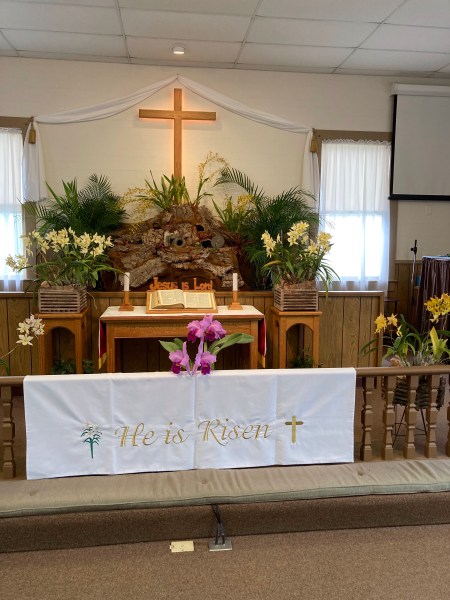
Proof of the Resurrection

Pastor Sherry’s message for April 16,2023

Scriptures: Acts 2:14a, 22-32; Ps 16; 1 Pet 1:3-9; Jn 20:19-31

The story is told that… “in 1799 the armies of Napoleon appeared on the heights above the town of Feldkirch, Austria. It was Easter Day, and the rays of the rising sun glittered on the weapons of the French, as they appeared drawn up on the hills to the west of the town. The Town Council was hastily called together to consult what was to be done.

“After much discussion, the dean of the Church rose and said, ‘My brothers, it is Easter Day! We have been reckoning our own strength, and that fails. Let us turn to God. Ring the bells and have service as usual, and leave the matter in God’s hands.

“They agreed to do as he said. Then from the church towers in Feldkirch there rang out joyous peals in honor of the Resurrection and the streets filled with worshipers hastening to the church.

“The French heard the sudden ringing of the joy bells with surprise and alarm. They concluded that the Austrian army had arrived to relieve the place. So they hastily fled, and before the bells had ceased ringing not a Frenchman was to be seen.”

(Website “Ministry 127,” 2023, quoting Walter Baxendale, Dictionary of Anecdote, Incident, Illustrative Fact: Selected and Arranged for the Pulpit and the Platform, 1888.)

There are a number of great lessons in this story, aren’t there? Look at what God can do when we trust in Him for protection. The French had had their revolution (1787), during which they had killed off many Roman Catholic clergy and protestant Huguenots 12 years before. Without anyone to lead worship, provide Biblical teaching, and help nurture and reinforce their Christian beliefs, the faith of the French army had withered to such an extent that they no longer even recognized Easter Sunday! (This is similar to today in America, in that a recent “man in the street” interview in New York City revealed that only one woman out of dozens of interviewees knew the meaning of Easter.) This is why the Napoleonic Army misconstrued the meaning behind the ringing of the bells.

I rang our bell this morning. Bob, the bell ringer when I arrived 8 years ago, has since moved into a nursing home. No one has rung our bell since he left. It occurred to me today that it was beyond time to ring it again. Our bell could also be called a “joy bell.” It calls us to worship and should remind us of the joy we have in Jesus’ resurrection.

Another story is told of a man driving down a country road with his 5 year old son. They passed a cemetery and noticed a large pile of dirt next to a grave that had been freshly dug. The little boy looked and exclaimed to his father, “Look, Dad, one got out!” The person who composed this story remains unknown. Nevertheless, the next time you pass a cemetery…“think of the One Whom the grave could not hold” (also anonymous).

Another unknown person once said, “Christmas is the promise and Easter is the proof.” Our Scriptures today all instruct us in the proof of Jesus’ resurrection:

A. Part of the proof resides in Psalm 16. It is a prophesy written by King David, but which pertains to and was fulfilled by Jesus some 1000 years later. Jesus says (v.8) I have set the Lord always before me. Because He is at My right hand, I will not be shaken. From this side of the Cross and Resurrection, we can attest that this was (and is) true of Christ’s life. No one and nothing had been able to deter Him from fulfilling His mission here on earth. The Father communicated often with the Son and because of their love for each other, Jesus persevered through (1) His poverty and homelessness; (2) His rejection by the religious authorities of His people; and (3) through His passion and death, to His glorious resurrection.

In verses 9-10, He states, Therefore My heart is glad and My tongue rejoices; My body also will rest secure, because You will not abandon Me to the grave, nor will You let Your Holy One [Jesus] see decay. Jesus totally trusted in His Father. He knew He would die, but He also knew His body would not languish in the grave. Because of His sacrifice for our sins, those of us who believe in Him can also trust our graves are not our final destinations.

Verse 11 describes His ascension into heaven You have made known to Me the path of life; You will fill Me with joy in Your presence, with eternal pleasures at Your right hand.

B. John’s account in our Gospel lesson today (John 20:19-31) describes how patiently Jesus proved His resurrection to the 11 Apostles (Judas had committed suicide) following Easter. First He appeared to all but Thomas, who was absent. His resurrection body suddenly manifested, despite the locked door. We are told He identified Himself to them by showing them His damaged hands, feet, side. This was no imposter, nor was He a ghost. He greeted them in peace (they were scared). He imparted to them Holy Spirit empowerment to overcome their fears, and to assist Him to begin to preach the truth of His resurrection to whomever would listen. The sins of those who became born again through their preaching were forgiven (cleansed by the blood of the Lamb); those who rejected Christ would continue to carry the guilt of their sin themselves.

Then He returned a week later to confront Thomas’ unbelief. Thomas was apparently a “Detective Joe Friday” (Remember the TV show, “Dragnet”?) who wanted to see and hear for Himself, “Just the facts, M’am.”

Like a modern day CSI investigator, he wanted physical proof before he would believe. Jesus knew this about him and patiently provided it for him. Thomas saw, believed, then proclaimed, My Lord and my God. Jesus affirmed Thomas (v.29) Because you have seen Me, you have believed. But He also rebuked him and the others Blessed are those who have not seen and yet have believed. These 11 were eye-witnesses to the Resurrection and they believed. But those of us who weren’t eye-witnesses, and still believe, are especially praised.

C. Peter’s famous Pentecost sermon (Acts 2:14a, 22-32) displays his deepened faith. He has accepted the proof of Jesus’ resurrection. In verse 25, he quotes from Psalm 16:8-11. By now, it is clear to him that Jesus fulfilled King David’s prophesy of Jesus’ life, death, resurrection, and ascension. And this is essentially what he preached to the Pentecost crowd in Jerusalem that day. Peter wanted them to understand that Jesus fulfilled King David’s prophetic promise (vv.31-32) Seeing what was ahead, He [King David] spoke of the resurrection of the Christ, that He was not abandoned to the grave, nor did His body see decay. God has raised this Jesus to life, and we are all witnesses of the fact. Can’t you just hear the excitement, the joy in his voice as he proclaimed this? Clearly Peter had become totally convinced and convicted!

D. In his letter, 1st Peter 1:3-9, the Apostle to the Jews of the Diaspora–those who lived outside Israel–is writing to encourage Christ-followers who are experiencing persecution. The time is somewhere during the mid-60’s of the First Century. Emperor Nero (54-68) had begun persecuting Christians in Rome. It is said that he had set fire to the poorest section of the city, but blamed Christians—even using their burning bodies as torches for his garden parties. (Later on, Emperor Domitian [81-96] would extend persecution of Christians throughout the Empire—claiming Christians were intolerant and seditious because they would not worship the Roman panoply of gods nor agree that “Caesar is Lord”).

Peter encouraged believers in the passage we read today to hold on to their hope, despite any persecution or suffering they might undergo. He says in verse 3 that our hope lies in Jesus’ Resurrection from the dead, and is also due to (v.4) …an inheritance that can never perish, spoil, or fade—kept in heaven for you, who through faith are shielded by God’s power….Despite any persecution we may suffer, we await in faith our own resurrection. Additionally, we happily anticipate joy without limit in Heaven.

Finally, echoing Jesus’ words to Thomas, he commends them (v.8) Though you have not seen Him [Jesus], you love Him; and even though you do not see Him now, you believe in Him. We, too, are to believe in Jesus because of His resurrection, the ultimate proof that He was and is God.

The first 2 Scottish missionaries sent to the Island of Aniwa in New Hebrides were killed and consumed by cannibals. Needless to say, it was difficult to recruit others to try to take their place. One fellow, though, John G. Paton (1884-1907)–perhaps distantly related to our army general, George Patton –bravely volunteered to go. When church members, friends, and family tried to talk him out of it, citing the danger of the cannibalistic natives, he said, “I confess to you, that if I can but live and die serving and honouring the Lord Jesus, it will make no difference to me whether I am eaten by cannibals or by worms; and in the Great Day my resurrection body will arise as fair as yours in the likeness of our risen Redeemer.” Because of the proof of the resurrection, Paton could fearlessly go minister among cannibals. In fact, he served as a missionary in New Hebrides for 15 years and successfully converted the entire island of Aniwa by the time he returned to Scotland.

(Story recounted on Website “Ministry 127,” April, 2023.)

We too can have the same confidence: We can trust that whatever happens to our mortal bodies, we will be raised to have resurrection bodies. We can also trust that we will dwell with Christ and all the resurrection saints in Heaven. The next time you pass a cemetery, think of the One Whom the grave could not hold, and be thankful.

©️2023 Rev. Dr. Sherry Adams

He is Risen!

Pastor Sherry’s Easter message for 4/9/23

Scriptures: Acts 10:34-43; Ps 118:1-2, 14-24; Col 3:1-4; Jn 20:1-18


“Max Lucado, in his book, Six Hours One Friday, tells the story of a missionary in Brazil who discovered a tribe of Indians in a remote part of the jungle. They lived near a large river. The tribe was friendly and in need of medical attention. A contagious disease was ravaging the population and people were dying daily. An infirmary was located in another part of the jungle and the missionary determined the only hope for the tribe was to go to the hospital for treatment and inoculations. In order to reach the hospital, however, the Indians would have to cross the river—a feat they were unwilling to perform.

“The river, they believed, was inhabited by evil spirits. To enter the water meant certain death. The missionary set about the difficult task of overcoming the superstition of the tribe.

“He explained how he had crossed the river arrived unharmed. No luck. He led the people to the bank and placed his hand in the water. The people still wouldn’t believe him. He walked out into the river and splashed water on his face. The people watched closely, yet were still hesitant. Finally, he turned and dove into the river. He swam beneath the surface until he emerged on the other side. Having proved that the power of the river was a farce, the missionary punched a triumphant fist into the air. He had entered the water and escaped. The Indians broke into cheers and followed him across.”

Isn’t that what Jesus did? He entered the river of death and came out on the other side so that we might no longer fear death, but find eternal life in Him.

(Max Lucado, Six Hours One Friday, Multnomah Books, 1989, pp.157-158).

Today, Easter Sunday, we celebrate the fact that Jesus Christ demonstrated that He had overcome sin and death by rising from the dead. He demonstrated the full extent of His miraculous power. And He brought us hope for the future (death is not the final outcome for us). All of our readings today refer in some way to Jesus’ resurrection:

A. In our Gospel, John (20:1-18) highlights some of the events of that first Easter Day. Mary Magdalene—remember, she had held a vigil for Jesus, along with His mother, John, and several other women–at the foot of His Cross. She had probably wept and prayed for Him as he hung dying. No doubt she had watched Joseph of Arimathea and Nicodemus quickly wrap His body for burial. In a dry land with limited water, they would have cleaned the corpse as best they could. They had to hurry before the onset of the Sabbath—He had to be buried before sundown. They then coated the body with myrrh, aloe, and the other spices they had brought. Next, they wrapped it up in stripes of cloth, which would have encased the body in a permanent, glued-on, kind of bandage. This process is important to note because of what happens later.

Mary had watched and must have thought the men did not do as good a job as they should have done for someone as important as Jesus. So she returned to the grave early the next morning, intending to make things right. How she thought she might roll away the heavy stone sealing the tomb is anyone’s guess. Nevertheless, she found the tomb already opened but containing no body. John tells us she ran to find Peter and the other disciple [this is how John always refers to himself in his Gospel], both of whom ran to see for themselves. John, the younger man, arrived first but only peeked into the tomb. The older Peter lagged behind, but reached the tomb and charged in to see only grave clothes on the shelf where Jesus had been laid.

The grave clothes told a story: The myrrh, aloe, and spices should have stuck the cloth stripes to the body, like a mummy. Remember Lazarus needed help to remove his. Both men saw strips of linen lying there, as if Jesus had materialized up through them, leaving them behind. In addition, the shroud for his head and face had been neatly folded and set aside. John saw this, knew it was physically impossible and therefore evidence of a miracle, and believed that Jesus had been resurrected. They appeared to have then gone home to ponder over what they’d seen.

Mary remained, grieving. Jesus appeared in His resurrection body and she didn’t recognize Him. Apparently the nail holes on His hands and feet, and the pieced place on His side, were evident, but something about His face and posture were altered in His resurrection body. Or perhaps she didn’t realize it was Him because she wasn’t expecting to see Him. She only comprehended that it was Jesus when He called her by name. He told her then to go tell the other disciples that He is going to see God the Father. Now we know from other accounts that He later met privately with Peter, encountered the two disciples on the road to Emmaus, and arrived back to greet 10 of the 11 disciples in the Upper Room, but we do not really know where He went during the middle hours between dawn and later that evening. Somewhere during that time, He had a joyous reunion with His Father in heaven! Mary, then, obediently carried the Good News of Jesus’ Resurrection—I have seen the Lord!–to the others.

B. Peter is certainly fired up as he preaches to Cornelius and his household in Acts 10:34-43). He had seen the empty tomb, the discarded grave clothes, and the resurrected Christ! Filled with the Holy Spirit (at Pentecost, back in Acts 2), he preaches with fiery conviction. Dr. J. Vernon McGee makes the point that, “There is not a single sermon in Acts that does not mention the resurrection of Jesus.” (Through the Bible Commentary Series, Acts, Thomas Nelson, 1991, p.129).

Peter reviews for the Cornelius’ Roman household the salient points of Jesus’ life and ministry, emphasizing the resurrection (vv.39b-41) They [the Jewish religious authorities + the Romans ] killed Him by hanging Him on a tree, but God raised Him from the dead on the third day and caused Him to be seen. He was not seen by all the people, but by witnesses whom God had already chosen—by us who ate and drank with Him after He rose from the dead. What a privilege to have been chosen by the Father to be one of the 500 or so to actually see and spend time with Jesus!

C. Paul reminds us, in Colossians 3:1-4, that because we are “in Christ,” we …have been raised with Christ. We share in Christ’s resurrection. Due to this new position in Christ, we have said goodbye to our old, fleshly selves; and we have put on a new, spiritual self. As a result of this phenomenal realignment/reorientation of our individual identities, Paul wants us to (v.2) set your minds on things above, not on earthly things. If you have read anything about people who claim to have died and gone to heaven (NDE’s, Near Death Experiences), they all agree they did not want to return to earth. Having seen Heaven, they wanted to stay. Similarly, Paul believes since heaven is ahead of us, we should focus on Jesus as we continue our tenure on earth. As children of the Resurrection, we are to pattern our lives after Jesus and keep our concentrate on heavenly realities.

D. Psalm 18:1-2, 14-24 is an ode to joy! The psalmist, predating but very like Paul, invites us to focus on heavenly realities–not the frustrations and disappointments of this life. Because of the mighty things Jesus has done—including demonstrating His power over death—we can rejoice in the Lord and praise Him for deliverance, provision, and protection.

We are thankful because…

1.) (V.1) The Lord is good; His love endures forever.

2.) (V.14)The Lord is my strength and my song; He has become my salvation.

3.) (V.17) I will not die but live, and will proclaim what the Lord has done.

4.) (V.24) This is the day the Lord has made, let us rejoice and be glad in it.

We also celebrate the fact that (v.22) The stone the builders rejected [Jesus] has become the capstone. The capstone was either a large rectangular stone used as a lintel in a doorway, or a large square or rectangular stone used to anchor or align the corner of a wall. It might also be the keystone or middlemost stone in an arch. The capstone (building corner or doorway lintel) or keystone (arch) kept the building from collapsing by supporting what exited beside and above it. Considering this metaphor for Jesus, no wonder we call Him our Rock and our Redeemer.

The story is told of…”a man (who) took a vacation to Israel with his wife and mother-in-law. During their time in the Holy Land, his mother-in-law unexpectedly passed away. The following day, the husband met with the local undertaker to discuss funeral plans.

“In cases like these, there are a couple of options to choose from,” the undertaker explained. “You can ship the body home for $5,000, or you can bury her in the Holy Land for just $150.” The man took a minute to think about it, and then announced his decision to ship her home.

“The undertaker, intrigued by his decision, said, “That’s an interesting choice. Can I ask why would you pay $5,000 to ship your mother-in-law home, when you can easily bury her here for $150?” The man promptly replied, “About 2,000 years ago, a man died and was buried here. Three days later he rose from the dead, and I can’t take that chance!” (Subsplash website, 5 humorous Easter sermon illustrations, April 13, 2022.)

Of course there is no guarantee that the mother-in-law would have resurrected—unless she had been a believer in Jesus Christ. Additionally, we know, of course, that Jesus’ ability to raise us from the dead is not limited to the geography of Israel—thank Goodness! Nonetheless, we can enjoy a good joke.

We can also enjoy the secure future we have in Christ. Like the missionary to Brazil, Jesus entered the river of death and came out victorious on the other side. Because He did this for us, we too share in His resurrection victory—and all of its benefits.

Alleluia, He is risen! The Lord is risen indeed, Alleluia!

©️2023 Rev. Dr. Sherry Adams

The Seven Last Words

Pastor Sherry’s message for Good Friday April 7, 2023

Scriptures: Isa 52:13-53:12; Ps 22; Heb 10:16-25; Jn 18:1-19:42

In years past, on this day, I have tried to explain to us the meanings of the 4th suffering Servant Song from Isaiah—how Jesus exactly fulfilled what Isaiah prophesied 700 yrs. before His birth—how Psalm 22 reveals His thoughts as He hung on the Cross; and the events in John’s account of Jesus’ arrest, trials, torture, crucifixion, death and burial. Today, however, I want us to visit and meditate upon what are called “the seven last words of Jesus.”

Jesus made seven statements from the Cross. Each one had to have been very important to Him because to make them, He would have had to push up on His nailed feet to gather breath to speak, while also rubbing His lacerated back against the rough, splintery wood behind Him. To make each statement must have caused Him incredible pain,

But as St. Augustine noted (354-430), “The tree upon which were fixed the members [His arms and feet] of Him dying was even the chair of the Master.” In other words, even from the Cross as His body suffered, Jesus was teaching us. Even as His death neared, He had important lessons to leave with us. Let’s examine them in order:

A. The 1st is “Father, forgive them, for they do not know what they do” (Luke 23:34). Through the millennia since, this statement has been known as “the word of forgiveness.” Wow! Such a powerful lesson! As He suffered agony, He prayed for God to forgive the very persons who despised Him and were responsible for His cruel murder. What an extraordinarily loving heart! How many of us could do the same?

But this is the challenge, isn’t it? Think of those who have harmed you, and of what they did that was so hurtful. Jesus is modeling for us what He wants us to do. He wants us to forgive those who have hurt us, no matter how badly they treated us; and no matter how much we might want them to suffer in return. We are to commend them to God in prayer. We are to offer them grace. We are to let go of our need for revenge. We place that desire into the Father’s hands, Who has said, Vengence is Mine.

B. The 2nd is “Truly I tell you, today you will be with me in Paradise” (Luke 23:43). To add to Jesus’ humiliation, the sinless Christ was hung between two guilty criminals. One continuously mocked Him, demanding that Jesus free him from their death sentence–if He were truly God. The other may have begun that way, but in watching and listening to Jesus, he realized He was someone special. Like the Centurion below, this 2nd thief came to believe that Jesus truly was the Son of God. In his brand new faith, he asked Jesus to remember him when He came into His Kingdom. Remember, Jesus had taught (Matthew 7:7) Ask and it will be given to you; seek and you will find; knock and the door will be opened to you. For everyone who asks receives….How reassuring! This guy was in the process of dying, but expressed his faith in Jesus. This is truly a last minute, death-bed conversion. I have a friend who was for years a hospice chaplain. He talked many World War II, Korea, and Vietnam vets in Washington, D.C. into accepting Jesus as their savior as they lay dying. A simple, “Yes, Lord, I believe” is enough faith for Jesus to act on.

This statement is known as the word of salvation because this guy’s faith in Jesus saves Him. You are here today because you have given your heart to Christ. Pray for family and friends who have not yet done so.

C. The 3rd is from today’s Gospel (John 19:26-27) Dear woman, here is your son; [and to the apostle, John] Here is your mother.

Jesus sees them grieving at the foot of His cross and wants them to comfort each other. It is a statement of their new relationship. In this, Jesus’ last will and testament, He provides for His mother’s comfort, safety, and companionship. Even though Jesus had several half-brothers and half-sisters, he gives “custody” of Mary to John. He appears to have been redefining or extending the concept of “family.” We have our nuclear family, into which we are born—mother, father, siblings. We also have an extended family —grandparents, aunts, uncles, cousins; a clan or kinship group, if you will. However, when we are in Christ, we also have a spiritual family, people with whom we become close due to our shared faith in Jesus. If our nuclear or extended families are not Christ-followers, we often find we have more in common with our spiritual family than with blood-kin.

Additionally, our Lord never means for us to be isolated, cut off from relationships with others. He has built into us a need for community, or connection with others. Brain researchers have discovered that when we spend time with people we love and who love us, it spikes amounts of the neurotransmitter, dopamine, in our brains, and we actually feel better. Seek out folks with whom you can share your thoughts, your faith, and your heart.

D. The 4th of Jesus’ words from the cross is, “My God, my God, why hast Thou forsaken me?” (Matt. 27:46; Mark 15:33-35). This word speaks to Jesus’ acute suffering. The physical was agony enough. But as He hung on the cross from noon to 3pm, He experienced—for the 1st time—the emotional and spiritual agony of abandonment. Remember He had taken upon Himself all of our sins. In His holiness, God His Father could not be present with Him. For 3 hours, Jesus hung alone. For the 1st time, He felt cut off from the strength and reassurance of His Father’s love. Only His solid trust in His unseen and unfelt Father helped Him to persevere.

Did you notice that He quoted from Psalm 22:1? This was a prayer of desperation. This is also meant to teach us what to do when we too feel desperate and abandoned—cry out to God! I was once fired from a church job for preaching the Gospel. Shocking, but it can happen. I went home, knelt by my bed and wept the lament psalms to the Lord. After a brief time, He told me to stop crying and call my friends in Tallahassee, Florida. It was truly a miracle that three of them—all busy persons—answered my first call. One agreed to drive to New Orleans to help me pack and move. A second one offered me a place to live. The third agreed to help me set up a private practice counseling business until I could land a church job. The Holy Spirit worked through my friends to help me move into a new future, 2 months before Hurricane Katrina nearly destroyed New Orleans. Jesus is the Only One we can truly count on when we are at the end of all of our own resources. Express your gratitude to Him for times when He Has rescued you.

E. Jesus’ 5th word was “I thirst!” (John 19:28). This, of course, refers to His very human state of dehydration. It was a statement of distressing physical need. Mark tells us He would not drink wine mixed with myrrh, a pain killer the Romans offered to those about to be crucified (Mk15:23). He knew He was to experience the totality of the pain inflicted upon Him. His last drink of anything may have been the final cup of wine the evening before at the Passover Feast. He describes His condition in Psalm 22:15 My strength is dried up like a potsherd [a broken piece of pottery], and my tongue sticks to the roof of my mouth. The soldiers then offered him wine vinegar, which He drank from a sponge lifted up to Him. Perhaps that eased his need somewhat. But I think I thirst also means He thirsted then and continues to desire that all would come to know and believe in Him. May we also thirst for the salvation of the many in our culture who reject Christ.

F. Jesus’ 6th word was “It is finished!” (John 19:30). We know His life wasn’t finished as He was resurrected 3 days later. What was finished was His saving work to bring salvation to us all. Scholars say this was a statement of triumph. When I completed seminary, my graduating class had tee-shirts made for all of us that said, tetelestai, which means it is finished in the Greek of Jesus’ day. At the time, we thought we were being clever. Twenty + years later, it seems to me to be presumptuous and irreverent. We had just completed our mission of passing 3 years’ worth of divinity study, while Jesus had paid it all—the full penalty for all our sins—on the Cross. Thank God we are saved by His blood, the blood of the true Passover Lamb. Meditate on your gratitude for His work as our Redeemer 2,000 years ago.

E. Finally, Jesus spoke His last word, “Father, into Your hands I commit My spirit” (Luke 23:46). What a wonderful final statement of reunion! He must have known He was about to breathe His last, and so He gave Himself back to the Father. He acknowledges that His pain, suffering, and alienation from the Father were at an end. I remember how the OR room nurses gave me a warm blanket and a glass of cold apple juice just after I had given birth (back in 1974). I felt such fatigue and relief that my labor suffering—only a fraction of that of Christ—was over and that my child was safely born with all his fingers and toes. No doubt Jesus too was tired, relieved, and exhilarated.

Where will our focus be when we too face death? And are we willing to commit our spirits to God right now?

(Ideas borrowed from Kevin Vost, Seven Meditations on Christ’s Seven Last Words, 2018.)

Jesus gifted us with 7 final lessons from His Cross. May we taken them to heart. Thanks be to God who gives us the victory through our Lord Jesus Christ!

©️2023 Rev. Dr. Sherry Adams

A Four-Day Journey

Pastor Sherry’s message for April 2, 2023

Scriptures: Isa 50:4-9a; Ps 31:9-16; Phil 2:5-11; Matt 27:11-66

Ironically, over 2000 years ago, the Sadducees had a tradition in which they believed the Messiah would show up four days before Passover. As a result, they kept the gates of the Temple open each year on this date so that He could walk right in and assume His rightful place. In fact, Jesus—the True Messiah–did choose to re-enter Jerusalem exactly 4 days before Passover, and proceeded to pray and teach in the Temple. By this time, many Jews had encountered Him. Many others had heard of His miracles, His healings, and of how He cast out demons. They were so taken by Him that crowds waited with joyous anticipation and with baited breath to see what He would do next.

The fact that Jesus chose that exact day to come back into Jerusalem would have driven the Jews’ expectations for their nation to a feverish height. They were sure He would overthrow the Romans, free them from oppression, and reign victoriously as King David had in ages past. But the Romans, too, would have heard the rumors and thus were anticipating an insurrection. They had called in reinforcements in case of an armed revolt. So tensions were very high in the city that day.

Today, we celebrate that historic day, calling it Palm Sunday–because the crowds waved palm branches in celebration of His arrival—or Passion Sunday, in anticipation of Jesus’ suffering and crucifixion, a brief 4 days later. The minor prophet Zechariah had predicted what would happen some 500 years before this event took place (9:9) Rejoice greatly, O Daughter of Zion! Shout, Daughter of Jerusalem! See, your king comes to you, righteous and having salvation, gentle and riding on a donkey, on a colt, the foal of a donkey. This is exactly Who Jesus was—their righteous Savior. This is exactly what happened. This is exactly how the Jews rejoiced: As Jesus rode in, the people shouted Hosanna (actually, Yasha anna in the Hebrew), which means, Save us, Lord! They were quoting Psalm 118:25-29 O Lord, save us! O Lord, grant us success. Blessed is He who comes in the name of the LORD…. The LORD is God and He has made His light shine upon us. With boughs in hand, join in the festal procession up to the horns of the altar. You are my God and I will give you thanks; you are my God, and I will exalt you. Give thanks to the LORD for He is good; His love endures forever.

On this day, they were excited and delighted! But 4 days later, they were demanding His death! By then, they had realized that Jesus had failed to meet their messianic expectations. As the “2 Bubbas and a Bible” explain it, “He was not 6 feet plus, with abs of steel. He rode into town on a baby donkey, not a warhorse. He went to pray at the Temple, not to protest at the palace. Jesus did not turn out to be their idea of a savior.” (Chilton & Fairless, Lectionary Lab Commentary, Year C, 2015, p.142).

But, as our Scriptures today highlight, He was our Heavenly Father’s Idea of a Messiah:

A. In Isaiah 50:4-9a, we read what is known as the 3rd Suffering Servant Song. Written some 750-700 years before Jesus’ birth, the prophet Isaiah predicts, exactly, what Jesus would experience and how He would behave as He faced and endured the Cross. Its theme is that Jesus came to earth determined to save us. He came into the world to pay the penalty for and to redeem us from our sins. He was instructed or trained for this by the Holy Spirit, and by what He read and meditated upon in Scripture (vv.4-5), the Old Testament writings available at that time.

Verse 6 tells us that His trial by the Sanhedrin led to significant suffering at their hands: They beat Him. They mocked Him. They spit in His face. They even pulled out the hairs of His beard. This was all before He was presented to Pilate for round two by the Romans.

What sustained Him? What helped Him to bear up under such torture? First, He knew His purpose. There was for Him deep meaning to His suffering. And, second, He trusted in His heavenly Father to assist and to comfort Him (vv.7-9) Because the Sovereign LORD [the Father] helps Me, I will not be disgraced. Therefore have I set My face like flint, and I know I will not be put to shame…He who vindicates Me is near…it is the Sovereign LORD who helps Me. His relationship and His intimacy with the Father are what propelled and compelled Him. This essentially kept Him emotionally and spiritually “bullet-proof” against the condemnation and the despicable treatment He received from the religious authorities and the forces of evil at work during His passion.

B. Philippians 2:5-11 is known as “the Philippian Hymn.” Bible scholars believe newly baptized Christians, in the early Church, memorized and recited this brief summary of exactly what Jesus did for us as a verbal profession of their faith. St. Paul included it in his letter because he wanted the church in Philippi (and us) to both understand and follow Jesus’ model of humility and obedience to the Father; as well as to realize the huge significance of what Jesus gave up—His heavenly/godly prerogatives— to become human like us. The One Who spoke creation into existence, the King of the Universe, was entrusted as a helpless infant to a poor, homeless, young couple. He lived His early life as a carpenter, eking out a living in an obscure, back-woods village. He Himself was sinless, but at the Cross He bore all our sins, past, present and future. The Great Shepherd humbled Himself and gave His life for us, His sheep.

As a result of His obedient self-sacrifice, God the Father has raised Him to the highest position of honor. At His name, every creature must bow. No person, animal, angel, or demonic entity has more power or greater authority.

C. Our psalm today (31:9-16) details Jesus’ thoughts on the way to and during His crucifixion. He abides in His Father’s love, praying to and calling out to Him in His mind: (V.9) Be merciful to Me, O LORD, for I am in distress; (V.10) My life is consumed by anguish and My years by groaning; My strength fails….(V.11) Because of My enemies, I am the utter contempt of My neighbors…(V.12) …I have become like broken pottery. He is experiencing despair, extreme pain, and grief, but He does not let it overwhelm Him, or turn Him against God the Father (V.14) But I trust in You, O LORD. I say, “You are My God.” Based on His faith, He goes on to reassure Himself, (v.15) My times are in Your hands.

If only we too could remember, when suffering, to pray to God and to trust in Him to sustain us during difficult, painful times.

D. Matthew’s version of Christ’s Passion is well worth meditating on this Holy Week. Traditionally, it begins in Chapter 26 at verse 14 and continues through the end of our Gospel reading today (Matthew 27:11-66). In today’s portion, we follow Jesus from His trial before Pilate, to His exchange for Barabbas, to His beating at the hands of Roman soldiers to His crucifixion, death, and burial. He had been betrayed and abandoned by all His friends–except John and a few female followers, including His mother. His Father registered His grief and judgment against the Jewish establishment with earthquakes, 3 hours of darkness ending with Jesus’ death; and splitting the Temple curtain from top to bottom. Then, anticipating Jesus’ glorious resurrection, the Father opened some tombs, and resurrected (v.52) …many holy people.

What a journey, in 4 days, from a celebratory welcome parade, to a funeral march, to an ignominious death between 2 criminals. Jesus Christ paid the price for our sins because He believed in Scripture, in His purpose, and because He trusted in His Father’s plan and in His Father’s love. By teaching, preaching, healing, casting out demons, dying a dreadful death in our place, He faithfully completed His 1st mission to earth. He has now returned to Heaven and is seated with the Father, awaiting with us the timing of His 2nd Coming. As we wait to greet Him, let us inspire ourselves with the words of the writer to the Hebrews (12:2-3) Let us fix our eyes on Jesus, the author and perfecter of our faith, Who for the joy set before Him [our salvation] endured the cross, scorning its shame and sat down at the right hand of the throne of God. Consider Him who endured such opposition from sinful men, so that you will not grow weary and lose heart.

©️2023 Rev. Dr. Sherry Adams

Resurrection Power

Pastor Sherry’s message for March 26, 2023

Scriptures: Eze 37:1-14; Ps 130; Ro 8:5-11; Jn 11:1-45

Have you ever wondered about what you might do if you were God? Jim Carey plays a guy who thinks he can do things better than God in the 2003 film, Bruce Almighty*. (Hard to believe it’s now 20 years old!) You may remember that Morgan Freeman, dressed totally in white, plays the role of God the Father. He gives Bruce His godly powers, then goes on vacation. At first, Bruce does not believe he has God’s powers.

Then he begins to experiment, with hilarious results: He starts his cranky, clunker of a car by simply telling it to start, and is gratified. He walks on water and is both scared and amazed. He produces a spoon to stir his coffee just by thinking it up. He creates a wind in a diner that parts his soup into two pools. As the movie progresses, most of what Bruce does is either silly, or selfish, or vindictive, or damaging—thereby making the point that we humans don’t have the necessary love, maturity, or wisdom to use such power judiciously. If we were God, we would most likely mess up massively.

Our scripture readings today all celebrate the phenomenal power of God, and the very wise and compassionate ways in which He utilizes it in our lives:

A. Psalm 130 sets the stage: In the ancient church tradition of naming the psalms by their first few words in Latin, Psalm 130 is called “De profundis”–or “Out of the depths.” Whoever composed this psalm captures our times of grief, despair, or overwhelm in his 1st verse: Out of the depths I cry to You, O Lord. The psalmist is saying “Lord, I am at the end of my resources. Help!” Or, as I said last week, “Lord, I’m at the end of myself. Help!” We can all think of times, can’t we, when we are overtaken by profound despair, debilitating grief, or hopeless depression? If we believe in God and in His power, at some point we remember to call upon Him for help. Verse 2 reads O Lord, hear my voice. Let your ears be attentive to my cry for mercy. If we are wise—and if we trust in Jesus—we take our distress to the Lord.

This psalmist clearly trusts in the Lord. He is very aware that we are all sinners who really don’t deserve God’s mercy, forgiveness, or grace. Yet he counts on it! He waits for the Lord to act on his behalf. My favorite verse is #7 O Israel [O Christ-followers], put your hope in the Lord, for with the Lord is unfailing love and with Him is full redemption. In other words, we can and should trust in God to love us despite our shortcomings. In other words, we can and should believe in His ability to overcome our suffering and to redeem our pain—even redeem our messes, if we surrender them to Him. Our God has the power to pull us up out of whatever depths we have sunken into.

B. Paul continues this theme in Romans 8:5-11. Before exploring the meanings of the passage, it is most helpful to begin before verse 5, at Paul’s basic premise expressed back in verse 1: Therefore there is now no condemnation for those who are in Christ Jesus. What a relief! If I abide in Christ—maintain my heartfelt relationship with Him—my sins aren’t counted against me. And not just me! All of our sinfulness is covered/hidden behind/or rather accounted for by the righteousness of Christ!

Back in the beginning of Lent (2/12/23), I preached on Paul’s 1st letter to the Corinthian Church (3:1-9). You may recall that he differentiated between the saved and the unsaved, as well as between spiritual (Mature) Christians and carnal (Immature) Christians. He is making a similar point to the church in Rome in the remainder of this passage: Rev. Dr. Eugene Peterson paraphrases it this way (The Message, NavPress, 2002, pp.2044-2045) Those who think they can do it on their own [overcome their carnal nature] end up obsessed with measuring their own moral muscle but never get around to exercising it in real life. Those who trust God’s action in them find that God’s Spirit is in them—living and breathing God! Obsession with self in these matters is a dead end; attention to God leads us out into the open, into a spacious, free life…..

The carnal Christian has a mindset that is controlled by his/her sinful nature. Rev. Dr. J. Vernon McGee says our sinful nature acts like a big bully, constantly trying to ambush us and beat us up (Commentary on Romans, Thomas Nelson, 1991, p.141). It feels like that, doesn’t it? Sin beats us up!

Paul states that the sinful nature leads us to death (certainly spiritually, but often even physically). On the other hand, the Spirit-led mindset leads us into life. The Holy Spirit acts like our big brother who shows up in the nick of time to save us from the bully. I didn’t have an older brother; in fact I saved my little brother’s neck a bunch of times. But even so, I know how good that feels to know the Holy Spirit is willing to go toe-to-toe with the bully and win for my behalf.

Additionally, Paul explains, (MSG, p.2045) But if God Himself has taken up residence in your life, you can hardly be thinking more of yourself than of Him. Anyone, of course, who has not welcomed this invisible but clearly present God, the Spirit of Christ, won’t know what we’re talking about. But for you who welcome Him, in whom He dwells—even though you still experience all the limitations of sin—you yourself experience life on God’s terms. It stands to reason, doesn’t it, that if the alive-and-present God who raised Jesus from the dead moves into your life, He’ll do the same thing in you that He did in Jesus, bringing you alive to Himself? What a blessing!

God the Holy Spirit abides in us and protects us from the bullies. And He also functions to grow us up into mature Christians.

C. This transformative, life-giving power is revealed in Jesus in our Gospel lesson from John 11:1-45. This is the familiar story of Jesus arriving in Bethany 4 days after his friend Lazarus has died. Both of Lazarus’ sisters greet Jesus with faith statements (v.21 and v.32) Lord, if you had been here, my brother would not have died. Both sisters trust that Jesus could have healed Lazarus of his fatal illness. Though neither has heard that He has the power to restore a dead person to life, they believe in the final resurrection after we die. Jesus reveals to Martha that (vv.25-26) I am the resurrection and the life. He [or in this case, she] who believes in Me will live, even though he [she] dies; and whoever lives and believes in Me will never die.

Then Jesus prays to His Father and proceeds to bring forth a living Lazarus from the grave. The formerly dead man walks out of the grave, but is still bound up in his grave wrappings. He probably looked somewhat like a mummy—alive but not really free—so Jesus directs the onlookers to (v.45) Take off the grave clothes and let him go. Jesus, God-incarnate, has the power to raise a dead person to life. Glory to God!

This is astonishing and defies science as we understand it! If any of you has read Mary Shelley’s Frankenstein—which she wrote at the age of 18—you may have noted that it is not only one of the first novels in the horror genre, but it is also a morality tale. Dr. Frankenstein wants to prove that humankind can create something alive from dead matter. He cobbles together cadaver parts, then shoots incredible amounts of electricity into the monster’s body to bring it to life. Later on the amoral, rogue monster kills his creator. The moral is that humans should stay in their own “wheelhouse” and leave the creation of life to God. God can simply call a person by name to bring them come back to life.

D. Additionally, as our OT lesson shows us (Ezekiel 37:1-14), our God can also resurrect an entire nation! By the power of the Holy Spirit, God takes the prophet Ezekiel to a wasteland, desert valley in which he sees the dried, scattered, skeletal remains of innumerable warriors killed long ago in some titanic battle. God then asks Ezekiel if these bones can return to life. The prophet wisely replies (v.3) O Sovereign Lord, You alone know. Like many of us, Ezekiel knows God can do it. He’s just not sure if, in this case, God will do it. But God tells the prophet to command the bones to come to life. Ezekiel does exactly what the Lord has told him.

Even as he is still speaking God’s words over the bones, they begin to move; they reassemble into human form; and they become upright but unbreathing cadavers. .

Then God tells the prophet to prophesy to the breath (v.9) Come from the four winds, O Breath, and breathe into these slain that they may live. God allows Ezekiel (who speaks for God) to command the Breath—the ruach [the word in the Hebrew for wind, breath, or Holy Spirit] to bring these cadavers to life. He does as directed and a mighty army returns to life! Bruce Almighty asks, “Who has the power?”

Ezekiel and we know that only God has the power to bring the dead back to life! This exercise in the Valley of the Dry Bones was meant to let the Israelites know that God will one day restore that nation–not as it is today, a geographical and political entity that barely acknowledges God. But, at Jesus’ 2nd Coming, as a nation of true-believers.

Our God has such extraordinary, resurrection power over our lives that He can resurrect us when we die. Many of God’s/Jesus’ miraculous powers amaze me. But, given the eternal consequences, none is as important as is His ability to bring us to new life in Christ Jesus, and through the power of the Holy Spirit. Thanks be to God, who gives us the victory over death, through our Lord, Jesus Christ. Amen!

©️2023 Rev. Dr. Sherry Adams

*Bruce Almighty

Follow Me into the Light

Pastor Sherry’s message for March 19, 2023

Scriptures : 1 Sam 16:1-13; Ps 23; Eph 5:8-14; Jn 9:1-41

My new, favorite, contemporary, Christian song is, “Follow Me,” by Casting Crowns* (Thrive CD, 2013). The lyrics are as follows:

(Look/listen for the repeated themes.)

At the end of myself, I am empty and dry

I have nothing to give, But surrender inside.  

[Jesus responds] Let down your nets, This is not the end

From now on, you’ll be Fishers of Men. [Who is this? Peter, Lk 5:1-11]

Follow Me, Follow Me, Follow Me.  

At the end of myself, Judgment calls out my name

I’ve been looking for love, but I’m swallowed by shame. 

[Jesus responds] Throw away all your stones, Find forgiveness in Me.

Let me be your new passion, My daughter you’re free [Woman caught in adultery, Jn 8:1-11]. 

At the end of myself, I’ve done things my own way;

This world gave up on me, now it’s death I do pay.

[Jesus responds] You know who I am, I’m sin’s sacrifice;

Today you will be… in paradise.  [Thief on the Cross, Lk 23:32-45]

[Any seeker] Who is the man who calmed the seas?

And Who is this man who loves the least of these?

[Jesus responds] I am the Promised One; God gave His only Son.

And those who believe…Will live eternally.

At the end of yourself, just follow Me.

I will give you new life, just follow Me, Follow me.

If at the end of yourself, just follow Me.

You may lose everything, just follow Me.

I will give you new life, just follow Me, follow Me.

The repeated themes are, off course, Follow Me, and, At the end of myself. When we come to the end of our own resources, we know we need Jesus. Another way of saying this is that without Jesus, we are spiritually blind. Two of our Scripture passages today deal with blindness (physical and spiritual) and what it takes to come out into the Light of Christ. Let’s examine them together:

A. John 9:1-41 details Jesus’ healing of the man born blind.

The context is that of a Sabbath Day when Jesus spots this blind man begging before one of the Temple gates in Jerusalem. Blind and other physically impaired persons usually did not make a living—in those days–by practicing a trade. Instead, they customarily stationed themselves somewhere near consistent foot traffic and begged for food money from passersby.

Upon seeing him, the disciples want Jesus to explain the cause of the man’s blindness (a theoretical, theological discussion). But Jesus downplays the issue of who or what to blame, saying (v.3, The Message, Eugene Peterson, NavPress, 2002, p.1937)”You’re asking the wrong question. You’re looking for someone to blame. There is no such cause-effect here. Look instead for what God can do. Then He proceeds to meet the man’s most pressing practical need, saying (vv.4-5, MSG)We need to be energetically at work for the One who sent Me here, working while the sun shines. When night falls, the workday is over. [Remember, this was a predominantly rural culture with no one working past sundown.] For as long as I am in the world, there is plenty of light. I am the world’s Light. (Other translations say, I am the Light of the World.) The poor guy has lived in darkness his whole life! Jesus isn’t going to stand there and argue the why’s of the fellow’s condition. He intends to heal him.

He also intends for them and for us to realize He is God. He makes an “I AM” statement—to Jewish ears, he was declaring His divinity. God the Father had identified Himself to them as “I am Who I am,” meaning that He has always existed; in a sense, our God is always exists in the present tense. In the Gospel of John, Jesus makes many I am statements so that the Jews would realize He was identifying Himself as God: I am the Living Water; I am Manna from Heaven; I am the Way, the Truth; and the Life; I am the Good Shepherd; I am the Resurrection and the Life; etc.

Now, this poor blind man has never enjoyed light in his life, but the One who is the Light of the World is going to bring it to him. He makes a kind of clay from saliva and dirt and places it on the guy’s closed eyes.

Now, consider this: The blind fellow has heard Jesus’ voice; he has felt Jesus’ touch; he has probably even smelled Jesus’ scent. He obeys his unseen Redeemer by going, as instructed, to wash the clay off in the pool of Siloam (which John tells us means “sent.” The man was sent by Jesus to the pool named “Sent”). He seems to trust Jesus, sight-unseen. He chooses to do what Jesus tells him (Contrast this with Naaman the Syrian general who was too proud to dip himself—as the prophet had instructed him—in the Jordan. His servants had to convince him to “follow orders” to obtain his healing.)

Throughout the rest of the incident, the Pharisees are trying to figure out how a rabbi who breaks Sabbath rules against working on that day—which makes Jesus a sinner in their eyes—could possibly work a miracle of God. The guys’ neighbors can’t explain it. Some of them don’t even recognize him since he is now sighted. His parents do recognize him but are afraid the religious rulers will excommunicate them if they celebrate Jesus, so they avoid committing themselves. But the grateful and spunky guy takes them to task! He’s not concerned about their theological issues. He just knows he was born blind but now has his sight.

Then Jesus turns the tables on the Pharisees when He calls them physically sighted but spiritually blind. He has worked a miracle that they cannot accept. In so doing, He has fulfilled the prophesy from Isaiah 61:1 that Messiah would restore sight to the blind. But in their confidence that Jesus cannot really be the Messiah, they refuse to see the evidence before their own eyes.

B. Paul also addresses the topic of spiritual blindness in Ephesians 5:8-14. Of course he (and we) start from knowledge that Jesus is the Light of the world. As Peterson puts it his paraphrase (MSG p.2132), Paul exhorts us You groped your way through that murk [habitual sins] once, but no longer. You are out in the open now. The bright light of Christ makes your way plain. So no more stumbling around. Get on with it! The good, the right, the true—these are the actions appropriate for daylight hours. Figure out what will please Christ, and then do it. In other words, prior to accepting Jesus as our Lord and Savior, we lived in spiritual darkness. Once we accept Jesus, we live the Light of Christ. As St. John would say later in 1 John 1:5-6 God is Light; in Him there is no darkness at all. If we claim to have fellowship with Him yet walk in the darkness, we lie and do not live by the truth. We demonstrate the fact that we dwell in Christ’s light by living a life different from that of our culture: We demonstrate goodness or kindness to others. We live lives that are righteous as we try to do those things of which Jesus would approve, and avoid doing the opposite. Our words and our manner reflect truth—i.e., we are sincere and genuine.

Finally, Paul urges us to (v.11) have nothing to do with the fruitless deeds of darkness….Dark deeds aren’t driven away by preaching or lecturing against them; but rather, our actions speak louder—and are a better witness to Christ—than are our words. Rev. Dr. J. Vernon McGee relates a true story of one of his parishioners. She was a married lady who grieved the fact that her husband was uninterested in Jesus. She wanted him to share her faith and to accompany her to church and in prayer. So she educated, begged, pleaded, nagged, and even resorted to crying through the two meals a day they were together. Dr. McGee told her to stop that immediately. He recommended she pray, fix excellent meals, and deal with her husband with a smile on her face and a loving attitude. It took about six months, but one day he suggested they attend church together. We cannot shame another into accepting Christ (McGee’s commentary on Ephesians, Thomas Nelson, 1991, pp.142-143).

The song I read earlier gives 3 examples of people who chose to follow Jesus: Peter, the woman caught in adultery, and the thief on the Cross. Our Gospel lesson provides an additional one, the man born blind. As with each of them, we often come to Jesus when we come to the end of ourselves; i.e., when we exhaust ourselves trying to save ourselves. We realize we can’t do it on our own. We recognize we need Jesus. Then, like the man born blind, we obey Him out of thanksgiving for His gift of salvation and healing.

Following Jesus means we don’t just claim we love Him, but we live lives that are changed due to our relationship with Him. We come to demonstrate the fruit of the spirit (Galatians 5:22) love, joy, peace, kindness, gentleness, goodness, patience, faithfulness, and self-control. We live out being good, being right with God, and being truthful.

Dear Lord, help us to live lives that are pleasing to You and that reflect Your Light to a lost, angry, and hopeless world. Help us to truly follow You. May the way we live attract others to You, O Lord, we pray in Jesus’ name. Amen.

©️2023 Rev. Dr. Sherry Adams

*Follow Me by Casting Crowns’ video: https://youtu.be/LraPDltKlvI

The God Behind the Curtain

Pastor Sherry’s message for February 19, 2023

Scriptures: Ex 24:12-18; Ps 99; 2 Pet 1:16-21; Matt 17:1-9

Today is Transfiguration Sunday, the day the church remembers its brief experience of Jesus in all of His revealed glory.

Typically, when we think of truth being revealed, we tend to summon up images of dark deeds brought into the light: Another corrupt politician or businessman being exposed, or the famous case of the Wizard of Oz. Remember the scene in that classic movie where Dorothy, Toto (her dog), the Tin Man, the Lion, and the Scarecrow encounter the Great Wizard? His voice thunders and his face is projected larger-than-life on a giant screen. Dorothy and friends are terrified until the little dog pulls back the curtain. They see the true, ordinary man, who has used showbiz technology to promote himself as all powerful. In a famous line—now seen as humorous–he cries out, “Pay no attention to the man behind the curtain.” Too late! His posturing has been exposed.

On the other hand, we also hear of wonderful revelations:

I remember seeing a video of a man who’d not seen color before get a pair of glasses that corrected for his color-blindness. He was able to experience the delight that color added to his previous dull gray or brown life. He appeared to be overwhelmed with joy. Or did you see the video of a baby girl with a severe hearing defect? A hospital in Cincinnati provided her a set of hearing aids that allowed her to hear her mother’s voice for the first time. Like the colorblind man, she reacted with great joy and wonder.

Our Scriptures today celebrate the joy and wonder of some particularly blessed humans when they visually beheld the God Behind the Curtain.

A. Let’s start with Peter (2nd Peter 1:16-21). Along with John and James, Peter was present at Jesus’ Transfiguration. He writes this letter in about 66AD, shortly before his crucifixion. One could say this was his farewell address. Just a few verses prior (vv.13-14), he refers to his earthly body as a tent, which Jesus has told him he… will soon put…aside.

As Peter prepares to die, he reassures his readers (including us) that Jesus’ transfiguration was a real event (v.16) We did not follow cleverly invented stories when we told you about the power and coming of our Lord Jesus Christ, but we were eyewitnesses of His majesty.

Peter saw Jesus in all His heavenly glory. He and the other two saw the True Divine Being behind the curtain of His human flesh. Peter heard the voice of the Father say to them (vv.17-18) This is my Son, whom I love; with Him I am well pleased. Peter may have later let his all too human fear override this experience of Jesus, briefly; but in his heart of hearts, he knew the truth of what he had seen and heard.

B. Matthew was not present on the mountain, but he had lived with Peter, James, John (and Jesus), for 3 years and he believed the account the 3 friends revealed after Jesus’ resurrection. Just as Peter later testified, Jesus’ appearance was transformed in a dramatic and otherworldly way. He shone with a tremendously bright light which did not shine down upon Him, but rather emanated from within Him. They saw Him in all his heavenly glory. Later, in Revelation 22:16, Jesus will say of Himself I am the Root and the Offspring of David, and the bright Morning Star. By this He meant He is descended from the lineage of King David, as prophesied, and He is the Divine Light that announces the new dawn.

The 3 apostles also beheld Him with two Old Testament “greats,” the prophets Moses, the Law-Giver, and Elijah, the one who challenged over 800 pagan priests–and who decisively demonstrated the power of God over their demonic gods. Neither one died and went to heaven in the usual way. Moses died as the people moved to enter the Promised Land. Scripture says that God buried him (Deuteronomy 34:6). Elijah exited this life in a blaze of glory in a fiery chariot (2 Kings 2:11-12). It is Luke who tells us (9:31) the Father had sent these two Old Testament saints to confer with Jesus about His impending death, probably to comfort and to reassure Him; and to strengthen and encourage Him to withstand His coming ordeal.

C. Speaking of Moses, our Old Testament lesson, Exodus 24:12-18, features him and his leadership team dining with God. The Lord has just revealed to him the Law, including the 10 Commandments (Exodus 20-23:19). God tells Moses to write the Law down, then read it to the Israelites. Moses obediently does so. The Israelites vow (v.3) Everything the Lord has said we will do, promising obedience. (Yeah, sure, that’s wishful thinking. Their adherence to their vow lasted about 40 days!)

Then God has Moses erect an altar and 12 stone pillars to represent each of the 12 tribes. Young men are then pressed into service to corral sacrificial animals for sin and fellowship offerings. Moses, as directed, collects the blood of the sacrifices and places some on the corners of the altar. He is then directed by God to sprinkle the people with the rest. You may recall that no one can enter into God’s presence with sin on their soul. Sprinkling them with the blood of sacrificial animals symbolizes that the people’s sins are washed away or cleansed. As Moses says (v.8) This is the blood of the covenant that the Lord has made with you in accordance with all these words. (Notice how closely this resembles what we say in the Communion Service over the wine: This is My [Jesus’] blood of the New Covenant which is shed for many for the forgiveness of sins.)

Following this, Moses, his brother Aaron (the 1st high priest), Aaron’s two eldest sons, and 70 elders are all invited to have a meal with God.

This whole procedure is actually the template for our communion service, established by God the Father over 4,000 years ago. Think about it:

(1) God’s Word is read;

(2) God’s Word is preached or explained;

(3) The people respond, “Thanks be to God.”

(4) Jesus is the once and for all perfect sacrifice for our sins (Hebrews 5:7-9), so we need not kill any bulls or lambs. His blood has atoned for our sins, so we are cleansed and can freely come into God’s presence. Communion, a spiritual and physical meal between God and human believers, is served. By the way, the Israelite leadership team did not see God the Father. He is Spirit and we know that no one can see Him. Instead, they dined with the pre-incarnate Jesus.

D. Do you think the leadership team knew they were standing on holy ground? Psalm 99 exhorts us to worship God with our praise. It reminds us that God is holy and totally “other” than us—supreme and exalted over all things, and worthy of our sincere devotion.

When the fleshly curtain of Jesus’ human body is pulled away, we shall see Him in all His divinity, all of His glory. He is the real deal! Some of you may have heard that a revival has broken out on the campus of Asbury University in Kentucky. In answer to our weekly prayers for revival and that God would reach our young people, students and guests from all over the world, have been praising God and worshipping Him, in the university chapel, since February 8th. God appears to be changing the lives of Gen Y’s and Z’s. Praise God! Let’s pray that the Lord brings many to Christ through this new move of the Holy Spirit. Let us, with them, worship the one true God who has revealed Himself from behind the curtain, through our Lord and Savior, Jesus Christ. Amen and Amen!

©️2023 Rev. Pastor Sherry Adams

Our Starting Point, Our Standing Place

Pastor Sherry’s message for February 5, 2023,

Scriptures: Isa 58:1-12; Ps 112:1-10; 1 Cor 2:1-16; Matt 5:13-20

Over my years here, you have probably realized that I don’t usually preach from the writings of Paul. I find him often difficult to understand and more often addressing theological points rather than everyday life. But this week, the Lord told me it was time for me to “Grow up!” So, today I will focus on the second chapter of Paul’s first letter to the Corinthian church. In chapter #2, he focuses on our correct starting point with Jesus and our secure standing point.

But first, let’s look at some humorous examples of various starting points:

(1) Great grandma’s recipe for chicken and dumplings: First, catch a chicken (Aren’t we glad we don’t have to do this today?). I remember this as a little child. My grandparents had a few chickens. Saturday afternoon they would kill one; my grandmother would pluck the feathers and clean it out, and then cook it for Sunday dinner.

(2) In the 1920’s, the University of Michigan had a famous football coach named Fielding Harris Yost. One season, Michigan had been badly beaten by Notre Dame, one of their major archrivals. The atmosphere on the train trip back to Ann Arbor was silent and dismal, as players waited to be thoroughly chewed out. Eventually, Yost stood up in the aisle to address the team. In a calm manner, and with a solemn demeanor, Yost held up a football and explained, “Gentlemen, this is a football.”

(3) You may have noticed that I struggle with my weight. Both of my grandmothers were plump (I always thought they were “fluffy” and provided such comfortable laps for a child), so I think I may have been genetically primed to carry extra pounds. At any rate, I have tried almost every diet plan known to humankind: Weight Watchers; The Daniel Diet (based on what Daniel, Shadrach, Meshach, and Abednego ate in Nebuchadnezzar’s court); Jenny Craig; The Maker’s Diet (consisting of vegetables like leeks and grains like spelt found in Old Testament times); Keto; and GoLo (or as my son calls it, “NoGo.”). Even when I struggle to take the excess pounds off, I cannot seem to preserve or maintain a reduced weight. I can start, but I can’t seem to successfully stand. Here’s the truth: I know the secret of weight loss, but I just enjoy eating too much of the wrong things. The most effective weight loss strategy—the starting point and the standing place of weight loss–boils down to this truth: Eat Less, Move More.

(Ideas borrowed from the Revs. John Fairless and Delmer Cilton, The Lectionary Lab Commentary, Year A, 2013, p.51.)

Again, I believe this is where the apostle Paul is coming from as he addresses the Church in Corinth (Greece) (1 Corinthians 2:1-16). Here’s the historic situation: Paul had established this church, in about 18 months, from 49-50 AD. The city was a sea port of Greece, numbering about 400,000, and populated by sailors, soldiers, and tradespeople of many races, nationalities, and belief systems. Additionally, it offered more than 1,000 male and female prostitutes to copulate with “worshipers” of the goddess Aphrodite and the god Apollo, in fertility rites.

Needless to say, the prevailing lifestyles were carnal ones—a lot like present day Las Vegas, which panders to about every addiction know to humankind–focused on meeting all sorts of human “needs.”

Since founding the church, a number of problems had arisen, so Paul wrote this first letter to them, from Ephesus, to address the 5 most troubling dilemmas:

(1) Divisions—those who preferred Apollos, or Peter, or Paul. He made short work of this issue in chapter 1. Christianity is not a cult of personality. We are all followers of Jesus Christ. We are to keep our focus on Jesus…End of story (Starting point, standing place).

(2) A case of a man sleeping with his stepmother—YIKES! This sin was a “notorious” one because everyone in Corinth knew about it. It was a disturbing example to nonbelievers. In a later chapter Paul gives the church a choice: the man can stop having sex with his stepmother and repent, or he can be expelled from the church.

(3) Law suits between members. Paul says, “God forbid!” This is not behavior grounded in Christian love. It is also a poor witness to nonbelievers. Paul wants the Corinthians to forgive as they have been forgiven.

(4) Abuses of Christian freedom (using grace as an excuse to continue to live as though we don’t know Jesus). Again, in a later chapter, Paul says in essence, “No, we really don’t have the freedom to do wrong.”

We are to remember that our bodies are temples of the Holy Spirit. When we fornicate or commit adultery, we bring Jesus into that illicit relationship. Again, YIKES!

(5) And, finally, he addressed the general chaos he had heard reigned during communion. People were hogging the bread and getting drunk on communion wine. Paul calls this a violation of the law of love and charity with our neighbor. It was selfish, indulgent behavior. We are to receive communion decently and in order, not taking more than our fair share.

He begins, in chapter two, to instruct (and correct) them by returning to the starting point, the basics: Remember, before you cook a chicken, you need to have one on hand. If you want to win at football, you need to know how to handle the ball (knowing the rules and having some strategic moves doesn’t hurt either). In other words, this is an “eat less, move more” moment for the Church at Corinth. The basic starting point (and standing place) for the Christian Church is (v.2) …Jesus Christ and Him crucified [and resurrected].

Paul then goes on to tell them (vv.3-4) he is not a great orator or a gifted debater, both of which were skills highly prized by Greeks I came to you in weakness with great fear and trembling. My message and my preaching were not with wise and persuasive words, but with a demonstration of the Spirit’s power, so that your faith might not rest on human wisdom, but on God’s power. He spoke as an ordinary person, not caring to draw attention to himself as a great preacher. He claims he had no eloquent words, no clever arguments; just “the Word of God for the People of God.” He says he preached in the power of the Holy Spirit, so all the glory would go not to him but to the Lord.

Next, he reminds them (vv.6-8) that salvation was purchased for us by the Son, but it was planned by the Father. Paradoxically, the Gospel is both simple and exceedingly complex–simple enough for an illiterate or uneducated person to grasp; but also so profound that it challenges the most brilliant minds. He stresses that the “lost”—and even immature believers—won’t get it. Jesus Christ crucified for our sins may seem ridiculous (foolishness) to nonbelievers. Nonbelievers of that day said, He was a nobody from nowhere of importance! And, He was executed as a criminal! Even Satan thought he had defeated Jesus at the Cross. Jesus’ death on the Cross is a mystery, a sacred secret, an unveiling of God’s plan from Old Testament times. These truths were hidden in the Old Testament (hinted at by the prophets, but not explained). They were also hidden from the unsaved world, people like Pilate and Herod, and others who encountered Jesus and never suspected Who He really was: The Son of God; The Creator and Redeemer of the World.

But Paul then asserts that these truths were revealed to us, by the Holy Spirit, and through the life, teachings, death, and resurrection of Jesus Christ. And Paul and the other apostles all devoted their lives to sharing them with anyone who wanted to understand.

This wisdom is still valid and applicable to our lives today. In verses 9-10, Paul quotes from Isaiah 64:4 ’What no eye has seen, what no ear has heard, and what no human mind has conceived’—the things God has prepared for those who love Him—these are the things God has revealed to us by His Spirit. The Holy Spirit has revealed to us God’s thoughts, God’s wisdom. After all, Deep speaks to deep (Psalm 42:7);

(V.13) —This is what we speak, not in words taught us by human wisdom but in words taught by the Spirit, explaining spiritual realities with Spirit-taught words. God’s thoughts have been preserved for us in God’s Word (the Bible).

Paul wants the Corinthians and us to know that our standing place is secure in Jesus Christ. We don’t have to placate a group of immoral immortals, as pagans do their gods (who often act like out-of-control humans). Our God has done the work of salvation for us. We simply have to say, “Yes, Lord, I believe.” Paul also wants us and them to realize that because we love Jesus, we have the mind of Christ. Through Christ, we are redeemed or ransomed. Through Christ, we are made right with God the Father (our sin is washed away by Jesus’ blood). Through Christ, we are sanctified, set apart for God’s service as works in progress. In Christ, we come to understand the wisdom of God.

So what’s the point for us today in modern-time America? We start right and stand firm/true when we accept and believe that Jesus Christ has saved us. This is not a faith based on human wisdom, but on the wisdom of God–even if nonbelievers consider it to be far-fetched.

As a result, those of us who are in Christ can say that, “Every Day is a good day.” It might not always look like it. It might not always feel like it. But think of this: We close our service each Sunday with a portion of the Kenyan (African, Anglican) liturgy…

All our problems…we send to the Cross of Christ.

All our difficulties…we send to the Cross of Christ.

All the devil’s works…we send to the Cross of Christ.

And all of our hopes…we set on the Risen Christ.

The purpose of this is to remind us, as we leave worship to go out into the world again, that we can give every trouble we encounter to Jesus. We can stand firm on the fact that He is able to take care of it all. We can also stand firm on the knowledge that Jesus Christ is our hope.

Our starting point and our standing place is this: Jesus Christ and Him crucified…and raised from the dead. Halleluiah! Amen!

©️2023 Rev. Dr. Sherry Adams

The Antidote to Isolation and Alienation

Pastor Sherry’s message for January 22, 2023

Scriptures: Isa 9:1-4; Ps 27:1-9; 1 Cor 1:10-18; Matt 4:12-23

John Fairless and Delmer Chilton, of “Two Bubba’s and a Bible” fame share the following story:

“Back in the 1980’s there was a man named Larry Trapp living in Lincoln, Nebraska. His name was doubly ironic: He was a man trapped in his own hatred and trapped in his own body. Larry Trapp was suffering from a fatal disease and was confined to a wheel chair; he was nearly blind; he was also the Grand Dragon of the Ku Klux Klan in Nebraska. He truly was a man trapped in darkness.

“Larry Trapp became obsessed with driving Michael Weisser out of town. Weiser was Jewish and the cantor of the Lincoln Synagogue. Trapp barraged Weisser with hate mail, at home and on the job [Remember, this was in the days before cell phones and internet]. He made incessant threatening phone calls, he organized demonstrations; he did everything he could to make life a living hell for Michael Weisser and his family.

“Cantor Weisser was truly intimidated and scared. He had a wife and children he wanted to protect. But Michael Weisser was also a man who was unwilling to let another person’s hate prevent him from showing love. So he started calling Larry Trapp’s home, always getting the answering machine. So, he always left a message. He said, ‘This is Michael Weisser. I’d like to talk to you. I want to know why you are doing this to me.’ Finally, one day, Larry Trapp answered the phone, screaming and cursing and threatening, ‘WHAT DO YOU WANT? YOU’RE HARASSING ME!’

“And Michael Weisser said, ‘I know you have a hard time getting around and can’t drive, and I was wondering if you might need a ride to the grocery store or something?’ After a very long stunned silence, Larry Trapp quietly replied, ‘Uh, no, I’ve got that covered, but thanks for asking.’

“Larry and Michael kept talking by phone. After a while, Larry Trapp started going over to the Jewish Cantor’s house for dinner, they became friends, and when it became apparent he had nowhere else to go the Weisser family invited Larry to move in with them and he did, dying there in Michael’s arms some months later.

“Somewhere along the way, Larry Trapp left the KKK. He spent his last time on earth spreading a message of love in a world of hate; Larry Trapp became an apostle to Klansmen and other hate groups, trying to let them see the great light of love and forgiveness he has seen and experienced.”

(Originally reported in Time Magazine, February 17, 1992)

I wish I could tell you that Michael Weisser was a Christian. He was not a Christian, and yet he offered Christ-like love, compassion, and mercy to someone who had been thoroughly hateful to him. Obviously he lived by God’s admonition in Leviticus 19:18: Do not seek revenge or bear a grudge against one of your people, but love your neighbor as yourself. I am the LORD. What a great example for us! We overcome hate not by repaying it in kind. We overcome hate not by exacting revenge—as the culture advises us. We overcome hate with a calm manner and a loving heart.

The plain truth is that disconnectedness — isolation and alienation (way too common in our nation today) is at the root of most human problems. We are disconnected from God, from each other, and even from our true selves. Think about those who instigate mass shootings—or even those who suicide. They tend to be loners, people who feel like outsiders. They lack genuine, open, trusting, and loving relationships. They don’t feel a sense of community and envy those who do. Over time, they become angry, disappointed, without hope and, I believe, then fall prey to acting on Satan-inspired thoughts like killing or destroying.

Now think about how we are to function as a church: We are to gather together to (1) Worship God; (2) Learn more about Him so we can love Him; (3) And to form a community that demonstrates His love for us to others. The church should be the antidote to the poison of disconnectedness, isolation, and alienation.

This is the clear message of three of our passages today.

A. Our Gospel is from Matthew 4:12-23, and describes how Jesus began His public ministry: Matthew 1st tells us Jesus’ motivation for moving His base of operations from Nazareth to Capernaum. We know from the prophesies of Isaiah in 9:1-2 and 42:6-7, that Jesus was/is meant to be a light for the Gentiles (a corrective for what the Israelites had failed to do). Additionally, Luke 4:14-30 tells us that Jesus was rejected by His friends and neighbors in Nazareth when He essentially claimed He was the Messiah. So, He moved His base of operations NE to a larger town, Capernaum. It was a fishing town on the banks of Sea of Galilee. Peter, Andrew, James, John and Matthew all came from there. It was also a busy border town with a customs house meant to regulate trade from two major trade routes: One running East and West; a second, “The Way of the Sea,” joined Arabia and Egypt with nations north of Israel. It was a region which contained a large number of Roman citizens (there for vacations, retirement, and “peace-keeping” purposes) and other folks from all over. As a result, Jesus could teach and interact with many, but without the scrutiny He would have received in Jerusalem.

There He enlisted His first disciples…out walking on the shoreline. First, He calls brothers Andrew and Peter (Remember, Andrew had been JtB’s disciple, an probably heard John call Jesus “the Lamb of God who takes away the sin of the world.” Then He calls brothers James and John. All four guys fish for a living, but He promises to make them fishers of men. Apparently they drop everything and follow Him. Jesus is picking the original leaders of His as yet to be formed Church.

The Church was/is His strategy for reaching us, the Gentiles. We know He lived and traveled with these guys for 3 years. They learned from His teachings; their observations of Him; and the practice opportunities He gave them. Jesus could have established His church any number of ways, but He gathered together a small group of committed followers. He developed deep, personal relationships with them. He then sent them out to transform the world–to carry His light to Jews, and to rescue Gentiles from the darkness of paganism or unbelief.

B. St. Paul, in his letter to the Corinthian Church (1 Corinthians 1:10-18) emphasizes 2 points: He wants us to be as unified as we can be…Not to argue the merits/strengths of different pastors; not to hold a special allegiance to the ones who baptized us, married us, or buried our mothers, etc.; not even to come to church to make ourselves feel better. Rather, we must remember we are in the church in order to learn to know and to love Jesus, and to offer love to those who don’t yet know Him.

Paul wants us to follow Jesus—just like James, John, Andrew, and Peter. Rather than competing with each other, we need to keep our focus on Christ. Our loyalty is not to this church building—though we may love it–or even to our denomination. Our loyalty is to Jesus.

I reviewed my old sermons and realized I preached what I am about to say three years ago. We are at a cross-road in our denomination: Those who favor ordaining active gay persons and allowing same sex marriage are once again bringing that issue up for a vote. I said then and I think it is still true: I believe the United Methodist Church as we know it, will soon split, with those who hold to Scripture separating from those who appear to be following the dictates of the culture. We will be holding a parish meeting this Wednesday, January 25th, to discuss what we feel called to do. If we want to remain true to Biblical teachings, we may opt to leave the UMC and either join another denomination or remain independent. I urge you to pray about this, and to remember that Paul is urging us to remain faithful to Christ above all things. If the denomination is bowing to pressure from the culture—and chooses to depart from the teachings of Scripture–we may want to disassociate ourselves from the denomination. I was ordained an Episcopal “priest,” and left that demonination when the same split arose in favor of the Anglican Church. Please note I don’t take such a move lightly. In fact, I find it heart-breaking.

Meanwhile, it may seem like a big disconnect to consider a denominational split while also speaking of building relationships. When we pursue the Truth, sometimes we have to walk apart from the culture, from the denomination that nurtured our faith, and even sometimes from our families, or members of our families. Nevertheless, we strive to build relationships when we focus our spiritual energies on loving God and loving our neighbors.

May God give us His wisdom in this hour. Amen!

©️2023 Rev. Dr. Sherry Adams

Leading Others to Christ

Pastor Sherry’s message for January 15, 2023

Scriptures: Isa 49:1-7; Ps 40:1-11; 1 Cor 1:1-9; Jn 1:29-42

Do you remember who led you to Christ? Perhaps it was a Sunday School Teacher when you were a child? Maybe a godly parent or relative, or even a Christian neighbor, a teacher, or a coach you admired? It might have even been someone you met in the pages of a book—like the Bible or the Chronicles of Narnia? Or someone from TV? A television evangelist someone recommended you watch? Or a series, like the very popular current series, “The Chosen”? If you haven’t tuned into it on a streaming service or YouTube, I would highly recommend that you do. I have long loved Jesus, but I am finding The Chosen’s portrayal of Gospel stories has deepened my faith in Him.

I credit my grandmothers with teaching me about Jesus. They were both church-going, Bible reading women with personal relationships with Jesus. My father’s mother saw to it that I was baptized at age three. Both taught me that Jesus loved me, and saw to it that I attended Sunday School when in their care. In the days before Christian cartoons, movies and internet, I remember those old flannel-board presentations of cut outs of Noah and the animals making their way into the ark, and of David going up against Goliath. My mother’s mother cleaned her church and took me with her as a child, teaching by example the idea of serving God with our hands and our hearts.

Think back to who introduced you to Jesus and be sure to thank them in person, or thank God for them if they have already gone on to Glory.

Our Gospel lesson today (John 1:29-42) describes how John the Baptist (JtB) pointed two of his followers to Jesus. JtB sees Jesus passing by and comments to them (v.36) Look, the Lamb of God! The first is Andrew, the brother of Simon Peter. We don’t know the identity of the second guy—though tradition tells us it was John, the author of this Gospel account. (He is always so modest, never naming himself in his Gospel account, but often calling himself “the disciple Jesus loved.”)

These two come alongside Jesus, Who then asks them, What do you want? He’s not being rude; He just wants to know what is motivating them to connect with Him. Perhaps they are nervous, or feel put on the spot, but they respond, (v.36) Rabbi, where are you staying? I think this is such a curious question. I would have asked about His knowledge and/or His credentials: “Are You indeed the Christ?” “May we ask You some questions?” “May we follow You to find out more?” Instead, it sounds as if they want to know about His accommodations—“Are you staying here Capernaum? “ “At the Holiday Inn or the Hilton Courtyard?” But Jesus isn’t put off and replies, (v. 39) Come and you will see an echo of Psalm 34:8 Taste and see that the Lord is good; blessed is the man who takes refuge in Him. He very simply invites them. He encourages them to Come and…see for themselves, and they do spend the rest of the day with Him.

At some point—maybe that day or the next—Andrew leads Peter to Jesus. Andrew rightly believes that he and John—thanks to JtB—have met the One believed to be Messiah. Andrew then urges his brother, Simon Peter, to come meet Jesus as well. Jesus greets Simon with “a word of knowledge.” Without having previously met Simon, Jesus says his name, and cites his lineage ”You are the son of John” [Simon bar Jonah]. Then He proceeds to change Simon’s name: Cephas is the Aramaic form of rock or stone; Peter is the Greek word for rock. Peter was at that point anything but a rock! Jesus is renaming him not to describe his current state, but to inform who he was to become.

So let’s consider this: JtB, Jesus’ cousin, identifies Christ to Andrew and John. They have JtB’s word for it that Jesus is the Lamb of the God (a title with Messianic implications). They spend time with Him and are convinced He is the Messiah. Andrew brings Peter to Christ (just as John brings his brother James, and his father, Zebedee.) We are each individually introduced to Jesus, very often one-by-one, almost like exposure to a virus (meaning no disrespect).

We can also “catch the fever” by reading Scripture. Some pretty famous Christian authors were nonbelievers prior to reading the Bible: The English professor and subsequent theologian, CS Lewis, was converted by reading Scripture, as were the journalists become Christian writers and apologists, Philip Yancey and Josh McDowell.

Our Old Testament lesson, Isaiah 49:1-7 is the 2nd (of 4) Servant Songs, all prophesies of Jesus. Last week, we read the 1st Servant Song from Isaiah 42, which talked about the character and mission of Jesus. He would be humble, gentle, and compassionate; He would be completely righteous or sinless; And he would be thoroughly dedicated to the task God placed before Him–He would redeem Israel as well as the rest of humankind.

Isaiah 49 speaks again of His task/His ministry of Salvation. God had meant the nation of Israel to be “a light to the Gentiles…,” a good example meant to attract pagan nations to God. But they had focused on themselves and had insulated themselves from other nations, thinking of them as unclean. So the Father would send Jesus Christ to take on the sinfulness of the world (i.e., clean us up). He was God’s plan from the beginning.

In verse 2, the prophet states He [God the Father] made My mouth [Jesus’] like a sharpened sword…. This means that Jesus’ teachings and pronouncements would be truthful and accurate. While His death might look to some like defeat, it would in fact fulfill God’s purposes for Him. The prophet predicts that the Father will be pleased with Jesus’ efforts–and Jesus did effect our salvation! Additionally, this Servant Song predicts, rightly, that Jesus the Messiah will be a light for the Gentiles and will save us all from the penalty for our sins.

Psalm 40:1-11 reiterates the same message. The death of Jesus might look like a catastrophic defeat, but His death and resurrection are in fact a great victory. The Psalmist, King David, through the inspiration of the Holy Spirit, defines Christ’s victory as a New Song, the Song of Redemption. He further asserts that (v.4) Blessed is the man [woman] who makes the Lord his [her] trust. That is what JtB, Andrew, John, and Peter each did. That’s what my grandmothers modeled for me. It’s what we all need to do…fully put our trust in Jesus.

Verse 6 is quoted in Hebrews 10:5 Sacrifice and offerings You did not desire, but a body you prepared for Me; with burnt offerings and sin offerings You were not pleased. In the Old Testament sacrificial system the burnt offering was an atonement for sin. A lamb, bull, goat, or pigeon was killed then burnt whole as an aroma pleasing to the LORD. It was a costly and extravagant offering. No part of it was to be eaten by any human. The life of the animal took the place of the life of the person, in order for the person to gain forgiveness for their sin.

Now, remember, JtB called Jesus the Lamb of God. Way back in Genesis 22:7-8 Abraham is obedient even to the extent of offering his long-awaited son to God, when Isaac asks, Father…the fire and wood are here, but where is the lamb for the burnt offering? Abraham answered, “God Himself will provide the lamb for the burnt offering, my son.” Later on, in Exodus 12 (think back to the 1st Passover) The Israelite slaves in Egypt were to select a 1 year old male lamb without defect. They were to kill it, then sprinkle its blood over their doorways, so when the angel of death swept through Egypt, claiming each first born son, those Israelites who had been obedient were spared. They had been saved by the blood of the lamb. Still later, in Isaiah 53:7 He [the suffering Servant, Jesus] was oppressed and afflicted, yet He did not open His mouth; He was led like a lamb to the slaughter, and as a sheep before her shearers is silent, so He did not open His mouth. This is part of Isaiah’s predictions of how Messiah would die (3rd Servant Song); the prophet refers to Messiah as a lamb. Jesus is the once and for all perfect sacrifice for our sins. His right standing with God is now applied to us.

Our readings today not only demonstrate how we learn about Christ—often one person teaching another—but also how precious is the gift Jesus made of Himself for us. We can and should be grateful to whoever led us to Christ. We can and should, as well, be grateful to Christ for His saving work on our behalf—how incredibly vital this is!

Furthermore, we can and should be about the business of leading others to Christ! Ask the Lord to set before you this week those He desires you to tell about Jesus. Trust in Him to prepare their hearts to hear what you have to say. Trust also in Him to give you the opportunity, the courage, and the words to say.

Thanks be to God who gives us the victory through our Lord Jesus Christ! Alleluia! Alleluia!

©️2023 Rev. Dr. Pastor Sherry Adams