But, What’s Next?

Pastor Sherry’s message for April 27, 2025

Scriptures: Acts 5:27-39; Ps 150; Rev 1:4-8; Jn 20:10-31

The true story is told of a mom of two small children helping them dye Easter Eggs several days before Easter Sunday (Yes, I realize Easter Sunday was last week). Her children were 3YO Dan and 2YO Debbie. As they worked at this craft activity, she taught them the meaning of Easter. She also taught them the Easter acclamation: She said, “Alleluia, The Lord is Risen!”  And the children learned to repeat, “The Lord is risen indeed, alleluia!  It turns out their father is a Presbyterian minister.

Dan, the 3YO, wanted to impress his Dad with what he had learned.  So, on Easter morning, he burst into his dad’s bedroom, shouting, “Daddy, Daddy, Daddy, God’s back!”  Isn’t that adorable?!  Don’t you love the way small children interpret life events?

Yes, Jesus came back from the grave, But, What’s Next? Where does this leave us?  What are we supposed to do now?

As always, our readings today point us in exactly the right direction:

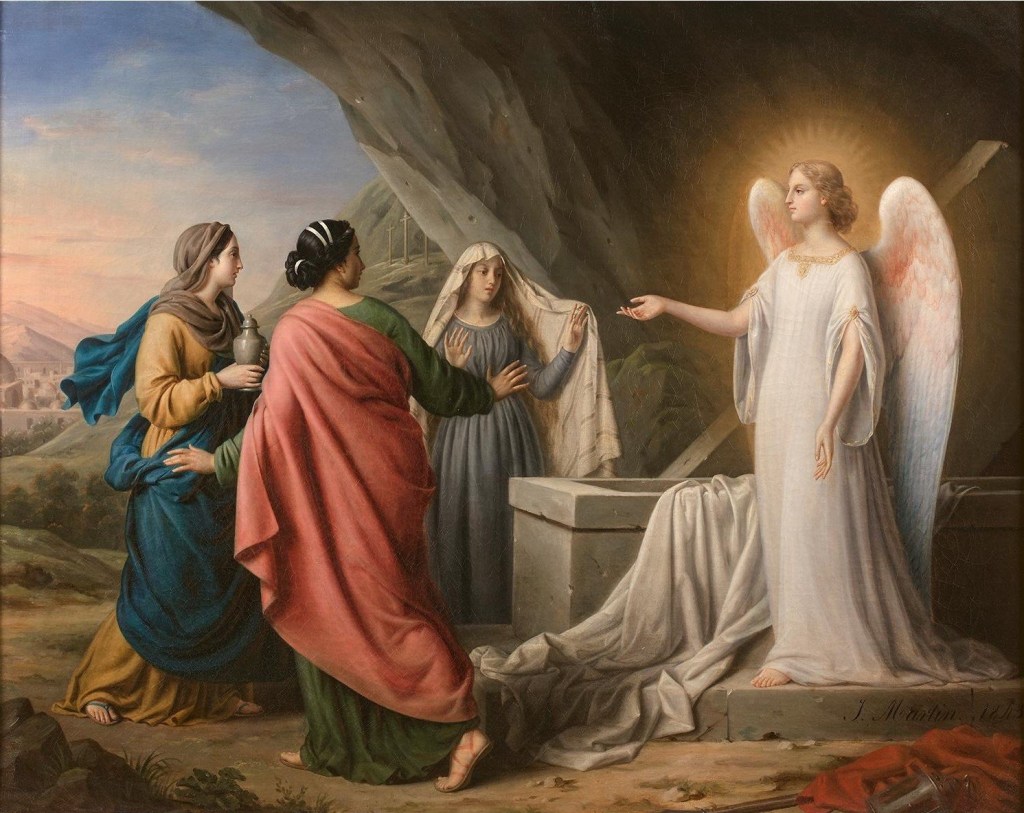
A. Let’s start with our Gospel from John 20:19-31.  We remember from our Gospel lesson last week that some women disciples of Jesus had gone to His tomb to pay their final respects to the Lord—only to find His tomb open, and His body gone.  Before they could get too upset, however, 2 angels appeared to tell them Jesus had been resurrected, and that they were to go report that miraculous news to “the-12-minus-Judas,” which they did.  The guys were of course skeptical, because none of them expected to see Jesus as anything other than dead. 

In today’s passage, it is the evening of Resurrection Day and Jesus appears to the “11-minus-Thomas.”  He suddenly materializes through a locked door.  He has to say (v.19)  Peace be with you! because they were no doubt shocked and afraid. He shows them his wounded hands and feet to assure them He is real and not a ghost. But notice what he does next:  He says again (v.21)—Peace be with you!  Then, He says, As the Father has sent Me, I am sending you.  He calms their fears and their excitement.  Then He announces that He is sending them. Of all the things He could have chosen to say to them, He gives them their But, what’s next?  Here’s what’s next for them and for us: They (and we) are to tell others who do not know Jesus, the Good News.  We are to teach them about who He is and what all He did.  We are to pray for them for faith and healing.

B. Our Acts lesson (5:27-39) tells us that this is exactly what the Disciples began to do.  Rather than continue to huddle in the Upper Room, they went to the Temple and began to preach and teach about Jesus. In chapter 4, Peter and John were arrested for this and for healing a beggar.

Peter boldly declares to the Sanhedrin (4:10)—It is by the name of Jesus Christ of Nazareth, Whom you crucified but Whom God raised from the dead, that this man stands before you healed. Peter did not mince any words did he?  The Jewish religious authorities tell them they are not to preach anymore about Jesus.  But again Peter bravely responds (4:19-20)—Judge for yourselves whether it is right in God’s sight to obey you rather than God.  For we cannot help speaking about what we have seen and heard.  The authorities let them go.

By the time of today’s passage, the word has spread that the Apostles are doing what Jesus did, preaching, teaching and healing.  Crowds flock to them. The jealous religious leaders once again have them arrested and jailed. An angel sets the Apostles free, and they resume teaching and healing again the next day. The jealous leaders, who are mad enough to kill them, arrest them again.  Bold Peter again proclaims they have to keep bringing people to Jesus because they are obeying God!  Even if it means being arrested or persecuted, they won’t stop.

At this point, the highly respected Rabbi Gamaliel (Paul’s teacher) wisely speaks up.  He counsels the Sanhedrin to leave the Apostles alone.

If they are zealots acting on their own, their movement will die a natural death; but if they are indeed doing God’s will, the Sanhedrin will not be able to stop them.  Worse yet, they will find themselves fighting against God. His wisdom prevails.

Now, we did not live with Jesus for three years, hear His words, or witness to His healings and deliverances.  But because of what we know from the Bible, and from what Jesus modeled and taught, we realize Jesus is worthy.  As the beginning verses of Revelation (1:4-8) reveal to us, He is our sovereign and everlasting God.  He is worthy of our attention.  He is worthy of our obedience.

D. And our Psalm (150) dramatically proclaims He is worthy of our praise and worship.  Only the Trinity, Father, Son, and Holy Spirit, are worthy of our worship.  Our culture now worships money, power, influence, sex, even fashion and one’s social media presence.  We need to be mindful of who or what we worship. The story is told of how the brother of the famous American preacher named Henry Ward Beecher (1813-1887), came to his church one Sunday to substitute for him. 

A large audience had already assembled to hear Beecher, and when the substitute pastor stepped into the pulpit, several disappointed listeners began to move toward the exits. That’s when the minister stood and said loudly, “All who have come here today to worship Henry Ward Beecher may now withdraw from the church. All who have come to worship God keep your seats!” 

(Lou Nicholes, November 28, 2017, as presented by  http://www.SermonCentral.com ,4/20/2025).

Hopefully, we come to church to worship none other than our Lord, Jesus Christ.

So, What’s Next?  We cannot just occupy the pews of our church building. The What’s next is to tell those who aren’t connected to Jesus about Who He is, why they need Him in their lives, and how to go about getting connected to Him.  It’s the first thing He told the Eleven—so it must have been very important to Him. One of the purposes for coming to church on Sunday is to become strengthened and equipped to bring others to Jesus. Another purpose for coming to church is to worship Him.

We need to obediently respond to Christ’s command that we tell those we encounter about Jesus. This will require we have God’s peace in our hearts and spirits. We need not stand on street corners or go door to door passing out tracts. Instead, we look for opportunities that the Lord gives us to connect with people, as well as the words to say.

This reminds me of something I heard from Graham Cooke, an Anglican priest, at a healing conference he held some years back at a Vineyard Church in Gainesville, Florida. He said he was in America, somewhere in New England, when he walked into a Starbucks. As he entered, he heard the Lord tell him, See that man seated over there.  I want you to go tell him I will heal his daughter if he prays for her daily. Graham obediently went up to the man to convey this message. The guy asked him not to bother him as he had had very bad news and wasn’t up to talking to anyone. Graham said he had a message from God for him. The guy replied that he was an atheist and didn’t believe in God. Graham replied to him, “Well God believes in you.”  He then told him the Lord knew that he had just learned that his daughter, his only child, had dropped out of college and was prostituting herself to earn money for drugs. The Lord also knew he was broken-hearted. God promised to heal her if the man would pray for her daily for 6 months. The man told Graham that he didn’t know how to pray.  So Graham Cooke wrote a prayer out on a Starbuck’s napkin and directed him to say that to Jesus daily. He also gave him his card so the man could report back whatever happened. Four months later, the guy contacted Graham Cooke to tell him his daughter had left her life of drugs and prostitution, that they were reconciled, and that he was both thrilled and grateful. In fact, both of them had become Christ-followers as a result of this. This is such a great example of (1) a divine appointment, an opportunity set up for Rev. Cooke by the Lord, and (2) also of how the Lord gave him the words to say. As a result, both this man and his prodigal daughter became believers in Jesus Christ.

Finally, we remember that our motivation to tell others about Jesus comes from our devotion to Him and our worship of Him.

Alleluia, He is risen!  The Lord is Risen indeed, Alleluia!

©️2025 Rev. Dr. Sherry Adams 

Resurrection Sunday, 2025

Pastor Sherry’s message for April 20, 2025

Scriptures: Isa 65:17-25; Ps 118:1-2,14-24; 1 Cor 15:19-26; Lk 24:1-12

How many of you enjoy a good mystery?  Briefly, here are two.  See if you can figure them out:

1. “Everyday a gentleman went to work.  Every day, he would ride the elevator all the way to the bottom floor of the high rise apartment building in which he lived.  But when he came home from work, he would ride the elevator back up to only the 6th floor.  Then, he would take the stairs to his apartment many stories higher in the building.  This he did every day, unless it was raining.  If it was raining, he would ride the elevator all the way to the floor of his apartment.  Why?”

2.  Here’s the second one:  “Ann is lying on the floor dead.  There’s broken glass and water all around her.  Stuart is asleep on the couch seemingly oblivious to the death that has occurred.  How did Ann die?”

To keep you from puzzling these two mysteries out while I continue to preach, I’ll tell you their solutions: “In the first one, the gentleman would only go to the 6th floor on his return home from work because that was the highest button that he could reach on the elevator control panel.  He was a short man.  On days that it rained, he had his umbrella with him, and he could use that to punch the button that indicated his floor.” “In the second situation, it might help you to know that Ann is a fish, and Stuart is a cat.  And the glass and water all around Ann on the floor is from her fishbowl that Stuart successfully knocked over.”  The true mystery here is what then kept Stuart from eating Ann? 

(Borrowed from a sermon by Chris Talton, April 15, 2001, www.sermoncentral.com, 3/24/2005)

If we put ourselves in the position of the women who went to Jesus’ tomb on the morning of His Resurrection Day, we would realize they too were presented with several mysteries:

1. The gigantic stone that had sealed the entrance to the tomb had been rolled back.  Who could have done such a thing?  Remember, these ladies had been with Jesus at the Cross.  They had seen Him suffer and die.  They had watched Joseph and Nicodemus remove Jesus’ body from the Cross and transport it for burial in the new tomb nearby.  They also knew the men had hastily anointed Jesus body with embalming ointments and cloths, and had come to neaten things up and complete the job.  Surely they realized no single person could have rolled that huge, heavy stone away.

They probably also knew a contingent of Roman soldiers had been assigned there to guard the tomb.  So what had happened to them?  Had the Romans stolen Jesus’ body?  Had the Jewish religious authorities taken it?  They had to be both puzzled and alarmed.

Cautiously, they stepped inside the tomb to see if His body was there. Instead of finding Jesus’ corpse, they suddenly encountered two “men” in brilliant white clothes–angels.  It’s almost comical that the angels ask them, Why do you look for the living among the dead?  [He is alive!]  He is not here; He has risen.  Literally, the ancient Greek states, He has been raised.  The verb tense implies that God the Father has raised Jesus.

Angels had proclaimed His birth; now angels proclaim His resurrection (The angels and the women are all witnesses to this miracle).  These angels remind them of Jesus’ teachings about His death and resurrection on the 3rd day.  This is a prompt for them to remember. but it’s also a rebuke—”How could you forget something so very important?!!”

Then they do remember, and go to tell the disciples (the next  resurrection witnesses).  The Eleven do not believe them, even though they should have known these women were reliable truth-tellers.  Peter takes off for the tomb, to see for himself (he is now a witness).  Peter probably now knows better than anyone not to doubt the Lord’s words.  But he still wonders (perhaps “marvels”) about what Jesus’ absence in the tomb means. 

This passage (Luke 24:1-12) closes with questions in everyone’s mind about what has happened (big mysteries). 

The accounts of Jesus’ Resurrection are also reported in the other three Gospels, Matthew 28:1-8; Mark 16:1-8; and John 20:1-8.

A. You might want to read them each and compare to get a fuller sense of how the first witnesses to Jesus’ resurrection responded to the mysteries with which they were presented.

B. Paul, as we know, came to believe in Jesus sometime after the events of Resurrection Sunday.  By then, the mysteries had been explained.

So Paul is intent, in our 1st Corinthians 15:19-26 lesson, that we understand that Jesus’ resurrection is the defining moment of Christianity.

First, back in verses 5-8, he reminds us of who all saw Jesus following His resurrection:  Peter (omitting the women); the 12 minus Judas; more than 500 disciples (maybe he included the women among the 500); Jesus’ brother, James; and Paul himself.

Next, in verses 13-19, Paul asserts that our entire faith depends upon the truth of the resurrection:  Verse 14—If Christ has not been raised, our preaching is useless and so is your faith. In other words, Christ’s resurrection from the dead is incontrovertibly true and forms the basis of our belief in Him.  We worship a God who has the power to bring His Son back from the dead.  I want a strong, powerful God like that, don’t you?  We worship a God who loves us so much that He sacrificed His one and only Son to redeem us.  We worship Jesus, the One and Only, the God Who—because of His self-sacrificing love for us and His obedience to His Father–was willing to cover the cost of our sins.  The sinless Son of God gave up His life so we might have new life, and have it abundantly.  We can connect directly with the Father because Jesus opened the way for us (As He hung on the cross, the massive Temple curtain was torn in two, from top to bottom.)  We can anticipate being resurrected because Jesus opened the way for us.  And, when He comes again in glory to judge the living and the dead, He will destroy death…Praise God! 

C.  We don’t know who wrote Psalm 118:1-2, 14-24, but it is an ode to joy!  The psalmist invites us to focus on heavenly realities–not the frustrations and disappointments of this life.  Because of the mighty things Jesus will do [has done]—including demonstrating His power over death—we can gratefully rejoice in the Lord and praise Him for our deliverance, provision, and protection.

We are to be thankful to Him because (V.1)—The Lord is good; His love endures forever.  (V.14)—The Lord is my strength and my song; He has become my salvation.  (V.18)—Prophesying Jesus’s resurrection, the psalmist wrote, I will not die but live, and will proclaim what the Lord has done…He has not given Me over to death. Jesus was laid dead in a tomb–But He did not remain there as we would have.  He rose again, overcoming death for our sakes!  We are also grateful for the fact that (v.22)—The stone the builders rejected [Jesus] has become the capstone.  The capstone was either (1) a large rectangular stone used as a lintel over a doorway; or (2) a large square or rectangular stone used to anchor or align the corner of a wall; or (3) it might also be the keystone or middlemost stone in an arch.  The capstone (building corner or doorway lintel) or keystone (arch) kept the building from collapsing by supporting what existed beside and above it. The psalmist prophetically meant this as a metaphor for Jesus, who holds all things together for us— no wonder we call Him our Rock and our Redeemer.

Our passage today ends with this line (V.24)—This is the day the Lord has made, let us rejoice and be glad in it.

D. Isaiah 65:17-25 reminds us both that Jesus overcame sin and death, and that we too will therefore experience a joy-filled life after death.

After Jesus defeats the forces of evil at Armageddon, God (v.17) will create new heavens and a new earth.  If you read through the book of Revelation, you can tell that our world will be a disastrous mess by the time Jesus appears a 2nd time.  We will probably need a new earth, at a minimum.

Verse 19 tells us that the newly created Jerusalem will be delightful!

God will be overjoyed with His people there; and they too will be very happy, with no one weeping or crying.  Premature death will be an event of the past (no cancers, illnesses, strokes, heart-attacks, eye problems, hearing loss, or sciatic pain).  People will be able to enjoy the fruits of their labors (no warfare or taxes).  All of God’s people will be blessed!  God will answer our prayers before we even finish praying them.  And all animals will become plant-eaters—no more carnivores devouring prey—and will be at peace with each other.

Thanks be to God the mysteries presented the women at the open tomb have been solved.  We are not left to wonder.  Paul wants us to fully appreciate what Jesus has done for us through dying and rising again.  Our psalmist calls upon us to be grateful and to rejoice!  And Isaiah describes a wonderful world ahead for us when the resurrected Jesus comes back to earth.  Let’s celebrate by singing along to Keith and Kaitlin Getty’s version of https://youtu.be/m_063OI38RQ?si=Dre8ll-AV-GHUlPB In Christ Alone.

©️2025 Rev. Dr. Sherry Adams 

If You Thought This was Spectacular….

Pastor Sherry’s message for April 6, 2025 

Scriptures: Isa 43:16-21; Ps 126; Phil 3:4b-14; Jn 12:1-8

I love stories of healing:  (1) One of our parishioners told us once that she felt God free her from years of a smoking addiction while sitting here in our sanctuary.  (2) We learned several weeks ago that someone we had been praying for for weeks was suddenly healed of Stage 4 Cancer. (3) John Wimber, who founded the Vineyard Church (a charismatic, nondenominational church that focuses on healing), reported many healings but one in particular seems pretty spectacular to me:

“…he received a phone call from a distraught father.  The man was sobbing and could hardly talk.  ‘My baby is here in the hospital,’ he said, ‘and they have tubes from machines attached all over her body.  The doctors say she will not survive the night.  What can you do?’  John said he would come to the hospital.  After he put the phone down, he prayed, ‘Lord, is this baby supposed to die?’  John sensed the Lord saying, ‘No!”  John walked into the hospital with the knowledge that he was a representative of Christ, a messenger who had a gift for that baby girl. 

“When John entered the baby’s room, he sensed [a spirit of] death, so he said quietly, ‘death, get out of here [in Jesus’ name].”  It left, and the whole atmosphere of the room changed, as though a weight had been lifted. Then he went over and began praying for the girl.  After only a few minutes he knew she was going to be healed, and so did her father.  Hope came into his eyes.  

“She is going to be okay,’ he said; ‘I know it.’. 

“Within 20 minutes she had improved greatly; several days later she was released, completely healed.”

(Graham Twelftree, Your Point Being?,  Monarch Books, 2003, p.132.)

Stories like these touch our hearts. They remind us of God’s great love for us.  They deepen our faith.  And they are evidence that our God didn’t just do miracles in Bible-times.  There is in some corners of the Church a believe called dispensationalism. Folks who subscribe to this belief feel convinced that all miracles of healing or deliverance stopped with the death of the last Apostle.  But we know this is simply not true.

All of our Scripture passages today seem to suggest God’s great delight in surprising us with his grace and goodness.  It’s as though He is saying to us, If you thought this was spectacular….

A. In Isaiah 43:16-21, the prophet Isaiah reminds God’s Chosen People of His redeeming work on their behalf.  They had been bound up as slaves in Egypt for 400 years.  God had tucked them out of the way while He waited on the Canaanites to accept Him as their Lord.  They didn’t.  So God sent Moses as His choice of a leader to free the Israelites.  Miraculously, then, Moses led 2 million people, plus their animals and belongings, through a supernaturally dried up Red Sea (1446BC). They walked through on dry land, while the Egyptian army and the chariots that pursued them were drowned.

Isaiah speaks for God saying essentially, “If you think that was spectacular, wait til you see this new thing I am going to do. In verses 18-19 (MLV), the Lord says—But forget all that—It is nothing compared to what I am going to do.  For I am about to do something new.  See, I have already begun!  Do you not see it?  He is referring to how He, the Lord, will lead His people with a cloud by day and a pillar of fire by night.  He will provide them with supernatural food (manna) from heaven and supernatural water from rocks.  He will protect them from enemy attacks. physical diseases, and even from wear and tear on their clothes and sandals.

But, most spectacular of all, He is predicting—through His prophet—the redemption of all humankind He has planned through the efforts of Jesus Christ. In the entire history of the world, there has never been a religion in which the deity comes to earth to save human beings.  This is clearly “a new thing.”

B.  Psalm 126 offers a similar refrain.  This time the Jewish people have been released from their 70 year exile in the Babylonian-Persian Empire.  God had allowed the forces of King Nebuchadnezzar to defeat Judea, destroy Jerusalem, and cart the people off (586BC).  He was chastising them—after many warnings of judgment to come—for their idolatry and stubborn disobedience.  The news that they were free to return to Jerusalem stunned the Jewish captives!  The psalmist writes in vv.1-3—When the LORD brought back His exiles to Jerusalem, it was like a dream!  We were filled with laughter, and we sang for joy.  And the other nations said, “What amazing things the LORD has done for them.” Yes, the LORD has done amazing things for us! What Joy!

This probably felt to them like a spectacular new thing.  God’s miracles for His people were clearly not at an end.  And, just as the Isaiah passage predicted Jesus’ 1st Coming, this psalm looks forward to the Jesus’ 2nd Coming. 

C. The Isaiah reading dealt with the Exodus, and our psalm, with the return of the Babylonian exiles.  Paul takes us in a different but related direction in Philippians 3:4b-14.  Paul had, prior to coming to Christ, thought he could manage his own salvation by his own efforts.  He lists 7 credentials he had accumulated that made him a religious superstar:

1.) He had godly parents, who saw to it that he was circumcised on the 8th day—by Jewish Law. 

2.) He was purely a Jew—no nonbelieving Gentiles in his gene pool. 

3.) He was a member of the tribe of Benjamin, Jacob’s favorite son after his loss of Joseph.

4.) He was an elite leader.

5.) He was a Pharisee by training, dedicated to teaching and enforcing Jewish Law.

6.) He was so zealous that he persecuted the infant Christian Church.

7.) And he kept short sin accounts with God, making the requisite sacrifices when he sinned.

But, since becoming a follower of Jesus Christ, he considers all his worldly accomplishments worthless. And so should we.  It’s not about impressing others with what we have done or not done. Paul knows he could not make himself right with God through his own efforts.  He wants us to realize that (v.9)—…God’s way of making us right with Himself depends on faith.  It’s about having faith in Jesus Christ.  He is now dedicated to getting to know Jesus better and better, and to helping others do so too.  And so he presses on (vv.13-14)—Forgetting the past and looking forward to what lies ahead, I press on to reach the end of the race and receive the heavenly prize for which God, through Christ Jesus is calling us. 

This is definitely a spectacular new thing: Salvation does not come from our efforts, but has been won for us by our Lord and Savior, Jesus Christ.  We don’t have to try to be perfect. Our sins are covered by the sacrificial blood of the sinless Son of God. Our striving can cease, replaced by our faith.

D. Finally, in our Gospel lesson (John 12:1-8), we see a young woman do something extraordinarily new to honor Jesus.  The scene is a dinner party in Jesus’ honor at the home of Lazarus.  Rev. Dr. J. Vernon McGee says the Lazarus family represents 3 essentials in every Church:

(1) The resurrected Lazarus has new life in Christ.

(2) Martha no doubt prepared and served the meal, so she represents service.

(3) Mary kneels at Jesus’ feet, worshiping and adoring Him.

(McGee, Through the Bible Commentary on John, Thomas Nelson, 1991, p.38.)

Notice how extravagant are Mary’s efforts.  Jesus will wash His disciples’ feet with water at the Last Supper, but she anoints His feet with a very expensive perfume from India, and dries them with her lovely long hair.

Mary of Bethany realizes how very special Jesus is and she honors Him with a pound of spikenard worth a year’s wages.  She, like Paul who comes after her, has made worshipping Jesus the most important thing. Jesus accepts her worship as if she is anointing Him for His death some 6 days ahead. We could say she is fully committed and has the utmost faith in Jesus. 

I don’t know about you, but I find that Jesus often surprises me by answering prayers I haven’t even put into words.  There’s a certain busy intersection, with no light in my town, into which it is very difficult to turn left. For several days, as I have approached this intersection, there has been—amazingly—no traffic in either direction. As I have easily executed my left-hand turn, I have laughed and thanked the Lord. This is not as spectacular as opening the Red Sea, returning exiles to Jerusalem, or healing a dying baby.  But it serves as a reminder to me that Jesus sees me, loves me, and wants to have me cross the intersection safely.

Like Paul and like Mary of Bethany let’s during what’s left of Lent, focus on how grateful we are to serve a God who enjoys gifting us with spectacular large and delightful small surprises.

Thanks be to God who gives us the victory through our Lord Jesus Christ.  Alleluia, alleluia!

©️2025 Rev. Dr. Sherry Adams

Radical Heart Surgery

Pastor Sherry’s message for March 23, 2025

Scriptures: Isa 55:1-9; Ps 63:1-8; 1 Cor 10:1-13; Lk 13:1-9

I believe I’ve mentioned several times in the past that I taught Psychology at Santa Fe College in Gainesville for about 5 years. Most majors at Santa Fe required Psychology—even welding!—so there were many sections offered. Whether you are majoring in Biology, English, or even Art, a basic understanding of human behavior can be very helpful.

I enjoyed how bright and how funny the students were, and often learned as much from them as they hopefully learned from me. Instead of a term paper every semester, I had them embark on a Self-Change project. They were to use principles of psychology to either (1) add a new, good habit like drinking more water, or working out more regularly, or even devoting more time to study; or (2) they could try to overcome a bad habit, like quitting smoking or dipping, or one young lady who decided to stop gossiping at work. She noticed her coworkers always talked badly about whoever was not present. She realized that probably meant they criticized her when she wasn’t there. She admitted that work had become an unsafe place, emotionally. A non-Christian, she decided to do something about it by abstaining from gossip.

Another young woman said she wanted to avoid talking and thinking negatively. She’d noticed that always focusing on the negative put her in a bad mood (This is true for most people).She planned to substitute three good thoughts for every negative one she had—it turns out that recent psychological research has shown that substituting positive for negative thoughts is an excellent way to overcome depression..

These young women had great intentions. I had hoped these self-change projects would make a significant difference for my students, but I sometimes had my doubts. A girl in one of my classes said she was going to control her road rage, and she appeared to have done so. The following semester, however, I was right behind her in traffic when she grew enraged at the driver ahead of her, and then honked, yelled, and made rude hand gestures to this person. She didn’t see me, but I emailed her about witnessing her relapse into road-rage, and encouraged her to remember her intentions to change and try again.

What that proved to me was that to overcome long standing bad habits, we need the help of the Holy Spirit. Simply put, our willpower alone is not enough. We are told by Jesus that (Matthew 12:34) Out of the fullness of the heart, the mouth speaks. To achieve the kinds of behavioral changes we may want to make requires radical heart-surgery—a transformed heart! My students needed Jesus, and so do we! 

In our Gospel lesson today, Luke 13:1-9, Jesus talks about a what we may term “radical heart surgery.” Just as with real estate, a critical factor in understanding any passage from Scripture is its location, location, location! In the end of Chapter 12, is Jesus’ final appeal to the nation of Israel to repent. He tells them they are responsible for every sin they commit. He also reminds them to keep short accounts with God, asking for forgiveness daily, while they still have time to make things right. In the passage right after this one, Jesus again heals on the Sabbath. He has already duked this one out with the Jewish religious leaders several times. It is lawful to heal on the Sabbath, because the Sabbath was made for humankind, and besides He, Jesus, is Lord of the Sabbath. Therefore He has the authority to determine what is lawful to do during it. So He heals a woman in the Synagogue who has been bent over for 18 years. He then looks to see if the hearts of the religious establishment have been changed since He healed the man with the withered hand. Apparently not! The Synagogue ruler dresses Jesus down for healing during worship! And Jesus calls him a hypocrite for leading his animals to water on the Sabbath, but denying a woman freedom from her crippled condition. 

So our passage is sandwiched between two important notions: (1) Your hearts are not right with God (including Jesus). Do something about this now, as your time for changing is short. And (2) your hearts are not right with your neighbors. In other words, “You’d stress the letter of your interpretation of the Law over this woman’s welfare? Really?”

Then He moves on to two examples from real life: Some listeners (believers? Scribes, Pharisees?) relate to Him the latest of Pilate’s atrocities. We tend to think of Pilate only in the context of Jesus’ crucifixion, but he was a weak leader, “sentenced” to serve Caesar in Judea as a last chance to prove himself. Thus he was highly reactive and overly sensitive to whatever might displease Caesar. Apparently Pilate exacted capital punishment on some Jews from Galilee as they were in the act of worshipping at the Temple. To the Jewish mind, then, this was pretty horrific. Furthermore, whatever happened to the notion of “sanctuary”? Like if terrorists stormed Wellborn Methodist Church and killed us all while we were singing or praying together, we and others would be outraged.

These tale-bearers then ask, Do you think these Galileans were worse sinners than all the other Galileans, because they suffered thus?

They want a judgment call. The prevailing thought at that time was that all misfortune—disease, financial struggles, relationship problems, premature death—was due to your being an extreme sinner. They really believed that you could recognize a sinner by the amount of tragedy in his/her life. They perhaps wanted some assurance they are not as bad as the slain worshippers.Note Jesus’ answer: I tell you, No [they were not worse sinners]; but unless you repent you will all likewise perish. Does that answer strike you as a little strange? Jesus responds to their question—NO—then redirects them from the issue of whose sin is worse. Just as back in Chapter 12, He wants them (and us) to remember they (and we) are all sinners.(a) We need to get right with God and others; (b) We are all going to die someday, somehow; (c.) So, right now we need to admit our sin, confess it to God, and ask His forgiveness. And by the way, He probably didn’t miss that they had pointed out that the unfortunate citizens Pilate had executed were—like Jesus—Galileans. Some scholars posit that they were either being dismissive of Jesus —like saying He was a hick from Wellborn or Live Oak! Or, even more subversive, they were trying to set Him up to condemn Pilate so they could then rat Him out to the Romans. By this point in Luke’s Gospel, the gloves are off between the Jewish religious leaders and Christ.

Then Jesus brings up another tragic account: the tower that fell, killing 18 workers.This may have been a portion of an aqueduct that Pilate was having built in Jerusalem—so, back at you with the Pilate provoked deaths of Galilean Jews. This time the persons killed were residents of Jerusalem. Jesus poses their question back to them, Or those eighteen upon whom the tower in Silo’am fell and killed them, do you think that they were worse offenders than all the others who dwelt in Jerusalem? I tell you NO; but unless you repent you will all likewise perish.With an economy of words, Jesus deflects from the issue about the degree of sin because it distracts from the weightier, more important issue: Don’t worry about who sinned more than whom; it’s not a contest as every sin separates us from God, so there are no degrees of sin. But right now, you (we) need to look to the evil in our own hearts. Do we love God with our whole heart, soul, mind, and strength?Do we love our neighbors as ourselves?

Then He follows up with the Parable of the Barren Fig Tree. In the Old Testament, vineyards and orchards were metaphors for the nation of Israel.Fig trees were often planted in vineyards. They typically took three years to mature (bearing fruit, when mature, 10 months out of 12); Then another 3 years to bear fruit that God would not allow them to use; But, by the 7th year, (4th year with fruit), this fruit belonged to God; This barren fig tree has not produced fruit for 7 years (seven means completion in the Hebrew numbering system)! The tree’s time was complete.

The Vineyard owner is God (representing God’s justice).The Lord is disappointed that the Jewish religious leadership has not been more fruitful. He is ready to cut them down!They’re hogging soil nutrients that could go to the vines, the people.The vinedresser is also God (representing God’s mercy), and asks for patience, grace. Let me dig about it, aerate it, water it; let me pour manure on it, and offer it more time to change. Jesus is making a point the religious leaders would have well understood! “You are helpless to help yourself! Heart-changing help must come from outside yourself —we/you are all sinners in need of a Savior.”And whether they accepted it or not, Jesus was giving them a limited time to repent/to accept He is God.We know they ultimately rejected Christ and so God allowed the Romans to destroy the Temple and Jerusalem in 70 AD.

So what does this mean to us? Jesus is sharing us the truths that (1) We are all sinners! (2) Sin kills. It cuts us off from God, and it warps our relationships with others. Consider the example of pornography—a self-change project that several of my male students embarked upon.

It objectifies the person viewed.It tends to result in the viewer becoming angry with the object of their lust, blaming her for posing for the picture.

And it sends every thought through a sexual filter. (3) We all need to repent.(4) We need to invite the Holy Spirit to do radical surgery on our hearts.

Jesus gave these hardhearted, religious leaders another chance. Let’s remember this week how gracious and patient He is with each of us. Then let’s humbly and sincerely thank Him for His grace, His mercy, and His forgiveness. AMEN!

©️2025 Rev. Dr. Sherry Adams

Despite Rejection

Pastor Sherry’s message for January 26, 2025

Scriptures: Jer 1:4-10; Ps 71:1-6; 1 Cor 12:12-31a; Lk 4:14-30

Did you know that Abraham Lincoln…

“…was defeated seven times for elective office before winning the Presidency of the United States. He certainly defied the odds. And he did not give up.

“Then there was Vincent van Gogh. Van Gogh earned all of $85 from his paintings during his lifetime. One hundred years after his death, just one painting alone, Dr. Bachet, sold for the incredible sum of $82.5 million.

“Then there was this itinerant, middle eastern preacher who lived some 2,000 years ago — his ideas were definitely rejected by the people of his hometown, as well as the religious leaders of his time and country. Yet he continued his ministry as he understood it to be — Divine Defiance?

“The point is clear. If Abraham Lincoln, Vincent van Gogh, or Jesus of Nazareth had let rejection rule their lives, and let it keep them from doing and saying what they felt sure to be right — our world would be incredibly impoverished today.”

(Dianne O’Connell, “Divine Defiance,” www.esermons.com, 1/20/2025)

Consider how often these three must have felt discouraged, frustrated, or ready to give up?: Yet, what great examples to us of the importance of persevering in the face of repeated rejection.

Two of our Scripture passages today illustrate this theme of persevering despite rejection:

A.: Our Old Testament lesson is from Jeremiah 1:4-10, and recounts the divine call to Jeremiah to become the Lord’s prophet.

Jeremiah was probably between 17-20 years old when this takes place.  He was already serving God as a priest in his home town of Anathoth, located just North of Jerusalem. King Josiah was about 22 then, in 626BC, and reigned until he died at age 39.: He and Jeremiah were contemporaries, and likely became friends. Jeremiah served all during the remainder of Josiah’s reign, and continuing also during the reigns of kings Jehoahaz and Jehoiakim (sons of Josiah), Jehoiachin (Josiah’s grandson), and Zedekiah (a third son of Josiah).

Josiah, a good and godly king, had led his people in a revival to turn their hearts back to God; but his sons and grandsons were another story.

Because of their idolatry and wicked behavior, God allowed the last to be defeated and carried off into slavery by King Nebuchadnezzar of Babylon.

Notice how God calls Jeremiah into His service: verse 5: Before I formed you in the womb, I knew you, before you were born I set you apart.: This is amazing and also a bit intimidating, isn’t it?: It implies that God knows us before we are even conceived, and that He has a plan for our lives—He has given us life for a purpose.: The Lord tells Jeremiah He had determined–even before the young man’s birth–that he would become a prophet and deliver to His people whatever God told him to say.: Jeremiah is a humble young man who replies to God, (v.6): I am only a child, meaning, Yes, I will do it, but I am young and lack much life experience.

In other words, I wouldn’t know what to say!: God’s response must have been very reassuring (v.7): Do not say,’ I am only a child.’: You must go to everyone I send you to and say whatever I command you. Do not be afraid of them, for I am with you and will rescue you.: The Lord assures him He will tell Jeremiah what to say; and He promises to take care of him, even though He was calling him to prophesy divine judgment on Judah and her heretical kings.

If we skip ahead 40 years to the end of Jeremiah’s life and career, we would find that he apparently never made a single convert; after King Josiah, the people ignored or ridiculed his preaching entirely.: He was rejected by his people because of his message, hated, beaten, put in stocks, imprisoned, and charged with being a traitor. He was later called “the prophet of the broken heart” because God’s judgments on his people—and their rejection of God–were so distressing to him.: Actually his emotional response to his rejection mirrored God’s own saddness.: Once, King Jehoiakim cut his hand-written, prophetic scrolls up.: He destroyed them by throwing them into the fire (but God just retold the contents to Jeremiah so he could write them again).

I don’t know about you, but though I would have been proud to speak the Lord’s words to His people, I would also have been exceedingly distressed to have had been so unsuccessful in changing peoples’ behavior.: Jeremiah may have been just as distressed, but he persisted!: He may have been disappointed, but he kept on giving out God’s messages.: He may have been discouraged, but he never gave up!: I think that he stands as an excellent example to us:: He trusted in God’s promise to him and he persevered despite what he probably considered his limited impact.

And, as Paul writes in 2 Timothy 4:7: I have fought the good fight. I have finished the race. I have kept the faith.: Now there is in store for me the crown of righteousness which the Lord, the righteous judge, will award to me on that day—and not only to me, but also to all who have longed for his appearing.: Those lousy kings after Josiah are no longer remembered by anyone, but Jeremiah’s two books of the Bible (Jeremiah and Lamentations) remain available today, 2700 years later!

With what in your life are you struggling today?: With a relative, a co-worker, or an unfair boss?: With an illness or a chronic condition?: With a lack of money or a lack of peace? Jeremiah’s obedience to God, and his perseverance in the face of repeated rejection, inspire and encourage us 

(1) to put one foot after the other, continuing to try to do good where we can; and (2) not to give Satan the victory by caving in to dejection and perceived defeat. 

B.: The same is true of Jesus (as per our Gospel lesson, Luke 4:14-30).: Jesus reads His job description from Isaiah 61:1, and tells His friends and neighbors in Nazareth that they are witnessing the fulfillment of Isaiah’s prophesy in Him.: At first, they were impressed with His knowledge and wisdom–until someone spoke up who reminded everyone that Jesus was the carpenter’s son.: This person had placed Jesus in a box and would not consider that He might in fact have become “more than a carpenter.”

His former neighbors were eager to see Him work some miracles, but they were unwilling to alter their perceptions of Him.: John Mark tells us in Mark 6:5: He could not do any miracles there, except lay His hands on a few sick people and heal them…due to their lack of faith.

Jesus really gets them riled up when He reminds them (v.24): I tell you the truth…no prophet is accepted in his hometown.: Then He further incenses them when He gives them two examples of “outsiders,” Gentiles whom God had provided for, rather than bless Israelites.: There were many widows in need in Israel during the famine and drought of Elijah’s day, but God sent the prophet to minister to a Phoenician woman.: He provided her with a continuous supply of food, and even resurrected her son when he died.: There were lots of Israelite lepers, but God chose to heal the Syrian general, Naaman.: In other words, Jesus is warning them that God will not bless them if they do not believe in His Son.

By this point, they are so enraged that they attempt to kill Him by tossing Him off a cliff.: The fact that He could just disappear from an angry mob should have stretched the box in which they had confined Him.: Surely Jesus was disappointed with their rejection of Him.: He was obviously willing to heal many, but their contempt and anger, their lack of faith, limited what His heavenly Father would allow Him to do there.: Just as with Jeremiah, His own did not believe Him.: So, He moves His base of operations to Capernaum.

I think what is most instructive for us is that is the example Jesus gives us in the face of rejection:: (1) Respond honestly, if given the opportunity.: He was admitting to them that He was the Messiah by saying He fulfills the Isaiah 61:1 passage.: He did not deny the truth even thught hearing it incited them to violence against them.: Don’t deny the truth as you know it, but also (2) don’t reply with anger, name-calling, or physical intimidation.: Years ago, I worked for a woman pediatrician in Tallahassee who gathered several social workers into her practice.: She worked with kids whose conditions did not resolve through the usual medical interventions, so instead, she involved the kids in counseling. I was there to supervise several interns she had working toward licensure, and I counseled some of the parents.: The longer I was there, the more it became evident to me that one of the women I was supervising (though she was married to a man) was having a lesbian affair with the doc.: The woman was good with the kids she counseled, but she viewed their parents as the enemy.: I repeatedly told her she needed to align sufficiently with the parents to change the social and psychological environment they created for their children. She resisted this vehemently.: I told her I could not then recommend her for licensure.: Our boss—and her lover—then demanded I do so despite my reservations.: I had to resign and leave that practice. As my Christian therapist friends helped me move my office, I walked out the door and “shook the dust off my sandals.” (3) Like Jesus, I remained calm, and moved on. The Lord provided me another location to do what He had gifted me to do…and He will do the same for you.

We cannot allow rejection to rule our lives.: We will not win over everyone we encounter.: Let’s remember how Lincoln, Van Gogh, Jeremiah–and even President Trump, whether you like him or not—as well as Jesus, all persevered despite being repeatedly rejected.

In Galatians 6:9, St. Paul encourages us (NLT): So: let’s not get tired of doing what is good.: At just the right time we will reap a harvest of blessing if we don’t give up.:  We are not meant to just, “Be calm and carry on,” but to continue to do our best to please God and to trust in Him.

Thanks be to God Who gives us the victory through our Lord, Jesus Christ.: Alleluia!: Alleluia!

©️2025 Rev. Dr. Sherry Adams  

Invite Jesus!

Pastor Sherry’s message for January 19, 2025

Scriptures: Neh 8:1-10; Ps 19; 1 Cor 12:1-11; Jn 2:1-11

Remember the old TV show, “The Tonight Show” with comedian Johnny Carson?  He was hilarious, wasn’t he?  You can probably recall some particularly funny episodes (You can locate reruns on www.YouTube.com).

One night he featured an interview with an 8 year old hero.  The child had rescued two friends who had gotten trapped in a West Virginia coal mine.

As Johnny continued to talk with the boy, it became obvious that the child was a Christian.

So Johnny asked him if he attended Sunday school. When the boy said he did Johnny inquired, “What are you learning in Sunday school?” “Last week,” came his reply, “our lesson was about when Jesus went to a wedding and turned water into wine.” The audience roared, but Johnny tried to keep a straight face. Then he said, “And what did you learn from that story?” The boy squirmed in his chair. It was apparent he hadn’t thought about this. But then he lifted up his face and said, “If you’re going to have a wedding, make sure you invite Jesus!” 

(Borrowed from www.Sermons.com, 1/14/2025)

The child was wise beyond his years!  We are told in Ecclesiastes 4:12 a cord of three strands is not easily broken.  This passage (4:9-12) is often read at weddings.  The bride and groom represent two of the three strands.  The marriage is strengthened if the third strand is Jesus.

Again, the child said, “If you are going to have a wedding, make sure you invite Jesus.” 

Our Gospel lesson today (John 2:1-11) recounts the wedding at Cana—to which Jesus had been invited.  Weddings were important events in Israel in the time of Christ.  They often involved feasting, dancing, and visiting with friends and family for up to a week!  It was time off for everyone to celebrate!  The couple didn’t take a Honeymoon in those days.

Instead, in the place of what we would call a Wedding Reception, the newlyweds would share their joy, and strengthen their ties, with their relatives and neighbors, with feasting and fun. 

Now the village of Cana was just over the hill from Nazareth.  Some scholars believe Mary, Jesus’ mother, had relatives there, so she, Jesus and the rest of her family had been invited.  You can thus see how, if a couple were poor, there was a real danger of running out of food and/or wine.  Wine to them was a staple with meals.  Perhaps the alcohol content helped kill bacteria in their unfiltered water.  However, drunkenness was universally condemned.  This couple, in our story today, does run out of wine, and the bridegroom is about to be publically embarrassed.

So Mary brings their dilemma to Jesus’ attention.  She says, They have no more wine.  Jesus responds, Dear woman, why do you involve Me?  Scholars are undecided about why she would ask Him to do something for them in this setting.  Jesus knew His Heavenly Father had not yet told Him to begin His public ministry, so He was reluctant to perform a miracle—He says, My time has not yet come.  I have heard this passage preached where the minister claimed Mary was a pushy, Jewish mother.  I could be wrong, but I think because she was His mother, she knew of knew His capabilities and His compassion. She had empathy for the couple.  Thus it is very likely that God the Father nudged Mary to “jump start” Jesus.

Whatever the case, He honors her by resolving the crisis.  He has servants gather 6 large water jars, each holding 20-30 gallons.  This would have been water set aside for ritual purification.  He then transforms the water into the best wine ever—somewhere between 6X20=120 gallons to 6X30=180 gallons!  This was an audaciously generous amount of delicious wine.  The one we would call “the wedding planner” or the master of the banquet, is amazed!  In so doing, Jesus has just offered the first sign of His divinity:  He can transform matter/material world.

We know from this side of the Cross that Jesus only did what His heavenly Father told Him to do.  So why unveil His divine powers at a wedding?

Our Psalm (19) celebrates God as our creator and redeemer. The Hebrew word used for God in the first 6 verses of this psalm is Elohim—it is the plural form of El—the Mighty One, or God the Creator [indicating that all 3 persons of the Trinity were involved in creation].  He created grapes and led someone at some point to ferment grape juice into wine.  The Vineyard is one of several metaphors God uses to describe the nation of Israel. The wedding takes place within the vineyard, Israel, and the groom has need of more wine. Perhaps God is saying, Jesus will meet your need, and what He supplies is better than the best.

In the 1 Corinthians 12:1-11 passage, Paul lists 9 spiritual gifts potentially given– through the power of the Holy Spirit–to those of us who love Jesus. These gifts are not given to us for our personal enjoyment, but for us to help with building up God’s Kingdom here on earth.  Among these is miraculous powers.  Jesus demonstrated His miraculous powers at the wedding in Cana.  Some believe this signaled His endorsement of the marital union.  (Since God the Father invented marriage in Genesis, we can be sure God the Son would support the Father’s idea.)  Other scholars make the distinction between Moses and Jesus: Moses’ first miracle was to turn Nile River water into blood (representing the Law);  Jesus’ first miracle was to turn water into fine wine (indicating grace and mercy).  Still other Biblical experts assert that Jesus took something old and battered (the jugs/water pots) and filled them with something new designed to meet their needs. In other words, He took a good thing from the past—water—and turned it into a good thing for the future–good, new wine. This way, we can begin to see the wine as a metaphor for the generous blessing of God.

Additionally, we have paired with these readings the Old Testament lesson from Nehemiah 8:1-11, which takes place in Jerusalem in 445BC.  Jewish POW’s of first the Babylonian, then the Persian Empires, had been set free by the Persian king, Artaxerxes, to return to their homeland.  Under the oversight and direction of their governor, Nehemiah, they have completed the massive rebuilding of the city walls in just 52 days.  Ezra, their priest, had begun the sad reconstruction of the Temple—which would take many more years.  We find them today assembled–on the equivalent of their New Year’s Day—inside the Water Gate (1 of the 12 refurbished gates of the city).  You may remember that business, legal, and political matters were debated and decided, in those days, at the city gates. So this wasn’t just some narrow passageway. It was, instead, a gate opening into a sizeable square or assembly area.

Ezra and Nehemiah had convened a “solemn assembly” of all the returning citizens.  Scholars estimate some 49,000 men, women, and children of an age to understand, had gathered there.  After 70 years of exile in a foreign nation, they were probably starved for God’s word.  They may have held Bible studies while in captivity, but they had not really been formally taught the Torah (the Law). Ezra and Nehemiah did not want the people to be ignorant of God’s Law. Their parents’ and grandparents’ ignorance and rebellion is what got them transported to Babylon in the first place.

Notice what happens: Ezra proclaims God’s word, in a loud voice, from a raised platform (perhaps the first pulpit). The people remain standing, and quiet, and as they listen for some 4-6 hours!  This is where the synagogue tradition of standing for the reading of Scripture began.  Standing is a sign of respect, of reverence.  I went to 4 years of Catholic Girl’s School (though not a Catholic) and learned quickly that one stood when called upon by one of the nuns. These Israelites are hearing God’s Law, Torah read to them—Genesis, Exodus, Leviticus, Numbers, and Deuteronomy—perhaps for the first time.  There are Levites/priests available to walk among the crowd and explain what God’s Word means.  This is probably the most important job we pastors do—explain the meaning of Scripture, as best as we can.  The pre-Reformation Catholic Church had moved away from this important duty, focusing instead on the dictates of “holy mother church.”  The Protestant Reformers were thus insistent that we preach and explain God’s word.  Like the people of Nehemiah’s day, we cannot obey God’s Word if we don’t know or understand it.

The people respond with AMEN, AMEN! May it be so, hands lifted, praising God.  We say, Thanks be to God! following the reading of Scripture in our worship services, and hopefully we mean it.  They then, as the Word sunk in, became convicted of their sinfulness.  They now knew the standard, and could gage how far short of it they fell.  So, they prostrate themselves and cry tears of repentance.  But Ezra, Nehemiah, the 13 on the platform, and the Levites among them, tell them not to grieve or mourn…a. They were to celebrate their deliverance from captivity by God.  He once again (remember 400 years in Egypt) freed them and restored them.  He hadn’t turned His back on them!  And now they had had a new chance to get it right.  This was an occasion to celebrate, to rejoice about the goodness and mercy of the Lord!

We are just 2 and ½ weeks into the New Year.  Let’s invite Jesus—not just to the wedding—but into our lives.  Let’s also commit ourselves to reading and studying Scripture, God’s Word.  Let’s allow God’s Word to cleanse us, or as Paul puts it in Ephesians 5:26–>wash us with the water of the Word.  God’s Word transforms us, if we are open to Him.  God’s Word leads, guides, and directs us. Finally, let’s look for the miracles, or blessings, He has for us, and be sure to thank Him for them.  Amen!  May it be so!

©️2025 Rev. Dr. Sherry Adams

Light’s On!

Pastor Sherry’s message for January 5, 2025 

Scriptures: Isa 60:1-6; Ps 72:1-7, 10-14; Eph 3:1-12; Matt 2:1-12

A fable is told of… “a cave which lived under the ground, as caves have the habit of doing. It had spent its life in darkness. It heard a voice calling to it: “Come up into the light; come and see the sunshine.” The cave retorted: “I don’t know what you mean; there isn’t anything but darkness.” Finally, the cave ventured forth and was surprised to see light everywhere. Looking up to the sun [the] cave said: “Come with me and see the darkness.” The sun asked: “What is the darkness?” The cave replied: “Come and see.” And so, one day the sun accepted the invitation. As it entered the cave it said:  “Now show me your darkness.” But there was no darkness!”

(Autoillustrator.com, TRUTH, as shared on www.FamilyTimes.com, 1/2/2025.)

It’s true, isn’t it…that the presence of light dispels darkness. Where ever you shine a lamp, a flashlight, a candle, your I-phone, light overcomes or invades and eliminates darkness.  This is the point of our Scriptures today:  Jesus Christ is the Light of the World.  He came into this world to save us, but He also shone the light of His sinless example to model for us a better way to live.

Today our Gospel Lesson (Matthew 2:1-12), on the Sunday closest to January 6th, celebrates Epiphany.  An epiphany is a God-sighting.  It always occurs on God’s timing, and it indicates a moment when the veil is pulled back, allowing humans to see God–and to realize that they have seen Him.  My 17 year old grandson was in a wreck in his pick-up truck on New Year’s Eve morning.  It was foggy and the road was slick.  His truck flipped but he emerged from the accident without a scratch.  It was a miracle that he wasn’t killed.  I told him afterward how happy I was that he is alive, and that it was God who had spared him.  That experience was an epiphany for him and for all of us in my family.

The first NT epiphany occurred when Mary and Joseph beheld the infant Jesus’ face.  The 2nd folks to view Jesus—and recognize Him as Messiah—were the shepherds, the night (or early morning) of His birth.

The prophets Anna and Simeon recognized Him when He was presented on His 8th day at the Temple (though the priests serving there, and the other worshippers, missed out).   But interestingly, the Christian Church has long celebrated Epiphany as the date that marked the visit of the Gentile Magi to Bethlehem.

The Magi seem to materialize out of nowhere, present their gifts, and disappear.  Only Matthew references them and he doesn’t tell us when they came.  I always thought it was directly after the shepherds, but Biblical scholars believe it was up to 1- 2 years later.  Matthew 2:11 reads—on entering the house.  This suggests that after eveyone else who had journied to Bethlehem to be counted and taxed had gone back home, Mary and Joseph had decided to remain.  They had been homeless, but let’s not forget that, as a carpenter, Joseph had a trade he could practice anywhere to support them.  So Jesus may have been a toddler by the time the Magi visited Him.

Matthew also doesn’t tell us how many Magi made the trip.  Paintings from the 2nd and 3rd centuries show four of them.  Other accounts cite 12. Church tradition settled on 3, because there were 3 types of gifts.  But because their caravan caused quite a stir in Jerusalem, there were probably more.

Furthermore, Matthew doesn’t really clarify who they were, or where they were from.  Again, tradition/song refers to them as Kings, probably based on the 10th verse we recited this morning from Psalm 72—May the kings of Tarshish [Turkey] and of the isles render Him tribute; may the kings of Sheba [Yemen] and Seba [Sudan] bring gifts. Some believe they were descended from Noah’s 3 sons, Shem, Ham and Japheth.  A Greek manuscript from the 6th century actually names them:

(1)  Balthasar, who was said to have been a black king from Ethiopia, about 40 years old, brought myrrh. Myrrh was used in perfumes but also as a pain-killer and as a funeral gift.  Due to its high cost, it was used for embalming a dead prophet or a king.

(2) Melchior, also 40, a King of Arabia, brought gold –-the world’s most precious commodity, a gift you presented to royalty! (3) and Caspar, a King of Turkey, around 20, brought frankincense–fragrant gum resin burned as incense in worship services,  This was a gift typically provided to a priest, wheich he would then use in a worship service. 

Thus they appear to represent Gentiles of all nations and races, and to bring gifts fitting for Jesus in his three “offices” (or functions) as suffering prophet, high priest, and king.  All Matthew tells us is that they came “…from the East” [east of Israel](v.1).  The Greek historian, Herodotus, writes that the priestly caste of the Medes [of Iran] were called Magi.  Magi are also mentioned in the Old Testament books of Esther, Jeremiah, and Daniel.  Jeremiah and Daniel both describe the Magi as serving in the Babylonian [Iraqi] court.  They were the doctors, scientists, mathematicians, and legal authorities (wise men) of their time.  They were also well-schooled in astronomy and astrology, and they advised the king.  In Daniel 2:48, King Nebuchadnezzar appoints Daniel, the Jewish prophet, master of all his Magi.  No doubt Daniel, and the other Jews living in Babylon, shared their faith in Israel’s One, True God.  Perhaps they also shared with them prophecies regarding the Coming Messiah.  So it is quite possible that they were familiar with the predictions from Numbers 24:17—A star shall come forth from Jacob [meaning Israel], and a scepter [indicative of a king’s rule] shall rise from Israel…and from Micah 5:2—But you, Bethlehem, in the land of Judah, are by no means least among the rulers of Judah; for out of you will come a ruler who will be the shepherd of my people Israel. 

What we do know for sure about these Gentile visitors is that they came from some distance, bringing gifts, and that they worshipped the baby Jesus. They are probably the first Gentile believers. They were drawn, obediently, to Bethlehem by the star–a “star” that traveled westward, leading them from the East.  This special star appeared to have stopped  and remained over Bethlehem on the exact night of the birth of Jesus-–and may have flashed on and off for some time after—light’s on for the Magi.  This Epiphany light was predicted in our Old Testament Lesson, Isaiah 60:1-2—Arise, shine, for your light has come, and the glory of the Lord rises upon you.  See, [spiritual] darkness covers the earth and thick darkness is over the peoples, but the Lord rises upon you and His glory [His bright, shining light] appears over you!

The Apostle Paul assures us in Ephesians 3:6 (NLT) that God the Father always intended for us Gentiles to come to know His Son, Jesus—And this is God’s plan:  Both Gentiles and Jews who believe the Good News share equally in the riches inherited by God’s children.  Both are part of the same body [the Christian Church] and both enjoy the promise of blessings because they belong to Christ Jesus.  God ensured that the Magi would not miss out on the birth of His Son.  And He didn’t want us to either!

On Epiphany Sunday, we celebrate the fact that the Light of Christ has come into the world!  It is possible to miss it!

Consider the following story:

“A man flew into Chicago and hired a taxi to take him downtown. As he was riding along they came to a red light & the driver went right on through the red light. The man said, “Hey, the light was red. You’re supposed to stop.” The driver said, “Yeah, I know, but my brother does it all the time.” Soon they came to a second red light and again he went right straight through. The passenger said, “You’re going to get us killed. That light was red. Why didn’t you stop?” The driver said, “Don’t worry about it. My brother does it all the time.” Then they came to a green light and he stopped. The man said, “The light is green. Now is the time to go. Why don’t you go on through?” The driver answered, “I know it’s green. But you never know when my brother may be coming through.” Sometimes it seems as if all the world is going through on red and stopping on green. We’re constantly trying things that don’t work. But the Gospel works. Folks, the Gospel works.”

(Melven Newland – Sermon Central; www.family times.com, 1/2/2025).

We don’t want to be misperceiving the meaning of the Light of Christ. We don’t want to stop when we should go or go when we should stop!

Let’s Pray:  Lord God, please help us to recognize any epiphanies—any God-sightings—in our lives.  Through Your Son, Jesus, you have caused a new light to shine in our hearts.  You’ve turned His light on!  May others see that this Christ light shines in us.  May we deeply believe in Him, treasure His light, and allow His light in us to dispel the spiritual darkness of the world around us.  Amen.

©️2025 Rev. Dr. Sherry Adams 

Mary, Did You Know?

Pastor Sherry’s Christmas Eve message 12/24/2024

This is the 9th Christmas Eve worship service I have attempted to help us wrap our minds around what it means to realize that Jesus was born.   I have asked us in the past to consider what each of the participants might have felt as they responded to Him:  (1) The shepherds—remember the little boy who thought the words shepherds were watching their sheep by night, were instead shepherds were washing their socks by night?  That misperception led me to images of shepherds, sitting around camp fires, washing their white tube socks and placing them on sticks to dry.  (2) The wise men, possibly disciples of the prophet Daniel, who traveled for miles and miles, seeking the Christ Child.  (3) The angel, Gabriel, ever obedient to God, but wondering if it was such a good plan to send Jesus to earth as a baby—afterall, they are not all very trustworthy or nice down there.  (4) The inn-keeper in Bethlehem, who no doubt wished he had built on even one more room for the young, very pregnant couple.  (5) Jesus’ adoptive father, Joseph, tasked with protecting and providing for his special little family.  6. Even God the Father–what must it have cost Him to send His only Son to earth to die?  And (7) we have examined the feelings and perceptions of the young Mary, unwed, but chosen by God to be the mother of the Messiah.  Tonight I want us to consider again the feelings, the wonder, the awe, the love of Jesus’ mother, Mary.

Perhaps you are aware of the song, “Mary, Did You Know?”  It’s my new favorite Christmas song.  We bless Mary because she said “Yes” to God.  We know she was a devout, humble, faith-filled young woman.

Scholars believe she was somewhere between the ages of 14-16YO, a teenager.  She was also unmarried, yet promised to an older fellow named Joseph (30?  Young girls in those days tended to marry older men who were established in a career and had the means to support a family).  When the angel, Gabriel, appeared to her she was first afraid; then perplexed about how she would have a child though a virgin; and then obedient, willing to bear the long awaited Messiah, no matter the personal cost to her (NIV, Luke 1:38)🡪”I am the Lord’s servant,” said Mary.  “May it be to me as you have said.”

Mary was willing to do God’s will, but did she understand what her obedience would mean?  Consider the words to the song, “Mary, Did You Know?”

Mary, did you know that your baby boy would one day walk on water?

Mary, did you know that your baby boy would save our sons and daughters?

Did you know that your baby boy would come to make you new?

This child that you delivered will soon deliver you?

Mary, did you know that your baby boy would give sight to a blind man?

Mary, did you know that your baby boy would conquer storms with His hand?

Did you know your baby boy has walked where angels trod?

When you kiss your little baby, you kiss the face of God?

Oh, Mary did you know? (repeated several times)

…the blind will see;

…the deaf will hear;

…the dead will live again;

…the lame will leap;

…the dumb will speak the praises of The Lamb.

Mary, did you know that your baby boy is Lord of all Creation?

Mary, did you know that your baby boy would one day rule the nations?

Did you know that your baby boy is Heaven’s Perfect Lamb?

The sleeping child you’re holding is the Great I AM!

(Lyrics by Mark Lowry, 1985; Music by Buddy Greene, 1991; my favorite version can be located on YouTube, sung by the Pentatonix.  It is well worth the listen.)

It’s such a beautiful song!  It causes us to wonder what she might have known, as well as what she probably never expected.

I asked a long time Christian mentor of mine. who also has a doctorate in Marriage and Family Therapy, what she thought Mary might have been cognizant of as she raised her Holy Son.  We agreed she certainly knew He possessed miraculous powers (Remember she encouraged Him to change water into wine at the wedding at Cana).  She would have known He had mastered the Scriptures (Remember she and Joseph found Him at 12 years disputing the meaning of Old Testament passages with Jewish scholars in the Temple). She of course knew that He was the Son of God, Messiah, and that He would save us all.

But did she know how it all would work out?  Did she suspect the extent of His miracles, even to raising people from the dead?  Did she worry about the tangles He would get into with the Jewish religious leaders?  (Remember at one point she and her other children tried to rescue Him, thinking He was crazy.)  Did she suspect she would witness the horrendous way He died?   Probably not, but thank God she said “yes”!  This brave young woman who, as the song says, kissed the face of God.  This Christmas Eve, let us all follow her example and say “Yes” to God’s will in our lives.  This Christmas Eve, let us welcome Jesus into our hearts and into our homes.  Amen!  May it be so!

©️2024 Rev. Dr. Sherry Adams

Touched by God

Pastor Sherry’s message for December 22, 2024

Scriptures: Mic 5:2-5a; Lk 1:46-56; Heb 10:5-10; Lk 1:39-45

The story is told of a man, a nonbeliever, with cancer, who was being treated in the hospital.  His prognosis was poor.  He had been raised to know Jesus, but had quit going to church when his complaints about church and church goers multiplied.  You’ve heard what non-attenders say about us:  (1) The church is too small—I can’t hide out. The folks there are too nosy; the folks there are too judgmental.  (2) The church is too big—I’m lost in the crowd; no one knows my name, or cares if I am there or not.  (3) The people there are hypocrites—acting loving on Sunday, but knifing you in the back Monday-Saturday!  I don’t like the hymns–they are too old fashioned–or I can’t stand the multiple repetitions of contemporary Christian music. (4) All those people want is my money!  (5) YIKES!  They’ve got a woman preacher!  I don’t know this guy’s particular criticism but he had given up on church long before he was diagnosed with an incurable cancer.

One day a hospital chaplain entered his room.  The fellow hadn’t called for a visit from a clergy-person, so he was surprised.  The chaplain addressed him by name and asked if he would like some prayer.  The man thought, “Why not?  What could it hurt?”  The chaplain proceeded to pray for his comfort, freedom from pain, a miraculous healing, and that he might know and trust Jesus as his Lord and Savior.  When the visit ended, the man felt moved to write the following:

“Lying on my narrow, hospital bed, feeling the oil of gladness and healing, I knew I had little time. More importantly though, I felt by a wondrous grace that this was the first time in my memory that the Church was paying attention to me, individually, by name, naming me, praying for me to deal with my painful circumstances and my suffering, the suffering that is uniquely mine. All of a sudden I realized, I matter, I really matter. I still can’t get over the power of this feeling of mattering, of being an irreplaceable individual.”

(Mark Trotter, Collected Sermons, www.Sermons.com, 12/18/2024.)

Praise God the guy experienced being touched by God.  Though he referenced being attended to by the church, he learned that he mattered to Jesus.  Despite his previously negative judgments against churches and church-goers, he learned our Lord touched him, thorough a clergy-person, in his time of need.

Our Scriptures today all center on folks who were touched by God in very unique and important ways.  Let’s see what we can learn from them.

A.  Our Old Testament lesson is from the minor prophet, Micah (5:2-5a)—again minor because his book is short, not because his message is unimportant.  He served as God’s spokesman to both the Northern and Southern Kingdom capital cities from 750-686BC.  He correctly predicted the fall of Samaria (Northern Kingdom) to the Assyrians in 722-721BC; and that of Jerusalem and Judea later in 586.  He then went on to correctly predict Jesus’ birthplace, 700 years before His birth (NIV, v.2)—But you, Bethlehem Ephrathah [Bethlehem and suburbs], though you are small, out of you will come for Me [God the Father] One [Jesus] who will be ruler over Israel, whose origins are from old, from ancient times. 

Though Mary and Joseph lived in Nazareth, Jesus was born in Bethlehem–due to Caesar’s census–fulfilling this prophesy.  A number of Pharisees rejected Him as Messiah because they did not realize Jesus had actually been born in Bethlehem as predicted.  Furthermore, the prophet states that though Jesus arrived on earth as a baby, His origins are from old, from ancient times, meaning He dwelt with the Father from before the creation of the world.  Remember, the Apostle John wrote in the very beginning of his Gospel (NLT, 1:1-3)—In the beginning the Word [Jesus, God’s word made flesh] already existed.  The Word was with God and the Word was God. He existed in the beginning with God.  God created everything through Him and nothing was created except through Him.  Creation was the Father’s idea, but Jesus spoke everything into existence.  This is why He could accurately say to the Jewish religious leaders later, (John 8:58)—I tell you the truth, before Abraham was even born, I AM!

From Jesus’ place of birth, Micah then jumps across the eons to predict the events of Jesus’ 2nd Coming.  At that time, God’s Chosen People will be scattered throughout the world, as they are now (It is said that there are more Jews in New York City than there are in Israel). The Jews will have suffered centuries of travail.  But the Lord Jesus will return to earth to re-gather them (and us, we who are grafted into Jesus’ line) and to shepherd them (v.4)—He will stand to lead His flock with the Lord’s strength, in the majesty of the name of the Lord His God.

Jesus will care for His people powerfully.  They will accept Him as their Messiah, and He will usher in a time of world-wide peace.

Micah was certainly touched by God, inspired by Him to speak these truths to the people of Israel and to us. Through Micah, the Lord tried to touch His people.  Through the book of Micah, the Lord touches us today.

B. The writer to the Hebrews is adamant that Jesus was no afterthought, no Plan B because God’s Plan A had failed.   In Chapter 10, verses 5-10, the author makes it clear that the Lord always knew the blood of animal sacrifices could only temporarily atone for our sins. They covered the sins that were confessed, but did nothing toward any future sins—or even unacknowledged past sins.  So sacrifices would have to be made again and again.  Under that system, you would have to once again purchase or raise an unblemished animal, take it to the Temple, pronounce all your sins upon its head, and watch the priest kill it and sprinkle its blood over the horns of the altar.  But because Jesus was the only perfect, sinless man, the sacrifice of His shed blood covers our sins for all time.  He is the Once and for All Perfect Sacrifice for our Sins!  All of us who are “in Christ”—who believe in Him and who love Him—are credited by the Father with Jesus’ righteousness.  Praise God we have all been touched by God—redeemed–through Jesus!

C. Our psalm or song this morning is Mary’s Magnificat (Luke 1:46-56).  Mary was, of course, very intimately touched by God.  She was no doubt awe-struck at the thought of having God’s Son.  This was the hope/the dream of every Jewish young woman…Will I be the one to bear the Messiah?  The Greek Christians later called her the theotokis—the God-bearer.   And so she celebrates this honor in 3 verses:  (NLT) Vv.46-49—Oh how my soul praises the Lord!  How my spirit rejoices in God my Savior!  For He took notice of His lowly servant girl, and from now on all generations will call me blessed!  For the Mighty One is holy and He has done great things for me.

But the remainder of her Psalm is focused on what God is doing for His people through the arrival of the long awaited Messiah:  She praises God for being merciful to those who respect/revere Him; she reminds us of His past works of power; she celebrates His surprising propensity to reverse worldly expectations:  the lowly are raised up, while the lofty are brought low.  And she applauds God for fulfilling His promises to Israel: He is bringing forth a Messiah who will bless all the earth.  This King comes from King David’s essentially extinct dynasty.  Mary’s genealogy in Luke places her in David’s lineage, though as a very poor relation, and Joseph, as per Matthew’s genealogy, also comes out of this diminished promised line.

Mary is such a great model for us, isn’t she?  She is humble and obedient.  God’s favor upon us is often unexpected, but she immediately complied with God’s plan.  She said “Yes” to God; may we say “yes” to Him as well.

D. Our Gospel lesson today is the passage just before Mary’s song of praise (Luke1:39-45).  The angel, Gabriel, tells Mary her elderly cousin Elizabeth is expecting a child too.  I think he gently gave the unwed Mary a good reason to leave town for a spell. Did he mean to prevent her from being stoned?  Fornicators and adulterers were to be stoned in those days, according to the Law of Moses.  As far as her neighbors were concerned, Mary had conceived as an unwed person and was liable.  Or did God mean to provide her some respite from being judged and condemned by her friends and neighbors, and even her family?  Perhaps all of this, as well as to help her feel affirmed by someone who loved her and who also appreciated the miraculous touches of God.

Elizabeth greets her (v.42) Blessed are you among women, and blessed is the child you will bear!   Without their even having shared Mary’s condition, Elizabeth—inspired by the Holy Spirit—declares—(NLT) Vv.42-45—God has blessed you above all women, and your child is blessed.  Why am I so honored that the mother of my Lord should visit me?  When I heard your greeting, the baby in my womb jumped for joy.  You are blessed because you believed that the Lord would do what He said.  Mary, you believed God, despite the awkward and dangerous position this placed you in at home.  Mary, your faith and trust in God to see you through will ever be a model to the rest of us.  Elizabeth has clearly been touched by God!

Do we all realize that our God so loves us that He broke into human history, as a helpless baby, to live among us and to die for us?  What a fabulous Christmas gift!  As we celebrate His birth this week, may we each be fully aware that we matter to Jesus.  And may we each come away from Christmas believing we have been touched by God. 

Amen!  May it be so!

©️2024 Rev. Dr. Sherry Adams 

Christmas Joy, All Year Round

Pastor Sherry’s message for December 15, 2024

Scriptures: Zeph 3:14-20; Isa 12:2-6; Phil 4:4-7; Lk 3:7-18

If there is a single word that describes what Christmas is about, it’s JOY!  Some of our favorite Christmas carols include the word:  (1) Joy to the world, the Lord is come; (2) O come all ye faithful, joyful and triumphant…; (3) Shepherd, why this jubilee, why your joyous strains prolong? (4) Good Christian men rejoice, with heart and soul and voice; (5) Joyful all ye nations rise, join the triumph of the skies, with the angelic host proclaim, “Christ is born in Bethlehem.”

But, I wonder how many of us could truthfully say we are filled with joy this morning?  Listening to these wonderful carols can help lift our spirits; however, it’s not always easy to feel joy, is it?  Judge Oliver Wendell Holmes, Jr.—a Supreme Court justice for 30 years–admitted becoming a judge had been his second choice of vocation.  He later said, “I might have entered the ministry if certain clergymen I knew had not looked and acted so much like undertakers,” a sad commentary on the clergy of his day.

(Moody Bible Institute’s “Today in the Word,” 6/88, p.13).

Or as the Christian writer, John Ortberg asserts, “Joy in this world is always in spite of something.”  His statement implies that we have to fight against negative emotions to feel joy.  It also suggests that we have to work hard to overcome every seduction of the world, the flesh, and the devil to experience it. 

(John Ortberg, The Life you’ve Always Wanted, 1997. P.73)

I think a large part of our problem with the emotion joy is that we have mistaken the way we think about it.  We tend to connect it with happiness and believe it is due to our circumstances.  But the truth is that true joy comes from our relationship with Christ Jesus.  The Rev. Will Willamon, former chaplain at Duke University, once said: Real joy is not self-induced. The Christmas story affirms that despite the oppressive political systems and the depressing reality of life, Christians can still be joyful, for they know joy is not about what they do to solve the problems of life, but that it is instead a byproduct of what God does through Jesus Christ. 

(Will Willimon, Christmas sermon, Duke University, 12/25/1994)

Like the peace that passes all understanding (Philippians 4:7), it has much less to do with what is going on in our life situations, and much more to do with the depth of our connection with our Lord.

Additionally, true joy just shows up on our faces.  Someone once stated, “Countenance is a press conference that your face calls to give the state of union of your soul.”  The story is told of a man… who walked by a table in a hotel and noticed 3 men and a dog playing cards.  The dog appeared to be winning.  “That must be a very smart dog,” the man commented.  “He isn’t so smart,” said one of the players. “Everytime he gets a good hand he wags his tail!”

(Kent Crockett’s  Sermon Illustrations, www.kentcrockett.com, 12/24/18)

I guess you could say that it is possible to look at certain people or animals and see joy all over their faces, or in the way they carry themselves, even if you know their life situations are troublesome. 

Our Scriptures this morning point to how we can experience true joy this Christmas—and actually, all year round:

A.  In our Old Testament lesson, Zephaniah 3:14-20, the prophet foretells of a glorious day coming for Jerusalem (and for those of us who love Jesus).  Zephaniah (who prophesied from 640-609 BC) was of royal blood, the great-great-grandson of King Hezekiah—one of the few good kings of Judea.  He was a minor prophet who appeared on the scene during the reign of King Josiah, another good king of Judea, and was one of the last of the prophets prior to the “Babylonian Captivity.”  Unlike his contemporary Jeremiah, who is often referred to as the weeping prophet, Zephaniah is called the prophet of love because of the final chapter of his prophesy.

He spends two chapters warning the people of God’s coming judgment on them for their idolatry and apostasy—for which they were subsequently carried off into the Babylonian Empire for 70 years.  His last chapter foretells of God’s planned restoration and redemption of them.  In His love for them, God is going to bring them back to Jerusalem from where they have been scattered.  How gracious of God to promise them deliverance and restoration even before He punishes them.

The prophet predicts essentially the 2nd Coming of Christ as well, also known as “the Great and Glorious Day of the Lord.”  In verses 14-15 he writes—Sing, O Daughter of Zion; shout aloud, O Israel!  Be glad and rejoice with all your heart, O Daughter of Jerusalem!  The Lord has taken away your punishment, He has turned back your enemy.  The Lord, the King of Israel, is with you; never again will you fear any harm.  And continuing on into verse 17, he comforts us all with this beautiful promise—The Lord your God is with you, He is mighty to save.  He will take great delight in you, He will quiet you with His love, He will rejoice over you with singing.

God, through Zephaniah, wants us to know that He will indeed discipline us, but He will also restore us because of His great love for us.

The writer to the Hebrews affirms this fact in 12:6—…the Lord disciplines those He loves….The Apostle John says it another way, quoting Jesus (John 15:1-2)—I am the True Vine and my Father is the Gardener.  He cuts off every branch in Me that bears no fruit, while every branch that does bear fruit He prunes [this process tends to hurt!] so that it will be even more fruitful.  Paradoxically, the fact that God allows us to go through trials is evidence of His love for us.   Furthermore, if we have the self-discipline and godly insight to recognize this fact, we can actually rejoice in our trials, knowing God is using them to mold and shape us.

B.  Isaiah 12:2-6 is essentially a song of praise to God.  In verse 2 he asserts—Surely it is God who saves me.  I will trust in Him and not be afraid.  He follows this up in verse 6 by assuring us that our response to God’s acts should make us—Shout aloud and sing for joy, people of Zion, for great is the Holy One of Israel among you.  So, we are to rejoice in God because He is our savior; our strength, our song, and our salvation; and because He has done—and will do–glorious things for us.

If we focus our hearts and minds on these things, we cannot help but be filled with joy.

C. In our New Testament lesson, Philippians 4:4-7—Paul actually commands us to rejoice!  We are not to worry about anything, a 2nd command.  Instead, we should submit all our concerns—with thanksgiving–to God through prayer.  Paul is insisting we pray about everything, a 3rd command.  Then, he promises, God’s peace will settle on us and in us and even guard us.  And, if we concentrate, intentionally, only on things that are noble, right, pure, lovely, admirable, excellent, or praiseworthy, we will retain our peace and increase our joy.  In other words, achieving a state of joy is both a choice and a habit.  It comes from disciplining ourselves to look for and celebrate the good.  It is also based upon trusting God, trusting in Jesus. 

Joy is certainly available to us, but it is not found in people’s usual life pursuits:

1. Voltaire, the French philosopher and historian (1694-1778), was an atheist who asserted as he died, “I wish I had never been born.”

2. The British poet, Lord Byron (1788-1824), investigated every possible type of pleasure but concluded before his untimely death at age 36, “The  worm, the canker, and grief are mine alone.”

3. Jay Gould, an unscrupulous, American financier and multi- millionaire (1836-1892), said from his death-bed, “I suppose I am the most miserable man on earth.”

4. Lord Beaconsfield (1804 –1881), also known as British Prime Minister Benjamin Disraeli, later wrote, “Youth is a mistake; manhood a struggle, old age a regret.” 

5. Even Alexander the Great (357-324BC), the young Greek General who conquered the known world of his day, was said to have wept in his tent, because he believed, “There are no more worlds to conquer.”   He died at age 33.

Each of these famous persons realized by the end of his life, that joy does not come from unbelief in God, nor the dogged pursuit of pleasure, money, position, fame, or successful military conquest (i.e., power).  

(Idea borrowed from “Pursuit for Joy,” www.bible.org, 12/14/2018).

D. Fortunately, though, we can all access joy through drawing near to Jesus.  In our Gospel lesson, Luke 3:7-18, John the Baptist teaches two activities that result in joy:  The first is submitting to baptism.

John’s baptism symbolically washes away our past sins.  Jesus’ baptism in the Holy Spirit empowers us to avoid present and future sin.  If you ever saw the movie, “Oh Brother, Where art Thou?” you may remember the scene in which the fugitive convict, Delmer, gets baptized in the river.

Later, in the car with his other 2 convict buddies, he exclaims, “I have been redeemed.  The preacher said so. All my sins and wrongdoings has been wiped away, including robbing that Piggly-Wiggly.”  Another convict says, “Uh, Delmer, I thought you said you was innocent of those charges.”

Delmer confidently replies, “Well, I lied, but I been forgiven of that too.”

Having his sins washed away filled Delmer with joy—as it should for each of us.  

The second activity that can lead to joy is being generous toward and honest with others.  John the Baptist exhorts is listeners to share with those who have needs, to not extort or oppress those less powerful, and to only charge a person their fair tax.  Our Christmas gift exchanges are a great way to experience this kind of generosity.  So are putting money in a Salvation Army kettle, filling Christmas shoe-boxes for Samaritan’s Purse’s Operation Christmas Child, or bringing food to the ill or the grieving.  

May we each draw closer to Jesus this Advent and experience His gift to us of Christmas joy all year round.  Amen!  May it be so!

©️2024 Rev. Dr. Sherry Adams