Ready or Not …

Pastor Sherry’s message for November 30, 2025

Scriptures: Isa 2:1-5; Ps 122; Ro 13:11-14; Matt 24:36-44

I thank God I am a little older than I was years ago!: I’ve learned to slow down and not expect as much of myself or of others as I did when I was younger.: About this time of year, I would “get my panic on,” thinking of all the things I “had to do” to get ready for Christmas:

(1) It began with filling a Shoe-box or two, or 10, for Operation Christmas Child.

(2) Then there was the Thanksgiving feast to prepare and hold.

(3) Next I felt compelled to decorate my house, inside and out for Christmas.

(4) And don’t forget my need to survey the Black Friday sales for potential gifts for family and friends.: Be sure to locate and purchase them, then wrap them.

(5) I couldn’t neglect Christmas cards, especially for friends and family who live far away—you know, the ones you only communicate with once a year.

(6) Then I felt compelled to fit in a visit to Christmas on the Square and the Christmas parade here in Live Oak.

(7) I would attempt to find out what gifts my kids and grandchildren particularly wanted.

(8) Daily, I would hum Christmas carols wherever I went and even in the shower. 

(9) I would try to participate in decorating the Church—thanks to all of you who came out to help yesterday.: Isn’t it beautiful?

(10) And finally, I would also try to get my mind into the right head space, remembering that “Jesus is the reason for the season!”

Were you ever this obsessed? I hope not!: I would work for weeks like my hair was on fire!: If you were like me—as a younger person—you reached Christmas afternoon exhausted and on your last nerve.

Fortunately, now that we have more age and experience, we realize it’s not about doing all these things—and doing them perfectly or with panache—but it’s about being.: We can eliminate a lot of the hustle and hassle we used to enforce upon ourselves in this season, and focus on having the right heart attitude as we await the Advent arrival of King Jesus.  

We lit the candle of Hope on this first Sunday of Advent, 2025, because our hope is in our Lord.: Consider this anonymous poem:

Philosophy says:: Think your way out.”

Indulgence says:: “Drink [or eat] your way out.”

Politics [government] says: “Spend your way out.”

Science says:: “Invent your way out.”

Industry says:: “Work your way out.”

Communism says: “Strike your way out.”

Fascism says:: “Bluff [bully] your way out.”

Militarism says:: “Fight your way out.”

The Bible says: “Pray your way out, but…

Jesus Christ says:: “I am the way [out]….”

(J. Vernon McGee, Through the Bible Commentary on Isaiah, Thomas Nelson, 1991, p.29.)

Our hope is in Jesus…Who He revealed Himself to be in His First Coming; and Who Scripture predicts Him to be in His Second.

Oddly enough on this first Sunday of Advent, our Scripture lessons today all focus on Jesus’ Second Coming:

A. Jesus Himself warns us to be ready for this great event in our Gospel, Matthew 24:36-44.: He says no one—not even He Himself—knows the hour or the day the Father has determined for His return to earth.

It could come as suddenly as the flood in Noah’s day.: People then were blithely unconcerned, oblivious about what was to happen.: They were just going about their lives as if God did not exist.: They were not ready when the flood waters came and swept them away.: I believe Jesus was thinking about the Rapture when He remarked that suddenly one person will disappear while another will be left behind.: Similarly, if burglars break into your home while you are away, you are shocked, stunned, and regret not having been better prepared.: I taught school years ago with a friend in Rhode Island who lived in Providence, on a corner, in a very nice neighborhood near Brown University.: Her family owned a summer home in Kennebunkport, Maine, that she and her husband would visit frequently.: Three times while they were out of town their house was robbed.: It seems that burglars then believed houses on corners belonged to wealthier persons (as they are taxed more), so that they expected the loot they would pilfer would be of a higher quality.: She bemoaned the fact that the thieves never took her grandmother’s china, an expensive but unattractive pattern, but stole much of her other valuable stuff.: Three robberies undermined her sense of safety and security in her home and she and her husband ended up moving.: The point Jesus is making, though, is that no one knows the hour or the day of His return, so we need to get ready and live ready.

B. Paul picks up the same theme in Romans 13:11-14.: He sees our need to be ready as crucial (v.11, NLT): This is all the more urgent, for you know how late it is:: time is running out.: Wake up, for our salvation is nearer now than when we first believed.: He urges us to get ready and stay ready to meet our Lord in person.: He writes, (v.12): So remove your dark deeds like dirty clothes, and put on the shining armor of right living.: He wants us to behave ourselves, to not give into our carnal natures (v.13): Don’t participate in the darkness of wild parties and drunkenness, or in: sexual promiscuity and immoral living, or in quarreling and jealousy.: He insists we can best be ready for Jesus’ 2nd coming by clothing ourselves with Christ—i.e., act like Jesus.

C. The prophet Isaiah (2:1-5) shares a vision he had of Jesus in His Millennial reign.: King Jesus will reign from Jerusalem, from the old Temple Mount (Mt. Zion), after He has defeated the forces of evil at the Battle of Armageddon.: The word mountain in the Hebrew means a kingdom, an authority, or a rule.: Jesus’ kingdom, authority, or rule will be based in Jerusalem.: It is from there that He will reign over all the earth.

Jerusalem will then have become the most significant place on earth. People from all over the world will journey there to worship the Lord and to learn from Him. They will recognize and acknowledge His transformational and sovereign power.: Additionally, King Jesus will mediate any and all disputes.Weapons of war will be melted down to become farming implements. There will be no more war between nations.

At that time, we will all walk in the Lord’s light. In other words, our God is the only light that overcomes the darkness of sin and evil. We are currently living in what is known as “The Church Age,” beginning at Pentecost and extending until the Rapture.: At the end of the seven years of the Great Tribulation, Jesus will return to earth to establish His earthly rule, and the Church Age will be replaced by “The Kingdom Age.”: We want to be ready to be inhabitants of that new reality.

 (J. Vernon McGee, Through the Bible Commentary on Matthew, Thomas Nelson, 1991, p.149.)

D.: Psalm 122 was written by King David and in it he prophesies about Christ’s Millennial Reign in Jerusalem.: Pilgrims traveling to the city for any one of the three great feasts would have sung this psalm after David composed it.: Verses 3-5 form an ode or a majestic poem in praise of the city.: And in verses 6-9, David urges us all to pray for Jerusalem.

The prophet Hosea latter penned these words (Hosea 3:5): …Israel will go a long time without a king or prince, and without sacrifices, sacred pillars, priests, or even idols!: But afterward the people will return and devote themselves to the Lord their God and to David’s descendant, their King.: In the last days, they will tremble in awe of the Lord and of His goodness.: The first part of this prophesy has come true—no king, prince, or Temple worship being practiced currently in Jerusalem.: The second part—the Jews will return to the city and worship the Messiah—awaits Jesus’ Second Coming.

Our Scripture passages all warn us that Jesus is coming again and we need to be prepared.: The Advent season reminds us to ready ourselves.: Consider this reworking of the Night Before Christmas story:

“Twas the night before Jesus came and all through the house

Not a creature was praying, not one in the house.

Their Bibles were lain on the shelf without care

In hopes that Jesus would not come in there.

The children were dressing to crawl into bed,

Not once ever kneeling or bowing a head, 

And Mom in her rocker with baby on her lap

Was watching the Late Show while I took a nap.

When out of the East there arose such a clatter, 

I sprang to my feet to see what was the matter.

Away to the window I flew like a flash

Tore open the shutters and threw up the sash!

And what to my wondering eyes should appear

But angels proclaiming that Jesus was here.

With a light like the sun sending forth a bright ray

I knew in a moment that this must be THE DAY!

The light of His face made me cover my head.

It was Jesus!: Returning just like He had said.

And though I possessed worldly wisdom and wealth,

I cried when I saw Him in spirt of myself.

In the Book of Life which He held in His hand

Was written the name of every saved [woman and] man.

He spoke not a word as He searched for my name;

When He said, “It’s not here,” my head hung in shame.

The people whose names had been written with love

He gathered to take to His Father above.

With those who were ready He rose without sound

While all of the rest were left standing around.

I fell to my knees, but it was too late;

I had waited too long and thus sealed my fate.

I stood and I cried as they rose out of sight.

Oh, if only I had been ready tonight.

In the words of this poem the meaning is clear:

The coming of Jesus is soon drawing near.

There’s only one life and when comes the last call—

We’ll find that the Bible was true after all.

(Chuck Swindoll, The tale of the Tardy Oxcart, Word Publishing, 1998, pp.86-87.)

Ready or not, here He comes!

©️2025 Rev. Dr. Sherry Adams 

Let’s Focus on What We can Do, and Leave the Rest to Jesus

Pastor Sherry’s message for November 16, 2025

Scriptures: Isa 65:17-25; Isa 12; 2 Thess 3:6-13; Lk 21:5-19

The story is told of a city pastor driving his son to school at 7:15 one morning. He was stuck in rush hour traffic and entertained himself by reading the bumper stickers of the cars just ahead of him. He read several, including the following: 

My driving scares me too! 

I had a life, but my job ate it. 

Don’t even think of dating my daughter! 

Wife and dog still missing…reward for dog. 

 I don’t know how to act my age…I’ve never been this old before. 

And my personal favorite, a picture of Jesus peeking around a wall, and saying, “I saw that!” 

The pastor was amused until he read, Forget world peace; visualize using your turn signal. “There you go,” he said to himself. “Forget the big stuff, like world peace. That’s too much, and too hard, and too unlikely to contemplate. But I can visualize (and actualize) using my turn signal; just do the little things that make life a little easier for everybody. Who knows, maybe if everybody [in Wellborn; Suwannee County, and Florida] and in the South and in the USA, etc., would use their turn signals properly, it might be a start toward world peace.”

(J. Fairless & D.Chilton, The Lectionary Lab, Year C, 2015, p.338.)

It kinda makes sense, doesn’t it? Do what it is possible for you to do, then leave the big, seemingly impossible things to Jesus. If we could live this way, we could avoid so much stress and worry, so much disappointment, and even some despair.

Our first two readings today provide us with reassurance and the final two, some practical advice about how to respond to the big things of life:

A. Our Old Testament lesson is from the prophet Isaiah (65:17-25). It’s the next to the last chapter of Isaiah’s prophesies. The Lord wants us to be encouraged, because Great Days are coming! (Verse 17) : The Lord is going to create a new heaven and a new earth at the end of the Millennial Reign of Christ. Satan and all the forces of evil will have been destroyed in the Lake of Fire. Scholars say the old earth (this present one) will have also been destroyed by fire (nuclear holocaust? The sun coming too near?). But Jesus will present a new Jerusalem which will be a place of joy (v.18)! There will be no weeping or crying there. There will be (v.) no need for assisted living facilities or nursing homes or Hospice care, as everyone will enjoy long life (like the patriarchs) and great health. In that time, we will all also enjoy prosperity, permanence, and stability (vv.21-23). The Law of the Jungle will have been replaced by the peaceful Rule of God’s Kingdom. Yippee ki-yi-yea! It’ll be great to be there!

B. Isaiah 12 has been termed a praise psalm for the worship of the Lord during Christ’s reign. We will be thrilled and fulfilled because God’s Kingdom will be established on earth and the Lord Jesus will be King over all. The suffering of the Great Tribulation will have ended. J. Vernon McGee writes, “The night of sin will be over and the day of salvation will have come.” (McGee, Through the Bible Commentary of Isaiah, Thomas Nelson, 1991, p.114.) All who believe in and love Jesus will be saved. And instead of crying at the Wailing Wall, Israel will be rejoicing at the feet of the Father, the Son, and the Holy Spirit. We will be engaged in joy-filled worship, praising God for His creation and re-creation, and for our redemption and salvation. This is all very reassuring for us.

C. In our Gospel passage (Luke 21:5-19), Jesus is operating in His prophetic role: The disciples are in Jerusalem and have commented on the beauty and majesty of the Temple. They seem to be implying that such a grand structure would last forever. Herod the Great had begun rebuilding and refurbishing the one rebuilt in the time of Nehemiah, Ezra, and Haggai, in 20BC. This project continued until 63 or 64 AD (80 years). It was considered one of the most notable structures around the Roman Empire. Not quite as grand as Solomon’s Temple, it was nevertheless ornamented with gifts of gold and jewels from a number of nations. The ancient historian, Josephus, described it as a “snow clad mountain looming over the city.”

But Jesus prophesies its coming destruction : (v.6) : Not one stone will be left on another; every one of them will be thrown down : the devastation will be complete. In 70 AD, the Roman General Titus laid siege to the city. First, he starved the city into submission. It is reported that people inside the walls ate their children. Josephus claimed that 1 million Jews were killed and their bodies were thrown over the city walls.  Another 100,000 were captured as slaves. Then Titus tore down the Temple: He burned the marble and he had his troops plow up the Temple grounds.

Jesus adds in V.24 : Jerusalem will be trampled on by the Gentiles until the times of the Gentiles are fulfilled. This is exactly what has happened. Currently, the Moslem Mosque of Omar sits on the former Temple site. All of this entails God’s judgment on the city for be returned as a place to honor God until the Gentiles have had an opportunity rejecting His Christ. Jesus then prophesied that the Temple mount will not to come to know Christ and until Jesus comes again.

Jesus next warns them they will be persecuted because they love Him: First by the Jews–they killed the deacon, Stephen, then beheaded the Apostle James– then by the Gentiles (The crazed emperor Nero began a persecution in Rome in 54AD). Despite this bad news, He then encourages them not to be afraid when/if they are arrested and tried: (vv.14-15) : But make up your mind not to worry beforehand how you will defend yourselves. For I will give you words and wisdom that none of your adversaries will be able to resist or contradict. He tells them they will be betrayed to the authorities by family members, neighbors, and acquaintances. They will be hated because of Him, but no one can take eternal life away from them!

D. Paul essentially supports and expounds upon what Jesus says by writing in 2 Thessalonians 3:6-13, in 51 or 52 AD from Corinth. In 1 Thessalonians 4:16-17, he stated : For the Lord Himself will come down from heaven, with a loud command, with the voice of the archangel and with the trumpet call of God, and the dead in Christ will rise first. After that, we who are still alive and are left will be caught up [rapturo : raptured], together with them in the clouds to meet the Lord in the air. And so will be with the Lord forever. 1st those who have died loving Jesus will be called home. We who remain on earth will then rise up to meet with them. Thus, it appears that the Church will be removed from the earth prior to Jesus’ Second Coming. The Great Tribulation will follow, consisting of 7 years of intense, worldwide suffering. The restraining hand of the Holy Spirit will have been removed, so Satan will be free to do his worst. He will encourage sin and depravity. He will compel people to worship his henchman, the Antichrist (also known as the man of sin, the son of perdition, or the lawless one). This will be a time for the Jews to come to Christ. The Antichrist will present himself first as a man of peace, uniting warring nations. Next, he will secure the peace of Jerusalem : He will appear to solve the problems of the Middle East (his Peace Treaty will mark the beginning of the 7 years). He will begin to rebuild the Temple. Three and a half years later, he will break the peace, demanding that he be worshipped in the Temple (He will set himself up as God). This is what Jesus called, the abomination of desolation (Matthew 24:15; also noted by the Old Testament prophet, Daniel in 9:27). He will perform signs and wonders, using Satan’s power. Then he will begin a program of persecution.  He will attempt to destroy Israel through genocide. He will require the “Mark of the beast” (on wrists or foreheads, or on our phones?) for people to obtain jobs or exchange money for all goods and services. Nevertheless, despite all this persecution, 144,000 Jews will come to Christ, as well as additional Gentiles from every tribe, tongue, and nation.

Finally, at end of 7 years, King Jesus will come again! He will defeat the Antichrist at the Battle of Armageddon. And He will judge Satan, the antichrist, and his false prophet/fake religious leader, and throw them all into the lake of fire.

Both Jesus and Paul provide reassurance and practical advice in these passages. Jesus does not want us to put our trust in buildings, or even in human leaders. We are to put our full trust in Him and in what He predicts. We need not be afraid! We know how it all turns out! The forces of evil are ultimately overcome by the forces of good! So what are we to do until this occurs? Paul says we are to live each day, believing and practicing the Truth we have in Christ! We are not to just sit around waiting, expecting the Church—or the government–to care for us. Additionally, Paul would have us make use of every opportunity to tell others about Jesus Christ.

In light of all of this, let us consider a new bumper sticker: Relax, God’s Got This!

©️2025 Rev. Dr. Sherry Adams

The Trouble with Comparisons

Pastor Sherry’s message for October 26, 2025

Scriptures: Joel 2:23-32; Ps 65; 2 Tim 4:6-18; Lk 18:9-14

Back in the late 80’s, as I was working on my doctorate in psychology, my next door neighbor was working on hers in Early Childhood Education. Her dissertation research examined how 4th grade children manage comparisons with their peers. As any of us who have raised children would know, 4th graders (10YO’s) are already comparing themselves to the kids around them. They compare clothing, book-bags, shoes, haircuts, lunch bags and what’s in them, grades, athleticism, etc. 

It even starts earlier than 4th grade, doesn’t it? Very little children compare cookie or cake size. Don’t we hear about it if their sibling or friend gets a bigger piece than they do? To keep the peace, we have to be sure things are doled out fairly. When my grandson, Noah, was 3-4YO, he would run a distance and then tell us adults that he was faster than Usain Bolt, the 8 time Olympic Gold medal sprinter from Jamaica. Our family thought his comparison was adorable because it was so unlikely, but it just goes to show how “hard-wired” is this tendency we have to compare ourselves with others.

Hoping we come out as well as, or perhaps even better than others seems to be a permanent factor in our fleshly natures.

Consider this: For those of you who follow professional tennis, Valentin Henequin (a photographer living in France), looks like and is frequently mistaken for tennis champ Novak Djokovic.  He appears to be Novak’s doppleganger, an unrelated identical twin. As a result, tourists often ask him for selfies. But a woman named Kayla Nicole had a totally different reaction to having a doppleganger. She dated Travis Kelse just before he began seeing–and is now engaged to–Taylor Swift. Kayla, who is frequently negatively compared to the singer on social media, finds it exhausting, and says it has lowered her self-esteem. Being compared to—or comparing ourselves to others—can be dangerous and destructive. Teddy Roosevelt once said, “Comparison is the thief of joy.” Mark Twain took it one step further insisting, “Comparison is the death of joy.”

Think for a moment about the Biblical examples of brothers who compared themselves: Cain was so jealous of his brother that he killed Abel. Jacob cheated his twin, Esau, of his birthright as well as their father’s blessing. Joseph’s brothers were so jealous of him that they sold him into slavery, fully expecting the experience would kill him. There were two pairs of brothers among Jesus’ 12 Apostles: James and John, Peter and Andrew.

James and John created a ruckus among the other 10 when they asked to sit at Jesus’ left and right hands in His Kingdom. We are not told directly about whatever animosity may have arisen when He singled out Peter as “the Rock.” (The series, “The Chosen” depicts Peter as a clear leader, so it may be that they all deferred to him because of his obvious gifting.) 

(Concept borrowed from “The comparison Complex,” www.proclaimsermons.com, 10/26/2025).

But the point is that we are not meant by God to compare ourselves to others. The only way we are to measure ourselves is against the standard or yardstick that the Lord has for us. How does He see us? What does He want of us? This is the only measurement of comparison that really matters.

In our Gospel lesson today (Luke 18:9-14), Jesus reveals what He thinks when we compare ourselves with other people. He is on His way to Jerusalem to die when he tells the Parable of the Pharisee and the Publican (Tax Collector). As I have said here before, this is His final chance to teach His disciples about His Kingdom and how we should behave in it. He is no longer focused on evangelizing the Jewish nation. Instead, He is trying to deepen the faith of those Jews who believe in Him. His time is short, so we can assume He is teaching concepts He thinks are important for them to have to sustain their faith when He is gone. 

There are only two men in this story: The Pharisee, a man at the top of the religious ladder of his day; and the Publican or tax collector, a social bottom-feeder. Jesus shares how the self-righteous Pharisee compares himself to the tax collector. We don’t know if he was praying out loud or silently, but Jesus knew what was in his heart. Rather than talking to God, he appears to be making a speech about himself to himself. In verse 11 he boast

Lord, I’m thankful that I am not like other men. The guy is puffed up with arrogance, isn’t he? He might have said, “Thank you that You called me to be a Pharisee; I am so grateful to You, Lord!” He could have also prayed, “Thank you for so guiding my steps that I never became a robber, an evildoer, an adulterer—or even a tax collector, bless their hearts. I mean, there but for the grace of You, Lord God, go I.”

Then Jesus compares the Pharisee to the Tax Collector: This poor fellow knows he’s a sinner! He is humbled and humiliated by his past, his present, his bad choices, his wrong actions. He is so aware of his deficiencies before God, that he cannot even raise his eyes to heaven. He knows that he has denied his nation as a treasonous Roman collaborator. He knows he has alienated himself from his own people. The Romans let tax collectors set their own salaries above what they collected for them. The downtrodden Jews saw this as legalized robbery, because tax collectors profited at the expense of their countrymen. He also clearly knows he has neglected God and sinned against Him. His prayer is one sentence: “God have mercy on me, a sinner,” or “God be merciful to me a sinner” (v.13). This is the early forerunner of “The Jesus Prayer”: Lord Jesus Christ, Son of the Living God, have mercy on me, a sinner.” Over the millennia, this prayer has been uttered from foxholes, places of danger, and in the midst of traumatic situations.

Jesus clarifies the lesson from this parable in verse 14–I tell you that this man, rather than the other, went home justified before God. For all those who exalt themselves will be humbled, and those who humble themselves will be exalted.  Jesus is teaching us that social comparison (comparing ourselves to others) is dangerous. Like the Pharisee, we often consider ourselves to be better than the one to whom we compare ourselves. We tend to think things like, “At least I’m not as fat as that person,” or, “I’m not as big a gossip as that one.”

The Pharisee had a pride problem, and we know how God hates our pride! The Pharisee was also a religious leader and teacher who lacked compassion on those God had given him to shepherd. Jesus is also teaching that the best way to come before God, in worship or in prayer, is to be humble. We are to humble ourselves in the sight of the Lord and He will lift us up (James 4:10); And (Micah 6:8), what does the Lord require of you? To act justly and to love mercy and to walk humbly with your God.

Our other lessons today show us many reasons why we should be humble and compassionate as we relate to God and to others:

A. The prophet Joel (2:23-32) supplies 5 reasons:

1. God is faithful to His people.

2. God provides for His people. The Jews’ agricultural economy depended on rain. He promised them abundant food, which we enjoy as well.

3. He restores to us what the evil one has stolen from us. I went to Seminary in 1996 with an IRA of $28,000. But my teenaged daughter got sick and we were without health insurance. Also, our house turned out to be a money pit. I had to cash in my IRA (resulting in a financial penalty), and take on a fulltime job. When I graduated from Seminary 5.5 years later, the college I worked for had put money into a retirement IRA. I left seminary with exactly $28,000 in that retirement account. I knew in my heart that the Lord had graciously replaced what the “locusts” had stolen from me.

4. In the end times, He will pour out His Holy Spirit on all people, men women, sons, daughters.

5. And, most importantly, (v.32)🡪Everyone [at the end of time] who calls on the name of the Lord will be saved. 

B. King David tells us 5 reasons in Psalm 65:

1. God answers our prayers.

2. God forgives our sins.

3. God has chosen those of us who believe in Him to dwell with Him forever.

4. Our God is an awesome, all-powerful, and righteous being.

5. And as Joel will later echo, God provides for those who love Him.

C. Paul, in 2 Timothy 4:6-18, gives us 4 reasons:

1. Paul does not fear dying and neither should we because we know God loves us and that He has given to us each a ministry which He has empowered us to complete.

2. Paul had a lot of friends. Our God has surrounded us with friends in the church for the spiritual journey.

3. Even when our associates betray or disappoint us, God never gives up on or abandons us.

4. And He delivers us from danger and sustains us through attacks by the evil one.

This week, let’s try to be aware of when we are comparing ourselves to others. Let’s remember to humble ourselves in the sight of the Lord, recognizing that when we think we are better than others, it is the sin of pride at work in us. Let’s also be grateful to the Lord for…                  (1) Rescuing us and providing for us; (2) Loving us so faithfully; (3) Forgiving us; (4) Empowering us; (5) Restoring our relationships, material goods, and God’s peace and joy that Satan occasionally has stolen from us; And (6) Protecting us from “ghoulies, ghosties, long-leggedy beasties and things that go bump in the night.” 

Thanks be to God who gives us the victory through our Lord, Jesus Christ. Alleluia, Alleluia!

©️2025 Rev. Dr. Sherry Adams 

Worthy is the Lamb

Pastor Sherry’s message for May 4, 2025

Scriptures: Acts 9:1-20; Ps 30; Rev. 5:1-14; Jn 21:1-12

Some years back, I read a book—can’t remember the title—but it was an autobiographical account of an Army doctor in WWI, who died and was taken up into heaven. You may renenber, from our Covid experience, that there was a huge, worldwide influenza epidemic from 1918-1920.  Mostly young people were susceptible, especially those gathered together in army camps, bases, or foxholes. This doctor, whose name I’ve sadly forgotten, was working in an Army hospital at a base in Texas. He was struck down by the disease and appeared to have died. Someone even covered his head with a blanket, the sign to everyone that another soldier had perished. It took several hours before anyone came to remove his body.

But in the meantime, he found himself flying back over his home (planeless) in Virginia, where he saw his mother hanging out clothes to dry, and his father walking over to talk with her. He noted that his parents were safe and well. Then he found himself whisked up into heaven. He reported beautiful, vivid colors, lots of flowers and wonderful smells. Everyone he saw there was happy and healthy. He felt enveloped in love. He even encountered Jesus! He was filled with joy and wanted to stay; but, in short order, Jesus told him his work on earth was not done, so he was going to be sent back. The doctor came back to life just as they were preparing to remove his body for burial. He went on to get well, only to fall into a profound depression that lasted 3 years!  He wrote that he missed heaven so much that he found life as we know it to be profoundly disappointing by comparison. Eventually, he rallied, found meaning and purpose in being a doctor, and went on with his life.

I previously preached here about Jesus’ fish-fry on the beach, and Paul’s dramatic conversion, but today I want to focus our attention on our reading from Revelation.

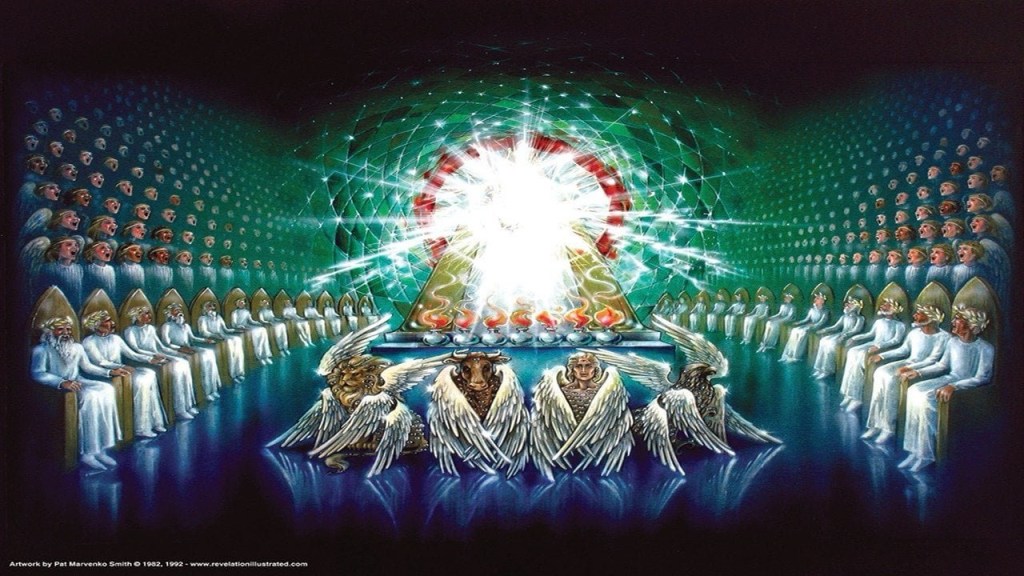
Revelation chapters 4 and 5 offer us the best report of what Heaven is like in all of Scripture. In Chapter #4, the 90-92 years old Apostle John finds himself “taken up” into the Heavenly throne room. He has a vision of Jesus and receives the Lord’s words for the 7 churches in Asia Minor, but is then directed by Jesus to come up into heaven.

He sees things there that are almost too difficult to for him to put into words. He sees God the Father, seated on His throne, at the very center of a huge gathering. God dwells in dazzling light so overwhelming that John cannot clearly see His face. He tries to describe that light by using the image of light reflected by sunlight on jewels.  Scholars believe the jewel tones he saw were red, white, bright green, and perhaps purple.  Additionally he observes that God is surrounded on His throne by an emerald-hued rainbow. The rainbow is likely reminiscent of the days of Noah.  It seems to indicate the eternality of God’s promises—that is, that God does not break His promises to us, even if we disappoint Him.

Around God’s throne are 24 smaller thrones.  There is considerable conjecture about who the 24 elders are who are seated on the lessor thrones.  Most experts today think they represent “the true Church” or the “Redeemed:” including the 12 patriarchs or leaders of the Old Testament tribes of Israel; and the 12 Apostles from the New Testament.  They are dressed in white, the color of purity and righteousness, and what seems to be the uniform of heaven. They all wear a gold crown on their head, indicating they are a royal priesthood.  

John hears thunder and sees lightening shoot out from God’s throne. In Old Testament times, these signaled God’s presence and often His judgment. John perceives that the One seated on the throne is about to release His judgment on the inhabitants of the earth. Additionally, He notes (1) 7 torches around the throne, symbolic of the full presence of the Holy Spirit.

(2) Then he describes a “glass sea” under the throne, separating God the Father from everyone else there. God is totally holy. He is also, as I often say, large and in charge, so this bit of separation makes sense. 

(3) John is also amazed by God’s Honor Guard–the 4 living creatures (seraphim). They have eyes all over themselves, which looks and sounds very strange but indicates that they are omniscient or all- seeing. They fly about on 6 wings. Their bodies are those of strange, composite beings that may symbolize the apex of created life forms:

(a.) The mightiest wild animal, a lion (known to be ferocious);

(b.) The mightiest domestic animal, an ox (known for its strength);

(c.) The mightiest of all animals, humankind (known for our intelligence)

(d.) And the mightiest bird, the eagle (known for its swiftness).

Obviously these composite beings are capable of protecting God’s space and His person. Who could successfully take them on?

In Chapter #5, we find God the Father holding a scroll in His right hand, the hand of power.  John notes that it has writing on both sides. Typically in those days, people wrote on the front side of papyrus only, as the fibers on front were oriented horizontally while those on the back ran vertically. To have written on both sides indicates that the scroll is filled to overflowing with the decisions and the direction of God.  A number of Biblical scholars believe it contains both the salvation of humankind and the judgment of the wicked. A noted expert on the interpretation of Revelation, Robert Mounce, writes, “The whole story of human history rests in the hand of God.  What simpler or more sublime way of picturing God’s ultimate sovereignty over all history could be found than this picture of the scroll resting in the hand of God?  However strong evil becomes, however fierce be the satanic evils that assail God’s people on earth, history still rests in God’s hand.”

(Robert H. Mounce, The Book of Revelaton (Revised Ed.), Eerdmans, 1998, pp.82-83.)

Additionally, this scroll is sealed with 7 seals against tampering (again 7, in the Hebrew numbering system, is the number indicating completion). So, we can assume that what’s written therein is perfectly safe against tampering and that what’s written therein is very important!

John hears an angel ask (v.2) Who is worthy to break the seals on this scroll and open it?  Perhaps eager to learn God’s plans, John bursts into tears because (v.4)…no one was found worthy to open the scroll and read it. Then one of the 24 elders directs John to stop weeping. because Someone worthy has been found:  the Lion of the Tribe of Judah, the heir to David’s throne, Jesus.

But the Jesus who comes forth is not a warrior king in all His resurrection splendor, nor a majestic lion. Rather, He is portrayed as a little lamb who had been sacrificed—alive now (resurrected) but probably evidencing a slit throat. Obviously it takes Someone totally conformed to God’s will—like Jesus—to break the seals. God Himself doesn’t do it, but He has the Mediator, Jesus, bring human history to its foreordained consummation (Mounce, Ibid, p.143).

At this point, we should pause and say, “Worthy is the Lamb!” The use of the Lamb image is both striking and unusual. When people groups want symbols of power for their country, they tend to choose apex predators: Russia has the bear; Britain, a lion; France, a tiger; and the USA, the bald eagle. But God chooses a slain lamb, a typical temple sacrifice for sin. Christ is victorious precisely because He has surrendered Himself to be sacrificed, like a Passover Lamb.  He has triumphed over sin, death, and evil by His death on the Cross.

This particular lamb, Jesus, is powerful because He is depicted with seven horns, an Old Testament symbol for complete and perfect power.

Similarly, He has 7 eyes, representing His all-seeing omniscience.

So the Lamb slain from the foundation of the world steps forward to open the scroll, and all of heaven bursts into song. The 24 elders fall down before Him, surrendering to worship, singing Jesus a new song. They play harps to accompany worship music (I don’t think we will be the ones playing harps, despite what the culture contends).  The elders also offer up golden bowls of incense, which John is told are the prayer of the saints.  Then a myriad of angels join in a powerful chorus.  Finally, John writes (v.13) Blessing and honor and glory and power belong to the one sitting on the throne and to the Lamb forever and ever. (Talk about a Halleluia Chorus!)

So what can we take away from our glimpse into God’s throne room in Heaven?  I believe the following insights are worth remembering:  

1.) True power in this world does not rest with human dictators or human governments, but rather with our God.

2.)  God controls the course of human history.

3.) Even the most exalted beings in heaven humbly acknowledge God’s superiority in every way—so should we.

4.)  As God, Jesus knows how human history will end…our history is truly His-Story.

5.) How true then is Paul’s assertion from Romans 8:31 If God is for us, who can be against us?

6.) When we each get to heaven we will join millions of believers and angels in worship of our God and our Lord Jesus.

Thanks be to God Who gives us the victory through our Lord Jesus Christ!  Alleluia!  Alleluia!

©️2025 Rev. Dr. Sherry Adams 

Live Like a Tree beside Water

Pastor Sherry’s message for February 16, 2025

Scriptures: Jer 17:5-10; Ps 1; 1 Cor 15:12-20; Lk 6:17-26

For several weeks, I have been preaching about what God wants from us, behavior-wise:  He wants us to love others abundantly and to remain humble.  Today I want to focus on trusting in Him.

Consider this true story:

“There is no situation I can get into that God cannot get me out. Some years ago when I was learning to fly, my instructor told me to put the plane into a steep and extended dive. I was totally unprepared for what was about to happen. After a brief time the engine stalled, and the plane began to plunge out-of-control. It soon became evident that the instructor was not going to help me at all. After a few seconds, which seemed like eternity, my mind began to function again. I quickly corrected the situation.

“Immediately I turned to the instructor and began to vent my fearful frustrations on him. He very calmly said to me, “There is no position you can get this airplane into that I cannot get you out of. If you want to learn to fly, go up there and do it again.” At that moment God seemed to be saying to me, “Remember this. As you serve Me, there is no situation you can get yourself into that I cannot get you out of. If you trust me, you will be all right.”  That lesson has been proven true in my ministry many times over the years.” 

(Pastor James Brown, Evangeline Baptist Church, Wildsville, LA, in Discoveries, Fall, 1991, Vol. 2, No. 4.)

Many of us have learned this over the years, but we need to be reminded of the fact occasionally, don’t we?  We say we trust God with our finances until we discover we owe IRS a bundle with no foreseeable way to pay it.  We say we trust God with our health, until we get the cancer or heart disease diagnosis.  We say we trust God with our relationships until a spouse cheats on us or dies. We seem to trust God as long as He is arranging our lives the way we want them.  It’s when life throws us a curved ball that our faith is stretched and strained. But the wise person trusts in God no matter what comes!

Our Scripture passages today all encourage us to keep trusting in God, no matter the scares we face in life:

A.  The portion of Jeremiah we read today is from chapter 17,verses 5-10. Remember that Jeremiah is the “weeping prophet”, called to pronounce God’s judgment on His disobedient people.  God had warned him ahead of time that no one would listen to him and that no one would heed his words. He was called to a mission of failure–by worldly standards–yet he persevered.

Perhaps he did so because he knew these verses.  God sets out curses and blessings in verses 5-8:  Curses if you put your trust in what human beings say is right; but blessings if you trust in what God says is right.

Jeremiah says those who trust in the Lord are like (v.8, NLT)…trees planted along a riverbank, with roots that reach deep into the water.  Such trees are not bothered by the heat or worried by long months of drought.  Their leaves stay green, and they never stop producing fruit.  What an amazing promise!  Like Jeremiah, we might not experience our blessings this side of heaven, but we can trust in God’s word that if we have been faithful, these blessings are coming.  We want to trust in God, not in news casters, weathermen, climate consultants, economic prognosticators, political analysts, pollsters, etc.  They are only human and can get things wrong.  But God (vv.9-10): search[es] all hearts and examine[s] secret motives.  He knows that the human heart (the Hebrews thought the heart was where we made our decisions, rather than our brains) can be the most deceitful of all things.  We humans can justify to ourselves whatever dishonest or immoral thing we decide to do.  The Lord sees when humans are tripped up by their own dishonorable motives or flawed thinking.  Rev. Dr. J. Vernon McGee puts it this way: “Unfortunately we all have heart trouble …”(Through the Bible Commentary on Jeremiah, Thomas Nelson, 1991, p.81).  In other words, only God sees and knows the Truth all the time.  We need look no further for an example of this than the corruption, fraud, and waste of taxes, recently uncovered by DOGE, and perpetrated by unelected bureaucrats.  These unknown persons dishonorably diverted our tax payer dollars into favorite causes of their own—some even contrary to US interests! Cheating the government is not new. The Israelites at the time of Jeremiah were doing the same or similar things

This passage reminds me of Proverbs 3:5 (NLT): Trust in the Lord with all your heart; do not depend on your own understanding.

B. Given the remarkable coherency of Scripture, Psalm 1 says essentially the same thing:  Joy comes to those who (v.1): do not follow the advice of the wicked or stand around with sinners, or join in with mockers.  These are all folks who proudly assert they are correct.

They don’t trust in God or God’s judgment.  Righteous people, on the other hand—those who love the Lord and try to follow His ways–(v.2):  are like trees planted along a river bank bearing fruit each season. Their leaves never wither and they prosper in all they do.

Again, we are reminded in Proverbs 1:7: Fear [awe, reverence] of the Lord is the foundation of true knowledge; but fools despise wisdom and discipline.  And in Proverbs 3:6: Seek His [God’s] will in all you do, and He will show you which path to take.  Human wisdom is limited but God’s wisdom is eternal and infinite.  We would all do well to consult with the Lord prior to making an important decision.

C. St. Paul is still arguing for the truth of the resurrection in 1 Corinthians 15:12-20.  He is asserting that because over 512 eye witnesses saw and interacted with the Risen Jesus, we can trust that Jesus was raised from the dead.  Reports of this event are trustworthy and true.

Jesus’ resurrection did happen.  If that were not so—and Paul utilizes the word if six times—then none of what we believe as Christians would be worth much.  Since it is true and has been verified, however, it is a truth worth dying for! Over the centuries since Jesus ascended to Heaven, hundreds upon thousands, even millions of Christians have died for this truth.  In 2025, we can stake our lives on its truth as well.

D. Finally, we have Jesus’ words of truth in His Sermon on the Plain, Luke 6:17-26 (Luke’s version of Matthew’s “The Sermon on the Mount”).  Because there were no electronic nor any social media at the time, Jesus had to repeat His primary teachings over and over again to different audiences.  He wanted to be sure folks heard His Words/His Truths.  Though many probably came to be healed or to witness healings, many also wanted to learn from this increasingly famous, itinerant rabbi.  And since there were Gentiles from Tyre and Sidon in this crowd, Jesus focused on sharing His expectations of all of His followers for ethical or righteous living.

He pronounces blessings on those who currently suffer.  He has special compassion on the poor, the hungry, and those who grieve.  They will—at some future time and because they believe in Him—experience total provision, satisfaction, and joy.  And if they experience persecution for Jesus’ sake, they can be (1) greatly reassured, for the prophets were treated the same way; and (2) they can rejoice because they are promised a wonderful reward in heaven.  His message is one of hope: Hold on, because the righteous will be blessed.

But He also pronounces curses or “woes” on those who neither care for God nor for other people.  If they were not generous to others with their wealth, their riches while they were alive will have been their total reward—not to be carried over into the afterlife.  If they are solely focused on the good life now, they will not enjoy their life on the other side.  If they are carried away with mirth, pleasure, and entertainment now, they only will grieve later.  If they enjoy accolades now and do not realize they are accountable to God, they will find themselves on the outside of heaven later on. 

Jesus’ message is clear:  Live your life in such a way now that you clearly demonstrate that you love God as well as your fellow human beings.

So how can we live like a tree planted by water?  Remember our three hurricanes of the past year?  We lost many trees in Suwannee County, Florida, blown over by hurricane-force winds and even some tornadoes spawned by the storms.  Many Water Oaks, whose root systems are shallow, running just undergrown and spreading wide, were felled.  Live Oaks, however, which have roots that grow deep into the ground, remained upright.  Trees planted by water tend to send their roots deep.  Our trust in God is like that—it keeps us anchored, no matter what storms blow around us.

The Bible says over and over again that Fools reject God, but those of us who love Him, trust in Him and His Word.  Consider the following  poem:

Trust Him when dark doubts assail thee,

Trust Him when thy strength is small,

Trust Him when to simply trust Him

Seems the hardest thing of all.

Trust Him, He is ever faithful,

Trust Him, for his will is best,

Trust Him, for the heart of Jesus

Is the only place of rest.

We believe in God.  We remember there is more evidence for the truth of Christ’s Resurrection than there is for the existence of Julius Caesar. 

(Josh McDowell, More than a Carpenter, Tyndale House, 1977, pp.96-97)

Jesus expects us to demonstrate our love for God and our love for others in the way we live.  Let us live a life that shows us firmly planted and well watered.  Let us live a life that reflects well on God and on other Christians. Amen!

©️2025 Rev. Dr. Sherry Adams 

Despite Rejection

Pastor Sherry’s message for January 26, 2025

Scriptures: Jer 1:4-10; Ps 71:1-6; 1 Cor 12:12-31a; Lk 4:14-30

Did you know that Abraham Lincoln…

“…was defeated seven times for elective office before winning the Presidency of the United States. He certainly defied the odds. And he did not give up.

“Then there was Vincent van Gogh. Van Gogh earned all of $85 from his paintings during his lifetime. One hundred years after his death, just one painting alone, Dr. Bachet, sold for the incredible sum of $82.5 million.

“Then there was this itinerant, middle eastern preacher who lived some 2,000 years ago — his ideas were definitely rejected by the people of his hometown, as well as the religious leaders of his time and country. Yet he continued his ministry as he understood it to be — Divine Defiance?

“The point is clear. If Abraham Lincoln, Vincent van Gogh, or Jesus of Nazareth had let rejection rule their lives, and let it keep them from doing and saying what they felt sure to be right — our world would be incredibly impoverished today.”

(Dianne O’Connell, “Divine Defiance,” www.esermons.com, 1/20/2025)

Consider how often these three must have felt discouraged, frustrated, or ready to give up?: Yet, what great examples to us of the importance of persevering in the face of repeated rejection.

Two of our Scripture passages today illustrate this theme of persevering despite rejection:

A.: Our Old Testament lesson is from Jeremiah 1:4-10, and recounts the divine call to Jeremiah to become the Lord’s prophet.

Jeremiah was probably between 17-20 years old when this takes place.  He was already serving God as a priest in his home town of Anathoth, located just North of Jerusalem. King Josiah was about 22 then, in 626BC, and reigned until he died at age 39.: He and Jeremiah were contemporaries, and likely became friends. Jeremiah served all during the remainder of Josiah’s reign, and continuing also during the reigns of kings Jehoahaz and Jehoiakim (sons of Josiah), Jehoiachin (Josiah’s grandson), and Zedekiah (a third son of Josiah).

Josiah, a good and godly king, had led his people in a revival to turn their hearts back to God; but his sons and grandsons were another story.

Because of their idolatry and wicked behavior, God allowed the last to be defeated and carried off into slavery by King Nebuchadnezzar of Babylon.

Notice how God calls Jeremiah into His service: verse 5: Before I formed you in the womb, I knew you, before you were born I set you apart.: This is amazing and also a bit intimidating, isn’t it?: It implies that God knows us before we are even conceived, and that He has a plan for our lives—He has given us life for a purpose.: The Lord tells Jeremiah He had determined–even before the young man’s birth–that he would become a prophet and deliver to His people whatever God told him to say.: Jeremiah is a humble young man who replies to God, (v.6): I am only a child, meaning, Yes, I will do it, but I am young and lack much life experience.

In other words, I wouldn’t know what to say!: God’s response must have been very reassuring (v.7): Do not say,’ I am only a child.’: You must go to everyone I send you to and say whatever I command you. Do not be afraid of them, for I am with you and will rescue you.: The Lord assures him He will tell Jeremiah what to say; and He promises to take care of him, even though He was calling him to prophesy divine judgment on Judah and her heretical kings.

If we skip ahead 40 years to the end of Jeremiah’s life and career, we would find that he apparently never made a single convert; after King Josiah, the people ignored or ridiculed his preaching entirely.: He was rejected by his people because of his message, hated, beaten, put in stocks, imprisoned, and charged with being a traitor. He was later called “the prophet of the broken heart” because God’s judgments on his people—and their rejection of God–were so distressing to him.: Actually his emotional response to his rejection mirrored God’s own saddness.: Once, King Jehoiakim cut his hand-written, prophetic scrolls up.: He destroyed them by throwing them into the fire (but God just retold the contents to Jeremiah so he could write them again).

I don’t know about you, but though I would have been proud to speak the Lord’s words to His people, I would also have been exceedingly distressed to have had been so unsuccessful in changing peoples’ behavior.: Jeremiah may have been just as distressed, but he persisted!: He may have been disappointed, but he kept on giving out God’s messages.: He may have been discouraged, but he never gave up!: I think that he stands as an excellent example to us:: He trusted in God’s promise to him and he persevered despite what he probably considered his limited impact.

And, as Paul writes in 2 Timothy 4:7: I have fought the good fight. I have finished the race. I have kept the faith.: Now there is in store for me the crown of righteousness which the Lord, the righteous judge, will award to me on that day—and not only to me, but also to all who have longed for his appearing.: Those lousy kings after Josiah are no longer remembered by anyone, but Jeremiah’s two books of the Bible (Jeremiah and Lamentations) remain available today, 2700 years later!

With what in your life are you struggling today?: With a relative, a co-worker, or an unfair boss?: With an illness or a chronic condition?: With a lack of money or a lack of peace? Jeremiah’s obedience to God, and his perseverance in the face of repeated rejection, inspire and encourage us 

(1) to put one foot after the other, continuing to try to do good where we can; and (2) not to give Satan the victory by caving in to dejection and perceived defeat. 

B.: The same is true of Jesus (as per our Gospel lesson, Luke 4:14-30).: Jesus reads His job description from Isaiah 61:1, and tells His friends and neighbors in Nazareth that they are witnessing the fulfillment of Isaiah’s prophesy in Him.: At first, they were impressed with His knowledge and wisdom–until someone spoke up who reminded everyone that Jesus was the carpenter’s son.: This person had placed Jesus in a box and would not consider that He might in fact have become “more than a carpenter.”

His former neighbors were eager to see Him work some miracles, but they were unwilling to alter their perceptions of Him.: John Mark tells us in Mark 6:5: He could not do any miracles there, except lay His hands on a few sick people and heal them…due to their lack of faith.

Jesus really gets them riled up when He reminds them (v.24): I tell you the truth…no prophet is accepted in his hometown.: Then He further incenses them when He gives them two examples of “outsiders,” Gentiles whom God had provided for, rather than bless Israelites.: There were many widows in need in Israel during the famine and drought of Elijah’s day, but God sent the prophet to minister to a Phoenician woman.: He provided her with a continuous supply of food, and even resurrected her son when he died.: There were lots of Israelite lepers, but God chose to heal the Syrian general, Naaman.: In other words, Jesus is warning them that God will not bless them if they do not believe in His Son.

By this point, they are so enraged that they attempt to kill Him by tossing Him off a cliff.: The fact that He could just disappear from an angry mob should have stretched the box in which they had confined Him.: Surely Jesus was disappointed with their rejection of Him.: He was obviously willing to heal many, but their contempt and anger, their lack of faith, limited what His heavenly Father would allow Him to do there.: Just as with Jeremiah, His own did not believe Him.: So, He moves His base of operations to Capernaum.

I think what is most instructive for us is that is the example Jesus gives us in the face of rejection:: (1) Respond honestly, if given the opportunity.: He was admitting to them that He was the Messiah by saying He fulfills the Isaiah 61:1 passage.: He did not deny the truth even thught hearing it incited them to violence against them.: Don’t deny the truth as you know it, but also (2) don’t reply with anger, name-calling, or physical intimidation.: Years ago, I worked for a woman pediatrician in Tallahassee who gathered several social workers into her practice.: She worked with kids whose conditions did not resolve through the usual medical interventions, so instead, she involved the kids in counseling. I was there to supervise several interns she had working toward licensure, and I counseled some of the parents.: The longer I was there, the more it became evident to me that one of the women I was supervising (though she was married to a man) was having a lesbian affair with the doc.: The woman was good with the kids she counseled, but she viewed their parents as the enemy.: I repeatedly told her she needed to align sufficiently with the parents to change the social and psychological environment they created for their children. She resisted this vehemently.: I told her I could not then recommend her for licensure.: Our boss—and her lover—then demanded I do so despite my reservations.: I had to resign and leave that practice. As my Christian therapist friends helped me move my office, I walked out the door and “shook the dust off my sandals.” (3) Like Jesus, I remained calm, and moved on. The Lord provided me another location to do what He had gifted me to do…and He will do the same for you.

We cannot allow rejection to rule our lives.: We will not win over everyone we encounter.: Let’s remember how Lincoln, Van Gogh, Jeremiah–and even President Trump, whether you like him or not—as well as Jesus, all persevered despite being repeatedly rejected.

In Galatians 6:9, St. Paul encourages us (NLT): So: let’s not get tired of doing what is good.: At just the right time we will reap a harvest of blessing if we don’t give up.:  We are not meant to just, “Be calm and carry on,” but to continue to do our best to please God and to trust in Him.

Thanks be to God Who gives us the victory through our Lord, Jesus Christ.: Alleluia!: Alleluia!

©️2025 Rev. Dr. Sherry Adams  

Look Up!

Pastor Sherry’s message for December 1, 2024

Scriptures: Jer 33:14-16; Ps 25:1-10; 1 Thess 3:9-13; Lk 21:25-36

Remember when you were a little kid, waiting on Christmas morning?  You knew Santa Claus would have come and that there were other surprises for you under that tree.  The time had finally arrived for you to unwrap those gifts you had spotted—with your name on the tags–that you had snuck around to shake, trying to figure out what was inside the box or bag.  That waiting was excruciating, wasn’t it?  Five more wake ups til Christmas…two more wake ups, etc.

Besides having to wait on Christmas, we wait on the arrival of a baby (especially when 8-9 months pregnant).  I think the last month of pregnancy is deliberately so uncomfortable that we are willing to go through the pains of labor just to be at ease in our bodies again.  How about the wait we undergo during the surgery of someone we love?  This time of year, we wait in lines in Publix, the Post Office, and the car wash.  Several days ago, I was waiting at the Customer Service counter at the grocery store. I only wanted a book of stamps, but I found myself in line behind a guy buying what looked like dozens of bouquets of flowers.  The cashier laboriously searched out the bar codes on each bunch.  Then the guy used a card to pay for his haul of flowers that did not work.  He had to search for another card that would.  As he fumbled in his wallet, I was becoming so impatient!  All I wanted were stamps, for heaven’s sake!  How ashamed was I to then be presented by the guy with one of his bouquets.  I was stunned!  Maybe it was his way of apologizing for keeping me waiting, but the store personnel told me he comes in weekly and buys up bunches of bouquets to give away.  How amazingly generous of him!  His gift reminded me that I needed to be more patient.

I also heard this week of a guy in NYC who was a professional line-waiter.  People paid him to wait in line to purchase tickets for them to a game, a concert, or a show.  He said his toughest wait was for tickets to “Hamilton” because his tent froze on the inside!  YIKES! He has also been paid to wait for a new IPhone model or for some other new tech gizmo to be released, or to purchase the latest limited edition hoodie, etc.  It is said that he made $86,000 a year!  Kind of an amazing service, isn’t it?

(as shared by www.sermoncentral.com, 11/29/2024)

With the possible exception of the professional line waiter, most of us hate to wait.  Today is the 1st Sunday of Advent, a time of waiting on Jesus.   We prepare for His 1st Coming, at Christmas, as a helpless infant, from a small, Hebrew, backwater town.  His mission then was to save a sin-sick and lost world.  We also await His Second Coming when He will return as a triumphant, all powerful king, with the mission to judge the world and create a heavenly, peaceful order on earth.  Our Scriptures today speak to both Advents or Comings:

A. In Jeremiah 33:14-16, the prophet reminds us that the promised Messianic King (Jesus) will be coming.  He will come from a righteous branch of King David’s family tree (a promise God had made to David that we spoke of last week).  This Messiah would save His people (Jesus’ name actually means God saves).

Jumping ahead to the end times, He will be called, “The Lord Our Righteousness.”   At His second coming, Jerusalem will Live in safety. 

It doesn’t now, by any stretch of the imagination, but it will then, praise God!

B. Our Psalm 25:1-10 is a plea from King David for God’s protection and love.  It suggests that God has a purpose as He makes us wait:  Waiting provides time/opportunity to learn (a) His ways more clearly: (v.4): Show me Your ways, O Lord, teach me Your paths; (b) to trust in Him more deeply; (c) to ask for His mercy, love, and forgiveness; and (d) to cling to hope due to His great faithfulness.  We can do these things by reading Scripture; praying/talking with God as we wait; remembering when God has shown up in our lives before; and by learning how others have experienced God’s intervention in their life. 

C. Our 1 Thessalonians 3:9-13 passage teaches us two other benefits of waiting: (1) God uses the time to strengthen a heart of holiness in each of us.  Waiting has been called “the crucible of the saints.”

One of my seminary professors used to say that as we wait, God is molding and shaping our character.  (2) He is also teaching us to abound in love–to love Him and to love others better. 

D.  In our Gospel lesson, Luke 21:25-36, Jesus gives us a few more clues as to what we can expect before His 2nd Coming:  Just as buds on trees broadcast the coming of Spring, we will know the end is near when…according to Peterson’s paraphrase of Scripture, The Message (p.1904): It will seem like all hell has broken loose—sun, moon, stars, earth, sea, in an uproar and everyone all over the world in a panic, the wind knocked out of them by the threat of doom, the powers that be quaking.  Heavenly bodies: stars, planets, our moon, will be shaken, doing never-before-seen things.  Worldwide, people will fear the roaring and tossing of the sea.  Does this mean an increase in the frequency and severity of hurricanes, typhoons, sunamis?  Perhaps.  What about a frightening incursion of water into previously dry land (like mountainous Western North Carolina during Hurricane Helena)?  Could be.  Whatever the case, everyone–especially non-believers–will be freaked.

Then, the Son of Man (Jesus’ favorite name for Himself) will come on a cloud.  He will arrive with power and with great glory.  Believers can and should rejoice.  We have every reason to Hope in Christ and in His return!

Today we lit the candle of hope on our Advent wreath.  “But,” you might say, “we hate to wait!”  Yes, but isn’t it also true that “good things come to those who wait” (consider my surprise bouquet of flowers)?  We believers in Christ Jesus celebrate His 1st Coming and dare to hope in His 2nd.  Remember, Hebrews 11:1 (New Living Translation, p.1572) tells us: Faith shows the reality of what we hope for; it is the evidence of things we cannot see.

One of my favorite stories about hope concerns Fiorello La Guardia, the Italian mayor of New York City from 1934-1946 (during the Great Depression and much of WWII).  It is said that he was…

“…quite a character. He would ride the city fire trucks, take entire orphanages to baseball games and whenever the city newspapers went on strike, he would get on the radio and read the Sunday “funnies” to the children.

“At any rate, one bitter cold winter’s night in 1935, Mayor LaGuardia turned up in a night court that served the poorest ward in the city, dismissed the judge for the evening and took over the bench himself [He was an attorney, but I doubt a mayor could substitute for a judge today]. After he heard a few cases, a tattered old woman was brought before him, accused of stealing a loaf of bread.

“She told LaGuardia that her daughter’s husband had deserted her, her daughter was sick and her grandchildren were starving. But the shopkeeper, from whom the bread was stolen, insisted on pressing charges. “My store is in a very bad neighborhood, your honor,” he said. “She’s got to be punished in order to teach other people a lesson.”

“The mayor sighed. He turned to the old woman and said, “I’ve got to punish you,” he said. “The law makes no exception – ten dollars or ten days in jail” [Remember, $10.00 meant a lot more in 1935 than it does now.]

“But even as he spoke, LaGuardia was reaching into his pocket and pulling out a ten dollar bill.  “Here is the woman’s fine,” he said, “and furthermore, I’m going to fine everyone in this court room fifty cents for living in a city where a person has to steal bread so that her grandchildren can eat [There were no welfare services in 1935]. Mr. Baliff, collect the fines and give them to the defendant.”

“The following day, the New York Times reported that $47.50 was turned over to the bewildered old woman. It was given by the red-faced store owner, some seventy petty criminals, people with traffic violations and city policemen – and they all [75 people] gave their mayor a standing ovation as they handed over their money.”

(Erskine White, Together in Christ, CSS Publishing Company, as shared by www.Sermon Central.com, 11/28/2024)  

Mayor LaGuardia set such a great example of how things will operate when Jesus comes back to earth.  You might logically expect the worst in a given situation; but Jesus, the King of Kings and Lord of Lords, will set things exactly right.  Tattered old grandmothers with poor, starving grandchildren will find mercy and provision.  The meek and the hungry will experience goodness and mercy.  Similarly, those who–like the baker—have been robbed, will be justly compensated for their labors.  Everyone wins!

Our Advent hope is that Jesus will come again, in His unlimited power and awe-inspiring glory, to restore us all to a true state of shalom: total well-being, physical, emotional, cognitive, and spiritual.  We can hope for this with confidence!

I don’t know how many of you have watched the 4 seasons thus far of “The Chosen.”  I think it is a beautifully dramatization of Jesus’ time with His disciples.  In an episode in which Jesus heals the woman who had been internally bleeding for 12 years, the series creators portray her huddled on her knees, head down in the roadway.  The crowd is clustered around her and Jesus wants to know who touched His garment.  A person who bled in those days was considered “unclean.”  Since her malady was chronic, she could not attend synagogue and had probably been shunned by her family and her community.  For 12 years she had been alone and alienated from all society.  Jesus tells her first to “Look up.”  He then goes on to reinstate her into Jewish community by calling her, “Daughter,” a relational term.  I was so stunned by His direction to her to “Lookup” that I bought a Chosen coffee cup that says exactly that: Look up!  Isn’t that precisely what we need to do when worried, troubled, or even joy-filled?  Because of Jesus Christ, we can all be brave and bold enough to Look up!  Amen!  May it be so this Advent and always!

©️2024 Rev. Dr. Sherry Adams

Gather up for Snacks!

Pastor Sherry’s message for July 7, 2024

Scriptures: 2 Sam 5:1-10; Ps 48; 2 Cor 12:2-10; Mk 6:1-13

Do you remember, when your kids/grandkids were little, going to their T-ball or Coach-pitched baseball games?  I apologize now, but I thought they were both adorable and hilarious!  I often laughed my head off!  The kids were about 6-7YO and, as one wag has said, “had lots of enthusiasm, but the attention span of a gnat.”  While the coaches and assistants of the kids in the outfield kept yelling for them to pay attention and keep their “heads up,” or their “eyes on the ball,” the children playing the outfield would be searching the grass for bugs, looking up in the sky, adjusting their hats, or focusing on their friend at 2nd base.  Then, when the occasional opponent player actually hit the ball, no one was prepared to catch it. It would usually plop down in someone’s vicinity and the rest of the team would then abandon their positions to converge on the ball as if it were a rugby scrum.  So, when the game ended, you could always hear some child asking, “Did we win?  Did we win?  (They hadn’t tuned in enough to know.)  If the coach answered that they did, the kids would jump up and down and cheer in delight.  If he said they’d lost, they would kick the ground or throw down their hats in the agony of defeat.  But then they would quickly perk up again when coach called out, “Gather up for snacks!”

Winning and losing tends to be much more complicated for grown-ups, doesn’t it?  Isn’t it true that many of us lose, fail, or are disappointed more often in life than we win?  For the sake of our mental health, we need to figure out how to bounce back from setbacks, defeats, insulting words, and poor performances.  We need to develop some of what psychology calls “emotional resilience.”  And even the best of snacks is not likely to cheer us up or help us feel better.

(Concept borrowed from Fairless and Chilton, The Lectionary Lab Commentary, Year B, 2014, p.235)

Our Scripture passages today all deal with folks who are struggling with failure or disappointments of one form or another:  vocational failures, health struggles, faith challenges, and even life defeats.  They provide us with some good examples of how a mature believer might bounce back from such troubles.

A.  In our Old Testament lesson (2 Samuel 5:1-10), King David is finally crowned king of Israel.  Remember, he had been anointed King by the prophet Samuel when he was about 16YO.  He remained a shepherd until called by God to go up against Goliath (perhaps 17 year old).  Then, as a talented musician, he played soothing music for the troubled King Saul. He was also enlisted in Saul’s army.  He developed a deep friendship with Saul’s son, Jonathan, and married Saul’s daughter, Michal.  He served in Saul’s army until his father-in-law grew murderously jealous of his continued success as a warrior.  Saul tried to kill David both in his palace and in David’s home.  The as yet uncrowned King David then lived as an outlaw, in the wilderness, (for 10-12 years) until King Saul died.

So, here he is at age 30, finally crowned king of Judah (and Simeon). These 2 tribes recognized his authority, while the 10 remaining tribes supported Saul’s son, Ish-Bosheth.  Civil war broke out and lasted 7 years. Can’t you just hear David’s frustrated thoughts, “God said I would be king. This isn’t supposed to be happening”?

Then someone—not King David—assassinates Ish-Bosheth.  Finally, the 10 tribes who had supported Saul’s son approach David to reunite all of Israel as king. They claim their relational ties to him and recall that God Himself had anointed him for the role of king.  After seven years of civil war, they are only remembering this now? Why hadn’t they considered this seven years earlier?  Well, the truth had obviously not fit their narrative until they found themselves between the proverbial rock and a hard place.  Nevertheless, this rapprochement ends about 20 years of disappointment, frustration, and struggle for David.

In one of his first acts as king of the reunited Israel, David decides to move his capital to Jerusalem, which was said to be an impenetrable citadel. He tells his army commander to find a way up through their water supply tunnel.  He then overwhelms the Jebusites—the Canaanites who had underestimated him—and claims Jerusalem, from which he reigns for the next 33 years.

The lesson from David is never give up (predating Winston Churchill by millennia)! Despite setbacks and delays, persist!  He waited for years to actually become king of Israel. He had to have felt discouraged and wronged. Perhaps he even wondered if God had changed His mind, or if he’d sinned too much for God to honor him, or if God had forgotten him. But his patient, persistent faith, his resilience–despite delays and what appeared to be life defeats–paid off.  May it be so with each of us!

B.  Psalm 48 is what scholars refer to as a Millennial Psalm.  It celebrates Jesus’ great victory to come, when He reappears on earth and brings everyone under the sovereign rule of Messiah.  He will be victorious over the forces of evil and He will reign from Jerusalem, King David’s capital.  In His 1st coming, Jesus won for us salvation and eternal life; but the world will not know He is King of Kings and Lord of Lords until He comes again in glory.

Even Jesus must patiently wait, with faith, in God’s timing. Remember His disciples asked Him when He would come again and He replied that no one except the Father—and including the Son—knew the hour or the day.  May we learn to be as patient as Jesus and as King David.

C.  Paul, in our 2 Corinthians 12:2-10, bemoans a thorn in his flesh. In verses 2-5, he cryptically refers to a time he was lifted up into the 3rd heaven (1st heaven is where birds and airplanes fly; 2nd heaven is where the stars and planets exist; 3rd heaven is God’s dwelling place).  Then he claims that—to keep him from becoming conceited over this experience—God gave him a thorn in my flesh, a messenger from Satan to torment me. 

What was it?  We don’t know.  I hope to ask Paul when I get to heaven.  Some scholars believe it was impaired eyesight, maybe cataracts?  We know that his hand writing and signature grew larger until he stopped writing himself and dictated his epistles to a secretary.  Others think maybeit was sciatica, pain in the hip as with Jacob after he had wrestled all night with the pre-incarnate Jesus.  Others think it might have been the Jewish folks who rejected Jesus who then followed Paul about, heckling him and agitating against him.

Whatever it was, He asks God three times to be healed of it and God tells him essentially “no”: (v.9)—My grace is sufficient for you, for My power is made perfect in weakness.  In other words, this unnamed problem reminded Paul daily that he is not ministering in his own strength, skill, or gifting; rather, it is God who empowered and made a way for him.  In other words, our setbacks may be a way to wean us from our own pride and self-reliance and to teach us to depend more upon our Lord.

As with King David, the message from Paul is persist in faith, no matter our health or other obstacles.  May it be so with each of us!

D. Last, but not least, we have Jesus’ example in Mark 6:1-13.

Some scholars believe this trip to Nazareth was His second.  In Luke 4:14-30, His first visit as Messiah, they got so mad they tried to throw Him from a cliff.  But these are His friends and relations, so He returns in today’s passage, to try again to win them over.  This time they both marvel at His wisdom and understanding, but also doubt Him because they think they know Him.  He’s the hometown boy who worked as a carpenter.  His brothers and sisters are still among them, and they don’t appear to accept Him as Messiah. They can’t believe He could be anything other than what they had always supposed of Him.

Jesus is saddened by their lack of belief.  He admits (v.4)—Only in his hometown, among his relatives and in his own house, is a prophet without honor.  And they lose out because His ability to heal folks is limited by their lack of faith.

But notice what He does next.  He doesn’t collapse into depression, wallowing in what appears to be a vocational failure.  He continues on to other towns and villages to teach and heal.  And He sends His disciples out, 2 by 2, to do the same.

Jesus is disappointed by the hometown rejection, but not defeated. He couldn’t do miracles in Nazareth because of their lack of faith in Him; He was stunned by this. If Jesus, who is God, the logos who spoke creation into existence, can or even needs to learn anything, He no doubt realized that you can control what you say, but not how people interpret it. You can control your own behavior, but not how other people respond to you. You can even control how you demonstrate your love to others, but not that they will receive it. Can we make another person love us?  No. Sadly, He recognized that lack of faith limits what He is able to accomplish in them and in us.

But His disciples didn’t seem to be discouraged by what happened there. They had seen Him, through the first 5 chapters of Mark’s Gospel, do miracle after miracle. So when He sent them off to do what they had seen Him do, they went with faith the Nazarenes lacked. As Paul would later write, they knew their weaknesses were made perfect in Jesus’ strength and power; and that His grace—His provision, His protection, His faith in them—was truly sufficient for them.  May it be so for us!

Well, there we have it!  Our journey with Jesus is not about winning or losing, is it? It’s about persisting in faith, even despite setbacks, waiting, and obstacles. It’s about keeping our “heads up” and our “eyes in God’s game.”  Who knows, we may even enter heaven like those little baseball kids, wondering if we won. Did we accomplish what God set out for us to do? Did we love Him and love our neighbors?  Did we obediently do what He set before us?  My hunch is that our Lord will then say, Glad to see you!  Gather up for snacks! 

©️2024 Rev. Dr. Sherry Adams 

The Christmas Let Down

Pastor Sherry’s message for December 31, 2023

Scriptures: Isa 61:10-62:3; Ps 148; Gal 4:4-7; Lk 2:22-40

Hopefully you have not experienced it this year but there is a psychological phenomenon called “Christmas Letdown.”

Let me share a story to illustrate: “A number of years ago, when Lou Holtz was at the University of Arkansas, he was taking his team to play a bowl game in Tempe, Arizona. The game was to be played on Christmas day. He was asked how he felt about playing a game on Christmas, rather than being with his family. The coach answered candidly: ‘I would rather be in Tempe. After all, once you have been to church, had Christmas dinner, and opened the presents, Christmas is the most boring day of the year.’”

(Illustration borrowed from www.sermoncentral.com, 12/26/2023.)

YIKES, Lou! Tell us how you really feel! Part of “Christmas Let Down” is the sense of “what now?” As the coach said, what’s left to expect when the gifts under the tree and in the stockings have been discovered and unwrapped? What’s there to look forward to when the festive meal with family and friends has been eaten?

I was working on continuing education to renew my psychology license while I was sick at home these past two weeks. The author of one course I took on addictions said that recovering addicts must not let themselves think of how much they enjoyed their “high.” She called this selective memory “euphoric memory,” and said it could lead a person right back into their addiction. Instead, the recovering addict should discipline their mind to think of all the ways that being clean and sober improve their life.

(D. Poor, “Codependency: Causes, Consequences, and Cures,” Professional Development Resources, 2015, p.33.)

I think this must be the antidote to “Christmas Let Down Syndrome” as well. Rather than focusing on any disappointed expectations of our own from people or events this time of year, we should look to what our God has done already–and will accomplish for us in the future–in Jesus’ 1st and 2nd Comings. This is certainly the perspective of all of our Scripture readings appointed for today.

A. Let’s begin with Psalm 148, a clarion call to all of creation to praise God. The psalmist includes nearly all imaginable created elements and entities, and calls upon them to praise the Lord:

1. Angels and all the heavenly hosts’

2. Sun, moon and stars;

3. Heavens and rain;

4. The oceans and all creatures within them;

5. Lightning, hail, snow, clouds; and wind;

6. Mountains, hills, and all varieties of trees;

7. Wild and domestic animals, as well as birds;

8. All people from rulers to ordinary citizens, young as well as old.

The psalmist expects them all to exalt the Lord. Why? Because the Lord created them all, and because (v.14) He has raised up for His people a horn, the praise of all His saints, of Israel, the people close to His heart. A horn is a figurative term for a powerful ruler; this is a metaphor for Our Deliverer, Jesus Christ. We don’t carry on like disappointed sad-sacks after Christmas because the very date reminds us that God both created us and sent a divine deliverer to save us.

B. The prophet Isaiah (61:10-62:3) assures us that God deserves our praise because of what He has in store for us with Jesus’ 2nd Coming. After Jesus comes again as a righteous, triumphant, all powerful Judge, He will do away with all evil-doers. Oh Happy Day! Won’t that be amazing?! And He will dress those of us living then who love Him in (v.11)—garments of salvation and…a robe of righteousness. We will be as decked out beautifully, as a bride or a groom, wearing especially fine clothes, as befitting such an grand occasion. Additionally, we will be inundated by righteousness and praise…again, Oh happy day!

Chapter 62:1-3 tells us that our Lord yearns for this to happen. Both God the Father and Jesus are looking forward to this time. Jesus will rule the earth from Jerusalem. The Present poor war-torn Israel will finally be at peace, and the beauty of Jerusalem will exceed what it looked like at its height, in the days of King Solomon. In a sense, God will delight over Jerusalem as a bridegroom cherishes his bride.

C. Not only that, but as Paul tells us in Galatians 4:4-7, our status has already improved due to Jesus’ 1st Coming. Jesus Christ has paid the penalty for our sins. Additionally, by redeeming us, He has grafted us into His lineage as sons and daughters of God. He has gifted us with the Holy Spirit, whose job is to lead us into all truth. Because of both Jesus and the Holy Spirit, we are privileged to enjoy a comfortable, intimate relationship with God the Father–so much so that we might call Him Abba or Daddy.

As an aside, notice in (v.4), Paul states that Jesus was—born under law. This means that Mary was a young Jewish woman, who performed all the requirements of the Law around Jesus’ birth and her post-birth purification. I saw on the news this week that some person claimed that Jesus was/is Palestinian because Mary was a Palestinian. No. That’s just not true. This person does not know Scripture. Jesus was born to a Jewish woman and was/is Jewish—though He died to redeem the world.

D. Finally, we see from our Gospel (Luke 2:22-40), that God sent two prophets to attest to Jesus identity as Messiah days after His birth. Luke relates that Jesus is named and circumcised on the 8th day. Circumcision is an undeniable sign of loyalty to God. Additionally, at the end of 40 days, Mary and Joseph present Him at the Temple (6 miles distant from Bethlehem). Women who gave birth were considered ritually unclean for 40 days after the birthing event. Once the 40 days ended, she was required to go and present an offering that signaled her purification. The offering of 2 turtledoves instead of a calf or a lamb attests to how poor Mary and Joseph were. But note: The offering was for Mary, not for Jesus as He was without sin and did not require a sacrifice under the Law. Dr. Luke wanted us to be sure to realize that Jesus’ earthly parents were raising Him in the traditions of their Jewish faith.

While they were in the Temple grounds, they were spotted by a man named Simeon. He was an old man who had served God faithfully for years. The Holy Spirit had told him he would not die until he had seen the Messiah; then the Spirit must have alerted him that Jesus was present and was “the One.” So, he approaches the couple, takes the child and prophesies over Him, saying he is now ready to die because he has seen “Israel’s consolation.” This is another metaphor for the Messiah, who Simeon expects will comfort His people. Simeon’s Holy Spirit-inspired speech is called the Nunc Dimittis, and is almost a word for word, prayerful repetition of Luke 2:29-32—Lord, now let Your servant depart in peace, according to Your word. For my eyes have seen Your salvation, which You have prepared before the face of all peoples; to be a light to lighten the Gentiles, and to be the glory of your people Israel. (The Anglican Book of Common Prayer, 2019, p.46).

The Holy Spirit uses Simeon to announce that Jesus is to be the means of salvation for both Jews and Gentiles. He will be a cornerstone/strong support for some; and a stumbling block for others. Simeon rightly predicted that Jesus would suffer, and he accurately predicted that Mary would suffer as she watched her son suffer and die on the Cross.

Because Jewish Law required two witnesses to affirm a truth in court, the Lord provided Anna as the 2nd prophetic witness. Dr. Luke tells us she was 84 years old, having been widowed after 7 years of marriage. Anna was a major prayer warrior in the Temple. She was there so much that the priests and Levites gave her a room in which to live. She spent her days praising God and praying. She too was told by the Holy Spirit that Jesus was the Messiah. She reaffirmed this to Mary and Joseph and shared with any interested onlookers Jesus’ true identity.

According to our Scripture passages, we have no excuse to give in to “Christmas Let Down” syndrome. Instead in these days after Christmas, our hearts should be elevated by celebration and praise!

Our God has created and redeemed us. He has great, restorative plans for us that will occur when Jesus returns to earth. Meanwhile, we have been saved by Jesus’ sacrificial death on the Cross and adopted by the Father as His children and as co-heirs with Christ. Many famous Old Testament prophets foretold Jesus’ birth and 2 faithful, spirit-led New Testament persons prophets confirmed His identity even as a newborn infant. So, no matter what has happened to us this Christmas Day and following, we can and should continue to be filled with rejoicing! Emmanuel [God with us] has come to dwell among us. Come, let us adore Him.

©️2024 Rev. Dr. Sherry Adams

Waiting on Jesus

Pastor Sherry’s message for December 3, 2023

Scriptures: Isa 64:1-9; Ps 80:1-7, 17-19; 1 Cor 1:3-9; Mk 13:24-37

Waiting is difficult, isn’t it? Think of all the times you’ve had to wait…

1. Would you get the job you just interviewed for?

2. What about the results of that medical test or scan you just underwent?

3. Did that person you fell in love with also love you back—remember the agony of that wait?

4. Would your child get into the college or internship of their choice?

5. Would your house sell? Would the sellers of the house you want accept your offer?

6. How about that last month of pregnancy? Would that baby ever make an entrance?

7. What about waiting on a grant to come through or a check in the mail?

8. How about those hostages of Hamas, waiting to be set free, or their families, dying to know how they are?

9. Remember being a kid and having to wait for Christmas morning to finally arrive?

Most of us hate to wait. We wring our hands. We pace the floor. We lose sleep. We grumble and groan and complain. We engage in what addiction counselors are now calling “BEEPS” Behaviors, Experiences, Events, People, and/or Substances that help us self-medicate or suffocate our anxiety as we wait.

(Ed Khouri, Restarting, Life Model Works, 2010, p.32.)

If we’re really smart, we pray and ask God to help us wait, so that we can learn what He means for us to learn during this time; so that we may develop the spiritual fruit of patience.

Today is the first Sunday of Advent—a time of great anticipation as we wait upon the arrival of Jesus.

A. In Isaiah 64:1-7, the prophet reminds us both that God controls the entire universe and that our condition as humans is that of unclean sinners (vv.5-7). Verses 1-2 constitute a cry, a plea for God to come down to earth, to defeat Israel’s enemies (and ours), and to make things right.

Isaiah recalls times God did intervene on the behalf of Israel doing (v.3)—…awesome things that we did not expect. He also reminds them and us, (vv.4-5)—Since ancient times, no one has heard, no ear has perceived, no eye has seen any God beside You, who acts on behalf of those who wait [there it is, wait] for Him. You come to the help of those who gladly do right, who remember Your ways. In other words, we can and should call upon God for help when we are troubled or anxious, when we are worn out with waiting. Isaiah assures us God will respond!

But notice, the prophet attaches this caveat: God rescues those who do the right thing, who remember to do as God would have us do.

I have told you before that I had some difficulty and fear around selling my house when I was leaving seminary. I had listed it in September of 2001, but then 9/11 took place and no one in SW Pennsylvania was buying or selling homes. By January 21, 2002, I had completed my degree but still had no buyers for my home. Worse yet, I had no job and no money. I was sick with a cold and would awaken all through the night whenever I became too congested to breathe. I would take something then return to bed, begging God in prayer to sell my house. Finally, at about 4am, I asked the Lord if I were doing something or not doing something that served as an impediment to Him taking action. I heard Him say, in my spirit, that I had not surrendered to being a lead pastor. He was of course right. I had thought to assist someone, as my gifts are in teaching and counseling, not in administration or leadership. I immediately agreed to surrender to His will, got up at 8:00am, and sent off letters to 4 small parishes in North Florida (I wanted to go home and I wanted a church small enough so I could know everyone’s names.) I put those letters in the mail at 10:30am on January 22nd. My realtor called at 11am with a couple interested in my house. They came at 5:00pm that day and signed a contract by 8:30pm. Additionally, I needed to close on February 7th as my next mortgage payment was due on the 8th and I knew I would be unable to pay it. My Jewish realtor said there wasn’t enough time to make that happen, but I replied that she did not know my Jesus. Sure enough, we closed on my house on the 7th, thanks be to God! I learned from this that God sometimes waits for us to change before He moves on our behalf. We have to be willing to ask if our wills are blocking His will and take action to rectify that.

Finally, Isaiah reminds us in this passage that we are like clay in the great Potter’s hands. We want to conform to His will. We want to allow Him to mold and shape us into the image of our best selves. When we wait upon God to act, God is working on our character, transforming us more and more into the image and likeness of Jesus. We may hate to wait, but God uses that time to do a work in us.

B. Psalm 80:1-7, 17-19, is both a prayer for God to relieve the peoples’ suffering—especially after an attack by brutal enemies—and a plea for God to lead them again. The psalmist, Asaph, a contemporary of King David, appeals to God as our shepherd king as He is enthroned in heaven. He is asking God to move on behalf of His people. In the desert wanderings, the ark and the cloud would move out for the days’ march. This signified that God was their leader. When camped, three tribes situated themselves to the north of the ark, three to the east, three to the west, and three to the south, with God at their center. When they moved, however, the tribe of Benjamin, along with the half-tribes of Joseph’s sons Ephraim and Manasseh (remember, Benjamin and Joseph were Jacob’s two favorite sons), would past like the Red Sea, allow the Ark to lead them, then follow directly behind. Then the other 9 tribes would all fall in behind them as well.

Asaph asks for God’s favor (v.3)—Restore us, O God: Make Your face shine upon us, that we may be saved (This is repeated 3 times). This is a poetic way of saying, smile at us. Demonstrate on your face that you enjoy being with us. Picture how people hold an infant and smile as they talk baby-talk to the new little one. Our faces often “shine upon” or look with great favor upon babies when we talk to them.

He also uses the images of eating and drinking tears to describe how much Israel has suffered. Some biblical experts believe there is no nation ever that has suffered to the degree that Israel has—and survived. (J. Vernon McGee, Commentary on Psalms, Chapters 42-89, Thomas Nelson, 1991, p.5.) According to Paul, as he writes in Romans 11, the Jews have suffered because they rejected Jesus as the Messiah when He walked among them. However, when “the time of the Gentiles” is over–or after the Church is raptured–and when the Great Tribulation begins, there will be a huge harvest of God’s original chosen people, as they finally recognize Jesus Christ as their Messiah.

Indeed, verse 17 predicts that Messiah, Jesus, will be standing at God’s right hand and will come (2nd Coming) to save them. We are to await that great day with hope and faith.

C. In 1 Corinthians 1:3-9, Paul refers to Jesus Christ a total of 5 times in 7 verses. The season of Advent calls upon us to be a waiting people. Who or what are we waiting for? Paul asserts it is Jesus, the end all and be all of our lives. And Paul assures us He will impart to us grace with which to await His 2nd Coming.

D. Finally, in our Gospel lesson (Mark 13:24-37) we are reminded, as we wait, of Jesus’ 2nd Coming. At the Incarnation, Jesus’ 1st Coming, God broke into human history, as a flesh and blood infant person. He came to preach, teach, heal, encourage, and to demonstrate to us God’s great saving love for us. When He comes again, it will be as the Great King of the Universe, and as a conquering military hero, to judge all the people of the earth. He will liberate all of the Christ-followers who are left from the effects of a fallen world.

His 2nd arrival will follow what the news media will probably proclaim as great heavenly catastrophes and climate change calamities: The sun and the moon will no longer give off light (the light source will be God the Father and Jesus). The stars will fall and planets will change their orbits. Non-believers will be horrified, terrified of what is to come. But Jesus will have already gathered to Himself the Church in the Rapture, and will at that time, then gather in those who have come to believe in Him through the Great Tribulation. Christ’s warning to us is clear: We are to be ready for when this happens…this afternoon or tonight, next month or next year. We don’t know the hour or the day, but while we wait, we need to get ready.

We hate to wait, so what can we do to help us wait with grace and peace? First it helps to understand that waiting can reveal to us our true motives. Are we committed enough to take some time. Or, are we so “me focused” that we are impatient and won’t postpone gratification?

Second, waiting builds the spiritual fruit of patience. The old saw goes, “Don’t pray for patience. If you do, God will put you in a situation that requires that you develop it.” God will and does answer that prayer, but you may wish He had taught you that virtue another way.

Third, waiting builds anticipation, so that we better appreciate those things that did not come to us immediately.

Fourth, waiting builds intimacy with and dependence upon God. Remember that waiting is the crucible of the saints! Back before pills were packaged, pharmacists used a mortal and pestle to pulverize substances into powder form, then sold the compounds they created in little bags. We are like those substances, with God grinding out our impurities as we wait. We are not alone in having to wait. In fact, waiting is a grand Biblical tradition: Abraham waited 25 years for Isaac; (his descendants waited 440 years to inherit the Land). Jacob, his grandson, worked for Laban 21 years before returning to “the Land” as Israel. Joseph was a slave in Egypt in Potipher’s house for 7 years, then in prison for another 7 before being raised second only to Pharaoh. Moses waited 40 years in Egypt, then another 40 years as a shepherd in Midian, before he led the nation of Israel out of bondage. King David was anointed by Samuel, then waited 20 years to become king. Jesus was 30 before beginning His ministry.

As I have said before, waiting molds and shapes our character. God uses it to train us to trust and to persevere. God uses the time to burn off or grind down our impurities (impatience, anxiousness, bad temper, Beeps). God uses it to make us dependent upon Himself. The result, if we wait and trust, is fantastic! The prophet Isaiah wrote in 40:31—Those who wait upon the Lord will renew their strength. They shall run and not grow weary; they shall walk and not be faint.

We have a God who keeps His promises! Let us wait upon Him and His timing with grace and in faith. In this season of Advent, let’s not grow anxious or impatient. But, instead, let’s trust in God’s goodness and loving kindness towards us, and in His perfect timing!

©️2023 Rev. Dr. Sherry Adams