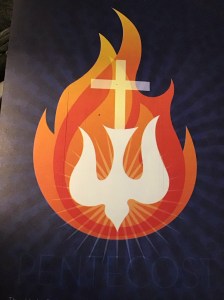
The Transforming Power of the Holy Spirit

Pastor Sherry’s Message for January 14, 2024

Scriptures: Gen 1:1-5; Ps 29; Acts 19:1-7; Mk1:1-11

The story is told that Dwight L. Moody—the great American evangelist who lived in the later part of the 1800’s—while witnessing to a large group of folks, asked how he might get the air out of a simple drinking glass. One listener shouted out that he should pump all the air out. Moody listened attentively, but replied that pumping the air out would create a vacuum, which would result in shattering the glass. He patiently heard some other suggestions, then took a nearby pitcher of water and calmly filled the glass. “’There,’ he said, ‘all the air is now removed.’ He then went on to explain that victory in the Christian life is not accomplished by “sucking out a sin here and there,” but by being filled with the Holy Spirit.”

(Illustration borrowed from Today in the Word, September, 1991, p. 30.)

Our Scriptures today each provide examples of the power of the Holy Spirit, perhaps as a way of encouraging each of us to be filled with the Spirit:

A. The Genesis account cited this morning (1:1-5) places the Holy Spirit at the beginning of creation. We are told that the Spirit hovered over the face of the water. Let’s read Peterson’s modern paraphrase of these 1st two verses (The Message, p.20) First this: God created the Heavens and Earth—all you see, all you don’t see. Earth was a soup of nothingness, a bottomless emptiness, an inky blackness. God’s Spirit brooded like a bird above the watery abyss.

Then God (the Apostle John tells us this was Jesus) spoke the first element of creation into existence. What came first? Light. He formed light and separated it from darkness. The Holy Spirit empowered the formation of day and night. The Holy Spirit is God’s power source. A former pastor of mine used to explain the Spirit as the electricity that flows behind our walls. We plug into it, and become empowered. But then we sin and pull our plug out and lose our power. The analogy is helpful but somewhat simplistic as the Holy Spirit is not just confined to our walls. Nevertheless, the metaphor poses the question: Are you cooperating with the creative, transformative power of the Holy Spirit in your life? Are you staying plugged in?

B. Our psalm (29) compares the powerful voice of the Lord to a storm in nature. We’ve had a few of these this week, haven’t we? We could hear the wind, a very strong wind (65-75 mph; some reported gusts to 105).

We could see our long, leggy, Florida pine trees bending over from the wind’s force. We saw the sky darken, as rain clouds rushed in. The rain commenced and quickly turned into a torrent. If you were in it, you wanted out of it; if you were in your house, you expected the lights to flicker or go out. Some of us did experience temporary power outages.

King David wrote Psalm 29 and it is clear that he is familiar with the voice of the Lord in all its manifestations: (1) Like in Genesis 1, (v.3)—the voice of the Lord is over the waters. (2) (V.4)—the voice of the Lord is powerful. (3) (V.5)—The voice of the Lord breaks the cedars. (4)

(V.7)—The voice of the Lord strikes with flashes of lightning. (5) (V.8)—The voice of the Lord shakes the desert. (6) (V.9)—The voice of the Lord twists the oak and strips the forests bare. David wants us to be aware of God’s mighty power, which He tends to use to (v.11)—…give strength to His people. His Holy Spirit power could function as a massive destructive force. But instead, He intends the Holy Spirit (1) to lead us to the Truth; (2) to heal us; (3) to help us understand Scripture; (4) to be our companion and friend; and (5) to remind us of the teachings of Jesus.

C. On his 3rd missionary journey, Paul traveled to Ephesus from Corinth. He stayed for 2 years, teaching folks at the Greek School of Tyrannus about Jesus. When he realized that 12 disciples (who had come to Christ through the teaching of Apollos) had been baptized by water, but lacked the Holy Spirit, he saw to it that they were also baptized with the Holy Spirit. The baptism of John the Baptist, which was the only one Apollos knew of at the time, is a baptism of repentance for sins, and places us under the leadership of Jesus. But the baptism of the Holy Spirit is what changes our behavior, our attitudes, and even the words that come out of our mouths. Paul wanted the Ephesian disciples to have the power of the Holy Spirit in their lives. The Holy Spirit lives in our hearts, but can you discern a difference in yourself as a result of His presence? Do others see evidence of the Spirit’s transforming power in your life?

D. Finally, in our Gospel lesson, the baptism of Jesus (Mark 1:1-11), we see that the power of the Holy Spirit came upon Jesus as He submitted to John’s water baptism. Jesus was without sin—He did not need a baptism of repentance, but He underwent the ritual in order to identify with our humanity. When He did, the heavens opened and…the Holy Spirit descended upon Him, empowering Him for His public ministry. He also heard His heavenly Father bless and affirm Him, saying (v.11)—You are my Son, whom I love; with You I am well pleased.

Even Jesus, the 2nd member of the Trinity, needed the power of the Holy Spirit at work in Him—energizing Him to teach and preach, and empowering Him to do miracles.

Before leaving Florida to attend seminary, I asked some Christian friends to pray with me for the baptism of the Holy Spirit. We went out to the beach at night and prayed in a pergola perched in the sand. It took a while, but I felt a strong wind come up and blow in my face. It didn’t exactly howl, but it did moan. If you have ever walked the beach during a “nor-easter,” you know the wind comes at you so strongly that you can hardly take a breath. That’s what it was like for me. Afterward, I asked the others if they heard the moaning wind and if they had had trouble catching a breath. They told me they had neither heard nor felt what I did. God had directed that wind of the Spirit just to affect me. In a similar way, when the Bishop laid hands on me to ordain me much later, I felt a huge weight descend on my head. I wondered if the Bishop was trying to push me through the floor. Later I realized the Hebrew word for God’s holiness is kavod, which also means the weightiness of God. The Lord conferred on me both His Holy Spirit power and His sign that He had set me apart for ministry. Praise God!

Todays’ readings compel us to ask, “Are you cooperating with the creative, transformative power of the Holy Spirit in your life?” Our Lord wants to make us more and more like Jesus—and He has the power to pull it off! Are we assisting this process in ourselves, or are we hindering it? He will not force Himself upon us. We have to agree to baptized with the Spirit. Are we willing to take charge of what comes out of our mouths, instead of just allowing ugliness to slip out? Are we willing to restrict our own behavior, doing what will bless but not harm other people? Do we believe that God is with us in the storm, and that He will see us through it? Do we listen for and hear the voice of the Lord in our lives?

Today, let’s pray for a fresh anointing of the Holy Spirit on each of us, as we continue to move in 2024: Father God, we ask in the name of Jesus Christ of Nazareth—our true Lord Jesus Christ—that you would send your Holy Spirit to anoint each of us with Holy Spirit power. Power to do the ministries You have set out for us. Power to cooperate with the Spirit and be molded and shaped into better people. Transformative power to become more and more like your son, Jesus. We pray this in Jesus’ precious and most powerful name. Amen!

©️2024 Rev. Dr. Sherry Adams

Obeying God

Pastor Sherry’s message for 7/9/2023

Scriptures: Gen 24:34-67; Ps 45:10-17; Ro 7:14-25a; Matt 11: 16-30

I want to share with you a true story told by a Kenyan pastor, Dr. Nicholas M. Muteti (He now ministers in North Carolina). He recalls,

“Nearly thirty years ago, I was a middle school teacher in Kenya. One day I took 20 students, and I told them: “I will do my best to teach you and train you. If you obey me, you will be the best students of this school.” They were excited.

“In a short time, I realized that only some of them were willing to keep up with my training. Some of them said, “It’s too difficult.” Some said, “We have more important things to do.” Some of them said, “You see other students are having more fun than we do.” When they graduated, 2 of them were the best students of the school. Only 2 out of 20.”Download (PDF

(Contributed by Dr. Nicholas M. Muteti on Jun 15, 2011, www.sermoncentral.com)

I wonder if this is how God feels. We each could be absolutely the best we could become, if only we obeyed the Lord. He knows this and sees so few of us trying to live out the Christian life style. I wonder how frustrated He gets with us human beings.

Both Paul and Jesus have a lot to say today about obeying God:

Paul reminds us (in Romans 7:14-25a) that our sinful (carnal) nature does not cease to exist when we become Christians. Oh, if only it did! If anything, we just become more frustrated because now we recognize—and hopefully, regret–our sinfulness. The cry of Paul’s heart is so poignant. Can’t we each identify with him in verse 24 What a wretched man [or woman] I am! Who will rescue me from this body of death? I find Peterson’s paraphrase of parts of this passage so helpful (The Message, pp.2043-2044) Yes, I’m full of myself—after all, I’ve spent a long time in sin’s prison. What I don’t understand about myself is that I decide one way, but then I act another, doing things I absolutely despise. So if I can’t be trusted to figure out what is best for myself and then do it, it becomes obvious that God’s command [the Law] is necessary. But I need something more! For if I know the law but still can’t keep it, and if the power of sin within me keeps sabotaging my best intentions, I obviously need help! I realize that I don’t have what it takes. I can will it, but I can’t do it: I decide not to do bad, but then I do it anyway. My decisions, such as they are, don’t result in actions.

Paul makes the case that just deciding not to sin is not enough to keep us from sinning. Remember, last week he said (in Romans 6)…

[1] Start with faith in Jesus;

[2] Surrender yourself to God;

[3] Then ask God, the Holy Spirit, to help you live into your new intentions.

We need supernatural help. We need the power of the Holy Spirit at work in us to help us live more and more like Jesus.

Jesus, in our Matthew 11:16-30 passage, is speaking about how folks have rejected both His cousin, John the Baptist, and Him. He says they rejected John for being too severe, too austere. Those who have rejected Jesus have done so for the opposite reason. They say he’s too friendly.

Since He eats with tax collectors and sinners, they claim He is a drunkard and a glutton. (YIKES! I wouldn’t want to be in their shoes at the Last Judgment.)

So, He then rejects the cities in which He has spent the most time: Korazon, Bethsaida, and Capernaum—Capernaum had been His headquarters! Most of the residents of these three cities have blown off His teachings, His miracles, and His healings done. To Jesus, they now rate worse than the fate of Sodom and Gomorrah, who God fire-bombed. (What might be worse than that? I hate to think it.)

Biblical scholars say it is at this point that Jesus turns from trying to convert the Jewish nation toward appealing to individuals who are open to Him. He offers rest to those who are weary and burdened. He asks them/us to join with Him and learn from Him. He promises rest for our souls, for My yoke is easy and My burden is light. Let me digress for just a moment: Jesus had been a carpenter, so He had most likely built wooden yokes for oxen. Jesus would have measured the oxen before fashioning their yoke—like us, all oxen are not of the same size or girth. Then the farmer would have returned about a week later to have the pair fitted with the new yoke. If it had been made to fit exactly, it would not chafe or injure their necks. Jesus is implying that he makes obeying Him individualized and non-stressful, if we partner in the effort with the Holy Spirit.

This is essentially what Paul later repeated, isn’t it? He wrote that we should put our trust in Jesus; we should do as He does, or at least obey what He says; and we should ask the Holy Spirit to help us when our sin natures want us to rebel. As J.Vernon McGee says, “The only place in the world to put that burden [our sins] is at the Cross of Christ.” The reward for this obedience is rest, deep shalom [total wellbeing] peace.

As with last week, the doctrines expressed by Jesus and by Paul are illustrated with a great story from the Old Testament, Genesis 24:34-67. Abraham had become very rich—he was like a prince or a high nomadic potentate by this time. Sarah had died at age 127, so Abraham was probably 137 years old. Before he died, he wanted to secure a bride for Isaac. He wants someone from his extended family, not an idolatrous Canaanite. So he sends his trusted representative to the area of Haran (Iran), to search out a suitable woman from among his extended family.

The servant prays to Abraham’s God and suggests a sign by which to recognize God’s choice of a bride for Isaac. She will encounter him at a well. She will offer him water to drink. She will even draw water for his 10 camels. Additionally, she will extend traditional middle eastern hospitality: water for his feet, food and refreshments, and overnight accommodations for him and his animals. Arriving in Haran, the servant then encounters a beautiful young woman who does exactly that. She gives him water. She draws water for his animals. She invites him home to meet her family. This woman is Rebekah, Abraham’s great-niece, the virgin granddaughter of Abraham’s brother, Nahor. Now of all the wells the servant could have visited, what are the chances that he would run into Abraham’s kin? God has clearly superintended this process. It’s a divine appointment.

The servant recognizes this and offers praise and thanksgiving to God.

In verse 26, we are told Then the man bowed down and worshiped the Lord, saying,”Praise be to the Lord, the God of my master Abraham, who has not abandoned his kindness and faithfulness to my master. As for me, the Lord has led me on the journey to the house of my masters’ relatives.” This woman, Rebekah, is clearly God’s choice for Isaac. The servant tells her the story of how he decided to approach her—he’d asked God for a sign. She doesn’t seem to have difficulty believing him. Then he gifts her with a ring and two gold bracelets.

Her brother, Laban, shows up, hears the story, and also invites Abraham’s servant to their home. Once again, the servant shares his instructions with everyone. No doubt Rebekah is somewhere listening in as the story is retold. Everyone appears to agree she is God’s choice of a bride for Isaac. The servant has surely filled them in on Isaac’s miraculous birth and the divine substitution of the sacrificial ram. They may have been impressed that Isaac seemed to be a man with a God-ordained destiny.

The family is impressed with the costly gifts bestowed on the maiden, signifying that Abraham is indeed wealthy. The bride-price is agreed upon, but by the next morning the family appears to have backed off a bit. In an intimation of things to come—Laban will renege on his agreement with his future nephew, Jacob—Laban, Rebekah’s brother, wants to delay his sister’s marriage. The family urges the servant to wait 10 more days. No doubt concerned for Abraham’s age and health, the servant insists they leave immediately.

In an interesting move in a paternalistic culture, the family members suggest Rebekah be consulted. From what she’s heard and experienced, she is ready to go—off with a servant she barely knows; to a country she’s never seen; to meet a husband she’s only heard of. What an adventure! What a courageous young woman!

What standards might this story point to for us today?

First, we note the faithfulness of the servant. He’s given his word to Abraham to do his best, but otherwise he has no stake in the outcome. Nevertheless, he works hard to fulfill his promise. He is obedient. He prays for the Lord’s favor. He diligently repeats his instructions from Abraham to the extended family members. He clearly does not want to mess up! This is a great example (from about 4,000 ago) of godly obedience.

Second, I am also struck by the willingness and courage of Rebekah. She doesn’t know Abraham from Adam’s house cat. She is looking at marrying a dude she’s only just heard of and never seen. She will be making her home far away from her family—in fact, she never sees them again this side of heaven. What convinces her to take the risk of leaving everything she has ever known? Perhaps she was impressed by the miraculous nature of Isaac’s birth, believing he is a man special to God. No doubt she had heard the story of his almost-sacrificial death, and been impressed with the fact that he could have overwhelmed his aged father’s strength, and taken himself off the altar. Nevertheless, he chose to be obedient to and respectful of his father, and of his father’s God. Maybe she rightfully understood that Isaac was special relationship with God and wished to attach herself to such a faithful and blessed man. And, if she had been a woman of faith, she could see and understand how God had indeed chosen her to be Isaac’s mate. After all, the servant had asked for a complex set of signs, and, without any prior knowledge of them, she had fulfilled each one.

Third, this story has a happy ending. It’s actually a love story. Scripture is God’s love story to us, but He never guarantees us “a rose garden.” He does, however, promise us blessings for faith and obedience. Rebekah gets on her camel and rides to Israel and to Isaac. The evening she arrives, Isaac is out praying. He sees her, the answer to his prayers. She sees him and leaps off her camel, indicating she is both single and eager to meet him. Cue the dramatic music! The faithful servant relates everything to Isaac, who obviously sees Rebekah as the answer to his prayers (and his father’s plans). Verse 67 tells us Isaac brought her into the tent of his mother Sarah [now dead], and he married Rebekah. So she became his wife, and he loved her; and Isaac was comforted after his mother’s death.

This beautiful story is an indication of what can happen to the righteous—those of us who call upon the Holy Spirit to live obedient lives pleasing to God. Yes, we inherit heaven. But, we can also be abundantly blessed by the Lord here on earth. Thanks be to God who gives us the victory through our Lord Jesus Christ!

©️2023 Rev. Dr. Sherry Adams

Trinity Sunday

Pastor Sherry’s message for June 4, 2023

Scriptures: Gen 1:1-31, 2:1-4; Ps 8; 2 Cor 13:11-13; Matt 28:16-20

Today is Trinity Sunday, traditionally the first Sunday after Pentecost. Many people have come up with metaphors to explain the Trinity—one God in three separate persons—but each of these images falls short somehow. Explaining the Trinity proves to be very difficult. Consider this true story from St. Augustine (396 to 430), Bishop of Hippo or present day Algeria. Many experts today still consider him to be one of the premier theologians of the Christian Church. It is said that,

“One day when St. Augustine was at his wits’ end to understand and explain the Trinity, he went out for a walk. He kept turning over in his mind, “One God, but three Persons. Three Persons–not three Gods but one God. What does it mean? How can it be explained? How can my mind take it in?”

“And so he was torturing his mind and beating his brains out, when he saw a little boy on the beach. He approached him to see what he was doing. The child had dug a small hole in the sand. With his hands he was carrying water from the ocean and was dumping it in the little hole. St. Augustine asked, “What are you doing, my child?”

“The child replied, “I want to put all of the water of the ocean into this hole.”

“St. Augustine asked, “But is it possible for all of the water of this great ocean to be contained in this little hole?”

“And then it dawned on Augustine, “If the water of the ocean cannot be contained in this little hole, then how can the Infinite Trinitarian God be contained in your mind?”

(Borrowed from a sermon by Rev. Gordon Curley, dated November 29, 2010, archived on http://www.Sermoncentral.com).

Again, it is very difficult to explain the Trinity using images like a three-leaf clover (one plant, three leaves), an egg (shell, liquid, solid), or water (ice, fluid, steam) because while these speak to the separateness of the three, they do not adequately describe the unity, the relationships among the persons, or their cooperative work together.

John Wesley (1703-1791), the Anglican pastor who founded our Methodist Church, may have come close. He once used the following analogy to explain the doctrine of the Trinity: He said,

“Tell me how it is that in this room there are three candles and one light, and I will explain to you the mode of the triune God.” “Although each of the three persons of the Holy Community has his own distinct identity, all work together harmoniously as one God to accomplish salvation.”

(Borrowed from Pastor Glen Key from his March 2, 2011 sermon; archived on website http://www.sermoncentral.com)

As it turns out, you won’t find the word Trinity in the Bible. People only began to use this term toward the end of the 2nd century. Theophilos, the Bishop of Antioch in 180 AD, used the term Trias to describe our one God in three persons. Later, the theologian Tertullian (155-220AD) who challenged many developing heresies in the early Church, changed the word to Trinitas. The church leaders who met in Nicea in 325 AD, and later in Constantinople in 381, set this reality as doctrine in the Nicene Creed. It’s a way of describing what the Bible tells us about the reality of God—in essence, One God, but formed of 3 distinct persons, God the Father, God the Son, and God the Holy Spirit.

But you will find citations of the three persons of the Trinity:

In John 10:30, Jesus says–>I and the Father are One. Later, in an epistle (1 John 5:7), John says For there are three that testify, the Father, the Word [Jesus], and the Spirit, and these three are one.

The Old Testament also mentions or implies the Triune nature of our God:

Job 33:6 refers to the Holy Spirit The Spirit of God has made me; the breath of the Almighty gives me life. Isaiah 6:8 Then I heard the voice of the Lord saying, “Whom shall I send? And who will go for us? [implying more than one person]. The Hebrews never adopted the custom exhibited by later European monarchs of referring to themselves in the plural. If the Hebrew passage said us, it meant literally more than one.

Isaiah also predicts the 1st Advent of Jesus, within Whom will reside many gifts of the Holy Spirit (Isaiah 11:1-2) A shoot will come up from the stump of Jesse [lineage of King David]; from his roots a Branch will bear fruit. The Spirit [Holy Spirit] of the Lord [God the Father] will rest on Him [Jesus]—the Spirit of wisdom and of understanding, the Spirit of counsel and of power, the Spirit of knowledge and of the fear of the Lord.

Our Scriptures today all shine further light on the cooperative functions of the members of the Trinity:

A. In our Genesis 1:1-31, 2:1-4 lesson, two members of the Trinity are mentioned: (1) Verse 1 In the beginning God [the Father planned and directed it] created the heavens and the earth.

(2) Verse 2 Now the earth was formless and empty, darkness was over the surface of the deep, and the Spirit of God [Holy Spirit] was hovering over the waters. Hovering here evokes such a lovely image. In the Hebrew it conveys the sense of a mother hen hovering over/covering with her wings her chicks. It’s a protective and a loving action.

(3) Verses 3-26 reveal the orderly mind of God and His attention to detail. The 1st day (v.3), He—John the Gospeler says this He is Jesus, who speaks creation into existence. In John 1:1,3, he tells us In the beginning was the Word [God’s Word made flesh, Jesus, the Logos], and the Word was with God, and the Word was God…Through Him [Jesus] all things were made; without Him nothing was made that has been made. That first day, Jesus spoke light into existence. Remember, Jesus said, “I am the Light of the world.”

The 2nd day (v.6), He created the sky, separating the waters above (rain, dew) from the waters below (oceans, lakes, rivers, etc.).

The 3rd day (vv.9-11), He separated out dry ground from the waters and made vegetation.

The 4th day (v.14), He formed lights in the sky, the sun, the moon, and the stars. (Notice, light itself was produced before these celestial bodies were placed in the heavens).

The 5th day (vv.20-24), He produced marine life and birds.

On the 6th day (26), He crafted land-dwelling animals and humankind, the pinnacle of His creation. He said Let us [plural, more than one] make man in our image, in our likeness. Adam, Eve, and the animals were to be fruitful and multiply; and Adam was to serve as a steward or overseer of over the rest of creation, as God’s agents.

So, according to the first chapters of Genesis and of John, all three persons of the Trinity were present at creation. God the Father devised the plan; God the Son spoke it into existence; and God the Spirit was both the power source and the breath (The Hebrew word for the Holy Spirit is ruach which means both breath, wind, and spirit).

B. Psalm 8, written by King David, is a hymn of praise to God for creation. It begins and ends with those wonderful words, O LORD, our LORD, how majestic is Your name in all the earth! Then it goes on to celebrate God’s formation of the cosmos, from planets and stars to humans and infants. We could call this a Messianic psalm because it speaks to a time when all persons will revere our Lord. As we know, the names of God and of Jesus are not everywhere honored today; some use them as curse words. But at Jesus’ 2nd Coming, all will know that God is real, that He exists, and that He rules in power and might. They will then either revere Him or be gone.

C. Both 2 Corinthians 13:11-13 and Matthew 28:16-20 are farewell addresses that include references to the Trinity. As Paul says goodbye to the Church in Corinth, he exhorts them to… (v.11) aim for perfection, listen to my appeal, be of one mind, and live in peace.

None of us is perfect, so what he means by this is grow up! In the first chapters of 1 Corinthians, he takes the believers there to task for being infantile in their faith (preferring milk to meat) and acting out of their carnal rather than spiritual nature. So, he is saying, essentially, “Don’t act like entitled children; learn to live a spirit-filled, disciplined life.”

Additionally, he wants them to pay attention to what he has taught them. He encourages them to try to maintain unity in doctrine and beliefs—which we know presently and personally is difficult. And he wants them to live in peace….We can’t create peace—only Jesus can—but we can conduct ourselves in a way that demonstrates we know Jesus can supply us with the peace that passes all understanding. Then he encourages them to greet each other with appropriate affection—no icky or invasive hugs or kisses.

Finally, he blesses them with a benediction that includes each member of the Trinity (v.14) May the grace of the Lord Jesus Christ, and the love of God [the Father], and the fellowship of the Holy Spirit be with you all. What a wonderful sendoff!

Jesus’s parting words in Matthew 28 are strikingly similar. We call His final instructions the Great Commission:

(1) We are to go! Through our neighborhoods, our county, our state, our country, to the entire world.

(2) We are to make disciples for Christ.

(3) We are to teach them about Jesus and that they and we are to be obedient to Him.

(4) And we are to baptize them (v.19) …in the name of the Father and of the Son and of the Holy Spirit.

Paul died but Jesus promises us to be present with us (through the Holy Spirit) (v.20)…to the very end of the age.

So what does this mean to us on this Trinity Sunday of 2023?

The story is told of a seminary professor who asked his students to close their eyes and see if they could summon up for themselves an image of God.

“After a few moments he had them open their eyes and, if comfortable, share what they saw. Most of them said the same thing: “An old man with a white beard floating in the clouds, looking down at us.” [The professor] then said, “If what you imagine God to be like is anything other than Jesus, then you have the wrong image of God.” Jesus is beautiful, and so are the Father and the Spirit: “The Word was made flesh, and dwelt among us, (and we beheld his glory, the glory as of the only begotten of the Father,) full of grace and truth” (John 1:14 KJV).”.

(Borrowed from The Magnificent Story by James Bryan Smith, InterVarsity Press, 2018.).

We want to remember that God the Father and the Spirit are spirits. Jesus shows us the loving, grace-filled face of the Father, as well as the powerful, healing and sanctifying presence of the Holy Spirit. Jesus is one with the Father and the Holy Spirit. The truth is that our God exists in 3 persons—all the same God but taking on three personalities or different expressions—all of which is difficult for our finite minds to take in. I don’t understand gravity. I can’t see it, but I know it is real and I don’t plan to test it by jumping off a tall building. I think, until we reach heaven, we probably have to agree with St. Augustine and take the same stance with the Trinity.

©️2023 Rev. Dr. Sherry Adams

Pentecostal Power

Pastor Sherry’s Message for May 28, 2023

Scriptures: Acts 2:1-21; Ps 104:24-34; 1 Cor 12:3-14; Jn 7:37-44

Isn’t it interesting that sometimes what you thought you heard may not necessarily have been what was said? Or even if you heard what was said accurately, the words used conveyed something different to you depending on your background and experiences?

For example, there is…

“an old joke that used to be popular around the Pentagon that the different branches of the Armed Forces have trouble operating jointly because they don’t speak the same language.

For example, if you told Navy personnel to “secure a building,” they would turn off the lights and lock the doors.

Army personnel would occupy the building so no one could enter.

Marines would storm the building, capture it, and defend it with suppressive fire and close combat.

The Air Force, on the other hand, would take out a three-year lease with an option to buy. “ (Illustration borrowed from www.sermons.com, 5/25/23.)

This joke is such a good example of how the same word can mean something different to different groups of folks. The word Pentecostal is another such word. To most, the noun, Pentecost, refers to the day we celebrate today, the anniversary of the day the Holy Spirit was given to all believers in Jesus, and the day the Church (capital “C”—Christians of all denominations) was born. It also marks an ancient Jewish religious feast day. It commemorated the end of the barley harvest and the beginning of the wheat harvest—the Spring Harvest season. Thus it was one of the 3 times per year a Jewish man was expected to journey to Jerusalem (The other two times were for Passover and the Feast of Tabernacles).

But consensus breaks down when the adjective form, Pentecostal, is used. This could refer to a Christian denomination, for example Pentecostal Holiness. A good number of folks associate it with speaking in tongues—and some Pentecostal churches believe you must speak in tongues to demonstrate you have been baptized in the Holy Spirit—though nowhere in Scripture is it stated that all spirit-filled Christians must speak in tongues. It could also mean charismatic—a person who believes in and moves in the gifts of the Holy Spirit.

Our readings today are all Pentecostal, or refer to some aspect of the Pentecostal power that manifested that Day.

A. In our Acts 2:1-21 lesson, we are reminded of the supernatural power the Holy Spirit can and does demonstrate when He shows up. (1) There was the sound of wind rushing. In this case, it was like the sound of a tornado, but without the wind damage. That sound is like 5-6 locomotive engines rushing by. The Holy Spirit came on with such a loud sound that folks rushed out of their homes to see what had produced it. Prior to moving off to seminary, I asked a group of my friends to pray for me to receive the Holy Spirit. We had gathered on the beach at night for that purpose. A very strong wind came up and blew in my face as they were praying. I felt I could hardly breathe. Afterwards, I asked them what they made of that wind. No one else in the group had experienced it! We knew then that the Spirit had indeed come over me.

(2) There was also the curious sight of a larger flame in the air separating into smaller flames. Stranger still, the smaller flames come to rest over the heads of the 120 disciples gathered in that place. Like the bush Moses saw aflame as he was shepherding sheep, these flames did not burn anyone or anything.

(3) There was also the sudden, unexplained ability of all to speak in tongues/languages they had never been taught. Apparently all 120 disciples present were filled with the power of the Holy Spirit. This power enabled them to do things they had never learned nor expected to be able to do.

Wouldn’t it be marvelous to instantly speak another language without the tedium of memorizing sounds, vocabulary words, and grammar rules, let alone another alphabet like that of Greek or Hebrew? These were not just a nonsense languages, gibberish, but actual languages and dialects recognized by the many nonbelievers who were there. People said, “Hey! Aren’t these men and women from Galilee?” In other words, “How do these “backwoods” folk know our native tongues?”

(4) Additionally, Peter—who had been unwilling to admit his association with Jesus just some 53 days earlier—is emboldened to preach to Jews (vv.14-36) about Jesus and 3,000 were so convinced by his sermon that they agreed to be baptized that day (v.41).

Miraculous, wonderful things happen when the Holy Spirit demonstrates His Pentecostal Power!

B. The key verse for us in Psalm 104:24-34 is verse 30 When You send Your Spirit, they [meaning humankind and all animal life] are created, and You renew the face of the earth.In this tribute to the creative power of God the Father, the Holy Spirit manifests this divine creative power. God may have efficiently used similar designs—apes have physical characteristics similar to humans—but He formed them all out of nothing. The originals were adults of two genders, so they could reproduce.

Each living thing is a manifestation of Holy Spirit power—remember, at the creation of the world, the Holy Spirit was hovering over the waters (Genesis 1:2). In a sense, we could say Pentecostal power was present at Creation.

C. In our 1 Corinthians 12:3-14 passage, Paul lists 9 gifts of the Holy Spirit (He has two other gifts lists in Romans 12:6-8 and 1 Corinthians 12:28-31.) These are each supernatural abilities bestowed on certain believers—not for their own entertainment or to puff up their egos—but (v.7) for the common good. They are meant to build up the body of Christ, His Church. They include (vv.8-10) wisdom, knowledge, faith, healing, miraculous powers, prophesy, distinguishing spirits (evil ones from good; angels from demons), speaking in tongues, and interpretation of tongues. Each believer is given at least one spiritual gift; some are given more than one. For example, sometimes when I pray for healing for a person and lay hands on them, my hands grow hot. The person I am praying for also feels those “hot hands.” The heat means the Holy Spirit is at work, healing them. I do not generate the heat and I do not experience it each time I pray for healing. This has led me to believe the gifting can come and go. Sometimes I have it and sometimes I don’t. It’s up to the Spirit when to apply it. And, again, the purpose of the gifts is to edify the Church, not the person who has the gift.

Think about it: What is (are) your spiritual gift(s)? You have been given Pentecostal power with which to help others.

D. In John 7:37-44, Jesus makes one of His I am statements. Remember, to the Jews, Yahweh or Father God was and is the Great I am. By saying, I am, Jesus was admitting He is equal to God and that He is God. Just prior to this chapter in John 6, Jesus states that He is the manna from heaven; He is heavenly food. Some turn away from Him then, misconstruing is metaphor as a cal for them to consume Him as in cannibalism. In John 7, He says He is living water to drink. Jesus is in Jerusalem at the Feast of Tabernacles (Ingathering, Booths, the Fall Harvest Festival). Believing Jews were to sleep in tents, booths, or tent-like structures meant to remind them of God’s provision for them during their 40 years of Wilderness Wanderings. For the 7 days of this national holiday, they were to do no work. They would worship the Lord at the Temple, daily, to seek forgiveness for their sins and to thank God for their harvest. Otherwise, they were to celebrate, feast, and visit with family and friends. On the eighth and last day of the Feast, the priests would pour water on the altar of sacrifices, dousing the flames and asking God to provide rain for another year.

According to John (vv.37-38), on the final day of the Feast, perhaps just as the priest poured water on the altar Jesus stood and said in a loud voice, “If anyone is thirsty, let him come to Me and drink. Whoever believes in Me, as the Scripture has said, streams of living water will flow from within him. He was saying, “I, God, give you what you need to sustain life.” This is the same living water He promised the Samaritan woman at the well. This water is a metaphor for a relationship with Christ that is life-giving and life-changing. John goes on to explain it also refers to the life-giving Spirit (v.39) By this He meant the Spirit, whom those who believed in Him were later to receive. Up to that time the Spirit had not been given, since Jesus had not yet been glorified.

Jesus gives us what we need—life giving, flowing-not-stagnant, living water—by gifting us with the Holy Spirit. The Spirit empowers us to live a life pleasing to God, and to love others, as Jesus commanded us. Just as in chapter 6, His words caused confusion about His true identity among those listening.

But we are not confused, are we? We have the gift of the Holy Spirit, one of whose jobs is to reveal all that is true to us. You know, if you watch the news on TV and ask the Holy Spirit to reveal what is true, you can begin to know who lies and who speaks truthfully. We know, through the supernatural gift of faith, that Jesus is indeed the Christ. We also know He has imparted to us the Pentecostal power of the Holy Spirit.

As we walk out this next week, let’s try to remember…

(1) We worship an all-powerful, creative God;

(2) His Son, Jesus, has given us the powerful, power-filled Holy Spirit to lead, guide, and direct us here on earth.

(3) The Holy Spirit also gift us—according to His will—with supernatural abilities meant to benefit others. Ponder what those are for you. Consider how you have used them in the past and might use this Pentecostal Power even more fully in the present and in the future. We want to be believers in and practitioners of God’s Pentecostal Power.

©️2023 Rev. Dr. Sherry Adams

Leading Others to Christ

Pastor Sherry’s message for January 15, 2023

Scriptures: Isa 49:1-7; Ps 40:1-11; 1 Cor 1:1-9; Jn 1:29-42

Do you remember who led you to Christ? Perhaps it was a Sunday School Teacher when you were a child? Maybe a godly parent or relative, or even a Christian neighbor, a teacher, or a coach you admired? It might have even been someone you met in the pages of a book—like the Bible or the Chronicles of Narnia? Or someone from TV? A television evangelist someone recommended you watch? Or a series, like the very popular current series, “The Chosen”? If you haven’t tuned into it on a streaming service or YouTube, I would highly recommend that you do. I have long loved Jesus, but I am finding The Chosen’s portrayal of Gospel stories has deepened my faith in Him.

I credit my grandmothers with teaching me about Jesus. They were both church-going, Bible reading women with personal relationships with Jesus. My father’s mother saw to it that I was baptized at age three. Both taught me that Jesus loved me, and saw to it that I attended Sunday School when in their care. In the days before Christian cartoons, movies and internet, I remember those old flannel-board presentations of cut outs of Noah and the animals making their way into the ark, and of David going up against Goliath. My mother’s mother cleaned her church and took me with her as a child, teaching by example the idea of serving God with our hands and our hearts.

Think back to who introduced you to Jesus and be sure to thank them in person, or thank God for them if they have already gone on to Glory.

Our Gospel lesson today (John 1:29-42) describes how John the Baptist (JtB) pointed two of his followers to Jesus. JtB sees Jesus passing by and comments to them (v.36) Look, the Lamb of God! The first is Andrew, the brother of Simon Peter. We don’t know the identity of the second guy—though tradition tells us it was John, the author of this Gospel account. (He is always so modest, never naming himself in his Gospel account, but often calling himself “the disciple Jesus loved.”)

These two come alongside Jesus, Who then asks them, What do you want? He’s not being rude; He just wants to know what is motivating them to connect with Him. Perhaps they are nervous, or feel put on the spot, but they respond, (v.36) Rabbi, where are you staying? I think this is such a curious question. I would have asked about His knowledge and/or His credentials: “Are You indeed the Christ?” “May we ask You some questions?” “May we follow You to find out more?” Instead, it sounds as if they want to know about His accommodations—“Are you staying here Capernaum? “ “At the Holiday Inn or the Hilton Courtyard?” But Jesus isn’t put off and replies, (v. 39) Come and you will see an echo of Psalm 34:8 Taste and see that the Lord is good; blessed is the man who takes refuge in Him. He very simply invites them. He encourages them to Come and…see for themselves, and they do spend the rest of the day with Him.

At some point—maybe that day or the next—Andrew leads Peter to Jesus. Andrew rightly believes that he and John—thanks to JtB—have met the One believed to be Messiah. Andrew then urges his brother, Simon Peter, to come meet Jesus as well. Jesus greets Simon with “a word of knowledge.” Without having previously met Simon, Jesus says his name, and cites his lineage ”You are the son of John” [Simon bar Jonah]. Then He proceeds to change Simon’s name: Cephas is the Aramaic form of rock or stone; Peter is the Greek word for rock. Peter was at that point anything but a rock! Jesus is renaming him not to describe his current state, but to inform who he was to become.

So let’s consider this: JtB, Jesus’ cousin, identifies Christ to Andrew and John. They have JtB’s word for it that Jesus is the Lamb of the God (a title with Messianic implications). They spend time with Him and are convinced He is the Messiah. Andrew brings Peter to Christ (just as John brings his brother James, and his father, Zebedee.) We are each individually introduced to Jesus, very often one-by-one, almost like exposure to a virus (meaning no disrespect).

We can also “catch the fever” by reading Scripture. Some pretty famous Christian authors were nonbelievers prior to reading the Bible: The English professor and subsequent theologian, CS Lewis, was converted by reading Scripture, as were the journalists become Christian writers and apologists, Philip Yancey and Josh McDowell.

Our Old Testament lesson, Isaiah 49:1-7 is the 2nd (of 4) Servant Songs, all prophesies of Jesus. Last week, we read the 1st Servant Song from Isaiah 42, which talked about the character and mission of Jesus. He would be humble, gentle, and compassionate; He would be completely righteous or sinless; And he would be thoroughly dedicated to the task God placed before Him–He would redeem Israel as well as the rest of humankind.

Isaiah 49 speaks again of His task/His ministry of Salvation. God had meant the nation of Israel to be “a light to the Gentiles…,” a good example meant to attract pagan nations to God. But they had focused on themselves and had insulated themselves from other nations, thinking of them as unclean. So the Father would send Jesus Christ to take on the sinfulness of the world (i.e., clean us up). He was God’s plan from the beginning.

In verse 2, the prophet states He [God the Father] made My mouth [Jesus’] like a sharpened sword…. This means that Jesus’ teachings and pronouncements would be truthful and accurate. While His death might look to some like defeat, it would in fact fulfill God’s purposes for Him. The prophet predicts that the Father will be pleased with Jesus’ efforts–and Jesus did effect our salvation! Additionally, this Servant Song predicts, rightly, that Jesus the Messiah will be a light for the Gentiles and will save us all from the penalty for our sins.

Psalm 40:1-11 reiterates the same message. The death of Jesus might look like a catastrophic defeat, but His death and resurrection are in fact a great victory. The Psalmist, King David, through the inspiration of the Holy Spirit, defines Christ’s victory as a New Song, the Song of Redemption. He further asserts that (v.4) Blessed is the man [woman] who makes the Lord his [her] trust. That is what JtB, Andrew, John, and Peter each did. That’s what my grandmothers modeled for me. It’s what we all need to do…fully put our trust in Jesus.

Verse 6 is quoted in Hebrews 10:5 Sacrifice and offerings You did not desire, but a body you prepared for Me; with burnt offerings and sin offerings You were not pleased. In the Old Testament sacrificial system the burnt offering was an atonement for sin. A lamb, bull, goat, or pigeon was killed then burnt whole as an aroma pleasing to the LORD. It was a costly and extravagant offering. No part of it was to be eaten by any human. The life of the animal took the place of the life of the person, in order for the person to gain forgiveness for their sin.

Now, remember, JtB called Jesus the Lamb of God. Way back in Genesis 22:7-8 Abraham is obedient even to the extent of offering his long-awaited son to God, when Isaac asks, Father…the fire and wood are here, but where is the lamb for the burnt offering? Abraham answered, “God Himself will provide the lamb for the burnt offering, my son.” Later on, in Exodus 12 (think back to the 1st Passover) The Israelite slaves in Egypt were to select a 1 year old male lamb without defect. They were to kill it, then sprinkle its blood over their doorways, so when the angel of death swept through Egypt, claiming each first born son, those Israelites who had been obedient were spared. They had been saved by the blood of the lamb. Still later, in Isaiah 53:7 He [the suffering Servant, Jesus] was oppressed and afflicted, yet He did not open His mouth; He was led like a lamb to the slaughter, and as a sheep before her shearers is silent, so He did not open His mouth. This is part of Isaiah’s predictions of how Messiah would die (3rd Servant Song); the prophet refers to Messiah as a lamb. Jesus is the once and for all perfect sacrifice for our sins. His right standing with God is now applied to us.

Our readings today not only demonstrate how we learn about Christ—often one person teaching another—but also how precious is the gift Jesus made of Himself for us. We can and should be grateful to whoever led us to Christ. We can and should, as well, be grateful to Christ for His saving work on our behalf—how incredibly vital this is!

Furthermore, we can and should be about the business of leading others to Christ! Ask the Lord to set before you this week those He desires you to tell about Jesus. Trust in Him to prepare their hearts to hear what you have to say. Trust also in Him to give you the opportunity, the courage, and the words to say.

Thanks be to God who gives us the victory through our Lord Jesus Christ! Alleluia! Alleluia!

©️2023 Rev. Dr. Pastor Sherry Adams

The Relationship of the Trinity to Each Other and to Us

Pastor Sherry’s message for 6/12/2022

Scriptures: Prov 8:1-4, 22-36; Ps 8; Ro 5:1-5; Jn 16:12-16

Today is Trinity Sunday, a day the Christian Church celebrates the fact that we worship one God in three Persons, Father, Son, and Holy Spirit. Lots of folks have tried to come up with illustrations that make this truth easier to understand:

1. An egg consists of an eggshell, egg white, and yolk, but remains one egg.

2. Water takes 3 forms—ice, liquid, and gas/steam—but all three are made up of water.

3. The shamrock, which St. Patrick used as he evangelized Ireland, has one plant stem, but three leaves.

4. Two new ones I came across this week include the following:

(1) You may have three different Bibles, an NIV, an ESV, and an NRSV, but all are God’s Word.

(2) Or let’s say Boris Johnson of England negotiated a Peace Treaty between Ukraine and Russia—wouldn’t that be wonderful!

(a.) One version would be printed in Russian;

(b.) Another version in Ukrainian;

(c.) And the third version in English, but all would say the same thing.

(Blogger BK -January 04, 2012, christiancadre@yahoo.com.)

Now the foregoing help explain the one-ness of the Trinity, but not the relationship between the three persons. Perhaps a good way to clarify or describe their relationship with each other is to look at ”…two wonderful Greek words that the early church theologians used to describe the Trinity: kenōsis and perichōrēsis. Kenosis is the act of self-giving for the good of another. It is found in the early Christian hymn in Philippians 2: 6-7 [Jesus], though he was in the form of God, did not regard equality with God as something to be exploited, but emptied himself, taking the form of a slave, being born in human likeness. The word emptied translates the verb form of kenōsis. Jesus gave of himself for the good of others [us!] ….They used the word perichōrēsis, meaning “mutual submission,” to explain it. So the Father, the Son, and the Holy Spirit are living in mutual submission to one another. This is the heart of the Trinity: giving oneself for the good of the other. (Taken from The Magnificent Story, James Bryan Smith, InterVarsity Press, 2018, www.ivpress.com).

Let me say that again: The relationship among the Father, Son, and Holy Spirit are characterized by each giving of Himself for the benefit of the other, with Son and Spirit each submitted to the will of the Father. They exhibit absolute cooperation with each other. They exist together in a dance of steadfast, unfailing, loyal love toward each other. The wonder is that they invited us into their dance, and model for us how to live with each other.

Let’s examine how our Scripture lessons for the day point to both the kenosis and the perichorisis of the Trinity.

A. Our Proverbs lesson (8:1-4, 22-36) speaks of wisdom as a person; i.e., the wisdom of God is demonstrated in the person of Jesus. Remember, Jesus called Himself the Way, the Truth, and the Life (John 14:6). Real truth is wisdom. I remember sitting in my class on Isaiah in seminary, and realizing that tears were sliding down my face as my spirit responded to the truth I was hearing read and explained.

In verse 4 the line reads, To you, O men, I call out; I raise my voice to all mankind. Isn’t that exactly what Jesus has done? He has called all men and women to Himself. He came to give of Himself for our benefit (kenosis). Everything He has said is worthy, right, true, and just. Read the red words written in read in your Bible (Gospels and Acts); these are the words of Jesus and they are all truth. If we could trust in His wisdom, we would be secure, at peace, and filled with love and hope.

Verse 22 tells us that Jesus possessed wisdom…as the first of His works, before His deeds of old. Wisdom was with Jesus as He spoke creation into existence. The very beginning of John’s Gospel (1:1-3) reports that In the beginning was the Word [Jesus; God’s word made flesh], and the Word was with God, and the Word was God. He was with God in the beginning. Though Him all things were made; without Him nothing was made that has been made.

As verses 35-36 warn, however …whoever finds Me finds life and receives favor from the LORD [perichoresis]. But whoever fails to find Me harms himself; all who hate Me love death. YIKES!

B. Psalm 8 is a messianic psalm, written by King David, in praise of God’s creative power (the Holy Spirit). Portions of this psalm are quoted in the New Testament 3 times:

(1) Jesus, quotes verse 2 in Matthew 21:16 From the lips of children and infants You have ordained praise. The context is that Jesus has just cleared the Temple of money lenders and those who sold animals for sacrifice. He was angry that His Father’s house had been made into a den of thieves. The Pharisees were furious, however, as they had not authorized His actions, nor had they sanctioned children running about praising Jesus. As Peterson relates it in his paraphrase, The Message, (NavPress, 2002,p.1786)

When the religious leaders saw the outrageous things He was doing, and heard all the children running and shouting through the Temple, ‘Hosanna to David’s Son!’ they were up in arms and took Him to task. ‘Do You hear what these children are saying?” Jesus said, ‘Yes, I hear them. And haven’t you read in God’s Word, ‘From the mouths of children and babies I’ll furnish a place of praise?’ This was not a popular thing that Jesus had done; but since we know He only did what His Father told Him to do, He was submitted to the Father’s will (perichoresis).

(2) Similarly, Paul, in 1 Corinthians 15:27, quotes verse 6 [For He—God the Father–has] put everything under His feet. Paul goes on to interpret this as meaning that God the Father put all of creation under the authority of Jesus, His Son. All of creation– but not the Father Himself—so that Jesus might glorify the Father (perichoresis).

(3) The writer to the Hebrews also quotes verses 4b-8 (in 2:5-8) It is not to angels that He has subjected the world to come, about which we are speaking. But there is a place where someone has testified: “What is man [humankind] that you are mindful of him, the Son of Man [Jesus] that you care for Him? You made Him [Jesus, when He came to earth] a little lower than the angels; you crowned Him [Jesus] with glory and honor and put everything under His feet.

The author of Hebrews, like Paul, asserts that God the Father has put all of creation under the authority of His Son. Furthermore, He has done this because of Jesus’ sacrificial death (kenosis) in submission to the will and plan of God the Father (perichoresis). Because Jesus died in submission to the Father’s will, the Father has…crowned [Him] so much higher than any angel, with a glory ’bright with Eden’s dawn light.’ (Peterson, The Message, p.2182.) In this great hymn of creation, Psalm 8, we discover that King David was prophesying the rule and reign of Jesus Christ—probably without realizing it.

C. In our Gospel lesson, John 16:12-16, Jesus further describes the work of the Holy Spirit. In verse 13, He calls Him the Spirit of Truth, who will guide you [meaning us] into all truth. [Sounds like wisdom to me.] He will not speak on His own; He will speak only what He hears, and He will tell you what is yet to come. Do you notice that the Spirit is submitted to Jesus (perichoresis)? And that one of His jobs is to steer us in the right direction, both now and in the future (kenosis)?

Jesus also asserts that (v.15) All that belongs to the Father is mine. The three persons of the Trinity share power. They also give of themselves for the good of the other (kenosis and perichoresis) .

D. This comes home for us in Paul’s letter to the Romans (5:15). Among the benefits to us of Jesus’ saving work on the Cross are the following:

First, we are at peace with God (we have tranquility of soul). I remember meeting two women at my new church (pre-seminary, back in 1986) who were clearly filled with peace. I could see it on their faces; I could sense it in their spirits. I wanted that peace and asked them where it came from. Their answer was “Jesus.” I now have that peace and you can too. We just have to say “yes” to Him. Those who have not said “yes” to Jesus are not at peace with God. Instead of being sinners saved by grace, they are just plain sinners. Their sin separates them from God and makes them enemies of God. I have a pastor friend whose church asked her not to preach on sin. They wanted to come to church only to be uplifted. Well, if we are not made aware of our sinfulness, we will not be uplifted. Warning people about the consequences of their sins is actually a loving thing to do. It has been said that a Christian pastor is to comfort the afflicted while afflicting the comfortable. Thank God we believers are at peace with the Father.

Second, we can then rightfully, accurately, say that God is for us.

Third, we have direct access to the Father, through the Son, and by the power of the Holy Spirit. When Jesus died on the Cross, He opened the way to the Father for us. In the final hours He hung on the Cross, the curtain that kept us out of the “holy of holies” was miraculously torn in two—from the top to the bottom so no one could claim a mere person had done it. As a result, like Adam and Eve before the Fall, we can walk with God through our prayer life.

Fourth, because we know the Trinity loves us, we have hope, or blessed assurance.

Fifth, we also experience meaning and purpose to our suffering. While being a Christ-follower does not protect us from suffering, we know that God is present with us in our suffering, and that He uses our suffering to produce in us perseverance and character.

The word “Trinity” is never found in Scripture, but the reality of it is. Father, Son, and Holy Spirit model for us how to live: Giving of oneself out of love for one another (kenosis), while being submitted to the will of God (perichoresis). When we choose to model our lives on the example of the Trinity, we experience peace, access to God, God’s favor, and blessed assurance, or hope. In these days of failed governmental policies, widespread corruption, increased inflation and economic hardship, unpredictable violence, and injustice, it is important to remember the hope we have in our Trinitarian God.

Chuck Swindoll tells the story of a missionary woman, watching passersby from the window of her second story apartment:

“…She was handed a letter from home. As she opened the letter, a crisp, new 10-dollar bill fell out. She was pleasantly surprised, but as she read the letter her eyes were distracted by the movement of a shabbily dressed stranger down below, leaning against a post in front of the building. She couldn’t get him off her mind. Thinking that he might be in greater financial stress than she, she slipped the bill into an envelope on which she quickly penned, “Don’t despair.” She then threw it out the window. The stranger below picked it up, read it, looked, up, and smiled as he tipped his hat and went on his way.

The next day she was about to leave the house when a knock came at the door. She found the same shabbily dressed man smiling as he handed her a roll of bills. When she asked what they were for, he replied: That’s the 60 bucks you won, lady. Don’t Despair paid five to one.” (Chuck Swindoll, The Tale of the Tardy Oxcart, Word Press, 1998, p.274).

Thanks be to God, who gives us the victory through our Lord Jesus Christ—and the help of the Holy Spirit. Alleluia, alleluia!

©️2022 Rev Dr Sherry Adams

Easter Punctuation

Pastor Sherry’s message for 4/17/22,

Scriptures: Acts 10:34-43; Ps 188:1-2, 14-24; 1Cor 15:19-26; Luke 24:1-12

Remember the days of punctuation marks? Now we tend to use emojis. But try to recall the time when a comma, a period, a question mark, and an exclamation point were commonly used and meant something. Now ask yourself, “Easter morning: Would I describe my response to this day with a period, a comma, an ! or a ?” If it’s just another day, having no real meaning for you, then a period will do. But maybe a comma better describes it…it gives you a pause as you think about it, but then you rapidly move on to the next thought or activity, and the next, etc. Non-believers, if they consider it at all, would probably use a ? Huh?

This week I saw one of those episodes on the news where they ask folks on the street what they think of certain issues. This time, the interviewer asked people in a New York City park what Easter was. Sadly, most didn’t know. A few said it’s about the bunny, finding eggs, and eating chocolate. Only one woman said that Easter commemorates the resurrection of Jesus Christ. We truly are living in a post-Christian America. But for those of us who love Jesus, Easter deserves a series of exclamation points. Fireworks emojis might also capture it. You may even throw in some smiley faces with hearts and praying hands.

But to the eyewitness disciples that original Easter, their morning was punctuated first by a period. They thought Jesus was dead, gone, buried, period. End of story. Their expectations of Him as their Messiah were disappointed. They were overwhelmed with dejection, grief and sorrow. Then the women arrive and tell what seems an unbelievable or even a crazy tale. His tomb is empty? A question mark at this point is more distressing than a period. A ? introduces doubt; it’s perplexing. Where could His body be? Who might have taken it? And why?

But thank God for angels, supernatural messengers (that requires an exclamation point)! Two angels are present to say (Luke 24:5-6) Why [?] do you look for the living among the dead? He is not here; He has risen! Remember how He told you, while He was still with you in Galilee: “The Son of Man must be delivered into the hands of sinful men, be crucified and on the third day be raised again.’ [?] The angels ask them a question, but they also expect them to remember what Jesus had said to them, repeatedly. OK, now they remember—thanks for reminding us! Even so, Peter and John (John 20:8) race to the tomb to see for themselves. Later that evening, the resurrected Jesus appears to the others. As is common with many folks, the disciples only believe when they can see for themselves. (Joe LoMusio, as quoted by Chuck Swindoll in The Tale of the Tardy Oxcart, Word Publishing, 1998, pp.171-172}.

By the end of Easter Day, the periods are gone. The question marks have been satisfactorily resolved. As our readings today attest, there remain, instead, several massive exclamation points! Alleluia, He is Risen! The Lord is risen indeed! Alleluia!

St. Luke, in Acts 10:34-43, wants us to know that one reason for an exclamation point was that Jesus’ death on the Cross—followed by His resurrection–had opened the way for Gentiles, like ourselves, to gain entrance into God’s Kingdom. As we have often noted, ethnic divisions were deeply ingrained in the Jews and others in 1st century Israel. For them, there were only two categories: Jews (the chosen people) and Gentiles (everyone else). Knowing this, Peter is surprised to be summoned to the home of the Roman centurion, Cornelius (who commanded and led over 600 soldiers). His household already knew about and believed in Jesus. Peter enters his home and announces: (v.34) I now realize how true it is that God does not show favoritism but accepts men [and women] from every nation who fear Him and do what is right.

His sermon from verses 36-43 is truly a great summary of the entire Gospel. In short, he says Jesus lived and walked among us, preaching, teaching, healing, and doing miracles; He died on the Cross for our sins;

Then He rose again, demonstrating His power over sin and death. Following Peter’s sermon, the Holy Spirit fell on Cornelius and his “congregation.” Peter considered this to be the Gentile Pentecost, and proceeded to baptize these Roman believers into the enfant Christian Church.

Scholars tell us that Psalm 118:1-2, 14-24, was a Hillel psalm. This meant it was one of several psalms sung from memory at the Passover meal. Jesus would have sung it with the apostles after they drank the final cup of wine at their Seder supper. The psalm celebrates the victory of a reigning king who had once been looked down upon by rival nations.

Several verses are particularly meaningful when viewed in the light of the resurrection: Verse 18 reads (and prophetically, Jesus would be the speaker) I shall not die, but live, and declare the works of the Lord…He has not given Me over to death. Jesus was laid dead into a tomb; but He did not remain there as we would. Instead, He rose again, overcoming death! And, in verses 22-23 He says the stone [the Rock: Jesus] the builders rejected has become the capstone; the Lord has done this and it is marvelous in our eyes. The Jewish religious leaders rejected Jesus as the Messiah; they rejected the cornerstone. Later, Peter writes in 1 Peter 2:4 As you come to Him [Jesus], The Living Stone—rejected by men but chosen by God and precious to Him—you also, like living stones, are being built into a spiritual house…. So a 2nd exclamation point is that Jesus’ resurrection fulfilled Old Testament prophecies (from the Psalms).

Third, St. Paul exhorts us to believe (in 1 Corinthians 15:19-26) that Jesus’ resurrection is the defining moment of Christianity.

First, (vv.5-8) he catalogues who all saw Jesus following His resurrection:

1. Peter,

2. The 12 minus Judas;

3. More than 500 disciples;

4. His brother, James;

5. And Paul himself.

Scholars tell us there is more eye-witness evidence that Jesus lived after His resurrection than there is for the existence of Julius Caesar (and many other important historical persons). There are many ancient manuscripts (all in museums now) that cite Christ’s resurrection. Josh and Sean McDowell, who wrote More than a Carpenter, researched proof of the resurrection and spent more than 700 hours discovering how well validated it is.

Next, in verses 13-19, Paul asserts that our entire faith depends upon the truth of the resurrection: Verse 14 If Christ has not been raised, our preaching is useless and so is your faith. In other words, Christ’s resurrection from the dead is incontrovertibly true and forms the basis of our belief in Him. We worship a God who has the power to bring His Son back from the dead. I want a strong, powerful God like that, don’t you? We worship a God who loves us so much that He sacrificed His one and only Son to redeem us. We worship Jesus, the One and Only, the God Who—due to His self-sacrificing love for us and His obedience to His Father–was willing to suffer to cover the cost of our sins. The sinless Son of God gave up His life so we might have new life, and have it abundantly. We can connect directly with the Father because Jesus opened the way for us (As He hung on the cross, the Temple curtain—a huge thick drape of goat’s hair—was torn in two). We can anticipate being resurrected because Jesus opened the way for us. And, when He comes again in glory to judge the living and the dead, He will destroy death…Praise God!

I’ve already commented extensively on our Gospel lesson today. Let me just add how ironic it is that the first to disbelieve Jesus’ resurrection were the apostles themselves. They didn’t believe the reports of the women who saw the open and empty tomb. Even after Peter viewed the physical evidence, he had to go off by himself to puzzle out what it meant. However, let’s offer them some grace—though difficult to believe, Jesus’ resurrection is nevertheless true, and they eventually got it!

As we wish one another Happy Resurrection Day, let us punctuate the day with exclamation marks as we remember the lyrics to an old Welsh Easter hymn:

We welcome glad Easter when Jesus arose

And won a great victory over His foes.

Then raise your glad voices, all Christians in song.

Bring glad Easter tidings to Jesus your King.

We tell how the women came early that day

And there at the tomb found the stone rolled away.

We sing of the angel who said: ‘Do not fear!

Your Savior is risen and He is not here.

We think of the promise which Jesus did give:

That he who believes in Me shall also live.’

Someone named S. Lewis Johnson has said (I don’t know who he is but I want to give him credit), “The Resurrection is God’s Amen! to Christ’s statement, “It is finished.” Alleluia, He is risen! The Lord is risen Indeed! Thanks be to God!

©2022 Rev. Dr. Sherry Adams

The Trouble With Forgiveness

Pastor Sherry’s message for 2/20/22

Scriptures: Gen 45:3-15; Ps 37:1-11, 39-40; Lk 6:27-38

Corrie ten Boom was a Holocaust survivor, a Christian, and a member of the Dutch underground resistance during WWII. Scott Sauls (in his book, A Gentle Answer, Thomas Nelson, 2020, pp.19-20) tells the following story to demonstrate the trouble with forgiveness:

“After the defeat of Hitler’s Nazi regime in World War II, Corrie returned to Germany to declare the forgiveness of Jesus Christ. One evening, after giving her message, she was approached by a man who identified himself as a former Nazi guard from the concentration camp at Ravensbruck, where she had been held and where her sister, Betsie, had died.

“When Corrie saw the man’s face, she recognized him as one of the most cruel and vindictive guards from the camp. He reached out his hand and said to her, “A fine message, Fraulein! How good it is to know that, as you say, all our sins are at the bottom of the sea! You mentioned Ravensbruck in your talk. I was a guard there, but I would like to hear it from your lips as well. Fraulein, will you forgive me?” About this encounter, Corrie writes:

‘I stood there—I whose sins had again and again been forgiven—and could not forgive. Betsie had died in that place. Could he erase her slow terrible death simply for the asking? It could have been many seconds that he stood there—hand held out—but to me it seemed hours as I wrestled with the most difficult thing I ever had to do . . . I had to do it—I knew that. The message that God forgives has a prior condition: that we forgive those who have injured us. . . . But forgiveness is not an emotion—I knew that too. Forgiveness is an act of the will, and the will can function regardless of the temperature of the heart. “Jesus, help me!” I prayed silently.’

“As she reached out her hand to the former guard, Corrie says that something incredible took place. She continues: ‘The current started in my shoulder, raced down my arm, sprang into our joined hands. And then this healing warmth seemed to flood my whole being, bringing tears to my eyes. ‘I forgive you, brother!’ I cried. ‘With all my heart!’ . . . I had never known love so intensely, as I did then. But even then, I realized it was not my love . . . It was the power of the Holy Spirit.’”

The trouble with forgiveness is that it is easy to talk about but difficult to do. It feels at the time like the emotional equivalent of having your toe-mails curled backwards.

Remember the Calvin and Hobbes cartoons by Bill Watterson? In one of them, Calvin—about 6YO–is sharing his guilt with his tiger friend, Hobbes. He admits he feels bad for calling someone named Susie names and for hurting her feelings. He says he is sorry. (Good for him!) Hobbes, a wise toy tiger, suggests Calvin apologize to Susie. After thinking it through for a moment, Calvin replies, “I keep hoping there’s a less obvious solution.” Isn’t that just the truth for most of us? We know that apologizing or asking for forgiveness is going to require that we humble ourselves and admit our fault. We also suspect that this action will be emotionally painful for us.

Jesus gives us His take on forgiveness in this famous portion of the Gospel of Luke (6:27-38). It is a continuation of the Sermon on the Plain. Jesus directs us to (v.27)love your enemies, do good to those who hate you, bless those who curse you, pray for those who mistreat you. YIKES! This is such a tall order! Foundational to the ability to do as He directs is a willingness to forgive. Corrie ten Boom found it very difficult to extend a hand of forgiveness to the former Ravensbruck guard.

She knew she had just talked about it publically, and hated to be seen as a hypocrite—if she could not. And she wisely asked Jesus to help her. Such forgiveness is beyond our human abilities. It requires the supernatural assistance of the Holy Spirit.

Additionally, in verse 29, Jesus commands us to famously “turn the other cheek.” Rev. Dr. J. Vernon McGee tells the story of an Irish prize fighter who was converted and became an itinerent pastor. “He happened to be in a new town setting up his evangelistic tent when a couple of tough thugs noticed what he was doing. Knowing nothing of his background, they made a few insulting remarks. The Irishman merely turned and looked at them. Pressing his luck, one of the bullies took a swing and struck a glancing blow on one side of the ex-boxer’s face. The former boxer shook it off and said nothing as he stuck out his jaw. The bully took another glancing blow on the other side. At that point the preacher swiftly took off his coat, rolled up his sleeves, and announced, “The Lord gave me no further instructions,” Whop! ( As related by J. Vernon McGee in Charles Swindoll’s Tale of a Tardy Oxcart, 1998, p 214.)

Clearly this is a joke as Jesus told Peter the trouble with forgiveness is that we are to forgive the same person not 7 but 77 times (Matthew 18:22). Jesus sums it up by charging us to (v.31)Do to others as you would have them do to you. We are not to seek revenge or repay evil with evil. Instead, we are called to treat everyone– even enemies– with love and mercy.

Furthermore, He exhorts us (vv.37-38)Do not judge, and you will not be judged. Do not condemn, and you will not be condemned. Forgive, and you will be forgiven. Give, and it will be given to you. A good measure, pressed down, shaken together and running over, will be poured into your lap. For, with the measure you use, it will be measured to you.

The story is told of the famous artist, Leonardo Da Vinci. He was painting “The Last Supper,” (in oils on a plaster wall in a convent in Milan, Italy) and had fashioned the face of Judas at the table to resemble one of his greatest detractors. Then, when he approached painting the face of Christ, he found he could not get it right. He tried and tried unsuccessfully, until he repented of how he had depicted the Judas figure. As soon as he painted over his enemy’s likeness with one more anonymous, he found he could then depict Jesus’ face.

Notice how God withheld blessing Da Vinci’s great work until the artist let go of avenging himself. The trouble with un-forgiveness is that it blocks our ability to receive God’s blessings. The “Cancel Culture” today tells us it is OK and even expected of us to get revenge. But according to Christ, we are blessed in the measure to which we bless others.

Jesus’ admonitions to forgive, not judge, and not condemn are so beautifully lived out by Old Testament Joseph (Genesis 45:3-15). Joseph is probably the most Christ-like person described in the Old Testament. Recall that his 10 brothers from another mother had sold him into slavery (he was about 17). They fully expected him to die in Egypt, as slaves were not treated well. They compounded their sin by lying to their father about Joseph’s supposed death, and causing him great grief. His grief was so profound and so agonizing that his brother Judah ended up leaving the family camp to live among Canaanites for a time.

But because of Joseph’s supernatural skill as a “seer,” he was rescued from prison by Pharaoh to interpret (see the meaning of) his ominous and perplexing dreams (by this point Joseph was 30YO). Previously, he had been able to see into the motives of his brothers, which got him sold into slavery. He had also correctly read the motives of Potipher’s wife, but received a prison sentence anyway. And, finally, his ability to see into the future of his prison roommate’s life had brought him to the attention of Pharaoh.

Now, with his brothers gathered around him in all his splendor (aged 39, having lived in Egypt for 22 years), as Vizier of Egypt, he sees as well as discerns and reveals God’s purposes in what his brothers had done to him. Prior to this passage, he has tested his felonious brothers twice to see if their character has changed at all in the 22 years since he last saw them.

It appears they have come to regret their past actions toward him, as well as the inconsolable grief they have caused their father, Jacob.

So, as per Peterson’s The Message, he tells his kin–>I am Joseph your brother whom you sold into Egypt. But don’t feel badly, don’t blame yourselves for selling me. God was behind it. God sent me here ahead of you to save lives. There has been a famine in the land now for two years; the famine will continue for five more years—neither plowing nor harvesting. God sent me on ahead to pave the way and make sure there was a remnant in the land, to save your lives in an amazing act of deliverance. So you see, it wasn’t you who sent me here but God. He set me in place as a father to Pharaoh, put me in charge of his personal affairs, and made me ruler of all Egypt.

The trouble with forgiveness is that it is difficult for us to offer. Our sinful human nature wants us to pursue revenge. But God will bless our efforts to forgive others. Joseph’s forgiveness results in a Jew, rising to the #2 power position in all of Egypt. It fulfills the prophetic dreams he had had as a young man. In addition, God uses Joseph to save his Father, all 11 of his brothers, and his extended family (approximately 90 people in all). He also saved unnumbered thousands of Egyptians and other Gentiles.

Joseph also demonstates the truth of Psalm 37, which is “Do not fret.” No matter what our circumstances, we do not need to worry.

Verse 3 tells us to Trust in the Lord and do good. Verse 4 encourages us to delight yourself in the Lord and He will give you the desires of your heart. It took 22 years, but Joseph—despite being sold into slavery and falsely accused of rape– does not appear to have lost his trust in God.

He did not get angry with God, he forgave his brothers, and God delivered him.

I think that examples like that of Old Testament Joseph and of Corrie ten Boom validate for us that it is possible for us to forgive others and to extend love to our enemies. Even though difficult for us, we can do it with God’s help.

We want to forgive because…

1. Christ commands it of us.

2. Christ demonstrated it to us, by forgiving us through His saving death on the Cross.

Stuart Strachan Jr. relates a tale written by Ernest Hemingway in this way: “The story revolves around a father and his teenage son Paco, set in Spain. Paco was an extremely common name in the Spain of that time. With desires to become a matador and to escape his father’s control, Paco runs away to the capital (from which the title is derived) of Spain, Madrid.

His father, desperate to reconcile with his son, follows him to Madrid and puts an ad in a local newspaper with a simple phrase: “Dear Paco, meet me in front of the Madrid newspaper office tomorrow at noon. All is forgiven. I love you.” Hemingway then writes, “the next day at noon in front of the newspaper office there were 800 “Pacos” all seeking forgiveness.” The world is full of people in need of forgiveness and reconciliation. The model for such forgiveness is most profoundly found in Jesus Christ.”

3. And because God gives back to us as good as we give.

This week, let’s allow the Holy Spirit to bring to our minds those people we need to forgive. Then let us go before the throne of God and offer up our desire, our intent to forgive them. God can work with the fact that we may only want to want to forgive. Pray for those persons daily for 30 days and watch and see what our Lord does to them and to us.

Thanks be to God who gives us the victory through our Lord, Jesus Christ. Alleluia, Alleluia!

©2022 Rev. Dr. Sherry Adams

Knowing Who We Are and What We Are Called to Do

Pastor Sherry’s message for 1/23/2022

Scriptures: Neh 8:1-10; Ps 19; 1Cor 12:12-31a; Lk 4:14-21

The story is told of a man who found a young eagle that had fallen from its nest ….

“He took it home and put it in his barnyard where it soon learned to eat and behave like the chickens. One day a naturalist passed by the farm and asked why it was that the king of all birds should be confined to live in the barnyard with the chickens. The farmer replied that since he had given it chicken feed and trained it to be a chicken, it had never learned to fly. Since it now behaved as the chickens, it was no longer an eagle.

Still it has the heart of an eagle,’ replied the naturalist, ‘and can surely be taught to fly.’ He lifted the eagle toward the sky and said, ‘You belong to the sky and not to the earth. Stretch forth your wings and fly.’ The eagle, however, was confused. He did not know who he was, and seeing the chickens eating their food, he jumped down to be with them again.

‘The naturalist took the bird to the roof of the house and urged him again, saying, ‘You are an eagle. Stretch forth your wings and fly.’ But the eagle was afraid of this unknown self and world and jumped down once more for the chicken food. Finally the naturalist took the eagle out of the barnyard to a high mountain. There he held the king of the birds high above him and encouraged him again, saying, ‘You are an eagle. You belong to the sky. Stretch forth your wings and fly.’ The eagle looked around, back towards the barnyard and up to the sky. Then the naturalist lifted him straight towards the sun and it happened that the eagle began to tremble. Slowly he stretched his wings, and with a triumphant cry, soared away into the heavens.

‘It may be that the eagle still remembers the chickens with nostalgia. It may even be that he occasionally revisits the barnyard. But as far as anyone knows, he has never returned to lead the life of a chicken.” (Theology News and Notes, October, 1976, quoted in Multnomah Message, Spring, 1993, p. 1).

The eagle had a case of confused identity. He didn’t know who he was—a chicken or an eagle. He didn’t know his purpose—to peck for food on the ground, like a strange domestic; or to soar the heavens as a magnificent raptor. We can often be like that, can’t we? We can limit who we are, and we can miss out on our purpose.

Let’s see what our Scripture passages today have to about our identity and our purpose.

A. Our Old Testament lesson comes from Nehemiah 8:1-10, and takes place in Jerusalem in 445BC, roughly 2500 years ago. Jewish POW’s of first the Babylonian, then the Persian Empires, had been set free by the Persian king, Artaxerxes, to return to their homeland. Under the oversight and direction of their governor, Nehemiah, they had completed the massive rebuilding of the city walls in just 52 days. Ezra, their priest had begun the sad reconstruction of the Temple, which would take many more years. We find them today assembled–on the equivalent of their New Year’s Day—inside the Water Gate (1 of the 12 refurbished gates of the city). You may recall that business, legal, and political matters were debated and decided, in those days, at the city gates. So this wasn’t just some narrow passageway, but a gate opening into a sizeable square or assembly area.

Again, they had to meet there because reconstruction of the Temple was not accomplished.

Ezra and Nehemiah had convened a “solemn assembly” of all the returning citizens. Scholars estimate some 49,000 men, women, and children of an age to understand [perhaps ages 8-10 and above], had gathered there—with someone providing child care for the younger ones. After 70 years of exile in a foreign nation, they may have held Bible studies there, but chances are good that they had not really been formally taught the Torah (the Law). The word has gotten around, however, that someone had found a copy of the Law of Moses during the Temple rebuilding project. The People wanted to know what it said. They realized they had been punished by God for their idolatry and for not obeying His Law. They wanted to be sure they didn’t err in the same way their grandparents had.

Notice what happens. Ezra proclaims God’s word, in a loud voice, from a raised platform (perhaps the first pulpit). The people remain standing, and quiet, and as they listen for some 4-6 hours! This is where the synagogue tradition of standing for the reading of Scripture began. In Eastern Orthodox congregations—and in the middle ages in Europe–people stood for the entire service. That’s why we find there large cathedrals with no pews. Today, we stand for the reading of the Gospel, the Creed, and communion. Standing is a sign of respect, a sign of reverence. These folks are hearing God’s word read to them—Genesis, Exodus, Leviticus, Numbers, Deuteronomy—perhaps for the first time.

Additionally, there are Levites available to walk among the crowd and explain what God’s Word means. Scholars believe the people may not have understood the Hebrew, as they had probably been speaking Aramaic or even Persian/Farsi. So the teachers of the Law were there to answer questions and to explain. This is probably the most important job we pastors now do—explain the meaning of Scripture, as best as we can. The pre-Reformation Catholic Church had moved away from this important duty. The Protestant Reformers were thus insistent that we preach and explain God’s Word. This is why I park on the Scripture passages appointed for the day in all of my sermons. Like the people of Nehemiah’s day, we cannot obey God’s Word if we don’t know or understand it.

The people respond with AMEN, AMEN! May it be so, hands lifted, praising God. We say, Thanks be to God! following our reading of Scripture and hopefully we mean it. They then became convicted of their sinfulness. They now knew the standard. They also realized how far short of God’s standard they had lived, and how the sins of their forebears had led to the destruction of their country, and to their 70 year exile as a subjugated people. So, they prostrate themselves and cry tears of repentance. But Ezra, Nehemiah, the 13 on the platform, and the Levites among them, tell them not to grieve or mourn. For a time they had lost their identity and their purpose! But God brought them out of captivity. He once again delivered them and restored them. He hadn’t turned His back on them. And now they had a new chance to get it right. This, then, is an occasion to celebrate, to rejoice about the goodness and mercy of the Lord.

Nehemiah tells them, (v.10)—Do not grieve, for the joy of the Lord is your strength. Just what does that mean? It doesn’t say, I bring God joy when I praise Him (though we probably do). It doesn’t say, My joy about God makes me strong (though it may). Both of the above statements begin in the wrong place: with ME. The true starting place, always, is with GOD. God’s joy is the foundation for our strength. So, what brings Him joy? When we remember our identity begins with our belief in Him, as His beloved children, and our purpose is to be obedient to Him.

B. Our Gospel lesson today comes from Luke 4:14-21. Jesus has returned home to Nazareth (following His baptism, 40 days in the wilderness, and probably the wedding at Cana. He goes to the Synagogue on the Sabbath, as was His custom. The synagogue at Nazareth would have been His “home church.” When I visited my home church in Tallahassee from seminary in Pittsburgh, it was always such a blessing and a celebration to greet old friends. This must have been true for Jesus too as they invited Him to read the Scripture appointed for the day and to preach.

Now Jesus knows Who He is—the beloved Son of God. He also knows His mission–to redeem the world—which He no doubt came to grips with during His time of prayer, meditation, and temptation in the wilderness.

And He would have realized the Scripture, Isaiah 61:1-2a, was His mission-statement. He reads aloud for the congregation what Isaiah had predicted about Him 700-750 years before His birth: Anointed by the HS, He would…

[1] Preach good news to the poor (God loves you and has sent Me to save you);

[2] I will proclaim freedom to prisoners (people whose own sin has captured them);

[3] I will recover sight for the blind;

[4] I will release those who have been captured and injured by the sins of others;

[5] And I will proclaim the year of the Lord’s favor: This is it! God has sent you the Messiah!

Then He sat down (the traditional posture of a teacher) and told them that what the prophet had predicted has now come true in Him. In other words, Jesus knows His identity and His purpose. Do we each know who we are and what we are called to do?

This week, let’s try to remember our true identity comes from our relationship with Jesus Christ.

1. Not from our profession;

2. Not from our marital status;

3. Not from our family name or our friendship circle;

4. Not from where we live;

5. Not from what sports team or political candidate we support;

6. Not even from our gender orientation.

7. No, we are children of God and inheritors of His Kingdom through Christ Jesus. That is our prime and most important identity.

And our purpose derives from that: We are here on earth, at this time and place, to know, love, and serve God. Christians means little Christs. We are to imitate Jesus in the way we behave.

Allow me to close with a story regarding the 19th century French artist Paul Gustave Dore, taken from Our Daily Bread, 01/06/1993. (Dore was famous as an illustrator of books, including the Bible, fairy tales, and other poems and novels of the day:

The renowned artist Paul Gustave Dore (1821-1883) lost his passport while traveling in Europe. When he came to a border crossing, he explained his predicament to one of the guards. Giving his name to the official, Dore hoped he would be recognized and allowed to pass. The guard, however, said that many people attempted to cross the border by claiming to be persons they were not. Dore insisted that he was the man he claimed to be. “All right,” said the official, “we’ll give you a test, and if you pass it we’ll allow you to go through.” Handing him a pencil and a sheet of paper, he told the artist to sketch several peasants standing nearby. Dore did it so quickly and skillfully that the guard was convinced he was indeed who he claimed to be. His work confirmed his word!

This week, let us remember, we are eagles called to be eagles, not chickens. May what we say and do reflect who we are. AMEN! (May it be so!)

©2022 Rev. Dr. Sherry Adams

Claimed!

Pastor Sherry’s message for January 9, 2022

Scriptures: Isa 43:1-7; Ps 29; Acts 8:14-17; Lk 3:15-22

I told this story a few years back, but I believe it bears retelling: A young woman was applying to college. She was uncomfortable with the question on the admission form, Are you a leader? She figured colleges were looking for leaders, but she was also pretty clear that she wasn’t one. She filled the form in honestly by answering the question with a “No.” As a result, she expected to be rejected. What a surprise when she got back this response: Dear Applicant, a careful review of this year’s application forms reveals that we will be accepting 1,452 new leaders. We are also accepting you because we feel it is important that these 1,452 have at least one follower.

In our Gospel today (LK 3:15-17, 21-22), John the Baptist makes it clear that he is not the leader—the Promised Messiah—but rather His devoted follower. John, Jesus‘ cousin, is baptizing Israelites in the Jordan. Now we know that baptism is a sacrament, an outward, visible sign of an important, inward, spiritual truth. By being dunked (or sprinkled like we do), the people were indicating their intention to die to their sins. Going under the water indicated symbolically their decision to turn away from or die to their sins. Coming up out of the water symbolized their decision to commit their lives to God. In other words, John was preaching a revival and encouraging everyone who heard him to be baptized—both as a sign of their repentance (sorrow for sin) and of their desire to live a changed life.

Apparently, he preaches so effectively and so convincingly that the crowd began to wonder aloud if he could be the coming Messiah. He heard their murmurings and replied, “No, no no…not me! I’m just the warm-up act. I’m baptizing you with water…but Someone mightier is coming after me Who…” (according to Peterson’s paraphrase, The Message)…will ignite the kingdom life, a fire, the Holy Spirit within you, changing you from the inside out. He is going to clean house—make a clean sweep of your lives. He’ll place everything true in its proper perspective before God; everything false He’ll put out with the trash to be burned. John the Baptist is saying, “I’m not the Messiah, but only the prelude to what Jesus will accomplish in the lives of those willing to believe in Him.”

The difference between Jesus’ and John the Baptist’s baptisms is this: John’s baptism was about jettisoning the old life. In the movie, O Brother, where art thou?, the fugitive convict, Delmar, gets baptized in a river. Returning to his other 2 convict buddies, he is filled with joy! He exclaims, “I have been redeemed. The preacher said so. All my sins and wrongdoings has been wiped away, including robbing that Piggly-Wiggly.” Another convict pipes up, “Uh, Delmar, I thought you said you was innocent of those charges.” Delmar replies, “Well, I lied, but I been forgiven of that too.”

As far as we know, Jesus never baptized anyone with water. Instead, He imparted to them the Holy Spirit. He gave them/us the supernatural power to live a new life. Again, John’s baptism jettisoned the old life; Jesus’ baptism in the Holy Spirit empowers us to live a new one–a life in which we love and serve God and others.

Now Luke is not telling this story chronologically, because after he tells us that King Herod had John the Baptist arrested, Jesus comes on the scene to be baptized. Regardless of the order of events, Jesus was without sin, so what did He have to die to in baptism? What old life was He getting rid of? Matthew’s Gospel tells us He submitted to John’s water baptism to fulfill all righteousness (3:15); that is, to identify with our sinful natures; and to model for all the way we should turn to God. Notice that while He was being baptized by John, the rest of the Trinity showed up as well: The Holy Spirit took on the form of the white dove and hovered over His head, indicating that Jesus was now empowered for ministry. Some apocryphal gospels (not considered accurate enough to have been included in the “canon” of Scripture) describe Jesus healing birds and transforming things into butterflies as a child. This cannot be as He had not yet been baptized in the Spirit. When the dove descended upon Him, the God-man Jesus was then plugged into His supernatural power source. Additionally, the Father’s voice (which we have been told in Ps 29 is exceedingly powerful) pronounced: You are my Son whom I love; with You I am well pleased!

Wow, just before He begins His ministry of saving humankind, Jesus heard a powerful affirmation from His Father! He receives this wonderful blessing, His Father’s statement that He was not just pleased with Him, but well pleased.

Wouldn’t you have loved to have heard that from your earthly father? My step-father never even told me he loved me, but my Heavenly Father has. Modern psychology tells us that it is the father in the family—not the mother–who conveys to children their self-esteem. Isn’t it true that we all need our Father’s blessing to feel confident and good about ourselves? One of my seminary professors, Rev. Dr. John Rogers, conveyed the Father’s blessing to me every time I saw him after graduating. We would occasionally see one another at a clergy conference. He would come up to me, cup my face in his large hands, and kiss me on the forehead. I believed then and still do that the Lord used him to let me know He loved and approved of me. I pray you have had someone similar to do the same in your life!

Our Acts lesson (8:14-17) describes a situation in which a deacon, Philip, has baptized new Samaritan converts with water, and the Apostles Peter and John show up to baptize them with the Holy Spirit. You may recall (from Acts 7) that a deacon, named Stephen, was stoned to death in Jerusalem, with Saul (soon to become Paul) presiding over his execution.

This begins the first persecution of the early Church, with Jews beating, imprisoning, and killing Christ-followers. Why would God allow this to happen in His enfant church? He allowed it to prompt them to leave their Holy Huddle in Jerusalem and to take the Gospel—as Jesus commanded them (Acts 1:8)–to Judea, Samaria, and to the ends of the earth.

So Philip, a 2nd deacon, goes to a city in Samaria. We are told, in verses 5-8, that he preached the Word, performed miracles, healed the sick, and cast out demons there—what a powerful ministry! And…there was great joy in that city! Later, the apostles Peter and John are sent to check into this “city-wide-revival.” They approved Philip’s work, then went on to baptize the people with the Holy Spirit. Why follow up water-baptism with a baptism in the Holy Spirit? Remember, John the Baptist baptized with water, representing repentance for and cleansing from sin; representing a turning away from the pre-baptism life. Jesus baptized with the Holy Spirit.

In our modern service of baptism, while sprinkling water on head of the person being baptized , we baptize him/her in the name of the Father and of the Son and of the Holy Spirit. Immediately after this, I make the sign of the cross on the person’s forehead (with oil that has been blessed) and say, “_______, you have been sealed by the Holy Spirit in baptism and claimed as Christ’s own forever.” To be baptized by the Holy Spirit is like having the dove descend upon us as happened with Jesus. It means we have been claimed and adopted, by God–through the saving work of Jesus–as His beloved daughters and sons. It also means we have been empowered by the Holy Spirit to reach out to others and to minister to them in Christ’s love.

So, all of us in this congregation have been baptized by both water and by the Holy Spirit (If you doubt this, please remain after church and I will pray with you to receive the Holy Spirit). Let us remember verse 1 from Isaiah 43–Fear not, for I have redeemed you; I have summoned you by name; You are mine! We have been claimed by God, through Jesus, and are now commissioned and empowered for ministry. This new year, let’s look for opportunities to tell others about Jesus and His impact on our lives. Let’s be like the fellow in the story of a father and son who “…arrived in a small western town looking for an uncle whom they had never seen. Suddenly, the father, pointing across the square to a man who was walking away from them, exclaimed, “There goes my uncle!” His son asked, “How do you know when you have not seen him before?” “Son, I know him because he walks exactly like my father.” If we walk in the Spirit, the world should know us by our walk (Related by Lee Roberson in, The Gold Mine , 2000, Sword of the Spirit Publishers). Amen. May it be so!

©2022 Rev. Dr. Sherry Adams