Arise, Shine, for God’s Light has Come!

Pastor Sherry’s message for January 7, 2024

Scriptures: Isa 60:1-6; Ps 72:1-14; Eph 3:1-12; Matt 2:1-12

In Rome, there is an ancient burial site containing the remains of hundreds of Christians from the 2nd to the 5th century. Known as the “Catacombs of Priscilla” for the wealthy Roman lady who donated the property, the series of underground tombs also includes some significant artwork by early Christians–including one of baby Jesus with His mother, Mary, and surprisingly, the pagan prophet, Balaam. But instead of gazing at the Madonna and Child, the prophet is pointing to a star over their heads.

(Borrowed from a sermon from www.sermoncentral.com, week of 1/07/2024.)

Perhaps you remember hearing of this “prophet for hire” as he is depicted in Numbers 22-24? If not, take time to read this account as it is both humorous and fascinating. Apparently, the Moabite King, Balak, was alarmed to learn that the Children of Israel were advancing on his country, on their way to the Promised Land. Biblical scholars believe there may have been as many as 2 million Israelites, so they would represent quite a threat to anyone whose land they crossed. King Barak did not believe he was strong enough to defeat them in battle—in fact, Moses reports in Numbers 22:3 that he and his whole nation were… filled with dread because of the Israelites. So he sent for a Prophet for hire, Balaam, and asked him to curse them, telling him (Numbers 22:5-6) A people has come out of Egypt; they cover the face of the land and have settled next to me. Now come and put a curse on these people, because they are too powerful for me. Perhaps then I will be able to defeat them and drive them out of the country. For I know that those you bless are blessed, and those you curse are cursed.

Obviously this Balaam had some power. But as you follow the story, you learn that God Himself talks to Balaam and forbids him to curse His Chosen People. King Balak tries to talk Balaam out of being obedient to God every way he can; but the prophet appears to rightly fear the One True God and wisely refuses to curse the Israelites. Even though Balak is furious with him, Balaam continues to bless Israel and prophesies to Balak (Numbers 24:17) I see Him [Messiah], but not now; I behold Him, but not near. A star will come out of Jacob [the Epiphany Star]; a scepter will rise out of Israel [a future king; Jesus].

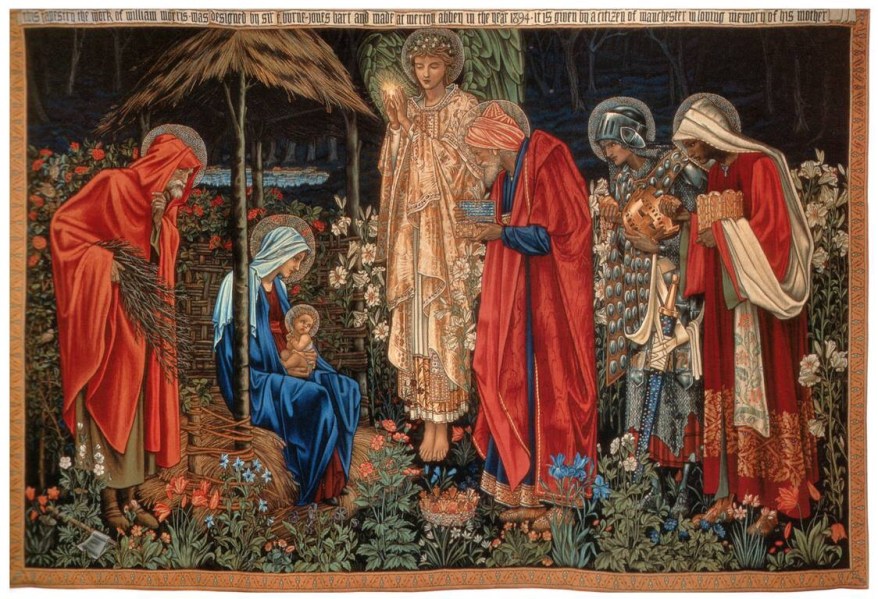
I find it fascinating—don’t you?—that hundreds of years (1450-1500BC) before Jesus’ birth and the appearance of the Magi, a nonbelieving prophet-for-hire would tell of the appearance of the Star, and prophesy the 1st coming of Christ. The star signaled Jesus’ birth to Gentiles. This star moved, it traveled to the West from the East, and the 3, 12, or 30 magi from the East, followed it to Jerusalem, then on to Bethlehem to worship the infant King. (Tradition says there were 3 kings, because of the three gifts, gold, frankincense, and myrrh; but there may have been more, especially since all of Jerusalem was in an uproar over their sudden appearance. Three would seem too few to cause a city-wide reaction. Perhaps there were more and no doubt they were accompanied by soldiers for protection.) So their arrival was probably notable and provoked curiosity and speculation. Instead of fireworks, the star was a heavenly manifestation of something truly big and important going on. Folks in that time and era were much more tuned in to the movements of the stars and the appearance of new ones than many of us are today. For those who studied such things, this was an exciting phenomenon which led to an Epiphany (God-sighting).

We celebrate this Epiphany, the visitation of the Magi to honor Baby Jesus today, Epiphany Sunday. Three of our Scripture passages refer to this event.

A. Our Old Testament lesson, Isaiah 60:1-6, appears to ratify or agree with Balaam’s older prophesy. Isaiah (writing from 750-700BC) states in verses 1-3 Arise, shine, for your light has come and the glory of the Lord rises upon you. See, darkness covers the earth and thick darkness is over the peoples, but the Lord rises upon you and His glory appears over you. Nations will come to Your light and kings to the brightness of Your dawn. The prophet uses the Hebrew prophetic tense that speaks of things which have not yet taken place as though they have already come to be. Just as Balaam appeared to have viewed the star to come as a metaphor for Jesus, so too does Isaiah equate Messiah with heavenly light. He is predicting that the “Son of Righteousness,” Jesus, will arise upon Israel just as the sun rises out of and dissipates pitch darkness. Those were dark times in Israel, as they lived under Roman oppression, just as these are dark times for us. But, Jesus has come as our Redeemer. And He will come again to finally free the earth from the grips of evil.

Additionally, Isaiah foretells the arrival again—at Jesus’ 2nd Coming–of kings bringing gifts. They will bring gold and incense (frankincense), but no myrrh—an embalming compound–as death will have been eradicated.

B. Psalm 72 was written by King David as a prayer for the success of his son, Solomon, as he is crowned David’s successor.

In it, King David describes the traits of the ideal king (around 960BC). While these are the hopes of a proud father, the psalm also describes—at a deeper level—the reign of the coming Messiah: Messiah will judge the accused with absolute justice or fairness. He will crush oppressors and defend the vulnerable. He will live forever. He will ensure prosperity for all. He will rule all the earth. And, in what seems like a foretelling of today’s Gospel, (v.10) The kings of Tarshish [modern Spain], and of distant shores will bring tribute to Him; the kings of Sheba [Yemen] and Seba [Sudan or Ethiopia] will present Him gifts.

C. Our Gospeler, Matthew, was intent on proving to the Jewish people how Jesus fulfilled so many of the Old Testament prophesies about Messiah. In today’s passage (2:1-22), he demonstrates how Jesus fulfilled 4 such predictions:

(1)He points out that Jesus was born in Bethlehem and quotes the passage from Micah 5:2 But you, Bethlehem, in the land of Judah…out of you will come a ruler who will be the shepherd of my people Israel. So the minor prophet, speaking for God, precisely predicted Jesus’ birthplace. He was a contemporary of Isaiah, and so wrote during the same time period. He relates how Jesus had to be taken into Egypt to protect Him from Herod’s jealousy. Joseph is told in a dream to leave Bethlehem by night and take Mary and the baby to Egypt.

(2) Hosea, also a contemporary of Isaiah, had prophesied in chapter 11, verse 1 Out of Egypt I called my son. God had planned in advance to have Jesus escape Herod’s “slaughter of the innocents.”

(3) But Jeremiah (626-586BC) had predicted in chapter 31, verse 15 A voice is heard in Ramah [the vicinity of Bethlehem], weeping and great mourning, Rachel [a personification of Jewish mothers] weeping for her children and refusing to be comforted, because they are no more.

(4) Finally, Matthew tells us they relocated from Egypt to Nazareth, at God’s direction, to fulfill the prophesy that the Messiah would be a Nazarene. One cannot locate that exact prophesy in the Old Testament. However, it is true that Isaiah 11:1 says a shoot will come up from the stump of Jesse; from his roots a Branch will bear fruit.

The passage goes on to describe all the divine attributes of Messiah. Mary and Joseph both were descended from poor, seemingly insignificant branches (shoots) of King David’s dynastic tree. But consider how cleverly the Lord hid Jesus, protected Him–in a place that few would expect to find Him–until it came time for Him to begin His public ministry.

Matthew’s is the only Gospel to describe the visit of the Magi. Luke relates the shepherds’ worship of the newborn king (poor, often disregarded Jews); while Matthew wants us to know that Jesus’ birth attracted the wonder and adoration of Gentile dignitaries. Jesus is a King for us all.

How wonderful of God the Father to have signaled His love for the poor, for His Chosen people, and for we Gentiles, as well.

I don’t know about you but I am struck by the number of times Jesus’ birth was predicted. And not just His birth, but details about His early days; who saw Him and who worshipped Him; Satan’s attempts through Herod and others to eliminate Him; and Father God’s protection of Him.

I’m also amazed about who all prophesied His birth and His role in our lives…So many voices over so many different time periods, but all correct down to every detail. If you ever wonder, as I do occasionally, if all we believe about Jesus is true (doubt is a tool of the evil one), think of these passages and their remarkable consensus, across time and situations, about the reality of Jesus. Who then can doubt?

If I were not a believer and someone walked me through today’s readings, I think I would have to become a believer! To me the Biblical evidence is both convincing and overwhelming. Arise! Shine! For God’s Light has come!

©️2024 Rev. Dr. Sherry Adams

Come, Let Us Adore Him.

Pastor Sherry’s message for New Year’s Day, 2023

Scriptures: Isa 60:1-6; Ps 72:1-14; Eph 3:1-12; Matt 2:1-12

Today is Epiphany Sunday. The word, Epiphany means manifestation (of God), and marks an encounter with God. On January 6th—or the Sunday closest to it—we celebrate the fact that God showed up to eager, Gentile Maji who had traveled hundreds of miles to see and worship Him. These were the 1st non-Jews to come adore the baby Jesus.

Their visit to Bethlehem represents the fact that the birth of Christ was of momentous significance to all people of the world.

A friend told me recently a story of a children’s Christmas Pageant: Young children portraying Joseph and Mary, and a doll for baby Jesus were seated center-stage. Some shepherds and kids dressed as sheep entered from the left and said their lines. But when the 5 year old kings arrived, they developed stage fright and froze in their tracks. Four year old Mary knew what they were supposed to do, and being a bossy little thing, yelled out, “Just come over here and bring your gifts of gold, common sense, and fur.”

Our readings today all want us to realize that God the Father always intended Jesus to show up and be worshipped by all people—not just His Chosen Ones.

Matthew–intent on proving to the Jews that Jesus is their long-awaited Messiah–is the only Gospel-writer to include the story of the visit of the Maji (Matthew 2:1-12). Matthew doesn’t really clarify who they were, or where they were from. Tradition and song refer to them as “kings,” probably based on the 10th verse we recited this morning from Psalm 72 May the kings of Tarshish [Spain] and of the isles render Him tribute; may the kings of Sheba [Yemen] and Seba [Sudan] bring gifts. But the Greek historian, Herodotus, writes that the priestly caste of the Medes [Iran] were called Magi.

We can find mentions of magi also in the Old Testament books of Esther, Jeremiah, and Daniel. Jeremiah and Daniel both describe the Magi as wise and highly educated men who served in the Babylonian [Iraqi] court. They were the doctors, scientists, mathematicians and legal experts of their day. They were also well trained in astronomy, astrology, and magic (Daniel’s specialty was interpreting dreams, a gift from the Holy Spirit).

In fact, the Magi served as advisors to the king. In Daniel 2:48, King Nebuchadnezzar makes Daniel master of all his Magi. Perhaps Daniel, and the other Jews living among them, shared their faith in Israel’s One, True God with their Magi associates. Perhaps they also shared with them prophecies regarding the Coming Messiah. We don’t know for sure, but it is quite possible that they were familiar with the predictions from Numbers 24:17 A star shall come forth from Jacob (meaning Israel), and a scepter (indicative of a king’s rule) shall rise from Israel… and from Micah 5:6 But you, Bethlehem, in the land of Judah, are by no means least among the rulers of Judah; for out of you will come a ruler who will be the shepherd of my people Israel. These 2 passages foretold of a special star to mark a king being born in Bethlehem of Judea.

What we do know for sure is that the Magi came a great distance from the East, bringing gifts to Jesus. They followed a star that led them westward. And then that star supernaturally stopped and remained over the house in Bethlehem to which Jesus and Mary had moved. (After the census had been taken, many returned to their homes elsewhere, so the tight housing problem in Bethlehem opened up, allowing the Holy Family to move out of the stable.) As Matthew describes it, the Magi gifted Jesus with gold, frankinsense, and myrrh.

We really don’t know how many of them there were. Tradition cites three because there were three gifts: Gold for royalty; Frankincense, a fragrant incense used by priests in worship; and myrrh, a pain-killer and a substance used for embalming a dead prophet or king. Their gifts exactly match Jesus’ 3-fold ministries of king, priest, and prophet.

But since their arrival caused a big buzz in Jerusalem and they had no trouble getting in to see King Herod, there were probably more. Paintings from the 2nd-3rd centuries depict 4. Other ancient records cite 12. And, due to the prevalence of highwaymen and robbers who often attacked travelers in those days, they would have been accompanied by armed guards for protection, as well as servants and animal handlers. So surely more than 3 important guys on camels made the trip.

Matthew cites Isaiah’s prophesy, Isaiah 60:1-2 Arise, shine, for your light has come, and the glory of the Lord rises upon you. See, darkness covers the earth and thick darkness is over the peoples, but the Lord rises upon you and His glory appears over you! In chapter 59, Isaiah had predicted that the Redeemer would come to Zion (Jerusalem). But in chapter 60, he uses something unique to Hebrew writing called the prophetic tense. In this tense, the prophet appears to have moved ahead of his prediction, and writes looking back on it as if it has already happened. So, instead of “the Redeemer is coming,” he boldly asserts, “He has come.” Jesus is the glory of the Lord, as well as the light of the world. Even though the times are evil and dark, in His 2nd Coming, Jesus—the revealed glory of God–will also be the light source for the world. Revelation tells us that one of the final plagues God sends on a those who have not been raptured (the Church) or martryed (non-believers who come to believe during the 7 years of the Great Tribulation), in a last ditch effort to bring them to faith, the sun, moon, and stars will disappear. There will be no light at all. Jesus will overcome evil, once and for all, and will reign as the King of the Universe and Light of the World.

Remember, Malachai predicted (4:2) that The day is coming, raging like a forest fire. All the arrogant people who do evil things will be burned up like stove wood, burned to a crisp, nothing left but scorched earth and ash—a black day. But for you, sunrise! The sun of righteousness will dawn on those who honor My name, healing radiating from its wings. You will be bursting with enegy, like colts frisky and folicking (Peterson’s paraphrase of the Bible, The Message, p.1738). Spiritual darkness will be overcome by the Light (power and might) of Christ.

Verse 3 Nations [Gentiles] will come to Your light, and kings to the brightness of Your dawn. Gentile and Jewish believers will flock to Jerusalem to see and worship Jesus when He comes again. This will be the world’s greatest revival! Again, bear in mind that the Church will have been raptured/removed from earth into heaven. Of those who remain on earth, a large percentage of nonbelievers (60%?) will lose their lives during the plagues God will send to earth during the Great Tribulation. Those who will have come to Christ during the Great Tribulation, and who survive those dreadful times, will be the ones who flock to Jerusalem. They will come by land, sea, or air.

In what seems an exact preview of our Matthew passage, verse 6 says, And all from Sheba will come, bearing gold and incense, and proclaiming the praise of the Lord. These God-fearing, Jesus-loving folks will descend upon Jerusalem with gifts for Christ the King. Just as will the Magi at Jesus’ 1st Coming, they will bring gold and incense (perhaps frankincense?). But since there will be no more death, there will be no need for myrrh—and myrrh is omitted.

Paul, in Ephesians 3:1-12, calls himself a prisoner of Christ and the apostle to the Gentiles. He is writing to the Ephesian church from prison in Rome, jailed for preaching the Gospel. He wants the Ephesians and us to know that the Christian Church is a divine mystery–not in the sense of a who-done-it novel–but rather as an innovation of Jesus’, unknown and therefore not mentioned previously in the Old Testament. Furthermore, he asserts that Christ intended the Church is God’s method of reaching the Gentiles, both to demonstrate the love and the wisdom of God.

We demonstrate God’s love by being loving and grace-filled toward others. We demonstrate wisdom by believing in what God has revealed in Scripture and by sharing it with others. This is how we pass on the light of Christ.

Finally our Psalm is a prayer for the new King Solomon written by his father, King David. It is thouight that it was prayed at Solomon’s coronation ceremony. David prays that his son will so love justice and righteousness, that it will be as though Solomon’s rule will reflect the rule of God Himself. Originally, Solomon asked God for the gift of wisdom and he did rule wisely and well for a time, so much so that folks came from all over to hear him dispense wisdom in judgment. However, he later allowed his many pagan wives to influence him away from the Lord. Eventually and sadly, he appears to have abandoned the One True God for idolatry.

David also prophetically expresses his faith in the goodness of the coming Messiah. It is He Who will (v.8) rule from sea to sea and from the River [the Euphrates] to the ends of the earth. Jesus will be a righteous King. All kings of the earth shall bow before Him (v.11). And, (v.14) He will also rescue the needy and the afflicted from oppression and violence.

Aren’t we grateful for Jesus? As we begin the New Year, let’s be mindful of God’s gift to us in Jesus. We may not bring Him gold, frankincense and myrrh—or even gold, common sense, and fur—but we can give Him our hearts, our faith, our obedience; and our gratitude.

Happy New Year! Come, let us adore Him!

©️2023 Rev. Dr. Sherry Adams