Connected to Christ

Pastor Sherry’s message for March 16, 2025

Scriptures: Gen 15:1-18; Ps 27; Phil 3:17-4:1; Lk 13:31-35

Last week, I preached about how to avoid temptation.  I hope a number of you were able to follow Jesus’ example and thwart the evil one as he tried to lead you astray.  This week, I would like us to focus on keeping our eyes on Jesus—and remaining connected to Christ.

Emily Compagno, of Fox News, has written a book called Under His Wings: How Faith on the Front Lines has Protected American Troops (Fox Books, 2023).  Her 1st story is of an Army Colonel she met in Iraq, in 2009, while on a USO tour as an NFL cheerleader.  Col. Tim Karcher was responsible for hosting and protecting Emily and her team as they visited our troops in the war zone to bring greetings from home and to boost morale.  She learned he was a committed Christian who led Bible studies in his home when stateside.  He was also the proud father of 3 girls, and the devoted husband to Alesia, a woman he believed God had given him 20 years earlier.  Emily met him his 3rd duty tour in Iraq.

Three days after Emily had returned to the US, he was in an army vehicle, stopped at a corner in an Iraqi town, when an IED exploded.  He checked to see if everyone else in the vehicle was OK and told his crew both his legs were broken.  The truth was both his legs had been blown off just above his knees!  He died once as they worked on him in the field, and again, several times, as they medivacked him to an Army trauma hospital in Germany, then on home to Walter Reed Army Hospital in DC.  He later wrote to Emily,

“I died there as well.  I remember as it was happening that I was really, really sad.  Not scared, because I knew where I was going.  I was sad to leave my wife, my daughters behind.  I was going to miss out on walking my daughters down the aisle, that kind of stuff.  But I also knew this:  hundreds and hundreds of people were praying for me.  And it was a rough, rough time.  I had all kinds of infections, a fever of 105,” (p.19).

Col. Karcher leaving hospital

He survived yet again to spend 2 years in military rehab in San Antonio, Texas, learning to walk with 2 prosthetic legs.  His last Army assignment, prior to retiring in 2015, was to serve as Director of the Army’s Wounded Warrior Program at Ft. Belvoir in Virginia.  St. Paul writes in 2 Corinthians 1:4 We comfort [others] with the comfort by which we have been comforted.  As a double-amputee, he was the perfect person to encourage other soldiers who had lost their limbs.  (I have included slides of him leaving Walter Reed and also of him walking 100 miles in a fund-raiser to benefit our wounded warriors.)
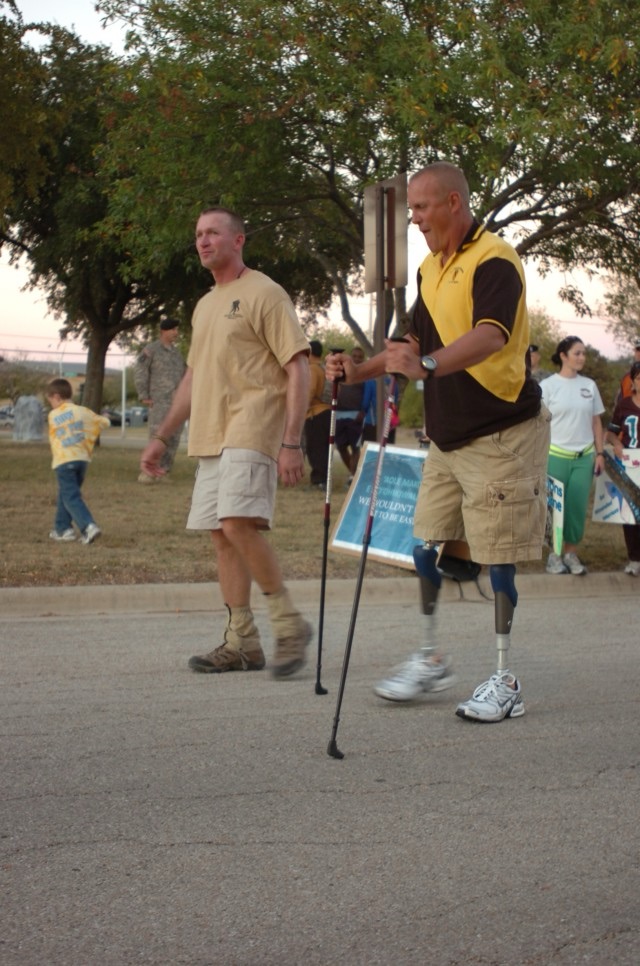
Col. Karcher’s 100 mile walk.

Col. Karcher is clearly a heroic and a determined guy who credits his faith—His connection to Christ–his family, and the prayers of hundreds with pulling him through.  

II. Body▶️Let’s see what our Scripture passages have to say today about having the faith to pull through tough times.

A. In Genesis 15:1-19—in His 4th appearance to him— God tells Abram, who is still awaiting the Child of Promise that He, the Lord, is Abram’s shield and greatest treasure.  In other words, God is Abram’s king or sovereign (shield) Who protects him (as He does us).  The Lord, too, is the best reward Abram, or us, could ever receive—greater even than the Child of Promise.  And, because the Lord keeps His promises, an heir, Isaac, is coming, as are many, many other descendants (v.3)▶️…look up at the heavens and count the stars—indeed if you can count them…So shall your offspring be.  All who believe in Christ Jesus are descendants of Abram, grated in to the line of Jewish believers.  And so also is the gift of property coming to this wandering Aramean, land stretching from the borders of Egypt to the Euphrates River.

In today’s passage, Abram has not yet seen either of these come true, but he believes God.  Verse 6 says▶️Abram believed the Lord, and He [God] credited it to him as righteousness.  Jesus had not yet come to earth to save us, yet God saved Abram due to his faith. Will we see Abraham in heaven?  YES! 

Notice one other point: God reiterates His promises to Abram by literally “cutting a covenant” with him.  In the Ancient Near East at that time, when you made a binding agreement with someone, you literally cut animal sacrifices in two and walked between them.  You were saying that, in effect, if I break this agreement, may I die as have these animals.  God was swearing an oath to Abram on His own life.  Remarkable!  Also, the forms He used to represent Himself (God is Spirit) are symbolic of the coming Christ:

The smoking firepot represents the judgments Jesus will make at His 2nd Coming; the burning lamp signifies Jesus as the light of the world.

We could say, then, that God as the Pre-incarnate Jesus, swore an oath with Abram.

Much later, Abram died a wealthy man with an heir from his own elderly body, Isaac, and a huge amount of property.  Good things come to those of us who trust in the Lord.  Like Col. Karcher, we may not move through our lives without pain and suffering, but Jesus holds our lives in His able hands and blesses us.

B.  King David wrote Psalm 27.  In the first 6 verses, David notes how God provides confidence and encouragement for those of us who love Him.  In verses 7-12, he then goes on to pray for deliverance from treacherous enemies.  Interestingly, these enemies have leveled false charges against King David.  This is so like what we witness today, where we observe people on social media and in politics so ready to fabricate lies aimed at discrediting/running down others.

But in verse 4, David articulates his primary desire:  One thing I ask of the Lord, this is what I seek:  that I may dwell in the house of the Lord all the days of my life, to gaze upon the beauty of the Lord and to seek Him in His temple. King David desires full-on access to God:  He’s got wealth and political power—his throne; he’s got either a land at peace, or military victories; he’s got wives and concubines and a bunch of children; but more than these usual things people yearn for, before anything else, David desires intimate communication/connection with the Lord.  This fervent desire to seek God’s face and to develop a deep relationship with Him is what carries us through hard times and helps us overcome our tough circumstances.

C. Our New Testament passage today is from Philippians 3:17-4:1.  Just prior to today’s reading, in verses 13-14, Paul asserts▶️…but one thing I do: Forgetting what is behind and straining toward what is ahead, I press on toward the goal to win the prize for which God has called me heavenward in Christ Jesus.  What goal is he talking about?  Intimate connection with Jesus.  He wants to be as close to Jesus as possible because (v.20)▶️Our citizenship is in heaven.  This earth is not our final home.  All that goes on here is a testing, a proving ground for rewards given us later in heaven.  Those who don’t pass the tests are what Paul calls (vv.18-19)▶️…enemies of the cross of Christ.  Their destiny is destruction, their god is their stomach [meaning satisfying their physical or their emotional needs], and their glory is in their shame. Their mind is on earthly things.

Paul exhorts us not to be like these kinds of folks.  He wants us to keep our focus on The things of God; And to remain closely connected to Jesus.

D.  And if we were not clear on this, Jesus weeps over Jerusalem, in Luke 13:31-35.  Jesus is praying as He overlooks the city from some height.  He is grieved because he knows what is to come–His betrayal, the trumped up accusations, the fraudulent trials, the beatings, and His crucifixion.  The city He has come to die for will soon reject Him.

He is grieved because he knows that Jerusalem, the capital city of God’s chosen people, was not desperate enough to seek His face.  They preferred to protect their idea of God while rejecting and discarding the One Who was God. 

Jesus has since gone on to glory, while His enemies in Jerusalem and Judea have no doubt met a far worse end.  We know He loves us and died for our sakes.  We know He has hidden us in the shelter of His wings.

On this, the 2nd Sunday of Lent, as we continue our spiritual house-cleaning, we should be asking ourselves, “Are we deeply connected to Jesus?”  The truth is that we need Him.  Consider this poem:

At my lowest, God is my hope.
At my darkest, God is my light.
At my weakest, God is my strength.
At my saddest, God is my comforter.”

Author Unknown

(Kathy Keller, “Stay Close to God,” www.sermonillustrations.com, 12/18/ 23).

This week, let’s focus on getting and remaining connected to Christ.  AMEN!

©️2025 Rev. Dr. Sherry Adams 

True Christian Fellowship

Pastor Sherry’s Message for April 11, 2021

Scriptures: Acts 4:32-35; Ps 133; 1 John 1:1-2:2

            In the early 2000’s, the denomination into which I had been ordained jettisoned Scripture as its foundation.  Those of us who were faithful to the Bible were horrified and decided to meet together—at a large church in Plano, Texas–in an attempt to discern what to do.  As it turned out, the response to the meeting grew so sizeable that they had to move it to the Civic Center in Dallas! At that time, I was serving a large church in Philadelphia.  The Bishop there was a heretic.  He could not say the words of the Creeds because he no longer believed in them.  He would not pray the Lord’s Prayer.  I began to dodge his clergy meetings because he wanted to end each with a celebration of communion to both God and “the goddess.”  YIKES!  This sounded like idolatry to me.   Others went along with it, but I could not.  I realized quickly that my “orthodox beliefs” isolated and marginalized me in that diocese.

Thankfully, my particular parish was Biblically conservative.  They were great folks and I loved serving them.  My boss, however, had by then become both emotionally and spiritually abusive of me.  Knowing the nonbelieving Bishop would like nothing better than to discredit him, I realized I could not look to the Bishop for help.  Here too, in the church I was serving, I felt isolated and alone among the four clergy.

When I expressed a desire to attend the Plano Meeting, my boss wouldn’t permit me to go.  Due to the deterioration in our relationship, I had expected this response.  He changed his mind, however, when I shared with him an email from one of my female seminary professors, urging all ordained women to attend.  Since he had already made plane and hotel reservations for a large contingent from our staff, it was now too late for me to join in with them.  They flew to Dallas with connections through Atlanta; while I made my own arrangements, connecting through Chicago, O’Hare.  Once again, I was feeling lonely and marginalized.

As God would have it, however, there were 2 male pastors aboard whom I got to talk with on our O’Hare layover.  I’d never met them before but I quickly recognized they, too, had been feeling as isolated and alone as I had.

We spent time in the aisle encouraging each other.  When the crew began boarding the connecting passengers, I noticed a significant number of folks in collars.  I watched, amazed, as they poured in. It turned out that many students and faculty I knew from my seminary in Pittsburgh were all on that flight! As they sought their seats, we greeted one another with joy and hugs!  They appeared to be as happy to see me as I was to see them!  I felt like I had come in out of the desert.  I began to weep, realizing how much I had missed the kind of community I had experienced with them in the past.

Even though I was on my way with them to Dallas, I felt like I had come home. I knew in my heart that these were my people.  This was true Christian fellowship!  We were united in our love for Jesus, our love for each other, and our respect and reverence for God’s Holy Word.

This kind of Koinonia or Christian fellowship is the point of our Scripture readings today:

Acts 4:32-35 In these few, short verses, Dr. Luke shares that the post-Resurrection, post-Ascension disciples were operating at a high spiritual levelThey met together daily, speaking of Jesus boldly and openly.  Amazingly—just like the folks I encountered on that Chicago plane–(v.32), All the believers were one in heart and mind.  They were united in their belief that Jesus is Messiah.  And they were determined to tell others the Good News of Salvation.

Additionally—and this is truly amazing—they shared their financial resources with each other, so no one was needy.  Dr. J. Vernon McGee says this probably didn’t last long.  He believes the 1st century Church quickly devolved into normal human selfishness.  But remember, they were initially filled with the Holy Spirit and with great joy.  If I had had much money I would have shared it with those on that plane that day—or at the conference in the 3 days that followed.  We all felt in the grip of something greater than ourselves!  Our prayers, Bible studies led by Rev. Dr. J.I. Packer, and corporate worship–and the unforgettable testimonies we heard–were just sublime!  Like those early disciples, I was just so happy to be there and to be included.

Additionally—and this is truly amazing—they shared their financial resources with each other, so no one was needy.  Dr. J. Vernon McGee says this probably didn’t last long.  He believes the 1st century Church quickly devolved into normal human selfishness.  But remember, they were initially filled with the Holy Spirit and with great joy.  If I had had much money I would have shared it with those on that plane that day—or at the conference in the 3 days that followed.  We all felt in the grip of something greater than ourselves!  Our prayers, Bible studies led by Rev. Dr. J.I. Packer, and corporate worship–and the unforgettable testimonies we heard–were just sublime!  Like those early disciples, I was just so happy to be there and to be included.

Psalm 133 was written by King David.  It is often referred to as a “Song of Brotherhood.”  David compares true, God-centered fellowship to abundant oil and to life-giving water. The precious oil that anointed the first High Priest, Aaron, setting him apart for ministry at his ordination ceremony, flowed extravagantly down his head to his beard, spilling over his collar.  To our modern ears, this sounds like a mess.  But the point is that the oil of blessing was extravagant.  Similarly, the water that begins as dew on the highest mountain peak in Israel, and then eventually flows down to the Jordan River, brings life-preserving moisture to an arid land.  God, through King David, is saying that Christian fellowship can and should be abundant and life-giving.

The 1st heresy arose out of Gnosticism, in about 67AD, just after the death of Paul.  It derived from Greek philosophy (the predominant belief system of the Roman world).  Anything spirit was considered good;but matter/the body/the material world were all thought to be bad.  So they reasoned that Jesus could not have been fully human.  For God, Spirit, Divinity to dwell within a human body was to them unthinkable. This belief left them in a terrible dilemma:  Christianity says Jesus was fully God and fully man.  But they didn’t believe God could or would tolerate being a person.  John is writing to tell the church congregations of the day that this Greek philosophy was an error, a heresy!

The Church stands firm in its belief that Jesus Christ was both fully man and fully God.  In verses 1-2, John reminds us he was an eye-witnessàThat which was from the beginning, which we have heard, which we have seen with our eyes, which we have looked at and our hands have touched—this we proclaim concerning the Word of life.  The life appeared; we have seen it and testify to it, and we proclaim to you the eternal life, which was with the Father and has appeared to us.  He is both asserting Jesus’ humanity and referencing the beginning of his GospelàIn the beginning was the Word and the Word was with God and the Word was God.  John is making it very clear that Jesus was/is God (divine); and that Jesus was really human—after all, John and the others saw Him, heard Him, looked upon and touched Him.

John was also determined to show us how to enjoy true fellowship with God (and with our fellow believers).   Jesus Christ has reconciled us to God through His death and resurrection.  But because we are sinners, or as AA says, “we are all bozos on the bus,” we are going to break relationship with Him and with others from time to time.  We do what we know we shouldn’t.  And we fail to do what we know we should. So, what’s going to get us back into right relationship with God?

John begins to tell us how in verse 5-7 God is light.  In Him there is no darkness at all.  If we claim to have fellowship with Him [the Father] yet walk in the darkness, we lie and do not live by the truth. But if we walk in the light, as He is in the light, we have fellowship with one another, and the blood of Jesus, His Son, purifies us from all sin.  God knows we are going to succumb to the enticements of the world, our flesh, and the devil, from time to time.  But here is the antidote to sin: Honesty and ForgivenessàWe need to honestly take stock of our sins; v.8 If we claim to be without sin, we deceive ourselves and the truth is not in us.  It’s a good practice to daily make a list of where we have fallen short of the glory of God; then check it twice.  AA calls this the 4th stepàWe make a searching and fearless moral inventory.  We bring our sins into the Light of Christ.

Then, v.9 If we confess our sins, He is faithful and just and will forgive us our sins, and purify us from all unrighteousness.  Folks, this is great, Good News! When we fall out of fellowship with God, we just need to quietly and privately tell God we are sorry for having offended Him.

And what happens when we do?  (1) He forgives us!  (2.) Then He purifies us!

So then, John, ever the Pastor says in Chapter 2:1 My dear children, I write this to you so that you will not sin.  But if anybody does sin, we have One who speaks to the Father in our defense—Jesus Christ, the Righteous One.   There is no sin any of us has committed that is too great to be forgiven!  Additionally, John goes on to remind us, we have an Advocate at the throne of the Father in Heaven.

Like a great defense attorney, Jesus Himself pleads our case.  He took our sinfulness at the Cross upon Himself and traded us His righteousness.  Thanks to Jesus, the Father sees us through the lens of Christ.

So how do we live into Christian Fellowship?  We recognize our great need for it. 

If you don’t have it, you can feel spiritually dry, isolated, and marginalized and even depressed.  The church I served in Philly was a wonderful body of believers; but because of my abusive boss and unbelieving Bishop, I felt alone, like I was wilting there.  The plane trip from O’Hare and the Plano Meeting helped me realize the importance of true Christian fellowship to my spiritual and emotional health.

But if you have it, you know you are loved and that you belong to a community of like-minded persons. These people are glad to see you! These folks miss you when you are absent from them, and you miss them as well.

I think we can all thank God for the fellowship we enjoy here at WUMC!  This is a body of believers who loves Jesus and who loves one another.  Let’s hold onto this and continue to live this out.  Thanks be to God for drawing us into koinonia through our Lord Jesus Christ.  Alleluia, alleluia!

©2021 Rev. Dr. Sherry Adams