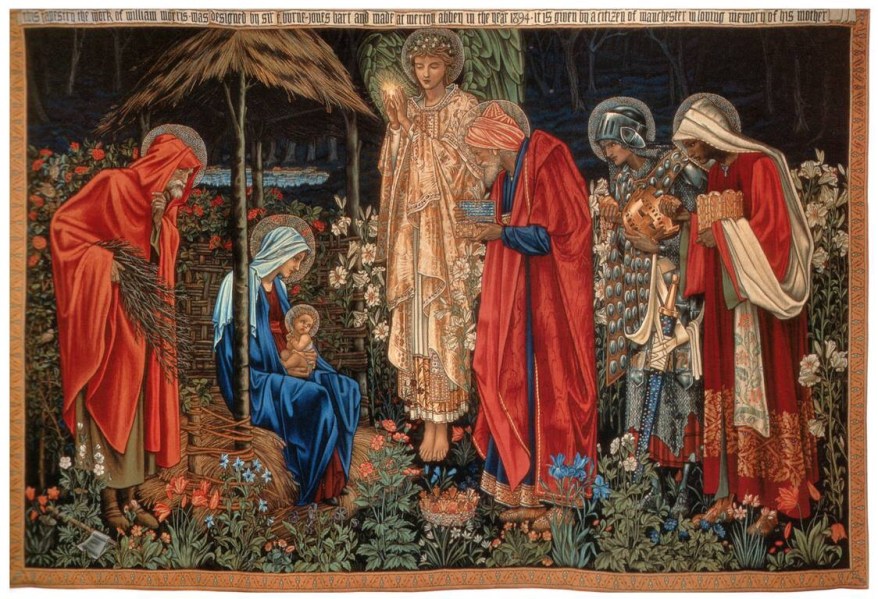
Baby Jesus: The Divine Threat

Pastor Sherry’s message for December 28, 2025

Scriptures: Isaiah 63:7-9; Ps 148; Heb 2:10-18; Matt 2:13-23

We have spent the past week focused on the sweet baby Jesus.

And He no doubt was a sweet and precious infant. What we tend to forget in this assessment, though, is that He was—and still is–a serious threat to the status quo.

Consider this story told by Anglican Bishop NT Wright, a noted New Testament scholar: After he had preached at a large Christmas service in England, he was approached at the door by a famous British atheist. The man told him, “I’ve finally worked out why people like Christmas.” Wanting to know what the man had gleaned from his sermon, Bp. Wright said to him, “Really? Do tell me.” The man replied, “A baby threatens no one, so the whole thing is a happy event which threatens no one.” Recalling the man’s remarks, the Bishop later wrote:

I was dumbfounded. At the heart of the Christmas story in Matthew’s Gospel is a baby who poses such a threat to the most powerful man around [King Herod, and also Satan] that he rids a whole village full of other babies in order to try to get rid of Him. At the heart of the Christmas story in Luke, too, is a baby who, if only the Roman emperor knew it, will be Lord of the whole world. Within a generation His followers will be persecuted by the empire as “a danger to good order.” Whatever else you say about Jesus, from His birth onward, people certainly found him a threat. He upset the power-games, and suffered the usual fate of people who do that.

In fact, the shadow of the Cross falls over the story from this moment on. Jesus is born with a price on His head…in a land and at a time of trouble, tension, violence, and fear…No point in arriving in comfort, when the world is in misery; no point having an easy life, when the world suffers violence and injustice! If He is to be Emmanuel, God-with-us, He must be with us where the pain is. 

(NT Wright, Matthew for Everyone, Part One, John Knox Press, 2004, pp.13-15.)

It’s true, isn’t it? Jesus was born as a tiny, helpless baby, but He also represented a divine threat.

A. The corrupt and wicked King Herod clearly perceived Baby Jesus as a threat to his reign (Matthew 2:13-23). Historians tell us that Herod, a non-Jewish political appointee of Rome, was by the time of Jesus’ birth, thoroughly paranoid. While he did maintain peace and prosperity in Judea, and engaged in ambitious building projects, he also killed anyone he thought might usurp his throne, including his 1st and 2nd wives, 3 of his sons, and his mother-in-law. He gave orders that when he died, the leading male citizens of Jericho should all be slaughtered so that people would be weeping on the day of his funeral. So it is no surprise that he would also command the deaths of any boy babies, aged 2 and under, from Bethlehem to Ramah, a radius of about 10-12 miles.

(J. Vernon McGee, Thru the Bible Commentary, Matthew Chapters 1-13, Thomas Nelson, 1991, p.44.)
Matthew goes on in his narrative, drawing a parallel between Moses and Jesus for his Jewish audience. Just as Moses was rescued from annihilation by Pharaoh’s daughter, Jesus is similarly rescued via a dream sent to his step-father, Joseph. Joseph is told to get up immediately, and take Jesus and Mary to Egypt.

He obediently does so, and probably proceeded to practice carpentry there, as a means to make a living for the family. Jesus is thought to have been about 2 or 3YO when they returned to Israel, instructed to do so by an angel in another dream. To demonstrate again that Jesus fulfills the Jewish prophesies of the Messiah, Matthew then quotes Hosea 11:1-→>When Israel was a child, I loved Him and out of Egypt I called My Son. Matthew wants us to understand that Jesus is the new Moses, both a law-giver and a deliverer.

He will obey His Father’s directives, as Moses did; and He will lead us out of our bondage to sin and death, as Moses led the Children of Israel out of slavery in Egypt.

Jesus’ mission was huge and represented a divine threat to the status quo. Satan was eager to take Him out! King Herod was Satan’s willing tool in this heinous enterprise. But both were thwarted, praise God!

B. Our Old Testament passage, Isaiah 63:7-9, predicts that our good, loving, kind, and merciful God will send a Messiah (1) to be our Savior; (2) to suffer for our sake; and (3) to personally redeem us. No wonder the powers that be would always see Jesus as a divine threat.

C. Our Psalm (148) is a demand for the entire created order to praise the Lord! It begins in the 1st three verses with a call to all the heavenly angels and all celestial bodies—sun, moon, and stars—to praise God. Then it commands all animals and people to do the same. Verse 5 says–>Let every created thing give praise to the Lord for He issues His command and they came into being. Implicit in the psalm is the thought that we praise God both for His creation and for His redemption. John 1:1-4 tells us that Jesus spoke creation into existence. This kind of tremendous power was and is certainly a divine threat to any worldly order.

D. Finally, we have the New Testament lesson from Hebrews 2:10-18. The writer to the Hebrews wants us to realize that Jesus’s status in Heaven was higher than that of angels, but when He took on the likeness of humankind and came to earth, His status fell to lower than that of angels. Nevertheless, God sent Him to us to (v.10)–>…bring many children into glory, and to fashion Him, through His suffering, into…a perfect leader, fit to bring them into their salvation. 

Jesus became a divine threat by becoming a human (verses 14-15)–>Because God’s children are human beings—made of flesh and blood—the Son also became flesh and blood. For only as a human being could He die [God cannot and does not die], and only by dying could He break the power of the devil, who had the power of death. Only in this way could He set free all who have lived their lives as slaves to the fear of dying.

In other words, Jesus presented a divine threat to the devil and to the evil powers and authorities of this world. He had to take on flesh so He could die in our place. As our great High Priest, He offered a once-and-for-all-perfect sacrifice, Himself, to (v.17)-→>…take away the sins of the people. And because He suffered in our place (v.18)->He is able to help us when we are being tested. The divine threat set us free from the clutches of the evil one.

The divine threat, through the power of the Holy Spirit, lives to encourage and strengthen us from His seat of intercession at the right hand of the Father in heaven.

Thank God for Jesus! Thank God that He came to earth as a divine threat…intending to pay for our sins; effecting our rescue from the grasp of the evil one; and setting us free from the strangle-hold of our own sin nature.

As we look to Thursday, the 1st day of 2026, let’s be sure to thank God for sending a divine threat to earth in the disguise of a new born baby. 

Thanks be to God who gives us the victory through our Lord, Jesus Christ. Alleluia, alleluia!

©️2025 Rev. Dr. Sherry Adams

Totally Un-ordinary

Pastor Sherry’s message for Christmas Eve, 2025

As we read the Biblical prophecies and re-experience the journey of the world to Christmas, we tend to forget that the folks in Jesus’ time were just like us—ordinary people.  They were going about their lives just as we do…working, raising kids, cleaning house, cooking meals, visiting with their neighbors, caring for sick relatives or friends, worrying about paying their bills or their taxes, maybe even quarreling with their siblings or their in-laws, etc.  And, hopefully in among all of those activities, they were also loving God and trying to obey Him.  As a licensed Psychologist, I can tell you that–while we have made many technological innovations in the 2000 years since Jesus was born–our human nature has not changed a wit!  Ordinary people back then had many of the same hopes and dreams we do now.  Ordinary people now carry out many of the same functions as they did then.  So I think we can safely say that they were blithely unaware until…“Something truly extraordinary suddenly intruded and changed their lives forever.” (Fairless and Chilton, The Lectionary Lab, Year A, 2013, pp.18-19). Tonight, we celebrate that time that God did something “totally un-ordinary.”  God came calling early Christmas morning.  He broke into human history in a dramatic way:  He announced Himself with a choir of angels, trumpet sounds, and a new, special star in the heavens.  Additionally, He brought us a gift!  The gift was Jesus, God’s only begotten son.  He arrived as a newborn baby, entrusted to two faith-filled, newlywed, young people.  He was and is the gift of God’s love, joy, grace, and forgiveness.  It is in remembrance of this that we give each other gifts at Christmas.

Tonight and in the coming days, let us offer to God our thanksgiving for His great gift of Jesus tonight by recommitting our lives to God, and by living lives of grateful obedience.

Let us pray:  Lord, please help us never to forget the magnificent gift you gave to us in Christ Jesus!  May our hearts overflow with joy and praise!  Come, let us adore Him!  AMEN!

©️2025 Rev. Dr. Sherry Adams

Christmas Joy, All Year Round

Pastor Sherry’s message for December 15, 2024

Scriptures: Zeph 3:14-20; Isa 12:2-6; Phil 4:4-7; Lk 3:7-18

If there is a single word that describes what Christmas is about, it’s JOY!  Some of our favorite Christmas carols include the word:  (1) Joy to the world, the Lord is come; (2) O come all ye faithful, joyful and triumphant…; (3) Shepherd, why this jubilee, why your joyous strains prolong? (4) Good Christian men rejoice, with heart and soul and voice; (5) Joyful all ye nations rise, join the triumph of the skies, with the angelic host proclaim, “Christ is born in Bethlehem.”

But, I wonder how many of us could truthfully say we are filled with joy this morning?  Listening to these wonderful carols can help lift our spirits; however, it’s not always easy to feel joy, is it?  Judge Oliver Wendell Holmes, Jr.—a Supreme Court justice for 30 years–admitted becoming a judge had been his second choice of vocation.  He later said, “I might have entered the ministry if certain clergymen I knew had not looked and acted so much like undertakers,” a sad commentary on the clergy of his day.

(Moody Bible Institute’s “Today in the Word,” 6/88, p.13).

Or as the Christian writer, John Ortberg asserts, “Joy in this world is always in spite of something.”  His statement implies that we have to fight against negative emotions to feel joy.  It also suggests that we have to work hard to overcome every seduction of the world, the flesh, and the devil to experience it. 

(John Ortberg, The Life you’ve Always Wanted, 1997. P.73)

I think a large part of our problem with the emotion joy is that we have mistaken the way we think about it.  We tend to connect it with happiness and believe it is due to our circumstances.  But the truth is that true joy comes from our relationship with Christ Jesus.  The Rev. Will Willamon, former chaplain at Duke University, once said: Real joy is not self-induced. The Christmas story affirms that despite the oppressive political systems and the depressing reality of life, Christians can still be joyful, for they know joy is not about what they do to solve the problems of life, but that it is instead a byproduct of what God does through Jesus Christ. 

(Will Willimon, Christmas sermon, Duke University, 12/25/1994)

Like the peace that passes all understanding (Philippians 4:7), it has much less to do with what is going on in our life situations, and much more to do with the depth of our connection with our Lord.

Additionally, true joy just shows up on our faces.  Someone once stated, “Countenance is a press conference that your face calls to give the state of union of your soul.”  The story is told of a man… who walked by a table in a hotel and noticed 3 men and a dog playing cards.  The dog appeared to be winning.  “That must be a very smart dog,” the man commented.  “He isn’t so smart,” said one of the players. “Everytime he gets a good hand he wags his tail!”

(Kent Crockett’s  Sermon Illustrations, www.kentcrockett.com, 12/24/18)

I guess you could say that it is possible to look at certain people or animals and see joy all over their faces, or in the way they carry themselves, even if you know their life situations are troublesome. 

Our Scriptures this morning point to how we can experience true joy this Christmas—and actually, all year round:

A.  In our Old Testament lesson, Zephaniah 3:14-20, the prophet foretells of a glorious day coming for Jerusalem (and for those of us who love Jesus).  Zephaniah (who prophesied from 640-609 BC) was of royal blood, the great-great-grandson of King Hezekiah—one of the few good kings of Judea.  He was a minor prophet who appeared on the scene during the reign of King Josiah, another good king of Judea, and was one of the last of the prophets prior to the “Babylonian Captivity.”  Unlike his contemporary Jeremiah, who is often referred to as the weeping prophet, Zephaniah is called the prophet of love because of the final chapter of his prophesy.

He spends two chapters warning the people of God’s coming judgment on them for their idolatry and apostasy—for which they were subsequently carried off into the Babylonian Empire for 70 years.  His last chapter foretells of God’s planned restoration and redemption of them.  In His love for them, God is going to bring them back to Jerusalem from where they have been scattered.  How gracious of God to promise them deliverance and restoration even before He punishes them.

The prophet predicts essentially the 2nd Coming of Christ as well, also known as “the Great and Glorious Day of the Lord.”  In verses 14-15 he writes—Sing, O Daughter of Zion; shout aloud, O Israel!  Be glad and rejoice with all your heart, O Daughter of Jerusalem!  The Lord has taken away your punishment, He has turned back your enemy.  The Lord, the King of Israel, is with you; never again will you fear any harm.  And continuing on into verse 17, he comforts us all with this beautiful promise—The Lord your God is with you, He is mighty to save.  He will take great delight in you, He will quiet you with His love, He will rejoice over you with singing.

God, through Zephaniah, wants us to know that He will indeed discipline us, but He will also restore us because of His great love for us.

The writer to the Hebrews affirms this fact in 12:6—…the Lord disciplines those He loves….The Apostle John says it another way, quoting Jesus (John 15:1-2)—I am the True Vine and my Father is the Gardener.  He cuts off every branch in Me that bears no fruit, while every branch that does bear fruit He prunes [this process tends to hurt!] so that it will be even more fruitful.  Paradoxically, the fact that God allows us to go through trials is evidence of His love for us.   Furthermore, if we have the self-discipline and godly insight to recognize this fact, we can actually rejoice in our trials, knowing God is using them to mold and shape us.

B.  Isaiah 12:2-6 is essentially a song of praise to God.  In verse 2 he asserts—Surely it is God who saves me.  I will trust in Him and not be afraid.  He follows this up in verse 6 by assuring us that our response to God’s acts should make us—Shout aloud and sing for joy, people of Zion, for great is the Holy One of Israel among you.  So, we are to rejoice in God because He is our savior; our strength, our song, and our salvation; and because He has done—and will do–glorious things for us.

If we focus our hearts and minds on these things, we cannot help but be filled with joy.

C. In our New Testament lesson, Philippians 4:4-7—Paul actually commands us to rejoice!  We are not to worry about anything, a 2nd command.  Instead, we should submit all our concerns—with thanksgiving–to God through prayer.  Paul is insisting we pray about everything, a 3rd command.  Then, he promises, God’s peace will settle on us and in us and even guard us.  And, if we concentrate, intentionally, only on things that are noble, right, pure, lovely, admirable, excellent, or praiseworthy, we will retain our peace and increase our joy.  In other words, achieving a state of joy is both a choice and a habit.  It comes from disciplining ourselves to look for and celebrate the good.  It is also based upon trusting God, trusting in Jesus. 

Joy is certainly available to us, but it is not found in people’s usual life pursuits:

1. Voltaire, the French philosopher and historian (1694-1778), was an atheist who asserted as he died, “I wish I had never been born.”

2. The British poet, Lord Byron (1788-1824), investigated every possible type of pleasure but concluded before his untimely death at age 36, “The  worm, the canker, and grief are mine alone.”

3. Jay Gould, an unscrupulous, American financier and multi- millionaire (1836-1892), said from his death-bed, “I suppose I am the most miserable man on earth.”

4. Lord Beaconsfield (1804 –1881), also known as British Prime Minister Benjamin Disraeli, later wrote, “Youth is a mistake; manhood a struggle, old age a regret.” 

5. Even Alexander the Great (357-324BC), the young Greek General who conquered the known world of his day, was said to have wept in his tent, because he believed, “There are no more worlds to conquer.”   He died at age 33.

Each of these famous persons realized by the end of his life, that joy does not come from unbelief in God, nor the dogged pursuit of pleasure, money, position, fame, or successful military conquest (i.e., power).  

(Idea borrowed from “Pursuit for Joy,” www.bible.org, 12/14/2018).

D. Fortunately, though, we can all access joy through drawing near to Jesus.  In our Gospel lesson, Luke 3:7-18, John the Baptist teaches two activities that result in joy:  The first is submitting to baptism.

John’s baptism symbolically washes away our past sins.  Jesus’ baptism in the Holy Spirit empowers us to avoid present and future sin.  If you ever saw the movie, “Oh Brother, Where art Thou?” you may remember the scene in which the fugitive convict, Delmer, gets baptized in the river.

Later, in the car with his other 2 convict buddies, he exclaims, “I have been redeemed.  The preacher said so. All my sins and wrongdoings has been wiped away, including robbing that Piggly-Wiggly.”  Another convict says, “Uh, Delmer, I thought you said you was innocent of those charges.”

Delmer confidently replies, “Well, I lied, but I been forgiven of that too.”

Having his sins washed away filled Delmer with joy—as it should for each of us.  

The second activity that can lead to joy is being generous toward and honest with others.  John the Baptist exhorts is listeners to share with those who have needs, to not extort or oppress those less powerful, and to only charge a person their fair tax.  Our Christmas gift exchanges are a great way to experience this kind of generosity.  So are putting money in a Salvation Army kettle, filling Christmas shoe-boxes for Samaritan’s Purse’s Operation Christmas Child, or bringing food to the ill or the grieving.  

May we each draw closer to Jesus this Advent and experience His gift to us of Christmas joy all year round.  Amen!  May it be so!

©️2024 Rev. Dr. Sherry Adams

The Christmas Let Down

Pastor Sherry’s message for December 31, 2023

Scriptures: Isa 61:10-62:3; Ps 148; Gal 4:4-7; Lk 2:22-40

Hopefully you have not experienced it this year but there is a psychological phenomenon called “Christmas Letdown.”

Let me share a story to illustrate: “A number of years ago, when Lou Holtz was at the University of Arkansas, he was taking his team to play a bowl game in Tempe, Arizona. The game was to be played on Christmas day. He was asked how he felt about playing a game on Christmas, rather than being with his family. The coach answered candidly: ‘I would rather be in Tempe. After all, once you have been to church, had Christmas dinner, and opened the presents, Christmas is the most boring day of the year.’”

(Illustration borrowed from www.sermoncentral.com, 12/26/2023.)

YIKES, Lou! Tell us how you really feel! Part of “Christmas Let Down” is the sense of “what now?” As the coach said, what’s left to expect when the gifts under the tree and in the stockings have been discovered and unwrapped? What’s there to look forward to when the festive meal with family and friends has been eaten?

I was working on continuing education to renew my psychology license while I was sick at home these past two weeks. The author of one course I took on addictions said that recovering addicts must not let themselves think of how much they enjoyed their “high.” She called this selective memory “euphoric memory,” and said it could lead a person right back into their addiction. Instead, the recovering addict should discipline their mind to think of all the ways that being clean and sober improve their life.

(D. Poor, “Codependency: Causes, Consequences, and Cures,” Professional Development Resources, 2015, p.33.)

I think this must be the antidote to “Christmas Let Down Syndrome” as well. Rather than focusing on any disappointed expectations of our own from people or events this time of year, we should look to what our God has done already–and will accomplish for us in the future–in Jesus’ 1st and 2nd Comings. This is certainly the perspective of all of our Scripture readings appointed for today.

A. Let’s begin with Psalm 148, a clarion call to all of creation to praise God. The psalmist includes nearly all imaginable created elements and entities, and calls upon them to praise the Lord:

1. Angels and all the heavenly hosts’

2. Sun, moon and stars;

3. Heavens and rain;

4. The oceans and all creatures within them;

5. Lightning, hail, snow, clouds; and wind;

6. Mountains, hills, and all varieties of trees;

7. Wild and domestic animals, as well as birds;

8. All people from rulers to ordinary citizens, young as well as old.

The psalmist expects them all to exalt the Lord. Why? Because the Lord created them all, and because (v.14) He has raised up for His people a horn, the praise of all His saints, of Israel, the people close to His heart. A horn is a figurative term for a powerful ruler; this is a metaphor for Our Deliverer, Jesus Christ. We don’t carry on like disappointed sad-sacks after Christmas because the very date reminds us that God both created us and sent a divine deliverer to save us.

B. The prophet Isaiah (61:10-62:3) assures us that God deserves our praise because of what He has in store for us with Jesus’ 2nd Coming. After Jesus comes again as a righteous, triumphant, all powerful Judge, He will do away with all evil-doers. Oh Happy Day! Won’t that be amazing?! And He will dress those of us living then who love Him in (v.11)—garments of salvation and…a robe of righteousness. We will be as decked out beautifully, as a bride or a groom, wearing especially fine clothes, as befitting such an grand occasion. Additionally, we will be inundated by righteousness and praise…again, Oh happy day!

Chapter 62:1-3 tells us that our Lord yearns for this to happen. Both God the Father and Jesus are looking forward to this time. Jesus will rule the earth from Jerusalem. The Present poor war-torn Israel will finally be at peace, and the beauty of Jerusalem will exceed what it looked like at its height, in the days of King Solomon. In a sense, God will delight over Jerusalem as a bridegroom cherishes his bride.

C. Not only that, but as Paul tells us in Galatians 4:4-7, our status has already improved due to Jesus’ 1st Coming. Jesus Christ has paid the penalty for our sins. Additionally, by redeeming us, He has grafted us into His lineage as sons and daughters of God. He has gifted us with the Holy Spirit, whose job is to lead us into all truth. Because of both Jesus and the Holy Spirit, we are privileged to enjoy a comfortable, intimate relationship with God the Father–so much so that we might call Him Abba or Daddy.

As an aside, notice in (v.4), Paul states that Jesus was—born under law. This means that Mary was a young Jewish woman, who performed all the requirements of the Law around Jesus’ birth and her post-birth purification. I saw on the news this week that some person claimed that Jesus was/is Palestinian because Mary was a Palestinian. No. That’s just not true. This person does not know Scripture. Jesus was born to a Jewish woman and was/is Jewish—though He died to redeem the world.

D. Finally, we see from our Gospel (Luke 2:22-40), that God sent two prophets to attest to Jesus identity as Messiah days after His birth. Luke relates that Jesus is named and circumcised on the 8th day. Circumcision is an undeniable sign of loyalty to God. Additionally, at the end of 40 days, Mary and Joseph present Him at the Temple (6 miles distant from Bethlehem). Women who gave birth were considered ritually unclean for 40 days after the birthing event. Once the 40 days ended, she was required to go and present an offering that signaled her purification. The offering of 2 turtledoves instead of a calf or a lamb attests to how poor Mary and Joseph were. But note: The offering was for Mary, not for Jesus as He was without sin and did not require a sacrifice under the Law. Dr. Luke wanted us to be sure to realize that Jesus’ earthly parents were raising Him in the traditions of their Jewish faith.

While they were in the Temple grounds, they were spotted by a man named Simeon. He was an old man who had served God faithfully for years. The Holy Spirit had told him he would not die until he had seen the Messiah; then the Spirit must have alerted him that Jesus was present and was “the One.” So, he approaches the couple, takes the child and prophesies over Him, saying he is now ready to die because he has seen “Israel’s consolation.” This is another metaphor for the Messiah, who Simeon expects will comfort His people. Simeon’s Holy Spirit-inspired speech is called the Nunc Dimittis, and is almost a word for word, prayerful repetition of Luke 2:29-32—Lord, now let Your servant depart in peace, according to Your word. For my eyes have seen Your salvation, which You have prepared before the face of all peoples; to be a light to lighten the Gentiles, and to be the glory of your people Israel. (The Anglican Book of Common Prayer, 2019, p.46).

The Holy Spirit uses Simeon to announce that Jesus is to be the means of salvation for both Jews and Gentiles. He will be a cornerstone/strong support for some; and a stumbling block for others. Simeon rightly predicted that Jesus would suffer, and he accurately predicted that Mary would suffer as she watched her son suffer and die on the Cross.

Because Jewish Law required two witnesses to affirm a truth in court, the Lord provided Anna as the 2nd prophetic witness. Dr. Luke tells us she was 84 years old, having been widowed after 7 years of marriage. Anna was a major prayer warrior in the Temple. She was there so much that the priests and Levites gave her a room in which to live. She spent her days praising God and praying. She too was told by the Holy Spirit that Jesus was the Messiah. She reaffirmed this to Mary and Joseph and shared with any interested onlookers Jesus’ true identity.

According to our Scripture passages, we have no excuse to give in to “Christmas Let Down” syndrome. Instead in these days after Christmas, our hearts should be elevated by celebration and praise!

Our God has created and redeemed us. He has great, restorative plans for us that will occur when Jesus returns to earth. Meanwhile, we have been saved by Jesus’ sacrificial death on the Cross and adopted by the Father as His children and as co-heirs with Christ. Many famous Old Testament prophets foretold Jesus’ birth and 2 faithful, spirit-led New Testament persons prophets confirmed His identity even as a newborn infant. So, no matter what has happened to us this Christmas Day and following, we can and should continue to be filled with rejoicing! Emmanuel [God with us] has come to dwell among us. Come, let us adore Him.

©️2024 Rev. Dr. Sherry Adams

The Miracle of Christmas

Pastor Sherry’s message for December 25, 2022

Scriptures: Isa 52:7-10; Ps 98; Heb 1:1-4; Jn 1:1-14

The story is told of a man who struggled to believe God would send His Son to earth to redeem us. The man said to himself, “There is no point to a God who becomes man,” he mused. “Why would an all-powerful God want to share even one of His precious moments with the likes of man? And even if He did, why would He choose to be born in an animal stall? No way! The whole thing is absurd! I’m sure that if God really wanted to come down to earth, He would have chosen some other way.”

“Suddenly, the man was roused from his reverie by a strange sound outside. He went to the window and saw a small gaggle of blue geese frantically honking and aimlessly flopping about in the snow. They seemed dazed and confused. Apparently they had dropped out in exhaustion from the flight formations of a larger flock on its way from the Arctic Islands to the warmer climes of the Gulf of Mexico. Moved to compassion, the man tried to “shoo” the poor geese into his warm garage, but the more he “shooed” the more they panicked.

“’If they only realized I’m only trying to do what’s best for them,” he thought to himself. “How can I make them understand my concern for their well-being?” Then, this thought came to him: “If for just a minute, I could become one of them, an ordinary goose, and communicate with them in their own language, they would know what I am trying to do.” And suddenly … suddenly, he remembered Christmas and a smile came over his face. Suddenly, the Christmas story no longer seemed absurd. Suddenly, he pictured that ordinary-looking infant, lying in the manger, in that stable in Bethlehem, and he knew the answer to his Christmas problem: God had become one of us to tell us that He loves us.“ (Borrowed from the TCM website, 12/19/2022, author’s name unknown.)

This Christmas illustration is meant to remind us of the real miracle of Christmas: That Jesus Christ—the sovereign King of the Universe, seated in heaven at the right hand of God the Father, the seat of power–would take on flesh and become one of us in order to speak our language/ to get through to us and to save us from destruction.

Our scripture lessons today leave no doubt that Christmas is a miracle:

A. The writer to the Hebrews (1:1-4) wants us to know that Jesus Christ is superior in position and power to all of the prophets who have lived and to all of the angels in heaven and on earth. Previously, God had spoken to humankind through prophets He ordained to convey His thoughts to us. Less often, He communicated through angelic beings who came with specific messages to particular persons. And, then He made His thoughts known to us through the 45 Holy-Spirit-inspired authors of the Old Testament written over 1500 years. But with the birth of Jesus, the Father has spoken to us through His Son, the full revelation of God: (v.3) The Son is the radiance of God’s glory and the exact representation of His [the Father’s] being, sustaining of all things by His powerful word. Or, as Peterson paraphrases it in his The Message, By His Son, God created the world in the beginning, and it will all belong to the Son at the end. This son perfectly mirrors God, and is stamped with God’s nature. He holds everything together by what He says—powerful words.

B. That theme of the power of The Word/the Divine Logos is spelled out for us in John 1:1-14.

First, let’s look at where John begins. Matthew and Luke each start with Jesus’ birth, Matthew from Joseph’s perspective and Luke, from Mary’s. Mark omits the birth narratives altogether and jumps into the beginning of Jesus’ earthly ministry. But John starts with the beginning of time and space! Verse 1 In the beginning was the Word, and the Word was with God, and the Word was God. Before creation took place, Jesus was present. Jesus, God’s Word made flesh, was with God, distinct from the Father; but also, Jesus, the Word, was God, part of the same deity as the Father. Like the Father, Jesus is fully divine! Verse 2 He was with God in the beginningThe Father and the Son have always co-existed. The Son did not come into being at His incarnation. He, like the Father, has existed forever.

Verse 3 Through Him all things were made and without Him, nothing was made that has been made. John sometimes repeats things to help insure that we don’t miss his point. Jesus made everything. John knows Genesis 1:1 In the beginning, God created the heavens and the earth. He just does not want us to miss the fact that Jesus was present at Creation. You see, the Father conceived the plan; and the Son, the agent of creation, spoke it into existence. Jesus brought all things to life because He is the life-force (the way, the truth and the life, John 14:6)!

Verse 4 What has come into being in Him was life, and the life was the light of all people. John makes a word play, in the original Greek, on life and light. Spiritually speaking, Jesus’ life brings light into ours. Later, Jesus will say, I am the light of the world (John 8:12) and I am the resurrection and the life (John 11:25). So, as God He is both light and life, and willingly offers both to us.

Verse 5 The light shines in the darkness, and the darkness did not overcome it. He came to dispel the darkness, the darkness surrounding us today: unbelief, sin, death, oppression, bondage, violence, the power of evil. But because we have free will, some of us will miss His gift. Some of us will refuse to believe in Him. Some of us will continue to live in spiritual darkness.

Verse 10 But to all who received Him, who believed in His name, He gave power to become children of God. Those of us who believe in Him are not His biological heirs, or heirs through any human effort, but we are spiritual children of God, through Christ’s blood and the Father’s plan. You see, those of us who have accepted God’s perfect gift—Jesus—receive another gift: the privilege to become daughters or sons of God.

As if that weren’t enough, (v.14)🡪The Word [Jesus] became flesh and made His dwelling among us! This is a total break from all non-Christian thought–the agent of Creation becomes a Creature! Jesus encased Himself in baby flesh and comes to earth as one of us. If I were in charge, I would have had Him come as a King or as a victorious general. But God, in His wisdom, has Him arrive as a vulnerable and totally dependent, nonthreatening babe.

There has never been—nor will there ever be–a human as important as Jesus Christ! He is fully God, and He is fully human. What a miracle!

C and D.Our final two readings look forward to Christ’s millennial reign on earth, His second coming. The Isaiah passage (52:7-10) speaks to what it will be like when what we pray in the Lord’s Prayer comes to passThy kingdom come. Jesus’ rule and reign on earth will be fabulous! Peace, justice, mercy, grace and forgiveness will characterize the behavior of all people. There will be no more wars, murders, illness, death, sexual assaults, human trafficking, slavery, injustice, lying, fraud, etc. Can you even imagine such a state? How wonderful! No wonder everyone will experience great joy!

Our Psalm too (98) celebrates the righteous reign of Christ. Verse 1 Sing to the Lord a new song for He has done marvelous things! The psalmist predicts how joyous celebration will begin in the congregation (Christian Church and Synagogue of Messianic believers); then it will spread to all humans; and finally will impact all of creation. Remember, God cursed the serpent and the ground at the Fall, but not the people. Paul tells us (Romans 8:20-22) For the creation was subjected to frustration, not by its own choice, but by the will of the One who subjected it [God the Father], in hope that the creation itself will be liberated from its bondage to decay and brought into the glorious freedom of the children of God [waiting on the Second Coming of Jesus Christ].

At His 2nd Coming, the Righteous Judge will set all things right. That is a miracle for which I can hardly wait!

So we say, “Happy Birthday, Lord Jesus, on this Christmas Day, 2022!” Thank you for taking on flesh and dwelling among us! Thank you for saving us from the penalty for our sins! Today,

“May our Christmas gifts remind us of God’s greatest gift, His only Son.
May our Christmas candles remind us of Him who is the “Light of the world.”
May our Christmas trees remind us of another tree upon which He died.
May our Christmas cheer remind us of Him who said, “Be of good cheer.”
May our Christmas feast remind us of Him who is “the Bread of Life.”
May our Christmas bells remind us of the glorious proclamation of His birth.
May our Christmas carols remind us of the Son of whom the angels sang, “Glory to God in the Highest!”
May our Christmas season remind us in every way of Jesus Christ our King!”

(Again, borrowed from the TCM website, 12/19/2022, author’s name unknown.)

Blessed Christmas to each one of you!

©️2022 Rev. Dr. Sherry Adams

Christmas Eve 2022

Pastor Sherry’s message for December 24, 2022

Tonight you have heard read 8 passages (Gen 3:8-15; Isa 9:2-7; Isa 35:1-10; Mic 5:2-4; Lk 1:26-38; Lk 1:59-79; Tit 2:11-14; and Lk 2:1-20) all foretelling or describing Jesus as our promised Messiah. They all reference Him in some way. Most were written hundreds of years before His 1st Coming, and some even pertain to His 2nd Coming. Tonight, at this candlelight service celebrating the eve of His birth, I want to focus entirely on the Genesis passage, Genesis 3:8-15.

It might surprise you to find intimations of Jesus from the very beginning of recorded time. You see, God created humans knowing we could never be (by our own efforts) holy enough, obedient enough—this side of heaven—to dwell in His presence. Like Adam and Eve, we fall into sin too easily. We don’t know how many days or weeks Adam and Eve hung out with God in the cool of the day before they sinned. Scripture suggests that their meetings together had become a habit. However, one of my seminary professors, recognizing the seductive allure of sin and our own weaknesses, thought they probably did not last even a day before capitulating to sin (eating the fruit from the forbidden tree).

So, even as He was pronouncing their punishment, God revealed His redemptive plan for human kind. This was not a plan B, but His plan from the foundation of the earth. He loved us so much that He and Jesus agreed Jesus would come to earth and take the penalty of our sins upon Himself.

His shed blood washed away our sins, past, present, and future. In a magnificent exchange, He took our sinfulness and gifted us with His righteousness. We are cleansed from our sins by Jesus’ selfless actions.

Our Genesis passage is thus called by theologians the Proto-Evangelion —The Gospel in the Old Testament, written centuries before the New Testament Gospel accounts unfolded. Because he seduced Adam and Eve, Satan is cursed (v.14) by God. Satan is called a serpent in Genesis and we think snake. However, some biblical scholars believe Satan is a “shape-shifter” (able to take on different shapes at will) and probably originally appeared as a dragon (which is how he is characterized in the book of Revelation). The fact that God tells him he will eat dust all the days of his life means he is ultimately defeated. It also means that God effectively “clipped his wings.” God says that His followers and the serpent will be at continuous war with each other. Satan will think he has won this conflict when he wounds our Lord (at His trials and on the Cross); but, Christ’s substitutionary death on the Cross—and His subsequent resurrection–will be the means by which Jesus demonstrates His victory over death and Satan. It will appear as though the snake has bitten the Lord’s heel. However, Jesus, the seed of the woman [Mary] will crush Satan’s head. Again, until Jesus’ 2nd Coming, humans and the devil will, throughout all history, struggle against each other. There is a reason for our difficulties here on earth. We are encouraged to power through with faith. (Later, Jesus says, In this world you will have trouble, but fear not for I have overcome the world—John 16:33.)

But God the Father, in His love and compassion for us, engineered His divine rescue plan. Jesus Christ, who came to earth the first time as a helpless, vulnerable baby to save us, will come again in all His power and glory, and defeat Satan for all time.

At Christmas, and at all other times, let us express our gratitude to God…who gives us the victory through our Lord, Jesus Christ. Alleluia, alleluia!

©️2022 Rev. Dr. Sherry Adams

Christmas Eve Lessons and Carols

Pastor Sherry’s Christmas Eve Message

Scriptures: Gen 3:8-15; Isa 9:2-7; Isa 35:1-10; Mic 5:2-4; Lk 1:26-38; Lk 1:59-79; Titus 2:11-14

Some of us will leave here tonight to gather with family and open Christmas gifts. For others, your practice will be to wait until tomorrow, Christmas Day, to unwrap your presents. Once, when my husband was on a naval cruise to the Mediterranean, I left the tree up and presents unwrapped until he got home on Valentine’s Day! Whatever your tradition, I want to draw your attention to the fact that the original Christmas-gift-giver was God the Father. As Scripture says (Isaiah 9:6), For unto us a child is born, unto us a Son [God’s Son] is given….God sent His only begotten Son on a rescue mission to earth. The Father gifted us because of His great love for us. At the Father’s command, Jesus–the Person of the Trinity who spoke creation into existence—“clothed Himself in humanity,” took on human flesh. He arrived among us as a “wee baby,” an expression we use here in the South. Yet He was entrusted with a gigantic mission: to save us sinners from the penalty for our sins. And He completed that mission gracefully and completely, didn’t He?

Perhaps this Advent Season, you have heard played or sung a 12th century French carol called, “The Friendly Beasts.” In the song, each of several animals (that might have been found in the stable where Jesus was born), sings to the Christ child, presenting Him a gift to bring Him comfort. The lyrics are as follows:

Jesus, our Brother, strong and good…

    Was humbly born in a stable rude,

    And the friendly beasts around Him stood, 

    Jesus, our Brother, strong and good.

    “I,” said the donkey, shaggy and brown,

    “I carried His mother up hill and down;

    I carried His mother to Bethlehem town.”

    “I,” said the donkey, shaggy and brown.

    “I,” said the cow all white and red,

    “I gave Him my manger for His bed;

    “I gave Him my hay to pillow His head.”

    “I,” said the cow all white and red.

    “I,” said the sheep with curly horn,

    “I gave him my wool for His blanket warm;

    “He wore my coat on Christmas morn.”

    “I,” said the sheep with curly horn.

    “I,” said the dove from the rafters high,

    “I cooed Him to sleep so He would not cry;

We cooed Him to sleep, my love and I.”

    “I,” said the dove from the rafters high.

    Thus every beast by some good spell, 

    In the stable dark was glad to tell

    Of the gift he gave Emmanuel,

    The gift he gave Emmanuel. 

The perspective is interesting, isn’t it? Like the little drummer boy in a more modern song, each friendly beast presents the only gift he/she has to set before the newborn king. The magi will show up later and present more costly gifts. But the first Christmas gifts were brought to Jesus…it was His birthday, after all. People and critters brought Him the best they had.

Some might think it’s childish or fanciful to think of animals gifting the Christ-child, but consider this:

a. In Numbers 22:28-30, the donkey belonging to Balaam, the pagan prophet, tells him a sword-carrying angel blocks their way (that donkey possessed more spiritual discernment than his master!).

b. Later, John reports that Jesus, during His earthly ministry, told the Pharisees that if He were to tell His disciples not to praise Him, the stones would cry out His name (Luke19:40).

c. Paul teaches in Romans 8:19: The whole creation [everything, hills, oceans, trees, animals] waits in eager expectation for the sons of God to be revealed [at the end of time]….Jesus Christ came to set humans free from the death penalty for sin—and He did! But animals and inanimate things are still held captive to decay.

d. Finally, Gabriel tells Mary, in Luke 1:37: For nothing is impossible with God! So, the animals who stood in the presence of the tiny King of the Universe may have truly known who He was. Giving Him gifts is improbable, perhaps, but not impossible.

If you were to present a gift to Jesus, what would it be? Can you bring Him the gift of your faith in Him? How about your willingness to obey Him? Are you ready to read Scripture regularly, to get to know Him better? How about spending more time with Him in prayer? Share what’s on your heart and mind, but also listen for His response. How about living a life-style pleasing to God? Can you give Him your obedience? Can you give Him your heart? The God of love wants our heart. The God of love wants our love.

This night, Our Savior has drawn near. Like the animals in the song, let’s remember a gift for baby Jesus. Then, come, let us adore Him.

©2021 Rev. Dr. Sherry Adams

Birth Announcements

Pastor Sherry’s Message for Christmas Eve

Scriptures: Isa 9:2-7; Luke 2:1-20

I ask you to think tonight about birth announcements.

Remember when we used to get a small card in an envelope, telling us of a birth?  It would have a cute motif (bunnies, chicks, teddys, pink for a girl, blue for a boy); the baby’s name; his/her birthdate, length, birth-weight; and the tired but proud parents’ names.  Nowadays, the news appears in a more dramatic style:  Typically there is a picture of the newborn, or perhaps one of the baby and mom, or of the parents with the newborn.  My personal favorite was of a mom tenderly holding the baby’s tiny hand in her own.

Again, we are given all of the pertinent info, and we celebrate with the family who has brought a new little one into the world.

Now, contrast this with Jesus’ day, when they lacked cell phones that could take pictures, Shutterfly to reproduce them as cards, or even other kinds of cameras with which to capture a birth.  Scripture has only words with which to mark for us the sacred and phenomenally important event of Jesus’ birth—and yet, we get the point and are moved, aren’t we?

All of our Scripture passages tonight either foretell or describe Jesus’ Coming/Advent; but I am going to focus on two:  Isaiah 9:2-7 and Luke 2:1-20.

Isa 9:2-7 was written between 700-750 years before Jesus’ actual birth.  In it, the prophet predicts who Jesus will be/what He will accomplish.  Notice, he doesn’t mention anything about his weight or length.  Our Luke passage tells us His earthly parents are young, poor, and homeless.  Since Joseph was taking them to his place of birth, Bethlehem, we might assume he had some kinfolk there.  But apparently he did not (Perhaps they had died or moved away).  Not one family member was present to provide shelter for them in a guest room.  They had to make do in a shed/stable.

Isaiah focuses instead on the fact that Jesus (later known as the “Light of the World”) will bring light to a spiritually dark region, Galilee of the Gentiles.  The area around Nazareth was known for belief in a large variety of pagan gods.  As J. Vernon McGee (my favorite Bible commentator) says, “They had a lot of religion, but they never had Christ” (Luke, p.94).

Then Isaiah jumps ahead to Christ’s Second Coming, telling us the characteristics and the roles Jesus will demonstrate when He comes again as King of Kings and Lord of Lords: 

(Verse 6), and the government will be on His shoulders.  This tells us that Jesus will be strong.  He will have the strength, intelligence, and leadership ability to rule/govern the whole earth.  Wow!

He will be called Wonderful…We will call Him Wonderful because, like His heavenly Father, He performs wonders.  He healed the sick and the broken-hearted.  He paid the penalty for our sins.  He restored  (reconciled) us to a good and an intimate relationship with His Father.  These are all significant because we could not have accomplished these things on our own.

(He will be called) Counselor….  He never said to His guys, “Fellows, what do you think I should do now?”  He did not need the counsel of another, because He was/is exceedingly wise.

(He will be called) Mighty God….  Like the Father, He is known as El Gibbor.  This means He is omnipotent, all powerful.

(He will be called) Everlasting Father….  He did not give birth to children from His own flesh.  But, again, like the Father, He is known as Avi adàthe Father of Eternity.  He is the creator of all things, even time, and events far off.  The Apostle John tells us in John 1:3, Through Him all things were made; without Him nothing was made that has been made. AndPaul adds in Colossians 1:16, For by Him all things were created: things in heaven and on earth, visible and invisible, whether thrones or powers or rulers or authorities. All things were created by Him and for Him.  Like a Father, He loves, provides, protects, and disciplines us.

(He will be called) Prince of Peace….In the Hebrew, He is called Sar-Shalohim. He will initiate peace and He will sustain peace.  Truly, there can be no peace, no lasting peace, until Jesus rules the earth.  When Jesus comes again, He will accomplish extraordinary things!

Luke’s passage (2:1-20) then records the circumstances surrounding Jesus’ birth event.  While we celebrate Jesus’ birth in toasty, comfortable homes, Jesus, Mary, and Joseph huddled in humble, uninsulated animalhousing.  While the future King of Kings and Lord of Lords should havehad the comforts of an opulent and warm palace, his quiet, humble arrival was nevertheless celebrated in a most spectacular way!  First one angel appeared to provide a spectacular birth announcement!  Today in the town of David a Savior has been born to you; He is Christ the Lord.  Next, the angel invited the shepherds to come and see the One who would become Our Great Shepherd.  Then suddenly, loads more angels show up!  They form a heavenly chorus and proceed to praise God and sing…Glory to God in the highest, and on earth peace to men [and women] on who His favor rests.

What a birthday celebration!  The shepherds do trek off to see the newborn Christ.  They are delighted with His birth!  After worshipping Him, they go tell everyone they know (quicker than a mailed announcement)–spreading the word that Messiah had come.

Tonight (Christmas Eve) and tomorrow (Christmas Day), let’s be aware of what we are celebrating–the birth of Jesus, our Messiah.  Over and over, God had his prophets foretell His coming.  Then, finally, (drum roll, please!) He arrives in the wee dark hours of Christmas morning.  Christ is the reason for the season.  Come, let us adore Him!

©Rev. Dr. Sherry Adams 2020