Family Reunion

Pastor Sherry’s message for August 20, 2023

Scriptures: Gen 45:1-7, 25-28; Ps 133; Ro 11:1-2a, 29-32; Matt 14:10-28

Amy Peterson writes, “…I started reading The Kindness of God by Catholic theologian and philosopher Janet Soskice. In her examination of the etymology of the word kindness, Soskice helped me see it for the first time as a strong virtue rather than a weak one. “In Middle English,” she writes, “the words ‘kind’ and ‘kin’ were the same—to say that Christ is ‘our kinde Lord’ is not to say that Christ is tender and gentle, although that may be implied, but to say that he is kin—our kind. This fact, and not emotional disposition, is the rock which is our salvation.” I paused after reading this sentence to try to take it in, to try to peel the sentimental layers off my definition of kindness and replace them with this fact: to be kind meant to be kin. The word unfolded in my mind. God’s kindness meant precisely that God became my kin—Jesus, my brother—and this, Soskice said, was a foundational truth about who I was. Not only that, but for speakers of Middle English, Lord had a particular meaning—a lord was someone from the nobility, the upper social classes. To say “our kinde Lord” was to say the difference in social or economic status between peasants and nobility was also erased through Jesus the “Lord” being of the same “kinde” as all, landowners and peasants alike. Jesus erased divisions that privileged some people over others.”

(Amy Peterson, Where Goodness Still Grows: Reclaiming Virtue in an Age of Hypocrisy, Thomas Nelson, 2020.)

The theme of our Scripture readings today is “Divine Kinship” or “Family Reunion.”

A. It begins with our Genesis reading (45:1-7, 25-28). After having lived in Egypt for about 22 years, Joseph has recognized his brothers and now reveals himself to them. Why would they not have recognized him?

By this time, he did not look Hebrew. They were bearded but he was clean shaven. Additionally, he was wearing an Egyptian wig (Egyptians shaved their heads, due to problems with lice, and were noted for wearing elaborate wigs). There was also his Egyptian style of dress and perhaps an arm bracelet and a jeweled collar signifying being a high Egyptian official. The last time they had seen him, he had been a gangly boy of 17; now he’s 39 years old and no doubt looked very different from the way he had in their last encounter. They also would have heard him speaking Egyptian/Arabic, but talking with them through an interpreter (even though he understood Hebrew). Finally, they were not expecting to see him again since slavery was usually implied a death sentence.

Unbeknownst to them, he has put them through two tests to see if they have changed in the intervening twenty two years. First, he has them leave Simeon behind and promise to bring back Benjamin, his full brother. He is checking to see how honest they are now. They had betrayed him. They had no doubt lied to their father. Will they sacrifice another brother to get what they want? Second, they return and bring back Benjamin, but Joseph has his favorite cup put into Benjamin’s bag of grain, and has his servants accuse their father’s new favorite of theft. Joseph wants to know if they have come to grips with what jealousy cost them in the past. Are they more loyal to Benjamin than they had been to Joseph? Have they developed more compassion for their aging and grieved father?

Apparently so because Judah, their leader, steps up and offers himself (and even his children) in place of Benjamin. Judah recognizes this dilemma is God’s punishment for what they had done to Joseph. He and the others cannot bear to imagine Jacob’s grief over losing Rachel’s only other son, Benjamin.

So, satisfied that his ten half-brothers have truly undergone a moral transformation, he reveals himself to them as their long, lost brother, Joseph. At first, they can’t believe it is him. Then they fear his retribution. But in a truly Christ-like way, he reassures them, [Peterson’s The Message, p.93] am Joseph your brother whom you sold into Egypt. But don’t feel badly, don’t blame yourselves for selling me. God was behind it. God sent me here ahead of you to save lives. There has been a famine in the land now for two years; the famine will continue for five more years—neither plowing nor harvesting [will take place]. God sent me on ahead to pave the way and make sure there was a remnant in the land, to save your lives in an amazing act of deliverance. So you see, it wasn’t you who sent me here but God. He set me in place as a father to Pharaoh, put me in charge of his personal affairs, and made me ruler of all Egypt. God uses Joseph to save his father, Jacob/Israel, his brothers, and his whole extended family (a total of 90 people). But Joseph’s wisdom also saves thousands, perhaps millions of Egyptians as well as untold, unnumbered, other Gentiles. What a fabulous and far-reaching family reunion!

B. In Psalm 133, King David continues the theme of family reunion. Verse 1 celebrates —How good and pleasant it is when brothers [and sisters] live together in unity! There is no back-biting, no sarcasm, no jealousy; no murderous rage, no hidden agendas. Instead, such family members experience love, support, and acceptance.

He goes on to mention two metaphors for how rich a blessing this could be: (1) a generous supply of anointing oil, representing empowerment of the Holy Spirit; and (2) abundant dew, highly desired and valued in an arid climate. As troubled and complex as were the kinship relationships in King David’s family, this psalm sets out his longing for this kind of God-inspired love, cooperation, and blessing among brothers and sisters.

C. In Romans 11:1-2a, 29-32, Paul continues his case for the Jewish people. True, most at that time, rejected Jesus as their Messiah. But Paul is adamant (v.1) that God has not rejected them, His Chosen People. They have rejected Him but He has not washed His hands of them. Instead, the Lord has a plan for bringing them to a saving knowledge of Christ.

Back in verses 25-26, he wrote —the harvest of the Jews will come after…the full number of the Gentiles has come in. And so all Israel will be saved…. Just as God has been merciful to us, He too will have mercy on the Jews. Many students of the book of Revelation believe the main purpose of the Great Tribulation (assuming the Church has already been raptured) is to turn a massive number of Jews into Jesus-followers. What a grand family reunion that will be!

D. Finally, in our Gospel lesson (Matthew 15, also Mark 7), Jesus delivers a new doctrine and graciously responds to a Gentile woman.

The new teaching is on moral uncleanliness. Yes, it’s a good health practice to wash your hands before eating—but hand-washing has only to do with the physical. Instead, it’s what comes out of one’s mouth that demonstrates one’s spiritual condition. Our moral or spiritual cleanliness—our heart attitudes–are revealed by what we say. This is why we want to work hard to eliminate cussing and gossip and lying and slander from our daily speech. He calls the rule-bound religious leaders of the Jews blind guides, and appears—by this point–to have given up on appealing to them further.

In fact, He leaves the country for the first time, venturing North into Tyre and Sidon (cities in Phoenicia). No doubt He wants a time-out from his Jewish adversaries. But almost immediately, He encounters a persistent Syro-Phoenician, Canaanite, or Gentile woman. Remember, He says (v.24) was sent only to the lost sheep of Israel (not Gentiles).

She calls Him (v.22) —Lord, Son of David. She knows He is a descendant of King David. But she is an outsider, not a member of the family. She is an ethnic outsider; she is a religious outsider; and her gender, in those days, made her an outsider as Jewish rabbis would rarely have spoken directly to a woman.

But she has a demonized daughter that no one has been able to heal, and she is desperate. She is begging Him to heal/deliver her child. Jesus makes the point that she does not belong to “the family.” He came to feed the “children of Israel” (v.26)It is not right to take the children’s bread and toss it to the puppies [the Hebrew word here means not adult dogs but the diminutive, puppies]. He is essentially saying, just as in a family, there is an order here —The children (Israelites) eat first; Then puppies get fed, but not from the table and not until the kids are done. He is not telling her she cannot expect help from Him, but rather that there is a set of priorities to His ministry.

She gets what He is saying, steps into His metaphor, and reminds Him (v.27) —…but even the puppies eat the crumbs that fall from their masters’ table. She knows she does not have a legitimate place at the Jewish table. But even as a nonfamily member, she has faith that Jesus can provide enough that some leftovers will be available to her and to her daughter. Notice, she doesn’t say, Give me what I deserve due to my goodness or my rights, as many today might demand. Instead, (as Timothy Keller asserts in his book King’s Cross , Dutton, 2011, p.89), she implies, “Give me what I don’t deserve on the basis of Your goodness—and, please, I need it right now.”

Jesus commends her faith (The Message, p.1775) —Oh, Woman, your faith is something else. What you want is what you get! Right then her daughter became well. She entered into His metaphor and responded with belief in Him. Because of her faith, He made her a member of His family.

There is no reason for us to ever feel like we are alone or outsiders. God’s family is made up of both Jewish and Gentile believers. Our weekly worship service is like a big family reunion. We who believe in Jesus Christ are members of God’s family. Come, every Sunday, to be with people who love Jesus and who love you. Amen!

©️2023 Rev. Dr. Sherry Adams

After Suffering Comes…

Pastor Sherry’s message for August 13, 2023

Scriptures: Gen 37:1-28; Ps 105:1-22, 45b; Ro 10:1-15; Matt 14:22-36

In a new twist on an old story, a young woman texts her parents from college:

Dear Mom and Dad,

Just thought I’d share with you my new plans: I’ve fallen in love with a guy named Jim. He quit high school in the 11th grade to get married. About a year ago, he got divorced. We’ve been dating for about 2 months and just decided to get married. I will be moving in with him shortly as we believe I’m pregnant. Don’t worry, though. I dropped out of all my classes last week, but I do plan to finish school at some point in the future. Unfortunately, I’ve been smoking a lot of pot, but intend to quit if it turns out I am expecting.

About 10 minutes later comes a second text:

Mom and Dad,

I just want you to know that everything I’ve texted you so far today is false. NONE of it is true! But, it is true that I made a C- in French and failed my Math class. And it’s also true that I will soon need a lot more money for tuition. Love you! Your Daughter.

(Chuck Swindoll, The Tale of the Tardy Oxcart, Word Publishing, 1998, p.445.)

I hope you’ve never been this frightened, or this manipulated, by someone you love. This devious, scheming young woman shocked then reassured her parents! It’s a sales technique: 1st ask an impossible “big,” then 2nd follow that up with a smaller, more reasonable request (people then tend to acquiesce to the smaller “ask”). Probably without meaning to, she was also illustrating how often, in the Christian walk, we have to endure suffering before we either come into an understanding of why God allowed difficulties to come our way, or enter into a time of blessing.

This truly is the focus of our Scripture lessons today.

A. Our Genesis passage (37:1-12) begins the Joseph narrative.

More chapters of Genesis are devoted to Joseph than to Abraham, his great grandfather; to Isaac, his grandfather; or to Jacob/Israel, his father. One reason is that he represents the nation of Israel. Remember, the name Israel means he who struggles or wrestles with God and with men and who comes through or prevails (though, as I pointed out last week, who can prevail against God?). Joseph endures some very tough times, but, because he is basically a righteous man, he is eventually blessed by the Lord. He also becomes a source of blessing to his family, his nation, to the Egyptians, and to unknown numbers of other Gentiles trying to survive the famine. It is through Joseph that the Lord moves the future leaders of the twelve tribes of Israel to Egypt, and ultimately sets the stage for the Exodus.

A second reason Joseph gets so much biblical coverage is that, as J. Vernon McGee writes, “There is no one in Scripture who is more like Jesus in his person and experiences than Joseph.” (McGee, Through the Bible Commentary: Genesis, Chapters 34-50, Thomas Nelson Publishers, 1991, p.43.):

1.) Both births were miraculous;

2.) Both were especially loved by their fathers;

3.) Joseph was set apart by his special coat, while Jesus was set apart by his sinlessness;

4.) Both were ridiculed for asserting they would one day rule over their brethren;

5.) Both were obedient to their fathers at considerable cost to self;

6.) Both were sent by their fathers into danger;

7.) Both were hated and rejected by their brothers (in Jesus’ case, His countrymen);

8.) Both redeemed/saved their brothers.

Our passage today provides the backstory for Joseph’s betrayal by his brothers. The 10 (half) brothers born to Leah and the 2 concubines were murderously jealous of Joseph. They resented their father’s favoritism. It’s never good to favor one child over another. The favored one can ultimately feel guilty or develop an unhealthy arrogance; the non-favored becomes resentful and can be plagued by low self-esteem. Jacob should have known better since his father, Isaac, had favored his twin, Esau. As a licensed psychologist, I can tell you I have seen this again and again: without Jesus, we later become or re-enact as an adult what we hated as a child. These brothers resented his dreams of future grandeur. They also despised the fact that their oblivious father tasked Joseph with ratting them out!

So they plot to kill him, their own flesh and blood. Reuben, the by- now discredited eldest, attempted to rescue him, thinking he would recover Joseph, return him to their father, and perhaps regain some favor with dad. Judah, the one to whom the leadership of the clan had passed after Reuben’s gross disrespect of Jacob, talked them out of murder and into selling Joseph into slavery—a likely avenue to death, anyway, but without having bloodied their hands. These dreadful brothers then sell Joseph to Ismaelite traders (descendants of Abraham’s son, Ishmael) for 20 shekels (another foreshadowing of Christ, who was betrayed for 30 pieces of silver.)

B. As our Psalm (105:1-22, 45b) recounts in verses 17-22, God intended Joseph’s descent into slavery—They bruised his feet with shackles, [and] his neck was put in irons—as well as his later rise to prominence—Till what he foretold [in his two dreams] came to pass, till the word of the Lord proved him true. King David, the assumed author of the psalm, relates how Pharaoh freed Joseph and made him master over all of Egypt in the time of a devastating 7 year famine. He also describes how God elevated Joseph—through Pharaoh—to instruct his princes as he pleased and teach his elders wisdom. Joseph was 17 when sold into slavery. For 14 years, God prospered both Potiphar’s house and the Egyptian prison under Joseph’s supervision and influence. Everything Joseph touched “turned to gold.” Once he was freed, he did instruct Pharaoh and the Egyptian leadership in the meanings of Pharaoh’s dreams. And by saving his family from starvation, he taught his 10 elder brothers and even his father about the sovereignty of God, and the value of forgiveness.

C. As I said last week, our God has not given up on the Jews, His Chosen People. Fortunately for us, we, Christ’s followers, are also God’s chosen people through the saving work on Jesus Christ on the Cross for our sake. We have been grafted into the lineage of Jesus by our belief in Him. We are co-heirs with Jesus, our Lord and our brother. Paul makes it clear in Romans 10:1-15 that keeping God’s Law saves neither us nor the Jews. Since we are sinners who cannot keep it perfectly, the Law simply serves the purpose of proving to us that we need a savior. In verse 9, Paul emphatically asserts what it takes to be saved If you confess with your mouth, ‘Jesus is lord,’ and believe in your heart that God raised Him from the dead, you will be saved! Jesus has done the hard work of salvation for us. We just respond with belief, with faith in Him.

Verses 11-15 contain Paul’s urgent plea that we, Christ’s Church, reach out to evangelize the Jews. He quotes the prophet Joel (2:32) Everyone who calls on the name of the Lord [who believes in Jesus] will be saved. He also quotes the prophet Isaiah (53:1) How beautiful are the feet of those who bring Good News. I remember a friend’s father telling me in the 8th grade that I had pretty feet. I remember thinking at the time that that felt rather “icky” and I couldn’t imagine why he would say such a thing. Everyone knows our feet are not really that attractive. But the prophet means that the one or ones who convey the Good News to those who haven’t yet taken it in are beautiful in God’s sight, feet and all. Paul’s heartfelt prayer is that his Jewish brothers and sisters come to a saving faith in Jesus. And he believes that those of us who try to evangelize the Jews–who have suffered dreadfully down through the ages–will be particularly blessed by the Lord.

D. I’m not sure Jesus would say it this way, but in today’s Gospel Lesson (Matthew 14:22-36), He urges us to…

1.) Get out of the boat. Let go of our fear. Let go of our pride. Let go of our insistence in our self-sufficiency, our willfulness, our disobedience. Do what God is calling us to do, even if it is emotionally uncomfortable for us.

2.) Keep our eyes on Jesus. Just attending church won’t save us. Even reading Christian books won’t save us. Having wonderful Christian friends won’t save us. These things can help move us in the right direction, but it is having faith in Jesus and confessing our faith aloud that saves us.

3.) And trust in Him to help us do what would be impossible for us—like walk on water—without Him. Our God…is able to do exceedingly and abundantly more than all we ask or imagine…. (Ephesians 3:20). I can do all things through Christ who gives me strength (Philippians 4:13).

When asked why God allows good people to undergo bad experiences (suffer), the famous Presbyterian preacher, R.C. Sproul, answered, “I haven’t met any good people yet, so I don’t know.” He was, of course, considering the Apostle John’s assertion from 1 John 1:8 If we claim to be without sin, we deceive ourselves and the truth is not in us. Or as the Apostle Paul states (Romans 3:10) There is no one righteous, not even one.

The next time you find yourself in a season of suffering, remember that—unlike the college co-ed–God does not manipulate us. He does, however, test us. He allows us to walk through suffering for a season, but always with a purpose. The purpose is to mold and shape our character; to reduce our dependence upon anything but Him; and to deepen or strengthen our faith. And he brings us out of that suffering both transformed and blessed. Look at Joseph. Look at Jacob/Israel and his extended family. Look at Peter. Look at Paul. Look at you! Thanks be to God who gives us the victory through our Lord Jesus Christ. Alleluia, alleluia!

©️2023 Rev. Dr. Sherry Adams

God Wants to Talk About You

Pastor Sherry’s message for August 6, 2023

Scriptures: Gen 32:1-31; Ps 17:1-9; Ro 9:1-5; Matt 14:13-21

In August of 2001, country singer Toby Keith released a song titled, “I Wanna Talk about Me.” It’s kind of a country rap showcasing a man’s desire to have some equal “air time” with his significant other. Here are a few of the lyrics:

We talk about your work, how your boss is a jerk,

We talk about your church and your head when it hurts.

We talk about the troubles you’ve been havin’ with your brother,

Bout your daddy and your mother and your crazy ex-lover. We talk about your friends and the places that you been,

We talk about your skin and the devils on your chin,

The polish on your toes, and the run in your hose, And Lord knows we’re gonna talk about your clothes!

You know talking about you makes me smile. But every once in a while, I want talk about me…

Wanna talk about I,

Wanna talk about #1, oh my, me, my…

What I think, what I like, what I know, what I want, what I see.

I like talking about you, you, you, you usually…

But occasionally, I want to talk about me!

I can’t think about this song without smiling. It sounds like his girlfriend is very self-focused, since it’s hard for him to get a word in edgewise. But if and when he gets the floor, what does he want to talk about? Himself! He wants to “talk about me!”

The song has become a metaphor in my family for thinking only of self. Someone cuts us off in traffic. One of us will smile and say to the others, “I want to talk about me.” Someone cuts in line in front of us at the grocery store, or at the post office, etc., and we’ll be thinking, “I wanna talk about me.” Have you noticed that, even when you politely let someone go ahead of you, often they don’t say thank you or even give you eye contact because…”I wanna talk about me.”

Let’s take a look at what the Lord has to say about this all too prevalent attitude in today’s world.

A. Psalm 17:1-9 was written by King David. Biblical scholars believe it dates from the time before he ascended the throne. God had lost confidence in King Saul and had had His prophet Samuel anoint David as the next King. The jealous and mentally unstable King Saul accurately viewed David as a rival to his throne and set out to kill him. In this psalm, David pleads with God for protection against Saul and any other adversaries.

Yes, David is worried about saving his own skin; but he also tells God (Peterson’s The Message, p.962)I’m not trying to get my way in the world’s way. I’m trying to get Your way; Your Word’s way; I’m staying on Your trail; I’m putting one foot in front of the other. I’m not giving up. David views the Lord as his (and our) protector. David trusts in God to provide him a divine rescue.

David knows we need to take our focus off ourselves and put it on God, first, and then on others. This is the shape of the Cross. The vertical reminds us to love God. The horizontal reminds us to love others. God would have us put our focus on loving Him and then on loving others. A healthy self-love comes third.

B. Our Old Testament lesson, Genesis 32:1-31, provides us with an object lesson in where our love/focus should be directed. Jacob is re- entering the Promised Land after having been an immigrant to Syria for 20 years. In that time, his Uncle Laban had cheated him at his wedding, substituting the less desirable Leah in the dark wedding tent for Jacob’s beloved Rachel. Uncle Laban also changed Jacob’s wages 10 times, always shifting things to Laban’s advantage.

Nevertheless, despite these numerous setbacks, the Lord has prospered Jacob: He leaves Syria with great wealth:

1.) 2 wives and 2 concubines (remember, this is before Moses’ time when the Law was given);

2.) 11 sons and 1 daughter;

3.) A large retinue of servants;

4.) and huge numbers of livestock.

Due to God’s blessings, Jacob returns to the Promised Land as rich as an Arabian prince or an oil sheik.

Focused on his fears that his brother might still want revenge (and is coming to greet him with 400 troops), Jacob sends Esau multiple, generous gifts to sweeten the deal:

1.) 200 female goats & 20 males (220 goats); 2.) 200 ewes & 20 rams (220 sheep);

3.) 30 female camels with young (30+ camels); 4.) 40 cows, 10 bulls (50 cattle);

5.) 20 female donkeys, 10 males (30 donkeys).

This represents approximately 600 livestock! And he still has other flocks with which to sustain his people. He divides his clan into two groups and directs them to separate encampments for protection

Then he prays. At this point, I want to shout out, “Good job, Jacob!” He reminds God of His promises to his grandfather, Abraham, to Isaac, his father, and to him. He admits he doesn’t deserve God’s love and mercy. But he does plead for God’s protection—like David will later—(Peterson’s The message, p.70) Save me, please, from the violence of my brother, my angry brother! I’m afraid he’ll come and attack us all, me, the mothers and the children. When he ran for his life 20 years earlier, his focus had been on himself—>“I wanna talk about me.” Now, after 20 years of trials, he has matured: His focus is still on self, but has enlarged to include family and the Lord.

God recognizes Jacob’s maturing faith, but then intervenes to strengthen it. In verse 24, Jacob finds himself engaged in a wrestling match with the pre-incarnate Christ. It’s like Jesus is saying to him, “Jacob, you are less self-focused than you were 20 years ago. But your faith still needs to deepen. In your life, you have wrestled with your twin, Esau…you have wrestled with your Uncle Laban for 20 years. But your first priority must be Me, God!” This then becomes a major turning point in Jacob’s faith: This is why we celebrate the “heal-grabber” as a respected patriarch. He persists. He does not let go of God. He has finally learned it’s not about struggling with God or others. It’s about yielding to God and holding on to Him. Once he comprehends this, Jesus blesses him and changes his name to IsraelGod-wrestlerHe who struggles with God and with men and has come through. (Some translations substitute the word overcome or prevail for come through, but actually none of us can overcome God.)

Our God wants to talk with each of us about us, and He does get the last word. He wants our focus to move from self to Him. He wants us to be generous toward other people, putting their needs above our own.

C. Look at Jesus’ example of this in our Gospel lesson, Matthew 14:13-21. Verse 1 tells us the Lord had just gotten word that King Herod had beheaded His cousin, John the Baptist. Jesus wanted or needed time by Himself to pray and to grieve His cousin’s murder. He tried to sail off to gain some alone-time with His Father. But He was accompanied by His disciples and, when the crowds saw Him depart, they raced around the lake to meet Him where He landed. I hope He was able to take a time- out to regroup and recharge emotionally and spiritually, but He seems hard- pressed for time and opportunity.

Notice He doesn’t act frustrated. Instead, (v.14) He had compassion on them and healed their sick. Additionally, after having taught them all afternoon, He tells His disciples to (v.16)…give them something to eat. They can’t feed this crowd, but Jesus can. He is saying to them, “Trust Me. I can make something from almost nothing [actually, He can make something from nothing]. I can take the little you bring Me and make of it much!”

D. And let’s not forget He does not break His promises. As our Romans 9:1-5 passage demonstrates, even though the Jews of His time rejected Him as their Messiah, He has not rejected them. Many Christians have taken it upon themselves to persecute the Jews because their religious leaders murdered Jesus. But God makes it clear through Paul that He has not forgotten that they are His chosen people. There is no place in the Christian life for us to disdain Jews. Through them, God has worked out His plan of salvation. Through them, God has brought forth the lineage leading up to Jesus. As we read last Sunday in Romans 8:31If God is for us, who can be against us?

God doesn’t want us to just “talk about me,” or be self-focused.

He wants us to focus on Him and on the needs of others. All through Scripture, He urges us to turn away from a concentration on self or selfishness. We are to follow Jesus’ and Jacob’s examples. He wants us to grab ahold of Him and hang on—no matter what. We are to surrender our wills to His, or as AA says, “let go and let God.” And then watch for His often surprising blessings.

©️2023 Rev. Dr. Sherry Adams

Wherever I go, only Thou.

Pastor Sherry’s message for July 21, 2023

Scriptures: Gen 28:10-19a; Ps 139:1-12, 23-24; Ro 8:12-25; Matt 13:24-30, 36-43

Some years ago, the magazine, Christianity Today, ran a true story about a woman in India, living in a concrete sewer pipe, with her husband and two kids. I never forgot it. Her name was Shivamma. She was a member of the Dalit caste, the lowest of the low (an “untouchable,” except for rape). She reported that she had been barren. A Dalit Christian named Bangarraju prayed for her in her home, the pipe. She conceived and bore two kids, a son and a daughter. The girl baby was badly jaundiced and not expected to live. Bangarraju returned and prayed for the child, and she was healed. Shivamma became a Christian she says because: “I realized that Jesus is the living God. We used to drink and every day we would fight, fight, fight. Jesus Christ brought peace to our family. I have no fear, because I have come to know the living God. I trust Him.” I love this story because God met her needs. As a result, she now trusts Him.

I believe this connects with another story concerning a debate between a Christian and an atheist. The Atheist began by writing on a white/dry erase board, “God is nowhere.” At his turn, the Christian speaker then erased “nowhere” and used the same letters to write, “God is now here.”

Our Scriptures today focus on the twin themes of God’s deep, intimate knowledge of us and His abiding and patient presence with us.

In our Old Testament lesson, we once again pick up the story of Jacob (Genesis 28:10-19a), the 3rd of the famous Hebrew patriarchs, Abraham, Isaac, and Jacob. By now, Jacob has tricked his brother Esau out of both his birthright and their father’s blessing. Esau is so enraged that he has sworn to catch Jacob and kill him. Remember, Esau was a skilled hunter, and could have easily picked Jacob off from a distance with his bow. So, at his Rebekah’s suggestion, Jacob runs to Haran to take refuge with her brother, Laban (and the extended family).

Our passage finds Jacob 40 miles from home. He has run/walked at a rate of 3.5 miles per hour for 12 hours! He wants to put allot of distance between himself and Esau. He lays down to rest at Luz. It was then a pretty dreary place: a high desert plateau about 1200 feet above sea level, arid and rocky. How must he have felt as he bedded down for the night? No doubt he was a worried/anxious fugitive. He knows his brother, Esau, is skilled with a bow, spear, or sling. He must have traveled the whole way, looking over his shoulder. Additionally, this is his first night alone and away from his home and his people. He was also probably uncertain about his future. Traveling alone, he had a long, potentially dangerous journey ahead.

His mother had made the reverse trip, years ago, before his birth, but she had been accompanied by servant girls and the protection of several men in a camel caravan. She also traveled with the knowledge that she was likely fulfilling God’s will for her life. There’s no indication of prayer here on Jacob’s part—before, or during the first leg of his flight—so Jacob was probably much less sure of what might happen to him.

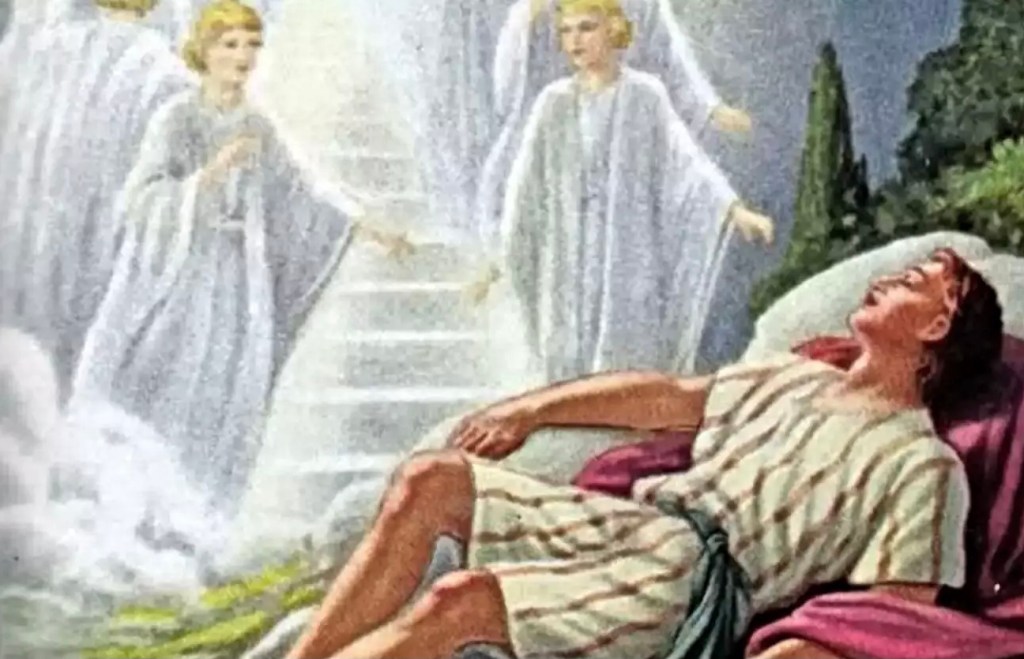
He beds down on rocky ground and God gives him a dream about a ladder to heaven. Angels traverse the ladder. Some are going up, signifying that they have access to heaven; others are going down demonstrating that they have access to earth. The Preincarnate Jesus stands at the top (His is “the voice from the top of the stairs”). In this memorable dream, God suddenly and unexpectedly breaks into Jacob’s life.

He’s hardly what we would consider worthy of a God-sighting—he’s in a serious conflict with his brother, has tricked his nearly blind father, and runs away. This is a sinful dude! Paul would say in Romans that he is operating out of his flesh or his carnal nature rather than his spiritual one. Nevertheless, Jacob has a spiritual encounter with God.

Much later, in John 1:47-51, when Jesus encounters Nathanael He said of him, “Here is a true Israelite, in whom there is nothing false.” “How do you know me?” Nathanael asked. Jesus answered, “I saw you while you were still under the fig tree before Philip called you.” Then Nathanael declared, “Rabbi, you are the Son of God; You are the King of Israel.” Jesus said, “You believe because I told you I saw you under the fig tree. You shall see greater things than that.” He then added, “I tell you the truth, you shall see heaven open, and the angels of God ascending and descending on the Son of Man. In other words, in the dream, Jesus is the ladder between God the Father and human beings. The ladder represents Jesus’ position as mediator between God the Father and us. It further confirms that we only get to heaven through Him–Jesus is truly the only way to the Father.

Additionally in the dream, the Lord reiterates to Jacob the promises He had made to Abraham, his grandfather and to Isaac, his father:

1.) Property the Promised Land, even though Jacob is leaving it;

2.) Progeny lots of descendants to populate the land and to bless all the people of the earth.

3.) Presence God will be with him. In the Ancient Near East, they believed all gods were attached to the land and did not travel with people outside national borders. When Daniel is later told by the angel Gabriel that he had been detained in relaying to Daniel the answer to his prayers by “the prince of Persia,” this “prince” was a demonic entity assigned by Satan to influence that territory (Daniel 10:13). God is affirming that He is not like these lesser, demonically inspired gods. Instead, He asserts, I won’t lose track of you outside the Promised Land (or in a sewer pipe outside some remote village in India, or even in Wellborn, Florida.) To God, this is all simply geography. As Psalm 139 tells us, He is not limited by where we located on earth.

4.) Protection In verse 15 God says, I am with you and I will watch over you wherever you go, and I will bring you back to this land. I will not leave you.

Notice, God does not require anything of Jacob. There is no If…then clause, surrounding these promises with conditions. God has chosen a flawed patriarch through whom to work out His plan of salvation. As Psalm 139 affirms, God knows Jacob’s every thought and scheme. And He is reassuring Jacob there is no place any of us can go where God might lose track of us.

So, Jacob’s response when he awakens is to make a vow to the Lord. He demonstrates his new partnership with God by first setting up a memorial stone to commemorate his divine encounter. He anoints it with oil, an act of worship which makes it holy. The stones became an altar.

Then, he renames the place, Bethel or house of God/the gate of God. It is no longer Luz; it has become a shrine. He reiterates God’s promises to him from the dream. Even though he enters into a conditional relationship, from his side with God, his faith is developing. Jacob is what we would call “a work in progress.” As a result, he moves from the status of fugitive to that of pilgrim. Like grandfather Abraham before him he also promises God a tithe, 1/10th of all God intends to give him.

The next day, as Jacob continues on his journey, how do you think he felt? No doubt, he had been comforted and reassured. God is with him so he’s not alone. Neither are we! As Paul later writes in Romans 8:12-25, we are children of God. As sons and daughters of God, and heirs—all because of the saving work of Jesus on our behalf, we have the right to call Father God, Abba, the Aramaic, personal, intimate form of father, or Daddy. Like us, Jacob has God’s protection—neither he nor we need to be afraid. He doesn’t have to worry about his brother catching up to him and killing him, or of a hostile reception in Haran. We don’t need to stress over the hundreds of potential negative outcomes that assault our minds daily either. Jacob could be confident that God would prosper him and bring him back to the Promised Land. We too can be confident that God will be with us in the storms of life and will usher us into heaven when our journey here on earth is done.

So, where can we run from God’s love? No where because we know God is now here! Jacob’s story makes me glad I am not him. But isn’t it also so reassuring to realize that God never deserts us. He loves us even if we are not truly making decisions pleasing to Him, and He cares for us, faithfully. This story also reaffirms for us that our God appears to enjoy overturning human expectations. He can and does do great things with the least likely. He’s not discouraged by our rebellion, sinfulness, or even our unbelief or lack of trust. He clearly sees us as we are—there’s no hiding from Him, or fooling him. And He see us, too, as who He wants us to become.

There is an ancient Hebrew poem that I think sums this up:

Wherever I go…only Thou!

Wherever I stand…only Thou!

Just Thou! Thou, Thou, Thou!

When things are good, Thou!

When things are bad, Thou!

Thou, Thou, Thou!

Aren’t we grateful?! Amen!

©️2023 Rev. Dr. Sherry Adams

Can’t Elevate Them All

Pastor Sherry’s message for July 16, 2023

Scriptures: Gen 25:19-34; Ps 119:105-112; Ro 8:1-11; Matt 13:1-9, 18-23

The Rev. Del Chilton, a Lutheran pastor, tells the story of how he cropped tobacco as a youngster in North Carolina in the summers (some of you can relate to this, I am sure). He says the “cropper” consisted of a low seat some 5-6 inches off the ground. It was pulled by a tractor. Del sat on the seat and cut tobacco leaves, starting at the bottom of the plant, as the tractor slowly drove them through the rows. He was then to place the cut leaves on a conveyor belt that transported them to an elevated platform, where folks called “stringers” tied them to sticks to be hung in barns where the tobacco was cured. One particular day, the conveyor belt was acting up, and was not moving the cut tobacco up to the platform. Chilton recalls, “There was a precocious six year old boy who was a friend of the family and was watching us work. He observed our troubles for a while and then walked up to the farmer and said, ‘Well, you can’t elevate ‘em all, can you, Mr. Virgil.’ Chilton’s point is that even Jesus could not “elevate” or convince everyone He met, taught, healed, or delivered from demons to trust in Him and in God. (Story and title borrowed from Fairless and Chilton, The Lectionary Lab Commentary, Yr. A, 2013, p.179.)

This is one of the messages of our Gospel lesson (Matthew 13:1-9, 18-23) today. We won’t reach everyone we try to tell about Jesus, will we? Some of us have family members or good friends we have tried to convince, but who still reject our Lord. Why would we ever be discouraged, though, if even Jesus Himself—died, resurrected, and ascended—couldn’t move them? But in the parable, Jesus means for us to try, anyway. We are to tell people about the difference Jesus has made in our lives, thus sharing with them about the Kingdom of Heaven.

In Jesus’ story, the seed is the Gospel, the sower is God (or Jesus, or even us), and the soils represent people’s receptivity to taking in the Message or of coming to faith in Christ.

1.) “Hard-Shelled hearers” are just not interested. They think Jesus is a myth and the Bible is nonsense. The birds—representing the devil—steal away God’s Word so that it cannot take root in their hearts.

2.) “Rocky Ground folk” don’t do anything to sustain or nourish their new faith. It’s not deeply rooted, so it fades away. It fades with persecution or when their faith is challenged. This happened to me when I went to college in the mid-1960’s. I arrived with faith, but when I studied sociology and learned that many folks believe the Christian faith is a myth, I fell away for a time. For some, it may be that someone they loved and prayed for died. For others, it may be that some dream or aspiration they held dear was disappointed. They blame God and reject their faith. Their spirit may have been willing, but their flesh capitulated.

3.) “Thorny Ground people” allow fear and worry to choke out their faith. Do you realize that fear is a negative faith? It is the antithesis of faith. Faith says, “I believe in God’s goodness and love for me, no matter what.” Remember, Paul says in 2 Timothy 1:7 For God did not give us a spirit of fear, but a spirit of power, of love, and of self-discipline. Notice, Paul believes fear is a spirit, actually a demon. Fear says, “I trust in a negative outcome”; that is, “If anything bad can happen, it will.”

Something else that can drive out or kill our faith is wealth. Ever notice how many rich folks live as though they don’t need God? They believe, falsely, that they came into their wealth through their own power or canny strategies. When one of these folks truly come to faith, it’s amazing as they tend then to do good things for others with their money, contributing generously to charitable causes.

Nevertheless, Jesus maintains that the cares of this world can and do discourage and drown out our faith.

4.) But “Good Soil people” hold onto our faith, despite the world, the flesh, and the devil. Jesus says these folks bring in a harvest, of varying sizes depending upon their influence and opportunities. Their faith is contagious and commended.

By now, you have noticed that I like to try to find the link between our lectionary readings—sometimes this link is more obvious than at others.

A. Our Psalm (119:105-112) connects to Jesus’ parable about the soils because it focuses on reading and meditating on God’s Word (spoken, written and in-fleshed in Jesus) as a primary means of nourishing our faith. This theme is also stated in Isaiah 55:10-11As the rain and the snow come down from heaven, and do not return to it without watering the earth and making it bud and flourish, so that it yields seed for the sower and bread for the eater, so is My Word, that goes out from My mouth; it will not return to Me empty, but will accomplish what I desire and achieve the purpose for which I sent it.

The psalmist is saying essentially the same thing: God’s Word provides light for steps taken in darkness. It provides a standard against which to measure our behavior. It guides us in ways to keep us close to God.

B. Paul, in Romans 8:1-11, is reassuring us that if we are in Christ (his famous concept that we accrue many blessings by maintaining a close, personal relationship with Jesus), we will not be condemned or rejected by God. Even though our carnal/fleshly nature continues to lure us into sinful activity, our spirit nature—assisted and strengthened by the Holy Spirit—can help us overcome this warp in our DNA. Again, as in Chapter 7, he makes the point that we cannot walk out the Christian life by our own will-power. We need the assistance of the Holy Spirit (like a booster rocket) to overcome sin’s gravitational pull.

As Paul writes (v.11) And if the Spirit of Him who raised Jesus from the dead is living in you, He who raised Christ from the dead will also give life to your mortal bodies, through His Spirit who lives in you. The Holy Spirit provides us with power to overcome fleshly, worldly, or devilish temptations. The Holy Spirit is called the paraclete or helper—like a combination defense attorney and coach—for a reason. He exists to help us become the best we can be, this side of Heaven. The Holy Spirit wants us to develop a strong, unshakable faith in Jesus. Or, as J. Vernon McGee writes, “The Holy Spirit is now able to do the impossible. The Holy Spirit can produce a holy life in the weak and sinful flesh” (J. Vernon McGee, Through the Bible Commentary, Romans Chapters 1-8, Thomas Nelson, 1991, p.138.)

C. Our Genesis 25:19-34 passage once again provides us with examples of all too human attitudes (or soils) toward our faith in God. Since the narrative says Isaac was married at forty (v.19) and had children at sixty (v.26), it is clear that Isaac and Rebekah waited twenty years to have children. Rebekah, like Sarah, Isaac’s mother, was barren, which would have been very hard on them for several reasons:

Remember, before Rebekah left her home to marry Isaac, her parents had prayed that she would be the mother of thousands (Gen 24:60). So they probably had great expectations, which made Rebekah’s barrenness more difficult. Isaac and Rebekah probably thought, “If we are going to fulfill God’s plan of forming a great nation, we have to start popping out kids right away.”

In addition, this waiting would have been hard simply because of cultural expectations. Women were expected to birth children in that culture. It was how the family name was carried on. It was how a work-force was developed. It was how elderly parents were provided for in retirement (there were no 401K’s). To be unable to have multiple children would have been very disconcerting.

Yet notice Isaac’s response to this dilemma: He prayed for his wife to conceive. Last Sunday, we noted that Isaac was a man of prayer. Rather than take matters into his own hands, as his parents had, he takes this problem to the Lord. Isaac is an example of good soil.

Then, when Rebekah does conceive, she experiences turbulence in her stomach. Perhaps due to her husband’s excellent example, she asks God what is going on in her womb. God speaks to her and tells her she is carrying twins who are and will be very different from one another. Identical twins often think the same way, like the same things, and dress the same, but not these two! Just as they are jostling about in her womb, they won’t get along in life either. A larger, stronger nation will come from one of them: This will be Esau (his name means hairy, not Harry; he would also be called Edom or red. Together with his half-Uncle, Ishmael, he will become the father of the Arabs. They will be more numerous and stronger than Israel. Esau will be a skillful hunter, outdoorsy, an athlete, and his father’s favorite. And yet, God’s word continues, Esau will eventually serve his minutes’ younger twin: This will be Jacob (his name means heel-grabber because he was born grasping his twin’s heel, or deceiver). YIKES! What a moniker to carry! He will be a quiet, contemplative man, a chef, and his mother’s favorite.

We are given one more indication of their important differences in the “stew episode.” As a grown-up, Esau reveals himself as a man driven by his fleshly appetites (He is either a rocky ground, or a hard-shelled-thinker). He is a man of his world who gives very little time or thought to God. In trading his birthright—which has long lasting repercussions—for one meal—a temporary pleasure–he forfeits (1) the inheritance of the first-born; (2) being considered the head and priest of his family; and (3) ultimately providing the lineage of Jesus.

At first blush, Jacob, the quiet chef, seems the more godly of the two…but wait! He desires being head and priest of the family, but he is unwilling to wait on God to achieve this. No doubt his mother had told him what God had said over him during her pregnancy; but, like his grandparents before him, he was not willing to wait on God’s timing. He takes the matter into his own hands, ripping off his carnal brother in a moment of Esau’s weakness. Jacob does not appear to be as decadent, but he clearly is a schemer who pulls a fast one on his twin. Jesus would say God’s word has impacted him somewhat, but it has been choked out in his life by the weeds and thorns of fear and ambition. Whereas the flesh and the Devil grab Esau, worldly desires overcome Jacob.

These twin brothers represent a lesson/example in how not to respond to God’s Word. Jacob will later in his life come to a deep, abiding faith in God, but only after he has suffered for his deceit and his willfulness the hard way, through rough experiences and trials in God’s “divine woodshed,” a.k.a., his unscrupulous Uncle Laban.

Our Scripture passages today make it clear that we can’t elevate them all. We can’t even elevate ourselves without the supernatural help of the Holy Spirit.

Let us pray: Lord, help us to be persons of prayer and of strong faith—good soil persons like Isaac. Thanks be to God who gives us the victory through our Lord Jesus Christ–and by the transforming power of the Holy Spirit! Amen!

©️2023 Rev. Dr. Sherry Adams

Obeying God

Pastor Sherry’s message for 7/9/2023

Scriptures: Gen 24:34-67; Ps 45:10-17; Ro 7:14-25a; Matt 11: 16-30

I want to share with you a true story told by a Kenyan pastor, Dr. Nicholas M. Muteti (He now ministers in North Carolina). He recalls,

“Nearly thirty years ago, I was a middle school teacher in Kenya. One day I took 20 students, and I told them: “I will do my best to teach you and train you. If you obey me, you will be the best students of this school.” They were excited.

“In a short time, I realized that only some of them were willing to keep up with my training. Some of them said, “It’s too difficult.” Some said, “We have more important things to do.” Some of them said, “You see other students are having more fun than we do.” When they graduated, 2 of them were the best students of the school. Only 2 out of 20.”Download (PDF

(Contributed by Dr. Nicholas M. Muteti on Jun 15, 2011, www.sermoncentral.com)

I wonder if this is how God feels. We each could be absolutely the best we could become, if only we obeyed the Lord. He knows this and sees so few of us trying to live out the Christian life style. I wonder how frustrated He gets with us human beings.

Both Paul and Jesus have a lot to say today about obeying God:

Paul reminds us (in Romans 7:14-25a) that our sinful (carnal) nature does not cease to exist when we become Christians. Oh, if only it did! If anything, we just become more frustrated because now we recognize—and hopefully, regret–our sinfulness. The cry of Paul’s heart is so poignant. Can’t we each identify with him in verse 24 What a wretched man [or woman] I am! Who will rescue me from this body of death? I find Peterson’s paraphrase of parts of this passage so helpful (The Message, pp.2043-2044) Yes, I’m full of myself—after all, I’ve spent a long time in sin’s prison. What I don’t understand about myself is that I decide one way, but then I act another, doing things I absolutely despise. So if I can’t be trusted to figure out what is best for myself and then do it, it becomes obvious that God’s command [the Law] is necessary. But I need something more! For if I know the law but still can’t keep it, and if the power of sin within me keeps sabotaging my best intentions, I obviously need help! I realize that I don’t have what it takes. I can will it, but I can’t do it: I decide not to do bad, but then I do it anyway. My decisions, such as they are, don’t result in actions.

Paul makes the case that just deciding not to sin is not enough to keep us from sinning. Remember, last week he said (in Romans 6)…

[1] Start with faith in Jesus;

[2] Surrender yourself to God;

[3] Then ask God, the Holy Spirit, to help you live into your new intentions.

We need supernatural help. We need the power of the Holy Spirit at work in us to help us live more and more like Jesus.

Jesus, in our Matthew 11:16-30 passage, is speaking about how folks have rejected both His cousin, John the Baptist, and Him. He says they rejected John for being too severe, too austere. Those who have rejected Jesus have done so for the opposite reason. They say he’s too friendly.

Since He eats with tax collectors and sinners, they claim He is a drunkard and a glutton. (YIKES! I wouldn’t want to be in their shoes at the Last Judgment.)

So, He then rejects the cities in which He has spent the most time: Korazon, Bethsaida, and Capernaum—Capernaum had been His headquarters! Most of the residents of these three cities have blown off His teachings, His miracles, and His healings done. To Jesus, they now rate worse than the fate of Sodom and Gomorrah, who God fire-bombed. (What might be worse than that? I hate to think it.)

Biblical scholars say it is at this point that Jesus turns from trying to convert the Jewish nation toward appealing to individuals who are open to Him. He offers rest to those who are weary and burdened. He asks them/us to join with Him and learn from Him. He promises rest for our souls, for My yoke is easy and My burden is light. Let me digress for just a moment: Jesus had been a carpenter, so He had most likely built wooden yokes for oxen. Jesus would have measured the oxen before fashioning their yoke—like us, all oxen are not of the same size or girth. Then the farmer would have returned about a week later to have the pair fitted with the new yoke. If it had been made to fit exactly, it would not chafe or injure their necks. Jesus is implying that he makes obeying Him individualized and non-stressful, if we partner in the effort with the Holy Spirit.

This is essentially what Paul later repeated, isn’t it? He wrote that we should put our trust in Jesus; we should do as He does, or at least obey what He says; and we should ask the Holy Spirit to help us when our sin natures want us to rebel. As J.Vernon McGee says, “The only place in the world to put that burden [our sins] is at the Cross of Christ.” The reward for this obedience is rest, deep shalom [total wellbeing] peace.

As with last week, the doctrines expressed by Jesus and by Paul are illustrated with a great story from the Old Testament, Genesis 24:34-67. Abraham had become very rich—he was like a prince or a high nomadic potentate by this time. Sarah had died at age 127, so Abraham was probably 137 years old. Before he died, he wanted to secure a bride for Isaac. He wants someone from his extended family, not an idolatrous Canaanite. So he sends his trusted representative to the area of Haran (Iran), to search out a suitable woman from among his extended family.

The servant prays to Abraham’s God and suggests a sign by which to recognize God’s choice of a bride for Isaac. She will encounter him at a well. She will offer him water to drink. She will even draw water for his 10 camels. Additionally, she will extend traditional middle eastern hospitality: water for his feet, food and refreshments, and overnight accommodations for him and his animals. Arriving in Haran, the servant then encounters a beautiful young woman who does exactly that. She gives him water. She draws water for his animals. She invites him home to meet her family. This woman is Rebekah, Abraham’s great-niece, the virgin granddaughter of Abraham’s brother, Nahor. Now of all the wells the servant could have visited, what are the chances that he would run into Abraham’s kin? God has clearly superintended this process. It’s a divine appointment.

The servant recognizes this and offers praise and thanksgiving to God.

In verse 26, we are told Then the man bowed down and worshiped the Lord, saying,”Praise be to the Lord, the God of my master Abraham, who has not abandoned his kindness and faithfulness to my master. As for me, the Lord has led me on the journey to the house of my masters’ relatives.” This woman, Rebekah, is clearly God’s choice for Isaac. The servant tells her the story of how he decided to approach her—he’d asked God for a sign. She doesn’t seem to have difficulty believing him. Then he gifts her with a ring and two gold bracelets.

Her brother, Laban, shows up, hears the story, and also invites Abraham’s servant to their home. Once again, the servant shares his instructions with everyone. No doubt Rebekah is somewhere listening in as the story is retold. Everyone appears to agree she is God’s choice of a bride for Isaac. The servant has surely filled them in on Isaac’s miraculous birth and the divine substitution of the sacrificial ram. They may have been impressed that Isaac seemed to be a man with a God-ordained destiny.

The family is impressed with the costly gifts bestowed on the maiden, signifying that Abraham is indeed wealthy. The bride-price is agreed upon, but by the next morning the family appears to have backed off a bit. In an intimation of things to come—Laban will renege on his agreement with his future nephew, Jacob—Laban, Rebekah’s brother, wants to delay his sister’s marriage. The family urges the servant to wait 10 more days. No doubt concerned for Abraham’s age and health, the servant insists they leave immediately.

In an interesting move in a paternalistic culture, the family members suggest Rebekah be consulted. From what she’s heard and experienced, she is ready to go—off with a servant she barely knows; to a country she’s never seen; to meet a husband she’s only heard of. What an adventure! What a courageous young woman!

What standards might this story point to for us today?

First, we note the faithfulness of the servant. He’s given his word to Abraham to do his best, but otherwise he has no stake in the outcome. Nevertheless, he works hard to fulfill his promise. He is obedient. He prays for the Lord’s favor. He diligently repeats his instructions from Abraham to the extended family members. He clearly does not want to mess up! This is a great example (from about 4,000 ago) of godly obedience.

Second, I am also struck by the willingness and courage of Rebekah. She doesn’t know Abraham from Adam’s house cat. She is looking at marrying a dude she’s only just heard of and never seen. She will be making her home far away from her family—in fact, she never sees them again this side of heaven. What convinces her to take the risk of leaving everything she has ever known? Perhaps she was impressed by the miraculous nature of Isaac’s birth, believing he is a man special to God. No doubt she had heard the story of his almost-sacrificial death, and been impressed with the fact that he could have overwhelmed his aged father’s strength, and taken himself off the altar. Nevertheless, he chose to be obedient to and respectful of his father, and of his father’s God. Maybe she rightfully understood that Isaac was special relationship with God and wished to attach herself to such a faithful and blessed man. And, if she had been a woman of faith, she could see and understand how God had indeed chosen her to be Isaac’s mate. After all, the servant had asked for a complex set of signs, and, without any prior knowledge of them, she had fulfilled each one.

Third, this story has a happy ending. It’s actually a love story. Scripture is God’s love story to us, but He never guarantees us “a rose garden.” He does, however, promise us blessings for faith and obedience. Rebekah gets on her camel and rides to Israel and to Isaac. The evening she arrives, Isaac is out praying. He sees her, the answer to his prayers. She sees him and leaps off her camel, indicating she is both single and eager to meet him. Cue the dramatic music! The faithful servant relates everything to Isaac, who obviously sees Rebekah as the answer to his prayers (and his father’s plans). Verse 67 tells us Isaac brought her into the tent of his mother Sarah [now dead], and he married Rebekah. So she became his wife, and he loved her; and Isaac was comforted after his mother’s death.

This beautiful story is an indication of what can happen to the righteous—those of us who call upon the Holy Spirit to live obedient lives pleasing to God. Yes, we inherit heaven. But, we can also be abundantly blessed by the Lord here on earth. Thanks be to God who gives us the victory through our Lord Jesus Christ!

©️2023 Rev. Dr. Sherry Adams

Our God Will Provide

Pastor Sherry’s message for July 2, 2023

Scriptures: Gen 22:1-14; Ps 13; Rom 6:11-23; Matt 10:40-42

Human beings appear to be programmed to love narrative—i.e., stories. It’s how our God has made us. As an experienced teacher, I know that people often remember a story before they will remember the point, theme, doctrine, concept, or theory. For instance, when I taught U.S. History in high school, I told the kids that when Grover Cleveland was running for president, the press learned he had had a child out of wedlock. The newspapers read, “Ma, Ma, where’s my Pa?” in an attempt to embarrass him. His supporters then printed, “Gone to the White House, ha, ha, ha!” To this day, even I don’t remember much about President Grover Cleveland other than this story.

I once had a recovering addict at a residential treatment center ask me why I taught them psychological principles of recovery by using so many story illustrations. He was impatient with this approach and just wanted me to get to the point. He was saying in effect, “Please just lay out the concept,” or “Just the facts, Ma’m.” I patiently explained that my goal was to have him remember the concepts I was presenting once he went back into his home environment—and he was more likely to do so if these concepts were wrapped in examples from other people’s lives.

This is why the Bible contains story after story of the people of God. Our God knew their stories would help us to remember many of the important biblical principles. This is also why Jesus taught in parables, memorable stories with often surprising twists.

Today our passages offer 2 readings comprised of doctrine and two with stories that illustrate those doctrines:

A. Paul is masterful at setting forth Christian doctrine. In Romans 6:11-23, Paul wants us to understand that if we are joined to Christ (through baptism, through our profession of faith), we are now dead to sin. Does it mean we never sin again? Oh, if only! What it means is that we probably will sin again but we can overcome our sinfulness through (1) our faith in Jesus and (2) with the help of the Holy Spirit. Paul personifies sin as a master. He asserts that whatever we do, we serve someone or something—perhaps even making ourselves king of our life. He says we can serve sin or we can serve Jesus—those are our only two choices. Christians should not attempt to do both. First, it makes us hypocrites; second, it leads us back into the enslavement we escaped through Jesus’ rescue. He says (1) we start with faith in Christ. Then (2) we have to refuse to let sin reign in our lives; and, finally, (3) we present ourselves to God. These are each three acts of the will, decisions we make with our mind. He wants us to recognize that—on our own–we cannot live out the Christian life. We have to allow God to live it through us. So, overcoming sin is an act of faith. As Bishop N.T. Wright rewords Paul, “Our limbs and organs, and for that matter our mind, memory, imagination, emotions and will, are to be put at the disposal not of sin, but of God.” (Paul for Everyone, Romans: Part One, Westminster John Knox Press, 2004, p.109.)

Incidentally, this is where AA has come up with its 12 steps. I believe the anonymous founders of AA were a Catholic and a Lutheran, both of whom seemed to know Scripture. AA asserts that we have to have faith in a higher power, God, who is able to free us from our sin patterns/our addictions. We must also realize we cannot be overcomers on our own—we are only overcomers by the blood of the Lamb. AA adds making amends (asking forgiveness and being reconciled, if possible) to anyone we have harmed. Then we serve God and others, as “servants of Christ.” In the 12th step, we agree to become a sponsor to help others, as we have been helped, on their journey out of addiction.

B. This doctrinal position is demonstrated in our Old Testament story of the obedient behavior of Abraham (Genesis 22:1-14). In this 7th and last appearance of God to Abraham, this pillar of faith is put to an extreme test: God tells him to prepare to sacrifice his long-awaited “Child of Promise,” Isaac. We tend to think of Isaac still as a child at this point, but Biblical scholars now believe he was much older, perhaps even as old as 33 (Jesus’ age when He went to the cross).

Listen to God’s instructions in verse 2 Take your son, your only son, Isaac, whom you love, and go to the region of Moriah. Sacrifice him there as a burnt offering on one of the mountains I will tell you about. Again, scholars believe this mountain would later be named the temple mount in Jerusalem, also known as Mt. Zion.

Verse 3 Early the next morning Abraham go up and saddled his donkey. Notice, Abraham’s obedience to God was immediate. He cut wood for the burnt offering; then he, Isaac, and 2 male servants set out. They traveled for 3 days before they saw the mountain God had directed him to in the distance. What was Abraham thinking during that journey? Did he even sleep the night before? He certainly had sufficient faith in God to even begin the trip. How many of us would have said, “No thanks, Lord. I believe I have a better idea”? How many of us would have felt justified in disobeying God? But Abraham was not going to rebel against God. The writer to the Hebrews later states (Hebrews 11:19) Abraham reasoned that God could raise the dead, and figuratively speaking, he did receive Isaac back from the dead. No, instead of rebelling, Abraham trusted in God to care for Isaac, the descendants of whom were to form a mighty nation. He obediently complied, offering himself and his son to the Lord. This is pretty amazing, isn’t it?!

Notice too that Isaac questioned what was happening (vv.7-8) Isaac spoke up and said to his father Abraham, “Father?” “Yes my son?” Abraham replied. “The fire and the wood are here,” Isaac said, “but where is the lamb for the burnt offering?” Abraham answered, “God Himself will provide the lamb for the burnt offering, my son.” And the two of them went on together. Isaac questioned, but he continued onward. He trusted his father and he trusted God. No wonder he is repeatedly included among the patriarchs of our faith, Abraham, Isaac, and Jacob! He was a man of deep faith in God. In this sense, Isaac is also a Christ-like figure (he foreshadows Jesus):

(1) Just as Jesus carried His wooden cross on His shoulders, Isaac carried the wood for the impending sacrifice on his.

(2) Abraham was prepared to offer his only and beloved son—just as Father God later did with Jesus—but at the last minute God provided a ram, a male sheep. A full grown sheep took Isaac’s place for the sin offering; while Jesus, the Lamb of God, became our sin offering.

(3) Finally, we see that Abraham renames that place (v.14) So Abraham called that place, “The Lord will provide. And to this day it is said, “On the mountain of the Lord it will be provided.” (One of the names of God is Jehovah Jirah, which means God, our provider.) Later in the Biblical narrative, Jesus did become the substitutionary replacement for all of us on that same mountain. A road and a wall would have been erected between Golgotha and the Temple by then, but the mountain ridge is Mt. Moriah. Again, the Lord will provide Jehovah Jireh, our provider.

C. Jesus provides the doctrine in our Gospel lesson (Matthew 10:40-42). It’s a very brief passage which marks the conclusion of Jesus’ instructions to the 12 before they go out on their first mission-trip. He is warning them that though they will heal people, raise others from the dead, preach the Good News, and cast out demons, they need to expect also to be rejected. But He reassures them if anyone rejects them, they are actually rejecting Jesus, the One Who sent them. This work of bringing people to Jesus is of the utmost importance and they will be rewarded. But they are to remember that they represent Jesus and that they should not allow anything—not even fear—to come between them and Him.

D. This realization—this trust—is true of King David in Psalm 13

This psalm is a fervent prayer for rescue. David, though anointed king, is being pursued by the jealous King Saul. Saul and his troops sought to kill David for around 14-15 years. David knows his life is at risk. He’s weary and downcast. But, nevertheless, He looks to God in prayer (v.13) But I trust in Your unfailing love; my heart rejoices in Your salvation. Like Abraham, David put all his faith in God, despite His negative circumstances.

These are our godly examples: Abraham, Isaac, and David. Their obedience to God proves their trust in Him. We too need to trust in our God, in His goodness and loving kindness towards us. We too need to focus on obeying the Lord, remembering that this side of heaven, we will not be able to be sinless, but—that when we sin—we can ask God’s forgiveness, and we ask for the help of the Holy Spirit to avoid these same sins in the future.

Their stories help us to see how to live out our faith. They help us to remember Biblical principles/points of doctrine. They help us remember to put God first in our lives. These stories help remind us that when we do put Him first, our God will provide for us. Thanks be to God Who gives us the victory through our Lord Jesus Christ!

©️2023 Rev. Dr. Sherry Adams

He Messes with our Messes

Pastor Sherry’s message for 2/25/23


Scriptures: Gen 21:8-21; Ps 86:1-10, 16-17; Ro 6:1-11; Matt 10:24-39


Beth Moore is a fabulous Bible teacher. Over the years, I have taken part in probably well over a dozen of her Bible studies. I recommend her to you. She is a life-long Baptist who has recently become an Anglican. In one of her studies, she made the statement that, “God loves to mess with our messes.” Let me illustrate this with a story from the early ministry of Tony Campolo.

He was a sociology professor who challenged his students, one day, to think about what Jesus might have said to a prostitute. He was hoping to get to evangelize them, quoting from such passages as John 4 and John 8. He wanted to demonstrate that Jesus was compassionate and merciful—much more so than the leaders of any other world religion.

He was stopped in his tracks, however, when a Jewish student in his class spoke up saying, “Jesus never met a prostitute.” The student continued to reiterate his perspective whenever Professor Campolo tried to resume his agenda, asserting, “Professor, you didn’t hear me. I said that Jesus never met a prostitute.” When Campolo persisted despite the young man’s argument, the student then said rather forcefully, “You’re not listening to what I am saying. I am saying that Jesus never met a prostitute. Do you think that when He looked at Mary Magdalene He saw a prostitute? Do you think He saw whores when He looked at women like her? Doc, listen to me! Jesus never met a prostitute!”

This silenced Professor Campolo. He realized he, a Christian, was being taken to school by a Jewish student who seemed to understand Jesus better than he had. (Illustration provided by The Rev Fred Demaray from AHA: The God Moment that Changes Everything, by Kyle Idelman, David C. Cook, 2014.)

The Jewish student makes the point that Jesus didn’t share our mistaken perceptions or attitudes. Instead, He offered grace, He offered mercy. He sees beyond our habitual behaviors to the heart of each of us. He loves us as we are, but also loves us too much to leave us that way. He wants to change our mistaken perceptions and attitudes. He wants to change our sinful behaviors. I believe, along with Beth Moore, that our God loves to mess with our messes—if we let Him! Let’s examine what our Scripture passages today tell us about our Lord’s ability to redeem what we have messed up.

In our OT lesson, (Genesis 21:8-21), we find God acting, in a surprising way, to fix a big mess that Sarah and Abraham had created. Remember, God had promised a child/an heir (so, a boy) to Abraham and Sarah, when Abe was 75 and Sarah 65. Back in Genesis 12:1, God had promised I will make you into a great nation and I will bless you. This assumed a large extended family; this assumed a son, but no son had come. Later, when Abraham is about 78 or so, and his son had not appeared as yet, the Promise was reiterated by God in Genesis 15:4. Abraham feared his estate would go to his manager, Eliazer, as was the custom. But God reassured him, saying This man will not be your heir, but a son coming from your own body will be your heir. Even later, when still there is no heir, Sarah came up with a “bright idea:” I’ve got an Egyptian servant girl. Sleep with her and her child will be your heir.” Abraham was about 85. Hagar was to be a surrogate for Sarah. Today they might visit a sperm bank and be artificially inseminated with am anonymous stranger’s DNA, but they did what was available to them at the time. Though not very clinical, Abraham copulates with her, and Hagar bears Ishmael for them.

As you can imagine, problems then arise between Sarah and Hagar:
Hagar apparently acts like the one of greater status, bragging over being the “baby-mama,” while the infertile Sarah does a slow, jealous burn. This is a mess! They’ve created a mess! Sarah’s bright idea leads to the kinds of unanticipated problems that plague many blended families today. Some years back (preceding seminary), I worked as a middle school counselor for a year. I was walking a troubled 8th grade boy back to class when he said to me, “See that girl over there. She used to be my sister.” I wondered how that could be. I knew his father and mother were divorced. He lived with dad because mother, a nurse, had a drug problem and had lost custody. Dad, however, would move his current girl-friend into their house—often with her children—and these new kids would become his “brothers” and “sisters” for a time. When dad and girl-friend inevitably broke up, the woman and her kids would move away, and this boy would lose his new siblings. In Abraham’s day, as in ours, it was very difficult to blend families of children from different parents.

Nevertheless, as we read last week, God finally acted when Abraham was 100 and Sarah, 90! Sarah conceived Isaac, carried him to term, and they were thrilled! But, YIKES! Ishmael is the first born (maybe as old as 14-15 by then). One day, Sarah overhears him mocking her small son. Having had her fill of Hagar’s bragging and now Ishmael’s contempt, she demands that Abraham drive them away. She may have feared that Ishmael would later kill Isaac in order to inherit; or, as a least one scholar has suggested, she may have read into Ishmael’s remarks a threat to sexually abuse his half-brother, Isaac. She certainly doesn’t trust that he will carefully guard his rival, the Heir. Like a mama bear, she wants Ishmael away from her cub. She convinces a broken-hearted Abraham to run both mother and son off.

Now before we get to what happens to mother and son in the desert, let’s check out a meaningful set of comparisons: Remembering that the Old Testament always points to Jesus, I feel a need to point out to you 9 similarities between the births of Isaac and that of Jesus:


(1) Both were promised. 25 years earlier, God had told Abraham that He would give a son to Abe and Sarah. We are told in Scripture, 750 years before Jesus was born, (Isa 7:14) The Virgin will be with child and will give birth to a son, and will call Him Immanuel [God with us].


(2) With both births, there is a long interval between promise and fulfillment: 25 years for Isaac; more like 1,000 years for Jesus, going back to God’s promise to King David in Psalm 89:29 I will establish His line forever, His throne as long as the heavens endure.


(3) The people involved are incredulous when they hear the birth announcements, as they seemed impossible. Genesis 18:12 tells us So Sarah laughed to herself as she thought, “After I am worn out and my husband is old, will I now have this pleasure?” Dr. Luke shares in Luke 1:34 “How will this be,” Mary asked the angel, “since I am a virgin?” Mary is confused, but humbly concurs. She responds to the angel, “I am the Lord’s servant….May it be to me as you have said.”


(4) Both sons were named before they were born. Remember, Sarah laughed Isaac means he laughs. In Matthew 1:21, the angel of the Lord appears to Joseph in a dream Joseph, son of David, do not be afraid to take Mary home as your wife, because what is conceived in her is from the Holy Spirit. She will give birth to a son, and you are to give Him the name Jesus, because He will save His people from their sins.


(5) Both births occurred at God’s appointed time. We are told in Genesis 21:2 that Sarah became pregnant and bore a son to Abraham in his old age, at the very time God had promised him. Similarly, Paul states in Galatians 4:4 But when the time had fully come, God sent His son, born of a woman, born under the Law, to redeem those under the Law, that we might receive the full rights of sons.


(6) Both births were miraculous–Isaac’s because of the ages of his parents; Jesus, because of Mary’s virginal state.


(7) Both sons brought particular joy to their fathers. Abraham and Sarah both laughed and were delighted with Isaac’s birth. God the Father put His stamp of approval on Jesus at His baptism in Matthew 3:17 And a voice from heaven said, “This is my Son, whom I love; with Him I am well pleased.”


(8) Both were obedient to their fathers, even unto death.
Isaac was about 18 (some say he was as old as 33) when Abraham had him lay upon the altar, prepared to sacrifice him to God’s will. Jesus was 33 years old when He obeyed the Father and submitted to the Cross.


(9) Finally, the miraculous birth of Isaac is a picture of, or a metaphor for the resurrection of Jesus: In Romans 4:19, Paul tells us Without weakening in his faith, he [Abe] faced the fact that his body was as good as dead—since he was about 100 years old—and that Sarah’s womb was also dead. As with resurrection, out of death comes life! And, in today’s epistle to the Romans (6:1-11), Paul wants us to understand that since we are “in Christ,” and Christ was resurrected from the dead, we will be too. In verse 4 (Peterson, the Message, p.2041) Paul insists That’s what baptism into the life of Jesus means. When we are lowered into the water, it is like the burial of Jesus; when we are raised up out of the water, it is like the resurrection of Jesus. Each of us is raised into a light-filled world by our Father….Then, in verse 8 he adds Could it be any clearer? Our old way of life was nailed to the Cross with Christ, a decisive end to that sin-miserable life—no longer at sin’s every beck and call! What we believe is this: If we get included in Christ’s sin-conquering death, we also get included in His life-saving resurrection.

Thank you, God, for covering us with Jesus’ righteousness in baptism. Thank you, Jesus, that You see us not as we are but as we were meant to be.Thank you, Jesus, that You redeem and resolve the messes we make through our ignorance or our willfulness.

Now, let’s go back to God’s care of Hagar and Ishmael (and of Abe): God assures Abraham that a great nation will come from Ishmael. Abe may never see him again, but God tells him that Ishmael will live and prosper/become a great nation. This had to have been hard on Abe, but it also beats sending your son off to war and not knowing if he will survive; or having him die in a car wreck, a drive by shooting, or some incurable disease.

Abe sends the two away with as much food and water as they can carry. Eventually, they run out of water. Hagar knows they will soon die. She places a weakened Ishmael at some distance from her so she will not have to observe his death. Both Hagar and Ishmael—nonbelievers, despite having lived with Abraham for years–are crying, and an angel calls to her, What’s the matter, Hagar? Do not be afraid. God has heard the boy crying as he lies there. Lift the boy up and take him by the hand, for I will make him into a great nation [now Hagar knows his destiny]. Then God opened her eyes and she saw a well of water. So she went and filled the skin with water and gave the boy a drink. God was with the boy as he grew up [for all intents and purposes, he had no father but the Lord]. The Lord provides water. The Lord provides protection from wild animals and hostile drifters. Later, Hagar finds him an Egyptian bride, but God, his heavenly father, makes him into a great nation. Ishmaelites became known as nomads in Sinai and on Paran (present day Iran). They later blended with the kin of Esau, grandson of Abraham through Isaac, to become the Arabs.

We serve a God Who loves to mess with our messes! Our God plans for events (and people) waaaaay in advance. He knows ahead of time what will happen to us. He provides a way for us to survive and to thrive—if we look to Him.
He also redeems our sins/our misguided solutions/our messes:
There is no doubt that God did not approve of Abraham and Sarah’s “plan B.” Sarah’s impatience led to the birth of the Arab peoples, who have always been antagonistic to God’s chosen people, the Jews. Nevertheless, when Abe and Sarah created a mess, God took care of Ishmael. God loves to mess with our messes! My experience is that He often redeems our thoughtlessness, our mistakes, if we only think to ask. I have found that if I am running late and worry I will be demonstrating to another that I don’t value their time, I ask God to intervene, and they end up being late too. As with the Tony Campolo story, Jesus sees us as we are and can be, not as our behavior indicates.

Finally, our God loves us as we are, but also loves us too much to leave us that way. So, be aware: He will mess with your mess!

©️2023 Rev. Dr. Sherry Adams

He’s a Good, Good Father

Pastor Sherry’s message for June 18, 2023

Scriptures: Gem 18:1-15; Ps 116:1-2, 12-19; Ro 5:1-8; Matt 9:35-38, 10:1-8

Happy Father’s Day to our fathers present here and to those who have gone on, we hope, to glory. Remember Paul Harvey? He wrote the following about fathers:

“A father is a creature that is forced to endure childbirth without an anesthetic. A father growls when he feels good and laughs when scared half to death.

“A father never feels worthy of the worship in a child’s eyes. He’s never quite the hero his daughter thinks; never quite the man his son believes him to be, and this worries him—sometimes. So he works too hard to try to smooth the rough places in the road for those of his own who will follow him.

“A father gets very angry when the school grades aren’t as good as he thinks they should be. So he scolds his son—though he knows it’s the teacher’s fault. A father gives his daughter away to another man who is not nearly good enough—so that he can have grandchildren who are smarter than anybody’s. A father makes bets with insurance companies about who will live the longest. One day, he loses—and the bet is paid off to those he leaves behind. “ (Paul Harvey, quoted by Chuck Swindoll in The Tale of the Tardy Oxcart, Word Publishing, 1998, p.204.)

It’s a touching tribute, isn’t it? I hope that is what your father was/is like. If not, we can all look to our Father God, to understand what a good father—what a really good, good Father is like! Our Scripture passages today make that point clearly.

A. Let’s begin with what Paul tells us in Romans 5:1-8. Paul is instructing us in the great progression of the generous gifts and blessings we obtain—like the one baptized as well as those we receive into our church fellowship today–when we believe in God and in our Lord Jesus Christ:

First, we are reconciled to God through Jesus. This is a huge blessing! Paul teaches, in Romans 1, that we pull ourselves away from God by our sinful behaviors (carnal nature), our rebellious and idolatrous thinking, and by allowing our feelings to dictate our behaviors and our beliefs. Feelings provide us with important data, but we do not want them to direct or compel our behaviors. We live now in an American culture where many people appear to believe it is okay to be driven by their feelings. This kind of behavior is out of control and leads to harm and to chaos. So, often because we do not sense God’s presence, we assume it’s hard to have a relationship with Him! This is just not true! Our Lord is only a prayer away! And He desires a deep connection with each one of us—which Jesus has made possible through His death on the Cross for our behalf.

A second concern, however, is what happens to us as we are drawing closer to God, and engaging in Kingdom work (spreading the gospel, sharing our testimonies regarding our own faith journeys). We encounter trouble! You see Satan leaves us alone if we are not pursuing God or are neutral about the Lord. But when we draw near to God, the evil one comes after us, “tooth and nail,’ trying to turn us against Him. The world and our flesh, inspired by the devil, try to discourage us. These forces work hard to pull us away from Jesus.

If we can hold on to our faith—in the face of trouble—we will emerge victorious. We will have become one who perseveres; one who learns patience; one who develops grit or persistence. This ability to persevere strengthens our character. We become more resilient. Psychology calls resilience the bounce-back factor. Resilient folks recover more quickly from the slings and arrows the enemy throws at us than do people who are not. Resilient people learn that even if we don’t feel God’s presence, we can trust He is with us in our suffering. All of this—suffering, perseverance, and a resilient character–helps us to have hope. We worship the God of all hope. And because our God keeps His promises, this hope does not ultimately disappoint us.

Finally, in verse 8, Paul pens this famous line But God demonstrates His own love for us in this: While we were still sinners, Christ died for us. We love and serve a God who has pursued us for relationship, even when we didn’t deserve His attention. This is the height of romance, isn’t it? John Eldredge, a contemporary Christian author, wrote a book called, The Sacred Romance, in 1997. His premise was that we each want to feel so cherished by another that that person would court us/pursue us, and want to live out their life with us. He contends and I agree that our God has done just that. The woman we baptize this morning has said “yes” to God. Each of us who has been baptized has said “yes” to God. Praise God and Halleluiah!

B. We see the miraculous hand of God in today’s story of Abraham and Sarah (Genesis 18:1-15). Abraham is now 99 years old, and Sarah, 89. They are way past child bearing possibilities! But two angels and the pre-incarnate Jesus visit them to say “the Child of Promise,” Isaac, will finally appear within the year. Sarah laughs at the idea of conception at their ages. (I think I would cry! Of course, they were wealthy and had a lot of servants, so she would have had sufficient help, bless her!) But they are both told (v.14) Is anything too hard for the Lord? It’s a rhetorical question. The answer is, “of course not!” We love and serve an all-powerful God of miracles.

C. Our Psalm (116:1-2, 12-19) reminds us that we appreciate and thank God because He hears and responds to us when we are in distress or trouble. He is our Rescuer, our Redeemer.

D. And our Gospel (Matthew 9:35-38, 10:1-8) demonstrates how He trusts us and empowers us to do Kingdom ministry. He sends out 12 ordinary men and tasks them with preaching the Gospel; warning folks that the Kingdom of God is near [that’s Jesus; Jesus is coming to visit them soon]; healing the sick; casting out demons; and even raising the dead. YIKES! How extraordinary! And He has empowered His followers today do the same.

Chris Tomlin wrote a sang a contemporary worship song called, “He’s a good, good Father.” We do worship a good, good Father, through our Lord Jesus Christ, and by the power of the Holy Spirit. What wonderful blessings we enjoy when we ally or bind ourselves to Jesus Christ:

(1) We experience peace with God and the peace that passes all understanding.

(2) We experience being deeply loved.

(3) We come to enjoy hope, despite our earthly circumstances.

(4) Our characters are developed and strengthened.

(5) We trust that our Redeemer hears and responds to us.

(6) We realize He trusts us enough to give us Kingdom building work to do.

(7) And we align ourselves with the God who works unheard of miracles for those He loves.

Thank you, Lord, for the good fathers you have given us and for modeling what it is to be a good, good father. Amen!

©️2023 Rev. Dr. Sherry Adams

Happy Father’s Day.

God’s Bigger Picture

Pastor Sherry’s message for June 11, 2023

Scriptures: Gen 12:1-9; Ps 33:1-12; Ro 4:13-25; Matt 9:9-13, 18-26

Some years back, a TV news show in the Midwest ran a TV ad campaign to try to increase their share of the viewing market. They showed a woman, sitting in her car, reading or writing down something—perhaps a shopping list—minding her own business, oblivious to her surroundings. Out of nowhere, this guy appears who rips open her car door, grabs her, and throws her out onto the ground. At first it looks like a car-jacking, which have proliferated all over the country lately. The viewer is horrified for the lady. We wonder what the attacker will do next. But the camera angle pulls way back, and we note that the car is on fire. The guy wasn’t attacking her, or trying to steal her car; instead, he had come to her rescue. The ad concluded with the following statement in big letters across the screen: ”You need the bigger picture. Channel XYZ gives you honest, trustworthy news everyday.”

(Borrowed from a sermon by Rev. Jenny Salt, “The Big Picture of God’s Faithfulness,” archived by www.preachingtoday.com, 6/9/2023.)

TV news programs may come and go—and some are more honest and trustworthy than others–but we can absolutely depend upon the faithfulness of our God.

Our readings today all speak to this immutable, unchanging characteristic of our God in all three persons.

A. Abraham is the first of the 4 great patriarchs of Israel.

Prior to Genesis 12:1-9, Scripture has focused on events important to the human race: Creation; the Fall and its consequences; the Flood; and the Tower of Babel. Talk about the Big Picture! But from Chapter 12 on, God begins to record His interactions with specific humans, beginning with Abram (whose name He changes to Abraham five chapters later).

In today’s reading, God tells Abram that he intends to make a great nation from him.

1.) The Lord promises to bless Abram;

2.) To make his name famous;

3.) To make him a blessing to others.

4.) And, in verse 4, God promises I will bless those who bless you and whoever curses you I will curse; and all peoples of the earth will be blessed through you. Wow! What a great set of promises!

How are all people on the earth going to be blessed by Abram? This side of the Cross, we know out of his lineage will come the Messiah, Jesus. This is the Bigger Picture! (By the way, this promise has not expired. Thus, we want to be careful to support Israel, especially praying that they would come to accept Jesus as the true Anointed One.)

Just as with Jesus’ Great Commission, which we considered last week, God tells Abram to “Go.” He was to go to Canaan from the south of present day Iraq. How did he know this? Scripture does not convey the conversations, but we can assume he heard from God. Abram was obedient and went. When he arrived in what would become Shechem, and later, Bethel, God promised him a huge territory 300,000 square miles in size. Even at its height as a nation, Israel has never exceeded 30,000 square miles. This promise is as yet unmet, perhaps awaiting the Millenial Reign of Christ at His 2nnd Coming. In thanksgiving to the Lord, though, Abram erected an altar to Him everywhere he went.

Abram lived about 2100BC, prior to the provision of the Law. He is famous for his faith and obedience to God. He probably suspected that he was missing something in life. He was satisfied that God gave him a bigger perspective. He is famous for his life-changing decision to follow God.

He is famous for his noble, generous character. And he is famous for being a man of destiny—the father of all believers (considered the patriarch of Jews, Christians, and even Moslems). He clearly understood the bigger picture!

B. In Psalm 33:1-12–called an “orphan psalm” because we do not know its author’s name–we are given our motivation to praise God. We praise Him 1st because He is the God of Creation, and 2nd, because He is a “providential ruler.” This means that what He says is always true, so we can count on Him. Additionally, it means He is completely faithful to His promises. Furthermore, He is just and loving in His dealings with us. Nothing—certainly nothing dreamed up by people or the evil one—can thwart His plans. The psalmist concludes (v.12) Blessed is the nation whose God is the LORD. This is why we pray weekly that America will return to the Lord. Our country needs to grasp the bigger picture: We were dedicated to Jesus at our founding; we have all but abandoned our faith in Him now; and we will probably not prosper again as a nation until we return to Christ once again.

C. In our Romans 4:13-25 passage, Paul makes the case that God saved Abraham because of the man’s faith. It wasn’t due to his good works, though he was mostly kind and generous. It wasn’t because Abraham obeyed God’s Law. The Law wasn’t given until the time of Moses.

This was years later than Abraham—after the adventures and exploits of his son, Isaac, his grandson Jacob, and his great-grandson. It was only after years of slavery and following the exodus from Egypt, that Moses was given the Law on Mt. Sinai in the Wilderness. God saved Abraham because of his trust in God’s promises. He trusted despite his circumstances—old age! He was 100 when his wife conceived Isaac, and Sarah was then 90!

Paul tells us Abraham was (v.21) fully persuaded—this means he had no doubts—that God would faithfully fulfill His Genesis 12 promises to him. He grasped the Bigger Picture for his life. Oh, that we all only had such unshakable faith!

D. These passages on faith are paired with our Gospel lesson today from Matthew 9: 9-13, 18-26. It may seem an odd pairing but let’s delve into it and search out the connections.

The first portion deals with Jesus’ call to Matthew. It’s Matthew who is telling this story, but notice how he skimps on the details. He may have simply been being modest. What made him answer Jesus’ call? I imagine he had seen Jesus in and around Capernaum. He would have also heard folks talking about Jesus’ teachings and His miracles. I could be wrong, but I think that like a lot of us, he found his life lived his way was bankrupt.

Being a rich tax collector hadn’t led him to happiness. If you have watched the 3 seasons of “The Chosen,” you have noted that Matthew is portrayed as being friendless, disowned by his orthodox parents, and despised by the Romans he served for being a Jew, but also hated and avoided by the Jews for collaborating with the Romans. Undoubtedly he knew he needed something more, something different. Maybe he was desperate for a change. So, somehow, when he looked into Jesus’ eyes, he had the faith to follow after him, and jumped into God’s Bigger Picture.

This is so similar to the synagogue ruler, Jairus. Though he was already a man of faith, he had to have been listening to the Pharisees who rejected Jesus. He knew they saw Him as a blasphemer or worse. Yet, when his precious child fell ill, he remembered all the people who had been healed by Jesus. Like Matthew, Jairus was desperate and Jesus healed his 12 year old daughter because of her father’s infant faith. Jairus, too, jumped into God’s Bigger Picture.

The woman who had bled continuously for 12 years was also desperate enough to reach out to Jesus. She didn’t make a request of Jesus, like Jairus. She didn’t look Him in the eyes, like Matthew. Bleeding people were considered unclean, and could not approach a rabbi. Her family had probably banished her due to her unclean status and guilt by association. She could not attend synagogue. Even Lepers lived in community, but she was all alone. She kept her eyes down and quietly touched the edge of Jesus’ garment. Jesus immediately understood her alienation and pain, healed her, and said (v.22) Take heart, daughter [restoring her to relationship], your faith has healed you. Additionally, as they portray this encounter in “The Chosen,” Christ kindly and lovingly tells her to look up. Her daring propelled her into God’s Bigger Picture.

Thank God we worship a God who is faithful and trustworthy. He is the God of the Bigger Picture and our divine rescuer. He responds to us with love and grace. In response to Him, we want to be persons of abiding faith…like Abram/Abraham; like Matthew; like Jairus, the synagogue president; and like the unnamed woman who had hemorrhaged for 12 years.

I personally stepped into God’s Bigger Picture when my husband of 16 years left me for another woman. Someone at my church suggested I read Isaiah 54 and it changed my life! The prophet is talking about God’s relationship with Israel, but it seemed so very appropriate to how my life was going just then. In verse 4, he identified my shame and humiliation. Then in verse 5, He reassured me For your Maker is your husband—the Lord Almighty is His name—the Holy One of Israel is your Redeemer…. Having felt abandoned, He comforted me by asserting in verse 10 ”Though the mountains be shaken and the hills be removed, yet my unfailing love for you will not be shaken nor my covenant of peace be removed,” says the Lord, Who has compassion on you. In my grief and heartbreak, I took God at His word, and have never regretted it.

If you are feeling desperate and like life is empty or unfulfilling, please don’t give up on our God. Jesus is still looking for the lost, those who have come to the end of their own resources. Our God has the bigger picture in mind. He sees more than we do. He understands more than we can. He loves us fiercely. He can and does see the forest despite the trees that impede our view. This week, let’s remind ourselves—no matter what happens–that our God sees the bigger picture and will bring about His plans and promises for us (Jeremiah 29:11) ”For I know the plans I have for you,” declares the Lord, plans to prosper you and not to harm you, plans to give you hope and a future.” Amen! May it be so!

©️2023 Rev. Dr. Sherry Adams