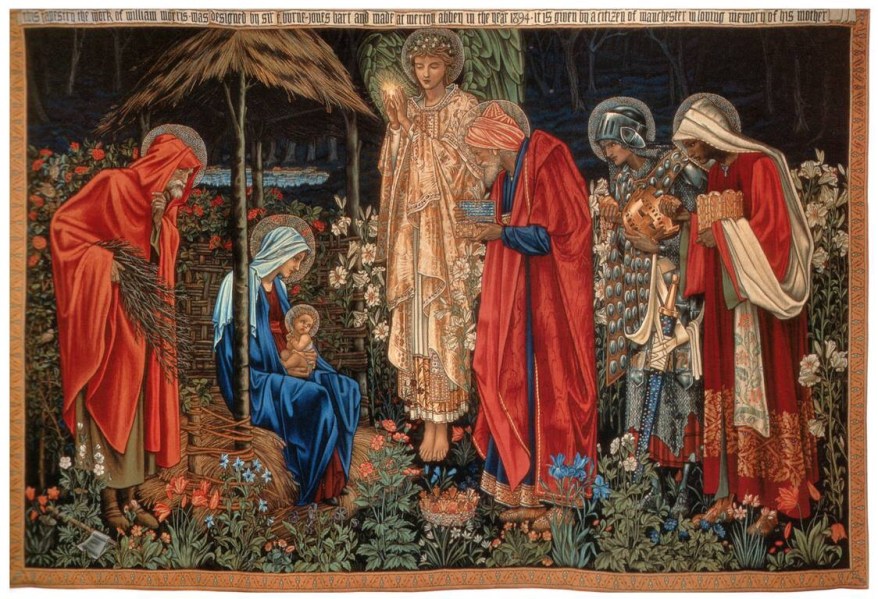
Christ, our Shepherd King

Pastor Sherry’s message for November 26, 2023

Scriptures: Eze 34:11-16, 20-24; Ps 95:1-7a; Eph 1:15-23; Matt 25:31-46

I love funny signs. Here are a few I’ve shared with you in years past and some new ones seen recently. Given it’s deer hunting season, we can appreciate these signs hung on property fences:

1. No hunting; No fishing; No nothing! Go home!

2. No trespassing! Violator will be shot; survivors will be shot again!

3. No trespassing! We’re tired of hiding the bodies.

How about these warning signs?

1. High voltage. Do not touch. Not only will this kill you, it will hurt the whole time you are dying.

2. Unattended children will be given an energy drink and a free puppy.

3. (I need this sign for my yard, since I feed 7 strays on my front porch.) No dumping cats! $750 fine and/or 90 days in jail. But, Hey! I’ll pray for you!

4. My personal favorite: Warning! If you think you can run across this pasture in 10 seconds, Don’t! The bull can do it in 9.

Finally, just for fun:

1. “Thank you for noticing this new notice. Your noticing has been noted and will be reported to the authorities.”

2. “Please do not throw your cigarette butts on the ground. The chickens come out at night and smoke them and we are trying to get them to quit.”

3. A sign outside a coffee shop: “Small coffee,” $5.00; “Small coffee, Please,” $3.00; “Hello, one small coffee, please” with a smile, $1.50.

4. On an infant’s onesie: “I just did 9 months on the inside; my parents are now in for life.”

Today we celebrate Christ the King Sunday. Our readings seem to progress, in a crescendo-like movement, like signs directing us to recognize and celebrate Christ as our Shepherd King.

A. In Ezekiel 34:11-16, 20-24—God tells us through the prophet that Jesus is our True Shepherd. The false prophets, idolatrous kings, and weak, compromised religious leaders of Israel and Judah have done a miserable job of shepherding God’s people. They have not fed the people on the Word of God; helped the sick; brought back the strays; or loved God’s people. God the Father is fed up with their ineptitude, their selfishness, their failures to protect His people, and their outright abuse of them. He says He will restore the flock and remove the selfish and self-focused shepherds. He will replace them with someone much superior.

So, this chapter contains a prophesy of Jesus. God will appoint Him as their True Shepherd (vv.23-24) I will place over them one shepherd, my servant David [it won’t be David himself, but Jesus from the lineage of David], and He will tend them; He will tend them and be their shepherd. I, the LORD, will be their God, and my servant David [Jesus] will be prince among them. I the lord have spoken. In other words, about 550 years before Jesus’ birth, and about 450 years after King David’s death, God is telling His people that an earthly king is coming who will rule wisely and justly. They needed Him and we need Him because most of our human leaders—whether religious or political–have been dismal failures. As Scripture says, He will be the One Shepherd, the Good Shepherd, the Great Shepherd, and the True Shepherd. Like His forefather, King David, Jesus will be a shepherd-king.

B. Psalm 95 is a song of joy and praise! (v.2)—Let us come before Him with thanksgiving and EXTOL [praise, worship] Him with music and song. Why? Because He is our Creator, our Maker, and the Rock of our Salvation. And in verse 7—For He is our God and we are the people of His pasture and the flock under His care [the sheep of His hand]. Again, we need God—and to be grateful to Him—because He watches over us/guards us like a Good Shepherd. Thus, we can worry less, risk more, and sleep better.

C. In Ephesians 1:15-23, Paul’s prayer is for the church at Ephesus, a church noted for its faith and love. He is not praying for material blessings for them. Instead, he wants them to have spiritual blessings: (1) to depend on the Holy Spirit for wisdom and revelation, so they will better understand God’s Word; (2) and for their spiritual eyes to be opened so that they will have hope; they will become aware of their spiritual inheritance because of Christ Jesus (adopted children of God and inheritors of heaven due to Jesus’ work on the Cross); and they will appreciate the exceeding and abundant power of the Holy Spirit—and call upon the Spirit to use this marvelous power in their behalf.

Then he declares that God the Father has made Jesus the Head (or shepherd) over everything! We, the Church, are the Body of Christ. God the Father planned for us; God the Son paid for us with His blood; and God the Holy Spirit empowers and protects us. Again, Jesus is our Good Shepherd.

D. Matthew 25:31-46—Reiterates that, at the end of time, King Jesus will assume the throne of this world. He will then judge the nations of this world (individuals too). God calls us all His sheep. There are two types of sheep: (1) the Saved—those who believe in Jesus and try to live according to His will; and (2) the Lost—those who reject Jesus and live life according to their own will. We only have to look around our world today to see examples of dictators who reject Christ and act as they are laws unto themselves. Folks like Putin of Russia and Ji Jinping of China appear to be among the Lost, especially as Ji has apparently taken it upon himself to rewrite the Bible. What hubris!

Then there are goats—whole nations (ethnos in the Greek) who have rejected Jesus. We recognize Christians by their love. In the Roman colony of Carthage in North Africa, in the second century, there was an extensive plague. Political and religious leaders took off and left the sick behind to tend themselves or to die. Furthermore, unwanted girl babies were abandoned left exposed on the garbage heaps outside the city. But the Christians of Carthage stayed behind to nurse the sick and to rescue the babies. They risked their own health. They did what no usual Roman citizen would. Carthaginian citizens were so astonished by the compassion and love of their Christian neighbors that many came to believe in Jesus as well.

Similarly, non-Christians are and will be defined by their lack of love, their lack of compassion. What kind of government builds weapons and arms but allows their people to suffer hunger? What kind of government uses noncombatant women, the elderly, and children as shields in military fights? What kind of government shoots to kill citizens trying to escape their cruelty? We can identify goats by their behavior. It is not our place to judge, but unless they undergo a heartfelt and radical change to the good, they are lost. I read recently that some of the religious authorities of Hamas told the terrorists, prior to their October 7th raid into Israel, that Allah would overlook their cruelty and barbaric treatment of Israeli women and children. What kind of god would authorize such inhumane behavior? Such people seem to resemble the kinds of folks to whom Jesus said (v.45)—I tell you the truth, whatever you did not do for one of the least of these, you did not do for Me. Then they will go away to eternal punishment, but the righteous to eternal life.

The signs are all there. Thank God, Jesus is our Shepherd King. The ancient Israelites needed Him. We need Him now. And we will need Him om the future. Christ our King is a mighty and a competent shepherd. We can trust in Him to care for us. We are safe in His arms.

Thanks be to God who gives us the victory through our Lord Jesus Christ! Alleluia, alleluia!

©️2023 Rev. Dr. Sherry Adams

Kingdom Courage

Pastor Sherry’s message for November 19, 2023

Scriptures: Jud 4:1-24; Ps 90:1-12; 1 Thess 5:1-11; Matt 25:14-30

Chuck Swindoll recalls the story of a 70 year old man who was being celebrated aboard a cruise ship for having saved a young woman. These folks were on a week-long cruise from California to Hawaii. The man was out walking on the deck when he saw the young woman fall overboard. He saw she could not swim, so he immediately went in after her, staying with her until they were both rescued. That night, the captain insisted they honor the somewhat embarrassed gentleman, over dinner, for his heroic actions. Speeches were made and the story of the man’s bravery was told and retold. Finally, they invited the fellow to the mike to say a few words. In what was probably the shortest hero speech ever offered, the fellow spoke these stirring words:

“I just want to know one thing—who pushed me?”

(Chuck Swindoll, The Tale of the Tardy Oxcart, Word Pub., 1998, p.119.)

I love this story because it illustrates so well the fact that our God can make the most unlikely of us into heroes. Can you imagine jumping overboard—at age 70—to rescue someone you didn’t know? Perhaps you’ve heard of similar stories. Courageous persons don’t allow their fears to talk them out of doing the brave thing. They also usually involve trusting in God to see them through a tough situation.

Our Old Testament and Gospel lessons today give us two examples of God’s concept of Kingdom Courage:

In our Old Testament lesson (Judges 4:1-24), we have the only example of a woman called to lead the nation of Israel, Deborah the Prophetess. Scripture mentions several women prophets: Miriam (Moses’ sister) (Exodus 15:20), Huldah, who sent a message to the good King Josiah (2 Kings 22:14), Noadiah, a bad prophet who tried to thwart the rebuilding of Jerusalem (Nehemiah 6:14), and Anna, who recognized that the infant Jesus was the Messiah (Luke2:36).

Deborah was called and equipped by God to lead during the time of the Judges. Joshua had died at 110, leaving no successor (no human understudy to rise up and lead in his place). Even though the people had promised him many times they would remain obedient to God, within 40 years, they had taken up idolatry and forsaken the LORD. The Lord would then allow a Canaanite people—Amorites, Amonites, Moabites, Midianites, or even Philistines—to then oppress them. They would then call out to the LORD for His rescue. God would forgive them and raise up a judge to lead them in defeating their enemies. They would thank and praise Him; but shortly, once the threat was over, they would again forget about their loyalty to God. And the 40 year cycle would begin all over again. The book of Judges reports 7 such cycles and 7 judges. Deborah was the 4th.

Who was she? Scripture tells us she was…

1.) A wife to Lippidoth. We know nothing of him, except that he seemed to have recognized God’s call on his wife’s life and did not appear to try to frustrate her influence or power.

2.) “A mother of Israel,” out of the tribe of Ephraim. While this may mean she had children of her own, it also means she nurtured and cared for the nation.

3) A wise counselor people came from miles around to seek her wisdom and advice.

4.) A renown judge—like Judge Janine Pirou or Judge Judy. Instead of sitting at the city gates to hear cases as was typical in those days (V.5)She sat beneath a palm tree named for Her–the Palm of Deborah–located between the cities of Ramah and Bethel.

5) A legitimate prophetess—She was anointed by God, who told her what to say to His people. She foretold events accurately, and nothing she prophesied disagreed with Scripture.

6.) We learn in today’s passage that she was a warrior.

7.) She was also a poet—She wrote a song/psalm, describing what God accomplished through her leadership in Judges 5.

8.) Finally, she was a woman who loved and trusted God—I’d say she had Kingdom Courage.

The situation Deborah finds herself in is that the Canaanite King Jabin had oppressed the Israelites for 20 years. He terrorized them with 900 iron chariots and horses and his successful General Sisera. Sisera’s army had confiscated all the Israelite‘s iron weapons in their initial victories. The Israelites were left then with wooden and stone weapons, clubs, rakes, etc.—they were at a distinct disadvantage. God tells Deborah to call for Gen. Barak from the tribe of Naphtali. She did, telling him that God meant for him to lead the people into battle against Sisera: (v.6–The LORD, the God of Israel, commands you: ‘Go, take with you ten thousand men of Naphtali and Zebulon and lead the way to Mount Tabor. I [the Lord] will lure Sisera, the commander of Jabin’s army, with his chariots and his troops to the Kishon River and give him into your hands.

God told Deborah and Gen. Barak that He was going to give the Israelites the victory. The General doesn’t see how—he doesn’t really trust in God. He focuses on the fact that his troops are outnumbered 10 to 1. He also knows he has no horses or chariots and that Sisera’s army is much better equipped (with iron weapons) than his army is. Barak agrees, but only if the prophetess will accompany him. However, since he doesn’t really seem to trust her or God, she tells him God will give the victory (Gen Sisera) to a woman (Jael, the wife of a weapons maker).

This previously unknown woman, Jael, was married to a Jewish man named Heber. He was an iron weapons manufacturer and a turncoat who collaborated with the Canaanites against his own people. To expedite his transactions, Heber and his much more loyal wife, Jael, lived in tents near the Canaanite army and the proposed battle site. (Sorry to say, but the men in this account do not appear to have the same moral fiber, Kingdom Courage, or faith that the women do.)

Much of what happens in the ensuing battle is recorded by Deborah in her psalm, in chapter 5. From her victory song we learn the LORD sent…

1.) Soldiers from the 6 tribes of Naptali, Zebulon; Issachar; Ephraim, Manasseh, and Benjamin.

2.) He also sent hail, sleet, and torrents of rain in which…

a.) bogged down the 900 chariots in deep mud;

b.) panicked the horses so they ran off;

c.) Canaanite archers couldn’t shoot their arrows in the sleet;

d.) and their swordsmen couldn’t wield their swords as well in the cold (remember this is essentially a desert-like land, where they are used to the heat, not the cold).

e.) Additionally, many enemy soldiers were swept away in a flash flood.

The battle belonged to the Lord. Israel’s army was able to kill all the enemy, except Sisera, who ran off in a desperate attempt to save himself. He escaped on foot and asked for sanctuary with Jael in her tent. In that culture in that day, the only man who was authorized to enter a woman’s tent was her husband. To hide out in a woman’s tent was outrageous. Remember, Jael is the wife of the Jewish weapon-maker. Sisera asked for water, but she gave him warm milk which we know would make him sleepy. Once he nodded off, she then executed this terrifying enemy of her people while he slept—and with the only weapon she had at hand. Interesting that, like the shoemaker’s daughter who has no shoes, this woman does not even have a metal knife at her disposal. Instead, she pounds a tent peg through his temple, killing him instantly, and fulfilling Deborah’s prophesy.

In her psalm, Deborah gives God the glory for their victory. Deborah trusted in God to free her people from oppression. She used her gifts of leadership in the face of overwhelming odds. Because of her faithful obedience and her Kingdom Courage, God gave Israel another 40 years of peace.

In our Gospel lesson, Matthew 15:14-30, Jesus provides examples of two courageous servants who utilize their talents for God and one who does not. Jesus says the master in the story leaves his assets in the hands of three servants. He appears to dole out his assets according to his trust in their abilities/motivation. One very able fellow gets 5 talents. Back then, a talent was equal to 1 years’ wages. For purposes of illustration, let’s say a years’ wages were $30,000; this guy has been entrusted with 5 times that or $150,000. The next gets 2 talents, or $60,000; and the third, 1 talent or $30,000.

When the Master returns, He expects them to account for how they invested His money. The fellow who had 5 talents invested them wisely and wound up earning double or $300,000! The guy with 2 also invested wisely and earned double, or $120,000. The guy with no faith or Kingdom Courage hid his 1 talent, so he gained nothing. At least he was honest and returned the $30,000. But the master was angry because he could have at least deposited the $30,000 somewhere and earned interest.

The Master commends the first two, Well done, good and faithful servant…Come and share your master’s happiness! But He has nothing but contempt for the third. This guy was either so lazy as to not use the talents, or too afraid to fail, so he did nothing. This guy gets thrown into the outer darkness, (v.30)…where there will be weeping and gnashing of teeth.

Many see this as a very hard teaching of Jesus. What they need to understand is that this is not a story of money or of wise investment practices. It is about utilizing the skills and gifts we have been given by God to build up His Kingdom. Notice, all are called to account: Those who use their gifts are blessed now and join Jesus in eternity. Those who do not are chastised and punished. I believe when we stand before God at His judgment seat, He will ask those of us who love His Son two questions: How well did you do at loving others? And how well did you use the gifts I gave you to advance My Kingdom?

So what is the point for us today?

First, like the 70 year old man pushed to rescue a woman at sea, God can make even ordinary people into heroes. Deborah was very gifted, but think about the housewife, Jael. She not only countered her husband’s disloyalty to Israel, but she was brave enough to kill a cruel enemy with a tent peg and a hammer.

Second, think about the two unnamed servants who took a risk and invested their master’s money. What about the risk and Kingdom Courage it takes us to step into our gifting? We need to not focus on our fears, but rather trust in God to help us achieve what He has put in our hearts. He expects us to use the talents He has given us to bless others.

Finally, God wants us to exhibit Kingdom Courage. He often uses ordinary people who trust in Him to accomplish His will. Do you trust God?

Are you willing to be obedient to Him, even when your situation seems difficult or impossible? If He can use an essentially unarmed army to defeat a vastly superior force, He can master any situation we bring before HIM.

What situation are you in that has you flummoxed, frightened, or frustrated?

Give it to the Lord, over and over until you see results (this is called “praying through”). Then ask God to give you Kingdom Courage to do any hard things that He may indicate He wants you to do.

Amen. May it be so!

©️2023 Rev. Dr. Sherry Adams

Wise Up!

Pastor Sherry’s message for November 12, 2023

Scriptures: Amos 5:18-24; Ps 78:1-7; 1 Thess 4:13-18; Matt 25:1-13

Someone on the Internet has come up with a list of 263 ways to say a person is not too bright. We probably all know, “The light’s on but no one’s home,” or “dumb as a box of rocks,” but have you heard the following:

1. A few screws short of a hardware store.

2. A few fries short of a Happy Meal.

3. The gates are down and the lights are flashing, but the train isn’t coming.

4. The elevator goes all the way to the top floor, but the doors don’t open.

5. Would lose a debate with a doorknob.

6. If this person had another brain, it would be lonely.

7. If you gave them a penny for their thoughts, you’d get change.

8. Has a mind like a steel trap: rusty and illegal in 37 states.

9. If their nose was on upside down they’d drown in the rain.

10. Their dog teaches them new tricks.

(Borrowed from https://dan.hersam.com/lists/not_bright.html)

My adult son offered a new one as we watched our favorite football team compete yesterday. They were playing at their opponents’ stadium and we noticed a big “3” painted on their field. The TV announcers never explained what the number three meant. My son suggested it stood for the number of their football players whose IQ was greater than that of Forrest Gump’s.

Both the list and my son’s comment may all be pretty funny, but none is kind. I don’t advise applying them to someone—remember, Jesus said not to call anyone “an idiot” (Matthew 5:22). However, in today’s Gospel, He does encourage us all to be wise instead of foolish.

I’ve titled today’s sermon, “Wise Up!” because our scripture readings point to the difference between wise and foolish behavior; i.e., we don’t want to be “eating soup with a fork.”

A. In Amos 5:18-24, our Old Testament reading, the prophet Amos is certainly telling the folks in the Northern Kingdom of Israel to wise up! We might say they go through the motions of attending church—they act like they love God—but their behaviors the rest of the week reveal their hypocrisy. Even worse, they actually worship idols, false gods. They have turned their backs on our One True Lord. They have broken the 10 Commandments; they are behaving immorally; they have corrupted justice; they have trampled on the poor; they have oppressed the righteous; they have taken bribes. Doesn’t this sound a lot like our culture today?

And the Lord has about had it with them. God cannot be fooled. We might try to hide things from Him, but He knows everything! He knows they have betrayed and abandoned their faith in Him (and for our nation, our faith in Christ Jesus). God, through Amos, gives them one last chance to repent, to change their ways. He warns them that terrible punishment is coming to them. Amos calls it the Day of the Lord and it will indeed be horrifying for those who have rejected God. He uses two arresting metaphors: (1) They might run to escape a lion or cougar, but will then encounter a bear. (2) They might think they have reached the safety of their home, only to be bitten there by a poisonous snake. In other words, there will be no escape for evil-doers, no matter how fast or how far they run.

In God’s mercy, they could have averted this terrible punishment if they had (v.24)—> …let justice roll on like a river, righteousness like a never-failing stream! But, they were unwilling to change, so their end came shortly after Amos’ prophesies. In 722BC, God used the dreaded, blood-thirsty, Hamas-like Assyrians to overrun them, defeat them, and carry any survivors off to Ninevah (Iraq) as slaves. They were stubborn. They didn’t wise up. God, after dozens and dozens of warnings, finally let them have it.

This is why we pray for our nation weekly. America is now a post-Christian nation. We were founded as a Christian society and meant to be an example for the world. Now, we too have rejected and rebelled against God. We too have had dozens of chances. We hope that the Lord will help our nation return to Him, rather than bring on an Assyrian-like punishment.

B. In 1 Thessalonians 5:1-11, Paul is warning Christians there (and us now) to be prepared for the end of time. He states in v.2 that—> …you know very well that the day of the Lord [same expression used by Amos] will come like a thief in the night. “The day of the Lord” is a synonym for God’s judgment. It will come when folks least expect it. Nevertheless, true believers need not be afraid of it. Paul equates nonbelievers with those living in nighttime darkness. But we who believe in Jesus Christ are all…sons [and daughters] of the day. We do not belong to the night or to the darkness. So then, let us not be like others, who are asleep but let us be alert and self-controlled (vv.5-6). We who love Jesus have nothing to fear because we will have been raptured up to heaven before the Great Tribulation takes place. God’s judgment will fall on nonbelievers and evil-doers. Meanwhile, the dead who waited on Christ, or who believed in Christ, will rise first. Then those of us believers who are still living will be lifted up/beamed up (raptured) to meet Christ in the air.

Now I used to wonder if the rapture came before, during, or after the Great Tribulation. However, Paul makes it clear in verse 9—> For God did not appoint us to suffer wrath but to receive salvation through our Lord Jesus Christ. This is pretty clear, isn’t it? The Church of true believers will not suffer on the day of the Lord. We will be removed from the earth before the time of terrible trial begins.

While we wait on this time of judgment or the rapture, however, Paul urges us to…(v.8)—> be self-controlled, putting on faith and love as a breastplate, and the hope of salvation as a helmet. He wants us to demonstrate faith, love, and hope to others and especially as a witness to unbelievers. He also wants us to encourage and build one another up (v.11).

C. Finally, we have Jesus’ parable of the 10 virgins in Matthew 25:1-13. The bride (who is not mentioned) is the Church; the bridegroom is Jesus. But who are the 10 wise and foolish bridesmaids?

Interestingly, all ten fall asleep while waiting on the bridegroom whose arrival is delayed. The story then asks us to consider which we would rather be, prepared or unprepared, for when Jesus returns. The prepared ones go in with and enjoy the wedding supper of Jesus, the Messiah. Those unprepared ones, however, miss out. We might say they…”Couldn’t hit the floor if they fell on it,” or that “Wisdom is chasing them but they’re always faster.” They are Christ-followers who are not ready to meet Jesus. In fact, Jesus says to these unprepared ones (at His 2nd Coming), I tell you the truth, I don’t know you. How are they unprepared? They have never cultivated a personal relationship with Jesus.

His final advice to us all is to Be Wise! Be ready! When we Floridians know a hurricane is coming we stock up, don’t we? We make sure we have stock-piled clean water in jugs. We have candles and matches, as well as a battery operated radio, in case we lose electricity. We gather food we can eat without cooking, etc. What would we need to have on hand if we are to be wise about Jesus’ return?

(1) We should intensify our relationship with the Lord;

(2) We might read and meditate more on Scripture;

(3) We could ask for forgiveness of our sins, keeping short accounts with the Lord. Back when I provided mental health in nursing homes (prior to going to seminary in the mid-1990’s), I noticed folks in the final stage of Alzheimers, comatose and vegetative, being fed with a tube in their stomach and hydrated through an IV. Sometimes their relatives asked me why the Lord was keeping their loved one alive in this helpless state. I told them I didn’t really know but I advised them to pray for this person—to pray specifically that God would forgive them for any unconfessed sin.

One family told me they were sure their dear mother had no unconfessed sins. I then told them I was sure their mother was a lovely person, but I wondered how any of us could ever be sure she didn’t have some hidden, long ago sin. I recalled that both of my dying, comatose parents each slipped away about a half hour after I prayed that Jesus would forgive them their sins. This family later reported to me that their mother died during the night after they had prayed this way for her.

(4) Obviously, it is wise to be prayed up, in frequent communication with the Lord. You might ask, “How do I know I am hearing from the Lord?” I recommend you ask the Holy Spirit to guard your prayers from any interference from Satan or his minions, and then pay attention to the thoughts that drop immediately into your head. If they do not contradict the Bible, you can be assured you are hearing from the Lord. Often I find the Lord does not speak to me as I am used to hearing others speak. He uses vocabulary or expressions that differ a bit from what I am used to hearing or saying. This helps me recognize His “voice.”

I believe our lessons today are telling us to pray for our nation to wise up! According to news sources, 76% of Americans today believe our country is clearly moving in the wrong/the unwise direction.

I believe we should also pray that each of us will have the faith to trust that God will protect us as things worsen toward the end. We cannot trust in our own goodness or our intelligence to save us. Those who do will be left behind to suffer God’s wrath. We must, instead, live out a life that tells others we believe in Jesus Christ as our Lord and Savior.

Finally, I believe we must pray that we will each be prepared– like the 5 wise bridesmaids–at any moment to meet the Lord. None of us knows how long he or she has to live. And none of us knows when the day of the Lord will occur. Let’s all wise up and be ready!

©️2023 Rev. Dr. Sherry Adams

Both/And

Pastor Sherry’s message for October 29, 2023

Scriptures: Deut 334:1-12; Ps 90:1-6, 12-17; 1 Thess 2:1-8; Matt 22:34-46

The story is told that…

“Isidor Isaac Rabi, a Nobel Prize winner in Physics, and one of the developers of the atomic bomb, was once asked how he became a scientist. Rabi replied that every day after school his mother would talk to him about his school day. She wasn’t so much interested in what he had learned that day, but how he conducted himself in his studies. She always inquired, ‘Did you ask a good question today?’

“‘Asking good questions,’ Rabi said, ‘made me become a scientist.’

“In order to ask a good question I think you need to have noble motives behind the question. You have to want to know the truth. The Pharisees, by contrast, already had the answers to their questions. They felt they already knew the truth. How many times have we had it in for someone, asking a question designed to trap them? We do it to our loved ones all the time. In a moment like this we are not trying to learn; we are trying to injure.

“The Pharisees come to Jesus once again with a question designed to do damage to the reputation of Jesus. And once again Jesus proves he is equal to the task. Teacher, which commandment in the law is the greatest? Now, even though this question was used to test Jesus, it is nonetheless an important question. Perhaps in the life of Israel at that time [and in our lifetime today] it was THE most important question.

(Excerpt from a sermon titled “The Two Most Important Questions a Christian Can Answer” as posted on www.sermons.com, 10/29/2023.)

Jesus’ answer to their question came from the Old Testament:

Believing Jews knew the first part, love God above all things, came from Deuteronomy 6:4-5. It was part of the Shema, which believing Jews recite daily Hear O Israel, the Lord our God, the Lord is one. Love the Lord your God with all your heart and with all your soul and with all your strength [might; mind]. The second, love others as you do yourself, comes from Leviticus 19:18—>Do not seek revenge or bear a grudge against one of your people, but love your neighbor as yourself. I am the Lord. Jesus combined these two and pointed out (v.40) that—> All the Law and the prophets hang on these two commandments. The Pharisees and their buddies, the lawyers who specialized in interpreting the Law, counted 613 laws handed down by Moses. Jesus summarized them all into these two, both/and. They are also represented in the shape of the Cross. The vertical is our love for God; the horizontal, our love for others. Furthermore, Jesus strongly asserts that all the Law is based on God’s love for them, as was every action and teaching of each Old Testament prophet. WOW!

Knowing they had set out to stump and to discredit Him, Jesus then turns the tables on them, asking them a riddle: (v.42)—>What do you think about the Christ? Whose son is He? They correctly answer that the Messiah comes from the lineage of King David. Now, He’s got them! “How can Messiah be both David’s son and David’s master?” He’s doing a twist on “which came first, the chicken or the egg?” Remember, a crowd was watching and listening to this debate. Many were no doubt delighted to hear Jesus turn the tables, saying in essence,”two can play this game.”

Jesus, God’s Word made flesh, clearly knows His Scripture. He refers them to Psalm 110:1, which He recites from memory—>The LORD says to my Lord: “Sit at My right hand until I make your enemies a footstool for your feet.” Perhaps the Pharisees and lawyers did not know that Jesus was, through His mother Mary, a descendant of King David, making Him, in effect, David’s-many-generations-later son. Perhaps they did not believe His Father was God, through the Holy Spirit, making Him the Son of God and King David’s Master. He was and is both fully human and also fully divine.

Notice, this ends the public debate. The lawyers and Pharisees have no answer for Him. As the English Anglican Bishop, NT Wright says, “The answer the opponents couldn’t question was followed by the question they couldn’t answer.” (N.T. Wright, Matthew for Everyone: Part Two, Westminister John Knox Press, 2002, p.93.) If nothing else, this should have proven that Jesus knew and understood Scripture better than they did!

How humiliating for them! At this point, they stop trying to trip Him up in public. Now they will plot a clandestine attack, at night, in the Garden.

But let’s return to the biggest point His enemies missed: The answer to Jesus’ question of them was standing right before them, both David’s son and David’s master! Moreover, He will soon demonstrate the two greatest commandments, through His arrest, crucifixion, and death. He both loved His Heavenly Father enough to give up His life in order to do God’s will. And He loved us enough to take upon Himself the penalty for all of our sins, for all time, past, present, and future. This is extravagant love, poured out on both the vertical and the horizontal plains of the Cross. Again, as N.T. Wright writes, Jesus reveals that He is both King David’s descendant, “the true king of Israel,” and King David’s Lord and Master (Ibid, p.94).

We know the Jews were expecting a militaristic Messiah, a king who, like King David, would defeat all their earthly enemies. The book of Revelation promises us that when Jesus comes a second time, He will indeed arrive as such a conquering monarch. He will eradicate the enemies of God. He will once and for all eliminate sin and death. But in His first coming, He lived out humility and human servanthood. A military Messiah would be unlikely to inspire us to love God or to love others, especially those we dislike. Instead, God the Father knew we needed a humble, righteous, grace-filled and loving Messiah to both teach and to model for us what it looks like to love God and to love others as ourselves.

A unique and modern way of looking at it is that our suffering servant Messiah took on Satan in unarmed combat on the Cross and won! This is a king worth worshipping!

G. K. Chesterton, the famous British author and satirist, said 100 years ago—>“Jesus…tells us to love our neighbors. Elsewhere the Bible tells us Jesus said we should love our enemies. This is because, generally speaking, they are the same people” (repeated from an old sermon of mine in which, unfortunately, I did not cite the source— Sorry! But I do believe the quote is accurate.) The truth is that it is easier to love God than to love our neighbors—especially the irritating ones, or worse yet, the dangerous, sadistic, cruel, and immoral ones. We can do it, but we must be intentional about it. We begin by praying for them, again and again. We continually offer grace to them, just as Jesus has to us. We do not allow them to harm us—we can protect ourselves—but we try to act in a Christ-like manner toward them. As I have related to you before, my step-father (now deceased) was physically and verbally abusive to me during my childhood. I feared him as a child and this fear stayed with me long into my adulthood. I would not visit him and my mother without my own transportation—if things got dangerous, I wanted to have a means of escape. I had forgiven him but I did not trust him for years after I had left to be on my own. We can forgive but also protect ourselves from being re-victimized.

Our Gospel lesson today illustrates for us that Jesus was/is certainly a brilliant debater! He knows His stuff! He even knows His enemies’ motives, and beats them at their own game. He also walked His talk. Unlike His religious opponents, He was not a hypocrite. He meant what He said and said what He meant. I taught my first group of high school seniors in 1970. My wonderful principal—who mentored me as a new teacher—told me to always say what I meant and mean what I said. Especially around classroom discipline, she advised me to never threaten a disciplinary action I was unwilling to carry out. She also warned me that there would always be at least one student who would challenge whether or not I meant it by breaking the rule. She was right, just as Jesus was right.

Jesus truly knew what it meant both to love God above all things—including His own life–and to love us. May we all, by the power of the Holy Spirit, come to love God with our whole heart, soul, mind and strength. And may we also learn to love our neighbors at least as well as we love ourselves.

Amen! May it be so!

©️2023 Rev. Dr. Sherry Adams

Love in Action

Pastor Sherry’s message for September 10, 2023

Scriptures: Ex 12:1-14; Ps 149; Ro 13:8-14; Matt 18:15-20

A group of 4-8 year olds was asked, “What does love mean?” Here are some of their answers:

Rebecca — age 8—>“When my grandmother got arthritis, she couldn’t bend over and paint her toenails anymore so my grandfather does it for her all the time, even when his hands got arthritis too. That’s love.”

Karl — age 5—>“Love is when a girl puts on perfume and a boy puts on shaving cologne and they go out and smell each other.”

Chrissy — age 6—>“Love is when you go out to eat and give somebody most of your French fries without making them give you any of theirs.”

Danny — age 7—>“Love is when my mommy makes coffee for my daddy and she takes a sip before giving it to him, to make sure the taste is okay.”

Bobby — age 7—>“Love is what’s in the room with you at Christmas if you stop opening presents and listen.”

Noelle — age 7—>“Love is when you tell a guy you like his shirt, then he wears it every day.”

Cindy — age 8—>“During my piano recital I was on a stage and I was scared. I looked at all the people watching me and saw my daddy waving and smiling. He was the only one doing that. I wasn’t scared anymore.”

Chris — age 7 —>“Love is when Mommy sees Daddy smelly and sweaty and still says he is handsomer than Brad Pitt.”

Lauren — age 5—>“I know my older sister loves me because she gives me all her old clothes and has to go out and buy new ones.”

Jessica — age 8—>“You really shouldn’t say ‘I love you’ unless you mean it. But if you mean it, you should say it a lot. People forget.”

(Borrowed from PASTOR LARRY PRESNELL’S BLOG, 2/14/11.)

These kids have the right idea, don’t they? Love is a positive, generous feeling. But it is a feeling expressed in an action. Kids recognize love when they observe a loving action.

Our God tends to express his love in action and wants us to do likewise.

A. Psalm 149 is a psalm of praise to God because He is both our Creator and our Redeemer. He redeemed the Israelites from Egypt by the blood of the Passover Lamb and through His powerful judgment of Egypt. Just as the Israelites (v.3) Praise[d] His name with dancing and ma[d]e music to Him with tambourine and harp following their escape through the Red Sea, we too can and should praise Him for His powerful, redemptive acts on our behalf. Scripture tells us that God is love. If we have eyes to see, we can confirm that He clearly loves us. As we acknowledge each Sunday in our “Joys” of Our “Joys and Concerns Prayers,” we can and do see clear evidence of His love in action in our lives.

B. Paul exhorts us to make sure our actions are loving in Romans 13:8-14. He insists that those who abide by the 10 Commandments are living a life-style characterized by love, as (v.10)—>Love does no harm to its neighbor. Again, as I have mentioned before, the vertical of the Cross represents our love for God (commandments 1-4), while the horizontal, our love for others (5-10). People who love well do not break these laws.

C. Jesus describes a loving way to address conflict between Christians in Matthew 18:15-20. We are not to sweep conflict under the rug and ignore it. And, rather than talk ugly about a person who has offended us—which many choose to do–we are to go to that individual and try to work it through. I recommend you pray before trying to do this. Ask God to give you the words, the wisdom, and the right heart attitude, and also to be working on the other person before you meet. He often, I find, solves the problem before we even begin the needed conversation.

D. Our Old Testament Lesson (Exodus 12:1-14) provides a perfect and memorable example of God’s love expressed in His actions. You may recall that back in Ex 3:7+, God had told Moses:

I have indeed seen the misery of my people in Egypt. I have heard them crying out because of their slave drivers, and I am concerned about their suffering. So I have come down to rescue them from the hand of the Egyptians and to bring them up out of that land into a good and spacious land, a land flowing with milk and honey. But I know that the king of Egypt will not let you go unless a mighty hand compels him. So I will stretch out my hand and strike the Egyptians with all the wonders that I will perform among them. After that, he will let you go. That was God’s promise: He would create a situation that would compel stubborn Pharaoh to let His people go. The Hebrews had been in Egypt about 400 years—long enough for the Canaanites to have time to come to love the true God–which they never did. So the Lord was ready to rescue the Israelites from Egyptian slavery and give them the land occupied by various pagan Canaanite tribes. His method was to judge Egypt with 10 plagues. Each plague was actually a put down of some Egyptian god. Yahweh had declared war on the gods of Egypt:

1st, He turned the Nile to blood—the fish died and no one could drink the water. They had to dig wells. The Egyptians so depended on the river for their water supply and commerce that they equated it with life. By polluting the Nile, God was saying to them, “I, not your river god, am the source of all life.”

2nd, He sent down upon them a superabundance of frogs. Egyptians of that day equated frogs with evil spirits. God is saying, “I can produce animal pests which your numerous gods of nature cannot prevent.”

Similarly, out of dust Moses tosses into the air, God produces 3rd, a plague of lice and 4th, of biting flies. God is saying, “Why aren’t your gods able to counter and destroy these pests?”

5th, God sends disease on their cattle, rams, sheep, and goats–many of which die. The Egyptians had gods for each of these animals. But our God is saying, “I have complete control over animal life, not Osirus, the bull god or Apis the ram god.”

6th, He afflicted the animals that remained—as well as the people—with boils. Even Pharaoh’s magicians couldn’t prevent these painful boils from manifesting. God is saying, “Only I have power over physical health.”

7th, He sends hail, actually fiery ice clumps. Egypt normally gets very little rain. God is saying, “I—not Hephaistos, your god of fire or Porphry, your god of rain—have complete authority over forces of nature.”

8th, God sends locusts to eat up any vegetation left over, then sends them to drown in the Red Sea. Egypt’s gods of nature are obviously helpless to combat any act of the One, True God. Our God is saying, “I can raise up hordes of any destructive creature, deploy them, and then I can put an end to them.”

By now, the Egyptian economy is in ruins, but still Pharaoh will not let his slave labor go free. God then sends the 9th plague, 3 days of complete darkness over all of Egypt–except over the Nile delta where the Israelites live. God is saying, “Your sun god, Re, is powerless before Me.”

Finally, God sends the 10th plague, the death of the firstborn person and animal. Egyptians believed their god, Horus, was the god of life.

They also believed they owed their lives to their Pharaoh, who they believed was divine. But God is saying, “Not so fast, My friends! I am the giver of life and I can take it away when it is in rebellion against Me…even to and including the first born of Pharaoh.

This brings us to chapter 12 and the institution of the Passover: God intended to take the life of every 1st born in Egypt. Those who loved Him, however, were to be spared. Through Moses, He told the Hebrew slaves to select a perfect 1 year old male lamb. They were then to slaughter it on the evening of Abib 14th (meaning young head of grain for the Spring harvest), or the 14th of Nisan (the later Babylonian name). God directed them to re-order their calendar so that Nisan became the first month of their year. Additionally, they were to paint their door frames with the lamb’s blood. The blood of the lamb would signal to the angel or death that they were true believers and their lives will be spared. They were to remain inside their homes, but dressed for travel, as they would be leaving Egypt directly.

Next, they were to eat the roasted lamb, unleavened bread, and bitter herbs. Roasting, rather than baking or boiling, was meant to recall the fire of God’s judgment on Egypt. The bitter herbs were to remind them of their tribulations under slavery. Leaven was a metaphor for sin, so the purpose of unleavened bread (like a pita) was to prompt them to remember that something else—the lamb-had paid the price for their sin. They were protected from the angel of death by the blood of the Passover Lamb. The first born of all of those with no blood over their doors died that night. By the next day, all of Egypt wanted the Israelites to be gone!

This is love in action! God protected the Israelite people from the angel of death by the blood of the Passover Lamb with which they had earlier anointed their door frames. The Historic Jewish Passover finds its ultimate fulfillment in Jesus Christ—it foreshadows or predicts Jesus’ blood shed for us on the Cross. He too was a perfect male lamb—>John the Baptist calls Him, in John 1:29—>…the Lamb of God Who takes away the sin of the world. He was completely without sin. He was God, the only Son of God, so His blood was the blood of God. No imperfect person would have been capable of atoning for our sins. But the writer to the Hebrews says that Jesus is the once and for all perfect sacrifice for our sins. Peter, on trial before the Sanhedrin, testifies in Acts 4:12 that—>Salvation is found in no one else [meaning Jesus] for there is no other name under heaven given to men by which we must be saved. John tells us in 1 John 3—>This is how we know what love is: Jesus Christ laid down His life for us. What perfect love!

We know that God is love. We also know He daily demonstrates His love for us in action. We must have spiritual eyes to begin to recognize His loving actions toward us. The 10 plagues and the Passover constituted God’s strategy for motivating a despot, a tyrant, to let go of a free labor force of 1-2 million people. The plagues and the Passover demonstrate how far God will go to redeem those He loves. Jesus’ death on the cross proves the same truth again: Our God has died an undeserved but agonizing penalty to obtain our freedom from slavery to sin and death. Like His Father before Him, He has gone to extreme lengths to redeem us.

As the apostle John tells us in 1 John 4:10—>This is love: not that we loved God, but that He loved us and sent His Son as an atoning sacrifice for our sins.

Thanks be to God who gives us the victory through our Lord Jesus Christ! Alleluia, alleluia!

©️2023 Rev. Dr. Sherry Adams

Pastor Sherry’s messages will return in October following her vacation.

SELF-LESS

Pastor Sherry’s Message for September 3, 2023

Scriptures: Ex 3:1-15; Ps 105:1-6, 23-26, 45b; Ro 12:9-21; Matt 16:21-28

         I came across this little poem the other day, whose author is anonymous (perhaps by choice?):

         I’ll go where You want me to go, dear Lord.

                    Real service is what I desire. 

          I’ll sing You a solo anytime, dear Lord,

                    But don’t ask me to sing in the choir.

          I‘ll do what You want me to do, dear Lord,

                    I like to see things of God come to pass.

          But don’t ask me to teach boys and girls, O Lord,

                    I’d rather just stay in my class.

          I’ll do what You want me to do, dear Lord,

                    I yearn for Thy kingdom to thrive. 

          I’ll give You my nickels and dimes, dear Lord,

                    But please don’t ask me to tithe.

          I’ll go where you want me to go, dear Lord,

                    I’ll say what You want me to say.

          I’m busy just now with myself, dear Lord,

                    I’ll help You some > convenient day.

(Chuck Swindoll, The Tale of the Tardy Oxcart, Word Publishing, 1998, pp. 516-517.)

This is amusing, isn’t it?  We’re ready to obey the Lord, but on our terms.  If we obey on our terms, then just who is God to us? We sit on the throne of our own lives, and obey God if and when it’s convenient—which means we have dethroned the true King.


And where does this leave us?  The comedian, George Carlin, once had a routine in which he challenged the concept of self-help.  He said, essentially, that self-help is an oxymoron:  “Look it up,” he said, “if you did it yourself, you didn’t need any help. Pay attention to the logic of the language, people.”   How about the concept of self-service?  Isn’t service something we provide to others? Again, using Carlin’s logic, is it a service if we do something for ourselves alone?

(Fairless and Chilton, The Lectionary Lab Commentary, Year A, 2013, p.213.)

The Bible is pretty clear that God prefers for us to turn from serving or helping self toward serving Him and helping others.

         A.  Our Old Testament lesson (Exodus 3:1-15) is a case in point:  By the end of chapter 2, Moses had become a grown man with   a desire to help his people, the Israelites.  So when he observed an Egyptian overseer mercilessly beating a Hebrew slave, he took it upon himself to kill the Egyptian.  We have no indication that the Lord told him to do this.

He had assumed this murder would be helpful.  But he was unprepared for what might happen when the word got out—even among the slaves–that he was a murderer.  His own people didn’t trust him.  He had been trying to help, but by his own misguided efforts.  The Egyptians wanted to arrest him and kill him.  This resulted in his having to flee for his life to the Egyptian “outback,” to the south end of the Sinai Peninsula, a place called “Midian.”

There, in Midian, the Lord placed him in a godly family and provided him with (1) sanctuary from any avenging Egyptians, (2) a lovely wife, Zipporah, and two sons, and (3) a new way to earn a living, as a shepherd.  We could say he served a 40 year apprenticeship, caring for sheep and goats, prior to shepherding God’s Chosen People.  He was also learning not to rely on self (help).  He was emptied of pride and self-will.  The burning bush incident was meant by God to teach Moses to surrender his ego, his princely prerogatives, and to trust in the name and power of the Lord.  God tends not to use those who will not yield to Him.

         B. We know God used Moses mightily, as we read the rest of Exodus, Numbers, Leviticus, and Deuteronomy (the Pentateuch or Torah, the Law, from Genesis through Deuteronomy).  After afflicting the Egyptians with 10 plagues—by the way, this was the Lord going to war with the gods of Egypt and winning every time!—Pharaoh gives in and lets the Israelite slaves leave Egypt.  Scholars believe King David wrote Psalm 105, to preserve and celebrate God’s actions on behalf of the Israelites from the time of Abraham to Moses.  This psalm retells their history.

The verses we read this morning recall how the Lord used Moses and Aaron, his brother, to display His power to Pharaoh, essentially saying, Dude, you and your gods don’t have a chance against the power of the Almighty God.

We’ve all just survived Hurricane Idalia.  Think of how Almighty God intervened to help us through.  A friend in Tallahassee who did not lose power was watching the Weather Channel and heard Dr. Greg Postel say, the day after Idalia hit land (8/11/23), that they observed “curious changes” that did not match their scientific predictions:  (1) The eye wall “eroded,” or “fell apart at the middle and lost convection so that the wind weakened just before landfall.”  130 mph suddenly dropped to 85 or 90—such a huge, immediate drop is not usual.  This Category 4 killer storm reduced to a Cat 2 or 1 as it reached land.  He admitted the science could not explain this.  (2) Though the storm surge was bad, due to the full moon, it materialized as less than expected because it hit at low tide rather than high tide, as had been predicted.  Perhaps the lowered wind speeds helped change the timing of the storm with the tides.  How amazing!  (3) Additionally, the winds at ground level during impact appeared to have separated from higher, more vicious winds which operated up to 1000 feet above land.  The winds that hit us were actually lower in velocity than the higher winds in the storm mass.  We were spared the really dangerous, brutal winds.  Remember our prayers, since the beginning of hurricane season against a dangerous hurricane hitting Florida?  No doubt we were not the only Christians praying this way.

Truly we were spared the devastation of a Cat 4 storm by divine intervention.  Never doubt the power of Almighty God!  All praise belongs to Him!

         C. In his letter to the Romans (12:9-21), Paul lays out how we are to relate to other believers and to nonbelievers.

         If we are cooperating with the transforming power of the Holy Spirit, our actions toward other believers will be characterized by

                  a. Sincere love;

                 b. Hatred only for what is evil;

                 c. Devotion to each other out of brotherly love (philios);

                 d. Industriousness, rather than laziness;

                 e. “Joy in hope, patience in affliction, faithfulness in prayer”;

                 f. Sharing with the truly needy;

                 g. Practicing hospitality;

                 h. Blessing rather than cursing others;

                 i. Empathizing with each other’s pain or joy;

                 j. Living in harmony with others;

                 k. And being humble.

Toward non-believers, we are to (1) refuse to exact revenge for being wronged—leaving that instead to God.  Remember, the culture says, “What goes around comes around.”  Scripture says “we reap what we sow.” It’s the same law.  Often I have seen someone receive back exactly the evil treatment they had previously dished out to another; (2) do the right thing; (3) as much as we can ensure it, we must live at peace; and (4) verse 21 Do not be overcome by evil, but overcome evil with good.

If we can demonstrate these attitudes and behaviors,we are truly demonstrating that we are surrendered to God.  If we can’t, we probably aren’t.

         D. Which leads us to our Gospel lesson (Matthew 16:21-28).

Jesus tells the disciples, for the 1st time, that He is going to Jerusalem to die (about 6 months prior to His crucifixion).  He will tell them four more times before His betrayal and arrest (Matthew 17:12, 17:22-23, 20:18-19, and 20:28).  He knows and accepts that this is the future set out for Him.

But Peter is appalled!  Seven verses earlier, Peter had confessed that Jesus is the Messiah, the Son of God.  He can’t believe that Jesus would willingly die a     criminal’s death.  Whereas his first statement was inspired by the Holy Spirit, this second one is inspired by Satan.  How quickly we can move from being in alignment with God’s will to being antagonistic to it.  Jesus loves Peter but rebukes him strongly.  Even the Son of God—who is also God—must submit His will to that of the Father.

Self-help, self-service, even self-improvement rarely work for us.  I once worked with a very bright doctoral student in Sports Psychology.  Those folks are smart as can be.  They have to learn all the psychology I did, as well as the physiology of bones, muscles, ligaments, and tendons that impact athletic performance.  She suffered from depression and did not believe in Jesus.  Instead she worshipped “the goddess within.”  I wondered how she could continue to believe in the goddess within when that entity had not helped her overcome her battle with depression.  Self-improvement based on self or even on “the goddess within” is typically fruitless.  We need Jesus to heal us.   

Ultimately, we need to follow the examples of Moses and of Jesus.  We are to deny ourselves.  We are to be willing to sacrifice what we want.  We are to serve and obey God.  We are to help others.

When we can become self-less, then God has us right where He wants us.  This is the point at which He will use us to build up His Kingdom.  And, paradoxically, when we surrender to Him and pick up our cross, we gain eternal rewards—we are richly blessed.

Thanks be to God who gives us the victory through our Lord Jesus Christ!  Alleluia, alleluia!

©2023 Rev. Dr. Sherry Adams

We Want a Hero!

Pastor Sherry’s message for 8/27/23

Scriptures: Ex 1:1-2:10; Ps 124; Romans 12:1-8; Matt 16:13-20

I attended 4th grade in NOLA (New Orleans, Louisiana). My dad was in the navy and we were stationed there for two years. My teacher was a sweet, pretty young woman, newly married. I can’t remember her name but I do remember that she exercised no classroom control. The boys in particular behaved very badly and she could not get them to shape up. They neither listened to nor respected her. The ceiling of our classroom was covered with their spit-balls. Normally, as an Adams, I was assigned a front row seat. But to avoid having sloppy, germy spit balls hit my face, neck, shoulders, or arms, I asked to be allowed to sit in the back row. I really learned to hate school that year.

From the vantage point of having taught high school and college classes for years now, I suspect this woman started off too soft, too friendly. We teachers are trained to start out “tough” or “strict” and then to loosen up control once the class has learned to be respectful and cooperative. You cannot start off lax and then tighten up later. Such a move causes resentment. She was so frustrated that she often punished the whole class—also not an effective move—by making us copy down dictionary definitions of dozens of words. She left at the half year point. I now suspect she “escaped” into a convenient pregnancy.

She was replaced by a retired Marine drill sergeant named Mr. Sterling (notice, I have remembered his name). He was tall and fit and tolerated no nonsense. Anyone who acted out was dealt with immediately and firmly. They might have to sit on an invisible bench—something you could not require of a kid now—or memorize the teen times tables. Mr. Sterling got those bad boys into order in no time. Because of him, our classroom grew to be safe again. He eliminated flying spit balls and group punishment—what a relief, on both counts. And if the class was good, he would tell us another installment of an exciting story, ending each day in a cliffhanger to be continued tomorrow, if we were cooperative. Looking back, it’s obvious that he was a wise man and a good teacher. He seriously became my hero.

We need and long for heroes to rescue us from painful circumstances, even death, and to help us become more than we might ever expect. If you’ve lived through a near death experience and a rescue, you know such an experience impacts your life in lasting ways.

A. In our Old Testament lesson today, we encounter 3 heroes:

First we have the very brave ladies who led the corps of Hebrew midwives, Shiphora (whose name means beauty) and Puah (splendor). We are told that a new pharaoh (coming some 200-250 years after Joseph’s administration) had not heard of Joseph and what he had done for Egypt. Additionally, this ruler was very worried about how numerous the Jews had become. As herdsmen, the Israelites had been left alone to multiply their numbers in the fertile delta region. (Egyptians avoided herders and herd animals, regarding them as “unclean” and uncouth.) God had foretold to Jacob in Genesis 46:3–Do not be afraid to go down to Egypt for I will make you into a great nation. So, the phenomenal growth of the Israelite people while sojourning in Egypt is the outworking of this promise. This Pharaoh, however, viewed them as a threat to Egyptian security.

He could have released them to return to the Promised Land, but decided instead to enslave them. This would eliminate any threat and Egypt could benefit from their free, hard labor. Israelite labor built 2 treasury cities of bricks. We know from modern philosophy that absolute power corrupts absolutely. Pharaoh first provided them with straw to make their building bricks—straw was the binding agent necessary to help the bricks remain firm. But later, to hopefully reduce their numbers, Pharaoh made them locate their own straw, while keeping their quotas the same. We would call this today “management by intimidation” or “management by spreadsheet.” Nevertheless, the Israelites continued to multiply, as if Egypt were a giant hatchery or incubator for them.

Pharaoh then instituted an edict that male babies born to Hebrew women were to be euthanized just after birth. The midwives were to kill all newborn males. But Puah and Shiphora revered God, the God of life, and refused to obey Pharaoh’s commands. When Pharaoh noted his male enfant genocide edict was not being enforced, he demanded to know why. The ladies fabricated the excuse that Hebrew women were so resilient that they gave birth, on their own, before the midwives could even arrive. Much like King Herod would later have his troops do to toddlers who could have been Jesus, Pharaoh had his troops throw male Hebrew babies into the Nile. Psalm 124:6 says—Praise be to the Lord, who has not let us be torn by their teeth….This could very likely refer to the teeth of Nile crocodiles who would feed on these poor infants. How cruel! Satan was working hard, even this early in Jesus’ lineage, to prevent Christ’s birth. These two midwives were truly heroes (heroines)!

Now enters our next hero, Moses. He was born to the Levite couple, Amram and Jocebed. Jocebed hides him for 3 months. Then, probably fearing he’d be heard crying and discovered by Pharaoh’s soldiers, she places him in a water-tight basket and floats him on the Nile with prayer. She also sends his older sister, Miriam, to keep watch. Miriam sees Pharaoh’s childless daughter draw Moses out of the river. As our God would have it, Miriam and Pharaoh’s daughter just happen along at the opportune time. Sister helpfully offers to find a Hebrew slave to nurse the baby—none other than her and his mother! Don’t ever think God lacks a sense of humor, or of justice. In an amazing turn of events, Jocebed, the slave, is paid to feed her own rescued son! We know, from this side of the Cross, that Moses, whose name means draw out or brought out, would be used by God to bring or draw out His Chosen People from slavery in Egypt. Moses goes on to become the hero of the Exodus.

B. Finally, in our Gospel lesson (Matthew 16:13-20) we have the greatest hero of all, Jesus! Jesus leads His disciples to Caesarea Philippi, a Roman resort town about 2 day’s walk north of Capernaum. He asks them what people make of Him, (v.13)—Who do people say the Son of Man [the title Jesus used to refer to Himself] is. People aren’t sure. Some say He’s His cousin, John the Baptist, back from the grave; others say He’s Elijah; still others believe He is a prophet like Jeremiah. These are all famous prophets.

But then He asks them, knowing they have been with Him for 2.5 years, (v.15)—But what about you? Who do you say I am? They have the most experience with Him. They should be able to say. Impulsive Peter accurately pipes up, You are the Christ, the Son of the Living God. Jesus commends him for having heard that from the Holy Spirit. We know, again from this side of the Cross, that Jesus Christ is the long awaited Messiah. He has rescued us from the penalty for our sins and from everlasting punishment in hell. He is truly our hero!

Why search for and honor heroes? First, they provide us with examples who give us hope. They help us to see that people can behave bravely or in the interests not just of self, but altruistically, in the interest of others (love one another). They teach us that we can rise above our usual self-focused behavior. They encourage us to be brave and to do the right thing, even if it threatens our own life. Secondly—or perhaps even more important—they rescue us from dire circumstances. The two leaders of the midwives, Puah and Shiphora, were used by God to save many male Hebrew babies. Moses, born to Hebrew slaves, ends up being nurtured and educated under Pharaoh’s own nose then used by God to free His people. Jesus asks the disciples, Who do the people say the Son of Man is? We want and need a hero. We know that Jesus is our Redeemer, our Savior; our Divine Rescuer. He has paid the penalty for our sins. Like Mr. Sterling, He will establish order and peace in His Second Coming. We owe Him our love, our thanks, our praise! He is our Hero!

Thanks be to God who gives us the victory through our Lord Jesus Christ. Alleluia, Alleluia!

*Please be sure you are prepared for Hurricane Idalia and pray the Lord diminishes its strength before it hits any Florida community. Blessings and peace! *

©️2023 Rev. Dr. Sherry Adams

Family Reunion

Pastor Sherry’s message for August 20, 2023

Scriptures: Gen 45:1-7, 25-28; Ps 133; Ro 11:1-2a, 29-32; Matt 14:10-28

Amy Peterson writes, “…I started reading The Kindness of God by Catholic theologian and philosopher Janet Soskice. In her examination of the etymology of the word kindness, Soskice helped me see it for the first time as a strong virtue rather than a weak one. “In Middle English,” she writes, “the words ‘kind’ and ‘kin’ were the same—to say that Christ is ‘our kinde Lord’ is not to say that Christ is tender and gentle, although that may be implied, but to say that he is kin—our kind. This fact, and not emotional disposition, is the rock which is our salvation.” I paused after reading this sentence to try to take it in, to try to peel the sentimental layers off my definition of kindness and replace them with this fact: to be kind meant to be kin. The word unfolded in my mind. God’s kindness meant precisely that God became my kin—Jesus, my brother—and this, Soskice said, was a foundational truth about who I was. Not only that, but for speakers of Middle English, Lord had a particular meaning—a lord was someone from the nobility, the upper social classes. To say “our kinde Lord” was to say the difference in social or economic status between peasants and nobility was also erased through Jesus the “Lord” being of the same “kinde” as all, landowners and peasants alike. Jesus erased divisions that privileged some people over others.”

(Amy Peterson, Where Goodness Still Grows: Reclaiming Virtue in an Age of Hypocrisy, Thomas Nelson, 2020.)

The theme of our Scripture readings today is “Divine Kinship” or “Family Reunion.”

A. It begins with our Genesis reading (45:1-7, 25-28). After having lived in Egypt for about 22 years, Joseph has recognized his brothers and now reveals himself to them. Why would they not have recognized him?

By this time, he did not look Hebrew. They were bearded but he was clean shaven. Additionally, he was wearing an Egyptian wig (Egyptians shaved their heads, due to problems with lice, and were noted for wearing elaborate wigs). There was also his Egyptian style of dress and perhaps an arm bracelet and a jeweled collar signifying being a high Egyptian official. The last time they had seen him, he had been a gangly boy of 17; now he’s 39 years old and no doubt looked very different from the way he had in their last encounter. They also would have heard him speaking Egyptian/Arabic, but talking with them through an interpreter (even though he understood Hebrew). Finally, they were not expecting to see him again since slavery was usually implied a death sentence.

Unbeknownst to them, he has put them through two tests to see if they have changed in the intervening twenty two years. First, he has them leave Simeon behind and promise to bring back Benjamin, his full brother. He is checking to see how honest they are now. They had betrayed him. They had no doubt lied to their father. Will they sacrifice another brother to get what they want? Second, they return and bring back Benjamin, but Joseph has his favorite cup put into Benjamin’s bag of grain, and has his servants accuse their father’s new favorite of theft. Joseph wants to know if they have come to grips with what jealousy cost them in the past. Are they more loyal to Benjamin than they had been to Joseph? Have they developed more compassion for their aging and grieved father?

Apparently so because Judah, their leader, steps up and offers himself (and even his children) in place of Benjamin. Judah recognizes this dilemma is God’s punishment for what they had done to Joseph. He and the others cannot bear to imagine Jacob’s grief over losing Rachel’s only other son, Benjamin.

So, satisfied that his ten half-brothers have truly undergone a moral transformation, he reveals himself to them as their long, lost brother, Joseph. At first, they can’t believe it is him. Then they fear his retribution. But in a truly Christ-like way, he reassures them, [Peterson’s The Message, p.93] am Joseph your brother whom you sold into Egypt. But don’t feel badly, don’t blame yourselves for selling me. God was behind it. God sent me here ahead of you to save lives. There has been a famine in the land now for two years; the famine will continue for five more years—neither plowing nor harvesting [will take place]. God sent me on ahead to pave the way and make sure there was a remnant in the land, to save your lives in an amazing act of deliverance. So you see, it wasn’t you who sent me here but God. He set me in place as a father to Pharaoh, put me in charge of his personal affairs, and made me ruler of all Egypt. God uses Joseph to save his father, Jacob/Israel, his brothers, and his whole extended family (a total of 90 people). But Joseph’s wisdom also saves thousands, perhaps millions of Egyptians as well as untold, unnumbered, other Gentiles. What a fabulous and far-reaching family reunion!

B. In Psalm 133, King David continues the theme of family reunion. Verse 1 celebrates —How good and pleasant it is when brothers [and sisters] live together in unity! There is no back-biting, no sarcasm, no jealousy; no murderous rage, no hidden agendas. Instead, such family members experience love, support, and acceptance.

He goes on to mention two metaphors for how rich a blessing this could be: (1) a generous supply of anointing oil, representing empowerment of the Holy Spirit; and (2) abundant dew, highly desired and valued in an arid climate. As troubled and complex as were the kinship relationships in King David’s family, this psalm sets out his longing for this kind of God-inspired love, cooperation, and blessing among brothers and sisters.

C. In Romans 11:1-2a, 29-32, Paul continues his case for the Jewish people. True, most at that time, rejected Jesus as their Messiah. But Paul is adamant (v.1) that God has not rejected them, His Chosen People. They have rejected Him but He has not washed His hands of them. Instead, the Lord has a plan for bringing them to a saving knowledge of Christ.

Back in verses 25-26, he wrote —the harvest of the Jews will come after…the full number of the Gentiles has come in. And so all Israel will be saved…. Just as God has been merciful to us, He too will have mercy on the Jews. Many students of the book of Revelation believe the main purpose of the Great Tribulation (assuming the Church has already been raptured) is to turn a massive number of Jews into Jesus-followers. What a grand family reunion that will be!

D. Finally, in our Gospel lesson (Matthew 15, also Mark 7), Jesus delivers a new doctrine and graciously responds to a Gentile woman.

The new teaching is on moral uncleanliness. Yes, it’s a good health practice to wash your hands before eating—but hand-washing has only to do with the physical. Instead, it’s what comes out of one’s mouth that demonstrates one’s spiritual condition. Our moral or spiritual cleanliness—our heart attitudes–are revealed by what we say. This is why we want to work hard to eliminate cussing and gossip and lying and slander from our daily speech. He calls the rule-bound religious leaders of the Jews blind guides, and appears—by this point–to have given up on appealing to them further.

In fact, He leaves the country for the first time, venturing North into Tyre and Sidon (cities in Phoenicia). No doubt He wants a time-out from his Jewish adversaries. But almost immediately, He encounters a persistent Syro-Phoenician, Canaanite, or Gentile woman. Remember, He says (v.24) was sent only to the lost sheep of Israel (not Gentiles).

She calls Him (v.22) —Lord, Son of David. She knows He is a descendant of King David. But she is an outsider, not a member of the family. She is an ethnic outsider; she is a religious outsider; and her gender, in those days, made her an outsider as Jewish rabbis would rarely have spoken directly to a woman.

But she has a demonized daughter that no one has been able to heal, and she is desperate. She is begging Him to heal/deliver her child. Jesus makes the point that she does not belong to “the family.” He came to feed the “children of Israel” (v.26)It is not right to take the children’s bread and toss it to the puppies [the Hebrew word here means not adult dogs but the diminutive, puppies]. He is essentially saying, just as in a family, there is an order here —The children (Israelites) eat first; Then puppies get fed, but not from the table and not until the kids are done. He is not telling her she cannot expect help from Him, but rather that there is a set of priorities to His ministry.

She gets what He is saying, steps into His metaphor, and reminds Him (v.27) —…but even the puppies eat the crumbs that fall from their masters’ table. She knows she does not have a legitimate place at the Jewish table. But even as a nonfamily member, she has faith that Jesus can provide enough that some leftovers will be available to her and to her daughter. Notice, she doesn’t say, Give me what I deserve due to my goodness or my rights, as many today might demand. Instead, (as Timothy Keller asserts in his book King’s Cross , Dutton, 2011, p.89), she implies, “Give me what I don’t deserve on the basis of Your goodness—and, please, I need it right now.”

Jesus commends her faith (The Message, p.1775) —Oh, Woman, your faith is something else. What you want is what you get! Right then her daughter became well. She entered into His metaphor and responded with belief in Him. Because of her faith, He made her a member of His family.

There is no reason for us to ever feel like we are alone or outsiders. God’s family is made up of both Jewish and Gentile believers. Our weekly worship service is like a big family reunion. We who believe in Jesus Christ are members of God’s family. Come, every Sunday, to be with people who love Jesus and who love you. Amen!

©️2023 Rev. Dr. Sherry Adams

After Suffering Comes…

Pastor Sherry’s message for August 13, 2023

Scriptures: Gen 37:1-28; Ps 105:1-22, 45b; Ro 10:1-15; Matt 14:22-36

In a new twist on an old story, a young woman texts her parents from college:

Dear Mom and Dad,

Just thought I’d share with you my new plans: I’ve fallen in love with a guy named Jim. He quit high school in the 11th grade to get married. About a year ago, he got divorced. We’ve been dating for about 2 months and just decided to get married. I will be moving in with him shortly as we believe I’m pregnant. Don’t worry, though. I dropped out of all my classes last week, but I do plan to finish school at some point in the future. Unfortunately, I’ve been smoking a lot of pot, but intend to quit if it turns out I am expecting.

About 10 minutes later comes a second text:

Mom and Dad,

I just want you to know that everything I’ve texted you so far today is false. NONE of it is true! But, it is true that I made a C- in French and failed my Math class. And it’s also true that I will soon need a lot more money for tuition. Love you! Your Daughter.

(Chuck Swindoll, The Tale of the Tardy Oxcart, Word Publishing, 1998, p.445.)

I hope you’ve never been this frightened, or this manipulated, by someone you love. This devious, scheming young woman shocked then reassured her parents! It’s a sales technique: 1st ask an impossible “big,” then 2nd follow that up with a smaller, more reasonable request (people then tend to acquiesce to the smaller “ask”). Probably without meaning to, she was also illustrating how often, in the Christian walk, we have to endure suffering before we either come into an understanding of why God allowed difficulties to come our way, or enter into a time of blessing.

This truly is the focus of our Scripture lessons today.

A. Our Genesis passage (37:1-12) begins the Joseph narrative.

More chapters of Genesis are devoted to Joseph than to Abraham, his great grandfather; to Isaac, his grandfather; or to Jacob/Israel, his father. One reason is that he represents the nation of Israel. Remember, the name Israel means he who struggles or wrestles with God and with men and who comes through or prevails (though, as I pointed out last week, who can prevail against God?). Joseph endures some very tough times, but, because he is basically a righteous man, he is eventually blessed by the Lord. He also becomes a source of blessing to his family, his nation, to the Egyptians, and to unknown numbers of other Gentiles trying to survive the famine. It is through Joseph that the Lord moves the future leaders of the twelve tribes of Israel to Egypt, and ultimately sets the stage for the Exodus.

A second reason Joseph gets so much biblical coverage is that, as J. Vernon McGee writes, “There is no one in Scripture who is more like Jesus in his person and experiences than Joseph.” (McGee, Through the Bible Commentary: Genesis, Chapters 34-50, Thomas Nelson Publishers, 1991, p.43.):

1.) Both births were miraculous;

2.) Both were especially loved by their fathers;

3.) Joseph was set apart by his special coat, while Jesus was set apart by his sinlessness;

4.) Both were ridiculed for asserting they would one day rule over their brethren;

5.) Both were obedient to their fathers at considerable cost to self;

6.) Both were sent by their fathers into danger;

7.) Both were hated and rejected by their brothers (in Jesus’ case, His countrymen);

8.) Both redeemed/saved their brothers.

Our passage today provides the backstory for Joseph’s betrayal by his brothers. The 10 (half) brothers born to Leah and the 2 concubines were murderously jealous of Joseph. They resented their father’s favoritism. It’s never good to favor one child over another. The favored one can ultimately feel guilty or develop an unhealthy arrogance; the non-favored becomes resentful and can be plagued by low self-esteem. Jacob should have known better since his father, Isaac, had favored his twin, Esau. As a licensed psychologist, I can tell you I have seen this again and again: without Jesus, we later become or re-enact as an adult what we hated as a child. These brothers resented his dreams of future grandeur. They also despised the fact that their oblivious father tasked Joseph with ratting them out!

So they plot to kill him, their own flesh and blood. Reuben, the by- now discredited eldest, attempted to rescue him, thinking he would recover Joseph, return him to their father, and perhaps regain some favor with dad. Judah, the one to whom the leadership of the clan had passed after Reuben’s gross disrespect of Jacob, talked them out of murder and into selling Joseph into slavery—a likely avenue to death, anyway, but without having bloodied their hands. These dreadful brothers then sell Joseph to Ismaelite traders (descendants of Abraham’s son, Ishmael) for 20 shekels (another foreshadowing of Christ, who was betrayed for 30 pieces of silver.)

B. As our Psalm (105:1-22, 45b) recounts in verses 17-22, God intended Joseph’s descent into slavery—They bruised his feet with shackles, [and] his neck was put in irons—as well as his later rise to prominence—Till what he foretold [in his two dreams] came to pass, till the word of the Lord proved him true. King David, the assumed author of the psalm, relates how Pharaoh freed Joseph and made him master over all of Egypt in the time of a devastating 7 year famine. He also describes how God elevated Joseph—through Pharaoh—to instruct his princes as he pleased and teach his elders wisdom. Joseph was 17 when sold into slavery. For 14 years, God prospered both Potiphar’s house and the Egyptian prison under Joseph’s supervision and influence. Everything Joseph touched “turned to gold.” Once he was freed, he did instruct Pharaoh and the Egyptian leadership in the meanings of Pharaoh’s dreams. And by saving his family from starvation, he taught his 10 elder brothers and even his father about the sovereignty of God, and the value of forgiveness.

C. As I said last week, our God has not given up on the Jews, His Chosen People. Fortunately for us, we, Christ’s followers, are also God’s chosen people through the saving work on Jesus Christ on the Cross for our sake. We have been grafted into the lineage of Jesus by our belief in Him. We are co-heirs with Jesus, our Lord and our brother. Paul makes it clear in Romans 10:1-15 that keeping God’s Law saves neither us nor the Jews. Since we are sinners who cannot keep it perfectly, the Law simply serves the purpose of proving to us that we need a savior. In verse 9, Paul emphatically asserts what it takes to be saved If you confess with your mouth, ‘Jesus is lord,’ and believe in your heart that God raised Him from the dead, you will be saved! Jesus has done the hard work of salvation for us. We just respond with belief, with faith in Him.

Verses 11-15 contain Paul’s urgent plea that we, Christ’s Church, reach out to evangelize the Jews. He quotes the prophet Joel (2:32) Everyone who calls on the name of the Lord [who believes in Jesus] will be saved. He also quotes the prophet Isaiah (53:1) How beautiful are the feet of those who bring Good News. I remember a friend’s father telling me in the 8th grade that I had pretty feet. I remember thinking at the time that that felt rather “icky” and I couldn’t imagine why he would say such a thing. Everyone knows our feet are not really that attractive. But the prophet means that the one or ones who convey the Good News to those who haven’t yet taken it in are beautiful in God’s sight, feet and all. Paul’s heartfelt prayer is that his Jewish brothers and sisters come to a saving faith in Jesus. And he believes that those of us who try to evangelize the Jews–who have suffered dreadfully down through the ages–will be particularly blessed by the Lord.

D. I’m not sure Jesus would say it this way, but in today’s Gospel Lesson (Matthew 14:22-36), He urges us to…

1.) Get out of the boat. Let go of our fear. Let go of our pride. Let go of our insistence in our self-sufficiency, our willfulness, our disobedience. Do what God is calling us to do, even if it is emotionally uncomfortable for us.

2.) Keep our eyes on Jesus. Just attending church won’t save us. Even reading Christian books won’t save us. Having wonderful Christian friends won’t save us. These things can help move us in the right direction, but it is having faith in Jesus and confessing our faith aloud that saves us.

3.) And trust in Him to help us do what would be impossible for us—like walk on water—without Him. Our God…is able to do exceedingly and abundantly more than all we ask or imagine…. (Ephesians 3:20). I can do all things through Christ who gives me strength (Philippians 4:13).

When asked why God allows good people to undergo bad experiences (suffer), the famous Presbyterian preacher, R.C. Sproul, answered, “I haven’t met any good people yet, so I don’t know.” He was, of course, considering the Apostle John’s assertion from 1 John 1:8 If we claim to be without sin, we deceive ourselves and the truth is not in us. Or as the Apostle Paul states (Romans 3:10) There is no one righteous, not even one.

The next time you find yourself in a season of suffering, remember that—unlike the college co-ed–God does not manipulate us. He does, however, test us. He allows us to walk through suffering for a season, but always with a purpose. The purpose is to mold and shape our character; to reduce our dependence upon anything but Him; and to deepen or strengthen our faith. And he brings us out of that suffering both transformed and blessed. Look at Joseph. Look at Jacob/Israel and his extended family. Look at Peter. Look at Paul. Look at you! Thanks be to God who gives us the victory through our Lord Jesus Christ. Alleluia, alleluia!

©️2023 Rev. Dr. Sherry Adams

God Wants to Talk About You

Pastor Sherry’s message for August 6, 2023

Scriptures: Gen 32:1-31; Ps 17:1-9; Ro 9:1-5; Matt 14:13-21

In August of 2001, country singer Toby Keith released a song titled, “I Wanna Talk about Me.” It’s kind of a country rap showcasing a man’s desire to have some equal “air time” with his significant other. Here are a few of the lyrics:

We talk about your work, how your boss is a jerk,

We talk about your church and your head when it hurts.

We talk about the troubles you’ve been havin’ with your brother,

Bout your daddy and your mother and your crazy ex-lover. We talk about your friends and the places that you been,

We talk about your skin and the devils on your chin,

The polish on your toes, and the run in your hose, And Lord knows we’re gonna talk about your clothes!

You know talking about you makes me smile. But every once in a while, I want talk about me…

Wanna talk about I,

Wanna talk about #1, oh my, me, my…

What I think, what I like, what I know, what I want, what I see.

I like talking about you, you, you, you usually…

But occasionally, I want to talk about me!

I can’t think about this song without smiling. It sounds like his girlfriend is very self-focused, since it’s hard for him to get a word in edgewise. But if and when he gets the floor, what does he want to talk about? Himself! He wants to “talk about me!”

The song has become a metaphor in my family for thinking only of self. Someone cuts us off in traffic. One of us will smile and say to the others, “I want to talk about me.” Someone cuts in line in front of us at the grocery store, or at the post office, etc., and we’ll be thinking, “I wanna talk about me.” Have you noticed that, even when you politely let someone go ahead of you, often they don’t say thank you or even give you eye contact because…”I wanna talk about me.”

Let’s take a look at what the Lord has to say about this all too prevalent attitude in today’s world.

A. Psalm 17:1-9 was written by King David. Biblical scholars believe it dates from the time before he ascended the throne. God had lost confidence in King Saul and had had His prophet Samuel anoint David as the next King. The jealous and mentally unstable King Saul accurately viewed David as a rival to his throne and set out to kill him. In this psalm, David pleads with God for protection against Saul and any other adversaries.

Yes, David is worried about saving his own skin; but he also tells God (Peterson’s The Message, p.962)I’m not trying to get my way in the world’s way. I’m trying to get Your way; Your Word’s way; I’m staying on Your trail; I’m putting one foot in front of the other. I’m not giving up. David views the Lord as his (and our) protector. David trusts in God to provide him a divine rescue.

David knows we need to take our focus off ourselves and put it on God, first, and then on others. This is the shape of the Cross. The vertical reminds us to love God. The horizontal reminds us to love others. God would have us put our focus on loving Him and then on loving others. A healthy self-love comes third.

B. Our Old Testament lesson, Genesis 32:1-31, provides us with an object lesson in where our love/focus should be directed. Jacob is re- entering the Promised Land after having been an immigrant to Syria for 20 years. In that time, his Uncle Laban had cheated him at his wedding, substituting the less desirable Leah in the dark wedding tent for Jacob’s beloved Rachel. Uncle Laban also changed Jacob’s wages 10 times, always shifting things to Laban’s advantage.

Nevertheless, despite these numerous setbacks, the Lord has prospered Jacob: He leaves Syria with great wealth:

1.) 2 wives and 2 concubines (remember, this is before Moses’ time when the Law was given);

2.) 11 sons and 1 daughter;

3.) A large retinue of servants;

4.) and huge numbers of livestock.

Due to God’s blessings, Jacob returns to the Promised Land as rich as an Arabian prince or an oil sheik.

Focused on his fears that his brother might still want revenge (and is coming to greet him with 400 troops), Jacob sends Esau multiple, generous gifts to sweeten the deal:

1.) 200 female goats & 20 males (220 goats); 2.) 200 ewes & 20 rams (220 sheep);

3.) 30 female camels with young (30+ camels); 4.) 40 cows, 10 bulls (50 cattle);

5.) 20 female donkeys, 10 males (30 donkeys).

This represents approximately 600 livestock! And he still has other flocks with which to sustain his people. He divides his clan into two groups and directs them to separate encampments for protection

Then he prays. At this point, I want to shout out, “Good job, Jacob!” He reminds God of His promises to his grandfather, Abraham, to Isaac, his father, and to him. He admits he doesn’t deserve God’s love and mercy. But he does plead for God’s protection—like David will later—(Peterson’s The message, p.70) Save me, please, from the violence of my brother, my angry brother! I’m afraid he’ll come and attack us all, me, the mothers and the children. When he ran for his life 20 years earlier, his focus had been on himself—>“I wanna talk about me.” Now, after 20 years of trials, he has matured: His focus is still on self, but has enlarged to include family and the Lord.

God recognizes Jacob’s maturing faith, but then intervenes to strengthen it. In verse 24, Jacob finds himself engaged in a wrestling match with the pre-incarnate Christ. It’s like Jesus is saying to him, “Jacob, you are less self-focused than you were 20 years ago. But your faith still needs to deepen. In your life, you have wrestled with your twin, Esau…you have wrestled with your Uncle Laban for 20 years. But your first priority must be Me, God!” This then becomes a major turning point in Jacob’s faith: This is why we celebrate the “heal-grabber” as a respected patriarch. He persists. He does not let go of God. He has finally learned it’s not about struggling with God or others. It’s about yielding to God and holding on to Him. Once he comprehends this, Jesus blesses him and changes his name to IsraelGod-wrestlerHe who struggles with God and with men and has come through. (Some translations substitute the word overcome or prevail for come through, but actually none of us can overcome God.)

Our God wants to talk with each of us about us, and He does get the last word. He wants our focus to move from self to Him. He wants us to be generous toward other people, putting their needs above our own.

C. Look at Jesus’ example of this in our Gospel lesson, Matthew 14:13-21. Verse 1 tells us the Lord had just gotten word that King Herod had beheaded His cousin, John the Baptist. Jesus wanted or needed time by Himself to pray and to grieve His cousin’s murder. He tried to sail off to gain some alone-time with His Father. But He was accompanied by His disciples and, when the crowds saw Him depart, they raced around the lake to meet Him where He landed. I hope He was able to take a time- out to regroup and recharge emotionally and spiritually, but He seems hard- pressed for time and opportunity.

Notice He doesn’t act frustrated. Instead, (v.14) He had compassion on them and healed their sick. Additionally, after having taught them all afternoon, He tells His disciples to (v.16)…give them something to eat. They can’t feed this crowd, but Jesus can. He is saying to them, “Trust Me. I can make something from almost nothing [actually, He can make something from nothing]. I can take the little you bring Me and make of it much!”

D. And let’s not forget He does not break His promises. As our Romans 9:1-5 passage demonstrates, even though the Jews of His time rejected Him as their Messiah, He has not rejected them. Many Christians have taken it upon themselves to persecute the Jews because their religious leaders murdered Jesus. But God makes it clear through Paul that He has not forgotten that they are His chosen people. There is no place in the Christian life for us to disdain Jews. Through them, God has worked out His plan of salvation. Through them, God has brought forth the lineage leading up to Jesus. As we read last Sunday in Romans 8:31If God is for us, who can be against us?

God doesn’t want us to just “talk about me,” or be self-focused.

He wants us to focus on Him and on the needs of others. All through Scripture, He urges us to turn away from a concentration on self or selfishness. We are to follow Jesus’ and Jacob’s examples. He wants us to grab ahold of Him and hang on—no matter what. We are to surrender our wills to His, or as AA says, “let go and let God.” And then watch for His often surprising blessings.

©️2023 Rev. Dr. Sherry Adams