Come, Holy Spirit!

Pastor Sherry’s message for 5/19/2024

Scriptures: Acts 2:1-21; Ps 104:24-35; Ro 8:22-27; Jn 15:26-27, 16:5-15

Do you remember learning this when you were a kid?  “How much wood could a woodchuck chuck if a woodchuck could chuck wood?” It’s a famous, old “tongue-twister.”  I just learned there’s another verse:  “He would chuck you wood as much as he could and chuck as much wood as a woodchuck would if a woodchuck could chuck wood.”

This reminds me somewhat of 2 Corinthians 1:3-4—Blessed be the God and Father of our Lord Jesus Christ, the Father of mercies and the God of all comfort:  Who comforts us in all our afflictions so that we may be able to comfort those who are in any affliction with the comfort with which we ourselves are comforted by God.  Instead of going on about woodchucks and wood, this passage repeats over and over the idea of comfort.  As Christians, we often comfort others in the same way we ourselves have been comforted. Who better to comfort a widow than another widow?  Especially one who has grieved her grief, and has learned there are ways to not only survive but thrive beyond the loss of a spouse.  Who better than a cancer survivor to minister hope to a new cancer patient?  AA and other such similar recovery programs have former addicts sponsor or mentor new members, encouraging them toward sobriety. We also as kids said, “It takes one to know one.”  Maybe it is truer to say…”It takes one to comfort one.”

One of the key ways we experience the Holy Spirit is as our Holy Comforter. He is called the Parakletos in New Testament Greek.

Para means alongside; Kaleo means to call.  When we pray, the Holy Spirit, the Parakletos, is called alongside us to help or comfort us.  This is one of His jobs.

(Chuck Swindoll, The Tale of the Tardy Ox Cart, Word,1998, p.272.)

Our Scripture passages today all refer to or describe the responsibilities or jobs of the Holy Spirit:

A.  In our Acts 2:1-21 lesson, the Holy Spirit births the Christian Church.  He is a spirit, so they don’t see Him but they do…see tongues of fire or detached flames above all their heads; and they hear an intense wind, like the noise of freight train engines or a tornado.  When several of my friends prayed for me to be baptized by the Holy Spirit—before I went to seminary–a great moaning wind blew in my face such that I could hardly breathe.  After that experience, I asked my friends what they thought of that wind and none of them had heard or felt it!  I knew then that that had been just for me and I believed.  

Similarly, the Holy Spirit settled upon each one of the 120 disciples gathered together, waiting for Him as Jesus had instructed them.  They then tumble out of the room, praising God and telling the marvelous story of Jesus’ death and resurrection in dozens of different languages.  How amazing this must have been to them and to those listening to them! Worshippers gathered in Jerusalem, from all over the known world, hear their own language spoken with no discernable accent.  Those in the crowd who knew many of the disciples were from Galilee wondered how regular, working-class folk like them could know these foreign tongues. They knew Aramaic, which Jesus spoke, a mix of the Hebrew and Canaanite languages.  They also knew Koine Greek, a kind of Hebrew influenced Greek, and distinguished from classic Greek or the Greek spoken today.  But how might they know all these other languages?

So we can gather from this that the Holy Spirit gets people excited enough and empowered enough to boldly proclaim God’s truths.

1.) He empowers;

2.) He inspires;

3.) and, He equips people to do things they had not done previously (equips us for service).

B.  Our psalmist (Psalm 104:24-35) reminds us that the Holy Spirit is the creative arm of the God-head.  We worship one God in three Persons, Father, Son, and Holy Spirit.  God the Father is the Head, the leader—He forms the ideas, the plans.  God the Son takes His orders from the Father, and has appeared to us in flesh to demonstrate the Father’s great love for us by saving or redeeming us.  We know from the 1st chapter of the Gospel of John that Jesus (the Logos—The Word made flesh) spoke creation into existence.  When He comes again, Revelations tells us He will speak a word and all evil persons assembled at Armageddon will immediately perish.  God the Holy Spirit is the power source, the energy.  An Episcopal priest I know used to say the Holy Spirit is like the electricity in the walls.  We have invisible power cords we plug into the wall sockets to become energized.  We can also unplug ourselves and lose that energy. The analogy is not quite accurate, however, because the Holy Spirit is not confined to our walls.  He is everywhere and can be accessed anywhere.  Nevertheless, He makes extraordinary things happen–like fluently speaking a language you never learned.

So this psalm celebrates God’s creative ingenuity:  He came up with so many different kinds of creatures, elephants, woodchucks, giraffes, octopi, and dogs.  Through the Holy Spirit, God the Father…

4.) gave us/them life (in Hebrew, the Holy Spirit is called the Ruach—the breath).  In verse 30—When You send Your breath [the word Ruach is used here], they are created and You renew the face of the earth.

5.) And He feeds them—the Holy Spirit sustains us.

C.  Paul, in our Romans lesson (8:22-27), gives us the perspective of the rest of creation as we all await Jesus’ 2nd coming:  He says (v.22)—We know that the whole creation has been groaning as in the pains of childbirth right up to the present time.  Another Biblical scholar puts it this way:  “The creation is like a bride, dressed for the wedding, who sees her groom killed just before the ceremony.”  (Rev. Dr. J. Vernon McGee, Through the Bible Commentary on Romans, Thomas Nelson, 1991, p.154.)  Hearts are broken and the rest of creation is grieved.  Adam and Eve were supposed to steward it all according to God’s orders.  They failed in their responsibilities.

As a penalty to Adam for his sin, God (Genesis 3:17-19) curses the ground.  We have been liberated from sin by Jesus’ saving death on the Cross.  But the rest of creation, the ground, must still wait to be redeemed. Death still takes place.  Mold and decay still plague us.  Animals and vegetation all await a return to the order that was in the Garden of Eden, before Adam and Eve fell into sin. 

But what is the job of the Holy Spirit in all of this?  Paul says (v.26)—…the Spirit helps us in our weakness.  We do not know what we ought to pray for, but the Spirit Himself intercedes for us with groans that words cannot express.  When we don’t know what or how to pray, the Spirit helps us.

6.) He comforts us.

7.) He intercedes with heaven for us.

He takes what we hold in our hearts and transmits it to Jesus. Then loving us as He does, Jesus intercedes for us with the Father.

D.  In our Gospel lesson (John 16:5-15) Jesus tells the apostles He needs to leave so the Holy Spirit can come to them.  Jesus, encased in a body, can only be in one place at a time.  Since the Holy Spirit is a spirit, He can be lots of places at one time.  How does that work?  I don’t know.  But I do know He is God and that through God all things are possible.

Jesus calls Him the Counselor.  I’ve been trained as a counselor, so I know very well what such a person is supposed to do: They listen empathically, trying to figure out the nature of their client’s problem and how the client thinks and feels about it. They restate or summarize what they have heard, in their own words, providing clarity to the client. They help the client arrive at the solution to their problem, serving as a sounding board.  Wise counselors are supposed to refrain from giving advice.  This is smart because we humans don’t always know the best action for another.  But the Holy Spirit is God so He does know and He does correctly advise.  If we are smart, we learn to listen to and follow His advice.

Jesus calls Him the Spirit of Truth.  This is why we can trust His still, small voice.  He speaks God-given truth, all of the time.

8.) He leads us to Christ;

9.) He reminds us of what Jesus has taught.  He brings to our minds the words of Scripture, as we need them;

10.) He counsels us;

11.) He even convicts us of our sins, so that we will confess them and ask God’s forgiveness.

The Holy Spirit is perhaps the least understood member of the Trinity.  This Pentecost, let’s try to remember that we need the Holy Spirit in our lives.  

His responsibilities are numerous:

1. To empower, 

2. To inspire, 

3. To equip us, 

4. To give life us life,

5. To sustain life,

6. To help us, 

7. To comfort us, 

8. To intercede for us,

9. To wisely counsel or advise us,

10. To lead us to faith in Jesusm

11. To remind us of Jesus’ teachings, 

12. To help us recognize our sins, 

13. To lead us to repentance.

Thank God Jesus did not abandon us when he jetted off to Heaven!

He left us the Holy Comforter.  If we listen to the Holy Spirit and obey Him, we are in good and capable hands until Jesus comes again.

Let us pray:  Come Holy Spirit, kindle in us the fire of your love.  Lord, send forth Your Spirit to rest upon us and to renew us.  Empower us to be faithful followers of our Lord and Savior Jesus Christ.  Amen!

©️2024 Rev. Dr. Sherry Adams

Come, Holy Spirit!

Pastor Sherry’s message for 5/19/2024

Scriptures: Acts 2:1-21; Ps 104:24-35; Ro 8:22-27; Jn 15:26-27, 16:5-15

Do you remember learning this when you were a kid?  “How much wood could a woodchuck chuck if a woodchuck could chuck wood?” It’s a famous, old “tongue-twister.”  I just learned there’s another verse:  “He would chuck you wood as much as he could and chuck as much wood as a woodchuck would if a woodchuck could chuck wood.”

This reminds me somewhat of 2 Corinthians 1:3-4—Blessed be the God and Father of our Lord Jesus Christ, the Father of mercies and the God of all comfort:  Who comforts us in all our afflictions so that we may be able to comfort those who are in any affliction with the comfort with which we ourselves are comforted by God.  Instead of going on about woodchucks and wood, this passage repeats over and over the idea of comfort.  As Christians, we often comfort others in the same way we ourselves have been comforted. Who better to comfort a widow than another widow?  Especially one who has grieved her grief, and has learned there are ways to not only survive but thrive beyond the loss of a spouse.  Who better than a cancer survivor to minister hope to a new cancer patient?  AA and other such similar recovery programs have former addicts sponsor or mentor new members, encouraging them toward sobriety. We also as kids said, “It takes one to know one.”  Maybe it is truer to say…”It takes one to comfort one.”

One of the key ways we experience the Holy Spirit is as our Holy Comforter. He is called the Parakletos in New Testament Greek.

Para means alongside; Kaleo means to call.  When we pray, the Holy Spirit, the Parakletos, is called alongside us to help or comfort us.  This is one of His jobs.

(Chuck Swindoll, The Tale of the Tardy Ox Cart, Word,1998, p.272.)

Our Scripture passages today all refer to or describe the responsibilities or jobs of the Holy Spirit:

A.  In our Acts 2:1-21 lesson, the Holy Spirit births the Christian Church.  He is a spirit, so they don’t see Him but they do…see tongues of fire or detached flames above all their heads; and they hear an intense wind, like the noise of freight train engines or a tornado.  When several of my friends prayed for me to be baptized by the Holy Spirit—before I went to seminary–a great moaning wind blew in my face such that I could hardly breathe.  After that experience, I asked my friends what they thought of that wind and none of them had heard or felt it!  I knew then that that had been just for me and I believed.  

Similarly, the Holy Spirit settled upon each one of the 120 disciples gathered together, waiting for Him as Jesus had instructed them.  They then tumble out of the room, praising God and telling the marvelous story of Jesus’ death and resurrection in dozens of different languages.  How amazing this must have been to them and to those listening to them! Worshippers gathered in Jerusalem, from all over the known world, hear their own language spoken with no discernable accent.  Those in the crowd who knew many of the disciples were from Galilee wondered how regular, working-class folk like them could know these foreign tongues. They knew Aramaic, which Jesus spoke, a mix of the Hebrew and Canaanite languages.  They also knew Koine Greek, a kind of Hebrew influenced Greek, and distinguished from classic Greek or the Greek spoken today.  But how might they know all these other languages?

So we can gather from this that the Holy Spirit gets people excited enough and empowered enough to boldly proclaim God’s truths.

1.) He empowers;

2.) He inspires;

3.) and, He equips people to do things they had not done previously (equips us for service).

B.  Our psalmist (Psalm 104:24-35) reminds us that the Holy Spirit is the creative arm of the God-head.  We worship one God in three Persons, Father, Son, and Holy Spirit.  God the Father is the Head, the leader—He forms the ideas, the plans.  God the Son takes His orders from the Father, and has appeared to us in flesh to demonstrate the Father’s great love for us by saving or redeeming us.  We know from the 1st chapter of the Gospel of John that Jesus (the Logos—The Word made flesh) spoke creation into existence.  When He comes again, Revelations tells us He will speak a word and all evil persons assembled at Armageddon will immediately perish.  God the Holy Spirit is the power source, the energy.  An Episcopal priest I know used to say the Holy Spirit is like the electricity in the walls.  We have invisible power cords we plug into the wall sockets to become energized.  We can also unplug ourselves and lose that energy. The analogy is not quite accurate, however, because the Holy Spirit is not confined to our walls.  He is everywhere and can be accessed anywhere.  Nevertheless, He makes extraordinary things happen–like fluently speaking a language you never learned.

So this psalm celebrates God’s creative ingenuity:  He came up with so many different kinds of creatures, elephants, woodchucks, giraffes, octopi, and dogs.  Through the Holy Spirit, God the Father…

4.) gave us/them life (in Hebrew, the Holy Spirit is called the Ruach—the breath).  In verse 30—When You send Your breath [the word Ruach is used here], they are created and You renew the face of the earth.

5.) And He feeds them—the Holy Spirit sustains us.

C.  Paul, in our Romans lesson (8:22-27), gives us the perspective of the rest of creation as we all await Jesus’ 2nd coming:  He says (v.22)—We know that the whole creation has been groaning as in the pains of childbirth right up to the present time.  Another Biblical scholar puts it this way:  “The creation is like a bride, dressed for the wedding, who sees her groom killed just before the ceremony.”  (Rev. Dr. J. Vernon McGee, Through the Bible Commentary on Romans, Thomas Nelson, 1991, p.154.)  Hearts are broken and the rest of creation is grieved.  Adam and Eve were supposed to steward it all according to God’s orders.  They failed in their responsibilities.

As a penalty to Adam for his sin, God (Genesis 3:17-19) curses the ground.  We have been liberated from sin by Jesus’ saving death on the Cross.  But the rest of creation, the ground, must still wait to be redeemed. Death still takes place.  Mold and decay still plague us.  Animals and vegetation all await a return to the order that was in the Garden of Eden, before Adam and Eve fell into sin. 

But what is the job of the Holy Spirit in all of this?  Paul says (v.26)—…the Spirit helps us in our weakness.  We do not know what we ought to pray for, but the Spirit Himself intercedes for us with groans that words cannot express.  When we don’t know what or how to pray, the Spirit helps us.

6.) He comforts us.

7.) He intercedes with heaven for us.

He takes what we hold in our hearts and transmits it to Jesus. Then loving us as He does, Jesus intercedes for us with the Father.

D.  In our Gospel lesson (John 16:5-15) Jesus tells the apostles He needs to leave so the Holy Spirit can come to them.  Jesus, encased in a body, can only be in one place at a time.  Since the Holy Spirit is a spirit, He can be lots of places at one time.  How does that work?  I don’t know.  But I do know He is God and that through God all things are possible.

Jesus calls Him the Counselor.  I’ve been trained as a counselor, so I know very well what such a person is supposed to do: They listen empathically, trying to figure out the nature of their client’s problem and how the client thinks and feels about it. They restate or summarize what they have heard, in their own words, providing clarity to the client. They help the client arrive at the solution to their problem, serving as a sounding board.  Wise counselors are supposed to refrain from giving advice.  This is smart because we humans don’t always know the best action for another.  But the Holy Spirit is God so He does know and He does correctly advise.  If we are smart, we learn to listen to and follow His advice.

Jesus calls Him the Spirit of Truth.  This is why we can trust His still, small voice.  He speaks God-given truth, all of the time.

8.) He leads us to Christ;

9.) He reminds us of what Jesus has taught.  He brings to our minds the words of Scripture, as we need them;

10.) He counsels us;

11.) He even convicts us of our sins, so that we will confess them and ask God’s forgiveness.

The Holy Spirit is perhaps the least understood member of the Trinity.  This Pentecost, let’s try to remember that we need the Holy Spirit in our lives.  

His responsibilities are numerous:

1. To empower, 

2. To inspire, 

3. To equip us, 

4. To give life us life,

5. To sustain life,

6. To help us, 

7. To comfort us, 

8. To intercede for us,

9. To wisely counsel or advise us,

10. To lead us to faith in Jesusm

11. To remind us of Jesus’ teachings, 

12. To help us recognize our sins, 

13. To lead us to repentance.

Thank God Jesus did not abandon us when he jetted off to Heaven!

He left us the Holy Comforter.  If we listen to the Holy Spirit and obey Him, we are in good and capable hands until Jesus comes again.

Let us pray:  Come Holy Spirit, kindle in us the fire of your love.  Lord, send forth Your Spirit to rest upon us and to renew us.  Empower us to be faithful followers of our Lord and Savior Jesus Christ.  Amen!

©️2024 Rev. Dr. Sherry Adams

Wise or Foolish?

Pastor Sherry’s message for May 12, 2024

Scriptures: Acts 1:15-26; Ps 1; 1 John 5:9-13; John 17:6-19

Happy Mother’s Day to all of our mothers!  “Former president Jimmy Carter spoke at Southern Methodist University and related an incident that occurred after he left the White House. A woman reporter came to Plains, Georgia, to interview his mother [Lillian Carter] in relation to an article about Mr. Carter and his family. His mother really didn’t want to be interviewed but was being gracious. So when the reporter knocked at her door, Mrs. Carter invited her in. The reporter asked some hard questions and actually was rather aggressive and rude.

“I want to ask you a question,” she said. “Your son ran for the presidency on the premise that he would always tell the truth. Has he ever lied?”

Mrs. Carter said, “I think he’s truthful; I think you can depend on his word.”

The reporter again asked if he had ever lied in his entire life.

His mother said, “Well, I guess maybe he’s told a little white lie.”

“Ah, see there!” the reporter exclaimed. “He’s lied! If he told a white lie, he has lied.”

The reporter was still not satisfied and asked, “What is a white lie?” And then Lillian Carter said, “It’s like a moment ago when you knocked on the door and I went to the door and said I was glad to see you.””

(Brett Blair, http://www.eSermons.com. Adapted from an unknown source.)

Isn’t that just a great story?  Former President Carter’s mother was honest, but also protective of him.  Ms. Lillian was a true southern lady: she was neither rude nor unkind, but she still conveyed her distain for the pushy reporter.  We hope for this from our mothers, don’t we?  They are very well aware of our failings and foibles, but–because of their love for us– they would never admit these to an “outsider.

I think this is the attitude of Jesus in today’s Gospel reading (John 17:6-19).  Jesus is headed to the Cross and so He prays over His disciples to His Father.  He knew He would be leaving them shortly, due to His imminent death, so He was asking His Father to protect them.  He reminds God that He did not lose anyone the Father had placed into His hands [anyone who believed in Him].  He had kept His disciples safe, all except for Judas, His betrayer.  By his choice, Judas rejected Jesus, then (due to guilt, shame, and despair) took his own life.  Jesus refers to Judas as (v.12) the one doomed to destruction so that Scripture would be fulfilled.  How sad for Jesus to know, the whole time He and Judas were developing a relationship, that Judas would betray Him. 

Notice, Jesus is not praying for the world here, but rather about the 11 He had spent 3 years training (plus all of us who have believed in Him down through the ages).  He is headed to the Cross but He is praying for us.

What a gift to have Jesus pray to the Father for us!  He is still doing this to this day.  He sits at the right hand of the Father in heaven and intercedes for us daily.  What a gift to us if our mother and father prayed for us daily!  I remember reading some books back in the early 1990’s by a woman named Stormie Ormartian.  She wrote The Power of a Praying Wife, and The Power of a Praying Mother.  In the latter book, she prayed for the spouses of her newborn children, from their birth until they eventually married.  She saw her children joined to godly spouses due to her long term prayers.  What a gift to our children and grandchildren if we pray for them daily! 

Additionally, Jesus asks His Father not to remove us from the world—even though we, like Him, don’t belong to this world–but rather to keep us safe from the evil one.  He prayed for our protection. President Carter’s mother, Lillian, in a Christ-like way, was trying to keep her son’s reputation safe from an antagonistic reporter.

Our Lord—and our mothers—want us to withstand the seduction of the evil one and make wise choices for our lives.

In Psalm 1, our Lord spells out the biggest most profound decision we will ever make: to choose to be follow God or to reject God.  The psalmist couches this choice as that between godliness/righteousness and that of ungodliness/wickedness.  Do we choose the way of sinners or the way of those who love and obey God?  Proverbs 1:7 reminds us that—the fear of [awe, reverence for] the Lord is the beginning of knowledge, but fools despise wisdom and discipline.  Choosing to revere our God is the wise choice.  Choosing to reject our God is foolish.  Those are the two choices before us. 

The psalmist goes on to assert that the person who chooses to follow God is blessed or experiences true happiness. This blessed person resists becoming ungodly: The blessed person resists listening to the advice of the ungodly, such as, “Go ahead, seek revenge;” or “Hey, steal what you want…no one is looking, and even if they catch you, you won’t serve any time.;” or “You deserve love, even if it means cheating on your spouse, abandoning your children, etc.”  The blessed person resists hanging out with sinners.  We might befriend them so as to lead them to Jesus.  But if we linger with them too long, they begin to win us over to their way of thinking and of living. The blessed person resists joining in with mockers or atheists.  Atheists don’t just deny God’s existence, love, or power.  They are more dangerous than this; they are actually antagonistic to God.

The blessed person, instead, meditates on God’s Word, written and in the flesh (Jesus).  This is where he/she derives guidance to live a godly life. Such persons are fruitful, productive, lively, thriving. The ungodly, by contrast, live meaningless lives. They do not impact others for good, and in the end, are blown away like chaff by the wind.

The psalmist concludes by stating, For the Lord watches over the way of the righteous, but the way of the wicked will perish.  This is consistent with Jesus’ prayer of John 17:6-19, isn’t it?  Jesus prays for those of us who love Him that the Father will protect us from the evil one.

The Apostle John, writes in his first letter (1 John 5:9-13), He [or she] who has the Son has life; he [or she] who does not have the Son of God does not have life.  It’s the same choice as that in our psalm, isn’t it?  If Christ dwells in us—due to our faith, due to our having chosen to follow Jesus, due to our being born again—we are wise, godly, and blessed. 

If not, we are foolish and, as Scripture calls it, wicked.

The disciples were attempting to comply with this in their choice of a successor to Judas (Acts 1:15-26). You see, in the Hebrew way of thinking, 12 is the number of completion; eleven is therefore incomplete. They looked for other followers of Jesus worthy of being the 12th man on the leadership team.  Texas A&M Aggies football fans who attend the games in their home stadium call themselves “the 12th man.”  There are 11 players on the field forming their team, but the fans in the stands make the 12th.  

Peter, the other 10, and 109 or so other followers of Jesus are in the “Upper Room,” waiting on the impartation of the Holy Spirit (Pentecost—remember, next week, wear red, the color of fire and of the Holy Spirit), and develop criteria for the 12th man:  (1) He had to be someone who had followed Jesus from the beginning of His public ministry; and (2) He had to be someone who like them had witnessed and believed in the Resurrected Christ. They came up with two names, Joseph Barsabbas (also called Justus) and Matthias.  They drew lots and discerned that Matthias was God’s choice.  The Holy Spirit made the decision. It was not based on human favoritism or bias. The disciples looked for and ratified God’s choice. They trusted in God to make the final decision.

When we trust in God, we communicate with Him, and we obey, in faith, what we discern He says to us.  This is wisdom.  I once served on a call committee for my church.  We had narrowed down the candidates for our new pastor to two men.  We make our decisions by unanimous vote, assuming that if the Holy Spirit were leading us, we would all agree.  The vote was locked up for 3 meetings, 11 for one fellow, and 1 for the other.  People got angry at the lone hold-out, who was me (this happened before I left for Seminary).  They wanted to vote to change the unanimous agreement requirement so they could vote in the fellow they all liked.   I reminded them that such a vote would require 100% agreement and I would not cooperate in changing the rules until after this pastor decision had been made.  Someone asked me if I would consider voting by lots.  I agreed because I had faith that God’s will would prevail.  Someone else put 12 purple-wrapped candies in a basket along with 12 gold-wrapped candies.  No one could see what we were choosing because the basket of candies was passed over our heads.  As God would have it, all 12 of us picked the color designated for the guy for whom I had held out.  We were all blown away!  We did call that pastor and he lead us into a deeper faith and a deeper knowledge of Scripture.  He was a blessing to our church.  People who operate this way are blessed.

In honor of Mother’s Day, I want to share a Biblical example of a Godly woman, Abigail.  We find her story in 1 Samuel 25:1-44.  She is described as both (v.3) beautiful and intelligent.  But, she was married to a harsh and mean-spirited man, Nabol (his name in the Hebrew actually means fool).  Nabol was wealthy, owning 1,000 goats and 3,000 sheep, but he was also selfish and greedy.  David had been anointed king but was being chased about the wilderness by the jealous King Saul.  David sent emissaries to Nabol to ask for food from his flocks to feed his growing army and his followers.  He reminded Nabol that his men had protected Nabol’s flocks from both human and animal predators.  Nabol’s response was arrogant, inhospitable, and dangerous (vv.10-11)—Who is this David?  Who is this son of Jesse?  Many servants are breaking away from their masters these days.  Why should I take my bread and water, and the meat I have slaughtered for my shearers, and give it to men coming from who knows where? 

YIKES!  Is this the way this fool insults his future king?  David hears the report from his delegation and is steamed!  He assembles 400 soldiers and lights out to set Nabol straight.  He has vengeance on his mind.

Abigail hears from a servant that Nabol has offended the future king. She wisely knows she needs to remedy this or her foolish husband is toast. She gathers several donkeys’ loads of food and wine and heads to intercept David and his men.  She falls at David’s feet, amazingly accepts the blame for her husband’s foolish actions, and offers the hospitality her husband should have provided.  Furthermore, she urges David not to sully his reputation by taking revenge against Nabol.  David commends her for her grace, wisdom, and generosity, and accepts her gift of provisions.  But God takes Nabol’s life 10 days later.  David doesn’t kill him but God protects His anointed.  David then proposes to Nabol’s widow and Abigail becomes the wife of the future king.

Can we aim to be like this?  Righteous, wise, godly, like Abigail?  Or will we be foolishly reckless and contemptuous, like Nabol?  Let us pray that we each make the right choice, the wise choice.  Amen!

©️2024 Rev. Dr. Sherry Adams 

SMART SHEEP

Pastor Sherry’s message for April 21, 2024

Scriptures  Acts 4 5-20; Ps 23; 1 Jn 3 16-24; Jn 10 1-18 

The story is told about a woman calling for help from a small plane. She and her husband were flying a small plane to dine with friends, perhaps from Live Oak to Cedar Key.   Once airborne, the husband got sick and fainted.  Scared witless, she radioed for help, saying she didn’t know how to fly. Lots of people provided lots of advice as to her location, her altitude, how to find out how much fuel remained, and how to turn on her landing lights. A flight instructor out at a nearby airport heard the radio chatter. He jumped into his plane and took off. He wisely waited for a lull in radio traffic, then told others who he was and to stop transmitting. He introduced himself to her and told her he would try to coach her down safely. When he saw her plane, he told her to turn her landing lights off. Then he came alongside her and taught her the basics of flying. He also called ahead for an ambulance for her husband and then helped her to land safely. The woman and her husband were saved because she obeyed the voice of the flight instructor.

Our Psalm and Gospel readings both reference us as sheep, and the Lord as our Shepherd. At first blush, referring to us as sheep is not very flattering  they are notoriously helpless, often grazing their way lost; they are skittish, fleeing when frightened; they are prone to over-eating (along with goats, they will even eat kudzu); and, if they fall into running water, their heavy coats will become waterlogged and they will drown.   However, they do recognize the voice of their particular shepherd.

Do you know there are over 700 references to sheep and shepherds in Scripture?   In the Old Testament, the Good Shepherd was God, the Father 

1.) 23rd Psalm The Lord is my shepherd; I shall not be in want (Peterson expresses it this way in The Message  I don’t need a thing!).

2.) Psalm 100  …we are His people and the sheep of His pasture.

3.) Isa: 40

:11  [God] tends His flock like a shepherd; He gathers the lambs in His arms and carries them close to His heart; He gently leads those that have young.

4.)   In Ezekiel: 34, God the Father lambasts the kings, prophets, and priests of Israel, calling them bad shepherds. He accuses them of abusing, neglecting, and even preying upon His sheep. He promises to save His flock.   In verse 23, He declares  I will place over them one shepherd, My servant David, and He will tend them and be their shepherd.   Now Ezekiel lived about 400 years after King David, so he wasn’t talking about David per se.   Instead, he was prophesying about Jesus (who, like David and out of his lineage) is a Shepherd-King.

In the New Testament, the Good Shepherd is Jesus, God the Son   Our Gospel today is from John 10 1-18.   Scholars say this is the climax of John’s Gospel because Jesus identifies Himself as “The Good Shepherd” (v.11), thus calling Himself one with God the Father. In verse 14, Jesus says  I am the Good Shepherd; I know My sheep and My sheep know Me. God the Father called Himself “I am that I am.”  Every time in John, when Jesus makes an “I am” statement, He is admitting that He is God.

We find Him in today’s passage teaching in the Temple during the season of Hanukkah.   He identifies for His audience the bad shepherds  They victimize God’s sheep; they are thieves and murderers; and they are not willing to die to protect their sheep. Then He describes what a Good Shepherd does. Back in Jesus’ day, sheep from several flocks were gathered into a sheepfold at night (a kind of roofless barn bordered by a rock fence). The shepherd would lay across the opening to this structure to make sure the sheep stayed within and that predators would remain outside. So He is saying that He is willing to lay down His life for the benefit of His flock [us].   Unlike a hired hand, he does not flee when confronted with danger.   He is invested in the welfare of His sheep [gain, us].

How do we know we are the sheep of the Good Shepherd?

First, we are baptized into His flock (we become children of God).

Second, we learn to hear His voice  our God communicates with us through our spiritual ears, a kind of knowing that just comes into our heads. He also speaks to us through His written Word; by His Holy Spirit (the still small voice); in our dreams–We know many Moslems have come to Jesus in recent years because He has appeared to them in their dreams– through song lyrics, bumper stickers, billboards; sometimes through other people, even including overheard conversations; and often through our particular circumstances. He speaks to us and He wants us to communicate with Him in return. We talk with Him by praying—it’s just having a conversation with Him. We also talk with Him through our worship and praise. 

Third, we come to realize we are each known by Him. He has known us from before we were born. Psalm 139 says  O Lord, You have searched me and You know me.   You know when I sit and when I rise; You perceive my thoughts from afar.  You discern my going out and my lying down; You are familiar with all my ways.   Before a word is on my tongue, You know it completely, O Lord…for You created my inmost being; You knit me together in my mother’s womb…When I was woven together in the depths of the earth, Your eyes saw my unformed body.  Jesus adds, in Luke 12 7  Indeed, the very hairs of your head are numbered!  God knows us intimately, better than we know ourselves  He knows our every action; our every plan; our thoughts, even before they are fully formed; our words, even before we utter them. This is such a paradox    all of us are members of His flock, but He views us individually as well (I once saw a humorous bumper sticker that read, “Jesus loves you, but I’m His favorite!”).  

Fourth, if we are smart sheep, we follow Him. Shepherds in Jesus’ day led their flocks, from the front. They did not push from behind. They whistled and called the sheep by name. The shepherd’s job, as Psalm 23 says, was to lead them to green pastures (healthy, plentiful food), beside calm, clean waters, to calm them down and settle their fears, and to protect them from predators.  When we follow Him, we go where He wants us to go, we do what He wants us to do.   Because He is the Good Shepherd, we can trust in His intentions for us.  He wants only the best for us, as Jeremiah 29 11 says  ”For I know the plans I have for you,” says the Lord.   “Plans to prosper you and not to harm you; plans to give you a hope and a future.”

When we follow Him… we are to be obedient. Most of us are not too keen on obedience; we prefer to do things our own way (We have all heard toddlers say, “Me do it!”).   This kind of independence starts young.   Beth Moore shared that her 3 year old daughter once stood on the third step of the staircase, with her hands on her hips, and defiantly declared, “I am the boss of me!” But Jesus is clear, saying in John 14 23-24  If anyone loves Me, He will obey my teaching.   My father will love him, and we will come to him and make our home with him.   He who does not love me will not obey my teaching.

We obey His teaching by putting our love into action! Christian love cannot be just a sentiment, a feeling. Christian love must be a Love Relationship–with the members of this body; with the people of this community; with those who do not yet know Jesus. Jesus blesses us when we obey His commands and love one another.

Fifth, smart sheep know Jesus is Lord!   Our Acts passage demonstrates, once again, that Peter and John were so emboldened by the Holy Spirit, that they were brave enough to confront the Jewish religious leaders (the Sadducees), despite their power to jail them. The Sadducees did not believe in a resurrection and did not want them teaching the Jesus had been resurrected.   His resurrection did not fit their narrative, so they denied it. After discussion these leaders let them go, but warned them not to continue to teach anyone about Jesus.   Peter replies, (vv.19-20)  Judge for yourselves whether it is right in God’s sight to obey you rather than God.   For we [Peter and John] cannot help speaking about what we have seen and heard.   In so many words, what Peter means is, “I know Jesus is Lord so I will obey Him in spite of your threats or intimidation.” 

John writes in his epistle (1 John 3 16-24), Christian love means being willing to give your life for the welfare of another (verse 16). Christian love is not just words, but actions (verse 18)!   Smart Sheep demonstrate this by the way we go about loving others.

Just as the lady in the plane lived to tell the story because she listened to and trusted in the flight instructor, we too are best off when we do what our Lord asks of us.  Like the flight instructor, He keeps us on course and guides us to safe landings.  But better than that flight instructor, He knows us intimately and loves us.   This week, let’s remind ourselves that we have a shepherd Who knows and loves us, intimately; Who cares for us generously and graciously; and Who desires that we serve and bless those around us.   For His love’s sake, we want to be smart sheep!

©️2024 Rev. Dr. Sherry Adams

Smart Sheep Hear the Shepherd’s Voice

Alleluia, He is Risen!

Pastor Sherry’s message for March 31, 2024

Scriptures: Acts 10:34-42; Ps 118:1-2, 14-24; 1 Cor 15:1-11; Mk 16:1-14

The story is told of a woman hurrying to church on Easter Sunday morning, when her car broke down: 

Not wanting to be late for the Easter service, she ordered an Uber to pick her up. The car arrived, and she quickly jumped in the back. 

Halfway through the ride, she asked the driver a question, but the driver didn’t respond. So she leaned forward and tapped [him] on the arm. The driver let out a loud scream, swerved into the other lane, almost hit another car, slammed on the brakes, and skidded over to the shoulder. 

The woman and driver sat in silence for a minute from the shock of what just happened. Finally, she said apologetically, “Wow, I’m so sorry. I had no idea that tapping your shoulder would alarm you like that.” 

“No, you really didn’t do anything wrong. It’s just that it’s my first day driving an Uber. You see, for the past 25 years, I’ve been driving a hearse.” 

(Borrowed from Subsplash.com, a blog, dated February 3, 2024.)

I’ll bet the poor driver thought he had witnessed a resurrection!  He was clearly shocked. He, and the woman trying to get to Easter Sunday services, were fortunate to escape injury.  It’s just a story—I don’t even know if it’s true—but it’s a reminder, isn’t it, of how fragile life is and of how amazingly our God looks after us.  I hope before they resumed their drive, they both took the time to thank the Lord for seeing them through a close call.

I think our responses to Easter Sunday must be belief and incredible gratitude.  Jesus’ death and resurrection accomplished for us what we could not do for ourselves.  He saved us from the penalty for our sin.  He dismantled the barriers between us and God the Father.  He demonstrated God’s life-giving, resurrection power.  And He grafted us into His Father’s family as adopted sons and daughters.

A. Mark gives us what is probably Peter’s account of what happened at the first Easter or Resurrection Sunday:  He shares that 3 women—who had all been at the foot of the Cross, grieving what had been done to Jesus—hurried to the tomb to complete the Jewish burial customs.

He had been hastily buried because of the Sabbath was scant hours away and the Sabbath prohibition from doing any work on that day.

None of the men accompanied them.  They may have been afraid they would be captured and crucified too.  Given the brutality of the Romans, this was all too likely, so the 11 disciples were in hiding.

No doubt the women wondered as they neared the tomb, “How will we roll back the rock covering the entrance?”  But they quickly observed that the tomb was standing open!  Moreover, it was empty!  Except for an angel who said (v.6)”Don’t be alarmed, …You are looking for Jesus the Nazarene, who was crucified.  He has risen!  He is not here.  See the place where they laid Him.  But go, tell His disciples and Peter, ‘He is going ahead of you into Galilee.  There you will see Him, just as He told you.’” 

What an astonishing greeting!  I’ve never seen an angel, but my friends who have say they are about 9 feet tall and shine brightly.  No wonder they always tell those to whom they appear to not be afraid.  The three ladies, who are no doubt in shock, run off.  According to Mark, they say nothing to anyone, at first.  Matthew and Luke tell us they did go and tell the 11 apostles.  John says Jesus appeared to Mary Magdalene first and told her to tell the 11.

So there are a few discrepancies about timing and order—which is often true with eye-witnesses as they process their own shock and surprise—but the main narrative is the same: (1) The tomb is open and empty.  (2) The angel announces the Jesus is alive again!  Alleluia!  He is risen!  (3) Whoever encounters the angel is told take that Good News to Jesus’ closest friends:  Jesus has done what He said He would do!  Alleluia!  He is risen indeed!

B. As Paul makes clear in our 1st Corinthians 15:1-11 lesson,we are to understand 2 facts:

First, Jesus’ resurrection was not just a spiritual truth but a bodily phenomenon.  The words he uses in the Koine Greek (the language in which the New Testament was written) are anastasis nekron, which means the standing up of a corpse.   Jesus appeared to His followers in a real body.  One that had been alive, but was then executed, and then miraculously came back to life!

Second, He appeared (post-resurrection), Paul tells us, to over 500 witnesses.  This is no myth!  This is no baseless narrative that has been spun to deceive.   No, Jesus’ resurrection is a fact!

1.) Peter and John saw Him;

2.) Mary Magdalene and the other faithful women saw Him; 

3.) His mother saw Him;

4.) His brother James saw Him;

5.) The 10 Apostles in the upper room saw Him;

6.) Later, the Apostle Thomas also saw Him;

7.) The two disciples on the road to Emmaus saw Him;

8.) Paul encountered Him on the road to Damascus;

9.) And Paul adds (verse 6) that >500 persons saw Him, at various times, during the 40 days between His Resurrection and Ascension.

You might be able to dismiss the testimonies of a few wild-eyed zealots.

But add to this over 500 “normal people?”   How about the fact that Jesus fulfilled over 325 Messianic prophesies from the OT?  Or the fact that He is probably the most influential person who has ever lived?  Still worshipped today, 2000 years later; still proclaimed as Lord, for 2 millennia. Or that thousands of His followers have met martyr’s’ deaths rather than renounce Him.  Scholars say there is more evidence of Jesus’ life, death, and resurrection than there is of the life of Julius Caesar.  These very strong proofs of the reality of Jesus’ resurrection should strengthen our faith in Him.

But let’s also consider what our other passages today have to say about why His resurrection should also result in our tremendous gratitude:

A.  King David who wrote Psalm 118:1-2, 14-24 as an ode to joy!  He invites us to focus on heavenly realities–not the frustrations and disappointments of this life.  Because of the mighty things Jesus has done—including demonstrating His power over death—we can gratefully rejoice in the Lord and praise Him for our deliverance, provision, and protection.

We are thankful to Him because…

(1) Verse 1—The Lord is good; His love endures forever.

(2) Verse 14—The Lord is my strength and my song; He has become my salvation.

(3) Verse 17—Prophesying Jesus’s resurrection, David wrote, I will not die but live, and will proclaim what the Lord has done.

(4) Verse 24—This is the day the Lord has made, let us rejoice and be glad in it.

(5) We are also grateful for the fact that (v.22)—The stone the builders rejected [Jesus] has become the capstone.  The capstone was either a large rectangular stone used as a lintel in a doorway, or a large square or rectangular stone used to anchor or align the corner of a wall.  It might also be the keystone or middlemost stone in an arch.  The capstone (building corner or doorway lintel) or keystone (arch) kept the building from collapsing by supporting what existed beside and above it.  Considering this metaphor for Jesus, who holds all things together for us, no wonder we call Him our Rock and our Redeemer.

B. Peter is certainly fired up as he boldly preaches to Cornelius and his household in Acts 10:34-43).  He saw the empty tomb, the discarded grave clothes, and the resurrected Christ!  Filled with the Holy Spirit (back in Acts 2), he preaches with fiery conviction.  Peter reviews for the Cornelius household the salient points of Jesus’ life and ministry, emphasizing the resurrection (vv.39b-41)—They [the Jewish religious authorities and the  Roman civil authorities] killed him [Jesus] by hanging Him on a tree, but God raised Him from the dead on the third day and caused Him to be seen.  He was not seen by all the people, but by witnesses whom God had already chosen—by us who ate and drank with Him after He rose from the dead.  Peter says they hanged Him on a tree—remember, Hebrews considered any piece of wood a “tree.”   They hear this and the Holy Spirit falls upon them all with the result that they praised God and spoke in tongues.  Wow! Powerful preaching, Peter!  Then Peter declares, “let’s baptize them with water.”

Here’s Peter-–not so long ago, cowering and ashamed—now boldly proclaiming Christ and baptizing Gentiles into “The Way,” as it was called in the 1st century.  Jesus has restored Peter.  And I think we can safely surmise Peter is so grateful for Jesus’ forgiveness, love, and trust in him, that he will go anywhere and preach to anyone willing to listen.

  Some of you may have seen or read Tolkien’s Trilogy of the Rings.  After accompanying Frodo on a often terrifying, always challenging, and truly exhausting mission to destroy the evil ring, Samwise Gamchee, Frodo’s faithful companion, collapses.  When he comes to, the first thing he sees is the good wizard Gandalf, who Sam had thought was dead.  At that moment, he asks a question (perhaps one of the best lines from the movies or the book, “Is everything sad going to come untrue?”  Jesus entered the river of death and came out victorious on the other side, making the sad of His death come untrue.  Because He did this for us, we too share in His resurrection victory—and all of its benefits. Yes, the world is still broken and people are still hurting, but because of Jesus, we have this promise.  At His 2nd Coming, everything sad will come untrue!!

Alleluia, He is risen!  The Lord is risen indeed, Alleluia!

©️2024 Rev. Dr. Sherry Adams

Palm Sunday/Passion Sunday

Pastor Sherry’s message for March 24, 2024

Scriptures: Isa 50:4-9a; Ps 31:9-16; Phil 2:5-11; Mk 14:1-15:47 

I have a pastor friend whose father had a sister; my friend calls her Aunt Mildred.  She never threw anything away!  When challenged about keeping ketchup packets from McDonalds or a program from some neighbor’s child’s 3rd grade school recital, she always said, “Well, you might need it someday.”  These are the words of what we might call today a hoarder.  Maybe you have one of these in your family.  My kids and I can name two.  My friend says he and his siblings would tease her, “But you have to be able to find “it” in order to use “it” when you needed “it.”

However, the joke was on them:  she apparently knew where all her “its” were.  If they asked her for the 1945 phone book for Wellborn and Suwannee County, she would reply something like, “It’s in the back bedroom, in the left hand corner of the closet, third shoebox from the bottom, in a plastic bag.” and she would be right.

My friend believes that God is somewhat like Aunt Mildred.

He appears to have a passion for saving, not stuff, but people!  Due to our frustrating tendencies to sin and sin again, He could have consigned us to some dumpster or heap of trash somewhere, at any point in time.  Instead, He insists—like Aunt Mildred—that we are worth saving.  In fact, He considers us so valuable that He decided we were worth dying for. 

Additionally, He knows where everyone He has saved is because He flat out loves us all!

          (Fairless and Chilton, The Lectionary Lab, Year B, 2014, p.132.)

Our Scripture passages today all emphasize how much Jesus was willing to suffer to save us.  Let’s check them out:

A.  Our Isaiah lesson (50:4-9a), comprises the 3rd of Isaiah’s four “Servant Songs,” and predicts some of the ways the “Suffering Servant” (Jesus) will suffer About 750-700 years before Jesus’ birth, the prophet Isaiah correctly foretold the coming of the Messiah and how He would die to redeem humankind.  Because the Jews rejected Jesus as Messiah, they really didn’t know what to do with these passages.  They thought they might depict the life and death of various prophets, or even the collective experience of the nation—though neither of these explanations really fits.  This side of the Cross, we know these passages (Isaiah 42:1-4; 49:1-6; 50:4-9; and 52:13-53:12) refer to Jesus and especially to what He would undergo (His Passion/emotional spiritual, and physical distress).

He will be obedient to the will of the Father, even though it included His torture and death.  Verse 6 of Isaiah 50—I offered my back to those who beat Me, My cheeks to those who pulled out My beard.  I did not hide My face from mocking and spitting.  This verse tells us He would endure beatings.  He was beaten by the Jewish Temple guards during the night; then He was beaten again by the Roman soldiers early in the morning.  He would be spit upon, in His face, on His bloody body (God Himself, so horribly desecrated!)  He will have His beard pulled out.  But, verses 7-9a—He will trust in God, His Father, the entire time.  Jesus remained so constant, so faith-filled through it all.

B.  Our Psalm (31:9-16) was written by King David.  The portion we read today is a prayer in which he seeks the Lord’s deliverance from a very powerful foe.  It is also very aptly describes what Jesus probably suffered on the way to His crucifixion at Golgatha, and even as He hung suspended from the Cross:  Verse 9— Be merciful to Me, O LORD, for I am in distress….verse 10—My life is consumed by anguish and my years by groaning; My strength fails….verses 11-12—Because of My enemies, I am the utter contempt of My neighbors; I am a dread to my friends—those who see Me on the street flee from Me.  I am forgotten by them as though I were dead; I have become like broken pottery.  He is experiencing despair, abandonment, and grief, but He does not succumb to them.  In verse 14, he reminds Himself, But I trust in You, O LORD.  I say, “You are my God.”  And He reaffirms for Himself, (v.15) My times are in Your hands   We can trust in the Lord to sustain us through the most difficult times because He is only a prayer away (meaning He is present to us).  He loves us, and He sent His only, beloved Son to die to save us.

C.  Paul shared with us what scholars believe is an ancient hymn of the early Church (Philippians 2:5-10).  It was probably a statement that newly baptized Christians had to memorize as it succinctly summarizes exactly what Jesus did for us, and how the Father regarded His saving work on our behalf.  

Paul wants us to be as humble and as obedient to the Father as Jesus was. He obeyed His Father in everything, even up to and including His manner of death.  Though totally righteous and holy, He died like a tortured, despised criminal.

Paul also desires that we appreciate the depths of Jesus’ sacrifice on our behalf:  He gave up His heavenly prerogatives as King of the Universe–the One who spoke creation into existence–to be born in a stable, to a poor, young, homeless couple, in a ragtag and oppressed 2/3rds world nation.  Instead of demanding respect and a wide following as a great and exalted leader, He humbly behaved as a servant to all.   

No wonder the Father has honored Him above all things, declaring that His name commands total obedience, from every being, in every sphere of the universe!

D. Finally, we have Mark’s (Peter’s) version of “the Passion of the Christ.”   Remember, Mark wrote for a Roman audience, to convince them that Jesus far surpassed their pantheon of pagan gods.  His Passion narrative emphasizes Jesus’…(1) Stoicism in the face of injustice and brutality; (2) His total command of the situation, even though His treacherous enemies conspired to murder Him; (3) His enormous self-control; (4) His obedience to His authority, His Father; and (5) the way in which He lived out prophesies spoken about Him from ages past (Romans would only learn this last as they later investigated the new Christian faith).  The centurion at the foot of the Cross, no doubt assigned to hundreds of crucifixion details, both marveled over the way in which Jesus died—neither begging, nor crying, but surrendering His spirit.  And, given that many Romans were superstitious, he noted such supernatural special effects as the eerie darkness from noon to three, the earthquakes, and the numerous tombs opening at his death.  The way Jesus conducted His life, and the very brave way in which He suffered and died, would have impressed the average Roman.

On this Passion Sunday, let’s agree to meditate on Jesus’ behavior and what he modeled for us as He endured the Cross.  His passion proves to us the depth of His love for us.  May we each never lose sight of that fact.  He has saved us (instead of stuff) and, like Aunt Mildred, He never forgets where we are.  Jesus endured the worst Satan could inspire evil men to do to Him, for the joy set before Him (Hebrews 12:2)—our redemption!

I think it is safe to say that we hate to suffer.  However, suffering seems–like death, taxes, and change–inevitable in this life.  During times of suffering, we want to remember–like King David and like Jesus–that God has everything well in hand.  He knows we may be worried about many things:  An inflation economy and runaway spending by Congress; rising and unarrested crime; the deluge of illegal outsiders rushing our southern border; the uneven and unfair application of justice in our courts; wars in Ukraine and in the Gaza Strip; let alone worries about health, our kids, our grandkids, the future.

But He holds us in His hands.  We can trust in Him because He is our saving, redeeming, and very present God.  Let’s focus on being as humble and as obedient to God as Jesus.  And, let’s give our Lord all the glory and praise He is due for loving us and for saving us.  Amen!  

©️2024 Rev. Dr. Sherry Adams

Spiritual House Cleaning

Pastor Sherry’s message for March 3, 2024

Scriptures: Gen 20:1-17; Ps 19; 1 Cor 1:18-25; John 2:13-22

Yesterday, my son moved out of my guest room into a modest house in Lake City.  After 2.5 years, it was time for him to be on his own again.  Fortunately for him, the landlord had had the place cleaned.  It’s really a sweet place in a quiet neighborhood.  I think he will be happy there.

When we finished lifting and carrying clothes and boxes, I was too tired to clean the guest room and put it back to the way it looked before he came.  My daughter could tell you, I would have had the vacuum and dust cloths out, and the cleaning frenzy would have commenced.  As it was, at 77, I had just enough energy left to come home, take a hot shower, and fall into bed.

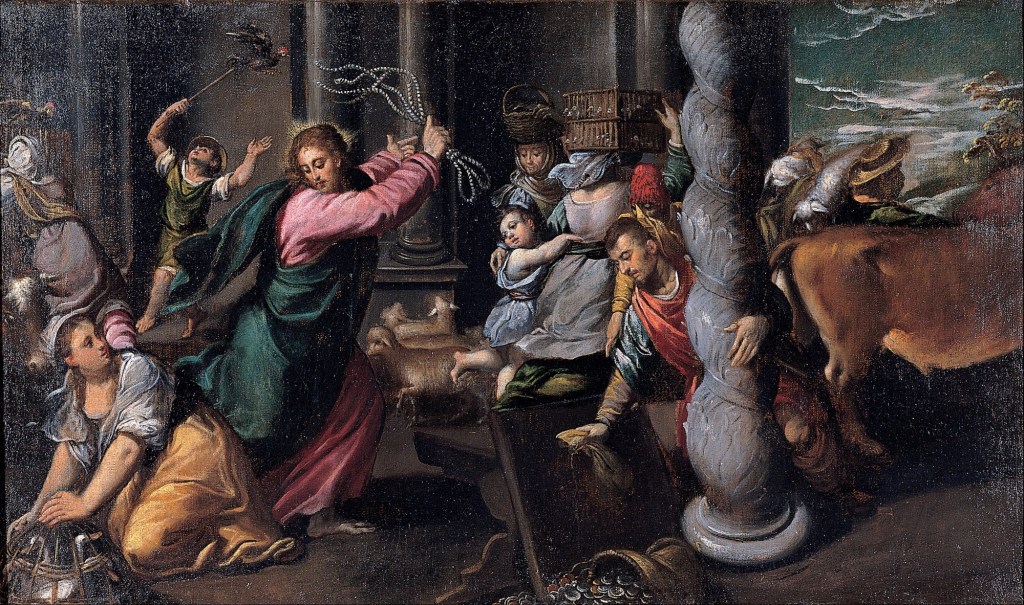
Our Gospel today depicts Jesus in a cleaning frenzy.  Unlike me, He was totally energized to clean up His Father’s House.  Let’s not forget that since He too is God, it was His House as well.  And He was incensed that the religious authorities had allowed what He saw going on there.

In our Gospel lesson (John 2:13-22), Jesus goes head to head with the Temple leadership to effect a physical and a spiritual house cleaning.  The religious establishment had authorized both the buying and selling of sacrificial animals, and a coin exchange–for a fee—on the Temple Grounds.  Some worshippers came from long distances without animals of their own.  So those “pilgrims” without animals had to purchase one or two to make their sacrifice.  Additionally, they had to pay a ½ shekel Temple Tax.  The fact that no Roman coins could be used–because they had Caesar’s face on them (a graven image which Jewish law prohibited), as well as the inscription, “Caesar is Lord” (which constituted blasphemy to the Jews), meant that they also had to exchange their money, for a fee.

Jesus was incensed with all of this for a number of reasons:

1.) Those selling the animals unfairly marked them up. They knew people didn’t have a choice, and they gouged them for the convenience. 

2.) They also charged an outrageous fee for the coin exchange.

3.) The animals were smelly and noisy and distracting in what was a house of prayer and a place of worship.

4.) But perhaps worst of all, the marketplace took over the only area in the Temple where Gentiles could gather.  Essentially, they were prevented from worshipping in the only space allotted to them.

So Jesus cleared the area in no uncertain fashion.  He formed a whip and used it to drive away the animals.  He also overturned tables, no doubt scattering money everywhere.  He shouted (v.16) How dare you turn my Father’s House into a market!  Of course, then “The Jews” (John-speak for the religious establishment) want to know what gives Jesus the right to clear the Temple and upset their very profitable businesses.  They said, Give us a miraculous sign—prove You have sufficient authority to do this.  Jesus responds rather cryptically, telling them (v.19), Destroy this temple and I will raise it again in three days.  They think He is speaking of the Temple building and scoff at Him.  We know He was speaking of His body (predicting His resurrection)—a pretty authenticating sign!  But they were so haughty—so sure their understanding surpassed His—that they did not believe Him.  Don’t you imagine that when He left, they went right back to doing business as usual?  

They must have forgotten verse 6 of Psalm 138—God is close to the humble, but distances Himself from the proud.  It’s dangerous to think we always have all the right answers.  Pride caused most of the Pharisees, Scribes, and Sadducees to miss who Jesus was.  They’d made an idol of their understanding of the Scriptures. Because Jesus didn’t fit their preconceptions, they missed out on the opportunity to develop a relationship with the Son of God.  Let’s not make the same mistake. Let’s make sure we clean our spiritual houses of the sin of pride.

Let’s take a look too at our Old Testament lesson from Genesis 20:1-17.  Just last week, we were praising Abraham, the Father of our Faith, for his trust in the Lord.  Abe is such a great example of trusting in the Lord’s provision of the Promised Land; trusting in God’s promise of descendants without number; and benefiting from God’s blessings of health and wealth. Where he seemed to have wavered in his faith, however, was in being certain that God would protect his life.  Apparently, his wife Sarah was very beautiful.  I’ve heard another pastor humorously refer to her as a “Biblical babe.”  Unfortunately, whenever Abraham encountered a foreign ruler, they appeared to covet her.  Back in Genesis 12, when Abraham moved to Egypt due to a famine, the Egyptian pharaoh heard of Sarah’s beauty and took her from him. Abraham in a sense brought this on himself because he lied, telling Pharaoh she was his sister (she was his half-sister), instead of his wife. He was afraid Pharaoh would kill him in order to clear the way to marry her.  In this situation, he didn’t depend on the Lord!

Fortunately for both of them, God protected them anyway. He afflicted the Egyptians with “serious diseases” until Pharaoh gave Sarah back to Abraham and told them both to leave.  So, this had happened before. You would think that Abraham would now trust God to protect him from rulers tempted by Sarah’s beauty.  But no, in today’s lesson, the two encounter Abimelech, a Canaanite king. Like with Pharaoh previously, Abraham again lied and said Sarah was his sister, not his wife. The same thing happened as Abimelech coveted Sarah and took her, intending to add her to his harem. 

Once again, God intervened—not with disease—but with a dream containing a death threat. Abimelech believed God’s message from the dream and immediately returned Sarah to Abraham. But the pagan king was also outraged and demanded to know why Abraham lied to him and put him and his people at risk.  Abraham, the great model to us of faith, had not trusted the Lord to keep him and Sarah safe from another lusty king. Abraham, who God judged as righteous due to his faith, has now lied twice.

What do you make of this?  I think we can safely say that Abraham was a good man but not a perfect man. There was and is only one perfect man–that’s our Lord, Jesus.  Like us all, Abraham’s great faith wavered from time to time.  Don’t we all have times when our faith is stronger or weaker  than usual.  We too may have areas in our lives where we find it very hard to trust God.  Nevertheless, since he was God’s choice as the patriarch of the Jews—since God meant to accomplish great things through him—the Lord guaranteed his safety.  Similarly, I think God has grace for us in those areas we have not yet surrendered to Him.

Remember, we are in the season of Lent.  These two readings today focus on two aspects of human behavior that God wants us to clean out of our spiritual houses:  (1) Pride (and even the misuse of His house of worship), and lying.  Lent is a time for evaluating our behavior, recognizing our sins, and asking God’s forgiveness.  Maybe you are not overly proud and you don’t lie.  But each of us is probably guilty of some other sins we could name.  Soon, in our preparation to receive Holy Communion, we will say a general prayer of confession.  Let’s take a moment now to call to mind our sins and confess them to Jesus, in our hearts, right now.  Let us also be comforted by what the Apostle John promised in 1 John 1:8-9—If we claim to be without sin, we deceive ourselves and the truth is not in us.  If we confess our sins, He is faithful and just and will forgive us our sins and purify us from all unrighteousness.  Amen and amen!

©️2024 Rev. Dr. Sherry Adams
Setting Us Right With God

Pastor Sherry’s message for February 25, 2024

Scriptures: Gen 17:1-7, 15-16; Ps 22:23-31; Ro 4:13-25; Mk 8:31-35

I read a humorous story this week.  Again, it has to do with a child’s perception of how things “ought to be”:

“A Sunday School teacher held up a portrait of Christ. She explained to the class that it was not an actual photograph of Christ but only an artist’s conception of what Christ might have looked like.

‘’But,’ said one little girl, ‘you’ve got to admit it looks a lot like him.’’’

(Borrowed from a sermon entitled, “A Pair of Ducks and Abundant Life,” www.sermons.com, 2/23/2024).

Isn’t that just the cutest thing?  I love how literal children tend to be and the humor that often results.  Little kids are trying to figure out how things in life work.  I remember when my 49 year old son was about 2 or two and a half and was trying to figure out animal categories. We had a dog with 4 legs, two ears, and a tail. In his child-logic, he looked at cows and told me (since they had 4 legs, 2 ears, and a tail), “Moo-tows are Biggggg doggies!”

It would be interesting to hear a child’s perspective on the elderly Abraham—at a great-great grandparent age—having a baby and his faith that God’s promise to him could still come true.  This constitutes the focus of several of our readings this morning:

A. In our Old Testament reading, Genesis 171-7, 15-16), God appears to Abraham for the 5th time, and reiterates His Covenant Promises:

God is giving him lots of land (the Promised Land, Canaan, or present day Israel; and even a baby from him and his elderly wife, Sarah.  Notice, the passage emphasized Abraham’s age, 99 (Sarah’s is 89).  God the Father wants Abraham—and us– to know that neither Abe’s biological age, nor his body’s elderly condition, could prevent God’s from fulfilling His promises.

Our God is capable of making awesome promises, with spectacular fulfillments.  The Israelites later did occupy God’s Land Grant.  And, at age 100 for Abraham (and 90 for Sarah), Isaac was born to them.  The Jewish people came from Abe via Isaac, and later Jacob.  The Arab people came from Abe via Ishmael, and Jacob’s twin, Esau.  By now, those two people groups constitute, in fact, millions upon millions of Abraham’s descendants.

B.  Paul is very taken by this fact, as evident in today’s epistle reading from Romans 4:13-25.  He is arguing for Abraham’s faith, and the need for our faith!  He is saying God fulfilled His promises to Abraham not based on anything Abe had done for God (except for trusting in Him).  God fulfilled His promises to Abraham due to Abe’s faith in the Lord to fulfill His promises.  This is so important for us to understand!  We are to trust in God, as Abraham did.  We are not looking for a promised baby in our old age, or a promised land.  We are looking for salvation.  Perhaps we are looking for healing or for peace.  We are anticipating living with God forever in Heaven—our happy ending.  But none of these gifts are due to any of our actions or our works.  Our salvation comes from the actions, the completed work of Jesus Christ and Him alone. 

Who would have thought His death on the Cross and His resurrection would be the means by which God would redeem us?  Who would have thought a 100 year olf man would birth a man who would then go on to have…first 2, then 12, then dozens, then hundreds, then thousands, then millions of descendants?  Clearly Isaiah the Prophet was correct when he quotes God as saying (Isaiah 55:8-9, as per Peterson’s The Message, p.1317)”I don’t think the way you think.  The way you work isn’t the way I work.”  God’s decree.  “For as the sky soars high above earth, so the way I work surpasses the way you work, and the way I think is beyond the way you think.“

Our God makes awesome promises.  He provides spectacular fulfillments.  In deed, He set us right with Himself.

C.  This is why Jesus gets so upset with Peter in today’s Gospel (Mark 8:31-38).  This interaction takes place just after Peter tells Jesus, “You are the Christ,” meaning the Messiah or the Anointed One.  It is also just before Jesus reveals Himself as God on the Mount of Transfiguration—during which Peter is present.  Jesus is trying to tell them all what His mission entails:  To redeem human kind, He must (v.31)— …suffer many things and be rejected by the elders, chief priests, and teachers of the Law, and that He must be killed, and after three days rise again.  Peter was so outraged after hearing this that he probably stopped listening when he heard Jesus say He would be executed.  We can imagine this, can’t we?  It’s just so human.  We don’t want someone we value or love or admire to die early.  Neither do we want them to die a horrible, gruesome death.  No, we want them to continue to live so we can enjoy their presence.  In speaking up so, poor Peter doesn’t realize he has just voiced to Jesus Satan’s short cut—take the crown but reject the cross.  Poor Peter doesn’t realize until he’s said it that Satan has used him to again tempt Jesus.  Jesus’ response is swift, isn’t it? (V.31)—Get behind Me, Satan!  Then He admonishes Peter—You do not have in mind the things of God, but the things of men.  Or, as Peterson paraphrases it, Peter, get out of My way.  You have no idea how God works.”

It’s true, isn’t it?  Peter doesn’t want Jesus to suffer and die.  He wants Him to keep on teaching, interpreting Scripture, healing, and casting out demons…being his friend.  Obviously, these are the desires of men and women, but in this case, not of God.  Having total faith in the Father, Jesus is committed to doing God’s will God’s way.  Nothing will deter Him from it.

He knows His mission is a huge undertaking. It is nothing less than setting us right with God! 

D.  Additionally, Jesus is familiar with Psalm 22.  We will note on Good Friday that the first portion of the psalm predicts Jesus’ thoughts from the Cross.  In the portion assigned to us today, verses 23-31, King David (and later Jesus) assert that they will praise God the Father amidst the congregation of all the people.  Even from the cross, Christ will trust that God still loves Him.  The hours on the cross, when Jesus becomes sin for us, the Father will turn His face from Him.  Nevertheless, He knows His Father is waiting to welcome Him back, to resurrect Him.  Too exhausted to speak, He praises God in His heart, crying out only (v.31) Tetelestai/it is finished.

Jesus’ final words from the cross are that He has completed the work of redemption the Father gave Him to do.  He has set us right with God again.

Thank you, Jesus, for Your courage and bravery!  Thank you for Your great agapeo (New Testament)/hesed (Old Testament) love for us.  Your loyal, everlasting, long-suffering love for us.  Thank You that You love us enough to have done for us what we could not do for ourselves.  Thank you for setting us right with God.

None of us knows what You look like, but I’ll bet Your face in Your resurrected body is beautiful.  (Isaiah said that His face would be unremarkable in His first Coming, so as to not attract the kind of fame a rock star gathers about himself; see Isaiah 53:2.)  Keith Greene, a Christian musician who died at 28 years old–way too young–in a 1982 plane crash, wrote and sang a song about the face of Christ.  The words go like this: 

Oh Lord, You’re beautiful,

Your face is all I see,

For when Your eyes are on this child,

Your grace abounds to me.

I want to take Your word and shine it all around

But first help me just to live it, Lord

And when I’m doing well help me to never seek a crown

For my reward is giving glory to You.

Oh Lord, please light the fire

That once burned bright and clean

Replace the lamp of my first love 

That burns with holy fear.

Oh Lord, You’re beautiful,

Your face is all I see,

For when Your eyes are on this child,

Your grace abounds to me.

Listen here.

May it be so for each of us.  Amen and Amen.

©️2024 Rev. Dr. Sherry Adams 

The Crown Without the Cross

Pastor Sherry’s message for February 18, 2024

Scriptures: Gen 9:8-17; Ps 25:1-10; 1 Pet 3:18-22; Mk 1:9-15

I read a funny story the other day that I want to share with you:  

“The local sheriff was looking for a deputy, and one of the applicants – who was not known to be the brightest academically, was called in for an interview.  “Okay,” began the sheriff, “What is 1 and 1?” “Eleven,” came the reply. The sheriff thought to himself, “That’s not what I meant, but he’s right.”

“Then the sheriff asked, “What two days of the week start with the letter ‘T’?” “Today & tomorrow.” Replied the applicant. The sheriff was again surprised over the answer, one that he had never thought of himself.

“Now, listen carefully, who killed Abraham Lincoln?”, asked the sheriff. The job seeker seemed a little surprised, then thought really hard for a minute and finally admitted, “I don’t know.” The sheriff replied, “Well, why don’t you go home and work on that one for a while?” The applicant left and wandered over to his pals who were waiting to hear the results of the interview. He greeted them with a cheery smile, “The job is mine! The interview went great! First day on the job and I’m already working on a murder case!”

(Borrowed from www.sermoncentral.com, 2/16/2024.)

Our Gospel this morning comes from Mark 1:9-15.  You may recall that we have jumped about some in Mark since Epiphany.  We have focused on Jesus’ choice of His disciples.  We have looked at His demonstrations of His power over the supernatural realm and over physical illness.  Last Sunday, we encountered His revelation of Himself, to Peter, James, and John in all His heavenly glory, on the Mount of Transfiguration.  This included God the Father’s order to the disciples to listen to Jesus.  They were reminded that Jesus goes where the Father directs Him, not where they might think He should go.

How odd, then, that we backtrack to the very beginning of Jesus’ ministry today:  He is baptized and blessed by the Father.  This is so very important because psychological research has revealed that fathers convey self-esteem on their children.  God the Father blesses Jesus before He launches on His ministry.  Then, the Holy Spirit leads Him into the wilderness to be tempted.  We could say it is Jesus’ 1st day of His public ministry—His 1st day of walking in His calling.  There is a lesson here for us:

Before He even really begins, He is confronted with three grave temptations.  Satan is trying to get Him to take a short cut or to “do things the easy way.” God the Father and the Holy Spirit are no doubt watching and rooting for Him to resist the possibilities of accepting His crown while avoiding the Cross.

Whoever it is that creates the lectionary arrangement of the readings (I think it’s a committee) wants us to realize—before we get too far into remembering Jesus’ ministry—that Satan will always try to pull us away from, or divert us from what God wants to accomplish through us. 

Will we take the short cut the evil one offers?  Or will we persevere through the tough times, remaining obedient to God as Jesus was?

Let’s look at these 3 temptations Satan presented to Jesus in more detail:

A.  There is the temptation to feed Himself:  Turn stones into bread.  After 40 days without food, He clearly must have been hungry.  We can only go three days without water, but people can live longer without food.  We grow weaker and lose a lot of weight, but we can still hang on to life.  The greater issue behind feeding Himself was would He be willing to use His power to satisfy Himself?  In terms of His ministry to redeem the world, this would have been a short-sighted choice.  It would have also indicated a lack of faith in His Father—He surely trusted that His Father would not have allowed Him to die before He even got started.  I remember telling you all once that I was flying back to Pittsburgh, PA, from Jackson, MS, when our plane was stranded on the tarmac during a terrible rain storm.  Once the lightening relented, we took off into the air, but proceeded to bump around a lot, losing altitude quickly in those sickening drops.  The lady seated next to me was a seasoned traveler who flew weekly for business.  She got out the “barf bag” because it she said it was the bumpiest she had ever experienced.  She wondered aloud if we were going to crash.  I told her no—with total confidence—because I was still in Seminary and I know the Lord was not finished with me yet.  God was not yet finished with Jesus, either.

The temptation to feed yourself is a little like the college quarterback who recently spent his $300,000 signing bonus (not to sign on but to return for another season) on a Lamborghini for himself, instead of offering watches, like Tom Brady did, to the lineman who protected him; or even cash for school tuition for those teammates who lacked athletic scholarships.

Jesus said “No” to this temptation to take care of Himself first.  Can this be said of each of us?

If we are as God-focused as Jesus, our tithe would come off the top of our pay.  It should be the first check we write after receiving our pay.  Please understand I am not urging you to give Wellborn Methodist Church all 10% of your resources.  We need enough money to keep the lights on…but you are free to offer a portion of your tithe to other worthwhile charities/causes as well.  The point is that rather than paying down our responsibilities and giving God the little that is left over, we gift God first.

Truly, the issue is, “Do we trust God to take care of us?”  Since I have lived on my own, I have found that the Lord always provides for me.  I might get down to my last dime to my name, but the Lord will come through with additional cash in the nick of time and usually in ways I would never have expected.  Even in the extreme situation of having no food for 40 days, Jesus trusted in His Father.

What about Jumping to your death on the rocks below?  If I were starving, the turning stones to bread would have truly tempted me.

This one, not so much…even if I knew I had the power to save myself.

I’m wary of heights.  I can recall visiting the Grand Canyon, which is a mile deep, and creeping cautiously to the edge to look down—there are no guard rails so you do have to be careful.  And I hate that feeling you get in roller coasters—and even in elevators or planes—of the bottom falling out.  My kids will tell you I scream all the way on roller coaster rides.  Nothing about dropping into thin air tempts me.

But again, Satan has offered Jesus a selfish way to attract attention and gain fame.  This is another cheap way out.  I’ll bet Jesus was tempted by the bread, but this one probably left Him cold.  Recall how often He asks people He’s healed not to tell anyone about it?  Last week He urged Peter, John, and James not even to tell the other disciples what they had witnessed on the Mount of Transfiguration.  Jesus wisely understood that some flashy, dynamic miracle witnessed by thousands would have gained Him too much attention from His enemies.  They would have come for Him before He had completed the work the Father gave Him.  As it was, He knew 3 years was hardly enough time to redeem as many hearts as He hoped to.  By rejecting Satan’s dare, He demonstrated for us that it is better to avoid the easy, splashy alternative, and just do the work set before us.

The third and last temptation was a doozy!  Serve Satan, instead of God the Father?  Are you kidding me?  Satan was tempting Jesus, who is God, to worship himself, a counterfeit god. This was a challenge to Christ to practice idolatry.  How absurd!  No wonder Jesus directs Satan to be gone from Him.  For us, however, the temptation may be more enticing.

Think of the siren allure of addictions. This substance or behavior will soothe you; it will help you feel nurtured or cared for.  Power and influence can have the same impact.  Watching the Fulton Country (Atlanta, GA) DA is a perfect example of how power and influence can corrupt.   She promised, on videotape, never to sleep with a subordinate.  Not only has she slept with someone she employed, but she paid for lavish trips for the two of them with public funds.  Corruption appears to abound in our federal government and also in state and even local governments.  How many have pilfered tax payer dollars? How many have sold their integrity for generous amounts of cash?  How many are compromised by elicit behaviors that have been videoed, then used to blackmail officials?  We want to remember that whatever we value more than God becomes our false God.

Jesus Christ has shown us the way:  Just say “No” to putting comfort before duty, fame before love of others, and anything before love of God.  Someone has put it this way:

A seeker after truth came to a saint for guidance.

“Tell me, wise one, how did you become holy?”

“Two words.”

“And what are they, please?”

“Right choices.”

The seeker was fascinated. “How does one learn to choose rightly?”

“One word.”

“One word! May I have it, please?” the seeker asked.

“Growth.”

The seeker was thrilled. “How does one grow?”

“Two words.”

“What are they, pray tell?”

“Wrong choices.”

I could be wrong, but I believe God allows us to endure times of testing to strengthen our faith in Him, and to develop our ability to resist the easy shortcuts with which Satan tempts us.

(Borrowed from Brian Stoffregen, Exegetical Notes, published on http://www.sermoncentral.com 2/16,2024.)

Let us keep our eyes on the example of Jesus, choosing to please God and frustrate the devil.  Amen, may it be so!

©️2024 Rev. Dr. Sherry Adams