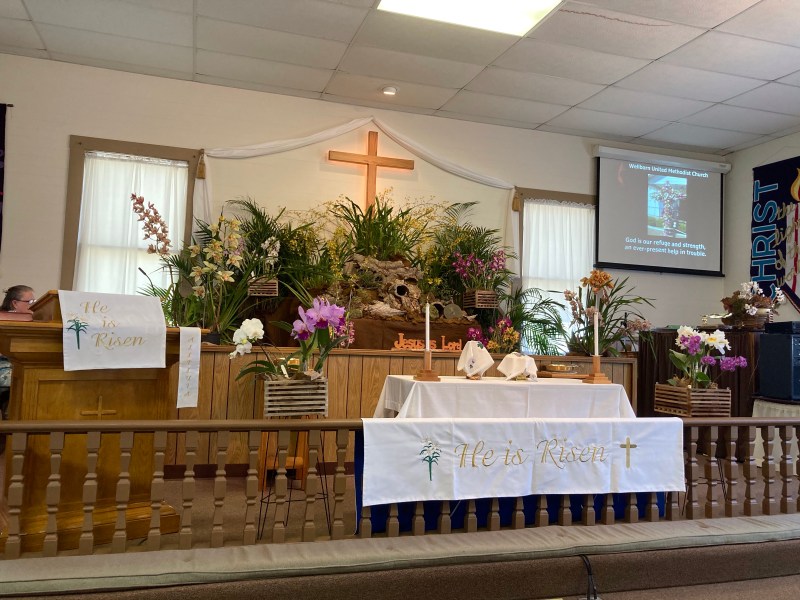
He Is Risen!

Pastor Sherry’s Message for Resurrection Day–April 4, 2021

Scripture Readings: Acts 10:34-43; 1 Cor. 15:1-11; John 20:1-18

One of my favorite Bible Commentators is the Rev. Dr. Delmer Chilton, a Lutheran pastor from North Carolina.  Together with his buddy, a Baptist pastor named John Fairless, he posts a blog called, “Two Bubbas and a Bible.”  In an Easter post some years back, Pastor Chilton shared a story told to him by a South Carolina pastor who had been invited by a guard friend to baptize some prisoners at the Central Carolina Prison in Columbia.  The pastor appeared at the prison early in the am, only to be frisked, ID’ed, interrogated, and then moved from one waiting area to another over the span of an hour.  The pastor joked that it took an hour to move him 15 feet.  Finally he met his guard friend and they walked together down some long hallways to the prison chapel.  It was a small, austere room containing several rows of chairs, a pulpit, and a piano.

         On this particular day, the pulpit and the piano had been pushed aside to accommodate a large wooden box.  The box contained an insert of blue plastic sheeting, into which had been poured gallons and gallons of water.

The first prisoner stepped into the box, sat down, then and laid back into the water.  Just as the pastor was about to dip the      man’s head under while reciting the baptismal proclamation, he realized the box was actually a coffin–a simple pine-box, prison issue, no frills.  He further realized that the prisoner was metaphorically going into and coming up out of the grave.

         Our baptismal service includes a prayer that reads (United Methodist Hymnal, p.36) as follows:  Pour out Your Holy Spirit to bless this gift of water and those who receive it, to wash away their sin and clothe them in righteousness throughout their lives, that, dying and being raised with Christ, they may share in His final victory.  In other words, we believe that with Christ as our Savior/our head, we go into death with Him on Good Friday (symbolically), and rise with Him in resurrection joy on Easter Sunday!  Together with Jesus, at Easter we (1) Die to sin and resurrect to new lives, covered by Christ’s righteousness;(2) We move from the despair of thinking the world, the flesh and the Devil have won, to the hope of realizing that Jesus has defeated all three.  (3) We all go under to death and rise up again to eternal life; and (4) Jesus’ resurrection ensures new life for us!

         It should come as no surprise that all of our Scriptures today emphasize Jesus’ Resurrection:

         In our Gospel lesson, John 20:1-18, the Apostle John describes    the reactions of the first eye-witnesses to the resurrection.  Mary Magdalene runs the gamut of emotions.  She arrives in the predawn, grieving but desiring to properly clean and anoint Jesus’ body.  She is no doubt shocked to discover the large rock is rolled back and the tomb is empty.   She frantically seeks the aid of Peter and John to locate Jesus’ body.  (Some Biblical scholars tell us that just as John took in Mary, Jesus’ mother, he also gave comfort to Peter who would have been ashamed over having denied and abandoned Jesus when He most needed him. Thus Mary Magdalene would have found them together.)

         They too are stunned and run to see the empty tomb for themselves.

Peter agrees the Lord’s body is gone.  But John then remembers how Jesus had told them He would die and be raised again on the 3rd day.  John appears to put it together, and is then reassured.  The two leave, ostensibly to ponder what they have seen.

Following their departure, Mary is even more deeply grieved and looks into the empty tomb to encounter 2 angels. They seem to chide her for crying, (v.13) Woman, why are you crying? In other words, This isn’t the end, Mary! But a new and better beginning! She turns, sees Jesus, and finally recognizes Him when He calls her name. Now she’s relieved and overjoyed to see Him again! Now she can run to gladly share with the disciples, (v.18) I have seen the Lord! She had mourned His death, but now she has witnessed and testified to the fact that He is alive!

         In our Acts lesson today (10:34-43), we find Peter, also an eye-witness, preaching to Cornelius, a Roman centurion, and his family–Gentiles living in Caesarea.  His sermon majors on Jesus’ life, death, and resurrection.  In fact, every sermon recorded in Acts does the same.

You see, this is the Gospel:  (1) Christ came to earth, lived among us and identified with us. (2) Then Christ died a criminal’s death to save us from the penalty for our sins.  (3) Finally, Christ overcame the power of sin and death and rose again!  Do you realize there would be no hope for us if Jesus’ life, His story, ended with the crucifixion?  The source of our hope lies in His return to life.  His resurrection demonstrates both that He is God, and that

He has extraordinary, life-giving power!

         Paul, in our NT lesson from 1 Corinthians 15:1-11, wants us to be sure we understand 2 facts:  First, Jesus’ resurrection was not just a spiritual truth but a bodily phenomenon.  The original Greek words he uses for resurrection are anastasis nekron, which means the standing up of a corpseJesus appeared to His followers in a real body.  One that had been alive, but was then killed; and then miraculously stood up or came back to life!

         Secondly, Paul assures us, Jesus appeared (post-resurrection) to over 500 witnesses.  The resurrection is no myth!  This is no baseless narrative that has been spun to deceive.   No, Jesus’ resurrection is am historic fact!

         1.) Peter and John saw Him;

         2.) Mary Magdalene and the other faithful women saw Him;

         3.) His mother saw Him;

         4.) His brother James saw Him;

         5.) The 10 Apostles in the upper room saw Him;

         6.) The two disciples on the road to Emmaus saw Him;

         7.) Paul encountered Him on the road to Damascus;

8.) And Paul declares (v.6) that a significant number of unnamed disciples saw Him at various events during the 40 days between His Resurrection and Ascension.

You might be able to dismiss the testimonies of a few wild-eyed zealots. But add to this over 500 “normal people?” Additionally, how about the fact that Jesus fulfilled over 325 Messianic prophesies from the Old Testament? Josh McDowell, in his book, More Than a Carpenter, computes the probability of anyone but Jesus fulfilling so many prophesies as the chance of finding one gold coin thrown into a pile of silver coins spread, 3 feet thick, over the surface area of the state of Texas! Moreover, consider the fact that Jesus is probably the most influential person who has ever lived. He is still worshipped today, 2000 years later. He is still proclaimed as Lord, after 2 millennia. Lastly, consider that hundreds of thousands of His followers have met martyr’s’ deaths rather than renounce Him. People do not willingly face death for something or someone that they consider to be exceedingly important.

         The truth is that the Resurrection is neither normal nor natural.

It may and probably does get in the way of many practical people coming to faith.  Nevertheless—though supernaturally caused–it was and is as real as real can be.

         It is hugely important to us because it speaks of Jesus’ transformative power.  Those South Carolina prisoners who were baptized in that coffin didn’t get to leave prison due to their new life in Christ.  They still had to serve out their sentences.  But spiritually speaking, they had gone from “dead men walking,” waiting to die, to new creations, new believers filled with new life.

         As we live into Easter, let’s be aware of how we might be living like dead persons walking.  Let’s jettison that prison and realize we don’t have to live that way.  Because of Jesus’ resurrection power, we can shake loose from whatever is holding us back and embrace the new life God has for us.  We can metaphorically lay down in a coffin, dying to our sins, but rise up with Christ with great joy and new hope on Easter!  Or, as one of my favorite Easter hymns proclaims,

                 He is risen, He is risen!  Tell it out with joyful voice:

                          He has burst His three days’ prison;

                 Let the whole wide earth rejoice;

                          Death is conquered, we are free,

                 Christ has won the victory!

Alleluia, Alleluia, thanks be to God for giving us the victory through our Lord Christ Jesus!  Alleluia, Alleluia!   

©2021 Rev. Dr. Sherry Adams                

Transcending Our Cultural Values

Pastor Sherry’s Message for March 28, 2021

Scriptures: Isa 50:4-9a; Ps 31:9-16;Phil 2:5-11; Mk 14:1-15:50

          Recently I learned of a historian named Charles John Summerville.  The 82 year old is currently retired from teaching yet held the honorary position of professor emeritus of history at the University of Florida.  It is said that he used to challenge his students in the following way: He would have them imagine an elderly lady carrying a large pocketbook walking down the street.  He would describe her as small, frail, perhaps with a Dowager’s hump, moving slowly with a cane.  He would then submit to his students that it would be remarkably easy to knock her over and steal her purse.  He would even admit that most students could use the money. Then he would ask his students how many of them would actually consider stealing the lady’s purse. The majority would deny it.

         He would go on to suggest that most of us would not grab her purse for either of two possible reasons:

         (1) We come from a “Shame and Honor Culture.”  If we acted this way, such behavior would mark us as contemptible persons, an embarrassment to ourselves and to our families.  Some people would condemn us as bullies and others would despise us for ripping off someone weaker than ourselves.  The professor called this approach “Self-Regarding.” He would clarify that we do what we do (or don’t do what we don’t do) because of how it reflects upon us and our clan.  The highest values of a shame and honor culture are personal honor and good reputation among others.  We wouldn’t mug the woman because we are concerned about how this would appear to others.  (If you recall the horrid incident– replayed repeatedly by the news this summer–of the elderly lady hit in the head by a young man as he passed her by, you can see where we are not living in a shame and honor culture.)

         (2) Or, we might imagine how mugging her would affect her or those she loves.  We would not want to deprive her of money for rent, groceries, or prescription medication.  We would not want her to risk being injured or to fear in the future for her personal safety.  In short, we would empathize with her and have compassion on her.  Prof. Summerville referred to this as an “Other-Regarding Culture.”

         He would summarize the challenge by pointing out that the ethic or value of putting another person’s needs ahead of our own derives from Christianity.  Even though a significant number of his students might have been hostile to the Christian faith, he would contend that their moral behavior (not to steal the woman’s money) had been largely shaped by Christian values.

         As Christ-followers, we are called to major on mercy/grace.   The values espoused by the power elites in our culture todayinclude the drive to achieve power, influence, and control; they also seek money because it provides power, influence, and control.  Others are driven to attain success, fame, and recognition (“developing their brand”).  But Jesus Christ lived, taught, and modeled a life based on humility. He put a lot of effort into dodging the lime-light and living out obedience to the Father.  He is the gold standard for putting the needs of others before His own.  His example was not just counter-cultural, it’s revolutionary!

         Our Scriptures today all demonstrate how very different Jesus was and is from the culture then (Ancient Near East) and our American culture now.

         Paul tells us in our Epistle, Philippians 2:5-11, that Jesus willingly left all of his divine prerogatives to come to earth to pay the penalty for our sins.  Can you think of any politician, rock or movie-star, or professional athlete who would willingly divest themselves of all of their extraordinary privileges for the sake of others?

         St. Paul celebrates Jesus’ humble obedience to the Father.  He asserts that the King of the Universe came to earth as a servant to all.

Jesus Christ agreed to deliver the Father’s rescue plan to die for our sins.

               But St. Paul also rejoices in how Jesus’ obedience led to His very great reward (2:10-11) Therefore God also highly exalted Him and gave Him the name that is above every name, so that at the name of Jesus every knee shall bow, in heaven and on earth and under the earth [all of creation] and every tongue should confess that Jesus Christ is Lord.

         We Christ-followers know that the way to the Father’s heart is through humble submission to God’s will.  Our God is most pleased when we counter-culturally put the needs of others before our own.  The story is told of John Wesley, the founder of the Methodist denomination, who encountered a hostile, rival pastor at a narrow footbridge:  Wesley allowed the man to pass before taking his own turn.  As the guy walked toward Wesley, he snootily commented, “I never give way to a fool.”  Rather than get angry, Wesley calmly replied, “I always do!”

        The psalm appointed for today, Psalm 31, was written by King David as a prayer for deliverance from trouble.  However, it also describes how Jesus probably felt during his arrest, His ridiculous excuses for trials, and His crucifixion:  He is drained, physically and emotionally; He feels abandoned by His friends; and He knows He has been slandered, that angry and evil men have deliberately misperceived and misconstrued Him.  Nevertheless, and actually quite amazingly, both King David and Jesus eschew an angry response and place their trust in the Father saying, (v.14) But I put my trust in You, Oh Lord; I say, ”You are my God.”

         This is such a good reminder for each of us when we encounter pain or difficulty:  Don’t get mad.  Don’t get even or seek revenge.  Instead, Do take the matter to God and trust in Him to redeem it!

         Our Old Testament reading, Isaiah 50:4-9a, is the 3rd of 4 “Suffering Servant Songs” in Isaiah.  Written 700-750 years before Jesus journeyed from Palm Sunday to Easter, they each foretell how the Messiah would behave.   Jesus fulfilled each of these descriptions to the letter.  He was totally obedient to the Father’s will and plan. He faced His Passion–His extreme travail–with courage, and humility—v6 I offered my back to those who beat me, my cheeks to those who pulled out my beard; I did not hide my face from mocking and spitting.

         Isaiah accurately predicted that Jesus would face His death with determination—v7 Because the Sovereign Lord helps Me, I will not be disgraced.  Therefore have I set My face like flint, and I know I will not be put to shame.  Again we read that Jesus trusted in His Father, despite His pain and suffering.  In a way that is counter to our current American cultural beliefs, He accepted that He must suffer in order to save us.

         Our Gospel passage from Mark 14:1-15:50 details only the essentials of Jesus’ experiences from the Thursday night Passover Meal until His death at 3:00 p.m. on Friday.  We commemorate His triumphal entry into Jerusalem today, Palm Sunday.  Crowds of common folk and Christ-followers provided Him a hero’s welcome.  Meanwhile, the unbelievers and those in the religious and political hierarchy most threatened by His counter-cultural ministry, plotted to take His life.

         In his practical and no-nonsense way, Mark minimizes the transitory rousing Palm Sunday welcome and gets right to the tragic miscarriage of human justice to come.  Mark leads us through Jesus’ Last Supper, a Passover Meal stripped of lamb, because Jesus Himself would be the Sacrificial Lamb of God.  Then Judas slips off to betray Him.  His three closest buddies sleep through His agony in the Garden.  He endures several kangaroo trials before the Sanhedrin and Pontius Pilate, His best buddy publically denies he knows Him, and He barely survives vicious beatings by Roman soldiers.  He is crucified, taunted, humiliated, and scorned, only to die after 6 agonizing hours on the Cross.  The Temple curtain, made of thick goat hair, is torn from top to bottom at the moment of His death.  (This signifies that God Himself made a way for sinful men and women to approach Him and live).  A tough, battle-hardened Roman Centurion—so impressed with the way in which Jesus died—prophetically proclaims He must have been the Son of God.  His female followers, and the Apostle John, stand vigil at the foot of the Cross.  Finally, Joseph of Arimathea, a rich member of the Sanhedrin (and heretofore closet believer), removes Jesus’ body and buries Him before sundown, the start of the Sabbath.

         Who can meditate on these two chapters without being overwhelmed by Jesus’ sacrifice for us?  Or by His great love for us!  He lived in a Shame-Honor culture, but thoroughly transcended those self-regarding values. 

         Jesus transcended the cultural values of that day and of this.   Additionally, He calls us to as well.  Acclaimed on Sunday, the perfect Son of God takes on Himself the penalty for our sins on Good Friday.As we journey through Holy Week this week, let’s praise Jesus for satisfying the Father’s justice in our place.  Let’s worship Him with gratitude.  Let’s meditate upon His love for us by responding with love for Him.  Let’s commit ourselves to follow His culture-transcending example of humble obedience to God and loving concern for others.

©2021 Rev. Dr. Sherry Adams

Correct Assessments

Pastor Sherry’s message for March 21, 2021

Scriptures: Jer 31: 31–34; Ps 51: 1–10; Heb 5: 1–10; John 12: 20-33

Do you remember a Scottish woman named Susan Boyle? She appeared on an English TV program called Britain’s Got Talent in 2001. She wowed the skeptical judges with her stunning rendition of “I Dreamed a Dream” from Les Miserables.

You may remember that she looked fairly frumpy; both the audience and the judges were cynical and dismissive, until she began to sing! Then they were awed and astonished. She has since gone on to improve her appearance and create award-winning albums.

Susan’s story proves the adage that we should not judge a book by its cover. Psychological research on perception says that we tend to size a person up in five seconds. We decided we would or would not like them based on very little information. We take more time than this to buy a car or rent an apartment. This makes it easier for us to quickly move on to other things but it also results in some misperceptions and erroneous assumptions.

Thankfully, our God has much more information on people and events than we do, and never makes some wrong assessment. His assessments are always correct!

Let’s start with our Jeremiah passage. Just prior to the passage, God says through His prophet to the Israelites, I have loved you with an everlasting love. God is foretelling the day when he will call all the Jews who are scattered throughout the world back to Israel. He will make a new covenant with them. Instead of abandoning them due to their unwillingness to except His son as Messiah, He will write his law upon their hearts. Instead of punishing them for turning away from Jesus, He will claim them to Himself again. As Peterson translates it, “they will no longer go about setting up schools to teach each other about God. They’ll know me first hand, the dull and the bright, the smart and the slow. I’ll wipe the slate clean for each of them. I’ll forget they ever sinned.”

We should rightfully expect judgment, but instead we get mercy, grace, forgiveness, and that everlasting love only God radiates. How surprising! How wonderful! How humble and grateful we should be that God assesses us and still desires to be in close relationship with us all.

Psalm 51: 1–13 is King David’s great penitential Psalm. He has broken the sixth, seventh, and tenth commandments. He had set up Uriah, a loyal bodyguard, to be murdered so that he could claim his wife, with whom he had had an adulterous relationship. And he kept quiet about his massive sins, only to suffer torment he was highly anxious and miserable.

When I kept it all inside, my bones turned to powder, my words became day long groans. The pressure never let up; all the juices of my life dried up.

The writer to the Hebrews (4:13) observes nothing in all creation is hidden from God’s sight. Everything is uncovered and laid bare before the eyes of Him to whom we must give account.

Sure enough, God dispatches the prophet Nathan to confront him in story form. David could’ve lied and blown Nathan off. Like many absolute rulers, he could’ve had him killed. But in a plot twist from what one might have expected from any other ancient Middle Eastern king, David admits his guilt—he takes responsibility.

  • For his transgressions—Stepping over God’s boundaries, he transgressed against Bathsheba, Uriah, and to his family. He was a poor example to his sons and to his nation.
  • For his iniquities— those things that are grossly immoral and thoroughly wrong: adultery, murder, covetousness.
  • For sins— failure to meet God‘s standards.

However, David does provide a good model for us in this Psalm. He admits his sins, transgressions, and iniquities; he begs God‘s forgiveness, and he asks God to transform him by the power of his Holy Spirit. In today’s “cancel culture,” David would be toast. His life and his legacy would be ruined. But our God loved his heart, took pity on him, and forgave him. I don’t know about you, but this is the kind of correct assessment I would prefer God had of me.

Hebrews 5:5-10 is making it clear to us that Jesus is our great high priest. But he’s from the tribe of Judah, not descended from Aaron, nor a member of the Levites the priestly clan. However, given God’s correct assessment, the Father defines Jesus as our high priest in the order of Melchizedek. Melchizedek is first mentioned in Genesis 14. He congratulates Abraham on his victory against four pagan kings and blesses Abraham in the name of the Most High God. As king of Salem, he gives Abraham bread and wine. Then Abraham awards him a tithe.

John 12 2333, some Greeks come to ask Jesus their questions. As outsiders they were consigned to the court of the Gentiles in the temple and could not be present to hear Jesus teach. They approach Phillip, perhaps because his name is Greek, who with Andrew bring them to Jesus’ attention. Jesus, knowing He is soon facing the cross, meets with them briefly. We don’t know what the Greeks expect or want to ask. But Jesus reiterates He is going to die.

A millennium later (Psalms 110:4), David speaks prophetically of a priest and king to whom he would bow, Jesus the Messiah. Today’s passage from Hebrews, written just after Christ’s Ascension, asserts that Jesus is a high priest from the order of Melchizedek, a higher order than the Aaronic or Levitical priesthood. Speaking God’s truth and accurately predicting His death, resurrection, and the destruction of Jerusalem, Jesus was a prophet in His earthly ministry. He will come again in glory as the universal king. And here we learn Jesus is our great high priest.

The kernel that falls to the ground but results are much fruit and many other seeds

He knows he’s going to the cross and it’s going to be very painful. He doesn’t want to, but he will. For the third time, God speaks encouragement to him. He will be lifted up as His followers hope, but on a cross not to a kingly throne…yet. Nevertheless, over hundreds of years, has He not drawn millions to Him?

So often our God does the opposite of what we might expect, or even what we wish Him to do, so how might we deal with this? We might want to remember that God’s assessments are always correct. We tend to trust in our own perceptions. Experience tells us we are sometimes—maybe even often—wrong. Nevertheless, we worship a God who is always accurate in his assessments.

Are we going to trust in our own perceptions or in God’s accurate assessments?

Proverbs 3:5– trust in the Lord with all your heart and lean not on your own understanding.

Proverbs 28-26– he who trust in himself is a fool, but he who walks in wisdom is kept safe.

Prayer:

Lord, help us to put our trust in you, even above ourselves and our own perceptions, judgments, and assessments. Help us to rightly discern the truth and to live lives that are pleasing in Your sight. We pray this in the mighty, compassionate, grace-filled, and always accurate name of Your son, Jesus Christ. Amen.

Copyright 2021 Rev. Dr. Sherry Adams

The Saving Power of God

Pastor Sherry’s message for March 14, 2021

Scriptures: Num 21:4-9; Ps 107:1-3, 17-22; Eph 2:1-10; Jn 3:14-21

Stories are told—true stories—of both Queen Elizabeth and Queen Victoria pardoning someone who had incurred the death penalty. In Queen Elizabeth’s case, the queen was traveling by barge on July 17, 1579. Not realizing her majesty was cruising through the area, a young man named Thomas Appletree was firing off shots into the air to impress his friends. Unfortunately for him, one of his bullets came within 6 feet of the queen, seriously wounding one of her rowers. The queen offered encouragement to the wounded man while young Appletree was summarily arrested by her guards and later condemned to death. Just as Appletreewas being led to the gallows, however, a pardon arrived from the queengraciously sparing his life. We don’t know her motivations. Perhaps she realized it had been a careless accident, “no harm, no foul.” Or maybe she had an appreciation for the folly of youth. Whatever the case, she let the guy go free.

In Queen Victoria’s case (just 18 years old when she came to the throne in 1837), she was asked to sign some documents, one of which concerned the execution of a criminal. She was reluctant to do this and asked, “And must I be a party to his death?” The Prime Minister answered, “I fear it is so, unless Your Majesty desires to exercise her royal prerogative of mercy.” In a surprising move for someone so young and so new to power, she responded, “As an expression of the spirit in which I desire to rule, I will exercise my royal prerogative.” She wrote, “Pardoned” on the document, and the man was freed.

​In both examples, neither fellow to be executed had any power to save himself.  Instead, both were pardoned by the sovereign authority—really by the saving grace–of God and of his compassionate monarch.

​Our scripture lessons today all attest to the saving power ​of our God:

Numbers 21:4-9 Recounts the 8th and final incidence of the Israelites grumbling against God during their desert wanderings.

No doubt they were tired of trudging across desert terrain, of the unchanging wilderness landscape, and of the food—marvelous though it was! Even a daily ration of steak or lobster would lose its appeal if that were all we had to eat.  So, they declare (v.5)àWe detest this miserable food. Despite the fact that it tasted good (like honey and coriander); was so nutritious that they had no diseases, cancers, or flues for 40 years; and they didn’t have to produce it by digging or hunting. They simply had to gather the flakes from the ground each morning.  Falsely asserting that they had it so good back in Egypt, they grumble one too many times.

Their behavior is what we might call “snarky,” or “snaky,” and certainly demonstrated a lack of gratitude to God. So, in an apt judgment for their lack of appreciation, the Lord sets loose poisonous snakes among them. No doubt these snakes bit the worst of the complainers first, and then struck fear into everyone else. (I mean, think of it! No chairs in the desert to jump up on to get away. No guns to shoot the things! YIKES!) But, when they beg Moses for help, God also graciously provides a curious snake-bite remedy: He has Moses fashion a snake out of bronze and affix it to a wooden pole, which he raises up so it can be seen. He then tells them that if they are bitten, they can look upon the snake on the pole and be healed.

This incident and God’s antidote are actually a foreshadowing, or a typology of Jesus: The snake represents the peoples’ sins, ingratitude and rebellion. The snake—sin–is nailed to tree, branch, or cross. (In the Hebrew, all three words are the same. Any portion of a tree, even a twig, was called a tree.) Jesus, on the Cross, exchanges our sins for His right-standing with God the Father.

Today’s Gospel, John 3:14-15, references and interprets this Old Testament event. Jesus says, Just as Moses lifted up the snake in the desert, so the Son of Man must be lifted up, that everyone who believes in Him may have eternal life. In other words, as Jesus explains to the Pharisee Nicodemus–and to us–it will be/was necessary for Him to go to the Cross and to die for our sins. We are set free of the penalty for our sins (death) by looking on Jesus with eyes of faith.

John goes on to say, (3:16) For God so loved the world that He gave His one and only Son, so that whoever believes in Him shall not perish but have eternal life. Notice it says that God loves all, but only saves those who believe in Jesus. Under the Old Covenant, we paid the price for our own sins. We raised or purchased an animal for sacrifice. Our sins were transferred to that animal, which the priest then slaughtered in our presence and burned on the altar. We left sin-free until we sinned again and had to do the same thing over and over. But under the New Covenant, we are forever saved by the power of God through our faith in the sacrifice of Jesus on our behalf. Please don’t miss the symbolism: Sin (not Jesus) is the snake! But through Jesus, our sin is nailed to the Cross of Christ–nothing else has to die and we are pardoned.

In Ephesians 2:1-10 Paul wants us to be mindful of the fact that we have no power, within ourselves, to save ourselves. Just like the two Brits who were saved by the two young queens, we are guilty of being sinners.

Paul writes, (verses 1-3, Peterson’s The Message) It wasn’t so long ago that you were mired in that old stagnant life of sin. You let the world, which doesn’t know the first thing about living, tell you how to live. You filled your lungs with polluted unbelief, and then exhaled disobedience. We all did it, all of us doing what we felt like doing when we felt like doing it, all of us in the same boat. It’s a wonder God didn’t lose His temper and do away with the whole lot of us. Some scholars believe that, without Jesus, we are all failures, spiritual zombies, lacking any ability to bring ourselves back to life.

But the great Good News is that (v.5)àInstead [of doing away with or executing us], immense in mercy and with an incredible love, He [God] embraced us. He took our sin-dead lives and made us alive in Christ. He did all this on His own, with no help from us! Or, as Paul goes on to explain in verses 8-9 (NIV) For it is by grace you have been saved, through faith—and this not from yourselves, it is the gift of God—not by works so that no one can boast.

Another of my heroes of the Christian faith is Martin Luther, the German reformer in the 1500’s. He had an exacting, critical father who wanted him to be a lawyer. Luther aspired to be a Catholic priest instead.

To his father’s huge disappointment, he did get ordained, but suffered from depression—probably somewhat due to having never received his earthly father’s approval. Luther feared he could never be good enough to please God. It is recorded that he read verses 8-9 in Ephesians 2 one day and had a “Eureka moment!” He realized he didn’t have to work so hard to attain God’s favor. No daily confessions–apparently he had attended confession 2-3 times a day trying to overcome his sinfulness. No repeated praying of the rosary day after day and no need to beat himself with a hand-held whip to atone. Instead, he finally realized that God the Father is not like his continually disapproving earthly father. Because of his faith in Christ Jesus, he had God’s favor. Because of our faith in Jesus Christ, we have God’s favor.

Again, Peterson paraphrases Paul so beautifully here (vv.4-7) Now God has us where He wants us, with all the time in this world and the next to shower grace and kindness upon us in Christ Jesus. Saving is all His idea, and all His work. All we do is trust Him enough to let Him do it. It’s God’s gift from start to finish! We don’t play the major role. If we did, we’d probably go around bragging that we’d done the whole thing! No, we neither make nor save ourselves. God does both the making and saving. God loves us, but His holiness and His perfect justice require that we confess our sins to and verbalize our need for Him. He has the power and the grace to then forgive us due to Jesus’ atoning death on the Cross, and to (pardon) save us.

Psalm 107:1-3, 17-22 spells out for us our appropriate response: In verse 1 the psalmist says we want to give thanks to the Lord because He is good to us and loves us. In verses 17-23 he exhorts us not to be rebellious and ungrateful, like the Israelites in the desert. In essence, we are urged to recognize God’s saving power.

The stories of the pardons of the two British queens are very grace-filled, are they not? They were gracious and magnanimous enough to eliminate the men’s punishment. But let’s remember that our God has done them one better. He didn’t just pardon us. He pardoned us thentook our sentence, the death penalty, so that justice was fulfilled and we wouldn’t have to pay the price There’s a contemporary Christian song with the following, relevant lyrics:

Amazing love, oh what sacrifice,

The Son of God given for me.

My debt He paid and my death He died

That I might live.

Thanks be to God who gives us the victory through our Lord Jesus Christ!

C 2021 Rev. Dr. Sherry Adams

The Problem With Freedom

Pastor Sherry’s message from March 7, 2021

Scriptures: Ex 20:1-17; Ps 19; 1 Cor 1:18-25; Jn 2:13-22

Remember when the Berlin Wall came down?  (Some of us remember when it was put up.)  What a historic day!  Communism appeared to be collapsing all over Eastern Europe.  On Christmas Day of 1989, the Romanian president was captured and executed.  Romanians were delirious with their newfound freedom.  However, since no one had been left in charge of the country, first joy, then turmoil reigned.  Western news correspondents found one woman who spoke English and asked her opinion of the chaos.  She stated correctly, “We have freedom, but we don’t know what to do with it.” (“Christian Century”, Mar. 15, 2000).  In her country, it appeared that freedom led to anarchy—at least for a time.

         Martin Luther expressed similar sentiments following the Protestant Reformation in the 1500’s.  The German people were so happy to be out from under   the then oppressive rules of the Catholic Church that they initially went hog wild.  Believing God’s grace was free, they felt they could do as they liked.  Luther himself visited a number of communities near Wittenburg and concluded, “Alas, what wretchedness I beheld.  We have perfected the fine art of abusing liberty.”  Hoping to reign in the worst of the excesses, he set about writing his Large and Small catechisms.

         We can all think of similar cases, can’t we?  How about the young man or woman whose folks raised them very strictly, then sent them off to college?  You, like me, probably saw some of them lose their minds, once the clamps were removed (drugs, sex, etc).  We often see similar behaviors from persons leaving unhappy marriages  (partying, drug use, multiple hook ups, etc.). 

         You see, freedom doesn’t mean we can do whatever we want.

Lasting freedom is much more disciplined than that.  Lasting freedom says, “What I want or need is important, but so is what others want or need.”  It’s not aggressiveà”Only what I need or want counts,” something we saw a lot of in the riots last summer, when peoples’ property was destroyed and some lives lost.  And it’s also not passiveà”Only what you need or want counts.”  This is where people take no action to protect their rights.  They naively allow someone stronger, or more charismatic/glib, or having more money and influence to determine what happens.

         Our Scriptures today impart to us how our God perceives we should respond to our freedoms:

                Exodus 20:1-17 demonstrates that we cannot manage well without a moral code.  The Israelites have been freed from slavery for about a month. 1st, they worried about escaping Egypt alive.  After God took care of them by parting the Red Sea and eradicating the pursuing Egyptian army,they then became concerned about having enough food and water in the wilderness. By the time of Exodus 20, it had become clear that they didn’t know how to behave.  While Moses was up on the mountain, receiving God’s Law, the people took the wealth with which they had left Egypt to make a golden calf to worship! They abused Moses’ leadership andthey were disrespectful to and untrusting of God.  God knew they needed some rules to live by and He provided them.

         We call these the 10 Commandments:  They are a God-given moral code for us.  The 1st four have to do with how we treat or regard God:

         1st, verse 3 No idolatry.  This meansno polytheism or multiple gods.  But it also implies noaethismàPsalm 53:1àthe fool has said in his heart, “there is no God.”  They [the fools who deny god’s existence] are corrupt, and their ways are vile; there is no one who does good.

         2nd, verse 4 No idolsThis one comes with consequences:  punishment to the 3rd and 4th generations of those who reject God;but blessings and rewards to the 1000’s of generations of those who love God and obey Him.

         3rd, verse 7 Do not take God’s name in vainWe see and hear cursing all the time which involves God’s name, don’t we?  Many people punctuate their speech with curses—and don’t know or care how they offend God.

         4th, verses 8-11 Keep the Sabbath holyOur culture also violates this one frequently.  But those of us who are believers know we need to take a day of rest, 1 per each 7 days to honor God.

         The next 6 all have to do with how we treat others:

         5th, verse 12 Honor your father and mother  Our God-given moral code toward others begins in our homes.  As I have shared several times, my folks were both active alcoholics whom I did not respect.   I have since wondered how much of the trouble in my life arose from my teenaged disrespect of them.

         6th, verse13 Do not kill (aimed at individuals, not nations).

         7th, verse 14 Do not commit adultery.

         8th, verse 15 Do not steal.

         9th. verse 16 Do not lie.

         10th,verse 17 Do not covet anything that belongs to your neighbor.  There was a time I had to not watch HGTV.  I found I was coveting the home improvements people enjoyed on those programs.  They create an appetite for more and better in us that we have to consciously decide not to pursue.

         The 10 Commandments are the guardrails on the highway of life.  They are not meant to restrict us as much as to keep us safe.  My son owns a Corvette.  These high performance cars sit very low to the ground.  My daughter has recently built a house at the back of a cow pasture.  To get to it, one must drive down a ¼ mile driveway consisting of two deep ruts in the grass—sometimes waiting for curious but unconcerned cows to move out of the way.  My son cannot drive his Corvette to see his sister.   Corvettes are not meant for off-road treking and neither are we!

         Using a different metaphor,  J. Vernon McGee says the 10 Commandments are like our bathroom mirror.  They help us see the dirt on our faces.  Fortunately, we have a sink just below the mirror in which to wash away the dirt.  God’s Law is like that mirror.  It reveals our sinfulness, but instead of a sink, we have Jesus to then forgive us for our sins.

         The ancient Hebrews would not have used either of these metaphors—expensive cars or mirrors, but neither did they regard the 10 Commandments as restrictive.  Instead, they viewed them as a gift which kept human ruthlessness at bay; which help us manage our freedoms well; and which convict us of where and when we fall short.

               Psalm 19 was written by King David to…

                 1. Praise God as the God of creation, Elohim (plural form of El, indicating the Trinity, Father, Son, and Holy Spirit);

                 2. And praise Him for His Commandments.

David knew full well what happened when someone, including himself, violated God’s Law.  In the Bathsheba incident, he had coveted the wife of his “might man,” Urriah.  He had an adulterous affair with her, then ordered Urriah to the front of a battle, effectively murdering him.  And he committed a lie of omission to then act as though he had done no wrong.  After he acknowledged his wrong-doings, he also knew the grief and sorrow these violations caused both him and those they loved.  God said the sword would never leave his house.  One of his sons raped a daughter by another mother.  That daughter’s brother then killed the rapist.  Another son attempted to steal his throne from him, and so on.  David paid mightily for his sins with Bathsheba!  By the time he wrote this psalm, he clearly saw the 10 Commandments  as the guardrails on the highway of his life.

               In 1 Corinthians 1:18-25, Paul is talking about how the Cross divides humankind into 2 categories:  saved vs. unsaved.  To those who are perishing, the lost, the Gospel of Christ appears foolish, a folktale, an unbelievable myth. I have certainly encountered scoffers, mockers, and unbelievers. They have made their choice and we Christ-followers know it is a misguided one.  But to those of us who believe, the Cross demonstrates the supreme power of God over sin and all the works of the evil one, and  over death.

         Paul also divides people into two other groups:  Jews and Gentiles (Greeks).  Essentially, he says the Jews lost out because they denied the Messiahship, the Lordship of Christ. During Jesus’ time among them, they were given many signs/miracles, but they disbelieved them or explained them away.  Their religious beliefs had largely become rituals only, empty forms lacking a personal relationship with God and a Holy Spirit inspired view of Scripture.  So, instead of looking to see how Jesus fulfilled their Scriptures, they asked for more signs in today’s Gospel, John 2:13-22

Nevertheless, Jesus did give them one more sign, the “sign of Jonah”(Matt 12:38-40) Just as Jonah was trapped for 3 days in the belly of the fish, Jesus lay in the tomb 3 days before being resurrected.

         Paul is writing to Corinthians, those who dwelt around and in the Greek city of Corinth.  The Greeks were big believers in the power of human philosophy, or human wisdom, to raise humanity to a higher level of functioning.  They sought the truth, but through human intellect. Someone has humorously defined philosophy as, “A blind man in a dark room looking for a black cat that isn’t there.”  Not a very reassuring definition is it?

We think we’re very smart, but we can and do justify whatever we want to try to defend.  The truth is that the wisdom of God far surpasses ours.    Or, as Paul writes, (v.25) For the foolishness of God is wiser than man’s wisdom and the weakness of God is stronger than man’s strength.

         So, the problem with freedom is that we humans tend to take it too far.  We need limits; we need boundaries to keep us safe.  God has provided these boundaries in the 10 Commandments and the rest of His Law.  In them, He has taught us how to live in regard to Him and to others.  In them. He has taught us how to enjoy freedom free of chaos.

Like David and Paul, let’s praise Him for His life-giving wisdom and His life-saving boundaries.

©2021 Rev. Dr. Sherry Adams

Trusting in God’s Promises

Pastor Sherry’s Message for February 28, 2021

Scriptures: Gen 17:1-16; Ps 22:23-31; Ro 4:13-25; Mk 8:31-38

Who of us has not enjoyed Charles Schultz’ comic strip, “Peanuts”?  Charlie Brown, the main character, though just a child–with an amazingly creative dog, Snoopie– is sort of a pint-sized “everyman,” a “mensch” as they would say in Yiddish.  Most of us can identify with his earnestness, his longing to be well regarded (especially by the curly-haired girl of his dreams), and his desire to do the right thing.  We can also all identify with him when things in his life go wrong.  Consider his relationship with Lucy and the football:  Haven’t you found yourself thinking, if not saying, “Charlie Brown, don’t trust her to hold that football!”  You know she will grab it out of the way just as you go to kick it, don’t you?  Charlie, she just can’t resist seeing you fall flat on your bohunkus!  Charlie, don’t you know by now, she can’t be trusted?”

         Charlie Brown is just a cartoon character, but don’t you identify with him in this? Can’t you think of times you have trusted someone, like Lucy, who turned out to be clearly untrustworthy?  We may not have landed flat on our backsides like Charlie, but the disappointment and the betrayal hurt nonetheless.

         There is such good news about the character of our God!  For all of us Charlie Browns, one of the best of God’s characteristics is that He is trustworthy!  My first principal told me, in dealing with high school students, “Say what you mean and mean what you say.”  She was a 35 year old nun who had been an excellent teacher herself.  She mentored me and claimed me to the teaching profession in 1970.  In advising me to always say what I meant and to mean what I said, she was conveying to me one of the ways you earn students’ trust and cooperation—and she was right!

         Our God says what He means and means what He says.  God does not lie.  He always speaks the truth.  He has earned our trust and our cooperation.  Our Scriptures today provide several examples of this:

         Genesis 17:1-16Last week, we examined God’s Covenant promise to Noah.  Remember, He promised never again to destroy all living creatures with a worldwide flood.  And now, several thousands of years later, He hasn’t broken this promise.  Our Old Testament reading this week finds God making a number of new promises to Abram.  The pre-incarnate Jesus visits Abram when Abram is 99 years old (Sarai, his wife, is 89).   Jesus tells him that he will be (vv.4-5)…the father of many nations.  No longer will you be called Abram; your name will be Abraham, for I have made you a father of many nations. The name Abram means exalted father in the Hebrew; whereas Abraham means father of many, or, father of a multitude. Jesus changes his name to indicate the coming change in his status: he is already a father to Ishmael, but by human manipulation.  God intends to make him the father of Isaac by divine intervention.  Jesus prophesies that nations and kings will come from Abraham’s lineage–not just figuratively or even spiritually, but literally and biologically.  In the 4000+ years since this prophesy, two great nations have indeed come from Abraham and Sarah:  (1) the Arabs from Ishmael’s line; (2) the Jews from Isaac’s line; (3) and Christians worldwide, who have been grafted into Isaac’s line through Christ Jesus.  How’s that for promise-keeping?!

         In verse 7, God promises to be Abraham’s God forever.  In verse 8, God guarantees that the Land of Canaan will be …an everlasting possession to [Abraham] and to your descendants after you.  Nowthe Jews have been put out of the Holy Land 3 times:

                 First, when famine drove them to Egypt under Joseph’s administration under pharaoh.  There were approximately 90 of them when Jacob’s extended family sought Joseph’s aid, but over 1.5 to 2 million of them when they left to return to the Land during the exodus 400+ years later. 

                 Second, in 578BC, as a punishment for idolatry.

                 Lastly, in 70AD as a punishment from the Romans for continuing insurrection, but actually from God for having rejected His Messiah. Scripture seems to indicate that they will not truly be restored to the Land until Jesus’ 2nd Coming.  (They were ceded the state of Israel in 1947, but its borders were/are far smaller than what God gave to Abraham, and there are said to be more Jews in New York than there are now in Israel.)  However, the Lord made this as an everlasting promise, so we can be sure that Israel will one day be fully restored to the Jews.

         Finally, in verse 10, God says the sign of the covenant will be circumcision.  This is done at 8 days old for Jews (13 years old for Arabs).  It’s a permanent sign.  Unlike a tattoo, it cannot be undone.  In essence it means, If I do not keep this covenant, may the sword of the Lord cut me off and my offspring as I have cut off my foreskin.  YIKES!  This is a serious promise!

         Psalm 22:23-31.  The first portion of this psalm conveys Jesus’ thoughts from the Cross.  Scholars believe He also thought this section assigned for us today, even though it celebrates the sovereignty and the trustworthiness of God.  Think of that.  Struggling for breath from the Cross, and in terrible pain, Jesus ends His meditations by declaring (v.28) that God the Father has charge of all creation, …for dominion belongs to the Lord and He rules over the nations.  Jesus’ final word from the cross and in this psalm is Tetelestai, (v.31) it is finished.  (This is actually His next to the last statement He made before His death.  As He breathed His last, He said, Father, into Your hands I commend [place] My spirit.)   How remarkable that, as He was dying, He would be rejoicing with His Father over having completed the work God sent Him to earth to do.

         Romans 4:13-25.  Paul is trying to demonstrate that Abraham    was made righteous before God by his faith, not his deeds.  Actions-wise, Abraham was just like us, a mix of good intentions, wise actions, and sinfulness.  However, it was his trust in God that makes him a standout, the “Father of our Faith.”  Paul makes the point in verses 19-21, that Abraham, without weakening in his faith,… faced the fact that his body was as good as dead—since he was about a hundred years old—and that Sarah’s womb [at 90YO] was also dead.  Yet he did not waver through unbelief regarding the promise of God, but was strengthened in his faith and gave glory to God, being fully persuaded that God had power to do what He had promised.  This is why it was credited to him as righteousness.  Abraham believed God even though biology, science, and common sense would have all made the case that a 100YO and a 90YO could not conceive and bear a child.  Oh that we might believe in God’s promises with this kind of unwavering faith!

         Finally, in our Gospel lesson (Mark 8:31-38), Jesus rebukes Peter for wanting Jesus to act according to Peter’s expectations.  You see, it’s not just science, biology, and common sense that we have to sometimes set aside in our walk in faith. It’s our will, too, that can be problematic.  Peter’s understanding was that Messiah would reign victoriously, so he was appalled that Jesus would predict His own death.  Jesus goes on to state thatHis followers must deny their own will, or…take up [our] cross and follow Him.  His followers must be willing suffer and to lose their [physical] lives in order to gain them [eternal spiritual ones].  YIKES!  Isn’t that where we err also?  We want Jesus to do for us what we request of Him.  Instead our Lord would have us trust in Him and do as He directs us to do.

         Are we willing to do this?  Do we so trust in Jesus that, like Abraham, we would deny biology, science, and common sense and trust in what God promises us?  Do we so trust in Jesus that, like Peter, we would stand corrected when what we desire contradicts what God wants for us?  When our will clashes with God’s will for us?  When our perception of what should happen conflicts with what God allows to happen?

         If you are one of those who want Charlie Brown to quit trusting in Lucy, rest reassured that Charles Schultz was a Christian.  He wrote his comic strip over 50 years, from 1950 to the year 2000 when he died. He showed us through the Peanuts gang that some are trustworthy—Linus for one, and Snoopy for another, and some are not–Lucy.  Charles Schultz knew and believed in the One who is worthy of trust.  Hopefully we do too!

©2021 Rev. Dr. Sherry Adams

Our Divine Benefactor

Pastor Sherry’s Message for February 21, 2021

Scriptures: Gen 9:8-17; Ps 25:1-10; 1 Pet 3:18-22; Mark 1:9-15

         Back in ancient times, when a person could no longer repay their debts (they were forced into bankruptcy), a list was made of how much they owed to whomever, and this list was posted in a public place.  The idea was to punish them by humiliation.  The list was posted with a nail at the top and at the bottom.  If the bankrupt person had a wealthy friend, that friend might feel moved to wipe out the debt.  If so, the friend would remove the bottom nail, fold over the parchment, re-secure the list with that nail, and write his signature across the document. This action signified to all that the wealthy friend would cover all his debtor friend owed.  How fortunate for the debtor!

         This is exactly what Jesus Christ has done for us.  Like that ancient debtor, we too were/are over our heads in what we owed God for having sinned against Him.  But in our case, Jesus is our wealthy friend, our Divine Benefactor.  His death atoned for (covered the cost of) our sins.  By going to the Cross, our sinless Savior signified that He had taken on our punishment.  Since Scripture tells us the wages of sin is death, Jesus’ substitionary death by crucifixion totally wiped out our debt to God the Father.  From the Cross, Christ wrote paid across the list of our sins. Jesus, our Divine Benefactor, did for us what we could not do for ourselves.  What a blessing!  What a testimony to God’s love, grace, and mercy!

         Our Scripture passages today all speak of God’s love, grace, and mercy.  On this 1st Sunday of Lent, let’s be Bereans (the original folks from Missouri, the “Show me State”) and examine them to see.

         A.  Genesis 9:8-17After flooding the earth and wiping out all life forms except those in the ark, God establishes a covenant with Noah, his sons, their wives, all future humans, and all animals.  God Himself promised Noah He would never again judge the earth with a worldwide flood.  People then must have been pretty bad to have brought on such a drastic punishment!  Out of all the persons on earth, only Noah, his wife, and his 3 sons and their wives, were righteous (Would we have made it into the ark?).  Of all the persons on earth then, only8 were spared.  YIKES!  Did God have to make a promise to Noah?  No!  He’s God.  He’s not beholden to anyone.  Nevertheless, He made Noah an unconditional promise to never punish humankind with another flood.  This is why Biblical scholars believe the next big punishment will come by fire, wind, plagues, and/or earthquakes.  God then went on to sign this promise with the symbol of the rainbow.  This symbol has been co-opted by the LGBTQ movement; but it was originally meant as a symbol of God’s covenant commitment to us.  This passage demonstrates God’s love, grace and mercy to humankind (and to animal-kind, as well).

         B. Psalm 25:1-10.  This psalm was composed by King David as a plea for God’s mercy and for deliverance from David’s enemies.  It’s written as an acrostic, with each verse beginning with the next letter in the Hebrew alphabet. An American example of this might be the following:

                          A-All of us look to God,

                          B–because He loves us and is powerful.

                          C—Consequently we can trust in Him to care for us, etc.

In this psalm, David expresses his confidence in God to care for him in his time of trouble.  

         Verses 1-3 articulateDavid’s plea that God would thwart his enemies, especially those who transgress against him without reason or justification.

You might be able to think of someone like that in your life.  Two families in our congregation are currently being pestered and annoyed by a mean and vengeful neighbor.  They aren’t even aware of what they have done to set this unforgiving and unhinged man off.   Notice that David doesn’t gossip or talk ugly about his enemies, but just takes his complaint about them to the Lord.  This is what we need to do about this aggravating and threatening neighbor.  Pray for him.  Pray for a change in his heart and in his thinking.  As Paul says, this kind of response will heap burning coals on his head.

         In verses 4-5, David moves to asking God to teach him God’s ways.

He wants to be led by God’s Truths.  He obediently waits upon the Lord for guidance.  In verse 6, David asks God to…remember Your tender mercies and Your loving kindnesses.       But, in verse 7, he beseeches God to please forget his sins.  Even though Jesus has not yet come to redeem David’s sins, David is hopeful he will receive God’s pardon by asking.

Finally, as he also wrote in Psalm 23:6 Surely goodness and love will follow me all the days of my life…, he sums up his confidence and trust in the Lord.  David’s faith and certainty in the Lord are a great model for us.

         C.  1 Peter 3:18-22 returns us to the theme that Jesus died for to make atonement for our sins.  Peter reminds his readers in verse 18àFor Christ died for sins once for all, the righteous for the unrighteous, to bring you to God.  Eugene Peterson paraphrases it this way in The Message:  that’s what Christ did, definitively:  Suffered because of others’ sins–the Righteous One for the unrighteous ones.  He went through it all—was put to death and then made alive—to bring us to God.  Once again, we are being reminded that Jesus paid the price for our sins.

         Then Peter makes reference to Noah.  He surprisingly claims that God worked through Noah for 120 years to bring the lawless and the sinful to God (construction of the ark apparently took 120 years).  Some scholars believe Peter may have instead been referring to the interval between Jesus’ death and resurrection, suggesting that Jesus went into Hades to preach repentance to those of Noah’s time who had not submitted themselves to God during their lives.  Whatever the case, Peter restates that only 8 persons were saved from the flood.  Noah and his family went through a symbolic baptism.  During the flood, their sins–not their bodies–were washed away, as are ours when we are baptized into Christ.

         As a man who once abandoned Christ, Peter wants us to realize that it is Jesus’ death and resurrection that save us.  Again, as Peterson summarizes verse 22àJesus has the last word on everything and everyone, from angels to armies.  He’s standing right alongside God, and what He says goes.

         D.  Mark 1:9-15.

         John Mark very concisely sets out Jesus’ baptism, His temptation in the desert for 40 days, and how He emerges from this time of       testing to begin His ministry.  Like His cousin, John the Baptist, Jesus calls folks to repentance.  But He goes beyond John the Baptist in that, rather than state that Messiah is coming, He declares (v.15)…the kingdom of God is near.  In other words, God is near them in the person of Jesus; or, God rules and reigns on the earth through Jesus.

         I have preached to you several times already about Jesus’ baptism and temptations.  Today, let me just emphasize that He was probably temped all 40 days in the wilderness.  Scripture only makes mention of 3 big temptations, but I believe we can rest assured that Satan was relentless with Jesus—just as he is with us!  Is it only me, or do you find that the evil one tempts you daily, almost constantly?

         Then, having resisted these temptations, Jesus initiates His ministry with power!  He doesn’t falter or flatter.  He says, essentially (again, re Peterson)àTime’s up!  God’s Kingdom is here. Change your life and believe the Message [the Gospel; the Good News].  What is that Good News?  It is that…

                          1.) God loves us with a steadfast and generous love.

                          2.) So much so that He sent His only Son to take on the penalty for our debts.

                          3.) We don’t have to work our way into God’s favor.

                          4.) We enjoy God’s favor due to the selfless, saving death  of Christ.

         Today is the 1st Sunday of Lent.  Our Scriptures remind us that Jesus Christ is our Divine Benefactor.  He paid the price for our sins so that we don’t have to.  He paid the price for our sins because we, like the massive debtor of ancient times, could not do so for ourselves.  As I said on Ash Wednesday, Lent is a time to re-evaluate our relationship to God, to take a searching moral inventory (Step 4 of AA) of our sinfulness, and to repent and to ask God’s forgiveness.

         Because of our Diving Benefactor, Jesus, we can trust in God’s love, grace, and mercy towards us.   Whether you choose to give up something for Lent or to take on a new spiritual discipline, let’s be sure to express our gratitude to God the Father for sending us Jesus Christ, our  Divine Benefactor    .  Thanks be to God who gives us the victory through our Lord, Jesus Christ!                                

©2021 Rev. Dr. Sherry Adams

Sacrifices Pleasing to God

Pastor Sherry’s Message for Ash Wednesday February 17, 2021


Scriptures: Joel 2:1-2, 12-17; Ps 51:1-17; 2 Cor 5:20b-6:10; Matt 6:1-6,16-21

The story is told of 2 African chiefs who came to a missionary named Chalmers. They approached him to request Christian teachers for their villages. He apologized, saying he had no one to send to them. Two years passed and the chiefs appeared again with the same request. This time, Chalmers went back with them himself. What he saw at the first village stopped him cold in his tracks. All the people of the village were silently on their knees. It was a Sunday, so Chalmers asked what they were doing. The chief replied that they were all praying. Chalmers then noted, “But no one is saying anything.” The chief then replied, “White man, we do not know what to say. For two years, every Sunday morning we have met here. And for four hours we have been on our knees and we have been praying like that; but we do not know what to say.”

This is a true story, but one that’s hard for us to imagine, isn’t it?  I don’t know about you, but stories like this of faith and piety or persistence in seeking God make me ashamed of myself by comparison. Would I, would you, willingly spend 4 hours on our knees seeking God, especially if we did not know how to pray?  I believe this kind of faith and persistence is pleasing to God.  I believe it blesses His heart.  We too can bless God’s heart—and open our own hearts up to improve our spiritual connection with Him.

A. Joel 2:1-2, 12-17:Joel is prophesying to the Southern Kingdom that “the Day of the Lord”—the day of judgment–is coming.  In the short term, Judah will be overrun by locusts, bringing on a widespread famine; but this was a metaphor for the long-term prophesy that the Babylonians would eventually invade and take over the Promised Land.  So his message—from the Lord—is that they need to repent while they still have time.  They can avoid locusts, famine, and a Babylonian takeover if they will return to the Lord (stop their worship of idols), confess their sins, and declare a holy fast to demonstrate their renewed commitment to God. Joel reminds them—and us– that God will give them another chance.

In v.13b he writes, He is gracious and compassionate, slow to anger and abounding in love…[and] He relents from sending calamity.  In other words, God loves them and wants them to draw near to Him, to avoid His judgment.  Our culture today is in a similar fix.  We have stopped worshipping the One True God.  Instead, we have made idols of money, influence, power, materialism, our own intellects, sex, etc.  Like those long-ago Judeans, if we want to please God, we need to humble ourselves before Him, admit our sins and failures, and ask His forgiveness.

Thankfully, it’s still not too late to avoid God’s wrath and discipline, but they—and we–need to get busy!  We need to ask ourselves, in the past year, have we been more concerned with the things of this world than with the things of God?  This past year, this year of Covid-19, has the Lord always taken 1st place in our hearts?  Or have we allowed other priorities, and our fears, to crowd Him out?  Have we been so focused on those priorities and fears that we have neglected to nurture our vital relationship with Jesus?  Have we abandoned meeting with Him in daily prayer and Scripture reading?  Have we locked the doors to our heart, assuming that our faith will remain intact until we have time to give it?  Unfortunately, death can come to us too quickly for us to react and ask God to save us.  We need to make the decision to draw near to God right now.

         Ash Wednesday marks the beginning of Lent, a period of spiritual house-cleaning lasting 40 days.  Scholars have traced its observance to the early 100’s    (attested to by Irenaeus of Lyons).  The 40 days are a reminder of the time Jesus fasted in the wilderness.  Ashes are applied to the forehead to remind us of the truth from Gen 3:19 when God told Adam and Eve, Remember you are dust and to dust you will return.  The ashes are a sign of our repentance and our sorrow for our sins.  As such, they remind us of the need to maintain our commitment to love and please Almighty God.

          B. David’s evidence of his sorrow for his sins in perfectly recalled in Psalm 51The prophet Nathan has confronted him about his sins of covetousness, adultery, and murder related to the beautiful Bathsheba.  His resulting lament to God provides a perfect example of how we should feel about our own sins.  (1)He takes personal responsibility—he admits he is guilty and does not blame others, including Bathsheba.  (2)He humbly pleads with God to(a) forgive him and (b)give him a pure heart, saying, in v.10, Create in me a pure heart, O God, and renew a steadfast [right] spirit within me.  David ended his life as a man after God’s own heart.  This means that despite his sins, he pleased the Lord.  We too, following David’s humble and heartfelt example, can please the Lord.

          C. Paul calls for us to be reconciled to God in 2 Corinthians 5:20b-6:10We do this by remembering that Jesus, who was sinless, took on all our sins so that we could stand before God with clear consciences and clean hearts.  Paul also tells us we do this by not allowing anything to displace our focus on God.  Do you recognize the common theme throughout these passages?  (1)Remember what Jesus has done for us;

                          (2) Keep God 1st pursuing Him like those African seekers;

                          (3) Humble ourselves with frequent sin inventories;

                          (4) Seek God’s face and ask His forgiveness.

          D. In Matthew 6:1-6, 16-21, Jesus tells us how to best go about fasting and doing good in God’s name.  We are to fast and practice good deeds quietly, without any fanfare. He assures us that even if no one else notices, God does.  If we play to the crowd, we receive our reward, from onlookers here on earth.  But tostore up lasting treasure for ourselves in heaven, we want to be “stealth-givers” and silent, non-complaining fasters. This is not how we get ourselves to heaven–Jesus has already done that for us.  But giving and fasting this covert way both blesses God’s heart and draws us closer to Him.

         Again, today we begin the season of Lent. As usual, I am asking us all to fast something.  It can be food or drink, or TV, or social media.

But it can also be a habit, something that calms you or brings you pleasure;

When we resolve to let go of it for 40 days, we demonstrate to God our commitment to get our hearts right with Him.

          Rather than fast, you may choose instead to add a spiritual practice that will draw you closer to Christ.  You may wish to do a Bible study, or to read a set of Lenten devotions.  Or you may want to increase your time spent in prayerful conversation with God.  Whether we give up something or add something, let’s realize that in doing so, we are making the kinds of sacrifices that please our God.

©2021 Rev. Dr. Sherry Adams

We Do Not Lose Heart!

Pastor Sherry’s Message for February 14, 2021

Scriptures: 2 Kings 2:1-12; Ps 50:1-6; 2 Corinthians 4:1-6; Mark 9:2-9

               This past Wednesday, I preached the funeral of D.W. Williams, a 94 year old member of this congregation.  After the service ended, one of his nephews—a man about my age—approached me for conversation.  It turns out he works for Franklin Graham’s Samaritan’s Purse organization in North Carolina.  He told me he is in charge of the distribution of the Christmas shoeboxes we help with annually to a large section of Africa.  In fact, on his last trip over, he contracted the Covid virus in Rwanda, but said he got excellent medical care.  We chatted at length about how fabulously God works through those gift boxes to bring so many children to a saving belief in Jesus Christ.  My particular favorite tale was of the young boy who desperately wanted a black shirt and a black cap.  Those two items were among the bounty in the shoebox he was given.  Only God could make such a thing happen!

         From there, he segued into telling me that not every member of his family at the funeral service was a professing Christian.  This is often the case, so I was not surprised.  It almost seems easier to reach children in Africa, who have so little–with some small gifts—than privileged and highly educated adults in the U.S.

         Paul speaks to this phenomenon—and our response to it—  in his 2nd Corinthians (4:1-6) passage today.  Paul begins by affirming that we have all been given the ministry of proclaiming the Gospel.  We may do this by preaching and teaching, like me, or like Ken and Jenn who evangelize in Eastern Europe each summer.  Or we may share our faith with friends who are open to it, through conversations or writing books—like Jenn or like my son, David.  Or we can reach others by writing and singing worship songs, like Matt Redman, Chris Tomlin, or other contemporary Christian singers and composers.  Or we may witness to others by simply trying to live out a life pleasing to God, letting what we do and what we don’t do be our model to others. I don’t believe we are called to stand on street corners and wave our Bibles at passersby, or to go door to door to try to convey the Gospel.  Jesus didn’t do this.  He spoke to those who were open to His message, and he told the disciples to share with those who were interested, but to shake the dust off their feet and move on when they encountered those who were not. 

         Next, Paul says our ministry is best served if we live lives that demonstrate Jesus’ transforming effect on us.  Listen to how Peterson’s The Message paraphrases v.2:  We refuse to wear masks and play games.  We don’t maneuver and manipulate behind the scenes.  And we don’t twist God’s Word to suit ourselves.  Rather, we keep everything we do and say out in the open, the whole truth on display, so that those who want to can see and judge for themselves in the presence of God.  In other words, we are not hypocrites.  We are not posers or fakers.  We believe the Word we present.  The fellow at the funeral said he could tell I believed in Jesus as I preached.   Though we’re not perfect, the way we live should, as much as possible, reflect well on Christ.

         However we go about it, Paul says (v.1)…we do not lose heart.   We don’t look at our lack of results and give up.  I could tell by watching peoples’ faces and by observing their body language (at the funeral) who was open to the Gospel and who was not.  We remember that even Jesus did not convince everyone in His day.  We remember that we are called to share our faith, but the results are up to the individual and to God.

         And we don’t contort God’s Word to justify things we want that God does not condone.  We don’t add to God’s Word.  For example, you’ve probably heard folks say that, “God helps those who help themselves,” but this proverb comes from Benjamin Franklin, not Scripture.  In addition, we don’t take anything away from it, even if    we don’t always understand or like God’s message.  For example, our culture is at odds with God on the issues of marriage, life, and homosexuality.  God has said that marriage is between one man and one woman, only.  Similarly, God is the giver of life and we are not free to justify the killing of unborn children.  Finally, I have read Romans chapter 1 in the original Greek.  It is very clear there that God is opposed to homosexual acts—both those done by men and by women–just as He is to heterosexual acts of fornication.  I cannot honor God and “shack up” with a man.  The only legitimate place for sexual activity is within marriage.  We must remember, though, that we love the sinner while not excusing the sin.

         Paul goes on to say (vv.3-4) that not everyone is going to understand God’s message.  Paul blames “the god of this world” for blinding people to the truth of the Gospel.  He writes, The god of this age [Satan] has blinded the minds of unbelievers, so that they cannot see the light of the Gospel of the glory of Christ who is the image of God.  Satan applies scales to their eyes so they cannot see/perceive the Truth.

Haven’t you heard nonbelievers say, “I read the Bible but I cannot understand it.”  Or, “There are things in the Bible that I just cannot believe.”   When we don’t understand, we ask the Holy Spirit to enlighten us (which is one of His jobs), or to lead us to a pastor or a Bible study to help us get it.  I recommend any Beth Moore study, or for folks to tune into Dr. David Jeremiah or to Dr. J. Vernon McGee, both of whom are excellent at explaining God’s Word.  Again, as Peterson presents it, If our message is obscure to anyone, it’s not because we’re holding back in any way.  No, it’s because these other people are looking or going the wrong way and refuse to give it serious attention.  All they have eyes for is the fashionable god of darkness.  They think he can give them what they want, and that they won’t have to bother believing a Truth they can’t see.  They’re stone-blind to the dayspring brightness of the Message that shines with Christ, who gives us the best picture of God we’ll ever get. 

         Consider today’s Gospel lesson (Mark 9:2-9): John, James, and Peter actually get to see Jesus in His glorified or heavenly state.  Scales removed, or vision transformed, they see Jesus as God’s Divine Son.  There is an otherworldly glow or aura about Him.  He is encompassed with bright, almost blinding light—not light that shines down on Him but light that shines forth from within Him.  If that weren’t enough, they encounter God the Father.  Much as He did in the 40 years of the Israelites’ desert wanderings, He manifests as cloud and fire or bright light.  Additionally, He speaks and they hear, Mark 9:7: Then a cloud appeared and enveloped them and a voice came from the cloud:  This is my Son, Whom I love.  Listen to Him!  Literally, John, James, and Peter see the Light of Christ.  They hear God’s voice and they later, after Jesus’ death and resurrection, faithfully recount this experience.

         Back to Paul, in verse 7 he says, But we have this treasure [the Gospel] in jars of clay [our ordinary/ human minds and bodies] to show that this all surpassing power is from God and not from us.  We are simply messengers of the Gospel to others.  How amazing of God to trust its transmission to us!

         In verses 8-9, Paul reiterates the troubles we may encounter when we share Christ with nonbelievers (as per Peterson): You know for yourselves that we are not much to look at.  [Again, the power of the Gospel comes from God, not us.]  We’ve been surrounded and battered by troubles, but we’re not demoralized; we’re not sure what to do, but we know that God knows what to do; we’ve been spiritually terrorized, but God hasn’t left our side; we’ve been thrown down, but we haven’t broken.  What they did to Jesus, they do to us—trial and torture, mockery and murder; what Jesus did among them, He does in us—He lives!

         The nephew at the funeral commended me for preaching the Gospel even though unbelievers were present.  As I stated last week, I can’t not preach the Gospel of Jesus Christ.  It was my first ordination vow.

It is also commended to us by Scripture (2 Timothy 4:2), where Paul tells the young pastor Timothy, Preach the Word; be prepared, in season and out of season [the Gospel is clearly out of season in our country today, isn’t it?]: correct, rebuke and encourage—with great patience and careful instruction.  For the time will come when men will not put up with sound doctrine.  Instead, to suit their own desires, they will gather around them a great number of teachers to say what their itching ears want to hear.  They will turn their ears away from the truth and turn aside to myths.

         I believe that time is now.  Many, even in our denomination, have abandoned the wisdom of God for their own faulty perceptions.  In over 40 years of counseling others, I have heard people justify all kinds of sinful things: murder, theft, not repaying debts, committing adultery, and even abusing children or the elderly.  Human beings are remarkably good at justifying whatever they want to do.  But we have a standard, and that standard is the Word of God, the Bible.  May we not be justifiers of immoral behavior, our own or that of others.  May we stand fast for the Gospel!  May we not lose heart, but continue to place our trust in Jesus Christ.  Amen!

©2021 Rev. Dr. Sherry Adams

Our God Does Not Forget Us!

Pastor Sherry’s Message for February 7, 2021

Scriptures: Isa 40:21-31; Ps 147:1-11; 1 Cor 9:16-23; Mk 1:29-30

If we were having a conversation, I would ask you to tell me if you have heard this story before.  But, we’re not, so please bear with me if this is a repeat.  It’s the truestory of the Cambodian man whose testimony I heard in a college chapel service and found to be riveting!

In the 1970’s, he was a 16 YO brilliant student, already in medical school at that young age.  One day, he and his friends were recreating in a city park when truckloads of Kmer Rouge soldiers (under the dictator PolPot) descended upon them.  He witnessed his friends to either side of him being shot to death. (They held University ID’s, and the communists were bent on getting rid of all intellectuals, doctors, etc.).  He was spared because—through a bureaucratic snafu, he had as yet no university ID [1st miracle].  Nevertheless, he was taken to prison camp with many others.  The word had spread there that they were all to be executed (You may remember a movie which documented those events called, “The Killing Fields”).  He found himself blindfolded and lined up and realized the executions were being carried out to his left.  He said he cried out to God, “If You exist, spare my life and I will serve you for the remainder of it.”  By a 2nd miracle, they ceased the executions just before they reached him.

         In a 3rd miracle, he escaped into the jungle.  While running by night and hiding during the day, he met a fellow he called, “The Jungle Man,” a 4th miracle.  “The Jungle Man” was a Christian who shared with him his faith in Jesus.  He taught him one Bible verse–probably John 3:16.  (Just think, if you were running for your life, which one Bible verse would you have wanted to have memorized?)  They had to separate for safety, but the Cambodian gradually made it to a refugee camp across the border into Thailand.  In a 5th miracle, he encountered “The Jungle Man” at the camp community water faucet.  “The Jungle Man” then taught him another Bible verse.  Daily, he learned a new verse and shared with whoever-camped-in-his-area would listen. No one had a Bible, but many were hungry to learn of Christ.  There is no telling how many were saved by learning those verses and sharing the love of Jesus with other refugees.  Not so ironically, they took in Living Water around a simple water faucet.

         In a 6th miracle, the Cambodian found sanctuary in the US, in Denver, Colorado.  There, he completed college and seminary—though he didn’t share how that had come about.  Nevertheless, it is clear he honored his promise to God to become a pastor.  I have no idea how many Cambodian refugees found their way to that Denver seminary, but in a 7th miracle, the Cambodian man met there and married a Cambodian Christian woman.

         They completed their studies and returned to Cambodia to preach the Gospel to their countrymen (now a communist country).  They were both arrested on arrival, imprisoned, and denied much food or water.  Like Paul in our 1st Corinthians passage, he believed he could not stand to not preach the Gospel.  Like Jeremiah, he felt his very bones would have to cry out God’s word.  His confinement left him despondent and frustrated with God.  As he grumbled one day, his dear wife reminded him, “Husband, didn’t Paul preach to the walls when he was imprisoned?”  So he began to preach to the walls.  It turned out they were bugged!  Several communist guards who were listening were actually converted! [8th miracle].  In a 9th miracle, they came to him and said,”We can’t let you go, but is there something else we can do for you?”  I might have asked for more food or water, but in his zeal, he asked them to bring people to his prison door so he could preach to them.  He reported that the guards actually went out into the streets and brought people in by gun point!  [10th miracle]  Eventually, he and his wife were released [11th miracle],  and he founded a Christian Seminary in Cambodia. By the time I heard him, he had been leading teaching crusades for Jesus in soccer stadiums in Cambodia, still a communist country [12th miracle].

         I was very touched by his testimony (which I heard in the late 1990’s). It was clear to me that God protected and provided for him over and over again in miraculous ways.  He knew for certain that God had saved him, several times over.   The Cambodian man’s experiences are dramatic and extraordinary, but as our Scriptures today attest, we too can be assured of God’s love, grace, provision, and protection.  Let’s focus on 2 of them:

               1.) Isaiah 40:21-31Isaiah is probably my favorite book in the Old Testament.  It is certainly quoted in the New Testament more than any other O.T. book.  Beginning with Chapter 40, the Prophet Isaiah is foretelling the return of the Israelite remnant from their Babylonian Captivity.   Now scholars believe Isaiah prophesied from 750-700BC.  In previous chapters, he predicts the Southern Kingdom, including Jerusalem, will be taken intocaptivity because they abandoned God and worshipped pagan dieties.  God then removed His protection from them and allowed the Babylonians to capture and deport them in 586BC.  Now, in chapter 40, Isaiah predicts that 70 years later God will bring them back home.  This had been meant as a punishment for their spiritual adultery.  In His mercy, however, God fully meant to later restore them.  In fact,God assures them in this message that, when the time comes, they will be able to pack up and set out in confidence.  WHY?

         a.)Because of His power and His sovereignty.  Afterall, He is (v.22) enthroned above the circle of the earth.  The sky and its stars are His canopy, His tent.  In Verses 22-24, he says essentially that God rules and overrules the decisions and the actions of rulers.  They only come to power because He allows it.  And when their reign ends, they disappear like dandelion seeds dispersed by wind.

         b.) And because He does not forget about us or fall asleep on the job! In verse 27, we learn thatGod knows where they are and what they need (He knows this about us too).  In verse 28, he proclaims that The Lord is the everlasting God.  This means He’s not dead! He’s not even retired!

He hasn’t abandoned us or left us to fend for ourselves.  Psalm 121:4 echoes this:  He who watches over Israel will neither slumber nor sleep….Later, in verses 7-8, the psalmist declares, The Lord will keep you from all harm—He will watch over your life; the Lord will watch over your coming and going both now and forevermore.  I don’t know about you, but I find deep comfort and reassurance in these passages.

         c.) Finally, if we wait upon Him (hope/trust in Him), God will renew our strength.  Isaiah 40:29 says, He gives strength to the weary and increases the power of the weak.  And in verse 30 (saving the best for last; this is one verse I would memorize to share), But those who hope in the Lord will renew their strength.  They will soar on wings like eagles; they will run and not grow weary, they will walk and not grow faint.  Do you know that God gave the Israelites strength to walk back to Jerusalem from Babylon, a journey on foot of 1678 miles!  He did the same for the Cambodian pastor.  Like Paul, the Cambodian fellow felt compelled to preach the Gospel.  Like Paul, God gave the Cambodian the power to preach and an audience to preach to.  So too can we assume He will also strengthen us if we ask.

         2.) Mark 1:29-39Look at the renewed strength Jesus gave to Peter’s wife’s mother!  She was sick, He healed her, and she popped right up and fixed Him supper.  From the perspective of one laid low this past week by a reaction to the Covid vaccine, I can now appreciate more fully how complete was her healing.  I spent two days in bed recuperating, while she immediately felt good enough to get up from bed and cook.

         The same was true for Jesus.  He taught at the Synagogue, chased out some demons, then He healed untold numbers of sick and demonized after sundown (once the Sabbath had ended).  Surely He was tired!  But rather than sleeping in late the next day, He got up early and went off alone to pray.  He knew that it was His connection to His Father and the Holy Spirit that renewed His strength.  Sure, He was/is God and we are not.  But He was/is human too, with human needs and frailties like ours.  I think Mark is emphasizing for us what Jesus modeled:   the necessity of a prayer connection with Our Heavenly Father, our Source and our Strength.                                                  

         Over the course of this next week, I urge you to focus on the encouragement our God gives us for those times we grow weary or overwhelmed.  We tend to think, “I can’t!” or “It’s awful!”  and forget that God is able.  Like with a deck of cards, pick a worry, any worry:

         a.) Your health; the Covid or other illnesses or concerns.

         b.) Your finances; the direction of the economy;

         c.) The moral decline of our culture;

         d.) The bad behavior or poor choices of a loved one;

         e.) The bad behavior or poor choices of our political leaders;

         f.) A mental condition or an addictive pattern with which you currently                     struggle, etc.

Let’s remember that none of these issues is a surprise to God. None of these is too difficult for Him to handle.  None of these is outside His expertise or His control.  This week, let’s practice trusting in the God of Isaiah, of St. Paul and of the Cambodian pastor.  Our God is never asleep at the wheel!  He knows what is going on in our lives and what we need.  When we trust in Him to provide and protect, He gives strength to the weary and increases the power of the weak.

Thanks be to God who gives us the victory through our Lord, Jesus Christ.  Alleluia!  Alleluia!

©2021 Rev. Dr. Sherry Adams