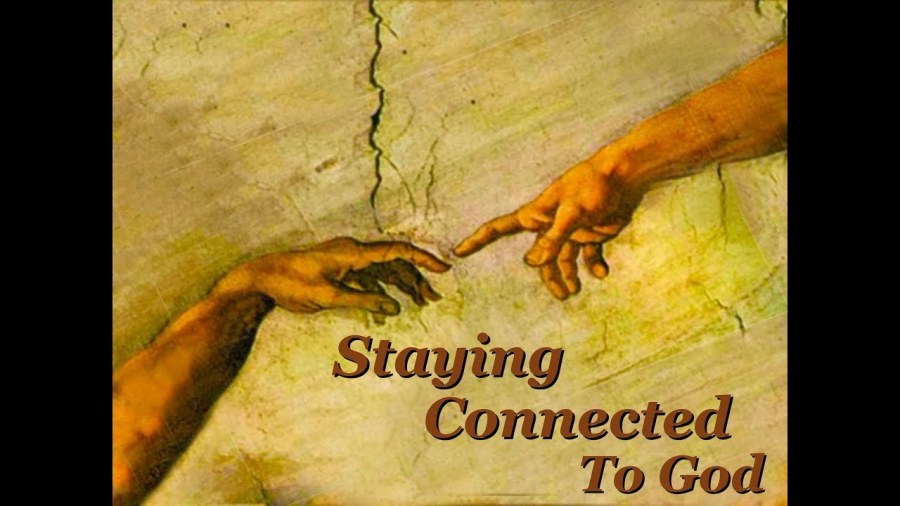
Connected to Christ

Pastor Sherry’s message for March 16, 2025

Scriptures: Gen 15:1-18; Ps 27; Phil 3:17-4:1; Lk 13:31-35

Last week, I preached about how to avoid temptation.  I hope a number of you were able to follow Jesus’ example and thwart the evil one as he tried to lead you astray.  This week, I would like us to focus on keeping our eyes on Jesus—and remaining connected to Christ.

Emily Compagno, of Fox News, has written a book called Under His Wings: How Faith on the Front Lines has Protected American Troops (Fox Books, 2023).  Her 1st story is of an Army Colonel she met in Iraq, in 2009, while on a USO tour as an NFL cheerleader.  Col. Tim Karcher was responsible for hosting and protecting Emily and her team as they visited our troops in the war zone to bring greetings from home and to boost morale.  She learned he was a committed Christian who led Bible studies in his home when stateside.  He was also the proud father of 3 girls, and the devoted husband to Alesia, a woman he believed God had given him 20 years earlier.  Emily met him his 3rd duty tour in Iraq.

Three days after Emily had returned to the US, he was in an army vehicle, stopped at a corner in an Iraqi town, when an IED exploded.  He checked to see if everyone else in the vehicle was OK and told his crew both his legs were broken.  The truth was both his legs had been blown off just above his knees!  He died once as they worked on him in the field, and again, several times, as they medivacked him to an Army trauma hospital in Germany, then on home to Walter Reed Army Hospital in DC.  He later wrote to Emily,

“I died there as well.  I remember as it was happening that I was really, really sad.  Not scared, because I knew where I was going.  I was sad to leave my wife, my daughters behind.  I was going to miss out on walking my daughters down the aisle, that kind of stuff.  But I also knew this:  hundreds and hundreds of people were praying for me.  And it was a rough, rough time.  I had all kinds of infections, a fever of 105,” (p.19).

Col. Karcher leaving hospital

He survived yet again to spend 2 years in military rehab in San Antonio, Texas, learning to walk with 2 prosthetic legs.  His last Army assignment, prior to retiring in 2015, was to serve as Director of the Army’s Wounded Warrior Program at Ft. Belvoir in Virginia.  St. Paul writes in 2 Corinthians 1:4 We comfort [others] with the comfort by which we have been comforted.  As a double-amputee, he was the perfect person to encourage other soldiers who had lost their limbs.  (I have included slides of him leaving Walter Reed and also of him walking 100 miles in a fund-raiser to benefit our wounded warriors.)

Col. Karcher’s 100 mile walk.

Col. Karcher is clearly a heroic and a determined guy who credits his faith—His connection to Christ–his family, and the prayers of hundreds with pulling him through.  

II. Body▶️Let’s see what our Scripture passages have to say today about having the faith to pull through tough times.

A. In Genesis 15:1-19—in His 4th appearance to him— God tells Abram, who is still awaiting the Child of Promise that He, the Lord, is Abram’s shield and greatest treasure.  In other words, God is Abram’s king or sovereign (shield) Who protects him (as He does us).  The Lord, too, is the best reward Abram, or us, could ever receive—greater even than the Child of Promise.  And, because the Lord keeps His promises, an heir, Isaac, is coming, as are many, many other descendants (v.3)▶️…look up at the heavens and count the stars—indeed if you can count them…So shall your offspring be.  All who believe in Christ Jesus are descendants of Abram, grated in to the line of Jewish believers.  And so also is the gift of property coming to this wandering Aramean, land stretching from the borders of Egypt to the Euphrates River.

In today’s passage, Abram has not yet seen either of these come true, but he believes God.  Verse 6 says▶️Abram believed the Lord, and He [God] credited it to him as righteousness.  Jesus had not yet come to earth to save us, yet God saved Abram due to his faith. Will we see Abraham in heaven?  YES! 

Notice one other point: God reiterates His promises to Abram by literally “cutting a covenant” with him.  In the Ancient Near East at that time, when you made a binding agreement with someone, you literally cut animal sacrifices in two and walked between them.  You were saying that, in effect, if I break this agreement, may I die as have these animals.  God was swearing an oath to Abram on His own life.  Remarkable!  Also, the forms He used to represent Himself (God is Spirit) are symbolic of the coming Christ:

The smoking firepot represents the judgments Jesus will make at His 2nd Coming; the burning lamp signifies Jesus as the light of the world.

We could say, then, that God as the Pre-incarnate Jesus, swore an oath with Abram.

Much later, Abram died a wealthy man with an heir from his own elderly body, Isaac, and a huge amount of property.  Good things come to those of us who trust in the Lord.  Like Col. Karcher, we may not move through our lives without pain and suffering, but Jesus holds our lives in His able hands and blesses us.

B.  King David wrote Psalm 27.  In the first 6 verses, David notes how God provides confidence and encouragement for those of us who love Him.  In verses 7-12, he then goes on to pray for deliverance from treacherous enemies.  Interestingly, these enemies have leveled false charges against King David.  This is so like what we witness today, where we observe people on social media and in politics so ready to fabricate lies aimed at discrediting/running down others.

But in verse 4, David articulates his primary desire:  One thing I ask of the Lord, this is what I seek:  that I may dwell in the house of the Lord all the days of my life, to gaze upon the beauty of the Lord and to seek Him in His temple. King David desires full-on access to God:  He’s got wealth and political power—his throne; he’s got either a land at peace, or military victories; he’s got wives and concubines and a bunch of children; but more than these usual things people yearn for, before anything else, David desires intimate communication/connection with the Lord.  This fervent desire to seek God’s face and to develop a deep relationship with Him is what carries us through hard times and helps us overcome our tough circumstances.

C. Our New Testament passage today is from Philippians 3:17-4:1.  Just prior to today’s reading, in verses 13-14, Paul asserts▶️…but one thing I do: Forgetting what is behind and straining toward what is ahead, I press on toward the goal to win the prize for which God has called me heavenward in Christ Jesus.  What goal is he talking about?  Intimate connection with Jesus.  He wants to be as close to Jesus as possible because (v.20)▶️Our citizenship is in heaven.  This earth is not our final home.  All that goes on here is a testing, a proving ground for rewards given us later in heaven.  Those who don’t pass the tests are what Paul calls (vv.18-19)▶️…enemies of the cross of Christ.  Their destiny is destruction, their god is their stomach [meaning satisfying their physical or their emotional needs], and their glory is in their shame. Their mind is on earthly things.

Paul exhorts us not to be like these kinds of folks.  He wants us to keep our focus on The things of God; And to remain closely connected to Jesus.

D.  And if we were not clear on this, Jesus weeps over Jerusalem, in Luke 13:31-35.  Jesus is praying as He overlooks the city from some height.  He is grieved because he knows what is to come–His betrayal, the trumped up accusations, the fraudulent trials, the beatings, and His crucifixion.  The city He has come to die for will soon reject Him.

He is grieved because he knows that Jerusalem, the capital city of God’s chosen people, was not desperate enough to seek His face.  They preferred to protect their idea of God while rejecting and discarding the One Who was God. 

Jesus has since gone on to glory, while His enemies in Jerusalem and Judea have no doubt met a far worse end.  We know He loves us and died for our sakes.  We know He has hidden us in the shelter of His wings.

On this, the 2nd Sunday of Lent, as we continue our spiritual house-cleaning, we should be asking ourselves, “Are we deeply connected to Jesus?”  The truth is that we need Him.  Consider this poem:

At my lowest, God is my hope.
At my darkest, God is my light.
At my weakest, God is my strength.
At my saddest, God is my comforter.”

Author Unknown

(Kathy Keller, “Stay Close to God,” www.sermonillustrations.com, 12/18/ 23).

This week, let’s focus on getting and remaining connected to Christ.  AMEN!

©️2025 Rev. Dr. Sherry Adams 

Recognizing Everyday Saints

Pastor Sherry’s message for November 10, 2024

Scriptures: WMC, 11/10/24; Ruth 3:1-5, 4:13-17; Ps 42; Heb 9:24-28; Mk 12:38-44

I heard this story just the other day.  It appears to describe a large Catholic parish in the Midwest:

“A priest once asked one of his parishioners to serve as financial chairman of his parish. The man, manager of a grain elevator, agreed on two conditions:  (1) No report would be due for a year, and (2) No one would ask any questions during the year.

“At the end of the year he made his report. He had paid off the church mortgage of $200,000.  He had updated the church’s interior. He had sent $1,000 to missions [he could have been more generous here], and he had put $5,000 in the bank’s savings account.

“How did you do all this?” asked the priest and the shocked congregation.  Quietly he answered, “You people bring your grain to my elevator. As you did business with me, I simply withheld 10 percent [in other words, he overcharged them by 10%] and gave it to the church. You never missed it.”

(Contributed by James S. Hewett, http://www.Sermons.com, November 5, 2024)

Now please don’t get alarmed.  I am not going to launch into a sermon on tithing, or your monetary giving to our church.  Too many people just happen to visit a church on the very day the pastor encourages everyone to contribute more money.  They walk away believing the church is only interested in digging into their wallets.  My son attended a non-demoninational church of 22,000 members in Texas.  He said at one point the pastor preached on tithing every week.  I guess he had a large facility and an equally large staff to support, so money was uppermost in his mind.

Because of this, however, I hardly ever say anything tithing.  Instead, I will let today’s Gospel passage speak for itself.

Instead, I want us to focus today on what our Bible passages tell us about how we might go about recognizing everyday saints.

Last week, I distinguished between canonized saints and “everyday saints.”

Canonized saints are those holy people who led obviously Christian lives, may have died for their faith, and often performed some sort of miracle.

Reports about their lives are scrutinized by the Catholic Church.  And if they meet the 3 criteria, they are recognized as true “saints of the Church.” 

Conversely, “everyday saints” are those of us who love Jesus as our Lord and Savior, and who try to model our lives after Him and what we learn from Scripture.  Keeping this 2nd category in mind, let’s examine the passages appointed for today to see how they help us recognize “everyday saints.” 

A.  Our OT lesson is from portions of Ruth 3 and 4.   You may remember that Ruth was from Moab, one of the perennial enemies bordering Israel.  The Moabites originated from the incestuous relationship of a drunken Lot and one of his two daughters.  The girls had seen the destruction of Sodom and feared they would never marry or bear children.  So they got their father drunk and slept with him.  Naturally this was abhorrent to our God (Genesis 19:30-37).  The Moabites also tried to hire a false prophet, Balaam, to curse Israel.  He was not a follower of the Hebrew God, but he obeyed God when He told him he could not curse His Chosen People. (Numbers 22 and 23).  So Ruth was from a nation that Israel despised and avoided.

Nevertheless, she had met and married one of the sons of the Israelite woman, Naomi.  From Bethlehem, Naomi had moved to Moab, with her husband and two sons, to escape a famine.  They had located food in Moab, and jobs, but all three men got sick there and died.  Naomi was once again faced with poverty and starvation and decided to return home to Bethlehem.

She tells her 2 devoted daughters-in-law to return to their Moabite relatives.

One, Orpah agrees and, though sorrowful, leaves her; the other, Ruth, loves Naomi dearly and loyally accompanies her into Israel.

What might this tell us about Ruth, a woman we might term an “everyday saint”?  For one thing, she’s compassionate: She puts her mother-in-law’s needs for companionship and help ahead of her own comforts.  Those of you who have cared for aging parents now or earlier have done the same, haven’t you?   Additionally, she’s loyal enough to accompany Naomi to a land where she might always be considered a despised outsider (Think of what a member of Hamas would experience today if such a person attempted to become a Jew).  Ruth is certainly courageous, willing to leave all she’s ever known to go where she might be treated hostilely.  And, perhaps most important, she has become a follower of Naomi’s God.

As we pick up in today’s reading, Naomi plays matchmaker for Ruth.

Naomi owned land in Bethlehem, land owing what we might call “back taxes.”  Back in Genesis (38: 13-30), the Lord had made provision for widows through the concept of a Kinsman Redeemer.  This male relative could claim the widow’s land if he paid what was owed, and he could marry the dead man’s widow (to continue her dead husband’s line) if she agreed.

Another, closer relation wanted the land but not the foreign widow.  But Naomi knew the kinsman-redeemer, Boaz (who foreshadows Jesus as our Kinsman Redeemer), had signaled he liked Ruth a lot.  So, Naomi has Ruth get all dolled up and approach the sleeping Boaz at a harvest festival.  By placing the blanket at his feet over hers, she signaled to him that she wanted to marry him.  (This may seem a little strange to us today, but that was the custom then.)

They do marry, and happily pick up in chapter #4 where Ruth bears Boaz a son, Obed [servant of the Lord], who will become the grandfather of King David.  Because of Ruth’s faith and character, the Lord establishes from her son, Obed, the line of Jesse, the stump of Judah, from whom Jesus later comes.  The Lord so values Ruth for her faith and character, that He places her—a hated outsider (like Hamas)—in the lineage of the Messiah.

B.  Psalm 42 was written by some sons of Korah.  Though their father had been discredited and killed for leading a rebellion against Moses (Numbers 16), God spared his sons and grandsons.  Those descendants of Korah who had been spared their father’s fate become gate-keepers and choir members in the Tabernacle.

This psalm is called a maschil or a teaching psalm.  Its primary message is that we are to hope and trust in God despite our negative circumstances.  The sons of Korah are certainly evidence that punishment for evil in one can result in good behavior in others, and that people do often recognize and appreciate God’s grace.  The instruction in this psalm consists of realizing that we worship a God of grace and mercy.

C.  The writer to the Hebrews (9:24-28) wants us to be clear that we realize that Jesus’ sacrifice of Himself for our sins was sufficient.  It was enough to clear our debt to the Father for our sins, past, present, and future.  Jesus’ atoning death on the cross was complete, sufficient, and perfect.  We don’t’ have to do anything to assure our salvation except say yes to Christ.  He did all the heavy-lifting, for all time.

Our response to Him should be one of gratitude.

D. Finally, in our Gospel (Mark 12:38-44), Jesus condemns the Pharisees for being fakers, posers, and hypocrites, caught up in appearing righteous to others, while missing out on a legitimate, honest, humble relationship with God.  Everyday saints are sincere.

They don’t just try to look good, but their hearts are good.  They desire to please God more than to please people.  And they, like the widow who gave her last coins to the Temple treasury, are fully trusting and fully committed.

So what are the characteristics of everyday saints?  The Book of Ruth shows us that everyday saints are compassionate, loyal, risk-takers, and courageous.  They are also committed followers of God/Jesus.

Psalm 42 teaches us that everyday saints are grateful to God, trusting in Him, through bad times as well as the good.  As Paul later on states, (Romans 8:28): For we know that in all things God works for the good of those who love Him, and who have been called according to His purpose.

Our Hebrews passage reiterates the powerful message that Jesus has done all that needed to be done to assure our salvation.

As He assured us from the Cross, It is finished.  Simply said, we are saved if we agree to believe in Him.

Finally, we demonstrate we are everyday saints if we are humble and sincere.  This means we don’t “put on airs” or fake our devotion to God.  This means we are not religious hypocrites.  Others will recognize we are everyday saints if we practice the Christian virtues our passages outline today

You may be thinking, “That’s a tall order to be compassionate, loyal, courageous, committed followers of Jesus, grateful, trusting, and sincere.”  Yes it is if we try to practice each of those virtues at once.  But we can consider which ones we already do pretty well, and then pick one we are less likely to demonstrate.  For this next week, try to practice one that is not yet true of you.  Psychology teaches us that it takes 23 repetitions to replace a bad habit with a good one. 

May the Holy Spirit empower you to cement these virtues in your life. Lord, make it so!  Amen!   

©️2024 Rev. Dr. Sherry Adams

Everyday Saints

Pastor Sherry’s message for November 3, 2024

Scriptures: Isa 25:8-9; Ps 24; Rev 21:1-7; Jn 11:32-44

Today we celebrate All Saints Sunday.  It is the Church’s attempt to counter the secular focus on ghosts, goblins, and all matter of scary Halloween folk, alive or dead, and instead highlight those followers of Jesus—Saints–who have gone on to glory.  Halloween was originally “All Hallows Eve,” when Christians everywhere meditated on their friends and family members—saints—who had entered into God’s glory.

I don’t know about you, but I don’t tend to think of myself as a saint.

Perhaps it is because the Roman Catholic Church has a lengthy process by which it canonizes someone into sainthood. Canonized saints had to have lived a holy life—in which they demonstrated the Christian virtues of faith, hope, and charity—and often were martyred for their faith.  They must also have performed some sort of miracle.  But the truth is that if we have been baptized into Christ, we too carry the name “saint.”  The academic dean of my seminary used to greet us all at every chapel service by saying, “Good morning, Saints!”

The following story provides an example of what we might call not a canonized but an “everyday saint”:

“During the course of earning her master’s degree, a woman found it necessary to commute several times a week from Victory, Vermont to the state university in Burlington, a good hundred miles away. Coming home late at night, she would see an old man sitting by the side of her road. He was always there, in sub zero temperatures, in stormy weather, no matter how late she returned. He made no acknowledgment of her passing. The snow settled on his cap and shoulders as if he were merely another gnarled old tree. She often wondered what brought him to that same spot every evening. Perhaps it was a stubborn habit, private grief or a mental disorder.

“Finally, she asked a neighbor of hers, “Have you ever seen an old man who sits by the road late at night?” “Oh, yes,” said her neighbor, “many times.” “Is he a little touched upstairs? Does he ever go home?” The neighbor laughed and said, “He’s no more touched than you or me. And he goes home right after you do. You see, he doesn’t like the idea of you driving by yourself out late all alone on these back roads, so every night he walks out to wait for you. When he sees your taillights disappear around the bend, and he knows you’re okay, he goes home to bed.”

(Contributed by Keith Wagner, Almost Heaven, adapted from Garret Keizer, Watchers in the Night, http://www.sermons.com, 10/31/2024.)

Everyday saints are big-hearted  souls like the old man in the story. .They generously  put themselves out for the benefit of others.  The young woman in the story didn’t ask him to watch out for her.  He just determined that someone needed to check on her safety, and that someone was him.  No fanfare; no publicity.  I believe a lot of us might similarly qualify as “everyday saints.”  I learned last night that my son-in-law, Job, went into action to help the police subdue some drunken, combative fans at a big football game in Jacksonville yesterday afternoon. These out of control football enthusiasts had thrown punches at the police who had come to escort them out of the game. Later Job said he helped the police cuff the drunks because he did not want them harming his family or any other observers in the crowd.  I told him this qualified him as an “everyday saint.”  Isn’t it true that so often we think, “Someone should do something about this or that situation,” and then we realize, perhaps I am that someone.

Our readings today all focus on the future home of both canonized and everyday saints.  Let’s examine them together to see what we have to look forward to.

A.  Our Old Testament reading is from the prophet Isaiah (25:6-9)—whose name means “the Lord saves.”  Imagine living out your life knowing this is what your name means.  In this passage, Isaiah is foretelling what the Millennial Kingdom of Jesus Christ will be like for all of us saints.  When the Great Tribulation ends and Christ returns to earth a second time, He will usher in 1,000 years of peace—known as the Kingdom Age, or the Millennial Reign of Christ—as He rules over all the earth.  He will reign from Jerusalem.  He will provide for all our needs.  This is what is meant by verse 6 (NLT version): …the Lord of Heaven’s Armies [Jesus] will spread a wonderful feast for all the people of the world [i.e., all those who believed in Jesus while they lived] .  It will be a delicious banquet with clear well-aged wine and choice meat.  We will eat well.  Our appetites will be satisfied.

Even better, verses 7-8 tell us: He [Jesus] will swallow up death FOREVER!  The Sovereign LORD will wipe away all tears.  He will remove forever all insults and mockery against His land and people.  The Lord has spoken!  In our new home, in our resurrection bodies, there will be no death or grief.  Jesus’ victory over death on the Cross will be a reality for each one of us.  Since He will have “swallowed death up,” death the concept and death the reality will ease to exist!

Verse 9 tells us: In that day, the people [we everyday and canonized saints] will proclaim, “This is our God!  We trusted in Him and He saved us!  This is the Lord in Whom we trusted.  Let us rejoice in the salvation He brings!  Our new home will be a place of joy and celebration.  We will be so grateful that we trusted in what Scripture has told us about our God.

B.  Psalm 24, Like Psalm 23 just before it, was written by King David.  In it, David prophesies that Jesus, our Chief Shepherd, will–at His 2nd Coming–be the King of the whole world.  David lived about 350 years before Isaiah, but he says essentially the same thing:  He predicts that Jesus will take possession of Jerusalem and Mount Zion, the Temple Mount.  There will be no more Dome of the Rock, the Moslem mosque that currently sits where the Temple used to be.  This is all possible because as vv.1-2 state: The earth is the Lord’s and everything in it.  The world and all its people belong to Him.  Since our God created all things, including us, it and we all belong to Him.  If He means to reclaim the Temple Mount for Himself, He will.  Given the upcoming national election, it is good for us to remember, our country does not belong to Democrats or Republicans, or to socialists, communists, or capitalists.  America belongs to God, whether we all recognize it or not.

As the remainder of the psalm asserts, the gates of the city will open for Jesus, the King of Glory.  We will be there because we loved Him and believed in Him. We everyday saints will dwell with our Great Shepherd in our glorious new home.

C.  Our New Testament passage is from the end of the book of Revelation (21:1-7).  The Apostle John tells us that after the 1,000 year reign of Christ, the devil will be destroyed, once and for all.  God will then create a new Heaven, a new earth, and a New Jerusalem.  (Some scholars believe the old earth and the old Jerusalem will be destroyed by fire.)  As our other passages have foretold, there will be… no more death or sorrow or crying or pain.  All these things are gone forever. 

And, as the hymn proclaims, “Oh happy Day!”  This is what our eternal home will be like, Saints!  Don’t you want to be there?  I do.  As another anthem asserts, “Oh yes, I want to be in that number, when the saints go marching in!”

D. Finally, in our Gospel lesson (John 11:32-44), we remember how Jesus raised Lazarus from the dead.  What is so important to realize is both that (1) Jesus demonstrated His power over life and death;

(2) but also that He was so angry about death.  Yes, He was sad that Mary and Martha and others were grieved over Lazarus’ death; He Himself wept.

But He was also angry that death had not yet been defeated.  How ironic that it took Jesus’ death to break the power of death over us.

As the message has been repeated throughout our readings today, in our new home–as either canonized or everyday saints—we will no longer experience death.  The evil one will have been destroyed, and we will live eternal lives of comfort, safety, health, and celebration.

Perhaps you’ve noticed that I always want us to consider how the messages of our Scripture passages apply to us today.  These are ancient words that are still so very true.  Today, our focus is on what our new eternal home will be like. We certainly don’t want to miss out on it, do we?  We want to rejoice in our salvation and to please God.

We also want to live like everyday saints.  One example of how to do this comes from the following story:

“Several years ago, a New York City radio station ran a contest. Disc jockeys invited their listeners to tune in their clock radios. “Just for fun,” they said, “when you wake up to the sound of FM-106, call and tell us the first words you spoke when you rolled out of bed. If you’re the third caller, you’ll win $106.”

“It didn’t take long for the contest to grow in enthusiasm. The first morning, a buoyant disc jockey said, “Caller number three, what did you say when you rolled out of bed this morning?” A groggy voice said, “Do I smell coffee burning?” Another day, a sleepy clerical worker said, “Oh no, I’m late for work.” Somebody else said her first words were, “Honey, did I put out the dog last night?” A muffled curse was immediately heard in the background, and then a man was heard to say, “No, you didn’t.” It was a funny contest and drew a considerable audience.

“One morning, however, the third caller said something unusual. The station phone rang. “Good morning, this is FM-106. You’re on the air. What did you say when you rolled out of bed this morning?”

“A voice with a Bronx accent replied, “You want to know my first words in the morning?”  The bubbly DJ said, “Yes, sir! Tell us what you said.”  The Bronx voice responded, “Shema, Israel … Hear O Israel, the Lord our God, the Lord is one. And you shall love the Lord your God with all your heart, with all your soul, and with all your might.” There was a moment of embarrassed silence. Then the radio announcer said, “Sorry, wrong number,” and cut to a commercial.”

(Borrowed from http://www.Sermons.com, 10/31/2024.)

Wow!  Are the first words out of your mouth each morning a prayer of praise to our wonderful God?  This is clearly one way to live like an everyday saint.  Like the old man in the Vermont cold, it also comes as a result of looking out for the health and wellbeing of others.  Prompted by All Saints Sunday, let’s be aware this week of demonstrating our love to God and to others in practical, generous, and maybe even brave ways.  Amen!

©️2024 Rev. Dr. Sherry Adams

Kingdom Courage

Pastor Sherry’s message for November 19, 2023

Scriptures: Jud 4:1-24; Ps 90:1-12; 1 Thess 5:1-11; Matt 25:14-30

Chuck Swindoll recalls the story of a 70 year old man who was being celebrated aboard a cruise ship for having saved a young woman. These folks were on a week-long cruise from California to Hawaii. The man was out walking on the deck when he saw the young woman fall overboard. He saw she could not swim, so he immediately went in after her, staying with her until they were both rescued. That night, the captain insisted they honor the somewhat embarrassed gentleman, over dinner, for his heroic actions. Speeches were made and the story of the man’s bravery was told and retold. Finally, they invited the fellow to the mike to say a few words. In what was probably the shortest hero speech ever offered, the fellow spoke these stirring words:

“I just want to know one thing—who pushed me?”

(Chuck Swindoll, The Tale of the Tardy Oxcart, Word Pub., 1998, p.119.)

I love this story because it illustrates so well the fact that our God can make the most unlikely of us into heroes. Can you imagine jumping overboard—at age 70—to rescue someone you didn’t know? Perhaps you’ve heard of similar stories. Courageous persons don’t allow their fears to talk them out of doing the brave thing. They also usually involve trusting in God to see them through a tough situation.

Our Old Testament and Gospel lessons today give us two examples of God’s concept of Kingdom Courage:

In our Old Testament lesson (Judges 4:1-24), we have the only example of a woman called to lead the nation of Israel, Deborah the Prophetess. Scripture mentions several women prophets: Miriam (Moses’ sister) (Exodus 15:20), Huldah, who sent a message to the good King Josiah (2 Kings 22:14), Noadiah, a bad prophet who tried to thwart the rebuilding of Jerusalem (Nehemiah 6:14), and Anna, who recognized that the infant Jesus was the Messiah (Luke2:36).

Deborah was called and equipped by God to lead during the time of the Judges. Joshua had died at 110, leaving no successor (no human understudy to rise up and lead in his place). Even though the people had promised him many times they would remain obedient to God, within 40 years, they had taken up idolatry and forsaken the LORD. The Lord would then allow a Canaanite people—Amorites, Amonites, Moabites, Midianites, or even Philistines—to then oppress them. They would then call out to the LORD for His rescue. God would forgive them and raise up a judge to lead them in defeating their enemies. They would thank and praise Him; but shortly, once the threat was over, they would again forget about their loyalty to God. And the 40 year cycle would begin all over again. The book of Judges reports 7 such cycles and 7 judges. Deborah was the 4th.

Who was she? Scripture tells us she was…

1.) A wife to Lippidoth. We know nothing of him, except that he seemed to have recognized God’s call on his wife’s life and did not appear to try to frustrate her influence or power.

2.) “A mother of Israel,” out of the tribe of Ephraim. While this may mean she had children of her own, it also means she nurtured and cared for the nation.

3) A wise counselor people came from miles around to seek her wisdom and advice.

4.) A renown judge—like Judge Janine Pirou or Judge Judy. Instead of sitting at the city gates to hear cases as was typical in those days (V.5)She sat beneath a palm tree named for Her–the Palm of Deborah–located between the cities of Ramah and Bethel.

5) A legitimate prophetess—She was anointed by God, who told her what to say to His people. She foretold events accurately, and nothing she prophesied disagreed with Scripture.

6.) We learn in today’s passage that she was a warrior.

7.) She was also a poet—She wrote a song/psalm, describing what God accomplished through her leadership in Judges 5.

8.) Finally, she was a woman who loved and trusted God—I’d say she had Kingdom Courage.

The situation Deborah finds herself in is that the Canaanite King Jabin had oppressed the Israelites for 20 years. He terrorized them with 900 iron chariots and horses and his successful General Sisera. Sisera’s army had confiscated all the Israelite‘s iron weapons in their initial victories. The Israelites were left then with wooden and stone weapons, clubs, rakes, etc.—they were at a distinct disadvantage. God tells Deborah to call for Gen. Barak from the tribe of Naphtali. She did, telling him that God meant for him to lead the people into battle against Sisera: (v.6–The LORD, the God of Israel, commands you: ‘Go, take with you ten thousand men of Naphtali and Zebulon and lead the way to Mount Tabor. I [the Lord] will lure Sisera, the commander of Jabin’s army, with his chariots and his troops to the Kishon River and give him into your hands.

God told Deborah and Gen. Barak that He was going to give the Israelites the victory. The General doesn’t see how—he doesn’t really trust in God. He focuses on the fact that his troops are outnumbered 10 to 1. He also knows he has no horses or chariots and that Sisera’s army is much better equipped (with iron weapons) than his army is. Barak agrees, but only if the prophetess will accompany him. However, since he doesn’t really seem to trust her or God, she tells him God will give the victory (Gen Sisera) to a woman (Jael, the wife of a weapons maker).

This previously unknown woman, Jael, was married to a Jewish man named Heber. He was an iron weapons manufacturer and a turncoat who collaborated with the Canaanites against his own people. To expedite his transactions, Heber and his much more loyal wife, Jael, lived in tents near the Canaanite army and the proposed battle site. (Sorry to say, but the men in this account do not appear to have the same moral fiber, Kingdom Courage, or faith that the women do.)

Much of what happens in the ensuing battle is recorded by Deborah in her psalm, in chapter 5. From her victory song we learn the LORD sent…

1.) Soldiers from the 6 tribes of Naptali, Zebulon; Issachar; Ephraim, Manasseh, and Benjamin.

2.) He also sent hail, sleet, and torrents of rain in which…

a.) bogged down the 900 chariots in deep mud;

b.) panicked the horses so they ran off;

c.) Canaanite archers couldn’t shoot their arrows in the sleet;

d.) and their swordsmen couldn’t wield their swords as well in the cold (remember this is essentially a desert-like land, where they are used to the heat, not the cold).

e.) Additionally, many enemy soldiers were swept away in a flash flood.

The battle belonged to the Lord. Israel’s army was able to kill all the enemy, except Sisera, who ran off in a desperate attempt to save himself. He escaped on foot and asked for sanctuary with Jael in her tent. In that culture in that day, the only man who was authorized to enter a woman’s tent was her husband. To hide out in a woman’s tent was outrageous. Remember, Jael is the wife of the Jewish weapon-maker. Sisera asked for water, but she gave him warm milk which we know would make him sleepy. Once he nodded off, she then executed this terrifying enemy of her people while he slept—and with the only weapon she had at hand. Interesting that, like the shoemaker’s daughter who has no shoes, this woman does not even have a metal knife at her disposal. Instead, she pounds a tent peg through his temple, killing him instantly, and fulfilling Deborah’s prophesy.

In her psalm, Deborah gives God the glory for their victory. Deborah trusted in God to free her people from oppression. She used her gifts of leadership in the face of overwhelming odds. Because of her faithful obedience and her Kingdom Courage, God gave Israel another 40 years of peace.

In our Gospel lesson, Matthew 15:14-30, Jesus provides examples of two courageous servants who utilize their talents for God and one who does not. Jesus says the master in the story leaves his assets in the hands of three servants. He appears to dole out his assets according to his trust in their abilities/motivation. One very able fellow gets 5 talents. Back then, a talent was equal to 1 years’ wages. For purposes of illustration, let’s say a years’ wages were $30,000; this guy has been entrusted with 5 times that or $150,000. The next gets 2 talents, or $60,000; and the third, 1 talent or $30,000.

When the Master returns, He expects them to account for how they invested His money. The fellow who had 5 talents invested them wisely and wound up earning double or $300,000! The guy with 2 also invested wisely and earned double, or $120,000. The guy with no faith or Kingdom Courage hid his 1 talent, so he gained nothing. At least he was honest and returned the $30,000. But the master was angry because he could have at least deposited the $30,000 somewhere and earned interest.

The Master commends the first two, Well done, good and faithful servant…Come and share your master’s happiness! But He has nothing but contempt for the third. This guy was either so lazy as to not use the talents, or too afraid to fail, so he did nothing. This guy gets thrown into the outer darkness, (v.30)…where there will be weeping and gnashing of teeth.

Many see this as a very hard teaching of Jesus. What they need to understand is that this is not a story of money or of wise investment practices. It is about utilizing the skills and gifts we have been given by God to build up His Kingdom. Notice, all are called to account: Those who use their gifts are blessed now and join Jesus in eternity. Those who do not are chastised and punished. I believe when we stand before God at His judgment seat, He will ask those of us who love His Son two questions: How well did you do at loving others? And how well did you use the gifts I gave you to advance My Kingdom?

So what is the point for us today?

First, like the 70 year old man pushed to rescue a woman at sea, God can make even ordinary people into heroes. Deborah was very gifted, but think about the housewife, Jael. She not only countered her husband’s disloyalty to Israel, but she was brave enough to kill a cruel enemy with a tent peg and a hammer.

Second, think about the two unnamed servants who took a risk and invested their master’s money. What about the risk and Kingdom Courage it takes us to step into our gifting? We need to not focus on our fears, but rather trust in God to help us achieve what He has put in our hearts. He expects us to use the talents He has given us to bless others.

Finally, God wants us to exhibit Kingdom Courage. He often uses ordinary people who trust in Him to accomplish His will. Do you trust God?

Are you willing to be obedient to Him, even when your situation seems difficult or impossible? If He can use an essentially unarmed army to defeat a vastly superior force, He can master any situation we bring before HIM.

What situation are you in that has you flummoxed, frightened, or frustrated?

Give it to the Lord, over and over until you see results (this is called “praying through”). Then ask God to give you Kingdom Courage to do any hard things that He may indicate He wants you to do.

Amen. May it be so!

©️2023 Rev. Dr. Sherry Adams