Worthy is the Lamb

Pastor Sherry’s message for May 4, 2025

Scriptures: Acts 9:1-20; Ps 30; Rev. 5:1-14; Jn 21:1-12

Some years back, I read a book—can’t remember the title—but it was an autobiographical account of an Army doctor in WWI, who died and was taken up into heaven. You may renenber, from our Covid experience, that there was a huge, worldwide influenza epidemic from 1918-1920.  Mostly young people were susceptible, especially those gathered together in army camps, bases, or foxholes. This doctor, whose name I’ve sadly forgotten, was working in an Army hospital at a base in Texas. He was struck down by the disease and appeared to have died. Someone even covered his head with a blanket, the sign to everyone that another soldier had perished. It took several hours before anyone came to remove his body.

But in the meantime, he found himself flying back over his home (planeless) in Virginia, where he saw his mother hanging out clothes to dry, and his father walking over to talk with her. He noted that his parents were safe and well. Then he found himself whisked up into heaven. He reported beautiful, vivid colors, lots of flowers and wonderful smells. Everyone he saw there was happy and healthy. He felt enveloped in love. He even encountered Jesus! He was filled with joy and wanted to stay; but, in short order, Jesus told him his work on earth was not done, so he was going to be sent back. The doctor came back to life just as they were preparing to remove his body for burial. He went on to get well, only to fall into a profound depression that lasted 3 years!  He wrote that he missed heaven so much that he found life as we know it to be profoundly disappointing by comparison. Eventually, he rallied, found meaning and purpose in being a doctor, and went on with his life.

I previously preached here about Jesus’ fish-fry on the beach, and Paul’s dramatic conversion, but today I want to focus our attention on our reading from Revelation.

Revelation chapters 4 and 5 offer us the best report of what Heaven is like in all of Scripture. In Chapter #4, the 90-92 years old Apostle John finds himself “taken up” into the Heavenly throne room. He has a vision of Jesus and receives the Lord’s words for the 7 churches in Asia Minor, but is then directed by Jesus to come up into heaven.

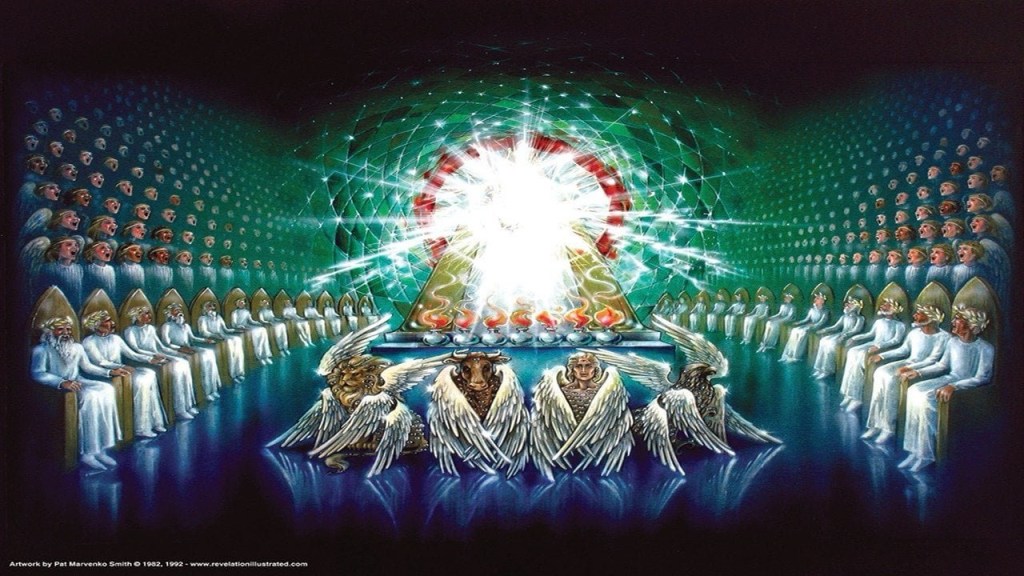
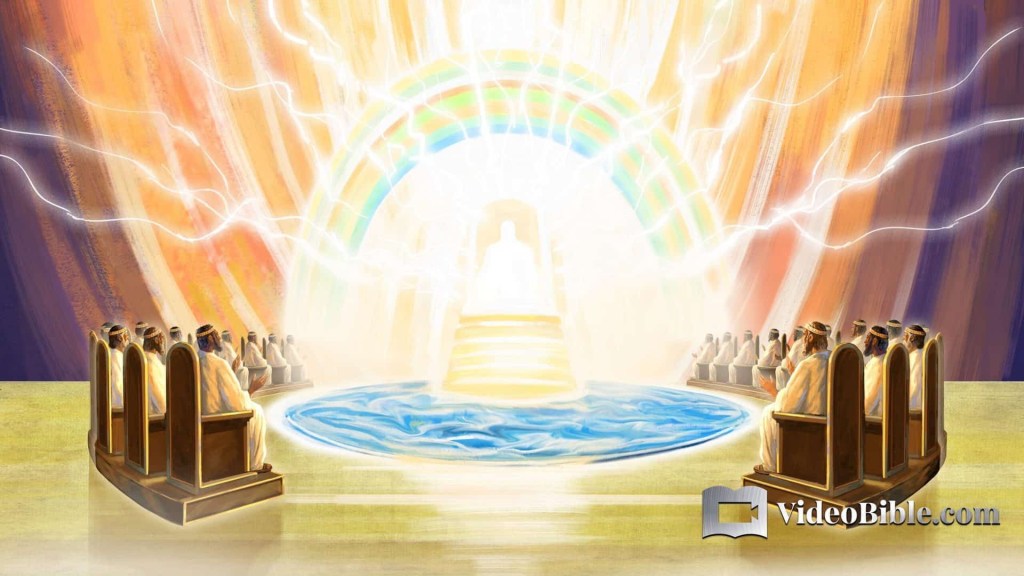
He sees things there that are almost too difficult to for him to put into words. He sees God the Father, seated on His throne, at the very center of a huge gathering. God dwells in dazzling light so overwhelming that John cannot clearly see His face. He tries to describe that light by using the image of light reflected by sunlight on jewels.  Scholars believe the jewel tones he saw were red, white, bright green, and perhaps purple.  Additionally he observes that God is surrounded on His throne by an emerald-hued rainbow. The rainbow is likely reminiscent of the days of Noah.  It seems to indicate the eternality of God’s promises—that is, that God does not break His promises to us, even if we disappoint Him.

Around God’s throne are 24 smaller thrones.  There is considerable conjecture about who the 24 elders are who are seated on the lessor thrones.  Most experts today think they represent “the true Church” or the “Redeemed:” including the 12 patriarchs or leaders of the Old Testament tribes of Israel; and the 12 Apostles from the New Testament.  They are dressed in white, the color of purity and righteousness, and what seems to be the uniform of heaven. They all wear a gold crown on their head, indicating they are a royal priesthood.  

John hears thunder and sees lightening shoot out from God’s throne. In Old Testament times, these signaled God’s presence and often His judgment. John perceives that the One seated on the throne is about to release His judgment on the inhabitants of the earth. Additionally, He notes (1) 7 torches around the throne, symbolic of the full presence of the Holy Spirit.

(2) Then he describes a “glass sea” under the throne, separating God the Father from everyone else there. God is totally holy. He is also, as I often say, large and in charge, so this bit of separation makes sense. 

(3) John is also amazed by God’s Honor Guard–the 4 living creatures (seraphim). They have eyes all over themselves, which looks and sounds very strange but indicates that they are omniscient or all- seeing. They fly about on 6 wings. Their bodies are those of strange, composite beings that may symbolize the apex of created life forms:

(a.) The mightiest wild animal, a lion (known to be ferocious);

(b.) The mightiest domestic animal, an ox (known for its strength);

(c.) The mightiest of all animals, humankind (known for our intelligence)

(d.) And the mightiest bird, the eagle (known for its swiftness).

Obviously these composite beings are capable of protecting God’s space and His person. Who could successfully take them on?

In Chapter #5, we find God the Father holding a scroll in His right hand, the hand of power.  John notes that it has writing on both sides. Typically in those days, people wrote on the front side of papyrus only, as the fibers on front were oriented horizontally while those on the back ran vertically. To have written on both sides indicates that the scroll is filled to overflowing with the decisions and the direction of God.  A number of Biblical scholars believe it contains both the salvation of humankind and the judgment of the wicked. A noted expert on the interpretation of Revelation, Robert Mounce, writes, “The whole story of human history rests in the hand of God.  What simpler or more sublime way of picturing God’s ultimate sovereignty over all history could be found than this picture of the scroll resting in the hand of God?  However strong evil becomes, however fierce be the satanic evils that assail God’s people on earth, history still rests in God’s hand.”

(Robert H. Mounce, The Book of Revelaton (Revised Ed.), Eerdmans, 1998, pp.82-83.)

Additionally, this scroll is sealed with 7 seals against tampering (again 7, in the Hebrew numbering system, is the number indicating completion). So, we can assume that what’s written therein is perfectly safe against tampering and that what’s written therein is very important!

John hears an angel ask (v.2) Who is worthy to break the seals on this scroll and open it?  Perhaps eager to learn God’s plans, John bursts into tears because (v.4)…no one was found worthy to open the scroll and read it. Then one of the 24 elders directs John to stop weeping. because Someone worthy has been found:  the Lion of the Tribe of Judah, the heir to David’s throne, Jesus.

But the Jesus who comes forth is not a warrior king in all His resurrection splendor, nor a majestic lion. Rather, He is portrayed as a little lamb who had been sacrificed—alive now (resurrected) but probably evidencing a slit throat. Obviously it takes Someone totally conformed to God’s will—like Jesus—to break the seals. God Himself doesn’t do it, but He has the Mediator, Jesus, bring human history to its foreordained consummation (Mounce, Ibid, p.143).
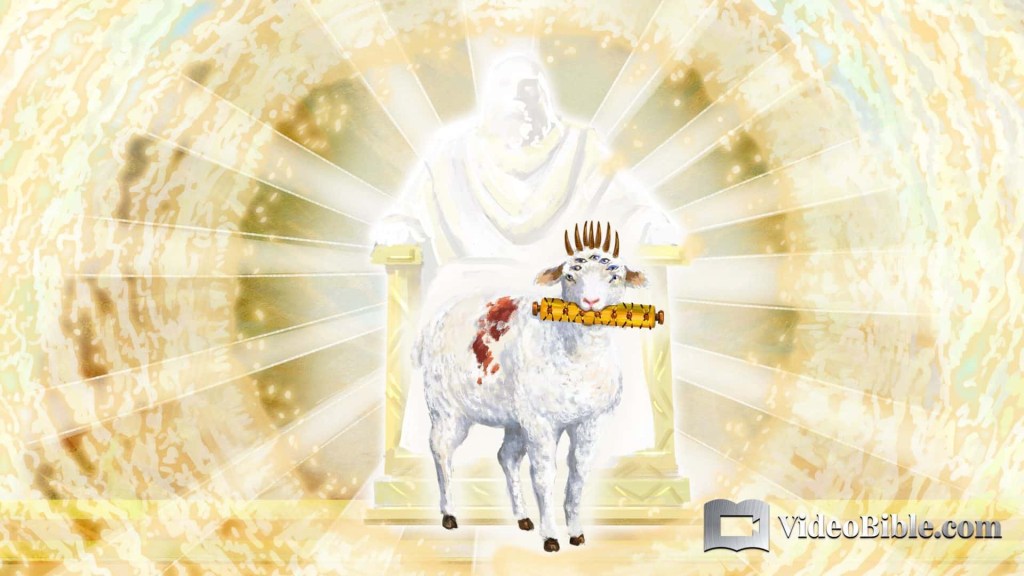
At this point, we should pause and say, “Worthy is the Lamb!” The use of the Lamb image is both striking and unusual. When people groups want symbols of power for their country, they tend to choose apex predators: Russia has the bear; Britain, a lion; France, a tiger; and the USA, the bald eagle. But God chooses a slain lamb, a typical temple sacrifice for sin. Christ is victorious precisely because He has surrendered Himself to be sacrificed, like a Passover Lamb.  He has triumphed over sin, death, and evil by His death on the Cross.

This particular lamb, Jesus, is powerful because He is depicted with seven horns, an Old Testament symbol for complete and perfect power.

Similarly, He has 7 eyes, representing His all-seeing omniscience.

So the Lamb slain from the foundation of the world steps forward to open the scroll, and all of heaven bursts into song. The 24 elders fall down before Him, surrendering to worship, singing Jesus a new song. They play harps to accompany worship music (I don’t think we will be the ones playing harps, despite what the culture contends).  The elders also offer up golden bowls of incense, which John is told are the prayer of the saints.  Then a myriad of angels join in a powerful chorus.  Finally, John writes (v.13) Blessing and honor and glory and power belong to the one sitting on the throne and to the Lamb forever and ever. (Talk about a Halleluia Chorus!)
So what can we take away from our glimpse into God’s throne room in Heaven?  I believe the following insights are worth remembering:  

1.) True power in this world does not rest with human dictators or human governments, but rather with our God.

2.)  God controls the course of human history.

3.) Even the most exalted beings in heaven humbly acknowledge God’s superiority in every way—so should we.

4.)  As God, Jesus knows how human history will end…our history is truly His-Story.

5.) How true then is Paul’s assertion from Romans 8:31 If God is for us, who can be against us?

6.) When we each get to heaven we will join millions of believers and angels in worship of our God and our Lord Jesus.
Thanks be to God Who gives us the victory through our Lord Jesus Christ!  Alleluia!  Alleluia!

©️2025 Rev. Dr. Sherry Adams 

Resurrection Sunday, 2025

Pastor Sherry’s message for April 20, 2025

Scriptures: Isa 65:17-25; Ps 118:1-2,14-24; 1 Cor 15:19-26; Lk 24:1-12

How many of you enjoy a good mystery?  Briefly, here are two.  See if you can figure them out:

1. “Everyday a gentleman went to work.  Every day, he would ride the elevator all the way to the bottom floor of the high rise apartment building in which he lived.  But when he came home from work, he would ride the elevator back up to only the 6th floor.  Then, he would take the stairs to his apartment many stories higher in the building.  This he did every day, unless it was raining.  If it was raining, he would ride the elevator all the way to the floor of his apartment.  Why?”

2.  Here’s the second one:  “Ann is lying on the floor dead.  There’s broken glass and water all around her.  Stuart is asleep on the couch seemingly oblivious to the death that has occurred.  How did Ann die?”

To keep you from puzzling these two mysteries out while I continue to preach, I’ll tell you their solutions: “In the first one, the gentleman would only go to the 6th floor on his return home from work because that was the highest button that he could reach on the elevator control panel.  He was a short man.  On days that it rained, he had his umbrella with him, and he could use that to punch the button that indicated his floor.” “In the second situation, it might help you to know that Ann is a fish, and Stuart is a cat.  And the glass and water all around Ann on the floor is from her fishbowl that Stuart successfully knocked over.”  The true mystery here is what then kept Stuart from eating Ann? 

(Borrowed from a sermon by Chris Talton, April 15, 2001, www.sermoncentral.com, 3/24/2005)

If we put ourselves in the position of the women who went to Jesus’ tomb on the morning of His Resurrection Day, we would realize they too were presented with several mysteries:

1. The gigantic stone that had sealed the entrance to the tomb had been rolled back.  Who could have done such a thing?  Remember, these ladies had been with Jesus at the Cross.  They had seen Him suffer and die.  They had watched Joseph and Nicodemus remove Jesus’ body from the Cross and transport it for burial in the new tomb nearby.  They also knew the men had hastily anointed Jesus body with embalming ointments and cloths, and had come to neaten things up and complete the job.  Surely they realized no single person could have rolled that huge, heavy stone away.

They probably also knew a contingent of Roman soldiers had been assigned there to guard the tomb.  So what had happened to them?  Had the Romans stolen Jesus’ body?  Had the Jewish religious authorities taken it?  They had to be both puzzled and alarmed.

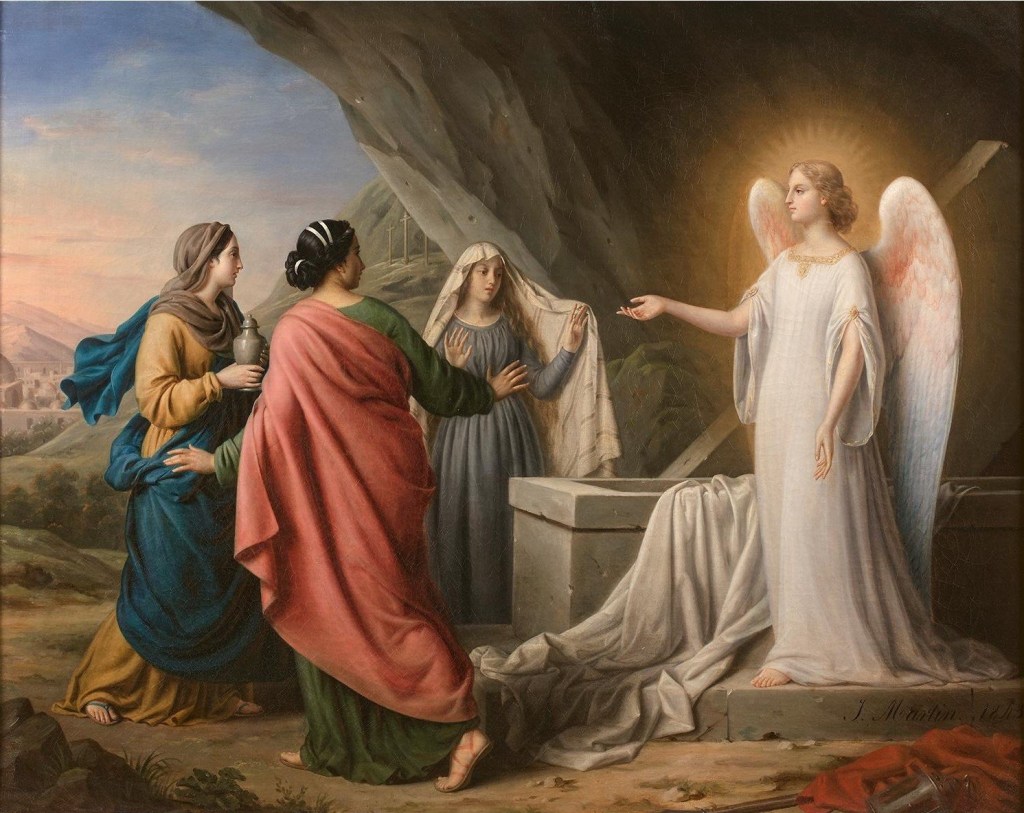
Cautiously, they stepped inside the tomb to see if His body was there. Instead of finding Jesus’ corpse, they suddenly encountered two “men” in brilliant white clothes–angels.  It’s almost comical that the angels ask them, Why do you look for the living among the dead?  [He is alive!]  He is not here; He has risen.  Literally, the ancient Greek states, He has been raised.  The verb tense implies that God the Father has raised Jesus.

Angels had proclaimed His birth; now angels proclaim His resurrection (The angels and the women are all witnesses to this miracle).  These angels remind them of Jesus’ teachings about His death and resurrection on the 3rd day.  This is a prompt for them to remember. but it’s also a rebuke—”How could you forget something so very important?!!”

Then they do remember, and go to tell the disciples (the next  resurrection witnesses).  The Eleven do not believe them, even though they should have known these women were reliable truth-tellers.  Peter takes off for the tomb, to see for himself (he is now a witness).  Peter probably now knows better than anyone not to doubt the Lord’s words.  But he still wonders (perhaps “marvels”) about what Jesus’ absence in the tomb means. 

This passage (Luke 24:1-12) closes with questions in everyone’s mind about what has happened (big mysteries). 

The accounts of Jesus’ Resurrection are also reported in the other three Gospels, Matthew 28:1-8; Mark 16:1-8; and John 20:1-8.

A. You might want to read them each and compare to get a fuller sense of how the first witnesses to Jesus’ resurrection responded to the mysteries with which they were presented.

B. Paul, as we know, came to believe in Jesus sometime after the events of Resurrection Sunday.  By then, the mysteries had been explained.

So Paul is intent, in our 1st Corinthians 15:19-26 lesson, that we understand that Jesus’ resurrection is the defining moment of Christianity.

First, back in verses 5-8, he reminds us of who all saw Jesus following His resurrection:  Peter (omitting the women); the 12 minus Judas; more than 500 disciples (maybe he included the women among the 500); Jesus’ brother, James; and Paul himself.

Next, in verses 13-19, Paul asserts that our entire faith depends upon the truth of the resurrection:  Verse 14—If Christ has not been raised, our preaching is useless and so is your faith. In other words, Christ’s resurrection from the dead is incontrovertibly true and forms the basis of our belief in Him.  We worship a God who has the power to bring His Son back from the dead.  I want a strong, powerful God like that, don’t you?  We worship a God who loves us so much that He sacrificed His one and only Son to redeem us.  We worship Jesus, the One and Only, the God Who—because of His self-sacrificing love for us and His obedience to His Father–was willing to cover the cost of our sins.  The sinless Son of God gave up His life so we might have new life, and have it abundantly.  We can connect directly with the Father because Jesus opened the way for us (As He hung on the cross, the massive Temple curtain was torn in two, from top to bottom.)  We can anticipate being resurrected because Jesus opened the way for us.  And, when He comes again in glory to judge the living and the dead, He will destroy death…Praise God! 

C.  We don’t know who wrote Psalm 118:1-2, 14-24, but it is an ode to joy!  The psalmist invites us to focus on heavenly realities–not the frustrations and disappointments of this life.  Because of the mighty things Jesus will do [has done]—including demonstrating His power over death—we can gratefully rejoice in the Lord and praise Him for our deliverance, provision, and protection.

We are to be thankful to Him because (V.1)—The Lord is good; His love endures forever.  (V.14)—The Lord is my strength and my song; He has become my salvation.  (V.18)—Prophesying Jesus’s resurrection, the psalmist wrote, I will not die but live, and will proclaim what the Lord has done…He has not given Me over to death. Jesus was laid dead in a tomb–But He did not remain there as we would have.  He rose again, overcoming death for our sakes!  We are also grateful for the fact that (v.22)—The stone the builders rejected [Jesus] has become the capstone.  The capstone was either (1) a large rectangular stone used as a lintel over a doorway; or (2) a large square or rectangular stone used to anchor or align the corner of a wall; or (3) it might also be the keystone or middlemost stone in an arch.  The capstone (building corner or doorway lintel) or keystone (arch) kept the building from collapsing by supporting what existed beside and above it. The psalmist prophetically meant this as a metaphor for Jesus, who holds all things together for us— no wonder we call Him our Rock and our Redeemer.

Our passage today ends with this line (V.24)—This is the day the Lord has made, let us rejoice and be glad in it.

D. Isaiah 65:17-25 reminds us both that Jesus overcame sin and death, and that we too will therefore experience a joy-filled life after death.

After Jesus defeats the forces of evil at Armageddon, God (v.17) will create new heavens and a new earth.  If you read through the book of Revelation, you can tell that our world will be a disastrous mess by the time Jesus appears a 2nd time.  We will probably need a new earth, at a minimum.

Verse 19 tells us that the newly created Jerusalem will be delightful!

God will be overjoyed with His people there; and they too will be very happy, with no one weeping or crying.  Premature death will be an event of the past (no cancers, illnesses, strokes, heart-attacks, eye problems, hearing loss, or sciatic pain).  People will be able to enjoy the fruits of their labors (no warfare or taxes).  All of God’s people will be blessed!  God will answer our prayers before we even finish praying them.  And all animals will become plant-eaters—no more carnivores devouring prey—and will be at peace with each other.

Thanks be to God the mysteries presented the women at the open tomb have been solved.  We are not left to wonder.  Paul wants us to fully appreciate what Jesus has done for us through dying and rising again.  Our psalmist calls upon us to be grateful and to rejoice!  And Isaiah describes a wonderful world ahead for us when the resurrected Jesus comes back to earth.  Let’s celebrate by singing along to Keith and Kaitlin Getty’s version of https://youtu.be/m_063OI38RQ?si=Dre8ll-AV-GHUlPB In Christ Alone.

©️2025 Rev. Dr. Sherry Adams 

Alleluia, He is Risen!

Pastor Sherry’s message for March 31, 2024

Scriptures: Acts 10:34-42; Ps 118:1-2, 14-24; 1 Cor 15:1-11; Mk 16:1-14

The story is told of a woman hurrying to church on Easter Sunday morning, when her car broke down: 

Not wanting to be late for the Easter service, she ordered an Uber to pick her up. The car arrived, and she quickly jumped in the back. 

Halfway through the ride, she asked the driver a question, but the driver didn’t respond. So she leaned forward and tapped [him] on the arm. The driver let out a loud scream, swerved into the other lane, almost hit another car, slammed on the brakes, and skidded over to the shoulder. 

The woman and driver sat in silence for a minute from the shock of what just happened. Finally, she said apologetically, “Wow, I’m so sorry. I had no idea that tapping your shoulder would alarm you like that.” 

“No, you really didn’t do anything wrong. It’s just that it’s my first day driving an Uber. You see, for the past 25 years, I’ve been driving a hearse.” 

(Borrowed from Subsplash.com, a blog, dated February 3, 2024.)

I’ll bet the poor driver thought he had witnessed a resurrection!  He was clearly shocked. He, and the woman trying to get to Easter Sunday services, were fortunate to escape injury.  It’s just a story—I don’t even know if it’s true—but it’s a reminder, isn’t it, of how fragile life is and of how amazingly our God looks after us.  I hope before they resumed their drive, they both took the time to thank the Lord for seeing them through a close call.

I think our responses to Easter Sunday must be belief and incredible gratitude.  Jesus’ death and resurrection accomplished for us what we could not do for ourselves.  He saved us from the penalty for our sin.  He dismantled the barriers between us and God the Father.  He demonstrated God’s life-giving, resurrection power.  And He grafted us into His Father’s family as adopted sons and daughters.

A. Mark gives us what is probably Peter’s account of what happened at the first Easter or Resurrection Sunday:  He shares that 3 women—who had all been at the foot of the Cross, grieving what had been done to Jesus—hurried to the tomb to complete the Jewish burial customs.

He had been hastily buried because of the Sabbath was scant hours away and the Sabbath prohibition from doing any work on that day.

None of the men accompanied them.  They may have been afraid they would be captured and crucified too.  Given the brutality of the Romans, this was all too likely, so the 11 disciples were in hiding.

No doubt the women wondered as they neared the tomb, “How will we roll back the rock covering the entrance?”  But they quickly observed that the tomb was standing open!  Moreover, it was empty!  Except for an angel who said (v.6)”Don’t be alarmed, …You are looking for Jesus the Nazarene, who was crucified.  He has risen!  He is not here.  See the place where they laid Him.  But go, tell His disciples and Peter, ‘He is going ahead of you into Galilee.  There you will see Him, just as He told you.’” 

What an astonishing greeting!  I’ve never seen an angel, but my friends who have say they are about 9 feet tall and shine brightly.  No wonder they always tell those to whom they appear to not be afraid.  The three ladies, who are no doubt in shock, run off.  According to Mark, they say nothing to anyone, at first.  Matthew and Luke tell us they did go and tell the 11 apostles.  John says Jesus appeared to Mary Magdalene first and told her to tell the 11.

So there are a few discrepancies about timing and order—which is often true with eye-witnesses as they process their own shock and surprise—but the main narrative is the same: (1) The tomb is open and empty.  (2) The angel announces the Jesus is alive again!  Alleluia!  He is risen!  (3) Whoever encounters the angel is told take that Good News to Jesus’ closest friends:  Jesus has done what He said He would do!  Alleluia!  He is risen indeed!

B. As Paul makes clear in our 1st Corinthians 15:1-11 lesson,we are to understand 2 facts:

First, Jesus’ resurrection was not just a spiritual truth but a bodily phenomenon.  The words he uses in the Koine Greek (the language in which the New Testament was written) are anastasis nekron, which means the standing up of a corpse.   Jesus appeared to His followers in a real body.  One that had been alive, but was then executed, and then miraculously came back to life!

Second, He appeared (post-resurrection), Paul tells us, to over 500 witnesses.  This is no myth!  This is no baseless narrative that has been spun to deceive.   No, Jesus’ resurrection is a fact!

1.) Peter and John saw Him;

2.) Mary Magdalene and the other faithful women saw Him; 

3.) His mother saw Him;

4.) His brother James saw Him;

5.) The 10 Apostles in the upper room saw Him;

6.) Later, the Apostle Thomas also saw Him;

7.) The two disciples on the road to Emmaus saw Him;

8.) Paul encountered Him on the road to Damascus;

9.) And Paul adds (verse 6) that >500 persons saw Him, at various times, during the 40 days between His Resurrection and Ascension.

You might be able to dismiss the testimonies of a few wild-eyed zealots.

But add to this over 500 “normal people?”   How about the fact that Jesus fulfilled over 325 Messianic prophesies from the OT?  Or the fact that He is probably the most influential person who has ever lived?  Still worshipped today, 2000 years later; still proclaimed as Lord, for 2 millennia. Or that thousands of His followers have met martyr’s’ deaths rather than renounce Him.  Scholars say there is more evidence of Jesus’ life, death, and resurrection than there is of the life of Julius Caesar.  These very strong proofs of the reality of Jesus’ resurrection should strengthen our faith in Him.

But let’s also consider what our other passages today have to say about why His resurrection should also result in our tremendous gratitude:

A.  King David who wrote Psalm 118:1-2, 14-24 as an ode to joy!  He invites us to focus on heavenly realities–not the frustrations and disappointments of this life.  Because of the mighty things Jesus has done—including demonstrating His power over death—we can gratefully rejoice in the Lord and praise Him for our deliverance, provision, and protection.

We are thankful to Him because…

(1) Verse 1—The Lord is good; His love endures forever.

(2) Verse 14—The Lord is my strength and my song; He has become my salvation.

(3) Verse 17—Prophesying Jesus’s resurrection, David wrote, I will not die but live, and will proclaim what the Lord has done.

(4) Verse 24—This is the day the Lord has made, let us rejoice and be glad in it.

(5) We are also grateful for the fact that (v.22)—The stone the builders rejected [Jesus] has become the capstone.  The capstone was either a large rectangular stone used as a lintel in a doorway, or a large square or rectangular stone used to anchor or align the corner of a wall.  It might also be the keystone or middlemost stone in an arch.  The capstone (building corner or doorway lintel) or keystone (arch) kept the building from collapsing by supporting what existed beside and above it.  Considering this metaphor for Jesus, who holds all things together for us, no wonder we call Him our Rock and our Redeemer.

B. Peter is certainly fired up as he boldly preaches to Cornelius and his household in Acts 10:34-43).  He saw the empty tomb, the discarded grave clothes, and the resurrected Christ!  Filled with the Holy Spirit (back in Acts 2), he preaches with fiery conviction.  Peter reviews for the Cornelius household the salient points of Jesus’ life and ministry, emphasizing the resurrection (vv.39b-41)—They [the Jewish religious authorities and the  Roman civil authorities] killed him [Jesus] by hanging Him on a tree, but God raised Him from the dead on the third day and caused Him to be seen.  He was not seen by all the people, but by witnesses whom God had already chosen—by us who ate and drank with Him after He rose from the dead.  Peter says they hanged Him on a tree—remember, Hebrews considered any piece of wood a “tree.”   They hear this and the Holy Spirit falls upon them all with the result that they praised God and spoke in tongues.  Wow! Powerful preaching, Peter!  Then Peter declares, “let’s baptize them with water.”

Here’s Peter-–not so long ago, cowering and ashamed—now boldly proclaiming Christ and baptizing Gentiles into “The Way,” as it was called in the 1st century.  Jesus has restored Peter.  And I think we can safely surmise Peter is so grateful for Jesus’ forgiveness, love, and trust in him, that he will go anywhere and preach to anyone willing to listen.

  Some of you may have seen or read Tolkien’s Trilogy of the Rings.  After accompanying Frodo on a often terrifying, always challenging, and truly exhausting mission to destroy the evil ring, Samwise Gamchee, Frodo’s faithful companion, collapses.  When he comes to, the first thing he sees is the good wizard Gandalf, who Sam had thought was dead.  At that moment, he asks a question (perhaps one of the best lines from the movies or the book, “Is everything sad going to come untrue?”  Jesus entered the river of death and came out victorious on the other side, making the sad of His death come untrue.  Because He did this for us, we too share in His resurrection victory—and all of its benefits. Yes, the world is still broken and people are still hurting, but because of Jesus, we have this promise.  At His 2nd Coming, everything sad will come untrue!!

Alleluia, He is risen!  The Lord is risen indeed, Alleluia!

©️2024 Rev. Dr. Sherry Adams

He is Risen!

Pastor Sherry’s Easter message for 4/9/23

Scriptures: Acts 10:34-43; Ps 118:1-2, 14-24; Col 3:1-4; Jn 20:1-18


“Max Lucado, in his book, Six Hours One Friday, tells the story of a missionary in Brazil who discovered a tribe of Indians in a remote part of the jungle. They lived near a large river. The tribe was friendly and in need of medical attention. A contagious disease was ravaging the population and people were dying daily. An infirmary was located in another part of the jungle and the missionary determined the only hope for the tribe was to go to the hospital for treatment and inoculations. In order to reach the hospital, however, the Indians would have to cross the river—a feat they were unwilling to perform.

“The river, they believed, was inhabited by evil spirits. To enter the water meant certain death. The missionary set about the difficult task of overcoming the superstition of the tribe.

“He explained how he had crossed the river arrived unharmed. No luck. He led the people to the bank and placed his hand in the water. The people still wouldn’t believe him. He walked out into the river and splashed water on his face. The people watched closely, yet were still hesitant. Finally, he turned and dove into the river. He swam beneath the surface until he emerged on the other side. Having proved that the power of the river was a farce, the missionary punched a triumphant fist into the air. He had entered the water and escaped. The Indians broke into cheers and followed him across.”

Isn’t that what Jesus did? He entered the river of death and came out on the other side so that we might no longer fear death, but find eternal life in Him.

(Max Lucado, Six Hours One Friday, Multnomah Books, 1989, pp.157-158).

Today, Easter Sunday, we celebrate the fact that Jesus Christ demonstrated that He had overcome sin and death by rising from the dead. He demonstrated the full extent of His miraculous power. And He brought us hope for the future (death is not the final outcome for us). All of our readings today refer in some way to Jesus’ resurrection:

A. In our Gospel, John (20:1-18) highlights some of the events of that first Easter Day. Mary Magdalene—remember, she had held a vigil for Jesus, along with His mother, John, and several other women–at the foot of His Cross. She had probably wept and prayed for Him as he hung dying. No doubt she had watched Joseph of Arimathea and Nicodemus quickly wrap His body for burial. In a dry land with limited water, they would have cleaned the corpse as best they could. They had to hurry before the onset of the Sabbath—He had to be buried before sundown. They then coated the body with myrrh, aloe, and the other spices they had brought. Next, they wrapped it up in stripes of cloth, which would have encased the body in a permanent, glued-on, kind of bandage. This process is important to note because of what happens later.

Mary had watched and must have thought the men did not do as good a job as they should have done for someone as important as Jesus. So she returned to the grave early the next morning, intending to make things right. How she thought she might roll away the heavy stone sealing the tomb is anyone’s guess. Nevertheless, she found the tomb already opened but containing no body. John tells us she ran to find Peter and the other disciple [this is how John always refers to himself in his Gospel], both of whom ran to see for themselves. John, the younger man, arrived first but only peeked into the tomb. The older Peter lagged behind, but reached the tomb and charged in to see only grave clothes on the shelf where Jesus had been laid.

The grave clothes told a story: The myrrh, aloe, and spices should have stuck the cloth stripes to the body, like a mummy. Remember Lazarus needed help to remove his. Both men saw strips of linen lying there, as if Jesus had materialized up through them, leaving them behind. In addition, the shroud for his head and face had been neatly folded and set aside. John saw this, knew it was physically impossible and therefore evidence of a miracle, and believed that Jesus had been resurrected. They appeared to have then gone home to ponder over what they’d seen.

Mary remained, grieving. Jesus appeared in His resurrection body and she didn’t recognize Him. Apparently the nail holes on His hands and feet, and the pieced place on His side, were evident, but something about His face and posture were altered in His resurrection body. Or perhaps she didn’t realize it was Him because she wasn’t expecting to see Him. She only comprehended that it was Jesus when He called her by name. He told her then to go tell the other disciples that He is going to see God the Father. Now we know from other accounts that He later met privately with Peter, encountered the two disciples on the road to Emmaus, and arrived back to greet 10 of the 11 disciples in the Upper Room, but we do not really know where He went during the middle hours between dawn and later that evening. Somewhere during that time, He had a joyous reunion with His Father in heaven! Mary, then, obediently carried the Good News of Jesus’ Resurrection—I have seen the Lord!–to the others.

B. Peter is certainly fired up as he preaches to Cornelius and his household in Acts 10:34-43). He had seen the empty tomb, the discarded grave clothes, and the resurrected Christ! Filled with the Holy Spirit (at Pentecost, back in Acts 2), he preaches with fiery conviction. Dr. J. Vernon McGee makes the point that, “There is not a single sermon in Acts that does not mention the resurrection of Jesus.” (Through the Bible Commentary Series, Acts, Thomas Nelson, 1991, p.129).

Peter reviews for the Cornelius’ Roman household the salient points of Jesus’ life and ministry, emphasizing the resurrection (vv.39b-41) They [the Jewish religious authorities + the Romans ] killed Him by hanging Him on a tree, but God raised Him from the dead on the third day and caused Him to be seen. He was not seen by all the people, but by witnesses whom God had already chosen—by us who ate and drank with Him after He rose from the dead. What a privilege to have been chosen by the Father to be one of the 500 or so to actually see and spend time with Jesus!

C. Paul reminds us, in Colossians 3:1-4, that because we are “in Christ,” we …have been raised with Christ. We share in Christ’s resurrection. Due to this new position in Christ, we have said goodbye to our old, fleshly selves; and we have put on a new, spiritual self. As a result of this phenomenal realignment/reorientation of our individual identities, Paul wants us to (v.2) set your minds on things above, not on earthly things. If you have read anything about people who claim to have died and gone to heaven (NDE’s, Near Death Experiences), they all agree they did not want to return to earth. Having seen Heaven, they wanted to stay. Similarly, Paul believes since heaven is ahead of us, we should focus on Jesus as we continue our tenure on earth. As children of the Resurrection, we are to pattern our lives after Jesus and keep our concentrate on heavenly realities.

D. Psalm 18:1-2, 14-24 is an ode to joy! The psalmist, predating but very like Paul, invites us to focus on heavenly realities–not the frustrations and disappointments of this life. Because of the mighty things Jesus has done—including demonstrating His power over death—we can rejoice in the Lord and praise Him for deliverance, provision, and protection.

We are thankful because…

1.) (V.1) The Lord is good; His love endures forever.

2.) (V.14)The Lord is my strength and my song; He has become my salvation.

3.) (V.17) I will not die but live, and will proclaim what the Lord has done.

4.) (V.24) This is the day the Lord has made, let us rejoice and be glad in it.

We also celebrate the fact that (v.22) The stone the builders rejected [Jesus] has become the capstone. The capstone was either a large rectangular stone used as a lintel in a doorway, or a large square or rectangular stone used to anchor or align the corner of a wall. It might also be the keystone or middlemost stone in an arch. The capstone (building corner or doorway lintel) or keystone (arch) kept the building from collapsing by supporting what exited beside and above it. Considering this metaphor for Jesus, no wonder we call Him our Rock and our Redeemer.

The story is told of…”a man (who) took a vacation to Israel with his wife and mother-in-law. During their time in the Holy Land, his mother-in-law unexpectedly passed away. The following day, the husband met with the local undertaker to discuss funeral plans.

“In cases like these, there are a couple of options to choose from,” the undertaker explained. “You can ship the body home for $5,000, or you can bury her in the Holy Land for just $150.” The man took a minute to think about it, and then announced his decision to ship her home.

“The undertaker, intrigued by his decision, said, “That’s an interesting choice. Can I ask why would you pay $5,000 to ship your mother-in-law home, when you can easily bury her here for $150?” The man promptly replied, “About 2,000 years ago, a man died and was buried here. Three days later he rose from the dead, and I can’t take that chance!” (Subsplash website, 5 humorous Easter sermon illustrations, April 13, 2022.)

Of course there is no guarantee that the mother-in-law would have resurrected—unless she had been a believer in Jesus Christ. Additionally, we know, of course, that Jesus’ ability to raise us from the dead is not limited to the geography of Israel—thank Goodness! Nonetheless, we can enjoy a good joke.

We can also enjoy the secure future we have in Christ. Like the missionary to Brazil, Jesus entered the river of death and came out victorious on the other side. Because He did this for us, we too share in His resurrection victory—and all of its benefits.

Alleluia, He is risen! The Lord is risen indeed, Alleluia!

©️2023 Rev. Dr. Sherry Adams

Resurrection Power

Pastor Sherry’s message for March 26, 2023

Scriptures: Eze 37:1-14; Ps 130; Ro 8:5-11; Jn 11:1-45

Have you ever wondered about what you might do if you were God? Jim Carey plays a guy who thinks he can do things better than God in the 2003 film, Bruce Almighty*. (Hard to believe it’s now 20 years old!) You may remember that Morgan Freeman, dressed totally in white, plays the role of God the Father. He gives Bruce His godly powers, then goes on vacation. At first, Bruce does not believe he has God’s powers.

Then he begins to experiment, with hilarious results: He starts his cranky, clunker of a car by simply telling it to start, and is gratified. He walks on water and is both scared and amazed. He produces a spoon to stir his coffee just by thinking it up. He creates a wind in a diner that parts his soup into two pools. As the movie progresses, most of what Bruce does is either silly, or selfish, or vindictive, or damaging—thereby making the point that we humans don’t have the necessary love, maturity, or wisdom to use such power judiciously. If we were God, we would most likely mess up massively.

Our scripture readings today all celebrate the phenomenal power of God, and the very wise and compassionate ways in which He utilizes it in our lives:

A. Psalm 130 sets the stage: In the ancient church tradition of naming the psalms by their first few words in Latin, Psalm 130 is called “De profundis”–or “Out of the depths.” Whoever composed this psalm captures our times of grief, despair, or overwhelm in his 1st verse: Out of the depths I cry to You, O Lord. The psalmist is saying “Lord, I am at the end of my resources. Help!” Or, as I said last week, “Lord, I’m at the end of myself. Help!” We can all think of times, can’t we, when we are overtaken by profound despair, debilitating grief, or hopeless depression? If we believe in God and in His power, at some point we remember to call upon Him for help. Verse 2 reads O Lord, hear my voice. Let your ears be attentive to my cry for mercy. If we are wise—and if we trust in Jesus—we take our distress to the Lord.

This psalmist clearly trusts in the Lord. He is very aware that we are all sinners who really don’t deserve God’s mercy, forgiveness, or grace. Yet he counts on it! He waits for the Lord to act on his behalf. My favorite verse is #7 O Israel [O Christ-followers], put your hope in the Lord, for with the Lord is unfailing love and with Him is full redemption. In other words, we can and should trust in God to love us despite our shortcomings. In other words, we can and should believe in His ability to overcome our suffering and to redeem our pain—even redeem our messes, if we surrender them to Him. Our God has the power to pull us up out of whatever depths we have sunken into.

B. Paul continues this theme in Romans 8:5-11. Before exploring the meanings of the passage, it is most helpful to begin before verse 5, at Paul’s basic premise expressed back in verse 1: Therefore there is now no condemnation for those who are in Christ Jesus. What a relief! If I abide in Christ—maintain my heartfelt relationship with Him—my sins aren’t counted against me. And not just me! All of our sinfulness is covered/hidden behind/or rather accounted for by the righteousness of Christ!

Back in the beginning of Lent (2/12/23), I preached on Paul’s 1st letter to the Corinthian Church (3:1-9). You may recall that he differentiated between the saved and the unsaved, as well as between spiritual (Mature) Christians and carnal (Immature) Christians. He is making a similar point to the church in Rome in the remainder of this passage: Rev. Dr. Eugene Peterson paraphrases it this way (The Message, NavPress, 2002, pp.2044-2045) Those who think they can do it on their own [overcome their carnal nature] end up obsessed with measuring their own moral muscle but never get around to exercising it in real life. Those who trust God’s action in them find that God’s Spirit is in them—living and breathing God! Obsession with self in these matters is a dead end; attention to God leads us out into the open, into a spacious, free life…..

The carnal Christian has a mindset that is controlled by his/her sinful nature. Rev. Dr. J. Vernon McGee says our sinful nature acts like a big bully, constantly trying to ambush us and beat us up (Commentary on Romans, Thomas Nelson, 1991, p.141). It feels like that, doesn’t it? Sin beats us up!

Paul states that the sinful nature leads us to death (certainly spiritually, but often even physically). On the other hand, the Spirit-led mindset leads us into life. The Holy Spirit acts like our big brother who shows up in the nick of time to save us from the bully. I didn’t have an older brother; in fact I saved my little brother’s neck a bunch of times. But even so, I know how good that feels to know the Holy Spirit is willing to go toe-to-toe with the bully and win for my behalf.

Additionally, Paul explains, (MSG, p.2045) But if God Himself has taken up residence in your life, you can hardly be thinking more of yourself than of Him. Anyone, of course, who has not welcomed this invisible but clearly present God, the Spirit of Christ, won’t know what we’re talking about. But for you who welcome Him, in whom He dwells—even though you still experience all the limitations of sin—you yourself experience life on God’s terms. It stands to reason, doesn’t it, that if the alive-and-present God who raised Jesus from the dead moves into your life, He’ll do the same thing in you that He did in Jesus, bringing you alive to Himself? What a blessing!

God the Holy Spirit abides in us and protects us from the bullies. And He also functions to grow us up into mature Christians.

C. This transformative, life-giving power is revealed in Jesus in our Gospel lesson from John 11:1-45. This is the familiar story of Jesus arriving in Bethany 4 days after his friend Lazarus has died. Both of Lazarus’ sisters greet Jesus with faith statements (v.21 and v.32) Lord, if you had been here, my brother would not have died. Both sisters trust that Jesus could have healed Lazarus of his fatal illness. Though neither has heard that He has the power to restore a dead person to life, they believe in the final resurrection after we die. Jesus reveals to Martha that (vv.25-26) I am the resurrection and the life. He [or in this case, she] who believes in Me will live, even though he [she] dies; and whoever lives and believes in Me will never die.

Then Jesus prays to His Father and proceeds to bring forth a living Lazarus from the grave. The formerly dead man walks out of the grave, but is still bound up in his grave wrappings. He probably looked somewhat like a mummy—alive but not really free—so Jesus directs the onlookers to (v.45) Take off the grave clothes and let him go. Jesus, God-incarnate, has the power to raise a dead person to life. Glory to God!

This is astonishing and defies science as we understand it! If any of you has read Mary Shelley’s Frankenstein—which she wrote at the age of 18—you may have noted that it is not only one of the first novels in the horror genre, but it is also a morality tale. Dr. Frankenstein wants to prove that humankind can create something alive from dead matter. He cobbles together cadaver parts, then shoots incredible amounts of electricity into the monster’s body to bring it to life. Later on the amoral, rogue monster kills his creator. The moral is that humans should stay in their own “wheelhouse” and leave the creation of life to God. God can simply call a person by name to bring them come back to life.

D. Additionally, as our OT lesson shows us (Ezekiel 37:1-14), our God can also resurrect an entire nation! By the power of the Holy Spirit, God takes the prophet Ezekiel to a wasteland, desert valley in which he sees the dried, scattered, skeletal remains of innumerable warriors killed long ago in some titanic battle. God then asks Ezekiel if these bones can return to life. The prophet wisely replies (v.3) O Sovereign Lord, You alone know. Like many of us, Ezekiel knows God can do it. He’s just not sure if, in this case, God will do it. But God tells the prophet to command the bones to come to life. Ezekiel does exactly what the Lord has told him.

Even as he is still speaking God’s words over the bones, they begin to move; they reassemble into human form; and they become upright but unbreathing cadavers. .

Then God tells the prophet to prophesy to the breath (v.9) Come from the four winds, O Breath, and breathe into these slain that they may live. God allows Ezekiel (who speaks for God) to command the Breath—the ruach [the word in the Hebrew for wind, breath, or Holy Spirit] to bring these cadavers to life. He does as directed and a mighty army returns to life! Bruce Almighty asks, “Who has the power?”

Ezekiel and we know that only God has the power to bring the dead back to life! This exercise in the Valley of the Dry Bones was meant to let the Israelites know that God will one day restore that nation–not as it is today, a geographical and political entity that barely acknowledges God. But, at Jesus’ 2nd Coming, as a nation of true-believers.

Our God has such extraordinary, resurrection power over our lives that He can resurrect us when we die. Many of God’s/Jesus’ miraculous powers amaze me. But, given the eternal consequences, none is as important as is His ability to bring us to new life in Christ Jesus, and through the power of the Holy Spirit. Thanks be to God, who gives us the victory over death, through our Lord, Jesus Christ. Amen!

©️2023 Rev. Dr. Sherry Adams

*Bruce Almighty

Easter Punctuation

Pastor Sherry’s message for 4/17/22,

Scriptures: Acts 10:34-43; Ps 188:1-2, 14-24; 1Cor 15:19-26; Luke 24:1-12

Remember the days of punctuation marks? Now we tend to use emojis. But try to recall the time when a comma, a period, a question mark, and an exclamation point were commonly used and meant something. Now ask yourself, “Easter morning: Would I describe my response to this day with a period, a comma, an ! or a ?” If it’s just another day, having no real meaning for you, then a period will do. But maybe a comma better describes it…it gives you a pause as you think about it, but then you rapidly move on to the next thought or activity, and the next, etc. Non-believers, if they consider it at all, would probably use a ? Huh?

This week I saw one of those episodes on the news where they ask folks on the street what they think of certain issues. This time, the interviewer asked people in a New York City park what Easter was. Sadly, most didn’t know. A few said it’s about the bunny, finding eggs, and eating chocolate. Only one woman said that Easter commemorates the resurrection of Jesus Christ. We truly are living in a post-Christian America. But for those of us who love Jesus, Easter deserves a series of exclamation points. Fireworks emojis might also capture it. You may even throw in some smiley faces with hearts and praying hands.

But to the eyewitness disciples that original Easter, their morning was punctuated first by a period. They thought Jesus was dead, gone, buried, period. End of story. Their expectations of Him as their Messiah were disappointed. They were overwhelmed with dejection, grief and sorrow. Then the women arrive and tell what seems an unbelievable or even a crazy tale. His tomb is empty? A question mark at this point is more distressing than a period. A ? introduces doubt; it’s perplexing. Where could His body be? Who might have taken it? And why?

But thank God for angels, supernatural messengers (that requires an exclamation point)! Two angels are present to say (Luke 24:5-6) Why [?] do you look for the living among the dead? He is not here; He has risen! Remember how He told you, while He was still with you in Galilee: “The Son of Man must be delivered into the hands of sinful men, be crucified and on the third day be raised again.’ [?] The angels ask them a question, but they also expect them to remember what Jesus had said to them, repeatedly. OK, now they remember—thanks for reminding us! Even so, Peter and John (John 20:8) race to the tomb to see for themselves. Later that evening, the resurrected Jesus appears to the others. As is common with many folks, the disciples only believe when they can see for themselves. (Joe LoMusio, as quoted by Chuck Swindoll in The Tale of the Tardy Oxcart, Word Publishing, 1998, pp.171-172}.

By the end of Easter Day, the periods are gone. The question marks have been satisfactorily resolved. As our readings today attest, there remain, instead, several massive exclamation points! Alleluia, He is Risen! The Lord is risen indeed! Alleluia!

St. Luke, in Acts 10:34-43, wants us to know that one reason for an exclamation point was that Jesus’ death on the Cross—followed by His resurrection–had opened the way for Gentiles, like ourselves, to gain entrance into God’s Kingdom. As we have often noted, ethnic divisions were deeply ingrained in the Jews and others in 1st century Israel. For them, there were only two categories: Jews (the chosen people) and Gentiles (everyone else). Knowing this, Peter is surprised to be summoned to the home of the Roman centurion, Cornelius (who commanded and led over 600 soldiers). His household already knew about and believed in Jesus. Peter enters his home and announces: (v.34) I now realize how true it is that God does not show favoritism but accepts men [and women] from every nation who fear Him and do what is right.

His sermon from verses 36-43 is truly a great summary of the entire Gospel. In short, he says Jesus lived and walked among us, preaching, teaching, healing, and doing miracles; He died on the Cross for our sins;

Then He rose again, demonstrating His power over sin and death. Following Peter’s sermon, the Holy Spirit fell on Cornelius and his “congregation.” Peter considered this to be the Gentile Pentecost, and proceeded to baptize these Roman believers into the enfant Christian Church.

Scholars tell us that Psalm 118:1-2, 14-24, was a Hillel psalm. This meant it was one of several psalms sung from memory at the Passover meal. Jesus would have sung it with the apostles after they drank the final cup of wine at their Seder supper. The psalm celebrates the victory of a reigning king who had once been looked down upon by rival nations.

Several verses are particularly meaningful when viewed in the light of the resurrection: Verse 18 reads (and prophetically, Jesus would be the speaker) I shall not die, but live, and declare the works of the Lord…He has not given Me over to death. Jesus was laid dead into a tomb; but He did not remain there as we would. Instead, He rose again, overcoming death! And, in verses 22-23 He says the stone [the Rock: Jesus] the builders rejected has become the capstone; the Lord has done this and it is marvelous in our eyes. The Jewish religious leaders rejected Jesus as the Messiah; they rejected the cornerstone. Later, Peter writes in 1 Peter 2:4 As you come to Him [Jesus], The Living Stone—rejected by men but chosen by God and precious to Him—you also, like living stones, are being built into a spiritual house…. So a 2nd exclamation point is that Jesus’ resurrection fulfilled Old Testament prophecies (from the Psalms).

Third, St. Paul exhorts us to believe (in 1 Corinthians 15:19-26) that Jesus’ resurrection is the defining moment of Christianity.

First, (vv.5-8) he catalogues who all saw Jesus following His resurrection:

1. Peter,

2. The 12 minus Judas;

3. More than 500 disciples;

4. His brother, James;

5. And Paul himself.

Scholars tell us there is more eye-witness evidence that Jesus lived after His resurrection than there is for the existence of Julius Caesar (and many other important historical persons). There are many ancient manuscripts (all in museums now) that cite Christ’s resurrection. Josh and Sean McDowell, who wrote More than a Carpenter, researched proof of the resurrection and spent more than 700 hours discovering how well validated it is.

Next, in verses 13-19, Paul asserts that our entire faith depends upon the truth of the resurrection: Verse 14 If Christ has not been raised, our preaching is useless and so is your faith. In other words, Christ’s resurrection from the dead is incontrovertibly true and forms the basis of our belief in Him. We worship a God who has the power to bring His Son back from the dead. I want a strong, powerful God like that, don’t you? We worship a God who loves us so much that He sacrificed His one and only Son to redeem us. We worship Jesus, the One and Only, the God Who—due to His self-sacrificing love for us and His obedience to His Father–was willing to suffer to cover the cost of our sins. The sinless Son of God gave up His life so we might have new life, and have it abundantly. We can connect directly with the Father because Jesus opened the way for us (As He hung on the cross, the Temple curtain—a huge thick drape of goat’s hair—was torn in two). We can anticipate being resurrected because Jesus opened the way for us. And, when He comes again in glory to judge the living and the dead, He will destroy death…Praise God!

I’ve already commented extensively on our Gospel lesson today. Let me just add how ironic it is that the first to disbelieve Jesus’ resurrection were the apostles themselves. They didn’t believe the reports of the women who saw the open and empty tomb. Even after Peter viewed the physical evidence, he had to go off by himself to puzzle out what it meant. However, let’s offer them some grace—though difficult to believe, Jesus’ resurrection is nevertheless true, and they eventually got it!

As we wish one another Happy Resurrection Day, let us punctuate the day with exclamation marks as we remember the lyrics to an old Welsh Easter hymn:

We welcome glad Easter when Jesus arose

And won a great victory over His foes.

Then raise your glad voices, all Christians in song.

Bring glad Easter tidings to Jesus your King.

We tell how the women came early that day

And there at the tomb found the stone rolled away.

We sing of the angel who said: ‘Do not fear!

Your Savior is risen and He is not here.

We think of the promise which Jesus did give:

That he who believes in Me shall also live.’

Someone named S. Lewis Johnson has said (I don’t know who he is but I want to give him credit), “The Resurrection is God’s Amen! to Christ’s statement, “It is finished.” Alleluia, He is risen! The Lord is risen Indeed! Thanks be to God!

©2022 Rev. Dr. Sherry Adams