Pastor Sherry’s message for May 17, 2926
Scriptures: Acts 1:6-14; Ps 68:1-10, 32-35; 1 Pet 4:12-14; 5:6-11; Jn 17:1-11
A number of my clergy friends don’t like Joel Osteen. They say he preaches an unrealistic “Prosperity Gospel,” or a Gospel-lite.” But I like that he is cheerful and encouraging, and really does set out the Good News of life in Christ. Each Sunday he begins his sermon with a joke which often has nothing to do with the rest of his sermon. Taking a cue from him, I have decided to do the same:The story is told that…
“A Christian [horse breeder] supposedly taught his horse to start and to stop, using words from the Bible. When he wanted the horse to go, he would shout, ‘Praise the Lord.’ When he wanted the horse to stop, he would shout, ‘Hallelujah.’ All went well until one day a thunderbolt caused the horse to take off galloping at full speed. Realizing he had lost control, the [breeder] panicked and forgot the words he had trained the horse to respond to. Up ahead was a cliff, and they were headed towards it at full speed. Desperately he tried to recall every religious word he’d ever heard of. He shouted, ‘Amen! Jesus saves! Worthy is the Lamb! Holy!’ Nothing worked. Just as the horse approached the precipice, he remembered and shouted, ‘Hallelujah!’ The horse stopped right there on the edge. Relieved, he wiped the sweat off his brow and said, ‘Whew, praise the Lord!’
(Source: The UCB Word For Today, 2/01/2018.)
I hope the guy knew how to pray. That was the time for what I call an “arrow prayer.” An arrow prayer is brief and intense, like, “Help!” If you were loading an arrow into a bow and shot it into the air, the prayer is the arrow to heaven. It’s all you have time for in an emergency. When I was in seminary in Pittsburgh, I came around a curve, on a dual highway in the winter time, only to confront a collision all over the road in front of me. There were concrete barriers on both sides of the highway, so I saw there was no way for me to avoid the wreck. I downshifted and applied the brakes—on black ice (I was from Florida. What did I know about black ice?) My car spun 180 degrees, only for me to see a large utility van headed straight for me. I figured I was going to die and sent up an arrow prayer: “Lord, who will raise Meredith?” (My daughter was 13-14 at the time.) The van hit me and my front end compressed like an accordion. I was bruised by the air bag, but otherwise unharmed as the third in a collision of about 8-9 cars. Like me, the guy on the horse needed an arrow prayer.
“On the subject of prayer, there’s a funny story told about a family who had the minister over for dinner, and when he got there and sat at the table the Mother asked her five-year-old to say grace. Puzzled, the child asked, ‘What should I say?’ Her mom replied, ‘Just say what you’ve heard me say, dear.’ So, bowing her head, the little girl prayed, ‘Dear God, why on earth did I invite the minister over for dinner?’ Amen.”
(www.accessinspiration.com 5/12/26)
The point is that prayer is simply a conversation with our Lord. We tend to think it’s about asking Him for things, but it can also be an expression of our gratitude/thanks; or even just observations about our day.
Our Scripture passages today all reference the importance of prayer.
A. In John 17:1-11, we are invited by Jesus to listen in as He prays to His Heavenly Father, perhaps better known as “The Lord’s Prayer.” We call the “Our Father,” “The Lord’s Prayer,” but it’s really Jesus’ model for how we should pray to the Father: We begin with praise and a recognition of who God is. Next, we ask for His divine will to be done in our lives and on earth; then we ask for daily provision and protection from evil; we then ask for divine assistance in forgiving others. Now notice, Jesus never sinned. He did not need to request this for Himself. This is what tells us that we normally think of as “the Lord’s Prayer” is actually our Lord sharing a way for us to pray. Finally, we close with praise for God. Effective, reverential prayer is what I call a praise sandwich.
In John’s version of “the Lord’s Prayer,” Jesus is actually bringing His own concerns to His Father. He is reporting to the Father that He had fulfilled His assignment on earth and is asking Him to restore to Him all the kingly prerogatives (His glory) He had left behind in Heaven. He had demonstrated God’s love to His people—teaching, healing, and delivering them from demons. Now He was on His way to Cross to complete His final demonstration of self-sacrificial love for us.
But next, He turns His attention to us—His disciples then and we, His followers, today. Think about this, now: He is on His way to be captured, tortured, and crucified, and He is concerned about us! He asks the Father to keep us safe from the evil one. Jesus intercedes with the Father for us—Our Lord’s prayer for us is a precious gift!
B. He follows this up in His post-resurrection appearances, just as He is about to jet off to Heaven (Acts 1:8-14). In verse 8, He reminds us it is our business to get the Word of God out to the rest of the world, starting with Jerusalem, then to Judea, then Samaria, and eventually to the whole wide world. This is an addendum to The Great Commission from Matthew 28:19-20-→Therefore, go and make disciples of all the nations, baptizing them in the name of the Father and the Son and the Holy Spirit. Teach these new disciples to obey all the commands I have given you. Jesus wants people to be saved. He left this task to us. We are privileged to join with Him in this great enterprise. We start in Wellborn, talking to our neighbors about Jesus. Then we move out to the surrounding county, Judea. From there, we begin to impact what would be our Samaria, Lake City, but don’t tell them I called them that. Then it’s on to the ends of the earth. Very few of us will venture out as long term missionaries—that’s a particular call. But we can partner with the ones who do go abroad, by praying for them and by supporting them financially.
Jesus has called all of us to do the work of evangelism, but not in our own power. We need to pray for the Holy Spirit to empower us and to give us the opportunity and the words with which to tell others about Jesus. We need also to pray for encouragement and stamina to do this work when we experience frustratingly small results. Finally, we need to pray for revival in our country.
C. Psalm 68 was written by King David. It is a hymn of praise for deliverance from enemies and victory over them, something David the warrior would have been very familiar with. Verse 1 actually quotes the prayer Moses used every time he urged the Children of Israel to set out on the next phase of their wilderness march (Numbers 10:35)-→Rise up, Lord, and let your enemies be scattered. Let those who hate You flee before You. Imagine what might happen if we were to say this prayer—or any prayer–upon rising in the morning! It’s a prayer for the start of our day. It’s a prayer expressing confidence that God will be with us throughout our day and in all that we encounter.
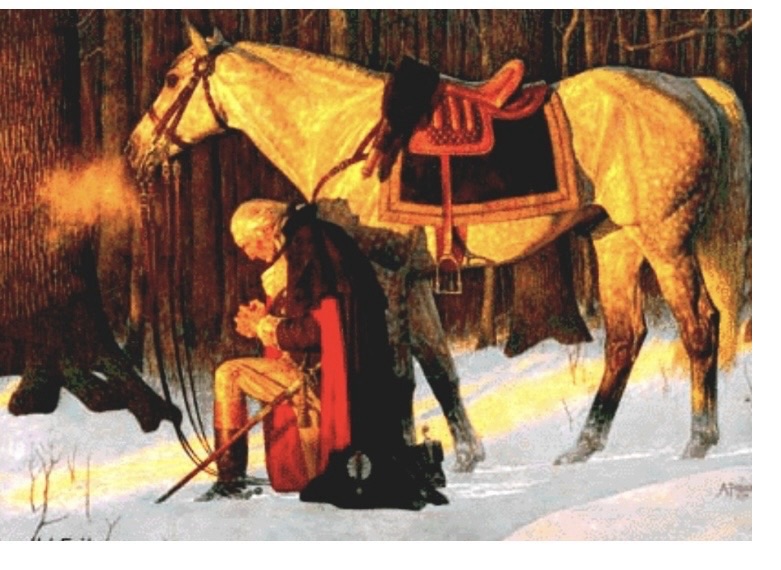
Consider the example of our first American President, George Washington.
In the winter of 1777, he and his army were encamped at Valley Forge, PA. It was bitterly cold, with snow on the ground. Valley Forge is now a beautiful park outside Philadelphia. The cold is a damp rather than a dry cold, as in Colorado or Utah. It seeps right through whatever you have on. Washington’s troops were in a world of hurt back then. Their supply lines had diminished to almost nothing so even food was scarce. Some of our troops lacked shoes—can you imagine living barefoot in the snow? Many others were sick or wounded. Morale was bad and some talked of mutiny. We were out manned and outgunned by the British army, one of the best in the world in those days. The outlook was grim.
One day, a Quaker man, Isaac Potts, was out walking in the woods, when he sighted General George Washington some yards away. He reported later that he saw the General on his knees in the snow. Washington’s head was bowed; his hands were folded; and his hat and sword rested nearby on the ground. Potts recognized Washington was praying and later wrote. “If there is anyone on this earth whom the Lord would listen to, it is George Washington. And I feel a presentiment that under such a commander there can be no doubt of our eventually establishing independence.”
Valley Forge was the turning point in our revolutionary war. Supply lines were reestablished, morale improved, and our ragtag army went on to win. It has been said, “Prayer didn’t change the weather. It didn’t instantly solve every hardship. But it changed a man. And that man changed a nation. When Washington prayed in the snow, something moved in Heaven—and the course of history began to shift.”
(Darrell Stetler, II, www.newstartdiscipleship.com. 5/15/2025.)
D. Finally, Peter reminds us (1 Peter 4:12-14; 5:6-11) of two important prayer needs: As J. Vernon McGee summarizes Peter, in chapter four, he writes-→”The word of God makes it very clear that suffering is a part of the Christian life. Suffering is what develops you.” There are no shortcuts to living the Christian life, no easy ways. We are to suffer for Jesus and with Jesus. So there is meaning to our suffering. Our Lord is with us through it and uses it to transform us by smoothing off our crusty edges.
(Mcgee, Through the Bible Commentary on 1st Peter, Thomas Nelson, 1991, pp.91-92.)
Peter assures us in verse 6-→So humble yourselves under the mighty power of God and at the right time He will lift you up in honor. This is a Scriptural promise-→If we humbly undergo times of trials and testings, keeping rather than abandoning our faith, God will raise us up after we have endured the test.
Peter also wants us to be aware that Satan is after us…again, Peter speaks from experience. He refers to the evil one as a roaring lion looking for someone to devour (5:8). So, we need to pray for strength and resilience to withstand trials, as well as to recognize when the evil one and his minions are after us.
Some dear person gave me a devotional at Christmas, and I don’t know who it was but I have truly enjoyed the gift. It’s called The One Year Book of Hymns, published by Tyndale in 2024. The hymn for Friday, May 18th (p.135) is entitled, “Prayer is the Soul’s Sincere Desire.” It was written by a fellow named James Montgomery (1771-1854). Consider these lyrics in the light of our Scripture passages today:
Prayer is the soul’s sincere desire,
Unuttered or expressed.
The motion of a hidden fire
That trembles in the breast.
Prayer is the burden of a sigh,
The falling of a tear,
The upward glancing of an eye,
When none but God is near.
Prayer is the simplest form of speech
That infant lips can try;
Prayer the sublimest strains that reach
The Majesty on High.
Prayer is the contrite sinner’s voice,
Returning from his ways,
While angels in their songs rejoice
And cry, “Behold, he prays!”
Prayer is the Christian’s vital breath,
The Christian’s native air,
His watchword at the gates of death,
He enters heaven with prayer.
Oh Thou, by whom we come to God,
The Life, the Truth, the Way;
The path of prayer Thyself hast trod;
Lord, teach us how to pray!
Our God is only a prayer away. Whether it’s an arrow prayer, or something lengthier, we can trust that prayer changes things. Jesus modeled consistent, daily prayer and taught us a way to go about it. This week, let’s practice turning all of our joys and concerns over to the Lord in prayer. AMEN!
©️2026 Rev. Dr. Sherry Adams

