Advent Joy

Pastor Sherry’s message for December 14, 2025

Scriptures: Isa 35:1-10; Lk 1:46-55; Ja 5:7-10; Matt 11:2-11

You may have heard this illustration before. Josh McDowell used it in his book, More than a Carpenter, Tyndale House, 1977, p.108:

In his book, Science Speaks, Peter Stoner applies the modern science of probability to just eight prophecies regarding Christ [from 60 major Old Testament prophesies of Jesus]. He says, “The chance that any man might have …fulfilled all eight prophecies is one in 10 to the 17th. That would be 1 in 100,000,000,000,000,000.” (one hundred quadrillion) Stoner suggests that “we take 10 to the 17th silver dollars and lay them on the face of Texas. They will cover all of the state 2 feet deep. Now mark one of these silver dollars and stir the whole mass thoroughly… Blindfold a man and tell him he can travel as far as he wishes, but he must pick up [that one marked silver dollar.] What chance would he have of getting the right one?” Stoner concludes, “Just the same chance that the prophets would have had of writing those eight prophecies and having them all come true in any one man…providing they wrote them in their own wisdom.”

(Peter Stoner and Robert Newman, Science Speaks, Moody Press, 1976, pp.106-112.)

This account gives us some idea of the incredible veracity, the compelling truth of the Biblical claim that Jesus Christ is God’s Messiah. Not only do Stoner’s (and Newman’s) math computations demonstrate that only one person in all of history could have fulfilled just 6 of the 60 major Old Testament prophesies of the Messiah, but that Jesus–and only Jesus–was the one person who satisfied these prophesies (He also satisfied the other 52 major and 270 minor ones).

Today is the 3rd Sunday of Advent and we just lit the candle representing Joy (and prophesy) in our Advent Wreath. Doesn’t it bring you great joy to realize we worship the One, True King, Jesus Christ our Lord? I read this years ago and it solidified in my mind what I already knew in my heart and in my spirit—Jesus is the One and Only, long awaited Messiah. Our Scripture lessons today all testify to His identity and to His saving actions on our behalf:

A. Let’s begin with Luke 1:46-55, known as Mary’s Magnificat, a psalm of praise to God from the newly pregnant Mother of Jesus. Mary realizes a great honor is being bestowed upon her to become what the ancient Greek Christians would later call the theotokis or God-bearer.  In those days, to be chosen to bear the Messiah was every Jewish girl’s dream. Even though having a child out of wedlock could prove dangerous (she could have been stoned) and embarrassing for her before her family and her small community, Mary believes the Angel Gabriel’s announcement and rejoices in God’s choice of her. She then composes a song in which she primarily praises God. How humble and obedient she was! We could expect the whole psalm to say, “YIPPEE, God picked ME! Hooray, I was His choice!” But instead she proclaims (vv.47-49, NLT)—Oh how my soul praises the Lord, how my spirit rejoices in God my Savior! For He took notice of His lowly servant girl, and from now on all generations shall call me blessed. For the Mighty One is holy and He has done great things for me. She recognizes that God has truly honored her, and she modestly admits her delight.

But then she proceeds to glorify God for what He is doing through her for His people. She shifts the focus from herself, and sets it upon God’s actions. She proceeds to praise Him for… (1) His mercy to those who respect and revere Him; (2) His past works of power; (3) His surprising, unexpected propensity to reverse worldly fortunes: The lowly are raised up, while the lofty and self-reliant are brought low; and 4) His fulfillment of His promises to Israel: A king from the lineage of David, and a Messiah who will bless all nations on earth. Can’t you just hear her joy as she delights in the plans of God the Father and in the future redeeming work of her soon-to-be-born son?!

B. Just prior to our Gospel lesson today, Matthew 11:2-11, Jesus has sent the 12 out to put into practice all He has taught them.

Meanwhile, He does not sit idle, but continues to preach and teach. John the Baptist (JtB), has been imprisoned for some time now, and—as often happens—he begins to doubt his earlier faith that his cousin Jesus is the Messiah. Remember, he was the forerunner, the prophet to announce Jesus’ arrival. But, rotting away in a dungeon, he begins to doubt his previous certainty. He deploys two of his disciples to ask Jesus (v.3) Are You the One who was to come, or should we expect someone else? 

No doubt JtB expected Jesus to set him free. After all, Jesus’ job description from Isaiah 61:1 promised that Jesus would—…proclaim that captives [would] be released and prisoners [would] be freed. John was probably expecting his immediate emancipation. He may have also been frustrated that it was taking Jesus so long to usher in His Kingdom on earth.

But instead of sending word of eminent release, Jesus reiterates from Isaiah 61:1 that the blind see, the lame walk, lepers are healed, the deaf hear, the dead are raised to life, and the Good News is preached to the poor.

Because He does not reiterate that He will also (NIV)—proclaim freedom for the captives and release from darkness for the prisoners, JtB learns Jesus will not be initiating a jail break. Yes, John, your cousin is the Messiah you proclaimed at the beginning of His earthly ministry; but no, He will not be commuting your sentence. 

Jesus does not meet JtB’s personal hopes. Apparently, it suited God’s purposes for JtB to leave the scene (decrease) so that Jesus’ ministry could increase. If you have watched the various scenes from “The Chosen,” you may have encountered the one that focuses on JtB’s execution. It what seemed to me to be so poignant, the writers have John look out a window, as the executioner’s ax is lifted above his head, and see a lamb grazing. It is as though the Lord wanted to remind him in his last moments that he had done a good job of telling others He was and is the Lamb of God. Jesus does proclaim to those He was teaching that JtB was the greatest of the Old Testament prophets. Hopefully, John understood this need to exit the world stage and had prepared himself to meet his Maker.

C. In fact, JtB probably knew Isaiah 35:1-10, a Messianic prophesy from 700 years before Jesus’ birth. He would have remembered that in the predicted Messianic or Mellenial Age (the 1000 year reign of Christ) that the material earth will be restored to the time before the Fall. As a consequence of Adam and Eve’s sin, God had cursed the ground and the serpent—not the humans. True, life would be harder than it had been for them in the Garden, but only the physical earth and Satan were actually cursed. Paul will later assert (Romans 8:22)—We know that the whole creation has been groaning as in the pains of childbirth right up to the present time. Paul had learned from Jesus that creation, too, would be redeemed at Jesus’ 2nd Coming.

Additionally, JtB would recall that the bodies of human beings will be renewed. Verses 5-6 promise that—…the eyes of the blind will be opened and the ears of the deaf unstopped. Then will the lame leap like a deer, and the mute tongue shout for joy. Water will gush forth in the wilderness and streams in the desert. Think of the vast swath of desert land in our southwest, or the enormous Sahara in North Africa. These lands will be renewed and covered with vegetation and flowers.

Though Jesus accomplished the healing of many individuals in His 1st Advent—we really have no idea of how very many He healed–when He comes again, all of humankind will be spiritually, physically, and emotionally restored. How can we learn this and not experience a welling up within our hearts and spirits of great joy?!!

D. No wonder we have the James 5:7-10 passage. The 2nd coming of Jesus Christ will right all that is now wrong with our world. However, as James counsels us, we need to (v.7)—Be patient, then, brothers [and sisters] until the Lord’s coming. Scripture has told us what to expect.

We just need to wait with faith, as a farmer waits for his/her crops to grow.

We should get ourselves ready to receive our King. James counsels us not to let Him catch us gossiping about or negatively judging others. And we can and should meditate on the lives of the prophets, including JtB, as we wait. They all prophesied the wonders to come In Jesus, but did not get to see them manifest in their own lives.

An anonymous author once wrote: 

If our greatest need had been information, God would have sent us an educator; If our greatest need had been technology, God would have sent us a scientist; If our greatest need had been money, God would have sent us an economist; If our greatest need had been pleasure, God would have sent us an entertainer; But our greatest need was forgiveness, so God sent us a Savior.

(Quoted in www.sermoncentral.com, 12/10/2025)

Thank God the Father sent us a Savior! We all needed saving from the penalty of death for our sins and from our carnal tendencies to seek out and indulge in sin. We all needed a divine rescue! We needed the gift of Jesus! 

The song in our hearts today could very well be Beethoven’s Ode to Joy (Music by Beethoven; lyrics by Henrr Van Dyke):

Joyful, joyful, we adore Thee, God of glory, Lord of Love;

Hearts unfold like flowers before Thee, praising Thee, the Sun above.

Melt the clouds of sin and sadness; drive the dark of doubt away;

Giver of immortal gladness, fill us with the light of day.

All Thy works with joy surround thee, earth & heaven reflect Thyrays;

Stars and angels sing around Thee, center of unbroken praise,

Field and forest, vale and mountain, blooming meadow, flashing sea,

Chanting bird and flowing fountain, call us to rejoice in Thee.

Thou art giving and forgiving, ever blessings, ever blest,

Wellspring of the joy of living, ocean depth of happy rest;

Thou our Father, Christ our Brother; all who live in love= thine;

Teach us how to love each other, lift us to the joy divine.

Lord, please fill our hearts with Joy during this Advent Season. Amen and Amen!

©️2025 Rev. Dr. Sherry Adams 

Ready or Not …

Pastor Sherry’s message for November 30, 2025

Scriptures: Isa 2:1-5; Ps 122; Ro 13:11-14; Matt 24:36-44

I thank God I am a little older than I was years ago!: I’ve learned to slow down and not expect as much of myself or of others as I did when I was younger.: About this time of year, I would “get my panic on,” thinking of all the things I “had to do” to get ready for Christmas:

(1) It began with filling a Shoe-box or two, or 10, for Operation Christmas Child.

(2) Then there was the Thanksgiving feast to prepare and hold.

(3) Next I felt compelled to decorate my house, inside and out for Christmas.

(4) And don’t forget my need to survey the Black Friday sales for potential gifts for family and friends.: Be sure to locate and purchase them, then wrap them.

(5) I couldn’t neglect Christmas cards, especially for friends and family who live far away—you know, the ones you only communicate with once a year.

(6) Then I felt compelled to fit in a visit to Christmas on the Square and the Christmas parade here in Live Oak.

(7) I would attempt to find out what gifts my kids and grandchildren particularly wanted.

(8) Daily, I would hum Christmas carols wherever I went and even in the shower. 

(9) I would try to participate in decorating the Church—thanks to all of you who came out to help yesterday.: Isn’t it beautiful?

(10) And finally, I would also try to get my mind into the right head space, remembering that “Jesus is the reason for the season!”

Were you ever this obsessed? I hope not!: I would work for weeks like my hair was on fire!: If you were like me—as a younger person—you reached Christmas afternoon exhausted and on your last nerve.

Fortunately, now that we have more age and experience, we realize it’s not about doing all these things—and doing them perfectly or with panache—but it’s about being.: We can eliminate a lot of the hustle and hassle we used to enforce upon ourselves in this season, and focus on having the right heart attitude as we await the Advent arrival of King Jesus.  

We lit the candle of Hope on this first Sunday of Advent, 2025, because our hope is in our Lord.: Consider this anonymous poem:

Philosophy says:: Think your way out.”

Indulgence says:: “Drink [or eat] your way out.”

Politics [government] says: “Spend your way out.”

Science says:: “Invent your way out.”

Industry says:: “Work your way out.”

Communism says: “Strike your way out.”

Fascism says:: “Bluff [bully] your way out.”

Militarism says:: “Fight your way out.”

The Bible says: “Pray your way out, but…

Jesus Christ says:: “I am the way [out]….”

(J. Vernon McGee, Through the Bible Commentary on Isaiah, Thomas Nelson, 1991, p.29.)

Our hope is in Jesus…Who He revealed Himself to be in His First Coming; and Who Scripture predicts Him to be in His Second.

Oddly enough on this first Sunday of Advent, our Scripture lessons today all focus on Jesus’ Second Coming:

A. Jesus Himself warns us to be ready for this great event in our Gospel, Matthew 24:36-44.: He says no one—not even He Himself—knows the hour or the day the Father has determined for His return to earth.

It could come as suddenly as the flood in Noah’s day.: People then were blithely unconcerned, oblivious about what was to happen.: They were just going about their lives as if God did not exist.: They were not ready when the flood waters came and swept them away.: I believe Jesus was thinking about the Rapture when He remarked that suddenly one person will disappear while another will be left behind.: Similarly, if burglars break into your home while you are away, you are shocked, stunned, and regret not having been better prepared.: I taught school years ago with a friend in Rhode Island who lived in Providence, on a corner, in a very nice neighborhood near Brown University.: Her family owned a summer home in Kennebunkport, Maine, that she and her husband would visit frequently.: Three times while they were out of town their house was robbed.: It seems that burglars then believed houses on corners belonged to wealthier persons (as they are taxed more), so that they expected the loot they would pilfer would be of a higher quality.: She bemoaned the fact that the thieves never took her grandmother’s china, an expensive but unattractive pattern, but stole much of her other valuable stuff.: Three robberies undermined her sense of safety and security in her home and she and her husband ended up moving.: The point Jesus is making, though, is that no one knows the hour or the day of His return, so we need to get ready and live ready.

B. Paul picks up the same theme in Romans 13:11-14.: He sees our need to be ready as crucial (v.11, NLT): This is all the more urgent, for you know how late it is:: time is running out.: Wake up, for our salvation is nearer now than when we first believed.: He urges us to get ready and stay ready to meet our Lord in person.: He writes, (v.12): So remove your dark deeds like dirty clothes, and put on the shining armor of right living.: He wants us to behave ourselves, to not give into our carnal natures (v.13): Don’t participate in the darkness of wild parties and drunkenness, or in: sexual promiscuity and immoral living, or in quarreling and jealousy.: He insists we can best be ready for Jesus’ 2nd coming by clothing ourselves with Christ—i.e., act like Jesus.

C. The prophet Isaiah (2:1-5) shares a vision he had of Jesus in His Millennial reign.: King Jesus will reign from Jerusalem, from the old Temple Mount (Mt. Zion), after He has defeated the forces of evil at the Battle of Armageddon.: The word mountain in the Hebrew means a kingdom, an authority, or a rule.: Jesus’ kingdom, authority, or rule will be based in Jerusalem.: It is from there that He will reign over all the earth.

Jerusalem will then have become the most significant place on earth. People from all over the world will journey there to worship the Lord and to learn from Him. They will recognize and acknowledge His transformational and sovereign power.: Additionally, King Jesus will mediate any and all disputes.Weapons of war will be melted down to become farming implements. There will be no more war between nations.

At that time, we will all walk in the Lord’s light. In other words, our God is the only light that overcomes the darkness of sin and evil. We are currently living in what is known as “The Church Age,” beginning at Pentecost and extending until the Rapture.: At the end of the seven years of the Great Tribulation, Jesus will return to earth to establish His earthly rule, and the Church Age will be replaced by “The Kingdom Age.”: We want to be ready to be inhabitants of that new reality.

 (J. Vernon McGee, Through the Bible Commentary on Matthew, Thomas Nelson, 1991, p.149.)

D.: Psalm 122 was written by King David and in it he prophesies about Christ’s Millennial Reign in Jerusalem.: Pilgrims traveling to the city for any one of the three great feasts would have sung this psalm after David composed it.: Verses 3-5 form an ode or a majestic poem in praise of the city.: And in verses 6-9, David urges us all to pray for Jerusalem.

The prophet Hosea latter penned these words (Hosea 3:5): …Israel will go a long time without a king or prince, and without sacrifices, sacred pillars, priests, or even idols!: But afterward the people will return and devote themselves to the Lord their God and to David’s descendant, their King.: In the last days, they will tremble in awe of the Lord and of His goodness.: The first part of this prophesy has come true—no king, prince, or Temple worship being practiced currently in Jerusalem.: The second part—the Jews will return to the city and worship the Messiah—awaits Jesus’ Second Coming.

Our Scripture passages all warn us that Jesus is coming again and we need to be prepared.: The Advent season reminds us to ready ourselves.: Consider this reworking of the Night Before Christmas story:

“Twas the night before Jesus came and all through the house

Not a creature was praying, not one in the house.

Their Bibles were lain on the shelf without care

In hopes that Jesus would not come in there.

The children were dressing to crawl into bed,

Not once ever kneeling or bowing a head, 

And Mom in her rocker with baby on her lap

Was watching the Late Show while I took a nap.

When out of the East there arose such a clatter, 

I sprang to my feet to see what was the matter.

Away to the window I flew like a flash

Tore open the shutters and threw up the sash!

And what to my wondering eyes should appear

But angels proclaiming that Jesus was here.

With a light like the sun sending forth a bright ray

I knew in a moment that this must be THE DAY!

The light of His face made me cover my head.

It was Jesus!: Returning just like He had said.

And though I possessed worldly wisdom and wealth,

I cried when I saw Him in spirt of myself.

In the Book of Life which He held in His hand

Was written the name of every saved [woman and] man.

He spoke not a word as He searched for my name;

When He said, “It’s not here,” my head hung in shame.

The people whose names had been written with love

He gathered to take to His Father above.

With those who were ready He rose without sound

While all of the rest were left standing around.

I fell to my knees, but it was too late;

I had waited too long and thus sealed my fate.

I stood and I cried as they rose out of sight.

Oh, if only I had been ready tonight.

In the words of this poem the meaning is clear:

The coming of Jesus is soon drawing near.

There’s only one life and when comes the last call—

We’ll find that the Bible was true after all.

(Chuck Swindoll, The tale of the Tardy Oxcart, Word Publishing, 1998, pp.86-87.)

Ready or not, here He comes!

©️2025 Rev. Dr. Sherry Adams 

Lost, but Found

Pastor Sherry’s message for September 14, 2025

Scriptures: Jer 4:4-12, 19-28; Ps 14; 1 Tim 1:12-17; Lk 15:1-10

Perhaps you have been more discerning than I have as you have read the 15th chapter of Luke. In studying our Scripture passages this week, I realized I had never quite put it together that the 3 parables Jesus provides the Pharisees about “lost things” are each a response to their grumbling criticisms. They notice that He hangs out with and even eats with notorious sinners.  They are critical of Jesus because He does not behave as they do–He does not always go along with the status quo, the expected way they think people, especially rabbis, should behave. He dares to do something different, something unexpected.  Rather than consider that they might be wrong in their attitudes and behavior, they find offense and reject Jesus. Nevertheless, He shares 3 stories (parables) that perfectly demonstrate God’s attitude toward “the lost.”

The Pharisees could easily grasp the need to locate a lost sheep.  A sheep represented money on 4 hooves. Any economically shrewd shepherd would go search for this absent asset–perhaps not because they valued the particular sheep per se, but because they valued the asset it represented. They could also understand the imperative to search for a missing coin of significant value. What was lost to them, however, was the Lord’s priority to locate and bring into His Kingdom people who had wandered far from God—people whom He knew needed Him.

Jesus wanted them…”to make the leap from sheep and coin to tax collector and sinner.”  (borrowed from www.Sermons.com, 9/9/2025.)

Our Lord knew that our values drive our behaviors. He knew that the Pharisees, God’s spiritual shepherds, did not value lost people.  He knew that God the Father did, as did He.  He taught these parables, hoping the religious leadership of His day would get it. Our God is a God of grace, love, and mercy. But they stubbornly held to their notion that He is a rather heartless God of rules.

At one time or another, we have all been lost. Aren’t we grateful we have a God who searches for and saves the lost? Consider this true story:

“Nine hundred miles out to sea, on an ocean liner headed to the Middle East, a sail was sighted on the horizon. As the liner drew closer, the passengers saw that the boat—a small sloop flying a Turkish flag—had run up a distress signal and other flags asking for its position at sea. Through a faulty chronometer or immature navigation the small vessel had become lost. For nearly an hour the liner circled the little boat, giving its crew correct latitude and longitude.  Naturally there was a great deal of interest in all the proceedings among the passengers of the liner.  A 12 year-old-boy remarked aloud to himself—‘It’s a big ocean to be lost in.’

“It’s a big universe to be lost in, too.  And we do get lost—we get mixed up and turned around. We despair, we make mistakes, we do evil to each other [e.g., the man who killed the Ukrainian refugee woman on the train in Charlotte, NC, and the assassin of Charlie Kirk].  We deserve the wrath of God and that is what the Pharisees who criticized Jesus maintained.  But Jesus understood God more.  He knew God as a Shepherd in search of the one lost sheep.  He knew God as if He were] a woman searching in the dark, in the crevasses, for that valuable coin.  In the end it was Jesus’ view of God which prevailed and not his critics. 

(Brett Blair, Christian Globe Network, as presented by www.Sermons.com, 9/9/25.)

Thank God our Lord is concerned about the very least of us—those without wealth, influence, popularity, and looks. Thank God our Lord loves us despite our sin and how often we disappoint Him.Thank God our Lord seeks to find and save the lost.

Hear the cry of God’s heart for the lost:

A.  In our Old Testament lesson (Jeremiah 4:4-12, 19-28), beginning back in verse 1, the lord makes it clear that He wants the people of Jerusalem and Judea to give up their idol worship and return to Him.  As J.Vernon McGee states, “He is vitally interested in them and He wants to bring them back into right relationship with Him.”  (Mc.Gee, Through the Bible commentary on Jeremiah, Thomas Nelson, 1991, p.42).  God wants them to (v.4)  surrender your pride and your power.  The situation is dire:  Unless they obey God, He is going to unleash a lion of destruction upon them (The Babylonian Empire).

While Jeremiah weeps as he gives his countrymen this dreadful prophesy, God says in verse 22 (NLT)  My people are foolish and do not know Me…they are stupid children who have no understanding.  What would He say about us in America today?  Don’t you think His message would be similar?  We tend to believe we can proceed as a country indefinitely into the future.  But our founders at Plymouth Rock in Massachusetts made a covenant agreement with the Lord.  We would be a city built on a hill, a light to the nations.  They dedicated our country to God.  We have over the past 250 years broken this covenant.  The choice facing the folks in Jerusalem during the 580’s is the same one we face today:  Pray, repent, fast, turn back to God, or face the destruction, the ruins, the barrenness Jeremiah predicted in verses 23-28.  There is a cost to stubbornly, willfully remaining lost.

     B.  In Psalm 14, King David is also prophesying, but about the depravity of humans in the last days.  He agrees with God’s assessment, as I just reviewed and as was stated later in Jeremiah 4:22, asserting  Only fools say in their hearts, there is no God.  They are corrupt, and their actions are evil.  None of them does good.  David predicts that in those days many will turn against God.  Without God, neither their intellects nor their academic credentials (nor their money or their influence) will save them.  David predicts people will turn against God and against each other.

However, due to God’s mercy and His pursuit of the Lost, in verse 7, David concludes that salvation will come out of Zion’s hills  Jesus will arrive, riding on the clouds.  (Look up on YouTubeMusic the contemporary Christian song, “These are the days of Elijah.”  Listen and see how the writer incorporated verse 7 into the chorus.)  Even when things appear the darkest ever, our God has a plan for our redemption.  Jesus, in His 2nd Coming, will once again rescue those who have survived the Great Tribulation, believing in Him.

    C.  Finally, we see in Paul’s 1st letter to Timothy (1 Timothy1:12-17)– who he brought to faith and mentored—that Paul is exceedingly thankful for God’s grace-filled pursuit of his lost self.  He admits that he was saved by grace; he knows that Jesus Christ Himself put him into the ministry.  This was nothing he had earned or merited.  He had been an enemy of the infant Christian Church.  In verse 14, Paul praises the Lord for filling him with faith in and love for Jesus.  And then, in verse 15 (NLT), he asserts so beautifully and so famously—This is a trustworthy saying, and everyone should accept it.  “Christ Jesus came into the world to save sinners”—and I am the worst of them all.”  How honest he is with Timothy and with us!  How many of us would be willing to admit—especially to someone who looks up to us–that we are terrible sinners?

Paul realizes that he was lost, and then found and redeemed by Jesus.  He admits he was a sinner who repented, and that the Lord has used him in ministry as both a preacher of the Gospel and an example of the Gospel in action.  (J. Vernon McGee, Through the Bible Commentary on First Timothy, Thomas Nelson, 1991, p.32.).

Essentially, what Paul is saying to encourage Timothy is that he was lost and now found, and so can anyone be who believes in Jesus!  He admits he was a sinner who repented, and that the Lord has used him in ministry as botha preacher of the Gospel and as an example of the Gospel in action (J. Vernon McGee, Through the Bible Commentary on 1st Timothy, Thomas nelson, 1001, p.32.).

Our Lord Jesus came to seek and save the lost.  That’s us…each one of us in the words of the hymn “Amazing Grace,” I once was lost but now am found.”  This is why we need to be mindful of the God-ordained opportunities that present themselves to us to tell others about Jesus, and to pray for their faith and their situations.  Thank you, Jesus, that You seek us until You find us. We are all so grateful!  We praise You, we bless You, and we adore You. Amen!

©️2025 Rev. Dr. Sherry Adams 

Worthy is the Lamb

Pastor Sherry’s message for May 4, 2025

Scriptures: Acts 9:1-20; Ps 30; Rev. 5:1-14; Jn 21:1-12

Some years back, I read a book—can’t remember the title—but it was an autobiographical account of an Army doctor in WWI, who died and was taken up into heaven. You may renenber, from our Covid experience, that there was a huge, worldwide influenza epidemic from 1918-1920.  Mostly young people were susceptible, especially those gathered together in army camps, bases, or foxholes. This doctor, whose name I’ve sadly forgotten, was working in an Army hospital at a base in Texas. He was struck down by the disease and appeared to have died. Someone even covered his head with a blanket, the sign to everyone that another soldier had perished. It took several hours before anyone came to remove his body.

But in the meantime, he found himself flying back over his home (planeless) in Virginia, where he saw his mother hanging out clothes to dry, and his father walking over to talk with her. He noted that his parents were safe and well. Then he found himself whisked up into heaven. He reported beautiful, vivid colors, lots of flowers and wonderful smells. Everyone he saw there was happy and healthy. He felt enveloped in love. He even encountered Jesus! He was filled with joy and wanted to stay; but, in short order, Jesus told him his work on earth was not done, so he was going to be sent back. The doctor came back to life just as they were preparing to remove his body for burial. He went on to get well, only to fall into a profound depression that lasted 3 years!  He wrote that he missed heaven so much that he found life as we know it to be profoundly disappointing by comparison. Eventually, he rallied, found meaning and purpose in being a doctor, and went on with his life.

I previously preached here about Jesus’ fish-fry on the beach, and Paul’s dramatic conversion, but today I want to focus our attention on our reading from Revelation.

Revelation chapters 4 and 5 offer us the best report of what Heaven is like in all of Scripture. In Chapter #4, the 90-92 years old Apostle John finds himself “taken up” into the Heavenly throne room. He has a vision of Jesus and receives the Lord’s words for the 7 churches in Asia Minor, but is then directed by Jesus to come up into heaven.

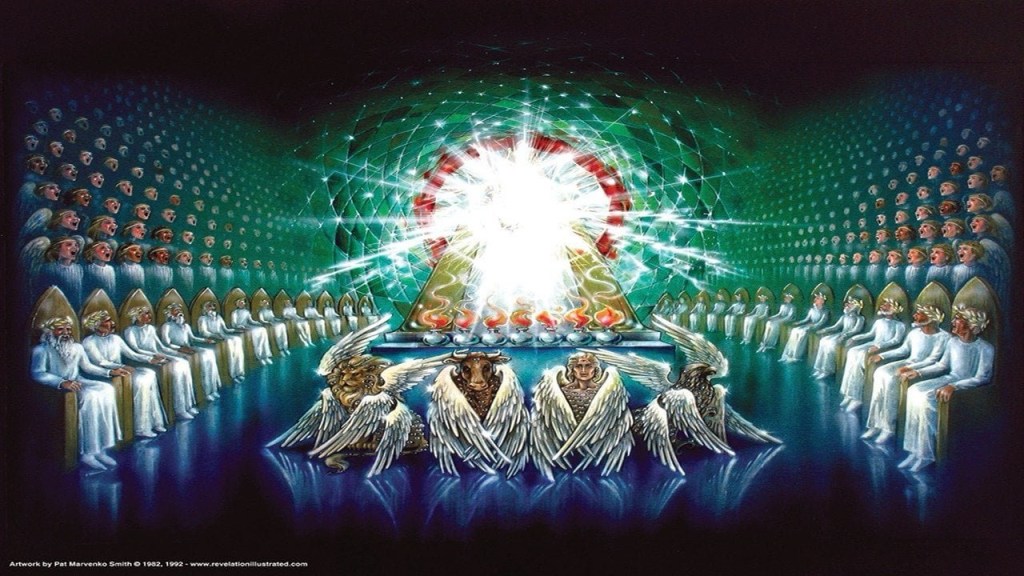
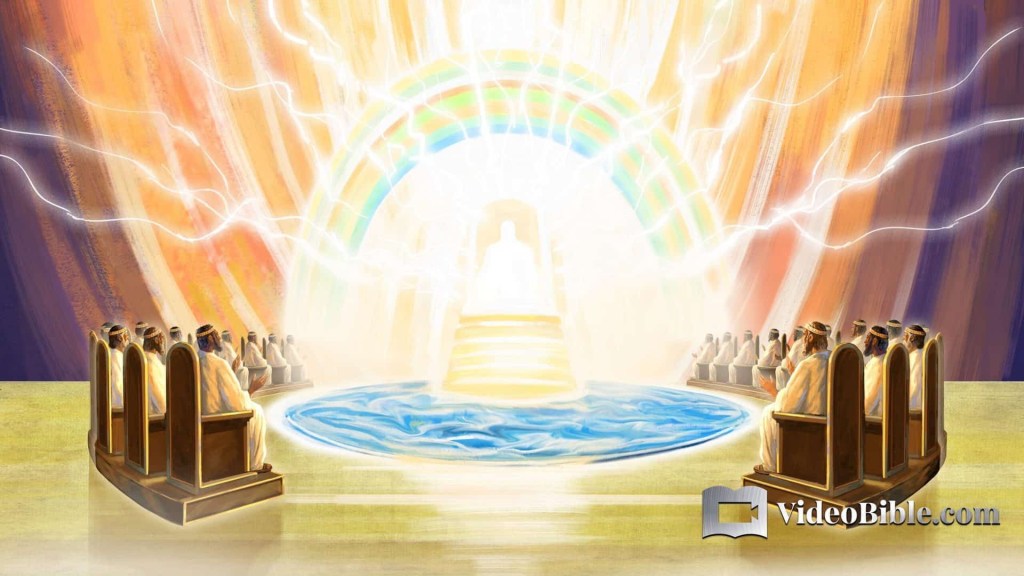
He sees things there that are almost too difficult to for him to put into words. He sees God the Father, seated on His throne, at the very center of a huge gathering. God dwells in dazzling light so overwhelming that John cannot clearly see His face. He tries to describe that light by using the image of light reflected by sunlight on jewels.  Scholars believe the jewel tones he saw were red, white, bright green, and perhaps purple.  Additionally he observes that God is surrounded on His throne by an emerald-hued rainbow. The rainbow is likely reminiscent of the days of Noah.  It seems to indicate the eternality of God’s promises—that is, that God does not break His promises to us, even if we disappoint Him.

Around God’s throne are 24 smaller thrones.  There is considerable conjecture about who the 24 elders are who are seated on the lessor thrones.  Most experts today think they represent “the true Church” or the “Redeemed:” including the 12 patriarchs or leaders of the Old Testament tribes of Israel; and the 12 Apostles from the New Testament.  They are dressed in white, the color of purity and righteousness, and what seems to be the uniform of heaven. They all wear a gold crown on their head, indicating they are a royal priesthood.  

John hears thunder and sees lightening shoot out from God’s throne. In Old Testament times, these signaled God’s presence and often His judgment. John perceives that the One seated on the throne is about to release His judgment on the inhabitants of the earth. Additionally, He notes (1) 7 torches around the throne, symbolic of the full presence of the Holy Spirit.

(2) Then he describes a “glass sea” under the throne, separating God the Father from everyone else there. God is totally holy. He is also, as I often say, large and in charge, so this bit of separation makes sense. 

(3) John is also amazed by God’s Honor Guard–the 4 living creatures (seraphim). They have eyes all over themselves, which looks and sounds very strange but indicates that they are omniscient or all- seeing. They fly about on 6 wings. Their bodies are those of strange, composite beings that may symbolize the apex of created life forms:

(a.) The mightiest wild animal, a lion (known to be ferocious);

(b.) The mightiest domestic animal, an ox (known for its strength);

(c.) The mightiest of all animals, humankind (known for our intelligence)

(d.) And the mightiest bird, the eagle (known for its swiftness).

Obviously these composite beings are capable of protecting God’s space and His person. Who could successfully take them on?

In Chapter #5, we find God the Father holding a scroll in His right hand, the hand of power.  John notes that it has writing on both sides. Typically in those days, people wrote on the front side of papyrus only, as the fibers on front were oriented horizontally while those on the back ran vertically. To have written on both sides indicates that the scroll is filled to overflowing with the decisions and the direction of God.  A number of Biblical scholars believe it contains both the salvation of humankind and the judgment of the wicked. A noted expert on the interpretation of Revelation, Robert Mounce, writes, “The whole story of human history rests in the hand of God.  What simpler or more sublime way of picturing God’s ultimate sovereignty over all history could be found than this picture of the scroll resting in the hand of God?  However strong evil becomes, however fierce be the satanic evils that assail God’s people on earth, history still rests in God’s hand.”

(Robert H. Mounce, The Book of Revelaton (Revised Ed.), Eerdmans, 1998, pp.82-83.)

Additionally, this scroll is sealed with 7 seals against tampering (again 7, in the Hebrew numbering system, is the number indicating completion). So, we can assume that what’s written therein is perfectly safe against tampering and that what’s written therein is very important!

John hears an angel ask (v.2) Who is worthy to break the seals on this scroll and open it?  Perhaps eager to learn God’s plans, John bursts into tears because (v.4)…no one was found worthy to open the scroll and read it. Then one of the 24 elders directs John to stop weeping. because Someone worthy has been found:  the Lion of the Tribe of Judah, the heir to David’s throne, Jesus.

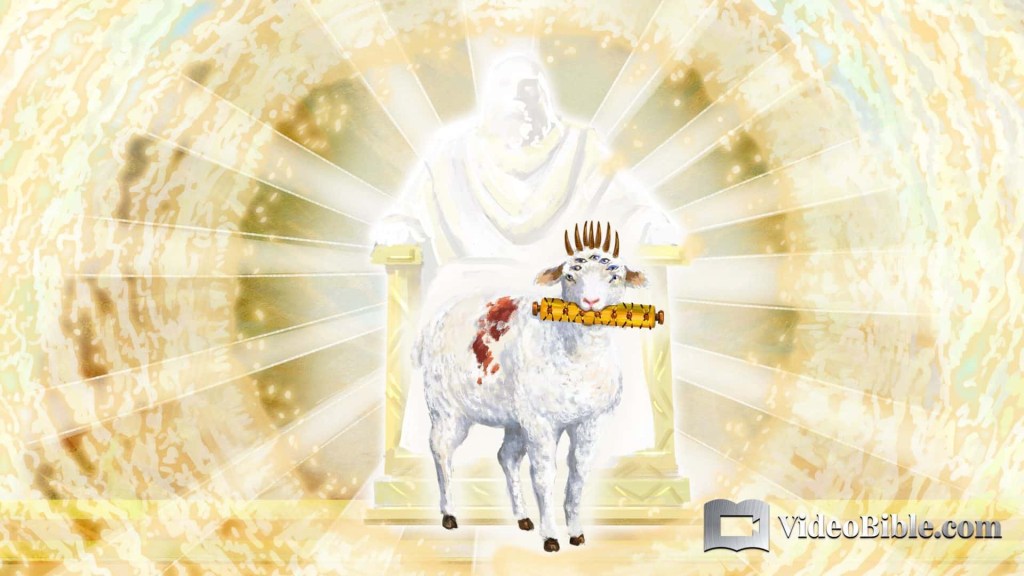
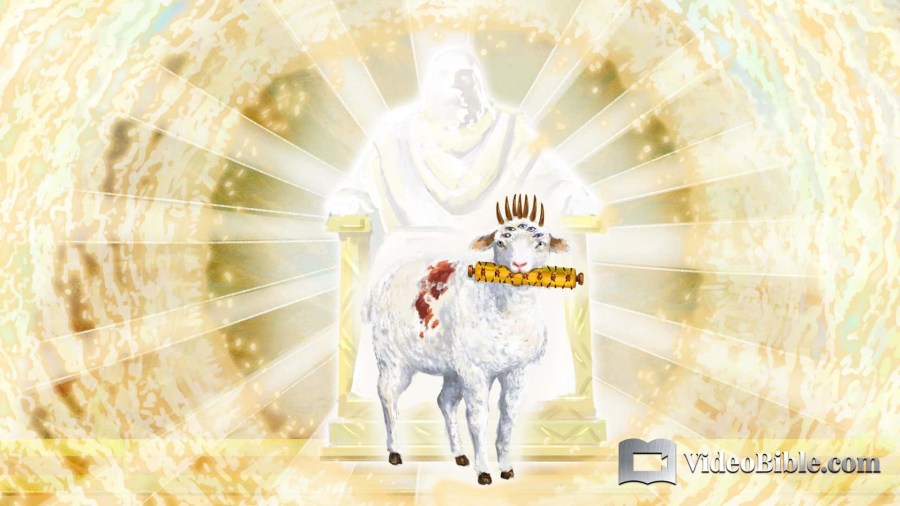
But the Jesus who comes forth is not a warrior king in all His resurrection splendor, nor a majestic lion. Rather, He is portrayed as a little lamb who had been sacrificed—alive now (resurrected) but probably evidencing a slit throat. Obviously it takes Someone totally conformed to God’s will—like Jesus—to break the seals. God Himself doesn’t do it, but He has the Mediator, Jesus, bring human history to its foreordained consummation (Mounce, Ibid, p.143).

At this point, we should pause and say, “Worthy is the Lamb!” The use of the Lamb image is both striking and unusual. When people groups want symbols of power for their country, they tend to choose apex predators: Russia has the bear; Britain, a lion; France, a tiger; and the USA, the bald eagle. But God chooses a slain lamb, a typical temple sacrifice for sin. Christ is victorious precisely because He has surrendered Himself to be sacrificed, like a Passover Lamb.  He has triumphed over sin, death, and evil by His death on the Cross.

This particular lamb, Jesus, is powerful because He is depicted with seven horns, an Old Testament symbol for complete and perfect power.

Similarly, He has 7 eyes, representing His all-seeing omniscience.

So the Lamb slain from the foundation of the world steps forward to open the scroll, and all of heaven bursts into song. The 24 elders fall down before Him, surrendering to worship, singing Jesus a new song. They play harps to accompany worship music (I don’t think we will be the ones playing harps, despite what the culture contends).  The elders also offer up golden bowls of incense, which John is told are the prayer of the saints.  Then a myriad of angels join in a powerful chorus.  Finally, John writes (v.13) Blessing and honor and glory and power belong to the one sitting on the throne and to the Lamb forever and ever. (Talk about a Halleluia Chorus!)

So what can we take away from our glimpse into God’s throne room in Heaven?  I believe the following insights are worth remembering:  

1.) True power in this world does not rest with human dictators or human governments, but rather with our God.

2.)  God controls the course of human history.

3.) Even the most exalted beings in heaven humbly acknowledge God’s superiority in every way—so should we.

4.)  As God, Jesus knows how human history will end…our history is truly His-Story.

5.) How true then is Paul’s assertion from Romans 8:31 If God is for us, who can be against us?

6.) When we each get to heaven we will join millions of believers and angels in worship of our God and our Lord Jesus.

Thanks be to God Who gives us the victory through our Lord Jesus Christ!  Alleluia!  Alleluia!

©️2025 Rev. Dr. Sherry Adams 
Palms to Passion

Pastor Sherry’s message for April 13, 2025

Scriptures: Lk 19:28-40; Ps 118:1-2, 19-29; Isa 50:4-9; Ps 31:9-16; Phil 2:5-11; Lk 22:14-23:56

Our custom here at Wellborn Methodist Church has been to focus on Jesus’ Passion—His experiences and thoughts leading up to and including His Crucifixion.   Typically, then, we have handed out palm crosses, like you have today, but without focusing on Jesus’ triumphal entry into Jerusalem on Palm Sunday. This year, I wanted us to focus on the difference between Palm Sunday and Good Friday.  This is why we began our service on the front porch today, symbolically outside Jerusalem, if you will. And we followed the path of Jesus, riding on a donkey, as He made His way from the city gate into the Temple.

Now the Sadducees of 2000 years ago believed the Messiah would enter the city 4 days before Passover. Passover would have begun at sundown on Friday and ended at sundown on Saturday, the Jewish Sabbath.Thus, they made sure the gates to the Temple remained open the first day of their week, so Messiah could walk right on in and assume His throne.

Under normal circumstances, then, there would have been a great deal of hoopla and excitement among the Passover crowds, with people asking, “Is this the year?  Will Messiah show up? “  Knowing He would be arrested early Thursday morning and hanging on His Cross by Friday, Jesus chose to enter Jerusalem on what we call Palm Sunday.  What courage!

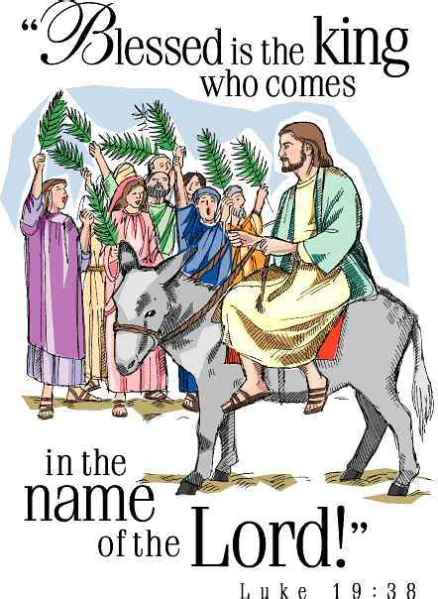
He fulfilled the prophesy of the minor prophet, Zechariah, from chapter 9, verse 9 (NLT) Rejoice, O people of Zion!  Shout in triumph, O people of Jerusalem!  Look your king is coming to you.  He is righteous and victorious, yet He is humble, riding on a donkey—riding on a donkey’s colt.  Victorious kings, Like David, would have entered the city to large, cheering crowds.  The people would have waved palms and placed their garments on the road for the King to tread upon.  At the end of 4th season of “The Chosen,” in episode 8 (you may call it up on YouTube), the writers re-enact one such victorious return, singing of King David, “Hosannah, Our King is Victorious!”

King David would have ridden in on his war-horse, but King Jesus rides in on a humbler animal, a donkey.  Luke wants us to be sure to know that this animal was borrowed from someone who knew of and loved Jesus, and it had never been ridden before.  Many in Jerusalem assumed Jesus was the Messiah and thronged around Him, praising Him and singing many of the lines read today from Psalm 118:25-29. Hosannah (Yesha anna in Hebrew) means save us now.  The crowds are asking Jesus to save them.

Do you think they knew that He was God in the flesh? They are cheering Him on. They are rejoicing in His presence. They are filled with hope that He is their Messiah.

The Passion readings appointed for today lead us from this celebratory procession to Jesus’ arrest, trials, death, and burial: 

A. Paul reminds us in Philippians 2:5-11 that Jesus humiliated or humbled Himself to come to earth to save us.  The Palm Sunday crowds expected Him to save them and that is exactly what He intended to do.  Paul wants us to be as humble and as obedient to the Father as Jesus was. Jesus obeyed His Father in everything, even up to and including His manner of death. Though totally righteous and holy, He died as though He were a rightfully tortured and despised criminal.

Paul also desires that we appreciate the depths of Jesus’ sacrifice on our behalf:  He gave up His heavenly prerogatives as King of the Universe–the One who spoke creation into existence–to be born in a stable, to a poor, young, homeless couple, in a ragtag and oppressed, tiny nation. Instead of demanding respect and a wide following as a great and exalted leader, He humbly behaved as a servant to all. No wonder the Father has honored Him above all things, declaring that His name commands total obedience, from every being, in every sphere of the universe!  Incidentally, this includes non-believers who will be shocked to arrive at the Great White Throne Judgment, only to discover they made the wrong choice to dismiss Him during their lifetimel

B.  Isaiah prophesies in 50:4-9 how Jesus, the Suffering Servant of God, will be treated during His Passion experience.  Verse 4 tells us He was tutored by Holy Scripture and also by His heavenly Father.  Verse 5 insists that He was always obedient to the Father’s will.  Verse 6 peaking for Jesus in the first person—I offered My back to those who beat Me, My cheeks to those who pulled out My beard.  I did not hide My face from mocking and spitting. This verse tells us He would endure beatings:  He was beaten by the Jewish Temple guards during the night;

Then He was beaten again by the Roman soldiers early in the morning. He would be spit upon, in His face (such a sign of contempt and hatred), and on His bloody body (YIKES!  to so desecrate God Himself)!  He will have His beard pulled out.

But notice too, in verses 7-9a—He will trust in God, His Father, the entire time.  He remained constant and faith-filled, despite all the evil that was done to Him!  I think He thus modeled to us how we might withstand persecution, if such befalls us for being Christians.  We are to hold on to our faith in God and to the love of Jesus for us, with both hands.

C.  Psalm 31:9-16 was written by King David.  The portion we read today is a prayer in which he seeks the Lord’s deliverance from a very powerful foe.  It is also very aptly describes what Jesus probably suffered on the way to His crucifixion at Golgatha, and even as He hung suspended from the Cross:  

   (1) V.9— Be merciful to Me, O LORD, for I am in distress… 

(2) V.10—My life is consumed by anguish and my years by groaning; My strength fails….

(3) Vv.11-12—Because of My enemies, I am the utter contempt of My neighbors; I am a dread to my friends—those who see Me on the street flee from Me.  I am forgotten by them as though I were dead; I have become like broken pottery.  

He is experiencing despair and grief.  But He does not succumb to it.  In verse 14, he reminds Himself, But I trust in You, O LORD.  I say, “You are my God.”  And He reaffirms for Himself, (v.15) My times are in Your hands.  We can trust in God to sustain us through the most difficult times because He is only a prayer away (meaning He is present to us).  He loves us, and He sent His only, beloved Son to die to save us.

D.  Our Passion narrative comes from Luke this year (22:14-23:56).  It needs little explanation as it speaks very powerfully for itself.  We see and understand that, though they had welcomed Him as a hero on Sunday, by Thursday they had replaced their Hosannah’s with outraged cries to Crucify Him!  What happened?  Well, quite simply, He disappointed their expectations.  They wanted a military leader to subdue the Romans; a warrior on a war-horse rather than a humble donkey.  They expected Him to overthrow their oppressors instead of teaching and praying daily in the Temple.  He didn’t live up to their idea of a Savior.  Their disappointment turned into anger and murderous rage, fueled and stoked by the jealous religious leadership who felt threatened by Him. So they killed Him.  But they didn’t eradicate either His memory or His influence.

We are currently living through a period in our country in which the influence of Jesus appears to have waned.  Fewer and fewer people seem to know Who Jesus is and why believing in Him and worshipping Him is important. Many churches have declining memberships. Folks appear to have given up regular Sunday attendance.  In fact, a statistic I heard recently said that most committed Christians only attend church once every three weeks.  Many activities compete for our attention—sporting events, leisure time pursuits, work, even sleeping in.  I was probably in my late 30’s when I realized that God spoke to me during Sunday worship.  His voice came to me through the music, the sermon, the readings, or sometimes from something a fellow worshipper said.  As much as I wanted to sleep in, I realized if I missed church, I would miss what the Lord had to say to me that week.  And as I came to regard my congregation as my “spiritual family,” I also realized I would miss what was often only a once a week contact. 

We need to remember all that Christ has done for us.  As I preached last week, we need a Savior because we cannot save ourselves.  The Good News is that we are washed clean of our sins by the sinless blood of the true Passover Lamb, our Lord and Savior, Jesus Christ.  Come, Let us adore Him!

©️2025 Rev. Dr. Sherry Adams

Transfigured to Transform

Pastor Sherry’s message for March 2, 2025

Scriptures: Ex 34:29-35; Ps 99; 2 Cor 3:12-4:2; Lk 9:28-43

Today the Church celebrates Transfiguration Sunday. What does it mean that Jesus was “transfigured”? The story is told of a Sunday School teacher trying to explain our Gospel story to a group of young children:

She noticed one little boy seemed confused.  When she was finished [reading] she asked him, “Johnny, why don’t you tell us where Jesus was in this story” He replied, “Oh, he was on a mountain.”

“Yes, that’s right; said the teacher, “Do you remember why he was up there?”

Johnny answered with a confused look, “I guess that’s where his arithmetic class was held .”

The teacher looked at him and wondered what he meant. “What do you mean, arithmetic class?”

“Well” Johnny replied, “The Bible said, ’Jesus went up on the mountain and there he BEGAN to FIGURE.”

(Tim Zingale, “Transformed,” 2/11/02, www.sermons.com)

Don’t you love the unique and literal way that little kids think?  The child obviously didn’t get it—the teacher needed to explain further.

There is a story told about Napoleon that comes closer to describing it.  It took place during his disastrous invasion of Russia (1812).The Emperor“

“… somehow got separated from his men and was spotted by his enemies, the Russian Cossacks. They chased him through the winding streets. Running for his life Napoleon eventually ducked into a furrier’s shop. Gasping for air and talking at the same time he begged the shopkeeper to save him. The furrier said, “Quick hide under this big pile of furs in the corner.” Then the furrier made the pile even large by throwing more furs atop of Napoleon.

“No sooner had he finished when the Russian Cossacks burst into the shop. “Where is he?” they demanded to know. The furrier denied knowing what they were talking about. Despite his protests the Russian Cossacks tore the shop apart trying to find Napoleon. They poked into the pile of furs with their swords but did not find him. The eventually gave up and left the shop.

“After some time had past, Napoleon crept out from under the furs, unharmed. Shortly after Napoleon’s personal guards came into the store. Before Napoleon left, the furrier asked, “Excuse me for asking this question of such a great man, but what was it like to be under the furs, knowing that the next moment could surely be your last?”  Napoleon became indignant. “How dare you ask such a question of the Emperor Napoleon?” Immediately he ordered his guards to blindfold the furrier and execute him.  The furrier was dragged out of the shop, blindfolded and placed against the wall of the shop. The furrier could see nothing but he could hear the guards shuffling into a line and preparing their rifles. Then he heard Napoleon call out, “Ready!” In that moment a feeling the shopkeeper could not describe welled up with him. Tears poured down his cheeks. “Aim!”  Suddenly the blindfold was stripped from his eyes. Napoleon stood before him. They were face to face and Napoleon said, “Now you know the answer to your question.”

“The lesson here is obvious: How can you describe a near death experience? You can’t. It has to be experienced. Jesus’ transfiguration falls in the same category of events which cannot be described. I think that is why Luke says that they kept it to themselves and told no one what they had seen. How do you describe it? It had to be experienced.”

(Brett Blair, www.eSermons.com, 2/27/2025.  Adapted from a story from Wayne Heyer.)

It’s interesting, isn’t it?  People can talk around it, but apparently the experience was difficult to describe.   Jesus’ transfiguration means that, for a brief time, He appeared to His closest friends in all His heavenly glory.  He had metamorphosized before their eyes.  Blinding light emanated from Him— His whole body radiated light   So Jesus shines bright as the brightest sunlight; He blazes brighter than a raging bonfire.  This gives new meaning to the praise song, “Shine, Jesus Shine,” doesn’t it?  Also, consider the Aaronic Blessing (Numbers 6:24-26, NIV):  The Lord bless you and keep you; the Lord make His face to shine upon you and be gracious unto you; the Lord turn His face toward you and give you peace.  Remember, the book of Revelation (21:22-24) tells us that Jesus and God the Father will be our light sources in the New Jerusalem, following Jesus’ 2nd Coming, as there will be no more sun, moon, or stars.  Paul tells us that we too will undergo this kind of transformation when we enter heaven.  We too will shine in the reflection of the Lord’s presence…but more about this in a minute.  (By the way, the three friends did not talk about what they saw because Jesus told them not to.  If you had seen Him in His heavenly state, wouldn’t you have kept quiet if He required it of you?)

II. Body—>Did you notice that all of our readings today focus on Jesus’ Transfiguration?

A. In our Gospel passage (Luke 9:28-43) Peter, James, and John are eye-witnesses to Jesus’ transfiguration.  By this third year of their “seminary experience” with Him (seminary normally takes 3 years), they probably thought they knew Him pretty well.  They have only seen Jesus as the itinerant rabbi from a humble, back-water town.  Yes, they have witnessed Him perform miracles.  They have been astonished by His wise but counter-cultural teaching.  But they have not, prior to this, been exposed to Him in all His heavenly glory.

Now, He metamorphosizes before them into the God He really is. Seeing Him this way should have convinced them that He truly is the Son of God.  Furthermore, they recognize Him talking with Moses, the deliverer and Law-Giver, and Elijah, the great prophet!  Finally, in the coup de grace, they hear God the Father say (v.35)—>This is My Son, whom I have chosen.  Listen to Him.  Surely these special friends realize in this experience that they have massively underestimated Jesus!  This very special event should have helped move them to the awareness that they were friends and comrades of the long-awaited Messiah.  The two figures with Him were both divinely favored heroes of Israel:  Moses, like Jesus, had lead God’s people out of bondage—>he foreshadowed Jesus as savior and redeemer.  Elijah was a great prophet who, like Jesus, held power over nature, performed wonderful miracles, and defeated 850 priests of Satan.  God the Father, in His proclamation, makes it clear that He sees Jesus as similar to but superior to them both.

You might be wondering how they knew it was Moses and Elijah who conversed with Jesus.  The Holy Spirit probably just revealed their identities to them, because they just seemed to know.

B.  Speaking of Moses (Exodus 34:29-35), he too briefly reflected God’s glory whenever He visited with the Lord.  Let’s consider first the backstory to this event: Just 3 months after crossing the Red Sea and escaping the pursuing Egyptian army—as well as having been fed, watered, and protected by God in the meantime–the Israelites are  encamped at the base of Mt. Sinai.  They have violated their covenant with God by worshipping a golden calf.  They have thus already broken the 1st (No gods before Me) and 2nd (No graven images/no idols) commandments which Moses is bringing to them.  Biblical scholars tell us had he brought the two tablets into the camp, their punishment would have been death to every one of them!  But, in anger and grief—and to protect them from the death penalty–Moses breaks the original tablets containing the 10 Commandments before returning to the camp.  God then commands the Levites faithful to Him to go throughout the camp, killing those guilty of worshipping the golden calf (spiritual adultery).  The guilty parties die (surely God discerned who offended and who did not), but how does the rest of the community get back into God’s good graces?

Moses journeys back up to meet with God a 2nd time.  He goes to beg the Lord to forgive His people. He hopes to try to repair the broken Covenant.  And, of course, he needs to request a new set of stone tablets.

God, in response, identifies Himself as patient, loving, faithful, forgiving, and just; and He demonstrates to Moses and to us that His covenant promises depend more upon His unchanging nature than on Israel’s (or our) unfaithfulness to Him.  Then He writes, a 2nd time, His Laws on new stone tablets.

As a result of this extraordinary encounter, Moses’ face shines!

He has experienced God’s glory and it is reflected on his countenance.

At first, he appeared not to have been aware; but in verse 30, we are told—>When Aaron and all the Israelites saw Moses, his face was radiant, and they were afraid to come near him.  He had to call them to himself to convince them it was still Moses that they saw, and that he was all right.  Interestingly, he then veiled himself as the glow wore off.

He spoke to God and to the people bare-faced, but he “masked up” afterward, to prevent anyone from seeing the glow diminish.  It appears he was trying to manage their perception of him.  He may have wanted their respect.  He may have wanted them to remember he spoke frequently with the Lord.

C. But Paul tells offers us an alternative explanation in 2nd Corinthians 3:12-4:2.  He asserts that Moses veiled himself…not because the people were afraid of him—at least not after the 1st time; but instead because Moses wanted them to focus on the Lord and not on Moses’ face (another form of idolatry).  He wore a veil until the shine dimmed.  He wore a veil because the people’s hearts were hard and not yet ready to draw close to God.  What Paul is saying in our passage today is that because Jesus has come and revealed Himself as our Messiah, we do not veil the Gospel but teach it freely and openly (Vv.16-17, NLT)—>But whenever someone turns to the Lord, the veil is taken away.  For the Lord is the Spirit, and wherever the Spirit of the Lord is, there is freedom.  We teach the Gospel without any gimmicks or tricks.  Additionally, neither Paul nor any of us is veiled because the Lord wants all to see His glory reflected in us. He wants others to see the life-giving Holy Spirit at work in our lives, and reflected in the faces of all believers.

D. Finally, Psalm 99 enjoins the people of all nations to worship the Lord, the King of all the Earth, who rules from Mt. Zion (the Temple Mount in Jerusalem).  We are reminded that Moses and Aaron served Him.  They called out to Him for help and He answered them.  He punished idolaters and the rebellious.  And He has always acted justly and righteously.  We will be able to gaze upon Him in heaven.  Again, our faces will be unveiled, and our eyes will be able to behold His brightness.  

So What are we to take away from Jesus’ Transfiguration?  First of all, clearly He is God.  Jesus shone with His heavenly glory and if we had been there, with Peter, James, and John, we would have seen it.  Moses picked up some of God’s reflective glory whenever he visited with the Father either on top of the mountain, or in the Tent of Meeting.  But Paul wants us to reflect Jesus’ glory in the way we look, the way we act, and in the way we speak to others.  Jesus transfigured so that we might be transformed more and more into His image and likeness.  We can do this as we allow the Holy Spirit to continuously mold and shape us more and more into the image and likeness of Christ.

©️2025 Rev. Dr. Sherry Adams