Humble Yourself in the Sight of the Lord

Pastor Sherry’s message for August 31, 2025

Scriptures: Jer 2:1-13; Ps 81:1,10-16; Heb 13:1-8,15-16; Lk 14:1-14

I begin today by playing the acapella version of “Humble Yourself in the Sight of the Lord” (by The Acapella Company; see YouTube music).  These folks have very effectively combined the verse from James 4:10 (NRSV) :  Humble yourselves before the Lord, and He will exalt you!—with our Gospel lesson and with verses from “Amazing Grace.”  It’s beautiful, isn’t it?  It seems that the way to elevate ourselves in God’s eyes is to be humble.

Consider this example from, “A radio conversation between a US naval vessel and Canadian authorities off the coast of Newfoundland.

Americans: Please divert your course 15 degrees to the North to avoid a collision.

Canadians: Recommend you divert YOUR course 15 degrees to the South to avoid a collision.

Americans: This is the Captain of a US Navy ship. I say again, divert YOUR course.

Canadians: No. I say again, you divert YOUR course.

Americans: THIS IS THE AIRCRAFT CARRIER  USS LINCOLN, THE SECOND LARGEST SHIP IN THE UNITED STATES’ ATLANTIC FLEET. WE ARE ACCOMPANIED BY THREE DESTROYERS, THREE CRUISERS AND NUMEROUS SUPPORT VESSELS.  I DEMAND THAT YOU CHANGE YOUR COURSE 15 DEGREES NORTH, THAT’S ONE FIVE DEGREES NORTH, OR COUNTER- MEASURES WILL BE UNDERTAKEN TO ENSURE THE SAFETY OF THIS SHIP.

Canadians: This is a lighthouse. Your call.”

(Borrowed from www.thepastor’sworkshop.com, 8/28/25)

Slightly embarrassing, wouldn’t you say?  The aircraft carrier captain had to humble himself or risk running aground on rocks, sandbars, or perhaps icebergs.  Having come from three generations of US naval personnel, I know that the worst offense one can commit in the Navy is to run your ship aground.  Any ship captain unfortunate enough to do this is immediately relieved of his command and can kiss his career in the service goodbye!

The Proverbs often point out that God hates human pride (8:13) and the Psalms(149:4) insist that He…crowns the humble with victory.

This is the point of all of our readings today.  Let’s examine them together.

A.  In Luke 14:1-14. Jesus appears intent on teaching the Pharisees a lesson on etiquette—but it’s more consequential than that.  He has been invited to dine at a Pharisee’s house. The Gospels record several of these occasions, each of which provides a lesson for the haughty religious leaders.  In this case, the host has set a trap.  It’s the Sabbath. They produce a man with “Dropsy”—what we today call “Edema,” serious swelling of the arms and legs—and watch to see what Jesus will do. This side of the Cross, we know Jesus will heal the guy, because He came to bind up the broken-hearted and to set the captives (of illness) free.

He asks the religious leaders (vv.3-4, NLT): Is it permitted in the law to heal people on the Sabbath day, or not?  When they remain silent, He asks them another question (v.5): Which of you doesn’t work on the Sabbath?  If your son or your cow falls into a pit, don’t you rush to get him out?  Of course events and needs occasionally necessitate that they work on the Sabbath.  (They defined healing as work.)  The religious leaders remain silent because their hearts are hard—they are blinded by their sin of pride.  They believe they know better than God’s own Son how folks are to behave on the Sabbath. 

The Lord then provides a lesson for the guests at the dinner, the “Parable of the Impolite Guests”:  In those days, there were no place cards to reserve seating.  Think about wedding receptions today.  The bride and her mother work tirelessly to be sure those seated next to each other are friendly and get along.  Woe be unto anyone who comes in and moves the place cards around to suit themselves! But Jesus observes that in their pride, these guests rush to put themselves in the seats of honor, the 4 middle of three seats on each side of a table; or if the seating arrangement were U-shaped, the seat of honor was at the bottom of the U.  Jesus watched these guests exalting themselves; each one was only thinking of himself.  Jesus instructs them to seek the least favored place and then be happily surprised when the host invites them to accept a more honored place.  He then summarizes His lesson in verse 11—>For those who humble themselves will be exalted and those who exalt themselves will be humbled.  We please God by being and behaving humbly.

(Darrell Bock, The NIV Application Commentary, Zondervan, 1996, pp.392-393.)

Jesus’ lesson for the hosts is similar: Serve the needy, not those for whom you feel a social obligation, for such humble service pleases God.

B. The writer to the Hebrews (13:1-8, 15-16) lists out for us behaviors, such as the following, that should characterize all Christians:

1. Love each other, as we are all brothers and sisters;

2. Show hospitality to strangers (and entertain angels?).  A clergy wife told me recently that her pastor husband encountered a homeless man at the mall, playing a guitar with an open guitar case to catch donations.  The young man was an excellent musician, and the pastor—a guitar player himself—was impressed.  So he complimented the man and dropped a $10.00 bill in his guitar case, and then walked away.  Thinking the young man may have been an angel, his wife asked him when he recounted the incident, “Why didn’t you invite him home for a shower and a meal, and offer to allow him to wash his clothes?”  She had remembered this verse from Hebrews 13

3. Remember those in prison and those mistreated;

4. Remain faithful in marriage;

5. Do not love money, but be satisfied with what you have;

6. Have no fear, because the Lord is our helper;

7. Remember your leaders who taught you the Word of God;

8. Praise Jesus often because…(v.8):  He is the same yesterday, today, and forever. 

We are also to continue to humbly do good, and to share with those in need, because (v.16): These are the sacrifices that please God.

C. In Jeremiah 2:1-13, the Lord is lamenting, through His prophet, how His Chosen People have deserted Him.  He poignantly reminisces about the “springtime” of their relationship with Him.  He protected them in the wilderness.  He brought them into a rich land.

But once they inherited the Land, they forgot Him (Read the books of Joshua and Judges).  Even the priests and the pastors deserted Him!

The people of Jerusalem and Judea fell into the 3 evils that universally and historically lead to a nations’ collapse:  (1) Spiritual apostasy—they abandoned the One, True God; (2) Moral awfulness—instead of behaving like a people group set apart, they joined into pagan sexual rituals and chose to serve false gods they could manipulate; and (3) Political anarchy.  As we think about these three causes of national collapse, consider where we are as a country today: Spiritual apostasy?  Check.  Moral degradation?  Check.  Political anarchy?  Almost.  In recognizing this, we can appeal to the Lord to help our country turn back to Him.  This takes concerted prayer and country-wide revival.

(Rev. Dr. J. Vernon McGee, Through the Bible Commentary on Jeremiah and Lamentations, Thomas Nelson Publishers, 1991, p.29.) 

So how did the Southern Kingdom specifically and thoroughly offend God?  They rejected Him for idols and pagan deities, and they built shrines to these false gods and worshipped them.

Interestingly, God Himself humbly asks them (v.6): What did your ancestors find wrong with Me that led them to stray so far from Me? They worshipped worthless idols, only to become worthless themselves.  This is certainly a strong condemnation from the Lord!  Almost again, as in a law court, He is asking what He’s done or not done that justifies their defection.  He, the Creator of the Universe, is humble.

So too was Jesus, as He humbled Himself and endured a criminal’s death on the cross for our sakes. 

God concludes, in verse 13, that in their pride and arrogance, “My people have done two evil things:  They have abandoned Me—the fountain of living water, and they have dug for themselves cracked cisterns that can hold no water at all.”  Rather than humble themselves in the sight of the Lord, they adopted gods they could manipulate, gods whose worship included sexually immoral behavior, gods made in their image rather than in that of the Lord.

D. The portion of Psalm 81 that we read today (1, 10-16) is a call to celebrate God because He delivered them from bondage in Egypt and blessed them.  But as the author, Asaph, continues, it is clear that God is severely disappointed in them (vv.11-12): But no, My people wouldn’t listen.  Israel did not want Me around. So I let them follow their own stubborn desires, living according to their own ideas.  Who had become their God?  Just like Satan in his fall from heaven, just like Adam and Eve who wanted to be like God, they succumbed to their pride and decided for themselves who they would let act as their gods.  And like the lamenting Lord in Jeremiah 2, God states that if they would just return to Him, He would both subdue their enemies (protect them) and provide for their needs.  Humility before God is key. 

Remember Micah 6:8: He has shown you, O man [O woman], what is good.  And what does the Lord require of you?  To act justly and to love mercy and to walk humbly with your God.   There it is: Be just and merciful toward others, and walk humbly with God.  Our pride has no place in our relationship with God.  Our God could rightly shine forth with all pride and arrogance, but He doesn’t.  We are to be like Him in this, to be humble.  Like the aircraft carrier’s captain, we hold onto our pride at a serious potential cost.  Like the impolite banquet guests at the Pharisee’s house, we are to humble ourselves in the sight of the Lord so that He may lift us higher and higher.  Amen!

©️2025 Rev. Dr. Sherry Adams 

If You Thought This was Spectacular….

Pastor Sherry’s message for April 6, 2025 

Scriptures: Isa 43:16-21; Ps 126; Phil 3:4b-14; Jn 12:1-8

I love stories of healing:  (1) One of our parishioners told us once that she felt God free her from years of a smoking addiction while sitting here in our sanctuary.  (2) We learned several weeks ago that someone we had been praying for for weeks was suddenly healed of Stage 4 Cancer. (3) John Wimber, who founded the Vineyard Church (a charismatic, nondenominational church that focuses on healing), reported many healings but one in particular seems pretty spectacular to me:

“…he received a phone call from a distraught father.  The man was sobbing and could hardly talk.  ‘My baby is here in the hospital,’ he said, ‘and they have tubes from machines attached all over her body.  The doctors say she will not survive the night.  What can you do?’  John said he would come to the hospital.  After he put the phone down, he prayed, ‘Lord, is this baby supposed to die?’  John sensed the Lord saying, ‘No!”  John walked into the hospital with the knowledge that he was a representative of Christ, a messenger who had a gift for that baby girl. 

“When John entered the baby’s room, he sensed [a spirit of] death, so he said quietly, ‘death, get out of here [in Jesus’ name].”  It left, and the whole atmosphere of the room changed, as though a weight had been lifted. Then he went over and began praying for the girl.  After only a few minutes he knew she was going to be healed, and so did her father.  Hope came into his eyes.  

“She is going to be okay,’ he said; ‘I know it.’. 

“Within 20 minutes she had improved greatly; several days later she was released, completely healed.”

(Graham Twelftree, Your Point Being?,  Monarch Books, 2003, p.132.)

Stories like these touch our hearts. They remind us of God’s great love for us.  They deepen our faith.  And they are evidence that our God didn’t just do miracles in Bible-times.  There is in some corners of the Church a believe called dispensationalism. Folks who subscribe to this belief feel convinced that all miracles of healing or deliverance stopped with the death of the last Apostle.  But we know this is simply not true.

All of our Scripture passages today seem to suggest God’s great delight in surprising us with his grace and goodness.  It’s as though He is saying to us, If you thought this was spectacular….

A. In Isaiah 43:16-21, the prophet Isaiah reminds God’s Chosen People of His redeeming work on their behalf.  They had been bound up as slaves in Egypt for 400 years.  God had tucked them out of the way while He waited on the Canaanites to accept Him as their Lord.  They didn’t.  So God sent Moses as His choice of a leader to free the Israelites.  Miraculously, then, Moses led 2 million people, plus their animals and belongings, through a supernaturally dried up Red Sea (1446BC). They walked through on dry land, while the Egyptian army and the chariots that pursued them were drowned.

Isaiah speaks for God saying essentially, “If you think that was spectacular, wait til you see this new thing I am going to do. In verses 18-19 (MLV), the Lord says—But forget all that—It is nothing compared to what I am going to do.  For I am about to do something new.  See, I have already begun!  Do you not see it?  He is referring to how He, the Lord, will lead His people with a cloud by day and a pillar of fire by night.  He will provide them with supernatural food (manna) from heaven and supernatural water from rocks.  He will protect them from enemy attacks. physical diseases, and even from wear and tear on their clothes and sandals.

But, most spectacular of all, He is predicting—through His prophet—the redemption of all humankind He has planned through the efforts of Jesus Christ. In the entire history of the world, there has never been a religion in which the deity comes to earth to save human beings.  This is clearly “a new thing.”

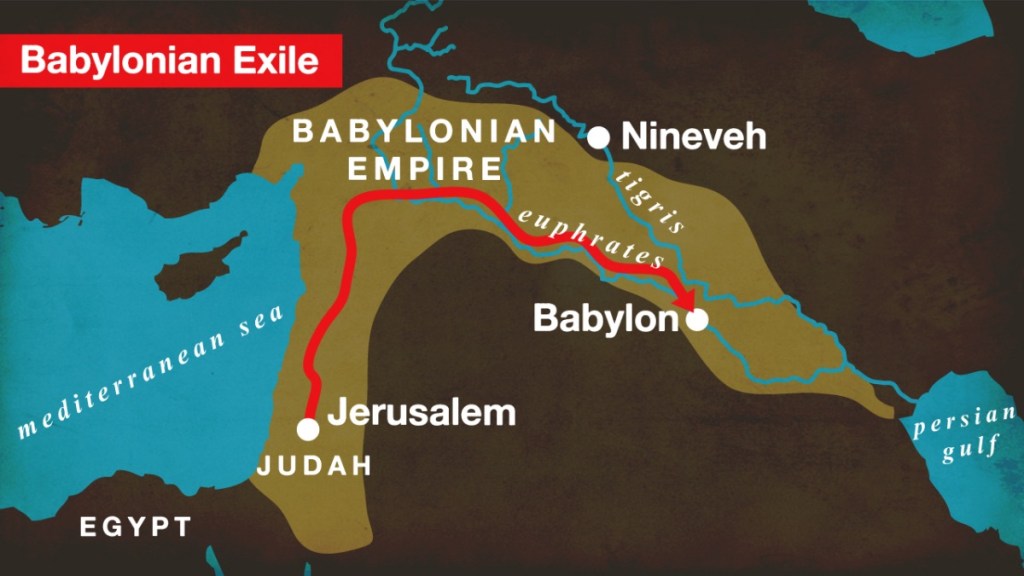
B.  Psalm 126 offers a similar refrain.  This time the Jewish people have been released from their 70 year exile in the Babylonian-Persian Empire.  God had allowed the forces of King Nebuchadnezzar to defeat Judea, destroy Jerusalem, and cart the people off (586BC).  He was chastising them—after many warnings of judgment to come—for their idolatry and stubborn disobedience.  The news that they were free to return to Jerusalem stunned the Jewish captives!  The psalmist writes in vv.1-3—When the LORD brought back His exiles to Jerusalem, it was like a dream!  We were filled with laughter, and we sang for joy.  And the other nations said, “What amazing things the LORD has done for them.” Yes, the LORD has done amazing things for us! What Joy!

This probably felt to them like a spectacular new thing.  God’s miracles for His people were clearly not at an end.  And, just as the Isaiah passage predicted Jesus’ 1st Coming, this psalm looks forward to the Jesus’ 2nd Coming. 

C. The Isaiah reading dealt with the Exodus, and our psalm, with the return of the Babylonian exiles.  Paul takes us in a different but related direction in Philippians 3:4b-14.  Paul had, prior to coming to Christ, thought he could manage his own salvation by his own efforts.  He lists 7 credentials he had accumulated that made him a religious superstar:

1.) He had godly parents, who saw to it that he was circumcised on the 8th day—by Jewish Law. 

2.) He was purely a Jew—no nonbelieving Gentiles in his gene pool. 

3.) He was a member of the tribe of Benjamin, Jacob’s favorite son after his loss of Joseph.

4.) He was an elite leader.

5.) He was a Pharisee by training, dedicated to teaching and enforcing Jewish Law.

6.) He was so zealous that he persecuted the infant Christian Church.

7.) And he kept short sin accounts with God, making the requisite sacrifices when he sinned.

But, since becoming a follower of Jesus Christ, he considers all his worldly accomplishments worthless. And so should we.  It’s not about impressing others with what we have done or not done. Paul knows he could not make himself right with God through his own efforts.  He wants us to realize that (v.9)—…God’s way of making us right with Himself depends on faith.  It’s about having faith in Jesus Christ.  He is now dedicated to getting to know Jesus better and better, and to helping others do so too.  And so he presses on (vv.13-14)—Forgetting the past and looking forward to what lies ahead, I press on to reach the end of the race and receive the heavenly prize for which God, through Christ Jesus is calling us. 

This is definitely a spectacular new thing: Salvation does not come from our efforts, but has been won for us by our Lord and Savior, Jesus Christ.  We don’t have to try to be perfect. Our sins are covered by the sacrificial blood of the sinless Son of God. Our striving can cease, replaced by our faith.

D. Finally, in our Gospel lesson (John 12:1-8), we see a young woman do something extraordinarily new to honor Jesus.  The scene is a dinner party in Jesus’ honor at the home of Lazarus.  Rev. Dr. J. Vernon McGee says the Lazarus family represents 3 essentials in every Church:

(1) The resurrected Lazarus has new life in Christ.

(2) Martha no doubt prepared and served the meal, so she represents service.

(3) Mary kneels at Jesus’ feet, worshiping and adoring Him.

(McGee, Through the Bible Commentary on John, Thomas Nelson, 1991, p.38.)

Notice how extravagant are Mary’s efforts.  Jesus will wash His disciples’ feet with water at the Last Supper, but she anoints His feet with a very expensive perfume from India, and dries them with her lovely long hair.

Mary of Bethany realizes how very special Jesus is and she honors Him with a pound of spikenard worth a year’s wages.  She, like Paul who comes after her, has made worshipping Jesus the most important thing. Jesus accepts her worship as if she is anointing Him for His death some 6 days ahead. We could say she is fully committed and has the utmost faith in Jesus. 

I don’t know about you, but I find that Jesus often surprises me by answering prayers I haven’t even put into words.  There’s a certain busy intersection, with no light in my town, into which it is very difficult to turn left. For several days, as I have approached this intersection, there has been—amazingly—no traffic in either direction. As I have easily executed my left-hand turn, I have laughed and thanked the Lord. This is not as spectacular as opening the Red Sea, returning exiles to Jerusalem, or healing a dying baby.  But it serves as a reminder to me that Jesus sees me, loves me, and wants to have me cross the intersection safely.

Like Paul and like Mary of Bethany let’s during what’s left of Lent, focus on how grateful we are to serve a God who enjoys gifting us with spectacular large and delightful small surprises.

Thanks be to God who gives us the victory through our Lord Jesus Christ.  Alleluia, alleluia!

©️2025 Rev. Dr. Sherry Adams

Profiles of Humility

Pastor Sherry’s message for February 9, 2025

Scriptures: Isa 6:1-13; Ps 138; 1 Cor 15:1-11; Lk 5:1-13

Remember Muhammed Ali?  The famous boxer who used to humbly claim, “I am the greatest!”?  Well, the story is told that he was seated on a plane getting ready to take off, and the flight attendant noted he wasn’t using his seatbelt.  She politely asked him to fasten it.  He replied, ”I’m Superman and Superman don’t need no seatbelt.”  To which she responded, ”Superman don’t need no airplane either, so please fasten your seatbelt.”   

 (Steve Jones, “God’s Spiritual Stimulus Plan—Humility, www.sermomcentral.com, 2/6/25.)  

By the way, a parishioner of mine told me (following this sermon) that her father was a city bus driver in Louisville, Kentucky, for years, and that Muhammed Ali (aka, Cassius Clay) rode his bus daily as a child going to school.  Her father said the great boxer had always had a tendency to brag about himself.

 A second story regarding humility involves Benjamin Franklin:  Apparently he once… “made a list of character qualities that he wanted to develop in his own life. When he mastered one virtue, he went on to the next. He did pretty well, he said, until he got to humility.  Every time he thought he was making significant progress, he would be so pleased with himself that he became proud.”

(“Illustrations on Humility,” the Disciplers Blog, 2/7/2025.)

It’s hard to be humble, isn’t it?  But our Scripture passages today provide us with some pretty strong reminders that the virtue of humility pleases God.

A.  Let’s look first at the prophet Isaiah (Isaiah 6:1-13).  This story recaps his call, by the Lord, to become a prophet.  The context for Isaiah is the death of the good king, Uzziah.  Uzziah had ruled the Southern Kingdom (Judea and Jerusalem) for 52 years, from 791-740 BC.  He subdued Israel’s traditional enemies, the Philistines (ancestors of today’s Palestinians), the Arabs, and the Ammonites.  And, as long as Uzziah sought God and did not get too proud, he led the country into a period of peace and prosperity.  When Uzziah died, however, Isaiah was grieved and worried for the future of Judea.  Fortunately, Isaiah took his worry to the Temple, where he placed it on God’s altar through prayer.  No doubt he was lamenting. “Lord, what shall we do? What will happen to us all now?”  

The Lord responds to him with a vision and a calling.  The vision is of God on His throne.  The Lord is so immense that the train of His garment fills the Temple.  God wants to reassure Isaiah that all is well:  Isaiah’s earthly King is dead, but his heavenly King is alive and well and sovereign over all things.

Isaiah also sees 6 seraphim—in the Hebrew, the name means to burn—flying about the Throne.  While the job of the cherubim is to protect the holiness of God, the job of the seraphim is to seek out sin and destroy it.

(J. Vernon McGee, Through the Bible Commentary on Isaiah, Thomas Nelson, 1991, p.68.)

This is important because Isaiah immediately becomes aware that he is a sinful man who has seen God himself.  He knows from Moses’ dialogue with God in Exodus 33:20, that—No one may see Me and live.  No sinful being may exist in the physical presence of the Living God.  So he cries out (verse 5, NLT)—It’s all over!  I am doomed, for I am a sinful man.  I have filthy lips and I live among a people with filthy lips.  Yet I have seen the King, the Lord of Heaven’s Armies.  Isaiah is honest—he admits and takes responsibility for his sinfulness.  He doesn’t blame his environment, his parents, or any sinful associates.  He humbles himself before God.

God then directs a seraph to cleanse Isaiah’s lips with a burning coal from the altar where sacrifices for sins are carried out.  Prior to Jesus’ once- and-for-all-perfect sacrifice of Himself, an animal was chosen to be offered in one’s place.  The sinner consigned his/her sins to the animal’s head, the priest slit the animal’s throat, drained its blood, and placed its body on the sacrificial altar to be burned.  The life blood of the animal paid for the sin of the human.  The burning or live coal the seraph brought to Isaiah came from the altar at which such atonement for sin was made.  McGee goes on to assert that this act foreshadowed the coming cleansing we would all experience through the shedding of Jesus’ blood (Ibid., p.71).  Remember the words of the old hymn, “What can wash away my sins? Nothing but the blood of Jesus.”  Instead of hurting Isaiah, Christ’s future (to him) finished work on the Cross cleansed and healed him.

Then the Lord calls Isaiah to a frustrating work in which he will convey God’s words to a people group who will neither listen to nor receive what the Prophet has to say.  Again, Isaiah humbly agrees to answer the call–Here I am; send me–even though it is to a mission that will feel very frustrating.

B.  In Psalm 138, King David offers thanksgiving to the Lord for His love and protection.  He says in v. 1—I will sing your praises before the gods.  By gods, David was referring to the false gods of Israel’s neighbors, Egyptian, Philistine, and Canaanite gods.  For us, today, the meaning is anything we put ahead of God in our lives (McGee, p.156 of his commentary on the Psalms).  This could be money, power, status, influence, certain relationships with people, and addictions.

In verse 2, he goes on to praise God for His love and His trustworthiness.  In verse 6, he insists—Though the Lord is great, He cares for the humble, but He keeps His distance from the proud.

There it is, the theme of humility and how it pleases God.  Later, James, the half-brother of Christ, will write (James 4:6)—God opposes the proud but gives grace to the humble.  Similarly Peter will state (1 Peter 5:6)—So humble yourselves under the mighty power of God, and at the right time He will lift you up in honor. 

C.  St. Paul, in his 15th chapter of 1 Corinthians (verses 1-11), refutes the first heresy to arise in the infant Christian Church: That there was no resurrection.  He carefully enumerates all the folks who saw and interacted with the risen Jesus.  There were more than 512 eye-witnesses.  Then he, himself, saw Jesus on the road to Damascus.

Next, he humbly recounts (vv.8-10, NLT)—Last of all, as though I had been born at the wrong time, I also saw Him.  For I am the least of all the apostles.  In fact, I’m not even worthy to be called an apostle after the way I persecuted the Church.  But whatever I am now, it is because God poured out His special favor on me….

Some say Paul, the apostle to the Gentiles, was the greatest of all the apostles; but here he humbly reminds us that if he is so, it is only due to the grace and forgiveness of Christ.

D.  Finally, we have the example of Peter (also of James, John, and Andrew, Peter’s brother) in Matthew 5:1-11.  Jesus uses Peter’s (and Andrew’s) boat to address the crowd of His followers.  The fishermen are cleaning their nets, but they are also listening to Jesus.  He dismisses the crowd and urges Peter to pull away from the shore and launch his nets again.  It’s daylight and they have already fished all night with no results.

They are tired, and Peter seems crabby.  He knows from experience that the fish they sought tend to swarm only at night.  He must wonder, “What’s the point of going back out now that it’s daylight?”

But Peter does as Jesus says and is amazed to haul in a gigantic haul of fish!  They bring in enough to tear their handmade nets.  They land enough to nearly sink Peter’s boat and that of the Zebedee brothers, James and John.  Peter recognizes both the miracle of the catch and that Jesus has the surprising power to accomplish miracles.  Like Isaiah before him, he immediately becomes aware of his sinfulness.  He humbles himself.  He feels so unworthy, he even asks the Lord to leave him.  But Jesus instead invites him—all 4 fishing partners, in fact–to become “fishers of men/people.”

Peter humbles himself and Jesus makes him a disciple—an apostle.

The Prophet Micah (6:8) has asserted that the way we please God is…”to do what is right, to love mercy, and to walk humbly with your God.”   Ali lacked humility, Franklin–like us–struggled to attain it, but Isaiah, King David, Paul, and Jesus’ Apostles all demonstrated it.  It is a virtue we can develop.  It is something we can intentionally cultivate and attain.

How do we do it?  King David was right:  (1) Put God first in our lives.  We decide to try to please Him.  (2) Then we recall James 1:17 (NLT)—Whatever is good and perfect is a gift coming down to us from God our Father, Who created all the light in the heavens.  He never changes or casts a shifting shadow [meaning He is not mercurial but is the same yesterday, today, and forever].  Whatever we do that might make us proud is actually something God prompted in us, inspired, or helped us to do.  Then, we must willingly give Him the praise for every good thing we accomplish and every good thing we experience.   Thanks be to God Who gives us the victory through our Lord Jesus Christ.  Alleluia, Alleluia!

©️2025 Rev. Dr. Pastor Sherry Adams

Humility

Pastor Sherry’s message for October 27, 2024

Scriptures: Job 42:1-17; Ps 34:1-8, 19-22; Heb 7:14-28; Mk 10:46-52

In a story borrowed from Our Daily Bread, it was recounted that…

 “Shortly after Booker T. Washington, the renowned black educator, took over the presidency of Tuskegee Institute in Alabama, he was walking in an exclusive section of town when he was stopped by a wealthy white woman. Not knowing the famous Mr. Washington by sight, she asked if he would like to earn a few dollars by chopping wood for her. Because he had no pressing business at the moment, Professor Washington smiled, rolled up his sleeves, and proceeded to do the humble chore she had requested. When he was finished, he carried the logs into the house and stacked them by the fireplace. A little girl recognized him and later revealed his identity to the lady. 

“The next morning the embarrassed woman went to see Mr. Washington in his office at the Institute and apologized profusely. “It’s perfectly all right, Madam,” he replied. “Occasionally I enjoy a little manual labor. Besides, it’s always a delight to do something for a friend.” She shook his hand warmly and assured him that his meek and gracious attitude had endeared him and his work to her heart. Not long afterward she showed her admiration by persuading some wealthy acquaintances to join her in donating thousands of dollars to the Tuskegee Institute.”

Another true story of a famous person who demonstrated humility is told of the great evangelist George Whitefield.  Whitefield was a friend and a contemporary of John Wesley, who, in the 1740’s, led the American colonies in a huge revival known as “The First Great Awakening.” 

“Although George Whitefield disagreed with John Wesley on some theological matters, he was careful not to create problems in public that could be used to hinder the preaching of the gospel. When someone asked Whitefield if he thought he would see Wesley in heaven, Whitefield replied, “I fear not, for he will be so near the eternal throne and we at such a distance, we shall hardly get sight of him.” 

(W. Wiersbe, Wycliffe Handbook of Preaching and Preachers,  Moody Press, 1984, p. 255.)

Both Dr. Booker T. Washington and Rev. George Whitefield illustrated the very rare virtue of humility.  We know that Jesus was humble. So too was Paul.  In Acts 20:19 (all biblical quotations cited are from the New Living Translation), Dr. Luke states that Paul asserted in Ephesus: I served the Lord with great humility and with tears, although I was severely tested by the plots of the Jews.  By the time he penned his epistle (1 Peter 5:5-6), Peter had also learned to be humble: All of you, clothe yourselves with humility toward one another, because, “God opposes the proud but gives grace to the humble” [Proverbs 3:34].  Humble yourselves, therefore, under God’s mighty hand, that He may lift you up in due time. 

Humility is one of the marks of a true follower of Jesus. I believe our God rejoices in us when we put aside our pride and live lives characterized by true humility.

A. Job (42:1-17) is another great example of a man who learned to be humble before God.  Verses 1-6 reveal that as a result of his confrontation with God, Job humbly admits he has erred by assuming he could judge God.  He admits his sinfulness (v.6): I take back everything I said, and I sit in dust and ashes to show my repentance

Then, in verses 7-9, God takes Job’s judgmental friends to task.

He rebukes them for their presumptions and their spiritual arrogance—for thinking they knew God’s purposes with Job.  He directs them to make sin offerings to atone for their guilt.  And then He tells them to ask Job to pray for them. God vindicates Job before his best but wrong-minded buddies.

Finally, God restores Job’s fortunes.  Somewhat like when the Egyptians gave the Israelite slaves their “back pay” when they left Egypt, Job’s relatives and friends (v.11) are prompted to bring him silver and gold, a kind of “grub-steak.”  God himself replenishes his supply of animals: WOW!  Consider the Lord’s largesse:  14,000 sheep, 6,000 camels, 1,000 yoke of oxen (really 2,000 oxen), and 1,000 female donkeys (remember donkey milk was prized then in the Ancient Near East)—twice as many animals as before.  He also helped Job procreate 7 sons and 3 beautiful daughters (not 20 kids, because he would later see the first 10 in heaven.)  And He grants him long life.  Scholars believe Job was about 70 when all of this took place, so God added 140 more years to his life.

The book of Job illustrates, among other things, that humbling ourselves before God brings us blessings.  Job lost everything, even his health, but God restored him two-fold—due to his faith, trust, repentance, and humility.

B. Psalm 34 was written by King David to express his gratitude to God for rescuing him from his enemies.   In verses 1-2, David praises God for delivering him from a king of the Phillistines (Achish, who was an Abimilech, or ruler in the Canaanite tongue).  In verse 3, he calls on others to praise God too.  David says (v.4): I prayed to the Lord and He answered me; He freed me from all my fears.  He continues in verse 8, Blessed is the man [or woman] who takes refuge in Him.  He concludes in v.19: A righteous person faces many troubles, but the LORD comes to the rescue each time.  Just because we love the Lord does not mean we live trouble-free.  Actually, Jesus later stated (John 16:33): Here on earth you will have many trials and sorrows [will not might or could].  But take heart because I have overcome the world.  It means that He will sustain us through our difficulties. 

Essentially, David’s point is that we can and should depend upon the Lord.  He can and does rescue us when we cannot save ourselves.  Holding firmly to this insight should make us humble, as we realize that we can’t but God can.

C.  The writer to the Hebrews (7:14-28) pretty much spends his [or her] entire book outlining why we humbly owe Jesus our love, gratitude, and respect.  (Many credit Paul with writing the Letter to the Hebrews, but Paul always identified himself as the author of his books and did not do so here.  Other scholars speculate it may have been Priscilla of Priscilla and Aquila fame.  She had been raised in Rome and probably had had an exceptionally good education, as the Greek used in this book is of a very high level.  We can only speculate and will have to ask in Heaven who the actual author was.)  

Whatever the case, Jesus was from the tribe of Judah, not of Levi, the priestly tribe.  But, as verse 16 explains: Jesus became a priest, not by meeting the physical requirement of belonging to the tribe of Levi, but by the power of a life that cannot be destroyed.  He became a priest through His resurrection from the dead.  As is clear from Psalm 110:4 [God is speaking]: The LORD has taken an oath and will not break His vow:  You [meaning Jesus] are a priest forever in the order of Melchizedec [the mysterious priestly king of Salem, forerunner of Jerusalem, in Abraham’s time].  In other words, Jesus surpassed the Arronic priesthood (begun with Moses’ brother, Aaron) because He is both perfect (without sin) and eternal.  And today, He is seated at the Father’s right hand, interceding for each of us, sinners though we are.  If that isn’t humbling, I don’t know what is.

D.  As a good friend of ours often states, “moving right along,” in our Gospel lesson (Mark 10:46-52), Jesus encounters a blind fellow named Bartimaeus.  Jesus is leaving the vicinity of the Old Jericho (left in ruins with a curse upon whoever might dare to rebuild it) and instead is departing from the “new” Jericho, built in a different location by Herod the Great.  Beggars often sat outside city gates, so they could solicit money from passers-by.  Bartimaeus hears that Jesus is passing and calls to Him (v.47): Jesus, Son of David, have mercy on me!  Jesus graciously stops and responds to the man, What do you want Me to do for you?  We suspect the guy would want to be healed.  But maybe he wanted more money, or a better place to live, or even a spouse.  Jesus often asked people to clarify their motives for themselves and for any onlookers.  But, Bartimaeus honestly says, I want to see.  And in verse 52, Jesus heals him saying, Go, your faith has healed you.

Jesus commends him for his faith.  Huh?  Jesus realizes Bartimaeus is a man of faith because he calls the Lord, “Jesus, Son of David.”  This is a Messianic title from the Old Testament.  Bartimaeus believed Jesus was the Messiah and that He was meant to bring about God’s Kingdom rule on earth.  Bartimaeus knew from Isaiah 61 that this meant Jesus would minister to the poor—of which group Bartimaeus was one—and that He would heal the maimed, lame, and blind, his particular affliction.  Notice, Jesus doesn’t touch him, but simply speaks healing into his life.  And then a sighted Bartimaeus humbly and gratefully follows Jesus.

So, where do these passages lead us?  Our God has told us back in Micah 6:8: The Lord has told you what is good, and this is what He requires of you:  to do what is right [just], to love mercy, and to walk humbly with your God.  We don’t see much humility around us these days, do we?  Instead of being humble, people tend to put themselves forward and/or brag about their accomplishments.  I, for one, am much more impressed by a proficient athlete who praises God for their successes than I am by to those who take all the credit themselves.  Scripture provides us with many examples of men and women who humbled themselves before God and people.

I think a case can be made for us each to act humbly because…

1. As Job discovered, we can question God but our minds are not capable of understanding the complexity of the universe, nor of comprehending the mind and plans of the Almighty. We need to approach God mindful of and repentant for our sins.  We should come before Him in all humility. 

2. King David says in Psalm 34, God hears our prayers and rescues us from trouble.  As Beth Moore, the wonderful Bible teacher, frequently states, “God loves to mess with our messes.”  Even if we have behaved like an absolute stinker, if we ask the Lord to redeem our mess, He will in ways beyond what we might have asked or imagined. 

3. As the writer to the Hebrews says, Jesus is powerful enough to save us and to intercede for us with God the Father.  We can’t save ourselves by our own actions.  We needed our great high priest, Jesus, to do the work of atonement for us—and He has!

4. Similarly, Bartimaeus knew he could not restore his own vision.  He needed the healing power of Jesus Christ to do it for him.

This week, let’s try to do the right thing, to love extending grace and mercy to others, and to walk humbly with our God.  Amen!

©️2024 Rev. Dr. Sherry Adams

SELF-LESS

Pastor Sherry’s Message for September 3, 2023

Scriptures: Ex 3:1-15; Ps 105:1-6, 23-26, 45b; Ro 12:9-21; Matt 16:21-28

         I came across this little poem the other day, whose author is anonymous (perhaps by choice?):

         I’ll go where You want me to go, dear Lord.

                    Real service is what I desire. 

          I’ll sing You a solo anytime, dear Lord,

                    But don’t ask me to sing in the choir.

          I‘ll do what You want me to do, dear Lord,

                    I like to see things of God come to pass.

          But don’t ask me to teach boys and girls, O Lord,

                    I’d rather just stay in my class.

          I’ll do what You want me to do, dear Lord,

                    I yearn for Thy kingdom to thrive. 

          I’ll give You my nickels and dimes, dear Lord,

                    But please don’t ask me to tithe.

          I’ll go where you want me to go, dear Lord,

                    I’ll say what You want me to say.

          I’m busy just now with myself, dear Lord,

                    I’ll help You some > convenient day.

(Chuck Swindoll, The Tale of the Tardy Oxcart, Word Publishing, 1998, pp. 516-517.)

This is amusing, isn’t it?  We’re ready to obey the Lord, but on our terms.  If we obey on our terms, then just who is God to us? We sit on the throne of our own lives, and obey God if and when it’s convenient—which means we have dethroned the true King.


And where does this leave us?  The comedian, George Carlin, once had a routine in which he challenged the concept of self-help.  He said, essentially, that self-help is an oxymoron:  “Look it up,” he said, “if you did it yourself, you didn’t need any help. Pay attention to the logic of the language, people.”   How about the concept of self-service?  Isn’t service something we provide to others? Again, using Carlin’s logic, is it a service if we do something for ourselves alone?

(Fairless and Chilton, The Lectionary Lab Commentary, Year A, 2013, p.213.)

The Bible is pretty clear that God prefers for us to turn from serving or helping self toward serving Him and helping others.

         A.  Our Old Testament lesson (Exodus 3:1-15) is a case in point:  By the end of chapter 2, Moses had become a grown man with   a desire to help his people, the Israelites.  So when he observed an Egyptian overseer mercilessly beating a Hebrew slave, he took it upon himself to kill the Egyptian.  We have no indication that the Lord told him to do this.

He had assumed this murder would be helpful.  But he was unprepared for what might happen when the word got out—even among the slaves–that he was a murderer.  His own people didn’t trust him.  He had been trying to help, but by his own misguided efforts.  The Egyptians wanted to arrest him and kill him.  This resulted in his having to flee for his life to the Egyptian “outback,” to the south end of the Sinai Peninsula, a place called “Midian.”

There, in Midian, the Lord placed him in a godly family and provided him with (1) sanctuary from any avenging Egyptians, (2) a lovely wife, Zipporah, and two sons, and (3) a new way to earn a living, as a shepherd.  We could say he served a 40 year apprenticeship, caring for sheep and goats, prior to shepherding God’s Chosen People.  He was also learning not to rely on self (help).  He was emptied of pride and self-will.  The burning bush incident was meant by God to teach Moses to surrender his ego, his princely prerogatives, and to trust in the name and power of the Lord.  God tends not to use those who will not yield to Him.

         B. We know God used Moses mightily, as we read the rest of Exodus, Numbers, Leviticus, and Deuteronomy (the Pentateuch or Torah, the Law, from Genesis through Deuteronomy).  After afflicting the Egyptians with 10 plagues—by the way, this was the Lord going to war with the gods of Egypt and winning every time!—Pharaoh gives in and lets the Israelite slaves leave Egypt.  Scholars believe King David wrote Psalm 105, to preserve and celebrate God’s actions on behalf of the Israelites from the time of Abraham to Moses.  This psalm retells their history.

The verses we read this morning recall how the Lord used Moses and Aaron, his brother, to display His power to Pharaoh, essentially saying, Dude, you and your gods don’t have a chance against the power of the Almighty God.

We’ve all just survived Hurricane Idalia.  Think of how Almighty God intervened to help us through.  A friend in Tallahassee who did not lose power was watching the Weather Channel and heard Dr. Greg Postel say, the day after Idalia hit land (8/11/23), that they observed “curious changes” that did not match their scientific predictions:  (1) The eye wall “eroded,” or “fell apart at the middle and lost convection so that the wind weakened just before landfall.”  130 mph suddenly dropped to 85 or 90—such a huge, immediate drop is not usual.  This Category 4 killer storm reduced to a Cat 2 or 1 as it reached land.  He admitted the science could not explain this.  (2) Though the storm surge was bad, due to the full moon, it materialized as less than expected because it hit at low tide rather than high tide, as had been predicted.  Perhaps the lowered wind speeds helped change the timing of the storm with the tides.  How amazing!  (3) Additionally, the winds at ground level during impact appeared to have separated from higher, more vicious winds which operated up to 1000 feet above land.  The winds that hit us were actually lower in velocity than the higher winds in the storm mass.  We were spared the really dangerous, brutal winds.  Remember our prayers, since the beginning of hurricane season against a dangerous hurricane hitting Florida?  No doubt we were not the only Christians praying this way.

Truly we were spared the devastation of a Cat 4 storm by divine intervention.  Never doubt the power of Almighty God!  All praise belongs to Him!

         C. In his letter to the Romans (12:9-21), Paul lays out how we are to relate to other believers and to nonbelievers.

         If we are cooperating with the transforming power of the Holy Spirit, our actions toward other believers will be characterized by

                  a. Sincere love;

                 b. Hatred only for what is evil;

                 c. Devotion to each other out of brotherly love (philios);

                 d. Industriousness, rather than laziness;

                 e. “Joy in hope, patience in affliction, faithfulness in prayer”;

                 f. Sharing with the truly needy;

                 g. Practicing hospitality;

                 h. Blessing rather than cursing others;

                 i. Empathizing with each other’s pain or joy;

                 j. Living in harmony with others;

                 k. And being humble.

Toward non-believers, we are to (1) refuse to exact revenge for being wronged—leaving that instead to God.  Remember, the culture says, “What goes around comes around.”  Scripture says “we reap what we sow.” It’s the same law.  Often I have seen someone receive back exactly the evil treatment they had previously dished out to another; (2) do the right thing; (3) as much as we can ensure it, we must live at peace; and (4) verse 21 Do not be overcome by evil, but overcome evil with good.

If we can demonstrate these attitudes and behaviors,we are truly demonstrating that we are surrendered to God.  If we can’t, we probably aren’t.

         D. Which leads us to our Gospel lesson (Matthew 16:21-28).

Jesus tells the disciples, for the 1st time, that He is going to Jerusalem to die (about 6 months prior to His crucifixion).  He will tell them four more times before His betrayal and arrest (Matthew 17:12, 17:22-23, 20:18-19, and 20:28).  He knows and accepts that this is the future set out for Him.

But Peter is appalled!  Seven verses earlier, Peter had confessed that Jesus is the Messiah, the Son of God.  He can’t believe that Jesus would willingly die a     criminal’s death.  Whereas his first statement was inspired by the Holy Spirit, this second one is inspired by Satan.  How quickly we can move from being in alignment with God’s will to being antagonistic to it.  Jesus loves Peter but rebukes him strongly.  Even the Son of God—who is also God—must submit His will to that of the Father.

Self-help, self-service, even self-improvement rarely work for us.  I once worked with a very bright doctoral student in Sports Psychology.  Those folks are smart as can be.  They have to learn all the psychology I did, as well as the physiology of bones, muscles, ligaments, and tendons that impact athletic performance.  She suffered from depression and did not believe in Jesus.  Instead she worshipped “the goddess within.”  I wondered how she could continue to believe in the goddess within when that entity had not helped her overcome her battle with depression.  Self-improvement based on self or even on “the goddess within” is typically fruitless.  We need Jesus to heal us.   

Ultimately, we need to follow the examples of Moses and of Jesus.  We are to deny ourselves.  We are to be willing to sacrifice what we want.  We are to serve and obey God.  We are to help others.

When we can become self-less, then God has us right where He wants us.  This is the point at which He will use us to build up His Kingdom.  And, paradoxically, when we surrender to Him and pick up our cross, we gain eternal rewards—we are richly blessed.

Thanks be to God who gives us the victory through our Lord Jesus Christ!  Alleluia, alleluia!

©2023 Rev. Dr. Sherry Adams

After Suffering Comes…

Pastor Sherry’s message for August 13, 2023

Scriptures: Gen 37:1-28; Ps 105:1-22, 45b; Ro 10:1-15; Matt 14:22-36

In a new twist on an old story, a young woman texts her parents from college:

Dear Mom and Dad,

Just thought I’d share with you my new plans: I’ve fallen in love with a guy named Jim. He quit high school in the 11th grade to get married. About a year ago, he got divorced. We’ve been dating for about 2 months and just decided to get married. I will be moving in with him shortly as we believe I’m pregnant. Don’t worry, though. I dropped out of all my classes last week, but I do plan to finish school at some point in the future. Unfortunately, I’ve been smoking a lot of pot, but intend to quit if it turns out I am expecting.

About 10 minutes later comes a second text:

Mom and Dad,

I just want you to know that everything I’ve texted you so far today is false. NONE of it is true! But, it is true that I made a C- in French and failed my Math class. And it’s also true that I will soon need a lot more money for tuition. Love you! Your Daughter.

(Chuck Swindoll, The Tale of the Tardy Oxcart, Word Publishing, 1998, p.445.)

I hope you’ve never been this frightened, or this manipulated, by someone you love. This devious, scheming young woman shocked then reassured her parents! It’s a sales technique: 1st ask an impossible “big,” then 2nd follow that up with a smaller, more reasonable request (people then tend to acquiesce to the smaller “ask”). Probably without meaning to, she was also illustrating how often, in the Christian walk, we have to endure suffering before we either come into an understanding of why God allowed difficulties to come our way, or enter into a time of blessing.

This truly is the focus of our Scripture lessons today.

A. Our Genesis passage (37:1-12) begins the Joseph narrative.

More chapters of Genesis are devoted to Joseph than to Abraham, his great grandfather; to Isaac, his grandfather; or to Jacob/Israel, his father. One reason is that he represents the nation of Israel. Remember, the name Israel means he who struggles or wrestles with God and with men and who comes through or prevails (though, as I pointed out last week, who can prevail against God?). Joseph endures some very tough times, but, because he is basically a righteous man, he is eventually blessed by the Lord. He also becomes a source of blessing to his family, his nation, to the Egyptians, and to unknown numbers of other Gentiles trying to survive the famine. It is through Joseph that the Lord moves the future leaders of the twelve tribes of Israel to Egypt, and ultimately sets the stage for the Exodus.

A second reason Joseph gets so much biblical coverage is that, as J. Vernon McGee writes, “There is no one in Scripture who is more like Jesus in his person and experiences than Joseph.” (McGee, Through the Bible Commentary: Genesis, Chapters 34-50, Thomas Nelson Publishers, 1991, p.43.):

1.) Both births were miraculous;

2.) Both were especially loved by their fathers;

3.) Joseph was set apart by his special coat, while Jesus was set apart by his sinlessness;

4.) Both were ridiculed for asserting they would one day rule over their brethren;

5.) Both were obedient to their fathers at considerable cost to self;

6.) Both were sent by their fathers into danger;

7.) Both were hated and rejected by their brothers (in Jesus’ case, His countrymen);

8.) Both redeemed/saved their brothers.

Our passage today provides the backstory for Joseph’s betrayal by his brothers. The 10 (half) brothers born to Leah and the 2 concubines were murderously jealous of Joseph. They resented their father’s favoritism. It’s never good to favor one child over another. The favored one can ultimately feel guilty or develop an unhealthy arrogance; the non-favored becomes resentful and can be plagued by low self-esteem. Jacob should have known better since his father, Isaac, had favored his twin, Esau. As a licensed psychologist, I can tell you I have seen this again and again: without Jesus, we later become or re-enact as an adult what we hated as a child. These brothers resented his dreams of future grandeur. They also despised the fact that their oblivious father tasked Joseph with ratting them out!

So they plot to kill him, their own flesh and blood. Reuben, the by- now discredited eldest, attempted to rescue him, thinking he would recover Joseph, return him to their father, and perhaps regain some favor with dad. Judah, the one to whom the leadership of the clan had passed after Reuben’s gross disrespect of Jacob, talked them out of murder and into selling Joseph into slavery—a likely avenue to death, anyway, but without having bloodied their hands. These dreadful brothers then sell Joseph to Ismaelite traders (descendants of Abraham’s son, Ishmael) for 20 shekels (another foreshadowing of Christ, who was betrayed for 30 pieces of silver.)

B. As our Psalm (105:1-22, 45b) recounts in verses 17-22, God intended Joseph’s descent into slavery—They bruised his feet with shackles, [and] his neck was put in irons—as well as his later rise to prominence—Till what he foretold [in his two dreams] came to pass, till the word of the Lord proved him true. King David, the assumed author of the psalm, relates how Pharaoh freed Joseph and made him master over all of Egypt in the time of a devastating 7 year famine. He also describes how God elevated Joseph—through Pharaoh—to instruct his princes as he pleased and teach his elders wisdom. Joseph was 17 when sold into slavery. For 14 years, God prospered both Potiphar’s house and the Egyptian prison under Joseph’s supervision and influence. Everything Joseph touched “turned to gold.” Once he was freed, he did instruct Pharaoh and the Egyptian leadership in the meanings of Pharaoh’s dreams. And by saving his family from starvation, he taught his 10 elder brothers and even his father about the sovereignty of God, and the value of forgiveness.

C. As I said last week, our God has not given up on the Jews, His Chosen People. Fortunately for us, we, Christ’s followers, are also God’s chosen people through the saving work on Jesus Christ on the Cross for our sake. We have been grafted into the lineage of Jesus by our belief in Him. We are co-heirs with Jesus, our Lord and our brother. Paul makes it clear in Romans 10:1-15 that keeping God’s Law saves neither us nor the Jews. Since we are sinners who cannot keep it perfectly, the Law simply serves the purpose of proving to us that we need a savior. In verse 9, Paul emphatically asserts what it takes to be saved If you confess with your mouth, ‘Jesus is lord,’ and believe in your heart that God raised Him from the dead, you will be saved! Jesus has done the hard work of salvation for us. We just respond with belief, with faith in Him.

Verses 11-15 contain Paul’s urgent plea that we, Christ’s Church, reach out to evangelize the Jews. He quotes the prophet Joel (2:32) Everyone who calls on the name of the Lord [who believes in Jesus] will be saved. He also quotes the prophet Isaiah (53:1) How beautiful are the feet of those who bring Good News. I remember a friend’s father telling me in the 8th grade that I had pretty feet. I remember thinking at the time that that felt rather “icky” and I couldn’t imagine why he would say such a thing. Everyone knows our feet are not really that attractive. But the prophet means that the one or ones who convey the Good News to those who haven’t yet taken it in are beautiful in God’s sight, feet and all. Paul’s heartfelt prayer is that his Jewish brothers and sisters come to a saving faith in Jesus. And he believes that those of us who try to evangelize the Jews–who have suffered dreadfully down through the ages–will be particularly blessed by the Lord.

D. I’m not sure Jesus would say it this way, but in today’s Gospel Lesson (Matthew 14:22-36), He urges us to…

1.) Get out of the boat. Let go of our fear. Let go of our pride. Let go of our insistence in our self-sufficiency, our willfulness, our disobedience. Do what God is calling us to do, even if it is emotionally uncomfortable for us.

2.) Keep our eyes on Jesus. Just attending church won’t save us. Even reading Christian books won’t save us. Having wonderful Christian friends won’t save us. These things can help move us in the right direction, but it is having faith in Jesus and confessing our faith aloud that saves us.

3.) And trust in Him to help us do what would be impossible for us—like walk on water—without Him. Our God…is able to do exceedingly and abundantly more than all we ask or imagine…. (Ephesians 3:20). I can do all things through Christ who gives me strength (Philippians 4:13).

When asked why God allows good people to undergo bad experiences (suffer), the famous Presbyterian preacher, R.C. Sproul, answered, “I haven’t met any good people yet, so I don’t know.” He was, of course, considering the Apostle John’s assertion from 1 John 1:8 If we claim to be without sin, we deceive ourselves and the truth is not in us. Or as the Apostle Paul states (Romans 3:10) There is no one righteous, not even one.

The next time you find yourself in a season of suffering, remember that—unlike the college co-ed–God does not manipulate us. He does, however, test us. He allows us to walk through suffering for a season, but always with a purpose. The purpose is to mold and shape our character; to reduce our dependence upon anything but Him; and to deepen or strengthen our faith. And he brings us out of that suffering both transformed and blessed. Look at Joseph. Look at Jacob/Israel and his extended family. Look at Peter. Look at Paul. Look at you! Thanks be to God who gives us the victory through our Lord Jesus Christ. Alleluia, alleluia!

©️2023 Rev. Dr. Sherry Adams

God Wants to Talk About You

Pastor Sherry’s message for August 6, 2023

Scriptures: Gen 32:1-31; Ps 17:1-9; Ro 9:1-5; Matt 14:13-21

In August of 2001, country singer Toby Keith released a song titled, “I Wanna Talk about Me.” It’s kind of a country rap showcasing a man’s desire to have some equal “air time” with his significant other. Here are a few of the lyrics:

We talk about your work, how your boss is a jerk,

We talk about your church and your head when it hurts.

We talk about the troubles you’ve been havin’ with your brother,

Bout your daddy and your mother and your crazy ex-lover. We talk about your friends and the places that you been,

We talk about your skin and the devils on your chin,

The polish on your toes, and the run in your hose, And Lord knows we’re gonna talk about your clothes!

You know talking about you makes me smile. But every once in a while, I want talk about me…

Wanna talk about I,

Wanna talk about #1, oh my, me, my…

What I think, what I like, what I know, what I want, what I see.

I like talking about you, you, you, you usually…

But occasionally, I want to talk about me!

I can’t think about this song without smiling. It sounds like his girlfriend is very self-focused, since it’s hard for him to get a word in edgewise. But if and when he gets the floor, what does he want to talk about? Himself! He wants to “talk about me!”

The song has become a metaphor in my family for thinking only of self. Someone cuts us off in traffic. One of us will smile and say to the others, “I want to talk about me.” Someone cuts in line in front of us at the grocery store, or at the post office, etc., and we’ll be thinking, “I wanna talk about me.” Have you noticed that, even when you politely let someone go ahead of you, often they don’t say thank you or even give you eye contact because…”I wanna talk about me.”

Let’s take a look at what the Lord has to say about this all too prevalent attitude in today’s world.

A. Psalm 17:1-9 was written by King David. Biblical scholars believe it dates from the time before he ascended the throne. God had lost confidence in King Saul and had had His prophet Samuel anoint David as the next King. The jealous and mentally unstable King Saul accurately viewed David as a rival to his throne and set out to kill him. In this psalm, David pleads with God for protection against Saul and any other adversaries.

Yes, David is worried about saving his own skin; but he also tells God (Peterson’s The Message, p.962)I’m not trying to get my way in the world’s way. I’m trying to get Your way; Your Word’s way; I’m staying on Your trail; I’m putting one foot in front of the other. I’m not giving up. David views the Lord as his (and our) protector. David trusts in God to provide him a divine rescue.

David knows we need to take our focus off ourselves and put it on God, first, and then on others. This is the shape of the Cross. The vertical reminds us to love God. The horizontal reminds us to love others. God would have us put our focus on loving Him and then on loving others. A healthy self-love comes third.

B. Our Old Testament lesson, Genesis 32:1-31, provides us with an object lesson in where our love/focus should be directed. Jacob is re- entering the Promised Land after having been an immigrant to Syria for 20 years. In that time, his Uncle Laban had cheated him at his wedding, substituting the less desirable Leah in the dark wedding tent for Jacob’s beloved Rachel. Uncle Laban also changed Jacob’s wages 10 times, always shifting things to Laban’s advantage.

Nevertheless, despite these numerous setbacks, the Lord has prospered Jacob: He leaves Syria with great wealth:

1.) 2 wives and 2 concubines (remember, this is before Moses’ time when the Law was given);

2.) 11 sons and 1 daughter;

3.) A large retinue of servants;

4.) and huge numbers of livestock.

Due to God’s blessings, Jacob returns to the Promised Land as rich as an Arabian prince or an oil sheik.

Focused on his fears that his brother might still want revenge (and is coming to greet him with 400 troops), Jacob sends Esau multiple, generous gifts to sweeten the deal:

1.) 200 female goats & 20 males (220 goats); 2.) 200 ewes & 20 rams (220 sheep);

3.) 30 female camels with young (30+ camels); 4.) 40 cows, 10 bulls (50 cattle);

5.) 20 female donkeys, 10 males (30 donkeys).

This represents approximately 600 livestock! And he still has other flocks with which to sustain his people. He divides his clan into two groups and directs them to separate encampments for protection

Then he prays. At this point, I want to shout out, “Good job, Jacob!” He reminds God of His promises to his grandfather, Abraham, to Isaac, his father, and to him. He admits he doesn’t deserve God’s love and mercy. But he does plead for God’s protection—like David will later—(Peterson’s The message, p.70) Save me, please, from the violence of my brother, my angry brother! I’m afraid he’ll come and attack us all, me, the mothers and the children. When he ran for his life 20 years earlier, his focus had been on himself—>“I wanna talk about me.” Now, after 20 years of trials, he has matured: His focus is still on self, but has enlarged to include family and the Lord.

God recognizes Jacob’s maturing faith, but then intervenes to strengthen it. In verse 24, Jacob finds himself engaged in a wrestling match with the pre-incarnate Christ. It’s like Jesus is saying to him, “Jacob, you are less self-focused than you were 20 years ago. But your faith still needs to deepen. In your life, you have wrestled with your twin, Esau…you have wrestled with your Uncle Laban for 20 years. But your first priority must be Me, God!” This then becomes a major turning point in Jacob’s faith: This is why we celebrate the “heal-grabber” as a respected patriarch. He persists. He does not let go of God. He has finally learned it’s not about struggling with God or others. It’s about yielding to God and holding on to Him. Once he comprehends this, Jesus blesses him and changes his name to IsraelGod-wrestlerHe who struggles with God and with men and has come through. (Some translations substitute the word overcome or prevail for come through, but actually none of us can overcome God.)

Our God wants to talk with each of us about us, and He does get the last word. He wants our focus to move from self to Him. He wants us to be generous toward other people, putting their needs above our own.

C. Look at Jesus’ example of this in our Gospel lesson, Matthew 14:13-21. Verse 1 tells us the Lord had just gotten word that King Herod had beheaded His cousin, John the Baptist. Jesus wanted or needed time by Himself to pray and to grieve His cousin’s murder. He tried to sail off to gain some alone-time with His Father. But He was accompanied by His disciples and, when the crowds saw Him depart, they raced around the lake to meet Him where He landed. I hope He was able to take a time- out to regroup and recharge emotionally and spiritually, but He seems hard- pressed for time and opportunity.

Notice He doesn’t act frustrated. Instead, (v.14) He had compassion on them and healed their sick. Additionally, after having taught them all afternoon, He tells His disciples to (v.16)…give them something to eat. They can’t feed this crowd, but Jesus can. He is saying to them, “Trust Me. I can make something from almost nothing [actually, He can make something from nothing]. I can take the little you bring Me and make of it much!”

D. And let’s not forget He does not break His promises. As our Romans 9:1-5 passage demonstrates, even though the Jews of His time rejected Him as their Messiah, He has not rejected them. Many Christians have taken it upon themselves to persecute the Jews because their religious leaders murdered Jesus. But God makes it clear through Paul that He has not forgotten that they are His chosen people. There is no place in the Christian life for us to disdain Jews. Through them, God has worked out His plan of salvation. Through them, God has brought forth the lineage leading up to Jesus. As we read last Sunday in Romans 8:31If God is for us, who can be against us?

God doesn’t want us to just “talk about me,” or be self-focused.

He wants us to focus on Him and on the needs of others. All through Scripture, He urges us to turn away from a concentration on self or selfishness. We are to follow Jesus’ and Jacob’s examples. He wants us to grab ahold of Him and hang on—no matter what. We are to surrender our wills to His, or as AA says, “let go and let God.” And then watch for His often surprising blessings.

©️2023 Rev. Dr. Sherry Adams

Turn Around!

Pastor Sherry’s message for December 4, 2022

Scriptures: Isa 11:1-10; Ps 72:1-7,18-19; Ro15:4-13; Matt 3:1-12

Someone asked me recently if I preached sermons I find online. I told the person that I do not. I write my own—hopefully with the inspiration of the Holy Spirit–but do locate online illustrations that are relevant to what I hope to convey. In that light, I have borrowed the following story from a Pastor online named Chuck Lawless (Jan 29, 2019):

He recalled that some years back he and his wife lived next door to a little boy named Charlie. One day there was a knock at their door, and Charlie stood there asking if the Pastor could please come out and play. Pastor Chuck figured “Sure, why not? The kid was a nice little guy.”

He discovered that Charlie had just received a new whiffle ball and bat. The child proceeded to tell the pastor, “Here’s what we do, Mr. Chuck. I’ll stand back here,” he said, “you throw the ball, and I’ll hit it.” Chuck threw his first pitch, only to see Charlie swing and miss the ball by several feet. He encouraged the little guy, adjusted his hands on the bat, then threw a 2nd time, only to have the kid miss again. The next pitch was no better – Charlie missed it again.

By now the child was exasperated – at the Pastor! He hefted the ball back to Chuck and yelled out to him, “Mr. Chuck, you’re doin’ it wrong!”

“What do you mean that I’m doing it wrong, Charlie?”

The boy answered: “Mr. Chuck, you’re supposed to be throwing the ball where I’m swinging the bat!”

At the time, he laughed over the boy’s logic…until it occurred to him later that we often treat God the same way. He says, “We’re willing to follow God as long as His plans meet ours, as long as what He demands fits inside our own box – as long as He’s pitching the ball where we’re swinging the bat. That’s not the way it works, however. The Almighty God, the Creator of the world, the Ruler of the universe does not adjust His pitching to where we’re swinging the bat. We’re the ones who must make the adjustments; we follow God and do whatever He demands, even if His plans stretch us.”

Our Advent preparation focus today is on peace; we lit the second or peace candle. Our Gospel lesson describes the work of John the Baptist. So, you might be wondering what does doing things God’s way, or even John the Baptist (JtB), have to do with peace? John, for instance, seems bent on shaking up, maybe even destroying folks’ peace. His message was essentially, Repent! In the original Greek, the word is metanoia. It means to turn, to change, to reverse oneself. It was not a particularly religious word back then. Instead, it was an ordinary, everyday word for turning around (execute a u-turn) and commence immediately to go the other way. But the sense of the word as JtB uses it is not just changing your mind, but totally re-orienting your will. He is saying, If you want true peace, you need to go the direction God is going; If you want true peace, you need to do things the way God wants them.

So, if God’s way is not the way we have been doing things, what are we to do? Here are some possibilities:

1. Consider Giving God a blank check. Don’t put any restrictions or limitations on what you want Him to do. I once counseled a guy who was frustrated about finding a wife. As we processed his dilemma, I discovered he had a whole check list of qualities and characteristics he wanted God to match: pretty, good figure, brunette, green eyes, etc. His list contained all physical attributes—nothing about her character or her personality. Now could God have located a woman who matched his list? Of course. But the Lord had not. Like Charlie, the fellow wanted God to throw the ball where his bat was.

Certainly we can make suggestions to the Lord, but we also need to let God be God. We need to swing our bat where He is pitching the ball.

2. Ask God to show you if there are areas of your life where you are waiting for God to adjust, rather than the other way around. Let’s say God tells you you are too stubborn, too proud, or too rigid? Are you willing to accept His assessment and turn around or turn away from that behavior? Recently a friend told me God had used a pastor to tell him he lacked a heart-to-heart relationship with Jesus. At first this fellow was insulted; but as he thought and prayed about it, he realized the man had been right. He had a head-knowledge of our Lord, but no true relationship with Him. Thankfully, he agreed to change this.

3. Finally—and this is a big one–try hard not to get frustrated with God’s plans for you. I thought God had called me into ordained ministry, after getting my doctorate in Psychology, so that I could do therapy with the clergy. That really never worked out! Instead, here I serving Him and you as a pastor in this church, and happy to do so. I have learned from this that the path to peace is following God’s will. Also, God’s path to peace often involves waiting. Have you ever noticed that many of the Old Testament saints had to wait for years to obtain their promised rewards? I think of waiting as the crucible of the saints. God uses the time to wear off our rough and sharp edges, to mold and shaped our character.

But, to get back to Chuck Lawless’ story, I have had to make adjustments to my swing, instead of expecting God to fulfill my plans—and perhaps you have too.

Let’s turn to our Gospel lesson again–John the Baptist’s words to the Pharisees and Sadducees were straight and true! They had joined the crowds that were coming to JtB, ostensibly to ask to receive the baptism of repentance. So why did John blast them, calling them “you brood of vipers”? He called them out because, as a prophet, he knew they had joined the crowd only out of curiosity. They were not there to humbly ask God’s forgiveness because they realized they needed to change. They did, in fact, need to change their hearts toward God and toward God’s people, but they were clearly unwilling to change.

So he thundered at them, Bear fruit worthy of repentance! What he meant was “Let me see some evidence of a changed direction in your life. You guys seem to believe because you are leaders of God’s Chosen People, you don’t have to examine your consciences, or to consider whether following the rules often means you are missing out on understanding the heart of God. You seem to have overlooked the truth that God is heading in one direction, and you insist you are following Him, even though you are wrong-headedly going the other way.”

If the Kingdom of God is at hand—and if we want the Advent peace God promises–what must we do to get ready? We want to look at the direction God is going, get ourselves turned around, and follow Him. It’s not up to us to debate the quality or direction of God’s pitches. We can insist on our own way and lose out. Or we can surrender our wills to His and join Him.

That’s where we will ultimately find the peace that Isaiah describes in his Chapter 11:6-9 passage this morning:

The wolf will live with the lamb, the leopard will lie down with the kid [young goat], the calf and lion and the yearling [young deer] will eat from the same trough, and a little child will lead them. The cow will feed with the bear, their calves and cubs grow up together, and the lion will eat straw like the ox. The nursing child will crawl over rattlesnake dens, the toddler stick his hand down the hole of a serpent. Neither animal nor human will hurt or kill on My holy mountain, for the whole earth will be full of the knowledge of the Lord as the waters cover the sea.

Oh Lord, may it be so and soon! Amen and Amen!

©️2022 Rev. Dr. Sherry Adams

Praying with Humility and Gratitude

Pastor Sherry’s message for October 23, 2022

Scriptures: Joel 2:23-32; Ps 65; 2 Tim 4:6-8, 16-18; Lk 18:9-14

I have preached here before on the fact that our God answers our prayers. He tends to answer in one of the following ways:

1. Yes, that’s something I am happy to do for you right away.

2. No, I am omniscient and know that would not be good for you.

3. Not yet.

a. I am working out all the intervening variables;

b. Or, I am waiting on you to develop further.

He also likes for us to have an humble attitude toward Him when we pray. In our Gospel Lesson today, Luke 18:9-14, Jesus contrasts the opposite attitudes of the Pharisee and the publican/tax collector.

The Pharisee was a man at the top of the religious ladder of the day. Was he praying out loud or silently? If out loud, how arrogant of him! He appears to be talking to himself, about himself, rather than dialoguing with God. His prayer is a soliloquy, a speech made by himself to himself. Lord, I’m thankful that I am not like other men (v.11)…YIKES! There’s his first mistake. He should have said, “Thank You that You called me to be a Pharisee; I am so happy to serve You and Your people, Lord!” He might have added, “Thank You for keeping me from becoming a robber, an evildoer, an adulterer, or anyone who mistreats others. I know that there, but for the grace of God, go I.” And he would have been very Christ-like to have requested of God, “Lord, I ask you to bless this tax collector and bring him to repentance for any theft or fraud he has committed.” Instead, being very self-focused and lacking humility, he considers himself a cut above other sinners.

The Publican or tax collector, was considered a low-life in that culture (definitely a sinner!). Unlike the Pharisee, however, he seems to have been very well aware of his deficiencies/his sins. He knows that he has denied his nation (as a Roman collaborator); he knows he has alienated himself from his countrymen. The Romans let tax collectors set their own salary, which they did by demanding a certain percentage above what he was required to collect for them. So typically, tax collectors charged extra, taking care of themselves at the expense of their own fellow citizens. Additionally, they didn’t think they needed God or were too ashamed to approach the Lord (We’ve all known people who have said, “If I entered the church, the roof would fall in.)

But notice his prayer, and contrast it with that of the Pharisee: The tax collector admits he’s a sinner! He is humble and humiliated by his past, his present, his bad choices, his wrong actions. He is so aware of his deficiencies before God, he cannot even raise his eyes toward heaven. His prayer is one sentence (v.13): God have mercy on me, a sinner, or God be merciful to me a sinner. This is where we derive The Jesus Prayer: Lord Jesus Christ, Son of the Living God, have mercy on me, a sinner.” It is a famous old prayer uttered from foxholes, places of danger, and traumatic situations.

I once was visiting some friends when someone they knew asked me to minister to their adult daughter. She had been car-jacked at night, kidnapped, and pistol whipped by two men. She feared for her life, sure she would be raped and murdered. She was a believer and knew to pray “The Jesus Prayer” throughout her entire ordeal. The felons took her to a deserted area, blind-folded her, and told her to remove her clothing. She was sure this was the end for her. Suddenly, however, she heard the sounds of the two men running away. She suffered from Post-Traumatic Stress afterward but also knew that God had saved her in answer to her prayer. We believe the men must have seen a large angel behind her who frightened them away.

So what is the right heart attitude? From what attitude should our prayers arise? Not that of the Pharisee—arrogant, going on about how great we are, how much we’ve done for God, how much better we are than others. Rather, Jesus says the right heart attitude, especially when we pray, should be one of humility–and of gratitude. He says in verse 14–For everyone who exalts himself will be humbled and he who humbles himself will be exalted. We want to approach God humbly, acknowledging and confessing our sinfulness. And, we want to approach God with gratitude for His mercy and love:

Our other lessons today explain why we should pray to God with gratitude:

A. 800 years before Jesus, the prophet Joel warns the Southern Kingdom (Joel 2:23-32) that the Great Tribulation of God’s Judgment is coming. Actually—even now—we haven’t yet seen the End Times. The prophet assures the people that if they repent and turn back to the Lord, He will respond, take pity on them, and call off the conquering Babylonians.

He foretells that they will rejoice in the Lord because…

1.). He will bring life-giving rain (v.23);

2.) He will repay them (v.25) for the years the locusts [enemies; evil-doers] have eaten.

3.) He will provide them with plenty to eat (v. 26);

4.) He will “pour out His Spirit on all people (v.28), empowering them and us to accomplish miraculous things we could never produce in our own.

5.) Best of all (v.28), Everyone who calls on the name of the Lord will be saved. This prophesy predates the saving work of Jesus Christ, but it does infer that redemption is coming.

B. In a similar vein, Psalm 65 is called a “Restoration Psalm” and also prophesies what will occur at Christ’s 2nd Coming: King David wrote it in celebration of God’s goodness to him/us. He knew, historically and personally, that God saves His people from our enemies. He also experienced God’s forgiveness for his (and our) sins. Furthermore, God also draws us near to Him—He wants to be with us!

David recognized that God answers our prayers with what he called (v.5) —awesome deeds of righteousness, and addressed the Lord as, O God our Savior, the hope of all the ends of the earth and of the farthest seas…. As a former Sociology major, I believe our younger American generations now—who do not know God—are suffering from what the French Father of Sociology, Emile Durkheim, called, anomie. This is a sense of purposelessness, of alienation. It occurs when people’s lives lack meaning, when they fail to see they have a reason for living. If unrelenting, it leads people to suicide and to other acts of desperation, like running people over in a parade, or shooting strangers in a grocery store. But for those of us who know and believe in God, we always have meaning and purpose in life (See Psalm 139), and, we are never alone!

Finally, David praises God for His loving provision for us.

C. 2 Timothy 4 constitutes Paul’s farewell address: He wants Timothy, his spiritual son, to know he has—(v.7)…fought the good fight, like a loyal soldier; I have finished the race, like an Olympic runner; and I have kept the faith—remember in our Gospel lesson of last week (Luke 18:8), Jesus wondered, When the Son of Man comes [when Jesus returns], will He find faith on the earth? Paul has kept the faith. He was, in fact, martyred for his faith. Paul is encouraging Timothy and us to keep our faith in Jesus, no matter what comes.

Why? Because death for us is not the final word/final chapter! It is a release:

1.) From the battles of life—or, “the rat race;” and

2.) From the frailty and failings of our mortal bodies. It is like a ship being untied from a wharf, freed to sail out to sea.

3.) And it is a release that frees us to accept our final reward, what Paul calls a crown of righteousness (v.8). It’s not a wreath of olive leaves, like the original Olympic winners got, or even a medal, like present day athletic stars. It is something Jesus, the Son of Righteousness, gives to each one of us who loves Him. Truthfully, I don’t know what it is, but I do know that I want it when my time comes. Death is not the end for those of us who love Jesus.

So why should we pray with gratitude in our hearts?

1.) Because our God is our creator, our provider, and our protector.

2.) Because He loves, forgives, and redeems us.

3.) Because He gives our lives meaning and purpose.

4.) Because He is present to us.

5.) Because He hears our prayers and responds to us

6.) And because He rewards us with a new and a better life—and some special reward–on the other side of death.

The next time you are feeling downhearted, discouraged, or alone, grab onto any one of those reasons to feel grateful to God. Remember, our God is for us, not against us. Thanks be to God!

©️2022 Rev. Dr. Sherry Adams

Gentle Correction

Pastor Sherry’s message for August 28, 2022

Scriptures: Jer 2:4-13; Ps 81:1, 10-16; Hebrews 13:1-8, 15-16; Luke 14:1-14

This week the Wednesday Afternoon Bible Study examined and meditated upon the passage from Philippians 4:4-9 where Paul exhorts us to Rejoice in the Lord always! Upon further musings that evening, what struck me anew, was his additional recommendation to (v.5) Let your gentleness be evident to all. Gentleness is the opposite of harsh or rough. To be gentle involves being kind, tender, calm, mellow, tranquil. The Bible Dictionary defines gentleness as sensitivity of disposition and kindness of behavior, founded on strength and prompted by love. How many of us can say we exhibit this kind of gentleness?

Essentially, Paul was describing a key quality of Jesus. Except for times when He became irritated with the hardheadedness and uncompassionate behavior of the Jewish religious leaders—who should have known better–Jesus was unfailingly gentle to the people He encountered.

Scripture teaches us to demonstrate this kind of gentleness:

Proverbs 15:1 A gentle answer turns away wrath, but a harsh word stirs up anger. As a teacher, counselor, and pastor, I have seen that when I can control myself and not get mad in response to someone who is angry with me, my calm, gentle manner has the effect of letting air out of a balloon.

Being gentle can deescalate intense feelings. I learned this from a master teacher when I was teaching high school back in 1982. She and I came upon a big, burly, mentally handicapped child who was threatening to punch a substitute (This behavior was relatively rare in the early 80’s). My friend simply and calmly said to the guy, “You must really be angry; what’s made you feel this way?” He dropped his fists, and shared with her all of his frustrations of the day, culminating in what he perceived as the sub’s disrespectful, unfair treatment of him. My friend’s gentle response to him calmed him right down.

Proverbs 25:15 Through patience a ruler can be persuaded, and a gentle tongue can break a bone.

Jesus, Himself, said (Matthew 11:29) “Take My yoke upon you and learn from Me, for I am gentle and humble in heart, and you will find rest for your souls.” He characterized Himself as gentle. So it occurs to me that we should read the accounts of Christ in the Gospels through the lens of His gentleness.

Thinking back, I believe I always understood that Jesus was castigating the Pharisees in today’s Gospel passage (Luke 14:1-14). I believe I have misperceived Him. I thought of Him as taking a stand against them (they would have been seated around the banquet table); using a loud and disapproving tone of voice; and perhaps shaking His index finger at them. I really always believed He was letting them have it for their bad manners and their pride and self-centeredness.

But what if that were not the case? What if, instead, he had been correcting them gently? Jesus masterfully sets the stage with a Sabbath healing. Remember last week I said this was the 5th and final recorded Sabbath healing, which He did in full view of the scribes and Pharisees. The man, perhaps a plant, has dropsy. Dropsy, a fluid build-up in his legs, especially, probably resulted from circulatory troubles. They did not have Lasik in those days. Jesus had been invited to a meal at a Pharisee’s house. The man was there and Jesus saw him and had compassion on him. But before healing him, He asks the assembled diners if it is lawful to heal such a person on the Sabbath. They would have defined healing as work and would have said, resoundingly, “no.” However, by this point, they know Jesus does not agree. So, they remain silent, watchful, and condemning.

We know Jesus then heals the guy, despite their disapproval. He reminds them that they would not hesitate to rescue a child or an animal of theirs who might have fallen into a well on the Sabbath—this too is work! He is once again trying to teach them that compassion trumps their 506 rules for Sabbath-keeping. But sin can and does blind us to the truth. Additionally, even for Jesus, it is difficult to break through hard-heartedness.

But, instead of rebuking them for misunderstanding the nature of God and of His command for us to love one another, He begins a brief teaching on humility. (They were all puffed up with their knowledge of the 506 rules.) Notice, Jesus has witnessed the men invited to the dinner rush for the seats of honor. Typically, the host would be seated at the bottom of a U-shaped seating arrangement; honored guests would be seated to his left and right. Our Lord should have been offered one of those prime chairs (or couches). In fact, perhaps He watched the host have to ask a guest to move so Jesus could take the place of honor. At any rate, He then proceeds to tell them, gently, how to avoid such embarrassment in the future. If you are an honored guest, take the least prestigious seat. The host will then exclaim over the mistake and invite you to move higher. Never assume you are the one to be honored, as that’s prideful. In a shame/honor based culture like that of the Ancient (and even modern)Near East, you will be humiliated if you are asked to move.

Chuck Swindoll reported he had heard about a pastor who…”was voted the most humble pastor in America. And the congregation gave him a medal that said, ‘To the most humble pastor in America.’ Then they took it away from him on Sunday because he wore it.” Similarly, a comedian once said, “If you’re humble, you don’t write a book on how humble you are, with twelve life-sized pictures in it.”

(Chuck Swindoll, The Tale of the Tardy Oxcart, Word Publishing, 1998, pp.279-280.)

But even more importantly, Jesus reiterates for them the Father’s view of human pride (v.11) For everyone who exalts himself will be humbled, and he who humbles himself will be exalted. Considering who God is, and our standing before Him, none of us should be puffed up with pride. It is up to God to exalt or honor us, either for services we rendered to Him or for attitudes we have of which He approves. Given Jesus’ gentleness, I think He was remarkably kind to them. Being harsh or angry would have just generated further hostility and defiance in them. I believe Jesus was sufficiently calm, loving, and authoritative to issue a gentle correction. But He is also telling all of them that the way they (and we) treat others impacts how God treats them (and us).

Interestingly, He then goes on to address His host, a Pharisee, regarding who he/we should invite to dine with him (and with us). He is calling the man to humble himself and serve those who cannot repay him.

In Victorian England and in 19th century, upper class America, if someone visited you, you owed them a return call. This was the custom and it could be seen as an outworking of Do unto others as you would have them do unto you. But Jesus is not just talking about etiquette but is actually going deeper into the meaning of humility. Social paybacks increase social cache/ego. Jesus is urging them all to change their approach to the people among whom God has placed them. They and we are not to lord it over them, but rather to serve them. Jesus is gently telling them that true righteousness comes as a result of giving freely to others—without expectation of reward. Furthermore, the reward is issued to us by God, not by humankind.

Jesus’ gentle approach to the issues of pride and humility really provide an extreme contrast to the current values of our culture. The prideful exalt themselves, today, even above the law. They are self-focused and arrogant. They take care of themselves and appear not to care about the rest of us. This is not a Biblical way to live. It does not please God. And it does not ultimately result in happiness.

Instead we want to humble ourselves before the Lord (James 4:10), because He will lift us up. Let us stand gently corrected. Let’s follow Jesus’ teaching, and also the example of Dan Crenshaw, a junior Congressman from Texas: “In 2018, the comedian Pete Davidson appeared on the ‘Weekend Update’ segment of Saturday Night Live (SNL). Davidson made a crude joke about a former Navy Seal turned Congressman-elect Dan Crenshaw. Crenshaw had lost an eye in the line of duty, which became the butt of Davidson’s vulgar joke. The combination of mocking a person’s disability (especially a disability that came from serving his country in war) alongside a clear disapproval of Crenshaw’s political beliefs led to a burst of public outrage. While Davidson was making the joke, it became clear many found it in poor taste, and the vitriol aimed at the young comedian would ultimately lead him down a spiral of depression and self-loathing.

Davidson then took his anguish public, posting on the social media platform Instagram: “I really don’t want to be on this earth anymore. I’m doing my best to stay here for you but I actually don’t know how much longer I can last. All I’ve ever tried to do was help people. Just remember I told you so.”

When Crenshaw heard about Davidson’s condition, he didn’t do what many do when embroiled in a public tiff: tell the offender the public scorn served him right, or make some other cutting comment at Davidson’s expense. Instead, Crenshaw decided to extend an olive branch, befriending the comedian, and even offering words of life to a person who clearly felt lost amidst being stuck in the cross-hairs of the American public. Davidson recounts that Crenshaw reached out and comforted him: “God put you here for a reason. It’s your job to find that purpose. And you should live that way.”

Humor, it has often been said, is a coping mechanism to deal with the pain that life throws at us. But in the midst of the deep, unsettling pain of being publicly shamed, what Davidson needed was not a good joke, but forgiveness, and perhaps, even a friend who could share the good news of the Gospel with him. In some ways it is ironic that a man trained to kill and destroy his enemies could be so moved by compassion that he reached out to someone who publicly mocked him and his deeply held political beliefs. But that is the beauty of the Gospel, it enables us to look beyond our own reputation, our own pride, to care for others.”

(Stuart Strachan Jr. Source Material from Dino-Ray Ramos, “Texas Congressman-Elect Dan Crenshaw Reaches Out to SNL’s Pete Davidson After Troubling Instagram Post,” Deadline, December 18, 2018.)

That’s gentleness in action. Lord, help us to be gentle. Help us not to push or to compel, or to be arrogant in asserting our rights, but rather to be like Jesus, gentle, and always speaking the truth in love. Amen.

©️2022 Rev Dr Sherry Adams