Our God is a Straight Shooter

Pastor Sherry’s message for November 9, 2025

Scriptures: Hab 1:12-2:9; Ps 145; 2 Thess 1:1-5, 17-21; Lk 20:27-40

The story is told that…

“Shortly after the Communist Revolution, a spokesman for the party visited one of the peasant villages and began to promote communism. He said, ‘Thanks to the party, we have increased wheat production by 100 percent.’ One little man stood up in the back and said, ‘My name is Menski, and I would like to know where all that wheat is.’

“The next year the same official returned to the same village and began the same litany of propaganda, except in this case he said, ‘I want you to know by now we have increased the wheat production 200 percent.’ A little man in the back stood up and said, ‘My name is Menski, and I have one question. Where is all that wheat?’

“Third year came. Same official approached these people and began his same talk. And he said, ‘The communist party has increased the wheat production 300 percent,’  A little fellow stood up in the back. And the official said, ‘I know, you’re Menski, and ….’ The fellow responded, ‘No, my name is Polaski and I have a question. Where is Menski?’”

(Chuch Swindoll, The Tale of the Tardy Oxcart, Word Publishing, 1998, pp.588-589.)

This story is a reminder to many of us that communists are not known for being truth-tellers. They reject Biblical truth, indeed they reject God altogether. Instead, they replace truth with propaganda, lies intended to subvert the truth—Where’s the wheat?–and make their godless rule look much better than it is. In George Orwell’s prophetic book, 1984, the agency that produced propaganda was called “The Ministry of Truth.”

Perhaps you are nervous over the fact that New York City has just elected a Moslem Communist (aka, a “Democratic Socialist”) as mayor. Perhaps you are wondering if this is an indicator of what is to come in our country, a trend in liberal big cities? Or is it exactly what is needed to alert conservatives and others to vote more toward the center in the midterm elections next year?

Rather than worry, let’s look to the truth of God’s word to see what our God has to say about the situation: 

A. In our Old Testament lesson, Habakkuk 1:12-2:9, the prophet—a contemporary of Jeremiah, Nahum, and Zephaniah– reminds us that (v.4, NLT) The righteous will live by their faithfulness to God. That means we are to remain faithful to our Lord, no matter what comes.

The book of Habakkuk is noted for relaying the prophet’s own experiences with God. As in the book of Jonah, it is the way the prophet interacts with the Lord that teaches us how to live and how to think. Jonah did not want to do what God directed him to do, and he paid a scary price. When he did finally comply with the Lord, he helped usher in a massive revival in the huge pagan city of Nineveh. 

Habakkuk, on the other hand, has questions for God and he poses them to the Father. He first asks God, in Chapter 1, verse 2 : How long, O Lord, must I call for help? He really wants to know where God is in the midst of so much evil around him. He wants to know why God hasn’t done something. We might say today, “Lord, how have You allowed a democracy-hating, Christian-hating, America-hating, and Jewish-hating person to be elected mayor of America’s largest city” (and a city with the largest concentration of Jews outside of Israel)? “How could someone whose beliefs are in every way opposite those of our Christian ideals exercise power over such a big and influential locale? 

God answers him in v.5 :Look around at the nations; look and be amazed! For I am doing something in your own day, something you wouldn’t believe, even if someone told you about it. Perhaps God is doing a new thing in our day too. The truth is that our God is still sovereign over our nation and over the entire universe. We can trust in the fact that He has a plan and that He has not abandoned us. The Lord goes on to say to Habakkuk (vv.6-11) :I am raising up the Babylonians, a cruel and violent people. They will march across the world and conquer other lands. In other words, the Lord is doing something for them as well. He is going to use the pagan Babylonians to discipline His wayward people.

Earlier, Isaiah called the Assyrians, who defeated the Northern Kingdom, (10:5) :the rod of God’s anger.  So too, it appears, are the Babylonians. 

In the section of Habakkuk read today, the prophet then asks God why He would use wicked, evil, brutal, heartless people for this task? But he then says he will wait to see what God does. He will watch, remaining faithful to the Lord, even if it pains him, even if he doesn’t understand.

In this way, he anticipates 2 Corinthians 5:7 :For we live by believing, not by seeing. [NIV, We live by faith, not by sight.] He does not understand, but he trusts the Lord who promises (v.4) He will later punish the Babylonians. 

This is a great lesson for us in these difficult times! Let’s trust in our God’s plan and purposes. The first new thing He did for them was to sustain them in captivity and then return them to the Land. The second, and best, was to send Jesus to earth to redeem us all. Let’s look forward with faith and patience as we await this new thing He is doing in our time.

B. King David exhorts us, in Psalm 145, to praise God for what He is—our Lord–and for what He does. We praise Him for all that He has done for us in the past and we trust in Him for what is to come. But we can also trust in Him for all that is past and praise Him for all that is to come. Both are true. He has cared for us all of our lives. Since the single best predictor of future behavior (outside of an intervention from God) is past behavior, we can also trust and praise Him for what is yet unknown to us and off in our future.

C. Luke 20:27-40, our Gospel lesson, chronicles how Jesus rebukes and redirects the Sadducees.  Remember, the Sadducees were the rich, urbane, religious liberals of the day. They dismissed the Pharisees as too conservative, and probably too “red-neck,” and they arrogantly cultivated favor with the Romans. They approach Jesus with a ridiculous issue: How likely is it that a woman would marry one brother after the elder brother had died, on and on through 7 brothers? Brothers 3-7 would no doubt decide she was cursed and would avoid her–or barren and would avoid her. We see this played out with Judah’s 1st two sons. Back in Genesis 38, Tamar married Judah’s 1st son, Er. He was so wicked he was put to death by God. Then, by the Levirate law intended to protect widows, Tamar married Judah’s 2nd son, Onan. Onan was also very evil so the Lord put him to death as well. Judah refused to allow Tamar to marry his 3rd son, Shelah, believing she might cause his death too. These Sadducees should have been familiar with this story, so they would have known their example was preposterous. Additionally, Sadducees didn’t even believe in the afterlife or in bodily resurrection.

Matthew and Mark both report that Jesus told them they did not either know Scripture, nor understand the power of God (they didn’t believe in the supernatural or in miracles). Jesus doesn’t really address their ridiculous case, but instead demonstrates from Exodus 3 that Our God is the God of the living. He says to them (v.37) :But in the account of the bush, even Moses showed that the dead rise, for he calls the Lord “the God of Abraham, and the God of Isaac, and the God of Jacob.” He is not the God of the dead, but of the living, for to Him all are alive.

He is the God of all of us on earth and also of those who go on to heaven to dwell—in a different life form–with Him there. He rebukes them for their ignorance of God’s Word and their wrong perceptions of God, and reasserts for them to the reality of resurrection.

Our God is a “straight-shooter.” As Scripture says (James 1:17) :[God] never changes or casts a shifting shadow. He is a consistent truth-teller. Hebrews 13:8 further clarifies that Jesus Christ is the same yesterday, today, and forever. We can and we should trust in Him, no matter what is going on in the American or the world’s political arena. He has a plan, He is aware of our concerns, and He is clearly in control. Thus, we can let go of our worry and trust in His purposes.

Thanks be to God who gives us the victory through our Lord Jesus Christ.  Alleluia, Alleluia!

©️2025 Rev. Dr. Sherry Adams

We don’t have to live in Fear!

Pastor Sherry’s message for June 29, 2025

Scriptures: 2 Kgs 2:1-15; Ps 77:1-3, 11-20; Gal 5:1, 11-25; Lk 9:51-62

Among the “Joys and Concerns” we offer up to the Lord each Sunday is a request that He bring down the incidence of violent crime in our country.  Thursday of this week, we were confronted with gang-related shootings and a high speed police chase—not in New York, LA, or Chicago—but just a few miles away from us in Lake City.  Perhaps you have even purchased a meal at the Arby’s restaurant where this went down.

My understanding is that two 20 year olds and one 18 year old rode in from Jacksonville with the intent to kill a former felon, Jayden Randall, working at Arby’s on a Department of Corrections work-release program.  The older two entered the restaurant at 11:30am, dressed in black, with guns drawn.  They located Randall, then chased him into the kitchen, shooting him seven times.  He was air-lifted to a trauma treatment center in critical condition.

We pray for his full recovery.  They also shot a high-school student, an innocent by-stander, also employed at the restaurant.  He was treated and released the same day.  We pray he has no residual PTSD.  All three suspects were caught by the Florida Highway Patrol as they gave chase at speeds of 125MPH going north on I-75.

(The Lake City Reporter. Jun. 26, 2025.)

Reading about this made me grateful that none of my loved ones were in that restaurant at that time.  I’ve eaten there and probably many of you have, too.  I was also hopeful that the high school student is okay—that could have been one of our children or grandchildren.  I was also relieved that no other vehicles crashed during the police pursuit on I-75. 

In thinking about the incident since, several things have occurred to me:  (1) We really can’t predict what might happen to us in a given day.  (2) This is the kind of behavior we might expect of people who do not know or love Jesus.  The three suspects were exacting some sort of revenge.  We are taught not to seek revenge, but to pray for them and give them over to Jesus.  (3) Thank God we do know and love Jesus.

Thank God because we know a better way to live—St. Paul calls it a more excellent way– and thank God because He protects us.  As a result, we don’t have to live in fear!

In Galatians 5:1, 13-25, the Apostle Paul reminds us that because we are in Christ—i.e., we put our faith in Him as His followers—we have perfect freedom from having to slavishly live by the Law.  We are saved by God’s grace, through Jesus’ perfect sacrifice of Himself on the Cross.  As Paul says in verse 1, NLT—So Christ has truly set us free.  Now make sure that you stay free and don’t get tied up again to slavery to the Law.  We don’t have to follow a lot of rules to earn our salvation (known as works righteousness).  In fact, we can’t earn our salvation on our own efforts.  We need a Savior and we have one:  Jesus Christ.  He has done all the work for us.

Paul goes on to insist (vv.13-14, NLT) —For you have been called to live in freedom, my brothers and sisters.  But don’t use your freedom to satisfy your sinful nature.  Instead, use your freedom to serve one another in love.  For the whole law can be summed up in this one command:  “Love your neighbor as yourself.”  In other words, we don’t live according to Laws, but rather according to Christian principles:

We’re to deny our sinful natures.  We are to focus, instead, on loving others.

And we are to (v.16) allow the Holy Spirit to guide our behavior (Be subject to the Holy Spirit rather than the Law).

But, there’s a nearly constant internal struggle going on in each of us, isn’t there?  Do what is right (live by the Holy Spirit) Vs. giving into our sinful desires.  Paul then supplies us with a sin list—If we do any of the sins on this “Works of the Flesh” list, we are not cooperating with the Holy Spirit—J.Vernon McGee says that Christians who do these things are Christian Cannibals  (J..Vernon McGee, Through the Bible Commentary on Galatians, Thomas Nelson, 1991,p.96)..  They devour others in the following ways: 

(1) Sexual immorality tops the list.

(2) Impurity and lustful pleasures are a close second—these 3 sins use others for a person’s selfish pleasure.

(3) Idolatry—worshipping anything other than God, and dragging others into these practices.

(4) Sorcery—calling on or utilizing power not of God, and recruiting others to do the same.

(5) Hostility and quarreling (offenses against loving our neighbors, and providing a poor example);

(6) Jealousy and envy (we are not to covet the blessings of another person);

(7) Angry outbursts (we’re called to be disciplined in the way we express anger—(Eph 4:26)—Be angry but sin not.);

(8) Selfish ambition (we want to be ambitious for God’s purposes only);

(9) Dissension and division (we encourage peace and unity.  I learned recently of a female ordained deacon who stirred up resentment toward the pastor of the church she was serving.  When he fired her, she went to another denomination, told her “sad story of having been abused by her former pastor,” and was rather quickly ordained a deacon by her new boss.  Neither the new pastor nor the new denomination checked with the former boss to learn she spreads dissension.  Since the single best predictor of future behavior is past behavior, they will undoubtedly discover they failed to do their due diligence.

(10) Drunkenness and wild parties (we do not lose our self-control).

Notice Paul follows this up with a list of 9 characteristics/or fruit of the Holy Spirit.  We can tell a person is walking in the transformative power of the Holy Spirit if we can see evidence in their lives of:

(1) Love,

(2) Joy, 

(3) Peace,

(4) Patience, 

(5) Kindness, 

(6) Goodness,

(7) Faithfulness, 

(8) Gentleness,

(9) and Self-control.

The truth is our Lord wants us to manifest this fruit.  In Matthew 13:3-9, Jesus says we are to be fruitful bringing back to Him thirty, sixty, or 100 times what He has given us—and not just with money.  We can’t do this on our own, but we can if we allow Christ to live His life in and through us.

Last week I focused our attention on how Satan uses discouragement as a tool to draw us away from God.  Fear is another very effective tool of his. But we don’t have to fall for it.  We know that [God’s] perfect love drives out all fear (1 John 4:18), and that…God did not give us a spirit of fear but of power, love, and a strong mind (2 Tim 1:7).  As Paul reminds us (vv.24-25), we can nail our fears to the Cross of Christ.  Think about how we say at the end of our service each Sunday, “All our problems, we send to the Cross of Christ;  All our difficulties, we send to the Cross of Christ; All the devil’s works, we send to the Cross of Christ.”  These are the Bible verses that practice is derived from.  We can go even further and nail our sinful natures to the Cross of Christ.  Additionally, we can ask Jesus to replace our fears, for instance, with love, joy, and peace, the fruit of the Spirit.  In fact, we can ask Jesus to replace all of our sinful tendencies with the fruit of the Holy Spirit.

I feel sorry for the 3 thugs from Jacksonville who shot those two people Thursday out of a desire for revenge. They are clearly living out their sin nature!  And where has it gotten them?  They are slaves to the devil and bound for prison and—without true repentance—they are headed to an eternity in Hell.  Let’s hope and pray someone in jail reaches out to them with the message of the Good News of the Gospel.  Let’s hope and pray they ask God’s forgiveness and accept Jesus as their Lord and Savior.  Let’s hope and pray they nail their sinful mindsets and antisocial life-styles to the Cross of Christ and exchange them for the fruit of the Holy Spirit.  Let’s hope and pray that they, like us, do not have to live in fear or as men who are lost in their sins.

  As I prepared this message, I was reminded of the lyrics to the hymn, “Come Thou Fount of Every Blessing,” written by a Methodist pastor who had come out of a criminal background, back in 1758:  

Come Thou Fount of every blessing, tune my heart to sing Thy grace;

Streams of mercy, never ceasing, call for songs of loudest praise.

Teach me some melodious sonnet, sung by flaming tongues above.  

Praise the mount!  I’m fixed upon it, mount of Thy redeeming love.

Here I raise mine *Ebenezer, hither by Thy help I’m come;

And I hope, by Thy good pleasure, safely to arrive at home.

Jesus sought me when a stranger, wandering from the fold of God;

He, to rescue me from danger, interposed His precious blood.

O to grace how great a debtor daily I’m constrained to be!

Let Thy goodness, like a fetter, bind my wandering heart to Thee.

Prone to wander, Lord, I feel it, prone to leave the God I love;

Here’s my heart, O take and seal it, seal it for Thy courts above.

(*An Ebenezer is a physical monument to a significant move of God.)

©️2025 Rev. Dr. Sherry Adams

We Want a Hero!

Pastor Sherry’s message for 8/27/23

Scriptures: Ex 1:1-2:10; Ps 124; Romans 12:1-8; Matt 16:13-20

I attended 4th grade in NOLA (New Orleans, Louisiana). My dad was in the navy and we were stationed there for two years. My teacher was a sweet, pretty young woman, newly married. I can’t remember her name but I do remember that she exercised no classroom control. The boys in particular behaved very badly and she could not get them to shape up. They neither listened to nor respected her. The ceiling of our classroom was covered with their spit-balls. Normally, as an Adams, I was assigned a front row seat. But to avoid having sloppy, germy spit balls hit my face, neck, shoulders, or arms, I asked to be allowed to sit in the back row. I really learned to hate school that year.

From the vantage point of having taught high school and college classes for years now, I suspect this woman started off too soft, too friendly. We teachers are trained to start out “tough” or “strict” and then to loosen up control once the class has learned to be respectful and cooperative. You cannot start off lax and then tighten up later. Such a move causes resentment. She was so frustrated that she often punished the whole class—also not an effective move—by making us copy down dictionary definitions of dozens of words. She left at the half year point. I now suspect she “escaped” into a convenient pregnancy.

She was replaced by a retired Marine drill sergeant named Mr. Sterling (notice, I have remembered his name). He was tall and fit and tolerated no nonsense. Anyone who acted out was dealt with immediately and firmly. They might have to sit on an invisible bench—something you could not require of a kid now—or memorize the teen times tables. Mr. Sterling got those bad boys into order in no time. Because of him, our classroom grew to be safe again. He eliminated flying spit balls and group punishment—what a relief, on both counts. And if the class was good, he would tell us another installment of an exciting story, ending each day in a cliffhanger to be continued tomorrow, if we were cooperative. Looking back, it’s obvious that he was a wise man and a good teacher. He seriously became my hero.

We need and long for heroes to rescue us from painful circumstances, even death, and to help us become more than we might ever expect. If you’ve lived through a near death experience and a rescue, you know such an experience impacts your life in lasting ways.

A. In our Old Testament lesson today, we encounter 3 heroes:

First we have the very brave ladies who led the corps of Hebrew midwives, Shiphora (whose name means beauty) and Puah (splendor). We are told that a new pharaoh (coming some 200-250 years after Joseph’s administration) had not heard of Joseph and what he had done for Egypt. Additionally, this ruler was very worried about how numerous the Jews had become. As herdsmen, the Israelites had been left alone to multiply their numbers in the fertile delta region. (Egyptians avoided herders and herd animals, regarding them as “unclean” and uncouth.) God had foretold to Jacob in Genesis 46:3–Do not be afraid to go down to Egypt for I will make you into a great nation. So, the phenomenal growth of the Israelite people while sojourning in Egypt is the outworking of this promise. This Pharaoh, however, viewed them as a threat to Egyptian security.

He could have released them to return to the Promised Land, but decided instead to enslave them. This would eliminate any threat and Egypt could benefit from their free, hard labor. Israelite labor built 2 treasury cities of bricks. We know from modern philosophy that absolute power corrupts absolutely. Pharaoh first provided them with straw to make their building bricks—straw was the binding agent necessary to help the bricks remain firm. But later, to hopefully reduce their numbers, Pharaoh made them locate their own straw, while keeping their quotas the same. We would call this today “management by intimidation” or “management by spreadsheet.” Nevertheless, the Israelites continued to multiply, as if Egypt were a giant hatchery or incubator for them.

Pharaoh then instituted an edict that male babies born to Hebrew women were to be euthanized just after birth. The midwives were to kill all newborn males. But Puah and Shiphora revered God, the God of life, and refused to obey Pharaoh’s commands. When Pharaoh noted his male enfant genocide edict was not being enforced, he demanded to know why. The ladies fabricated the excuse that Hebrew women were so resilient that they gave birth, on their own, before the midwives could even arrive. Much like King Herod would later have his troops do to toddlers who could have been Jesus, Pharaoh had his troops throw male Hebrew babies into the Nile. Psalm 124:6 says—Praise be to the Lord, who has not let us be torn by their teeth….This could very likely refer to the teeth of Nile crocodiles who would feed on these poor infants. How cruel! Satan was working hard, even this early in Jesus’ lineage, to prevent Christ’s birth. These two midwives were truly heroes (heroines)!

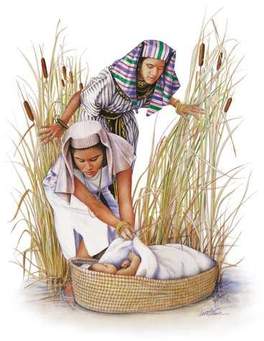
Now enters our next hero, Moses. He was born to the Levite couple, Amram and Jocebed. Jocebed hides him for 3 months. Then, probably fearing he’d be heard crying and discovered by Pharaoh’s soldiers, she places him in a water-tight basket and floats him on the Nile with prayer. She also sends his older sister, Miriam, to keep watch. Miriam sees Pharaoh’s childless daughter draw Moses out of the river. As our God would have it, Miriam and Pharaoh’s daughter just happen along at the opportune time. Sister helpfully offers to find a Hebrew slave to nurse the baby—none other than her and his mother! Don’t ever think God lacks a sense of humor, or of justice. In an amazing turn of events, Jocebed, the slave, is paid to feed her own rescued son! We know, from this side of the Cross, that Moses, whose name means draw out or brought out, would be used by God to bring or draw out His Chosen People from slavery in Egypt. Moses goes on to become the hero of the Exodus.

B. Finally, in our Gospel lesson (Matthew 16:13-20) we have the greatest hero of all, Jesus! Jesus leads His disciples to Caesarea Philippi, a Roman resort town about 2 day’s walk north of Capernaum. He asks them what people make of Him, (v.13)—Who do people say the Son of Man [the title Jesus used to refer to Himself] is. People aren’t sure. Some say He’s His cousin, John the Baptist, back from the grave; others say He’s Elijah; still others believe He is a prophet like Jeremiah. These are all famous prophets.

But then He asks them, knowing they have been with Him for 2.5 years, (v.15)—But what about you? Who do you say I am? They have the most experience with Him. They should be able to say. Impulsive Peter accurately pipes up, You are the Christ, the Son of the Living God. Jesus commends him for having heard that from the Holy Spirit. We know, again from this side of the Cross, that Jesus Christ is the long awaited Messiah. He has rescued us from the penalty for our sins and from everlasting punishment in hell. He is truly our hero!

Why search for and honor heroes? First, they provide us with examples who give us hope. They help us to see that people can behave bravely or in the interests not just of self, but altruistically, in the interest of others (love one another). They teach us that we can rise above our usual self-focused behavior. They encourage us to be brave and to do the right thing, even if it threatens our own life. Secondly—or perhaps even more important—they rescue us from dire circumstances. The two leaders of the midwives, Puah and Shiphora, were used by God to save many male Hebrew babies. Moses, born to Hebrew slaves, ends up being nurtured and educated under Pharaoh’s own nose then used by God to free His people. Jesus asks the disciples, Who do the people say the Son of Man is? We want and need a hero. We know that Jesus is our Redeemer, our Savior; our Divine Rescuer. He has paid the penalty for our sins. Like Mr. Sterling, He will establish order and peace in His Second Coming. We owe Him our love, our thanks, our praise! He is our Hero!

Thanks be to God who gives us the victory through our Lord Jesus Christ. Alleluia, Alleluia!

*Please be sure you are prepared for Hurricane Idalia and pray the Lord diminishes its strength before it hits any Florida community. Blessings and peace! *

©️2023 Rev. Dr. Sherry Adams

The WHY Questions

Pastor Sherry’s message for May 7, 2023

Scriptures: Acts 7:54-8:1; Ps 31:1-5, 15-16; 1 Pet 2:2-10; Jn 14:1-14

Remember when your kids or grandkids played “the Why Question Game” with you? We’ve all experienced it. Perhaps we were driving somewhere in the car, or trying to put them to bed, and they would pipe up with a Why question. Example One: We announce, “Kids, We’re going to stop at McDonalds for lunch.” The chorus from the backseat sings out, “Why?” “Because we all like McDonalds!” “Why?” “Well,” we say, “it’s quick and everyone can get what they want.” “Why?” By this time we are beginning to get irritated. But we’re on to them. We know how this goes, so we put a stop to the game. We say, “No more why’s!” From the back seat, accompanied by giggles, we hear, “Why?”

Example Two: The child has been bathed, teeth are brushed, a bedtime story has been read, and prayers are said. We say, “Good night. It’s time to go to sleep.” Just as we go to turn out the light, and close the door, we hear, “Why?” “Because you’ve had a busy day. You need your rest. ” “Why?” “Because your bones grow mainly when you are asleep.” “Why?” And on it can go, ad nauseum, and ad aggravation.

Actually, it’s a very good thing to ask why! Kids can ask why to manipulate or to irritate, but they can also be genuinely interested in cause and effect, and in finding out how their world works. Someone, somewhere once said, “The unexamined life is not worth living.” In other words, that person meant that we are not to live without questioning our routine and habitual ways of living out our lives. From this perspective, asking Why is among the most important things we ever do.

We must all answer for ourselves the Great Existential (things related to life and living) Questions:

1.) Who am I? (This deals with our identity.)

2.) Who (or what) made me?

3.)Why am I here? (What’s my purpose?)

4.) How do I know I have lived a good life?

5.) Where do I go when I die?

They are not all why questions but they do try to get at the Why? of our existence and of our purpose.

Peter offers, in today’s Epistle reading (1 Peter 2:2-10) some pretty effective answers to the Why Questions of life. As Christians, we know we are children of God, created by our Lord to know, love, and serve Him. That belief answers the Who made me Question. The answer, of course, is God. It also addresses the Why am I here Question: (1) To come to know God; (2) To develop a relationship with and learn to love God; and (3) to serve God and his people.

Peter also offers us answers to the identity and purposeful life questions: In verse 5, Peter refers to us each as …living stones [who are] being built into a spiritual house to be a holy priesthood, offering spiritual sacrifices acceptable to God through Jesus Christ. Remember, Jesus is the Rock. He changed Peter’s name from Simon to Peter, which means little rock, or chip off the Rock. As Christ-followers, we too are to live our lives as though we are chips off of Jesus–not just those who follow Christ’s teachings intellectually, but those who imitate Him, in what we do and in what we say.

The Lord wants to use us, as we serve Him, as a holy priesthood. In following Jesus denying Jesus then being lovingly forgiven and received back by Jesus, Peter knows the most important thing for us in life is to be closely connected to Jesus. What is the job/the role of a priest? It is to explain God to people—Who He is and what He wants from us. It is also to help people relate to Him—here’s what helps you draw nearer to Him and here’s what distances you from Him. Finally, a priest assists us to offer sacrifices to God–no longer animals, thank God, because Jesus is the once and for all perfect Sacrifice. But we offer God sacrifices of praise (consider our “Halleluiah Sing” this past Sunday. We each took an hour out of our day to sing hymns to the Lord). We also offer Him our time and talents (to cook, to decorate or maintain the church, to practice and perform music, to operate the Thrift Store, etc.). And we offer to Him money or tithes to help build up His Kingdom here on earth.

Peter goes on to exclaim (v.9) But you are a chosen people, a royal priesthood, a holy nation, a people belonging to God, that you may declare the praises of Him who called you out of darkness into His wonderful light. Peter asserts that we each were chosen. Here’s a great Why? Question. Why was Israel chosen to be God’s special people? Why were each of us chosen to be Christ-followers? Why did God pick us? While each of us is unique and special, none of us has earned special recognition from God—none of us deserves to be among God’s chosen. So why did God choose us? He chose each one of us because of His love and His grace. It all starts with Him. He initiates relationship and we respond to Him. The “Two Bubba’s and a Bible” say it so well: Why were we chosen, royal, holy [set apart]? Because of the pure, unbridled, unadulterated, unmitigated, unreasoned love of God. Why? …Not why as in, ”Why has God loved us, chosen us, made us royal and holy?” But Why as I, “Why has God called us together, what are we chosen for, what is our purpose, our reason for being?” Peter tells us that God has chosen us so that [we] may proclaim the mighty acts of (the One) who has called (us) out of darkness into God’s marvelous light. (Fairless and Chilton, The Lectionary Lab, Year A, 2013, pp.126-127).

There it is! Our purpose is to know, love and serve God by telling others about Him. Our purpose—as they say in Cursillo–is to “be a friend, make a friend, bring a friend to Christ.” Our greatest purpose in life is to help make Jesus known to others. We can do this by talking, blogging, or writing, recounting from our hearts how knowing Jesus has changed our lives. We can do this by assisting people in need, then giving Jesus the credit if they try to thank us. We can do this by the way we live our lives.

Stephen (Acts 7:54-8:1) witnessed to Jesus as he was being stoned to death. Saul observed Stephen’s death and scholars believe the way Stephen died subsequently prepared Saul to accept Jesus (in Acts 9) on the road to Damascus. We can fulfill our divine purpose in life by praying that people who don’t yet know Jesus to come to know Him.

Our Psalm (31:1-5, 15-16) and our Gospel (14:1-14) further illuminate our reasons to love and serve God:

Psalm 31 is a prayer for deliverance from trouble. Certainly being dragged out by an angry mob to be stoned to death, like Stephen–or crucified, like Jesus–qualifies as “big trouble.” Both Stephen and Jesus quote this psalm as they are being murdered: Verse 5 Into Your hands I commit my spirit. Both Jesus and Stephen exhibit the kind of faith in God demonstrated in verses 15-16 My times are in Your hands; deliver me from those who pursue me. Let your face shine on your servant; save me in your unfailing love. They knew that whether they lived or died was up to the Father. Both also forgave their murderers as they were being executed.

In John 14:6, Jesus declares that He is…the way and the truth and the life. No one comes to the Father except through Me. We love and follow Jesus because He is our only route to the Father. People who espouse other beliefs are offended by what they consider to be the “exclusive claims of Christianity.” Jesus is clearly saying no other set of religious beliefs will get us to heaven–neither worshipping the Buddha, Confucius, any Hindu gods, Allah, Baal, Satan, nor even a political party or “the state,” as communists do, will earn someone salvation. The Gospels and the Epistles proclaim that only Jesus can ultimately rescue us.

Jesus goes on to say in verses 9-10 Anyone who has seen Me has seen the Father. How can you say, “Show us the Father?” Don’t you believe that I am in the Father, and that the Father is in Me? In other words, Jesus is the Face of the Father. The Father is spirit and does not take on human form. Jesus fully represented God the Father on earth.

He gave us a human face to look upon; then, He only said what the Father told Him to say; and He did only what the Father told Him to do. He is what people might call “God with skin on.” So, we know we have lived a good life if we have accepted Jesus as our Lord and Savior, and if we have tried to live a life pleasing to Him, obeying Him and His Father.

One final thought: Our Gospel passage today also answers for us the final existential question—Where do we go when we die? John 14:1-3 is often read at funerals because of the hope and comfort it offers. Jesus promises (per Peterson’s The Message, NavPress, 2002, p.1948) Don’t let this throw you. You trust God, don’t you? Trust Me. There is plenty of room for you in my Father’s home. If that weren’t so, would I have told you that I’m on My way to get a room ready for you? And if I’m on my way to get your room ready, I’ll come back and get you so you can live where I live. Where do we go when we die? If we love Jesus, we go to live with Him forever in Paradise, in a room or a home He has prepared for us.

It’s good to ask “the Why Questions.” But it’s even better to know the answers. All of the great existential questions are answered, for those of us who love Jesus, though our faith in our Him.

Thanks be to God who gives us the victory through our Lord, Jesus Christ. Alleluia! Alleluia!

©️2023 Rev. Dr. Sherry Adams

The Antidote to Isolation and Alienation

Pastor Sherry’s message for January 22, 2023

Scriptures: Isa 9:1-4; Ps 27:1-9; 1 Cor 1:10-18; Matt 4:12-23

John Fairless and Delmer Chilton, of “Two Bubba’s and a Bible” fame share the following story:

“Back in the 1980’s there was a man named Larry Trapp living in Lincoln, Nebraska. His name was doubly ironic: He was a man trapped in his own hatred and trapped in his own body. Larry Trapp was suffering from a fatal disease and was confined to a wheel chair; he was nearly blind; he was also the Grand Dragon of the Ku Klux Klan in Nebraska. He truly was a man trapped in darkness.

“Larry Trapp became obsessed with driving Michael Weisser out of town. Weiser was Jewish and the cantor of the Lincoln Synagogue. Trapp barraged Weisser with hate mail, at home and on the job [Remember, this was in the days before cell phones and internet]. He made incessant threatening phone calls, he organized demonstrations; he did everything he could to make life a living hell for Michael Weisser and his family.

“Cantor Weisser was truly intimidated and scared. He had a wife and children he wanted to protect. But Michael Weisser was also a man who was unwilling to let another person’s hate prevent him from showing love. So he started calling Larry Trapp’s home, always getting the answering machine. So, he always left a message. He said, ‘This is Michael Weisser. I’d like to talk to you. I want to know why you are doing this to me.’ Finally, one day, Larry Trapp answered the phone, screaming and cursing and threatening, ‘WHAT DO YOU WANT? YOU’RE HARASSING ME!’

“And Michael Weisser said, ‘I know you have a hard time getting around and can’t drive, and I was wondering if you might need a ride to the grocery store or something?’ After a very long stunned silence, Larry Trapp quietly replied, ‘Uh, no, I’ve got that covered, but thanks for asking.’

“Larry and Michael kept talking by phone. After a while, Larry Trapp started going over to the Jewish Cantor’s house for dinner, they became friends, and when it became apparent he had nowhere else to go the Weisser family invited Larry to move in with them and he did, dying there in Michael’s arms some months later.

“Somewhere along the way, Larry Trapp left the KKK. He spent his last time on earth spreading a message of love in a world of hate; Larry Trapp became an apostle to Klansmen and other hate groups, trying to let them see the great light of love and forgiveness he has seen and experienced.”

(Originally reported in Time Magazine, February 17, 1992)

I wish I could tell you that Michael Weisser was a Christian. He was not a Christian, and yet he offered Christ-like love, compassion, and mercy to someone who had been thoroughly hateful to him. Obviously he lived by God’s admonition in Leviticus 19:18: Do not seek revenge or bear a grudge against one of your people, but love your neighbor as yourself. I am the LORD. What a great example for us! We overcome hate not by repaying it in kind. We overcome hate not by exacting revenge—as the culture advises us. We overcome hate with a calm manner and a loving heart.

The plain truth is that disconnectedness — isolation and alienation (way too common in our nation today) is at the root of most human problems. We are disconnected from God, from each other, and even from our true selves. Think about those who instigate mass shootings—or even those who suicide. They tend to be loners, people who feel like outsiders. They lack genuine, open, trusting, and loving relationships. They don’t feel a sense of community and envy those who do. Over time, they become angry, disappointed, without hope and, I believe, then fall prey to acting on Satan-inspired thoughts like killing or destroying.

Now think about how we are to function as a church: We are to gather together to (1) Worship God; (2) Learn more about Him so we can love Him; (3) And to form a community that demonstrates His love for us to others. The church should be the antidote to the poison of disconnectedness, isolation, and alienation.

This is the clear message of three of our passages today.

A. Our Gospel is from Matthew 4:12-23, and describes how Jesus began His public ministry: Matthew 1st tells us Jesus’ motivation for moving His base of operations from Nazareth to Capernaum. We know from the prophesies of Isaiah in 9:1-2 and 42:6-7, that Jesus was/is meant to be a light for the Gentiles (a corrective for what the Israelites had failed to do). Additionally, Luke 4:14-30 tells us that Jesus was rejected by His friends and neighbors in Nazareth when He essentially claimed He was the Messiah. So, He moved His base of operations NE to a larger town, Capernaum. It was a fishing town on the banks of Sea of Galilee. Peter, Andrew, James, John and Matthew all came from there. It was also a busy border town with a customs house meant to regulate trade from two major trade routes: One running East and West; a second, “The Way of the Sea,” joined Arabia and Egypt with nations north of Israel. It was a region which contained a large number of Roman citizens (there for vacations, retirement, and “peace-keeping” purposes) and other folks from all over. As a result, Jesus could teach and interact with many, but without the scrutiny He would have received in Jerusalem.

There He enlisted His first disciples…out walking on the shoreline. First, He calls brothers Andrew and Peter (Remember, Andrew had been JtB’s disciple, an probably heard John call Jesus “the Lamb of God who takes away the sin of the world.” Then He calls brothers James and John. All four guys fish for a living, but He promises to make them fishers of men. Apparently they drop everything and follow Him. Jesus is picking the original leaders of His as yet to be formed Church.

The Church was/is His strategy for reaching us, the Gentiles. We know He lived and traveled with these guys for 3 years. They learned from His teachings; their observations of Him; and the practice opportunities He gave them. Jesus could have established His church any number of ways, but He gathered together a small group of committed followers. He developed deep, personal relationships with them. He then sent them out to transform the world–to carry His light to Jews, and to rescue Gentiles from the darkness of paganism or unbelief.

B. St. Paul, in his letter to the Corinthian Church (1 Corinthians 1:10-18) emphasizes 2 points: He wants us to be as unified as we can be…Not to argue the merits/strengths of different pastors; not to hold a special allegiance to the ones who baptized us, married us, or buried our mothers, etc.; not even to come to church to make ourselves feel better. Rather, we must remember we are in the church in order to learn to know and to love Jesus, and to offer love to those who don’t yet know Him.

Paul wants us to follow Jesus—just like James, John, Andrew, and Peter. Rather than competing with each other, we need to keep our focus on Christ. Our loyalty is not to this church building—though we may love it–or even to our denomination. Our loyalty is to Jesus.

I reviewed my old sermons and realized I preached what I am about to say three years ago. We are at a cross-road in our denomination: Those who favor ordaining active gay persons and allowing same sex marriage are once again bringing that issue up for a vote. I said then and I think it is still true: I believe the United Methodist Church as we know it, will soon split, with those who hold to Scripture separating from those who appear to be following the dictates of the culture. We will be holding a parish meeting this Wednesday, January 25th, to discuss what we feel called to do. If we want to remain true to Biblical teachings, we may opt to leave the UMC and either join another denomination or remain independent. I urge you to pray about this, and to remember that Paul is urging us to remain faithful to Christ above all things. If the denomination is bowing to pressure from the culture—and chooses to depart from the teachings of Scripture–we may want to disassociate ourselves from the denomination. I was ordained an Episcopal “priest,” and left that demonination when the same split arose in favor of the Anglican Church. Please note I don’t take such a move lightly. In fact, I find it heart-breaking.

Meanwhile, it may seem like a big disconnect to consider a denominational split while also speaking of building relationships. When we pursue the Truth, sometimes we have to walk apart from the culture, from the denomination that nurtured our faith, and even sometimes from our families, or members of our families. Nevertheless, we strive to build relationships when we focus our spiritual energies on loving God and loving our neighbors.

May God give us His wisdom in this hour. Amen!

©️2023 Rev. Dr. Sherry Adams