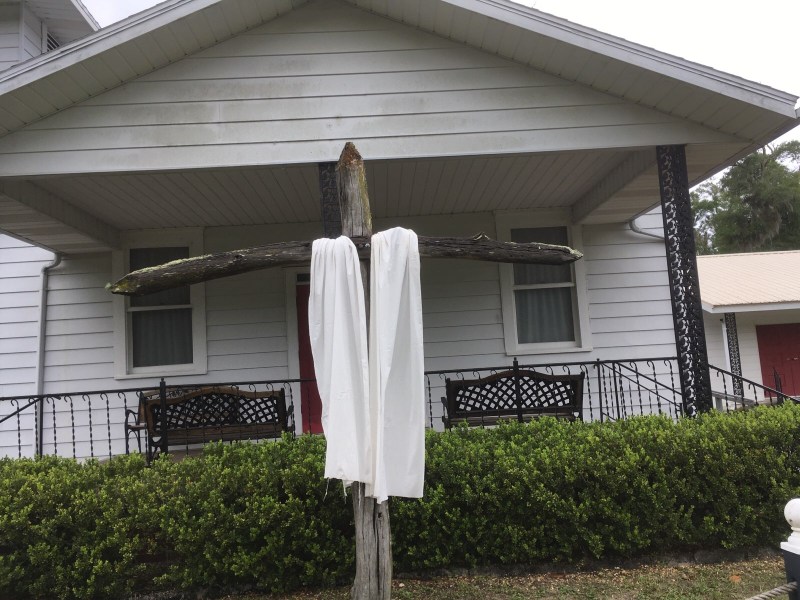
Good Friday Call to Prayer

Pastor Sherry’s Message for April 10, 2020

The LORD tells us in 2 Chronicles 7:14 If My people, who are called by My name, will humble themselves and pray and seek My face and turn from their wicked ways, then I will hear from heaven and will forgive their sin and will heal their land.

Based on these words, and given our present Covid-19 Crisis, we can safely assume we must (I) Humble ourselves, (II) Seek the Lord in prayer, (III) Confess our sins; (IV) Ask God’s forgiveness for our sins; and (V) Pray to Him to protect us and heal us from this terrible, deadly virus.  Apparently the Presbyterian Church of America (PCA), the Evangelical Presbyterian Church (EPC), and the Anglican Church of North America (ACNA)—an estimated 550,000 faithful persons–have all agreed to pray and fast on Good Friday with these intentions.

If you would be willing to enter into a holy fast—a fast for holy purposes—simply remember that it is a spiritual discipline that has us deny ourselves of some or all food and drink.  Please do what you can.  If you cannot skip a meal, try fasting social media or TV or the news.  Biblical fasting took place when a loved one died (2 Samuel 1:11-12), to prepare for special times of renewing one’s relationship with God (Numbers 29:7), to express sincere repentance for one’s sins and the sins of others (Ezra 10:6), and when the people of God desired to cry out for God’s special help in extraordinary circumstances—like the Covid-19 virus–(2 Chronicles 20:3) Throughout history, God’s people have sought His help in times of trouble through prayer and fasting.

If you would like to join in with these Christ-followers from other denominations in this time of prayer, please feel free to use the following prayers and/or add your own as you feel led:

(I-II) All we like sheep have gone astray; we have turned every one to his [her] own way, and the Lord has laid on Him the iniquity of us all (Isaiah 53:6).

Let us pray:  Almighty God, we beseech You graciously to behold this your family, for whom our Lord Jesus Christ was willing to be betrayed and given into the hands of sinners and to suffer death upon the Cross; Who now lives and reigns with You and the Holy Spirit, one God, for ever and ever.  Amen.

(III-IV) Please take a few minutes to consider your sins.  Remember what the apostle John wrote in 1 John 1:8-10àIf we claim to be without sin, we deceive ourselves and the truth is not in us.  If we confess our sins, He is faithful and just and will forgive us our sins and purify us from all unrighteousness.  If we claim we have sinned, we make Him out to be a liar and His word has no place in our lives

You might make a list of your sins to convey to God at this time, using this modern wording of an ancient prayer: 

Almighty God, Father of our Lord Jesus Christ, maker and judge of us all:  We acknowledge and lament our many sins and offenses, which we have committed by thought, word, and deed against Your divine majesty, provoking most justly your righteous anger against us.  We are deeply sorry for these our transgressions; the burden of them is more than we can bear.  Have mercy upon us, have mercy upon us, most merciful Father; for your Son our Lord Jesus Christ’s sake, forgive us all that is past; and grant that we may evermore serve and please You in newness of life to the honor and glory of your Name; through Jesus Christ our Lord.  Amen!

Since we know our God forgives all confessed sin—and places them…as far as the east is from the west… (Psalm 103:12), we can accept this in faith.  In thanksgiving and gratitude, and as an act of submission to God’s will, let us also pray the Lord’s Prayer:

Our Father, in heaven, hallowed be Your Name, Your kingdom come, Your will be done, on earth as it is in heaven. Give us today our daily bread. And forgive us our sins as we forgiven those who sin against us. Save us from the time of trial, and deliver us from evil—especially from the COVID-19 virus. Amen.

(V) These following are only suggested topics for your prayers:  Again, pray as the Holy Spirit leads you:

(1) Pray that God, in His power and mercy, would end the Coronavirus Pandemic.

(2) Pray that all our government leaders will be protected from the virus and that they will have the patience, wisdom, civility, and compassion to deal with the many problems facing our country in this perilous time.

(3) Pray for the safety of all members of the medical community and pray that they will be able to care for the sick with wisdom, kindness, and stamina.

(4) Pray that the sick will be healed and restored and that the elderly, and others with preexisting vulnerabilities, will be protected.

(5) Pray that the medical community will have the medical supplies, drugs, testing kits, protective equipment, ventilators, hospital and ICU beds to take care of the sick.

(6) Pray for those who are grieving for lost friends and family.

(7) Pray for the poor and all those who have been hurt by the economic downturn: employees—especially those in the service industry–the self-employed, small business owners, big businesses, churches, and charities.

(8) Pray that all those who have lost jobs will be able to return to work soon.

(9) Pray to restore the economy.

(10) Pray that in these difficult times hurting people will not turn to drug abuse, alcohol abuse, other addictions, and/or domestic abuse.

(11) Pray for those confined by quarantine those who are sheltered in place, and those practicing social distancing that they might not despair in loneliness and isolation.

(12) Pray for our education system at every level that has broken down under the threat of this disease. Pray for the millions of children who are trying to keep up with their schooling at home. Pray for wisdom, understanding, and the self-discipline to actually pursue their studies.

(13) Pray for the health and protection of all those who work in jobs that still serve the public every day and have greater exposure to the virus.

(14) Pray for a vaccine to end this virus and that this plague might not return among us.

(15) Pray that n this time of great national distress our people will show patience, kindness, grace, and love to all, and not turn to panic, greed, hoarding, and mischief. Pray that those cast down will be raised up.

(16) Pray for single mothers, widows, orphans, aliens, and outcasts in their distress.

(17) Pray for the peace and safety of the Church universal around the world.

(18) Pray for people everywhere according to their needs and for all the special needs that you know about.

(19) Pray that our countrymen and women will realize the brevity and uncertainty of life and would turn to Christ in repentance and faith.

(20) Pray that the people of God will love what He commands and desire what He promises.

(21) Pray that God will be pleased with our prayers and answer themin His infinite grace and mercy, through Jesus Christ our Lord.

©2020 Rev. Dr. Sherry Adams

Palm Sunday, 2020

Pastor Sherry’s Message for April 5, 2020

Scripture Readings: Isaiah 50:4-9a; Psalms 31:9-16; Philippians 2:5-11; Matthew 26:14—27:66

         Some of us are old enough to remember a book that came out in 1984 called Future Shock.  In it the author, Alvin Toffler, cited a dizzying array of changes that had already occurred in the world back then, and proclaimed—accurately so—that the rate of change in the 20th century was increasing exponentially.  He predicted that people would become overwhelmed by the rate of change and would have difficulty orienting ourselves, let alone feeling secure, in what amounts to a cultural whirlwind or earthquake.  As I tune into the daily news reports on the Covid-19 virus, I am reminded of Toffler’s premise.  One day the experts tell us one thing; the next day, given new information, the previous perception has changed and been replaced by something new.  We can expect that our understandings of this pandemic will continue to modify as doctors and scientists gather more data and refine their predictive models.  Meanwhile, we are left coping with the usual anxiety surrounding life as we know it, to which has now been added the stress of a serious health risk and the threat of potential death.  How will we manage to maintain our footing, our balance, our sanity in these uncertain times? 

         As always, our God has some very useful, practical, and encouraging reminders for us in the Scriptures appointed for today.  I recommend you read the passage as I attempt both to explain it and to share its relevance as a counter to our mounting anxiety:

         Our Old Testament lesson is from the prophet Isaiah.  Chapter 50 (verses 4-9a) contains the 3rd of 4 passages known as the “Suffering Servant Songs.”  Between 750-700 years before Jesus was born, the prophet was describing—very accurately—what Jesus would experience and how He would behave as He faced and endured the Cross.  Prior to His crucifixion, the Jews believed these passages may have described the predicted Messiah, but most did not agree that they referred to Christ.  It is only from this side of the Cross that we realize they do refer to and were precisely fulfilled by Jesus.  The point of this 3rd Servant Song is that Jesus came to earth determined to save us; that is, that He came into the world to pay the penalty for and to redeem us from our sins.  To prepare Himself, He studied God’s Word, the Old Testament writings.  During the 30 years before His public ministry, He steeped Himself in Scripture (vv.4-5) We would say He was a “student of the Word.”  Verse 6 tells us that His trial by the Sanhedrin (the Jewish religious ruling body) led to significant suffering at the hands of His own chosen people.  They beat Him, mocked Him, spit upon His precious face, and even pulled out the hair of His beard—all prior to appearing before Pilate.  What sustained Him?  What allowed Him to endure all this?  He knew His purpose and He trusted in the Father to help Him:  (vv.7-9) Because the Sovereign LORD [the Father] helps Me, I will not be disgraced.  Therefore have I set My face like flint, and I know I will not be put to shame…He who vindicates Me is near…it is the Sovereign LORD who helps me.  Jesus is reassuring Himself, though the prophet’s words, of the Father’s presence and the Father’s love.  This is what defines Him, not the attitudes, the condemnation, nor the despicable treatment of the religious authorities of His day. 

Such a lesson for us, isn’t it?  Do you see the trustworthiness of the Lord?  Thank God Jesus Christ is the once and for all sacrifice for our sins (Hebrews 7:6-27)!  He paid the price for us!  His atoning death set us free from the penalty we deserved.  And Jesus did it believing in Scripture and trusting in His Father’s love.  May we cling to the promises of the Old and New Testaments, and may we hold onto our faith in our God—despite accelerating rates of change and worldwide pandemics!  May we exhibit faith like that of Jesus!

Psalm 31 was written by King David.  It describes how he felt during his tough times, both prior to and after ascending the throne of Israel.  But it also very aptly describes what Jesus probably suffered on the way to His crucifixion at Golgatha, and even as He hung suspended from the Cross:  (V.9) Be merciful to Me, O LORD, for I am in distress… (v.10) My life is consumed by anguish and my years by groaning; My strength fails….(v.11) Because of My enemies, I am the utter contempt of My neighbors…(v.12) …I have become like broken pottery.  He is experiencing despair and grief.  But He does not succumb to it.  In verse 14, he reminds Himself, But I trust in You, O LORD.  I say, “You are my God.”  And He reaffirms for Himself, (v.15) My times are in Your hands.  These truths hold true for you and me as well.  I think it is safe to say that we hate to suffer.  However, suffering seems, like death, taxes, and change, inevitable in this life.  During times of suffering, we want to remember–like King David and like Jesus–that God’s got this!  God was not surprised by the virulence of this pandemic.  God knows that many of us are experiencing “cabin fever” while “sheltering in place.”  He knows we are worried about our health and about the economy, and are perhaps even stress-eating. Yikes!   We can trust in Him to sustain us through the most difficult times because He is only a prayer away (meaning He is present to us), He loves us, and He sent His only, beloved Son to die to save us.

St. Paul’s epistle to the Philippians (2:5-11) contains what the early Christian Church called “the Philippian Hymn.”  It was probably a statement that newly baptized Christians had to memorize as it succinctly summarizes exactly what Jesus did for us, and how the Father regarded His saving work on our behalf.  Paul wants us to be as humble and as obedient to the Father as Jesus was.  He also desires that we appreciate the depths of Jesus’ sacrifice on our behalf:  He gave up His heavenly prerogatives as King of the Universe, the One who spoke creation into existence, to be born in a stable, to a poor, young, homeless couple, in a ragtag and oppressed 2/3rds world nation.  Instead of demanding respect and a wide following as a great and exalted leader, He humbly behaved as a servant to all.  He obeyed His Father in everything, even up to and including His manner of death—totally righteous and holy, He died like a tortured, despised criminal.  No wonder the Father has honored Him above all things, declaring that His name commands total obedience, from every being, in every sphere!  Wow!  This reminds me of the lyrics of a Chris Tomlin song from sometime back a while ago:

Amazing love, O what sacrifice,

The Son of God given for me…

My debt He paid and my death He died,

That I might live…that I might live.

How amazing is God’s love for us!

         Finally, we have Matthew’s version of “the Passion of the Christ” (26:14-27:66), or what we know as the story of Jesus’ trials, crucifixion, and death.  It’s a long passage, but well worth reading and meditating upon during Holy Week.  It reminds us of the price our Lord paid for us, emotionally, intellectually, physically, and spiritually.  He was “all in,” whereas Judas, Peter, the rest of the Apostles, the Jewish religious leadership, the mob, even Pilate all betrayed and abandoned Him.  Simon of Cyrene helped Him carry His cross (voluntarily or coerced, it’s unclear), the hardened, Roman centurian on execution detail (a Gentile) attested to His true identity, and a few devoted women (plus John, according to his Gospel) remained with Him until He gave up His spirit.  Notice that the Father registered His own grief with earthquakes, 3 hours of darkness, and splitting the heavy temple curtain (made of woven goat hair) from top to bottom.  Additionally He commemorated the completion of Jesus’ work by opening tombs, and offering a preview of the Big Easter Event by resurrecting (v.52) …many holy people.  The dead Christ was placed in His tomb, the stone sealed, and a detail set by Pilate to guard the grave.  What a journey from the noisy, Hosanna celebration of Palm Sunday to the quiet grief and despair of Good Friday!

         As Paul Harvey would have said, we know the rest of the story.  We know it doesn’t end there, with death having the last word.  Praise God!  When Jesus cried out from the Cross, (John 19:30) It is finished! (tetelestai), He meant that He had accomplished the work of redemption the Father had given Him to do.  All that is left is a kind of “mopping up detail” that we are living out today.  Jesus has demonstrated the truth of His name, God Saves.  Our God has done all the work of salvation for us.  The battle is over.  The victory has been won for us by Christ.  Again, thanks be to God who gives us the victory over sin and death, through our Lord, Jesus Christ.  All we have to do is say “yes” to Jesus.  All we have to do is allow Him to sit on the throne of our lives.  As we surrender to Him—just as He surrendered to His Father–He will bless us, guard us, protect us, and even resurrect us. 

         Yes, the world is changing at a hypersonic rate.  Many things we used to depend upon are uprooted or overturned or no longer reliable or even available.  In these anxiety-riddled and unstable times, Let us fix our eyes on Jesus, the author and perfecter of our faith, who for the joy set before Him endured the cross, scorning its shame and sat down at the right hand of the throne of God.  Consider Him who endured such opposition from sinful men, so that you will not grow weary and lose heart (Hebrews 12:2-3).  We can trust in our God, despite any threats to the contrary.  This Holy Week, let us stand firm our faith that Jesus has the power to help us, to sustain us, and to keep us sane, safe, and secure.  AMEN! 

©2020 Rev. Dr. Sherry Adams

Faith: The Antidote to Fear

Pastor Sherry’s Message for March 29, 2020

Scripture Readings: Ezekiel 37:1-14; Psalm 130; Romans 8:5-11; John 11:1-45

         Wow!  The fears that are being expressed across our nation, during the current threat of the Chinese Coronavirus, are just about overwhelming, aren’t they?  If you watch the news for any length of time—or check into social media–you will find your heartbeat accelerating, your sense of dread rising, and your desire to begin to hoard supplies snowballing. Along with this is a growing tendency of many to lose hope.  I spoke this week with a relative who lives in Seattle.  This person does not appear open to believing in God, but trusts in science and in the government to keep her safe.  She feels that neither has done so; thus, as a result, she is very angry and very frightened.  But for those of us who trust in God’s love and His power (rather than exclusively in science or in the efforts of humankind), we realize that our God is the God of all hope—and, as a result, we do not need to lose heart or hope, even in these perilous times.

         Our Scripture lessons appointed for today all stress this truth:  We can believe that our God can do something about every situation about which we feel powerless.  Take a look at the Ezekiel passage.  (You may want to read it now.)  The prophet Ezekiel is foretelling the restoration of the nation of Israel.  At the time of his writing, the Israelites had been taken captive by the Babylonians and had been exiled away from the Promised Land.  God is saying through His mouthpiece that He intends to revive them spiritually and to bring them home.  In a sense, they are dry, desiccated bones lying about in a disconnected disarray.  But God has the prophet speak life into them, and miraculously they reassemble in stages, from scattered fragments, to cadavers (reunited bodies, but without life), to a restored and living army or assembly.  Notice, it is God who gives them life.  He works through commands He gives to the prophet to relay, but the work of reviving life is His.  Our God has the power over life.  Should we really worry about a virus taking us out?  No!  And even if it does, we have eternal life and will simply cross over into an existence so much better than what we experience now.

         As Paul relates in his letter to the Romans (chapter 5, verse 6), The mind of sinful man [and woman] is death, but the mind controlled by the Spirit is life and peaceIn other words,we are unable—without divine assistance—to overcome sin in our lives.  Or, as Peterson writes in his modern paraphrase, Those who think they can do it on their own [overcome sin by their own efforts] end up obsessed with measuring their own moral muscle but never get around to exercising it in real life.  Those who trust God’s action in them find that God’s Spirit is in them—living and breathing God!  Obsession with self in these matters is a dead end; attention to God leads us out into the open into a spacious, free life.   Again, God can do in our lives—when we trust Him—immeasurably more than all we ask or imagine, according to His power that is at work within us….(Ephesians 3:29).  So, we want to be smart.  We want to follow the recommendations that have come down to us from our President and our Governor about how to minimize our risk of infection now.  But, we do not want to lose heart!  We do not want to panic!  Those of us who know and love Jesus have… the peace of God which transcends all understanding (Philippians 4:7).  This peace is not centered on what is going around in the world or in our country, but upon our relationship with the Rock, who is Christ Jesus.  He is our peace and He longs to give us His peace.

         Our psalm (130) encourages us to bring our fears to the One who can do something about them.  In verses 1-2, he says, Out of the depths I cry to you, O LORD; O Lord, hear my voice.  Let your ears be attentive to my cry for mercy.  As you read or recite this, don’t you get the sense that the writer knows that our Lord hears his cry?  It is true that He knows and hears our pleas for safety and health in this current crisis.  We can convey those to Him with faith.  Like us, the Psalmist recognizes he is a sinner who has been forgiven through God’s grace.  He trusts that God hears, attends, and will answer and protect him.  In verses 5-6, he describes waiting on the Lord’s answer, not in an anxious, worried way, but with hopeful expectation.  I believe we can similarly await effective treatments for this dangerous virus, and may already have found several.  We can pray for a hedge of God’s protection around our healthcare workers as they contend with ameliorating symptoms and attempting to save lives.  Like Israel, we are to put our hope in the Lord (v.7),…for with the LORD is unfailing love and with Him is full redemption….

         Finally, our Gospel lesson gives us an example of a person (one of three mentioned in the New Testament: Jairus’ 12 year old daughter, the son of the widow of Nain, and now Lazarus, Jesus’ friend) who had died and was raised from the dead by Jesus.  A number of Christian scholars point out that these folks were not truly “resurrected” because when that happens the body is actually transformed or transfigured into something immortal in preparation for entering into eternity.  These three—and there may have been more not cited in the Gospels—were brought back to life, in this world, in their normal, everyday, mortal bodies.  And, sadly for them, they faced death again, at a later time, because those bodies came with expiration dates.  In verse 4, Jesus tells His disciples regarding Lazarus’ demise, This sickness will not end in death.  No, it is for God’s glory so that God’s Son may be glorified through it.  In other words, the Father meant for Jesus to demonstrate to the large group of Jerusalem Jews grieving with Mary and Martha that Jesus had the same power over life and death that the Father has.  What this strongly suggests to us is that nothing—not even the Chinese Coronavirus—comes into our lives without God’s permission; and, if God permits it, it is somehow going to be for His glory.  I believe God is already at work, inspiring talented doctors and scientists to develop treatment protocols and medications to control and defeat Covid-19.  Further I believe that when this is said and done, we will be able to look back and see God’s hand at work in ways we might not have anticipated.  Already, commentators are projecting that the pandemic will permanently alter the way we deliver college education; bring back “supply chains” of important resources to America from abroad; and draw families into closer, face-to-face communication.   With so many manufacturing concerns voluntarily retooling from their usual products to those required by hospitals and clinics now, there may be a resurgence of American patriotism and a renewed sense of togetherness despite our differences.  No one wants anyone to die, but I do believe there will be God-ordained benefits to be derived from this that will serve the greater good.

Jesus tells Martha (verses 25-26), I am the resurrection and the life. He who believes in Me will live, even though he dies; and whoever lives and believes in Me will never die…. If we have Jesus, we have life! The great author, Fyodor Dostoevsky, learned this firsthand and it permanently changed his life. As an educated young man from a wealthy family, he flirted with communist and revolutionary thought in czarist Russia. Czar Nicholas 1st learned of his leanings and had him arrested, tried, and sentenced to death by a firing squad. Dostoevsky was blind-folded, dressed in burial clothes, bound, and led into a public square where he was tied to a post. The young writer next heard the rifles being cocked. The order was given, “Ready, aim,” but just at that moment—when the command “fire” was expected–a message arrived from the czar to commute the death penalty to 4 years of hard labor. Dostoevsky later wrote that he never totally recovered from this experience. On the train to prison in Siberia, an unnamed Christian gave him a copy of the New Testament, which he devoured. He then turned his life over to Christ. Despite witnessing great evil among some of his cellmates, he developed the belief that humans are only capable of loving if they believe they are loved. His greatest works are all novels which treat the issues of sin and repentance, grace, and forgiveness. In other words, coming so close to death radically altered his sense of what is important in life. How would you change your thinking or your life style if you knew you only had a moment or days to live? Dostoevsky has left us a record of how he changed. Wouldn’t you love to know how Lazarus was impacted by a second chance at life?

         Our God intends for us to live each day as persons who do not fear death or viruses.  We are to live as persons who know that God’s love is more important and more powerful that anything this world can throw at us.  Our faith in God is our antidote to fear.  Can we try to live this week and beyond—despite news reports and what others may say or write—as if we truly believe this?  Thanks be to God who gives us the victory through our Lord, Jesus Christ!

Copyright Rev. Dr. Sherry Adams 2020

Fear Not!

Pastor Sherry’s Message 

Scripture Readings: Sam.16:1-13; Ps 23; John 9:1-41

One of my heroes of the faith is a man named Charles Simeon (1758-1836).  He was an Englishman who was about 18 at the time of our Revolutionary War.  An Evangelical, Bible-believing, Anglican pastor and college professor, he had graduated from Eton & from Cambridge University.  Having had an encounter with Christ through his own Scripture readings on Easter Sunday, Charles had converted to Christianity at age 19.  He was definitely a unique person as there were apparently no other Christians at the University for the next 3 years.

Two years after graduating from Cambridge, in 1782, he was appointed by his Bishop to be the lead pastor at Holy Trinity Church–the most prominent church in Cambridge at the time.  Though typically Bishops then appointed clergy rather than their being “called” by individual congregations, Charles was a young man (24) for such an important position. As it turned out, many parishioners there didn’t want him because he believed in Jesus and he preached the Scriptures.  It was the era of the Enlightenment, when many intellectuals in England—and in this university city–had abandoned their faith in God in favor of trusting only in science.  They preferred an associate pastor, a Mr. Hammond, a guy who preached more to their liking.  So unable to get the Bishop to agree with their choice, they began a campaign to run Simeon off. For 12 years,

  1. They locked their pew doors so that anyone who came to services had to

stand in the aisles.

  1. They refused to let Simeon preach the Sunday afternoon service for 10

years.

  1. They slandered
  2. In addition, Cambridge students
  3. Derided his belief in the truth claims of the Bible;
  4. Ostracized the students he did convert;
  5. Disrupted services inside & created noisy demonstrations in thestreets to keep worshippers away;
  6. And threw tomatoes at Simeon as he entered the church yard.
  7. Cambridge University named him Dean for 9 years, even though his peers snubbed/avoided him because he was a follower of Jesus Christ.

What is truly astonishing to me about him is that he remained in that parish for 54 years (ages 24-77)!  He did not appear to be afraid of what they might do to him to drive him off; instead he simply out-persisted his antagonists!  Over the years he was there, he turned many hearts to Jesus through his patient endurance & faithful Gospel preaching (his sermons have been preserved in 21 volumes).  Though they had begun his tenure by hating and reviling him, by the time he died, the entire parish & University turned out for his funeral.  He had become beloved by town, gown, and parish.  He had served as a model of humility and perseverance. What sustained him through the first 12 years of energetic resistance? He never married, so it wasn’t a reassuring, supportive spouse.  So Who or What helped him to patiently persist all those lonely years?  The same Jesus, and the same Holy Spirit, who sustain, protect, and encourage each of us.

Right now, we are in voluntary quarantine due to the Chinese Corona Virus.  Let’s examine what the Scripture lessons appointed for today have to tell us about facing such threats without fear.

  • In our Old Testament lesson, Samuel anoints David King of Israel in about 1025BC. Now Israel had a king already, King Saul; but because he did not have a healthy respect for or a reverence for God, God had rejected him as the leader of His people.  So God sends the prophet Samuel to anoint someone else to take Saul’s place.  Afraid of Saul’s anger and vengeance, Samuel journeys to Bethlehem under a religious pretext.  Notice, the prophet doesn’t know God’s choice; he has to have Jesse parade 7 of his eight handsome sons before him (David was the baby of 10 kids, including 2 daughters).  The 7 older sons are tall and handsome, but God rejects them all.  The Lord tells His prophet, Do not look on his appearance or on the height of his stature, because I have rejected him; for the Lord does not see as mortals see; they look on the outward appearance, but the Lord looks on the heartIt’s only when David is sent for, that God says, “Yes, this is my choice.”

Why is David God’s choice as King?  We tend to judge people by their looks, how much money they have, and/or their influence or status.  But God is mainly concerned with heart attitudes.  It’s due to David’s heart (his character) that God chooses him.  Later, he proves he is…

a.) courageous by killing Goliath, the giant, with just a slingshot;

b.) humble by assisting/serving the very man he is to replace;

c.) not vengeful because he refrains from killing Saul, even when Saul is

determined to kill him;

  • and commited to God, even though it takes another 15 years before

he actually begins his reign as king.

Please be aware that the prophet Samuel was very worried about going to Bethlehem.  Like us, facing this Chinese Coronavirus pandemic, he had the backing, the fortification, the defense of God’s presence with him.  We do not need to be afraid!  We do not need to panic, even if the culture around us seems to be freaking out.  We know Jesus, so we can know (and feel) peace.

  • In the 23rd Psalm, we learn that King David trusted God to lead, guide, & provide for him. Verse 4 relates to the issue of fear:  Even though I walk through the valley of the shadow of death, I will fear no evil, for You [God] are with me.  David had experienced God’s protection over and over again, and so have we.  I wonder if,  when we get to heaven, we will learn of the many threats against us–brought about by the Evil One–from which God will have rescued us?  To God be the glory, great things He has done!


Additionally, like Charles Simeon 2800 years later, King David spent 15 years in the school of hard knocks.  If you look at the lives of many Biblical Greats, we see the same pattern:

  • Abraham & Sarah anxiously wait 25 yrs. for the birth of Isaac;
  • Moses shepherds 40 yrs. before leading God’s people out of Egypt, then wanders about with them for another 40;
  • Joseph endures 7 yrs. as a slave & another 7 in prison before God raises him to second in command after Pharaoh.

The question is:  Why does God allow this sort of thing to happen to those who put their trust in Him?  We were given the answer in last week’s Epistle reading from Peterson’s The Message(Ro 5:3-5):  We continue to shout our praise even when we’re hemmed in with  troubles [suffering], because we know how troubles can develop passionate patience in us [patient endurance], & how patience in turn forges the tempered steel of virtue [character], keeping us alert for whatever God will do next.  In alert expectancy [hope] such as this, we’re never left feeling shortchanged.  Quite the contrary—we can’t round up enough containers to hold everything God generously pours into our lives thru the Holy Spirit!  In other words, God allows us to undergo suffering [like the Chinese CoronaVirus and its attendant quarantine] because our patient endurance of it molds and shapes our character.  Unless we get really angry with God, it makes us more dependent on Him.  We become acquainted with the Holy Spirit and we learn to listen to His voice for guidance.  As a result, our faith deepens.  Charles Simeon admitted he had a terrible temper and a sharp tongue prior to his 12 year struggle with the resistance at Holy Trinity Church.


3.)Our Gospel lesson relates the story of the man born blind.  What might his testimony have to tell us about facing fear?  For one thing, he’s cheeky, gutsy, and grateful.  Prior to meeting Jesus, he is an adult who has had to beg for his living.  Imagine never, ever having seen colors or dimensions; or not being able to observe the behavior of people or their facial expressions.  What about missing out on perceiving your mother or your father’s faces?  He encounters Christ and receives sight, for the first time ever. Wow!  What joy!  Though he might now have some concerns about how to make a living, on the whole, this is something to be thrilled about!

However, look at the response of the others around him:  Some of his neighbors doubt his identity and his healing.  The Pharisees grill him.  Like police with a suspect under a naked light bulb, they demand to know, “Who healed you?”  “Why was the One who healed you working on the Sabbath?”  In other words, they are trying to discern, “Is Jesus a good guy or a sinner?”  They don’t believe the man’s own account, so they call his parents.  Now, these parents are shrewd.  They know the attitude of Pharisees toward Jesus, and they’ve heard that the Pharisees are throwing Christ-followers out of the synagogue,.  So they refuse to commit themselves and send the issue back to their son:  “Hey, don’t ask us!  He’s a grown up!  Ask him!”  The Pharisees call the man back again, and want him to renounce Christ.  He won’t do it! [Good for him!]  Essentially he says, “This is my story and I’m sticking to it…I’m sticking with Him too!  And then they do excommunicate him.

This man is very brave in the face of economic and social ruin.  Excommunication from the synagogue in those days meant you were a pariah.  You could not talk with practicing Jews; you would not be invited to their homes; you had no way to make a living nor to worship God.  Yet this guy braves it all.  His reward?  He gets to see and he gets to see Jesus!

Truthfully, how much do we have to fear from the Virus?   In Whom do we trust?

When we consider the examples of Charles Simeon, from history, & of King David and the man born blind from our Scriptures, we are encouraged to Take heart!  The spiritual temptation, when we go through hard times, is to cringe,  to withdraw, and to lose faith in God’s power or desire to act on our behalf.  These individuals each urge us to keep our faith and keep our heads!  We want to trust in our God and in His loving protection of us.  We want to remember that our God uses hard times—like what we are going through now–to improve & refine us:

  • He knocks off our prickly edges, and hammers out our imperfections;
  • He molds and shapes us into the image of Jesus;
  • He softens our hearts and helps us to love as He does.

So, as Moses writes (Deuteronlmy 1:29), let us remember, Do not be terrified, do not be afraid [of the virus].  The Lord will fight for you!  Let’s remember to keep the faith and not surrender to fear.  Thanks be to God who gives us the victory through our Lord, Jesus Christ. Amen. 

Copyright 3/22/20201 Rev. Dr. Sherry Adams

Faith Not Fear

In compliance with CDC recommendations, Wellborn United Methodist Church is suspending all services, at least until April, 2020. Yet worship will continue. Pastor Sherry will post weekly messages and asks for daily prayers for an end to the Coronavirus pandemic, for healing of those stricken with the illness, and for strength for all medical professionals and caregivers affected by Coronavirus.