The Primacy of Love

Pastor Sherry’s Message for October 25, 2020

Scriptures: Matt. 22:34-46; Deut 34:1-12; Ps 90:1-6, 13-17; 1 Thes. 2:1-8

You hear a lot of talk today about people who claim they are spiritual but are not really interested in committing to Jesus. I hear this from the young people who spend 30-60 days at Honey Lake Clinic. They come in admitting they have tried everything they know to help themselves overcome their addictions, or their hopeless depressions, or their paralyzing anxieties. Through the testimonies and examples of staff, we tend to be able to convince them that Jesus loves them and is able to heal them. Where we have less success is in persuading them to join a body of believers–to support their newfound faith–when they return home. You see, they can believe Jesus loves them, but they doubt they will experience love from His body, the Church.

They look around at us and say, “Hypocrites!”   Unfortunately, they see us as judgmental, critical of them and of their lifestyles.  Sometimes I think they are so sure we will reject them that they reject us first.  While we may be able to win them over to our God because He loves them and wants to heal & bless them—even though they cannot see Him, we do much less well at talking them into getting involved with other followers of Christ—who they can see.

Remember last week I encouraged us to pray for those political persons we find ourselves hating or at least severely disliking.  This is tough to do, isn’t it?  It’s not our natural inclination. We’d rather hold onto our resentments and our anger.  This is exactly what nonbelievers hold against us.  I have shared with you before that G.K. Chesterton, the noted British writer, said 100 years ago, Jesus…tells us to love our neighbors.  Elsewhere the Bible tells us Jesus said we should love our enemies.  This is because, generally speaking, they are the same people.

So, how exactly do we go about loving the seeminglyunlovable?  Those who have offended us or harmed us?  Our lessons today speak to this point:

First of all, Jesus instructs us on the primacy of love in Matthew 22:34-46The Pharisees are now colluding with the Sadducees to try to trap Jesus.  This is like a coalition of conservative Republicans and Green New Deal Democrats, a very unlikely coalition.  An expert in the Law asks Jesus (v.36), Teacher, which is the greatest commandment in the Law?  Now bear in mind they taught there were as many as 613 commandments, the original 10 plus others.  Hoping to trip Him up, the Pharisee is saying “What’s the most important one?  Give me the bottom line.  What’s our takeaway?  Come on, Man, let’s cut to the chase (and bear in mind that we will make a huge deal of the ones You omit!)   

So Jesus, who is great at getting to the bottom line, says two things matter most in this life.   Citing Deuteronomy 6:5 and Leviticus 19:18, Jesus ties them together as the greatest commandment.  Deuteronomy 6:5àLove the Lord your God with all your heart and with all your soul and with all your strength.  And Leviticus 19:18àlove your neighbor as yourself.  We tend to believe these two laws were created by Christ, but God the Father set them out early on in the Torah.

Then Jesus politely shuts them up by tossing them a riddle from Psalm 110:  If the Messiah is David’s son (descendant), how can He also be David’s master?  This is for them an unanswerable question, somewhat like, Which comes first, the chicken or the egg?  From this side of the Cross, we know the answer is “Jesus is Lord of all,” including King David.  What the observing crowd understands is that Jesus has bested them—again–at their own game.

 As Christ followers, we are to love God above all things, and love our neighbors—even the ones we don’t like– as ourselves.  This means we are to begin with a healthy love for ourselves.  I’m not talking about an arrogant or narcissistic self-love, nor do I mean a self-love so self-effacing as to appear we hate or loath ourselves.  As they say in Live Oak, Florida, “You can’t get back from where you ain’t been! “  We have to love ourselves in order to be able to love others.  Jesus is saying, we are to love God and others because God the Father has commanded us to do so.  We are to love God and others because Jesus seconded the motion. 

Finally, we are to love God and others because this is what wins the world to Christ!  Remember in world-wide plagues in the late 100’s and late 200’s, the Church grew because Christians remained to help nurse those who were sick, while other religious and political leaders headed to the hills to save themselves.  Christians also rescued infants abandoned on the city trash-heaps and raised them.  Their pagan neighbors were so impressed by the selfless love involved in both actions that they decided to become Christ-followers themselves.

Now, let’s look at our other Scripture lessons to see if there are hints as to how we demonstrate the primacy of love:

Deuteronomy 43:1-12  describes the death of Moses, at 120 years old.

Some scholars say this final chapter ought to be the first chapter of Joshua.  We know that Moses wrote Genesis, Exodus, Leviticus, Numbers, and Deuteronomy—the Torah (Law); but how could he write this last chapter describing his own death?  Perhaps Moses was being prophetic?  Or maybe his successor, Joshua—who was not there—recorded what God told him about the event.  Afterall, verse 9 says Joshua was filled with the spirit of wisdom because Moses had laid hands on him.

Verse 6 tells us, He buried him in Moab, in the valley opposite Beth Peor, but to this day no one knows where his grave is.  Who is the HE who accomplished the burial?  God.   God the Father probably had His angels perform it, while He presided—what a funeral!   Some scholars say, He [Moses] died by a kiss of God.  The Israelites then honored Moses by grieving for him for 30 days.

Why did God see to his burial?   Verse 10 tells us, Since then [until Jesus], no prophet has risen in Israel like Moses, whom the LORD knew face to face.

Because Moses loved God and served God, our God was with him until the end of his life and appears to have ushered him into the one beyond.  I believe that If we love and serve Him with this kind of dedication, He will welcome us too into eternity with open arms!

            Psalm 90:1-6, 13-1 7 tells us that grasping the concept of eternity is really beyond the capacity of our earthly intellect.  Seriously, think about it for long and it will give you a headache.  Same result if we try to understand how God always was, is now, and will be forever.  Moses wrote this Psalm in about 1400 BC.

Now, having shepherded the children of Israel out of Egypt (1-2 million of them), and learning from God that none of them (except Joshua and Caleb) would enter the Promised Land—due to lack of trust in God to help them conquer the tribes living there—I think it is safe to say that Moses attended a lot of funerals!

He has, as a result, written a Psalm of death.  He lived to be 120, and yet he refers to how brief life is:  He says our lives are like a watch in the night (v.4);  like the new grass of the morning—though in the morning it springs up new, by evening it is dry and withered (vv.5-6).  Then he compares our lifespans with God’s: (V.2) …from everlasting to everlasting, you are God.  Literally, in the Hebrew, that means, from vanishing point to vanishing point; from east to west or from the past into the future.  In other words,

                                   [1] Before time was, God is;

                                    [2] When time shall be no more, God still is.

                                    [3] God never was;

                                    [4] There is never a time when God will be;

                                    [5] God simply is (I am who I am).

So, in light of God’s eternity, Moses asks God to (v.12) Teach us to number our days aright, that we may gain a heart of wisdom.  Moses is urging us to remember that we are mortal, and that we make our days count by demonstrating/living out God’s love to others.

            1 Thessalonians 2:1-8àWe make our days count by sharing the Gospel with others.  Sometimes we do this with our words.  But, perhaps more powerfully, we do this by our actions.   Paul says he did not come to the Thessalonians out of self-serving motives, or to earn money.  He did not minister among them to gather prestige, honor, or position.  He came to them out of his love for Christ and Christ’s love for them.  That’s how we make our days count.

We do what God has put before us to do, out of love for Christ and for His people.

God’s View of what’s crucial in this life ought to be ours, right?

The upcoming election next week is certainly very important. However, it is not as important as loving God and loving others.  This week, let’s try to be aware of being a good example of a Christian.  If non-believers were watching you or watching me, would they want to become a follower of Jesus Christ?

©2020 Rev. Dr. Sherry Adams

Trick Questions

Pastor Sherry’s Message for October 18, 2020

Scriptures: Ex 33:12-23; Matt 22:15-23

Anyone who has spent any time with young children knows they can ask some questions that contort our minds as they force us to search for explanations they can understand (assuming we understand).  Here are some examples you may have heard in the past:

  1. Why do leaves change colors; why do they fall off the trees?
  2. If shampoos come in so many shades in the bottle, why is it only white when you use it to scrub your head?
  3. If the #2 pencil is the most popular kind, why is not #1?
  4. Why can’t dogs have kittens?
  5. Where does the water in the sink come from?
  6. Why is the sky blue?

The story is told of a young child who had been watching TV.  She grew tired of the political ads and the programming aimed at adults; So she asked her Daddy to please read her a fairy tale instead.  He had no sooner begun when she interrupted with a question:  “Daddy, do all fairy tales begin with “once upon a time?”  “No,” he answered, “only those that begin with, “And when I am elected….

Two of our Scriptures today involve important questions.

Let’s examine them together.  First, our Gospel lesson, Matt 22:15-23, takes place just a day or two before Jesus is arrested.  He is teaching in the Temple.  A group of Pharisees gather—together with a delegation of  Herodians–to entrap Him by using a question.  Now the Pharisees were nationalists.  True, they felt responsible for teaching the Israelites how to relate to God, but they also loved their country.  As a result, they hated Roman rule.  The Herodians, on the other hand, were not even a religious group but rather a political party.  They favored the rule of the secular

Herodian kings.  And they supported Roman rule because doing so was their pathway to wealth from influence-peddling.  Needless to say, with these 2 unlikely groups in cahoots or colluding together, Jesus knew something was fishy.

Notice their approach:  They begin with flattery.  If they truly believed what they said, they would not be trying to entrap Him.  They claim they know He is a man of integrity.  They say they believe He teaches accurately and truthfully.  They affirm that He does not pander to any specific interest groups–He’s not on the take like they are, and He does not slant what He says in order to gain popularity, like most politicians, and like them.

If they truly believed their flattery, you would think they would admire Him and leave Him be.  But no, they are in a devilish pact to bring Him down.

So they ask …is it right to pay taxes to Caesar or not?  I have so much admiration (and love) for Jesus.  He is so smart and so cool!  He calls them out on their conspiracy!  In v.18, He asks, Why are you playing these games with Me?  Why are you trying to trap Me? (This is the way Eugene Peterson translates it in his modern paraphrase of the Bible called The Message.)  Now if Jesus said don’t pay taxes, don’t support Rome, the Herodians would have had a fit and tattled to Rome.  Rome would have considered such a statement treasonous, and would have invoked the death penalty for Jesus.  On the other hand, if our Lord said do pay taxes, the Pharisees would have accused Him of being disloyal to the nation.  In Jesus’ calm and unruffled way, He sidesteps their trap by asking to see a coin.  The inscription on the coins (denarii) of that day read, “Tiberius Caesar Divi August: Filius Augustus Pontifex Maximus,” translated this meant, “Tiberius Caesar, son of the divine Augustus, high priest.”  This inscription claimed Caesar was a god, which he clearly was not!  Jesus, who is God, looks at the coin and says, This engraving, who does it look like?  And whose name is on it?  They have to say Caesar’s as that is whose head was on it and that is what the coin read.  Then, He says, give Caesar what is his, and give God what is His.

As He often does, He has turned their question back on them and evaded their trap brilliantly!  In the Greek of that day, the word Jesus uses is apodote, which meant, render, give what is due by obligation.  Now the Jews resented Roman rule, but they also profited from Roman roads, viaducts, and architecture, Roman trade, and Roman law and order.  They clearly owed Rome something in taxes.  Jesus is saying the coins which bear Caesar’s image belong to him; thus, they were to give Caesar his due.  As long as what Caesar required did not conflict with what God requires, Jews and Romans could peacefully coexist.  (Persecution broke out against Christians, however, when the Romans demanded that Christ-followers say, “Hail Caesar!  Caesar is Lord!”)

But there is the crux of the matter, isn’t it?  The really difficult, mind-contorting question is, “what do we owe to God?”

We saw the answer two weeks ago when I preached on the Parable of the Wicked Tenants.  They and we owe God our love and gratitude.  We owe God our worship.  And we owe God our obedience.

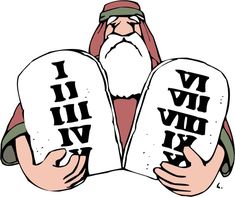
We see it again today in our Old Testament lesson, Exodus 33:1.  Moses has just come down from the mountainwith the 10 Commandments, carved into 2 stone tablets by the finger of God.  He arrives to the camp and is stunned to catch them dancing around a goldencalf.  They have committed spiritual adultery.  Right out of the gate, they have broken 3 of the newly minted 10 Commandments!

God has seen their apostasy, and has essentially told Moses He is fed up with them.  Because God keeps His promises, they may proceed on to the Promised Land, but He will not be going with them.  In other words, they will now longer enjoy a personal relationship with Him.  To their credit, the people do not want this, nor does Moses.  Moses intercedes for the Israelites.  He asks God to (v.13) teach me your ways so that I might know You….that is, “Help me to understand You better; Teach me about Your character, Your nature.”  Then he reminds God (v.16), How will anyone know that You are pleased with me and with Your people unless You go with us?  What else will distinguish me and Your people from all the other people on the face of the earth?  God then relents, because of His relationship with Moses and with His chosen people.

Next we see that God allows Moses to have a special, profound, personal revelation of Him.  Moses gets to see God—in the rearview mirror—and live. Imagine the state of his faith after this!

So that was ancient Israel.  What is the point for us, living today in the USA?

Now I am not suggesting we answer our grandchildren or our children’squestions with a question.That is a technique Jesus often used.

Neither do we want to be like the young photographer sent to record the fires on the West Coast, who didn’t ask enough questions.  He arrived on site and found he could not get good picturesdue to the dense, dark smoke.  So he prevailed upon his agency to charter him a small plane from which to memorialize the damage.  They agreed and he sped to the airport to hop on awaiting aircraft.  As He jumped on board with his gear and closed the door, he yelled, “Ready for take off!”

The little aircraft proceeded down the runway, and jerked and shook its way airborne.  The photographer, somewhat alarmed, noticed that the pilot looked young and nervous.  Nevertheless, he asked the pilot to fly low, over the flames.  ”Why?” the pilot asked.  ”Well because I’m a photographer and I need to be close to the action to record the fire.”  The pilot was silent for a few moments, then said, “Oops, I thought you were the flight instructor.”  We do want to ask the important questions.

Today’s important question is, “What we should render to God?”  Our Scriptures today teach us that we want to offer Him a heartfelt desire to know Him personally.  This sincere quest to know Him will lead us to loving Him, being grateful to Him, worshipping Him.  This also implies that we will become obedient to Him while serving Him.  When we do these things, God is with us and God protects and blesses us.  Thanks be to God who gives us the victory through our Lord, Jesus Christ.  Alleluia!  Alleluia!

©2020 Rev. Dr. Sherry Adams

The Keys to Peace and Joy

Pastor Sherry’s Message for October 11, 2020

Scriptures: Ex 32:1-14; Ps 106: 19-23; Phil 4:1-19; Matt 22:1-14

I just read an article by Judith Graham (in the Epoch Times Newspaper) titled, “Seniors are having Second Thoughts about Where to Live.” Generally speaking, older Americans have desired to remain in their own homes until health issues (physical & cognitive) have made it necessary to (1) downsize to smaller retirement homes;(2)or move in with adult children;(3)or move to nursing homes or assisted living facilities.  But given that some 70,000 residents and staff have died in nursing and assisted living facilities by mid-August of this year, due to the pandemic—and many others have suffered emotionally from being isolated from others—numbers of retirement aged-Americans are rethinking where to spend their “twilight years.”  Some are choosing to build homes or set up mobile homes closer to family members. Others, who have found small city apartments too lonely and confining during the quarantine, are now choosing to move to multigenerational “cohousing communities” where neighbors share dining and recreational facilities.  One of my former professors at FSU built a home in such a community in Tallahassee, Florida.  Each family had a separate home, but they all partook of meals together and they all shared a common recreational park.  Still others have decided to build bigger homes, on the premise that if they are again stuck in a lockdown, they will at least have more space (and can share their shelter with friends).

The folks Ms. Graham interviewed seemed to think the keys to peace and joy are picking a place to live that allows us independence while also providing community.  These concerns are an unexpected legacy of the Covid-19 virus among older Americans.  The writer does not distinguish between those older Americans who have a vital Christian faith and those who do not.  I think if she had, her conclusions might have been different.

No matter what our age, the Apostle Paul has some  excellent ideas for how to live out our lives—not with worry—but with peace and joy.  In Philippians 4, Paul gives us 6 ideas for how to live a joyful, peace-filled life:

  • V.1–Rather than worry about an unknown future—which could change in a New York minute–let’s set our minds on heavenly things & stand firm in the LORD.

This includes setting aside our quarrels with others. As he did with Euodia and Syntyche, Paul would have us figure out a way to forgive insults or slights from others.  He would want us to grant grace and forgiveness to others as Jesus has to us.  These are ways to keep our minds on heavenly things and to stand firm in the teachings of Jesus Christ.

  • V.–We are to rejoice!  i.e., to celebrate!

Paul didn’t have a bold feature or capital letters, exclamation points, or thumbs up “emogies” on his computer of the day.  The way he emphasized something was to repeat it.  Our joy comes from our relationship with Jesus. We need to celebrate this.  One good way to do so is to daily think of three things you can be or are grateful for and to thank God for these.  This practice will help you feel better.  When we think of what we are grateful for, we end up smiling.  Additionally, this practice will begin to retrain your brain to focus on what is positive rather than the negative.  Psychology and medical science tell us our brain’s default is to think negatively.  We tend to scan the environment for threats because attending the negative may keep us safe.  However, focusing on the negative does not lead us into peace and joy.  This practice will help you better note and remember the good things that God is doing in your life.  If those Israelites from our Old Testament lesson today had daily repeated 3 miracles God had done for them since leaving Egypt—the 10 plagues, the parting of the Red Sea, God’s daily provision of food and frequent provision of water, not to mention destroying the army of Egyptian chariots hot on their trail—they might not have fallen so quickly (40 days) into idolatry (Ex 32:1-14; Ps 106:19-23).  What were they thinking?!  Worshipping a golden calf, fashioned after a beast that eats grass on all fours.  They formed this idol and then worshipped it.  How foolish!  They worshipped a creature when they had had intimate contact with the Great Creator!  YIKES!

  •  V.6–Rather than be anxious (or rebellious), we should pray.

Those Israelites could have prayed for Moses’ safety and his quick return to them.  Instead, they abandoned their faith in God and took matters into their own hands.  The Lord wants us to bring every concern we have to Him.  No request is too small.  As Dr. J. Vernon McGee says, “If it matters to us, it matters to God.”

We want to follow up our appeals with thanksgiving.  Now we are not assuming God will do what we ask every time, so we are not thanking Him in advance for complying with our wishes.  No, this would make us God instead of Him.  Instead, we realize that sometimes God agrees with us and says “yes.”  Other times, His answer is “not yet” or even “no.”  So we are instead expressing appreciation that He always hears us and pays attention to us.

  • V.7–When we pray and leave our worries to God, His peace which transcends all understanding will descend upon us.

In the place of stress, we will feel His shalom peace.  Shalom meant more to the ancient Hebrews than a wish for peace, but instead conveyed total well-being, in mind, body, and spirit.  This deep shalom peace depends on our relationship with Jesus, not on our current circumstances.

(5)  V.8–Again, we want to focus our thoughts on the positive: …whatever is true, whatever is noble, whatever is right, whatever is pure, whatever is lovely, whatever is admirable—if anything is excellent or praiseworthy—think about these things.

Our news media is likely to emphasize whatever is scary, depressing, unexpected, or horrifying. This tends to lead us to believe their reports accurately reflect the national state of affairs—that things are more awful than they are good.  We have to remember, however, that the true, the good, the noble, the right, the pure, the lovely, and the admirable are not considered newsworthy.  So, unless we listen to a compassionate newscaster or commentator with an ear to peoples’ acts of kindness, we do not often hear of these things.    

If we are to live out lives that demonstrate peace and joy, we have to discipline ourselves to look for and celebrate the good!  Paul saw the truth of this long ago.  Secular Psychology has just recognized this truth in the past 20 years.  Modeling this very concept, Paul commends the Philippian

Church for sending him money.  He writes this letter to them from jail in Ephesus.  In those days, a prisoner—not the prison—was responsible for providing his/her own food and drink.  Without support from friends or family outside, any prisoner was out of luck.  Now God had been sustaining Paul in ways he did not report; but, even though he never wrote asking them for support, he still greatly appreciated the money they had sent him via Epaphroditus.  In the final words of his letter, he thanks them for their kindness to him.  Paul knew and was modeling the fact that expressing thanks blesses those whose generosity has already blessed him.

  • Finally, he blesses them (v.19)And my God will meet all your needs according to His glorious riches in Christ Jesus. 

Paul exhibits faith and trust in God’s loving care for the Philippians.  Knowing God is able to do so, Paul prays that God will provide for them as they have for him.

Jesus offers us a 7th key in His parable of the Wedding Banquet (Matthew 22:1-14).  Special guests had been invited to the King’s Son’s wedding banquet, but they (the Jewish religious leadership) made their excuses and did not come.  These excuses were very weak.  By refusing to attend, they expressed disinterest and lack of respect.  As we saw last week, the King is enraged and punishes them by destroying them and their city—again a prophesy of the obliteration of Jerusalem in 70AD by the Romans.

Then the King dispatches His servants to bring in those the original guests would have considered undesirables (a “basket of deplorables”). He supplies wedding clothes and is angry when a guest does not come dressed appropriately.  This is not a matter of fashion; rather, it reflects God’s concern for righteousness—having a mind and a heart set on Christ; being grateful to God; trusting in Him; and praying to Him.  Without our wedding garment of Christ’s righteousness, we will be tossed out of the wedding banquet.  This is the 3rd parable of judgment on the Pharisees, elders, and Scribes of Jesus’ time, preached by Jesus two days before His arrest.  All of them—and all of us–are invited to God’s heavenly banquet, but not all will be allowed to participate.  Those who are rebellious (as the Israelites in today’s Exodus passage, and the short-sighted religious leaders in Jesus’ time) and reject Jesus will be excluded.

God has given us, in His Scriptures, a pathway or the keys to a life of peace and joy.  As we go about our daily lives this week, let’s be mindful of…

  1. Keeping a heaven-mindset, standing firm in the Lord;
  2. Rejoicing!  Celebrating our relationship with God;
  3. Praying, the small and the big things, turning them all over to Jesus.  Let’s leave our concerns in His care, resisting the impulse to worry, while also being grateful to God for His many blessings and for attending us.
  4. Seeking God’s peace and His continued blessing.
  5. Remembering, with gratitude, that we are clothed in Jesus’ righteousness.

Let’s also remember this is not our home.   Our final retirement home is in Heaven and our invitation to the banquet comes at a great price, the precious blood of Jesus Christ!

©2020 Rev. Dr. Sherry Adams

Broken Promises and Second Chances

Pastor Sherry’s message for October 4, 2020

Scriptures: Ex 20:1-21; Matt 21:1-14

The story goes that a Jewish medieval astrologer, named Moshe, prophesied that the king’s favorite horse would die soon. The king got really angry with Moshe, both because his horse did die shortly after Moshe had foretold, and because the king believed Moshe’s prophecy had brought about his horse’s death.  So the angry king summoned Moshe to present himself immediately and demanded of the astrologer, “Prophet, tell me when you will die.”  Being a shrewd man, Moshe figured out this meant that the king intended to kill him, so he thought fast and replied, “I don’t know when I will die, but I do know that whenever that happens, the king will die 3 days later.”  Needless to say, the clever Moshe lived a long life.

In our Gospel today (Matt 21”33-46), Jesus is similarly prophesying the future fate of His enemies, the Jewish religious leaders, through a parable.  Jesus tells them and us that the King (God) created a lovely vineyard (the nation of Israel).  Referencing the Song of the Vineyard (Isa 5:1-7), which I read last week, Jesus’ listeners in the Temple would have known He was talking about the nation and God the Father.  They would have remembered the passage and its description of the loving care with which God established His vineyard:  He terraced the land;

  • He removed the rocks and stacked them to form walls around the vineyard;
  • He planted the vines, watered, fertilized and pruned them. 
  • Additionally, He built a watchtower within it from which to see thieves trying to steal His grapes, or anyone who would want to damage or destroy the vineyard.

But despite all God’s loving concern, the vineyard only yielded sour/wild grapes. So, fed up, God allows ruin to come the His vineyard.  He removes His “umbrella of protection” over it.  The wall is broken down; the vineyard is trampled; no rain falls to irrigate it; and thorns and thistles compete with and eventually replace the choice vines.  In fact, Israel was destroyed by Assyrian invaders in 722 BC, and Judah by Babylonian invaders in 587 BC.  They had by then enjoyed many more that second chances.

Now Jesus essentially retells that story with some new details:

Jesus says the King was absent.  We know that God is omnipresent, always around/with us.  But the Jewish religious leadership had encouraged a distant relationship with God in which obeying rules substituted for personal contact.  Consider how the people at the end of our Exodus passage today want God to remain far from them.  His thundering and lightnings scared them, so they asked Moses to speak to God so they did not have to deal with Him directly.  They felt safer having an intercessor speaking to God for them.  (By the way, don’t many of us also fear intimacy with God?)

Now, the King had entered into a sharecropping kind of arrangement with the tenants (Jewish religious leadership).  They were to manage the vineyard, but also pay Him a certain percentage every year; i.e., they were to worship only Him, in a heartfelt way, and give Him the tithe off the top.

Because God provided sun, rain, protection, and blessing, they should have been willing to give Him what He asked.  However, they beat one prophet, killed a 2nd, and stoned a 3rd.  It’s bad enough that they were ungrateful; but they also abused the very ones God sent to set them straight, to hold them accountable.  Nevertheless, our longsuffering God then provided them a second chance and sent another delegation of perhaps more noteworthy prophets.  But the result was the same.  These leaders abused them as well.  Finally, in a surprising move, God then sends His Son.  Perhaps they thought the King was dead?  With a weird sort of logic, they decide they can kill the Son and inherit the vineyard.  If there is no heir, they reasoned they could claim the land because they had worked it (assuming possession is 9/10ths of the law). So they indeed kill the Son–Jesus is now, within the parable, predicting His death at their hands.

Then Jesus asks the crowd (including the leaders), …when the owner of the vineyard comes, what will He do to those tenants?

They knew.  They knew and replied that, (v.41) He will bring those wretches to a wretched end…and He will rent the vineyard to other tenants, who will give Him His share of the crop at harvest time.

These new tenants will be Gentile believers and Jewish ones too. These will be the yet to be birthed Christian Church.

Now Jesus lowers the boom:  He reminds them of the capstone, the cornerstone from Psalm 118:21-22.  There is a foundational rock that will carry the weight ofthis Church.  That Rock is none other than Jesus Christ, the Son of God.  And He prophesies, Therefore, I tell you that the Kingdom of God will be taken away from you and given to a people who will produce its fruit.  He who falls on this stone will be broken to pieces, but He on whom it falls will be crushed.   The Jews who reject Christ as Messiah will lose out.  Christ will invest instead in those who follow Him, Messianic Jews and non-Jewish “Christ-followers.”  Accepting Jesus is the watershed choice, the crucial decision-point.The religious leadership rejected Jesus and one generation later, divine judgment was meted out upon them:  Titus of Rome staged a 3 year siege of Jerusalem.  Historians believe there were by then as many as 1 million personswithin the walls of the city.  Titus cut off their food supply, hoping to starve them into surrender.  Historians report some were reduced to cannibalism.  When the Roman forces did eventually break through the city walls and gates, Titus’ forceskilled the sick, the very young, and the elderly, and enslaved and deported the remaining inhabitants.  He also totally demolished the Temple,even to plowing up the Temple foundation and burning the marble stones.  Everything Jesus foretold came to be.

I could be wrong, but I think the Christian Church needs to consider long and hard how similar we have become to those ancient Jewish leaders.  Have we moved to a cultural faith, going through empty motions?  Or are we maintaining a vibrant, living relationship with Jesus?  I don’t believe God will spare us any more than He did Jerusalem, if our sins are similar to theirs.  This is why I have called upon us to pray for revival in our country.  This is why I have urged us to become aware of our sins and to confess them daily to God.  This is why I have encouraged us to ask God to forgive us for walking so far from Him.  We have broken our promises to God and badly need another, second chance.

There is a song, “The Heart of Worship” that bears on this issue:

         When the music fades and all is stripped away,

And I simply come, longing just to bring something that’s of worth,

That will bless Your heart…

I’ll bring You more than a song for a song in itself is not what You have

required.

You search much deeper within…You’re looking into my heart…Thru the way

things appear.

I’m coming back to the heart of worship,

Cuz it’s all about You, it’s all about You, Jesus.

We don’t have to be shrewd, like Moshe.  We won’t be able to out-think God anyway.  We just need to love our God and serve Him as He desires.

©2020 Rev. Dr. Sherry Adams

Obedience.XYZ

Pastor Sherry’s Message for September 27, 2020.

Scriptures: Matt 21:23-32; Phil 2:1-13; Ex 17:1-7

Norma Dearing, a woman who worked for years in the Christian Healing Ministry in Jacksonville, Florida (with Francis and Judith MacNut), used to use this metaphor when speaking at women’s retreats: Where is Jesus in the car of your life?  She would ask, Is He a hood ornament?  Or abumper sticker?  A decoration for all to see, but conveying no indication of your true commitment to Him.  Or perhaps He is in your trunk, taken along for the ride like luggage, or even bound and gagged, having minimal or no influence on your life at all.  Maybe you drive Him around in the back seat, from which He provides directions that you ignore.  Or, have you placed Him in the passenger seat such thatHe is companionably along for the ride, but with no real control over the direction you take.  Perhaps you have seen those bumper stickers that assert, God is my co-pilot.  Closebut not enough.  Jesus belongs in the driver’s seat of the car of our lives.  If we are obedient to Him, He determines the direction we take and the speed with which we get there.

         Some years back, I decided to use this illustration in a sermon I was giving as a seminarian.  On my way to the church where I was serving an internship–some 30 minutes from my house–I was driving along, practicing my sermon, when I got pulled over.  My 1st response was to fuss with the Lord:   Lord, I am on my way to do Your work…Couldn’t You have hidden me under the radar?  The cop walked up to my window and said, Lady, do you have any idea how fast you were going?  No Sir, I said, I’m afraid I was practicing my sermon and I wasn’t paying attention.  (Honest it was, but not very smart to admit I wasn’t paying attention.)  It turns out I was doing 65 in a 45 zone.  However, he expressed surprise that I, a woman, was on my way to preach (I figure he was probably a Roman Catholic and not used to female clergy).  He took my license and registration, and returned to his patrol car.  I continued to whine to the LORD and to beg for His divine intervention because, as a poor seminarian, I didn’t have the $180-$200 this ticket would cost.  The patrolman returned to my window and said, I’ll tell you what, if you‘ll promise to slow down, I ‘ll let you off this time.  He also asked me to pray for him and his partner.  I was absolutely delighted to comply!  As I continued on my way, more slowly, I was thanking God for His grace and mercy toward me, a sinner.  The Lord then said to me (in my spirit), Sherry, where is Jesus in the car of your life?  I replied, Lord, You know He is in the driver’s seat.  You know I have surrendered my life to Christ!  Sherry, that may be true, but whose foot is on the gas pedal?  I laughed with the Lord all the way to church that day.  I had learned yet another lesson about obedience.  Not just lesson.2 or.10 but .XYZ!

This, I believe, is the Lord’s point in our readings today:

Our Gospel comes from Matthew 21:23-32.  Jesus preaches this parable, in the Temple, on Tuesday before His arrest late Thursday night.  The Chief priests and the elders, the “usual suspects” are there, trying to find a justification to get rid of Him.  Earlier, they had observed Him clear the Temple of the moneychangers (2nd time); heal the blind and the lame; and had heard the peoples’ praise of Him.  These 3 events pointed to His authority as the Messiah, demonstrating Him in the roles of Prophet, Priest, and King.  They know the Scriptures, yet they want Him to state the source of His authority.  They should have been cognizant of the passages predicting Messiah and what He would be like.  They could have recognized Jesus was The One of whom the prophets proclaimed.  But they wouldn’t allow Him in the driver’s seat where He rightfully belonged.  Too concerned with holding their own authority, they were unable to expand their-too small box to include Him.

Our passage picks up with Jesus teaching in the Temple on Tuesday, again two days before His arrest.  He knows His religious enemies will be gathered there like so many vultures.  Nevertheless—and bravely—He teaches three parables on God’s judgment.  These stories are specifically aimed at the religious authorities for having failed as Israel’s spiritual leaders.  Our parable today is the 1st of these.

Jesus sets the parable in a vineyard. Everyone listening knows this symbolizes Israel.  Since grapes were a very important crop in Israel, the vine or the vineyard had become a metaphor for the nation.  The prophet Isaiah talks extensively of God’s disappointment in His disobedient vineyard in Isaiah 5:1-7.  Jesus teaches in JOHN 15:1, I am the true vine and my father is the gardener.  In this judgment parable, however, He introduces a father who commissions his sons to work in his vineyard.  The father figure is God.  He appoints leaders, sons, to work the vineyard, Israel.  Their work is to bring the people into intimate relationship with Him, and to assist Him to usher in His Kingdom on earth.

The first son says No, then apparently reconsiders and is obedient.  As Jesus interprets this, the 1st son represents the tax collectors and the  prostitutes—sinners, the unchurched, pagans—anyone common, ordinary person who has accepted Him as Lord.  They had probably rejected Jesus at first, thinking they didn’t need a Savior, and found themselves caught up in dead-end, sinful lives.  But, hearing Him teach and realizing they do need Jesus, they now have put Him in the driver’s seat.

The second son Jesus describes says, Yes. Lord, I’ll do what You’ve asked, but then doesn’t.  Jesus explains that these are the very ones who are there trying to trip Him up:  the chief priests & the elders. It was their job to guide the people to God and they had failed due to their spiritual blindness. They should have been able to recognize Jesus as the fulfillment of the Messianic prophesies, but they were too worried about hanging onto their power, positions, and influence.  They not only wanted to keep Jesus bound and gagged in the trunk, but they were ready to murder Him and toss His body out onto the roadside.  Jesus knows this and reprimands them for failing to believe in John the Baptist as well as for missing that He is Messiah.  Matthew explains in chapter 21:45-46, When the chief priests and the Pharisees heard Jesus’ parables, they knew He was talking about them.  They looked for a way to arrest Him, but they were afraid of the crowd because the people held that He was a prophet.  

In our Philippians lesson (2:1-13), Paul tells us the way we keep Jesus in the driver’s seat of the car of our lives is to have “the mind of Christ.”  By this he means that Christ was entirely obedient to God the Father.  Jesus humbly gave up His self-will, and all of His heavenly prerogatives, and put God in the driver’s seat.  Jesus’ humble obedience is the best model of this that we have.

We only have to look at our Exodus lesson (17:1-7) to see a repeated example of how not to behave.  Those poor Israelites appear to have forgotten God’s gracious provision for them as soon as they meet a new or different roadblock.  All too like us,they put the Lord in the driver’s seat until they become afraid.  Even so, the Lord always provided for them—this time water from the smitten rock (a prophetic picture of Jesus’ death).  Look at the pattern:  they trust and obey until they come to some new crisis; then they cry, complain, or get angry.  How gracious of God to continually rescue them and to meet their needs, despite their rebellion and lack of trust.

Our lessons today pose the question, which kind of son or daughter are we?  Our Lord calls us to be obedient to Him…are we?  Maybe like the sinners Jesus lists, we said NO at first, buthave come to say YES later in life.  Or perhaps we had never invited Him into the car of our lives, but are happy we have done so now.  Or maybe we trust Him until we hit a bump in the road, then we panic.  Jesus wants to be in the driver’s seat of the car of our lives, hands on the wheel, controlling the speed and the direction we take.  We can trust in Him to get us where we need to go.

We don’t have to whine or complain or rebel…we just need to sit back, relax, and leave the driving to Him.  We can trust and obey, even down to allowing His foot to manage the gas pedal.

©2020 Rev. Dr. Sherry Adams

Way-maker!

Pastor Sherry’s message for 9/13,2020,

Scriptures: Exodus 14:5-31; Ps 114

Osinachi Lalu Egbu is a 47YO Nigerian woman who has written more than 200 Christian praise songs.  She has shortened her name to Sinach.  Perhaps you have seen T-shirts emblazoned with the words,

“Way-Maker, Promise-Keeper, Miracle-Worker, Light-in-the-Darkness.”

These names of God begin the chorus of one of her currently popular songs, which ends with, “My God, that is Who You are!”  This song seems to be currently taking the Christian world by storm because it expresses such deep trust in God’s abilities to…1. Make a way where there seems to be none;2. Keep His promises to us;3. Work miracles on our behalf, often at the 11th hour;4. And provide light to us in our times of darkness.

I cannot think of a more dramatic event from the Old Testament that so fully demonstrates God as Way-maker, Promise Keeper, Miracle-Worker, and Light in the Darkness, as His fabulousrescue of His people in the Red Sea Crossing (Ex 14:5-31).  

Remember from last week’s lesson, God had sent the final plague—the death of the 1st born—upon Egypt.  Those Israelite slaves, however, who had applied the blood of the Passover Lamb to their door frames were spared. This final plague seemed to have broken the back of the Pharaoh’sresistance to losing his free labor-force.  He gave the word that they and their livestock could leave Egypt the next morning.  So they did…2 million of them.

Our reading today begins with them trekking through the desert region between the Nile and the Red Sea. God had them avoid two well-traveled land routes to the north, both of which paralleled the Mediterranean Sea. He knew that Egyptian spies were watching their exodus. He also realized that they would report to Pharaoh that the freed slaves seemed to be apparently wandering aimlessly. Once again underestimating God, Pharaoh decides to pursue the Hebrews with his 600 chariots. He seemed to believe his crack troops would either make mincemeat of the 2 million untrained slaves, or be able to reroute them back into captivity. Despite the recent lessons of the 10 plagues, Pharaoh appeared confident he could recapture his unpaid laborers. This, as we know, was a massive case of hubris!

Our God was not ambushed! Instead He effected a Divine Rescue:

1. As the Way-Maker, He led the people thru the desert.

The Israelites were not lost; instead they were being guided by GPS—God’s Planned Strategy.  With the Red Sea to the left and Egyptian Special Forces to the right, it seemed like the people were caught in a deadly trap between the Devil (Pharaoh) and the Deep Blue (Red) Sea!  But God purposefully led them to this situation.  The cloud-by-day, fire-by-night suddenly shifted from front, leading the people, to the back, providing a rear guard.

2. God had promised to deliver the Israelites from Egypt. So He instructed Moses to raise his staff, and by the power of the Holy Spirit, God blew open the Red Sea. Walls of water stood up on both sides of the escape route. On dry ground—let’s not miss this!—and hidden from the Egyptians, the people were able to cross through all night long. God literally had their backs! He engineered their escape as the divine Miracle-Worker.

3. The Promise-Keeper shielded the people from the their pursuers by essentially turning out the lights.

4. Meanwhile, our God provided bright firelight to reveal the path of escape for the pursed. He provided Light in the Darkness.

​There were no phones, drones, or video cameras to record this set of miracles.  Nevertheless, word of them made it to the Canaanites, especially those living in Jericho.  A Canaanite document dated from 1375BC warned of a fearsome people, called the Habiru (or Hebrews), whose powerful God fought for them. Rahab, the Canaanite prostitute who hid Joshua’s two spies, told them (Joshua 2:9-10), I know that the LORD has given this land to you and that a great fear of you has fallen on us, so that all who live in this country are living in fear because of you. We have heard how the LORD dried up the Red Sea for you when you came out of Egypt.

So, what are the lessons for us today from the Exodus?

1. We want to remember that God is the Way-maker.

When we are caught in circumstances that seem impossible for us, we are to pray, to ask for God’s help, and to trust He will provide it. Our God hears us and often provides a response we never considered nor could have predicted! Money might manifest from some unexpected source. We might enjoy a needed delay or reprieve from some consequence we had dreaded. We might experience a cure for a disease or from an addiction we had not yet overcome. We might have undergone a sudden change of heart, or seen an altered attitude or positive behavioral shift in a friend or relative. A job or an opportunity we never imagined might have presented itself.

2. We want to remember that God is a Promise-Keeper.

He promised to save us and He has, through Jesus Christ’s sacrifice of Himself upon the Cross. He promises to never leave or forsake us. He promises to protect those who love Him. He promises to be present to us. He promises to answer those who call upon Him. He promises to love us, even when we act in ways that make us unlovable. He promises to forgive us if we ask Him. The writer to the Hebrews says that God is the same yesterday, today, and forever. James tells us (1:17)…the Father of the heavenly lights who does not change like shifting shadows. He does no posing, He exhibits no fakery. He keeps His word!

3. We want to remember that God is a Miracle-Worker.

He has all of the resources of the universe at His command. It’s not like He has to search around for ways to provide for us. He doesn’t have to do fund raisers or set up a “Go Fund Me” page. He can just speak the word and His will is accomplished. Scripture tells us again and again that nothing is impossible with Him. Some people write off the Red Sea Crossing as a myth. They seem to believe even God cannot violate the laws of physics. They must not believe in the God of miracles that I do, that you do. Since God set the laws of physics into being, isn’t it clearly possible that He can override or supersede them? Our God is able to do whatever He decides todo.

Additionally, no schemes of evil men or of the Devil can thwart His plans. To me the greatest example of this is how Jesus is appearing—in dreams and visions—to people caught behind the Moslem Curtain. Hostile Moslems tell their people that Christian missionaries are evil purveyors of sex trafficing and molesters of children. Radical Islamists then use this as a justification for capturing Christian missionaries, torturing them, and thenkilling them in those countries. But no human or government can capture or kill Jesus. It’s already been done and it didn’t stick!4. Finally, we want to remember that God is the Light in the Darkness. The news media daily inundates us with negativity and fear-producing predictions. Consider what they say just with regard to thethe Covid-19 virus:a. It will have a resurgence. So far this has not really happened.b. So it’s very dangerous to send kids back to school, or to reopen businesses with face to face contact. Schools have reopened now in Florida without the dreaded upsurge predicted, as have restaurants and hair salons. The developing vaccines will either not work or will have dangerous side-effects. We will have to wait on this one, but I am willing to take a dose of vaccine when one is released. d. We can never again hug or shake hands. I have been hugging folks and shaking hands with no ill effect for several weeks. In addition, I have been careful to wash my hands well before eating.e. Our economy will never recover. This also remains to be seen; however, some are predicting we will be back to pre-pandemic economic levels by early 2021.

The person of faith wants to focus on their faith in God and not innews casters. The person of faith daily puts on the whole armor of God (Eph 6): the shoes of the Gospel of Peace; the belt of Truth; the breastplate of Righteousness; the helmet of Salvation; the shield of Faith, and the sword of the Spirit. The person of faith recalls 2 Cor 10:3-5àFor though we live in the world, we do not wage war as the world does. The weapons we fight with are not the weapons of the world. On the contrary, they have divine power to demolish strongholds. We demolish arguments and every pretension that sets itself up against the knowledge of God, and we take captive every thought to make it obedient to Christ. The person of faith recites, in Jesus’ name, No weapon formed against us will prosper/prevail (Isa 54:17).

Israel has long celebrated God’s rescue of His people in the story of the Exodus.  The freed Hebrew slaves directly experienced God as their Way-maker, Promise-Keeper, Miracle-Worker, and Light-in-the-Darkness.  And if we ponder it long enough, we will have to admit that we have probably too.  Praise God from Whom all blessings flow!

Copyright 2020 Rev. Dr. Sherry Adams

What is Love?

Pastor Sherry’s message for September 6, 2020

Scripture: Exodus 12:1-14

The story is told of an old granny lady who had decided that Christmas shopping had just gotten to be too much for her.  Now she still wanted to do something nice for her kids, grands, nieces, nephews, etc., so she decided to send each a nice Christmas card with a $50 Visa card inside.   Granny selected the Christmas cards, addressed the envelopes, added stamps, and deposited them at the post office, innocently assuming she had taken care of Christmas gifts for all of her family in a way that could not help but please each one.  The problem, however, was that–being a little forgetful–she had neglected to include the Visa cards (probably also forgot where she had put them), and had happily written next to her signature, “Merry Christmas!  Go get your own presents.”   We laugh, but this could all too easily be any one of us!  The intention was love, but the result was not.

When I was in college, my school had a foreign language requirement. There were 3 prerequisites:  (1) You had to be able to read it; (2) You had to know the grammar, correct sentence structure, and vocabulary; (3) And then you had to demonstrate you could speak it by passing an interview with the foreign language department professors.

I managed to make it through the first courses, but put the speaking part off until my Senior year…YIKES!  The first day of class, a stereotypical French woman came into class (complete with beret, tight slim skirt with side split, fishnet stockings, and spiked heels), propped herself on the teacher’s desk, told us we could not speak English for the remainder of the semester, and asked us, in French, to respond to the question, “What is love?”  Before I had even begun to formulate an answer in English, then could laboriously translate it into French, she had gone on to the next deep question.  I knew my goose was cooked! 

Praise God I survived conversational French because I paid a linguistically brilliant underclassman to tutor me.  I paid him with coffee and a piece of pie (this was 1967 and he was hungry) to talk with me in French for an hour 2-3 times a week.  By the time he finished with me, I was thinking and dreaming in French!

But I have never forgotten that French professor’s question, “What is love?”  Our Scriptures today give us some good answers to that timeless question.  Our Old Testament lesson comes from Exodus 12:1-14.  Back in Ex 3:7+, God had told Moses:  “I have indeed seen the misery of my people in Egypt. I have heard them crying out because of their slave drivers, and I am concerned about their suffering. So I have come down to rescue them from the hand of the Egyptians and to bring them up out of that land into a good and spacious land, a land flowing with milk and honey. But I know that the king of Egypt will not let you go unless a mighty hand compels him. So I will stretch out my hand and strike the Egyptians with all the wonders that I will perform among them. After that, he will let you go.  That was God’s promise…He would create the situation that would compel the stubborn Pharaoh to let His people go.  Now the Hebrews had been in Egypt about 400 years—long enough for the Canaanites to have time to come to love the true God, which they never did.  So God was finally ready to rescue the Israelites from Egyptian slavery with 10 plagues.

Each plague was actually a put down of some Egyptian god.  Yahweh had declared war on the gods of Egypt:

(1)1st, He turned the Nile to blood—the fish died and no one could drink from it.  They so depended on the river for their water supply and commerce that they equated it with life.  God was saying to them, I, not your river god, am the source of all life.

  • 2nd, He sent a superabundance of frogs.  Seven days after turning the Nile to blood, frogs left the polluted river and invaded the Egyptian homes in huge numbers.  Now the Egyptians equated frogs with evil spirits.  God was saying to them, I can produce animal pests and your numerous gods of nature cannot prevent this.
  •   Similarly, out of dust Moses tosses into the air, God produces 3rd, a plague of lice and 4th, of biting flies.  Essentially God is asking Pharaoh and the Egyptians, Why aren’t your gods countering and destroying these pests? They aren’t able to do what I can do.
  • 5th, God sends disease on their cattle, rams, sheep, and goats, many of which die.  The Egyptians had gods for each of these animals.  But God is saying, I have complete control over animal life, not Osirus, your bull god, or Apis your ram god.
  • 6th, He afflicted the animals that remained—and the people as well–with boils.  Even Pharaoh’s magicians couldn’t prevent breaking out with them. God is saying only I have power over physical health.
  • 7th, He sends hail made of ice clumps and fire.  Egypt normally gets very little rain and fire is a sign of God’s judgment.  Thus God is saying, I—not Hephaistos, your god of fire or Porphry, your god of rain—have complete authority over forces of nature.
  • 8th, God sends locusts to eat up any vegetation left over, then sends them to drown in the Red Sea.  Egypt’s gods of nature are helpless to prevent this infestation.  God is saying, I can raise up hordes of any creature and I can destroy them as I will.
  • By now, the Egyptian economy is in ruins, but still Pharaoh will not let his slave labor go free.  God then sends the 9th plague, 3 days of complete darkness—except over where the Israelites live.  God is saying, Your sun god, Re, is powerless before Me.
  • Finally, God sends the 10th plague–the death of the firstborn, person and animal. They believed their god, Horus, was the god of life.  They also believed Pharaoh was divine. God is saying, Not so fast, My Friend!  Yahweh is the giver of life and He can take it away when it is in rebellion against Him.

This brings us to the Passover:  God intends to take the life of every 1st born.  Those who love Him, however, can and will be spared.

They are to select a perfect male lamb less than 1 year old; they are then to slaughter it on the 14th of Nisan; and paint their door frames with its blood.

The blood of the lamb will be the sign that they are true believers and their lives will be spared. They were to remain inside their homes, eating the roasted lamb, unleavened bread, and bitter herbs. This was a hasty meal that predated “take out.”  It meant that they would soon be free to travel.  The first born of those with no blood over their doors succumbed to the angel of death.  By the next morning, all of Egypt wanted the Israelites to be gone!

This is love!  God provided a way for the angel of death to distinguish Israelites from Egyptians.  While every house in Egypt had a dead person in it, the blood of the Lamb signaled to death, pass over, pass on by those who love the true Lord of all.  This event broke the back of Pharaoh’s resistance.  He finally decided let the God’s people go.  And the Egyptians were so glad to see them leave that they gifted them with gold and silver (God’s provision of reparations/back wages owed).

The historic Jewish Passover finds its ultimate fulfillment in Jesus—it foreshadows or predicts Jesus’ blood shed for us on the Cross.  He too was a perfect male lamb–John the Baptist calls Him (John1:29)…the Lamb of God Who takes away the sin of the world.  Jesus was without sin.  If He had sinned, He would not have been eligible to be our sinless Substitute, our Savior.  Furthermore, He was God, the only Son of God, so His blood was essentially the blood of God.  Paul tells the leaders of the Ephesian Church in Acts 20:28àBe shepherds of the church of God, which He bought with His own blood.No mere person would have been capable of atoning for our sins.  Additionally, Jesus’ sacrifice on our behalf was totally acceptable to His Father.  The writer to the Hebrews says that Jesus is the once and for all perfect sacrifice for our sins.  Peter, on trial before the Sanhedrin, testifies in Acts 4:12 that Salvation is found in no one else [meaning Jesus] for there is no other name under heaven given to men by which we must be saved.  John tells us in 1 John 3: This is how we know what love is:  Jesus Christ laid down His life for us.

So what is love?  The 10 plagues and the Passover formed God’s strategy for motivating a despot to let go of a free labor force of around 2 million people.  The plagues and the Passover demonstrate how far God will go to redeem those He loves.  Jesus’ death on the cross proves the same truth again:  Our God has died an undeserved but agonizing death to obtain our freedom from sin and mortality.  Like His Father before Him, He has gone to extreme lengths to redeem us.

As the apostle John tells us, (1 John 4:10)–this is love: not that we loved God, but that He loved us and sent His Son as an atoning sacrifice for our sins.  If I could go back in time, I would tell my French Conversation professor, “Your question can be answered a number of ways…But the best and most complete answer to that is Jesus Christ loves me and you so much that He died so you and I could have abundant life!

Thanks be to God who gives us the victory thru our Lord Jesus Christ!  Alleluia, alleluia!

©2020 Rev. Dr. Sherry Adams

God’s Grace versus Cancel Culture

Pastor Sherry’s Message for 8/30/2020

Scriptures: Ex 3:1-15; Ps 105:23-26; Ro 12:9-21; Matt 16:21-28

Recently I came across 2 examples of our current “cancel culture” at work. With the “cancel culture,” you are only as good as your social media account messages are PC.  Step out of line and your reputation is destroyed, while your future is threatened.

The first concerned a Jordanian-American named Natasha Tynes.  Tynes had researched and written about threats to free speech and a free press in Egypt and then had faced persecution in Egypt for it.  Back in the states again, she was riding the DC-area subway, the Metro, when she saw a transit worker eating in the train.  There are signs posted everywhere prohibiting this behavior, so Natasha confronted the worker and pointed out that she was violating the rules.  The worker rudely blew her off! Natasha said she frequently rides the subway hungry and so was frustrated that a person with the power to fine her for eating was herself violating the rules.  As a result, Natasha wrote a letter of complaint to the transit authorities, asking that they take some disciplinary action.  

She probably should have left the matter there, but she also “tweet-shamed” her by calling the woman out on line, including a picture of her eating on the train. Some 45 minutes later, Natasha rethought what she had done and deleted her tweet.  She also apologized on line for her actions, admitting she had responded out of a “short-lived expression of frustration.  In addition, she wrote the transit authority to ask them to overlook her complaint.  But the Twitter Mob turned on her, calling her “Metro-Molly.”  Ms. Tyne’s publisher learned of this “temptest in a teapot” and decided not to print her latest book. They claimed she had done “something truly horrible” and excused their decision to renege on their contract because Natasha “had threatened the transit worker’s health and safety.  What?

The second incident concerned that vocal young man from the Parkland high school shooting, Kyle Kashuv. We saw him interviewed on TV a number of times.  He received several offers of scholarships to college and turned them all down to attend Harvard.  Later, word got back to Harvard, via some of his classmates that Kashuv–a Jewish conservative–had made anti-semetic and racist comments in a private online chat back when he was 16 years old.  The young man apologized publically.  He even wrote a Harvard dean to admit his responsibility and to ask for forgiveness.

David French of the National Review reported that Kashuv did “everything we want a young man to do when he’s done something wrong.”  Nevertheless, Harvard believed his email remarks from several years younger were too egregious to forgive, and rescinded his admission.

 Recently, Kellyanne Conway resigned as advisor to the President when her 15 year old daughter “tweet-shamed” her and her husband on line.  I am not trying to draw in politics here.  Rather, I am making the point that people feel all too free to call one another out on line.  This teen has hurt her parents very publically by defaming their reputations.  I wonder how she will feel about this when she is 25 or 35, or a parent herself. Sadly, this child has not learned to live out Paul’s admonitions from Romans 12: V.14àBless those who [you believe] persecute you; bless and do not curse; v.16àLive in harmony with one another; and v.17+àDo not repay [even perceived] evil for evil.  Be careful to do what is right in the eyes of everybody.  If it is possible, as far as it depends on you, live at peace with everyone.

This is where we are now.  A mistake, a lapse in judgment, can cost you everything today.  Thank God our Lord does not operate by cancel culture rules!  Let’s look at two He could have chosen to cancel, but didn’t, in today’s scripture passages:

First, we have Moses (Ex 3:1-15).  Last week, we saw this Hebrew slave kid rescued from the Nile, to be raised in Pharaoh’s own household.

By this week, he has advanced to the age of 40, and realized God has tapped him to champion his people, the Jews.  Without waiting on God’s direction, however, he kills an Egyptian overseer for beating a Hebrew slave. His own people, seeing him dressed as an Egyptian, fail to trust him, fearing he is an Egyptian murderer.  Furthermore, Pharaoh hears of the incident and wants to arrest him.  So Moses flees Egypt into the desert.  By attempting to do what he thought he should do, He finds himself driven away.

 He reaches Midian and rescues the 7 daughters of Reuel who were also doing what they were supposed to do—watering their sheep.  Moses observed some rowdy male shepherds attempting to push them aside to water their animals first.  Moses rescues the ladies and sends the ruffians packing.  Subsequently, he marries the eldest, Zipporah; soon has a son, Gershom (whose name means “sojourner” or “alien”—kinda suggests how Moses feels about living in Midian); and tends sheep, for another 40 years. Like King David, later, he is going to be called from tending a flock of animals to shepherding God’s people.

 In today’s passage, he encounters God (the preincarnate Christ) in aburning bush that does not burn up.  He is told to take his shoes off becausehe is in the presence of God, which makes the ground they are on holyindeed.  God calls him by name twice (make no mistake, our God knows our names!).  God also reveals who He is:  The God of the Hebrew patriarchs Abraham, Isaac, and Jacob.  God shares that His name is, I am who I am; or, as some translations say, I will be who I will be.   In other words, as the passage states, He is the God who sees, thinks, hears, knows,remembers, and intervenes for His people.

God also reaffirms Moses’ call to deliver the Hebrew slaves from Egyptian bondage.  Notice, God has not canceled him due to having murdered an Egyptian.  Instead God has hidden him out, in the back of the beyond for 40 years, so that the Pharaoh who sought to arrest him has had time to die and be replaced.  Additionally, those Israelite slaves who witnessed the murder have also passed on. God has made sure it is safe for Moses to return to Egypt.  And Moses has learned to wait on God.

Our Psalm mentions how God sent Moses, His servant, to set His people free.

 Now, let’s jump to our Gospel lesson from Matt 16:21-28.  Last week, we read how Peter confessed what the Holy Spirit had revealed to him:  that Jesus was/is the Messiah.  This week, Jesus begins to educate the Twelve regarding what God’s Messiah will do.  Despite their personal beliefs and expectations of Messiah, Jesus says He will die on a Roman cross, condemned by His own; He will die to redeem those very folks and all the rest of us too.  Like Moses before Him, Jesus is a shepherd, our shepherd and a deliverer, our deliverer.  Understandably, Rocky (Peter) is horrified! Like Moses, he gets ahead of himself.  Rather than taking in what Jesus is saying, he tries to talk Him out of it.  YIKES, Peter!  We don’t get to tell God what to do.  Jesus has just praised Rocky, but now he really tears into him—

He calls His dear friend Satan!  He rightly accuses him of interfering with God’s plan.  Whether he or we like it or not, God’s plan appears to require that we (v.24) deny [ourselves, our self-will], take up [our] Cross and follow [Jesus].  Like so many of us, Peter hears from God but he is also motivated by selfish self-interest and perhaps beguiled by the evil one.

 We know the outcome of both stories:  Moses leads the people out of Egypt—even though they wander in the desert for 40 years.  And Peter becomes a dynamic, faith-filled leader of the new Christian Church. God had grace, mercy, and forgiveness for them both!

What would have happened to Moses or to Peter—Rocky–if our Lord operated by the rules of cancel culture?  Cancel culture assumes—impossibly—that you can never make a mistake.  No grace or mercy is allowed for immaturity, anger, impetuousness.  Cancel Culture believes, Once a sinner, always a sinner.   You cannot even apologize and be forgiven.  As we have seen in the examples of Natasha, Kyle, and the Conways, judgment is swift and forgiveness is withheld!  Furthermore, cancel culture ruins the person’s future—despite a very productive present–based on one lapse in judgment or a perceived wrong response. 

Aren’t we glad our God does not operate that way?  Our God is characterized by love, grace, and mercy.  He keeps His promises and He forgives our sins.  He reinstates us. He uses us once we realize we cannot work out His program in our own strength.  Instead, we operate in His strength, surrendered to His will.  Thanks be to God that He has such patience, such forgiveness, such mercy for us.

This week, I challenge you to pray for Natasha Tynes and Kyle Kashuv, and any other victims of the media mob and the cancel culture.  Pray for peace and reconciliation between the senior Conways and their 15 year old daughter.  Let’s also be aware of God’s mercy.  And let’s be grateful that there is no cancel culture with our Lord!


c 2020 Rev. Dr. Sherry Adams


God’s Picks

Pastor Sherry’s message for August 23, 2020

Scriptures: Exodus 1:8-2:10; Ps 124; Matthew 16:13-20

This story falls under the category of “truth is stranger than fiction”:  Back in the mid to late 300’s, there was a slave in Egypt named “Moses the Black” (330-405 AD). He was a tall, intimidating Ethiopian, who stole from his Egyptian master.The master also suspected of him of murder.Rather than sell him off, the master fired him and threw him out. So, Moses the Black joined a gang of thugs. Almost immediately he became their leader, and for years his band of hoodlums terrorized folks along the Nile River Valley.

At one point, Moses the Black attempted to evade the law by hiding out in a desert monastery.  He thought he was pretty clever to take refuge in a church, but the joke was on him–as he encountered Jesus and gave his life to Christ in that place.  Perhaps even more incredible is the fact that 4 of his former gang members—not realizing he was there—decided to rob the monastery.  Moses the Black completely overpowered them (making a citizen’s arrest?), tied them up, and dragged them before the abbot.  Because he didn’t slit their throats, the thugs were so moved that they too gave their lives to Christ, and became monks as well.

Legend has it that he was martyred, as an old monk, by a different band of robbers who did not know Moses the Black’s reputation or his conversion story. The former robber, murderer, and adulterer had been transformed by God into a Christ-following teacher and priest. Interestingly enough, the former gangster who had lived by the sword also died by the sword. Nevertheless, the Catholic Church has proclaimed him a saint.

Isn’t it interesting who God chooses to do His work?  Often it is some pretty unlikely persons! Our Old Testament lesson, Exodus 1:8-2:10, introduces us to Moses’ backstory. Moses was born to an Israelite family, from the tribe of Levi, working as slaves in Egypt. Almost 350 years after the death of Joseph–the one God used to save the fledgling Israelite nation and Egypt from a massive famine–the new leadership in town had no gratitude for the Hebrew who saved his countrymen and women. The new Pharaoh (Ahmose? Rameses?), who either didn’t know the history or didn’t care, ascended to the throne of Egypt. He looked around and saw how numerous the Israelites had grown.  Here is the outworking of the promise to Abraham from Genesis 12: his descendants would outnumber the stars or the grains of sand on a beach. God would see to it that they would become a “great nation,” and they have indeed. This new Pharaoh was afraid he and his countrymen were vastly outnumbered by Hebrews.  So, he decided to contain any threat by enslaving them.  He worked them hard and harshly.  Even so still they seemed to multiply.

As the story unfolds today, Pharaoh is concerned that the Israelites are reproducing too rapidly. He calls in the head Hebrew midwives and tells them to go ahead and deliver any girl babies, but kill the boys (this is one time in ancient history when it paid to be a female). The midwives are wise; they fear/respect God more than they do Pharaoh. They refuse to practice male infant genocide. Pharaoh notices that male Israelite infants are surviving and wants to know why. The wise midwives claim Hebrew moms are very hardy and complete the birthing process without calling upon them.

This is no doubt a lie, but it seems to prevent Pharaoh from exacting revenge.       

Moses is born in the midst of this national birth-control strategy. As a male, he should have been euthanized. However, his mom, Jochabed, rears him to 3 months. Then she places him in a carefully water-proofed basket and sets him adrift on the Nile. In an amazing twist of fate—like Moses the Black, thief and murderer becoming a monk—Moses the Levite is spotted and rescued by Pharaoh’s eldest daughter. Childless, she decides to raise the child as her own son. Miriam, his biological sister, has been watching over him and suggests a woman to nurse him, the baby’s own biological mother, Jochabed, for pay! How ironic, and how like our God to place the future deliverer of Israel within the very household of Israel’s chief oppressor. A Hebrew slave will learn the Egyptian language, culture, history, and military strategies. God has once again placed one of His own into a position of authority and influence in Egypt. Whether Pharaoh realizes it or not, God is also demonstrating that Pharaoh will be impotent to destroy God’s people or His program (developing the lineage of Jesus).

Psalm 124 is a Psalm of Ascents, sung by Jewish pilgrims on their way to the Temple Mount to celebrate one of the major feasts.

They praise God for His protection of them in the past. They worship Him for having protected them just as He did Moses.

In our Gospel lesson, Matthew 16:13-20, our Lord commends Peter for both recognizing and testifying to whom Jesus really is. Remember, Jesus is still outside the borders of Israel, this time in aRoman resort/retirement town, 2 days’ walk north of the Sea of Galilee.Simon, inspired by the Holy Spirit, asserts that Jesus is the Messiah, the Son of God—a Deliverer even greater than Moses. Jesus commends him and He renames Simon as Peter, or we might say, “Rocky.” Jesus Himself is the “ROCK”—but it is on faith like Peter’s and on believers like Peter that Jesus will establish His fellowship, His Church.

In addition, Jesus proclaims that (V.18)… the Gates of Hades/Hell will not overcome it [His Church]. The deaths of believing individuals will not extinguish the flame of the Church, just as Satan did not kill off the Jews through either slavery or Pharaoh’s schemes. No one person, or groups of persons, can thwart God’s plan and program.

Next, Jesus gives Peter (the apostles, the early church, and us) (v.19) …the keys of the kingdom of heaven: authority to preach and teach the Gospel. Roman Catholics claim Jesus was hereby making Peter the leader of His Church (the 1st Bishop of Rome, the first Pope) and authorizing him to forgive or fail to forgive sins.  Others—primarily Protestants–interpret this somewhat differently: If we, as Jesus-followers, loose or proclaim God’s truth on earth, the powers of heaven will support our efforts. As it says in Isaiah, God’s word will not return to Him empty.  Teaching and preaching the Scriptures will result in bringing many into God’s Kingdom. But if we bind it on earth (fail to proclaim or prevent its dissemination), the Church will not live into its destiny.

Last week, I asked us to consider who gets saved.  This week, I hope I have drawn your attention to who God picks to work in His program of redemption.  He appears to pick the unlikely: (1) The reprobate, Moses the Black, becomes a major force forChrist in the 4th century Church as a teacher, pastor, martyr, saint.  (2) Moses–born to Hebrew slaves–is nurtured and educatedunder Pharaoh’s own nose, then used by God to free His people.  (3) Peter, who takes his eyes off Jesus, resorts to violence in theGarden, denies Him three times, and fails to show up at the Cross to support Him, is selected by God as a leader in the 1st Century Church.

The beauty of all of this is that God picks unlikely, even weak and flawed people to carry out His program of redemption. He trains us up. He strategically places us. He chooses and uses folks like you and me.

What’s really amazing to me that He puts so much trust in us.

Let’s agree to live into His trust and to assist Him in His goal to bring the lost to Christ. This week, look for opportunities to tell those who don’t know Jesus (1) Who He is; (2) How much He loves them; and (3) How knowing Him has changed our lives for the good.

Thanks be to God who gives us the victory thru our Lord, Jesus Christ!  Alleluia, Alleluia!

©2020 Rev. Dr. Sherry Adams

Who Gets Saved?

Pastor Sherry’s Message for August 16, 2020

Scriptures: Gen 45:1-15; Ro 11:1-2a, 29-32; Matt 15:21-28

Who Gets Saved?

Recently I came across this story of a present day American artist, Steven Lavaggi. Some years back, he encountered a number of personal set-backs:  His wife left him to marry a writer for Rolling Stone Magazine.  Not two weeks later, he learned his son was suffering from Juvenile Diabetes. Then his graphic art business failed.

Unemployed, abandoned, and worried about his son, Lavaggi turned to God’s Word.  Sitting on his bedroom floor, and by himself, Steven read the Gospels. He later reported that he skipped over the black letters, wanting only to read the words spoken by Christ. Because he was reading with the intention of finding Jesus, the Risen Christ emerged from the pages. The artist then gave his life to the Lord.

As a new Christian, he clung to Psalm 91:11: “For he shall give his angels charge over thee, to keep thee in all thy ways.”  Out of his brokenness, came a passion to create a message of hope. To this end, he left the lucrative world of graphic art to become a struggling fine artist.  His paintings typically are of beautiful rural scenes usually populated with tall, graceful angels; he has also fashioned some amazing sculptures of angels.

Lavaggi’s story is of a man who has withstood and overcome the blows of life.  At a point of true despair, he began to search the Bible for encouragement.Reading only the red letters, he found it–Praise God!–and gave his heart to Jesus!  Out of the depths of his pain, Steven sought out and found salvation.  Finding Jesus inspired him to redirect his life’s work from graphic art to painting and sculpting works that bring hope to others.

One of the themes present in our Scripture passages today is that of being saved or experiences of salvationLet’s examine these together:

Last week, our Old Testament lesson, related how Joseph’s 10 brothers from other mothers sold him into slavery. This week’s lesson, Genesis 45:1-15, jumps ahead to describe Joseph’s reunion with the 10 half-brothers and with his full brother, Benjamin.  Joseph, after 13-14 years of slavery, interprets Pharaoh’s dreams and reports correctly that they predict 7 years of massively abundant harvests followed by 7 years of desperate famine.

Two years into the famine, his 10 treacherous brothers arrive in Egypt to purchase food for the family.  Unbeknownst to them, their lost brother Joseph has survived—by the design and grace of God—and is now second in command of all of Egypt.  They no doubt fail to recognize him because he is…

[1] Clean shaven rather than bearded;

[2] Dressed in Egyptian clothing and jewelry;

[3] 22 years older than when they last saw him;

[4] Speaking the Egyptian language, while talking to them thru an

interpreter.

         [5] And, not to mention, they probably never expected to see him alive ever again.  It is to Joseph that they must apply to buy grain.  Just as Joseph’s own dreams from age 17 had prophesied, his 10 brothers now bow down to him to request aid.

Wisely, before he reveals himself to them, Joseph checks to see if they have changed in the interim.  He generously sells them the grain they need to live, but also decides to test them in two ways:  1st he requires that they leave Simeon behind and bring back Benjamin.  He is testing their honesty.  He is also checking to see if they will allow another brother (Simeon) to be killed or imprisoned to get what they want.  The brothers return again, to buy more food, and bring Benjamin.  Joseph’s 2nd test involves his full brother, Benjamin.  Joseph has his servants hide a favored cup in Ben’s bags.  This is a set up to see if they will sacrifice the new favorite son.  Joseph wants to know if they have ascertained the cost of jealousy.  Have they become more loyal to their brother from Joseph’s mother?  Have they developed greater compassion for their ageing and heartbroken, grieving father?

Judah, the new leader of the 10 brothers, steps up and offers his life in the place of Benjamin.  The brothers do realize that potentially losing another brother is God’s punishment for what they did to Joseph.  At least Judah—who had been the one to suggest they sell Joseph to slave traders–is willing to sacrifice his life for Benjamin’s.  Judah had been so mortified by his father’s deep grief over Joseph’s supposed death that he had fled the family camp and lived for a time with the Canaanites.  Judah’s offer indicates a true change of heart.

So, satisfied that they have truly undergone a moral transformation, Joseph reveals his true identity to them.  At first, they can’t believe it is him.

Then they fear his retribution.  But in a truly Christ-like way, he reassures them, [Peterson’s The Message](v.5+)àI am Joseph your brother whom you sold into Egypt.  But don’t feel badly, don’t blame yourselves for selling me.  God was behind it.  God sent me here ahead of you to save lives.  There has been a famine in the land now for two years; the famine will continue for five more years—neither plowing nor harvesting.  God sent me on ahead to pave the way and make sure there was a remnant in the land, to save your lives in an amazing act of deliverance.  So you see, it wasn’t you who sent me here but God.  He set me in place as a father to Pharaoh, put me in charge of his personal affairs, and made me ruler of all Egypt.  God uses Joseph to save his father, Jacob/Israel, his brothers, and his whole extended family (a total of 90 people); but Joseph’s wisdom also saves thousands, perhaps millions of Egyptians; as well as untold, unnumbered, other Gentiles.

So, who gets saved?  Joseph’s family and the fledgling Jewish/Hebrew nation.

Our New Testament Lesson, Romans 11:1-2a, 29-32, makes it pretty clear that God has not rejected the Jews as His Chosen People.  Just as God is merciful to us, Gentile believers, He too will have mercy on the Jews.  At some point in the future (probably during the Great Tribulation), many—not all—but many Jews will come to Christ and be saved.

 Who gets saved?  Many modern day Jews in the days to come.

Our Gospel lesson occurs in Matthew 15, but is also told in Mark 7.  Jesus journeys outside Israel’s borders (into Tyre & Sidon, NW of Jerusalem)because He knows He has been rejected by many of his countrymen.  He apparently needs a break.  His focus has been on reaching His fellow Jews, the Children ofIsrael.  But now He appears to indicate, through this story, that He will also receive Gentiles (aren’t we glad?).

This Canaanite (Syro-Phoenecian) woman with a demonized daughter approaches Him.  Apparently, she is noisily insistent that she see Jesus. she persists.  She won’t take no for an answer.  She has no true claim on Jesus as…

[1] She is not a Jew by nationality—wrong ethnicity;

[2] She is not a convert to the Jewish faith—wrong religion;

[3] And she is a woman—wrong gender, by the standards of the day.  And, remember, Jewish rabbis did not typically speak to women.

But this woman is a mother–and apparently a tigress–desiring healing for her child.  Clearly she believes Jesus can free her daughter from demons.  And clearly she isn’t going to be put off.

Jesus uses the metaphor of dogs to remind her, His disciples, and whoever might else might be listening, that His first priority is to the Jews.

Jews often referred to Gentiles as “dogs.”  However, Jesus uses the diminutive of “dogs”, “puppies” in the Hebrew.  He is essentially saying, just as in a family, there is an order here. The children (Israelites) eat first; then puppies get fed, but not from the table and not until the kids are done.  He is not telling her she cannot expect help from Him, but rather that there is a set of priorities to His ministry.

She gets what He is saying, steps into His metaphor, and reminds Him that (v.27)àbut even the puppies eat the crumbs that fall from their masters’ table.  She knows she does not have a legitimate place at theJewishtable;but she indicates that she believes that Jesus can provideenough to Israel that some leftovers will be available to her and to her daughter.  She dialogues with Jesus in a most respectful way.Notice, she doesn’t say, Give me what I deservedue to my goodness or my rights—or quote “Me too” movement slogans, which some today might.  Instead, as Timothy Keller asserts in his book King’s Cross (2011, p.89), she implies,Give me what I don’t deserve on the basis of Your goodnessand, please, I need it right now.

Jesus commends her:  (v.28)àWonderful answer!  Incredible answer!  You may go.  The demon has left your daughter.  He appears to be impressed with her—and heals herchild—because she got His metaphor without His having to explain it; and perhaps too because she answers Him from within the parable.  These things tell Himshe heard and understood His message to her.

Who gets saved?  This woman and probably her daughter.

So, to sum up, who gets saved?

  1. Steven Laveggi, through reading Scripture;
  2. Joseph’s father, brothers, their wives and kids; through Joseph’s wisdom and forgiving spirit.
  3. God’s chosen people, the Jews, if they behave like they know, obey, and love the Lord; and if they accept Jesus as their Savior.
  4. And Gentiles, like us, who–as Paul reminds us in Romans 10:9–If you confess with your mouth “Jesus is Lord,” and believe in your heart that God raised Him from the dead, you will be saved.

To this I say “Thank you, Lord, for making it so simple.  Help us all to demonstrate our love and faith in you, daily, by what we say and by what we do.  May it all be pleasing to You!  Amen!”

©2020 Rev. Dr. Sherry Adams