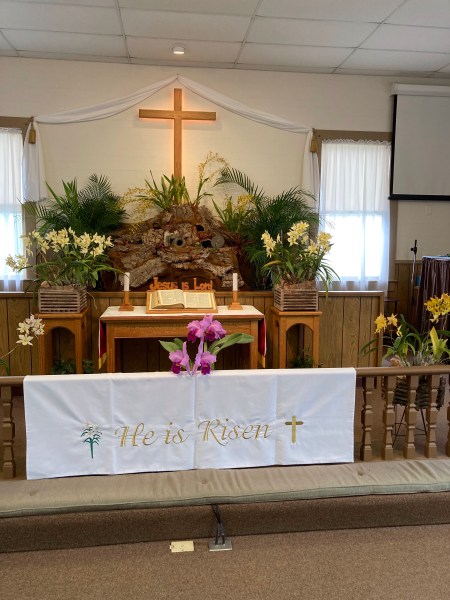
He is Risen!

Pastor Sherry’s Easter message for 4/9/23

Scriptures: Acts 10:34-43; Ps 118:1-2, 14-24; Col 3:1-4; Jn 20:1-18


“Max Lucado, in his book, Six Hours One Friday, tells the story of a missionary in Brazil who discovered a tribe of Indians in a remote part of the jungle. They lived near a large river. The tribe was friendly and in need of medical attention. A contagious disease was ravaging the population and people were dying daily. An infirmary was located in another part of the jungle and the missionary determined the only hope for the tribe was to go to the hospital for treatment and inoculations. In order to reach the hospital, however, the Indians would have to cross the river—a feat they were unwilling to perform.

“The river, they believed, was inhabited by evil spirits. To enter the water meant certain death. The missionary set about the difficult task of overcoming the superstition of the tribe.

“He explained how he had crossed the river arrived unharmed. No luck. He led the people to the bank and placed his hand in the water. The people still wouldn’t believe him. He walked out into the river and splashed water on his face. The people watched closely, yet were still hesitant. Finally, he turned and dove into the river. He swam beneath the surface until he emerged on the other side. Having proved that the power of the river was a farce, the missionary punched a triumphant fist into the air. He had entered the water and escaped. The Indians broke into cheers and followed him across.”

Isn’t that what Jesus did? He entered the river of death and came out on the other side so that we might no longer fear death, but find eternal life in Him.

(Max Lucado, Six Hours One Friday, Multnomah Books, 1989, pp.157-158).

Today, Easter Sunday, we celebrate the fact that Jesus Christ demonstrated that He had overcome sin and death by rising from the dead. He demonstrated the full extent of His miraculous power. And He brought us hope for the future (death is not the final outcome for us). All of our readings today refer in some way to Jesus’ resurrection:

A. In our Gospel, John (20:1-18) highlights some of the events of that first Easter Day. Mary Magdalene—remember, she had held a vigil for Jesus, along with His mother, John, and several other women–at the foot of His Cross. She had probably wept and prayed for Him as he hung dying. No doubt she had watched Joseph of Arimathea and Nicodemus quickly wrap His body for burial. In a dry land with limited water, they would have cleaned the corpse as best they could. They had to hurry before the onset of the Sabbath—He had to be buried before sundown. They then coated the body with myrrh, aloe, and the other spices they had brought. Next, they wrapped it up in stripes of cloth, which would have encased the body in a permanent, glued-on, kind of bandage. This process is important to note because of what happens later.

Mary had watched and must have thought the men did not do as good a job as they should have done for someone as important as Jesus. So she returned to the grave early the next morning, intending to make things right. How she thought she might roll away the heavy stone sealing the tomb is anyone’s guess. Nevertheless, she found the tomb already opened but containing no body. John tells us she ran to find Peter and the other disciple [this is how John always refers to himself in his Gospel], both of whom ran to see for themselves. John, the younger man, arrived first but only peeked into the tomb. The older Peter lagged behind, but reached the tomb and charged in to see only grave clothes on the shelf where Jesus had been laid.

The grave clothes told a story: The myrrh, aloe, and spices should have stuck the cloth stripes to the body, like a mummy. Remember Lazarus needed help to remove his. Both men saw strips of linen lying there, as if Jesus had materialized up through them, leaving them behind. In addition, the shroud for his head and face had been neatly folded and set aside. John saw this, knew it was physically impossible and therefore evidence of a miracle, and believed that Jesus had been resurrected. They appeared to have then gone home to ponder over what they’d seen.

Mary remained, grieving. Jesus appeared in His resurrection body and she didn’t recognize Him. Apparently the nail holes on His hands and feet, and the pieced place on His side, were evident, but something about His face and posture were altered in His resurrection body. Or perhaps she didn’t realize it was Him because she wasn’t expecting to see Him. She only comprehended that it was Jesus when He called her by name. He told her then to go tell the other disciples that He is going to see God the Father. Now we know from other accounts that He later met privately with Peter, encountered the two disciples on the road to Emmaus, and arrived back to greet 10 of the 11 disciples in the Upper Room, but we do not really know where He went during the middle hours between dawn and later that evening. Somewhere during that time, He had a joyous reunion with His Father in heaven! Mary, then, obediently carried the Good News of Jesus’ Resurrection—I have seen the Lord!–to the others.

B. Peter is certainly fired up as he preaches to Cornelius and his household in Acts 10:34-43). He had seen the empty tomb, the discarded grave clothes, and the resurrected Christ! Filled with the Holy Spirit (at Pentecost, back in Acts 2), he preaches with fiery conviction. Dr. J. Vernon McGee makes the point that, “There is not a single sermon in Acts that does not mention the resurrection of Jesus.” (Through the Bible Commentary Series, Acts, Thomas Nelson, 1991, p.129).

Peter reviews for the Cornelius’ Roman household the salient points of Jesus’ life and ministry, emphasizing the resurrection (vv.39b-41) They [the Jewish religious authorities + the Romans ] killed Him by hanging Him on a tree, but God raised Him from the dead on the third day and caused Him to be seen. He was not seen by all the people, but by witnesses whom God had already chosen—by us who ate and drank with Him after He rose from the dead. What a privilege to have been chosen by the Father to be one of the 500 or so to actually see and spend time with Jesus!

C. Paul reminds us, in Colossians 3:1-4, that because we are “in Christ,” we …have been raised with Christ. We share in Christ’s resurrection. Due to this new position in Christ, we have said goodbye to our old, fleshly selves; and we have put on a new, spiritual self. As a result of this phenomenal realignment/reorientation of our individual identities, Paul wants us to (v.2) set your minds on things above, not on earthly things. If you have read anything about people who claim to have died and gone to heaven (NDE’s, Near Death Experiences), they all agree they did not want to return to earth. Having seen Heaven, they wanted to stay. Similarly, Paul believes since heaven is ahead of us, we should focus on Jesus as we continue our tenure on earth. As children of the Resurrection, we are to pattern our lives after Jesus and keep our concentrate on heavenly realities.

D. Psalm 18:1-2, 14-24 is an ode to joy! The psalmist, predating but very like Paul, invites us to focus on heavenly realities–not the frustrations and disappointments of this life. Because of the mighty things Jesus has done—including demonstrating His power over death—we can rejoice in the Lord and praise Him for deliverance, provision, and protection.

We are thankful because…

1.) (V.1) The Lord is good; His love endures forever.

2.) (V.14)The Lord is my strength and my song; He has become my salvation.

3.) (V.17) I will not die but live, and will proclaim what the Lord has done.

4.) (V.24) This is the day the Lord has made, let us rejoice and be glad in it.

We also celebrate the fact that (v.22) The stone the builders rejected [Jesus] has become the capstone. The capstone was either a large rectangular stone used as a lintel in a doorway, or a large square or rectangular stone used to anchor or align the corner of a wall. It might also be the keystone or middlemost stone in an arch. The capstone (building corner or doorway lintel) or keystone (arch) kept the building from collapsing by supporting what exited beside and above it. Considering this metaphor for Jesus, no wonder we call Him our Rock and our Redeemer.

The story is told of…”a man (who) took a vacation to Israel with his wife and mother-in-law. During their time in the Holy Land, his mother-in-law unexpectedly passed away. The following day, the husband met with the local undertaker to discuss funeral plans.

“In cases like these, there are a couple of options to choose from,” the undertaker explained. “You can ship the body home for $5,000, or you can bury her in the Holy Land for just $150.” The man took a minute to think about it, and then announced his decision to ship her home.

“The undertaker, intrigued by his decision, said, “That’s an interesting choice. Can I ask why would you pay $5,000 to ship your mother-in-law home, when you can easily bury her here for $150?” The man promptly replied, “About 2,000 years ago, a man died and was buried here. Three days later he rose from the dead, and I can’t take that chance!” (Subsplash website, 5 humorous Easter sermon illustrations, April 13, 2022.)

Of course there is no guarantee that the mother-in-law would have resurrected—unless she had been a believer in Jesus Christ. Additionally, we know, of course, that Jesus’ ability to raise us from the dead is not limited to the geography of Israel—thank Goodness! Nonetheless, we can enjoy a good joke.

We can also enjoy the secure future we have in Christ. Like the missionary to Brazil, Jesus entered the river of death and came out victorious on the other side. Because He did this for us, we too share in His resurrection victory—and all of its benefits.

Alleluia, He is risen! The Lord is risen indeed, Alleluia!

©️2023 Rev. Dr. Sherry Adams

The Seven Last Words

Pastor Sherry’s message for Good Friday April 7, 2023

Scriptures: Isa 52:13-53:12; Ps 22; Heb 10:16-25; Jn 18:1-19:42

In years past, on this day, I have tried to explain to us the meanings of the 4th suffering Servant Song from Isaiah—how Jesus exactly fulfilled what Isaiah prophesied 700 yrs. before His birth—how Psalm 22 reveals His thoughts as He hung on the Cross; and the events in John’s account of Jesus’ arrest, trials, torture, crucifixion, death and burial. Today, however, I want us to visit and meditate upon what are called “the seven last words of Jesus.”

Jesus made seven statements from the Cross. Each one had to have been very important to Him because to make them, He would have had to push up on His nailed feet to gather breath to speak, while also rubbing His lacerated back against the rough, splintery wood behind Him. To make each statement must have caused Him incredible pain,

But as St. Augustine noted (354-430), “The tree upon which were fixed the members [His arms and feet] of Him dying was even the chair of the Master.” In other words, even from the Cross as His body suffered, Jesus was teaching us. Even as His death neared, He had important lessons to leave with us. Let’s examine them in order:

A. The 1st is “Father, forgive them, for they do not know what they do” (Luke 23:34). Through the millennia since, this statement has been known as “the word of forgiveness.” Wow! Such a powerful lesson! As He suffered agony, He prayed for God to forgive the very persons who despised Him and were responsible for His cruel murder. What an extraordinarily loving heart! How many of us could do the same?

But this is the challenge, isn’t it? Think of those who have harmed you, and of what they did that was so hurtful. Jesus is modeling for us what He wants us to do. He wants us to forgive those who have hurt us, no matter how badly they treated us; and no matter how much we might want them to suffer in return. We are to commend them to God in prayer. We are to offer them grace. We are to let go of our need for revenge. We place that desire into the Father’s hands, Who has said, Vengence is Mine.

B. The 2nd is “Truly I tell you, today you will be with me in Paradise” (Luke 23:43). To add to Jesus’ humiliation, the sinless Christ was hung between two guilty criminals. One continuously mocked Him, demanding that Jesus free him from their death sentence–if He were truly God. The other may have begun that way, but in watching and listening to Jesus, he realized He was someone special. Like the Centurion below, this 2nd thief came to believe that Jesus truly was the Son of God. In his brand new faith, he asked Jesus to remember him when He came into His Kingdom. Remember, Jesus had taught (Matthew 7:7) Ask and it will be given to you; seek and you will find; knock and the door will be opened to you. For everyone who asks receives….How reassuring! This guy was in the process of dying, but expressed his faith in Jesus. This is truly a last minute, death-bed conversion. I have a friend who was for years a hospice chaplain. He talked many World War II, Korea, and Vietnam vets in Washington, D.C. into accepting Jesus as their savior as they lay dying. A simple, “Yes, Lord, I believe” is enough faith for Jesus to act on.

This statement is known as the word of salvation because this guy’s faith in Jesus saves Him. You are here today because you have given your heart to Christ. Pray for family and friends who have not yet done so.

C. The 3rd is from today’s Gospel (John 19:26-27) Dear woman, here is your son; [and to the apostle, John] Here is your mother.

Jesus sees them grieving at the foot of His cross and wants them to comfort each other. It is a statement of their new relationship. In this, Jesus’ last will and testament, He provides for His mother’s comfort, safety, and companionship. Even though Jesus had several half-brothers and half-sisters, he gives “custody” of Mary to John. He appears to have been redefining or extending the concept of “family.” We have our nuclear family, into which we are born—mother, father, siblings. We also have an extended family —grandparents, aunts, uncles, cousins; a clan or kinship group, if you will. However, when we are in Christ, we also have a spiritual family, people with whom we become close due to our shared faith in Jesus. If our nuclear or extended families are not Christ-followers, we often find we have more in common with our spiritual family than with blood-kin.

Additionally, our Lord never means for us to be isolated, cut off from relationships with others. He has built into us a need for community, or connection with others. Brain researchers have discovered that when we spend time with people we love and who love us, it spikes amounts of the neurotransmitter, dopamine, in our brains, and we actually feel better. Seek out folks with whom you can share your thoughts, your faith, and your heart.

D. The 4th of Jesus’ words from the cross is, “My God, my God, why hast Thou forsaken me?” (Matt. 27:46; Mark 15:33-35). This word speaks to Jesus’ acute suffering. The physical was agony enough. But as He hung on the cross from noon to 3pm, He experienced—for the 1st time—the emotional and spiritual agony of abandonment. Remember He had taken upon Himself all of our sins. In His holiness, God His Father could not be present with Him. For 3 hours, Jesus hung alone. For the 1st time, He felt cut off from the strength and reassurance of His Father’s love. Only His solid trust in His unseen and unfelt Father helped Him to persevere.

Did you notice that He quoted from Psalm 22:1? This was a prayer of desperation. This is also meant to teach us what to do when we too feel desperate and abandoned—cry out to God! I was once fired from a church job for preaching the Gospel. Shocking, but it can happen. I went home, knelt by my bed and wept the lament psalms to the Lord. After a brief time, He told me to stop crying and call my friends in Tallahassee, Florida. It was truly a miracle that three of them—all busy persons—answered my first call. One agreed to drive to New Orleans to help me pack and move. A second one offered me a place to live. The third agreed to help me set up a private practice counseling business until I could land a church job. The Holy Spirit worked through my friends to help me move into a new future, 2 months before Hurricane Katrina nearly destroyed New Orleans. Jesus is the Only One we can truly count on when we are at the end of all of our own resources. Express your gratitude to Him for times when He Has rescued you.

E. Jesus’ 5th word was “I thirst!” (John 19:28). This, of course, refers to His very human state of dehydration. It was a statement of distressing physical need. Mark tells us He would not drink wine mixed with myrrh, a pain killer the Romans offered to those about to be crucified (Mk15:23). He knew He was to experience the totality of the pain inflicted upon Him. His last drink of anything may have been the final cup of wine the evening before at the Passover Feast. He describes His condition in Psalm 22:15 My strength is dried up like a potsherd [a broken piece of pottery], and my tongue sticks to the roof of my mouth. The soldiers then offered him wine vinegar, which He drank from a sponge lifted up to Him. Perhaps that eased his need somewhat. But I think I thirst also means He thirsted then and continues to desire that all would come to know and believe in Him. May we also thirst for the salvation of the many in our culture who reject Christ.

F. Jesus’ 6th word was “It is finished!” (John 19:30). We know His life wasn’t finished as He was resurrected 3 days later. What was finished was His saving work to bring salvation to us all. Scholars say this was a statement of triumph. When I completed seminary, my graduating class had tee-shirts made for all of us that said, tetelestai, which means it is finished in the Greek of Jesus’ day. At the time, we thought we were being clever. Twenty + years later, it seems to me to be presumptuous and irreverent. We had just completed our mission of passing 3 years’ worth of divinity study, while Jesus had paid it all—the full penalty for all our sins—on the Cross. Thank God we are saved by His blood, the blood of the true Passover Lamb. Meditate on your gratitude for His work as our Redeemer 2,000 years ago.

E. Finally, Jesus spoke His last word, “Father, into Your hands I commit My spirit” (Luke 23:46). What a wonderful final statement of reunion! He must have known He was about to breathe His last, and so He gave Himself back to the Father. He acknowledges that His pain, suffering, and alienation from the Father were at an end. I remember how the OR room nurses gave me a warm blanket and a glass of cold apple juice just after I had given birth (back in 1974). I felt such fatigue and relief that my labor suffering—only a fraction of that of Christ—was over and that my child was safely born with all his fingers and toes. No doubt Jesus too was tired, relieved, and exhilarated.

Where will our focus be when we too face death? And are we willing to commit our spirits to God right now?

(Ideas borrowed from Kevin Vost, Seven Meditations on Christ’s Seven Last Words, 2018.)

Jesus gifted us with 7 final lessons from His Cross. May we taken them to heart. Thanks be to God who gives us the victory through our Lord Jesus Christ!

©️2023 Rev. Dr. Sherry Adams

A Four-Day Journey

Pastor Sherry’s message for April 2, 2023

Scriptures: Isa 50:4-9a; Ps 31:9-16; Phil 2:5-11; Matt 27:11-66

Ironically, over 2000 years ago, the Sadducees had a tradition in which they believed the Messiah would show up four days before Passover. As a result, they kept the gates of the Temple open each year on this date so that He could walk right in and assume His rightful place. In fact, Jesus—the True Messiah–did choose to re-enter Jerusalem exactly 4 days before Passover, and proceeded to pray and teach in the Temple. By this time, many Jews had encountered Him. Many others had heard of His miracles, His healings, and of how He cast out demons. They were so taken by Him that crowds waited with joyous anticipation and with baited breath to see what He would do next.

The fact that Jesus chose that exact day to come back into Jerusalem would have driven the Jews’ expectations for their nation to a feverish height. They were sure He would overthrow the Romans, free them from oppression, and reign victoriously as King David had in ages past. But the Romans, too, would have heard the rumors and thus were anticipating an insurrection. They had called in reinforcements in case of an armed revolt. So tensions were very high in the city that day.

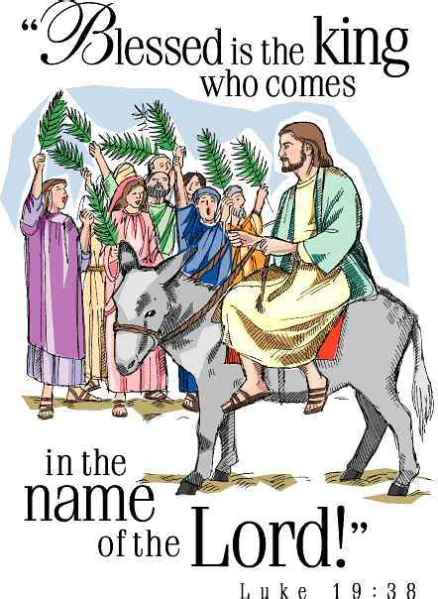
Today, we celebrate that historic day, calling it Palm Sunday–because the crowds waved palm branches in celebration of His arrival—or Passion Sunday, in anticipation of Jesus’ suffering and crucifixion, a brief 4 days later. The minor prophet Zechariah had predicted what would happen some 500 years before this event took place (9:9) Rejoice greatly, O Daughter of Zion! Shout, Daughter of Jerusalem! See, your king comes to you, righteous and having salvation, gentle and riding on a donkey, on a colt, the foal of a donkey. This is exactly Who Jesus was—their righteous Savior. This is exactly what happened. This is exactly how the Jews rejoiced: As Jesus rode in, the people shouted Hosanna (actually, Yasha anna in the Hebrew), which means, Save us, Lord! They were quoting Psalm 118:25-29 O Lord, save us! O Lord, grant us success. Blessed is He who comes in the name of the LORD…. The LORD is God and He has made His light shine upon us. With boughs in hand, join in the festal procession up to the horns of the altar. You are my God and I will give you thanks; you are my God, and I will exalt you. Give thanks to the LORD for He is good; His love endures forever.

On this day, they were excited and delighted! But 4 days later, they were demanding His death! By then, they had realized that Jesus had failed to meet their messianic expectations. As the “2 Bubbas and a Bible” explain it, “He was not 6 feet plus, with abs of steel. He rode into town on a baby donkey, not a warhorse. He went to pray at the Temple, not to protest at the palace. Jesus did not turn out to be their idea of a savior.” (Chilton & Fairless, Lectionary Lab Commentary, Year C, 2015, p.142).

But, as our Scriptures today highlight, He was our Heavenly Father’s Idea of a Messiah:

A. In Isaiah 50:4-9a, we read what is known as the 3rd Suffering Servant Song. Written some 750-700 years before Jesus’ birth, the prophet Isaiah predicts, exactly, what Jesus would experience and how He would behave as He faced and endured the Cross. Its theme is that Jesus came to earth determined to save us. He came into the world to pay the penalty for and to redeem us from our sins. He was instructed or trained for this by the Holy Spirit, and by what He read and meditated upon in Scripture (vv.4-5), the Old Testament writings available at that time.

Verse 6 tells us that His trial by the Sanhedrin led to significant suffering at their hands: They beat Him. They mocked Him. They spit in His face. They even pulled out the hairs of His beard. This was all before He was presented to Pilate for round two by the Romans.

What sustained Him? What helped Him to bear up under such torture? First, He knew His purpose. There was for Him deep meaning to His suffering. And, second, He trusted in His heavenly Father to assist and to comfort Him (vv.7-9) Because the Sovereign LORD [the Father] helps Me, I will not be disgraced. Therefore have I set My face like flint, and I know I will not be put to shame…He who vindicates Me is near…it is the Sovereign LORD who helps Me. His relationship and His intimacy with the Father are what propelled and compelled Him. This essentially kept Him emotionally and spiritually “bullet-proof” against the condemnation and the despicable treatment He received from the religious authorities and the forces of evil at work during His passion.

B. Philippians 2:5-11 is known as “the Philippian Hymn.” Bible scholars believe newly baptized Christians, in the early Church, memorized and recited this brief summary of exactly what Jesus did for us as a verbal profession of their faith. St. Paul included it in his letter because he wanted the church in Philippi (and us) to both understand and follow Jesus’ model of humility and obedience to the Father; as well as to realize the huge significance of what Jesus gave up—His heavenly/godly prerogatives— to become human like us. The One Who spoke creation into existence, the King of the Universe, was entrusted as a helpless infant to a poor, homeless, young couple. He lived His early life as a carpenter, eking out a living in an obscure, back-woods village. He Himself was sinless, but at the Cross He bore all our sins, past, present and future. The Great Shepherd humbled Himself and gave His life for us, His sheep.

As a result of His obedient self-sacrifice, God the Father has raised Him to the highest position of honor. At His name, every creature must bow. No person, animal, angel, or demonic entity has more power or greater authority.

C. Our psalm today (31:9-16) details Jesus’ thoughts on the way to and during His crucifixion. He abides in His Father’s love, praying to and calling out to Him in His mind: (V.9) Be merciful to Me, O LORD, for I am in distress; (V.10) My life is consumed by anguish and My years by groaning; My strength fails….(V.11) Because of My enemies, I am the utter contempt of My neighbors…(V.12) …I have become like broken pottery. He is experiencing despair, extreme pain, and grief, but He does not let it overwhelm Him, or turn Him against God the Father (V.14) But I trust in You, O LORD. I say, “You are My God.” Based on His faith, He goes on to reassure Himself, (v.15) My times are in Your hands.

If only we too could remember, when suffering, to pray to God and to trust in Him to sustain us during difficult, painful times.

D. Matthew’s version of Christ’s Passion is well worth meditating on this Holy Week. Traditionally, it begins in Chapter 26 at verse 14 and continues through the end of our Gospel reading today (Matthew 27:11-66). In today’s portion, we follow Jesus from His trial before Pilate, to His exchange for Barabbas, to His beating at the hands of Roman soldiers to His crucifixion, death, and burial. He had been betrayed and abandoned by all His friends–except John and a few female followers, including His mother. His Father registered His grief and judgment against the Jewish establishment with earthquakes, 3 hours of darkness ending with Jesus’ death; and splitting the Temple curtain from top to bottom. Then, anticipating Jesus’ glorious resurrection, the Father opened some tombs, and resurrected (v.52) …many holy people.

What a journey, in 4 days, from a celebratory welcome parade, to a funeral march, to an ignominious death between 2 criminals. Jesus Christ paid the price for our sins because He believed in Scripture, in His purpose, and because He trusted in His Father’s plan and in His Father’s love. By teaching, preaching, healing, casting out demons, dying a dreadful death in our place, He faithfully completed His 1st mission to earth. He has now returned to Heaven and is seated with the Father, awaiting with us the timing of His 2nd Coming. As we wait to greet Him, let us inspire ourselves with the words of the writer to the Hebrews (12:2-3) Let us fix our eyes on Jesus, the author and perfecter of our faith, Who for the joy set before Him [our salvation] endured the cross, scorning its shame and sat down at the right hand of the throne of God. Consider Him who endured such opposition from sinful men, so that you will not grow weary and lose heart.

©️2023 Rev. Dr. Sherry Adams

Resurrection Power

Pastor Sherry’s message for March 26, 2023

Scriptures: Eze 37:1-14; Ps 130; Ro 8:5-11; Jn 11:1-45

Have you ever wondered about what you might do if you were God? Jim Carey plays a guy who thinks he can do things better than God in the 2003 film, Bruce Almighty*. (Hard to believe it’s now 20 years old!) You may remember that Morgan Freeman, dressed totally in white, plays the role of God the Father. He gives Bruce His godly powers, then goes on vacation. At first, Bruce does not believe he has God’s powers.

Then he begins to experiment, with hilarious results: He starts his cranky, clunker of a car by simply telling it to start, and is gratified. He walks on water and is both scared and amazed. He produces a spoon to stir his coffee just by thinking it up. He creates a wind in a diner that parts his soup into two pools. As the movie progresses, most of what Bruce does is either silly, or selfish, or vindictive, or damaging—thereby making the point that we humans don’t have the necessary love, maturity, or wisdom to use such power judiciously. If we were God, we would most likely mess up massively.

Our scripture readings today all celebrate the phenomenal power of God, and the very wise and compassionate ways in which He utilizes it in our lives:

A. Psalm 130 sets the stage: In the ancient church tradition of naming the psalms by their first few words in Latin, Psalm 130 is called “De profundis”–or “Out of the depths.” Whoever composed this psalm captures our times of grief, despair, or overwhelm in his 1st verse: Out of the depths I cry to You, O Lord. The psalmist is saying “Lord, I am at the end of my resources. Help!” Or, as I said last week, “Lord, I’m at the end of myself. Help!” We can all think of times, can’t we, when we are overtaken by profound despair, debilitating grief, or hopeless depression? If we believe in God and in His power, at some point we remember to call upon Him for help. Verse 2 reads O Lord, hear my voice. Let your ears be attentive to my cry for mercy. If we are wise—and if we trust in Jesus—we take our distress to the Lord.

This psalmist clearly trusts in the Lord. He is very aware that we are all sinners who really don’t deserve God’s mercy, forgiveness, or grace. Yet he counts on it! He waits for the Lord to act on his behalf. My favorite verse is #7 O Israel [O Christ-followers], put your hope in the Lord, for with the Lord is unfailing love and with Him is full redemption. In other words, we can and should trust in God to love us despite our shortcomings. In other words, we can and should believe in His ability to overcome our suffering and to redeem our pain—even redeem our messes, if we surrender them to Him. Our God has the power to pull us up out of whatever depths we have sunken into.

B. Paul continues this theme in Romans 8:5-11. Before exploring the meanings of the passage, it is most helpful to begin before verse 5, at Paul’s basic premise expressed back in verse 1: Therefore there is now no condemnation for those who are in Christ Jesus. What a relief! If I abide in Christ—maintain my heartfelt relationship with Him—my sins aren’t counted against me. And not just me! All of our sinfulness is covered/hidden behind/or rather accounted for by the righteousness of Christ!

Back in the beginning of Lent (2/12/23), I preached on Paul’s 1st letter to the Corinthian Church (3:1-9). You may recall that he differentiated between the saved and the unsaved, as well as between spiritual (Mature) Christians and carnal (Immature) Christians. He is making a similar point to the church in Rome in the remainder of this passage: Rev. Dr. Eugene Peterson paraphrases it this way (The Message, NavPress, 2002, pp.2044-2045) Those who think they can do it on their own [overcome their carnal nature] end up obsessed with measuring their own moral muscle but never get around to exercising it in real life. Those who trust God’s action in them find that God’s Spirit is in them—living and breathing God! Obsession with self in these matters is a dead end; attention to God leads us out into the open, into a spacious, free life…..

The carnal Christian has a mindset that is controlled by his/her sinful nature. Rev. Dr. J. Vernon McGee says our sinful nature acts like a big bully, constantly trying to ambush us and beat us up (Commentary on Romans, Thomas Nelson, 1991, p.141). It feels like that, doesn’t it? Sin beats us up!

Paul states that the sinful nature leads us to death (certainly spiritually, but often even physically). On the other hand, the Spirit-led mindset leads us into life. The Holy Spirit acts like our big brother who shows up in the nick of time to save us from the bully. I didn’t have an older brother; in fact I saved my little brother’s neck a bunch of times. But even so, I know how good that feels to know the Holy Spirit is willing to go toe-to-toe with the bully and win for my behalf.

Additionally, Paul explains, (MSG, p.2045) But if God Himself has taken up residence in your life, you can hardly be thinking more of yourself than of Him. Anyone, of course, who has not welcomed this invisible but clearly present God, the Spirit of Christ, won’t know what we’re talking about. But for you who welcome Him, in whom He dwells—even though you still experience all the limitations of sin—you yourself experience life on God’s terms. It stands to reason, doesn’t it, that if the alive-and-present God who raised Jesus from the dead moves into your life, He’ll do the same thing in you that He did in Jesus, bringing you alive to Himself? What a blessing!

God the Holy Spirit abides in us and protects us from the bullies. And He also functions to grow us up into mature Christians.

C. This transformative, life-giving power is revealed in Jesus in our Gospel lesson from John 11:1-45. This is the familiar story of Jesus arriving in Bethany 4 days after his friend Lazarus has died. Both of Lazarus’ sisters greet Jesus with faith statements (v.21 and v.32) Lord, if you had been here, my brother would not have died. Both sisters trust that Jesus could have healed Lazarus of his fatal illness. Though neither has heard that He has the power to restore a dead person to life, they believe in the final resurrection after we die. Jesus reveals to Martha that (vv.25-26) I am the resurrection and the life. He [or in this case, she] who believes in Me will live, even though he [she] dies; and whoever lives and believes in Me will never die.

Then Jesus prays to His Father and proceeds to bring forth a living Lazarus from the grave. The formerly dead man walks out of the grave, but is still bound up in his grave wrappings. He probably looked somewhat like a mummy—alive but not really free—so Jesus directs the onlookers to (v.45) Take off the grave clothes and let him go. Jesus, God-incarnate, has the power to raise a dead person to life. Glory to God!

This is astonishing and defies science as we understand it! If any of you has read Mary Shelley’s Frankenstein—which she wrote at the age of 18—you may have noted that it is not only one of the first novels in the horror genre, but it is also a morality tale. Dr. Frankenstein wants to prove that humankind can create something alive from dead matter. He cobbles together cadaver parts, then shoots incredible amounts of electricity into the monster’s body to bring it to life. Later on the amoral, rogue monster kills his creator. The moral is that humans should stay in their own “wheelhouse” and leave the creation of life to God. God can simply call a person by name to bring them come back to life.

D. Additionally, as our OT lesson shows us (Ezekiel 37:1-14), our God can also resurrect an entire nation! By the power of the Holy Spirit, God takes the prophet Ezekiel to a wasteland, desert valley in which he sees the dried, scattered, skeletal remains of innumerable warriors killed long ago in some titanic battle. God then asks Ezekiel if these bones can return to life. The prophet wisely replies (v.3) O Sovereign Lord, You alone know. Like many of us, Ezekiel knows God can do it. He’s just not sure if, in this case, God will do it. But God tells the prophet to command the bones to come to life. Ezekiel does exactly what the Lord has told him.

Even as he is still speaking God’s words over the bones, they begin to move; they reassemble into human form; and they become upright but unbreathing cadavers. .

Then God tells the prophet to prophesy to the breath (v.9) Come from the four winds, O Breath, and breathe into these slain that they may live. God allows Ezekiel (who speaks for God) to command the Breath—the ruach [the word in the Hebrew for wind, breath, or Holy Spirit] to bring these cadavers to life. He does as directed and a mighty army returns to life! Bruce Almighty asks, “Who has the power?”

Ezekiel and we know that only God has the power to bring the dead back to life! This exercise in the Valley of the Dry Bones was meant to let the Israelites know that God will one day restore that nation–not as it is today, a geographical and political entity that barely acknowledges God. But, at Jesus’ 2nd Coming, as a nation of true-believers.

Our God has such extraordinary, resurrection power over our lives that He can resurrect us when we die. Many of God’s/Jesus’ miraculous powers amaze me. But, given the eternal consequences, none is as important as is His ability to bring us to new life in Christ Jesus, and through the power of the Holy Spirit. Thanks be to God, who gives us the victory over death, through our Lord, Jesus Christ. Amen!

©️2023 Rev. Dr. Sherry Adams

*Bruce Almighty

Follow Me into the Light

Pastor Sherry’s message for March 19, 2023

Scriptures : 1 Sam 16:1-13; Ps 23; Eph 5:8-14; Jn 9:1-41

My new, favorite, contemporary, Christian song is, “Follow Me,” by Casting Crowns* (Thrive CD, 2013). The lyrics are as follows:

(Look/listen for the repeated themes.)

At the end of myself, I am empty and dry

I have nothing to give, But surrender inside.  

[Jesus responds] Let down your nets, This is not the end

From now on, you’ll be Fishers of Men. [Who is this? Peter, Lk 5:1-11]

Follow Me, Follow Me, Follow Me.  

At the end of myself, Judgment calls out my name

I’ve been looking for love, but I’m swallowed by shame. 

[Jesus responds] Throw away all your stones, Find forgiveness in Me.

Let me be your new passion, My daughter you’re free [Woman caught in adultery, Jn 8:1-11]. 

At the end of myself, I’ve done things my own way;

This world gave up on me, now it’s death I do pay.

[Jesus responds] You know who I am, I’m sin’s sacrifice;

Today you will be… in paradise.  [Thief on the Cross, Lk 23:32-45]

[Any seeker] Who is the man who calmed the seas?

And Who is this man who loves the least of these?

[Jesus responds] I am the Promised One; God gave His only Son.

And those who believe…Will live eternally.

At the end of yourself, just follow Me.

I will give you new life, just follow Me, Follow me.

If at the end of yourself, just follow Me.

You may lose everything, just follow Me.

I will give you new life, just follow Me, follow Me.

The repeated themes are, off course, Follow Me, and, At the end of myself. When we come to the end of our own resources, we know we need Jesus. Another way of saying this is that without Jesus, we are spiritually blind. Two of our Scripture passages today deal with blindness (physical and spiritual) and what it takes to come out into the Light of Christ. Let’s examine them together:

A. John 9:1-41 details Jesus’ healing of the man born blind.

The context is that of a Sabbath Day when Jesus spots this blind man begging before one of the Temple gates in Jerusalem. Blind and other physically impaired persons usually did not make a living—in those days–by practicing a trade. Instead, they customarily stationed themselves somewhere near consistent foot traffic and begged for food money from passersby.

Upon seeing him, the disciples want Jesus to explain the cause of the man’s blindness (a theoretical, theological discussion). But Jesus downplays the issue of who or what to blame, saying (v.3, The Message, Eugene Peterson, NavPress, 2002, p.1937)”You’re asking the wrong question. You’re looking for someone to blame. There is no such cause-effect here. Look instead for what God can do. Then He proceeds to meet the man’s most pressing practical need, saying (vv.4-5, MSG)We need to be energetically at work for the One who sent Me here, working while the sun shines. When night falls, the workday is over. [Remember, this was a predominantly rural culture with no one working past sundown.] For as long as I am in the world, there is plenty of light. I am the world’s Light. (Other translations say, I am the Light of the World.) The poor guy has lived in darkness his whole life! Jesus isn’t going to stand there and argue the why’s of the fellow’s condition. He intends to heal him.

He also intends for them and for us to realize He is God. He makes an “I AM” statement—to Jewish ears, he was declaring His divinity. God the Father had identified Himself to them as “I am Who I am,” meaning that He has always existed; in a sense, our God is always exists in the present tense. In the Gospel of John, Jesus makes many I am statements so that the Jews would realize He was identifying Himself as God: I am the Living Water; I am Manna from Heaven; I am the Way, the Truth; and the Life; I am the Good Shepherd; I am the Resurrection and the Life; etc.

Now, this poor blind man has never enjoyed light in his life, but the One who is the Light of the World is going to bring it to him. He makes a kind of clay from saliva and dirt and places it on the guy’s closed eyes.

Now, consider this: The blind fellow has heard Jesus’ voice; he has felt Jesus’ touch; he has probably even smelled Jesus’ scent. He obeys his unseen Redeemer by going, as instructed, to wash the clay off in the pool of Siloam (which John tells us means “sent.” The man was sent by Jesus to the pool named “Sent”). He seems to trust Jesus, sight-unseen. He chooses to do what Jesus tells him (Contrast this with Naaman the Syrian general who was too proud to dip himself—as the prophet had instructed him—in the Jordan. His servants had to convince him to “follow orders” to obtain his healing.)

Throughout the rest of the incident, the Pharisees are trying to figure out how a rabbi who breaks Sabbath rules against working on that day—which makes Jesus a sinner in their eyes—could possibly work a miracle of God. The guys’ neighbors can’t explain it. Some of them don’t even recognize him since he is now sighted. His parents do recognize him but are afraid the religious rulers will excommunicate them if they celebrate Jesus, so they avoid committing themselves. But the grateful and spunky guy takes them to task! He’s not concerned about their theological issues. He just knows he was born blind but now has his sight.

Then Jesus turns the tables on the Pharisees when He calls them physically sighted but spiritually blind. He has worked a miracle that they cannot accept. In so doing, He has fulfilled the prophesy from Isaiah 61:1 that Messiah would restore sight to the blind. But in their confidence that Jesus cannot really be the Messiah, they refuse to see the evidence before their own eyes.

B. Paul also addresses the topic of spiritual blindness in Ephesians 5:8-14. Of course he (and we) start from knowledge that Jesus is the Light of the world. As Peterson puts it his paraphrase (MSG p.2132), Paul exhorts us You groped your way through that murk [habitual sins] once, but no longer. You are out in the open now. The bright light of Christ makes your way plain. So no more stumbling around. Get on with it! The good, the right, the true—these are the actions appropriate for daylight hours. Figure out what will please Christ, and then do it. In other words, prior to accepting Jesus as our Lord and Savior, we lived in spiritual darkness. Once we accept Jesus, we live the Light of Christ. As St. John would say later in 1 John 1:5-6 God is Light; in Him there is no darkness at all. If we claim to have fellowship with Him yet walk in the darkness, we lie and do not live by the truth. We demonstrate the fact that we dwell in Christ’s light by living a life different from that of our culture: We demonstrate goodness or kindness to others. We live lives that are righteous as we try to do those things of which Jesus would approve, and avoid doing the opposite. Our words and our manner reflect truth—i.e., we are sincere and genuine.

Finally, Paul urges us to (v.11) have nothing to do with the fruitless deeds of darkness….Dark deeds aren’t driven away by preaching or lecturing against them; but rather, our actions speak louder—and are a better witness to Christ—than are our words. Rev. Dr. J. Vernon McGee relates a true story of one of his parishioners. She was a married lady who grieved the fact that her husband was uninterested in Jesus. She wanted him to share her faith and to accompany her to church and in prayer. So she educated, begged, pleaded, nagged, and even resorted to crying through the two meals a day they were together. Dr. McGee told her to stop that immediately. He recommended she pray, fix excellent meals, and deal with her husband with a smile on her face and a loving attitude. It took about six months, but one day he suggested they attend church together. We cannot shame another into accepting Christ (McGee’s commentary on Ephesians, Thomas Nelson, 1991, pp.142-143).

The song I read earlier gives 3 examples of people who chose to follow Jesus: Peter, the woman caught in adultery, and the thief on the Cross. Our Gospel lesson provides an additional one, the man born blind. As with each of them, we often come to Jesus when we come to the end of ourselves; i.e., when we exhaust ourselves trying to save ourselves. We realize we can’t do it on our own. We recognize we need Jesus. Then, like the man born blind, we obey Him out of thanksgiving for His gift of salvation and healing.

Following Jesus means we don’t just claim we love Him, but we live lives that are changed due to our relationship with Him. We come to demonstrate the fruit of the spirit (Galatians 5:22) love, joy, peace, kindness, gentleness, goodness, patience, faithfulness, and self-control. We live out being good, being right with God, and being truthful.

Dear Lord, help us to live lives that are pleasing to You and that reflect Your Light to a lost, angry, and hopeless world. Help us to truly follow You. May the way we live attract others to You, O Lord, we pray in Jesus’ name. Amen.

©️2023 Rev. Dr. Sherry Adams

*Follow Me by Casting Crowns’ video: https://youtu.be/LraPDltKlvI

Copper Nails on my Conscience

Pastor Sherry’s message for February 26, 2023

Scriptures: Gen 2:15-17, 3:1-7; Ps 32; Ro 5:12-19; Matt 4:1-11

Dr. H.A. Ironside (1876-1951) was a famous preacher and Bible teacher in America. One day, he was preaching on verse 3 from Psalm 32 (Peterson’s paraphrase, The Message, p.948) When I kept it [my unconfessed sin] all inside, my bones turned to powder, my words became a daylong groan, when he said, “There is nothing that so takes the joy out of life like unconfessed sin on the conscience.” He went on to repeat the following story, borrowed from a pastor friend, who had been preaching on the subject of unconfessed sin and the importance of both confession and of providing restitution to anyone we may have injured through that sin:

At the close [of a service] a young man, a member of the church, came up to him with a troubled countenance. “Pastor,” he explained, “you have put me in a sad fix. I have wronged another and I am ashamed to confess it or to try to put it right. You see, I am a boat builder and the man I work for is an infidel. I have talked to him often about his need of Christ and urged him to come and hear you preach, but he scoffs and ridicules it all. Now, I have been guilty of something that, if I should acknowledge it to him, will ruin my testimony forever.”

He then went on to say that sometime ago he started to build a boat for himself in his own yard. In this work copper nails are used because they do not rust in the water. These nails are quite expensive and the young man had been carrying home quantities of them to use on the job. He knew it was stealing, but he tried to salve his conscience be telling himself that the master had so many he would never miss them and besides he was not being paid all that he thought he deserved. But this sermon had brought him to face the fact that he was just a common thief, for whose dishonest actions there was no excuse.

“But,” said he, “I cannot go to my boss and tell him what I have done or offer to pay for those I have used and return the rest. If I do he will think I am just a hypocrite. And yet those copper nails are digging into my conscience and I know I shall never have peace until I put this matter right.” For weeks the struggle went on. Then one night he came…and exclaimed, “Pastor, I’ve settled for the copper nails and my conscience is relieved at last.”

“What happened when you confessed to your employer what you had done?” asked the pastor.

“Oh,” he answered, “he looked queerly at me, then exclaimed, ‘George, I always did think you were just a hypocrite, but now I begin to feel there’s something in this Christianity after all. Any religion that would make a dishonest workman come back and confess that he had been stealing copper nails and offer to settle for them, must be worth having.'”

[The pastor] asked if he might use the story, and was granted permission.

Sometime afterwards, he told it in another city. The next day a lady came up and said, “[Pastor], I have had ‘copper nails’ on my conscience too.” “Why, surely, you are not a boat builder!” “No, but I am a book-lover and I have stolen a number of books from a friend of mine who gets far more than I could ever afford. I decided last night I must get rid of the ‘copper nails,’ so I took them all back to her today and confessed my sin. I can’t tell you how relieved I am. She forgave me, and God has forgiven me. I am so thankful the ‘copper nails’ are not digging into my conscience anymore.”

I have told this story many times and almost invariably people have come to me afterwards telling of “copper nails” in one form or another that they had to get rid of. On one occasion, I told it at a High School chapel service. The next day the principal saw me and said, “As a result of that ‘copper nails’ story, ever so many stolen fountain pens and other things have been returned to their rightful owners.”

Dr. Ironside concluded, “Reformation and restitution do not save. But where one is truly repentant and has come to God in sincere confession, he will want to the best of his ability to put things right with others.” (H.A. Ironside, Illustrations of Bible Truth, 1945, Moody Press, pp. 104-106.)

Now this story dates from 1945. We know our culture has changed radically since then. Most Americans then were church-attending Christians; and most had developed strong consciences. You see, following Jesus gives us a standard of morality against which to measure our behavior. Without this standard, we have the sort of mess we see in our culture today. For instance, we have to wonder if children are being taught right from wrong anymore. Or are they being taught, “Don’t do that because it irritates me,” or “Do this because it pleases me.” Such an approach simply teaches our children to be manipulative people-pleasers. Nevertheless, we have to hope that most older Americans’ consciences would bother them if they wronged another; and we should pray for those both young and older whose consciences are underdeveloped.

Regardless, this is what Christ wants from us when we wrong others:

1. Confess the wrong;

2. Then, make it right.

This is the focus of our Scripture passages today:

A. In Genesis 2:15-17, 3:1-7, God makes Adam’s wonderful life situation in the garden dependent upon one, and only one condition: (v.17) But you must not eat from the tree of the knowledge of good and evil, for when you eat of it you will surely die. The fruit of one tree alone —among many, wonderful other trees–was forbidden. Notice the Lord told them ahead of time what would happen if they disobeyed His command. Obviously, Adam and Eve did not physically die when they sinned, but because they had rebelled, sin and death entered the world. They were severely negatively impacted—physically (they aged, then eventually died), emotionally, and especially spiritually. Their sin separated them from intimacy with God. Because we were all under the headship of Adam, the natural head (patriarch) of the human race, we also suffered the consequences of his actions as they trickled down to us.

B. Paul, in Romans 5:12-19, explains this principle further.

Adam, from whom we are all descended, sinned; because he sinned, we his descendants, are tainted with the same sin. Roman Catholics call this original sin. What was his and Eve’s original sin? It was rebellion, motivated by pride. We didn’t commit their specific sin, but isn’t it true that we too are rebellious and hounded by pride? When we decide to disobey God, aren’t we saying in so many words, “Lord, I choose my will over Yours—even though You are wiser than me, as well as all-knowing and able to see into the future.” Paul makes the case in verses 13-14 that (original) sin had entered the world even before the Law was given to us by God via Moses. Even so, the Law was not able to keep us from sinning!

Fortunately for us, Jesus’ atoning death on the Cross more than corrected for our inherited sin nature. Thanks be to God! To provide an analogy, let’s say that just like a gene for height or for hair color is handed down through generations, we were all born—from Adam down to Christ—physically bent or twisted. Even receiving and abiding by the Law would not remove the warp in us human beings. But for those of us who believe in Jesus, His atoning death for our sakes essentially de- warped or un-warped us. Now can we still sin? Unfortunately, yes. But the difference for believers is that we are covered with or shielded by the right-ness of Christ.

Paul calls this a demonstration of God’s grace. Jesus not only satisfied the penalty for our sin, but he gave us in addition an unmerited, undeserved, but magnanimous gift! Listen to how Peterson paraphrases verses 15-19 in everyday American (The Message, NavPress, 2002, p.2040) Yet the rescuing gift is not exactly parallel to the death-dealing sin. If one man’s sin [Adam’s] put crowds of people at the dead-end abyss of separation from God, just think what God’s gift poured through one man, Jesus Christ, will do! There is no comparison between that death-dealing sin and this generous, life-giving gift. The verdict on that one sin was the death sentence; the verdict on the many sins that followed was this wonderful life sentence. If death got the upper hand through one man’s wrongdoing, can you imagine the breathtaking recovery life makes, sovereign life, in those who grasp with both hands this wildly extravagant gift, this grand setting-everything-right, that the one man Jesus Christ provides?

Here it is in a nutshell: Just as one person did it wrong and got us in all this trouble with sin and death, another person [Jesus, the 2nd Adam] did it right and got us out of it. But more than just getting us out of trouble, He got us into life! One man said no to God and put many people in the wrong; one man said yes to God and put many in the right.

In other words, from God’s perspective, “…putting humankind to rights is far more important that making up for Adam.” (J. Vernon McGee, Thomas-Nelson, 1991, Romans, p. 92). Thanks be to God, we are no longer under the headship of Adam. Jesus Christ is the head of a new race, the Redeemed. This is our true identity and it supercedes our racial, ethnic, and even gender identities! Those of us who love Jesus are no longer under death sentence of original sin. Jesus Christ has set us free!

Additionally, Jesus (Matthew 4:1-11) provides us with the best example of how to proceed when we are tested or tempted to sin. Matthew reports (v.1) that…Jesus was led by the Spirit into the desert to be tempted by the devil. This occurred right after He had been baptized and the Father had claimed Him as His Son and blessed Him, audibly, from heaven. Matthew then goes on to relate Jesus’ major temptations:

1.) To feed His own hungers—forty days without food had to have been rough!

2.) To win popularity and great power, cheaply and quickly;

3.) And to become famous.

However, to accommodate Satan, He would have had to betray the One True God. Thanks be to God that He did not betray His Father! Besides wrestling with hunger, thirst, and loneliness in the wilderness, Jesus had lots of time to think and pray. During those 40 days, He came to a true understanding of Who He was/is. He came to grips with His true identity as the Son of God.

Now the Devil watches us all carefully, so he knows which buttons to push to try to pull us away from God. Satan’s temptations were all intended to seduce Jesus into being selfish and self-gratifying. But our Lord knew after 40 days of self-denial that He was meant to be selfless and self-sacrificing. He was meant to save lost sinners (The Revs. John Fairless and Delmer Chilton, “The Lectionary Lab, year A, 2013, p. 75). Thanks be to God!

Let’s return to the image of copper nails on our conscience. King David wrote Psalm 32, while he was suffering the impact of his sins with Bathsheba and against Uriah, her husband—coveting his neighbor’s wife, adultery with her, and setting Uriah in the front lines of the next battle so he would be killed. King David killed to save his skin and his reputation. However, his conscience was so seared by his memory of the copper nails that he felt compelled to confess his sins to Almighty God (here and in Psalm 51). Then he reports, with great relief and gratitude, that he receives God’s forgiveness, and feels blessed because of his restoration.

Jesus has given us the key to resisting our temptations:

1. Understand our true identity as the Redeemed, and the magnitude of God’s love and grace;

2. Then ask the Holy Spirit to help us use Scripture to resist the Devil.

We don’t want to be like the 4 pastors who agreed to confess their sins to each other (What an awful idea!): One said, “I cheat on my taxes.” The 2nd confessed he snuck food and drinks into the movie theater. The 3rd said he borrowed all of his sermons from the internet. The 4th was unwilling to say what he did wrong. The others pressed him, saying, “Come on, we confessed ours. It’s your turn.” It took some pressure, but he finally admitted, “Mine’s gossiping and I can hardly wait to get out of here.” Unlike this guy, remember cooper nails. Confess the wrong; make it right.

Paul has stressed for us the enormity of Jesus’ saving actions in each of our lives. Our best response is to praise Him with gratitude. Thanks be to God Who gives us the victory through our Lord Jesus Christ!

©️2023 Rev. Dr. Sherry Adams

Where is Your Heart?

Pastor Sherry’s message for Ash Wednesday February 22, 2023

Scriptures: Joel 2:1-2, 12-17; Ps 51:1-17; 2 Cor 5:20b-6:10; Matt 6:1-6, 16-21

John Wesley began his small group meetings with the question, “How is it with your soul?” As the founder of our Methodist denomination, we know Wesley as a passionate evangelist. Even though ordained an Anglican, he had experienced the Church of England—in the 18th century–as spiritually dead. So he left church buildings and preached in fields, in town squares, or wherever he could find a responsive audience.

But he wasn’t just content to bring people to a saving knowledge of Jesus; he wanted them to be discipled in the faith. So he began to set up small groups, which he called “Bands.” These were like Cursillo or Emmaus Walk “Reunion Groups.” They met once a week to challenge themselves to move deeper into their faith. Cursillo and Emmaus groups ask, “When this week did you feel closest to Christ?” Sometimes the question is, “Where are you in your walk with Jesus?” Or, as Jesus asks in today’s Gospel (v.21), Where is your heart?

Today, the church season of Lent begins. For the 40 days leading up to Easter (not including Sundays), the Church—Roman Catholics, Anglicans, Episcopalians, Lutherans, and Presbyterians—commemorates Jesus’ 40 days in the wilderness. Remember, following His baptism, the Holy Spirit drove Him out into the wilderness to fast, to pray, and to be tested. We too are encouraged to fast, pray, and to develop the strength to resist temptations, as Jesus did. The intention of this is to help us to take inventory of where we are spiritually, and to make course corrections. You could say the 40 days of Lent invite us to ask daily, “How is it with my soul?” or “Where is my heart?”

Our Scriptures today all speak to this issue:

A. In our Gospel lesson (Matthew 6:1-6, 16-21), Jesus directs our attention to our motivation as we give (service or money), fast, or pray. Our understanding of our heart is that it is a very important physical organ that may or may not work well. We also see it as a metaphor for our tender feelings. We say, “She has a good heart,” meaning she is generous or compassionate. Or we say, “He has a tender heart,” when he is known for rescuing stray animals or showing kindness to children. We just celebrated Valentine’s Day, a day to focus on romantic hearts.

But the Hebrew understanding of heart was very different: To them, it is not just an important physical organ. The people of Jesus’ day considered the word heart as a metaphor for the whole self. They believed you decided with your heart rather than your brain. They saw the heart as the core of our identity (not race, gender, or nationality). Our heart, according to them, is what drives or motivates us. So, when Jesus says (v.21) For where your treasure is, there your heart will be also, He means we can each rightly discern our priorities by noting where we spend our time, attention, and money. Our priorities can be on acquiring physical things, like a fancy car, a fine home, an expensive item of clothing or of jewelry. Our priorities may be our spouses or our kids, our “grands,” or our pets. Our priorities may also be such values as success, security, happiness, or romantic love. None of these is bad in and of themselves; they become problematic when these treasures/priorities come between us and our relationship with Jesus.

So to spiritually wean ourselves away from whatever interferes with a heart-felt relationship with our Lord, we may choose, for 40 days…

a. to give up social media; TV; chocolate; eating out; etc. I recently read of a woman who decided to pare down the number of knickknacks and decorating items she had by donating a bagful a day to recycling shops. I think the Lord would approve of her desire to simplify her life’s distractions and clear away her clutter; but He probably would not be impressed if this were just another self-improvement project disguised as a Lenten discipline. He would want her to do whatever she does in order to draw her heart closer to Him.

b. Or, we may decide to take on a new spiritual discipline: I am taking (instead of leading) a Bible study on Zoom with some friends from Tallahassee beginning Monday night. You could take a walk daily with the purpose of having quiet time to talk with the Lord. You could read some Christian books—fiction or nonfiction–to increase your faith, etc.

The traditional disciplines, or methods of self-restraint, are what Jesus cites in verses 1-6 and 16-21: (a) Almsgiving or giving of your time, talents or cash to others; (b) Fasting; and (c) increased prayer. The point is to draw our hearts closer to Christ, not to impress others.

B. Briefly, the authors of our other lessons today encourage us to draw our hearts closer to Christ in the following ways:

1. Joel says (2:12-13) we draw closer to the Lord when we …return to [the Lord] with all your heart, with fasting and weeping and mourning. Rend your heart and not your garments. Return to the Lord your God, for He is gracious and compassionate, slow to anger and abounding in love, and He relents from sending calamity. This return to the Lord involves demonstrating repentance.

We acknowledge our sins and turn away from them.

2. King David implies, by his example in Psalm 51, that we can return to a close relationship with God when we honestly acknowledge our sins. As we recite tonight verses1-17, we can clearly perceive his sincere grief and regret over what he has done. His sins were grave: coveting his neighbor’s wife, adultery with her, and murder of her husband. We know from Psalm 32:3-4 that he suffered emotional pain and agony as long as he covered up those sins. He openly begs for God’s forgiveness, asking for mercy. He also recognizes that it is only God Himself who can cleanse him (v.10) Create in me a pure heart, O God, and renew a steadfast spirit within me. He also affirms his faith that God will forgive him because he has asked (v.15) O Lord, open my lips, and my mouth will declare Your praise, and (v.17) The sacrifices of God are a broken spirit; a broken spirit and contrite heart, O God, you will not despise.

3. Paul, with his typical zeal, exhorts us to (2 Corinthians 5:20b) Be reconciled to God. In chapter 6, verses 3-10, he reminds the Corinthian Church (and us) that we are to faithfully turn our hearts to Jesus no matter how dire or how happy our circumstances. We are to stay close to Christ because (5:21) God made Him who had no sin to be sin for us, so that in Him we might become the righteousness of God.

So, this Lent—beginning tonight—let’s ask ourselves, daily, “How is it with my soul?” or “Where is my heart?” Let‘s each take an honest inventory of our spiritual health. And then let’s engage in the attitudes and behaviors that will bring us right up, tucked up to Jesus.

And all God’s people say, “Amen!”

©️2023 Rev. Dr. Sherry Adams

The God Behind the Curtain

Pastor Sherry’s message for February 19, 2023

Scriptures: Ex 24:12-18; Ps 99; 2 Pet 1:16-21; Matt 17:1-9

Today is Transfiguration Sunday, the day the church remembers its brief experience of Jesus in all of His revealed glory.

Typically, when we think of truth being revealed, we tend to summon up images of dark deeds brought into the light: Another corrupt politician or businessman being exposed, or the famous case of the Wizard of Oz. Remember the scene in that classic movie where Dorothy, Toto (her dog), the Tin Man, the Lion, and the Scarecrow encounter the Great Wizard? His voice thunders and his face is projected larger-than-life on a giant screen. Dorothy and friends are terrified until the little dog pulls back the curtain. They see the true, ordinary man, who has used showbiz technology to promote himself as all powerful. In a famous line—now seen as humorous–he cries out, “Pay no attention to the man behind the curtain.” Too late! His posturing has been exposed.

On the other hand, we also hear of wonderful revelations:

I remember seeing a video of a man who’d not seen color before get a pair of glasses that corrected for his color-blindness. He was able to experience the delight that color added to his previous dull gray or brown life. He appeared to be overwhelmed with joy. Or did you see the video of a baby girl with a severe hearing defect? A hospital in Cincinnati provided her a set of hearing aids that allowed her to hear her mother’s voice for the first time. Like the colorblind man, she reacted with great joy and wonder.

Our Scriptures today celebrate the joy and wonder of some particularly blessed humans when they visually beheld the God Behind the Curtain.

A. Let’s start with Peter (2nd Peter 1:16-21). Along with John and James, Peter was present at Jesus’ Transfiguration. He writes this letter in about 66AD, shortly before his crucifixion. One could say this was his farewell address. Just a few verses prior (vv.13-14), he refers to his earthly body as a tent, which Jesus has told him he… will soon put…aside.

As Peter prepares to die, he reassures his readers (including us) that Jesus’ transfiguration was a real event (v.16) We did not follow cleverly invented stories when we told you about the power and coming of our Lord Jesus Christ, but we were eyewitnesses of His majesty.

Peter saw Jesus in all His heavenly glory. He and the other two saw the True Divine Being behind the curtain of His human flesh. Peter heard the voice of the Father say to them (vv.17-18) This is my Son, whom I love; with Him I am well pleased. Peter may have later let his all too human fear override this experience of Jesus, briefly; but in his heart of hearts, he knew the truth of what he had seen and heard.

B. Matthew was not present on the mountain, but he had lived with Peter, James, John (and Jesus), for 3 years and he believed the account the 3 friends revealed after Jesus’ resurrection. Just as Peter later testified, Jesus’ appearance was transformed in a dramatic and otherworldly way. He shone with a tremendously bright light which did not shine down upon Him, but rather emanated from within Him. They saw Him in all his heavenly glory. Later, in Revelation 22:16, Jesus will say of Himself I am the Root and the Offspring of David, and the bright Morning Star. By this He meant He is descended from the lineage of King David, as prophesied, and He is the Divine Light that announces the new dawn.

The 3 apostles also beheld Him with two Old Testament “greats,” the prophets Moses, the Law-Giver, and Elijah, the one who challenged over 800 pagan priests–and who decisively demonstrated the power of God over their demonic gods. Neither one died and went to heaven in the usual way. Moses died as the people moved to enter the Promised Land. Scripture says that God buried him (Deuteronomy 34:6). Elijah exited this life in a blaze of glory in a fiery chariot (2 Kings 2:11-12). It is Luke who tells us (9:31) the Father had sent these two Old Testament saints to confer with Jesus about His impending death, probably to comfort and to reassure Him; and to strengthen and encourage Him to withstand His coming ordeal.

C. Speaking of Moses, our Old Testament lesson, Exodus 24:12-18, features him and his leadership team dining with God. The Lord has just revealed to him the Law, including the 10 Commandments (Exodus 20-23:19). God tells Moses to write the Law down, then read it to the Israelites. Moses obediently does so. The Israelites vow (v.3) Everything the Lord has said we will do, promising obedience. (Yeah, sure, that’s wishful thinking. Their adherence to their vow lasted about 40 days!)

Then God has Moses erect an altar and 12 stone pillars to represent each of the 12 tribes. Young men are then pressed into service to corral sacrificial animals for sin and fellowship offerings. Moses, as directed, collects the blood of the sacrifices and places some on the corners of the altar. He is then directed by God to sprinkle the people with the rest. You may recall that no one can enter into God’s presence with sin on their soul. Sprinkling them with the blood of sacrificial animals symbolizes that the people’s sins are washed away or cleansed. As Moses says (v.8) This is the blood of the covenant that the Lord has made with you in accordance with all these words. (Notice how closely this resembles what we say in the Communion Service over the wine: This is My [Jesus’] blood of the New Covenant which is shed for many for the forgiveness of sins.)

Following this, Moses, his brother Aaron (the 1st high priest), Aaron’s two eldest sons, and 70 elders are all invited to have a meal with God.

This whole procedure is actually the template for our communion service, established by God the Father over 4,000 years ago. Think about it:

(1) God’s Word is read;

(2) God’s Word is preached or explained;

(3) The people respond, “Thanks be to God.”

(4) Jesus is the once and for all perfect sacrifice for our sins (Hebrews 5:7-9), so we need not kill any bulls or lambs. His blood has atoned for our sins, so we are cleansed and can freely come into God’s presence. Communion, a spiritual and physical meal between God and human believers, is served. By the way, the Israelite leadership team did not see God the Father. He is Spirit and we know that no one can see Him. Instead, they dined with the pre-incarnate Jesus.

D. Do you think the leadership team knew they were standing on holy ground? Psalm 99 exhorts us to worship God with our praise. It reminds us that God is holy and totally “other” than us—supreme and exalted over all things, and worthy of our sincere devotion.

When the fleshly curtain of Jesus’ human body is pulled away, we shall see Him in all His divinity, all of His glory. He is the real deal! Some of you may have heard that a revival has broken out on the campus of Asbury University in Kentucky. In answer to our weekly prayers for revival and that God would reach our young people, students and guests from all over the world, have been praising God and worshipping Him, in the university chapel, since February 8th. God appears to be changing the lives of Gen Y’s and Z’s. Praise God! Let’s pray that the Lord brings many to Christ through this new move of the Holy Spirit. Let us, with them, worship the one true God who has revealed Himself from behind the curtain, through our Lord and Savior, Jesus Christ. Amen and Amen!

©️2023 Rev. Pastor Sherry Adams

Immature Christians

Pastor Sherry’s message for February 12, 2023

Scriptures: Deut 30:15-20; Ps 119:1-8; 1 Cor 3:1-9; Matt 5:21-37

About 10 years ago, I was teaching Introductory Psychology at Santa Fe College, in Gainesville, Florida, when I had in my class a young man on the autism spectrum, likely diagnosed with Asperger’s Disorder. He was 18 years old, earnest, and smart, but also very concrete in his thinking. He seemed not to be able to comprehend abstract ideas. He told me he had an older brother who was a pharmacist, and his perception was that his brother was their parent’s favorite. He told me how hard he worked to be just as good as his brother, academically, and how important it was to him to make A’s to impress his parents. I noticed in the parking lot that he drove a brand new Ford Mustang GT with racing stripes, so his parents must have favored him more than he acknowledged.

Now the study of Psychology involves a great number of abstract ideas, so I was worried that he would not score well on my tests. Sure enough, he failed the first one. Given the amount of pressure he put on himself, I suspected his reaction to his score would be one of intense disappointment. What I was not prepared for was his startling behavior.

When the other students filed out of the classroom, he threw himself on the floor and had a temper tantrum like that of a 2 or 3 year old. He flailed his arms and legs. He screamed and cried. Believe me, I felt compassion for him in his distress; however, his behavior was thoroughly inappropriate for a college student.

I stood near him and told him, calmly, to stop that. I said his tantrum was not age appropriate. I asked him to get up off the ground and to seek the free counseling that the college offered (which he later did). He needed to learn to control his anger and to manage his distress, and he needed to learn to express negative emotions in an age-appropriate manner. Such a response was immature and would only earn him his peers’ and his professors’ contempt.

Immaturity is the issue that Paul addresses in 1 Corinthians 3:1-9. Let’s back up for just a minute and put Paul’s concern into context. In chapter #2, he had divided humankind into two classes of people: the unsaved and the saved. The unsaved he also called the natural man, or the fleshly man. Such persons either reject the idea that God exists– they are atheists–or, they worship gods they create in their own image, and we call them idolaters. Or they cling to their own wills, believing spiritual things are foolish. They are so fascinated by their own intellects that they believe they can save themselves (I have met many like this in academia).

Paul contrasted the unsaved with the saved or spiritual man. This man or woman has accepted Christ. They are spiritual enough, or practical enough, or wise enough to realize (1) they can receive the wisdom of God; but, (2) they cannot attain righteousness on their own. On other words, they know cannot save themselves—they need Jesus.

Now, in chapter 3, he further divides Christians (the saved; spiritual persons) into two classes: Paul asserts there are Mature Christians, who are cooperating with the transforming power of the Holy Spirit. You can see evidence that their life has changed since they came to know Jesus. They are not perfect, but they do most everything they do with the awareness that God is watching. A church in Live Oak has on their sign, “God saw that.” I think that’s funny. It’s also true since God is omniscient and omnipresent. He does see everything. Furthermore, mature Christians do most everything they do with a desire to please the Lord. They are also future thinking, often considering what might be the eternal consequences of their current actions and words. They are constantly learning from Jesus and/or Scripture and desire to share what they learn with others.

Then there are also what Paul calls Carnal or Immature Christians. They are Christians who look like and live like everyone else in the culture. Coming to know Jesus has not changed them at all. The Greek word for carnal is sarkikos, which means fleshly. In Latin and in French, carna means sensual. Thus, the word carnival comes from carna vale—or farewell to the flesh. This is why many cultures celebrate the Tuesday before Lent starts—Fat Tuesday—as the last opportunity for gluttony allowed before the traditional deprivations of Lent set in. This is who Paul meant when he wrote in Philippians 3:19 [they are the ones]…whose god is their belly. Paul thinks of them as “spiritual infants;” they are as immature acting as my former student.

Paul tells them he fed them milk, the basics, because they were too immature to digest meat. They may have come to know Biblical stories, but were probably not familiar with Biblical doctrine. When I arrived at a church in New Orleans to assist my friend, the lead pastor, we discovered the staff were all reading The DaVinci Code, by Dan Brown. They did not understand why Jesus would not have impregnated Mary Magdalene and left behind a child the Catholic Church worked hard to deny. We shared with them the doctrine that Jesus was sinless as he walked the earth. He needed to be in order to save us. Also, He would not have committed fornication, nor would He marry only to have shirked His responsibility as a husband or father. The staff were “baby Christians.” They hadn’t really studied Scripture (which is both milk, bread, meat, honey), like the Corinthians. Or perhaps they had studied God’s Word, but they had not digested the hard truths they found there (like in today’s Gospel lesson). They weren’t cooperating with the Holy Spirit, so there was no spiritual fruit in their lives, little grace for others, and no true desire to live a life pleasing to Christ.

In verses 1-3, Paul says that the Corinthians are immature, worldly, and carnal Christians. He is convinced his assessment is accurate due to their (a) quarreling (strife)—they are too fascinated with fallen humans; (b) jealousy of (and gossip about) one another; (c) factions; and (d) the fact that they allow gross immorality to go on in their fellowship in the name of toleration. He then reverts back to his arguments of chapter #1they are being carnal, immature Christians when they try to elevate Paul over Apollos, or vice versa. There is not to be any competition, as both are servants of God who do different aspects of God’s work: Paul planted the church and the “seed” of God’s Word in their hearts. Apollos then “watered” that seed as the great preacher and teacher who God used to deepen their faith. They were a kind of one-two punch for Jesus!

Paul wants them and us to be sure that God alone gets the glory. It’s not who the preacher or teacher is–not their personality or their skill set; not even whether we like them or not. It is, instead, whether God is using that person! He rarely ever uses only one person. I have heard other pastors criticize an Ed Young, Jr. and a Joel O’Steen because they preach “Gospel light.” They are both invested in attracting nonbelievers to Jesus. Once people have accepted Christ, they probably then move on to someone like Ed Young, Sr., Charles Stanley, or Dr. David Jeremiah to dig down deep to experience being discipled in the faith. I believe God uses many persons of differing skill sets to bring us to a full, mature faith. Again, Paul, Peter, and Apollos did not compete with one another. All three were doing the work assigned to him, under Christ’s Lordship.

Paul’s message in 1 Corinthians 3:1-9 is that he wants both the Corinthian Church, and us, to grow up in our faith! (Remember, I told you last week that God told me to “Grow up!” because I am usually reluctant to preach from Paul’s letters?)

We become mature Christians when we marinate ourselves in God’s Word, the Bible. Make it a practice to read a passage daily. If you don’t understand it, get a study Bible and/or a good commentary to help you. Ponder what you have read and notice how opportunities to apply it come up in your daily life. When I was doing fulltime therapy with folks, I often found the Scripture I had read that morning was immediately relevant to what they were going through, and because it was fresh on my mind, I could share it with them. The Bible consists of God’s thoughts–God’s wisdom–written down for our benefit, ”The Word of God for the people of God.” Let what it says begin to guide your behavior. Let what it says begin to corral and transform your thoughts. Ask the Holy Spirit to help you change the way you live and think so that you line up with how Jesus lived and how He thinks.

We become mature Christians as we notice things like gross immorality in our culture—like drag shows for toddlers and sex change operations for children—and refuse to participate in it ourselves. Pray that those who practice these things come to a saving faith in Jesus, rather than summarily condemning them. Instead of condemning corrupt politicians, pray they discover Christ. Instead of seeking revenge, pray the evil-doer has a life transforming experience with the God you know and love. Finally, look for opportunities to offer nonbelievers knowledge about Jesus. This could include your personal testimony about how faith in Him has changed your life. It might also involve sharing the truth that all of the addictions or immoral practices people are using to fill the God-shaped hole in their lives will never satisfy them as Jesus can and will.

Thanks be to God who desires to grow us up into Mature Christians through our Lord Jesus Christ! Alleluia! Alleluia!

©️2023 Rev. Dr. Sherry Adams

Our Starting Point, Our Standing Place

Pastor Sherry’s message for February 5, 2023,

Scriptures: Isa 58:1-12; Ps 112:1-10; 1 Cor 2:1-16; Matt 5:13-20

Over my years here, you have probably realized that I don’t usually preach from the writings of Paul. I find him often difficult to understand and more often addressing theological points rather than everyday life. But this week, the Lord told me it was time for me to “Grow up!” So, today I will focus on the second chapter of Paul’s first letter to the Corinthian church. In chapter #2, he focuses on our correct starting point with Jesus and our secure standing point.

But first, let’s look at some humorous examples of various starting points:

(1) Great grandma’s recipe for chicken and dumplings: First, catch a chicken (Aren’t we glad we don’t have to do this today?). I remember this as a little child. My grandparents had a few chickens. Saturday afternoon they would kill one; my grandmother would pluck the feathers and clean it out, and then cook it for Sunday dinner.

(2) In the 1920’s, the University of Michigan had a famous football coach named Fielding Harris Yost. One season, Michigan had been badly beaten by Notre Dame, one of their major archrivals. The atmosphere on the train trip back to Ann Arbor was silent and dismal, as players waited to be thoroughly chewed out. Eventually, Yost stood up in the aisle to address the team. In a calm manner, and with a solemn demeanor, Yost held up a football and explained, “Gentlemen, this is a football.”

(3) You may have noticed that I struggle with my weight. Both of my grandmothers were plump (I always thought they were “fluffy” and provided such comfortable laps for a child), so I think I may have been genetically primed to carry extra pounds. At any rate, I have tried almost every diet plan known to humankind: Weight Watchers; The Daniel Diet (based on what Daniel, Shadrach, Meshach, and Abednego ate in Nebuchadnezzar’s court); Jenny Craig; The Maker’s Diet (consisting of vegetables like leeks and grains like spelt found in Old Testament times); Keto; and GoLo (or as my son calls it, “NoGo.”). Even when I struggle to take the excess pounds off, I cannot seem to preserve or maintain a reduced weight. I can start, but I can’t seem to successfully stand. Here’s the truth: I know the secret of weight loss, but I just enjoy eating too much of the wrong things. The most effective weight loss strategy—the starting point and the standing place of weight loss–boils down to this truth: Eat Less, Move More.

(Ideas borrowed from the Revs. John Fairless and Delmer Cilton, The Lectionary Lab Commentary, Year A, 2013, p.51.)

Again, I believe this is where the apostle Paul is coming from as he addresses the Church in Corinth (Greece) (1 Corinthians 2:1-16). Here’s the historic situation: Paul had established this church, in about 18 months, from 49-50 AD. The city was a sea port of Greece, numbering about 400,000, and populated by sailors, soldiers, and tradespeople of many races, nationalities, and belief systems. Additionally, it offered more than 1,000 male and female prostitutes to copulate with “worshipers” of the goddess Aphrodite and the god Apollo, in fertility rites.

Needless to say, the prevailing lifestyles were carnal ones—a lot like present day Las Vegas, which panders to about every addiction know to humankind–focused on meeting all sorts of human “needs.”

Since founding the church, a number of problems had arisen, so Paul wrote this first letter to them, from Ephesus, to address the 5 most troubling dilemmas:

(1) Divisions—those who preferred Apollos, or Peter, or Paul. He made short work of this issue in chapter 1. Christianity is not a cult of personality. We are all followers of Jesus Christ. We are to keep our focus on Jesus…End of story (Starting point, standing place).

(2) A case of a man sleeping with his stepmother—YIKES! This sin was a “notorious” one because everyone in Corinth knew about it. It was a disturbing example to nonbelievers. In a later chapter Paul gives the church a choice: the man can stop having sex with his stepmother and repent, or he can be expelled from the church.

(3) Law suits between members. Paul says, “God forbid!” This is not behavior grounded in Christian love. It is also a poor witness to nonbelievers. Paul wants the Corinthians to forgive as they have been forgiven.

(4) Abuses of Christian freedom (using grace as an excuse to continue to live as though we don’t know Jesus). Again, in a later chapter, Paul says in essence, “No, we really don’t have the freedom to do wrong.”

We are to remember that our bodies are temples of the Holy Spirit. When we fornicate or commit adultery, we bring Jesus into that illicit relationship. Again, YIKES!

(5) And, finally, he addressed the general chaos he had heard reigned during communion. People were hogging the bread and getting drunk on communion wine. Paul calls this a violation of the law of love and charity with our neighbor. It was selfish, indulgent behavior. We are to receive communion decently and in order, not taking more than our fair share.

He begins, in chapter two, to instruct (and correct) them by returning to the starting point, the basics: Remember, before you cook a chicken, you need to have one on hand. If you want to win at football, you need to know how to handle the ball (knowing the rules and having some strategic moves doesn’t hurt either). In other words, this is an “eat less, move more” moment for the Church at Corinth. The basic starting point (and standing place) for the Christian Church is (v.2) …Jesus Christ and Him crucified [and resurrected].

Paul then goes on to tell them (vv.3-4) he is not a great orator or a gifted debater, both of which were skills highly prized by Greeks I came to you in weakness with great fear and trembling. My message and my preaching were not with wise and persuasive words, but with a demonstration of the Spirit’s power, so that your faith might not rest on human wisdom, but on God’s power. He spoke as an ordinary person, not caring to draw attention to himself as a great preacher. He claims he had no eloquent words, no clever arguments; just “the Word of God for the People of God.” He says he preached in the power of the Holy Spirit, so all the glory would go not to him but to the Lord.

Next, he reminds them (vv.6-8) that salvation was purchased for us by the Son, but it was planned by the Father. Paradoxically, the Gospel is both simple and exceedingly complex–simple enough for an illiterate or uneducated person to grasp; but also so profound that it challenges the most brilliant minds. He stresses that the “lost”—and even immature believers—won’t get it. Jesus Christ crucified for our sins may seem ridiculous (foolishness) to nonbelievers. Nonbelievers of that day said, He was a nobody from nowhere of importance! And, He was executed as a criminal! Even Satan thought he had defeated Jesus at the Cross. Jesus’ death on the Cross is a mystery, a sacred secret, an unveiling of God’s plan from Old Testament times. These truths were hidden in the Old Testament (hinted at by the prophets, but not explained). They were also hidden from the unsaved world, people like Pilate and Herod, and others who encountered Jesus and never suspected Who He really was: The Son of God; The Creator and Redeemer of the World.

But Paul then asserts that these truths were revealed to us, by the Holy Spirit, and through the life, teachings, death, and resurrection of Jesus Christ. And Paul and the other apostles all devoted their lives to sharing them with anyone who wanted to understand.

This wisdom is still valid and applicable to our lives today. In verses 9-10, Paul quotes from Isaiah 64:4 ’What no eye has seen, what no ear has heard, and what no human mind has conceived’—the things God has prepared for those who love Him—these are the things God has revealed to us by His Spirit. The Holy Spirit has revealed to us God’s thoughts, God’s wisdom. After all, Deep speaks to deep (Psalm 42:7);

(V.13) —This is what we speak, not in words taught us by human wisdom but in words taught by the Spirit, explaining spiritual realities with Spirit-taught words. God’s thoughts have been preserved for us in God’s Word (the Bible).

Paul wants the Corinthians and us to know that our standing place is secure in Jesus Christ. We don’t have to placate a group of immoral immortals, as pagans do their gods (who often act like out-of-control humans). Our God has done the work of salvation for us. We simply have to say, “Yes, Lord, I believe.” Paul also wants us and them to realize that because we love Jesus, we have the mind of Christ. Through Christ, we are redeemed or ransomed. Through Christ, we are made right with God the Father (our sin is washed away by Jesus’ blood). Through Christ, we are sanctified, set apart for God’s service as works in progress. In Christ, we come to understand the wisdom of God.

So what’s the point for us today in modern-time America? We start right and stand firm/true when we accept and believe that Jesus Christ has saved us. This is not a faith based on human wisdom, but on the wisdom of God–even if nonbelievers consider it to be far-fetched.

As a result, those of us who are in Christ can say that, “Every Day is a good day.” It might not always look like it. It might not always feel like it. But think of this: We close our service each Sunday with a portion of the Kenyan (African, Anglican) liturgy…

All our problems…we send to the Cross of Christ.

All our difficulties…we send to the Cross of Christ.

All the devil’s works…we send to the Cross of Christ.

And all of our hopes…we set on the Risen Christ.

The purpose of this is to remind us, as we leave worship to go out into the world again, that we can give every trouble we encounter to Jesus. We can stand firm on the fact that He is able to take care of it all. We can also stand firm on the knowledge that Jesus Christ is our hope.

Our starting point and our standing place is this: Jesus Christ and Him crucified…and raised from the dead. Halleluiah! Amen!

©️2023 Rev. Dr. Sherry Adams